SCENE V.
Reading edition
ROBESPIERRE AND ST. JUST IN A CART CONDUCTED BY GUARDS TOWARDS THE PLACE DE GRÊVE.
St. Just.—So here ends our part in a tragic farce, Hiss'd off the stage, my friend—ha, ha! (laughing.) I am content—I mean I am resigned— As well die now as later. Does your wound Pain you severely that you look so gravely? Cheer thee, my comrade, we shall quickly learn The last dread secret of our frail existence, Few moments more will cut our barks adrift Upon an ocean, boundless and unknown, Even to ourselves who have despatched so many To explore for us its dark and fathomless depths. Give me some wine. (they give him wine.) Here's to a merry voyage! What in the fiend's name art thou musing on!
Robes.—My thoughts were with the past—the days of youth, And peace, and innocence, and woman's love, And ardent hope—the blossoms of a life So baleful in its fruits. This day, the last Of my career, is the anniversary Of one, from which my after life may date Its withering influence. Wouldst thou not think That I, whom thou hast known for a few years, Must ever have been, even from my earliest youth, A hard and cruel man?
St. Just.—Much like myself. I think you were no saint even when a child.
Robes.—Such is the common blunder of the world To think me, like the demon they believe in, From the beginning, "murderer and liar;" So let it be—I would not change their thoughts. But I, St. Just, strange as it seems to you, Even I, whose name, even in this age of crime, Must stand aloft alone a blood-red beacon And warning to posterity, was once Young, warm, enthusiastic, generous, Candid, affectionate, a son and brother, But proud and sensitive. I lov'd a maid— Yes, if entire and all-absorbed devotion Of life and soul and being to her, were love— If to be willing to lay down my life, My hopes of fame and honorable notice, And all the world holds dear, for her dear sake, May be call'd love, then I most truly lov'd her. I was a thriving lawyer, and could raise My voice without reward to shield the oppress'd, I lov'd my kind and bore a stainless name. (a funeral crosses the street.)
St. Just (to the officer.) Whose obsequies are these, That look as if the dead one had not perished By trying our Republican proscription, The guillotine?
Officer.—'Tis Madame de la Harpe. Your worthy friend there sent his satellites To bring her to the bar of your tribunal, The high-soul'd lady sooner than be made A gaze for all the outcasts in the city, As you are now, hurl'd herself from a window.
Robes.—How strange a meeting this! Ah! foolish woman, Had she but dar'd to live another day, She might have died at ninety in her bed, And I, who sought to escape her threatened doom, Baffled of self-destruction, could not die. (they pass on.) (to St. Just.) How small a thing may sometimes change the stream Of a man's life even to its source, to poison! A trifle scarcely worthy of a name, The sarcasms of a brute, while I was pleading An orphan's cause, convulsed the court with mirth, Marr'd all my rhetoric, and snatch'd the palm Of truth and justice from my eager grasp— My wrath boil'd forth—with loud and fierce reproach I brav'd the judge, and thunder'd imprecations On all around. This passion ruin'd me. And she too laugh'd among that idiot throng— Oh, tell not me of jealousy or hate Or hunger for revenge—no sting so fierce, So all tormenting to a proud man's soul As public ridicule from lips belov'd. Have they not rued it? Let yon engine tell: (pointing to the scaffold in the distance.) What I have been since then mankind have seen, But could they see the scorpion that hath fed Where once a heart beat in this breast of mine, They would not marvel at my past career. I quit the world with only one regret, I would have shown them how the scrivener, Who with his tongue and pen hath rack'd this land, Could plague it with a sword. Had yonder cowards Who vainly hope to save themselves, but stood As prompt to follow me as I to lead them, Our faction would have rallied. Might the cries Of death and rapine through this blazing city Have been my funeral knell I had gladly died. Then had they seen my spirit whelm'd and crush'd, Yet gazing upward like the o'erthrown arch fiend To a loftier seat than that from which he fell. But now——
St. Just.—Regrets are useless! such as we May not join hands or say farewell, like others; But since we die together, let us face This reptile crowd, like men who've been their lords, And show them, though they slay, they cannot daunt Those who were born to sway their destinies. (men and women surrounding the cart.)
1st Woman.—Descend to hell, I triumph in thy death! Die, thou accurs'd of every wife and mother! May every orphan's wail ring in thy ears, And every widow's cry, and matron's groan!
2d Woman.—Thine execution maddens me with joy: Monster, depart—perish, even in thy crimes, And may our curses sink thee into depths Whence even omnipotent mercy will not raise thee! (they shout and hiss him.)
Robes.—Silence awhile these shouts, unfetter'd slaves, Hear his last words, whose name but yesterday Struck terror to your souls! Dare ye so soon Think that your lives are safe, and I still breathing? Deem ye the blow that speeds my dissolution And gives my body to the elements, Will be the signal to call freedom hither? Will peace and virtue dwell among ye then? Never! ye bondmen of your own vile passions; For crested serpents are as meet to range At large and poison-fang'd among mankind, As ye who claim a birthright to be free. Thank your own thirst of plunder and of blood, That I, and such as I, could reign in France. A tyrant ye must have. I have been one, And such a one, that ages hence shall gaze, Awe-struck on my pre-eminence in blood, And men shall, marvelling, ask of your descendants If that my name and deeds be not a fable. I die—and, Frenchmen, triumph while you may! The man breathes now and walks abroad among ye, Who shall be my successor. I can see Beyond the tomb—and when ye dare to rise And beard the tyrant faction, now victorious, His rule commences. He shall spill more blood In one short day to crush your hopes of freedom, Than I in half my reign—but God himself Ne'er had the homage ye shall render him. Champions of freedom, ye shall worship him, And in the name of liberty be plunder'd Of all for which your sons have fought and died; And in the name of glory he shall lead ye On to perdition, and when ye have plac'd Your necks beneath his feet, shall spend like dust Your treasures and pour forth your bravest blood To be the scourge of nations and of kings. And he shall plant your eagles in the west, And spread your triumphs even to northern snow, Tormenting man and trampling every law, Divine and human, till the very name Of Frenchmen move to nought but hate and scorn. Then heaven with storms, and earth with all her armies Shall rise against ye, and the o'erwhelming tide Of your vast conquests ebb in shame and ruin. Then—false to honor, native land, and chief!— Ye who could swarm like locusts on the earth For glory or for plunder, shall desert, Or Judas-like betray, the cause of freedom, And tamely crouch to your now banish'd king, When foreign swords instale him in his throne: And laugh and sing while Prussians and Cossacks Parade the streets of this vice-branded city, And see without a blush the Austrian flag And England's banner float o'er Notre Dame.
Bye-word among the nations! Fickle France! Distant and doubtful is your day of freedom, If ever it shall dawn, which it ne'er will, Until ye learn, what my hate would not teach ye. On, to the scaffold! May my blood infect With its fierce mania every human heart— Mourn'd as I am by none! May ye soon prove Another ruler o'er this land like me.
WOMAN.
To woman is assigned the second grade in the order of created beings. Man occupies the first, and to him she looks for earthly support, protection, and a "present help" in time of need. The stations which they occupy—the pursuits which they should engage in—the legitimate aim to which their thoughts and wishes should tend, are widely different, yet inseparably connected. To show the error so prevalent in respect to these subjects, the improper mode of education so generally adopted, and if possible, to assign to woman her proper sphere, privileges and pursuits, is the object of the present sketch. We have stated that woman is second only in the scale of created beings, and proceed to examine, first, the important station which she occupies—secondly, the means usually adopted for preparing her for this station—thirdly, the results produced by those means—fourthly, the proper means—and lastly, endeavor to illustrate the ideas advanced by the testimony of history, and the observations drawn from real life.
1st. The important stations which she occupies. A daughter, a sister—the friend and companion of both sexes and all ages—the wife, the mistress, the mother—stations high, honorable, important.
In the second place, we will examine the means usually adopted for preparing her for these elevated and important duties. View her first the helpless infant—her heart uncorrupted by external influences, and her mind, like the unsullied mirror, to be made the reflector of those images and lessons, to which it is to be subjected and exposed. Soon, however, the innocence of the infant gives way to the frowardness and turbulence of the child. Generally, no restraints of a salutary nature have been exercised over her mind. The hacknied axiom, that "she is too young to understand," has prevented any examination into her powers of perception or reflection, and she has been left to follow the desires of her own heart. The petulance of a nurse, impatience or thoughtlessness of a mother, may have frequently thwarted her little plans, or denied her some indulgence. Her feelings were most frequently soured by these restraints, ill humor or obstinacy was the usual result—both either suffered to pass by unnoticed, or treated in a manner calculated to engender feelings and passions, which in future life are destined to exercise a powerful and painful influence over her own happiness and that of others. Soon the child exchanges the nursery for the school room. If her circumstances in life are prosperous and refined, humorous studies and indiscriminately selected accomplishments are forced upon her mind, or crowded upon her hands; the former, impaired by early neglect, and enervated by improper indulgences, is wholly incompetent to the task assigned it. A superficial knowledge of many things is the usual result, while her vanity, long fed by the praises of menials and imprudent commendations of friends, visitors, &c. steps in and whispers to her credulous ear, that she is, or will be, all that woman can or ought to be. During these school-day exercises, her mind has frequently been edified by relations of future scenes of pleasure in ball-rooms, theatres, assemblies, &c.—that she may shine in them being the object of her present course of study; while tales of rivalry, conquest, hatred and revenge, are frequently related in her presence, or placed in her hands; things which, if not really praiseworthy in themselves, are related and heard with an eclat, that induces the belief that they are the inevitable attendants on fashionable pleasures and high life. If a stimulant is applied to urge her on to diligence, it is to excel some companion, or some other like inducement, which must inevitably foster feelings of envy or emulation, calculated to poison the fountain from which is to flow the future stream of life. Such is a fashionable or popular education. The next stage on which we behold her, is the broad theatre of gay life. The duties of the daughter and sister she was never taught, and is now acting under her third station—that of the companion and friend of both sexes and most ages. If possessed of personal attractions, she moves about—the little magnet of her circle. Meeting with no events to arouse evil passions, she contents herself with exercising a petty tyranny over the hearts of the admiring swains, who follow, bow to, and flatter her. After a few brief months or years of pleasure, she determines to marry; and at length selects from her train the wealthiest, handsomest, or most admired of her suitors. Her heart has no part in this transaction. Ignorant of the nature of love—ignorant of the principles necessary to ensure happiness in the married state, she remains ignorant of the exalting, ennobling influence, which it exercises over minds capable of appreciating or enjoying its blessings. She is now the wife—the mistress—the mother. Thus are rapidly crowded on her duties, for which she was never prepared by education, and which she is consequently incompetent to perform. Perhaps, for a season, the current of her life runs smooth. Her husband—either blindly devoted to her, or bent on the gratification of his own pleasures—allows her unrestrained to mingle in the same pleasures and gay scenes in which he found her. She is still seemingly amiable, and perhaps considered quite a notable woman by the most of her companions.
But a change comes! the sun of prosperity withdraws his rays. She is now forced to abandon that, which has hitherto formed all her happiness. Need I describe the result. Her heart, unaccustomed to disappointments or restraints, unfortified by holy principles, unsustained by mental resources, and perhaps too little influenced by conjugal devotion or maternal tenderness, either frets away the smile of peace and rose of health; or, sunk in self-consuming mortification, envy or some unholy passion, abandons itself to the darkness of despair, the rust of inactivity, or the canker of discontent. Her husband, if his pride and principles have survived his ruined prospects, may struggle for a time to keep up the dignity of a man; but his heart is chilled, his exertions are paralyzed—domestic happiness he cannot find, and too frequently he is driven abroad in search of those comforts and that peace, which can be found at home alone.
This is no ideal picture—it is only one of the thousands which may be found in real life. If we leave our own land and direct our attention to those countries where women hold the reins of state, we will only see the principles of early education more powerfully displayed. Among savage nations (and what but want of early culture makes a savage?) see the horrid Zingha, queen of Matamba and Angola. Nursed in scenes of carnage and blood, what could she be but a monster, the existence of whom would fain be believed to have sprung but in the heated imagination of a dream? In a more civilized country, behold Christina of Sweden. She was reared by her father to be any thing but a useful woman. She knew no restraint when young, and when she ascended the throne, knew no law but her own will—and what was the result? Despised at home, and finding that even on a throne she must in self-defence yield some of her feelings to demands of others, rather than do so she abdicated it, and leaving her native land, roamed among other nations, a reproach to her sex and a general object of disgust. Look at Mary, Queen of England. Her first lessons were malice and revenge, and faithfully did she practise them when exalted to power. And we may name the beautiful Anne Boleyn. Ambition was the goal to which all her early energies were directed, and to ambition she sacrificed honor, humanity, and eventually her life. In more modern times, the lovely lady Mary W. Montague may be noticed. Endowed with talents, accomplishments, beauty, rank, fortune, she seemed formed to move a bright and favored star in the world's horizon. But no early discipline had prepared her to be happy. United to a man who idolized her, and whom she loved—what but the want of self-control and submission to the will of others, caused her separation from a husband every way worthy of her? But why enumerate other cases? These are but a few, taken from among thousands of both modern and ancient times.
In the fourth place, we proceed to point out the remedy for these evils, by briefly shewing some of the proper plans to be adopted in education. We again assert, that in the nursery are first sown the seeds of future character. Where is the prudent and observing parent, that will not acknowledge, that at a very early age the infant is capable of forming good or bad habits, and of discriminating between the approbation or displeasure shown towards it. None, we presume, will gainsay this point. As soon then as this intelligence on the part of a child is discovered, so soon does a parent's duties begin, and if faithfully discharged, the task of rearing up a useful and ornamental member of society, will be found comparatively easy.
If taught then to yield its desires to parental wishes and commands—taught that the path of duty is the path of pleasure—convinced by every day's experience that the object of all restraints is her good, and proving continually that her happiness is her parent's great delight, she soon becomes, both by habit and nature, submissive,—and consequently is at peace with herself and all around her. If a sister, early does she learn, that affection and tenderness to those so closely united to her, is a duty, the performance of which, brings a sweet reward. Gradually are her duties enlarging, and gradually is she prepared by judicious government and good habits, to fulfil them.
When the nursery is exchanged for the school room, easy is the task to lead that child on from knowledge to knowledge. The mind is not crowded with many and incongruous studies—but gradually is it enlarged, and its wants supplied by a well regulated course. If in a situation to permit the acquirement of ornamental branches, she is taught to regard them as the light dressings of the mind, intended not to interfere with what is useful and solid, but as a recreation and source of future pleasure to herself and friends. When the mental powers are sufficiently expanded, to digest what is presented to them, books of general knowledge and taste are allowed, while the manners have been formed by good society, and the ideas arranged by conversation, &c. If intended to mingle in a gay circle for a season, her character is so formed as to be able to resist, in a great degree, the snares to which such scenes usually expose the young and thoughtless. Taught to regard these things as trifles compared to the other pursuits of life, she enjoys without abusing them, and willingly returns to the sweet domestic fireside, and the pleasures and amusements within her own bosom.
The feelings which will exist between that daughter and her parents, deserve to be considered. The filial care and tenderness which was exercised over her mind, will not be forgotten or unrepaid. In all times of doubt or difficulty, to a parent's bosom and counsel will she fly, as her surest refuge. If about to settle in life, prudence and the heart directs her choice. To her parents she confides the feelings and hopes that agitate her bosom. On their judgment she relies, and knowing their sentiments are governed by the desire to see her happy, she is prepared to weigh all their reasons, and to act with prudence. She was early taught to reflect, and is now capable of acting, with dignity. Her heart is capable of love—she has been taught the nature of the flame, and the only solid grounds on which it could be reared. She is capable of discriminating between a man of ton and a man of worth. Most generally, such a woman will marry well. The man of lightness, dissipation and folly, rarely seeks her hand. He may and does admire her, but he feels his own inferiority, and rarely wishes to form such an alliance.
The man of sense, of virtue, and of solidity, would seek such a companion to share his pleasure and sooth his pain. Mutual sympathies would engender mutual esteem, and on that foundation it is easy, very easy to rear the altar of love. A union formed with such feelings would most generally prove a happy one. If prosperous, such a woman is qualified to use without abusing her blessings. The lessons learnt at her first home would be practised in her second, and she would be likely to discharge with credit the duties of a wife, a mother, and a mistress. If misfortunes came, she would be prepared to brave the storm. Her affections, never set on earthly pleasures and splendid scenes, would relinquish them without grief. Her mind, stored with useful and ornamental information, would furnish a treasury from whence her family and herself could draw with profit and delight. In the humblest vale of poverty, such a woman would be a blessing to her whole circle of associates, and in most cases preserve the affection of her husband and raise a family, respectable and useful. This too is no ideal picture. Such women have been found in all ages, and such women may be raised up in almost every circle of society. If denied the extended advantage meant by a liberal or elegant education, the principles here laid down may be carried to the peasant's cottage, as well as to the splended domes of the rich and great. Among the biographies of women in all civilized nations, many beautiful examples might be adduced.
Among the wives and mothers of our own land a rich collection might be found. One thing is here worthy of record. In tracing the history of nearly all the great men, with whose history we are acquainted, whether remarkable for valor, piety, or any other noble attribute, to a mother's influence is their eminence to be attributed, in a greater or less degree. But it is needless to enumerate instances on this occasion, as our sketch is already extended beyond the intended limits. Should it give rise to inquiry and serious investigation on this important subject, or furnish a hint worthy the attention of the serious and anxious parent, the utmost ambition of the author will be realized.
PAULINA.
LINES TO ——.
While yet the ling'ring blush of day Hangs sweetly on the brow of even, And birds and flowers their homage pay In song and incense breathed to heaven, Accept this tribute of a friend, Whose heart of hearts for thee is glowing; Who prays thy path of life may wend Through light, and flowers forever blowing. I've seen the midnight Cereus bloom; Th' admiring throng around it gathered, And ere they dreampt its rapid doom, It breathed, it bloomed, collapsed and withered! Thus youth and beauty fill the eye, Dear lady! oft in bloomy weather, And time scarce rolls the season by, When with the leaf they fade together. Though nature 'wails the dying leaf, And sorrows o'er her silent bowers, She soon forgets her gloom and grief When dew-eyed spring revives her flowers; But when affection weeps for one, Whose daily life new charms imparted, Alas! what power beneath the sun Can cheer the lone—the broken-hearted! Friendship and love must ever mourn The faded wreath of promised pleasure, And though the flow'ers of hope lie torn Fond mem'ry hoards the heart's lost treasure. Oh! cherish then, that vestal flow'r! Simplicity, dear maiden, cherish! 'Twill shed a fragrance o'er the hour When all thy mortal charms shall perish!
M.
READINGS WITH MY PENCIL.
NO. III. Legere sine calamo est dormire.—Quintilian.
21. "There is a pride, in being left behind, to find resources within, which others seek without."—Washington Irving.
I have pondered a good deal on this passage, and find a beautiful moral in what, when I first read it, I was fain to fancy but a misanthropic, or, at the least, an unsocial sentiment. I now feel and acknowledge its truth. "There is a pride in being left behind, to find resources within, which others seek without." What concern have I in the greater brightness that another's name is shedding? Let them shine on whose honor is greater. Their orbit cannot interfere with mine. There may be something very grand and sublime in the wide sweep of Herschel and Saturn: but planets, whose path is smaller, are more cheered by the rays of light and warmth from the sun, which is the centre of their revolutions.
22. "Oh the hopeless misery of March in America. Poetry, taste, fancy, feeling,—all are chilled by that ever-snowing sky, that ever snow clad earth. Man were happy could he be a mole for the nonce, and so sleep out this death-in-life, an American six months' winter."—Subaltern in America.
What a querulous noodle! He is one of those who can "travel from Dan to Beersheba, and cry, All is barren!" It is March, and "March in America," while I write. The air is bracing and full of reviving springlike influences. I disagree with the would-be mole from whom I quote. I love to watch every month's sweep of the sun,—while he is performing his low wintry arc, as if almost ashamed to revolve around the cheerless earth, and while he daily performs a wider and wider circle, until at length he comes to stand nearly over my head at noon. I enjoy the result the more intensely for watching its progress. I love to watch him gradually calling out the green on the black hills around me, whose only beauty now are the narrow stripes of fading snow, forming white borders that intersect each other, thus dividing the mould into something not altogether void of the picturesque. So, on yonder field, where the sun now shines quite cheeringly, there is a remnant of beauty. The dead grass, with its yellow and reddish tinge, is divided by small crystal ponds and canals, glistening in the bright ray, and seeming like the gratitude of the poor,—able to return but little, yet determined to return that little gladly.
23. "There is no motion so graceful as that of a beautiful girl in the mazy meanderings of the dance. Nature cannot furnish a more perfect illustration of the poetry of motion than this."—Ibid.
Yes she can. I will give the traveller two far more perfect illustrations. The on deggiando movement of a light breeze, as it passes, wave upon wave, over high grass: and the gradual and rapid passing away of a shadow, when the sun leaves a cloud, from a hill side of rich foliage.
24. "I have been thinking, more and more, of the probability of departed friends' watching over those whom they have left behind."—Henry Kirk White.
I have often done so; and whether the idea be a delusive one or not, there is no delusion in believing that the Deity sees them and us at the same instant. They turn, and we turn, at the same moment, to him, and thus through him we enjoy a communion. If two hearts were once preserved in reciprocal love by contemplating, when parted from each other, the same star, how close will be the bond with those who have gone before us, when, at such a distance, we are worshipping the same God!
25. "When one is angry, and edits a paper, I should think the temptation too strong for literary, which is not always human nature."—Lord Byron.
There is a couple of young Irishmen who "edit a paper" not far from the place of this present writing, who might furnish a striking corroboration of this opinion of the noble poet. Think of a couple of boobies, pretending to be oracles in literature, wreaking their petty vengeance upon the productions of one against whom they have a personal pique! Such and so contemptible are some of the "critics!" God save the mark! of this generation!
J. F. O.
LINES TO ——.
Lady!—afar yet loved the more— My spirit ever hovers near, And haunts in dreams the distant shore That prints at eve thy footstep dear. And say—when musing by the tide, Beneath the quiet twilight sky, Wilt thou forget all earth beside And mark my memory with a sigh? The wind that wantons in thy hair— The wave that murmurs at thy feet, Shall whisper to thy dreaming ear An answer—loving—true and meet. Oh! fancy not if from thy bower I tarry now a weary while, My heart e'er owns another's power Or sighs to win a stranger's smile. Those gentle eyes, which in my dream, With unforgotten love still shine— Shall never glance a sadder beam Nor dim with tears for change of mine. I gaze not on a cloud, nor flower That is not eloquent of thee— The very calm of twilight's hour Seems voiceless with thy memory. Like waves that dimple o'er the stream And ripple to the shores around, Each wandering wish—each hope—each dream Steals unto thee—their utmost bound. Oh! think of me when day light dies Among the far Hesperian bowers— But most of all 'neath silent skies, When weep the stars o'er earth's dim flowers. When the mysterious holiness Which spell-like lulls the silent air, Steals to the heart with power to bless, And hallows every feeling there.
A TALE OF JERUSALEM.
BY EDGAR A. POE.
Intensos rigidam in frontem ascendere canos Passus erat——— Lucan—de Catone. ———a bristly bore——— Translation.
"Let us hurry to the walls"—said Abel-Shittim to Buzi-Ben-Levi, and Simeon the Pharisee, on the tenth day of the month Thammuz, in the year of the world three thousand nine hundred and forty-one—"let us hasten to the ramparts adjoining the gate of Benjamin, which is in the city of David, and overlooking the camp of the uncircumcised—for it is the last hour of the fourth watch, being sunrise; and the idolaters, in fulfilment of the promise of Pompey, should be awaiting us with the lambs for the sacrifices."
Simeon, Abel-Shittim, and Buzi-Ben-Levi were the Gizbarim, or Sub-Collectors of the offering in the holy city of Jerusalem.
"Verily"—replied the Pharisee—"let us hasten: for this generosity in the heathen is unwonted; and fickle-mindedness has ever been an attribute of the worshippers of Baal."
"That they are fickle-minded and treacherous is as true as the Pentateuch"—said Buzi-Ben-Levi—"but that is only towards the people of Adonai. When was it ever known that the Ammonites proved wanting to their own interest? Methinks it is no great stretch of generosity to allow us lambs for the altar of the Lord, receiving in lieu thereof thirty silver shekels per head!"
"Thou forgettest, however, Ben-Levi"—replied Abel-Shittim—"that the Roman Pompey, who is now impiously beseiging the City of the Most High, has no assurity that we apply not the lambs thus purchased for the altar to the sustenance of the body, rather than of the spirit."
"Now by the five corners of my beard"—shouted the Pharisee, who belonged to the sect called The Dashers (that little knot of saints whose manner of dashing and lacerating the feet against the pavement was long a thorn and a reproach to less zealous devotees—a stumbling block to less gifted perambulators)—"by the five corners of that beard which as a priest I am forbidden to shave!—have we lived to see the day when a blaspheming and idolatrous upstart of Rome shall accuse us of appropriating to the appetites of the flesh the most holy and consecrated elements? Have we lived to see the day when"——
"Let us not question the motives of the Philistine"—interrupted Abel-Shittim—"for to-day we profit for the first time by his avarice or by his generosity. But rather let us hurry to the ramparts, lest offerings should be wanting for that altar whose fire the rains of Heaven cannot extinguish—and whose pillars of smoke no tempest can turn aside."
* * * * *
That part of the city to which our worthy Gizbarim now hastened, and which bore the name of its architect King David, was esteemed the most strongly fortified district of Jerusalem—being situated upon the steep and lofty hill of Zion. Here a broad, deep, circumvallatory trench—hewn from the solid rock—was defended by a wall of great strength erected upon its inner edge. This wall was adorned, at regular interspaces, by square towers of white marble—the lowest sixty—the highest one hundred and twenty cubits in height. But in the vicinity of the gate of Benjamin the wall arose by no means immediately from the margin of the fosse. On the contrary, between the level of the ditch and the basement of the rampart, sprang up a perpendicular cliff of two hundred and fifty cubits—forming part of the precipitous Mount Moriah. So that when Simeon and his associates arrived on the summit of the tower called Adoni-Bezek—the loftiest of all the turrets around about Jerusalem, and the usual place of conference with the beseiging army—they looked down upon the camp of the enemy from an eminence excelling, by many feet, that of the Pyramid of Cheops, and, by several, that of the Temple of Belus.
* * * * *
"Verily"—sighed the Pharisee, as he peered dizzily over the precipice—"the uncircumcised are as the sands by the sea shore—as the locusts in the wilderness! The valley of The King hath become the valley of Adommin."
"And yet"—added Ben-Levi—"thou canst not point me out a Philistine—no, not one—from Aleph to Tau—from the wilderness to the battlements—who seemeth any bigger than the letter Jod!"
"Lower away the basket with the shekels of silver!"—here shouted a Roman soldier in a hoarse, rough voice, which appeared to issue from the regions of Pluto—"lower away the basket with that accursed coin which it has broken the jaw of a noble Roman to pronounce! Is it thus you evince your gratitude to our master Pompeius, who, in his condescension, has thought fit to listen to your idolatrous importunities? The God Phœbus, who is a true God, has been charioted for an hour—and were you not to have been on the ramparts by sunrise? Ædepol! do you think that we, the conquerors of the world, have nothing better to do than stand waiting by the walls of every kennel, to traffic with the dogs of the earth? Lower away! I say—and see that your trumpery be bright in color, and just in weight!"
"El Elohim!"—ejaculated the Pharisee, as the discordant tones of the centurion rattled up the crags of the precipice, and fainted away against the Temple—"El Elohim!—who is the God Phœbus?—whom doth the blasphemer invoke? Thou, Buzi-Ben-Levi! who art read in the laws of the Gentiles, and hast sojourned among them who dabble with the Teraphim!—is it Nergal of whom the idolater speaketh?—or Ashimah?—or Nibhaz?—or Tartak?—or Adramalech?—or Anamalech?—or Succoth-Benoth?—or Dagon?—or Belial?—or Baal-Perith?—or Baal-Peor?—or Baal-Zebub?"
"Verily, it is neither—but beware how thou lettest the rope slip too rapidly through thy fingers—for should the wicker-work chance to hang on the projection of yonder crag, there will be a woful outpouring of the holy things of the Sanctuary."
* * * * *
By the assistance of some rudely-constructed machinery, the heavily-laden basket was now lowered carefully down among the multitude—and, from the giddy pinnacle, the Romans were seen crowding confusedly around it—but, owing to the vast height and the prevalence of a fog, no distinct view of their operations could be obtained.
A half-hour had already elapsed.
"We shall be too late"—sighed the Pharisee, as, at the expiration of this period, he looked over into the abyss—"we shall be too late—we shall be turned out of office by the Katholim."
"No more"—responded Abel-Shittim—"no more shall we feast upon the fat of the land—no longer shall our beards be odorous with frankincense—our loins girded up with fine linen from the Temple."
"Raca!"—swore Ben-Levi—"Raca!—do they mean to defraud us of the purchase-money?—or, Holy Moses! are they weighing the shekels of the tabernacle?"
"They have given the signal at last"—roared the Pharisee—"they have given the signal at last!—pull away! Abel-Shittim!—and thou, Buzi-Ben-Levi! pull away!—for verily the Philistines have either still hold upon the basket, or the Lord hath softened their hearts to place therein a beast of good weight!" And the Gizbarim pulled away, while their burthen swung heavily upwards through the still increasing mist.
* * * * *
"Booshoh he!"—as, at the conclusion of an hour, some object at the extremity of the rope became indistinctly visible—"Booshoh he!"—was the exclamation which burst from the lips of Ben-Levi.
"Booshoh he!—for shame!—it is a ram from the thickets of Engedi, and as rugged as the valley of Jehosaphat!"
"It is a firstling of the flock," said Abel-Shittim—"I know him by the bleating of his lips, and the innocent folding of his limbs. His eyes are more beautiful than the jewels of the Pectoral—and his flesh is like the honey of Hebron."
"It is a fatted calf from the pastures of Bashan"—said the Pharisee—"the Heathen have dealt wonderfully with us—let us raise up our voices in a psalm—let us give thanks on the shawm and on the psaltery—on the harp and on the huggab—on the cythern and on the sackbut."
It was not until the basket had arrived within a few feet of the Gizbarim that a low grunt betrayed to their perception a hog of no common size.
"Now El Emanu!"—slowly, and with upturned eyes ejaculated the trio, as, letting go their hold, the emancipated porker tumbled headlong among the Philistines—"El Emanu!—God be with us!—it is the unutterable flesh!"
"Let me no longer," said the Pharisee wrapping his cloak around him and departing within the city—"let me no longer be called Simeon, which signifieth 'he who listens'—but rather Boanerges, 'the Son of Thunder.'"
Lucian calls unmeaning verbosity, anemonæ verborum. The anemone, with great brilliancy, has no fragrance.
LEAVES FROM MY SCRAP BOOK.
I.
"I think Homer, as a poet, inferior to Scott." T. C. Grimckè—Pamphlet.
The gentleman whose words I have just used, maintained on all occasions the superiority of modern over ancient literature. He prefers the better portions of Milman's "Samor, Lord of the Bright City," to the better portions of the Odyssey; and contends that "Scott's description of the battle of Flodden Hill, the midnight visit of William of Deloraine to Melrose Abbey, &c., are unequalled by anything in the Iliad or Æneid."
Now such comparisons are plainly unreasonable. "To read Homer's poems, is to look upon a brightly colored nosegay whose odor is departed," or, if not departed, at least lost to our dull and ignorant sense. The subtle odor of idiom and provincial peculiarity—the stronger odor of association are entirely lost to us. I may better illustrate my idea. Every one will recollect the following couplet in the description of William of Deloraine:
"A stark moss-trooping Scot was he, As e'er couched border lance by knee."
Reversing the order of things, suppose these lines read by a Greek of twenty-seven centuries ago; suppose him even well acquainted with the English tongue—could he appreciate their beauty? Let the Greek attempt to translate the lines into his own language. He begins with stark. The nice excellence of this word he knows nothing of. He finds that its meaning is somewhere between stout and swift, and gives the Greek word "οχυς." The first downward step has been taken. He next pounces upon the term, moss-troopers. He translates this "Ληστης ιπποτʼ ανδρειο." Couched, is an idiom which he cannot translate; he gives us by way of equivalent, "εβαλλε." Border lance, is beyond his version. He contents himself with a simple "δορυ,"—for how is the word Border to be translated? It is a word depending on collateral matters for its meaning. These matters—involving the storied reyd and feud—must be known before the word can be understood; and twenty centuries would blot out all remembrance of the Percy and Douglas feuds. The word Border is therefore, wholly lost in the version.
The Greek version would read when completed—
Ληστης, καλεδονος οχυς ην ιπποτʼ ανδρειος ʼΟυ, το δορυ μηδεις αθεμιστον, αμεινον εβαλλε,
which may be re-translated into
This Scot was a swift horse-riding robber, And no one balanced spear by knee better,
—verses as little resembling the original as "an eyas does a true hawk."
Translated into Latin, the original lines would read
Scotticus fuit eques, strenuus raptoque pollutus Quo nullus hastam a genu tam apte librabat,
as great a failure as the Greek.
If Scott would suffer so much in the eyes of the Greek and Latin reader, it is only fair to presume that Homer and Virgil suffer as much in our eyes.
We perceive the merits of our modern poet; we are blind to the merits of the ancient. We are consequently incapable of judging between them. Mr. Grimckè's comparison is unreasonable.
II.
"Humility is certainly beautiful, but vanity is not always uncomely."—Anon.
It is singular how little we appreciate the humility of some men. Launce says, "I am an ass," and we, coinciding with him in the sentiment, scarcely think of giving him credit for his humility. We perhaps take the trouble to approve of his want of vanity—but this is only a negative sort of approbation. Humility seems such a man's province—as natural to him as the grass to a snail. To be appreciated, humility must manifest itself in high natures. We are captivated by the spectacle of highness contenting itself with lowliness. The grass is natural to the snail, but the home of the lark is the sky—and when he descends to the meadow, we, mindful of his fleetness of pinion, marvel at his descent and love him for his simple humility. The "great Lyttleton" was a man of the most perfect modesty. A fine specimen of this may be found in the last paragraph of his work upon the English laws, "And know, my son, that I would not have thee believe, that all which I have said in these bookes is law, for I will not presume to take this upon me. But of those things which are not law, inquire and learn of my wise masters learned in the law." Sir John Mandeville, who wrote in the fourteenth century, was also remarkable for his modesty as a writer. I will quote a fine sample of it. "I, John Maundeville, knyghte aboveseyd (alle thoughe I be unworthi) have passed manye londes, and many yles and contrees, and cerched manye fulle straunge places, and have ben in manye a fulle gode honourable companye, and at manye a faire dede of armes—alle be it that I dide none myself, for myn unable insuffisance—etc."
VANITY in a weak man is disgusting; all pretension is disgusting. But "vanity is not always uncomely." The vanity of a strong man is sometimes beautiful. I remember an instance or two of this beautiful vanity. Some lines of Spenser—a part, I believe, of the preface to his Dreams of Petrarch, occur to me.
"This thing he writ who framed a calendar; Who eke inscribed on monument of brass Words brillianter than lighte of moon or star And destinyed to lyve till alle things pass."
Southey too has given us a magnificent specimen of vanity in the opening to "Madoc,"
"Come listen to a tale of times of old: Come, for ye know me; I am he who framed Of Thalaba the wild and wondrous song."
The younger D'Israeli has placed in the mouth of Vivian Grey some expressions which, regarded as outbreaks of lofty confidence, and youthful reliance upon self, are strikingly beautiful. I refer more particularly to the page or paragraph ending with the words—"and have I not skill to play upon that noblest of all instruments—the human voice?"
III.
"Love, despair, ambition, and peace, spring up like trees from the soil of our natures."—E. Irving.
This idea, by a "singular coincidence," has been carried out in the Chinese novel, 'Yu-Kiao-Li, or the Adventures of Red Jasper and Dream of a Peartree,'—traduit par M. Abel Remusat. I translate from the French translation.
"In a fresh soil under a pleasant sky—clouded, but spanned by a rainbow—grew a green tree. Its branches were beautifully fashioned, and wore leaves which seemed to be chiselled from emerald. The moonlight fell upon the tree, and so intense was the reflection that every portion of the surrounding scenery took upon itself a gaudy and happy coloring. This tree was Love—it grew from the soil of a young nature. Alas! its life cannot be the life of the amaranth.
"The second tree was in a soil torn up and bruised—the plants of which were freezing under a cold wind. Its branches were matted and black. No light penetrated them. The sky above was of ebony. The rainbow was not there. This tree was Despair. Alas! for the beauty of Love! Is it not pushed from its stool by Despair?
"The third tree was in a soil firm to the eye, but undermined by the molewarp. Its scathed branches were entombed in the sky. Its peak, jealous of the eagle, out-towered him. About its stem, and through its haughty boughs a strange light played. It was neither the light of the sun nor yet the light of the moon. It was a false glare—a glare greatest about the region of decay. This tree was Ambition. Alas! for the pride and the haughty yearning of mortal men!
"In the healthy soil of a valley, on which the eye of a bright day seemed ever open, grew the fourth tree. Its branches neither towered haughtily nor stooped slavishly. Health was in every bough; and lo! the rainbow which had fallen from the sky of Despair had surely been imprisoned among its leaves. The wind fanned these leaves healthily and their transparent cups teinted by the sunlight—as red wines teint the fine vases of porcelain—were beautiful to behold. This tree was Peace. The moonlight of Love may grow dim; the sky of Despair is of ebony; the light of Ambition dies in the ashes of its fuel; but the sunlight of Peace is the light of an eye ever open. The head may be white and bowed down, but the threads of the angel-woven rainbow are wrapped about the heart of peaceful and holy Eld."
IV.
"The chiefest constituent of human beauty is the hair; after which in degree is to be ranked the eye; and lastly come the color and the texture of the skin. The varieties of these, cause it to happen that not unfrequently men differ in opinion as to what is comely and what is uncomely; this man maintaining black to be the better color for the hair as for the eye; that man maintaining a lighter color to be the better for both."—Burton.
Poets are generally persons of taste, and if we could find one of them certainly unbiassed by early recollections and the thousand trifles which warp taste, we might consider his judgment in regard to "the rival colors of the hair," as going far to exalt the color of his choice above its rivals. But the first of the modern philosophers loved squinting eyes because in his youth he had been in love with a little girl who squinted; and no taste is free from the influence of early recollections. Spenser's cousin, the lady who discarded him, "had hair of a flaxen hue." He ever after preferred this "hue," to all others. Lady Elizabeth Fitzgerald was "of a stately person and gifted with pale glossy hair, with a sunny tinge about it." Lord Surrey sang of these "mixed ringlets" until the day of his death. I do not know that Ben. Jonson ever had a sweetheart, but he surely had a taste as good as if it had never been biassed by love for one. He speaks very well of—
"Crisped hair Cast in a thousand snares and rings For love's fingers and his wings: Chesnut color or more slack Gold upon a ground of black."
Leigh Hunt says that Lucrecia Borgia had hair "perfectly golden." Neither auburn nor red, but "perfectly golden." He has written some pretty verses upon a lock of this golden hair. He speaks of each thread as,
——"meandering in pellucid gold."
I forget the lines. This was the color beloved by a thousand poets; and one was found who forgot in contemplating the rare masses that, stained with it, lay upon the brow of Lucrecia Borgia, the "dark and unbridled passions" which led her to the bed of one brother and to the murder of another—and which have doomed her to "an immortality of evil repute."
Anacreon preferred auburn hair.
"Deepening inwardly, a dun; Sparkling golden next the sun,"
conveys nearly the same idea with that expressed in Jonson's "Gold upon a ground of black."
I have two or three more verses upon hair, which I recollect to have seen in an old English poem. They are descriptive of "Hero the nun of Venus—the lady beloved of Leander." These are the lines—three in number,
"Come listen to the tale of Hero young, Whom pale Apollo courted for her hair, And offered as a dower his burning throne."
We often meet with double tastes. Tasso loved two Leonoras. Leonora D'Este had a fair skin. The other was a brunette.
"Bruna sei tu ma bella Qual virgini viola."
It is difficult to decide between the rival colors of the eye. This difficulty is set forth in a little poem called the "Dilemma," which I find in an old number of the New England Magazine.
"I had a vision in my dreams, I saw a row of twenty beams; From every beam a rope was hung, In every rope a lover swung. I asked the hue of every eye That bade each luckless lover die; Ten livid lips said heavenly blue And ten accused the darker hue."
Before ending this "scrap" I will quote some sentences written by a friend of my own long ago—a very eccentric man, and indeed a melancholy one. He had been crossed in love, and could rarely speak or write without recurring to the origin of his unhappiness. He had a great many faults, but he is dead now, and has been so for many years; I am not anxious to say any more about them. The paragraph which I copy from his manuscript, is a portion of a flighty book, the aim or meaning of which I could never discover. It owes its fanciful extravagance, I rather think, to the influence of opium upon the author's nerves. After pointing out the numerous particulars in which "nature imitates our women," he proceeds to observe after the following fashion,
"In the hair, nature is most an imitator. The cascade caressing the precipice with the threads of its silver locks, which the teeth of the granite comb have frizled, and which the winds play at gambol with, is only a copy. So with the vine on the rock—the great vine whose metallic tendrils I have looked on and wondered at when the sunshine spanned them with a cloven halo. So with the drooping moss—the Barba Espagna, with its drapery of gold held by threads of spun alabaster, hanging in hard festoons from the tree beside the Lagoon and sighing when its hues die with the sunlight. And so with the boughs of our weeping trees. O, but are not these last most beautiful? Place your ear to the soft grass-blades on the brink of a valley brook, and listen to the monotone of the willow's stirred ringlets, and watch them as the wind lifts them from the eddy beneath to float, bejewelled by adhering globules. And then look upon them as with the abating wind they sink lower and lower, leaving their cool rain upon your cheek. See them trail in the pebbly waters and conjure up in each detached leaf an Elfin barque laden with its rare boatmen and tiny beauties. Hear the tinkle of the little bells and the shrieks of the wrecked mariners, as they cling to the hair of the willow (as Zal clung to the locks of his mistress) and splash the brook into foam. And now they leap to the backs of their skipper steeds, and ply the spur of the thistle seed, and gallop off for the green shore, wringing their hands and bewailing the ill fate of their holiday trim. Such marvellous fancies, if you are fanciful, will prick your brain until the drowsy sough of the tree-hair and the renewed trickle of the raining spray lend your eyes sleep and call forth the dream spirit, as the fly from its cocoon, and give it the wings of wilder vagary to flutter away withal—whither? Mine would return to my wanderings by Goluon with her whose tomb in the valley of sweet waters often pillows my head."
Alas for my poor friend Bob! He died of a broken heart—that is to say mediately. He died im-mediately of hard drinking. Napoleon remembered the Seine on his death-bed and asked to be buried upon its sunniest bank; Bob remembered Goluon when his great temples had the death-damp upon them. His vision had failed him; his nose had become peaked; his body, like a jaded and worn hack, had fallen under the spirit, which like a stout horseman had long kept it to its paces; but the little abiding place of memory had not been destroyed, and poor Bob muttered at times of a dead lady with fair hair—of a valley of sweet waters—of a grave with two willows above it—of pleasant Goluon—and died with an unuttered prayer upon his lips, and with a strong desire at his heart. The prayer was, that I, his friend, would bury him between the two willows—on the evening bank of Goluon—side by side with Betty Manning his old sweetheart. Poor Bob! May God take kind care of his soul!
V.
"I much lament that nevermore to me Can come fleet pulse, bright heart, and frolic mood; I much lament that nevermore may be My tame step light, my wan cheek berry-hued."
In the lines just quoted, the poet (old Philip Allen, a Welshman) strikes the proper key. When we have ceased to derive pleasure from that which once afforded it to us, we should regard the change as in ourselves. The grass of the hill is as green as it ever was, but the step once "light" has become "tame." The bird sings as sweetly as ever, but the "bright heart" into which the "honey drops of his constant song" once fell, has been dimmed and darkened by human passions. The berry-clusters are still in the fringe of the thicket, but the palate has no longer any relish for them. We have changed. Yet we are apt to believe the change any where rather than in ourselves. Indeed we are for the most part like Launcelot in the play.
Gobbo.—"Lord worshipped might he be! What a beard hast thou got! Thou hast more hair on thy chin than Dobbin my thill horse, has on his tail."
Launcelot.—"It would seem then that Dobbin's tail grows backward. I am sure that he had more hair on his tail than I had on my face when I last saw him."
It was the chin of Launcelot that had undergone the change, and not the tail of his father Gobbo's thill horse Dobbin.
Editorial.
THE LOYALTY OF VIRGINIA.
In our last number, while reviewing the Ecclesiastical History of Dr. Hawks, we had occasion to speak of those portions of Mr. George Bancroft's United Slates, which have reference to the loyalty of Virginia immediately before and during the Protectorate of Cromwell. Since the publication of our remarks, a personal interview with Mr. Bancroft, and an examination, especially, of one or two passages in his History, have been sufficient to convince us that injustice (of course unintentional) has been done that gentleman, not only by ourselves, but by Dr. Hawks and others.
In our own review alluded to above, we concluded, in the following words, a list of arguments adduced, or supposed to be adduced, in proof of Virginia's disloyalty.
"6. Virginia was infected with republicanism. She wished to set up for herself. Thus intent, she demands of Berkeley a distinct acknowledgment of her Assembly's supremacy. His reply was 'I am but the servant of the Assembly.' Berkeley, therefore, was republican, and his tumultuous election proves nothing but the republicanism of Virginia." To which our reply was thus.
"6. The reasoning here is reasoning in a circle. Virginia is first declared republican. From this assumed fact, deductions are made which prove Berkeley so—and Berkeley's republicanism, thus proved, is made to establish that of Virginia. But Berkeley's answer (from which Mr. Bancroft has extracted the words, 'I am but the servant of the Assembly,') runs thus. 'You desire me to do that concerning your titles and claims to land in this northern part of America, which I am in no capacity to do: for I am but the servant of the Assembly: neither do they arrogate to themselves any power farther than the miserable distractions in England force them to. For when God shall be pleased to take away and dissipate the unnatural divisions of their native country, they will immediately return to their professed obedience.'—Smith's New York. It will be seen that Mr. Bancroft has been disingenuous in quoting only a portion of this sentence. The whole proves incontestibly that neither Berkeley nor the Assembly arrogated to themselves any power beyond what they were forced to assume by circumstances—in a word it proves their loyalty."
We are now, however, fully persuaded that Mr. Bancroft had not only no intention of representing Virginia as disloyal—but that his work, closely examined, will not admit of such interpretation. As an offset to our argument just quoted, we copy the following (the passage to which our remarks had reference) from page 245 of Mr. B.'s only published volume.
"On the death of Matthews, the Virginians were without a chief magistrate, just at the time when the resignation of Richard had left England without a government. The burgesses, who were immediately convened, resolving to become the arbiters of the fate of the colony, enacted 'that the supreme power of the government of this country shall be resident in the assembly, and all writs shall issue in its name, until there shall arrive from England a commission which the assembly itself shall adjudge to be lawful.' This being done, Sir William Berkeley was elected governor, and acknowledging the validity of the acts of the burgesses, whom it was expressly agreed he could in no event dissolve, he accepted the office to which he had been chosen, and recognized, without a scruple, the authority to which he owed his elevation. 'I am,' said he, 'but a servant of the assembly.' Virginia did not lay claim to absolute independence; but anxiously awaited the settlement of affairs in England."
It will here be seen, that the words italicized beginning "Virginia did not lay claim," &c. are very nearly, if not altogether equivalent to what we assume as proved by the whole of Berkeley's reply, viz. that neither Berkeley nor the Assembly arrogated to themselves any power beyond what they were forced to assume by circumstances. Our charge, therefore, of disingenuousness on the part of Mr. Bancroft in quoting only a portion of the answer, is evidently unsustained, and we can have no hesitation in recalling it.
At page 226 of the History of the United States, we note the following passage.
"At Christmas, 1648, there were trading in Virginia, ten ships from London, two from Bristol, twelve Hollanders, and seven from New England. The number of the colonists was already twenty thousand; and they, who had sustained no griefs, were not tempted to engage in the feuds by which the mother country was divided. They were attached to the cause of Charles, not because they loved monarchy, but because they cherished the liberties of which he had left them in undisturbed possession; and after his execution, though there were not wanting some who favored republicanism, the government recognized his son without dispute. The loyalty of the Virginians did not escape the attention of the royal exile. From his retreat in Breda he transmitted to Berkeley a new commission, and Charles the Second, a fugitive from England, was still the sovereign of Virginia."
This passage alone will render it evident that Mr. Bancroft's readers have been wrong in supposing him to maintain the disloyalty of the State. It cannot be denied, however, (and if we understand Mr. B. he does not himself deny it,) that there is, about some portions of his volume, an ambiguity, or perhaps a laxity of expression, which it would be as well to avoid hereafter. The note of Dr. Hawks we consider exceptionable, inasmuch as it is not sufficiently explanatory. The passages in Mr. B.'s History which we have noted above, and other passages equally decisive, were pointed out to Dr. Hawks. He should have therefore not only stated that Mr. B. disclaimed the intention of representing Virginia as republican, but also that his work, if accurately examined, would not admit of such interpretation. The question of Virginia's loyalty may now be considered as fully determined.
CHIEF JUSTICE MARSHALL.
It is with great pleasure, at the opportunity thus afforded us of correcting an error, that we give place to the following letter.
Philadelphia, March 25, 1836.
SIR,—A mistake, evidently unintentional, having appeared in the February number of your journal for this year, we feel convinced you will, upon proper representation, take pleasure in correcting it, as an impression so erroneous might have a prejudicial tendency. Under the notice of the Eulogies on the Life and Character of the late Chief Justice Marshall, it is there stated that "for several years past Judge Marshall had suffered under a most excruciating malady. A surgical operation by Dr. Physick of Philadelphia at length procured him relief; but a hurt received in travelling last Spring seems to have caused a return of the former complaint with circumstances of aggravated pain and danger. Having revisited Philadelphia in the hope of again finding a cure, his disease there overpowered him, and he died on the 6th of July, 1835, in the 80th year of his age."
Now, sir, the above quotation is incorrect in the following respect: Judge Marshall never had a return of the complaint for which he was operated upon by Dr. Physick. After the demise of Chief Justice Marshall, it became our melancholy duty to make a post mortem examination, which we did in the most careful manner, and ascertained that his bladder did not contain one particle of calculous matter; its mucous coat was in a perfectly natural state, and exhibited not the slightest traces of irritation.
The cause of his death was a very diseased condition of the liver, which was enormously enlarged, and contained several tuberculous abscesses of great size; its pressure upon the stomach had the effect of dislodging this organ from its natural situation, and compressing it in such a manner, that for some time previous to his death it would not retain the smallest quantity of nutriment. By publishing this statement, you will oblige
Yours, very respectfully, N. CHAPMAN, M.D. J. RANDOLPH, M.D.
To T. W. White, Esq.
MAELZEL'S CHESS-PLAYER.
Perhaps no exhibition of the kind has ever elicited so general attention as the Chess-Player of Maelzel. Wherever seen it has been an object of intense curiosity, to all persons who think. Yet the question of its modus operandi is still undetermined. Nothing has been written on this topic which can be considered as decisive—and accordingly we find every where men of mechanical genius, of great general acuteness, and discriminative understanding, who make no scruple in pronouncing the Automaton a pure machine, unconnected with human agency in its movements, and consequently, beyond all comparison, the most astonishing of the inventions of mankind. And such it would undoubtedly be, were they right in their supposition. Assuming this hypothesis, it would be grossly absurd to compare with the Chess-Player, any similar thing of either modern or ancient days. Yet there have been many and wonderful automata. In Brewster's Letters on Natural Magic, we have an account of the most remarkable. Among these may be mentioned, as having beyond doubt existed, firstly, the coach invented by M. Camus for the amusement of Louis XIV when a child. A table, about four feet square, was introduced, into the room appropriated for the exhibition. Upon this table was placed a carriage, six inches in length, made of wood, and drawn by two horses of the same material. One window being down, a lady was seen on the back seat. A coachman held the reins on the box, and a footman and page were in their places behind. M. Camus now touched a spring; whereupon the coachman smacked his whip, and the horses proceeded in a natural manner, along the edge of the table, drawing after them the carriage. Having gone as far as possible in this direction, a sudden turn was made to the left, and the vehicle was driven at right angles to its former course, and still closely along the edge of the table. In this way the coach proceeded until it arrived opposite the chair of the young prince. It then stopped, the page descended and opened the door, the lady alighted, and presented a petition to her sovereign. She then re-entered. The page put up the steps, closed the door, and resumed his station. The coachman whipped his horses, and the carriage was driven back to its original position.
The magician of M. Maillardet is also worthy of notice. We copy the following account of it from the Letters before mentioned of Dr. B., who derived his information principally from the Edinburgh Encyclopædia.
"One of the most popular pieces of mechanism which we have seen, is the Magician constructed by M. Maillardet, for the purpose of answering certain given questions. A figure, dressed like a magician, appears seated at the bottom of a wall, holding a wand in one hand, and a book in the other. A number of questions, ready prepared, are inscribed on oval medallions, and the spectator takes any of these he chooses, and to which he wishes an answer, and having placed it in a drawer ready to receive it, the drawer shuts with a spring till the answer is returned. The magician then arises from his seat, bows his head, describes circles with his wand, and consulting the book as if in deep thought, he lifts it towards his face. Having thus appeared to ponder over the proposed question, he raises his wand, and striking with it the wall above his head, two folding doors fly open, and display an appropriate answer to the question. The doors again close, the magician resumes his original position, and the drawer opens to return the medallion. There are twenty of these medallions, all containing different questions, to which the magician returns the most suitable and striking answers. The medallions are thin plates of brass, of an elliptical form, exactly resembling each other. Some of the medallions have a question inscribed on each side, both of which the magician answered in succession. If the drawer is shut without a medallion being put into it, the magician rises, consults his book, shakes his head, and resumes his seat. The folding doors remain shut, and the drawer is returned empty. If two medallions are put into the drawer together, an answer is returned only to the lower one. When the machinery is wound up, the movements continue about an hour, during which time about fifty questions may be answered. The inventor stated that the means by which the different medallions acted upon the machinery, so as to produce the proper answers to the questions which they contained, were extremely simple."
The duck of Vaucanson was still more remarkable. It was of the size of life, and so perfect an imitation of the living animal that all the spectators were deceived. It executed, says Brewster, all the natural movements and gestures, it eat and drank with avidity, performed all the quick motions of the head and throat which are peculiar to the duck, and like it muddled the water which it drank with its bill. It produced also the sound of quacking in the most natural manner. In the anatomical structure the artist exhibited the highest skill. Every bone in the real duck had its representative in the automaton, and its wings were anatomically exact. Every cavity, apophysis, and curvature was imitated, and each bone executed its proper movements. When corn was thrown down before it, the duck stretched out its neck to pick it up, swallowed, and digested it.1
1 Under the head Androides in the Edinburgh Encyclopædia may be found a full account of the principle automata of ancient and modern times.
But if these machines were ingenious, what shall we think of the calculating machine of Mr. Babbage? What shall we think of an engine of wood and metal which can not only compute astronomical and navigation tables to any given extent, but render the exactitude of its operations mathematically certain through its power of correcting its possible errors? What shall we think of a machine which can not only accomplish all this, but actually print off its elaborate results, when obtained, without the slightest intervention of the intellect of man? It will, perhaps, be said, in reply, that a machine such as we have described is altogether above comparison with the Chess-Player of Maelzel. By no means—it is altogether beneath it—that is to say provided we assume (what should never for a moment be assumed) that the Chess-Player is a pure machine, and performs its operations without any immediate human agency. Arithmetical or algebraical calculations are, from their very nature, fixed and determinate. Certain data being given, certain results necessarily and inevitably follow. These results have dependence upon nothing, and are influenced by nothing but the data originally given. And the question to be solved proceeds, or should proceed, to its final determination, by a succession of unerring steps liable to no change, and subject to no modification. This being the case, we can without difficulty conceive the possibility of so arranging a piece of mechanism, that upon starting it in accordance with the data of the question to be solved, it should continue its movements regularly, progressively, and undeviatingly towards the required solution, since these movements, however complex, are never imagined to be otherwise than finite and determinate. But the case is widely different with the Chess-Player. With him there is no determinate progression. No one move in chess necessarily follows upon any one other. From no particular disposition of the men at one period of a game can we predicate their disposition at a different period. Let us place the first move in a game of chess, in juxta-position with the data of an algebraical question, and their great difference will be immediately perceived. From the latter—from the data—the second step of the question, dependent thereupon, inevitably follows. It is modelled by the data. It must be thus and not otherwise. But from the first move in the game of chess no especial second move follows of necessity. In the algebraical question, as it proceeds towards solution, the certainty of its operations remains altogether unimpaired. The second step having been a consequence of the data, the third step is equally a consequence of the second, the fourth of the third, the fifth of the fourth, and so on, and not possibly otherwise, to the end. But in proportion to the progress made in a game of chess, is the uncertainty of each ensuing move. A few moves having been made, no step is certain. Different spectators of the game would advise different moves. All is then dependant upon the variable judgment of the players. Now even granting (what should not be granted) that the movements of the Automaton Chess-Player were in themselves determinate, they would be necessarily interrupted and disarranged by the indeterminate will of his antagonist. There is then no analogy whatever between the operations of the Chess-Player, and those of the calculating machine of Mr. Babbage, and if we choose to call the former a pure machine we must be prepared to admit that it is, beyond all comparison, the most wonderful of the inventions of mankind. Its original projector, however, Baron Kempelen, had no scruple in declaring it to be a "very ordinary piece of mechanism—a bagatelle whose effects appeared so marvellous only from the boldness of the conception, and the fortunate choice of the methods adopted for promoting the illusion." But it is needless to dwell upon this point. It is quite certain that the operations of the Automaton are regulated by mind, and by nothing else. Indeed this matter is susceptible of a mathematical demonstration, a priori. The only question then is of the manner in which human agency is brought to bear. Before entering upon this subject it would be as well to give a brief history and description of the Chess-Player for the benefit of such of our readers as may never have had an opportunity of witnessing Mr. Maelzel's exhibition.
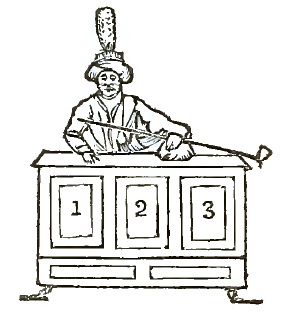
The Automaton Chess-Player was invented in 1769, by Baron Kempelen, a nobleman of Presburg in Hungary, who afterwards disposed of it, together with the secret of its operations, to its present possessor. Soon after its completion it was exhibited in Presburg, Paris, Vienna, and other continental cities. In 1783 and 1784, it was taken to London by Mr. Maelzel. Of late years it has visited the principal towns in the United States. Wherever seen, the most intense curiosity was excited by its appearance, and numerous have been the attempts, by men of all classes, to fathom the mystery of its evolutions. The cut above gives a tolerable representation of the figure as seen by the citizens of Richmond a few weeks ago. The right arm, however, should lie more at length upon the box, a chess-board should appear upon it, and the cushion should not be seen while the pipe is held. Some immaterial alterations have been made in the costume of the player since it came into the possession of Maelzel—the plume, for example, was not originally worn.
At the hour appointed for exhibition, a curtain is withdrawn, or folding doors are thrown open, and the machine rolled to within about twelve feet of the nearest of the spectators, between whom and it (the machine) a rope is stretched. A figure is seen habited as a Turk, and seated, with its legs crossed, at a large box apparently of maple wood, which serves it as a table. The exhibiter will, if requested, roll the machine to any portion of the room, suffer it to remain altogether on any designated spot, or even shift its location repeatedly during the progress of a game. The bottom of the box is elevated considerably above the floor by means of the castors or brazen rollers on which it moves, a clear view of the surface immediately beneath the Automaton being thus afforded to the spectators. The chair on which the figure sits is affixed permanently to the box. On the top of this latter is a chess-board, also permanently affixed. The right arm of the Chess-Player is extended at full length before him, at right angles with his body, and lying, in an apparently careless position, by the side of the board. The back of the hand is upwards. The board itself is eighteen inches square. The left arm of the figure is bent at the elbow, and in the left hand is a pipe. A green drapery conceals the back of the Turk, and falls partially over the front of both shoulders. To judge from the external appearance of the box, it is divided into five compartments—three cupboards of equal dimensions, and two drawers occupying that portion of the chest lying beneath the cupboards. The foregoing observations apply to the appearance of the Automaton upon its first introduction into the presence of the spectators.
Maelzel now informs the company that he will disclose to their view the mechanism of the machine. Taking from his pocket a bunch of keys he unlocks with one of them, door marked 1 in the cut above, and throws the cupboard fully open to the inspection of all present. Its whole interior is apparently filled with wheels, pinions, levers, and other machinery, crowded very closely together, so that the eye can penetrate but a little distance into the mass. Leaving this door open to its full extent, he goes now round to the back of the box, and raising the drapery of the figure, opens another door situated precisely in the rear of the one first opened. Holding a lighted candle at this door, and shifting the position of the whole machine repeatedly at the same time, a bright light is thrown entirely through the cupboard, which is now clearly seen to be full, completely full, of machinery. The spectators being satisfied of this fact, Maelzel closes the back door, locks it, takes the key from the lock, lets fall the drapery of the figure, and comes round to the front. The door marked 1, it will be remembered, is still open. The exhibiter now proceeds to open the drawer which lies beneath the cupboards at the bottom of the box—for although there are apparently two drawers, there is really only one—the two handles and two key holes being intended merely for ornament. Having opened this drawer to its full extent, a small cushion, and a set of chessmen, fixed in a frame work made to support them perpendicularly, are discovered. Leaving this drawer, as well as cupboard No. 1 open, Maelzel now unlocks door No. 2, and door No. 3, which are discovered to be folding doors, opening into one and the same compartment. To the right of this compartment, however, (that is to say the spectators' right) a small division, six inches wide, and filled with machinery, is partitioned off. The main compartment itself (in speaking of that portion of the box visible upon opening doors 2 and 3, we shall always call it the main compartment) is lined with dark cloth and contains no machinery whatever beyond two pieces of steel, quadrant-shaped, and situated one in each of the rear top corners of the compartment. A small protuberance about eight inches square, and also covered with dark cloth, lies on the floor of the compartment near the rear corner on the spectators' left hand. Leaving doors No. 2 and No. 3 open as well as the drawer, and door No. 1, the exhibiter now goes round to the back of the main compartment, and, unlocking another door there, displays clearly all the interior of the main compartment, by introducing a candle behind it and within it. The whole box being thus apparently disclosed to the scrutiny of the company, Maelzel, still leaving the doors and drawer open, rolls the Automaton entirely round, and exposes the back of the Turk by lifting up the drapery. A door about ten inches square is thrown open in the loins of the figure, and a smaller one also in the left thigh. The interior of the figure, as seen through these apertures, appears to be crowded with machinery. In general, every spectator is now thoroughly satisfied of having beheld and completely scrutinized, at one and the same time, every individual portion of the Automaton, and the idea of any person being concealed in the interior, during so complete an exhibition of that interior, if ever entertained, is immediately dismissed as preposterous in the extreme.
M. Maelzel, having rolled the machine back into its original position, now informs the company that the Automaton will play a game of chess with any one disposed to encounter him. This challenge being accepted, a small table is prepared for the antagonist, and placed close by the rope, but on the spectators' side of it, and so situated as not to prevent the company from obtaining a full view of the Automaton. From a drawer in this table is taken a set of chess-men, and Maelzel arranges them generally, but not always, with his own hands, on the chess board, which consists merely of the usual number of squares painted upon the table. The antagonist having taken his seat, the exhibiter approaches the drawer of the box, and takes therefrom the cushion, which, after removing the pipe from the hand of the Automaton, he places under its left arm as a support. Then taking also from the drawer the Automaton's set of chess-men, he arranges them upon the chess-board before the figure. He now proceeds to close the doors and to lock them—leaving the bunch of keys in door No. 1. He also closes the drawer, and, finally, winds up the machine, by applying a key to an aperture in the left end (the spectators' left) of the box. The game now commences—the Automaton taking the first move. The duration of the contest is usually limited to half an hour, but if it be not finished at the expiration of this period, and the antagonist still contend that he can beat the Automaton, M. Maelzel has seldom any objection to continue it. Not to weary the company, is the ostensible, and no doubt the real object of the limitation. It will of course be understood that when a move is made at his own table, by the antagonist, the corresponding move is made at the box of the Automaton, by Maelzel himself, who then acts as the representative of the antagonist. On the other hand, when the Turk moves, the corresponding move is made at the table of the antagonist, also by M. Maelzel, who then acts as the representative of the Automaton. In this manner it is necessary that the exhibitor should often pass from one table to the other. He also frequently goes in rear of the figure to remove the chessmen which it has taken, and which it deposits, when taken, on the box to the left (to its own left) of the board. When the Automaton hesitates in relation to its move, the exhibitor is occasionally seen to place himself very near its right side, and to lay his hand, now and then, in a careless manner, upon the box. He has also a peculiar shuffle with his feet, calculated to induce suspicion of collusion with the machine in minds which are more cunning than sagacious. These peculiarities are, no doubt, mere mannerisms of M. Maelzel, or, if he is aware of them at all, he puts them in practice with a view of exciting in the spectators a false idea of pure mechanism in the Automaton.
The Turk plays with his left hand. All the movements of the arm are at right angles. In this manner, the hand (which is gloved and bent in a natural way,) being brought directly above the piece to be moved, descends finally upon it, the fingers receiving it, in most cases, without difficulty. Occasionally, however, when the piece is not precisely in its proper situation, the Automaton fails in his attempt at seizing it. When this occurs, no second effort is made, but the arm continues its movement in the direction originally intended, precisely as if the piece were in the fingers. Having thus designated the spot whither the move should have been made, the arm returns to its cushion, and Maelzel performs the evolution which the Automaton pointed out. At every movement of the figure machinery is heard in motion. During the progress of the game, the figure now and then rolls its eyes, as if surveying the board, moves its head, and pronounces the word echec (check) when necessary.2 If a false move be made by his antagonist, he raps briskly on the box with the fingers of his right hand, shakes his head roughly, and replacing the piece falsely moved, in its former situation, assumes the next move himself. Upon beating the game, he waves his head with an air of triumph, looks round complacently upon the spectators, and drawing his left arm farther back than usual, suffers his fingers alone to rest upon the cushion. In general, the Turk is victorious—once or twice he has been beaten. The game being ended, Maelzel will again, if desired, exhibit the mechanism of the box, in the same manner as before. The machine is then rolled back, and a curtain hides it from the view of the company.
2 The making the Turk pronounce the word echec, is an improvement by M. Maelzel. When in possession of Baron Kempelen, the figure indicated a check by rapping on the box with his right hand.
There have been many attempts at solving the mystery of the Automaton. The most general opinion in relation to it, an opinion too not unfrequently adopted by men who should have known better, was, as we have before said, that no immediate human agency was employed—in other words, that the machine was purely a machine and nothing else. Many, however maintained that the exhibiter himself regulated the movements of the figure by mechanical means operating through the feet of the box. Others again, spoke confidently of a magnet. Of the first of these opinions we shall say nothing at present more than we have already said. In relation to the second it is only necessary to repeat what we have before stated, that the machine is rolled about on castors, and will, at the request of a spectator, be moved to and fro to any portion of the room, even during the progress of a game. The supposition of the magnet is also untenable—for if a magnet were the agent, any other magnet in the pocket of a spectator would disarrange the entire mechanism. The exhibiter, however, will suffer the most powerful loadstone to remain even upon the box during the whole of the exhibition.
The first attempt at a written explanation of the secret, at least the first attempt of which we ourselves have any knowledge, was made in a large pamphlet printed at Paris in 1785. The author's hypothesis amounted to this—that a dwarf actuated the machine. This dwarf he supposed to conceal himself during the opening of the box by thrusting his legs into two hollow cylinders, which were represented to be (but which are not) among the machinery in the cupboard No. 1, while his body was out of the box entirely, and covered by the drapery of the Turk. When the doors were shut, the dwarf was enabled to bring his body within the box—the noise produced by some portion of the machinery allowing him to do so unheard, and also to close the door by which he entered. The interior of the Automaton being then exhibited, and no person discovered, the spectators, says the author of this pamphlet, are satisfied that no one is within any portion of the machine. This whole hypothesis was too obviously absurd to require comment, or refutation, and accordingly we find that it attracted very little attention.
In 1789 a book was published at Dresden by M. I. F. Freyhere in which another endeavor was made to unravel the mystery. Mr. Freyhere's book was a pretty large one, and copiously illustrated by colored engravings. His supposition was that "a well-taught boy very thin and tall of his age (sufficiently so that he could be concealed in a drawer almost immediately under the chess-board") played the game of chess and effected all the evolutions of the Automaton. This idea, although even more silly than that of the Parisian author, met with a better reception, and was in some measure believed to be the true solution of the wonder, until the inventor put an end to the discussion by suffering a close examination of the top of the box.
These bizarre attempts at explanation were followed by others equally bizarre. Of late years however, an anonymous writer, by a course of reasoning exceedingly unphilosophical, has contrived to blunder upon a plausible solution—although we cannot consider it altogether the true one. His Essay was first published in a Baltimore weekly paper, was illustrated by cuts, and was entitled "An attempt to analyze the Automaton Chess-Player of M. Maelzel." This Essay we suppose to have been the original of the pamphlet to which Sir David Brewster alludes in his letters on Natural Magic, and which he has no hesitation in declaring a thorough and satisfactory explanation. The results of the analysis are undoubtedly, in the main, just; but we can only account for Brewster's pronouncing the Essay a thorough and satisfactory explanation, by supposing him to have bestowed upon it a very cursory and inattentive perusal. In the compendium of the Essay, made use of in the Letters on Natural Magic, it is quite impossible to arrive at any distinct conclusion in regard to the adequacy or inadequacy of the analysis, on account of the gross misarrangement and deficiency of the letters of reference employed. The same fault is to be found in the "Attempt &c." as we originally saw it. The solution consists in a series of minute explanations, (accompanied by wood-cuts, the whole occupying many pages) in which the object is to show the possibility of so shifting the partitions of the box, as to allow a human being, concealed in the interior, to move portions of his body from one part of the box to another, during the exhibition of the mechanism—thus eluding the scrutiny of the spectators. There can be no doubt, as we have before observed, and as we will presently endeavor to show, that the principle, or rather the result, of this solution is the true one. Some person is concealed in the box during the whole time of exhibiting the interior. We object, however, to the whole verbose description of the manner in which the partitions are shifted, to accommodate the movements of the person concealed. We object to it as a mere theory assumed in the first place, and to which circumstances are afterwards made to adapt themselves. It was not, and could not have been, arrived at by any inductive reasoning. In whatever way the shifting is managed, it is of course concealed at every step from observation. To show that certain movements might possibly be effected in a certain way, is very far from showing that they are actually so effected. There may be an infinity of other methods by which the same results may be obtained. The probability of the one assumed proving the correct one is then as unity to infinity. But, in reality, this particular point, the shifting of the partitions, is of no consequence whatever. It was altogether unnecessary to devote seven or eight pages for the purpose of proving what no one in his senses would deny—viz: that the wonderful mechanical genius of Baron Kempelen could invent the necessary means for shutting a door or slipping aside a pannel, with a human agent too at his service in actual contact with the pannel or the door, and the whole operations carried on, as the author of the Essay himself shows, and as we shall attempt to show more fully hereafter, entirely out of reach of the observation of the spectators.
In attempting ourselves an explanation of the Automaton, we will, in the first place, endeavor to show how its operations are effected, and afterwards describe, as briefly as possible, the nature of the observations from which we have deduced our result.
It will be necessary for a proper understanding of the subject, that we repeat here in a few words, the routine adopted by the exhibiter in disclosing the interior of the box—a routine from which he never deviates in any material particular. In the first place he opens the door No. 1. Leaving this open, he goes round to the rear of the box, and opens a door precisely at the back of door No. 1. To this back door he holds a lighted candle. He then closes the back door, locks it, and, coming round to the front, opens the drawer to its full extent. This done, he opens the doors No. 2 and No. 3, (the folding doors) and displays the interior of the main compartment. Leaving open the main compartment, the drawer, and the front door of cupboard No. 1, he now goes to the rear again, and throws open the back door of the main compartment. In shutting up the box no particular order is observed, except that the folding doors are always closed before the drawer.
Now, let us suppose that when the machine is first rolled into the presence of the spectators, a man is already within it. His body is situated behind the dense machinery in cupboard No. 1, (the rear portion of which machinery is so contrived as to slip en masse, from the main compartment to the cupboard No. 1, as occasion may require,) and his legs lie at full length in the main compartment. When Maelzel opens the door No. 1, the man within is not in any danger of discovery, for the keenest eye cannot penetrate more than about two inches into the darkness within. But the case is otherwise when the back door of the cupboard No. 1, is opened. A bright light then pervades the cupboard, and the body of the man would be discovered if it were there. But it is not. The putting the key in the lock of the back door was a signal on hearing which the person concealed brought his body forward to an angle as acute as possible—throwing it altogether, or nearly so, into the main compartment. This, however, is a painful position, and cannot be long maintained. Accordingly we find that Maelzel closes the back door. This being done, there is no reason why the body of the man may not resume its former situation—for the cupboard is again so dark as to defy scrutiny. The drawer is now opened, and the legs of the person within drop down behind it in the space it formerly occupied.3 There is, consequently, now no longer any part of the man in the main compartment—his body being behind the machinery in cupboard No. 1, and his legs in the space occupied by the drawer. The exhibiter, therefore, finds himself at liberty to display the main compartment. This he does—opening both its back and front doors—and no person is discovered. The spectators are now satisfied that the whole of the box is exposed to view—and exposed too, all portions of it at one and the same time. But of course this is not the case. They neither see the space behind the drawer, nor the interior of cupboard No. 1—the front door of which latter the exhibiter virtually shuts in shutting its back door. Maelzel, having now rolled the machine around, lifted up the drapery of the Turk, opened the doors in his back and thigh, and shown his trunk to be full of machinery, brings the whole back into its original position, and closes the doors. The man within is now at liberty to move about. He gets up into the body of the Turk just so high as to bring his eyes above the level of the chess-board. It is very probable that he seats himself upon the little square block or protuberance which is seen in a corner of the main compartment when the doors are open. In this position he sees the chess-board through the bosom of the Turk which is of gauze. Bringing his right arm across his breast he actuates the little machinery necessary to guide the left arm and the fingers of the figure. This machinery is situated just beneath the left shoulder of the Turk, and is consequently easily reached by the right hand of the man concealed, if we suppose his right arm brought across the breast. The motions of the head and eyes, and of the right arm of the figure, as well as the sound echec are produced by other mechanism in the interior, and actuated at will by the man within. The whole of this mechanism—that is to say all the mechanism essential to the machine—is most probably contained within the little cupboard (of about six inches in breadth) partitioned off at the right (the spectators' right) of the main compartment.