CONTENTS OF VOLUME II, NUMBER 3 (continued 5)
Reading edition
Generally, the true chronology of Rienzi's life is preserved. In regard to the story—or that chain of fictitious incident usually binding up together the constituent parts of a Romance—there is very little of it in the book. This follows necessarily from the character of the composition—which is essentially Epic rather than Dramatic. The author's apology seems to us therefore supererogative when he says that a work which takes for its subject the crimes and errors of a nation and which ventures to seek the actual and the real in the highest stage of action or passion can rarely adopt with advantage the melo-dramatic effects produced by a vulgar mystery. In his pictures of the Roman populace, and in those of the Roman nobles of the fourteenth century—pictures full at all times of an enthralling interest—Mr. B. professes to have followed literally the descriptions left to us.
Miss Mitford's Rienzi will of course be remembered in reading that of Bulwer. There is however but one point of coincidence—a love-intrigue between a relative of the hero and one of the party of the nobles. This, it will be recollected, forms the basis of the plot of Miss M. In the Rienzi of Bulwer, it is an Episode not affecting in any manner either the story itself, or the destinies of the Tribune.
It is by no means our intention to give an analysis of the volume before us. Every person who reads at all will read Rienzi, and indeed the book is already in the hands of many millions of people. Any thing, therefore, like our usual custom of a digest of the narrative would be superfluous. The principal characters who figure in the novel are Rienzi himself—his brother, whose slaughter by a noble at the commencement of the story, is the immediate cause of Rienzi's change of temper and consequent exaltation—Adrian di Castello, a young noble of the family of Colonna but attached to the cause of the people—Martino di Porto the chief of the house of the Orsini—Stephen Colonna, the chief of the house of the Colonna—Walter de Montreal, a gentleman of Provence, a knight of St. John, and one of the formidable freebooters who at the head of large "Companies" invaded states and pillaged towns at the period of Rienzi's Revolution—Pandulfo di Guido a student, whom, under the appellation of Pandolficcio di Guido, Gibbon styles "the most virtuous citizen of Rome"—Cecco del Vecchio a smith—Giles D'Albornoz of the royal race of Arragon—Petrarch the poet, and the friend of Rienzi—Angelo Villani—Irene, the sister of the Tribune and betrothed to Adrian di Castello—Nina, Rienzi's wife—and Adeline, the mistress of Walter de Montreal.
But as was said before, we should err radically if we regard Rienzi altogether in the light of Romance. Undoubtedly as such—as a fiction, and coming under the title of a novel, it is a glorious, a wonderful conception, and not the less wonderfully and gloriously carried out. What else could we say of a book over which the mind so delightedly lingers in perusal? In its delineations of passion and character—in the fine blending and contrasting of its incidents—in the rich and brilliant tints of its feudal paintings—in a pervading air of chivalry, and grace, and sentiment—in all that can throw a charm over the pages of Romance, the last novel of Bulwer is equal, if not superior, to any of his former productions. Still we should look at the work in a different point of view. It is History. We hesitate not to say that it is History in its truest—in its only true, proper, and philosophical garb. Sismondi's works—were not. There is no greater error than dignifying with the name of History a tissue of dates and details, though the dates be ordinarily correct, and the details indisputably true. Not even with the aid of acute comment will such a tissue satisfy our individual notions of History. To the effect let us look—to the impression rather than to the seal. And how very seldom is any definite impression left upon the mind of the historical reader! How few bear away—even from the pages of Gibbon—Rome and the Romans. Vastly different was the genius of Niebuhr—than whom no man possessed a more discriminative understanding of the uses and the purposes of the pen of the historiographer. But we digress. Bearing in mind that "to contemplate"—ιςορειν1—should and must be allowed a more noble and a more expansive acceptation than has been usually given it, we shall often discover in Fiction the essential spirit and vitality of Historic Truth—while Truth itself, in many a dull and lumbering Archive, shall be found guilty of all the inefficiency of Fiction.
1 History, from ιςορειν, to contemplate, seems, among the Greeks, to have embraced not only the knowledge of past events, but also Mythology, Esopian, and Milesian fables, Romance, Tragedy and Comedy. But our business is with things, not words.
Rienzi, then, is History. But there are other aspects in which it may be regarded with advantage. Let us survey it as a profound and lucid exposition of the morale of Government—of the Philosophies of Rule and Misrule—of the absolute incompatibility of Freedom and Ignorance—Tyranny in the few and Virtue in the many. Let us consider it as something akin to direct evidence that a people is not a mob, nor a mob a people, nor a mob's idol the idol of a people—that in a nation's self is the only security for a nation—and that it is absolutely necessary to model upon the character of the governed, the machinery, whether simple or complex, of the governmental legislation.
It is proper—we are persuaded—that Rienzi should be held up in these many different points of view, if we desire fully to appreciate its own merits and the talents of Mr. Bulwer. But regard it as we will, it is an extraordinary work—and one which leaves nothing farther to accomplish in its own particular region. It is vastly superior to the "Last Days of Pompeii"—more rich—more glowing, and more vigorous. With all and more than all the distinguishing merits of its noble predecessor, it has none of its chilliness—none of that platitude which (it would not be difficult to say why) is the inevitable result of every attempt at infusing warmth among the marble wildernesses, and vitality into the statue-like existences, of the too-distantly antique.
We will conclude our notice of Rienzi with an Extract. We choose it not with any view of commending it above others—for the book has many equally good and some better—but to give our readers—such of them as have not yet seen the novel, an opportunity of comparing the passage with some similar things in Boccaccio. We may as well say that in all which constitutes good writing the Englishman is infinitely the superior. What we select is Chapter V, of the sixth Book. Irene, the betrothed of the noble Roman Adrian di Castello, being in Florence during the time of the Great Plague, is sought by her lover at the peril of his life. Overpowered by a fever he meets with Irene—but his delirium prevents a recognition. She conveys him to one of the deserted mansions, and officiates as his nurse. Having thrown aside her mantle, under the impression that it retained the infection of the Pestilence, it is found and worn by another.
THE ERROR.
For three days, the three fatal days, did Adrian remain bereft of strength and sense. But he was not smitten by the scourge which his devoted and generous nurse had anticipated. It was a fierce and dangerous fever, brought on by the great fatigue, restlessness, and terrible agitation he had undergone.
No professional mediciner could be found to attend him but a good friar, better perhaps skilled in the healing art than many who claimed its monopoly, visited him daily. And in the long and frequent absences to which his other and numerous duties compelled the monk, there was one ever at hand to smooth the pillow, to wipe the brow, to listen to the moan, to watch the sleep. And even in that dismal office, when, in the frenzy of the sufferer, her name, coupled with terms of passionate endearment, broke from his lips, a thrill of strange pleasure crossed the heart of the betrothed, which she chid as if it were a crime. But even the most unearthly love is selfish in the rapture of being loved! Words cannot tell, heart cannot divine, the mingled emotions that broke over her when, in some of those incoherent ravings, she dimly understood that for her the city had been sought, the death dared, the danger incurred. And as then bending passionately to kiss that burning brow, her tears fell fast over the idol of her youth, the fountains from which they gushed were those, fathomless and countless, which a life could not weep away. Not an impulse of the human and the woman heart that was not stirred; the adoring gratitude, the meek wonder thus to be loved, while deeming it so simple a merit thus to love;—as if all sacrifice in her were a thing of course,—to her, a virtue nature could not paragon, worlds could not repay! And there he lay, the victim to his own fearless faith, helpless—dependent upon her—a thing between life and death, to thank, to serve—to be proud of, yet to protect—to compassionate, yet revere—the saver, to be saved! Never seemed one object to demand at once from a single heart so many and so profound emotions; the romantic enthusiasm of the girl!—the fond idolatry of the bride—the watchful providence of the mother over her child.
And strange to say, with all the excitement of that lonely watch, scarcely stirring from his side, taking food only that her strength might not fail her,—unable to close her eyes—though, from the same cause, she would fain have taken rest, when slumber fell upon her charge—with all such wear and tear of frame and heart, she seemed wonderfully supported. And the holy man marvelled, in each visit, to see the cheek of the nurse still fresh, and her eye still bright. In her own superstition she thought and felt that Heaven gifted her with a preternatural power to be true to so sacred a charge: and in this fancy she did not wholly err;—for Heaven did gift her with that diviner power, when it planted in so soft a heart the enduring might and energy of Affection! The friar had visited the sick man, late on the third night, and administered to him a strong sedative—"This night," said he to Irene, "will be the crisis—should he awaken, as I trust he may, with a returning consciousness, and a calm pulse, he will live—if not, young daughter, prepare for the worst. But should you note any turn in the disease, that may excite alarm, or require my attendance, this scroll will inform you where I am if God spare me still, at each hour of the night and morning."
The monk retired and Irene resumed her watch.
The sleep of Adrian was at first broken and interrupted—his features, his exclamations, his gestures, all evinced great agony whether mental or bodily—it seemed, as perhaps it was, a fierce and doubtful struggle between life and death for the conquest of the sleeper. Patient, silent, breathing but by long-drawn gasps, Irene sate at the bed-head. The lamp was removed to the further end of the chamber, and its ray, shaded by the draperies, did not suffice to give to her gaze more than the outline of the countenance she watched. In that awful suspense, all the thoughts that hitherto had stirred her mind lay hushed and mute. She was only sensible to that unutterable fear which few of us have been happy enough not to know. That crushing weight under which we can scarcely breathe or move, the avalanche over us, freezing and suspended, which we cannot escape from, with which, every moment, we may be buried and overwhelmed. The whole destiny of life was in the chances of that single night! It was just as Adrian at last seemed to glide into a deeper and serener slumber, that the bells of the death-cart broke with their boding knell the palpable silence of the streets. Now hushed, now revived, as the cart stopped for its gloomy passengers, and coming nearer and nearer after every pause. At length she heard the heavy wheels stop under the very casement, and a voice deep and muffled calling aloud "Bring out the dead!" She rose, and with a noiseless step, passed to secure the door, when the dull lamp gleamed upon the dark and shrouded forms of the Becchini.
"You have not marked the door, nor set out the body," said one gruffly, "but this is the third night! He is ready for us!"
"Hush, he sleeps—away, quick, it is not the Plague that seized him."
"Not the Plague," growled the Becchino in a disappointed tone, "I thought no other illness dared encroach upon the rights of the gavocciolo!"
"Go, here's money, leave us."
And the grisly carrier sullenly withdrew. The cart moved on, the bell renewed its summons, till slowly and faintly the dreadful larum died in the distance.
Shading the lamp with her hand, Irene stole to the bed-side, fearful that the sound and the intrusion had disturbed the slumberer. But his face was still locked, as in a vice, with that iron sleep. He stirred not—his breath scarcely passed his lips—she felt his pulse, as the wand lay on the coverlid—there was a slight heat—she was contented—removed the light, and, retiring to a corner of the room, placed the little cross suspended round her neck upon the table, and prayed—in her intense suffering—to Him who had known death, and who—Son of Heaven though he was, and Sovereign of the Seraphim—had also prayed, in his earthly travail, that the cup might pass away.
The morning broke, not, as in the north, slowly and through shadow, but with the sudden glory with which in those climates Day leaps upon earth—like a giant from his sleep. A sudden smile—a burnished glow—and night had vanished. Adrian still slept; not a muscle seemed to have stirred; the sleep was even heavier than before; the silence became a burthen upon the air. Now, in that exceeding torpor so like unto death, the solitary watcher became alarmed and terrified. Time passed—morning glided to noon—still not a sound nor motion. The sun was mid-way in heaven—the friar came not. And now again touching Adrian's pulse, she felt no flutter—she gazed on him, appalled and confounded; surely nought living could be so still and pale. "Was it indeed sleep, might it not be ——." She turned away, sick and frozen; her tongue clove to her lips. Why did the father tarry—she would go to him—she would learn the worst—she could forbear no longer. She glanced over the scroll the monk had left her: "From sunrise," it said, "I shall be at the Convent of the Dominicans. Death has stricken many of the brethren." The Convent was at some distance, but she knew the spot, and fear would wing her steps. She gave one wistful look at the sleeper, and rushed from the house. "I shall see thee again presently," she murmured. Alas! what hope can calculate beyond the moment. And who shall claim the tenure of "The Again!"
It was not many minutes after Irene had left the room, ere, with a long sigh, Adrian opened his eyes—an altered and another man; the fever was gone, the reviving pulse beat low indeed, but calm. His mind was once more master of his body, and, though weak and feeble, the danger was past, and life and intellect regained.
"I have slept long," he muttered—"and oh such dreams—and methought I saw Irene, but could not speak to her; and while I attempted to grasp her, her face changed, her form dilated, and I was in the clutch of the foul grave-digger. It is late—the sun is high—I must be up and stirring. Irene is in Lombardy. No, no; that was a lie, a wicked lie—she is at Florence—I must renew my search."
As this duty came to his remembrance, he rose from the bed—he was amazed at his own debility; at first he could not stand without support from the wall—by degrees, however, he so far regained the mastery of his limbs, as to walk, though with effort and pain. A ravening hunger preyed upon him; he found some scanty and light food in the chamber, which he devoured eagerly. And with scarce less eagerness laved his enfeebled form and haggard face with the water that stood at hand. He now felt refreshed and invigorated, and began to indue his garments, which he found thrown on a heap beside the bed. He gazed with surprise and a kind of self-compassion upon his emaciated hands and shrunken limbs, and began now to comprehend that he must have had some severe but unconscious illness. "Alone too," thought he, "no one near to tend me! Nature my only nurse! But alas! alas! how long a time may thus have been wasted, and my adored Irene——quick, quick, not a moment more will I lose."
He soon found himself in the open street; the air revived him; and that morning, the first known for weeks, had sprung up the blessed breeze. He wandered on very slowly and feebly till he came to a broad square, from which, in the vista, might be seen one of the principal gates of Florence, and the fig-trees and olive-groves beyond. It was then that a pilgrim of tall stature approached towards him as from the gate; his hood was thrown back, and gave to view a countenance of great but sad command; a face, in whose high features, massive brow, and proud, unshrinking gaze, shaded by an expression of melancholy more stern than soft, Nature seemed to have written majesty, and Fate disaster. As in that silent and dreary place, these two, the only tenants of the street, now encountered, Adrian stopped abruptly, and said in a startled and doubting voice: "Do I dream still, or do I behold Rienzi?"
The pilgrim paused also, as he heard the name, and gazing long on the attenuated features of the young lord, said: "I am he that was Rienzi! and you, pale shadow, is it in this grave of Italy that I meet with the gay and high Colonna? Alas, young friend," he added in a more relaxed and kindly voice, "hath the Plague not spared the flower of the Roman nobles? Come, I, the cruel and the harsh tribune, I will be thy nurse: he who might have been my brother, shall yet claim from me a brother's care."
With these words, he wound his arm tenderly round Adrian; and the young noble, touched by his compassion, and agitated by the surprize, leant upon Rienzi's breast in silence.
"Poor youth," resumed the Tribune, for so since rather fallen than deposed he may yet be called, "I ever loved the young; (my brother died young!) and you more than most. What fatality brought thee hither?"
"Irene!" replied Adrian falteringly.
"Is it so, really? Art thou a Colonna, and yet prize the fallen? The same duty has brought me also to the City of Death. From the farthest south—over the mountains of the robber—through the fastnesses of my foes—through towns in which the herald proclaimed in my ear the price of my head—I have passed hither, on foot and alone, safe under the wings of the Almighty One. Young man, thou shouldst have left this task to one who bears a wizard's life, and whom Heaven and Earth yet reserve for an appointed end!"
The Tribune said this in a deep and inward voice; and in his raised eye and solemn brow might be seen how much his reverses had deepened his fanaticism, and added even to the sanguineness of his hopes.
"But," asked Adrian, withdrawing gently from Rienzi's arm, "thou knowest, then, where Irene is to be found, let us go together. Lose not a moment in this talk—time is of inestimable value, and a moment in this city is often but the border to eternity."
"Right," said Rienzi, awakening to his object. "But fear not; I have dreamt that I shall save her, the gem and darling of my house. Fear not—I have no fear."
"Know you where to seek," said Adrian, impatiently; "the convent holds far other guests."
"Ha! so said my dream!"
"Talk not now of dreams," said the lover, "but if you have no other guide, let us part at once in quest of her; I will take yonder street, you take the opposite, and at sunset let us meet in the same spot."
"Rash man," said the Tribune, with great solemnity, "scoff not at the visions which Heaven makes a parable to its Chosen. Thou seekest counsel of thy human wisdom; I, less presumptuous, follow the hand of the mysterious Providence, moving even now before my gaze as a pillar of light, through the wilderness of dread. Ay, meet we here at sunset, and prove whose guide is the most unerring. If my dream tell me true, I shall see my sister living, ere the sun reach yonder hill, and by a church dedicated to St. Mark."
The grave earnestness with which Rienzi spoke, impressed Adrian with a hope his reason would not acknowledge. He saw him depart with that proud and stately step to which his sweeping garments gave a yet more imposing dignity, and then passed up the street to the right hand. He had not got half way when he felt himself pulled by the mantle. He turned and saw the shapeless mask of a Becchino.
"I feared you were sped, and that another had cheated me of my office," said the grave-digger, "seeing that you returned not to the old prince's palace. You don't know me from the rest of us, I see, but I am the one you told to seek——"
"Irene!"
"Yes, Irene di Gabrini, you promised ample reward."
"You shall have it."
"Follow me."
The Becchino strode on, and soon arrived at a mansion. He knocked twice at the porter's entrance; an old woman cautiously opened the door. "Fear not, good aunt," said the grave-digger, "this is the young lord I spoke to thee of. Thou sayest thou hadst two ladies in the palace, who alone survived of all the lodgers, and their names were Bianca di Medici, and—what was the other?"
"Irene di Gabrini, a Roman lady. But I told thee this was the fourth day they left the house, terrified by the deaths within it."
"Thou didst so—and was there any thing remarkable in the dress of the Signora di Gabrini?"
"Yes, I have told thee, a blue mantle, such as I have rarely seen, wrought with silver."
"Was the broidery that of stars, silver stars," exclaimed Adrian, "with a sun in the centre."
"It was!"
"Alas! alas! the arms of the Tribune's family! I remember how I praised the mantle the first day she wore it—the day on which we were betrothed!" And the lover at once conjectured the secret sentiment which had induced Irene to retain so carefully a robe so endeared by association.
"You know no more of your lodgers?"
"Nothing."
"And is this all you have learnt, knave?" cried Adrian.
"Patience. I must bring you from proof to proof, and link to link, in order to win my reward. Follow, Signor."
The Becchino then passing through the several lanes and streets, arrived at another house of less magnificent size and architecture. Again he tapped thrice at the parlor door, and this time came forth a man withered, old, and palsied, whom death seemed to disdain to strike.
"Signor Astuccio," said the Becchino, "pardon me; but I told thee I might trouble thee again. This is the gentleman who wants to know, what is often best unknown—but that's not my affair. Did a lady—young and beautiful—with dark hair, and of a slender form, enter this house, stricken with the first symptom of the plague, three days since?"
"Ay, thou knowest that well enough—and thou knowest still better—that she has departed these two days; it was quick work with her, quicker than with most!"
"Did she wear any thing remarkable?"
"Yes, troublesome man, a blue cloak with stars of silver."
"Couldst thou guess aught of her previous circumstances?"
"No, save that she raved much about the nunnery of Santa Maria dei Pazza, and bravos, and sacrilege."
"Are you satisfied, Signor?" asked the grave-digger, with an air of triumph, turning to Adrian. "But no, I will satisfy thee better, if thou hast courage. Wilt thou follow?"
"I comprehend thee; lead on. Courage! what is there on earth now to fear?"
Muttering to himself—"Ay, leave me alone. I have a head worth something; I ask no gentleman to go by my word; I will make his own eyes the judge of what my trouble is worth." The grave-digger now led the way through one of the gates a little out of the city. And here under a shed sat six of his ghastly and ill-omened brethren, with spades and pick-axes at their feet.
His guide now turned round to Adrian, whose face was set and resolute in despair.
"Fair Signor," said he, with some touch of lingering compassion, "wouldst thou really convince thine own eyes and heart; the sight may appal, the contagion may destroy thee,—if, indeed, as it seems to me, Death has not already written 'mine' upon thee."
"Raven of bode and woe," answered Adrian, "seest thou not that all I shrink from is thy voice and aspect? Show me her I seek, living or dead."
"I will show her to you, then," said the Becchino, sullenly, "such as two nights since she was committed to my charge. Line and lineament may already be swept away, for the Plague hath a rapid besom; but I have left that upon her by which you will know the Becchino is no liar. Bring hither the torches, comrades, and lift the door. Never stare; it's the gentleman's whim, and he'll pay it well."
Turning to the right, while Adrian mechanically followed his conductors,—a spectacle whose dire philosophy crushes as with a wheel all the pride of mortal man—the spectacle of that vault in which earth hides all that on earth flourished, rejoiced, exulted—awaited his eye!
The Becchino lifted a ponderous grate, lowered their torches (scarcely needed, for through the aperture rushed, with a hideous glare, the light of the burning sun,) and motioned to Adrian to advance. He stood upon the summit of the abyss and gazed below.
* * * * * * * * * *
It was a large, deep and circular space, like the bottom of an exhausted well. In niches cut into the walls of earth around, lay, duly confined, those who had been the earliest victims of the plague, when the Becchino's market was not yet glutted, and priest followed, and friend mourned, the dead. But on the floor below, there was the loathsome horror! Huddled and matted together,—some naked, some in shrouds already black and rotten,—lay the later guests, the unshriven and unblest! The torches, the sun, streamed broad and red over corruption in all its stages, from the pale blue tint and swollen shape, to the moistened undistinguishable mass, or the riddled bones, where yet clung, in strips and tatters, the black and mangled flesh. In many the face remained almost perfect, while the rest of the body was but bone; the long hair, the human face, surmounting the grisly skeleton. There, was the infant, still on the mother's breast; there, was the lover stretched across the dainty limbs of his adored! The rats (for they clustered in numbers to that feast,) disturbed, not scared, sate up from their horrid meal as the light glimmered over them, and thousands of them lay round, stark and dead, poisoned by that they fed on! There, too, the wild satire of the grave-diggers had cast, though stripped of their gold and jewels, the emblems that spoke of departed rank;—the broken wand of the Councillor; the General's baton; the Priestly Mitre! The foul and livid exhalations gathered like flesh itself, fungous and putrid, upon the walls, and the——
* * * * * * * * * *
But who shall detail the ineffable and unimaginable horrors that reigned over the Palace where the Great King received the prisoners whom the sword of the Pestilence had subdued.
But through all that crowded court—crowded with beauty and with birth, with the strength of the young and the honors of the old, and the valor of the brave, and the wisdom of the learned, and the wit of the scorner, and the piety of the faithful—one only figure attracted Adrian's eye. Apart from the rest, a late comer—the long locks streaming far and dark over arm and breast—lay a female, the face turned partially aside, the little seen not recognisable even by the mother of the dead,—but wrapped round in that fatal mantle, on which, though blackened and tarnished, was yet visible the starry heraldry assumed by those who claimed the name of the proud Tribune of Rome. Adrian saw no more—he fell back in the arms of the grave diggers: when he recovered, he was still without the gates of Florence—reclined upon a green mound—his guide stood beside him—holding his steed by the bridle as it grazed patiently on the neglected grass. The other brethren of the axe had resumed their seat under the shed.
"So you have revived; ah! I thought it was only the effluvia; few stand it as we do. And so, as your search is over, deeming you would not be quitting Florence if you have any sense left to you, I went for your good horse. I have fed him since your departure from the palace. Indeed I fancied he would be my perquisite, but there are plenty as good. Come, young Sir, mount. I feel a pity for you, I know not why, except that you are the only one I have met for weeks who seem to care for another more than for yourself. I hope you are satisfied now that I showed some brains, eh! in your service, and as I have kept my promise, you'll keep yours."
"Friend," said Adrian, "here is gold enough to make thee rich; here too is a jewel that merchants will tell thee princes might vie to purchase. Thou seemest honest, despite thy calling, or thou mightest have robbed and murdered me long since. Do me one favor more."
"By my poor mother's soul, yes."
"Take yon—yon clay from that fearful place. Inter it in some quiet and remote spot—apart—alone! You promise me—you swear it—it is well. And now help me on my horse."
"Farewell Italy, and if I die not with this stroke, may I die as befits at once honor and despair—with trumpet and banner round me—in a well-fought field against a worthy foe!—save a knightly death nothing is left to live for!"
Here, in many incidents of extraordinary force—in the call of the Becchini on the third night—in the most agonizing circumstance of Irene's abandonment of Adrian—in the bodily weakness and mental prostration of that young nobleman—in the desolation of the streets—in the meeting with Rienzi—in the colossal dignity of the words, "I am he that was Rienzi!"—in the affectionate attention of the fallen hero—and lastly, in the appalling horror of the vault and its details—may be seen and will be felt much, but not all, of the exceeding power of the "Last of the Tribunes."
ROGET'S PHYSIOLOGY.
Animal and Vegetable Physiology, considered with reference to Natural Theology. By Peter Mark Roget, M.D. Secretary to the Royal Society, &c. &c. 2 vols, large octavo. Philadelphia: Republished by Carey, Lea, and Blanchard.
As we have no doubt that the great majority of our readers are acquainted with the circumstances attending the publication of the Bridgewater Treatises, we shall content ourselves with a very brief statement of those circumstances, by way of introduction to some few observations respecting this, the fifth of the Series.
Francis Henry, Earl of Bridgewater, who died some time in the beginning of the year 1829, directed certain Trustees mentioned in his Will, to invest eight thousand pounds sterling in the public funds, which eight thousand pounds, with the interest accruing, was to be under the control of the President, for the time being, of the Royal Society of London. The money thus invested, was to be paid by the President to such person or persons as he, the President, should appoint to "write, print and publish, one thousand copies of a work, On the Power, Wisdom, and Goodness of God, as manifested in the Creation; illustrating such work by all reasonable arguments, as, for instance, the variety and formation of God's creatures, in the animal, vegetable, and mineral kingdoms; the effect of digestion, and thereby of conversion; the construction of the hand of man, and an infinite variety of other arguments; as also by discoveries ancient and modern, in arts, sciences, and the whole extent of literature." The profits of the works were to be paid to the authors.
Davies Gilbert, Esq. being President of the Royal Society, advised with the Archbishop of Canterbury, the Bishop of London, and "a nobleman immediately connected with the deceased," in regard to the best mode of carrying into effect the design of the testator. It was finally resolved to divide the eight thousand pounds among eight gentlemen, who were to compose eight Treatises as follows. Thomas Chalmers, D.D. Professor of Divinity in the University of Edinburgh, was to write on "The Power, Wisdom, and Goodness of God, as manifested in the Adaptation of External Nature to the Moral and Intellectual Constitution of Man,"—John Kidd, M.D. F. R. S. Regius Professor of Medicine in the University of Oxford, on "The Adaptation of External Nature to the Physical Condition of Man,"—William Whewell, M.A. F. R. S. Fellow of Trinity College, Cambridge, on "Astronomy and General Physics considered with reference to Natural Theology,"—Sir Charles Bell, K. G. H. F. R. S. L. and E. on "The Hand: its Mechanism and Vital Endowments as Evincing Design,"—Peter Mark Roget, M.D. Fellow of and Secretary to the Royal Society, on "Animal and Vegetable Physiology,"—William Buckland, D.D. F. R. S. Professor of Geology in the University of Oxford, on "Geology and Mineralogy,"—William Kirby, M.A. F. R. S., on "The History, Habits, and Instincts of Animals"—and William Prout, M.D. F. R. S., on "Chemistry, Meteorology, and the Function of Digestion, considered with Reference to Natural Theology."
However excellent and praiseworthy the intention of the Earl of Bridgewater, and however liberal the sum bequeathed, there can be little doubt that in the wording of his bequest, in the encumbering of the work so nobly proposed with a specification of the arguments to be employed in its execution, he has offered a very serious impediment to the fulfilment of the spirit of his design. It is perhaps, too, a matter of regret, that the introduction of the words "person or persons" in the paragraph touching the contemplated publication, should have left it optional with the President of the Royal Society to divide the eight thousand pounds among so many. We are sorry that the eight treatises were determined upon for several reasons. First, we do not believe any such arrangement to have been contemplated by the testator—his words "write, print, and publish one thousand copies of a work," &c., inducing the opinion that one single book or treatise was intended: and we the rather hold to this belief, as it might easily be proved (we will speak farther of this hereafter,) that the whole argument set forth in the words of the Testament, and indeed the whole arguments of the whole eight Treatises now published, might have been readily discussed in one connected work of no greater bulk than the Physiology whose title forms the heading of this article. In the second place—the bequest of the eight thousand pounds, which en masse, is magnificent, and which might thus have operated as a sufficient inducement for some one competent person to devote a sufficiency of time to the steady and gradual completion of a noble and extraordinary work—this bequest, we say, is somewhat of a common-place affair when we regard it in its subdivision. Thirdly, one thousand pounds is but little for the labor necessary in a work like any one of the Treatises, and we are mistaken if the "profits of the sales" meet in any degree either the merits or the expectations of the respective authors. If they do, however, it is a matter altogether foreign to and apart from the liberality of the testator—a liberality whose proper development should have been scrupulously borne in view by the Trustee. Fourthly—the result of the combination of a number of intellects is seldom in any case—never in a case like the present—equal to the sum of the results of the same intellects laboring individually—the difference, generally, being in precise ratio with the number of the intellects engaged. It follows that each writer of a Bridgewater Treatise has been employed at a disadvantage. Lastly—an accurate examination of the nature and argument of each Treatise as allotted, will convince one a priori that the whole must, in any attempt at a full discussion, unavoidably run one into the other—this indeed in so very great a degree that each Treatise respectively would embody a vast quantity of matter, (handled in a style necessarily similar) to be found in each and all of the remaining seven Treatises. Here again is not only labor wasted by the writers—but, by the readers of the works, much time and trouble unprofitably thrown away. We say that this might have been proved a priori by an inspection of the arguments of the Treatises. It has been fully proved, a posteriori, by the fact: and this fact will go far in establishing what we asserted in our first reason for disapproving of the subdivision—to wit: that the whole argument of the whole eight Treatises might have been readily discussed in one connected work of no greater bulk than the Physiology now before us.
We cannot bring ourselves to think Dr. Roget's book the best of the Bridgewater series, although we have heard it so called. Indeed in the very singular and too partial arrangement of the subjects, it would have been really a matter for wonder if Dr. Whewell had not written the best, and Sir Charles Bell the worst of the Treatises. The talents of Dr. Roget, however, are a sufficient guarantee that he has furnished no ordinary work. We are grieved to learn from the Preface that his progress has been greatly impeded by "long protracted anxieties and afflictions, and by the almost overwhelming pressure of domestic calamity."
The chief difficulty of the Physiologist in handling a subject of so vast and almost interminable extent as the science to which his labors have been devoted—a science comprehending all the animal and vegetable beings in existence—has evidently been the difficulty of selection from an exuberance of materials. He has excluded from the Treatise—(it was necessary to exclude a great deal)—"all those particulars of the natural history both of animals and plants, and all description of those structures, of which the relation to final causes cannot be distinctly traced." In a word, he has admitted such facts alone as afford palpable evidence of Almighty design. He has also abstained from entering into historical accounts of the progress of discovery—the present state of Physiological science being his only aim. The work is illustrated by nearly 500 wood cuts by Mr. Byfield, and references in the Index to passages in the volumes where terms of mere technical science have been explained. Appended are also a catalogue of the engravings, and a tabular view of the classification of animals adopted by Cuvier in his "Regne Animal" with examples included. This Table is reprinted from that in the author's "Introductory Lecture on Human and Comparative Physiology," published in 1826. Such alterations, however, have been introduced as were requisite to make the Table correspond with Cuvier's second edition.
CAREY'S AUTOBIOGRAPHY.
We have been delighted with the perusal of this book, and consider it one of the most instructive as well as one of the most amusing of autobiographies. The ruling feature of the work is candor—a candor of the rarest and noblest description. The author has not scrupled, or even hesitated, in a single instance to declare, without prevarication, the truth and the whole truth, however little redounding to his own credit. Nor in the details so frankly laid before the eye of the public, are the many—very many other excellent qualities less manifest, which have exalted the autobiographer to so enviable a station in the opinions of his fellow-citizens. In the whole private and public course of Mr. Mathew Carey, from that chivalrous Essay against Duelling, of which he has rendered so amusing an account in the commencement of his "Life," to the more important yet equally Quixottic publication of the Olive Branch, the strictest scrutiny can detect nothing derogatory to the character of "the noblest work of God, an honest man." His energy, his high-mindedness, and his indomitable perseverance, will force themselves upon the most casual observer. It is not surprising that, with qualifications so well adapted for success in life, Mr. C. should have been enabled finally to set at defiance the innumerable obstacles which obstructed his path. Indeed, although few men have labored under greater incidental disadvantages, very few have been better prepared to overcome them by both moral and physical constitution.
There is much in these Memoirs of Mr. Carey, which will bring to the mind of the reader Benjamin Franklin, his shrewdness, his difficulties, and his indefatigability. It is therefore almost unnecessary to add, that apart from its other merits, the Autobiography now before us has all the value so unequivocally due to good example. Its perusal cannot well fail of having a salutary effect upon those who struggle with adversity—of imparting a salutary strength to all who grow feeble under the pressure of the innumerable harassing cares which encumber and weigh so ponderously upon the "man of the world." It may, indeed, if rightly considered, have a still more beneficial influence. It may incite to good deeds. It may induce a love of our fellow-men, in many bosoms hitherto self-hardened against the urgent demands of philanthropy. What so likely to bring about a kindly spirit in any human heart as the contemplation of a kindly spirit in others?
It is perhaps already known to many that Mr. Carey was born in Dublin in 1760. His hatred of oppression, which broke out, as early as his seventeenth year, in the "Essay against Duelling," to which we have already alluded, and which, in 1779, rendered him obnoxious to the British Government, and forced him into a temporary exile, at length, in 1784, made it necessary for him to abandon his country altogether, and seek an asylum in America. He arrived in Philadelphia, greatly embarrassed in his pecuniary circumstances; and an incident by means of which he obtained relief, has proved of so deep interest to ourselves, that we cannot but think it may prove equally so to our readers. We copy the following from page 10 of the Autobiography.
Behold me now landed in Philadelphia, with about a dozen guineas in my pocket, without relation, or friend, and even without an acquaintance, except my compagnons de voyage, of whom very few were eligible associates.
While I was contemplating a removal into the country, where I could have boarded at about a dollar or a dollar and a quarter a week, intending to wait the arrival of my funds, a most extraordinary and unlooked-for circumstance occurred, which changed my purpose, gave a new direction to my views, and, in some degree, colored the course of my future life. It reflects great credit on the Marquess de La Fayette, who was then at Mount Vernon, to take leave of Gen. Washington. A young gentleman of the name of Wallace, a fellow passenger of mine, had brought letters of recommendation to the General; and having gone to his seat to deliver them, fell into the Marquess's company, and in the course of conversation, the affairs of Ireland came on the tapis. The Marquess, who had, in the Philadelphia papers, seen an account of my adventures with the Parliament, and the persecution I had undergone, inquired of Wallace, what had become of the poor persecuted Dublin printer? He replied, "he came passenger with me, and is now in Philadelphia," stating the boarding house where I had pitched my tent. On the arrival of the Marquess in this city, he sent me a billet, requesting to see me at his lodgings, whither I went. He received me with great kindness; condoled with me on the persecution I had undergone; inquired into my prospects;—and having told him that I proposed, on receipt of my funds, to set up a newspaper, he approved the idea, and promised to recommend me to his friends, Robert Morris, Thomas Fitzsimons, &c. &c. After half an hour's conversation, we parted. Next morning, while I was at breakfast, a letter from him was handed me, which, to my very great surprise, contained four one hundred dollar notes of the Bank of North America. This was the more extraordinary and liberal, as not a word had passed between us on the subject of giving or receiving, borrowing or lending money. And a remarkable feature in the affair was, that the letter did not contain a word of reference to the enclosure.
In the course of the day I went to his lodgings, and found that he had, an hour or two previously, departed for Princeton, where Congress then sat, having been in some measure driven from Philadelphia, by a mutiny among the soldiers, who were clamorous for their pay, and had kept them in a state of siege for three hours in the State House. I wrote to him to New York, whither, I understood, he had gone from Princeton, expressive of my gratitude in the strongest terms, and received a very kind and friendly answer.
I cannot pass over this noble trait in the character of the illustrious Marquess, without urging it strongly on the overgrown wealthy of our country, as an example worthy of imitation. Here was a foreign nobleman, who had devoted years of the prime of his life, and greatly impaired his fortune, in the service of a country, separated by thousands of miles distance from his native land. After these mighty sacrifices, he meets, by an extraordinary accident, with a poor persecuted young man, destitute of friends and protectors—his heart expands towards him—he freely gives him means of making a living without the most remote expectation of return, or of ever again seeing the object of his bounty. He withdraws from the city to avoid the expression of the gratitude of the beneficiary. I have more than once assumed, and I now repeat, that I doubt whether in the whole life of this (I had almost said) unparalleled man, there is to be found any thing, which, all the circumstances of the case considered, more highly elevates his character.1
1 It is due to myself to state, that though this was in every sense of the word a gift, I regarded it as a loan, payable to the Marquess's countrymen, according to the exalted sentiment of Dr. Franklin, who, when he presented a bill for ten pounds to the Rev. Mr. Nixon, an Irish Clergyman, (who was in distress in Paris, and wanted to migrate to America,) told him to pay the sum to any Americans whom he might find in distress, and thus "let good offices go round." I fully paid the debt to Frenchmen in distress—consigned one or two hogsheads of tobacco to the Marquess, (I believe it was two, but am uncertain,) and, moreover, when in 1824, he reached this country, with shattered fortunes, sent him to New York, a check for the full sum of four hundred dollars, which he retained till he reached Philadelphia, and was very reluctant to use, and finally consented only at my earnest instance.
The annexed little anecdote, which Mr. Carey justly considers an instance of the truest pathos, we must be pardoned for inserting as an appropriate pendant to the above.
To an importunate mendicant, whom I had sometimes relieved, I said one day, on giving him a trifle—"Do not let me see you again for a long time." He conformed to the direction, and refrained from applying for about seven months. At length he ventured to bring and hand me a billet, of which I annex a copy verbatim et literatim.
"Sir—You desired me, last time you relieved me, not to call for a long time. It was a few days after Easter. To a wretch in distress 'it is a very long time.'
Yours gratefully,
Nov. 14.
R. W."
At page 21, is an account of a publication, some of whose predictions were certainly imbued with a rare spirit of prophecy.
In October 1786, I commenced, in partnership with T. Siddons, Charles Cist, C. Talbot, W. Spotswood, and J. Trenchard, the Columbian Magazine. In the first number, I wrote four pieces, "The Life of General Greene," "The Shipwreck, a Lamentable Story, Founded on Fact," "A Philosophical Dream," and "Hard Times, a Fragment."
The Philosophical Dream was an anticipation of the state of the country in the year 1850, on the plan of Mercier's celebrated work, "The Year 2500." Some of the predictions, which at that period must have been regarded as farcical, have been wonderfully fulfilled, and others are likely to be realized previous to the arrival of the year 1850. I annex a few of them, which may serve to amuse the reader.
"Pittsburg, Jan. 15, 1850. The canal which is making from the river Ohio, to the Susquehanna, and thence to the Delaware, will be of immense advantage to the United States. If the same progress continues to be made hereafter as has been for some time past, it will be completed in less than two years."
This was probably the first suggestion of the grand project of uniting the waters of the Delaware with those of the Ohio. It preceded by four years the project of the financier, Robert Morris, and his friends, to unite the Delaware with the Schuylkill and the Susquehanna, which was broached in 1790.
"Pittsburg, Jan. 15. Delegates from the thirtieth new state, laid off a few months since by order of Congress, lately arrived at Columbia; and on producing their credentials, were received into the Federal Council.
"Charleston, April 15. No less than 10,000 blacks have been transported from this state and Virginia, during the last two years, to Africa, where they have formed a settlement near the mouth of the river Goree. Very few blacks remain in this country now: and we sincerely hope that in a few years every vestige of the infamous traffic carried on by our ancestors in the human species, will be done away.
"Richmond, April 30. By authentic advices from Kentucky, we are informed,—that 'no less than 150 vessels have been built on the river Ohio, during the last year, and sent down that river and the Mississippi, laden with valuable produce, which has been carried to the West Indies, where the vessels and their cargoes have been disposed of to great advantage.'
"Boston, April 30. At length the canal across the Isthmus of Darien is completed. It is about sixty miles long. First-rate vessels of war can with ease sail through. Two vessels belonging to this port, two to Philadelphia, and one to New York, sailed through on the 20th of January last, bound for Canton, in China.
"Columbia, May 1. Extract from the Journals of Congress.—'Ordered that there be twenty professors in the University of Columbia, in this city; viz. of Divinity, of Church History, of Hebrew, of Greek, of Humanity, of Logic, of Moral Philosophy, of Natural Philosophy, of Mathematics, of Civil History, of Natural History, of Common and Civil Law, of the Law of Nature and Nations, of Rhetoric and Belles Lettres, of Botany, of Materia Medica, of Physic, of Chemistry, of Anatomy, and of Midwifery.'"
Philadelphia, Oct. 1, 1786.
There is much characteristic simplicity in Mr. Carey's manner of telling the anecdote annexed.
In travelling from New York to Philadelphia, some years since, the slenderness of my knowledge of the French led me into a most egregious error, and excited the displeasure of a splendid French lady who was in the stage. She had lived a long time in New York, and yet spoke the English language very imperfectly. I told her she ought to speak English constantly, when she was in company with English or Americans: that this was the only way in which she could acquire it. "Monsieur," says she, "j'ai honte," I am ashamed; literally, "I have shame." Reiterating her own word, I replied, "Madame, je croyais que les dames Françoises n' avaient pas de honte"—whereas I ought to have said, as I really meant, "mauvaise honte." She was exasperated, and told me indignantly that the French ladies had as much "shame" (meaning modesty) as the Americans; and that there was more immorality practised in New York than in Marseilles, of which she was a native, or in Martinique, where she had long resided. It was in vain that I repeatedly pledged my honor that I had not meant to affront her; that I was led into error solely by repeating her own word. It was equally in vain that I appealed to some of the passengers who understood French, who testified that the mistake was perfectly natural, and was justified by the imperfection of my knowledge of her language. Nothing could pacify her, and after several vain attempts, I relinquished the hope of soothing her feelings, and she scarcely spoke another word during the rest of the journey.
AUTOGRAPHY.
Our friend and particular acquaintance, Joseph Miller, Esq. (who, by the way, signs his name, we think, Joseph A. Miller, or Joseph B. Miller, or at least Joseph C. Miller) paid us a visit a few days ago. His behavior was excessively odd. Walking into our sanctum without saying a word, he seated himself with a dogged air in our own exclusive arm-chair, and surveyed us, for some minutes, in silence, and in a very suspicious manner, over the rim of his spectacles. There was evidently something in the wind. "What can the man want?" thought we, without saying so.
"I will tell you," said Joseph Miller, Esq.—that is to say, Joseph D. Miller, Joseph E. Miller, or possibly Joseph F. Miller, Esq. "I will tell you," said he. Now, it is a positive fact that we had not so much as attempted to open any of our mouths.
"I will tell you," said he, reading our thoughts.
"Ah, thank you!" we replied, slightly smiling, and feeling excessively uncomfortable—"thank you!—we should like to know."
"I believe," resumed he—resumed Joseph G. Miller—"I believe you are not altogether unacquainted with our family."
"Why, not altogether, certainly—pray, sir, proceed."
"It is one of the oldest families in —— in ——"
"In Great Britain," we interposed, seeing him at a loss.
"In the United States," said Mr. Miller—that is, Joseph H. Miller, Esq.
"In the United States!—why, sir, you are joking surely: we thought the Miller family were particularly British—The Jest-Book you know ——"
"You are in error," interrupted he—interrupted Joseph I. Miller—"we are British, but not particularly British. You should know that the Miller family are indigenous every where, and have little connection with either time or place. This is a riddle which you may be able to read hereafter. At present let it pass, and listen to me. You know I have many peculiar notions and opinions—many particularly bright fancies which, by the way, the rabble have thought proper to call whims, oddities, and eccentricities. But, sir, they are not. You have heard of my passion for autographs?"
"We have."
"Well, sir, to be brief. Have you, or have you not, seen a certain rascally piece of business in the London Athenæum?"
"Very possible," we replied.
"And, pray sir, what do you think of it?"
"Think of what?"
"No, sir, not of what," said he—said Joseph K. Miller, Esq. getting very angry, "not of what at all; but of that absurd, nefarious, and superfluous piece of autographical rascality therein—that is to say in the London Athenæum—deliberately, falsely, and maliciously fathered upon me, and laid to my charge—to the charge of me, I say, Joseph L. Miller." Here, Mr. M. arose, and, unbuttoning his coat in a great rage, took from his breast pocket a bundle of MSS. and laid them emphatically upon the table.
"Ah ha!" said we, getting particularly nervous, "we begin to understand you. We comprehend. Sit down! You, Joseph M.—that is to say, Joseph N. Miller—have had—that is to say, ought to have had, eh?—and the London Athenæum is—that is to say, it is not, &c.—and—and—and—oh, precisely!"
"My dear sir," said Mr. Miller, affectionately, "you are a fool—a confounded fool. Hold your tongue! This is the state of the case. I, Joseph O. Miller, being smitten, as all the world knows, with a passion for autographs, am supposed, in that detestable article to which I am alluding, and which appeared some time ago in the London Athenæum,—am supposed, I say, to have indited sundry epistles, to several and sundry characters of literary notoriety about London, with the sinister design, hope, and intention, of thereby eliciting autograph replies—the said epistles, presumed to be indited by me, each and individually being neither more nor less than one and the same thing, and consisting——"
"Yes sir," said we, "and consisting——"
"And consisting," resumed Mr. Joseph P. Miller, "of certain silly inquiries respecting the character of certain ——"
"Of certain cooks, scullions, and chambermaids," said we, having now some faint recollection of the article alluded to.
"Precisely," said our visiter—"of certain cooks, scullions, chambermaids, and boot-blacks."
"And concerning whose character you are supposed to be excessively anxious."
"Yes, sir—I—excessively anxious!—only think of that!—I, Joseph Q. Miller, excessively anxious!"
"Horrible!" we ejaculated.
"Damnable!" said Mr. M.
"But what papers are these?" demanded we, taking courage, and eyeing the bundle of MSS. which our friend had thrown upon the table.
"Those papers," said Mr. Miller, after a pause, and with considerable dignity of manner, "those papers are, to tell you the truth, the result of some—of some ingenuity on the part of your humble servant. They are autographs—but they are American autographs, and as such may be of some little value in your eyes. Pray accept them—they are entirely at your service. I beg leave, however, to assure you that I have resorted to no petty arts for the consummation of a glorious purpose. No man can accuse me, sir, me, Joseph R. Miller, of meanness or of superficiality. My letters have invariably been—have been—that is to say, have been every thing they should be. Moreover, they have not been what they should not be. I have propounded no inquiries about scullions. I wrote not to the sublimated Mr. ——, [here we do not feel justified in indicating more fully the name mentioned by Mr. M.] touching a chambermaid, nor to Mr. ——, in relation to a character. On the contrary, I have adapted my means to my ends. I have—I have—in short, sir, I have accomplished many great and glorious things, all of which you shall behold in the sequel." We bowed, and our visiter continued.
"The autographs here included are, you will perceive, the autographs of our principal literati. They will prove interesting to the public. It would be as well to insert the letters in your Messenger, with facsimiles of the signatures. Of my own letters eliciting these replies I have unfortunately preserved no copies." Here Mr. M. handed us the MSS.
"Mr. Joseph S. Miller"—we began, deeply penetrated by his kindness.
"Joseph T. Miller, if you please," interrupted he, with an emphasis on the T.
"Well, sir," said we—"so be it; Mr. Joseph V. Miller, then, since you will have it so, we are highly sensible of your noble, of your disinterested generosity. We are ——"
"Say no more," interrupted our friend, with a sigh—"say no more, I beseech you. The MSS. are entirely at your service. You have been very kind to me, and when I forget a kindness my name is no longer Joseph W. Miller."
"Then your name is—is positively Joseph W. Miller?"—we inquired with some hesitation.
"It is"—he replied, with a toss of the head, which we thought slightly supercilious—"It is—Joseph X. Miller. But why do you ask? Good day! In a style epistolary and non-epistolary I must bid you adieu—that is to say I must depart (and not remain) your obedient servant, Joseph Y. Miller."
"Extremely ambiguous!" we thought, as he whipped out of the room—"Mr. Miller! Mr. Miller!"—and we hallooed after him at the top of our voice. Mr. Miller returned at the call, but most unfortunately we had forgotten what we had been so anxious to say.
"Mr. Miller," said we, at length, "shall we not send you a number of the Magazine containing your correspondence?"
"Certainly!"—he replied—"drop it in the Post Office."
"But, sir," said we, highly embarrassed,—"to what—to what address shall we direct it?"
"Address!" ejaculated he—"you astonish me! Address me, sir, if you please—Joseph Z. Miller."
The package handed us by Mr. M. we inspected with a great deal of pleasure. The letters were neatly arranged and endorsed, and numbered from one to twenty-four. We print them verbatim, and with facsimiles of the signatures, in compliance with our friend's suggestion. The dates, throughout, were overscored, and we have been forced, accordingly, to leave them blank. The remarks appended to each letter are our own.
LETTER I.
Philadelphia, ——.
Dear Sir,—I regret that you had the trouble of addressing me twice respecting the Review of your publication. The truth is it was only yesterday I enjoyed the opportunity of reading it, and bearing public testimony to its merits. I think the work might have a wider circulation if, in the next edition, it were printed without the preface. Of your talents and other merits I have long entertained a high opinion.
Respectfully, your faithful servant,
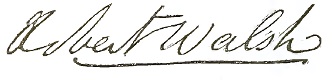
JOSEPH A. MILLER, ESQ.
There is nothing very peculiar in the physique of this letter. The hand-writing is bold, large, sprawling, and irregular. It is rather rotund than angular, and is by no means illegible. One would suppose it written in a violent hurry. The t's are crossed with a sweeping scratch of the pen, giving the whole letter an odd appearance if held upside-down, or in any position other than the proper one. The whole air of the letter is dictatorial. The paper is of good but not superior quality. The seal is of brown wax mingled with gold, and bears a Latin motto, of which only the words trans and mortuus are legible.
LETTER II.
Hartford, ——.
My Dear Sir,—Your letter of the — ult. with the accompanying parcel, reached me in safety, and I thank you for that polite attention, which is the more gratifying, as I have hitherto not had the pleasure of your acquaintance. The perusal of the pamphlet afforded me great delight, and I think it displays so much good sense, mingled with so much fine taste, as would render it an acceptable present to readers even more fastidious than myself. The purely Christian opinions with which the work abounds, will not fail of recommending it to all lovers of virtue, and of the truth.
I remain yours, with respect and esteem,
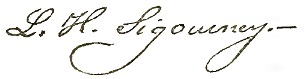
JOSEPH B. MILLER, ESQ.
Much pains seem to have been taken in the MS. of this epistle. Black lines have been used, apparently. Every t is crossed and every i dotted with precision. The punctuation is faultless. Yet the tout-ensemble of the letter has nothing of formality or undue effeminacy. The characters are free, well-sized, and handsomely formed, preserving throughout a perfectly uniform and beautiful appearance, although generally unconnected with each other. Were one to form an estimate of the character of Mrs. Sigourney's compositions from the character of her hand writing, the estimate would not be very far from the truth. Freedom, dignity, precision, and grace of thought, without abrupt or startling transitions, might be attributed to her with propriety. The paper is good, the seal small—of green and gold wax—and without impression.
LETTER III.
New York, ——.
Dear Sir,—I have delayed replying to your letter of the — ult. until I could find time to make the necessary inquiries about the circumstances to which you allude. I am sorry to inform you that these inquiries have been altogether fruitless, and that I am consequently unable, at present, to give you the desired information. If, hereafter, any thing shall come to light which may aid you in your researches, it will give me great pleasure to communicate with you upon the subject.
I am, Dear Sir, your friend and servant,
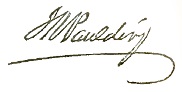
JOSEPH C. MILLER, ESQ.
There is much in the hand-writing here like that of Mrs. Sigourney, and yet, as a whole, it is very different. In both MSS. perfect uniformity and regularity exist, and in both, the character of the writing is formed—that is to say, decided. Both are beautiful, and, at a casual glance, both have a somewhat similar effect. But Mrs. Sigourney's MS. is one of the most legible, and Mr. Paulding's one of the most illegible in the world. His small a's, t's and c's are all alike, and the style of the characters generally is French. No correct notion of Mr. Paulding's literary peculiarities could be obtained from an inspection of his MS. It has probably been modified by strong adventitious circumstances. The paper is of a very fine glossy texture, and of a blue tint, with gilt edges.
LETTER IV.
Boston, ——.
It is due from me to advise you that the communication of the — ult. addressed by you to myself involves some error. It is evident that you have mistaken me for some other person of the same surname, as I am altogether ignorant of the circumstances to which you refer.
I am, sir, very respectfully, your obedient servant,
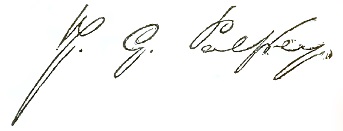
JOSEPH D. MILLER, ESQ.
The hand writing here is of an odd appearance. The capitals and long letters extend far above or below the line, and the rest have a running and diminutive formation, rendering it difficult to distinguish one from another. The words are unusually far apart, and but little matter is contained in much space. At first sight the MS. appears to be hurried—but a few moments' examination will prove that this is not the case. The capital I's might be mistaken for T's. The whole has a clean and uniform appearance. The paper is common, and the seal (of red wax) is oval in shape—probably a shield—the device illegible.
LETTER V.
St. Mark's Place, New York, ——.
Dear Sir,—Your obliging letter of the —— was received in due course of mail, and I am gratified by your good opinion. At the same time my numerous engagements will render it out of my power to send you any communication for your valuable Magazine, 'The Humdrum,' for some months to come at least. Wishing you all success, and with many thanks for your attention.
I remain, sir, your humble servant,
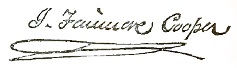
JOSEPH E. MILLER, ESQ.
Mr. Cooper's MS. is bad—very bad. There is no distinctive character about it, and it appears to be unformed. The writing will probably be different in other letters. Upon reference we find this to be the fact. In the letter to Mr. Miller, the MS. is of a petite and finicky appearance, and looks as if scratched with a steel pen—the lines are crooked. The paper is fine, and of a bluish tint. A wafer is used.
LETTER VI.
New York, ——.
My Dear Sir,—I owe you a very humble apology for not answering sooner your flattering epistle of the — ult. The truth is, being from home when your letter reached my residence, my reply fell into the ever open grave of deferred duties.
As regards the information you desire I regret that it is out of my power to aid you. My studies and pursuits have been directed, of late years, in so very different a channel, that I am by no means au fait on the particular subject you mention. Believe me, with earnest wishes for your success,
Very respectfully yours,
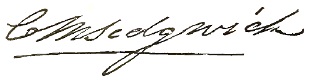
JOSEPH F. MILLER, ESQ.
The penmanship of Miss Sedgwick is excellent. The characters are well-sized, distinct, elegantly, but not ostentatiously formed; and, with perfect freedom of manner, are still sufficiently feminine. The hair strokes of the pen differ little in thickness from the other parts of the MS.—which has thus a uniform appearance it might not otherwise have. Strong common sense, and a scorn of superfluous ornament, one might suppose, from Miss Sedgwick's hand writing, to be the characteristics of her literary style. The paper is very good, blue in tint, and ruled by machine. The seal of red wax, plain.
LETTER VII.
New York, ——.
Dear Sir,—I have received your favor of the ——. The report to which it alludes was entirely without foundation. I have never had, and have not now, any intention of editing a Magazine. The Bookseller's statement on this subject originated in a misunderstanding.
Your Poem on "Things in General," I have not had the pleasure of seeing. I have not, however, the least doubt of its—of its—that is to say, of its extreme delicacy of sentiment, and highly original style of thinking—to say nothing at present of that—of that extraordinary and felicitous manner of expression which so particularly characterizes all that—that I have seen of your writings. I shall endeavor, sir, to procure your Poem, and anticipate much pleasure in its perusal.
Very respectfully, your obedient servant,
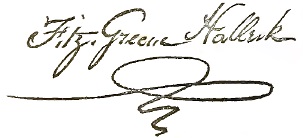
JOSEPH G. MILLER, ESQ.
Mr. Halleck's is a free, mercantile hand, and evinces a love for the graceful rather than for the picturesque. There is some force, too, in its expression. The tout ensemble is pleasing. Mr. H.'s letter is probably written currente calamo—but without hurry. The paper is very good, and bluish—the seal of red wax.
LETTER VIII.
Alexandria, Red River, ——, Louisiana.
Dear Sir,—Your polite letter of the — is before me, and the view which you present of the estimation in which you hold my poor labors is every way gratifying. It would afford me great pleasure to send you a few trifles for the Hum-drum, which I have no doubt will prove a very useful periodical if its design is well carried out—but the truth is my time is entirely occupied.
Yours,
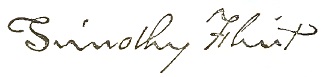
JOSEPH H. MILLER, ESQ.
The writing in this letter has a fidgetty appearance, and would seem to indicate a mind without settled aims—restless and full of activity. Few of the characters are written twice in the same manner, and their direction varies continually. Sometimes the words lie perpendicularly on the page—then slope to the right—then, with a jerk, fly off in an opposite way. The thickness, also, of the MS. is changeable—sometimes the letters are very light and fine—sometimes excessively heavy. Upon a casual glance at Mr. F.'s epistle, one might mistake it for an imitation of a written letter by a child. The paper is bad—and wafered.
LETTER IX.
Philadelphia, ——.
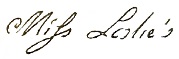
compliments to Mr. Miller. She has no knowledge of the person spoken of in Mr. Miller's note, and is quite certain there must be some mistake in the statement alluded to.
JOSEPH I. MILLER, ESQ.
Several persons of our acquaintance, between whose mental character and that of Miss Leslie we have fancied a strong similitude, write a hand almost identical with this lady's—yet we are unable to point out much in the MS. itself according with the literary peculiarities of Miss L. Neatness and finish, without over-effeminacy, are, perhaps, the only features of resemblance. We might, also, by straining a point, imagine (from the MS.) that Miss L. regards rather the effect of her writings as a whole than the polishing of their constituent parts. The penmanship is rotund, and the words are always finished with an inward twirl. The paper tolerable—and wafered.
LETTER X.
Boston, ——.
Dear Sir,—I have your favor of the ——. For the present I must decline replying to the queries you have propounded. Be pleased to accept my thanks for the flattering manner in which you speak of my Lecture.
I am, Dear Sir, very faithfully, yours,

JOSEPH K. MILLER, ESQ.
Here is a noble MS. It has an air of deliberate precision about it emblematic of the statesman; and a mingled solidity and grace speaking the scholar. Nothing can be more legible. The words are at proper intervals—the lines also are at proper intervals, and perfectly straight. There are no superfluous flourishes. The man who writes thus will never grossly err in judgment or otherwise. We may venture to say, however, that he will not attain the loftiest pinnacles of renown. The paper is excellent—stout yet soft—with gilt edges. The seal of red wax, with an oval device bearing the initials E. E. and surrounded with a scroll, on which are legible only the word cum and the letters c. o. r. d. a.
LETTER XI.
New York, ——.
My Dear Sir,—I must be pardoned for refusing your request touching your MS. "Treatise on Pigs." I was obliged, some years ago, to come to the resolution not to express opinions of works sent to me. A candid opinion of those whose merit seemed to me small, gave offence, and I found it the best way to avoid a judgment in any case. I hope this will be satisfactory.
I am, my Dear Sir, very respectfully yours,
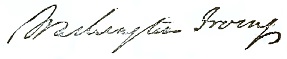
JOSEPH L. MILLER, ESQ.
Mr. Irving's hand writing is common-place. There is nothing indicative of genius about it. Neither could any one suspect, from such penmanship, a high finish in the author's compositions. This style of writing is more frequently met with than any other. It is a very usual clerk's hand—scratchy and tapering in appearance, showing (strange to say)—an eye deficient in a due sense of the picturesque. There may be something, however, in the circumstance that the epistle to Mr. Miller is evidently written in a desperate hurry. Paper very indifferent, and wafered.
LETTER XII.
Boston, ——.
Sir,—In reply to your note of the ——, in which you demand if I am "the author of a certain scurrilous attack upon Joseph M. Miller, in the Daily Polyglot of the — ult." I have to say that I am happy in knowing nothing about the attack, the Polyglot, or yourself.
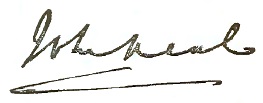
JOSEPH M. MILLER.
Mr. Neal's MS. is exceedingly illegible, and very careless. It is necessary to read one half his epistle and guess at the balance. The capitals and long letters, like those of Mr. Palfrey, extend far above and below the line, while the small letters are generally nothing but dots and scratches. Many of the words are run together—so that what is actually a sentence is frequently mistaken for a single word. One might suppose Mr. Neal's mind (from his penmanship) to be bold, excessively active, energetic, and irregular. Paper very common, and wafered.
LETTER XIII.
Baltimore, ——.
Dear Sir,—I have received your note of the — ult. and its contents puzzle me no little. I fear it will be impossible to give a definitive reply to an epistle so enigmatically worded. Please write again.
Yours truly,
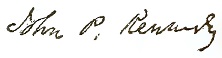
JOSEPH N. MILLER, ESQ.
This is our beau ideal of penmanship. Its prevailing character is picturesque. This appearance is given by terminating every letter abruptly, without tapering, and by using no perfect angles, and none at all which are not spherical. Great uniformity is preserved in the whole air of the MS.—with great variety in the constituent parts. Every character has the clearness and blackness of a bold wood-cut, and appears to be placed upon the paper with singular precision. The long letters do not rise or fall in an undue degree above the line. From this specimen of his hand writing, we should suppose Mr. Kennedy to have the eye of a painter, more especially in regard to the picturesque—to have refined tastes generally—to be exquisitely alive to the proprieties of life—to possess energy, decision, and great talent—to have a penchant also for the bizarre. The paper is very fine, clear and white, with gilt edges—the seal neat and much in keeping with the MS. Just sufficient wax, and no more than sufficient, is used for the impression, which is nearly square, with a lion's head in full alto relievo, surrounded by the motto "il parle par tout."
LETTER XIV.
Philadelphia, ——.
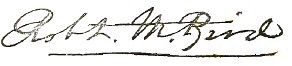
Dear Sir,—Enclosed is your letter of the — ult. addressed to Dr. Robert M. Bird, Philadelphia. From the contents of the note it is evidently not intended for myself. There is, I believe, a Dr. Robert Bird, who resides somewhere in the Northern Liberties—also several Robert Birds in different parts of the city.
Very respectfully, your obedient, humble servant,
JOSEPH O. MILLER, ESQ.
Dr. Bird's chirography is by no means bad—still it cannot be called good. It is very legible and has force. There is some degree of nervousness about it. It bears a slight resemblance to the writing of Miss Leslie, especially in the curling of the final letters—but is more open, and occupies more space. The characters have the air of not being able to keep pace with the thought, and an uneasy want of finish seems to have been the consequence. A restless and vivid imagination might be deduced from this MS. It has no little of the picturesque also. The paper good—wafered and sealed.
LETTER XV.
Oak Hill, ——.
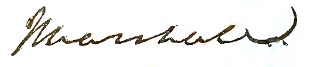
Dear Sir,—I have received your polite letter of the ——, and will have no objection to aid you in your enterprise by such information as I can afford. There are many others, however, who would be much better able to assist you in this matter than myself. When I get a little leisure you shall hear from me again.
I am, Dear Sir, with respect, your obedient,
JOSEPH P. MILLER, ESQ.
The hand writing of the Chief Justice is not unlike that of Neal—but much better and more legible. The habit of running two words into one (a habit which we noticed in Neal) is also observable in the Chief Justice. The characters are utterly devoid of ornament or unnecessary flourish, and there is a good deal of abruptness about them. They are heavy and black, with very little hair stroke. The lines are exceedingly crooked, running diagonally across the paper. A wide margin is on the left side of the page, with none at all on the right. The whole air of the MS. in its utter simplicity, is strikingly indicative of the man. The paper is a half sheet of coarse foolscap, wafered.
LETTER XVI.
Baltimore, ——.
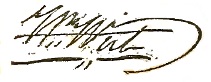
Dear Sir,—I have received your letter of the — ult. in which you do me the honor of requesting an autograph. In reply, I have to say, that if this scrawl will answer your purpose it is entirely at your service.
Yours respectfully,
JOSEPH Q. MILLER, ESQ.
Mr. Wirt's hand writing has a strong resemblance to that of his friend John P. Kennedy—it is by no means, however, as good, and has too much tapering about it to be thoroughly picturesque. The writing is black, strong, clear, and very neat. It is, upon the whole, little in accordance with the character of Mr. W.'s compositions. The lines are crooked. The paper bluish and English—wafered.
LETTER XVII.
Washington, ——.
Dear Sir,—In answer to your kind inquiries concerning my health, I am happy to inform you that I was never better in my life. I cannot conceive in what manner the report to which you allude could have originated.
Believe me with the highest respect, your much obliged friend and servant,

JOSEPH R. MILLER, ESQ.
Judge Story's is a very excellent hand, and has the air of being written with great rapidity and ease. It is rotund, and might be characterized as a rolling hand. The direction of the letters occasionally varies from right to left, and from left to right. The same peculiarity was observable in Mr. Flint's. Judge Story's MS. is decidedly picturesque. The lines are at equal distances, but lie diagonally on the page. The paper good, of a bluish tint, and folded to form a marginal line. The seal of red wax, and stamped with a common compting-house stamp.
LETTER XVIII.
New York, ——.
My Dear Sir,—I thank you for the hints you have been so kind as to give me in relation to my next edition of the "Voyage," but as that edition has already gone to press, it will be impossible to avail myself of your attention until the sixth impression.
Very respectfully, your obedient servant,
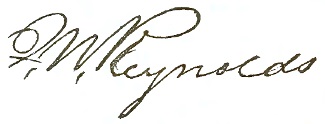
JOSEPH S. MILLER, ESQ.
We are not partial to Mr. Reynolds' style of chirography. It is a common mercantile hand, in which the words taper off from their beginning to their end. There is much freedom, but no strength about it. The paper good, and wafered.
LETTER XIX.
Portland, ——.
Dear Sir,—I have no knowledge of your owing me the small sum sent in your letter of the ——, and consequently I re-enclose you the amount. You will no doubt be able to discover and rectify the mistake.
Very truly yours,
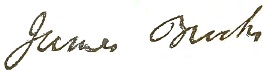
JOSEPH T. MILLER, ESQ.
Mr. Brooks writes a very good hand, strong, bold, and abrupt—highly indicative of the author's peculiar features of mind. These are nervous common sense, without tinsel or artificiality, and a straight forward directness of conception. The lines are even—and the words at proper intervals. The paper good—and wafered.
LETTER XX.
Washington, ——.
Sir,—I shall be better enabled to answer your letter about "certain mysterious occurrences," of which you desire an explanation, when you inform me explicitly (and I request you will do this) what are the mysterious occurrences to which you allude.
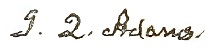
JOSEPH V. MILLER, ESQ.
The chirography of the Ex-President is legible—but has an odd appearance, on account of the wavering of the capitals and long letters. The writing is clear, somewhat heavy, and picturesque—without ornament. Black lines seem to have been used. A margin is preserved to the right and left. The proportion of the letters is well maintained throughout. The paper common, and wafered.
LETTER XXI.
Philadelphia, ——.
Dear Sir,—I have just received your letter of the ——, in which you complain of my neglect in not replying to your favors of the —— of the —— and of the —— ult. I do assure you, sir, that the letters have never come to hand. If you will be so good as to repeat their contents, it will give me great pleasure to answer them, each and all. The Post Office is in a very bad condition.
Yours respectfully,
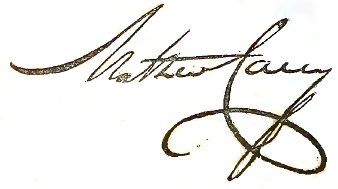
JOSEPH W. MILLER, ESQ.
Mr. Carey does not write a legible hand—although in other respects a good one. It resembles that of Neal very nearly. Several of the words in the letter to Mr. Miller are run together. The i's are seldom dotted. The lines are at equal distances, and straight. The paper very good—wafered.
LETTER XXII.
Boston, ——.
Dear Sir,—No such person as Philip Philpot has ever been in my employ as a coachman, or otherwise. The name is an odd one, and not likely to be forgotten. The man must have reference to some other Dr. Channing. It would be as well to question him closely.
Respectfully yours,
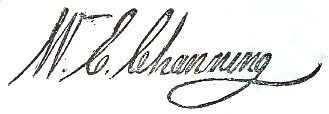
JOSEPH X. MILLER, ESQ.
Dr. Channing's MS. is very excellent. The letters are bold, well-sized, and beautifully formed. They are, perhaps, too closely crowded upon one another. One might, with some little acumen, detect the high finish of Dr. C.'s style of composition in the character of his chirography. Boldness and accuracy are united with elegance in both. The paper very good, and wafered.
LETTER XXIII.
Philadelphia, ——.
Dear Sir,—I must be pardoned for declining to loan the books you mention. The fact is, I have lost many volumes in this way—and as you are personally unknown to me you will excuse my complying with your request.
Yours, &c.
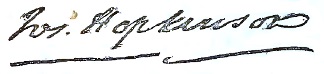
JOSEPH Y. MILLER, ESQ.
This is a very good MS.—forcible, neat, legible, and devoid of superfluous ornament. Some of the words are run together. The writing slopes considerably. It is too uniform to be picturesque. The lines are at equal distances, and a broad margin is on the left of the page. The chirography is as good at the conclusion as at the commencement of the letter—a rare quality in MSS.—and evincing indefatigability of temperament.
LETTER XXIV.
Washington, ——.
Sir,—Yours of the —— came duly to hand. I cannot send you what you wish. The fact is, I have been so pestered with applications for my autograph, that I have made a resolution to grant one in no case whatsoever.
Yours, &c.

JOSEPH Z. MILLER, ESQ.
The writing of the orator is bold, dashing, and chivalrous—the few words addressed to Mr. Miller occupying a full page. The lines are at unequal distances, and run diagonally across the letter. Each sentence is terminated by a long dash—black and heavy. Such an epistle might write the Grand Mogul. The paper is what the English call silver paper—very beautiful and wafered.