APPENDIX
Reading edition
Abyssinia is a deeply interesting country from the point of view of geographical distribution, and it is much to be regretted that Dr. A. J. Hayes did not have the opportunity of collecting insects on a large scale. The animals of the southern half of Arabia are Ethiopian in character; but in the Abyssinian mountains we may expect to find, and we do find, a certain amount of Oriental affinity.
The valuable little collection of insects made by Dr. Hayes has been presented by him to the Hope Department of the Oxford University Museum, where the specimens can be seen and studied by every naturalist interested in the great problems of distribution. The attention of the donor was directed to the Oxford Museum by Mr. W. L. S. Loat, who has himself contributed a large amount of valuable material. Dr. Hayes’ collection was made, in February 1903, in the vicinity of Lake Tsana, at a height of about 6500 feet. A complete list is furnished below. Dr. Dixey has kindly determined and made remarks upon the Pierinae.
LEPIDOPTERA.
NYMPHALIDAE.
Danainae: 1 Limnas chrysippus (Linn.) ♀. The ground colour of the pale tint characteristic of Oriental specimens and usually replaced by a much darker shade in African.
Danainae: 2 L. chrysippus (Linn.) var. alcippus (Cram.) ♂♂. Typical.
Nymphalinae: 1 Neptis agatha (Cram.).
1 Precis cebrene (Trim.).
PAPILIONIDAE.
Pierinae: 1 Catopsilia florella (Fabr.) ♂.
2 Colias electra (Linn.) ♂ ♀.
3 Terias brigitta (Cram.) ♂ ♂ ♀. Dry season forms; not extreme.
3 Eronia leda (Boisd.) ♂ ♀ ♀.
One of these females has an orange apical patch on the forewing, almost as distinct as that of the male.
1 Pinacopteryx sp. ?
A female, rather worn; simulating Mylothris agathina ♀.
Probably a new species, but being in poor condition and a single specimen it would not be advisable to describe it.
1 Belenois severina (Cram.) ♀. Dry season form.
1 Phrissura sp. ♂.
A male, of the P. sylvia group. This form of Phrissura has not previously been recorded from any part of East Africa.
Papilioninae: 8 Papilio demodocus (Esp.).
HYMENOPTERA.
1 Dorylus fimbriatus (Shuck.) ♂.
COLEOPTERA.
LAMELLICORNIA.
Scarabaeidae: 1 Oniticellus inaequalis (Reiche). Only known from Abyssinia.
Cetoniidae: 1 Pachnoda abyssinica (Blanch.).
1 Pachnoda stehelini (Schaum). Both Abyssinian species.
PHYTOPHAGA.
Cassididae: 1 Aspidomorpha punctata (Fab.).
HETEROMERA.
Cantharidae: 2 Mylabris, probably a new species.
NEUROPTERA.
1 Nemoptera, probably a new species.
ORTHOPTERA.
Acridiidae: 1 Cyrtacanthacris sp.
1 Phymateus brunneri? (Bolivar).
1 Phymateus leprosus (Fab.).
1 Petasia anchoreta (Bolivar).
Mantidae: 1 Sphodromantis bioculata (Burm.).
1 Chiropus aestuans? (Sauss.).
In addition to the above, Dr. Hayes presented three insects captured by him at Gedaref in the Soudan, including a pair of a magnificent new species of Buprestid beetle of the genus Sternocera, taken in coitu. This species has recently been described, from Dr. Hayes’ specimen and two others in the British Museum, by Mr. C. O. Waterhouse, who has given it the name Sternocera druryi (“Ann. Mag. Nat. Hist.” Oct., 1904, p. 247). The third insect is an example of a Cantharid beetle, which does great damage to the crops at Gadarif. Its determination as Mylabris hybrida (Bohem.) is therefore a matter of some importance.
THE END
PRINTED BY WILLIAM CLOWES AND SONS, LIMITED, LONDON AND BECCLES.
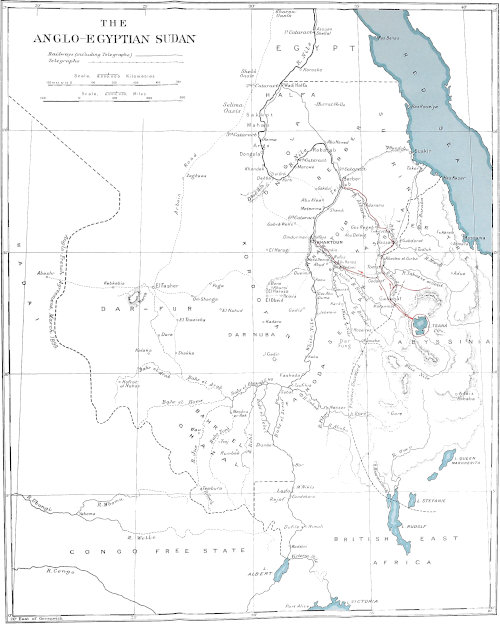
THE ANGLO-EGYPTIAN SUDAN By permission of the Egyptian Government. London: Smith, Elder & Co. Stanford’s Geogl. Estabt., London. (Large-size)
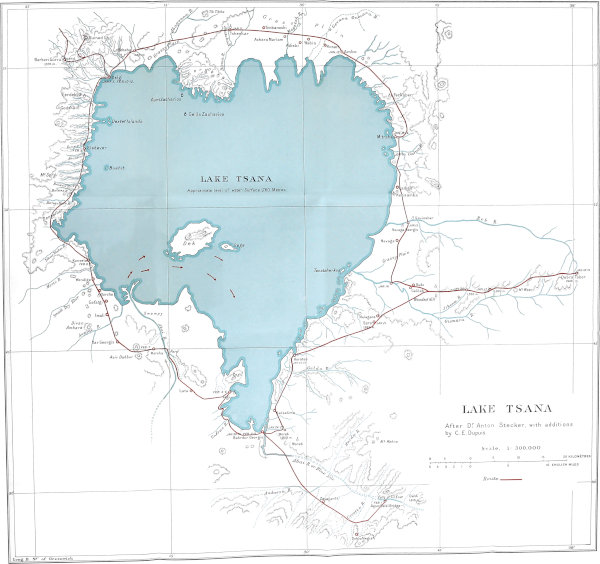
LAKE TSANA By permission of the Egyptian Government. London: Smith, Elder & Co. Stanford’s Geogl. Estabt., London. (Large-size)