Front matter
Reading edition
THE SOUL OF ANN RUTLEDGE
ABRAHAM LINCOLN'S ROMANCE
SECOND IMPRESSION
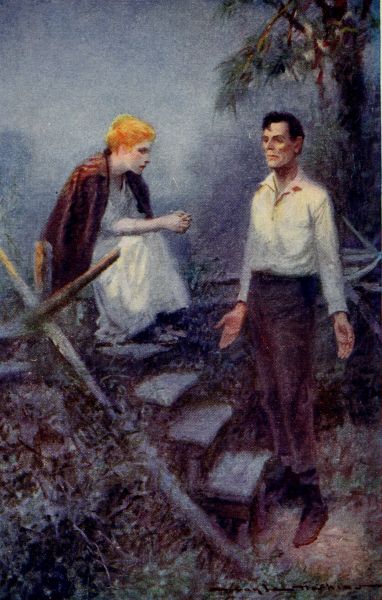
"ABRAHAM, THIS PLACE SEEMS HOLY AND YOU ARE ITS PROPHET" Page 276
THE SOUL OF ANN RUTLEDGE
ABRAHAM LINCOLN'S ROMANCE
BY
BERNIE BABCOCK
WITH A FRONTISPIECE IN COLOR BY GAYLE HOSKINS
PHILADELPHIA & LONDON J.B. LIPPINCOTT COMPANY 1919
COPYRIGHT, 1919, BY J.B. LIPPINCOTT COMPANY
PRINTED BY J.B. LIPPINCOTT COMPANY
AT THE WASHINGTON SQUARE PRESS
PHILADELPHIA, U.S.A.
To J
AUTHOR'S NOTE
In the tremendous output of Lincolniana that has been given to literature, it seems strange that no adequate story has been given of one of the greatest loves in history.
Many writers have referred to it and to its moulding power on the lover's after life. Some have thrown sidelights on the character of the woman. Some have mentioned her rare gift of song and her unusual endowment of mind, and one writer has given a careful description of her personal appearance. But so far as careful and exhaustive research shows, all this matter has never been woven into one story.
It is also strange that there has been so much controversy regarding the religious views of Abraham Lincoln, and by those whose faith is based on the evidence required by the Great Teacher When He said, "Ye shall know them by their fruits." Nor should it ever have been taken as an evidence of lack of faith because he did not accept the creedal beliefs of his day, for had not the Christ Himself strenuously denied much that was insisted on in His day, Christianity could never have been possible.
In this story both the love and the faith of one of earth's noblest souls is simply and intimately told.
In an age when the cynical opinion is too often heard, that between men and women there can be no different or more lasting love than the mating instinct of animals, and at a time when the death of millions of the world's best men has brought into fresh insistence the age-long question, "If a man die shall he live again?" a fresh and different setting forth of Abraham Lincoln's master passion for a woman, and his calm and unshakable faith in immortality, may be of more than usual interest and value.
CONTENTS
CHAPTER PAGE
I. One April Day 11
II. In Clary's Grove 23
III. The Railsplitter 33
IV. The Pilgrim 40
V. Swapping Hosses 50
VI. "Fixin' fer the Angels" 60
VII. "Sic 'em, Kitty" 66
VIII. The Test 73
IX. "Thou Shalt not Covet" 83
X. The Mysterious Pig 92
XI. Peter Cartwright Arrives 101
XII. The Righteous Shout 113
XIII. A Busy Sinner 124
XIV. The Spelling Match 134
XV. "Who's Afraid?" 146
XVI. Politics and Steamboats 157
XVII. Captain Lincoln 163
XVIII. "Books Beat Guns, Sonny" 171
XIX. Abe Makes a Speech 175
XX. Story of a Boy 180
XXI. Only Wasting Time 189
XXII. Town Topics 202
XXIII. Alias McNeil 211
XXIV. In the Cellar 221
XXV. Father and Daughter 227
XXVI. Gloom and the Light 232
XXVII. Covering the Coals 245
XXVIII. "He's Ruint Hisself Forever" 256
XXIX. God's Little Girl 263
XXX. The End of June 271
XXXI. Stronger Than Death 277
XXXII. The Unfinished Song 286
XXXIII. "Where is Abe Lincoln?" 294
XXXIV. For the Things That Are to be 305
XXXV. The Poem 310
XXXVI. On the Way 321
THE SOUL OF ANN RUTLEDGE
CHAPTER I
ONE APRIL DAY
"Ann! Ann! Ann Rutledge! Hallo! Hallo!"
The cheerful voice belonged to a rosy-cheeked girl who shouted in front of Rutledge Inn, one of the straggling group of log houses that made the village of New Salem, Illinois, in 1831.
Pausing in front of the Inn, the animated girl repeated her call lustily as she watched for the closed door to open.
"Hallo yourself, Nance Cameron," a clear, musical voice replied from somewhere in the rear of the weather-stained building, and the next moment Ann Rutledge came around the corner.
"Look! Springtime has come! Isn't it splendid to be alive in the springtime? I found them in the thicket!" and pausing she held out an armful of plum branches white with their first bloom.
In the moment she stood, an artist might have caught an inspiration. On one side of the background was a vista of open garden, perhaps, and meadow, with a glimpse of forest farther back, and over it all the white-flecked, spring-blue sky.
On the other side was the solid framework that told of days when there had been no meadow or garden, and of the pioneer labor that had wrought the change.
In the foreground of this brown and green and blue setting stood a slender girl in a pink-sprigged calico dress. Her violet eyes were shaded with dark lashes. Her shapely head was crowned with a wealth of golden hair in which a glint of red seemed hiding. A white kerchief was pinned low about her neck, and across her breast were tied the white strings of a ruffled bonnet which dropped on her shoulders behind. She pressed her face for a moment in the armful of blossoms, sniffing deep, and with the joy of youth exclaimed again, "Isn't it splendid to be alive in the springtime!"
But Nance Cameron had no eye for the artistic at this moment.
"Have you been to the river?"
"River? What's going on at the river?"
"Didn't Davy tell you, nor your father?"
"No, I've just come home across lots from Green's. What's happening at the river?"
"Everything, and everybody's down seeing it happen. Let's go."
"If you'll wait till I fix my flowers."
"Don't wait—drop them or bring them. Everybody but us is there."
Nance Cameron had turned to the roadway. Ann was about to join her when she turned back.
"Bad luck! Bad luck!" shouted Nance. "Don't go back!"
"I forgot to shut the back door."
Nance stopped, made a cross in the dirt and spat on it.
"You don't pay attention to your signs worth a cent," she said, as Ann rejoined her.
"I don't much believe in signs," Ann answered.
"That's where you're silly. A black cat ran across Mrs. Armstrong's path no later than yesterday after she had her soap in the kettle. And wasn't that soap a fizzle? And don't Hannah Armstrong know how to make soap? It was the cat did it, and if I hadn't changed your luck just now you'd been in for something awful—might never live to marry John McNeil."
Ann laughed, and they started on their way down the road, that stretched the length of New Salem's one street toward Sangamon River.
"What's going on at the river?" Ann asked again.
"Somebody's ark is stuck on the dam. It got stuck just before dark last night. The crew couldn't get it off and had to wait until morning. They came up to the store to get some drinks. The town men gathered in and you never on this earth heard such roars of laughter as those men let out. Ma couldn't guess what it could be about. When Pa came in he told her there was the funniest tall human being he ever set eyes on with the ark crew. Said his legs reached as high up as a common man's breech belt, his body reached up as high as another man's arms, and his head was up on top of all that. And Pa said he told the funniest stories, and the men nearly died. Pa was laughing yet when he told Ma about it."
"Is the boat stuck yet?"
"She's stuck yet. Dr. Allan and Mentor Graham just went down and I heard them talking. She's on her way to New Orleans with a load of barreled pork and stuff. Davy's been up to the store twice. He says the crew have worked like beavers to get the cargo off the big boat, but that the water is running in bad and the barrels are slipping to the end which sticks out over the dam and she's sure to go over. She's going to make a great splash, and I love splashes. Let's hurry!"
"I hope nobody gets drowned," Ann said.
"Like as not they will, and we'll get to see them fished out. Let's trot a little."
With the inspiring hope of hearing a splash and perhaps seeing the first shocking throes of a drowning, the two girls hastened on down the slope that reached to Rutledge Mill, where the dam was.
It was true, as Nance had said, New Salem was out to witness the unusual sight of a flat boat on the dam where it had been stuck nearly twenty-four hours. It was a river craft of the usual flat-boat size, about forty feet long by fifteen wide, and sides six feet high. One end was covered with a roof of boards, and there were other boards fitted with ragged sails to hasten the freight-bearer on its long journey of 1800 miles to New Orleans.
The crowd on the river bank and the platform of the mill was lavish with suggestions and advice which were shouted to the crew working desperately to save the cargo.
Ann Rutledge and Nance Cameron paused a moment to take in the view of the unfortunate boat, whose rear stuck clear of the water and into whose fore the barrels were slowly settling. It seemed nothing could prevent the impending catastrophe.
"Let's get out on the platform. I would like to see that funny, tall fellow your father told about," Ann said.
Passing through the mill, deserted for the time by the dusty miller, the girls joined the crowd on the platform and Ann found herself standing by a peculiar appearing personage, a small man of uncertain age, who wore foxed breeches and coon-skin cap, and who had but one good eye which just now was fastened on the fore of the imperiled boat.
"'Ole Bar's' come back," Ann whispered, punching Nance and turning her eye toward the old man who stood beside her.
'Ole Bar' was a person of interest, and very peculiar. He was chewing some sort of a cud rapidly. When an unusually interesting suggestion was shouted out over the roar of the dam water, he rolled his cud into a hollow made by the loss of two back teeth and kept quiet until the moment of suspense was past, when he made up time working his jaws. Nance only glanced at him now. "I wonder where that tall baboon is?" she said, craning her neck toward the raft.
"See that thar patch of something that ain't no color the Lord God ever made nor no shape He ever seen? Well, that's his hat. He's under it, squattin' in the boat, doin' something to get 'er goin'."
"What's he doing?" Ann ventured.
"Eh—that's it," Ole Bar said with a dry smile. "The rest of the crews runnin' about like chickens with their heads chopped off, and these here galoots along shore is yelping like a pack of coyotes after a buffalo bull. But he's keepin' cool. This kind generally gits something done. Howsomever, that ark's goin' over. I've been numerous in turkey-trottin' and bee-runnin' and bar-killin', but I hain't never before seen an ark in no such fix as this un is."
"Look Nance," Ann whispered. "He's rising up—look!"
A moment his body partially showed. Then he bent low again. The next moment there was a sudden spurt of water from the bottom of the boat. The water pumping its way out caught the attention of the crowd.
"He's emptying her out!" they cried. "How did he do it?"
The tall figure under the colorless, shapeless hat had now lifted himself, and, as if to straighten his muscles after a long cramped position, he stretched to a height that seemed to be that of a giant, threw out his chest, reached his long arms to a prodigious expanse and took a deep breath.
As he did so Ann felt someone touch her. It was "Ole Bar." "Some huggin' he could do with them arms in matin' season—hey, Molly," he said; and when Ann turned to look at Ole Bar he winked his good eye at her and waited for an answer.
A shout from the crowd made any answer to this remark unnecessary. For a moment the towering youth stood before them like a comical picture, slender, angular, barefooted, his faded yellow breeches scarce more than clearing his knees and showing a pair of spindle legs. His uncolored shirt was flung wide open and over one shoulder was stretched a suspender which held one breeches-leg higher than the other. As the water pumped itself out and the boat began to right, they knew that he had bored a hole.
The cheers continued, he lifted his shapeless hat and, with the grace of a gentleman, waved it a couple of times at the cheering crowd. Then he pushed back a mop of black hair, clapped his head-covering down on it and turned to help reload the cargo that had been moved into small boats.
To bore a hole in the bottom of a water-filled boat was no great physical task. But the crowd cheered uproariously as the boat righted herself. Men shouted, women waved their bonnets and kerchiefs, and Ann Rutledge shook her branches of wild plums.
Again the ungainly young giant waved his hat.
"He's waving at you, Ann," John McNeil, who had joined the girls, said, coming up behind her. "Wave at him." And she did and laughed as he swung his limp and tattered hat.
"Where do you suppose that kind grow?" Nance asked. "He looks like a giant scarecrow, but he's had lessons in manners, the identical same kind Mentor Graham tells about."
It took but a short time to reload the boat. As she started on her way the cheers died, and most of the crowd went up the hill to the village.
"Let's stay to see the last of it," Ann said to Nance.
"You want him to wave at you some more," John McNeil said to Ann. "Well, go ahead—you'll never see him again."
The boat sailed on. To those on board who looked back a few moments later, the mill and dam were resolving themselves into an indistinct patch of gray and brown, against which a bit of pink, waving something white, stood out. As a farewell answer to the waving of the white, the mellow music of the boat horn came floating back.
The sun went down behind the forests bordering the smoothly flowing Sangamon; the crude craft passed from view.
And yet once again the mellow tones of the primitive horn came floating back over the forest and across the river.
"What a good sound!" Ann exclaimed. "It's soft as the first shadows, and it's strong."
"Yes, strong as that man's arms in mating season—hey, Molly?" And Nance punched Ann in the side.
The girls laughed merrily. "Isn't 'Ole Bar' funny?" Ann said. "He's just back from an awful exciting trip to Arkansas, wherever that is. He'll have lots to tell."
"Davy and father will get his stories. But say, Nance, do sounds make you think of smells?"
"I never thought of such a thing."
"Don't cow-bells make you think of hay and dandelions and grass and the smell of the cow-lot in the evening?"
"They do go together."
"And don't water running over roots make you think of willow blooms, and water dripping over stones sound like ferns when the stems are crushed? And the sound of crows—don't they bring the smell of the field furrows? And don't bees and honey-locust, and robins and apple blossoms, go together? I could name a hundred sounds that have smells for partners.
"Yes, but you're funny, Ann, to think of such things."
"Now I have a new pair. The sound of that horn, away off behind the trees, will always make me think of the first plum blossoms. The smell and the sound came together as I shook the branches, and the smell right here seemed to me exactly the same thing told in another way as the sound away over the water. O Nance—don't you love plum blossoms?"
"I don't know as they're any better than dogwood or haw blooms and I'm not crazy about any of them."
"You're just like John McNeil. John don't like plum blossoms. I nearly cried when he told me he was going to chop out all the plums and wild vines on his place. But those on our place will not be cut. Father has promised me the thicket and the dell on the creek for my flower garden forever."
"I'd rather have a new belt-buckle. But let's go."
"I'm ready—I'll race you to the top of the bill before the sun drops behind the trees. One—two—three—off," and with her spring flowers in her arms and her bonnet flying, Ann with Nance ran shouting up the hillside in the slanting rays of the April sun.
CHAPTER II
IN CLARY'S GROVE
The evening of the day the imprisoned flat boat made its way successfully out of New Salem, the Clary Grove gang had a meeting. Windy Batts was expected to return from Springfield, where he had gone to prove his fitness for fellowship with the Clary Grove Boys by thrashing a Springfield strong man who had cast aspersions on his character as a pugilist.
Clary Grove was a settlement of a few log houses near New Salem, so called for Bill Clary, the owner of the grove where the select met to swap stories, discuss news and partake of real liquor.
Every new-comer to the vicinity was sized up. If Clary Grove was friendly, so much the better for the new-comer. He might not become a member of the gang. Indeed few were allowed to sit in close fellowship about the fire with the gang, but he would at least be let alone.
Windy Batts had expressed a desire to be of the gang. He was, however, looked upon with a degree of suspicion, as he had done some exhorting for the Hard Shells, and Clary Grove looked askance at religion in any form, and while he had boasted of "dingblasting the daylights out of them shoutin' Methodists," Clary Grove was not satisfied that he was proper stuff to fellowship with them and their whiskey.
They awaited his return from Springfield, where he was to prove his pugilistic ability, with some interest.
The cool, spring air with the tang of frost not yet safely out of it, made a fire comfortable, and a bright blaze burned between the two smooth logs on which the gang roosted.
Buck Thompson, the luckiest horse-trader in that section, and Ole Bar were the first to arrive. Ole Bar sat beside the fire, his jaws working industriously and his one good eye shining like a spark. No one of the gang had ever been able to learn what misfortune had befallen the lost eye of Ole Bar.
That he had been "cleaned of it right and proper" all agreed. Opinion was divided, however, as to the cause or method, one portion believing a bear had clawed it out, because of his familiarity with bears, and others holding to the opinion that some specimen of womankind was responsible for the loss, because of his oft-expressed unfriendly feeling toward women.
Jo Kelsy, a fat and favorite brother of the clan, who was always ready with a new story about a ghost or a witch from his one treasure, an inherited copy of Shakespeare, was the third to arrive.
His usual costume was varied slightly. He came hobbling in, one foot encased in a moccasin. Ole Bar glanced at his mismated feet.
"What's bit ye, Jo?" he asked.
"My wife she dropped a five-gallon crock on my foot," he answered.
"Good thing it wasn't your head, for be it known by man and bars, them as mixes up with wimmen has heads softer than their feet."
Jo laughed good naturedly. Then the three talked of the raft and the ungainly youth who had resorted to the homely but efficient expedient of boring a hole.
"I've seen some legs in my day," Jo Kelsy observed, "but none long as his'n."
"Ain't no longer than yours is, Dumplin'," said Old Bar. "Yours reaches to the ground and his'n don't go no further. According to my way of figgerin' his legs wasn't so numerous when it comes to length as his head. That galoot's got a long head."
A couple more of the gang dropped in, and the talk continued about the raft and the head raftsman. "Ever see anything like it? Wouldn't think a backwoodsman could tell such stories as he did last night, would ye?"
"Nor know enough to get an ark floating when she was stuck so tight that God hisself couldn't stick her no tighter."
"McNeil was figgerin' on her cargo to see what it was worth."
"Trust McNeil for figgerin' the worth of a cargo—or anything else."
"Ann Rutledge—eh?"
They laughed. Then one said, "I heard him tellin' Hill him and Ann was goin' to marry and have a big infare. But her Pappy won't let her till next year. She has to git more schoolin'."
"He better git while gittin's good. John Rutledge is fixed, and he sets more store by Ann than the whole other eight of 'em."
"McNeil knows all that. But here comes Kit Parsons. Wonder what's kept him late? Kit, you're late."
"Yeh," and he sat down by the fire.
"What's extry? Been stealin' anything or gettin' religion?"
"Same thing as gettin' religion," he said. "Been fulfillin' the Scripture injunction."
"Which one?"
"Been replenishin' and multiplyin'."
"Mollie got another litter?" Ole Bar asked with a show of interest.
"Just one this year. But I calculate that a man what grubs for three which arrives in two years is somewhat religious."
"Bars is that religious," the one-eyed man observed, "only when they pursue the course of Nature they don't blame it on religion."
After a laugh Ole Bar said solemnly to Kit, "If you young fellers knew what was good fer you you'd let wimmin alone."
"Where'd you learn so much about wimmin?" Jo asked.
"From bars. Bars rub noses at matin' time and tears the ears offen each other when the cubs has to be fed. Let wimmin alone and save the wear on your noses and ears."
"How's a body going to leave any ancestry if he don't never git no place near a woman?" Buck Thompson asked.
"Ancestry?" repeated Ole Bar. "Well, what under heaven is these little, wet-nosed ancestry good fer anyhow? Never had no ancestry myself and I'm gettin' along all right—got along all right while I was in Arkansas, and anybody that can do that don't need to worry about leavin' no ancestry."
"Tell us about Arkansas," was the next demand.
Ole Bar shifted his cud into its receptacle and said, "Wall, as you all know, in bar hunts I've been numerous, but I hain't never seen no such bars as grow in Arkansas. The bars in Arkansas is the most promiscuous I've ever seen and don't give a damn for nobody. But, Squire, lets licker up. I'm gettin' so dry I'm takin' the rattles," and he reached for the bottle which was passed around.
"Bars in Arkansas grows so fat they can't wobble. You fellers here that think you're gettin' the real thing when you bag the chipper-growlers and shite pokers of these parts don't know nothin' about what's growing in Arkansas. Them bars rear up into the heavens high as that feller that plugged the ark."
"That smells rather tall," Buck Thompson observed, but Ole Bar paid no attention.
"The woods in Arkansas is ankle deep with acorns and berries and other bar food. Everybody there eats bar, bar-ham and bar-sassage. The beds is covered with bar-skins. They don't use small skins like wild cat fer nothin' 'cept piller covers."
"Do they have hoss tradin' in them parts?" Buck Thompson inquired.
"Hoss tradin'? Well, I should say 'Yeh.' You galoots think you swap hosses, but in Arkansas——"
"Hallo, fellers," shouted someone in the outer circle of light.
"It's Windy Batts," several declared at once, and immediately the man whose qualifications to become a member of the charmed group had been put to the test, entered the circle of light.
He was scrutinized and with not an altogether approving eye. His arm was done up in a sling. The forefinger of his right hand was wrapped in a red, calico handkerchief. Something like a knob stuck out back of one ear which was covered with a square of muslin, giving it the appearance of a pat of butter. One eye was black and both legs seemed to be stiff. Greetings were brief. The main question was. "Who whipped?"
"Yeh—who hollered?" was asked.
Windy drew near the fire. "It was a great fight," he began. "The greatest fight that was ever fought in Springfield. We rolled over and over, him sometimes on top and me sometimes under. It was a fearful fight. Court turned out to see it and an Indian Chief was there. He said he never seen nothing like it."
"Who whipped?" was again asked.
"Yeh—who hollered?"
Ignoring these questions, Windy continued.
"The big Indian and the Judge of the Court both said they hadn't never seen such sledge-hammer blows as I hit. It was them blows that put my shoulder out of joint. But I fixed his eye. You couldn't have told it from a knot-hole in a burnt tree. Time he aimed a second socdologer at me I was ready. The crowd roared like a camp-meeting. We fell to it. He got a straddle of my head and chawed my finger. There wasn't no place for me to git holt owing to the fact my head was pinned in twix his legs. Jean britches didn't taste well and was ungodly tough. But I was resolute. I found the right place and I chawed like hell. But would he let go of my finger? No, and I finally had to knock half his teeth out to git my finger out his mouth."
"You tanned him—hey?"
"You mauled him, Windy?"
"You beat the Springfield stuffing out of him?"
"And nobody parted you?"
Ignoring these questions, Windy took a fresh start. "And there's no telling how long it might have lasted, us two going 'round and 'round and up and down and every which way. I was eternally mauling the ding-blasted daylights out of him when the Judge got hold of me and asked as a favor if I wouldn't put off the finish till next day. He said he couldn't get nobody into court if I didn't and so I—I hollered."
There was a moment of profound silence. Windy shifted his weight from one stiff leg to the other, stroked his bandaged arm and sighed.
"Spit in his ashes!"
It was the voice of Jack Armstrong that broke the painful stillness. Immediately every man emptied the contents of his mouth, with no small force, into the fire, which voiced its protest by a vigorous spitting and sputtering.
Then Windy was given some advice.
"This ain't no place fer you. You go join them Hard Shells that's fixin' fer a ten days' fightin' match with the devil. They have the same runnin' off at the mouth as you have, but they hain't never drawed no devil's blood yet, and that's your crowd."
Windy's lips moved as if to speak.
"Roll in your molasses sucker and trampoose," was the order.
"Yeh—trampoose," was the repeated order. "Go fight the devil."
"The devil—that's the Clary Grove gang," he muttered as he turned away.
"Devil-fighter," some one said as his limping figure disappeared in the darkness.
"If the devil pays any more heed to him than he would to a skit-fly he's a blame bigger ass than I've ever took him to be," Ole Bar observed. "Let's licker up."
CHAPTER III
THE RAILSPLITTER
It was two months after the flat boat stuck on the dam at New Salem and the day following a quiet election in the village, that Nance Cameron ran over to Rutledge Inn with news of great importance for Ann.
"Long Shanks has arrived," she announced without ceremony.
"Long Shanks?" Ann questioned. "Who is Long Shanks?"
"The giant scarecrow, the big baboon," Nance answered.
"Baboon," Ann repeated. "Nance what are you talking about?"
"My land, Ann Rutledge, have you forgotten the unhinged giant you waved plum blossoms at—the captain of the flat boat who looked like sin, but knew how to use his hat like a gentleman?"
"Oh!" answered Ann. "Has he come?"
"Yes. He got here yesterday. They didn't have anybody to help at election. Mentor Graham asked him if he could write. He said he could make his rabbit's foot, and so he helped. Mr. Graham says he can write well. Besides, he told them stories, and they liked that. Last night he came to our house."
"Tell me about him. What does he look like close to?"
"He's the homeliest man God ever put breath into. His legs run down into feet so long he can't find anything big enough to stick them under, and his arms are nearly as long as his legs. He has a big head, big nose, big mouth, big ears, lots of black hair, and he's hard and horny and knotty like a tree—and as green, too."
"Did he talk to you?"
"No, he didn't pay me any heed at all, but he and Ma got to be good friends before he'd been in the house an hour. She was tired half to death putting up berries and trying to get supper. She put Johnnie watching the baby and he let him roll down the steps. The new man heard him crying and went right out and got him. In five minutes the baby was laughing. This made Ma feel better and she got talking, and first thing I knew he was helping her wash dishes and telling her about what he saw in New Orleans and down the Mississippi. He talks better than he looks."
"How does he talk? Has he a big, deep voice and mellow, like the sound of the horn over the tree and river?"
"No, indeed. He sets out thin sounding, but his voice seems to work down into his chest as he talks and he sounds pretty good. After supper Pa brought in the cider. Mr. Graham came over and Dr. Allen, and they got Long Shanks talking and didn't want him to quit. Mentor Graham took a great liking to him. He lived in Kentucky once and then Indiana. He asked about the folks in these parts and when he heard Jo Kelsy owns a Shakespeare he said he was going to try to borrow it, said he's read the Bible till he knew it by heart and the Constitution and some other things but never seen a Shakespeare. When Mr. Graham told him he had fifty books his dull, gray eyes turned bright as new candles. He's terrible interested in books, but he don't have any time for girls."
"How do you know?"
"'Cause. Ma asked him if he saw the girl waving at him, when the boat stuck? He said, 'Yes'm—wasn't it kind of her?'"
"Ma said, 'She's the prettiest girl in town.'"
"He said, 'Yes'm—isn't that nice?'"
"Ma said, 'She's the smartest girl in town.'"
"He said, 'Yes'm—it's worth while to be smart!'"
"Ma told him you was going to marry John McNeil. He said, 'They all do it.' And he never even asked your name."
"I tell you what; you drop past to-morrow afternoon before supper. He'll be there then. He won't look at you, he's so funny. But you can see him."
It was with as much interest as a person goes to a show that Ann Rutledge went to the Cameron home the next afternoon. She was doomed to disappointment.
"He's gone," Nance informed her.
"Where?"
"Gone out to split rails for some folks that have come in from Indiana and are taking a homestead near Turtle Ford. He's going to split enough rails to fence the clearing. He's to get one yard of brown jeans dyed with white walnut bark for every four hundred rails. It's to make some new breeches."
"That's an awful lot of work for a pair of pants."
"Yes, but look at the length of his legs. A fellow with legs like that will always have to work extra to keep them covered."
"I wanted to see him."
"He's coming back. I heard him telling Pa he was going to open a store here for a man named Offutt. His wares haven't come yet. They will be here by the time the new breeches are ready. Then you can see him. You'll think him half-baboon and half-giraffe and he won't even notice you only to say 'Yes'm' and pull off his hat."
"Does he have any name? You didn't tell it."
"Name? O yes," and Nance laughed. "He's named after Abraham, of the Abraham, Isaac and Jacob family. The rest of his name is Lincoln."
"Abraham Lincoln," Ann repeated. "I don't think that's such a bad sounding name."
John McNeil called at the Rutledge home the night young Lincoln went to Turtle Ford to earn his new pants. After the family had gone to bed and Ann was left to say good-night to the young man she was engaged to, he said, "Ann, I thought that fellow was captain of the boat and maybe owned some of the cargo. He's nothing but a railsplitter."
"He didn't use his hat like a railsplitter."
"He's picked up a few lessons in manners somewhere—maybe saw somebody doing it in New Orleans."
"No—because it was on his way down that he lifted his hat."
"Well, I don't know where he got it, but he's only a railsplitter just the same. Hasn't a cent in the world. Didn't know it was a railsplitter waving to you, did you?"
"It wasn't me he waved at. He never heard of me and don't know yet that I am living. It was the flowers he liked and I'm glad he likes flowers if he is a railsplitter."
"I'd like to know, Ann, why you take on so over flowers. What are they good for?"
"Good for? What a funny question. What is the song of birds good for and the fragrance of flowers and the beauty of ferns? What is the music of running brooks good for and the splendor of gold and red sunsets—what are any of them good for?"
"That's just what I'm asking," John McNeil said seriously. "What are they good for? Can't eat them, can you? Can't wear them, can you? Can't sell them, can you? or trade them or swap them for anything? Women are such funny folks and don't know a thing about values. But I'm going to leave the plum thicket another year and the corner in the pasture where the blue flowers grow you like to pick."
"Thank you, John—thank you a whole lot"; and happy because of his promise, Ann kissed John McNeil good-night.
CHAPTER IV
THE PILGRIM
A few days after Abraham Lincoln had entered service to split rails for a new pair of breeches, he came to town late one afternoon to get an ax.
After tarrying a short time to tell a story or two, he started back about sun-down, his ax, on the handle of which was swung a bundle, over his shoulder.
As twilight gathered, the ungainly youth took his way along the road that ran not far from the smoothly flowing Sangamon. His strides were long and easy, and, away from the small habitations and contrivances of mankind, he seemed to become one with the big things of nature, and what was sometimes considered lack of grace seemed now an easy expression of reserve force.
The roar of the mill-dam sounded musical as if the twilight were softening its daytime boisterous tumult.
The falling dew seemed loosening up the fragrance of the woods, the subtle breath of tangled vines and trailing roses, with sometimes a more decided fragrance, as when the full-sized foot of the pedestrian brushed into a bed of wild mint.
As he rounded the skirt of the bluff, the rosy tinted sky seemed suddenly to withdraw itself, and the timbers upon the summit to move themselves slowly against the crimson and fading gold, like a row of shadowy sentinels gathered for the night.
A tinkling gurgle from an irregular, dark spot against the foot of the bluff told of a ravine, and the running stream, whose musical babble, as it made its way to the river, sounded like the prattle of a child compared to the river's volume falling by the mill.
As he took his way in the gathering gray of night, the long-limbed youth cast giant shadows, subtle, indistinct shadows far across the road and into other shadows, where they merged into the formless gloom and were lost.
While yet rounding the bluff he heard the barking of a dog and then the tinkle of a cow-bell. Common sounds these were, but coming on the stillness from the heights above they lent a sort of musical enchantment to the quiet and the enfolding mystery of night. Then a human voice was heard, a woman's voice that seemed to burst suddenly into the flower of a full blown song.
The youth slowed up a bit and listened. The words thrown out by the ringing voice sounded clearly:
I'm a pilgrim And I'm a stranger; I can tarry, I can tarry but a night.
The young man stopped. The song was to him unusual. The clear voice took the notes unhesitatingly and rolled them in melodious movement as she sang the words "p-i-l-grim" and "s-t-r-a-n-ger," and then hurrying on gladly, as if it were a matter for great rejoicing that she could tarry but a night.
The youth dropped his ax and bundle to the ground and turned his face toward the bluff casting its long shadows. The bell tinkled a moment in the gathering gloom. Then the voice rang out again on the evening hush:
Do not detain me, For I am going To where the streamlets are ever flowing.
Again there was the peculiar rolling fall and rise on the syllables. Again the gladness of some exultation, then the refrain "I'm a pilgrim" with its confidence and its melody.
The voice was nearer now. There was no sound or sight of any moving object on the bluff, but she was somewhere there and seemed coming nearer.
The tinkle of the cow-bell made an interlude. Then again the voice of singing, whether nearer or farther now he did not question. He was listening to the words:
Of that country To which I'm going My Redeemer, my Redeemer is the light. There is no sorrow Nor any sighing Nor any sin there, nor any dying.
The mysterious singer on the heights was farther away now. The voice was growing fainter as the refrain rang into the stillness, "I'm a pilgrim—and I'm a stranger—I can tarry—I can tarry——"
The youth leaned forward and listened, breathlessly. But the voice was dying and the tinkle of the bell came on the stillness, faint as a memory.
After standing a moment, the listener in the shadows made ready to go on. When he turned to pick up his ax and bundle, he found his hat in his hands. When he had removed it he did not remember. Mechanically he placed it on his head and started on his way.
The red and purple of the earlier evening showing through the trunks of the trees crowning the bluff was giving way now to the silvery green of the rising moon.
With his ax over his shoulder the figure paused a moment for a last look upward and then moved on.
But he did not feel the same. He had undergone some change. What was it? Within his breast the song had raised something intensely alive—something like hunger, fierce yet very tender; something like strange pain; something like wild joy; something like unsatisfied longing, together with unmeasured satisfaction. What was it? He did not know. Mysterious to him as was the singer, was now the effect of the singing.
Yet out of the mingled sensation of unrest and satisfaction, suddenly stirred into life, there came to the youth thoughts of his mother.
His mother had been a pilgrim on a journey. He had heard her say so many times. But the burden of her song had been "Earth is a desert drear." He had heard her sometimes try to sing. But she did not go shouting. She suffered on the way, endured, was patient, and at the last she reached a groping hand for something strong to hold her back from that country to which she believed she was going. It was with a twitching of his muscles and a quiver of the big strong mouth he thought of the passing on of his mother.
But here was a pilgrim happy, shouting, even jubilant. Who was she? What manner of person could she be? His curiosity was aroused.
As he strode on toward Turtle Ford the falling waters of the dam softened their roar into an indistinct murmur, and then like the voice of the singer and the tinkle of the bell, blended into the quiet, broken only by the call of a whip-poor-will or the whirr of a bat's wing.
The moon rose above the lacey darkness of the timber-line. The railsplitter had had no supper. Once he stopped and gathered some berries. But he was not thinking of food. The eternal mystery of the awakening of one's other self had both breathed through and enfolded him. He was not hungry. He tossed the berries down by the roadside. His pace quickened as he neared the clearing. He did not understand, but for some reason he himself experienced a lifted-up sensation. It was as if the conquering confidence and joy of the unknown singer had been contagious.
At the edge of the clearing he stopped. The shack and pig-pen and few rail-fences stood out in the moonlight like the skeleton of something to be clothed with a body. The dogs came out and barked, but crept back satisfied at sight of the tall figure. He stepped up to the door of the shack. The snoring of a man told him his approach had not disturbed the sleeping family.
He turned toward the end of the cabin where a ladder stood, which he mounted. At the square opening which served as door and window to the loft, he paused and looked in, and by the moon's indistinct light he saw the three boys of the family lying on a pallet. The dull hum of mosquitoes sounded.
He turned back to the ladder, and on its top, with his back resting against the cabin, he sat and looked out into the night. In the light all was beautiful; even the piles of brush were softened until they looked like the gray and silver tendrils of giant vines piled by titanic fairies, and the trunks of trees were columns in some mysterious and endless cathedral canopied with silvered green.
Across the wilds of the forest, which in the magic of night and the moon were so beautiful, the thoughts of the youth again traveled back to his childhood and its mysteries, and he seemed to see again a very small grave in a lonesome spot beside which his mother cried and declared with tears and choking voice that she could not go away and leave it forever. To the boy who looked on, this had seemed strange. Why should she weep because she could not take a grave from Kentucky to Indiana, the new home, and such a tiny little grave? It had been a mystery. Later he came to answer the mystery of it by calling it "mother love." He thought of that grave, far away in Kentucky, as he sat on the ladder. Then he thought of the grave of the mother who had wept beside the little grave—two graves.
Some time he too would fill a grave somewhere—and so would the singer on the heights. What was life after all? Its end was the same for all—whether a tiny grave or one long enough even for him? The question seemed to mock itself and laugh.
Then the voice of the singer rang clear again—a pilgrim rejoicing, shouting—such a glad pilgrim, and again he felt himself impelled to the heights from which it had come—felt himself a creature of some fresh-born force he could no more fathom than explain.
A wild cat screamed down the creek. The three boys thumped the floor, seeking in their sleep to destroy the mosquitoes. The dogs scratched under the house. The man snored. Once the baby cried and the mother soothed it.
These voices and sounds seemed a part of the secrets of the night and of the strange awakening that possessed him with the pleasure and pain of its mystery.
There was a sound, however, that came with the first pink of the morning that seemed in some unknown way to hold the key to the mystery of his strangely aroused hunger—a hunger born whether for good or ill he knew not.
With the first stirring of life at the new day, a song bird just at the edge of the clearing sent out its call, clear as the voice of the singer on the bluff and, in the imagination of the inquiring youth, like it, glad and unafraid.
But the bird was calling for a mate—one of its own kind—one which would answer its call.
Again the call rang out penetrating and joyful.
The young man listened. Then a smile of satisfaction lit his homely face, for from somewhere down in the tangle of the creek banks, one of its own kind was answering the call.
The hidden singer in the clearing called again, even throwing more life and gladness into the song. Again the answer came from the unseen one of like kind, a little closer now. They were moving toward each other. The silent listener had not made a study of birds. Yet now he was quite sure that somewhere they would meet in the wide expanse of over-laced branches and would mate.
Again his mind went back to the singer of the bluff—and her challenging call. Who or what manner of woman was she? He wondered.
When the man who had been snoring awoke with the first streaks of day, the ringing of an ax sounded on his ear. "If he don't beat anything to bite them trees down and eat them up, I'm a liar. He must have been at it all night."
"He needs breeches—needs them powerful bad," his wife replied.
"Must want to go a courtin'," was his comment.
"Courtin' or no courtin', he'll be ketched by the sheriff if he don't git some new breeches right soon. His is fixin' to leave him. I'm skeered every time he jumps over the fence."
CHAPTER V
SWAPPING HOSSES
Not more than a fortnight after Windy Batts had been weighed in the balance by the Clary Grove boys, Mrs. Mirandy Benson ran over to Rutledge's to discuss a few news items.
Mrs. Benson was Phoebe Jane Benson's mother. Phoebe Jane Benson had never been kissed by a human man—her mother the authority for the statement. "No start, no finish," was Mrs. Benson's oft-quoted statement as touching the delicate question of the preservation of female virtue. "For this reason, Mis' Rutledge, I'm dead set against huggin'. There's never no tellin' where huggin' will end, and Phoebe Jane shan't get no opportunity."
But it was not of hugging that she now talked. "Mis' Rutledge," she said, "Windy Batts has been dipped and is going to set out preachin' for the Hard Shells and will hold a meetin' near New Salem. It's set to his credit, I say, that he chose to unite with the Hard Shells instead of the Clary Grove gang. Since Windy Batts has been keepin' company with Phoebe Jane, I've been uncommon interested. He has a powerful flow of language, and will make a famous exhorter."
A second topic of conversation was the tall clerk who was in charge of the new store opened by Offutt. "He's the one that helped Mentor Graham election day and has been chopping rails since on Turtle Ford.
"Everybody in town's been in the store, and the men hang around every evenin'. Phoebe Jane, she's been, too. He's an awful friendly fellow, scraped up a speakin' with Phoebe Jane and asked her who in these parts could sing. She told him she could sing, bass or tenor, either he liked. Phoebe Jane was quite took up with him and wanted to ask him to meetin'. But he's too friendly. These friendly young fellows must be watched. He might be all right. Then again he mightn't, and if he should take a huggin' spell like some young fellows takes, with them arms no tellin' what might happen. I told Phoebe Jane not to let out too much rope, especially since Windy Batts got religion."
It was true the new clerk at Offutt's store had inquired who about New Salem could sing. Having been unable to learn anything satisfactory from the girl he had asked, he put the question to several men who chanced to be in the store. The only result of his questioning was to bring out a story about a girl in New Salem who had a "singin'" in her head for which a plaster of "psalm tunes," applied to the feet to draw the singing down, had been prescribed. Unsatisfied, young Lincoln determined to keep his ears open and try to discover for himself.
Meantime there were many to get acquainted with, and when Bill Clary himself invited the new man to the Grove, he at once accepted the invitation.
Ole Bar, Buck Thompson, Jo Kelsy and several others had gathered early and were discussing the guest that was to arrive shortly. Buck Thompson was especially interested. He was in possession of a horse with a head three times too large and legs four times too small for his bony body. Some fatal defect in the horse made him, as Buck Thompson confidently told the crowd, "not worth a chaw," and this horse he was going to try to swap Lincoln, "sights unseen."
Speculation has just started as to the outcome of Buck's horse-trade when Clary and the tall stranger arrived.
"His name is Abe Lincoln," Clary advised.
"'Linkhorn' is what they called me over in Indiana."
"Paws, Abry Linkhorn," Ole Bar said, extending his hand and casting his one good eye with approval on the stranger.
The few brief formalities having been dispensed with, the group settled down to stories and discussions, Ole Bar leading off with a graphic description of many of the wonders of Arkansas, and its riches of soil and abundance of game. "There was one feller down thar had a sow," he declared gravely. "She stole an ear of corn and took it down whar she slept at night. She spilt a grain or two on the ground, and then she lay on them. And, gentlemen, believe it or not, before morning the corn shot up, pushed on right through her and the percussion killed her. Next morning she was found flat as a pancake and three-inch corn sticking like green har through her spotted hide."
"I swear!" exclaimed Jo Kelsy.
"Don't cuss; jes go down to that country and see," was Ole Bar's comment.
When Abe Lincoln's time came he was asked for the lizard story he had told at the store the night the flat boat stuck on the dam. In an inimitable way he told the story, joining heartily with the others in the boisterous laughter it called forth, but neither this nor any other of the stories told diverted the mind of Buck Thompson from the main question, this being, "Is he as green as he looks? Will he swap hosses?"
"Don't happen to have a hoss you want to trade, do ye?" Buck at last indifferently questioned.
The interest of the company was at once centered on the answer.
"Want to swap hosses?" Abe Lincoln asked good naturedly.
"Well, I dunno. Do you happen to own a hoss of any kind?"
"Yep," answered the visitor. "Such as it is, I own a hoss."
An expression of pleasure showed on the face of Buck Thompson.
"What sort is he?" Buck asked.
"Who said it was a 'he'?"
The crowd laughed.
"What kind is she?" Buck corrected.
"Well," answered the youth as if weighing the matter, "she ain't nothing extra on looks, but she can stand up under as much hard work as any hoss in these parts."
"How old is she?"
"I dunno to a day—not very old."
"Stand without hitchin'?"
"Never's been hitched to anything in her life."
"Saddle hoss, I take it. Ain't any mustang is it?"
"Not a drop of mustang in the critter, I swear it."
"Ain't blind in one eye, is she?"
"No."
"How's her legs?"
"Can't lie partner. She's stiff in the legs."
"Stiff in the legs, eh? How about her teeth?"
"Haven't counted them."
"Ever had the botts?"
"Not as I know of."
"Or winded?"
"Not since I've had her."
"Want to swap hosses?" Buck asked.
"What you got?" Abe Lincoln asked with interest.
"I got one what'll stand hitched. I'm goin' to be honest as you and tell you my hoss has stiff legs. From what I git, my hoss is just about such a hoss as your hoss. How'll you swap, sight unseen?"
Abe Lincoln aked a few questions which proved beyond a doubt to Buck Thompson that the lanky youth was as green as he looked on the horse-trading proposition, and he was delighted both for the stakes involved and the effect of his deal on the Clary Grove Boys, when Abe Lincoln agreed to the trade.
"Where's your hoss at?" Buck inquired.
"Out back of Offutt's store. Where's yourn?"
"He's to home—but I'll bring him."
"Any rush?" Lincoln inquired. "Morning's not far off."
But Buck had no notion of taking chances on letting the horse-trader consider over night. He insisted on winding up the trade in the bright light of the moon in front of Offutt's store. The crowd agreed to be present, and immediately afterward, with singing and loud talking, the Clary Grove gang took their way to New Salem to Offutt's store. Buck Thompson went after his horse, and Abe Lincoln disappeared in the shadows of the store to find his.
Buck was the first to arrive. Not even the moonlight could cast any redeeming qualities on the beast that hobbled after him. The crowd looked it over and laughed uproariously. Buck grinned with satisfaction at the sight-unseen trade he was about to make and questioned half fearfully if the greenhorn would stand by his agreement.
The appearance in the distance of a tall and shadowy figure approaching with long, easy strides was not reassuring. Certainly he was neither leading nor driving a horse. The company looked. As he came nearer they saw he carried something. Its shadow blended with that of his body.
"He's got his hoss under his arm or on his back," one observed.
Buck was looking anxiously.
"Bet two to one it's a goat," Jo Kelsy said.
This sounded good to Buck. "Goat!" he said with evident pleasure. Then they looked again. The next minute he cleared the last lap of shadow and came into the light in the open space.
There was a moment of impressive silence.
"My hoss is this kind—one of the most useful animals in this neck of the woods," and he placed a saw-horse before them.
There was a moment of impressive silence, then the angry voice of Buck Thompson.
"You're a liar," he cried, greatly angered by the roar of laughter that had greeted the speech.
A dead hush fell on the company. A fight seemed the next excitement. Every eye was on Lincoln.
"Don't get riled up," he said good naturedly, "especially after I told you I was tellin' the truth. Didn't I tell you her legs was stiff?"
"Yeh," roared 'Buck—"and you told me she had two good eyes—eh, boys?" and he turned to the crowd standing close about.
"Easy now," Abe Lincoln remonstrated. "I didn't say she had two good eyes. You asked if she was blind in one eye, and I said 'No, she ain't blind in no eye.'"
"You said she had all her teeth," Buck challenged.
"Naw, what I said was, 'she hasn't never lost no teeth, far as I know.' Can you see any place where they have come out?"
Clearly the new clerk had the best of the trade. Buck Thompson stood to his bargain. The horse was passed to Lincoln. He looked it over. Something in the ungainly figure and the big-headed horse brought a smile. Yet they waited. What would he do next—or say?
"Partner," he said to Buck after the examination, "I wouldn't know what use to make of this here critter. I can't make no sight-unseen proposition, but I'd give you two bits for my own hoss back."
CHAPTER VI
"FIXIN FER THE ANGELS"
Offutt's new store under the management of Abe Lincoln came to be, almost immediately, the chief point of interest in the village.
Business was never so rushing that the genial, long-legged new-comer could not find time for a friendly greeting or a new story.
Jo Kelsy, famed as the best Shakespeare scholar New Salem boasted, soon discovered a kindred spirit in Abe Lincoln, and was delighted to find in him a pupil so hungry to get acquainted with Bill Shakespeare.
Mentor Graham, the Scotch schoolmaster, dropped into the store because he soon discovered that, although the youth who had assisted him on election day had had no opportunity of going to school, he was far more advanced in general knowledge than any pupil in his school, and the fact that Abe Lincoln wanted to study grammar with him, and after a while higher branches, pleased him.
Even Doctor Allen, the busiest and most conscientious Predestinarian in Sangamon County, cultivated the acquaintance of the Lincoln youth, and he soon discovered that the uncommon young fellow, who seemed to be everybody's friend, was not given to social drink, and this pleased Doctor Allen, who boldly preached that liquor was poison and stood for its total abstinence.
The Clary Grove Boys visited the store, and when several of them happened in at the same time, the laughter and boisterous talk could be heard the length of New Salem.
Ann Rutledge had not yet been at the new store. She had heard from it, however, through her brother Davy, two years younger than herself, and her half-grown sister, known as "Sis Rutledge," both having formed the acquaintance of Abe Lincoln and both having immediately become his staunch admirers.
Ole Bar was in the store one afternoon when Davy came in.
"Davy," Abe Lincoln said, "see here"; and putting three long fingers gently into his pocket he drew out a handful of tiny rabbits. "Their mother got killed. I put the poor little things in my pocket. Know anybody that will take care of them?"
Ole Bar opened his good eye and listened.
"Sure, Ann, she'll do it. Ann Rutledge takes care of blind cats, lame dogs, lousy calves, birds With broke wings, and all such things."
Abe Lincoln had placed the rabbits carefully in his hat and handed it to Davy.
"Want them back?" the boy questioned as he turned toward the door.
"No—but hurry back with my hat. I'm goin' out with Kelsy while he fishes, and read about a Jew who wanted a pound of flesh."
The expression on Ole Bar's small eye was one of concentrated disgust.
"Men's not what they used to be," he observed, chewing violently.
"I reckon not," Abe Lincoln observed.
"These times they wear whiskers on their upper lip, and breeches buttoned up the fore, but I don't see as it's give them any more wits."
Abe Lincoln did not answer this, but asked a question.
"Who sings about these diggin's? It's some woman who has a way of her own."
"All wimmin sings; wimmin birds sings, and wimmin bull frogs sings, and human wimmin sings. But whether they be scaled or feathered or diked out in calico and combs, their singin' is to git the men of their kind. Take the advice of Ole Bar, my long-legged son, Abry Linkhorn, and let all wimmin kind alone. Furthermore, don't try to start no love-makin' with Ann Rutledge and blame it onto rabbits. I've heard said Ann Rutledge can outsing a bird. If she can, it's for John McNeil. John McNeil, he's worth ten thousand dollars—so they say. Hain't this worth singin' for?"
"The one I'm talking about wasn't singin' for any man's money."
"How do you know?"
"It wasn't that kind of a song."
Ole Bar laughed. "Sonny," he said, "you're as green as you look. But why don't you go up to the meetin' what Windy Batts's started? All the singers will be there. Windy's trying to scare the devil out of his own den by his fierce preachin'. Last night he called the whole Clary Grove tribe by name and told them the devil was goin' to pepper them with burnin' fiery sulphur in chunks as big as Rutledge's Mill forever and aye unless they crawled up on the rock of ages. They'll be going to meetin' theirselves right soon, and if he don't know any better sense than readin' cusses at them out of the Holy Scriptures and pointin' the finger of scorn at them before the people, they'll learn him some."
It was this same evening Abe Lincoln decided to go to Clary Grove in search of Kelsy, from whom he wanted to borrow the Shakespeare. The Grove Boys were in council. An indignation meeting was being held. Kit Parsons had just been quoting Windy Batts, who had the night before consigned those Clary Grove sinners root and branch to burn forever, and it had been just about decided that he, and the horse he had purchased to start on an itinerary after his New Salem meeting, should be treated to a coat of tar and feathers.
"That deer-faced hypocrit tells how God sent his angels to git Daniel out of the lion's den, how he sent angels to git them three fool Jews out of the fiery furnace. He says them kind of angels guard the Hard Shells, saves them from their enemies and gits them out of tight places. We're needin' some angels in this section. Let's coax them down. Let's anoint this belly-aching coward with hot tar and feathers—both him and his horse, till we make him look like the buzzard he is. Then we'll set by and see how long it takes them angels to git the feathers picked off."
A laugh had followed this speech. It was about this time Abe Lincoln appeared.
"Howdy!" he said in his most friendly manner.
They returned his greeting, but it was evident he was not wanted. They, however, asked him for a suggestion as to how best to punish "a moon-eyed pole cat that hain't nothin' better to do than stir up a stink about hell fire and brimstone, and call out the names of them picked by the devil to supply the roasts."
"I wouldn't take it to heart about his fiery talk. He can't hurt God with his spittin' and sputterin', and so long as God's all right the rest of us needn't worry," Lincoln said, before answering the request asked. "As to punishin' a 'Moon—faced pole cat,' I'd plug him up in some tight corner, poke sin out of him—and he'd punish hisself gentlemen—punish hisself."
Abe Lincoln got the book and went away. After he had gone, the Clary boys put their heads together, and before they had separated for the night, the tar and feathers plan had been temporarily abandoned.
CHAPTER VII
"SIC 'EM, KITTY"
The afternoon following his rather unwelcome visit to Clary Grove, Abe Lincoln was invited by Kit Parsons to attend religious services that night. From the manner of the invitation, the storekeeper gathered that there might be something interesting on foot, and he decided to go.
Some changes had been made in the meeting-place since the gathering of the year before. At the former time Satan had moved the dogs, so the elder explained, to crowd under the exhorter's stand and engage in riotous disagreement. In an endeavor to chew each others ears and gnaw holes in each others hides, they had bumped their backs onto the rude floor underneath the preacher's feet, and in other ways raised a disturbance.
To prevent a repetition of this disorderly conduct on the part of the dogs, the hiding-place under the stand had been made proof against all intruders by the use of stobs driven so close that not even a shadow could creep between.
It was in this long-time rendezvous of dogs that a couple of the Clary Grove gang seemed interested, as between services they strolled several times past the pulpit end of the arbor.
That evening, in the shadowy gloom cast by the arbor roof, a couple of men might have been seen, had the dark been closely scrutinized, moving softly about.
Just what they were doing was not apparent. They seemed to have a barrel close by and a long trough of some kind.
But nobody paid any attention to these quiet two. All interest was centered in Windy Batts, who in a trumpet voice was giving out the words of a song which all who knew him were certain would be sung with great unction and fervor.
He was reading the lines from a hymn-book. At the end of every second line he gave the pitch, whereupon all sang in many keys, but with united fervor.
Into a world of ruffians sent, I walk on hostile ground; While human bears, on slaughter bent, And raving wolves surround.
Between each two lines he shouted, "God have mercy on them Clary Grove sinners! Them ravening wolves! Strike them human bears down!"
Then the hymn went on:
The lion seeks my soul to slay, In some unguarded hour; And waits to tear his sleeping prey, And watches to devour.
"God save us from them Clary Grove lions that seek to devour."
The movements in the shadows just outside the arbor continued, but nobody noticed. The exhorter, calling on God and all the holy angels to witness the truth of his sayings, was drawing a graphic comparison between the righteous and the sinner, especially of that most fallen and hopeless sinner, the Clary Grove sinner.
After the discourse, which was thundered out with tremendous force, the first altar-song was announced,
If you get there before I do, I'm bound for the land of Ca-na-yan; Look out for me, I'm coming, too, I'm bound for the land of Ca-na-yan;
When this popular song got well underway, the woods for miles around rang with the refrain. The altar filled with sinners who fell in the dust, and with saints who whispered in their ears full directions for planting their feet firmly on the old ship Zion, and with shouters, among whom was Phoebe Jane Benson.
Ann Rutledge and Nance Cameron on one side of the arbor, and Abe Lincoln and Jo Kelsy on the other, had watched Phoebe Jane taking her combs out and in other ways preparing for the shouting. Ann, remembering what Mrs. Benson had said about hugging, was prepared to watch for developments as Phoebe Jane, with arms flying, began her religious exercise.
When the mourners were prostrating themselves in the dust, one of the dark figures in the shadowy background whispered, "Tickle her up and then run"; and as he reached a long pole into the enclosure under the exhorter's feet he said, "Sic 'em, kitty!" and the two were off.
Just as the first sinner was saved and the shouters were getting well warmed up, a heavy and most unreligious odor suddenly pervaded the air.
The front row of mourners, with their faces in the dust, nearest the exhorter's stand, noticed it first as it came like a puff from the infernal regions just pictured by Windy Batts. Lifting their heads, these mourners looked about, with facial expressions none too pious, to see what had smitten them. Next the shouters got the full force of the growing odor. Immediately their shouts turned to groans, and they put their hands over their noses. By this time the mourners were on their feet. This sudden change from the dust of humiliation to the erect poise of saved souls, ordinarily denoted a conversion. At this time, however, the eye of suspicion cast on every man by every other man, together with the sudden and violent outbreak of snorting and spewing, gave evidence of something different from spiritual birth.
When Windy Batts, who at this first moment was engaged in holding Phoebe Jane in the close embrace of brotherly love, was struck by the force of the permeating odor, he pushed Phoebe Jane from him, giving her a look both questioning and unsanctified.
A moment, and he understood. Springing onto his high platform, he cried in trumpet tones, "The devil is at his old game! A burning, fiery trial is about to test our faith. Sometimes afflictions come like lice, mites, boils, fits. But the worst has been reserved for these later days, and now doth God afflict his people with a skunk. Satan abounds on every hand. The most eternal and ding-blasted stink ever turned loose on the sanctuary of the Lord is now in our midst. Let a committee of fearless men with good noses volunteer to locate the spot where this varmint of the pit is hiding."
The source of the odor was soon located. About this time, out in the darkness of the woods, was heard a man's voice shouting:
The devil's dead. Oh! smell his stink; Killed by the power of Windy.
Then a rooster was heard crowing—the crow repeating the words. Then a cat yowled—and a dog growled—and a goose quacked, all sending out the same message about the devil's death, and the manner thereof.
Here was insult added to injury, for while the exhorter might have forgiven God and the angels for the horrible ordeal they were passing through, he could never forgive the Clary Grove crowd.
During the excitement John McNeil had joined Ann Rutledge and Nance Cameron.
"It's those Clary Grove rowdies," John McNeil said. "They're a bad lot, and there will be murderers in the bunch if they do not change their ways. For this they should be put in jail."
"Windy Batts said very unkind things about them," Ann observed.
"And didn't say half bad enough. I'm sorry Abe Lincoln joined in with them. He was in their camp last night. Like as not he hatched this whole plot."
"I can't see why he should want to do a thing like that," Ann said.
"You don't? Don't you know the whole Clary Grove gang is opposed to religion? Do you suppose this railsplitter would choose their kind if he wasn't an opposer, too?"
"But he's not a railsplitter now—he's Offutt's clerk."
"He's no real clerk and never will be. Once a railsplitter, always a railsplitter."
"Maybe so, but even then, John, it's no disgrace to be an honest railsplitter—and I'm going to ask Nance if he's an opposer."
"What difference does it make to you whether he's an opposer or not?"
"I always like to think the best of everybody, John," Ann answered, "and it's an awful sin to be an opposer of religion."
CHAPTER VIII
THE TEST
The Clary Grove gang were gathered in council. A grave matter was to be decided and there seemed a division of opinion as to the qualifications of Abe Lincoln for becoming a member of the brotherhood. Personally no man had an unfriendly feeling. In fact some of them liked him. But there were certain qualifications which it was not certain he possessed.
The horse-trade with Buck was discussed. Had he gotten the best of Buck? Several contended that he should have kept the horse and would have done so had he not been afraid of the gang. Others were of the opinion that he did not want the horse, and several declared him a good fellow for knowing where to quit joking.
There were graver considerations than this, however.
"Ever see a man that had any guts totin' rabbits around in his pockets?" Ole Bar questioned sharply. "I seen a feller once that packed a couple of wild cats about with him—but rabbits—rabbits——" and language failed to express his disgust.
"And he don't drink no whiskey."
"And Jo Kelsy says he never carries a gun."
"Don't never go gamin'?"
"No," answered Jo Kelsy, "he ain't never been no hunter."
"Hain't never killed nothin'?" Ole Bar questioned in amazement.
"Not just fer fun. Once he killed a pant'er what dropped on him without saying nothin'. He ketched it around the neck and choked its eyes out and skinned it. He said he wouldn't have bothered it if it hadn't acted so nasty and climbed his frame without warnin'."
There was silence. No such case had come up for discussion. Here was a young giant who could strangle a panther—perhaps a bear. Yet he didn't bother them if they let him alone, and he carried new-born rabbits in his pocket, and didn't drink whiskey.
"Offutt's got him put up against any man in Sangamon County; says he can out-run, out-wrestle, out-throw, out-whip the best man that can be put up. He's bragged till folks has forgot about Jack Armstrong of Clary Grove."
The eyes of the company turned to Jack Armstrong, the champion wrestler of Sangamon County. Built square as an ox, his mighty muscle gave the suggestion of the monarchy of muscular force. Added to his force of muscle was unusual quickness, and added to this, as the Clary Grove crowd knew, was the art of a trick that was held permissible by the gang as a last resort in holding championship of the county.
"What about it, Jack?" Kit Parsons asked.
"I'll wrastle him."
"He's different from anything you've gone up against. Jo Kelsy saw him lift a whiskey barrel and let a feller drink out of the bung hole one day when he was in the store."
"The Lord's truth," Jo answered solemnly.
"And Buck Thompson says he histed a chicken coop that weighed five or six hundred pounds and set her down on the other side of the yard, nobody lendin' a hand."
"The Lord's truth," Buck answered.
"And Ole Bar says they was having some sort of a contest down at the mill when he first come here—some sort of a stone-moving tussle—and Abe Lincoln let them strap him like a hoss and moved a thousand pounds. Hey, Ole Bar?"
"I ain't sayin' nothin', only I seen it done."
"I can whip any man on Sangamon River." It was Armstrong who spoke.
This was final and gave great satisfaction. The crowd shook hands with the champion, and one of the number was appointed to bear the challenge to Abe Lincoln, early the next morning.
When the young clerk was approached on the matter of the fight he declined. "What's the use of this wooly-rousin', anyhow? I never did see no sense in tuslin' and cuffin'. Grown-up men might be in better business."
But Offutt, satisfied that he could win the contest urged him on, and as there seemed nothing else to do, Lincoln accepted, and the day was set.
The news spread over town and around the country. Jack Armstrong the long-time champion was to meet the giant youth known as flat-boat Abe, the railsplitter.
Early in the game Offutt and Bill Clary bet ten dollars on their respective men. Lesser lights bet whiskey, knives, tobacco, and even caps and coats. The better element entered no protest, and the Clary Grove kind from Wolf Creek openly exulted.
During the growing interest Lincoln seemed to pay no attention to the matter nor cared to discuss it. He said he had a good feeling for the whole bunch and believed his antagonist to be a brave and square wrestler.
"Clear the street of weak things," Bill Clary had advised, the morning of the match, which was taken to mean that there might be a gang fight instead of a wrestling match.
Even before the appointed hour the town was out and lined up opposite Offutt's store. Doctor Allen, who had formed a warm friendship for the young clerk and who was opposed to fighting, was there. The school-teacher was there; Clary Grove to a man was present with several from Wolf Creek. John Rutledge and Cameron stopped by to look on. The women folks were on hand, for here was something that promised to be as interesting as a shouting match at a camp-meeting. And the girls were there, Nance Cameron, Ann Rutledge, Phoebe Jane Benson and Ellen Green, keyed up with the excitement that comes to the young female of any species when the males of like kind give an exhibition of primitive strength. Nor did John McNeil remain away. He even stood by a Clary Grove leader to see the show.
Many glances were cast at the store inside of which Abe Lincoln was seen talking to a crowd, and laughing as good naturedly as if the whole town were not feverishly waiting for him to come out and face the broad-shouldered, iron-muscled man, who as calmly awaited the event, surrounded by his friends under a tree near the side of the store.
At the appointed time Abe Lincoln came slowly out and took his way in an unhurried sort of a shamble across to the side of the store. Seeing him, Jack Armstrong emerged from his friends. The tall youth extended his hand and shook in a friendly grasp. Then he pulled off his hat and pitched it aside, opened his shirt and turned it back, hitched up his breeches, tossed back his mop of black hair, and the wrestle was on.
A cheer went up as they went the first round.
Armstrong had entered the contest with the determination of a speedy finish. He knew the art. It was evident from the beginning that Lincoln was not a skilled wrestler. Indeed he seemed only defending himself, which he did so easily that he was not given full credit for it.
Armstrong gave him some blows. They might as well have fallen on a steel trap. Lincoln gave no hard blows; evidently his intention was not to inflict harm. Through the early portion of the wrestle he was entirely good-natured. But not so with Armstrong. He was working hard. He was not making progress. His backers and friends were urging him on, while cheers sounded each time his wily antagonist escaped what seemed to be a well-directed, sledge-hammer blow.
When the contest had been on some minutes it became apparent to the crowd and to Armstrong that he must use different tactics, or the wily, good-natured Abe Lincoln would keep him fighting for a week.
Armstrong now undertook his trick.
The moment he did so the eager crowd saw an instantaneous change in the young giant.
The good-natured expression on his face was swept aside by a wave of such anger as transformed him from a citizen into a fighter. The mild and friendly light in his gray eye made way for a fire that gave it a strange, shining appearance. The slight stoop of the body disappeared and the tall figure towered high and tense, for a passing instant. Then he threw out his powerful arm and just as his antagonist hoped to take him from his feet, he felt his neck caught in the grasp of something as unrelenting as a steel trap. Tighter the powerful fingers wrapped about his neck. He felt himself forced away from the man he would defeat by trickery.
It was done in a moment. The crowd saw Abe Lincoln holding Jack Armstrong at arm's length and shaking him as a cat would shake a kitten, as he shouted in white wrath "Play fair, will ye? If you win, win. If you lose, lose—but do it like a man! Play fair, will ye?" and again he shook him as if in an effort to shake the words from him.
For a moment there was an ominous silence.
"He's a bar! He's a bar!" shouted Ole Bar. Whatever this meant was uncertain. The gang closed in. They seemed coming to the rescue of their champion.
With the breath half-choked out of him, Armstrong felt himself pulled along. Abe Lincoln backed against the store wall. He released Armstrong, shouting, "I'm ready! I'll meet anybody in a fair tussle, but no tricks go with Abe Lincoln!"
Again there was a moment of silence. The gang looked at Armstrong, then the crowd cheered. The gang fell back. The next moment something unexpected happened. Jack Armstrong approached, held out his hand and, turning to the crowd, said, "Boys, Abe Lincoln's the best fellow that ever broke into this gang."
The white anger faded from the face of the tall giant as quickly as it had come. The fire passed from his eyes. His homely face was lit by a kindly smile. He hitched up his trousers and pushed back his hair. Then with his hand warmly grasped around that of Armstrong he said, "Hand-shakes are better than cuffin's. It's friends we are."
A shout went up, the women shouting with the men. Among those who cheered most heartily was the group of girls with whom Ann Rutledge stood. So interested had she been in the climax of the contest she had not noticed that John McNeil had moved to a place beside her. She did not know it until, in the midst of her most enthusiastic hand-clapping, she turned and met his eye. Her face was bright with pleasure at the outcome. She was laughing and cheering. When she met his eye she knew he was not pleased.
"I told you he'd be one of the gang," McNeil said.
"But he plays fair."
"I never could understand why women and girls like the fighting kind, the rowdy kind—the kind that has roustabout ways, and that has no business, and opposes religion."
"But are you sure he opposes religion?"
"These fighting roustabouts generally do. Now don't get mixed. I'm not saying Abe Lincoln's not a good fellow. He's good enough of his kind, and I like him. But for women and girls that's religious, he wouldn't be my kind."
"I'm going to find out if he opposes religion," Ann said.
"Going over to the store to see him?" John questioned.
"No; I would so like to talk with him just once. But I won't because——"
"Why?" he asked, looking at her.
"Because, John, some way I feel you would not like it. I'm promised to you, and I play fair."
He made no answer, but some way Ann felt that her statement was not altogether satisfactory to John McNeil.
CHAPTER IX
"THOU SHALT NOT COVET"
The wrestling match, that proved the championship of Sangamon River, established Abe Lincoln with his love of peace and his unlimited reserve of physical power to enforce it, as the peace-maker of New Salem.
The following day John Rutledge called at the store.
John Rutledge, with his partner Cameron, was the founder of New Salem. Some few years before, he had come from Kentucky with his family, bought a farm a few miles to the west, built a mill at New Salem, and opened a store and a tavern.
Within a year, ten log houses had been added to the original two. A cobbler and a blacksmith had shops. Then a few more houses were built, and a cooper mill where crude barrels and kegs were made.
John Rutledge, a descendant of the famous Rutledge family of the Carolinas, possessed the manly qualities of his ancestors in full measure, and pioneer life had by no means obliterated those instincts which make generous friends and progressive citizens.
Mr. Rutledge was also a firm believer in education as the foundation for the future greatness of the new Western country as well as the success of the individual, and it was largely due to his efforts that the Scotch schoolmaster, Mentor Graham, was among the first settlers.
John Rutledge had been into the new store before to look around. Once he had tarried to hear a story. But he was a busy man and had as yet formed no special acquaintance with the much-discussed Abe Lincoln.
This visit was for the purpose of getting acquainted. After Rutledge had warmly congratulated the ungainly clerk, on his insistence on fair play, they sat down to talk, and the conversation turned to a discussion of the widely renowned circuit-rider, Peter Cartwright, who was expected to hold a wonderful meeting in the vicinity of Springfield during the month of September.
Abe Lincoln had heard of Peter Cartwright, the eccentric Methodist exhorter, who was born in a Kentucky cane-brake and rocked in a bee-gum cradle, and could tell many stories about him.
The outcome of this short visit was an invitation to the clerk to visit at Rutledge Inn and tell some of the Cartwright stories.
Rutledge Inn was the largest building in the town except the mill. None of the other homes had more than two rooms, some only one. Rutledge Inn had four rooms and a sort of porch made by an extension of roof over a hardly packed, cleanly swept, dirt floor. It was here Mentor Graham, Doctor Allen, John Rutledge, William Green and other of the intelligent citizens gathered to discuss news, matters of education, religion and politics.
Quite pleased with his invitation, Abe Lincoln went to the Inn and found in addition to the family, Mentor Graham and Doctor Allen.
It was a night in late August. The stars twinkled above the dark outlines of the trees that crested the bluff. The one road of New Salem, that wound its way down the hill, lay like a gray ribbon and log houses made the darker spots that at irregular intervals marked it. Occasionally the call of a night bird sent ripples of wave-melody onto the stillness, or sometimes the tinkle of a bell stirred the ocean of the night silence, while the fall of the dam water sent out its rhythm in never-ending cadences.
The discussion turned to religion, a most fruitful topic of argument, for Mentor Graham was a Hard Shell and Doctor Allen was a Predestinarian. This night there was the uncommon Abe Lincoln to be heard from. Stories of Peter Cartwright were first on the program, and from these the conversation turned to a discussion of religion in particular and its uses to mankind.
"One of the best uses of religion," Dr. Allen said, "is to cast out fear. Medicine won't work when fear is present and there's been many a man scared to death. I was called out once to see a child who had been bitten by a rattlesnake. She died and her father nearly lost his mind. Later he got bit in the night by something—a spider, I think. He was sure it was a rattlesnake. There was no need of the man dying, but he did die—actually frightened to death. It's an awful condition for a soul to be in that fears eternal punishment for sin. Religion takes away this fear."
"Just what is religion?" asked Abe Lincoln. "From what I've been able to gather, it's preachin' purgatory and damnation till you get up a panic, offerin' the mercy of God as a way of escape, and then takin' up a collection for the good advice you have given—is this religion?"
The men laughed.
"I may be off," Lincoln continued, "but looks to me like there wouldn't be so much need of gettin' the fear out of folks if the fear of hell wasn't first preached into them."
"Don't you believe in hell?" Mentor Graham asked.
"Can't say I do."
"But you believe in God, I am sure."
"Yes—only a fool has said in his heart there is no God."
"But the same authority that teaches God teaches hell," Doctor Allen said.
"Not to my way of thinking it don't," Lincoln answered. "'The heavens declare the glory of God and the firmament shows his handiwork,' the Book tells me. But I can't see how the heavens declare the glory of hell nor its necessity either."
"But how can God punish the unrighteous without a hell? Can't you see that by taking hell out of the Bible you destroy its value as an inspired book, and where else can one learn of God?"
"Have you forgotten the heavens and the stars? And then there are other things, too, that tell of God besides the Bible. Did you ever watch a dirt-dauber? Know how they work, do you? Builds his nest and puts in his egg. The young one is not goin' to get out until it can fly, so it must have food. The parent goes in search. Here comes a worm. Good food and enough to last until the young dauber is ready to wing its way. But there is a difficulty. If the dauber kills the worm and puts it in, it will be rotten as Heck before the young is ready to get out. What happens? The dauber sticks its stinger into a certain spot where it paralyzes the worm—knocks him out, so to speak, without killin' him. Then he puts him in the cell with the young, seals him and leaves. What I say is—where does the mud-dauber get his knowledge? Who told him to deaden that food without killin' it? Who shows him, or her, just the right point to stick in that sting? To me it has always seemed that any Creator that can plan this way has more than horse-sense. But to make folks like the Book says, in his own likeness and image, and then get mad at them and roast them alive a million or so years cause they can't swallow Hard Shell religion or gulp down Predestinarianism, looks like God hain't planned things as well as a mud-dauber. Maybe I'm lackin' myself, but I got to turn loose of God or hell one, and for my purpose I'm choosin' to hang on to God, and I somehow got a feelin' He's not goin' back on me. Twouldn't be fair—and God plays fair, gentlemen—God plays fair."
There was a moment of silence. Then John Rutledge said, "Davy, get a jug from the cellar. Sis, bring the water pitcher, glasses and sugar."
As the boy and girl arose Lincoln turned slightly. He had not noticed before that the daughter of the house had joined the group.
As he saw her now in the semi-darkness she looked like some fair creature of another world. He had heard that Ann Rutledge was the prettiest girl in town. She had passed his store and been pointed out to him. He had been told she was engaged to marry John McNeil who was the most settled young fellow in town and already worth ten thousand dollars. But neither of these news items had interested him sufficiently to take his attention from the story he had happened to be telling or hearing when she had passed.
As his eyes turned toward her, he saw she was leaning forward as if not to lose a word, and gazing at him intently.
He changed the glance of his eye to give her a chance to look another way. Then he turned his glance on her again. As he did so there came to him a revelation. Here was the pilgrim. How did he know it? He could not tell, yet, as surely as she sat there in the dim light, as surely as his eyes were resting on her golden head and fair face, he knew it.
Mentor Graham and Doctor Allen had launched a spirited discussion on baptism. Abe Lincoln did not join them. He turned his eyes again toward the girl. In the half-light he could not see the expression of her face, but her face was turned toward him and he was conscious she was thinking of him. She turned away as if embarrassed, but no sooner had he shifted than the dark eyes again turned toward the heroic figure, a figure like a bronze, the profile of his face half-Roman and half-Indian. His head rested on a neck of cords and muscle which stood straight out from a turn-down collar.
As irrestible as the pole draws the magnet, the glances of the two were drawn toward each other again, and in the dark each felt the meeting of this glance. Then Ann Rutledge got up and went away.
Abe Lincoln thought of the bird he had heard the night he sat on the ladder—the night the voice had called to him from the heights. He smiled.
The next morning Abe Lincoln was at the store early, waiting to see McNeil pass. When he had heard half a dozen times before that Ann Rutledge was engaged to marry McNeil, the words had been as idle gossip. Nor had he given McNeil any special attention. Now all was different. With keen eye and feverish desire he waited to pass judgment.
As the young man passed, the watching Lincoln felt himself moved by some tremendous impulse of destruction, a destruction that would annihilate this man from the face of the earth as completely as though he had never existed.
As he stood in the doorway of the rude frontier store, no Sinaitic thunder roared its disapproval of this primitive animal impulse. But he heard, instead, the gentle voice of a woman who had long lain sleeping under the tangle of a forsaken wildwood—a voice that had read to him from an open book by the light of a pine torch fire, "Thou shalt not covet."
CHAPTER X
THE MYSTERIOUS PIG
One day a poverty-stricken and dispirited woman, whom Abe Lincoln had not before seen, entered his store to buy a few candles and a small quantity of molasses.
As she went out the storekeeper was informed that she was the wife of a notorious drunkard, known throughout the settlement as "Snoutful Kelly," who lived in a miserable shack out near Muddy Point.
After the woman had gone, in casting up his accounts, Abe Lincoln found himself with a few pennies more than he should have, and, after puzzling over the small excess, he discovered that he had overcharged the wife of Snoutful Kelly.
Though it was yet early, he closed the store and at once set out toward Muddy Point to return the woman's change.
The shack he found the family living in was not the worst he had ever seen, and he himself had once lived in one nearly as bad. He had not expected, however, to find such a home near the thrifty settlement of New Salem.