THE LIFE OF PETRARCH. (continued 5)
Reading edition
I despair of ever seeing in English verse a translation of Petrarch's Italian poetry that shall be adequate and popular. The term adequate, of course, always applies to the translation of genuine poetry in a subdued sense. It means the best that can be expected, after making allowance for that escape of etherial spirit which is inevitable in the transfer of poetic thoughts from one language to another. The word popular is also to be taken in a limited meaning regarding all translations. Cowper's ballad of John Gilpin is twenty times more popular than his Homer; yet the latter work is deservedly popular in comparison with the bulk of translations from antiquity. The same thing may be said of Cary's Dante; it is, like Cowper's Homer, as adequate and popular as translated poetry can be expected to be. Yet I doubt if either of those poets could have succeeded so well with Petrarch. Lady Dacre has shown much grace and ingenuity in the passages of our poet which she has versified; but she could not transfer into English those graces of Petrarchan diction, which are mostly intransferable. She could not bring the Italian language along with her.
Is not this, it may be asked, a proof that Petrarch is not so genuine a poet as Homer and Dante, since his charm depends upon the delicacies of diction that evaporate in the transfer from tongue to tongue, more than on hardy thoughts that will take root in any language to which they are transplanted? In a general view, I agree with this proposition; yet, what we call felicitous diction can never have a potent charm without refined thoughts, which, like essential odours, may be too impalpable to bear transfusion. Burns has the happiest imaginable Scottish diction; yet, what true Scotsman would bear to see him done into French? And, with the exception of German, what language has done justice to Shakespeare?
The reader must be a true Petrarchist who is unconscious of a general similarity in the character of his sonnets, which, in the long perusal of them, amounts to monotony. At the same time, it must be said that this monotonous similarity impresses the mind of Petrarch's reader exactly in proportion to the slenderness of his acquaintance with the poet. Does he approach Petrarch's sonnets for the first time, they will probably appear to him all as like to each other as the sheep of a flock; but, when he becomes more familiar with them, he will perceive an interesting individuality in every sonnet, and will discriminate their individual character as precisely as the shepherd can distinguish every single sheep of his flock by its voice and face. It would be rather tedious to pull out, one by one, all the sheep and lambs of our poet's flock of sonnets, and to enumerate the varieties of their bleat; and though, by studying the subject half his lifetime, a man might classify them by their main characteristics, he would find they defy a perfect classification, as they often blend different qualities. Some of them have a uniform expression of calm and beautiful feeling. Others breathe ardent and almost hopeful passion. Others again show him jealous, despondent, despairing; sometimes gloomily, and sometimes with touching resignation. But a great many of them have a mixed character, where, in the space of a line, he passes from one mood of mind to another.
As an example of pleasing and calm reflection, I would cite the first of his sonnets, according to the order in which they are usually printed. It is singular to find it confessing the poet's shame at the retrospect of so many years spent.
Voi ch' ascoltate in rime sparse il suono. Ye who shall hear amidst my scatter'd lays The sighs with which I fann'd and fed my heart. When, young and glowing, I was but in part The man I am become in later days; Ye who have mark'd the changes of my style From vain despondency to hope as vain, From him among you, who has felt love's pain, I hope for pardon, ay, and pity's smile, Though conscious, now, my passion was a theme, Long, idly dwelt on by the public tongue, I blush for all the vanities I've sung, And find the world's applause a fleeting dream.
The following sonnet (cxxvi.) is such a gem of Petrarchan and Platonic homage to beauty that I subjoin my translation of it with the most sincere avowal of my conscious inability to do it justice.
In what ideal world or part of heaven Did Nature find the model of that face And form, so fraught with loveliness and grace, In which, to our creation, she has given Her prime proof of creative power above? What fountain nymph or goddess ever let Such lovely tresses float of gold refined Upon the breeze, or in a single mind, Where have so many virtues ever met, E'en though those charms have slain my bosom's weal? He knows not love who has not seen her eyes Turn when she sweetly speaks, or smiles, or sighs, Or how the power of love can hurt or heal.
Sonnet lxix. is remarkable for the fineness of its closing thought.
Time was her tresses by the breathing air Were wreathed to many a ringlet golden bright, Time was her eyes diffused unmeasured light, Though now their lovely beams are waxing rare, Her face methought that in its blushes show'd Compassion, her angelic shape and walk, Her voice that seem'd with Heaven's own speech to talk; At these, what wonder that my bosom glow'd! A living sun she seem'd—a spirit of heaven. Those charms decline: but does my passion? No! I love not less—the slackening of the bow Assuages not the wound its shaft has given.
The following sonnet is remarkable for its last four lines having puzzled all the poet's commentators to explain what he meant by the words "Al man ond' io scrivo è fatta arnica, a questo volta." I agree with De Sade in conjecturing that Laura in receiving some of his verses had touched the hand that presented them, in token of her gratitude.[O]
In solitudes I've ever loved to abide By woods and streams, and shunn'd the evil-hearted, Who from the path of heaven are foully parted; Sweet Tuscany has been to me denied, Whose sunny realms I would have gladly haunted, Yet still the Sorgue his beauteous hills among Has lent auxiliar murmurs to my song, And echoed to the plaints my love has chanted. Here triumph'd, too, the poet's hand that wrote These lines—the power of love has witness'd this. Delicious victory! I know my bliss, She knows it too—the saint on whom I dote.
Of Petrarch's poetry that is not amatory, Ugo Foscolo says with justice, that his three political canzoni, exquisite as they are in versification and style, do not breathe that enthusiasm which opened to Pindar's grasp all the wealth of imagination, all the treasures of historic lore and moral truth, to illustrate and dignify his strain. Yet the vigour, the arrangement, and the perspicuity of the ideas in these canzoni of Petrarch, the tone of conviction and melancholy in which the patriot upbraids and mourns over his country, strike the heart with such force, as to atone for the absence of grand and exuberant imagery, and of the irresistible impetus which peculiarly belongs to the ode.
Petrarch's principal Italian poem that is not thrown into the shape of the sonnet is his Trionfi, or Triumphs, in five parts. Though not consisting of sonnets, however, it has the same amatory and constant allusions to Laura as the greater part of his poetry. Here, as elsewhere, he recurs from time to time to the history of his passion, its rise, its progress, and its end. For this purpose, he describes human life in its successive stages, omitting no opportunity of introducing his mistress and himself.
1. Man in his youthful state is the slave of love. 2. As he advances in age, he feels the inconveniences of his amatory propensities, and endeavours to conquer them by chastity. 3. Amidst the victory which he obtains over himself, Death steps in, and levels alike the victor and the vanquished. 4. But Fame arrives after death, and makes man as it were live again after death, and survive it for ages by his fame. 5. But man even by fame cannot live for ever, if God has not granted him a happy existence throughout eternity. Thus Love triumphs over Man; Chastity triumphs over Love; Death triumphs over both; Fame triumphs over Death; Time triumphs over Fame; and Eternity triumphs over Time.
The subordinate parts and imagery of the Trionfi have a beauty rather arabesque than classical, and resembling the florid tracery of the later oriental Gothic architecture. But the whole effect of the poem is pleasing, from the general grandeur of its design.
In summing up Petrarch's character, moral, political, and poetical, I should not stint myself to the equivocal phrase used by Tacitus respecting Agricola: Bonum virum facile dixeris, magnum libenter, but should at once claim for his memory the title both of great and good. A restorer of ancient learning, a rescuer of its treasures from oblivion, a despiser of many contemporary superstitions, a man, who, though no reformer himself, certainly contributed to the Reformation, an Italian patriot who was above provincial partialities, a poet who still lives in the hearts of his country, and who is shielded from oblivion by more generations than there were hides in the sevenfold shield of Ajax—if this was not a great man, many who are so called must bear the title unworthily. He was a faithful friend, and a devoted lover, and appears to have been one of the most fascinating beings that ever existed. Even when his failings were admitted, it must still be said that even his failings leaned to virtue's side, and, altogether we may pronounce that
His life was gentle, and the elements So mix'd in him that Nature might stand up And say to all the world, "This was a man!"
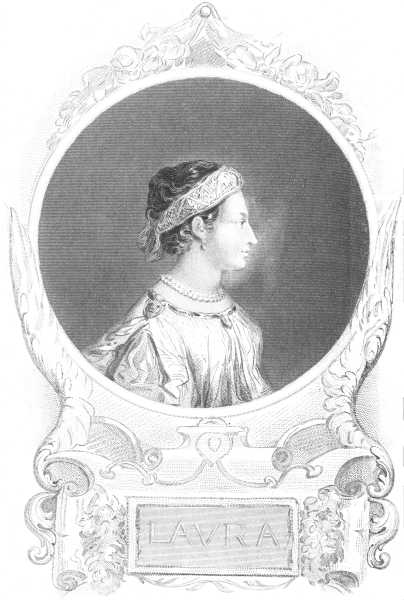
LAURA.