Volume 1 — THE FRANCO-BRITISH OFFENSIVE OF THE SOMME (1916).
Reading edition
THE OBJECTIVES OF THE OFFENSIVE.
In June, 1916, the enemy were the attacking party; the Germans were pressing Verdun hard, and the Austrians had begun a vigorous offensive against the Italians. It therefore became necessary for the Allies to make a powerful effort to regain the initiative of the military operations.
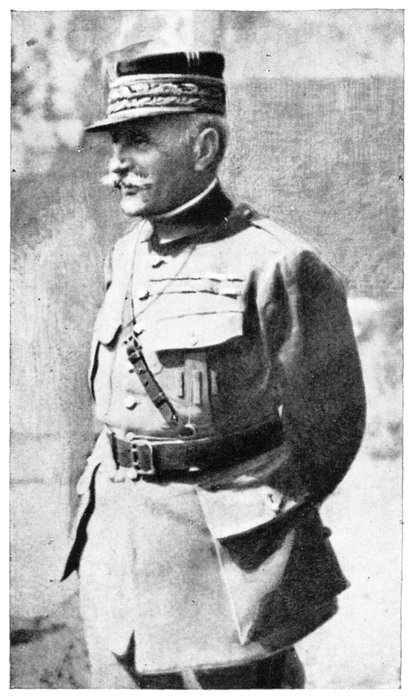
GENERAL FOCH, IN COMMAND OF THE FAYOLLE-MICHELER ARMY GROUP, DURING THE SOMME OFFENSIVE OF 1916.
The objectives of the Franco-British offensive were, to regain the initiative of the military operations; to relieve Verdun; to immobilise the largest possible number of German divisions on the western front, and prevent their transfer to other sectors; to wear down the fighting strength of the numerous enemy divisions which would be brought up to the front of attack.
Thanks to the immense effort made by the entire British Empire, their army had considerably increased in men and material, and was now in a position to undertake a powerful offensive.
Under the command of Field-Marshal Haig, two armies, the 4th (General Rawlinson) and the 2nd (General Gough) were to take part in the offensive.
In spite of the terrible strain France was undergoing at Verdun, the number of troops left before that fortress, under the command of General Pétain, who had thoroughly consolidated the defences, was reduced to the strictest minimum, and the 6th and 10th Armies, under the command of General Fayolle and General Micheler, respectively, were thus able to collaborate with the British in the Somme offensive.
Within a few days of the enemy's formidable onslaught of June 23 against the Thiaumont—Vaux front, in which seventeen German regiments took part (see the Michelin Guide: "Verdun, and the Battles for its Possession"), the Allied offensive was launched (July 1).
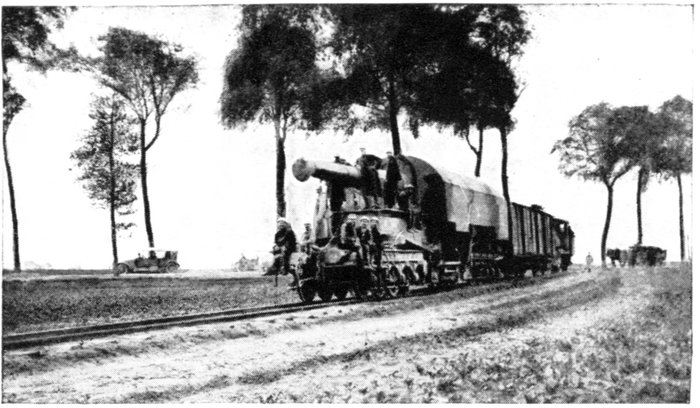
FRENCH HEAVY GUN ON RAILS.
The Theory, Methods and Tactics adopted
With both sides entrenched along a continuous front, the predominating problem was: How to break through the enemy's defences to the open ground beyond the last trenches, and then force the final decision.
In 1915, the Allies had endeavoured unsuccessfully to solve it; in 1916, the Germans, in turn, had suffered their severest check before Verdun.
Putting experience to profit, the Allies now sought to apply the methods of piercing on broader lines.
The defences having increased in strength and depth, the blow would require to be more powerful, precise, and concentrated as to space and time.
After the attacks of September, 1915, the French Staff set down as an axiom that "material cannot be combatted with men." Consequently, no more attacks without thorough preparation; nothing was to be left to chance.
The orders issued to the different arms, divisions, battalions, batteries, air-squadrons, etc., were recorded in voluminous plans of attack, the least of which numbered a hundred pages.
Thousands of aerial photographs were taken and assembled; countless maps, plans and sketches made. Everything connected with the coming drama was methodically arranged: the staging, distribution of the parts, the various acts.
Such was the intellectual preparation which, lasting several months, was carried out simultaneously with the equipping of the front line.
Equipping the Front Line
Preparing for a modern battle is a Herculean task. At a sufficient distance behind the front line immense ammunition and revictualling depôts are established. Miles of railway, both narrow and normal gauge, have to be put down, to bring up supplies to the trenches. Existing roads have to be improved, and new ones made. In the Somme, long embankments had to be built across the marshy valleys, as well as innumerable shelters for the combatants, dressing-stations, and sheds for storing the ammunition, food, water, engineering supplies, etc. Miles of deep communicating trenches, trenches for the telephone wires, assembly trenches, parallels and observation-posts had to be made. The local quarries were worked, and wells bored.
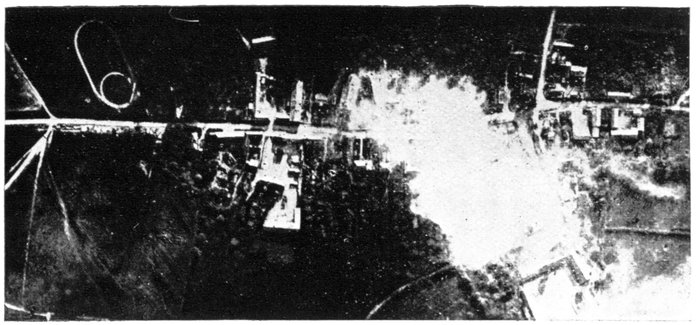
Ginchy, bombarded by the British on July 11, 1916.
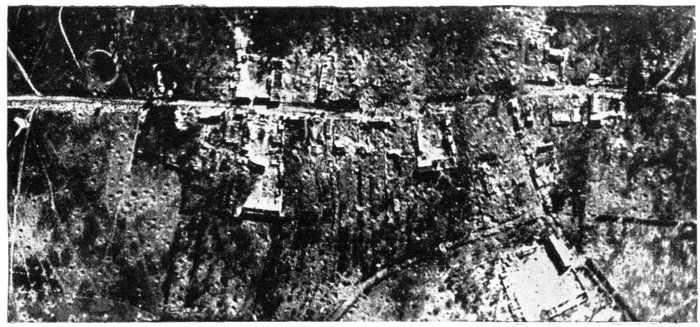
Ginchy, ten days later (July 21, 1916).
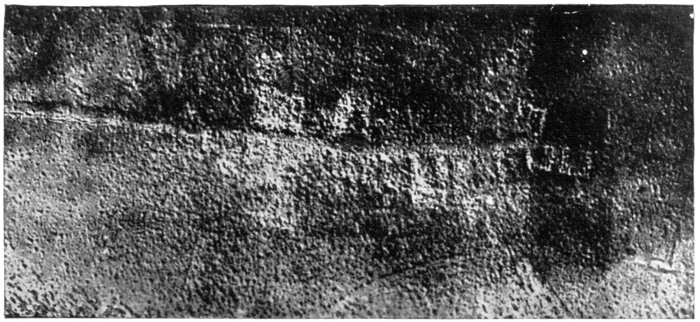
Ginchy, two days before capture by the British (Sept. 7, 1916). See p. 86.
ILLUSTRATING THE PROGRESSIVE DESTRUCTION AND LEVELLING OF A VILLAGE BY ARTILLERY.
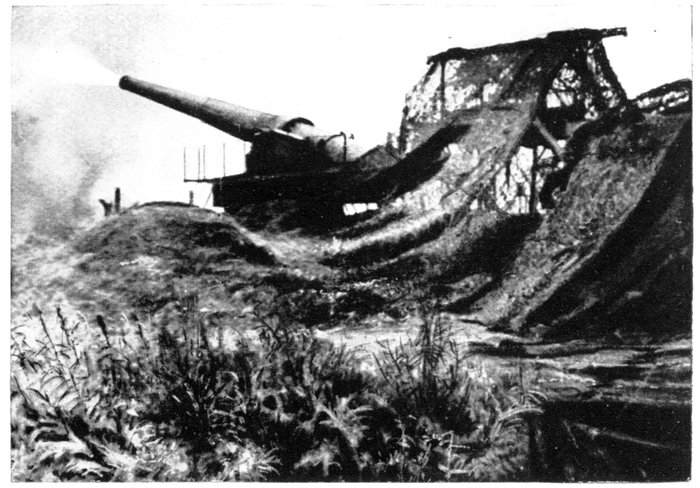
FIRING A 12-INCH LONG-RANGE GUN.
The Part Played by each Arm in the Different Phases of the Attack
In modern, well-ordered battle, it is the material strength which counts most. The cannon must crush the enemy's machine-guns. Superiority of artillery is an essential element of success.
According to the latest formula, "the artillery conquers, the infantry occupies."
At each stage of the battle, each arm has a definite role to play.
The Artillery
Before the battle, the artillery must destroy the enemy's wire entanglements, trenches, shelters, blockhouses, observation-posts, etc.; locate and engage his guns; hamper and disperse his working parties.
During the battle, it must crush enemy resistance, provide the attacking infantry with a protecting screen of fire, by means of creeping barrages, and cut off the defenders from supplies and reinforcements by isolating barrages.
After the battle, it must protect the attacking troops who have reached their objectives, from enemy counter-attacks, by barrage fire.
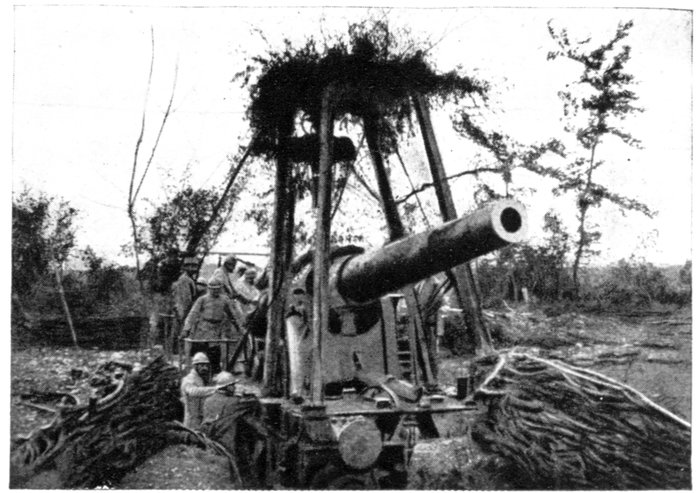
CAMOUFLAGED HEAVY GUN ABOUT TO FIRE.
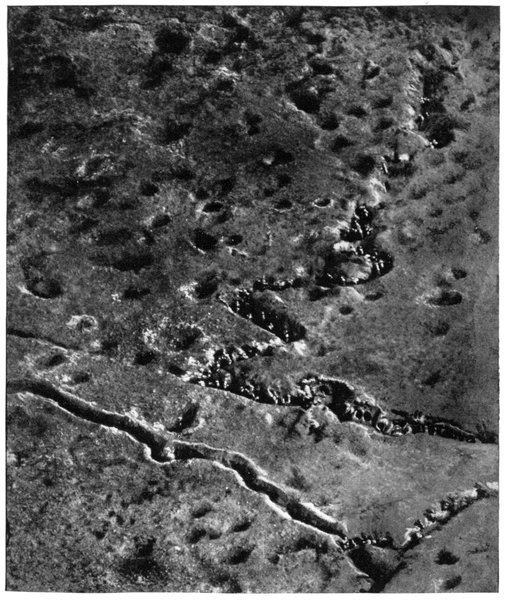
THE CAPTURE OF VERMANDOVILLERS.
The arrival of French reinforcements. Photographed from accompanying aeroplane at 600 feet (p. 128).
The Infantry
Before the battle, the attacking troops assemble first in the shelters, then in the assembling places and parallels made during the previous night. The battalion, company and section commanders survey the ground of attack with field-glasses.
During the battle, at a given signal, the assaulting battalions dash forward from the departure trenches, the first wave deployed in skirmishing order; the second and third, consisting of trench-cleaners, machine-gunners and supports, follow thirty or forty yards behind, in short columns (single file or two abreast). Reinforcements echeloned, and likewise in small columns, bring up the rear, 150 to 200 yards behind.
As a matter of fact, in actual fighting, each regiment attacks separately. The Commandant, realising the difficulties on the spot, must have in hand all the necessary means of success, the most powerful being the artillery, which accompanies and prepares each phase and development of the attack. Generally, the creeping barrage, timed beforehand, is loosed at the same moment of time as the assaulting wave. The infantry follows as closely as possible.
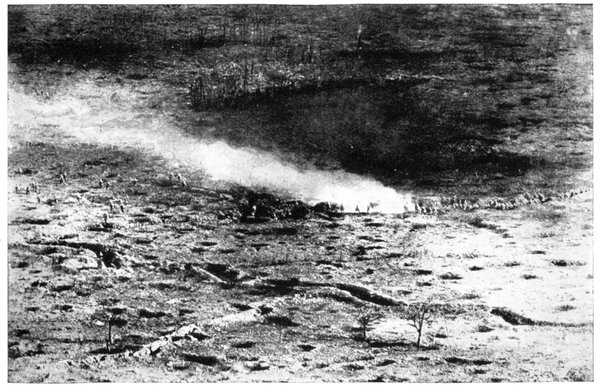
INFANTRY ADVANCE.
The attacking waves mark their advance with Bengal lights.
Constant and perfect liaison is necessary between the infantry and artillery. This is ensured by means of runners, pennons, panels, telephones, optical telegraphy, signals, rockets, Bengal lights, etc. A similar liaison is ensured between the various attacking units, on the right, left and behind. Action must be co-ordinated, an essential point on which the G.H.Q. always strongly insist.
As soon as the enemy perceives the assaulting waves, every effort is made to scatter them by means of artillery barrage and machine-gun fire, asphyxiating gas, grenades and liquid fire, so that generally the storming troops cross "no man's land" through a veritable screen of fire. The enemy's fire likewise extends to the first-line trenches, to cut off the first waves from their supports.
Without stopping at the enemy's first-line organisations, the first attacking wave overwhelms the position, annihilates all defenders encountered, and only comes to a halt at the assigned objective. The following waves support the first one, and deal with points of resistance. The trench-cleaners or moppers-up "clean out" the position of enemy survivors with bayonet, knife and grenade, in indescribable death grapples. Progress is slow along the communicating trenches, and in the underground shelters, tunnels, cellars and ruins, where the defenders have taken refuge. From time to time hidden machine-guns are unmasked and have to be captured.
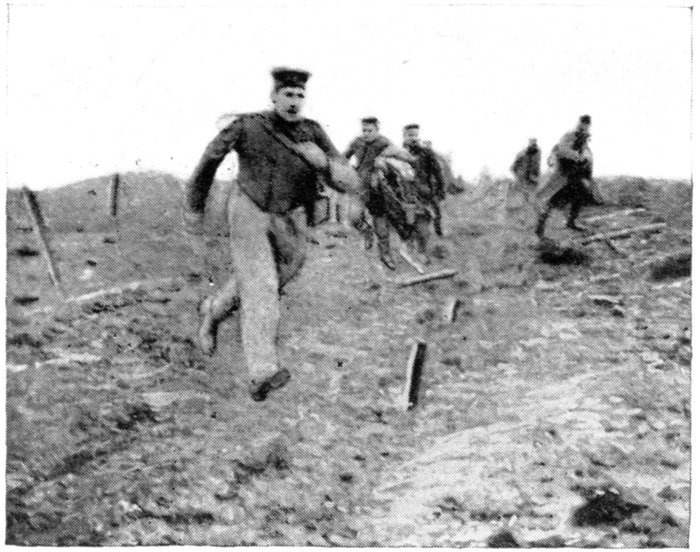
GERMAN PRISONERS HURRYING TO THE ALLIES' LINES.
After the attack.—As soon as the "cleaning out" is finished, any prisoners are sent to the rear, being often forced to cross their own barrage-fire. Meanwhile the other defenders will have withdrawn to their positions of support.
Having reached their objective, the assaulting troops must hold their ground. Sentries are posted, while the rest of the men consolidate the position in view of the inevitable counter-attack, which is generally not long in coming.
Under bombardment, the levelled trenches have to be remade, the shell-holes organised and flanked with machine-guns, and communications with the rear ensured for the bringing up of stores and, if necessary, reinforcements.
The assaulting troops may thus reach their objectives without excessive losses or nervous strain, and may be kept in line for a second and third similar effort, after a few days' rest, during which the artillery will have destroyed the next enemy positions.
The Flying Corps
Before the battle.—Metaphorically speaking, the Flying Corps (aeroplanes and observation balloons) is the "eye" of the High Command, which largely depends on it for precise information regarding the enemy's movements and positions. It likewise regulates the artillery fire, and furnishes that arm with photographs, showing exactly the progress made by the destruction bombardments. Another equally important duty is to "blind the enemy" by destroying their aeroplanes and observation balloons.
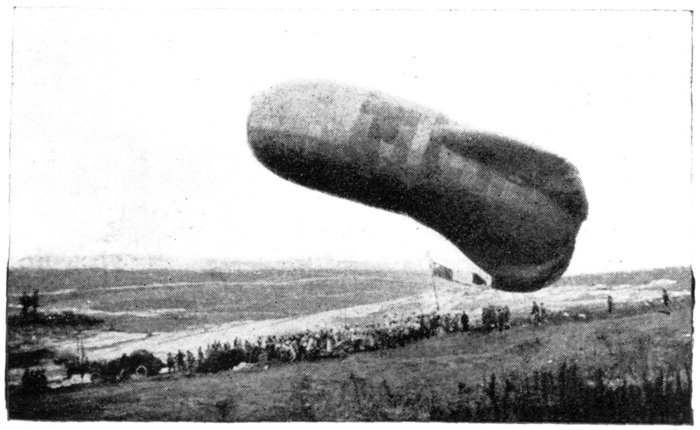
OBSERVATION BALLOON.
During the battle.—Flying low, sometimes within a few hundred feet of the ground, the airmen furnish invaluable information, and often photographs, showing the progress of the attack, the terrain being marked out with panels and Bengal lights. They also often attack the enemy with their machine-guns.
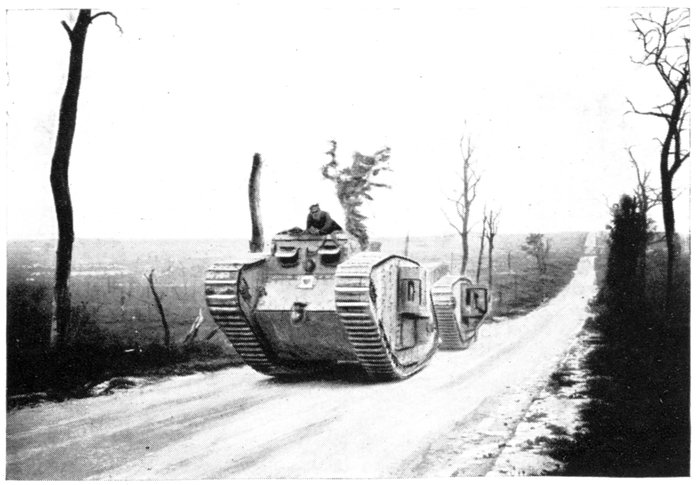
BRITISH TANKS MAKE THEIR DÉBUT.
After the battle.—The massing of enemy troops for counter-attacks is signalled to the artillery, which regulates its barrages accordingly, then, working in liaison, the two services "prepare" the ground for the next attack.
These tactics were, gradually perfected on the Somme battlefields, where the Germans learned by costly experience to improve their defences.
The offensive methods acquired also greater suppleness, and the new arm—the tank—came to the relief of the infantry.
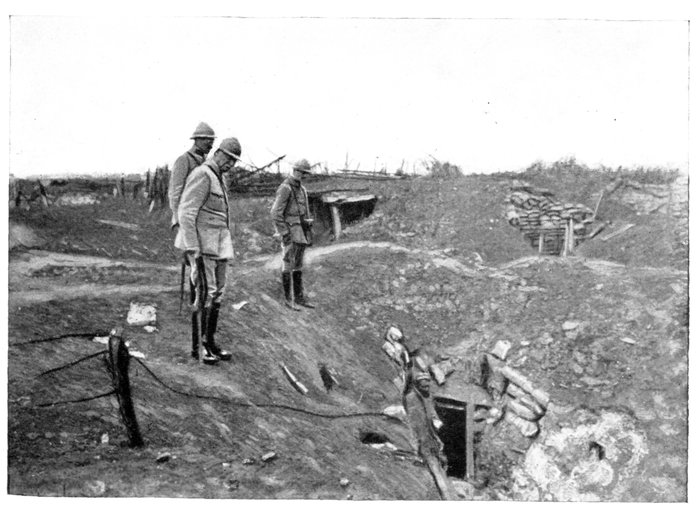
GENERAL FAYOLLE INSPECTING THE CONQUERED LINES.
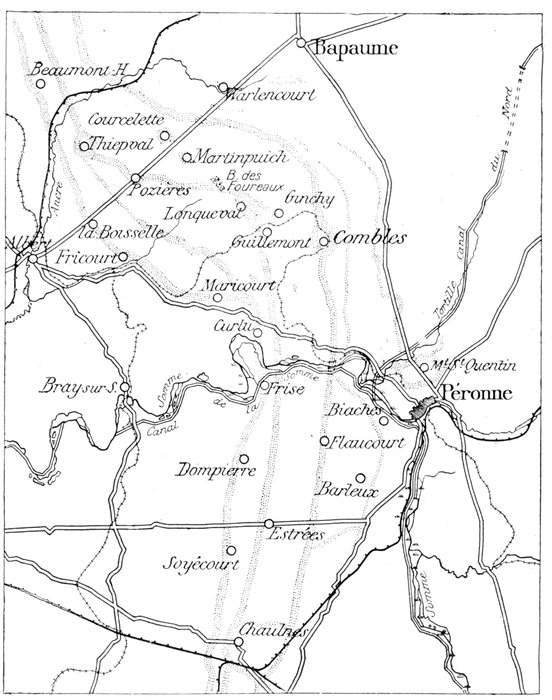
THE DOTTED ZONES REPRESENT THE GERMAN LINES OF RESISTANCE.
THE SOMME BATTLEFIELD.
The battle extended over the Picardy plateau, south and north of the Somme. Before the war, the region was rich and fertile, the chalky ground having a covering of alluvial soil of variable thickness.
The slopes of the undulating hills and the broad table-lands were covered with immense fields of corn, poppies and sugar beet. Here and there were small woods—vestiges of the Arrouaise Forest, which covered the whole country in the Middle-Ages. There were scarcely any isolated houses, but occasionally a windmill, farm or sugar-refinery would break the monotony of the landscape.
The villages were surrounded with orchards, and their low, red-tiled houses were generally grouped around the church. The plateau was crossed by wide, straight roads bordered with fine elms.
The war has robbed the district of its former aspect. The ground, in a state of complete upheaval, is almost levelled in places, while the huge mine-craters give it the appearance of a lunar landscape. The ground was churned up so deeply that the upper covering of soil has almost entirely disappeared and the limestone substratum now laid bare is overrun with rank vegetation. From Thiepval to Albert, Combles and Péronne, and from Chaulnes to Roye, the ground was so completely upturned as to render it useless for agriculture for many years to come, and a scheme to plant this area with pine trees is now being considered.
Nearly all the villages were razed, and now form so many vast heaps of débris. This battlefield is a striking example of the total destructions wrought by the late war.
The Topography of the Ground and the Enemy Defence-works
North of the Somme.—The battle zone, bounded by the rivers Ancre, Somme and Tortille—the latter doubled by the Northern Canal—forms a strongly undulating plateau (altitude 400-520 feet), which descends in a series of hillocks, separated by deep depressions, to the valleys of the rivers (altitude 160 feet). The Albert—Combles-Péronne railway runs along the bottom of one of these depressions.
The higher parts of the plateau form a ridge, one of whose tapering extremities rests on the Thiepval Heights, on the bank of the Ancre. Running west to east, the ridge crosses the Albert-Bapaume road at Pozières, passes Foureaux Wood, then north of Ginchy. It is the watershed which divides the rivers flowing northwards to the Escaut and southwards to the Somme.
The second line of German positions was established on this ridge, while the first line extended along the undulating slopes which descended towards the Allies' positions. There were other enemy positions on the counter-slopes behind the ridge.
These positions took in the villages and small woods of the region, all of which, fortified during the previous two years, bristled with defence-works and machine-guns.
Some of these villages (Courcelette, Martinpuich, Longueval, Guillemont and Combles), hidden away in hollows, were particularly deadly for the Allies; the defenders, unseen, were able to snipe the assailants as they appeared on the hill tops. The Allies had to encircle these centres of resistance before they were able to enter them.
South of the Somme.—The battle zone, bounded by the large circular bend of the Somme at Péronne, formed a kind of arena. The vast, flat table-lands of the Santerre district, separated by small valleys, descend gently towards the large marshy valley of the Somme, in which the canal runs parallel with the river.
Owing to the narrowness of this zone, the Germans were forced to establish their positions close behind one another, and the latter were therefore in danger of being carried in a single rush. On the other hand, the assailants' rapid advance was first hampered, then held by the marshy valley, which prevented them from following up their brilliant initial success.
During the battle, the Germans, driven from their first positions, hastily prepared new ones, and clung desperately to the counter-slopes of the hills which descend to the valleys.
The Different Stages of the Offensive
The offensive of the Somme, the general direction of which was towards Cambrai, aimed at reaching the main northern line of communications, by opening a gap between Bapaume and Péronne.
The main sector of attack—between the Ancre and the Somme—was flanked on either side by diversion sectors north of the Ancre and south of the Somme.
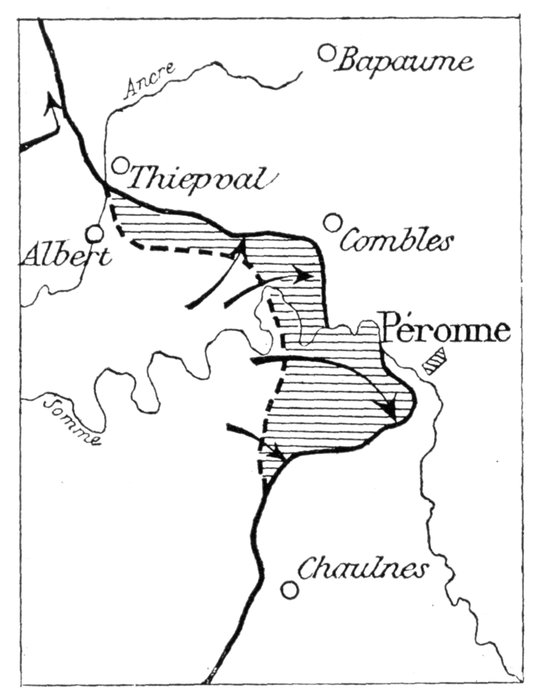
ATTEMPTED BREAK-THROUGH.
A breach was made south of the Somme, but the marshes prevented development, while to the north, the offensive was held on the Ancre lines.
Putting to profit the German failure at Verdun, where the enemy masses, after appalling sacrifice of human life, gradually became blocked in a narrow sector (7½ miles in width), the Allies widened their front of attack.
After an effective "pounding" by the guns which annihilated all obstacles to a considerable depth, the assaulting waves went forward simultaneously along a 24-mile front, feeling for a weak sector where a breach could be made. The attack was a complete success in the diversion sector, south of the Somme, thanks to the nature of the ground, but, as previously stated, it was not possible to follow it up immediately.
North of the Somme the British offensive was held.
Warned by the immense preparations, the Germans were not taken unawares. Their reserves flowed in and resisted on new defensive positions. The advance of the French 6th Army was slowed down to correspond with that of the British.
The Battle of Attrition
(See the sketch-maps on pages 13, 18, 27.)
This attempted break-through (July 1-12) soon changed into a battle of attrition (July 14, 1916, to March, 1917).
The Allies' plan now was gradually to shatter the German resistance by a continuous push along the whole line, and by vigorous action at the various strong-points.
The gains of ground diminished, but the German reserves were gradually used up. In spite of their hastily constructed system of new defences, the Germans realised the precarious nature of their new lines, and were forced, in March, 1917, to fall back and shorten their front.
THE PHASES OF THE BATTLE OF ATTRITION.
NORTH OF THE SOMME.
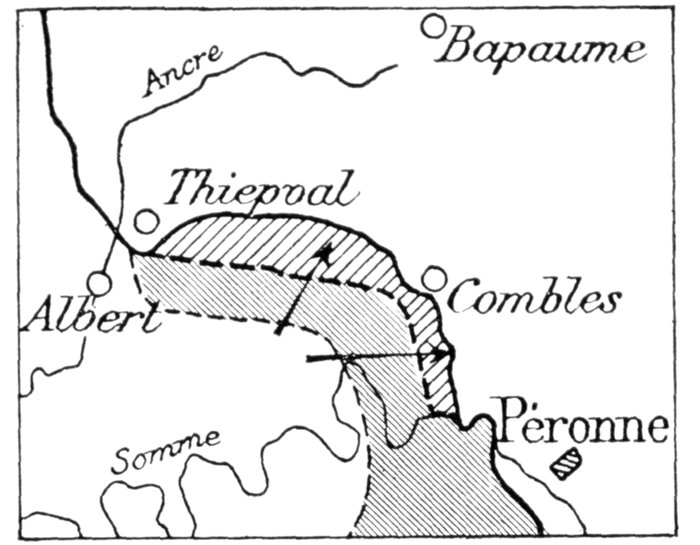
The Franco-British troops enlarge the conquered positions and attack the centres of resistance: Combles and Thiepval (July 14—September 1).
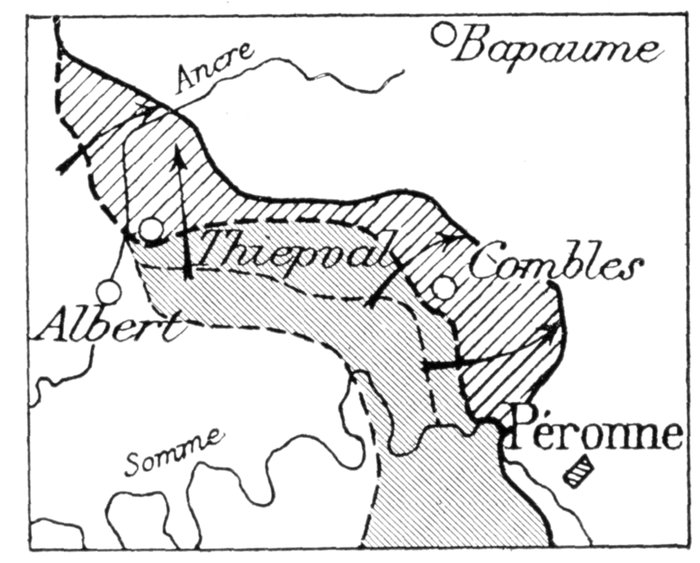
Combles and Thiepval turned and conquered, after being surrounded (September—November).
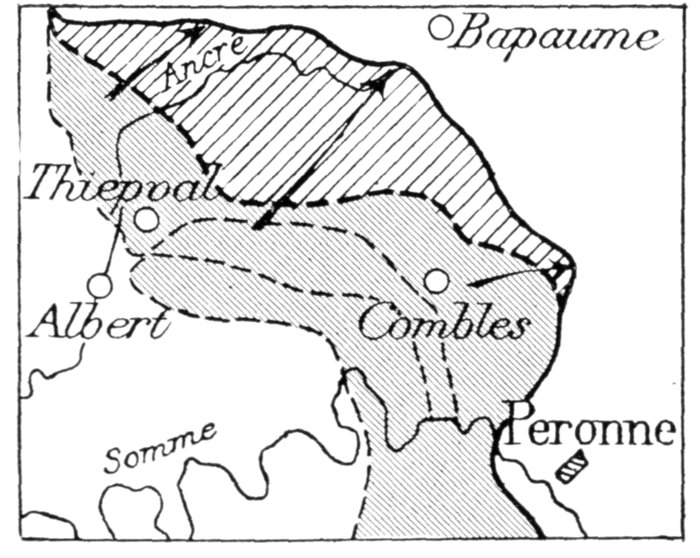
The Allies advance toward their main objectives: Bapaume and Péronne (November—March).
SOUTH OF THE SOMME.
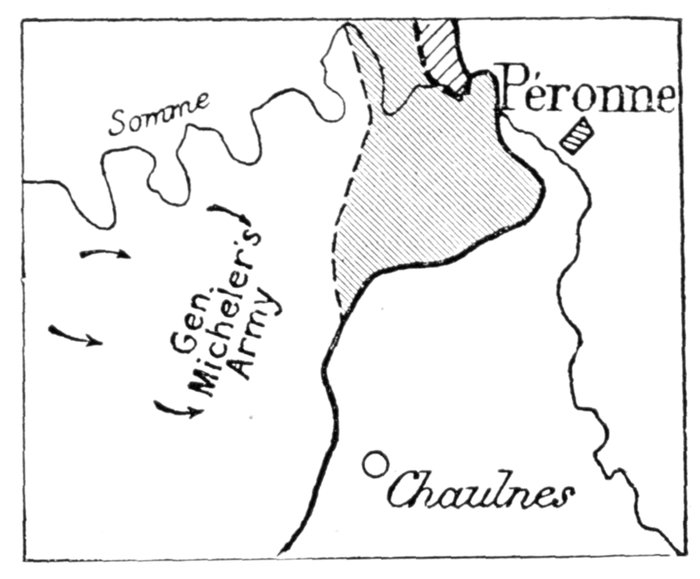
The 6th Army (French) held by the Somme Marshes, took up its new position. The 10th Army (French) assembled on its right (August—September).
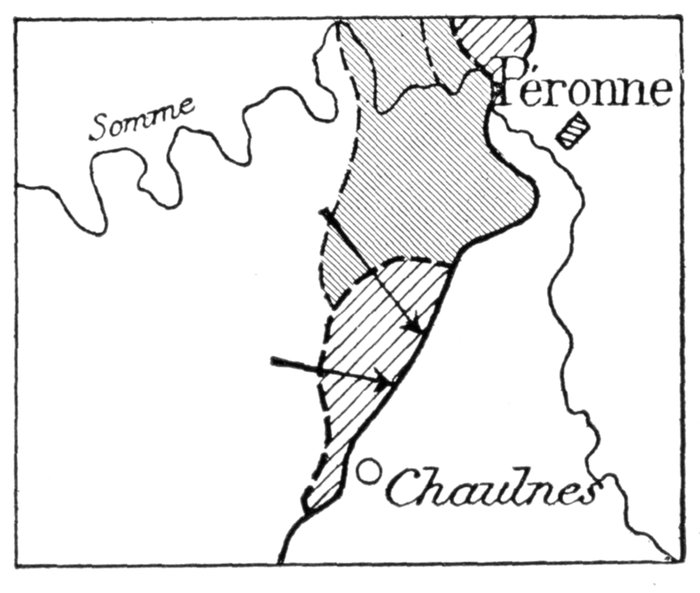
The 10th Army attacked, but was held in front of Chaulnes (September—October).
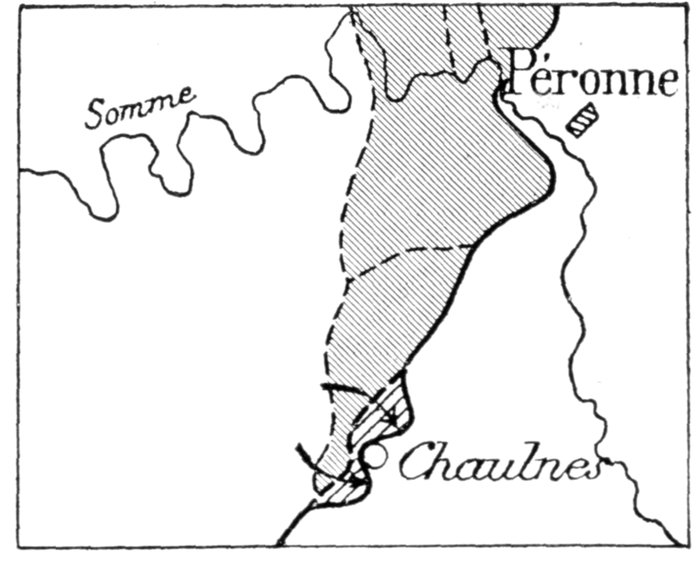
The 10th Army (French) failed to encircle Chaulnes, and consolidated its new positions (October—November).
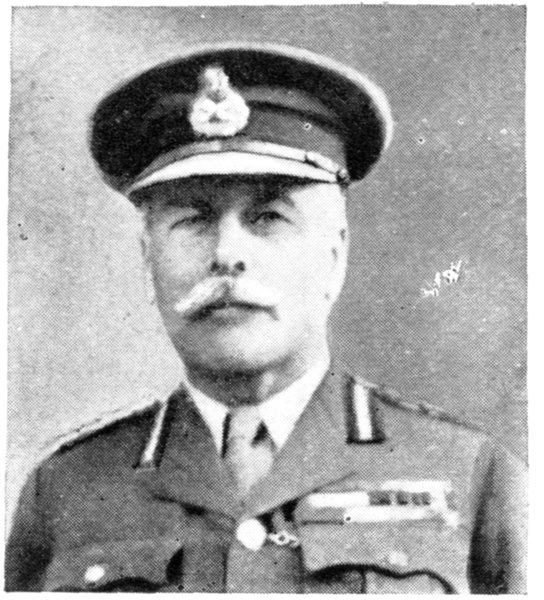
FIELD-MARSHAL HAIG.
THE ATTEMPTED BREAK-THROUGH.
The British Attack
On July 1, the front of attack, about 21 miles long, extended from Gommécourt to Maricourt.
The attack was made by the 4th Army (Gen. Rawlinson), comprising five army corps, and by three divisions of the right wing of the 3rd Army (Gen. Allenby).
The main sector of attack, lying between the Ancre and Maricourt, forms a 90° salient; the summit of which encircled Fricourt.
The first German positions included Ovillers, La Boisselle, Fricourt, Mametz and Montauban, and formed the objective of the attack.
The latter, directed generally towards Bapaume, was delivered against both flanks of the salient.
From the start, the attack was held before the western side of the salient, in spite of the great heroism of the British.
The right wing, on the southern side, succeeded in carrying the first German position.
Photo, Russell, London.
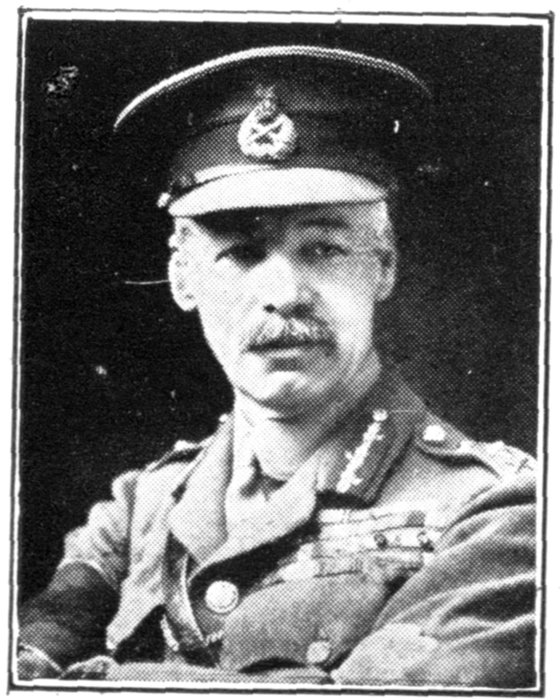
GENERAL RAWLINSON.
Photo, F. A. Swaine, London.
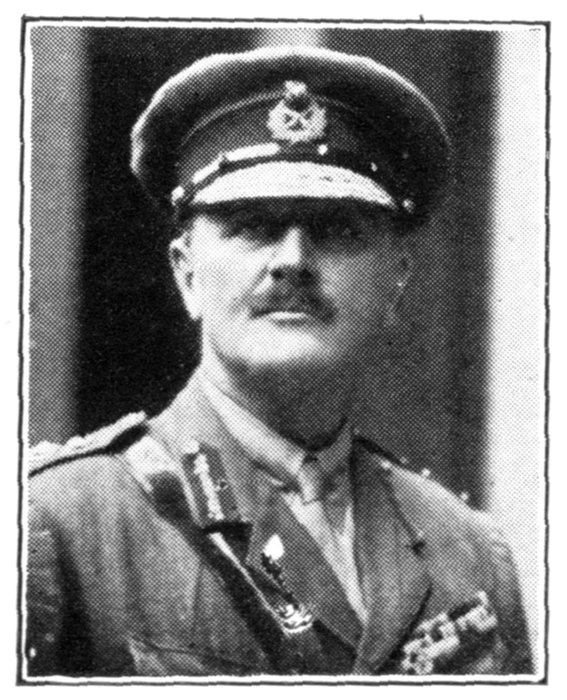
GENERAL ALLENBY.
In face of this result, Field-Marshal Haig decided to push home the attack on his right (three corps under Gen. Rawlinson), while his left (two corps under Gen. Gough) would continue to press the enemy, and thus form the pivot of the manœuvre.
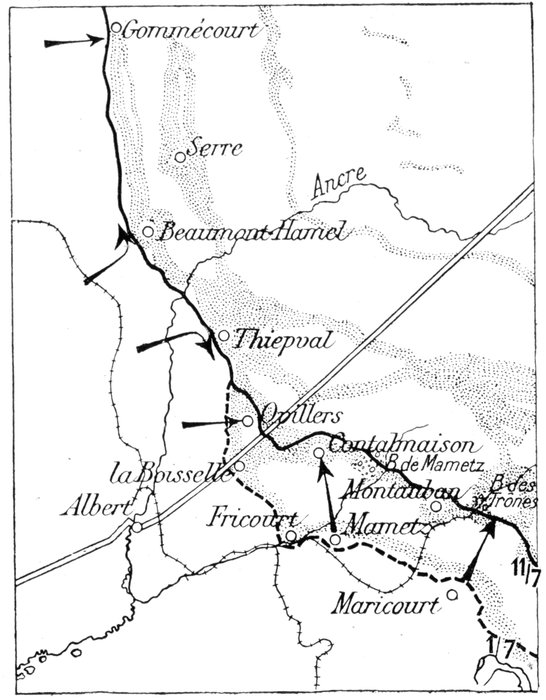
THE DOTTED ZONES ON THIS AND THE FOLLOWING SKETCH-MAPS REPRESENT THE GERMAN LINES OF RESISTANCE.
The first assaults on July 1 gave the British Montauban and Mametz, while Fricourt and La Boisselle wore encircled and carried on July 3. Progress continued on the right, Contalmaison and Mametz Wood, reached on the 5th, were carried on the 11th.
Photo, "Daily Mirror" Studios.
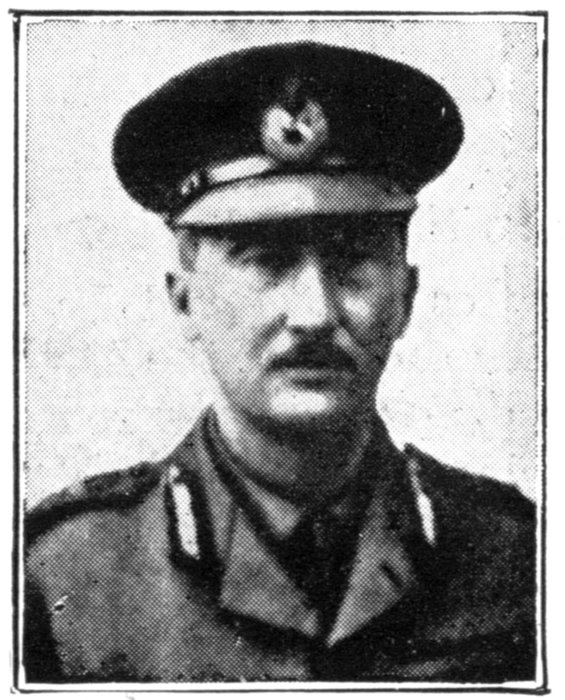
GENERAL GOUGH.
On the extreme right, the British, in liaison with the French, reached the southern edges of Trônes Wood, and came into contact with the second German positions. Over 6,000 prisoners were taken. The Germane launched incessant counter-attacks without result.
In the diversion sector, north of the Ancre, the initial successes at Gommécourt, Serre and on the Ancre could not be followed up.
The Germans continued to hold Beaumont-Hamel and Thiepval in force.
The French Attack
The French 6th Army (Gen. Fayolle) attacked along a ten-mile front, astride of the Somme, from Maricourt to Soyécourt, in the general direction of Péronne.
North of the Somme.—The 20th Corps had to conquer the German first position, consisting of three or four lines of trenches connected by numerous boyaux to the fortified woods and village of Curlu.
This position was carried in a single rush on July 1, and consolidated on the three following days.
The second and third German positions were as strong as the first, and included the villages of Hardecourt and Hem. On the 5th, Hem and the plateau which dominates the village to the north were taken. On the 8th, the French, in liaison with the British, first carried, then progressed beyond, Hardecourt.
From July 1 to 8, the 20th Corps captured the first and second German positions and consolidated their conquest on the following days.
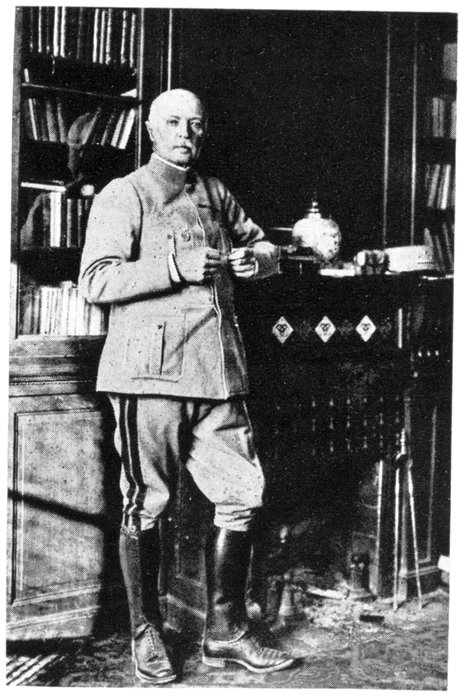
GENERAL FAYOLLE.
South of the Somme.—The attack was launched on July 1, two hours later than that on the northern bank. With fine dash, the 1st Colonial Corps and a division of Brittany reserves carried the first German position, including the villages of Dompierre, Becquincourt and Fay.
On the 2nd, the movement was continued on the left. Frise, outflanked from the south, was captured, Méréaucourt Wood encircled, and Herbécourt carried by a frontal attack, after being turned from the north. The approaches to Assevillers and Estrées were reached. The northern part of the second position was captured.
On the 3rd, the advance continued on the left. Flaucourt, in the third position, was carried in the course of an extraordinarily daring coup-de-main. Assevillers likewise fell.
Belloy was captured on the 4th; the divisional cavalry patrolled freely as far as the Somme, between Biaches and Barleux.
Biaches village and La Maisonnette observation-post fell on the 9th and 10th. The horses of the African Mounted Chasseurs were watered in the Somme, and the Zouaves gathered cherries in the suburban gardens of Péronne.
During these ten days the French troops, by carrying out a vast turning movement on the left, towards the south-east, had pierced all the German positions. A breach had been made, but the marshy valley of the Somme in this diversion sector made it very difficult to follow up the success; moreover, the objectives assigned to these troops did not provide for such exploitation.
The French attack had been carried out with great dash. In addition to the many lines of defences, villages and fortified woods conquered, 85 guns, 100 machine-guns, and 26 minenwerfer were captured, and over 12,000 prisoners, including 235 officers, taken.
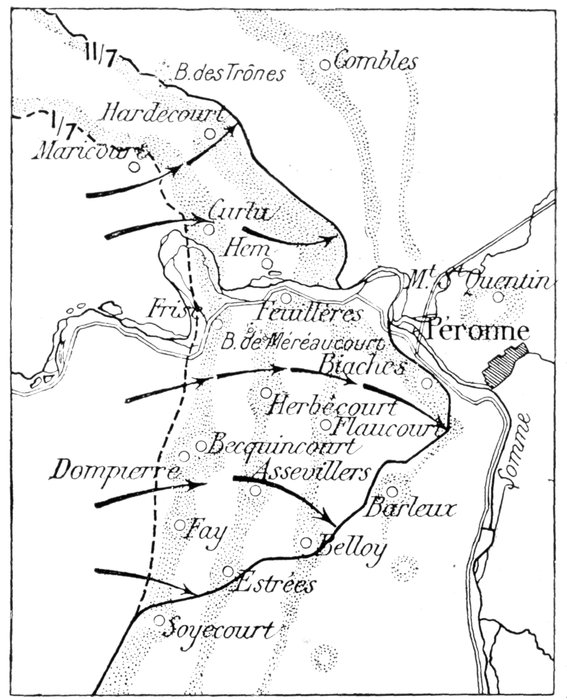
The gallant troops, which had thus inflicted a stinging defeat on the enemy, included the famous 20th Corps, which, a few months before, in a veritable inferno, had barred the road to Verdun.
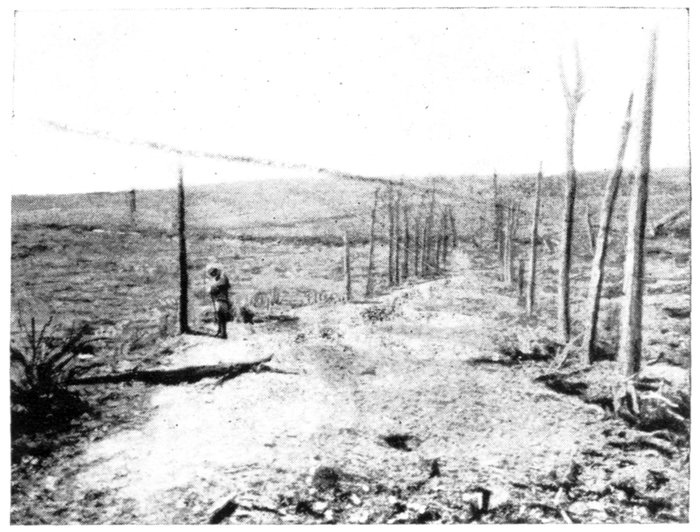
THE SITE OF MONACU FARM ON THE MAUREPAS ROAD NEAR HEM WOOD.
THE BATTLE OF ATTRITION (North of the Somme).
In the main sector of attack the German line had not been completely broken. This attempt to break through was succeeded by a battle of attrition, in the course of which the Allies, working in close collaboration, dealt the enemy repeated blows.
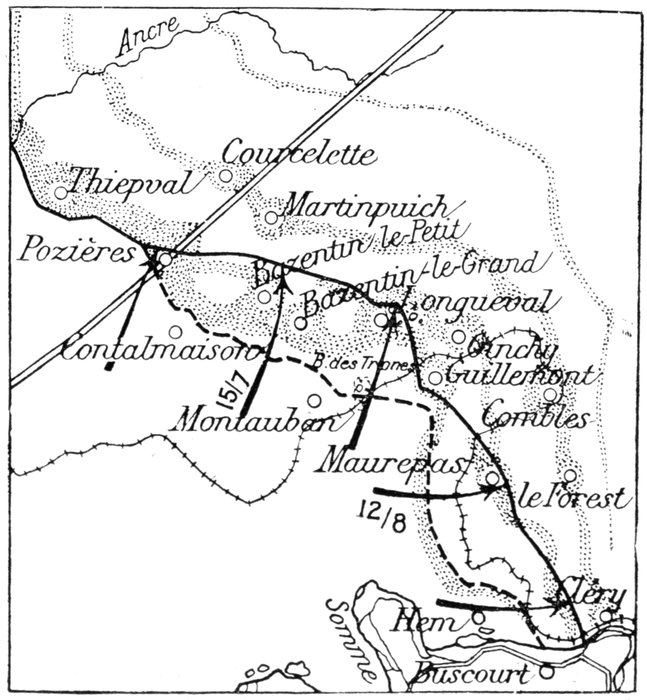
North of the Somme.—After July 11, the Allied front between the Ancre and the Somme, held by the strong German positions of the Thiepval Plateau, passed in front of Contalmaison and Montauban. On the southern edges of Trônes Wood it turned southwards towards Hem.
This line formed a salient to the east of Trônes Wood—a narrow space bristling with guns. From the high ground of their second position in the north, and that of Longueval, Ginchy and Guillemont, the German firing line formed a semi-circle round this salient, which was threatened by incessant counter-attacks. While maintaining the pressure on the west, it became necessary for the Allies to widen the angle and enlarge the front, or, in other words, to obtain greater freedom of movement.
This was the aim of the various Franco-British thrusts during the second fortnight of July and in August.
1.—Widening the Front
(July 14—September 1.)
In order to support the forthcoming French thrust towards the east, a British attack to the north-east was deemed necessary.
The German second positions from Contalmaison to Trônes Wood, and the crests of the ridge of the plateau formed the objective.
On July 14, the 4th British Army, by a clever manœuvre, took up positions in the dark at attacking distance. Trônes Wood was carried on the first day. Longueval, stormed from east and west, was partly captured. In the centre, Bazentin-le-Grand with its wood and Bazentin-le-Petit were taken. To the left, the southern outskirts of Pozières were reached.
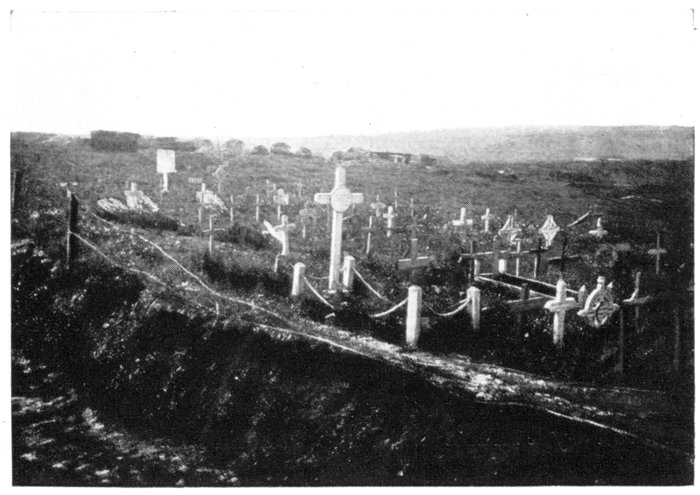
BRITISH GRAVES IN TRÔNES WOOD (p. 85).
On July 15-16, the British progressed beyond the German second position—carried along a three-mile front—and established their advance-posts in the vicinity of the German third position.
By this time the Germans had recovered from their set-back of the 14th and offered an aggressive defence. Counter-attacking at the point of the salient in the Allied lines at Delville Wood, they succeeded in slipping through, but they were held in front of Longueval.
On the 20th and 23rd, the Allies delivered a general attack. The British 4th Army was now confronted by the enemy in force all along the line. However, the village of Pozières, one of the strong-points of Thiepval Plateau, to the west, was carried by the Australians on July 25. The French advanced their lines as far as the ravine, in which runs the light railway from Combles to Cléry.
Hidden in a hollow of the ground, Guillemont resisted the British assaults of July 30 and August 7.
On August 12, the French 1st Corps continued its thrust eastwards, turning Guillemont from the south. The Zouaves and 1st Cambrai Infantry Regiment entered Maurepas.
More to the south, the 170th Infantry captured the fortified crest lying 1 km. 500 m. west of Cléry.
The British hung on to the western outskirts of Guillemont.
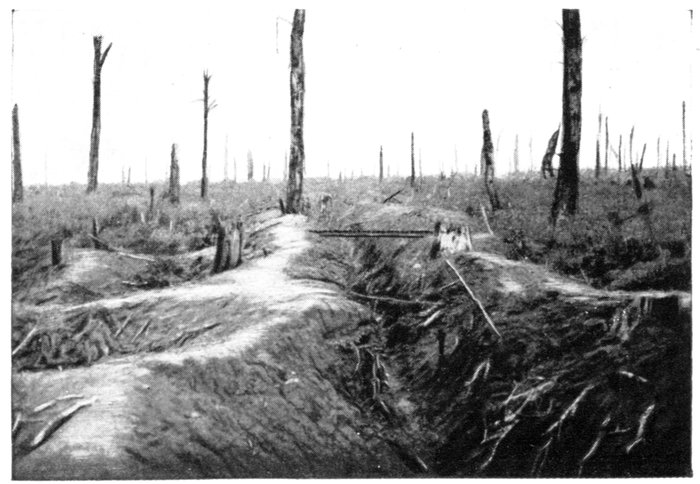
DELVILLE WOOD NORTH OF LONGUEVAL (p. 60).
2.—The Surrounding and Capture of the Main Centres of Resistance
On September 1, the British lines, still hanging on to the southern slopes of the Thiepval Plateau, followed the crest of the ridge north of the villages of Thiepval, Bazentin-le-Petit and Longueval, in front of the outskirts of Delville Wood, were then deflected south-east and joined with the French lines in the ravine of the Combles railway. The French lines surrounded Maurepas, then followed the road from Maurepas to Cléry. Thiepval and Combles seemed impregnable.
Instead of making a frontal attack against these positions, the Allies first turned and then surrounded them by a succession of thrusts.
In addition to their successive lines of defence-works, which included a number of villages, the Germans had transformed the little town of Combles, lying entirely hidden from view at the bottom of an immense depression—into a redoubtable fortress. A large garrison was safely sheltered in vast quarries connected by tunnels with the concrete defence-works.
The Surrounding and Capture of Combles
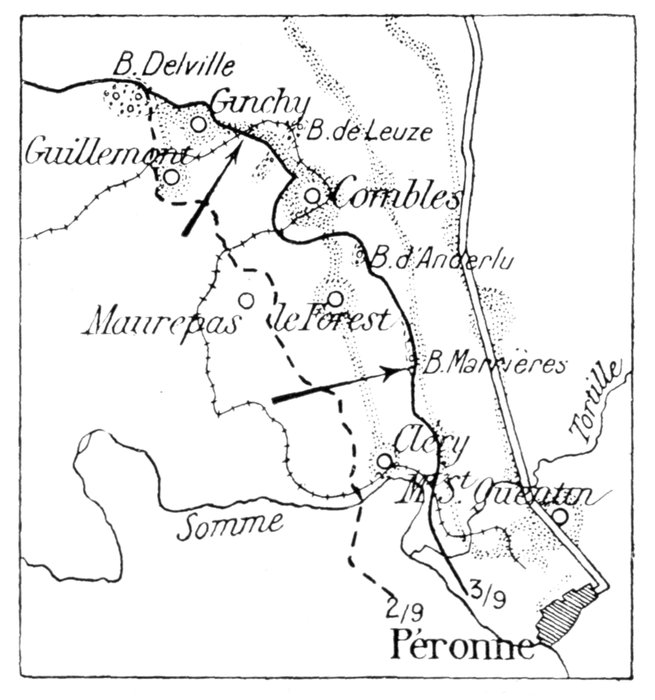
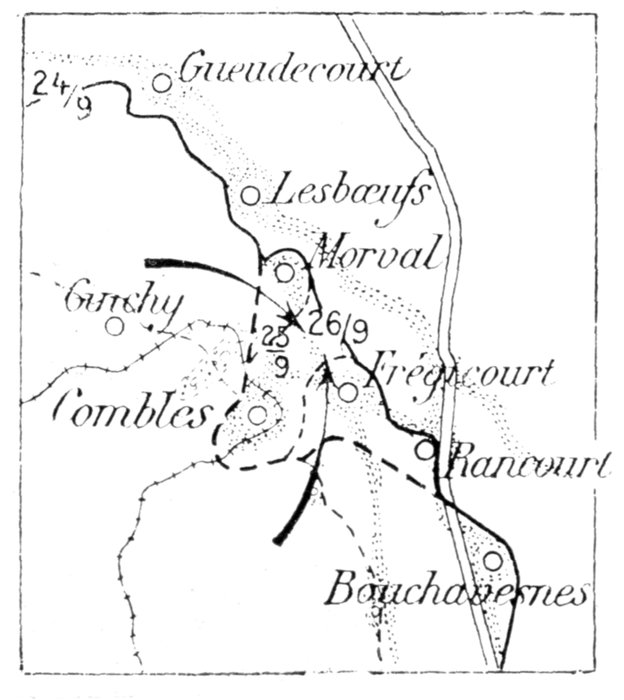
In September, four Allied thrusts were necessary to encircle and capture Combles (see p. 80).
The Attack of September 3
Ginchy and Guillemont formed the British objective. On the 3rd, in spite of machine-gun fire from Ginchy, the Irish carried Guillemont, which had resisted for seven weeks. Progressing beyond the village they reached and captured Leuze Wood, 1 km. 500 m. west of Combles. On the 9th, they enlarged their gains by the conquest of Ginchy (see p. 4).
The German positions connecting Combles with Le Forest and Cléry formed the French objective.
This position—defended by four German divisions—was carried with magnificent dash on the 3rd, from near Combles to the Somme.
On the 5th, the French progressed beyond the position and reached the following line: Anderlu Wood, north-east of Le Forest, Marrières Wood, and the crest north-east of Cléry; 2,500 prisoners were taken.
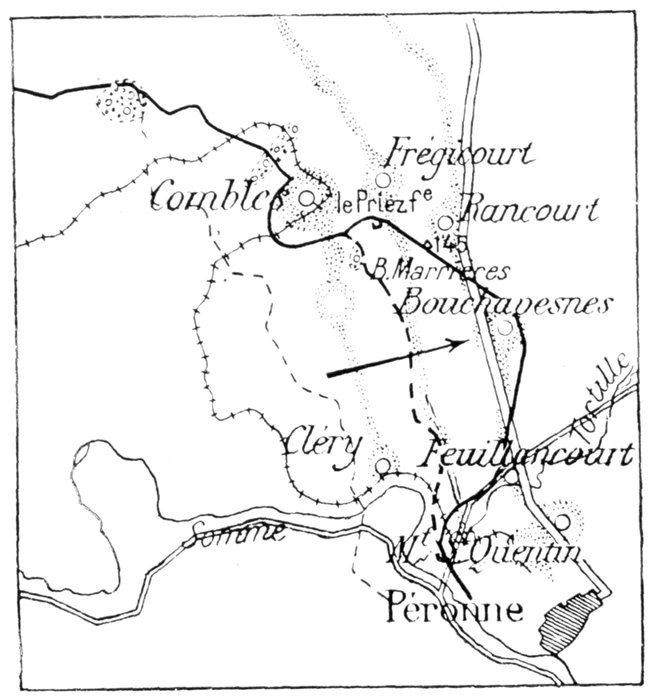
The French Attack of the 12th
Attacking again, the French were now confronted by two parallel lines of defences. The first position (known as the Berlingots' trenches) ran through Frégicourt, Le Priez Farm and Marrières Woods. The second position, along the National road, 2 km. behind the first, rested on Rancourt, Feuillancourt and the Canal du Nord, taking in Bouchavesnes.
Following close behind the creeping barrage, the attacking troops carried the Berlingots' trenches in half an hour. From there, the left wing attacked and captured Hill 145, and advanced as far as the National road, between Rancourt and Bouchavesnes. The right wing reached the Valley of the Tortille, opposite Feuillancourt.
Bouchavesnes, although not included in the objectives assigned to the storming troops, was next attacked, and at 8 p.m. Bengal lights, announcing its capture, were burning in the ruins of the village.
On the 13th, the French crossed the National road. The enemy showed great nervousness, and brought up three new divisions.
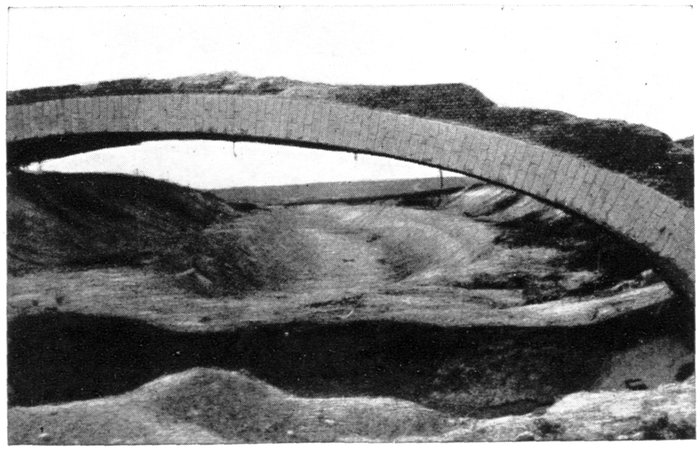
THE CANAL DU NORD.
The British Attack of September 15
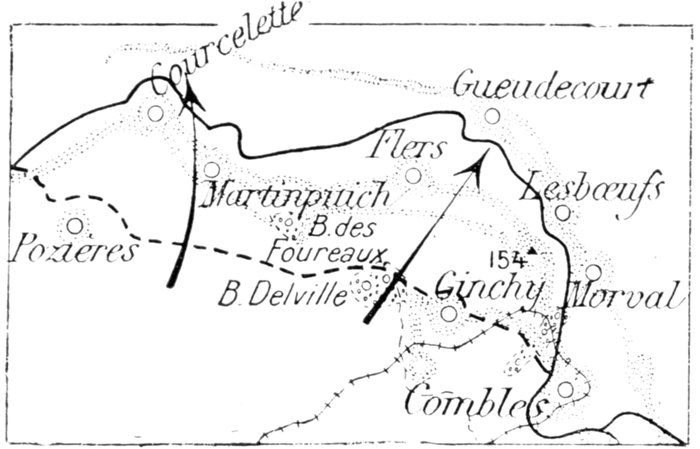
The German positions of Foureaux Wood, Hill 154 and Morval were the objectives of the attack.
For the first time tanks accompanied the storming waves, giving the enemy an unpleasant surprise, which contributed largely to the victory.
In the centre, the tanks entered Flers before noon; the troops advanced beyond the village and established themselves. On the left, Foureaux Wood, bristling with strong-points and redoubts, and on the right, Hill 154 were carried, and the Morval—Lesbœufs—Gueudecourt line reached.
In consequence of this brilliant success of the British right, the attack was extended on the left; the tanks entered Martinpuich and Courcelette. In a single day the British advanced 2 km. along a 10 km. front, and captured 4,000 prisoners.
The enemy threw two more divisions into the battle, and fiercely counter-attacked the salient formed by the French lines at the Bapaume-Péronne road. After getting a footing in Bouchavesnes on September 20, they were driven out at the point of the bayonet.
The General Attack of September 25, and Capture of Combles
The Allied front line moved forward again, to complete the investment of Combles.
Rancourt and Frégicourt fell on the 25th, in the French attack; Morval was captured by the British.
The encirclement of Combles was complete, and the enemy had already partially evacuated the place. On the 26th, the British entered the fortress from the north, the French from the south, and captured a company of laggards.
The Turning and Capture of Thiepval Plateau
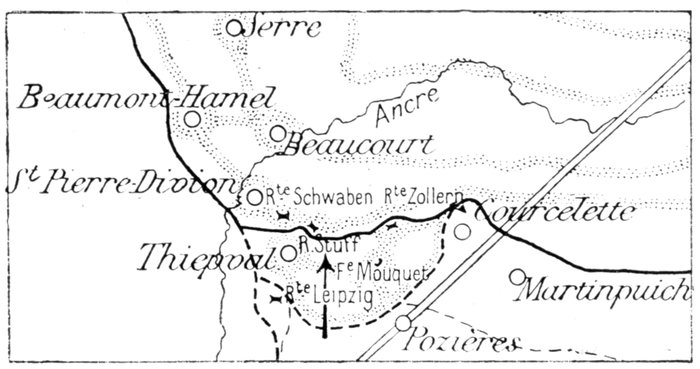
West of the lines of the 4th British Array, and dominating the valley of the Ancre, the powerfully fortified Thiepval Plateau still remained un-captured. This very strong system of defences comprised the village, Mouquet Farm, and the Zollern, Schwaben and Stuff Redoubts.
In July, the British had gained a footing in the Leipzig Redoubt, which formed the first enemy positions south of the Plateau. In August, Pozières had been carried by the Australians. On September 15, the British captured Martinpuich and Courcelette, and progressed beyond the plateau to the east.
The Attack of September 26
On September 26, the day Combles was taken, an attack was made against this formidable plateau. Mouquet Farm and Zollern Redoubt fell, and on the 27th, Thiepval was captured (see p. 48).
The British carried the trenches connecting the Schwaben and Stuff Redoubts, but the enemy still clung to the northern slopes of the plateau which descends towards the Ancre.
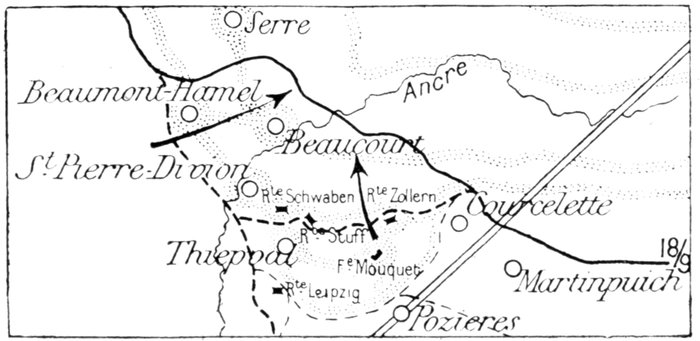
The Attack of November 13
The German lines now formed a sharp salient on the Ancre.
To reduce this salient and complete the capture of Thiepval Plateau, the British attacked on both sides of the river.
The attack was delivered in a thick fog, on the 13th, when St. Pierre-Divion and Beaumont-Hamel fell; the same evening Beaucourt village was encircled, to be captured on the morrow. On the following days, the assailants successfully resisted numerous counter-attacks. From the 13th to the 19th, 7,000 prisoners were taken, and the whole of Thiepval Plateau was captured.
The Advance towards the Main Objectives (Bapaume—Péronne)
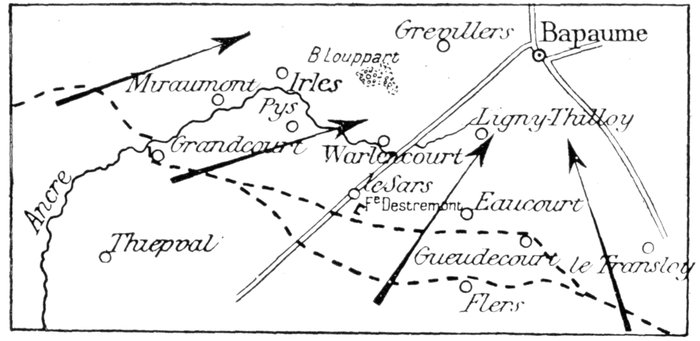
Towards Bapaume.—The British advance on the two wings—Thiepval to the west and Gueudecourt to the east—forced the German centre back on the Le Sars-Eaucourt line. Continuing to press the enemy, the British carried Destremont Farm, in front of Le Sars, on September 29, while on October 3, the village of Eaucourt-l'Abbaye was taken. On the 7th, a further advance was made along the spur which forms a salient in front of Le Transloy village, and Le Sars village was carried the same day.
A single line of heights only now separated the British Army from Bapaume, 6 km. distant from Le Sars. This line consisted chiefly of Warlencourt Ridge, which dominates the country all round, and which had been turned by the Germans into an apparently impregnable fortress.
Although the bad weather and the mud now forced the Allies to suspend their offensive, sharp fighting continued. From December to the end of January the British raided the enemy's trenches unceasingly.
After that, operations were resumed to reduce the Ancre salient completely. The improvement, realised since the previous summer, in their offensive strength, at once became apparent. Their artillery, reinforced, thoroughly "pounded" the whole terrain, making it possible for the infantry to force a way through all obstacles, and to advance continuously.
Advancing over the tops of the hills, which border the Upper Ancre, the British directed their efforts alternately against both banks of the river, and soon rendered untenable those positions still held by the Germans at the bottom of the valleys. On February 7, 1917, Grandcourt was captured, while the week following, Miraumont, Pys, Warlencourt with its famous Ridge, and Ligny-Thilloy (within 3 km. of Bapaume) were surrounded.
The Germans now fell back on a new line of defences close to the town, and by strong counter-attacks sought to stay the British advance. Their efforts were in vain, however, and the British hemmed them in more closely each day. Irles was occupied on March 10; Louppart Wood and Grévillers on the 13th. On the 14th, the British were at the gates of Bapaume, which they entered three days later (the 17th), only to find that the town had been burnt and methodically destroyed by the Germans.
Towards Péronne.—On October 1, the French lines, in liaison with those of the British south of Morval, took in Rancourt, Bouchavesnes and Labbé Farm, passed in front of Feuillancourt and reached the Somme at Omiécourt.
After a halt, devoted to the consolidation of the ground, the French resumed their advance, in spite of the bad weather. The objective was now to widen the positions beyond the Bapaume-Péronne road, in order to turn the town from the north, as the marshes of the Somme and the defences of Mont-Saint-Quentin did not permit a frontal attack.
On October 7, the road was occupied from Rancourt to within about 200 yards of the first houses of Sailly-Saillisel, and the western and south-western outskirts of Saint-Pierre-Vaast Wood were reached. During the following weeks the fighting, which was furious, concentrated around Sailly-Saillisel. On October 18, Sailly was carried, but Saillisel held out until the beginning of November. Meanwhile, the French made several unsuccessful attempts to carry the defence-works of Saint-Pierre-Vaast Wood, and finally remained hanging on to the western outskirts, in close contact with the enemy.
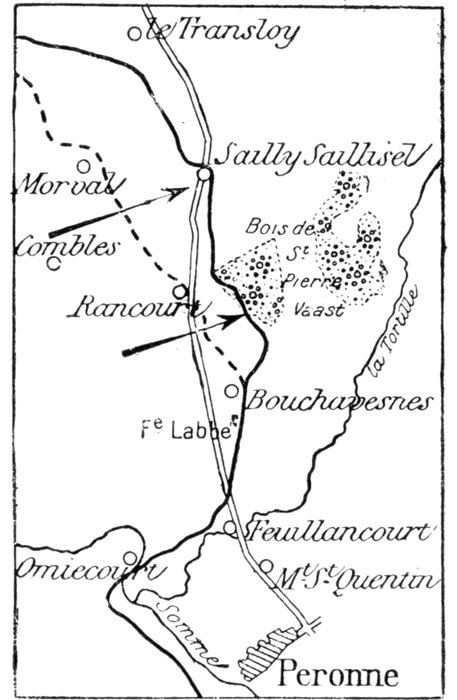
At the end of 1916, the front line in this sector extended from the northern outskirts of Sailly-Saillisel, along the western edges of Saint-Pierre-Vaast Wood, then took in Bouchavesnes and crossed the Somme near Omiécourt.
The winter passed quietly, except in the region of Sailly-Saillisel and Saint-Pierre-Vaast Wood, where skirmishing and grenade fighting were incessant. The British took possession of the sector and fortified it strongly, raiding from time to time the enemy trenches.
In March, 1917, the artillery duel increased in intensity, and the Germans prepared to evacuate their positions.
Their retreat began on March 15, after the country had been methodically devastated. The British occupied the whole wood of Saint-Pierre-Vaast on the 15th and 16th, almost without striking a blow. On the 17th, they held the Mont-Saint-Quentin—powerful advance fortress of Péronne. On the 18th, they finally entered the town from the north, while other detachments reached it from the south-east, across the marshes of the Somme.
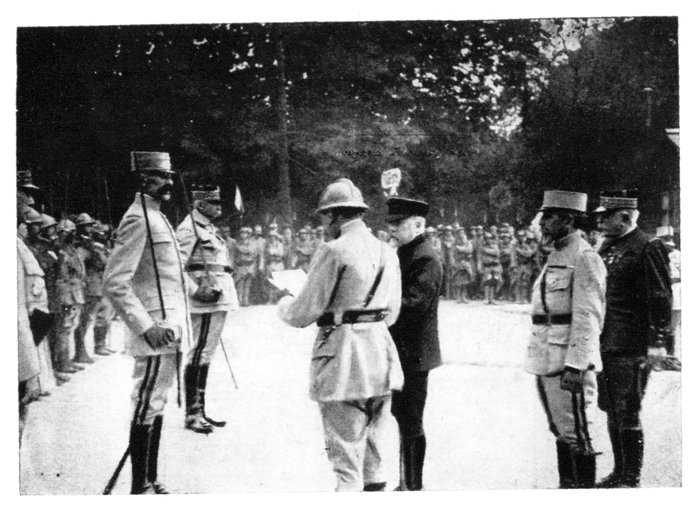
PRESIDENT POINCARÉ HANDING THE "COMMANDEUR DE LA LÉGION D'HONNEUR" INSIGNIA TO GENERAL MICHELER.
The Battle of Attrition, South of the Somme
In the early days of July, in the diversion section south of the Somme, the French 1st Colonial Corps, having carried the three German positions, faced south-east.
The French lines, resting on the western outskirts of Omiécourt, followed the Somme Canal, encircled Biaches and La Maisonnette, turned south-west, and passed in front of Barleux village, which, hidden in a depression of the ground, had till then successfully resisted all assaults. The lines ran towards Soyécourt (still held by the enemy), then southwards via Lihons and Maucourt.
From La Maisonnette to Maucourt, they formed the sides of an enormous obtuse angle, the apex of which was Soyécourt.
The objective of the French 10th Army (General Micheler), disposed along the sides of this angle, was to widen the latter by means of continued thrusts in the direction of the southern end of the bend in the Somme. Its advance being then stayed by the important stronghold of Chaulnes, the latter was to be half-encircled, thereby seriously threatening the rear of the German positions south of the town.
The French offensive was launched on September 4. The outskirts of Deniécourt and Berny were reached in the first rush; in the centre, Soyécourt was carried; on the left, Vermandovillers was partly captured and Chilly passed by about half a mile.
On the 5th, the Germans counter-attacked unsuccessfully, and failed to stay the French advance. On the 6th, half the village of Berny was taken. In three days, 6,650 prisoners and 36 guns, including 28 heavies, were captured.
A fresh offensive was combined, with the attack of the 12th by the Franco-British troops north of the Somme, and that of the 15th by the British troops operating beyond Combles.
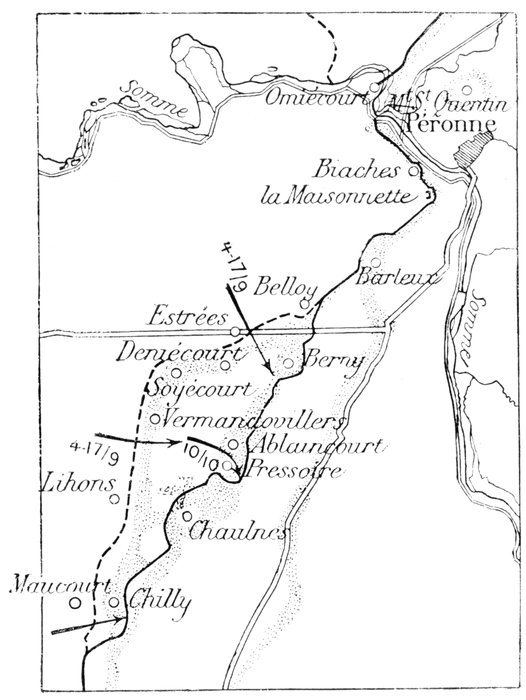
On the 17th, the conquest of Vermandovillers and Berny was completed, and on the 18th, the village of Deniécourt was encircled and captured.
On October 10th, the offensive was resumed after a heavy bombardment between Berny and Chaulnes. The hamlet of Bovent, north of Ablaincourt, was conquered, together with the western edge of Chaulnes Wood. Parts of these woods were captured in October, and at the beginning of November. The villages of Ablaincourt and Pressoire were also occupied.
Thanks to this slow but continuous advance, and to the capture of these various villages, the fortress of Chaulnes was outflanked and half-encircled.
However, the Germans managed to maintain themselves there, and the French progress was held in this sector, as it had been further north, by the stronghold of Barleux and the marshes of the Somme.
At the end of 1916, the front line of the sector south of the Somme started from Omiécourt, left Barleux in German hands, and crossed the Maisonnette Plateau. From there, it described a large circle via Berny (French) and Chaulnes (German), skirting Roye and Lassigny (see sketch map, p. 29).
The German Retreat of March, 1917
Although the Somme offensive did not give immediate strategical results, it nevertheless procured the Allies tactical advantages which were one of the causes of the German retreat of March, 1917.
The capture of important points of support made the position of the Germans a very precarious one, at all the points where they had so far succeeded in maintaining themselves. They feared that if in 1917 the Allies resumed their offensive—which the experience acquired in 1916 would render still more formidable—further retreat, resulting in the piercing of their front line, might become necessary. They consequently decided voluntarily to shorten their lines by falling back on new positions in the rear, known as the "Hindenburg Line" (see the Michelin Guide: "The Hindenburg Line").
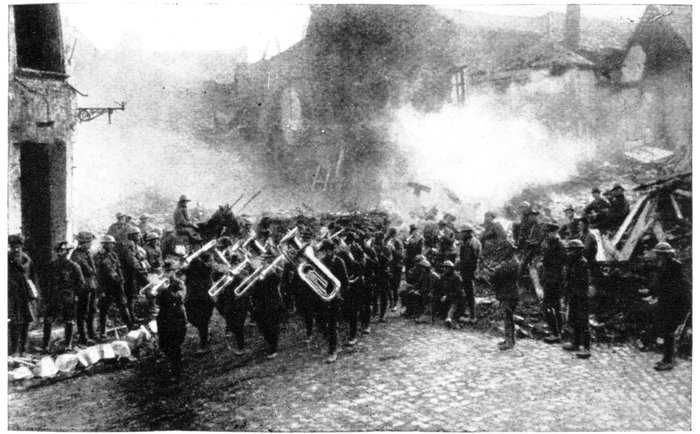
THE BAND OF THE AUSTRALIAN 5TH BRIGADE PASSING THROUGH THE SMOKING RUINS OF BAPAUME ON MARCH 19, 1917, WHILE THE BATTLE STILL RAGED NEAR BY, ON THE LINE BECQUINCOURT—NOVAINS.
The formation of a new defensive front was only possible by evacuating a large area, and the German retreat extended to the whole of the region comprised between Arras and Soissons. It was very skilfully carried out, unhampered by the Allies, who contented themselves with following close behind the retreating enemy.
On March 15 and 16, 1917, the French, informed by their Air Service of the enemy's imminent retirement, made numerous raids into the German trenches between the Oise and the Avre, advancing in places as much as 4 km. On the 17th, the cavalry, followed by the infantry, entered Lassigny and Roye. Noyon was occupied early on the 18th.
On the same day (March 17) the British, having relieved the French as far as south of Chaulnes during the winter, captured La Maisonnette, Barleux, Villers-Carbonnel and all the villages still occupied by the enemy within the loop of the Somme. On the 18th, they entered Péronne and Chaulnes.
The whole region between the Somme and the Oise was liberated at that time, after thirty months of German occupation, but only after it had been systematically and totally devastated, according to elaborate plans drawn up beforehand. These destructions were absolutely unjustifiable from a military point of view. Towns and villages were wiped out, houses plundered, industries ruined, factories destroyed, land devastated, agricultural implements broken, farms burnt, trees cut down—in a word, everything done to turn the place into "a desert incapable for a long time of producing the things necessary to life" (Berliner Tagblatt).
It was from these new lines that in the spring of the following year the Germans launched their great offensive, designed to separate the Allied armies and resume their march "nach Paris."
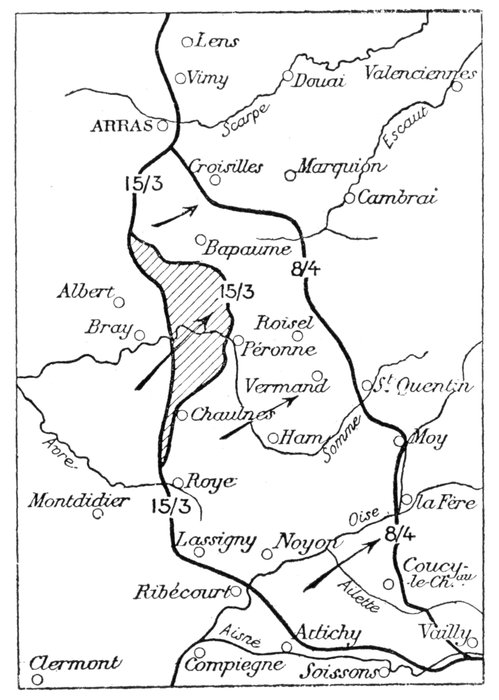
THE SHADED PORTION REPRESENTS THE GROUND CONQUERED DURING THE 1916-1917 OFFENSIVE.
The German offensive and the Allied counter-offensive of 1918 are dealt with in the Michelin Guide: "The Second Battle of the Somme (1918)."
In addition to the pushing back of the enemy front, the Allies' three immediate objectives had been attained.
Verdun was soon relieved of the German pressure, as the enemy "were exhausted and compelled to use their reserves for the Russian front, and especially in the Somme. Their activities on the Verdun front were limited to making good their losses. However, they were finally obliged to weaken this front to a point that they were unable to reply to the French attacks." (See the Michelin Guide: "Verdun, and the Battles for its Possession.")
The Allies' further aim to keep the maximum of the German forces on the western front was likewise attained. According to Field-Marshal Haig's report, the transfer of enemy troops from west to east, begun after the Russian offensive of June, lasted a very little time after the beginning of the Somme offensive. Afterwards, with one exception, the enemy only sent exhausted battle-worn divisions to the eastern front, which were always replaced by fresh divisions. In November, the number of enemy divisions present on the western front was greater than in July, in spite of the abandonment of the offensive against Verdun.
As regards the wearing down of the enemy's fighting strength, their losses in men and material were much heavier than those of the Allies.
Half the German forces in France came out of the battle physically and morally worn.
From July 1 to December 1, the enemy had more than 700,000 men put out of action (killed, wounded or prisoners). More than 300 guns were captured and many others destroyed.
The German nation, badly shaken by the violence and duration of the battle, alarmed at the events on the eastern front, and cruelty disappointed by their failure before Verdun, were on the point of suing for peace at the end of the Battles of the Somme.
On the other hand, the British had gained full consciousness of their strength, and had fought in closer union with their French comrades.
The Allies of all ranks had learned to know and appreciate one another better, and future operations were destined to become more closely co-ordinated. "To fight under such conditions unity of command is generally essential, but in this case, the cordial good feeling of the Allied Armies, and their sincere desire to help one another, served the same purpose and removed all difficulties" (Field-Marshal Haig).
Among the French, the veterans and young classes vied with one another in heroism. Many "bleuets" (twenty-year old youths) were under fire for the first time. In contact with their seasoned Verdun comrades, they fought with splendid dash. After scaling the craggy slopes east of Curlu village, many of them waved their handkerchiefs to cries of "Vive la France!"
Up to the middle in the foul Somme mud, which at times forced the men out of the trenches into the open, in spite of the shells and bullets, the Allied troops acquired the morale of Victory, while the High Command gained and kept the initiative.
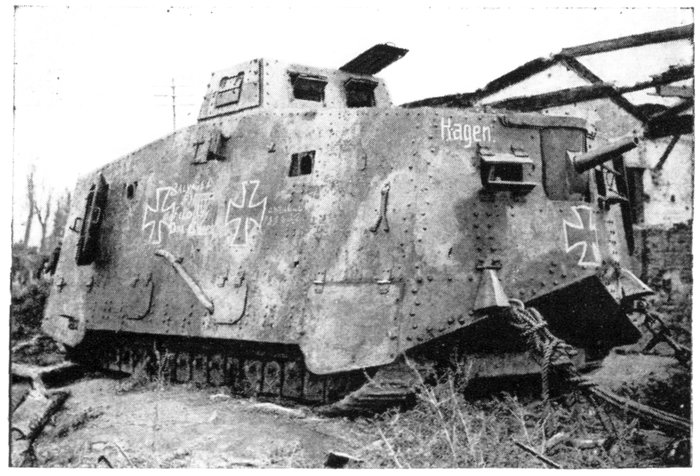
GERMAN TANK CAPTURED BY THE NEW ZEALANDERS DURING THE ALLIED OFFENSIVE OF 1918.
Extracted from the Michelin Guide "The Second Battle of the Somme (1918)"