Volume 2 — Introductory material (continued 2)
George Burnham Ives translation
"Ah! I feel it already," said Emile, "and I have passed from a day of bright sunshine and intoxicating bliss into the shadow of death. But the profound and irreparable calamity that forces itself upon my mind, whatever sacrifice I may resolve upon, is this—that my heart has become as ice toward my father, and that, for several hours past, it has seemed to me that I no longer love him, that I no longer dread to wound him, that I no longer feel either respect or esteem for him. O my God, preserve me from this suffering beyond my strength! Hitherto, as you know, despite all the pain and terror he has caused me, I still cherished him and I put forth all the strength of my heart to believe in him. I felt in the very depths of my being that I was still his son and his friend, and to-day it seems to me that the bond of blood is broken forever, and that I am struggling against a strange master, who oppresses me, who weighs on my heart like an enemy, like a ghost! Ah! I remember a dream I had the first night I passed in this neighborhood. I dreamed that my father came and sat on me to suffocate me!—It was horrible; and now that ghastly vision is being realized; my father has placed his knees, his elbows, his feet on my breast; he is trying to tear out my conscience or my heart. He is poking about in my entrails to see what weak spot will give way to him. Oh! it is a devilish invention, a murderous project, which leads him astray. Is it possible that love of gold and worship of success can inspire such thoughts in a father's mind against his child? If you had seen the smile of triumph with which he displayed the sudden inspiration of his peculiar generosity! he was not a protector and adviser, but an adversary who has set a trap and seizes his foe with a fiendish laugh. 'Choose,' he seemed to say, 'and if you die, what does it matter? I shall have triumphed.'—O my God! it is horrible, horrible, to condemn and to hate one's father!"
And poor Emile, crushed by grief, laid his face on the grass on which he was lying and watered it with burning tears.
"Emile," said Monsieur de Boisguilbault, "you can neither hate your father nor be false to your mistress. Tell me, do you set much store by the truth? Can you lie?"
The marquis had touched the right spot. Emile sprang to his feet impetuously.
"No, monsieur, no," he said, "you know that I cannot lie. And of what use is falsehood to cowards? What happiness, what repose can it assure them? If I swear to my father that I have changed my religion, that I believe in ignorance, error, injustice, folly, that I hate God in man, and that I despise man in myself, will some monstrous miracle take place in me? shall I be convinced? shall I find myself suddenly transformed into a placid and supercilious egotist?"
"Perhaps so, Emile! in evil it is only the first step that costs, and whoever has deceived other men, reaches the point where he is able to deceive himself. That has happened often enough to be credible."
"In that case, falsehood to the winds! for I feel that I am a man and I cannot transform myself into a brute of my own free will. My father, with all his craft and all his strength, is blind in this. He believes what he tries to make me believe, and if he should be urged to make my belief his own he could not do it. No interest, no passion could force him to do it, and yet he fancies that he would not despise me on the day that I debased myself so far as to do a dastardly thing of which he knows that he is himself incapable! Does he feel that he must despise me and ruin me in order to confirm himself in his inhuman theories?"
"Do not accuse him of such perversity; he is the man of his epoch—what do I say? he is the man of all epochs. Fanaticism does not reason, and your father is a fanatic; he still burns and tortures heretics, believing that he is doing honor to the truth. Is the priest who comes to us at our last hour and says; 'Believe or you will be damned!' much wiser or more humane? Does not the powerful man who says to the poor clerk or the unfortunate artist; 'Serve me and I will make your fortune,' believe that he is doing him a favor, conferring a benefit on him?"
"But that is corruption!" cried Emile.
"Very good!" rejoined the marquis; "by what means is the world governed to-day, pray tell me? Upon what does the social structure rest? One must needs be very strong, Emile, to protest against it; for when you do, you must make up your mind to be sacrificed."
"Ah! if I were the only victim of my sacrifice," said the young man sorrowfully; "but she! poor, saint-like creature, must she be sacrificed too?"
"Tell me, Emile, if she should advise you to lie, would you still love her?"
"I don't know! I think so! Can I imagine a state of things in which I should not love her, since I love her now?"
"You really love her, I see. Alas! I too have loved!"
"Tell me, then, if you would have sacrificed honor?"
"Perhaps so, if I had been loved."
"Oh! feeble creatures that we are!" cried Emile. "God help me! shall I not find a counsellor, a guide, a help in my distress? Will no one give me strength? Strength, O my God! I implore it on my knees; and never have I prayed with greater faith and ardor: I beseech Thee, give me strength!"
The marquis went to Emile and pressed him to his heart. Tears were rolling down his cheeks; but he held his peace and did not help him.
Emile wept a long time on his breast and felt that he loved that man whom each succeeding test revealed to him as an extremely sensitive rather than really strong man. He loved him the more for it, but he grieved that he did not find in him the energetic and powerful adviser upon whom he had counted in his weakness. He left him at nightfall and the marquis said nothing more to him than: "Come again to-morrow; I must know what you decide upon. I shall not sleep until I see you in a calmer frame of mind."
Emile took the longest road to return to Gargilesse; he made a détour by means of which he passed within a short distance of Châteaubrun by shaded paths which hid him from sight, and when he was quite near the ruins, he stopped, fairly distracted at the thought of what Gilberte must have suffered since his father's heartless visit, and not daring to carry her better news lest he should lose all his courage and virtue.
He had been standing there several minutes, unable to come to any decision, when he heard his name called in an undertone, with an accent that sent a thrill through him; and looking toward a small clump of oaks at the right hand side of the road, he saw in the shadow a dress gliding behind the bushes. He darted in that direction, and when he was far enough among the trees to be in no danger of being seen, Gilberte turned and called him again.
"Come, Emile," she said, when he was at her side. "We haven't an instant to lose. My father is in the field close by. I saw you and recognized you just as you started down this road, and I left him without saying anything while he was talking with the mowers. I have a letter to show you, a letter from Monsieur Cardonnet: but it is too dark for you to read it, so I will repeat it to you almost word for word. I know it by heart."
When she had repeated the substance of the letter, she continued:
"Now, tell me what this means? I think that I understand it, but I must know surely from you."
"O Gilberte!" cried Emile, "I hadn't the courage to come and tell you; but it was God's will that I should meet you and that my fate should be decided by you. Tell me, my Gilberte, my first and last love, do you know why I love you?"
"Apparently," replied Gilberte, abandoning her hand to him, which he pressed against his lips, "it was because you divined in me a heart created to assist you."
"Very good; and can you tell me, my only love, my only treasure on this earth, why your heart gave itself to me?"
"Yes, I can tell you, my dear; because you seemed to me, from the very first day, noble, generous, simple-hearted, humane, in a single word, good, which to my mind is the noblest quality a man can have."
"But there is a passive goodness which in some sort excludes nobility and generosity of sentiment, a yielding weakness, which may be a charming characteristic, but which, under difficult circumstances, compromises with duty and betrays the interests of mankind generally to spare itself and one or two others a little suffering?"
"I understand that, but I do not call weakness and fear goodness. To my mind there is no true goodness without courage, dignity and, above all, devotion to duty. If I esteem you to the point of saying to you, without suspicion and without shame, that I love you, Emile, it is because I know that you are great in heart and mind; it is because you pity the unfortunate and think only of assisting them, because you despise nobody, because you suffer when others suffer, because you would gladly give everything that belongs to you, even your blood, to relieve the poor and the abandoned. That is what I understood about you as soon as you talked before me and with me; and that is why I said to myself: This heart answers mine; these noble thoughts exalt my soul and confirm me in all that I have thought; I detect in this mind, which impresses me and charms me, a light which I am compelled to follow and which guides me toward God himself. That is why, Emile, I felt neither terror nor remorse in yielding to the inclination to love you. It seemed to me that I was performing a duty; and I have not changed my opinion after reading your father's mocking words concerning you."
"Dear Gilberte, you know my heart and my thought; but your adorable goodness, your divine affection ascribe to me as a great merit sentiments which seem to me so natural and so forced upon men by the instinct God has implanted in them, that I should blush not to have them. And yet these sentiments, which must appear in the same light to you, since you yourself entertain them with such innocence and simplicity, are spurned by many people and derided as dangerous errors. There are some who hate and despise them because they haven't them. There are others who, by a strange anomaly, have them to a certain extent, but cannot tolerate the logical deduction from them and their inevitable consequences. Heaven help me! I fear that I cannot explain myself clearly."
"Yes, yes, I understand you. Janille is good like God himself, and, through ignorance or prejudice, that perfect friend rejects my ideas of equality, and tries to convince me that I can love and pity and help the unfortunate without ceasing to think that they are naturally inferior to me."
"Well, my noble-hearted Gilberte, my father has the same prejudices as Janille, from another point of view. While she believes that birth creates a claim to power, he is persuaded that skill, strength and energy create a claim to wealth, and that it is the duty of acquired wealth to go on adding to itself forever, at any cost, and to pursue its way into the future, never allowing the weak to be happy and free."
"Why, that is horrible!" cried Gilberte, ingenuously.
"It is prejudice, Gilberte, and the terrible power of custom. I cannot condemn my father; but tell me—when he asks me to swear that I will espouse his errors, that I will share his passionate ambition and his arrogant intolerance—ought I to obey him? And if your hand is to be had only at that price, if I hesitate an instant, if a profound terror takes possession of me, if I fear that I may become unworthy of you by denying my belief in the future of mankind, do I not deserve some pity from you, some encouragement, or some consolation?"
"O mon Dieu!" said Gilberte, clasping her hands, "you do not understand what is happening to us, Emile! Your father does not wish us ever to be married, and his conduct is full of cunning and shrewdness. He knows well enough that you cannot change your heart and brain as one changes his coat or his horse; and be sure that he would despise you himself, that he would be in despair if he should obtain what he asks. No, no, he knows you too well to believe it, Emile, and he has but little fear of it; but he attains his end all the same. He separates you from me, he tries to make trouble between us, he puts himself in the right and you in the wrong. But he will not succeed, Emile; no, I swear it; your resistance to his demands will increase my affection for you. Ah! yes, I understand it all; but I am above such a paltry stratagem, and nothing shall ever part us."
"O my Gilberte, O my blessed angel!" cried Emile, "tell me what I shall do; I belong to you absolutely. If you bid me, I will bend my neck under the yoke; I will commit all manner of iniquities, all manner of crimes for you."
"I hope not," rejoined Gilberte, mildly yet proudly, "for I should no longer love you if you ceased to be yourself, and I will have no husband whom I cannot respect. Tell your father, Emile, that I will never give you my hand on such conditions, and that, notwithstanding all the contempt he may entertain for me in the bottom of his heart, I will wait until he has opened his eyes to justice and his heart to a more honorable feeling for us two. I will not be the reward of an act of treachery."
"O noble girl!" cried Emile, throwing himself at her knees and ardently embracing them, "I adore you as my God and bless you as my providence! But I have not your courage. What is going to become of us?"
"Alas!" said Gilberte, "we must cease to meet for some time. We must do it; my father and Janille were present when your father's letter arrived. My poor father was dumb with joy, and understood nothing of the conditions at the end. He has expected you all day, and he will continue to expect you every day until I tell him that you are not coming, and then, I trust, that I shall be able to justify your conduct and your absence. But Janille will not excuse you for long; she is already beginning to be surprised and disturbed and irritated because your father seems to await your sanction to come and make a formal request for my hand. If you should tell her now what I insist upon your doing, she would curse you and banish you from my presence forever."
"O my God!" cried Emile, "to see you no more! No, that is impossible!"
"Why, my dear, what change will there be in our relations? Will you cease to love me because you do not see me for a few weeks, a few months, perhaps? Are we proposing to bid each other adieu forever? Do you no longer believe in me? Did we not anticipate obstacles, suffering, a period of separation?"
"No, no," said Emile, "I anticipated nothing. I could not believe that this would happen! I cannot believe it yet!"
"O my dear Emile! do not be weak when I need all my strength. You have sworn to overcome your father's opposition, and you will do it. Here is one of his most tremendous efforts which we have defeated already. He was very sure beforehand that you would not accept dishonor, and he thinks that you will be discouraged so easily! He doesn't know you. You will persist in loving me, and in telling him so, and in proving it to him every day. Come, the hardest part of it is over, since he knows all, and, instead of being indignant and grieved, he accepts the battle with a smile, like a game of cards in which he believes himself the more skilful. So have courage; I will have plenty of it. Do not forget that our union is the work of several years of perseverance and faithful toil. Adieu, Emile, I hear my father's voice coming nearer and I must fly. Stay here, and do not go on until we are well out of the way."
"To see you no more!" murmured Emile; "to hear your voice no more, and still have courage?"
"If you lack courage, Emile, it will be because you do not love me as much as I love you, and because our union does not promise happiness enough to induce you to fight hard and long."
"Oh! I will have courage!" cried Emile, conquered by the noble-hearted girl's energy. "I will force myself to suffer and to wait. You will see, Gilberte, whether the happiness the future promises does not enable me to endure everything in the present. But can we not meet sometimes, by chance, as we met to-day, for instance?"
"Who knows," said Gilberte. "Let us rely on Providence."
"But one can sometimes assist Providence. Can we not invent some means of communication, of sending word to each other?—by writing, for instance?"
"Yes, but then we must deceive those whom we love!"
"O Gilberte! what can we do?"
"I will think about it; let me go."
"Go without promising me anything at all?"
"You have my pledge and my heart; are they nothing to you?"
"Go, then!" said Emile, making a violent effort to unclasp his arms, which obstinately detained Gilberte's slender form. "I am happy, Gilberte, even as I let you go! See if I love you, if I believe in you and in myself!"
"Believe in God," said Gilberte, "He will protect us."
And she disappeared among the trees.
Emile remained a long while on the spot she had just left. He kissed the grass that her feet had barely touched and the tree she had grazed with her dress, and after lying a long while in that thicket, the silent witness of his last joy, he tore himself away with difficulty. Gilberte ran after her father, who had started to return to the ruins and was walking fast in front of her. Suddenly he turned and retraced his steps. "Ah! my dear child, I was coming back to look for you," he said innocently.
"That is to say, father, you had forgotten me," replied Gilberte, forcing herself to smile.
"No, no, don't say that; Janille would call it absent-mindedness! I was thinking of you all the time. That letter from Monsieur Cardonnet is running in my brain. Perhaps Emile is waiting for us at the house—who knows? Probably he couldn't have come sooner; his father must have detained him. Let us hurry back; I'll wager that he's there." And the goodman confidently quickened his pace.
Janille was in a savage humor. She could not understand Emile's moderation, and was beginning to be seriously disturbed. Gilberte tried to divert her thoughts, and during supper was calm and almost cheerful. But she was no sooner alone in her room than she fell on her knees and buried her face in the bed, to stifle the sobs which shook her frame.
XXVIII CONSOLATION
Gilberte was resigned, albeit in despair. Emile was perhaps less desperate, because in the bottom of his heart he was not yet resigned. Every moment his uncertainty returned, and the greater and more worthy of his love Gilberte appeared to him in the light of their conversation, the more intensely did that love make its invincible power felt. As he was entering the village, he turned abruptly and retraced his steps, trying to fancy that he was going to Châteaubrun; and when he had walked a few minutes, he sat down on a rock, covered his face with his hands, and felt weaker, more in love, more human than ever.
"If Monsieur de Boisguilbault had seen her and heard her," he said to himself, "he would understand that I cannot hesitate between her and myself, and that I must have her, even at the price of a falsehood! O my God! my God! inspire me. It was Thou who didst plant this love in my heart, and, having given me the strength to conceive it, Thou wouldst not give me the strength to crush it."
"Well, Monsieur Emile, what are you doing here?" queried Jean Jappeloup, whose approach he had not observed, and who had seated himself by his side. "I was looking for you, for I had fallen into the habit of talking with you in the evening, and when I don't see you after my day's work, I miss you. What is the trouble? Have you got a headache, that you hold your head in your hands as if you were afraid of losing it?"
"It is too late, my friend," replied Emile; "my head is lost forever."
"Why, are you so very much in love? Tell us when the wedding is to be."
"Soon, Jean, whenever we choose!" cried Emile, wild at the thought. "My father consents, and I am going to marry her. Yes, I am going to marry her, do you hear? for if I don't, I shall die. Tell me, mustn't I marry her?"
"The devil! I should think so! How can you hesitate a minute? I would never be the one to justify you, if you should throw her over; and upon my word, my boy, I believe I would force you to marry her even if I had to fight you."
"Yes, it's my duty, isn't it?"
"Damnation! one would say that you doubt it. You have a sort of daft way of saying that."
"Yes, I am daft, it is true; but no matter. I know my duty now, and you confirm me in my best resolution. Let us go to Châteaubrun together!"
"Are you going there? All right; but let's walk fast, for it is late. You can tell me on the way how your father, whom I believed to be a madman, suddenly made up his mind to be sensible."
"My father is mad, in very truth," said Emile, taking the carpenter's arm and walking excitedly beside him; "altogether mad! for he gives his consent on condition that I tell him a lie which he will not believe. But it is a triumph to him, a genuine delight, to induce me to lie!"
"Look here," said Jappeloup, "you've not been drinking? No, you never drink too much! and yet you are crazy. They say that love makes one as drunk as wine; it must be true, for you say things without rhyme or reason."
"My father, who is mad," continued Emile, beside himself with excitement, "wants to make me mad too, and he is succeeding finely, as you see! He wants me to tell him that two and two make five, and to take my oath to it before him. I consent, you see! What harm does it do to flatter his mania, so long as I marry Gilberte?"
"I don't like all this business, Emile," said the carpenter. "I don't understand it, and it annoys me. If you are mad, I don't propose that Gilberte shall marry you. Let us stop here and try to collect our wits a little. I have no desire to take you to Châteaubrun, if you are going to ramble in this way, my son."
"Jean, I feel very ill," said Emile, sitting down again; "I am dizzy. Try to understand me, to calm me, to help me to understand myself. You know that I don't think as my father does. Well, my father insists that I shall think as he does; that's the whole story! That is impossible; but so long as I say the same things that he does, what difference does it make?"
"Say what? deuce take it!" cried Jean, who had, as we know, very little patience.
"Oh! a thousand foolish things," replied Emile, who felt an icy chill, alternating at intervals with a burning flush. "For instance, that it is exceedingly fortunate for the poor that there are rich men."
"That is false!" said Jean, with a shrug.
"That the more rich and poor there are, the better the world will get on."
"I deny it."
"That the battle between the rich and poor is ordained by God, and that the rich should go forth to it with the keenest joy."
"On the contrary, God forbids it!"
"Lastly, that men of intellect are happier than the poor in intellect, because such is the order of Providence."
"Ten thousand devils, he lies!" cried Jean, smiting the rock with his stick. "Don't repeat any more of that drivel, for I can't listen to it. The Good Lord himself has said just the opposite of it all, and he came to the earth, disguised as a carpenter, for nothing else than to prove it."
"Much God and the Gospel have to do with it!" rejoined Emile. "This is a question of Gilberte and me. I shall never persuade my father that he is wrong. I must say what he does, Jean, and then I shall be free to marry Gilberte. He will go himself to-morrow and ask her father to give her to me."
"Really! Why he must be mad indeed to believe that you will echo his nonsense in good faith! Ah! yes, I see that his brain is really awry, Emile, and that is what makes you feel so badly; for I see, also, that you are sad to the bottom of your heart, my poor boy."
Emile shed tears, which relieved him, and, recovering his self-possession, he explained more clearly to the carpenter what had taken place between his father and himself.
Jean listened with his eyes on the ground; then, after reflecting for a long time, he took the young man's hand, saying:
"Emile, you mustn't tell these lies; they are unworthy of a man. I see that your father is more crafty than crazy, and that he won't be satisfied with two or three vague words, such as we sometimes say to soothe a man who has drunk too much and whom we treat like a child. Your father, when you have lied to him, or made promises that you can't keep, won't let you breathe, and if you try to become a man again he will say: 'Remember, that you're nobody now?' He is proud and hard; I know it well. He won't give you one day a week to think in your own way, and, more than that, he will make your wife unhappy. I can see it all: he will make you blush before her, and he will play his cards so well that she will finally blush for you. To the devil with all lies and words you don't mean! None of that, Emile; I forbid it."
"But Gilberte?"
"Gilberte will say as I do, and so will Antoine and Janille. Ma mie Janille can say what she pleases. For my part, I don't propose that you shall lie. There's no Gilberte who could make me lie."
"Then I must give her up—not see her any more?"
"That is a misfortune," said Jean, firmly; "but when misfortune is upon us, we must bear it. Go and see Monsieur de Boisguilbault; he will say the same as I do, for, according to all you have told me of him, he is a man who takes a just view of things and whose ideas are good."
"Well, Jean, I have seen Monsieur de Boisguilbault, and he realizes that the sacrifice is beyond my strength."
"Does he know that you love Gilberte? Oho! did you tell him?"
"He knows that I am in love, but I didn't mention her name."
"And he advised you to lie?"
"He gave me no advice at all."
"For heaven's sake, has he lost his wits too? Come, Emile, you will listen to me because I am right. I am neither rich nor learned; I don't know whether that deprives me of the right to eat my fill and sleep in a bed, but I know well that God never said to me when I prayed to him: 'Get you gone!' and that, when I have asked him what is true or false, bad or good, he has always told me, without answering: 'Go to school.' Just reflect a little. There are many of us poor people on earth, and a small lot of rich men; for, if everybody had a large slice, the earth would be too small. We are a good deal in the way of one another, and we can't love one another, try as we will. That is proved by our having to have police and prisons to keep us on good terms. How could it be otherwise? I have no idea. You say some very pretty things on that subject, and when you're on it I could pass days and nights listening to you, it pleases me so to see how you arrange it all in your head. That is what makes me love you; but I have never said, my boy, that I had any hope of seeing it come true. It seems to me to be a long way off, if it is possible at all, and I, who am accustomed to hard work, ask the good Lord for nothing more than to leave us as we are, and not allow the rich and great to make our lot any worse. I know that if everybody was like you and me and Antoine and Gilberte we should all eat the same soup at the same table; but I also see that most other people wouldn't care to hear of such an arrangement, and that it would take too much time and talk to bring them to it. I am proud myself, and I can get along very well without people who look down on me; that's my wisdom. I bother my head very little about politics; I don't understand it; but I don't want to be eaten, and I detest the people who say: 'Let us devour everything.' Your father is one of those devourers, and if you were like him I would split your head open with my axe rather than let you think of Gilberte. God chose that you should be a good man, and that the truth should seem to you worth sticking to. Stick to it, therefore, for it is the only thing the wicked cannot take from this earth. Let your father say: 'It's this way; it suits me so, and I choose to have it so!' Let him talk; he is powerful because he is rich, and neither you nor I can hold him back. But if he is obstinate and angry enough to try to make you say that it is so, and that God is satisfied to have it so—stop there! It is contrary to religion to say that God loves evil, and we are Christians, I believe. Have you been baptized? So have I; and I deny Satan. At all events my sponsors renounced him for me, and I have renounced him for others when I have been a sponsor. For that reason we must take no false oaths, nor blaspheme, nor say that all men are not equal when they come into the world and do not all deserve happiness, for that is equivalent to saying that some are condemned to hell before they are born. I am done, Emile. You won't lie, and you will make your father abandon that cunning condition!"
"Ah! my friend, if I could see Gilberte once a week! If I were not dishonored in her father's eyes and banished from his house, I should not lose hope or courage."
"Dishonored in Antoine's eyes? Pray tell me, what do you take him for? Do you think he would have a renegade and backslider for a son-in-law?"
"Oh, if he only looked at things as you do, Jean! but he will not understand my conduct."
"Antoine didn't invent gunpowder, I agree. He has never been able to get the square of the hypotenuse into his head, whereas I learned it in a few minutes, simply by watching a schoolmate do it. But you consider him much simpler than he is. In the matter of honor and worthy sentiments, that old fellow knows all that any one ought to know. Pray, do you think that a man must be very sly and very learned to understand that two and two make four and not five? For my part, I say that, to know that, one needn't have read a roomful of big books like old Boisguilbault, and that every unhappy man on this earth knows very well that his lot is unjust when he has not deserved it. Very good! hasn't friend Antoine suffered and endured, I should like to know? Did not the rich turn their backs on him when he became poor? Is there any one who can say that they were justified in treating him so—a man who never had a crust of bread that he didn't give three-quarters and sometimes the whole of it to others! And if you were not a sensible man, would you ever have been attracted to him? Would you be in love with his daughter to the point of wanting to marry her, if you had your father's ideas? No, you wouldn't have looked at her, or else you'd have seduced her; but you would reflect that she has no dowry, and you would abandon her like a villain. Courage, Emile, my boy! Honest men will always esteem you, and I will answer for Antoine; I will take charge of him. If Janille cries out, I will cry out too, and we will see whether she or I has the loudest voice and the best-oiled tongue. As for Gilberte, be sure that she will have a kindly feeling for you all her life, and that she will think well of you for your straightforwardness. She will never love any other man, I promise you! I know her; she's a girl who has only one word. But the time will come when your father will change his tune. That will be when he is unhappy in his turn, and I have already prophesied that time would come."
"He doesn't believe it."
"Have you told him what I think about his factory?"
"I was bound to."
"You did wrong, but it's done now, and what must be will be. Come, Emile, let us go back to the village and to bed, for I see that you are shivering and I feel that you are feverish. Come, my boy, don't let your blood boil like this, and rely a little on the good Lord! I will go to Châteaubrun to-morrow morning; I will say what I have to say, and they will have to listen to me. I will answer for it that you won't have any falling out with them, at all events, for doing your duty."
"Good Jean! you do me a deal of good! you give me strength, and I feel better since you have been talking to me."
"Because I go straight to the point, you see, and don't embarrass myself with useless things."
"And you will go to Châteaubrun to-morrow? to-morrow? although it's a working day?"
"To-morrow, to be sure; as I work for nothing, I can begin my day at any time I please. Whom do you suppose I am going to work for to-morrow? Let's see you guess, Emile; there's something to divert your thoughts."
"I can't guess. For Monsieur Antoine?"
"No, Antoine hasn't much work to be done, poor fellow, and he can do it alone; but he has a neighbor who has plenty of it, and who doesn't haggle over the time of his workmen."
"Who is it? Has Monsieur de Boisguilbault become reconciled to your features?"
"Not so far as I know; but he never forbade his farmers giving me work. He is not the man to try to injure me, and almost nobody outside of his house knows that he has a grudge against me, if indeed he has; the devil only knows what's at the bottom of it all! However, as I say, I work for him without his knowing anything about it; for you know that he inspects his property once a year at the most. It's a little far from our village; but, thanks to your father, workmen are so rare that they sent for me; and I didn't wait to be asked twice, although I had some urgent work elsewhere. It's a pleasure to me to work for that old fellow! But, as you can imagine, I will never take any pay. I owe him enough, after what he has done for me."
"He won't allow you to work for him for nothing."
"He must allow it, for he will know nothing of it. Does he know what is done on his farms? He settles his account at the end of the year, and pays little heed to details."
"But suppose the farmers charge him for the days you work, as if they had paid you?"
"To do that they must be rascals, and on the contrary they are honest men. You see, a man is what other men make him. Old Boisguilbault is never robbed, although nothing in the world would be easier; but as he neither worries nor pushes any one, no one has any occasion to deceive him or to take any more than belongs to him. He isn't like your father. He reckons and disputes and watches every one closely, and consequently his people steal from him, and always will: that's the kind of business he will do all his life."
Jean succeeded in diverting Emile's thoughts, and almost in consoling him. That upright, bold, decided character had an excellent influence over him, and he went to bed with a more tranquil mind, after receiving his promise that he would let him know on the following evening how Gilberte's people felt toward him. Jean was confident of his ability to open their eyes concerning his conduct and Monsieur Cardonnet's. Sorrow makes us weak and trustful, and when our courage fails us, we can find nothing better to do than place our fate in the hands of an energetic and resolute person. If he does not solve the embarrassing problems of our position so easily as he flatters himself that he can do, at all events the contact with him strengthens and revivifies us; his confidence insensibly passes into us and makes us capable of assisting ourselves.
"This peasant, whom my father despises," thought Emile as he fell asleep, "this poor, ignorant, simple-hearted man has done me more good than Monsieur de Boisguilbault did; and when I asked God for an adviser, a support, a savior, He sent the poorest and humblest of His servants to mark out my duty in two words. Oh! what force the truth has in the mouths of those men whose instincts are upright and pure! and how profitless is all our knowledge compared with that of the heart! Father! father! more than ever I feel that you are blinded, and the lesson I have received from this peasant condemns you more than all the rest."
Although mentally more tranquil, Emile had a sharp attack of fever in the night. Amid the violent upheavals of the mind, we forget to care for and preserve the body. We allow ourselves to be exhausted by hunger, surprised by cold and dampness, when we are reeking with perspiration or burning with fever. We do not feel the approach of physical disease, and when it has fastened itself upon us, there is a sort of relief from the change from mental suffering. At such times we flatter ourselves that we cannot be unhappy long without dying of it, and there is some comfort in believing oneself too weak to endure never-ending sorrow.
Monsieur de Boisguilbault expected his young friend all the following day, and he became exceedingly anxious at night, when he did not appear. The marquis had become deeply attached to Emile. While he did not express himself nearly so strongly as he felt, he could no longer do without his society. He was immensely grateful to the noble-hearted boy whom his cold and melancholy nature had never repelled, and who, after obstinately persisting in reading his heart, had religiously kept the promise he had made of being a devoted son to him. This dismal old man, who was reputed to be such a terrible bore, and who, through discouragement, exaggerated in his own mind his involuntary faults, had found a friend when he made up his mind that there was nothing left for him to do but to die alone and unregretted. Emile had almost reconciled him to life, and sometimes he abandoned himself to a sweet illusion of paternity, when he saw that young man make himself at home in his house, share his dismal amusements, arrange his library, turn the leaves of his books, ride his horses, and sometimes even attend to matters of business for him, in order to relieve him of a particularly tedious duty; in short, take his ease under his roof and in his company, as if nature and the habit of a whole lifetime had neutralized the difference in their ages and their tastes.
The old man had continued for a long time to have occasional fits of distrust, and he had tried to make Emile fit in with his curious misanthropic theories, but he had not succeeded. After he had passed three days trying to persuade himself that idleness or curiosity had brought him this new guest, with the thirst for serious conversation and philosophical discussion, when he saw that amiable face, expansive and ingenuous in its fearless expression, appear in his solitude, he felt that hope appeared with it, and he surprised himself in the very act of loving, at the risk of being more unhappy than ever when doubt returned. In a word, after passing his whole life, especially the last twenty years, in guarding against emotions which he deemed himself incapable of sharing, he fell under their dominion, and could not endure the thought of being deprived of them.
He wandered, in feverish agitation, through all the avenues of his park, waited at all the gates, sighing with every step, starting at the slightest sound, and at last, depressed beyond measure by that silence and that solitude, heart-broken at the thought that Emile was contending with a sorrow which he could not lighten, he went out into the road and turned in the direction of Gargilesse, still hoping to see a black horse coming toward him.
It very rarely happened that Monsieur de Boisguilbault ventured to make such a rash sortie from the park, and he could not make up his mind to follow the beaten roads lest he should fall in with some face with which he was not familiar. So he walked as the crow flies, through the fields, without, however, losing sight of the road on which Emile was likely to be. He walked slowly, at a pace which might have been characterized as uncertain, but which the prudence and circumspection which marked his most trivial movements made firmer than it appeared.
As he approached an arm of the stream which, after leaving his park, followed a winding course through the valley, he heard an axe, and the sound of several voices attracted his attention. It was his custom always to turn away from any sound which indicated the presence of man, and to make a détour to avoid meeting anybody, but he had something on his mind which led him at this time to adopt the contrary course. He had a passion for trees, if we may so express it, and did not allow his tenants to cut any down unless they were entirely dead. Therefore, the sound of an axe made him prick up his ears, and he could not resist the desire to go and see with his own eyes if his orders were disobeyed.
So he walked resolutely into the field where the men were at work, and saw, with a feeling of childlike grief, some thirty or more superb trees, all covered with foliage, lying at full length on the ground, and already partly cut up. A farmer, assisted by his men, was at work loading several huge logs on an ox-cart. The axe which was being plied so energetically, awaking all the echoes of the valley, was in the diligent hands of Jean Jappeloup!
Monsieur de Boisguilbault had not exaggerated when he previously told Emile, in glacial tones, that he was very irascible. That was another of the anomalous features of his character. At sight of the carpenter, whose face, or whose name even, always affected him painfully, he turned pale; then, as he saw him cutting in pieces his fine trees, still young and perfectly sound, he trembled with anger, flushed scarlet, stammered some incoherent words, and rushed at him with an impetuosity of which no one would have deemed him capable who had seen him a moment before, walking with measured steps, leaning on his stout cane, with its well-turned head.
XXIX AN ADVENTURE
The felling which offended Monsieur de Boisguilbault so deeply had been done on the bank of the little stream, and the slender poplars, the old willows and the majestic elms, falling in confusion, had formed a sort of bridge of verdure over that narrow current. While the oxen were dragging some of the trees with ropes to the carts that were to haul them away, the sturdy carpenter, running about on the trunks that blocked the stream, busied himself cutting away the tangled branches whose resistance neutralized the efforts of the cattle. Intent upon his task and zealous in the work of destruction of which his trade reaps the benefit, he exerted his skill and daring with a sort of frenzy. The river was deep and swift at that point, and Jean's post was so dangerous that no one else dared to share it with him. Running with a young man's lightness of foot and self-possession to the flexible extremities of the trees that lay across the stream, he turned sometimes to cut the very branch on which he was balancing himself, and, when a loud cracking told him that his support was on the point of giving way under his feet, he would jump nimbly to a branch near by, electrified by the danger and the amazement of his comrades. His gleaming axe whirled in lightning flashes around his head, and his resonant voice stimulated the other workmen, surprised to find how simple was a task which the intelligence and energy of a single man directed, simplified and performed as by a miracle.
If Monsieur de Boisguilbault had not been excited, he would have admired with the rest, aye, and would have felt a certain respect for the man who imported the power of genius into the accomplishment of that commonplace task. But the sight of a noble tree, full of sap and life, cut down by the axe in the midst of its development, angered him and tore his heart, as if he had witnessed a murder, and when that tree belonged to him, he defended it as if it were a member of his family.
"What are you doing there, you stupid fools!" he cried, brandishing his cane, and in a high tone which anger made as shrill and ear-piercing as the note of a fife. "And you, villain!" he shouted to Jean Jappeloup, "have you taken an oath to wound me and outrage my feelings all the time?"
The peasant has a dull ear, especially the Berri peasant. The ox-drivers, excited by their unaccustomed interest in their work, did not hear the master's voice, especially as the straining of the ropes, the groaning of the yokes and the carpenter's powerful shouts, rising above everything, drowned those shrill tones. The weather was threatening, the horizon was a mass of dark purple clouds which were rapidly overspreading the sky. Jean, dripping with perspiration, had kept everybody at work, swearing that the job must be finished before the rain, which would swell the stream and might carry away the trees they had felled. A sort of frenzy had taken possession of him, and despite the true piety which reigned in his heart, he swore like a heathen, as if he thought that he could in that way increase his strength tenfold. The blood hummed in his ears; exclamations of excitement and satisfaction escaped him at every exploit of his muscular arm, and mingled with the rumbling of the thunder. Violent gusts of wind enveloped him in leaves and kept his coarse silvery locks flying about his forehead. With his pale face, his flashing eyes, his leathern apron, his tall thin figure, his bare arms brandishing the axe, he had the aspect of a Cyclops, on the sides of Mount Ætna, gathering wood to keep alight the fire of his infernal forge.
While the marquis exhausted his strength in unavailing cries, the carpenter, having cleared away the last obstacle, darted back to the round trunk of a young maple, with an address that would have done credit to a professional acrobat, leaped to the bank, and, seizing the draught-rope, was reinforcing the tired oxen with his exuberant muscular strength, when he felt upon his loins, covered with a coarse shirt only, the sting of Monsieur de Boisguilbault's flexible bamboo.
The carpenter thought that a branch had swung back against him, as often happened in such battles with verdure-clad boughs. He uttered a terrible oath, turned quickly and cut the marquis's cane in two with his axe, exclaiming:
"I guess that won't strike another man!"
He had no sooner pronounced this apostrophe of extermination, than his eyes, veiled by the excitement of toil, suddenly shone clear, and, by the glare of a vivid flash of lightning, he saw his benefactor standing before him, pale as a ghost. The marquis still held in his hand, which trembled with rage, the stump of his cane and its gold head. The stump was so short that it was plain that Jean had narrowly missed striking off the hand that was rashly raised against him.
"By the five hundred thousand names of the devil, Monsieur de Boisguilbault!" he cried, throwing away his axe; "if this is your ghost come here to torment me, I will have a mass said for you; but if it's yourself, in flesh and blood, speak to me, for I am not patient with people from the other world."
"What are you doing here? why are you cutting down my trees, you stupid beast?" replied Monsieur de Boisguilbault, in no wise tranquillized by the danger which he had escaped as by a miracle.
"Excuse me," retorted Jean, in utter amazement, "you don't seem pleased! So it was you who struck me, was it? You're no baby when you are angry, and you don't warn a fellow. Look you, don't do it again, for if you hadn't done me such a great service I would have cut you in two like a reed before this."
"Master, master, pardon!" said the farmer, who had hurriedly left his cattle to place himself between the carpenter and the marquis; "I was the one who asked Jean to cut down our trees. No one understands it like him and he does ten men's work all by himself. See if he's wasted his time! Since noon he has cut down these thirty trees, chopped 'em up as you see, and helped us haul 'em out of the water. Don't be angry with him, master! He's a fine workman, and he wouldn't work so well for his own benefit."
"But why does he cut down my trees? who gave him leave to cut them down?"
"They are trees that the freshet uprooted, master, and they were beginning to turn yellow; one more freshet and the water would have carried them off. See if I am wrong!"
The marquis thereupon calmed down sufficiently to look about him and to see that the June freshet had partially uprooted the trees. The disturbed condition of the ground and the exposed roots attested the truth of what the farmer said. But, unwilling as yet to believe the testimony of his eyes, he said:
"Why didn't you await my orders to take them away? haven't I forbidden you a hundred times to put the axe to a single tree without consulting me?"
"Why, master, don't you remember my coming to tell you of this damage the very day after the freshet? and you said: 'In that case you must take 'em away and set out more'? This is the best time to set 'em out and I was hurrying up to make room, especially as these trees are fine to make long ladders, and I wouldn't have liked to have you lose 'em. If you'll just walk as far as our farmyard, you'll see a dozen of 'em under the shed, and to-morrow we will take the rest there."
"Very well," replied Monsieur de Boisguilbault, ashamed of his precipitation, "I remember now that I gave you leave to do it. I had forgotten. I ought to have come sooner and looked at it."
"Dame! you go out so little, master!" said the honest peasant. "The other day I met Monsieur Emile, as he was going to see you, and I pointed out the damage to him and asked him to remind you of it. Did he forget?"
"Apparently," replied Monsieur de Boisguilbault, "but no matter; you had better go home, for it is dark and the storm is coming."
"But you'll get wet, master; you must come to the house and wait till the rain's over."
"No," said the marquis, "it may last a long while, and I am not so far from home that I can't return in time."
"You won't have time, master; here it is beginning now, and it's going to rain hard!"
"All right, all right, I thank you, I will take care of myself," said the marquis. And he turned his back and walked away, while his farmers and their cattle started for the farm.
"This won't do an old man like him any good!" said the farmer to his son, looking after the marquis, who walked more slowly than ever, not having the support of his cane.
"If he had been willing to wait," replied the young peasant, "we might have gone and got his carriage.—Come, Gaillard! Chauvet!" he shouted to his oxen, "courage, my boys. Gee! steady, boy."
And the father and the son, thinking no more of aught save guiding their horned team across the wet fields, disappeared behind the bushes, followed by all their people, without further anxiety concerning the old master. Such is the peasant's natural heedlessness.
Monsieur de Boisguilbault had reached the end of the field across which he had come and was just about to pass through the hedge, when he turned and saw Jean Jappeloup, who was sitting on a stump among the felled trees, like a conqueror meditating sorrowfully on the battlefield. All of the powerful workman's gayety and ardor had suddenly vanished; he sat perfectly still, indifferent to the rain which was beginning to mingle with the sweat of toil on his brow, and he seemed absorbed in profound melancholy.
"It is my destiny to insult that man, and not to meet him without suffering on both sides," said Monsieur de Boisguilbault to himself. And he hesitated a long while between an ingenuous repentance and a violent feeling of repugnance.
He decided to motion to him to join him, but Jean did not seem to see the motion, although there was still a little daylight. Then he called him in a voice of which the pitch was no longer raised by anger, but Jean did not seem to hear him.
"Well," said Monsieur de Boisguilbault to himself, "you are to blame; you must punish yourself."—And he walked straight to the carpenter.
"Why do you stay here?" he said, touching him on the shoulder.
Jean started, and said in a sharp, irritated tone, as if awakened from a dream:
"What! what do you want of me, I pray you? Have you come back to strike me again? See, here's the rest of your cane! I intended to bring it to you to-morrow to remind you of what happened to you this evening."
"I was wrong," faltered Monsieur de Boisguilbault.
"It's very easy to say 'I was wrong,'" retorted the carpenter; "and with that, when you are old and rich and a marquis, you think that you have made everything right."
"What reparation do you demand of me?"
"You know very well that I can demand nothing of you. I could break you in two with a mere tap, and, besides that, I am your debtor. But I shall bear you a grudge all my life for making gratitude a humiliating and heavy burden for me to bear. I wouldn't have believed that could ever happen to me, for my heart is no more ungrateful than any other man's, and I submitted to the vexation of being unable to thank you. But, mind you, I had rather go to prison or resume my vagabond life, than put up with blows. Go away and leave me in peace. I was arguing myself into a calmer state of mind, and you come and make me angry again. I have to keep telling myself that you are a little mad to avoid saying something worse to you."
"Well, Jean, it is true, I am a little mad," rejoined the marquis sadly, "and this isn't the first time that I have lost control of my reason about a trifle. That is why I live alone, why I never go out, and show myself as little as possible. Am I not punished enough?"
Jean made no reply; that distressing confession caused his anger to give place to compassion.
"Now, tell me what I can do to repair the injury I did you," continued Monsieur de Boisguilbault, in a trembling voice.
"Nothing," said the carpenter, "I forgive you."
"I thank you, Jean. Will you come and work at my house?"
"What's the use, as I am working for you here? My face disturbs you, and it depended entirely on yourself to avoid seeing it. I didn't seek you out. And then, you would want to pay me for my work, and when I work for your farmers you can't compel me to take their money."
"But your work is of benefit to me, since its results add to the value of my property. Jean, I cannot agree to that."
"Ah! you can't agree to it? I don't care whether you can or not! you can't prevent me from paying my debt to you in that way; and since you have beaten me and insulted me, I will pay it, mordieu! just to make you furious. That humiliates you, doesn't it? Very good, that is my revenge."
"Take your revenge some other way."
"How then, pray? Shall I strike you? That wouldn't make us square; I should still be your debtor, and I prefer not to owe you anything."
"Very well, pay your debt, if you choose, as you are so proud and obstinate," said the marquis, losing patience. "You are blind and cruel, as you don't see how I suffer. You would be sufficiently revenged if you understood; but you desire a brutal, cruel revenge. You insist upon reducing yourself to destitution and upon wearing yourself out with fatigue in order to make me blush and weep all the days of my life."
"If you take it that way—" said Jean, half-conquered; "no, I am not a bad man, and I can forgive you for a young man's folly. The devil! your head is still hot and your hand quick. What did it mean? However, let us say no more about it; once more, I forgive you."
"You consent to work for me?"
"At half price. Let us arrange it that way to settle the question."
"There is no comparison between my position and yours. There would be still less between your work and your wages. Be generous; that is the noblest and most perfect revenge. Come and work for me as you work for other people; forget that I did you a service which my purse never so much as discovered, and thus force me to be your debtor, since you will accept, in satisfaction of an irreparable outrage, the most paltry of reparations—money."
"I can't understand a word when you twist it about that way. However, we will see if we can get along together. But suppose I go to your house and my face makes you angry? Come, can't you tell what you have had against me all these years? You surely owe me that. It must be that, without knowing it, I resemble somebody who has injured you. It can't be hereabout: for I don't know of anybody except the curé of Cuzion's old horse that I look anything like."
"Ask me no questions; it is impossible for me to answer. Admit that I am subject to these outbreaks of madness, and love me through pity, as I cannot be loved otherwise."
"Monsieur de Boisguilbault," said the carpenter warmly, "you mustn't talk like that; you don't do yourself justice. You have faults, it is true, crotchets, fits of temper that are a little violent; but you know well that everybody is obliged to respect you in his heart, because you are a just man, because you love to do good and have never made any one about you unhappy; and then you have ideas, which you haven't got from books simply, ideas that rich men don't often have, and that would make the world happy if the world chose to think the same as you do. To have these ideas it isn't enough to be well-educated and sensible, but one must love everybody in the world and not have a stone in place of a heart; that is why it is necessary that God should have a hand in it. So don't talk about loving you through pity; you would have only to put out your hand to be loved, and you wouldn't have to change much to succeed."
"What must I do, in your opinion?"
"The principal thing would be not to try to prevent people who are inclined to love you from doing so."
"When did I ever do that?"
"Many a time, and I don't speak of myself alone, as there are others whose names you surely do not want me to mention——"
"Speak of yourself, Jean," said Monsieur de Boisguilbault, with painful eagerness—"or rather—come and take supper and sleep at my house to-night. I propose that we shall be entirely reconciled from this day, but on certain conditions, which I will tell you to-night perhaps, and which have nothing whatever to do with the cause of our quarrel. The rain is increasing, and these branches no longer shelter us."
"No, I will not go to your house to-night," said the carpenter, "but I will go with you to your gate; for yonder's a wicked-looking cloud, and in a few minutes it won't be pleasant walking. Here, Monsieur de Boisguilbault, take my advice and put this leather apron of mine over your shoulders. It isn't handsome, but it never touches anything but wood—my trade is a clean one, that is what I have always liked about it—and it isn't afraid of the water."
"On the contrary, I insist on your putting it on your own back; you are drenched with perspiration, and although you choose to treat me as an old man, you are no longer young yourself, my friend. Come, no ceremony! I am warmly clad. Don't take cold on my account; remember that I struck you to-night."
"You are as sly as the devil! Well, let us be off! It is true, I am no longer young, although I don't feel my years much as yet. But do you know that I am hardly ten years younger than you? Do you remember the time I built the wooden house in your park—your chalet, as you call it? Well, it was nineteen years ago last St. Jean's Day that I raised the frame."
"Yes, that is true, only nineteen years. It seems longer to me. By the way, the little house is very well built, and there are very few repairs to make. Will you look after them?"
"If there's anything to be done, I don't say no. It's a job that gave me a lot of trouble in its time. How often I had to look at your devilish pictures to try to make it look like them!"
"It is your master-piece and you enjoyed it."
"Yes, there were days when I enjoyed it too much, it made me sick; but when you would come and say: 'Jean, that isn't right; you are making a mistake;' dame! how angry you made me!"
"You lost your temper and almost told me to be off!"
"And you used to let me talk in those days. I would never have believed that, after being so patient with me for so many years, you would suddenly fly out at me without telling me why. By the way, what is there to be done to the wooden house?"
"There's a devil of a door that doesn't shut."
"The wood has warped, I suppose. When shall I come?"
"To-morrow. That's why you must come and sleep at my house; the weather's too bad for you to go back to Gargilesse."
"It is black enough to break one's neck, that's a fact. Look out where you step, you are almost in the ditch! But if it rained scythe-blades, I would go home to sleep to-night."
"Have you important business on hand?"
"Yes. I want to see young Emile Cardonnet, to whom I have something to say."
"Emile! Have you seen him to-day?"
"No; I started very early to attend to his matters. If you weren't so peculiar, I would tell you about it, as you know the bulk of his story."
"I don't think he has any secrets for me. However, if he has confided something more to you than to me, I have no desire to know it."
"Never fear, I have no desire to tell it to you, either."
"And you cannot even give me any news of him? I am anxious about him. I had hoped to see him to-day; indeed I came away from home to meet him."
"Ah! in that case I understand how it happens that you, who never leave your park, have strayed so far. But you are wrong to follow the fields like that. They are all cut up with brooks that are of no mean size, and I don't know where we are. Ten million devils! How it comes down! This is just the kind of night that Emile arrived in this region. I met him under a big rock where he had gone for shelter, and I had no idea that when I crept in there I put my hand on a friend, a true manly heart, a treasure!"
"You are very much attached to him, aren't you? He has tried very often to talk to me about you."
"And you would never let him? I suspected as much. He is a man like you; no prouder in the depths of his heart and as ready to give his life as his purse for the unfortunate. But he doesn't lose his temper for nothing, and when he says a pleasant word to you, you aren't afraid that he's going to hit you with a club."
"Oh! I know that he's a much better and very much more amiable man than I am. If you see him to-night or to-morrow morning, tell me how he is. Tell him to come and see me, for I am overwhelmed by his sorrow."
"And so am I; but I have more hope than you and he. However, if I were rich like you——"
"What would you do?"
"I don't know; but money makes everything smooth with people of Père Cardonnet's cut. Suppose you should set him up in some business and sacrifice a few hundred thousand francs—you who have three or four millions and no children! He isn't so rich as he seems to be! Perhaps he may have more income than you, but his capital is smaller, I fancy."
"So you would approve of buying his son's liberty?"
"There are some people who never give anything away, and who sell what they ought to give away. Why, by the blood of the devil, here we are in the pond! Stop! stop! that isn't land, it's water. We have gone too far to the right; but our brains are not fuddled by wine. How are we to get out of this?"
"I have no idea; we have been walking a long while, and we ought to be at Boisguilbault."
"Wait! wait! I know where I am," said the carpenter. "There's a little clearing behind us with one big tree—wait for the flash and look sharp—there it comes! Yes, I know. There's Mère Marlot's house! The devil! There are sick children there—two have typhoid fever, they say! Never mind, she's a good woman, and at all events you are sure of being well received anywhere on your estates."
"Yes, this woman is a tenant of mine if I am not mistaken."
"Who doesn't pay you very much or very often, I fancy! Come, give me your hand."
"I didn't know that her children were sick," said the marquis as they entered the yard in front of the hovel.
"That's natural enough; you seldom go out and never so far as this. But other people have looked after her. See! there's a horse and wagon that I know; they may be of use to us."
"Who is that lady?" said the marquis, looking in at the window.
"Why, don't you know her?" said the carpenter, with suppressed excitement.
"I don't remember that I ever saw her," replied Monsieur de Boisguilbault, scrutinizing the interior more closely. "Some charitable person, I presume, who attends to the duties toward the unfortunate which I neglect."
"It is the curé of Cuzion's sister," replied Jean Jappeloup. "She's a kind-hearted soul, a young widow, and very charitable, as you say. Wait until I give her warning of your arrival, for I know her, and she is a little timid."
He hastened into the hovel, whispered a few hurried words to the old woman and Gilberte, whom, by a sudden inspiration, he had metamorphosed into a curé's sister, then returned to Monsieur de Boisguilbault and led him in, saying:
"Come, monsieur le marquis, come; you won't frighten anybody. The sick children are better, and there's a brisk little fire to dry your clothes."
XXX THE IMPROMPTU SUPPER
The weather must needs have been very bad, or the marquis have unconsciously undergone some mysterious influence; for he actually made up his mind to risk a meeting with an entire stranger. He entered, and saluting the pretended widow with timid courtesy, drew near the fire, on which the old woman was hastily tossing fresh branches, deploring the condition of her old master's clothes.
"Oh! good people, is it possible; what a state you're in, monsieur le marquis! Really, I wouldn't 'a' known you if Jean hadn't told me. Warm yourself, warm yourself, monsieur, for there's a chance of catching your death at your age."
And, thinking that she showed great zeal and interest by her sinister predictions, the good woman, completely bewildered by the arrival of such a visitor, came near setting fire to her mantelpiece.
"No, my good woman," said the marquis, "I am very thickly dressed at all times, and I hardly feel the rain."
"Oh! I should say you are well dressed!" she replied, intending to pay him a compliment which she thought well adapted to flatter him, "for you have money enough to be!"
"I do not refer to that," said the marquis; "I mean to say that you need not put yourself out so much or leave your patients for me. I am very comfortable here, and the life of an old man like me is worth less than that of your young children. Have they been sick long?"
"About a fortnight, monsieur. But the worst has passed, thank God!"
"Why don't you come to see me when you have sickness in the house?"
"Oh! nenny, I should never dare to. I should be afraid of vexing you. We peasants are so stupid! We can't talk very well and we're afraid to ask."
"I ought to come and find out about your troubles," said the marquis with a sigh; "but I see that more active and less selfish hearts do it in my place!"
Gilberte was sitting at the other side of the room. Dumb with fright, and not daring to lend her countenance to the carpenter's ruse, she tried to conceal herself behind the coarse serge curtains of the bed in which the youngest child lay. She would have been glad to say nothing at all, and, as she prepared a potion, she kept her face turned to the wall and pulled her little shawl over her shoulders. A scarf of coarse black lace, tied under her chin, concealed or at all events dimmed the golden sheen of her hair, which the marquis might have recognized if he had ever noticed its brilliancy and luxuriance. But Monsieur de Boisguilbault had met Gilberte only twice, on her father's arm. He had recognized Monsieur Antoine in the distance and had turned his head away. When he had been obliged to pass them at close quarters, he had shut his eyes to avoid seeing the girl's dreaded features. Therefore he had no idea of her figure, her face or her carriage.
Jean had lied with so much self-possession and so aptly that the marquis suspected nothing. The features of Sylvain Charasson, who was lying like a cat in the ashes, sound asleep, could not be so unfamiliar to him, for the page of Châteaubrun, a shameless marauder by nature, must have been caught by him many a time clinging to fruit-laden branches along his hedges; but he asked so few questions and took such painstaking care to avoid seeing or knowing anything of what took place outside his park wall, that he had no idea of the child's name or station in life.
Having no feeling of distrust, therefore, and being impelled by the mental and physical agitation he had undergone that evening, to open his heart more than usual, he ventured to follow the charitable lady's movements with his eyes, and even to approach her and ask some questions concerning the invalids. The somewhat shy reserve of this friend of the poor inspired in him profound respect, and it seemed to him worthy of all praise and in the best of taste that, instead of boasting of her good works before him, she seemed disturbed and annoyed to have been taken by surprise in the exercise of her functions as a sister of charity.
Gilberte was so afraid of being recognized that she was afraid to let her voice be heard—as if it were not as unfamiliar to the marquis as her face—and waited for the peasant woman to answer his questions. But Jean, fearing that the old woman would fail to play her part intelligently and would betray Gilberte's incognito by her awkwardness, kept constantly in front of her and edged her toward the fireplace, glaring savagely at her whenever Monsieur de Boisguilbault's back was turned. Mère Marlot, trembling from head to foot and having no comprehension of what was taking place in her house, did not know which way to turn and prayed fervently that the rain might cease and she be delivered from the presence of these new guests.
At last, somewhat encouraged by the marquis's soft voice and courteous manners, Gilberte made bold to answer him; and as he continued to accuse himself of negligence, she said:
"I have heard, monsieur, that your health is very delicate and that you read a great deal. I can understand that you are unable to attend to so many things as you have on hand. For my part I have nothing better to do, and I live so near that I deserve no great credit for helping to take care of the sick in the parish."
She glanced at the carpenter as she spoke, as if to call his attention to the fact that she was entering into the spirit of her part at last; and Jean hastened to add, in order to give more weight to that pious sentiment:
"Besides, it is a necessity and a duty of her position. If the curé's sister didn't look after the poor, who would?"
"I should be a little reconciled with my conscience," said the marquis, "if madame would kindly apply to me when it happens that I am ignorant or oblivious of my duties. What my zeal leaves undone, my good will can supply; and while madame reserved for herself the noblest and most difficult task, that of nursing the sick with her own hands, I can increase with my money the limited resources of the priest's charity. Allow me to join you in your good deeds, madame, I entreat you, or, if you do not choose to do me that honor, send all your poor to me. A simple recommendation from you will make them sacred to me."
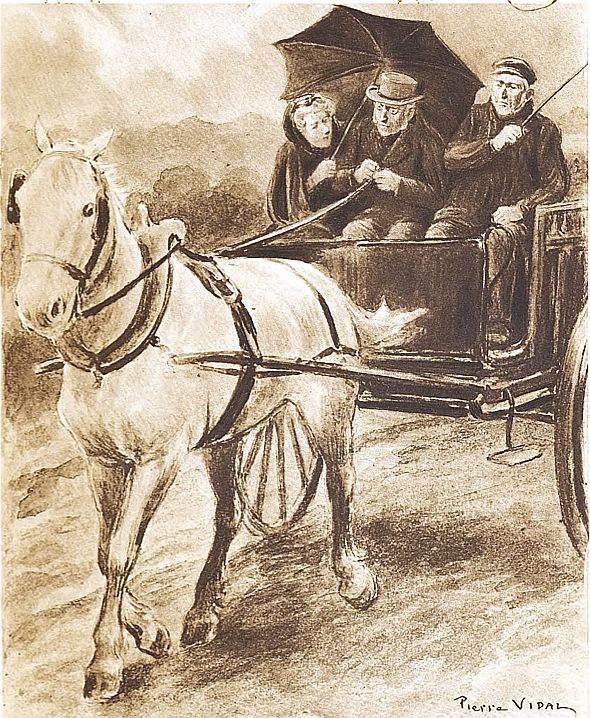
GILBERTE AND JAPPELOUP ACCOMPANY THE MARQUIS TO HIS CHÂTEAU.
The Marquis took the reins, refusing to allow his charming companion to have the trouble of driving. Jean armed himself with the whip, to stimulate poor Lanterne's courage with a sturdy arm.
"I know that they do not need that, monsieur le marquis," replied Gilberte, "and that you assist many more than I can hope to do."
"You see that is not so, for I have come here entirely by chance, and you are here for the express purpose of doing good."
"Oh no! I did not divine that they needed me," replied Gilberte; "this poor woman came after me; except for that I should probably have known no more about it than you."
"You try in vain to decry your deserts in order to diminish my culpability. They send for you, and they dare not come near me: that fact alone condemns me and glorifies you."
"The deuce! my dear Gilberte," said the carpenter, leading the girl apart, "in my opinion you are performing miracles and you could tame the old owl if you would only have the courage. Ah but! as Janille says, all goes well, and if you will act and talk like me, I will answer for it that you will reconcile him with your father."
"Oh! if I only could! but alas! my father has made me promise, yes, swear, that I would never try it."
"And yet he would give all he owns to have you succeed! Look, you, when he made you promise that, he thought that was impossible which is quite possible to-day—not to-morrow perhaps, but this evening, now! We must strike the iron while it's hot, and you can see that there has been a great change already, as he and I came here together and he talks to me in such a friendly way."
"How on earth did that miracle come about?"
"It was a cane that performed the miracle, on my back; I'll tell you about it later. Meanwhile you must be very lady-like, a little bold, and have your wits about you—in a word be like your friend Jean in everything. Listen, I am going to begin!"
Thereupon, Jean abruptly left Gilberte and went to the old man.
"What do you suppose this young lady just whispered in my ear? That she absolutely insists on taking you home in her carriage. Ah! Monsieur de Boisguilbault, you can't refuse a lady; she says that the roads are too badly washed for you to walk, that you are too wet to wait here for your own carriage, that she has a cabriolet with a good horse, a genuine curé's mare that doesn't lose her temper or take fright at anything and goes fast enough when your arm isn't asleep and there's a lash on the whip. In quarter of an hour you'll be at home, instead of splashing through the mud and stones for an hour."
Monsieur de Boisguilbault thanked the lovely widow warmly but would not accept; but Gilberte herself insisted, with irresistible grace.
"I implore you, monsieur le marquis," she said, turning upon him her beautiful eyes, still frightened like those of a half-tamed dove, "do not pain me by refusing; my carriage is ugly, shabby and muddy, and so is my horse; but they are both strong. I know how to drive and Jean will take me home."
"But it will delay you a long while," said the marquis; "your folks will be anxious."
"No," said Jean, "here is monsieur le curé's page, who serves the mass and rings the bell for him; he's a sure-footed, sharp-eyed rascal, with no more fear of the water than a frog. He has wooden clogs on his feet a little stouter than yours, and he will go to Cuzion as straight and fast as a saw will cut a spruce board. He will tell them not to worry; that madame's in good company and that old Jean will bring her home. So that's settled!—Look you, young wide-awake," he said to Charasson, who yawned as if he would dislocate his jaw and gazed in bewilderment at Monsieur de Boisguilbault; "just come and let me rouse you a bit in the fresh air, and start you on your road."
He dragged, almost carried Sylvain to a short distance from the house, and there, putting his leather apron over his shoulders, he said to him, pulling his ears briskly to fix his words in his memory:
"Run to Châteaubrun and tell Monsieur Antoine that Gilberte is going to Boisguilbault with me; tell him to keep quiet, that all goes well in that direction, and that he needn't worry if she passes the night away from home. Do you hear? do you understand?"
"I hear well enough, but I don't understand," replied Sylvain. "Will you let my ears alone, you old villain of a Jean!"
"I'll make them longer than they are, if you argue; and if you make a botch of my errand, I'll tear them off to-morrow."
"I heard you, that's enough; let me go."
"And if you stop to play on the road, look out!"
"Pardié! it's fine weather to play!"
"And if you lose my goatskin apron!"
"I'm no such fool, it won't do me any harm!"
And the child started off at full speed toward the ruins, picking his way in the darkness with the instinct of a cat.
"Now," said Jean leading the old mare and the barrow out from under the shed, "it's our turn, honest Lanterne. Oh! don't get excited, Monsieur Sacripant, it's only me! You came with your young mistress, good; but monsieur le marquis, who doesn't look at people, isn't afraid to look at dogs, and he may know you. Do me the favor to follow your friend Charasson. I am sorry to say you must return home on foot."—He cracked the whip at the poor beast and drove him away in the direction Charasson had taken.—"Come, monsieur le marquis, I am waiting for you!" And the marquis, conquered by Gilberte's persistence, mounted the barrow, where he sat between her and Jappeloup.
The stars in heaven did not witness this strange association, for heavy clouds concealed them, and Mère Marlot, the sole witness of this extraordinary adventure, was not sufficiently clear in her mind to indulge in any extended comments. The marquis had put his purse in her hand as he crossed the threshold of her house, and she passed the rest of the night counting the shining coins it contained and waiting on her little ones, saying:
"Dear young lady, she brings us good luck!"
The marquis took the reins, refusing to allow his charming companion to have the trouble of driving. Jean armed himself with the whip, to stimulate poor Lanterne's courage with a sturdy arm. Gilberte, whom Janille, anticipating the storm, had provided with a large umbrella and her father's old cloak when she allowed her to depart on her errand of mercy, gave her attention to sheltering her companions; and as the wind fought for the cloak with her, she held it over Monsieur de Boisguilbault's shoulders with one hand, while she exerted all her strength to hold the umbrella over the old man's head with the other hand, with filial solicitude. The marquis was so touched by these affectionate attentions that he lost all his bashfulness and expressed his gratitude in the warmest terms that his respect would permit. Gilberte trembled at the thought that this sympathetic feeling might change to wrath at any moment, and old Jean laughed in his beard, relying on Providence.
Although it was only nine o'clock, everybody at the château of Boisguilbault had retired when our travellers arrived. No one except old Martin ever paid any attention to the master after sunset, and on this evening Martin had closed the park after seeing the marquis enter his chalet, and had no suspicion that he had gone abroad and was travelling around the country in the rain and thunder, with an old carpenter and a young woman.
Jean was not particularly anxious to go into the courtyard with Gilberte; for, living so near Châteaubrun as they did, it was impossible that some if not all of the servants should not be familiar with the lovely girl's face, and the first exclamation would betray her.
But the rain was still falling, and there was no plausible excuse for making the marquis or Gilberte alight at the outer gate, especially as Monsieur de Boisguilbault absolutely insisted that his companions should come in and wait by the fire until the rain, which was quite cold and continuous, had ceased. Jean meanwhile was dying with longing to seize this pretext for prolonging the interview; but Gilberte refused in dismay to enter the dreadful manor-house of Boisguilbault, and it was certain that there was great peril in doing it.
Luckily the marquis's eccentric habits made it impossible for them to effect an entrance to the château. In vain did they ring the bell again and again, the wind roared so fiercely that the sound was carried far away. No servant, male or female, slept in that part of the building, where a grewsome solitude habitually prevailed; and, as for old Martin, the only person who ever ventured there, he was too deaf to hear anything, the bell or the thunder.
Monsieur de Boisguilbault was extremely mortified by his inability to show the hospitality which all the circumstances combined to impose upon him as a duty; and he was very angry with himself for having failed to anticipate what had happened. His wrath was on the point of breaking out anew and turning against old Martin, who went to bed with the sun. But at last, suddenly making up his mind what course to pursue, he said:
"I see that I must abandon the idea of getting into my own house, for I shall never make anybody hear unless I send for cannon to take the house by assault; but if madame is not afraid to visit an anchorite's cell, I have another lodging, the key of which never leaves me, where we shall find all that we need to enable us to warm ourselves and rest."
As he spoke he turned the horse's head toward the park, alighted at the gate, opened it himself, and led Lanterne in by the bridle, while Jean squeezed the trembling Gilberte's arm to encourage her to risk the adventure. "God forgive me!" he muttered, "he is taking us to his wooden house, where he passes all his nights evoking the devil! Never fear, Gilberte, I am with you, and this is the day we are going to turn Satan out-of-doors here!"
Monsieur de Boisguilbault, having closed the gate behind him, bade the carpenter take the reins and follow him at a foot-pace to a sort of gardener's shed where Emile often hitched Corbeau when he came late or expected to stay late; and while Jean busied himself putting poor Lanterne and Monsieur Antoine's barrow under cover, the marquis offered Gilberte his arm, saying: "I am distressed to ask you to walk a few steps on the gravel; but you will not have time to wet your feet, for my hermitage is right here, behind these rocks."
Gilberte shuddered from head to foot as she entered the chalet, alone with that strange old man whom she had always believed to be a little mad, and who now led the way into the darkness. She was somewhat relieved when he opened a second door, and she saw the corridor lighted by a lamp which stood in a niche decorated with flowers. That retreat, so luxurious and comfortable despite its rustic exterior, pleased her exceedingly, and in her youthful imagination, enamored of poetic simplicity, she fancied that she had found the sort of palace of which she had often dreamed.
Since Emile had been admitted to the mysterious chalet, notable improvements had been made there. He had impressed upon the old man that the stoical habits by which he undertook to protest against his own wealth were beginning to be too severe for a man of his years; and, although Monsieur de Boisguilbault was not as yet attacked by any serious infirmity he admitted that he had suffered much from the cold there during the winter. Emile had himself brought from the château carpets, hangings, thick curtains and suitable furniture; he had frequently lighted a fire in the huge stove for protection against the dampness on rainy nights, and the marquis had yielded to the pleasant sensation of being cared for, a sensation entirely mental to him, in which he saw the proof of a zealous and delicate affection. The young man had also rearranged and beautified the room in which he and the old man often took their evening meal. He had made it into a sort of salon, and Gilberte was delighted to place her little feet, for the first time in her life, on superb bearskin rugs, and to gaze in admiration at the beautiful vases of old Sèvres, filled with the rarest flowers, standing on a marble console.
The fireplace, filled with very dry pine cones, blazed up as if by enchantment when the marquis tossed in a piece of burning paper, and the candles, reflected in a mirror, the oaken frame of which was curiously carved and twisted, soon filled the room with a brilliant light dazzling to the eyes of a girl accustomed to the poor little lamp to which Janille supplied oil with a sparing hand, after the example of the woman in the Bible.
Monsieur de Boisguilbault, for the first time in his life, exerted himself with a sort of coquetry to do the honors of his chalet to such a charming guest. He took an artless pleasure in watching her examine and admire his flowers, and promised her that on the very next day she should have all the grafts and all the seeds to replenish the vicarage garden. Resuming momentarily the animation of youth, he ran hither and thither to find the little curiosities he had brought back from his trip to Switzerland, and offered them to her with ingenuous joy; and when she blushingly refused to accept anything, he took the little basket in which she had taken syrups and sweetmeats to her sick protégés and filled it with pretty bits of wood-work carved at Fribourg, specimens of rock-crystal, agates and cornelians set in seals and rings; and lastly with all the flowers in the vases, of which he made an enormous bouquet as deftly as he could.
The touching grace with which Gilberte in her confusion thanked the old man, her artless questions concerning his travels in Switzerland, of which Monsieur de Boisguilbault retained most enthusiastic recollections, expressed in terms that were far from classic, the interest with which she listened to him, her intelligent comments when she succeeded in recovering her self-possession, the fascinating tones of her voice, the distinction of her simple, natural manners, her absence of coquetry, and the mixture of alarm and enthusiasm in her bearing and her features, which made her beauty even more impressive than usual, her glowing cheeks, her eyes moist with emotion and fatigue, her bosom oppressed by unfamiliar agitation, and her angelic smile which seemed to implore mercy or protection—all combined to produce such a profound impression on the marquis and took possession of him so rapidly, that he suddenly felt that he loved her with all his heart; with a holy love, be it understood, not the base desire of an old man for youth and beauty, but the love of a father for the pure and adorable child. And when the carpenter joined them, himself dazzled and overjoyed to find himself in such a light, warm room, he thought that he was dreaming when he heard Monsieur de Boisguilbault say to Gilberte: "Put your feet to the fire, my dear child; I am terribly afraid you have caught cold to-night, and if you have I shall never forgive myself so long as I live!"
Thereupon, the marquis, impelled by an extraordinary outburst of expansiveness, turned to the carpenter and held out his hand, saying: