COSMOGONY. (continued 2)
Reading edition
During the journey of the Sia from the white-house in the north they built many villages. Those villages were close together, as the Sia did not wish to travel far at any one time. Finally, having concluded they had about reached the center of the earth, they determined to build a permanent home. The ti´ämoni, desiring that it should be an exact model of their house of white stone in the north, held a council, that he might gain information regarding the construction, etc., of the white village. “I wish,” said the ti´ämoni, “to build a village here, after our white-house of the north, but I can not remember clearly the construction of the house,” and no one could be found in the group to give a detailed account of the plan. The council was held during the night, and the ti´ämoni said, “To-morrow I shall have some one return to the white-house, and carefully examine it. I think the Si´sika (swallow) is a good man; he has a good head; and I think I will send him to the white-house,” and calling the Si´sika he said: “Listen attentively; I wish you to go and study the structure of the white-house in the north; learn all about it, and bring me all the details of the buildings; how one house joins another.” The Si´sika replied, “Very well, father; I will go early in the morning.” Though the distance was great, the Si´sika visited the white-house, and returned to the ti´ämoni a little after the sun had eaten (noon). “Father,” said the Si´sika, “I have examined the white-house in the north carefully, flying all over it and about it. I examined it well and can tell you all about it.” The ti´ämoni was pleased, for he had thought much concerning the white house, which was very beautiful.
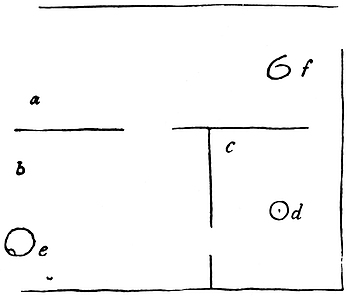
Fig. 15. Diagram of the white house of the north, drawn by a theurgist.
Lines indicate houses.
Street.
Plaza.
Plaza.
Doorway of the north wind.
The great chita.
Cougar, mother of the north village.
He at once ordered all hands to work, great labor being required in the construction of the village after the plan laid down by the Si´sika. Upon the completion of this village, the ti´ämoni named it Kóasaia. It is located at the ruin some 2½ miles north of the present site of Sia. (Fig. 15.) It is an accurate copy of a plan drawn by the theurgist who first related the cosmogony to the writer.
The theurgist explained that the cougar could not leave her post at the white stone village of the north; therefore, the lynx was selected as her representative at this village. And no such opening as shown in d existed in the duplicated village, as the doorway of the north wind was ever in the north village. And the ti´ämoni, with all his people, entered the large chita and held services of thanksgiving. Great was the rejoicing upon the completion of the village, and the people planted corn and soon had fine fields.
The Sia occupied this village at the time of their visit from Po´shaiyänne, the quasi messiah, after he had attained his greatness, and when he made a tour of the pueblos before going into Mexico.
Po´shaiyänne was born of a virgin at the pueblo of Pecos, New Mexico, who became pregnant from eating two piñon nuts. The writer learned through Dr. Shields, of Archuleta, New Mexico, that the Jemez Indians have a similar legend. When want and starvation drove the Pecos Indians from their pueblo they sought refuge with the Jemez. Philologists claim that the languages of the Pecos and Jemez belong to the same stock. The woman was very much chagrined at the birth of her child, and when he was very young she cast him off and closed her doors upon him. He obtained food and shelter as best he could; of clothing he had none but the rags cast off by others. While still a little boy he would follow the ti´ämoni and theurgists into the chita and sit apart by the ladder, and listen to their wise talk, and when they wished a light for their cigarettes Po´shaiyänne would pass a brand from one to another. But no one ever spoke to him or thanked him, but he continued to follow the wise men into the chita and to light their cigarettes. Even when he reached years when other youths were invited to sit with the ti´ämoni and theurgists and learn of them, he was never spoken to or invited to leave his seat by the entrance.
Upon arriving at the state of manhood he, as usual, sat in the chita and passed the light to those present. Great was the surprise when it was discovered that a string of the rarest turkis encircled his right wrist. After he had lighted each cigarette and had returned to his seat by the entrance, the ti´ämoni called one of his men to him and said, “What is it I see upon the wrist of the boy Po´shaiyänne; it looks like the richest turkis, but surely it can not be. Go and examine it.” The man did as he was bid, and, returning, told the ti´ämoni that it was indeed as he had supposed. The ti´ämoni requested the man to say to the youth that he wished to know where he obtained the turkis and that he desired to buy the bracelet of him. When the man repeated the message, Po´shaiyänne said, “I can not tell him how it came upon my wrist, and I do not wish to sell it.” The reply being delivered to the ti´ämoni, he said to his messenger, “Return to the youth and tell him I have a fine house in the north. It and all its contents shall be his in exchange for the bracelet.” The people present, hearing the words of the ti´ämoni, regretted that he offered his house and all therein for the bracelet, but they did not say anything as they thought he knew best. The message being delivered to Po´shaiyänne, he said, “Very well, I will give the bracelet for the house and all it contains.” The ti´ämoni then called Po´shaiyänne to him and examined the bracelet, and his heart was glad because he was to have the jewels. He then begged Po´shaiyänne to be seated, saying, “We will play the game Wash´kasi.”[7]
In playing the favorite game of Wash´kasi (Fig. 16), forty pebbles form a square, ten pebbles on a side, with a flat stone in the center of the square. Four flat sticks, painted black on one side and unpainted on the other, are held vertically and dropped upon the stone. The ti´ämoni threw first. Two black and two unpainted sides faced up. Two of the painted sides being up entitled the player to move two stones to the right. Po´shaiyänne then threw, turning up the four painted sides. This entitled him to move ten to the left. The ti´ämoni threw and three painted sides faced up. This entitled him to move three stones to the right. Again Po´shaiyänne threw and all the colored sides faced up, entitling him to move ten more. The next throw of the ti´ämoni showed two colored sides and he moved two more. Po´shaiyänne threw again, all the colored sides being up; then he moved ten. The ti´ämoni then threw and all four unpainted sides turned up; this entitled him to move six. Po´shaiyänne threw and again all the painted sides were up, entitling him to move ten, which brought him to the starting point, and won him the game.
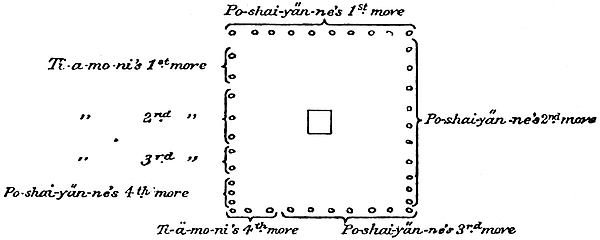
Fig. 16. The game of Wash´kasi.
The following morning, after the ti´ämoni had eaten, they went into the chita as usual; Po´shaiyänne, following, took his seat near the entrance, with a blanket wrapped around him. When he approached the ti´ämoni to hold the lighted stick to his cigarette, the ti´ämoni’s astonishment was great to find a second bracelet, of ko-ha-qua,[8] upon the wrist of Po´shaiyänne. Each bead was large and beautiful. The ti´ämoni urged Po´shaiyänne not to return to his seat by the ladder, but to sit with them; but he declined, and then a messenger was sent to examine the bracelet, and the man’s report excited a great desire in the ti´ämoni to secure to himself this second bracelet, and his house in the west, with all that it contained, was offered in exchange for the bracelet. This house was even finer than the one in the north. Po´shaiyänne replied that if the ti´ämoni wished the bracelet, he would exchange it for the house in the west. Then he was invited to be seated near the ti´ämoni, who placed between them a large bowl containing six 2-inch cubes, which were highly polished and painted on one side. The ti´ämoni said to Po´shaiyänne, “Hold the bowl with each hand, and toss up the six cubes. When three painted sides are up the game is won; with only two painted sides up the game is lost. Six painted sides up is equivalent to a march in euchre.” Po´shaiyänne replied, “You first, not I. You are the ti´ämoni; I am no one.” “No,” said the ti´ämoni, “you play first;” but Po´shaiyänne refused, and the ti´ämoni tossed up the blocks. Only two painted sides were up; Po´shaiyänne, then taking the bowl, tossed the blocks, and all the painted sides turned up. Again the ti´ämoni tried his hand, and three painted sides faced up; then Po´shaiyänne threw and the six painted sides were up. The ti´ämoni again threw, turning up two painted sides only; then Po´shaiyänne threw, with his previous success. The ti´ämoni threw, and again two painted sides were up. Po´shaiyänne threw, and six painted sides faced up as before, and so a second house went to him. The ti´ämoni said, “We will go to our homes and sleep, and return to the chita in the morning, after we have eaten.”
The following morning Po´shaiyänne took his seat at the usual place, but the ti´ämoni said to him: “Come and sit among us; you are now more than an ordinary man, for you have two houses that belonged to the ti´ämoni,” but Po´shaiyänne refused and proceeded to light the stick to pass around for the lighting of the cigarettes. When he extended his hand to touch the stick to the cigarettes it was discovered that he wore a most beautiful bracelet, which was red, but not coral. The ti´ämoni again sent an emissary to negotiate for the bracelet, offering Po´shaiyänne his house in the south in exchange for the red bracelet. Po´shaiyänne consented and again a game was played. Four circular sticks some 8 inches long, with hollow ends, were stood in line and a blanket thrown over them; the ti´ämoni then put a round pebble into the end of one, and removing the blanket asked Po´shaiyänne to choose the stick containing the pebble. “No, my father,” said Po´shaiyänne, “you first. What am I that I should choose before you?” but the ti´ämoni replied, “I placed the stone; I know where it is.” Then Po´shaiyänne selected a stick and raising it the pebble was visible. Po´shaiyänne then threw the blanket over the sticks and placed the stone in one of them, after which the ti´ämoni selected a stick and raised it, but no stone was visible. This was repeated four times. Each time the ti´ämoni failed and Po´shaiyänne succeeded, and again the house in the south went to Po´shaiyänne.
The next day when all had assembled in the chita and Po´shaiyänne advanced to light the cigarettes a bracelet of rare black stone beads was noticed on his wrist. This made the ti´ämoni’s heart beat with envy and he determined to have the bracelet though he must part with his house in the east; and he offered it in exchange for the bracelet, and Po´shaiyänne accepted the offer. The ti´ämoni then made four little mounds of sand and throwing a blanket over them placed in one a small round stone. Then raising the blanket he requested Po´shaiyänne to select the mound in which he had placed the stone. Po´shaiyänne said: “My father, what am I that I should choose before you?” The ti´ämoni replied, “I placed the stone and know where it is.” Then Po´shaiyänne selected a mound, and the one of his selection contained the stone. The placing of the stone was repeated four times, and each time the ti´ämoni failed, and Po´shaiyänne was successful; and the hearts of all the people were sad when they knew that this house was gone, but they said nothing, for they believed their ti´ämoni knew best. The ti´ämoni said: “We will now go to our homes and sleep, and on the morrow, when we have eaten, we will assemble here.”
In the morning Po´shaiyänne took his accustomed place, entering after the others. Upon his offering the lighted stick for the cigarettes the people were struck with amazement, for on the wrist of Po´shaiyänne was another bracelet of turkis of marvelous beauty, and when the ti´ämoni discovered it his heart grew hungry for it and he sent one of his men to offer his house of the zenith. Po´shaiyänne replied that he would give the bracelet for the house. This house contained many precious things. The ti´ämoni requested Po´shaiyänne to come and sit by him; and they played the game Wash´kasi and, as before, Po´shaiyänne was successful and the house of the zenith fell to him.
The following morning, when the people had assembled in the chita and as Po´shaiyänne passed the stick to light the cigarettes, the ti´ämoni and all the people saw upon his wrist another bracelet of large white beads. They were not like the heart of a shell, but white and translucent. The ti´ämoni could not resist the wish to have this rare string of beads, and he sent one of his men to offer his house of the nadir for it. When Po´shaiyänne agreed to the exchange, all the people were sad, that the ti´ämoni should part with his house, but they said nothing and the ti´ämoni was too much pleased with the beautiful treasure to be regretful. He had Po´shaiyänne come and sit by him and again play the game with the six blocks in the large bowl. The game was played with success on the part of Po´shaiyänne and he became the owner of the sixth house.
On the following day when all were gathered in the chita the ti´ämoni said to Po´shaiyänne: “Come and sit with us; surely you are now equal with me, and you are rich indeed, for you have all my houses,” but he refused, only passing among theurgists and people to offer the lighted stick for the cigarettes. When he extended his hand a bracelet was discovered more beautiful than any of the others. It was pink and the stones were very large. The ti´ämoni upon seeing it cried, “Alas! alas! This is more beautiful and precious than all the others, but all my houses and treasures are gone. I have nothing left but my people; my old men and old women; young men and maidens and little ones.” Addressing the people, he said: “My children, what would you think of your ti´ämoni should he wish to give you to this youth for the beautiful beads?” They replied, “You are our father and ruler; you are wise and know all things that are best for us;” but their hearts were heavy and sad, and the ti´ämoni hesitated, for his heart was touched with the thought of giving up his people whom he loved; but the more he thought of the bracelet the greater became his desire to secure it, and he appealed a second time to his people and they answered: “You know best, our father,” and the people were very sad, but the heart of the ti´ämoni though touched was eager to possess the bracelet. He sent one of his men to offer in exchange for the bracelet all his people, and Po´shaiyänne replied that he would give the bracelet for the people. Then the ti´ämoni called the youth to him, and they repeated the game of the four sticks, hollowed at the ends. Po´shaiyänne was successful, and the ti´ämoni said: “Take all my people; they are yours; my heart is sad to give them up, and you must be a good father to them. Take all the things I have, I am no longer of any consequence.” “No,” said Po´shaiyänne; “I will not, for should I do so I would lose my power over game.” The two remained in the chita and talked for a long time, the ti´ämoni addressing Po´shaiyänne as father and Po´shaiyänne calling the ti´ämoni father.
After a time Po´shaiyänne determined to visit all the pueblos, and then go into Mexico.
He was recognized by the Sia at once upon his arrival, for they had known of him and sung of him, and they looked for him. He entered the chita in company with the ti´ämoni (the one appointed by Ût´sĕt) and the theurgists. It was not until Po´shaiyänne’s visit to the Sia that they possessed the power to capture game. The men were often sent out by the ti´ämoni to look for game, but always returned without it, saying they could see the animals and many tracks but could catch none; and their ruler would reply: “Alas! my children, you go for the deer and return without any;” and thus they hunted all over the earth but without success.
After Po´shaiyänne’s talk with the ti´ämoni, and learning his wish for game, he said: “Father, what have you for me to do?” And the ti´ämoni replied: “My children have looked everywhere for deer, and they can find none; they see many tracks, but they can not catch the deer.” “Well,” replied Po´shaiyänne, “I will go and look for game.” He visited a high mountain in the west, from whose summit he could see all over the earth, and looking to the north, he saw on the top of a great mountain a white deer. The deer was passing toward the south, and he said to himself, “Why can not the Sia catch deer?” And looking to the west, he saw a yellow antelope on the summit of a high mountain. He, too, was passing to the south, and Po´shaiyänne said to himself, “Why can they not catch antelope?” And he looked to the south, and saw on the great mountain of the south a sheep, which was also passing to the south, and he looked to the east, and there, on a high peak, he saw the buffalo, who was passing to the south; and then, looking all over the earth, he saw that it was covered with rabbits, rats, and all kinds of small animals, and that the air was filled with birds of every description. Then, returning to the ti´ämoni, he said: “My mother, my father, why do your children say they can catch no game? When I first looked to the mountain of the north I saw the deer, and to the west I saw the antelope, and to the south the mountain sheep, and to the east the buffalo, and the earth and air were filled with animals and birds.” The ti´ämoni inquired how he could see all over the earth. He doubted Po´shaiyänne’s word. Then Po´shaiyänne said: “In four days I will go and catch deer for you.” “Well,” said the ti´ämoni, “when you bring the deer I will believe. Until then I must think, perhaps, you do not speak the truth.”
For three days the men were busy making bows and arrows, and during these days they observed a strict fast and practiced continency. On the fourth morning at sunrise Po´shaiyänne, accompanied by Ma´asewe and Úyuuyewĕ, who came to the earth to greet Po´shaiyänne, and the men of the village, started on the hunt. They ate before leaving the village, and after the meal Po´shaiyänne asked: “Are you all ready for the hunt?” And they replied: “Yes; we are ready.” Po´shaiyänne, Ma´asewe, and Úyuuyewĕ started in advance of the others, and when some distance ahead Po´shaiyänne made a fire and sprinkled meal to the north, the west, the south, and the east, that the deer might come to him over the roads of meal. He then made a circle of meal, leaving an opening through which the game and hunters might pass, and when this was done all of the men of the village formed into a group a short distance from Po´shaiyänne, who then played on his flute, and, holding it upward, he played first to the north, then west, then south, and then east. The deer came over the four roads to him and entered the great circle of meal. Ma´asewe and Úyuuyewĕ called to all the people to come and kill the deer. It was now before the middle of the day. There were many deer in the circle, and as the people approached they said one to another: “Perhaps the deer are large; perhaps they are small.”
(The deer found by the Sia in this world are quite different from those in the lower world. Those in the lower world did not come to this world; they are called sits´tä-ñe, water deer. These deer lived in the water, but they grazed over the mountains. They were very large, with great antlers. The deer in this world are much smaller and have smaller antlers.)
The circle was entered at the southeast, Ma´asewe passing around the circle to the left was followed by half of the people, Úyuuyewĕ passing to the right around the circle, preceded the remainder. As soon as they had all entered Po´shaiyänne closed the opening; he did not go into the circle but stood by the entrance. The deer were gradually gathered into a close group and were then shot with arrows. When all the deer had been killed they were flayed, and the flesh and skins carried to the village. As they passed from the circle Po´shaiyänne said, “Now carry your meat home. Give your largest deer to the ti´ämoni and the smaller ones to the people of your houses.” After the Sia had started for their village Po´shaiyänne destroyed the circle of meal and then returned to the ti´ämoni, who said: “You, indeed, spoke the truth, for my people have brought many deer, and I am much pleased. On the morrow we will kill rabbits.” The ti´ämoni informed the coyote of his wish for the rabbits, and in the morning a large fire was made, and the coyote spoke to the fire, saying: “We desire many rabbits but we do not wish to go far.” He then threw meal to the cardinal points, zenith, and nadir, and prayed that the sun father would cause the small and large rabbits to gather together that they might not have to go a great distance to find them, for as he, the father, wished, so it would be, and Ma´asewe and the coyote sat down while the people gathered around the fire and passed their rabbit sticks through the flames. Then Ma´asewe directed them to start on the hunt. They formed into an extensive circle surrounding the rabbits, and a great number were secured. Some were killed by being struck immediately over their hearts. It was very late when the people returned to the village laden with rabbits.
The ti´ämoni said: “Day after to-morrow we will have a feast.” Po´shaiyänne agreeing, said: “It is well, father.” All the women worked hard for the feast. Half of their number worked for the ti´ämoni and half for Po´shaiyänne. The ti´ämoni going alone to the house of Po´shaiyänne, said: “Listen: to-morrow you will have the great feast at your house.” Po´shaiyänne replied: “No, father; you are the elder, and you must have it at your house.” The ti´ämoni answered: “Very well, my house is good and large; I will have it there.”
In the morning, when the sun was still new, the ti´ämoni had the feast spread—bowls of mush, bread, and meat; and he said to Po´shaiyänne, who was present: “Father, if you have food bring it to my house and we will have our feast together.” Po´shaiyänne replied: “It is well, father;” and, to the astonishment of all, Po´shaiyänne’s food immediately appeared. It was spread on tables;[9] the bowls holding the food being very beautiful, such as had never before been seen. The ti´ämoni told Ma´asewe to bid the people come to the feast; and all, including the most aged men and women and youngest children, were present. Upon entering the house they were surprised with the things
they saw on Po´shaiyänne’s table, and all who could went to his table in preference to sitting before the ti´ämoni’s. Even the water upon Po´shaiyänne’s table was far better than that furnished by the ti´ämoni; and those who drank of this water and ate Po´shaiyänne’s food immediately became changed, their skins becoming whiter than before; but all could not eat from Po´shaiyänne’s board and many had to take the food of the ti´ämoni, and they remained in appearance as before.
After this feast, Po´shaiyänne visited all the pueblos and then passed on to Chihuahua in Mexico. Before Po´shaiyänne left the Sia, he said to them: “I leave you, but another day I will return to you, for this village is mine for all time, and I will return first to this village.” To the ti´ämoni he said: “Father, you are a ti´ämoni, and I also am one; we are as brothers. All the people, the men, the women, and the children are mine, and they are yours; and I will return to them again. Watch for me. I will return;” and he added, “In a short time another people will come; but before that time, such time as you may choose, I wish you to leave this village, for my heart is here and it is not well for another people to come here; therefore depart from this village before they come near.”
Upon entering the plaza in Chihuahua Po´shaiyänne met the great chief, who invited him to his home, where he became acquainted with his daughter. She was very beautiful, and Po´shaiyänne told the chief that he was much pleased with his daughter and wished to make her his wife. The chief replied: “If you desire to marry my daughter and she wishes to marry you, it is well.” Upon the father questioning the daughter the girl replied in the affirmative. Then the father and mother talked much to the daughter and said: “To-morrow you will be married.” The chief sent one of his officials to let it be known to all the people that Po´shaiyänne and his daughter were to be united in marriage in the morning, and many assembled, and there was a great feast in the house of the chief. Many men were pleased with the chief’s daughter, and looked with envy upon Po´shaiyänne; and they talked together of killing him, and finally warriors came to the house of Po´shaiyänne and carried him off to their camp and pierced his heart with a spear, and his enemies were contented, but the wife and her father were sad. The day after Po´shaiyänne’s death he returned to his wife’s home, and when he was seen alive those who had tried to destroy him were not only angry but much alarmed; and again he was captured, and they bound gold and silver to his feet, that after casting him into the lake his body should not rise; but a white fluffy feather of the eagle fell to him, and as he touched the feather the feather rose, and Po´shaiyänne with it, and he lived again, and he still lives, and some time he will come to us. So say the Sia. Po´shaiyänne’s name is held in the greatest reverence; in fact, he is regarded as their culture hero[10], and he is appealed to in daily prayers, and the people have no doubt of his return. They say: “He may come to-day, to-morrow, or perhaps not in our lifetime.”
Soon after Po´shaiyänne’s departure from Sia the ti´ämoni decided to leave his present village, though it pained him much to give up his beautiful house. And they moved and built the present pueblo of Sia, which village was very extensive. The ti´ämoni had first a square of stone laid, which is to be seen at the present day, emblematic of the heart of the village (for a heart must be, before a thing can exist). After the building of this village the aged ti´ämoni continued to live many years, and at his death he was buried in the ground, in a reclining position. His head was covered with raw cotton, with an eagle plume attached; his face was painted with corn pollen, and cotton was placed at the soles of his feet and laid over the heart. A bowl of food was deposited in the grave, and many hä´chamoni were planted over the road to the north, the one which is traveled after death. A bowl of food was also placed on the road. All night they sang and prayed in the house of the departed ti´ämoni, and early in the morning all those who sung were bathed in suds of yucca made of cold water.
There are two rudely carved stone animals at the ruined village supposed to have been visited by Po´shaiyänne. These the Sia always speak of as the cougar, but they say, “In reality they are not the cougar, but the lynx, for the cougar remained at the white-house in the north.”
This cosmogony exhibits a chapter of the Sia philosophy, and though this philosophy is fraught with absurdities and contradictions, as is the case with all aboriginal reasoning, it scintillates with poetic conceptions. They continue:
“The hour is too solemn for spoken words; a new life is to be given to us.”
Theirs is not a religion mainly of propitiation, but rather of supplication for favors and payment for the same, and to do the will of and thereby please the beings to whom they pray. It is the paramount occupation of their life; all other desirable things come through its practice. It is the foundation of their moral and social laws. Children are taught from infancy that in order to please the pantheon of their mythical beings they must speak with one tongue as straight as the line of prayer over which these beings pass to enter the images of themselves.
It will be understood from the cosmogony that the Sia did not derive their clan names from animal ancestors, nor do they believe that their people evolved from animals, other than the Sia themselves. The Zuñi hold a similar belief. The Zuñi’s reference to the tortoise and other animals as ancestors is explained in the “Religious Life of the Zuñi Child.”[11]
I am of opinion that closer investigation of the North American Indian will reveal that the belief in the descent of a people from beasts, plants, or heavenly bodies is not common, though their mythological heroes were frequently the offspring of the union of some mortal with the sun or other object of reverence. There is no mystery in such unions in the philosophy of the Indian, for, as not only animate but inanimate objects and the elements are endowed with personality, such beings are not only brothers to one another, but hold the same kinship to the Sia, from the fact, according to their philosophy, that all are living beings and, therefore, all are brothers. This is as clearly defined in the Indian mind as our recognition of the African as a brother man.
The spider is an important actor in Sia, Zuñi, and Tusayan mythology. Sia cosmogony tells us the spider was the primus, the creator of all. Sûs´sĭstinnako is referred to as a man, or, more properly, a being possessing all power; and as Sûs´sĭstinnako created first man and then other beings to serve his first creation, these beings, although endowed with attributes superior to man in order to serve him, can hardly be termed gods, but rather agents to execute the will of Sûs´sĭstinnako in serving the people of his first creation.
Sûs´sĭstinnako must be supplicated through the mediator Ûtsĕt, who is present at such times in the fetich I´ärriko. Ko´shairi and Quer´ränna appear for the sun and moon. The war heroes and the warriors of the six mountains of the world, the women of the cardinal points, and animals, insects, and birds holding the secrets of medicine, are present, when invoked, in images of themselves. The Sia can not be said to practice ancestor worship. While the road to Shipapo (entrance to the lower world) is crowded with spirits of peoples returning to the lower world, and spirits of unborn infants coming from the lower world, the Sia do not believe in the return of ancestors when once they have entered Shipapo. While many of the kokko (personated by persons wearing masks) are the immediate ancestors of the Zuñi, the Ka´ᵗsuna of the Sia, also personated by men and women wearing masks, are altogether a distinct creation, and can not be considered to bear any relation to ancestor worship.
The Sia, however, have something as appalling to them as the return of the dead, in their belief in witchcraft, those possessing this craft being able to assume the form of dogs and other beasts; and they are ever on the alert when traveling about on dark nights, especially if the traveler is a man of wealth, as witches are always envious of the financial success of others. They create disease by casting into the body snakes, worms, stones, bits of fabric, etc. Hair must be burned that it may not be found by wizards or witches, who, combining it with other things, would cast it into the person from whose head it was cut, causing illness and perhaps death. There is, however, a panacea for such afflictions in the esoteric power of the theurgists of the secret cult societies. A man was relieved of pain in the chest by a snake being drawn from the body by an eminent theurgist during the stay of the writer at Sia. Such is the effect of faith cure in Sia that, though the man was actually suffering from a severe cold, his improvement dated from the hour the snake was supposed to have been extracted.