PART V. THE PONT, OR BRIDGE.
Reading edition
The bridge is one of the oldest tricks in use amongst sharpers, and it is almost impossible to be on one's guard against its use, when well done.
As in the preceding examples, it is used to make a false cut, and thus to retain the cards as they have been arranged by the sharper to enable him to win.
The pack of cards must be held in the right hand, and bent, by pressing them against the first finger of the left. The upper part of the pack must then be bent in an opposite direction, so as to form an arch, as in figure 8.
Fig. 8.
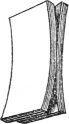
This being accomplished, the upper portion of the pack is laid on the top of the other, as if to mix the cards.
The two bent cards are thus brought in contact, and it is the gap produced by these two arcs, which forces the cut to be made oftener at that spot than at any other, as represented in figure 9.
Fig. 9.
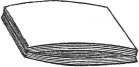
The smallest space between any two cards is sufficient for this purpose. The "carte tuilée," or card bent lengthways, is also used for this purpose.
The two portions of the pack, being bent lengthways, and laid face to face, are sure to make the cut at that particular spot, by causing a division in the pack; but this trick is not so good as the last-mentioned, and is, consequently, seldom employed.