Part III (continued 2)
Reading edition
“I wish you’d do some of your ‘stunts’ for Father,” Lois suggested.
“All right. If you want stunts, here is my best one.” This was written briskly, upside down and backward from my position. “Dad, this is the way I wrote the letter to you and the girls. Here’s another, with my love and greeting. I said I’d do this with trimmings. This is the beginning.”
We gave him fresh paper, and he wrote rapidly, in winding circles, starting at the edge of the table and finishing at the center: “Now I’ll do it this way, all around the family circle. All of you in, and I am not left out.” Diagonally across the whole in bold script, “Frederick.”
In moving the paper again, it was torn a little. Mr. Gaylord made some suggestion as to the way it should be handled, and Lois humorously complained that he was “always interfering with other people’s purposes.” Beginning at the upper right-hand corner of the table, Frederick wrote along the edges, and then in circles toward the center, as indicated in the diagram:
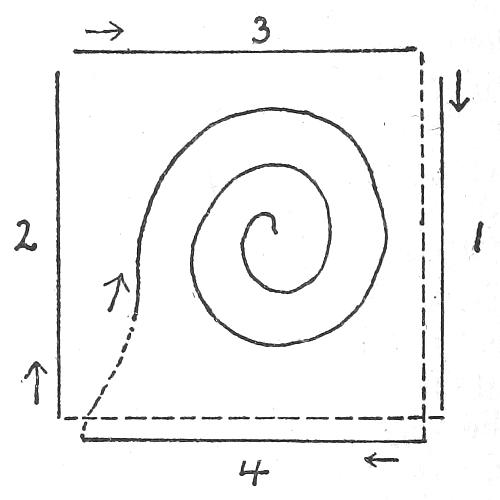
“Don’t you mind, Dad. Let them laugh. You and I will be laughing at them presently, from all four points of the compass.” Again his name was signed diagonally across the whole.
“I always did like circuses, and I can be a four-ringed one now, all by myself, if I have a sympathetic audience,” was his next achievement, done once more in circles from edges to center, but this time his name was signed in the center, in small script, surrounded by a flourish.
When again a clear surface offered, he drew a large circle around the edge of the table—the symbolism of which, curiously, occurred to none of us until the next day—and then ran to the center, to circle toward the edge: “All of us together again, and all being happy in the consciousness that this is real and eternal union, and that from now on we are going to keep our family circle intact.”
Some one suggested that unquestionably he was keeping his promise to “do it with trimmings,” and in an intricate pattern, impossible to describe clearly, he replied: “Sure! I’m doing all the trimmings I can think of, and after a minute or two I’ll think of more.”
By this time the astonishment and curiosity aroused by these performances had perceptibly lowered the emotional pressure, and the interview again proceeded more normally.
Not unnaturally, in this first family reunion Frederick’s messages were chiefly personal. Frequently, in pauses, he made enthusiastic little circles, as has been his custom from the first, and I asked him whether it was the circle of infinity, all-inclusive.
“Yes, partly. Put out all disturbing factors and all forces of disintegration, add more to eternity and infinity—and that is the circle.”
“Good night,” he said, a little later. “I’ll stay here to-night and as long as Margaret stays. You’ll talk often, won’t you?”
The next night, he began with a suggestion that the rest do the talking, adding: “I’ll listen and answer questions.” After some discussion of purpose, in its personal application, and inquiries concerning other members of the family on his plane, Mr. Wylie asked whether his grandfather could talk to him in this way.
“I can get him, I think, by to-morrow,” Frederick replied. “He’s sheltering a lot of poor, undeveloped wretches who have come out of conditions not making for fitness or growth. He teaches, and urges, and offers them opportunity, and is too busy and helpful to come away often.”
After this had been written, I was told that this man, during his earthly life, had devoted time and money to providing opportunity for others; never offering charity, but building roads that the unemployed might have work, exchanging some commodity needed by a poor man for some other of which he had enough and to spare, and always encouraging his less fortunate fellows to retain and develop their self-respect.
Of another on his plane, now a healer, Frederick said: “I haven’t seen him. Every healing force here, as with you, is occupied with war-stricken forces. They come so dazed, and sometimes terrified—and almost always startled, if they come from battle. And all our healing forces are required every minute.”
This reminded Mrs. Gaylord of an experience of her own, a few days before, when her pencil had written detached words, suggestive of battle. “Lost ... many lost ... another dead ... shot ...” etc. She asked whether this came from a friend, and was answered in the negative. To her inquiry, “Did you live here?” the reply was: “Near.” She asked for the name, and it was written clearly, “K——.” A few days later the name of Lieutenant K——, of a neighboring city, headed the American casualty list.
“K—— caught his one chance before his consciousness dimmed,” Frederick commented. “He is now too bewildered to talk. Just after what people who don’t know call death, there is a moment of singular clarity and vision. He happened to catch you in that moment.”
We fell to wondering, then, whether these messages could be flashed to us from a distance, or whether the person communicating must be present, and I asked Frederick whether he could send me a message from a distance.
“No, but we travel in a flash.”
We who had had some experience in receiving these communications spoke of the fear we all had lest we might unconsciously influence the pencil, at times, to write our own imaginings.
“You people have such a fear of imagining things that you shut out a lot we try to tell you,” Frederick interpolated. “We can’t get through doubt, bitterness, resentment, or selfish grief. Fear can be conquered, but doubt shuts the door in our faces. Please relax a little of this too rigid vigilance, and at least entertain the idea we are trying to put over.”
“Do I shut things out by too much vigilance?” I asked.
“You bet you do! But you do it for the best of reasons. You can’t take chances of giving the wrong message.”
To a question about the desire of others on his plane to communicate with those here, he replied: “They are all eager to get in touch, just now. Every one of us here is pulling every thread of connection he can there, because this is a critical time and because never before in the world’s history have so many people been reaching out for the thing that means co-operation and progress, in the biggest and broadest sense, if we can only reach them and convince them that we are all working together, and that we here can help if they will let us.”
Mr. Wylie spoke of some one whose “make-up,” he thought, might enable him to receive these communications.
“Make-up has a lot to do with it,” Frederick returned, “but the peculiar quality of following accurately a thought put forth by a force so subtle that science has failed to detect it is a thing that none of you recognize until it has demonstrated itself.”
Some one asked about a prominent politician, whom Frederick had known well in this life, and he replied: “—— is working his way back to a place in the forces of Production. He had a great opportunity, and used it for personal ends, and now he is learning how to use it for Progress. He is not destructive, nor even deterrent. He is a fine force, delayed a little.”
“Have you ever seen my mother and father?” Mr. Gaylord asked, thereby eliciting the most rapidly written communication—with the possible exception of one coming the next night—that I have ever taken, the force moving the pencil being so strongly applied, at moments, that the instrument was almost pulled out of my fingers.
It should be explained that in this appeal to his father Frederick was addressing neither reluctance nor doubt, but a certain mental tensity, resulting from deep emotion, deeply repressed.
“Yes, I had Grandmother at Mrs. Z——’s one day,” he began. “She is very anxious to talk to you, but she has gone on to a life, or a plane, beyond the one I am on, and I can’t always reach her. I hope to get her some time before Margaret goes home.... She never wholly left you, any more than I have. She tried for years to tell you she was there, and she wants to come back as soon as possible and tell you herself that there is no death, no separation, no cause for pain, or grief, or fear, or sadness of parting, except as it is made in the hearts of those who do not know the truth.
“We are nearer to you than you are to each other, Dad, and we can prove it, if you will let go of yourselves and take hold of us. We want to come to you. We do come to you. We try and try to tell you that there is nothing to grieve about, nothing to dread. Only love, and hope, and growth, and beauty of completer union. But we can’t do it alone. We must have a free heart, a free mind, a free hope to come into. Give us that, and we will show you that we are more truly your own—not your own flesh and blood, but your own purpose and force, which was one in the beginning, and will inevitably be one in the end. We want to make it one now. Don’t you, Dad? Won’t you try to let the bars down and take us in? We’ll come, and we’ll all be happier than you’ve ever been in all your life yet, because the Eternal Purpose is Unity, and we can begin it right here and now, if you there will join us and be part with us, as we with you, of the glorious and happy and (O) irresistible movement toward the great end—which, after all, is not an end, but an eternal and infinite growth toward bigger things.
“It is a big gospel we are giving you, sir; a man’s gospel; a gospel of hope and beauty and construction. And I am asking you to let me come in again to your every-day life, to let the dread and misgiving and unhappiness go, to think of us here—all of us who are yours—as still yours, still with you, still loving and working and hoping with you and for you; and if you can do that, I promise you we shall all be happier than any of us have ever been before.
“You see, sir, we are all of the forces of Progress. We are all for Light, and Building, and Justice, and Truth, and when one of us holds back we are all held back. This is the first time it has been possible to tell you all this. This is the first time we have been able to reach you freely, in a way you could not mistake. But the people who have preached the gospel of happiness as a curative force have not been entirely wrong. They have not been wholly right. But the forces here cannot possibly affect a tense and resisting mind as they can a relaxed and receptive one. And the forces here are potent and eager and ready. You know that must be true, because I am one of them, and the only change in me—absolutely the only one, Dad—is that I have left the limitations of the flesh behind and grown in perception and knowledge. I am the same Boy,[8] plus the better things, and minus the limitations.
“Grandmother is the same, too—plus. She is sweeter, finer, broader, more loving, than when you knew her. Just as she was, but expanded, irradiated, deepened. That’s all that death means, so you see it isn’t death at all, nor separation, nor anything but beauty, and greater love, and wider opportunity, and higher ideals to live to.
“This is what we want to share with you. We can, now. You can have a little of our knowledge, while still in that preliminary life. You can help us and yourselves by realizing and living the purpose that is ours. You have always lived it, but you haven’t always recognized it. Do that, recognize it, recognize us, let us in as recognized and essential parts of your life and hope and happiness, and I shall not need to tell you that this is a true gospel. You will have proved it for yourself.
“Your son always,
“Frederick.”
We were all deeply moved. After a little, Mr. Gaylord asked: “Is there anything more?”
Frederick began making circles, and his mother said: “He’s so happy!”
“Happy isn’t the word for it! I’m personified radiance and bliss! There isn’t anything more to-night, except my love to all of you, always—and to-morrow, and the next day, and all the days to come, we are reunited and indivisible. That’s enough, isn’t it, sir? Good night. Frederick.”
VIII
The next day, that grandfather for whom Mr. Wylie had asked came briefly, discussing purpose, like the rest.
“I didn’t half understand my own impulses there,” he said, “but I know now that the best thing a man can do for other men—and for himself, too—is to give them a chance to develop whatever is in them. Sometimes it isn’t much, from the point of view of the intelligent man, but the fact remains that it is force, and the more quickly it is developed the more quickly the sum of the whole will be raised.”
He closed more personal assurances by saying: “There may be no way to put it into words, but you may be sure I am watching, and helping, and being helped, too, by your reaching toward our common purpose.”
When Frederick had taken over the pencil again, Mrs. Gaylord spoke of the long message to his father the night before, to which he replied: “It was only a beginning. This thing we have to tell you can’t be given, nor yet accepted, in a day or a month. That letter last night was a sort of foreword, just to get us all started even. The proof of the pudding is coming later.”
Some more or less personal discussion followed, during which Mr. Gaylord asked whether certain arrangements he contemplated making were wise.
Frederick replied that they were, as far as he could see, adding: “This is hardly a time for making permanent arrangements, for while the end of the war is certain, the economic conditions with you, following the war, are impossible now to foresee. We have no way of knowing how that struggle between labor and capital, power of foundation and power of development, will end. That is one of the reasons we are so eager to get all forces for true progress united now. There are thousands of laboring men misled. Get them in for our work. There are hundreds of employers ignorant or indifferent. Turn them out.”
Mr. Gaylord, who had not at that time read the Lessons carefully, interpreted this as championship of the cause of labor as opposed to capital. Some one else suggested that every one, employer or laborer, who was not for united progress, should be “turned out.”
“Sure,” Frederick answered. “Turn out the unions, as they work now. Get in unity, regardless of class.”
When Mrs. Gaylord inquired about a member of her own family, he replied: “He has gone on, and I haven’t seen him. To some of us here there comes a lessening of interest in your life, and an intensified feeling of the importance of work beyond your plane. He has this interest, I hear, and very rarely comes back now. There is a lot I want to tell you some time about the differences and conditions of the many planes, but I can’t do it now. The first work of those of us who have still close ties there is to give you all we can of the possibilities and meaning of the life you live. Some day I’ll tell you what I can of the life ahead, which as yet I only aspire to.”
“I suppose there’s no use asking whether you inhabit space, or planes, or stars?” Lois inquired.
“There are things that I can tell you later about those matters of plane and future progress,” he said, “but there is so much that is more imperative now that I am told not to tell more, at present, than the immediate needs of your life require.”
“Do you feel any depression, when you realize the immensity of the universe and the smallness of each individual?” was the next question.
“That’s a thing you’ve got to learn. There is no force that is not true force, and no atom so small that its weight doesn’t count. If one atom is for destruction, that means two atoms lost to construction, the one that is against us and the one that balances it here, without any forward movement.”
“Have you seen my father?” Mr. Gaylord asked.
“No. He is a healer now, and has come back from the plane beyond to help the newly arrived find their balance. I have tried to get in touch with him, but he is busy and I haven’t yet met him, but still hope to. Few come back for any work here, and their greater knowledge makes them very much in demand, just as a great surgeon is with you in times like these.”
Again the talk turned into more personal channels, and Mr. Gaylord asked a specific question, affecting future arrangements.
“... Your choice will be influenced, probably, by many considerations, as choice must always be in your life.... I can influence you in ways I can’t define in words, but I can’t properly tell you how to choose—as you know better than I. You taught me that, and it’s true. Every fellow on his own feet.... Not that I’m not eager to help, sir. You understand that, don’t you? But the way I can help most is by a close and constant association and suggestion, that still stops short of definite expression of choice for you. That is your privilege. Mine is to help you see the way more clearly.”
“Do you know what we are thinking, at all times?”
“Not always. We read most of the thought of the sympathetic forces, and some of everybody’s. I can’t always answer the thought I read, though I can sometimes. But Margaret keeps up such a stiff guard, I can’t always get over a thing she doesn’t know is asked.”
I said I was sorry for that, and did not understand it, as I thought I had lowered all guards as far as he was concerned.
“You can’t understand all the barricades—and the limitations, too—of consciousness. Sometimes I sneak one through on you, but you are from Missouri, all right! You want to see the works before you admit the applicant.”
After dinner, we talked a little about the publication of these communications, and of the extent to which personal messages should be quoted.
As soon as we gave him opportunity, Frederick said: “You people can’t guess what it means to hear you talking about me, in the old, happy way. I’ve missed myself terribly, you know.... You’ve been talking about the book. If you’ll permit a suggestion from me, the plan of copious quotation from all the interviews that have bearing on the big message, as well as some characteristic extracts from the more personal messages, under initials frankly substituted for real ones, is to my notion the way to do it.... A good deal of what we have been allowed to say was because this message was given through Margaret, and the rest of us have told things that illumine and carry on the message for the world. We have all wanted you of our own to know these things, but the channels through which this has come to her have been chosen for her fuller conviction, and to enable her to deliver this with greater force.”
In this connection, it is interesting to note that in every instance when messages of importance have come, it has been during intercourse primarily requested by those gone before, who have asked me to send for the person here through whose co-operation the freest communication could be established—Frederick writing more fluently to some member of his family than to me alone, Mary Kendal to Mansfield, David Bruce to his wife, and so on. Conversely, interviews arranged at the instigation of persons on our own plane have been generally without satisfactory result.
“We who can tell it clearly, and whom she can absolutely identify,” Frederick went on, “have had extraordinary fluency, and almost unlimited authority to speak. We have spoken to our own, and through them to all who will listen. Keep the personal part of all we have said as sacredly to yourselves as you like, but my own desire is that the parts of my messages that will carry conviction or comfort to people suffering in ignorance of all this may be given to them through you—as your faith and conviction will lead you to do, I know—not in your name or mine, but in the spirit of light, healing, and progress we all serve.”
When this was construed as an intimation that he did not want his name used, he returned: “I have no slightest objection. I have only a feeling that this personal revelation belongs to you. Use it as you choose. I do not ask anything, except that you share its essence with those who suffer as you have suffered. Give them what will relieve them, and do it as you think best.”
At this point, the question of publication was dropped, though he returned to it the next day. A short pause followed. Then the touch on the pencil changed, Frederick’s bolder writing being succeeded by a smoother, more flowing, and exceedingly rapid script, in a message to Mr. Gaylord from his mother, for whose early death he had never ceased to grieve.
“—— dear, this is Mother.
“Frederick told me I could reach you at last. I have had always the greatest desire to touch you, to tell you that your mother could not leave you, could not cease to love you, could not leave off watching over you, hoping for you, guarding your highest hopes and ideals. To have known the darkness that fell upon you, and to be unable to lighten it, or to soothe your anguish, made me as sad as one can be in this fine and everlastingly expanding life. I knew that you must some day come back to me, and into full knowledge of all that eternal life means, so I could bear it.
“You have been always a joy and a source of great happiness to me, in your splendid adherence to the things we know now to be the first and fundamental principles of life. We did not know, when I was with you, all the wonders and beauties of the eternal life we talked about. We thought heaven was quite different from this. But it is heaven, in a much higher and finer way than anything we dreamed of then, and to be able to come back to you now—to my boy, through his boy—and tell you all this, is almost as wonderful and blessed to me as it is to you.
“I have gone on to a life and a work I cannot easily explain to you now. I have lost touch with the material things of your life. But you, your purpose, your achievement of force, the love you have never ceased to give me, the love with which you bless and are blessed by your family—all these things I know, dear, and have always known.
“For so long, I tried to tell you not to grieve. We have been so close together, in the ways that are real and infinite. Never grieve again, dear son, for any loved one coming to this happy life. We do not leave you. We do not part in any way, except the way of flesh. We are happy, but can be so much happier if you know us with you and of you, and if you can come to us in confidence and love and conviction of our life, as we never cease to go to you.
“Your father wanted me to tell you this is from him as well as from me. He is doing a great work and cannot come to you now, but he knew that I should soon come to say this, and he wants you to know that he, too, is happier in your growing knowledge of our unceasing life, and unceasing love, and unceasing upward growth.
“Your family are all dear to us as part of you, and therefore part of us. It is a light increasing the light in which we dwell, to be at last in this close communion with you. I will come again some time—many times—and I want you always to think of me as loving you, keeping watch over you, and living in you and yours.
“Frederick is splendid. You know that. Please be as sure that I am—and your father, too—always so full of happiness in the thought and knowledge of you and your love.
“Your loving Mother.”
IX
“I am with all of you as I never could be before,” Frederick said, the next day, “because until we are realized and recognized the communion can’t be complete. Now I can tell all of you lots of things you can get without words or messenger. Sometimes you will know they are my suggestions, sometimes you won’t. But the fact that I am closely and intimately in touch with you is the important thing for all of us. The recognition of my definite suggestion will come later, when you are more accustomed to all this and have learned the little signals by which I identify myself to you.”
“Can you tell us what those signals are?” some one asked.
“They are like the force I am, too subtle for scientific analysis or description, but you’ll know them, all of you. This thing can’t be developed in a minute, you know. Wait, and watch, and let the bars down, and you’ll know me when I come, in a comparatively short time.”
“Can you tip tables with us?” Lois inquired.
“Yes, probably; but that’s a clumsy way of doing it. Some of you can run a planchette. None of you are likely to get anything like this.... This fluency of reception is hardly to be expected. We can talk, however.... You can always get me, for the essential intercourse, and somehow we’ll get it across.”
“I want you to give your father something like the ‘stop—look—listen’ reminder to me,” his mother said.
“All right; but I can’t do it in cold blood. Let me cogitate, and I’ll try to think up a password that can’t fail to accomplish the desired effect. You and Dad are the same purpose in essentials, but your force is differently applied and can’t be approached in the same way.”
“How far down in the scale does the possession of a soul go?” Mr. Wylie asked, presently. “How about animals?”
“There is no such thing as soul, in that sense. All purpose is force. All force personified is individuality. All individuality is eternal. The development is unequal. The undeveloped force finds quicker development here. But the force that has been developed to a point of intelligence in your life, and is not actively put to work, goes down in the scale, is deterrent, and has to work just as hard to get back as the force that never has developed at all.”
“Where does the force animating babies come from?” I asked. “What was little Dick before he was little Dick?”
“That’s what I want to explain, if I can. The force that manifests itself in animals is a grade higher in force than the vegetable manifestation, and that higher than inanimate stone and metal. The force of an animal comes here, to swell the forces that become individual and human through birth, but individuality begins with human consciousness. All force that is not human may eventually become human, but there is no persistence of individuality until birth as a human and more or less productive force begins it. Animals do not produce anything but their kind. Only man creates, and that is the eternal attribute.”
“Is there a struggle between purposes to enter a new-born human?”
“Many purposes are latent in every human being from birth. None is in absolute possession. Life on your plane is one perpetual struggle between the eternal warring purposes. No newly born child has chosen. The training of a child should, from the first, be a preparation for battle, for daily—almost hourly—choice. Diligence, vigilance, purpose to work unceasingly and against all disintegrating influences, determination to construct and to progress in spite of anything, mental, moral, physical, or material—these are the essential things in training a child to live forcefully and eternally.”
“What becomes of babies who die at birth?”
“They have undeveloped personalities and are developed here. We have strong forces of Light and Truth devoted to their teaching.”
“When a man is consciously determined to construct, is he ever overcome by disintegrating forces?”
“Sure thing he is, if he doesn’t fight. Sometimes he sways and recovers. Read the Lessons. They’ll tell you more every time you read them. They come from General Headquarters.... The arousing force of this message is to be measured by conviction manifested in action. Again you are respectfully referred to the Lessons.”
“It doesn’t seem fair that physical and nervous conditions should affect one’s ability to resist or receive the forces,” Lois mentioned.
“It doesn’t. You just think it does. The forces of construction are always eager to come in. The thing you call nervous exhaustion generally comes from yielding to forces of disintegration. A person yields to one or more of them, and then is sorry for himself because some doctor doesn’t rout them. What he needs is to buck up and kick them out himself.” Evidently he referred here to the nervous disorders arising from mental disturbances, for the next day he emphasized the government of physical forces by physical laws.
It was suggested that while many nervous disorders might be controlled in their incipiency by the person suffering from them, they eventually get beyond his control, and Frederick replied: “You think so; but there’s always force where there’s personality, and if it can just be put up to you, by yourself or another, that the choice in the end is yours and nobody’s else, you can help yourself. In the end, you help yourself, anyhow, unless you slide back to protoplasm of purpose. Get busy and buck up, or backslide and slump. It’s up to every fellow for himself, and every one who slips back impedes the way for somebody else.”
In the talk following this, some one spoke of the constant teaching of brotherhood and regard for one’s neighbor as a vicarious gospel.
“Not vicarious,” Frederick corrected. “It is not vicarious to give the other fellow a chance. No man is his brother’s keeper. No man has a right to impede construction, unless he’s destructive. But it’s every personality developed to its highest that makes the strong constructive army. The weak should have a chance to develop, but no strong force should yield its purpose. Nothing vicarious about that. Just common sense and good organization.”
Mr. Gaylord—the successful head of a large manufacturing concern—asked, with a twinkle: “Can you successfully run a business in accordance with the principles laid down in these Lessons? Before you answer, I want to say that I believe it can be done.”
“You’re right, Dad. It can’t be done easily, nor quite consistently, at present, because of the complexity of modern business conditions. You are all bound to some extent by association with some one else, whether by a man, a directors’ board, an association, or a contributing concern. These all limit, to a certain extent, your freedom of action; but fundamentally the principle is practicable, and can gradually be put into consistent practice by uniting with those of your own purpose, instead of with those who seem expedient.”
That evening, Mrs. Wylie said that the repeated assertions of invisible forces of construction and of destruction, alertly striving to influence us, reminded her of the old theories of guardian angels and possessing devils.
I think it was that night, too, though I made no record of it at the time, that Mr. Gaylord said, when Frederick’s good night had been followed by his customary signature: “I wish he’d sign the name I used to call him by.” Efforts to obtain it then, however, were unsuccessful.
The next day—the last of my visit—Frederick said of a man of whom we had been talking: “He hasn’t just found himself yet, but he will. He likes to produce some things, and he will respond to the higher call to build for the higher end. You can all help him, and yourselves, and our whole purpose, by calling to the latent builder in him. He wants to come in, but doesn’t know just where to start.... More effort, more concentration, more force applied for purpose, is the thing to strive for first. I can’t tell him how to build. That’s for him to choose.... You can build together. Each of you helping the other, each of you bringing effort, willingness, perception, force of various kinds. But first and foremost, devotion to the purpose of progress, regardless of intervening difficulties and discouragements. Habit is strong in every human force. Remember that, and watch—watch for the little masquerading devils of destruction. They are clever and subtle, and come in plausible guise. Kick them out and work.... You said this sounded like the old stories of possession by devils, Sis. It’s not that. The devils of old possessed a man in spite of himself. The forces of destruction govern him only when he permits them to. He can always be constructive, if he will. He may do no more than carry bricks to the mason, but still he builds. The man who has great opportunity must use it greatly. The little chap can use only the force he has. Thus endeth this preachment.”
Lois asked whether he had been present at a moment when several members of the family had been in great physical danger, and he replied that he had come at once, from a great distance, in response to a summons from a force “that is always with you when I am not.”
“There is always a connecting force between you and the free forces here,” he explained. “We are always in touch that way. That is equally true of the forces for destruction. The greater forces for good or evil can be instantly summoned to reinforce your choice.”
This led to a discussion of prayer, in which certain members of our group had lost faith.
“You can always summon help, if you call the (O) eternal constructive forces to build with you,” he told us. “But most people pray for physical or material aid. Physical forces follow physical laws. Forces of eternity affect them to some extent, but do not govern them. Prayer with other people is a sort of lying down on the Infinite and giving up personal effort. The prayer that is most truly and promptly answered is the one that begins and ends with a determination not to yield to weakness, or fear, or the other disintegrating powers. Prayer implies an open mind, and is too often made with a closed one. Not wilfully closed, but fearfully, and therefore not truly open.”
“Physical forces, Mother, were too much for my physical resistance,” he said, when she spoke of her effort to hold him here. “No amount of prayer, or influence of the forces of eternal progress, could affect that, beyond the extent to which it was affected. That is the reason it was a long fight. The forces helped all they could. But the physical thing is a minor thing, after all. The eternal thing is all that really counts. And to be able to put you, whom I love so much, in touch with the eternal while still in that preliminary life, is worth all that I—and you—went through to make it possible. To be able to pass on this knowledge to that life of yours is worth anything.”
“Isn’t the time coming when we shall be able to control our physical condition better than we do now?” Mrs. Wylie asked.
“Yes, the mind—and what we call force in the eternal sense—has great influence over personal physical force. It performs no miracles, but prevents much yielding to what is really the forces of destruction, trying to hamper and delay accomplishment of any constructive kind.... The forces of disintegration are the busy boys, and it takes force and purpose and struggle to keep them out.”
“Is our decision to use your first name in the book right?” his father asked.
“Yes, sir. I am very happy about that. It will identify me, and therefore the message, to many people I should like to reach personally, and will not identify you to the public at large. I should not like to have Mother and the girls annoyed by publicity, but that was for you to choose. The message, as you know, is important and general. But to a lot of fellows I want to reach, Frederick will carry where Z. X. would fail to convince.... Your attitude about the book pleases me, too.... You and I both know the force of the primitive masculine feeling that a man’s family is his own, and its affairs private and personal. This time, the personal affair is also the eternal affair, vital and illuminating. And the fact that I have been one of the channels through which this came, that it was the search for me that made Margaret begin this work, must not be confused in anybody’s mind with the fact that the message is more than a message—it is a revelation. For that reason, you and I both will gladly sink the personal reluctance and remember the purpose we serve.”
A long pause ensued, while we sat soberly about the table, waiting. Then some one suggested that perhaps he wished us to ask questions.
“All I want is to talk like folks to the family,” he announced, with a force and rapidity amounting to emphasis. “For the love of Mike, stop thinking of me as different, and translated, and serious, and solemn! I do preach a lot, I admit. That’s for reasons you know. But I’m just as fond of a joke as I ever was, and I refuse to be set aside as a superior being! Come on, now, count me in as the Boy, and out as a thing to be treated with solemn reverence! I’m myself, and I want it recognized!”
After this, the talk drifted, much as it might have done had he returned visibly after a long absence, touching here and there.
Presently Lois asked, referring to a friend in Europe: “Did you know H—— was married? And to an American woman?”
“No, I didn’t know that. He should marry a free force, like an American girl. He was too blamed medieval in his feeling about females. We are all a bit inclined that way, we men, but American women are doing a lot to free force, the world over. They are more nearly free in purpose than any other women in the world, more truly individuals—when they don’t abuse it, and turn into dolls. American girls help women everywhere. They don’t stand for any harem stunts. H—— will learn a lot of things he needs to know, if she’s the real thing.”
Concluding a long reply to a personal question of his father’s, he said: “Know that I am enjoying every pleasure you take, doubly, once for you and twice for myself. There’s your watchword, Dad! One for myself, and two for the Boy. Remember that every time you are worried, every time you are tempted to overwork, every time you put off physical repairs, every time you feel depressed, every time you need rest and relaxation and pleasure, every time you play with Mother and the girls, every time you renew your fellowship with other men—always remember: One for myself, and two for the Boy.”
That evening, Mrs. Gaylord said that she had received a message about a relative in the West, purporting to come from her brother on the next plane, which she thought was not true, but one of her daughters told her that a letter received the night before had verified it.
“Mother dearest, all messengers have that trouble,” Frederick warned her. “There are certain things concerning details of your plane, that will come to you through forces around you, that get confused in transmission. That’s as near as I can come now to explaining what happens. Some day, I can perhaps tell you more about it. But don’t let that disturb or discourage you. The explanation is as natural as a deflected ray of light, or an electric current grounded.[9] It is a part of the conditions under which we work with your plane, and is never encountered regularly or continuously. Certain detached experiences of that sort come to every messenger. This one you mention was not one of them, but I tell you this now, because the experience may come to any of you, including Margaret, any day. The current gets mixed. That’s the best way I can express it. But it doesn’t persist for any length of time.”
We talked about the force moving the pencil. Mr. Gaylord asked whether I wrote the words, after receiving the message through my mind, and I replied that the force, on the contrary, seemed to be applied to the pencil from without—sometimes above my fingers, sometimes below them—my only participation being to hold the pencil upright and to follow its movement. Mrs. Wylie mentioned the theory that the message comes through the subconscious mind, the muscles of the hand supplying the motive power. We asked Frederick whether he could tell us anything about it.
“The subconscious mind is like the battery,” he said, slowly, “but the connection is made through the hand. The motive power for the pencil does not come, as scientists claim, from the subconscious mind, but from the subtle force I mentioned, put into connection with the hand by certain sympathetic and sensitive conditions of the subconscious mind. The comparison is not exact. The force is not electric, and has certain definitely distinctive qualities not to be expressed in any terms now familiar to your plane; but in time words will be found—or coined—to express this connection.”
Some weeks afterward, Mr. Kendal obtained a little additional information about this unknown force from his wife.
In endeavoring to establish communication with Frederick, through a pencil, one of his sisters had been overwhelmed by insistent, and frequently unknown, personalities seeking expression, and had had some rather violent and annoying manifestations of the force they employ.
“You mustn’t do too much of this writing stunt,” Frederick now advised her, “unless you give up a lot of other things. You can’t burn your candle of force at both ends. Margaret gave up a lot of outside activities long ago. You are sensitive, and could do this in time very freely, but the receptivity is decidedly a strain upon the messenger at best, and if any amount of writing is to be done, you can’t do other things, too.” After mentioning that she would probably be beset by “any number of yearning forces,” he added: “So either say ‘not at home’ to anybody but Uncle J—— and Bud ...”
I halted the pencil, supposing that he had intended to write either Boy or Brother, and that there had been a mistake in transmission.
Lois glanced at the sheet, and ejaculated: “Buddie!”
“That’s the name I’ve been waiting for!” her father exclaimed.
The pencil then went on, completing the name as if no interruption had occurred: “... die, or give up other things, or quit.”
Afterward, when it had been explained that certain members of the family had called Frederick Buddie, Bud, or Buzz, variations of Lois’s baby attempts at Brother, he added: “I’ve been trying to get that through, but the Missourian held me to known names.”
At first, names came to me with little difficulty, but latterly—possibly beginning with the Annie Manning episode—I have been generally unable to transmit them. Some one asked Frederick the reason for this.
“Because names are specific,” he said. “She knows my name. She knew I had a special name, besides. But while an idea expressed in familiar words can be transmitted, however unfamiliar the idea, the definite and specific spelling of an unfamiliar name is very difficult to get through, especially if the messenger is a little nervous about it, or constantly alert for possible mistakes. We can sometimes get it through, as I did this, in a rush of other stuff.”
[A few days later, when I was very tired, receiving with difficulty, and therefore questioning every statement made through the pencil, Mary K. said: “You are the most mentally ... el ... elas ... el ... elastic is not the word. Means elastic and masterful ... impregnable messenger I ever tried to work through.... That is the reason names are almost impossible to send through you. You try to get them, but the almost invincible character of your mental resistance to deception makes it difficult for us to penetrate where a doubt exists in your mind. A name is specific to the highest degree, and resistance, however unconscious and unrecognized, prevents its free transmission.”]
“You will come again, won’t you?” Frederick asked, as the hour of my departure approached. “I have had a bully time talking to the family, and I can do better work now, because they are all happier, and all with me in conscious purpose. It’s true that every bit of conscious co-operation with us helps us, as well as you. So that ‘One for myself and two for the Boy’ is not bunk, Dad. It’s the real thing, for both of us.”
With a final brief message to every member of the group, the last of these L—— interviews closed.[10]
X
The experience at L——, while stimulating, was also fatiguing, and for several days thereafter I was tired and dull, receiving with difficulty the few communications that were attempted.
Tuesday evening, April 23d, two of Anne Lowe’s friends wished to talk to her, but were told that she was busy and could not come. Mary K. answered some of their questions, concluding: “Anne sends love to you both, and says please come again soon. She is sorry she can’t come now.”
After giving me the twelfth Lesson, Mary K. had said: “That is the last formal lesson. The rest will be given in other ways.”
“You mean through interviews and personal messages?”
“Not entirely. You will be given signed letters, by great forces.”
Afterward, she mentioned these prospective communications sometimes as “letters,” sometimes as “talks,” but Mary Kendal told us, May 13th, that this intention had been temporarily abandoned, as sufficient material for the book had already been given. Evidently this decision had been reached only recently, however, for an attempt to give me the first letter was frustrated on the 25th of April, and a second period of confusion and partial control by invading forces ensued.
During the morning, Mary K. prepared me for this letter, in a communication written quickly and easily, as follows:
“Men will ask the theory of the letters that are coming to them through you. This must be explained.
“As the Lessons have been given to me to deliver to the world through you, so the letters that are to come will be given to me by the forces from whom they come. The reason that they come through me is that I reach you more freely, when you are alone, than any other force known to you and therefore commanding your confidence....
“The Lessons came from great forces combined. They represent unity of all purposes, and were framed by the co-operation and agreement of the greatest forces of each constructive purpose, to reach the consciousness of men in general terms of your plane.
“The reason that these forces do not come to you personally is that not all of them can reach you as freely as I do. Your simile of wireless telegraphy is a good one. It does not fully explain the connection between you and me, but is as good an explanation as the progress of physical science enables you on that plane to follow. The full explanation will inevitably be possible, as physical scientists are already beginning to work toward it.
“You and I may be regarded as the receiving and sending instruments through which forces here transmit their messages. You receive from many other instruments, I send through others. But for impersonal messages you and I are most completely in accord, and thus it is that these greater forces use us as a means of communication. The first letter is ready now.”
It chanced, unfortunately, that I was called away, and when I was prepared to take the letter, later in the day, almost two hours were consumed in an attempt to write the name of its author, who was described as “a leading educator.” Eventually I was assured that “Matthew Alden” was correct, but, while the name was repeatedly written, I had a strong impression that it was not what Mary K. had intended to write. Reminding myself of previous difficulties in obtaining names, I tried to believe that the delay and fatigue incident to this effort had contributed to my doubt of its authenticity. But the doubt remained.
The long letter which followed was also received with great difficulty and many delays, and proved, when completed, to be a verbose jumble of platitudes concerning educational methods, with here and there a striking phrase. It was signed, “Matthew Al....” By this time, I was excessively tired and could obtain but one statement from Mary K. “You have not the name right.”
Later in the evening, I took up a pencil, and it wrote: “Mar ... Matthew Ald....” The name was not finished.
“Isn’t Mary K. here?”
“No. No, she will return.”
“She said she would be with me through this work.”
“She will again. Mary K....” Illegible lines followed.
“Is this Mary K. now?”
“No. Mary K. has gone. This is Mar....” Again the reply trailed off indeterminately.
“Mary Kendal?”
“No. Mary K. has gone. Matthew.”
Eventually, failing to elicit any response from Mary K., I asked whether Matthew had anything to say to me, and he replied with vague phrases, so reminiscent of the “letter” that I impatiently gave up the attempt for the day.
The next day, Friday, Matthew’s signature was the only one obtainable, but I have no record of any messages. I think I refused to take them from him. Saturday morning, I tried again.
“Matthew ald....”
“I want Mary K. Why isn’t she here?”
“Mary K. will be ret ... eternally with you.”
“Then isn’t she here now?”
“No, she was called away. She will come back soon.”
“Was that letter from the ‘educator’ yours?”
“No, I am not a force for light. I am for truth and healing.”
“Did you deliver it to me?”
“No.”
“Then why was your name given before it?”
“Mary K. to ... taken ... told ... took ... tried to tell you I was here and would guard you. She will return soon.”
“Do you know about the letter? Did she give it to me?”
“Not all of it. She will explain. I am just Mary K.’s tatl ... to ... tr ... tried ... trained substitute.”
Asked how he could be her substitute, when admittedly not of her purpose, he said: “Healing is her purpose and mine, and truth the best guard.”
At this time, the Farrow mystery was still unsolved. Not until after this second prolonged experience was I given any explanation of these attacks by opposing forces, or of the conditions governing such struggles, and while I was less disquieted than upon the first occasion, I was still puzzled and uneasy, strongly suspecting interference of some kind.
That afternoon, Mrs. Gaylord and one of her daughters, passing through the city, came in for a brief talk with Frederick, and while there was at first some interference, he was soon writing with his customary clarity and vigor.
When his sister asked about a personality aggressively demanding utterance through her pencil, he said: “Not much! Don’t give in to him.... Don’t you let anybody you don’t know tell you anything. It may be true and it may not, and it’s not a game to play any more blindfolded than you have to be. You have to take a good deal on faith, at best. Identify anybody who comes, as far as possible.”
“Can you tell me from whom that ‘letter’ came?” I asked.
“That letter got deteriorated in transmission. It short-circuited, so to speak, and was somewhat damaged. The next, we hope, will be better.”
After my friends’ departure, I caught Mary K. briefly, when she told me the source of the letter she had tried to deliver, adding that it had been too much interrupted. “Other forces tried to intervene and dominated you temporarily,” she said, after which the pencil wrote only “Ma ... Ma ... Ma....” sometimes surrounding the letters with two reversed circles. I suggested Maynard, but the answer was, “No ... Ma ... Ma ... Matt....”
“I am not a disintegrating force,” was the reply to my accusation. “I am Mary K....”
“Mary K. back?”
“... no ... her substitute. Mary K. will return soon.”
“Are you sure of that?”
“Yes. Mary K. is here.” This was followed by Mary K.’s characteristic and vigorous signature. “You should know me.”
“It seems easy for the others to masquerade,” I mentioned.
“Not to your touch,” she returned, indicating a means of identification that I had hesitated to trust.
“Why do you leave me?” I demanded.
“You know I have followed light, healing, and justice all my life,” was her retort. “Why doubt me now? I leave you that ... Ma ... Ma ... Ma ...”
By a curious coincidence, the names of several persons connected with these communications begin with those two letters—Mary K., Mary Kendal, Mansfield, Maynard, Margaret—and I suggested each of them in turn, before it occurred to me that “M. A.” signified Matthew Alden, the usurper.
That evening was spent with Anne Lowe and her friends—Anne in one of her whimsical moods, jesting most of the time, with occasional more serious moments.
Speaking of a dog for whose death they had grieved, she said: “He came, and grew into a better force, and some day he’ll make an adorable baby. Part of him, anyway. He was almost human. Every force goes on to a higher one—unless it slides back. In the end it’s got to go on, so why fret and fume about a step either way? Whichever way it is, it’s one step nearer the end, and the end is inevitable and fine. If people must have coasting, let them coast. They’ll begin climbing that much sooner.”
“Matt ...” was written once, but with one voice we refused to talk to him. Mary K. followed, with a reference to a promise she had made to Ruth, several weeks before. Then Anne again, with an apparently clear connection.
Sunday, I was unable to get anything from Mary K. I was told she was away, doing my work. Monday morning, M. A. told me that Mary K. would be “through with the task soon,” and wrote various phrases intended to be misleading. In my note-book, at this point, I find the following entry: “I am beginning to get M. A.’s messages a little more freely, but they are still slow and difficult.”
Upon the departure of a visitor, late in the afternoon, I was conscious of a strong summons, and of a strange sense of turmoil and commotion. When I took up the pencil, the applied force was very strong at moments, then ceased utterly—sometimes sharply, in the middle of a word, or with a letter only half formed. Occasionally, the pencil was dragged down until it almost lay flat on the paper, and cancelations were frequent.
“Matthew Alden is destructive ... Ma ... M. A.... Matthew is destr.... des ... de ... disturbed about Mary K. She means to be the force de ... to have ... han ... handle you, but she destr ... has not done ... been here ... held to her purpose, and has departed to the other side of the world. She must be held firmly to her purpose.”
Knowing Mary K.’s steadfastness in all things, I said that this was absurd.
“She will be pursued ... bett ... forced to strong pleading to be allowed to do the rest of the letters. She should be having a following of our forces. She has been detained for a long time. Matthew Alden ... is having a battle.... Matthew has been defeated and ... M. A.... Matthew is de ... det ...”
Bewildered and irritated, I demanded: “What does this mean?”
“Means that the powers ... forces of de ... construction are defeated. We have been beaten.”
“I don’t believe that for a minute,” I said. “Or do you mean the military forces? Is Germany winning a battle to-day?”
“No, that is the least of it.”
“Are you trying to tell me that Germany will win?”
“Yes, we are defeated. Her forces have reassembled, and have helped her slaughter ours.” Again I said I did not believe it. “M. A.... Matthew is doing his best.”
“You said he was defeated.”
“He lost a fight.”
“If you are Mary K.’s substitute, why doesn’t she come to the rescue?” I asked.
“She didn’t. She believes Matthew held out.... Message from Mary K. Margaret, I do.... I do fight for you.” I asked if Mary K. were writing. “No. Go to high forces for help. Only be forceful for us first. Mary K. will do her best for forces of light and progress. Matthew is better and danger is passing. M. A.” I demanded Mary K. “Not this time. All the forces have gathered.... She should ... said be forceful.”
Saying that the whole thing seemed absurd, I asked whether it had to do with Germany and the war, or with the book and me—provided it had to do with anything, which I began to question.
“It is the flander ... it is the battle ... book, not the godse ... god sent war.”
Amazed, I questioned: “Is God-sent war right?”
After some delay—when one of the numerous blanks occurred, all force being withdrawn from the pencil—the impression of tumult instantly ceased, leaving a sense of sudden quiet and peace. Then—“Mary K. Mary K. Mary K.”
“That feels like Mary K.,” I said.
“It means Mary K., too.”
“What did all that mean?”
“Meant that the forces of disintegration have had control of you for days, at moments. Matthew was a force for fear.”
When I asked whether she had been away she wrote quickly: “No, not for one instant. He held me back, and called to your fear in accents of truth.... We have the forces all about us, and sometimes we are overpowered and compelled to let them through temporarily, but they can always be fought away in time.”
Brisk circles of affirmation followed my suggestion that possibly this explained the Farrow episode, and she made the statement previously quoted: “We had a terrific struggle for you then. We told you the truth, but the other forces controlled the pencil.”
Weeks afterward, I asked her to explain more fully this dual control, and her reply seems to me singularly illuminating.
“The connection with the pencil has no influence on your consciousness. We may control the consciousness, through purpose and its unity, even though other forces control the material instrument.”
This seems not only to show why these messages are written sometimes with and sometimes without the messenger’s previous knowledge of their content, but also to offer a possible explanation of phenomena of a much wider range.
To my great surprise, Mary Kendal announced herself a day or two after this, having preceded Mansfield, she said, because I was “fairly beleaguered by the enemy” in an attempt to prevent the publication of the message.
In spite of this reinforcement, however, M. A. persisted in attempts to engage my attention. On one occasion, he invited me to “try a little change” and talk to him. On another, he asked me to let him write, as he had “a long story to tell” about my husband, who was out of town. Again, he assured me that I had disappointed “them,” that “they” felt that I had failed as a messenger, and that Mary K. had departed permanently. Still again, when confusion seemed to have overtaken the book project, he declared, quite frankly: “We have stopped you now. M. A.”
No longer troubled by these intrusions, however, I never permitted him to use the pencil after his identity had been discovered. Occasionally I was deceived for a moment, and not infrequently it was his failure to complete a sentence or a word that betrayed him.
“He defeats himself by his fear, like all cowards,” Mary K. said, one day, and when I mentioned that his messages lacked continuity, she returned: “No coward is consecutive. How could he be?”
These were by no means the last of the encounters with Matthew. Mr. Kendal arrived on the 7th of May, and a night or two later, when several of those interested in these communications were together, M. A. made his appearance again. For some time his initials followed every attempt to establish communication with our invisible friends, but eventually we obtained Mary Kendal’s clear signature, and a message, slowly written, with frequent pauses, during which the personality striving to oppose her was gradually overcome. M. A.’s erratic touch was occasionally evident, lessening in strength as Mary’s steady, gentle control increased.
“Come on,” she said, finally. “We are ready for a little fun now, and we will leave the more serious matters until we have more truly a clear field.”
Accordingly, we abandoned our intended inquiry, for the moment, resorting to persiflage, in which she took an active part, writing with increased fluency.
“Laughter is a constructive force, children,” she told us, when things were going smoothly again. “Remember that when you fight fiends.... If we keep our touch close, and laugh like that, with real mirth, they can’t get in.”
Later that evening, Anne Lowe came for a moment, just to tell us, she said, that we had made a step in learning what laughter that is from the heart will do. “It is protective, constructive, curative, and the devil for devils. They can’t get over, or around, or through it. That’s your best weapon and your best protection, aside from fundamental purposes. Use it, and more power to your—what is it you laugh with? Diaphragm, or what?”
The next night, when conditions were normal from the first, we asked Mary Kendal about this incident, and she said: “It was just a massed attack, which will occur from time to time. They will fight as long as they exist, but the virulence and violence of their present efforts is due to our united attack on them.”
An interesting and illuminating variation of these occasional sorties occurred during an interview between a man of whose personal relations and interests I have only the most casual knowledge, and a personality on the next plane whom I knew not at all.
The first messages to him, as to most of the others, concerned purpose and its unity. Apparently not convinced of the authenticity of their source, he repeatedly asked for an intimate, characteristic, personal message. Not receiving it, he asked a question relating to an entirely imaginary situation—“just to see,” as he afterward explained.
The question was answered in detail, immediately followed by the statement, “Phil fears too much.”
Suspecting interference, from the peculiar movement of the pencil, I asked him who Phil was, and when he replied that he knew no such person, I demanded to know who was writing.
“M. A.” This signature was not complete, but the reply to a question in this connection, purporting to come from Mary K., was followed by a vigorous repetition of M. A.’s initials, inclosed in two reversed circles—his characteristic signature when in full control of the pencil.
My visitor then admitted that he had asked a fictitious question, but attempts to learn who had answered it resulted in contradictory assertions from various sources, and knowing the difficulty of re-establishing a connection once effectually broken, I refused to continue the interview.
“The integrity of the seeker,” Mary K. said, the next day, “is the messenger’s only protection from disintegrating force during an interview. These forces should be persistently repelled, not invited. Ignorance of their presence and power frequently opens a way for them, as in this instance. Absolute sincerity and candor are essential to the maintenance of a connection with constructive forces, in these interviews.”
“Forces of disintegration do not wait to be invited,” she asserted, on another occasion. “They constantly attack, and seize the first opportunity to take possession. We, also, watch and call, and enter where we can. But the idea of original sin is so strongly implanted in the minds of most men, that an assumption that disintegrating force can only enter where it is invited is inevitable. It must be clearly understood that attack by forces of disintegration does not imply weakness, or fear, or sinful desire. It implies only a desire on the part of the attacking force to destroy. That there are individuals given to disintegration is another matter. Those most desirous of construction and progress are more often attacked by persistent, massed forces of destructive purpose. To be conscious of this is to be protected, to some degree. For that reason, we urge the publication of these truths, that the struggle may no longer be waged in ignorance and doubt and confusion.”
“Does ‘massed forces of destructive purpose’ imply some combination, or co-operation, or co-ordination, among disintegrating forces?” Mary K. was asked, at another time.
“Yes, they combine every appealing force, as we do. One man may answer to doubt, fear, cupidity, and envy. Another to malice, doubt, and lust. Any forces that can reach him mass themselves in attack and call on their purposes in him to respond.”
“Then there must be a considerable degree of intelligence among them. You said they would become constructive when intelligent.”
“When intelligent enough. I never meant to imply that the purposes and forces of destruction are unintelligent. They are not fully intelligent. They are not balanced, not fully animated. All forces of construction comprehend destruction. No forces of destruction comprehend construction. They are intelligent and wily in destruction, but fail to apprehend its futility.”
“Are they what we on this plane call uneducated, unlearned, ignorant in that sense?”
“They are sometimes found on your plane among the highly educated, learned, and powerful. Here we regard them as undeveloped forces, to be fought unceasingly until they consent to become constructive.”
“You don’t call that coercing your brother, do you?” I asked.
“No, we do not compel them to construct, if they would destroy by preference. We oppose them until they perceive that they must fail, and seek light. Then we accept them, instruct them, and are stronger.... The forces opposing us have no faith, hence no knowledge of a future. They dread destruction, fear the end of existence, deny a future, and constantly seek to destroy the inevitable.”
In this connection, Mr. Kendal once asked Mary: “What do the evil forces think they’re trying to do? Have they lost the great primary idea? Was there a great primary idea? Or are they just bandar-logging it around in a chaotic forest of spiritual upas-trees, screaming at anything they happen to see?”
“There was no great primary idea of destruction,” she returned. “A lot of idle force gathered together, and finding itself behind the procession in strength, radiance, and beauty, began envying and coveting and backbiting, and from that to destruction is a logical and inevitable progression. Why is anybody among you envious, or malicious, or cowardly, or destructive? There is no great idea behind it. They see they are behind somebody else in something, and instead of developing what constructive power they have of their own, they, hate the person who has more and try to destroy him, or his reputation, or his property. There you have concrete examples of all the idea there is in destructive purpose. It’s spiritual unintelligence.”
“Why did they quit Germany?” he asked, then. “Isn’t the apotheosis of such personal and deterrent and soul-driving and dominating purposes just their caliber?”
“They see the forces of progress gathering among you, and know that they cannot win through Germany. She still follows their methods, but without their help, while every vibration of progressive and co-operative purpose among you enables us to help you more. So they have left her to the fruits of their union, the consequence inevitable, and hatch fresh mischief themselves.”
XI
On the evening of his arrival, May 7th, Mr. Kendal asked his wife whether she could stay with us during his visit to New York, and she replied that she would outstay him, unless the forces attacking me were defeated before his departure.
“It really helps, then, for us to get together here,” he inferred.
“Yes, indeed, it helps. All combination of force adds by the sum of its participation to the original amount of force combined.”
Taken in conjunction with other, similar assertions in this connection—“Its force is freed and multiplied by the sum of your participation”; “For every vibration of pure constructive purpose among the Allied forces, we have added two”; “Force united is more powerful by half than similar forces separately striving”; etc.—it seems probable that these expressions were intended as figures of speech, emphasizing the increased potency of united purpose on our plane and the ability of the free forces to reinforce it in proportion to its actual vitality, rather than as mathematical statements of the exact degree to which this reinforcement and co-operation may be carried.
Mentioning that sometimes they seemed to make a distinction between purpose and force, and again to use the terms interchangeably, Mr. Kendal said he would like to know the character of each. “Is purpose like the direction of an electric current, and force like amperage and voltage?” he asked. “Or is purpose the road, and force the velocity in following it? Is purpose qualitative, and force quantitative? Is the distinction between them along some of these lines?”
“It is along all those lines,” was the reply. “Purpose is the force that draws. Force is the purpose that pushes.”
Like various others to whom these messages first came through me, Mr. Kendal had been trying, with some success, to obtain direct communication. Mary facetiously described his pencil as “a good burro,” and mine as “a real hawse.” I had thought this dialecticism differently spelled, but he reminded me that “hoss” belonged to New England, and “hawse” to Mary’s native state, Kentucky.
While the pencil-point rested idly on the paper, we talked about the sensations accompanying its movement, and about the probable direction of the force propelling it. To him, the impulse seemed to come first and chiefly through the consciousness; to me, it seemed a physical force externally applied to the pencil, notwithstanding occasional consciousness of what the message would be; but we were agreed that it was difficult, at first, to be sure that the impulse was not in some unrecognized way our own.
“It has been amusing to us to see you two struggle against our psychical intrusions,” Mary remarked, at this point. “We do push the pencil. We also reach the mind. Sometimes the one, sometimes the other, is what does the trick. It is easier for us to impress the mind, but harder for you to recognize that suggestion as ours. You think it’s your own, and fight. Margaret is even more resistant than Manzie—perhaps because she has more responsibility to other people.”
“Are present conditions—the gathering of the clans for the coming struggle—going to enable many people to do this, who have never done it before and otherwise would have been unable to do it?” he asked.
“Yes; but the danger of that is that the other forces will find their own channels, and steal and defile some of ours. So we can’t advise people to experiment, unless they can absolutely identify the force here, and only a few, comparatively, can do that.”
He said that he had hesitated to ask questions of his own pencil, being unwilling to go too far in this until he had checked it up through me.
“He’s scairt,” she teased, before he had fairly started to speak. “You don’t trust yourself or me.”
Laughing, he retorted: “That’s another!”
“You are right to be careful,” she went on, serious again. “It’s a dangerous adventure, unless you keep your balance, follow your own purpose, keep close tab on the force handling the pencil, and lean on it only spiritually. The minute advice in material things is sought, that minute there is danger.”
“There’s no danger that anybody can impersonate you and fool me,” he declared.
“Never! The danger is that somebody might lie to you about me; or if you cease to stand on your own feet and make your own choice in matters of your plane, only then somebody might impersonate me for a moment. Sometimes I can tell you those things, but the habit of depending on them is bad for you.”
A night or two later, beginning with a reply to a question concerning another subject, she returned to the discussion of the force used in conveying these communications—“a force compared to which electricity is like spring water,” she said—declaring, like Frederick, that its explanation is still impossible in terms of our plane.
“There is a vital and potent force, not yet isolated—and hardly discovered—by your most advanced scientists,” she told us. “It has characteristics and attractions not explainable until its discovery and analysis give rise to a new set of words. There is no adequate comparison that may be used to indicate its force, or the conditions and degrees of its variations. It has some resemblance to electricity, yet the comparison in certain cases would be misleading.”
“I am talking about the force we use in moving this pencil, and to some extent in affecting your thought,” she continued, when Mr. Kendal had mentioned certain recent scientific experiments of which he had read. “The scientists have long associated the power of thought with the brain, and have seriously argued that, as we could not be seen, measured, weighed, or condensed, we did not exist. We do. And we have a force at our command that cannot be explained, as yet. It can only occasionally be demonstrated as clearly as this. Electricity is the most likely to impress the man in the street as a comparison, but to argue from that as a premise would lead to misconception. At present, it must be accepted as a recognized but not understood force, only dimly perceived, as for years electricity was.”
“Does it help, if we emphasize what we know of static electricity, as well as thinking of the comparison in terms of electric current? A static force in your plane, perhaps?”
“Yes, that helps; but the static force is in your plane, quite as much as here. We have more knowledge of the current, to continue the simile, but encounter static conditions both here and there, as well as counter currents here.”
This would seem to offer reasons—in addition to David Bruce’s explanation of the difficulties of translation when the messenger’s reaction to certain word-symbols fails—for occasional delays in the transmission of these communications.
“Margaret hasn’t tried us yet with an antagonistic force on your plane,” she said, on another occasion. “We don’t do it this way when the forces there are not harmonious.”
“Is your forward sight much greater than ours?” her husband asked. “Or is it, in relation to other planes, about what ours is in regard to yours?”
“We can see the end as you have not even dreamed it yet, but our detailed knowledge is limited to two or three planes beyond ours. Even here, development is uneven, and some of us see farther than others. We are far from omniscient or omnipotent. We have advanced beyond you, our individual purposes are clear where yours are confused, we know where we are bound and why, we see much farther ahead than you can, and we work in three planes—yours as teachers, ours as laborers, and the next as students.”
Referring to the statements about Russia, of which we had told him, he asked whether there were the same relative differences of opinion and judgment among them as among us, as to psychological policies to be pursued for the Great Purpose, and as to the applications of those policies on this plane.
“There are some differences of perception. Light, for example, sees shadow and desires to dispel it. Truth sees error and wishes to correct it. But, broadly speaking, the opinions are the same. The impediments in the path of progress are many. Each purpose deals with its own; Light with darkness, Truth with error, and so on. Each may work in the same field, even in the same individual, but here we work for the same ultimate purpose. We do not disagree. Each follows his own work, and recognizes the other’s field.”
“We have a united policy,” she said, at another time, “but each our individual application of it in personal relations and messages like these. It is all intended to enlighten and inspire you, but only in certain fundamental and specific matters are we instructed what to say.”
“Can you determine time there, by other than the memory of it here and by close inspection?” was another question.
“We have no time here, in your sense. We watch you, and remember, but we lose track of you, sometimes.”
Mr. Kendal then said—explaining his phrase, “close inspection”—that he thought they saw time dimly, as we see through water or through fog.
“Is memory with you as acute as answers to some of these questions seem to indicate?” one of us inquired.
“Not of material things, generally. We don’t pay much attention to them, unless they interfere with purpose. Just now they are interfering a good deal—or were, before the war, which is itself a material manifestation of purpose.” We said that we should have thought this interference in full force still, and she continued: “The real interference, from our point of view, came before the war, when the world outside of Germany was too much occupied in pursuit of material things to see what was happening. They failed even to see Germany’s intention. Much less did they discover their own danger, of which Germany’s purpose, materially, was the least. The war woke them up by degrees, fortunately, or there would be no use telling them this.”
A question concerning the possibility of communicating with a person recently departed from this plane, was met with the statement that he had “free communion” still to learn. This expression had been used several times by others, and now I asked: “Mary, what is free communion?”
“You don’t think we vocalize our talk, do you?”
Mansfield suggested that when a man found himself suddenly without his material veil, he must be at a loss how to proceed, and asked whether that was what she meant.
“Not entirely. The veil isn’t missed particularly, but there is a ... a....”
“Difference of medium?” he asked. “Like a water-color artist who can’t paint in oil?”
“That’s it.”
“Referring to your assertion in March that truth is absolute,” he said, “is not truth itself relative on this plane? Truth as a statement of eternal law is absolute, but when applied to concrete facts and ideas, it changes from time to time? That is, a concrete statement which expressed the relations of certain mundane conditions to the eternal verities in B.C. 1000, would not necessarily be a correct statement of the relations of corresponding conditions to those verities in the year 1900 A.D.”
“That is the idea on which this whole revelation is based,” she returned. “These things have always been true. They would not have sounded true in the year one, any more than a lot of the ‘truths’ of that day are true now.”
A night or two after this, he said he would like more light on the practical application of these principles, especially those in relation to freedom. “How, for instance, would you go about helping a school?” he asked. “Take, as concrete examples, a University like ——, its Faculty held in subjection by hidebound trustees, and the proposed People’s University, to be governed from day to day by plebiscite or referendum, with no defined policy for procedure beyond a general idea of freedom. ‘You may lead a horse to water, but you can’t make him drink.’ Should the construction of the trough be left to chance, or should it be planned carefully? In other words, should mundane provision and prevision be employed in building it?”
“It has been said already that men must first learn to think, and to govern themselves, before they can be free.” It was Mary K. who answered. “If experience were not taken into consideration, progress would be impossible. Mundane prevision and provision is essential to all constructive activity on your plane. Opinions will differ as to ways and means of applying principles of progress. The first way to help a school is to establish unity among the teachers. Not only unity of purpose, but a certain large unity of method, that one may not tear down what his brother builds. Ideals of freedom have been confused by men resenting the first law of freedom—discipline. Lack of discipline, carried to its logical conclusion, would return the world to chaos. The school that is free in its teaching must be carried on by disciplined teachers, united in a purpose of progress clearly recognized and agreed upon, to teach discipline that the minds of men may dare to be free.”
“The idea underlying that, I take it, is that as the athlete whose body is thoroughly trained and co-ordinated dares to jump an abyss, without fear of falling, so the man whose mind and spirit are disciplined can jump an intellectual abyss, without losing balance or sanity.”
“Yes. And as a man trained to carry great weights on his shoulders must be trained to it from youth, so the man who would carry government and freedom of thought must train his mind to carry its weight—not alone to hold it briefly, but to carry it on.”
“Is it true, then,” he asked, “that safe freedom and constructive freedom are only possible after prior discipline and self-control?”
“How can undisciplined freedom be safe or constructive? It makes the wilderness. It makes the jungle. It makes the uncharted and devouring sea.”
XII
One day, about the middle of May, discussing these manifestations over a luncheon table, a man who described himself as “a sympathetic agnostic” mentioned that while all those on the next plane reported that they were busy, none to his knowledge had told just what they were doing.
At that time, we had received several statements concerning their activities. Frederick had spoken of his efforts in connection with “a pro-German newspaper editor.” Maynard Holt’s mother had told us that she worked “with undeveloped purposes, here before their time.” It had been said of a famous editor: “He is for Justice.... He is one of the forces determining the grouping of the newly arrived.” Anne Lowe had said: “I handle children. Some of them thought they were grown up when they left you.” And the work of the healers, in receiving and soothing “war-stricken forces,” had been repeatedly mentioned.
However, with the comment of the “sympathetic agnostic” in mind, we asked Mary Kendal, apropos of some allusion to the healers on her plane, whether she could tell us of their work in detail.
“You have already seen that our ability to be specific, even about things here, is dependent on your ability to understand conditions of our plane,” she reminded us. “As fast as we can, we give it to you. But as well explain the operation of wireless telegraphy to an illiterate ‘cracker,’ as to try to explain healing, as we understand and practise it, to the person unprepared by thought and study of these truths.”
The next day, in another city, Frederick, writing through a member of his family, said that he had been doing some work in developing some spirits who had “let their lowest tendencies be their guiding force.”
“They were men who were very unhappy, because they had left the world before they were ready, and did not know what this life meant,” he said.
“Had they recently gone over?” he was asked.
“Yes, not very long on this side. They were so bewildered that they thought they were in some kind of dream that they could not wake from. They had been sick, but not long enough to let them get any idea of death, or light after death, so they were sorry to come over.”
“Do they call you teacher?”
“No, just a friend.”
Replying to a question about a specific activity on this plane, he said: “I can tell you that a lot of those things that seem bewildering are not important enough to be doing what we call work here.”
“What do you call work?”
“Conscious development of spiritual forces.”
A month later, a question about a woman known here as a sculptor brought the following reply from David Bruce.
“She is working with a development of the purpose of production, which is the foundation that underlay her work there. She is producing force by developing the undeveloped producers.”
Probably the most specific information yet received by any of our small group concerning the practical application of these principles to the affairs of our plane, came through Maynard Holt.
“My work lies principally with business men on your plane,” he said, one day, to a family connection. “We are much concerned about the lack of co-operation among persons of constructive tendencies, and my own job is to apply this force we cannot fully explain to you, in any way that will influence men or women toward co-operation. Sometimes we use it to suggest a new idea. Sometimes we use it to so direct apparently consequential circumstances and events that the person we wish to influence gets an object lesson.”
In support of this is a statement of his made in April. While writing a long message, most of which was intimately personal, he indicated his interest in business conditions, and urged a greater and more far-seeing co-operation among business men. In the midst of a sentence the pencil stopped, creating a long delay. Failing, after repeated efforts, to transmit the word he had attempted, he drew a series of singularly uniform arches across the whole width of the paper.
After puzzling over it a moment, I drew a line above the arches, and said, perceiving no significance in the symbol: “That looks like a viaduct.”
“That’s what I mean,” he resumed, vigorously, and proceeded with an elaboration of his theme, comparing co-operation to a viaduct.
“In the end, the forces for progress will cross to all lands by that viaduct,” he continued, “and those who balk and refuse it will be diverted and delayed by following old paths through the tortuous chasm of competitive destruction. Not that we discourage competition. The individual organization, like the individual man, must follow its purpose and develop its force, but ... competition at its best is entirely friendly and constructive. Boys have it taught them in the simplest form in college sports. There it is personal, but co-operative in the development of college spirit. Each man does his best for himself and his own record, but loyally and cheerfully supports against opposing forces the more successful man who is of his own group. With increasing responsibilities, temptations and difficulties increase, but experience should bring ability to meet them. The code of school and college forces may be developed and applied to business and productive forces. This is the first application of college training to competitive business.”
Afterward, when Mr. Kendal had expressed his cordial sympathy with the theory of co-operation, widely applied, Maynard said: “That’s where the college team has won and the union has failed. The union was good in conception, but has made for the suppression of individual development, where the college team encourages it.”
Later still, following a conversation concerning national economics and international commerce after the war, he said:
“Co-operation is moral. Commercial supremacy is material. Material success is constructive only if permanent, and permanent only if constructive. Until co-operation for permanent progress becomes a principle of international as well as national purpose, there will be little actual progress toward permanent peace, or lasting prosperity.
“As the college boy works first for his own power, but most for his team, and first, last and all the time for clean athletics, so the business man should work first for his unit, definitely for his country’s welfare, but first, last and always for clean co-operation with all who make for the world’s progress.
“The exponents of national supremacy at the expense of world progress are exactly in the position of the exponents of personal prosperity at the expense of national welfare. The situations are analogous to a degree as yet comprehended by few men.
“It took many years to convince the manufacturer that increased production would follow shorter hours and improved working conditions. It took many years to convince merchants that decreased cost and increased profit followed combination of forces. It took some time to convince financiers and manufacturers that success, not failure, would follow the co-operation of competing concerns in the foreign field. Yet it is now recognized that all these things are true and practicable. No less—even more—is it practicable to unite world forces of progress in commerce as they are united now in war, the fight at all times being for construction and development, against destruction and regression.
“This cannot be done in a day or a year, but this is the goal toward which enlightened forces should move. It may sound Utopian now. So did model factories and tenements, a few years ago. Their advocates were scoffed at and discredited. Now, the manufacturer who fails to provide healthful working conditions for his operatives is called short-sighted and pig-headed, and cheats himself twice, while cheating his employees once.
“Co-operation is the basic principle of all progress, and the point at which it stops is the measure of strength of man or nation. The nation that refuses to co-operate for progress is a nation confessing itself deterrent.”
Again, in June, Maynard returned to this subject, saying that men must become “strong enough to let the other fellow live and prosper, without fearing him.” After mentioning “fear of what may come, or lust for what may be seized,” as motives making for destruction, he added: “Neither is constructive or progressive, and neither can win in the end.”
“We have purpose to progress beyond the vision of man,” he went on, “but even material progress, to be constructive and permanent, must be governed by a vision beyond the day. We are trying to extend that vision.
“Co-operation in individual enterprise has succeeded. Co-operation in national enterprise would succeed no less. More and more, men are recognizing the value of united effort in commercial enterprise, however long it took the truth to dawn. Must other centuries pass, other wars be fought, other dynasties rise and fall, before the larger truth ushers in a new day? Will co-operation in business, co-operation in war, teach them to study and practise co-operation in world welfare and progress? Will they learn that it is not only in war that a weakened Belgium means an endangered England, that a hungry France means short rations in America, that a link weakened means the chain weak?
“How many times must this premise be demonstrated before the argument is carried to its logical conclusion, and national co-operation, free and voluntary, provide for the good of one by protecting and developing all?
“This is not a Utopian fantasy. It is common sense.”
XIII
Talking about the Lessons one day, Mr. Kendal mentioned his impression that Zoroaster had said something approaching the first one in theory, and then asked, a whimsical gleam in his eye: “Mary, has Professor James said anything about Zoroaster in this connection?”
“Manzie, Mr. James has no philosophical library here to refer to,” was the prompt retort. She told us, however, that he would soon come himself to talk to this former pupil of his, adding a characteristic glint of humor in the assurance that he would then give “a demonstration of a philosopher simplified to a force.”
A night or two afterward (May 13th), she announced: “Manzie, here is Mr. James.”
There was a brief delay, and when the pencil moved again, it was with a changed application of force and a new movement, the first words being personal. Referring to an early period in his own investigation of psychic phenomena, he said:
“Youth, in its nearness to inspiration, sometimes sees more clearly than age, with its academic dependence upon theory and precedent and what men call the wisdom of experience. When this wisdom is based on perception, conscious or otherwise, of eternal purpose, it transcends the vision of youth. But when it is based on perception of physical phenomena and the accumulated theories of other men, youth has an inspiration and a faith that leads it, all unknowing, to the brink of great mysteries.” This was followed by an allusion to those “befogged in precedent, physical phenomena, and intellectual theory,” who were “unable to follow where they should have led.”
“There has seemed to be a good deal of genuine feeling underlying the humorous persiflage through the pencil about the scientific state of mind,” Mr. Kendal suggested. “Hasn’t the time come when we can reach the scientific type of mind? And isn’t it worth while to do so? And if so, what is the best psychological line of attack?”
“The scientist is not by any means hopeless, but like many men in your plane, he is overbalanced and therefore unbalanced by physical considerations. Physical phenomena are of vital importance in your life, and their study and analysis has led to a degree of material progress which would have been incredible to the third—and all but incredible to the second—generation back. It is only because scientists have persisted in the study of physical phenomena that you are enabled to understand in some part what is now being given you. The misapprehension has been that physical phenomena alone could be recognized. Those who have believed that have denied the existence of the greatest and most persistent of all forces. Attempts to explain spiritual phenomena by physical formulæ have been found unsuccessful by every one save those who took refuge in denial of the thing that moved them to deny, the eternal and indestructible purpose.