Chapter V · ARCHITECTURE AND OTHER ARTS. (continued 2)
Reading edition
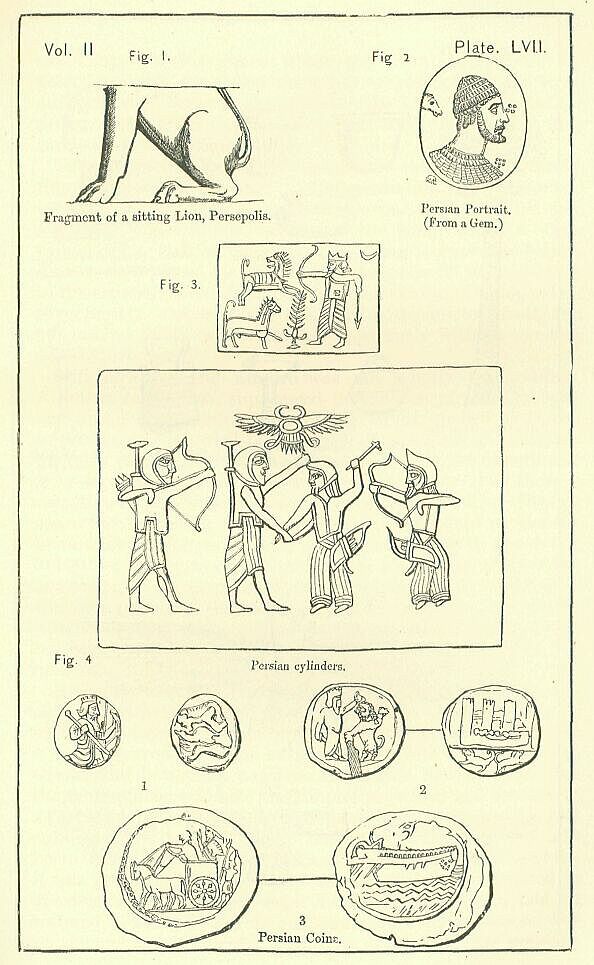
The Persian gem-engravings have considerable merit, and need not fear a comparison with those of any other Oriental nation. They occur upon hard stones of many different kinds, as cornelian, onyx, rock-crystal, sapphirine, sardonyx, chalcedony, etc., and are executed for the most part with great skill and delicacy. The designs which they embody are in general of a mythological character; but sometimes scenes of real life occur upon them, and then the drawing is often good, and almost always spirited. In proof of this, the reader may be referred to the hunting-scenes already given, which are derived wholly from this source, as well as to the gems figured [PLATE LVI., Fig. 3], one of which is certainly, and the other almost certainly, of Persian workmanship. In the former we see the king, not struggling with a mythological lion but engaged apparently in the actual chase of the king of beasts Two lions have been roused from their lairs, and the monarch hastily places an arrow on the string, anxious to despatch one of his foes before the other can come to close quarters The eagerness of the hunter and the spirit and boldness of the animals are well represented. In the other gem, while there is less of artistic excellence, we have a scene of peculiar interest placed before us. A combat between two Persians and two Cythians seems to be represented. The latter marked by their peaked cap and their loose trousers, fight with the bow and the battle-axe, the former with the bow and the sword One Scyth is receiving his death-wound, the other is about to let loose a shaft, but seems at the same time half inclined to fly The steady confidence of the warriors on the one side contrasts well with the timidity and hesitancy of their weaker and smaller rivals. [PLATE LVII., Fig. 3.]
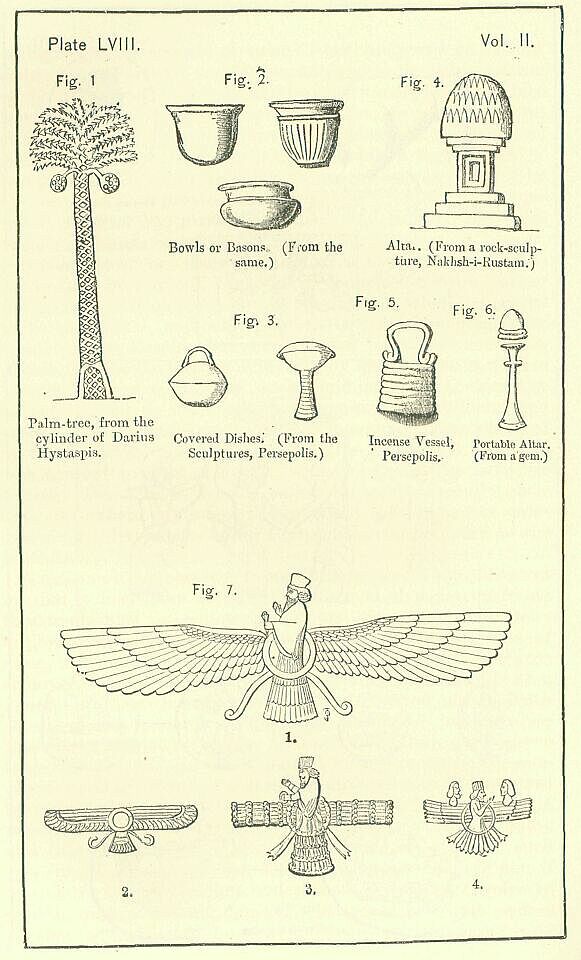
The vegetable forms represented on the gems are sometimes graceful and pleasing. This is especially the case with palm-trees, a favorite subject of the artists, who delineated with remarkable success the feathery leaves, the pendant fruit and the rough bark of the stem. [PLATE LVIII., Fig 1.] The lion-hunter represented on the signet-cylinder of Darius Hystaspis takes place in a palm-grove, and furnishes the accompanying example of this form of vegetable life.
One gem, ascribed on somewhat doubtful grounds to the Persians of Achaemenian times, contains what appears to be a portrait. It is thought to be the bust of a satrap of Salamis in Cyprus, and is very carefully executed. If really of Persian workmanship, it would indicate a considerable advance in the power of representing the human countenance between the time of Darius Hystaspis and that of Alexander [PLATE LVII. Fig. 2.]
Persian coins are of three principal types. The earliest have on the one side the figure of a monarch bearing the diadem and armed with the bow and javelin, while on the other there is an irregular indentation of the same nature with the quadratum incusum of the Greeks. This rude form is replaced in later times by a second design, which is sometimes a horseman, sometimes the forepart of a ship, sometimes the king drawing an an arrow from his quiver. Another type exhibits on the obverse the monarch in combat with a lion while the reverse shows a galley, or a towered and battlemented city with two lions standing below it, back to back. The third common type has on the obverse the king in his chariot, with his charioteer in front of him, and (generally) an attendant carrying a fly-chaser behind. The reverse has either the trireme or the battlemented city. A specimen of each type is given. [PLATE LVII., Fig. 4.]
The artistic merit of these medals is not great. The relief is low, and the drawing generally somewhat rude. The head of the monarch in the early coins is greatly too large. The animal forms are, however, much superior to the human, and the horses which draw the royal chariot, the lions placed below the battlemented city, and the bulls which are found occasionally in the same position, must be pronounced truthful and spirited.
Of the Persian taste in furniture, utensils, personal ornaments and the like, we need say but little. The throne and footstool of the monarch are the only pieces of furniture represented in the sculptures, and these, though sufficiently elegant in their forms, are not very remarkable. Costliness of material seems to have been more prized than beauty of shape; and variety appears to have been carefully eschewed, one single uniform type of each article occurring in all the representations. The utensils represented are likewise few in number, and limited to certain constantly repeated forms. The most elaborate is the censer, which has been already given. With this is usually seen a sort of pail or basket, shaped like a lady’s reticule, in which the aromatic gums for burning were probably kept. [PLATE LVIII., Fig. 5.] A covered dish, and a goblet with an inverted saucer over it, are also forms of frequent occurrence in the hands of the royal attendants; and the tribute-bearers frequently carry, among their other offerings, bowls or basons, which, though not of Persian manufacture, were no doubt left at the court, and took their place among the utensils of the palace. [PLATE LVIII., Figs. 2 and 3.]
In the matter of personal ornaments the taste of the Persians seems to have been peculiarly simple. Earrings were commonly plain rings of gold; bracelets mere bands of the same metal. Collars were circlets of gold twisted in a very inartificial fashion. There was nothing artistic in the sheaths or hilts of swords, though spear-shafts were sometimes adorned with the representation of an apple or a pomegranate. Dresses seem not to have been often patterned, but to have depended generally for their effect on make and color. In all these respects we observe a remarkable contrast between the Arian and the Semitic races, extreme simplicity characterizing the one, while the most elaborate ornamentation was affected by the other.
Persia was not celebrated in antiquity for the production of any special fabrics. The arts of weaving and dyeing were undoubtedly practised in the dominant country, as well as in most of the subject provinces, and the Persian dyes seem even to have had a certain reputation; but none of the productions of their looms acquired a name among foreign nations. Their skill, indeed, in the mechanical arts generally was, it is probable, not more than moderate. It was their boast that they were soldiers, and had won a position by their good swords which gave them the command of all that was most exquisite and admirable, whether in the natural world or among the products of human industry. So long as the carpets of Babylon and Sardis, the shawls of Kashmir and India, the fine linen of Borsippa and Egypt, the ornamental metal-work of Greece, the coverlets of Damascus, the muslins of Babylonia, the multiform manufactures of the Phoenician towns, poured continually into Persia Proper in the way of tribute, gifts, or merchandise, it was needless for the native population to engage largely in industrial enterprise.
To science the ancient Persians contributed absolutely nothing. The genius of the nation was adverse to that patient study and those laborious investigations from which alone scientific progress ensues. Too light and frivolous, too vivacious, too sensuous for such pursuits, they left them to the patient Babylonians, and the thoughtful, many-sided Greeks. The schools of Orchoe, Borsippa, and Miletus flourished under their sway, but without provoking their emulation, possibly without so much as attracting their attention. From first to last, from the dawn to the final close of their power, they abstained wholly from scientific studies. It would seem that they thought it enough to place before the world, as signs of their intellectual vigor, the fabric of their Empire and the buildings of Susa and Persepolis.