W.H.G. Kingston (translation from Jules Verne) (continued 3)
Agnes Kinloch Kingston translation
The weather was magnificent.
“We shall have a warm day of it,” said the reporter, laughing.
“Pooh! Dr Spilett,” answered Pencroft, “we shall walk under the shade of the trees and shan’t even see the sun!”
“Forward!” said the engineer.
The cart was waiting on the beach before the Chimneys. The reporter made Herbert take his place in it during the first hours at least of the journey, and the lad was obliged to submit to his doctor’s orders.
Neb placed himself at the onagas’ heads. Cyrus Harding, the reporter, and the sailor, walked in front. Top bounded joyfully along. Herbert offered a seat in his vehicle to Jup, who accepted it without ceremony. The moment for departure had arrived, and the little band set out.
The cart first turned the angle of the mouth of the Mercy, then, having ascended the left bank for a mile, crossed the bridge, at the other side of which commenced the road to Port Balloon and there the explorers, leaving this road on their left, entered the cover of the immense woods which formed the region of the Far West.
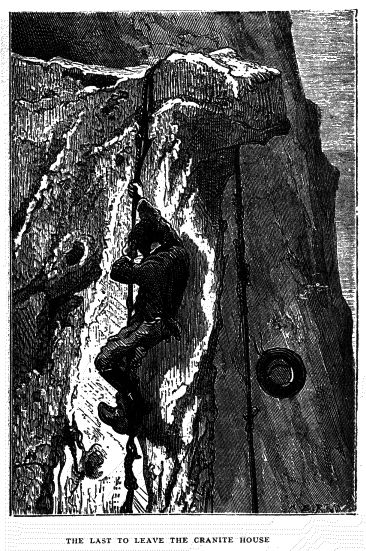
For the first two miles the widely-scattered trees allowed the cart to pass with ease; from time to time it became necessary to cut away a few creepers and bushes, but no serious obstacle impeded the progress of the colonists.
The thick foliage of the trees threw a grateful shade on the ground. Deodars, douglas-firs, casuarinas, banksias, gum-trees, dragon-trees, and other well-known species, succeeded each other far as the eye could reach. The feathered tribes of the island were all represented—tetras, jacamars, pheasants, lories, as well as the chattering cockatoos, parrots, and paroquets. Agouties, kangaroos, and capybaras fled swiftly at their approach; and all this reminded the settlers of the first excursions they had made on their arrival at the island.
“Nevertheless,” observed Cyrus Harding, “I notice that these creatures, both birds and quadrupeds, are more timid than formerly. These woods have, therefore, been recently traversed by the convicts, and we shall certainly find some traces of them.”
And, in fact, in several places they could distinguish traces, more or less recent, of the passage of a band of men—here branches broken off the trees, perhaps to mark out the way; there the ashes of a fire, and footprints in clayey spots; but nothing which appeared to belong to a settled encampment.
The engineer had recommended his companions to refrain from hunting. The reports of the fire-arms might give the alarm to the convicts, who were, perhaps, roaming through the forest. Moreover, the hunters would necessarily ramble some distance from the cart, which it was dangerous to leave unguarded.
In the after-part of the day, when about six miles from Granite House, their progress became much more difficult. In order to make their way through some thickets, they were obliged to cut down trees. Before entering such places Harding was, careful to send in Top and Jup, who faithfully accomplished their commission, and when the dog and orang returned without giving any warning, there was evidently nothing to fear, either from convicts or wild beasts, two varieties of the animal kingdom, whose ferocious instincts placed them on the same level. On the evening of the first day the colonists encamped about nine miles from Granite House, on the border of a little stream falling into the Mercy, and of the existence of which they had till then been ignorant; it evidently, however, belonged to the hydrographical system to which the soil owed its astonishing fertility. The settlers made a hearty meal, for their appetites were sharpened, and measures were then taken that the night might be passed in safety. If the engineer had had only to deal with wild beasts, jaguars, or others, he would have simply lighted fires all round his camp, which would have sufficed for its defence; but the convicts would be rather attracted than terrified by the flames, and it was, therefore, better to be surrounded by the profound darkness of night.
The watch was, however, carefully organised. Two of the settlers were to watch together, and every two hours it was agreed that they should be relieved by their comrades. And so, notwithstanding his wish to the contrary, Herbert was exempted from guard, Pencroft and Gideon Spilett in one party, the engineer and Neb in another, mounted guard in turns over the camp.
The night, however, was but of few hours. The darkness was due rather to the thickness of the foliage than to the disappearance of the sun. The silence was scarcely disturbed by the howling of jaguars and the chattering of the monkeys, the latter appearing to particularly irritate master Jup. The night passed without incident, and on the next day, the 15th of February, the journey through the forest, rather tedious than difficult, was continued. This day they could not accomplish more than six miles, for every moment they were obliged to cut a road with their hatchets.
Like true settlers, the colonists spared the largest and most beautiful trees, which would besides have cost immense labour to fell, and the small ones only were sacrificed, but the result was that the road took a very winding direction, and lengthened itself by numerous détours.
During the day Herbert discovered several new specimens not before met with in the island, such as the tree-fern, with its leaves spread out like the waters of a fountain, locust-trees, on the long pods of which the onagas browsed greedily, and which supplied a sweet pulp of excellent flavour. There, too, the colonists again found groups of magnificent kauries, their cylindrical trunks, crowned with a cone of verdure, rising to a height of two hundred feet. These were the tree-kings of New Zealand, as celebrated as the cedars of Lebanon.
As to the fauna, there was no addition to those species already known to the hunters. Nevertheless, they saw, though unable to get near them, a couple of those large birds peculiar to Australia, a sort of cassowary, called emu, five feet in height, and with brown plumage, which belong to the tribe of waders. Top darted after them as fast as his four legs could carry him, but the emus distanced him with ease, so prodigious was their speed.
As to the traces left by the convicts, a few more were discovered. Some footprints found near an apparently recently-extinguished fire were attentively examined by the settlers. By measuring them one after the other, according to their length and breadth, the marks of five men’s feet were easily distinguished. The five convicts had evidently camped on this spot; but,—and this was the object of so minute an examination,—a sixth foot-print could not be discovered, which in that case would have been that of Ayrton.
“Ayrton was not with them!” said Herbert.
“No,” answered Pencroft, “and if he was not with them, it was because the wretches had already murdered him! but then these rascals have not a den to which they may be tracked like tigers!”
“No,” replied the reporter; “it is more probable that they wander at random, and it is their interest to rove about until the time when they will be masters of the island!”
“The masters of the island!” exclaimed the sailor; “the masters of the island!” he repeated, and his voice was choked, as if his throat was seized in an iron grasp. Then in a calmer tone, “Do you know, Captain Harding,” said he, “what the ball is which I have rammed into my gun?”
“No, Pencroft!”
“It is the ball that went through Herbert’s chest, and I promise you it won’t miss its mark!”
But this just retaliation would not bring Ayrton back to life, and from the examination of the footprints left in the ground, they must, alas! conclude that all hopes of ever seeing him again must be abandoned.
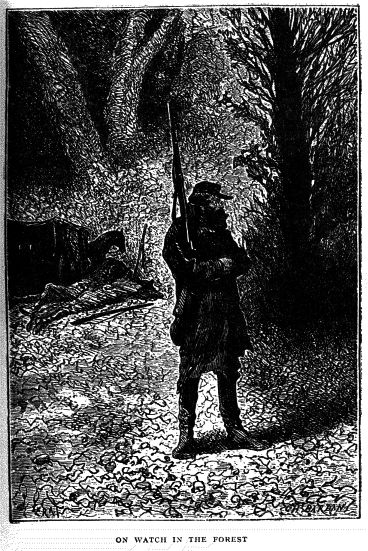
That evening they encamped fourteen miles from Granite House, and Cyrus Harding calculated that they could not be more than five miles from Reptile Point.
And, indeed, the next day the extremity of the peninsula was reached, and the whole length of the forest had been traversed; but there was nothing to indicate the retreat in which the convicts had taken refuge, nor that, no less secret, which sheltered the mysterious unknown.
Chapter Twelve.
Exploration of the Serpentine Peninsula—Encampment at the Mouth of Falls River—Gideon Spilett and Pencroft reconnoitre—Their Return—Forward, All!—An open Door—A lighted Window—By the Light of the Moon!
The next day, the 18th of February, was devoted to the exploration of all that wooded region forming the shore from Reptile End to Falls River. The colonists were able to search this forest thoroughly, for, as it was comprised between the two shores of the Serpentine Peninsula, it was only from three to four miles in breadth. The trees, both by their height and their thick foliage, bore witness to the vegetative power of the soil, more astonishing here than in any other part of the island. One might have said that a corner from the virgin forests of America or Africa had been transported into this temperate zone. This led them to conclude that the superb vegetation found a heat in this soil, damp in its upper layer, but warmed in the interior by volcanic fires, which could not belong to a temperate climate. The most frequently-occurring trees were kauries and eucalypti of gigantic dimensions.
But the colonists’ object was not simply to admire the magnificent vegetation. They knew already that in this respect Lincoln Island would have been worthy to take the first rank in the Canary group, to which the first name given was that of the Happy Isles. Now, alas! their island no longer belonged to them entirely; others had taken possession of it, miscreants polluted its shores, and they must be destroyed to the last man.
No traces were found on the western coast, although they were carefully sought for. No more footprints, no more broken branches, no more deserted camps.
“This does not surprise me,” said Cyrus Harding to his companions. “The convicts first landed on the island in the neighbourhood of Flotsam Point, and they immediately plunged into the Far West forests, after crossing Tadorn Marsh. They then followed almost the same route that we took on leaving Granite House. This explains the traces we found in the wood. But, arriving on the shore, the convicts saw at once that they would discover no suitable retreat there, and it was then that, going northwards again, they came upon the corral.”
“Where they have perhaps returned,” said Pencroft.
“I do not think so,” answered the engineer, “for they would naturally suppose that our researches would be in that direction. The corral is only a store-house to them, and not a definitive encampment.”
“I am of Cyrus’ opinion,” said the reporter, “and I think that it is among the spurs of Mount Franklin that the convicts will have made their lair.”
“Then, captain, straight to the corral!” cried Pencroft. “We must finish them off, and till now we have only lost time!”
“No, my friend,” replied the engineer; “you forget that we have a reason for wishing to know if the forests of the Far West do not contain some habitation. Our exploration has a double object, Pencroft. If, on the one hand, we have to chastise crime, we have, on the other, an act of gratitude to perform.”
“That was well said, captain,” replied the sailor; “but, all the same, it is my opinion that we shall not find that gentleman until he pleases.”
And truly Pencroft only expressed the opinion of all. It was probable that the stranger’s retreat was not less mysterious than was he himself.
That evening the cart halted at the mouth of Falls River. The camp was organised as usual, and the customary precautions were taken for the night. Herbert, become again the healthy and vigorous lad he was before his illness, derived great benefit from this life in the open air, between the sea-breezes and the vivifying air from the forests. His place was no longer in the cart, but at the head of the troop.
The next day, the 19th of February, the colonists, leaving the shore, where, beyond the mouth, basalts of every shape were so picturesquely piled up, ascended the river by its left bank. The road had been already partially cleared in their former excursions made from the corral to the west coast. The settlers were now about six miles from Mount Franklin.
The engineer’s plan was this:—To minutely survey the valley forming the bed of the river, and to cautiously approach the neighbourhood of the corral; if the corral was occupied, to seize it by force; if it was not, to intrench themselves there and make it the centre of the operations which had for their object the exploration of Mount Franklin.
This plan was unanimously approved by the colonists, for they were impatient to regain entire possession of their island.
They made their way along the narrow valley separating two of the largest spurs of Mount Franklin. The trees, crowded on the river’s bank, became rare on the upper slopes of the mountain. The ground was hilly and rough, very suitable for ambushes, and over which they did not venture without extreme precaution. Top and Jup skirmished on the flanks, springing right and left through the thick brushwood, and emulating each other in intelligence and activity. But nothing showed that the banks of the stream had been recently frequented—nothing announced either the presence or the proximity of the convicts. Towards five in the evening the cart stopped nearly 600 feet from the palisade. A semicircular screen of trees still hid it.
It was necessary to reconnoitre the corral, in order to ascertain if it was occupied. To go there openly, in broad daylight, when the convicts were probably in ambush, would be to expose themselves, as poor Herbert had done, to the fire-arms of the ruffians. It was better, then, to wait until night came on.
However, Gideon Spilett wished without further delay to reconnoitre the approaches to the corral, and Pencroft, who was quite out of patience, volunteered to accompany him.
“No, my friends,” said the engineer, “wait till night. I will not allow one of you to expose himself in open day.”
“But, captain,” answered the sailor, little disposed to obey.
“I beg you, Pencroft,” said the engineer.
“Very well!” replied the sailor, who vented his anger in another way, by bestowing on the convicts the worst names in his maritime vocabulary.
The colonists remained, therefore, near the cart, and carefully watched the neighbouring parts of the forest.
Three hours passed thus. The wind had fallen, and absolute silence reigned under the great trees. The snapping of the smallest twig, a footstep on the dry leaves, the gliding of a body amongst the grass, would have been heard without difficulty. All was quiet. Besides, Top, lying on the grass, his head stretched out on his paws, gave no signs of uneasiness. At eight o’clock the day appeared far enough advanced for the reconnaissance to be made under favourable conditions. Gideon Spilett declared himself ready to set out accompanied by Pencroft. Cyrus Harding consented. Top and Jup were to remain with the engineer, Herbert, and Neb, for a bark or a cry at a wrong moment would give the alarm.
“Do not be imprudent,” said Harding to the reporter and Pencroft; “you have not to gain possession of the corral, but only to find out whether it is occupied or not.”
“All right,” answered Pencroft.
And the two departed.
Under the trees, thanks to the thickness of their foliage, the obscurity rendered any object invisible beyond a radius of from thirty to forty feet. The reporter and Pencroft, halting at any suspicious sound, advanced with great caution.
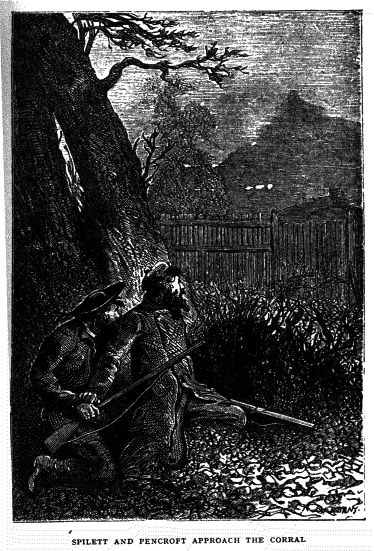
They walked a little distance apart from each other so as to offer a less mark for a shot. And, to tell the truth, they expected every moment to hear a report. Five minutes after leaving the cart, Gideon Spilett and Pencroft arrived at the edge of the wood before the clearing beyond which rose the palisade.
They stopped. A few straggling beams still fell on the field clear of trees. Thirty feet distant was the gate of the corral, which appeared to be closed. This thirty feet, which it was necessary to cross from the border of the wood to the palisade, constituted the dangerous zone, to coin a term: in fact, one or more bullets fired from behind the palisade might knock over any one who ventured onto this zone. Gideon Spilett and the sailor were not men to draw back, but they knew that any imprudence on their part, of which they would be the first victims, would fall afterwards on their companions. If they themselves were killed, what would become of Harding, Neb, and Herbert?
But Pencroft, excited at feeling himself so near the corral where he supposed the convicts had taken refuge, was about to press forward, when the reporter held him back with a grasp of iron.
“In a few minutes it will be quite dark,” whispered Spilett in the sailor’s ear; “then will be the time to act.”
Pencroft, convulsively clasping the butt-end of his gun, restrained his eagerness, and waited, swearing to himself.
Soon the last of the twilight faded away. Darkness, which seemed as if it issued from the dense forest, covered the clearing. Mount Franklin rose like an enormous screen before the western horizon, and night spread rapidly over all, as it does in regions of low latitudes. Now was the time.
The reporter and Pencroft, since posting themselves on the edge of the wood, had not once lost sight of the palisade. The corral appeared to be absolutely deserted. The top of the palisade formed a line, a little darker than the surrounding shadow, and nothing disturbed its distinctness. Nevertheless, if the convicts were there, they must have posted one of their number to guard against any surprise.
Spilett grasped his companion’s hand, and both crept towards the corral, their guns ready to fire.
They reached the gate without the darkness being illuminated by a single ray of light.
Pencroft tried to push open the gate, which, as the reporter and he had supposed, was closed. However, the sailor was able to ascertain that the outer bars had not been put up. It might, then, be concluded that the convicts were there in the corral, and that very probably they had fastened the gate in such a way that it could not be forced open.
Gideon Spilett and Pencroft listened. Not a sound could be heard inside the palisade. The musmons and the goats, sleeping no doubt in their huts, in no way disturbed the calm of night.
The reporter and the sailor hearing nothing, asked themselves whether they had not better scale the palisades and penetrate into the corral. This would have been contrary to Cyrus Harding’s instructions.
It is true that the enterprise might succeed, but it might also fail. Now, if the convicts were suspecting nothing, if they knew nothing of the expedition against them, if, lastly, there now existed a chance of surprising them, ought this chance to be lost by inconsiderately attempting to cross the palisade?
This was not the reporter’s opinion. He thought it better to wait until all the settlers were collected together before attempting to penetrate into the corral. One thing was certain, that it was possible to reach the palisade without being seen, and also that it did not appear to be guarded. This point settled, there was nothing to be done but to return to the cart, where they would consult.
Pencroft probably agreed with this decision, for he followed the reporter without making any objection when the latter turned back to the wood.
In a few minutes the engineer was made acquainted with the state of affairs.
“Well,” said he, after a little thought, “I now have reason to believe that the convicts are not in the corral.”
“We shall soon know,” said Pencroft, “when we have scaled the palisade.”
“To the corral, my friends!” said Cyrus Harding.
“Shall we leave the cart in the wood?” asked Neb.
“No,” replied the engineer, “it is our waggon of ammunition and provisions, and, if necessary, it would serve as an intrenchment.”
“Forward, then!” said Gideon Spilett.
The cart emerged from the wood and began to roll noiselessly towards the palisade. The darkness was now profound, the silence as complete as when Pencroft and the reporter crept over the ground. The thick grass completely muffled their footsteps.
The colonists held themselves ready to fire. Jup, at Pencroft’s orders, kept behind. Neb led Top in a leash, to prevent him from bounding forward.
The clearing soon came in sight. It was deserted. Without hesitating, the little band moved towards the palisade. In a short space of time the dangerous zone was passed. Not a shot had been fired. When the cart reached the palisade, it stopped. Neb remained at the onagas’ heads to hold them. The engineer, the reporter, Herbert, and Pencroft, proceeded to the door, in order to ascertain if it was barricaded inside. It was open!
“What do you say now?” asked the engineer, turning to the sailor and Spilett. Both were stupefied.
“I can swear,” said Pencroft, “that this gate was shut just now!”
The colonists now hesitated. Were the convicts in the corral when Pencroft and the reporter made their reconnaissance? it could not be doubted, as the gate then closed could only have been opened by them. Were they still there, or had one of their number just gone out?
All these questions presented themselves simultaneously to the minds of the colonists, but how could they be answered?
At that moment, Herbert, who had advanced a few steps into the enclosure, drew back hurriedly, and seized Harding’s hand.
“What’s the matter?” asked the engineer. “Alight!”
“In the house?”
“Yes!”
All five advanced and indeed, through the window fronting them, they saw glimmering a feeble light. Cyrus Harding made up his mind rapidly. “It is our only chance,” said he to his companions, “of finding the convicts collected in this house, suspecting nothing! They are in our power! Forward!” The colonists crossed through the enclosure, holding their guns ready in their hands. The cart had been left outside under the charge of Jup and Top, who had been prudently tied to it.
Cyrus Harding, Pencroft, and Gideon Spilett on one side, Herbert and Neb on the other, going along by the palisade, surveyed the absolutely dark and deserted corral.
In a few moments they were near the closed door of the house.
Harding signed to his companions not to stir, and approached the window, then feebly lighted by the inner light. He gazed into the apartment.
On the table burned a lantern. Near the table was the bed formerly used by Ayrton.
On the bed lay the body of a man.
Suddenly Cyrus Harding drew back, and in a hoarse voice—
“Ayrton!” he exclaimed.
Immediately the door was forced rather than opened, and the colonists rushed into the room.
Ayrton appeared to be asleep. His countenance showed that he had long and cruelly suffered. On his wrists and ankles could be seen great bruises.
Harding bent over him.
“Ayrton!” cried the engineer, seizing the arm of the man whom he had just found again under such unexpected circumstances.
At this exclamation Ayrton opened his eyes, and, gazing at Harding, then at the others—
“You!” he cried, “you?”
“Ayrton! Ayrton!” repeated Harding.
“Where am I?”
“In the house in the corral!”
“Alone?”
“Yes!”
“But they will come back!” cried Ayrton. “Defend yourselves! defend yourselves!”
And he fell back exhausted.
“Spilett,” exclaimed the engineer, “we may be attacked at any moment. Bring the cart into the corral. Then barricade the door, and all come back here.”
Pencroft, Neb, and the reporter hastened to execute the engineer’s orders. There was not a moment to be lost. Perhaps even now the cart was in the hands of the convicts!
In a moment the reporter and his two companions had crossed the corral and reached the gate of the palisade behind which Top was heard growling sullenly.
The engineer, leaving Ayrton for an instant, came out ready to fire. Herbert was at his side. Both surveyed the crest of the spur overlooking the corral. If the convicts were lying in ambush there, they might knock the settlers over one after the other.
At that moment the moon appeared in the east, above the black curtain of the forest, and a white sheet of light spread over the interior of the enclosure. The corral, with its clumps of trees, the little stream which watered it, and its wide carpet of grass, was suddenly illuminated. From the side of the mountain, the house and a part of the palisade stood out white in the moonlight. On the opposite side towards the door, the enclosure remained dark.
A black mass soon appeared. This was the cart entering the circle of light, and Cyrus Harding could hear the noise made by the door, as his companions shut it and fastened the interior bars.
But, at that moment, Top, breaking loose, began to bark furiously and rush to the back of the corral, to the right of the house.
“Be ready to fire, my friends!” cried Harding.
The colonists raised their pieces and waited the moment to fire.
Top still barked, and Jup, running towards the dog, uttered shrill cries.
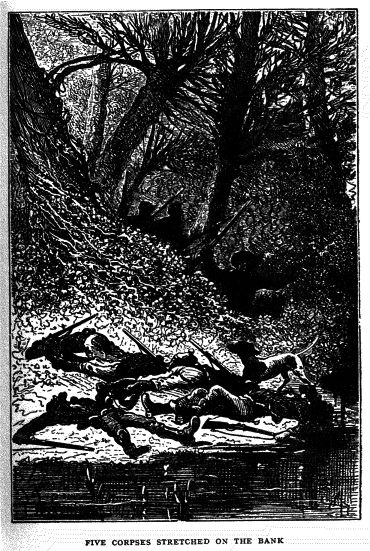
The colonists followed him, and reached the borders of the little stream, shaded by large trees. And there, in the bright moonlight, what did they see? Five corpses, stretched on the bank!
They were those of the convicts who, four months previously, had landed on Lincoln Island!
Chapter Thirteen.
Ayrton’s Story—Plans of his former Accomplices—Their Installation in the Corral—The avenging Justice of Lincoln Island—The Bonadventure—Researches around Mount Franklin—The Upper Valleys—A subterranean Volcano—Pencroft’s Opinion—At the Bottom of the Crater—Return.
How had it happened? Who had killed the convicts? Was it Ayrton? No, for a moment before he was dreading their return.
But Ayrton was now in a profound stupor, from which it was no longer possible to rouse him. After uttering those few words he had again become unconscious, and had fallen back motionless on the bed.
The colonists, a prey to a thousand confused thoughts, under the influence of violent excitement, waited all night, without leaving Ayrton’s house, or returning to the spot where lay the bodies of the convicts. It was very probable that Ayrton would not be able to throw any light on the circumstances under which the bodies had been found, since he himself was not aware that he was in the corral. But at any rate he would be in a position to give an account of what had taken place before this terrible execution. The next day Ayrton awoke from his torpor, and his companions cordially manifested all the joy they felt, on seeing him again, almost safe and sound, after a hundred and four days’ separation.
Ayrton then in a few words recounted what had happened, or at least as much as he knew.
The day after his arrival at the corral, on the 10th of last November, at nightfall, he was surprised by the convicts, who had scaled the palisade. They bound and gagged him; then he was led to a dark cavern, at the foot of Mount Franklin, where the convicts had taken refuge.
His death had been decided upon, and the next day the convicts were about to kill him, when one of them recognised him, and called him by the name which he bore in Australia. The wretches had no scruples as to murdering Ayrton! They spared Ben Joyce!
But from that moment Ayrton was exposed to the importunities of his former accomplices. They wished him to join them again, and relied upon his aid to enable them to gain possession of Granite House, to penetrate into that hitherto inaccessible dwelling, and to become masters of the island, after murdering the colonists!
Ayrton remained firm. The once convict, now repentant and pardoned, would rather die than betray his companions. Ayrton—bound, gagged, and closely watched—lived in this cave for four months.
Nevertheless the convicts had discovered the corral a short time after their arrival in the island, and since then they had subsisted on Ayrton’s stores, but did not live at the corral.
On the 11th of November, two of the villains, surprised by the colonists’ arrival, fired at Herbert, and one of them returned, boasting of having killed one of the inhabitants of the island; but he returned alone. His companion, as is known, fell by Cyrus Harding’s dagger.
Ayrton’s anxiety and despair may be imagined when he learnt the news of Herbert’s death. The settlers were now only four, and, as it seemed, at the mercy of the convicts. After this event, and during all the time that the colonists, detained by Herbert’s illness, remained in the corral, the pirates did not leave their cavern, and even after they had pillaged the plateau of Prospect Heights, they did not think it prudent to abandon it.
The ill-treatment inflicted on Ayrton was now redoubled. His hands and feet still bore the bloody marks of the cords which bound him day and night. Every moment he expected to be put to death, nor did it appear possible that he could escape.
Matters remained thus until the third week of February. The convicts, still watching for a favourable opportunity, rarely quitted their retreat, and only made a few hunting excursions, either to the interior of the island, or the south coast.
Ayrton had no further news of his friends, and relinquished all hope of ever seeing them again. At last, the unfortunate man, weakened by ill-treatment, fell into a prostration so profound that sight and hearing failed him. From that moment, that is to say, since the last two days, he could give no information whatever of what had occurred.
“But, Captain Harding,” he added, “since I was imprisoned in that cavern, how is it that I find myself in the corral?”
“How is it that the convicts are lying yonder dead, in the middle of the enclosure?” answered the engineer.
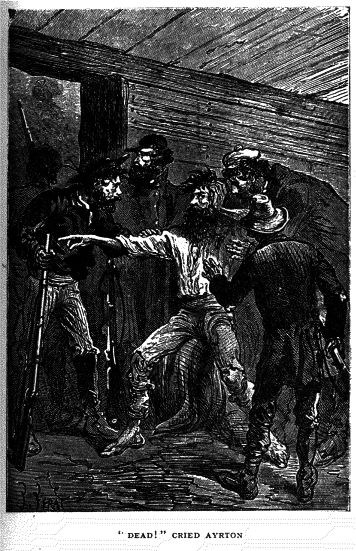
“Dead!” cried Ayrton, half rising from his bed, notwithstanding his weakness.
His companions supported him. He wished to get up, and with their assistance he did so. They then proceeded together towards the little stream.
It was now broad daylight.
There, on the bank, in the position in which they had been stricken by death in its most instantaneous form, lay the corpses of the five convicts!
Ayrton was astounded. Harding and his companions looked at him without uttering a word. On a sign from the engineer, Neb and Pencroft examined the bodies, already stiffened by the cold.
They bore no apparent trace of any wound.
Only, after carefully examining them, Pencroft found on the forehead of one, on the chest of another, on the back of this one, on the shoulder of that, a little red spot, a sort of scarcely visible bruise, the cause of which it was impossible to conjecture.
“It is there that they have been struck!” said Cyrus Harding.
“But with what weapon?” cried the reporter.
“A weapon, lightning-like in its effects, and of which we have not the secret!”
“And who has struck the blow?” asked Pencroft.
“The avenging power of the island,” replied Harding, “he who brought you here, Ayrton, whose influence has once more manifested itself, who does for us all that which we cannot do for ourselves, and who, his will accomplished, conceals himself from us.”
“Let us make search for him, then!” exclaimed Pencroft.
“Yes, we will search for him,” answered Harding; “but we shall not discover this powerful being who performs such wonders, until he pleases to call us to him!”
This invisible protection, which rendered their own action unavailing, both irritated and piqued the engineer. The relative inferiority which it proved was of a nature to wound a haughty spirit. A generosity evinced in such a manner as to elude all tokens of gratitude, implied a sort of disdain for those on whom the obligation was conferred, which in Cyrus Harding’s eyes marred, in some degree, the worth of the benefit.
“Let us search,” he resumed, “and God grant that we may some day be permitted to prove to this haughty protector that he has not to deal with ungrateful people! What would I not give could we repay him, by rendering him in our turn, although at the price of our lives, some signal service!”
From this day, the thoughts of the inhabitants of Lincoln Island were solely occupied with the intended search. Everything incited them to discover the answer to this enigma, an answer which could only be the name of a man endowed with a truly inexplicable, and in some degree superhuman power. In a few minutes, the settlers re-entered the house, where their influence soon restored to Ayrton his moral and physical energy.
Neb and Pencroft carried the corpses of the convicts into the forest, some distance from the corral, and buried them deep in the ground.
Ayrton was then made acquainted with the facts which had occurred during his seclusion. He learnt Herbert’s adventures, and through what various trials the colonists had passed. As to the settlers, they had despaired of ever seeing Ayrton again, and had been convinced that the convicts had ruthlessly murdered him.
“And now,” said Cyrus Harding, as he ended his recital, “a duty remains for us to perform. Half of our task is accomplished, but although the convicts are no longer to be feared, it is not owing to ourselves that we are once more masters of the island.”
“Well!” answered Gideon Spilett, “let us search all this labyrinth of the spurs of Mount Franklin. We will not leave a hollow, not a hole unexplored! Ah! if ever a reporter found himself face to face with a mystery, it is I who now speak to you, my friends!”
“And we will not return to Granite House until we have found our benefactor,” said Herbert.
“Yes,” said the engineer, “we will do all that it is humanly possible to do, but I repeat we shall not find him until he himself permits us.”
“Shall we stay at the corral?” asked Pencroft.
“We shall stay here,” answered Harding. “Provisions are abundant, and we are here in the very centre of the circle we have to explore. Besides, if necessary, the cart will take us rapidly to Granite House.”
“Good!” answered the sailor. “Only I have a remark to make.”
“What is it?”
“Here is the fine season getting on, and we must not forget that we have a voyage to make.”
“A voyage?” said Gideon Spilett.
“Yes, to Tabor Island,” answered Pencroft. “It is necessary to carry a notice there to point out the position of our island and say that Ayrton is here in case the Scotch yacht should come to take him off. Who knows if it is not already too late?”
“But, Pencroft,” asked Ayrton, “how do you intend to make this voyage?”
“In the Bonadventure.”
“The Bonadventure!” exclaimed Ayrton. “She no longer exists.”
“My Bonadventure exists no longer!” shouted Pencroft, bounding from his seat.
“No,” answered Ayrton. “The convicts discovered her in her little harbour only eight days ago, they put to sea in her, and—”
“And?” said Pencroft, his heart beating.
“And not having Bob Harvey to steer her, they ran on the rocks, and the vessel went to pieces.”
“Oh, the villains, the cut-throats, the infamous scoundrels!” exclaimed Pencroft.
“Pencroft,” said Herbert, taking the sailor’s hand, “we will build another Bonadventure—a larger one. We have all the iron-work—all the rigging of the brig at our disposal.”
“But do you know,” returned Pencroft, “that it will take at least five or six months to build a vessel of from thirty to forty tons?”
“We can take our time,” said the reporter, “and we must give up the voyage to Tabor Island for this year.”
“Oh, my Bonadventure! my poor Bonadventure!” cried Pencroft, almost broken-hearted at the destruction of the vessel of which he was so proud.
The loss of the Bonadventure was certainly a thing to be lamented by the colonists, and it was agreed that this loss should be repaired as soon as possible. This settled, they now occupied themselves with bringing their researches to bear on the most secret parts of the island.
The exploration was commenced at daybreak on the 19th of February, and lasted an entire week. The base of the mountain, with its spurs and their numberless ramifications, formed a labyrinth of valleys and elevations. It was evident that there, in the depths of these narrow gorges, perhaps even in the interior of Mount Franklin itself, was the proper place to pursue their researches. No part of the island could have been more suitable to conceal a dwelling whose occupant wished to remain unknown. But so irregular was the formation of the valleys that Cyrus Harding was obliged to conduct the exploration in a strictly methodical manner.
The colonists first visited the valley opening to the south of the volcano, and which first received the waters of Falls River. There Ayrton showed them the cavern where the convicts had taken refuge, and in which he had been imprisoned until his removal to the corral. This cavern was just as Ayrton had left it. They found there a considerable quantity of ammunition and provisions, conveyed thither by the convicts in order to form a reserve.
The whole of the valley bordering on the cave, shaded by fir and other trees, was thoroughly explored, and on turning the point of the south-western spur, the colonists entered a narrower gorge similar to the picturesque columns of basalt on the coast. Here the trees were fewer. Stones took the place of grass. Goats and musmons gambolled among the rocks. Here began the barren part of the island. It could already be seen that, of the numerous valleys branching off at the base of Mount Franklin, three only were wooded and rich in pasturage like that of the corral, which bordered on the west on the Falls River valley, and on the east on the Red Creek valley. These two streams, which lower down became rivers by the absorption of several tributaries, were formed by all the springs of the mountain and thus caused the fertility of its southern part. As to the Mercy, it was more directly fed from ample springs concealed under the cover of Jacamar Wood, and it was by springs of this nature, spreading in a thousand streamlets, that the soil of the Serpentine Peninsula was watered.
Now, of these three well-watered valleys, either might have served as a retreat to some solitary who would have found there everything necessary for life. But the settlers had already explored them, and in no part had they discovered the presence of man.
Was it then in the depths of those barren gorges, in the midst of the piles of rock, in the rugged northern ravines, among the streams of lava, that this dwelling and its occupant would be found?
The northern part of Mount Franklin was at its base composed solely of two valleys, wide, not very deep, without any appearance of vegetation, strewn with masses of rock, paved with lava, and varied with great blocks of mineral. This region required a long and careful exploration. It contained a thousand cavities, comfortless no doubt, but perfectly concealed and difficult of access.
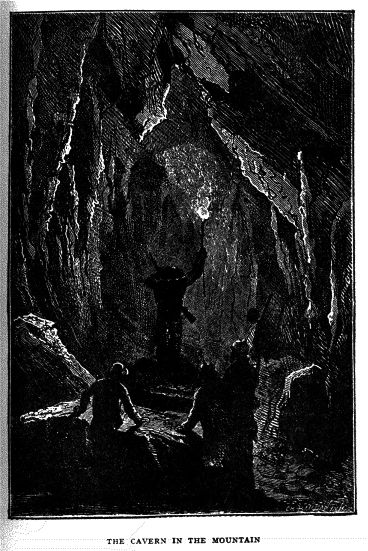
The colonists even visited dark tunnels, dating from the volcanic period, still black from the passage of the fire, and penetrated into the depths of the mountain. They traversed these sombre galleries, waving lighted torches; they examined the smallest excavations; they sounded the shallowest depths, but all was dark and silent. It did not appear that the foot of man had ever before trodden these ancient passages, or that his arm had ever displaced one of these blocks, which remained as the volcano had cast them up above the waters, at the time of the submersion of the island.
However, although these passages appeared to be absolutely deserted, and the obscurity was complete, Cyrus Harding was obliged to confess that absolute silence did not reign there.
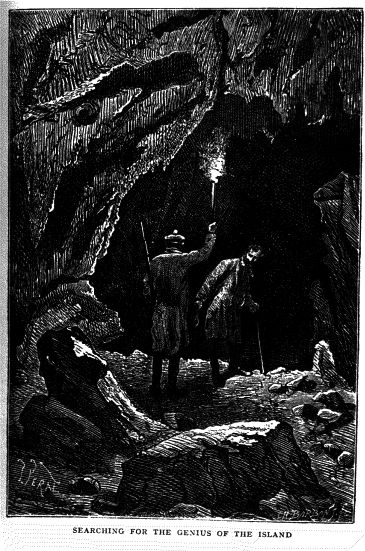
On arriving at the end of one of these gloomy caverns, extending several hundred feet into the interior of the mountain, he was surprised to hear a deep rumbling noise, increased in intensity by the sonorousness of the rocks.
Gideon Spilett, who accompanied him, also heard these distant mutterings, which indicated a revivification of the subterranean fires. Several times both listened, and they agreed that some chemical process was taking place in the bowels of the earth.
“Then the volcano is not totally extinct?” said the reporter.
“It is possible that since our exploration of the crater,” replied Cyrus Harding, “some change has occurred. Any volcano, although considered extinct, may evidently again burst forth.”
“But if an eruption of Mount Franklin occurred,” asked Spilett, “would there not be some danger to Lincoln Island?”
“I do not think so,” answered the reporter. “The crater—that is to say, the safety-valve, exists, and the overflow of smoke and lava would escape, as it did formerly, by its customary outlet.”
“Unless the lava opened a new way for itself towards the fertile parts of the island!”
“And why, my dear Spilett,” answered Cyrus Harding, “should it not follow the road naturally traced out for it?”
“Well, volcanoes are capricious,” returned the reporter.
“Notice,” answered the engineer, “that the inclination of Mount Franklin favours the flow of water towards the valleys which we are exploring just now. To turn aside this flow, an earthquake would be necessary to change the mountain’s centre of gravity.”
“But an earthquake is always to be feared at these times,” observed Gideon Spilett.
“Always,” replied the engineer, “especially when the subterranean forces begin to awake, as they risk meeting with some obstruction, after a long rest. Thus, my dear Spilett, an eruption would be a serious thing for us, and it would be better that the volcano should not have the slightest desire to wake up. But we could not prevent it, could we? At any rate, even if it should occur, I do not think Prospect Heights would be seriously threatened. Between them and the mountain, the ground is considerably depressed, and if the lava should ever take a course towards the lake, it would be cast on the downs and the neighbouring parts of Shark Gulf.”
“We have not yet seen any smoke at the top of the mountain, to indicate an approaching eruption,” said Gideon Spilett.
“No,” answered Harding, “not a vapour escapes from the crater, for it was only yesterday that I attentively surveyed the summit. But it is probable that at the lower part of the chimney, time may have accumulated rocks, cinders, hardened lava, and that this valve of which I spoke, may at any time become overcharged. But at the first serious effort, every obstacle will disappear, and you may be certain, my dear Spilett, that neither the island, which is the boiler, nor the volcano, which is the chimney, will burst under the pressure of gas. Nevertheless, I repeat, it would be better that there should not be an eruption.”
“And yet we are not mistaken,” remarked the reporter. “Mutterings can be distinctly heard in the very bowels of the volcano!”
“You are right,” said the engineer, again listening attentively. “There can be no doubt of it. A commotion is going on there, of which we can neither estimate the importance nor the ultimate result.”
Cyrus Harding and Spilett, on coming out, rejoined their companions, to whom they made known the state of affairs.
“Very well!” cried Pencroft, “the volcano wants to play his pranks! Let him try, if he likes! He will find his master!”
“Who?” asked Neb.
“Our good genius, Neb, our good genius, who will shut his mouth for him, if he so much as pretends to open it!”
As may be seen, the sailor’s confidence in the tutelary deity of his island was absolute, and, certainly, the occult power, manifested until now in so many inexplicable ways, appeared to be unlimited; but also it knew how to escape the colonists’ most minute researches, for, in spite of all their efforts, in spite of the more than zeal,—the obstinacy,—with which they carried on their exploration, the retreat of the mysterious being could not be discovered.
From the 19th to the 25th of February the circle of investigation was extended to all the northern region of Lincoln Island, whose most secret nooks were explored. The colonists even went the length of tapping every rock. The search was extended to the extreme verge of the mountain. It was explored thus to the very summit of the truncated cone terminating the first row of rocks, then to the upper ridge of the enormous hat, at the bottom of which opened the crater.
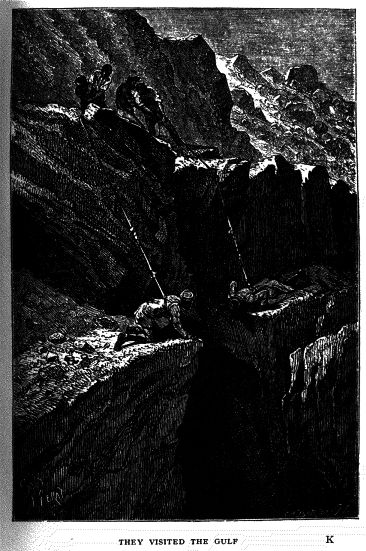
They did more; they visited the gulf, now extinct, but in whose depths the rumbling could be distinctly heard. However, no sign of smoke or vapour, no heating of the rock, indicated an approaching eruption. But neither there, nor in any other part of Mount Franklin, did the colonists find any traces of him of whom they were in search.
Their investigations were then directed to the downs. They carefully examined the high lava-cliffs of Shark Gulf from the base to the crest, although it was extremely difficult to reach even the level of the gulf. No one!—nothing!
In short, in these two words was summed up so much fatigue uselessly expended, so much energy producing no result, that somewhat of anger mingled with the discomfiture of Cyrus Harding and his companions.
It was now time to think of returning, for these researches could not be prolonged indefinitely. The colonists were certainly right in believing that the mysterious being did not reside on the surface of the island, and the wildest fancies haunted their excited imaginations. Pencroft and Neb, particularly, were not contented with the mystery, but allowed their imaginations to wander into the domain of the supernatural.
On the 25th of February the colonists re-entered Granite House, and by means of the double cord, carried by an arrow to the threshold of the door, they re-established communication between their habitation and the ground.
A month later they commemorated, on the 25th of March, the third anniversary of their arrival on Lincoln Island.
Chapter Fourteen.
Three Years have passed—The new Vessel—What is agreed on—Prosperity of the Colony—The Dockyard—Cold of the Southern Hemisphere—Washing Linen—Mount Franklin.
Three years had passed away since the escape of the prisoners from Richmond, and how often during those three years had they spoken of their country, always present in their thoughts!
They had no doubt that the civil war was at an end, and to them it appeared impossible that the just cause of the North had not triumphed. But what had been the incidents of this terrible war? How much blood had it not cost? How many of their friends must have fallen in the struggle? They often spoke of these things, without as yet being able to foresee the day when they would be permitted once more to see their country. To return thither, were it but for a few days, to renew the social link with the inhabited world, to establish a communication between their native land and their island, then to pass the longest, perhaps the best, portion of their existence in this colony founded by them, and which would then be dependent of their country, was this a dream impossible to realise?
There were only two ways of accomplishing it—either a ship must appear off Lincoln Island, or the colonists must themselves build a vessel strong enough to sail to the nearest land.
“Unless,” said Pencroft, “our good genius himself provides us with the means of returning to our country.”
And, really, had any one told Pencroft and Neb that a ship of 300 tons was waiting for them in Shark Gulf or at Port Balloon, they would not even have made a gesture of surprise. In their state of mind nothing appeared improbable.
But Cyrus Harding, less confident, advised them to confine themselves to fact, and more especially so with regard to the building of a vessel—a really urgent work, since it was for the purpose of depositing, as soon as possible, at Tabor Island a document indicating Ayrton’s new residence.
As the Bonadventure no longer existed, six months at least would be required for the construction of a new vessel. Now winter was approaching, and the voyage could not be made before the following spring.
“We have time to get everything ready for the fine season,” remarked the engineer, who was consulting with Pencroft about these matters. “I think, therefore, my friend, that since we have to rebuild our vessel it will be best to give her larger dimensions. The arrival of the Scotch yacht at Tabor Island is very uncertain. It may even be that, having arrived several months ago, she has again sailed after having vainly searched for some trace of Ayrton. Will it not then be best to build a ship which, if necessary, could take us either to the Polynesian Archipelago or to New Zealand? What do you think?”
“I think, captain,” answered the sailor; “I think that you are as capable of building a large vessel as a small one. Neither the wood nor the tools are wanting. It is only a question of time.”
“And how many months would be required to build a vessel of from 250 to 300 tons?” asked Harding.
“Seven or eight months at least,” replied Pencroft. “But it must not be forgotten that winter is drawing near, and that in severe frost wood is difficult to work. We must calculate on several weeks’ delay, and if our vessel is ready by next November we may think ourselves very lucky.”
“Well,” replied Cyrus Harding, “that will be exactly the most favourable time for undertaking a voyage of any importance, either to Tabor Island or to a more distant land.”
“So it will, captain,” answered the sailor. “Make out your plans then; the workmen are ready, and I imagine that Ayrton can lend us a good helping hand.”
The colonists, having been consulted, approved the engineer’s plan, and it was, indeed, the best thing to be done. It is true that the construction of a ship of from two to three hundred tons would be great labour, but the colonists had confidence in themselves, justified by their previous success.
Cyrus Harding then busied himself in drawing the plan of the vessel and making the model. During this time his companions employed themselves in felling and carting trees to furnish the ribs, timbers, and planks. The forest of the Far West supplied the best oaks and elms. They took advantage of the opening already made on their last excursion to form a practicable road, which they named the Far West Road, and the trees were carried to the Chimneys, where the dockyard was established. As to the road in question, the choice of trees had rendered its direction somewhat capricious, but that at the same time facilitated the access to a large part of the Serpentine Peninsula.
It was important that the trees should be quickly felled and cut up, for they could not be used while yet green, and some time was necessary to allow them to get seasoned. The carpenters, therefore, worked vigorously during the month of April, which was troubled only by a few equinoctial gales of some violence. Master Jup aided them dexterously, either by climbing to the top of a tree to fasten the ropes or by lending his stout shoulders to carry the lopped trunks.
All this timber was piled up under a large shed, built near the Chimneys, and there awaited the time for use.
The month of April was tolerably fine, as October often is in the northern zone. At the same time other work was actively continued, and soon all trace of devastation disappeared from the plateau of Prospect Heights. The mill was rebuilt, and new buildings rose in the poultry-yard. It had appeared necessary to enlarge their dimensions, for the feathered population had increased considerably. The stable now contained five onagas, four of which were well broken, and allowed themselves to be either driven or ridden, and a little colt. The colony now possessed a plough, to which the onagas were yoked like regular Yorkshire or Kentucky oxen. The colonists divided their work, and their arms never tired. Then who could have enjoyed better health than these workers, and what good humour enlivened the evenings in Granite House as they formed a thousand plans for the future!
As a matter of course Ayrton shared the common lot in every respect, and there was no longer any talk of his going to live at the corral. Nevertheless he was still sad and reserved, and joined more in the work than in the pleasures of his companions. But he was a valuable workman at need—strong, skilful, ingenious, intelligent. He was esteemed and loved by all, and he could not be ignorant of it.
In the meanwhile the corral was not abandoned. Every other day one of the settlers, driving the cart or mounted on an onaga, went to look after the flock of musmons and goats and bring back the supply of milk required by Neb. These excursions at the same time afforded opportunities for hunting. Therefore Herbert and Gideon Spilett, with Top in front, traversed more often than their companions the road to the corral, and with the capital guns which they carried, capybaras, agouties, kangaroos, and wild pigs for large game, ducks, tetras, grouse, jacamars, and snipe for small, were never wanting in the house. The produce of the warren, of the oyster-bed, several turtles which were taken, excellent salmon which came up the Mercy, vegetables from the plateau, wild fruit from the forest, were riches upon riches, and Neb, the head cook, could scarcely by himself store them away.
The telegraphic wire between the corral and Granite House had of course been repaired, and it was worked whenever one or other of the settlers was at the corral and found it necessary to spend the night there. Besides, the island was safe now and no attacks were to be feared, at any rate from men.
However, that which had happened might happen again. A descent of pirates, or even of escaped convicts, was always to be feared. It was possible that companions or accomplices of Bob Harvey had been in the secret of his plans, and might be tempted to imitate him. The colonists, therefore, were careful to observe the sea around the island, and every day their telescope swept the horizon enclosed by the Union and Washington Bays. When they went to the corral they examined the sea to the west with no less attention, and by climbing the spur their gaze extended over a large section of the western horizon.
Nothing suspicious was discerned, but still it was necessary for them to be on their guard.
The engineer one evening imparted to his friends a plan which he had conceived for fortifying the corral. It appeared prudent to him to heighten the palisade and to flank it with a sort of block-house, which, if necessary, the settlers could hold against the enemy. Granite House might, by its very position, be considered impregnable; therefore the corral with its buildings, its stores, and the animals it contained, would always be the object of pirates, whoever they were, who might land on the island, and should the colonists be obliged to shut themselves up there they ought also to be able to defend themselves without any disadvantage. This was a project which might be left for consideration, and they were, besides, obliged to put off its execution until the next spring.
About the 15th of May the keel of the new vessel lay along the dockyard, and soon the stem and stern-post, mortised at each of its extremities, rose almost perpendicularly. The keel, of good oak, measured 110 feet in length, this allowing a width of five-and-twenty feet to the midship beam. But this was all the carpenters could do before the arrival of the frosts and bad weather. During the following week they fixed the first of the stern timbers, but were then obliged to suspend work.
During the last days of the month the weather was extremely bad. The wind blew from the east, sometimes with the violence of a tempest. The engineer was somewhat uneasy on account of the dockyard sheds—which, besides, he could not have established in any other place near to Granite House—for the islet only imperfectly sheltered the shore from the fury of the open sea, and in great storms the waves beat against the very foot of the granite cliff.
But, very fortunately, these fears were not realised. The wind shifted to the south-east, and there the beach of Granite House was completely covered by Flotsam Point.
Pencroft and Ayrton, the most zealous workmen at the new vessel, pursued their labour as long as they could. They were not men to mind the wind tearing at their hair, nor the rain wetting them to the skin, and a blow from a hammer is worth just as much in bad as in fine weather. But when a severe frost succeeded this wet period, the wood, its fibres acquiring the hardness of iron, became extremely difficult to work, and about the 10th of June ship-building was obliged to be entirely discontinued.
Cyrus Harding and his companions had not omitted to observe how severe was the temperature during the winters of Lincoln Island. The cold was comparable to that experienced in the States of New England, situated at almost the same distance from the equator. In the northern hemisphere, or at any rate in the part occupied by British America and the north of the United States, this phenomenon is explained by the flat conformation of the territories bordering on the pole, and on which there is no intumescence of the soil to oppose any obstacle to the north winds; here, in Lincoln Island, this explanation would not suffice.
“It has even been observed,” remarked Harding one day to his companions, “that in equal latitudes the islands and coast regions are less tried by the cold than inland countries. I have often heard it asserted that the winters of Lombardy, for example, are not less rigorous than those of Scotland, which results from the sea restoring during the winter the heat which it received during the summer. Islands are, therefore, in a better situation for benefiting by this restitution.”
“But then, Captain Harding,” asked Herbert, “why does Lincoln Island appear to escape the common law?”
“That is difficult to explain,” answered the engineer. “However, I should be disposed to conjecture that this peculiarity results from the situation of the island in the southern hemisphere, which, as you know, my boy, is colder than the northern hemisphere.”
“Yes,” said Herbert, “and icebergs are met with in lower latitudes in the south than in the north of the Pacific.”
“That is true,” remarked Pencroft, “and when I have been serving on board whalers I have seen icebergs off Cape Horn.”
“The severe cold experienced in Lincoln Island,” said Gideon Spilett, “may then perhaps be explained by the presence of floes or icebergs comparatively near to Lincoln Island.”
“Your opinion is very admissible indeed, my dear Spilett,” answered Cyrus Harding, “and it is evidently to the proximity of icebergs that we owe our rigorous winters. I would draw your attention also to an entirely physical cause, which renders the southern colder than the northern hemisphere. In fact, since the sun is nearer to this hemisphere during the summer, it is necessarily more distant during the winter. This explains then the excess of temperature in the two seasons, for, if we find the winters very cold in Lincoln Island, we must not forget that the summers here, on the contrary, are very hot.”
“But why, if you please, captain,” asked Pencroft, knitting his brows, “why should our hemisphere, as you say, be so badly divided? It isn’t just, that!”
“Friend Pencroft,” answered the engineer, laughing, “whether just or not, we must submit to it, and here lies the reason for this peculiarity. The earth does not describe a circle round the sun, but an ellipse, as it must by the laws of rational mechanics. Now, the earth occupies one of the centres of the ellipse, and consequently, at the time of its transfer, it is further from the sun, that is to say, at its apogee, and at another time nearer, that is to say, at its perigee. Now it happens that it is during the winter of the southern countries that it is at its most distant point from the sun, and consequently, in a situation for those regions to feel the greatest cold. Nothing can be done to prevent that, and men, Pencroft, however learned they may be, can never change anything of the cosmographical order established by God Himself.”
“And yet,” added Pencroft, persisting, “the world is very learned. What a big book, captain, might be made with all that is known!”
“And what a much bigger book still with all that is not known!” answered Harding.
At last, for one reason or another, the month of June brought the cold with its accustomed intensity, and the settlers were often confined to Granite House. Ah! how wearisome this imprisonment was to them, and more particularly to Gideon Spilett.
“Look here,” said he to Neb one day, “I would give you by notarial deed all the estates which will come to me some day, if you were a good-enough fellow to go, no matter where, and subscribe to some newspaper for me! Decidedly the thing that is most essential to my happiness is the knowing every morning what has happened the day before in other places than this!”
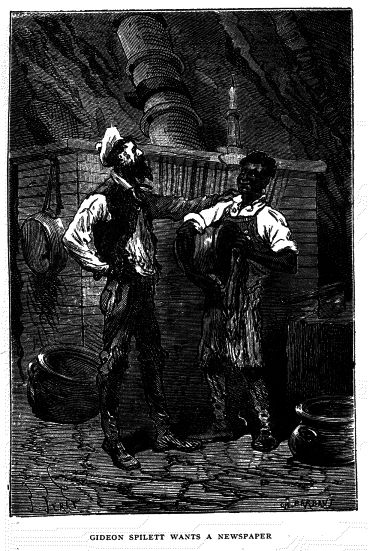
Neb began to laugh.
“’Pon my word,” he replied, “the only thing I think about is my daily work!”
The truth was that indoors as well as out there was no want of work.
The colony of Lincoln Island was now at its highest point of prosperity, achieved by three years of continued hard work. The destruction of the brig had been a new source of riches. Without speaking of the complete rig which would serve for the vessel now on the stocks, utensils and tools of all sorts, weapons and ammunition, clothes and instruments, were now piled in the store-rooms of Granite House. It had not even been necessary to resort again to the manufacture of the coarse felt materials. Though the colonists had suffered from cold during their first winter, the bad season might now come without their having any reason to dread its severity. Linen was plentiful also, and besides, they kept it with extreme care. From chloride of sodium, which is nothing else than sea salt, Cyrus Harding easily extracted the soda and chlorine. The soda, which it was easy to change into carbonate of soda, and the chlorine, of which he made chloride of lime, were employed for various domestic purposes, and especially in bleaching linen. Besides, they did not wash more than four times a year, as was done by families in the olden time, and it may be added, that Pencroft and Gideon Spilett, whilst waiting for the postman to bring him his newspaper, distinguished themselves as washermen.
So passed the winter months, June, July, and August. They were very severe, and the average observations of the thermometer did not give more than eight degrees of Fahrenheit. It was therefore lower in temperature than the preceding winter. But then, what splendid fires blazed continually on the hearths of Granite House, the smoke marking the granite wall with long, zebra-like streaks! Fuel was not spared, as it grew naturally a few steps from them. Besides, the chips of the wood destined for the construction of the ship enabled them to economise the coal, which required more trouble to transport.
Men and animals were all well. Master Jup was a little chilly, it must be confessed. This was perhaps his only weakness, and it was necessary to make him a well-wadded dressing-gown. But what a servant he was, clever, zealous, indefatigable, not indiscreet, not talkative, and he might have been with reason proposed as a model for all his biped brothers in the Old and the New World!
“As for that,” said Pencroft, “when one has four hands at one’s service, of course one’s work ought to be done so much the better!”
And indeed the intelligent creature did it well.
During the seven months which had passed since the last researches made round the mountain, and during the month of September, which brought back fine weather, nothing was heard of the genius of the island. His power was not manifested in any way. It is true that it would have been inutile, for no incident occurred to put the colonists to any painful trial.
Cyrus Harding even observed that if by chance the communication between the unknown and the tenants of Granite House had ever been established through the granite, and if Top’s instinct had as it were felt it, there was no further sign of it during this period. The dog’s growling had entirely ceased, as well as the uneasiness of the orang. The two friends—for they were so—no longer prowled round the opening of the inner well, nor did they bark or whine in that singular way which from the first the engineer had noticed. But could he be sure that this was all that was to be said about this enigma, and that he should never arrive at a solution? Could he be certain that some conjuncture would not occur which would bring the mysterious personage on the scene? Who could tell what the future might have in reserve?
At last the winter was ended, but an event, the consequences of which might be serious, occurred in the first days of the returning spring.
On the 7th of September, Cyrus Harding, having observed the crater, saw smoke curling round the summit of the mountain, its first vapours rising in the air.
Chapter Fifteen.
The Awakening of the Volcano—The fine Season—Continuation of Work—The Evening of the 15th of October—A Telegram—A Question—An Answer—Departure for the Corral—The Notice—The additional Wire—The Basalt Coast—At High Tide—At Low Tide—The Cavern—A dazzling Light.
The colonists, warned by the engineer, left their work and gazed in silence at the summit of Mount Franklin.
The volcano had awoke, and the vapour had penetrated the mineral layer heaped up at the bottom of the crater. But would the subterranean fires provoke any violent eruption? This was an event which could not be foreseen. However, even while admitting the possibility of an eruption, it was not probable that the whole of Lincoln Island would suffer from it. The flow of volcanic matter is not always disastrous, and the island had already undergone this trial, as was shown by the streams of lava hardened on the northern slopes of the mountain. Besides, from the shape of the crater—the opening broken in the upper edge—the matter would be thrown to the side opposite the fertile regions of the island.
However, the past did not necessarily answer for the future. Often, at the summit of volcanoes, the old craters close and new ones open. This has occurred in the two hemispheres—at Etna, Popocatepetl, at Orizaba—and on the eve of an eruption there is everything to be feared. In fact, an earthquake—a phenomenon which often accompanies volcanic eruptions—is enough to change the interior arrangement of a mountain, and to open new outlets for the burning lava.
Cyrus Harding explained these things to his companions, and, without exaggerating the state of things, he told them all the pros and cons. After all they could not prevent it. It did not appear likely that Granite House would be threatened unless the ground was shaken by an earthquake. But the corral would be in great danger should a new crater open in the southern side of Mount Franklin.
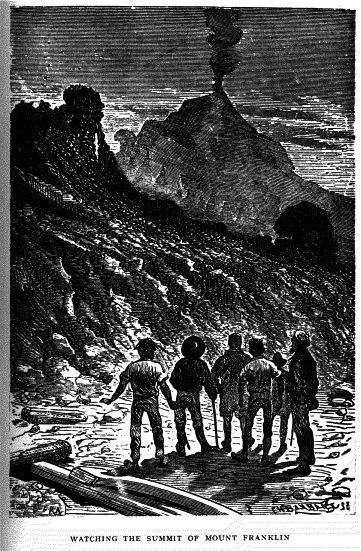
From that day the smoke never disappeared from the top of the mountain, and it could even be perceived that it increased in height and thickness, without any flame mingling in its heavy volumes. The phenomenon was still concentrated in the lower part of the central crater.
However, with the fine days work had been continued. The building of the vessel was hastened as much as possible, and, by means of the waterfall on the shore, Cyrus Harding managed to establish an hydraulic saw-mill, which rapidly cut up the trunks of trees into planks and joists. The mechanism of this apparatus was as simple as those used in the rustic saw-mills of Norway. A first horizontal movement to move the piece of wood, a second vertical movement to move the saw—this was all that was wanted; and the engineer succeeded by means of a wheel, two cylinders, and pulleys properly arranged. Towards the end of the month of September the skeleton of the vessel, which was to be rigged as a schooner, lay in the dockyard. The ribs were almost entirely completed, and, all the timbers having been sustained by a provisional band, the shape of the vessel could already be seen. This schooner, sharp in the bows, very slender in the after-part, would evidently be suitable for a long voyage, if wanted; but laying the planking would still take a considerable time. Very fortunately, the iron-work of the pirate brig had been saved after the explosion. From the planks and injured ribs Pencroft and Ayrton had extracted the bolts and a large quantity of copper nails. It was so much work saved for the smiths, but the carpenters had much to do.
Ship-building was interrupted for a week for the harvest, the haymaking, and the gathering in of the different crops on the plateau. This work finished, every moment was devoted to finishing the schooner. When night came the workmen were really quite exhausted. So as not to lose any time they had changed the hours for their meals; they dined at twelve o’clock, and only had their supper when daylight failed them. They then ascended to Granite House, when they were always ready to go to bed.
Sometimes, however, when the conversation bore on some interesting subject the hour for sleep was delayed for a time. The colonists then spoke of the future, and talked willingly of the changes which a voyage in the schooner to inhabited lands would make in their situation. But always, in the midst of these plans, prevailed the thought of a subsequent return to Lincoln Island. Never would they abandon this colony, founded with so much labour and with such success, and to which a communication with America would afford a fresh impetus. Pencroft and Neb especially hoped to end their days there.
“Herbert,” said the sailor, “you will never abandon Lincoln Island?”
“Never, Pencroft, and especially if you make up your mind to stay there.”
“That was made up long ago, my boy,” answered Pencroft. “I shall expect you. You will bring me your wife and children, and I shall make jolly little chaps of your youngsters!”
“That’s agreed,” replied Herbert, laughing and blushing at the same time.
“And you, Captain Harding,” resumed Pencroft enthusiastically, “you will be still the governor of the island! Ah! how many inhabitants could it support? Ten thousand at least!”
They talked in this way, allowing Pencroft to run on, and at last the reporter actually started a newspaper—the New Lincoln Herald!
So is man’s heart. The desire to perform a work which will endure, which will survive him, is the origin of his superiority over all other living creatures here below. It is this which has established his dominion, and this it is which justifies it, over all the world.
After that, who knows if Jup and Top had not themselves their little dream of the future.
Ayrton silently said to himself that he would like to see Lord Glenarvan again and show himself to all restored.
One evening, on the 15th of October, the conversation was prolonged later than usual. It was nine o’clock. Already, long badly-concealed yawns gave warning of the hour of rest, and Pencroft was proceeding towards his bed, when the electric bell, placed in the dining-room, suddenly rang.
All were there, Cyrus Harding, Gideon Spilett, Herbert, Ayrton, Pencroft, Neb. Therefore none of the colonists were at the corral.
Cyrus Harding rose. His companions stared at each other, scarcely believing their ears.
“What does that mean?” cried Neb. “Was it the devil who rang it?”
No one answered.
“The weather is stormy,” observed Herbert. “Might not its influence of electricity—”
Herbert did not finish his phrase. The engineer, towards whom all eyes were turned, shook his head negatively.
“We must wait,” said Gideon Spilett. “If it is a signal, whoever it may be who has made it, he will renew it.”
“But who do you think it is?” cried Neb. “Who?” answered Pencroft, “but he—”
The sailor’s sentence was cut short by a new tinkle of the bell.
Harding went to the apparatus, and sent this question to the corral:—
“What do you want?”
A few moments later the needle, moving on the alphabetic dial, gave this reply to the tenants of Granite House:—
“Come to the corral immediately.”
“At last!” exclaimed Harding.
Yes! At last! The mystery was about to be unveiled. The colonists’ fatigue had disappeared before the tremendous interest which was about to urge them to the corral, and all wish for rest had ceased. Without having uttered a word, in a few moments they had left Granite House, and were standing on the beach. Jup and Top alone were left behind. They could do without them.
The night was black. The new moon had disappeared at the same time as the sun. As Herbert had observed great stormy clouds formed a lowering and heavy vault, preventing any star rays. A few lightning-flashes, reflections from a distant storm, illuminated the horizon.
It was possible that a few hours later the thunder would roll over the island itself. The night was very threatening. But however deep the darkness was, it would not prevent them from finding the familiar road to the corral.
They ascended the left bank of the Mercy, reached the plateau, passed the bridge over Creek Glycerine, and advanced through the forest.
They walked at a good pace, a prey to the liveliest emotions. There was no doubt but that they were now going to learn the long-searched-for answer to the enigma, the name of that mysterious being, so deeply concerned in their life, so generous in his influence, so powerful in his action! Must not this stranger have indeed mingled with their existence, have known the smallest details, have heard all that was said in Granite House, to have been able always to act in the very nick of time?
Every one, wrapped up in his own reflections, pressed forward. Under the arch of trees the darkness was such that the edge of the road even could not be seen. Not a sound in the forest. Both animals and birds, influenced by the heaviness of the atmosphere, remained motionless and silent. Not a breath disturbed the leaves. The footsteps of the colonists alone resounded on the hardened ground.
During the first quarter of an hour the silence was only interrupted by this remark from Pencroft:—
“We ought to have brought a torch.”
And by this reply from the engineer:—
“We shall find one at the corral.”
Harding and his companions had left Granite House at twelve minutes past nine. At forty-seven minutes past nine they had traversed three out of the five miles which separated the mouth of the Mercy from the corral.
At that moment sheets of lightning spread over the island and illumined the dark trees. The flashes dazzled and almost blinded them. Evidently the storm would not be long in bursting forth.
The flashes gradually became brighter and more rapid. Distant thunder growled in the sky. The atmosphere was stifling.
The colonists proceeded as if they were urged onwards by some irresistible force.
At ten o’clock a vivid flash showed them the palisade, and as they reached the gate the storm burst forth with tremendous fury.
In a minute the corral was crossed, and Harding stood before the hut.
Probably the house was occupied by the stranger, since it was from thence that the telegram had been sent. However, no light shone through the window.
The engineer knocked at the door.
No answer.
Cyrus Harding opened the door, and the settlers entered the room, which was perfectly dark. A light was struck by Neb, and in a few moments the lantern was lighted and the light thrown into every corner of the room.
There was no one there. Everything was in the state in which it had been left.
“Have we been deceived by an illusion?” murmured Cyrus Harding.
No! that was not possible! The telegram had clearly said—
“Come to the corral immediately.”
They approached the table specially devoted to the use of the wire. Everything was in order—the pile and the box containing it, as well as all the apparatus.
“Who came here the last time?” asked the engineer.
“I did, captain,” answered Ayrton.
“And that was—”
“Four days ago.”
“Ah! a note!” cried Herbert, pointing to a paper lying on the table.
On this paper were written these words in English:—
“Follow the new wire.”
“Forward!” cried Harding, who understood that the despatch had not been sent from the corral, but from the mysterious retreat, communicating directly with Granite House by means of a supplementary wire joined to the old one.
Neb took the lighted lantern, and all left the corral. The storm then burst forth with tremendous violence. The interval between each lightning-flash and each thunder-clap diminished rapidly. The summit of the volcano, with its plume of vapour, could be seen by occasional flashes.
There was no telegraphic communication in any part of the corral between the house and the palisade; but the engineer, running straight to the first post, saw by the light of a flash a new wire hanging from the isolater to the ground.
“There it is!” said he.
This wire lay along the ground, and was surrounded with an isolating substance like a submarine cable, so as to assure the free transmission of the current. It appeared to pass through the wood and the southern spurs of the mountain, and consequently it ran towards the west.
“Follow it!” said Cyrus Harding.
And the settlers immediately pressed forward, guided by the wire.
The thunder continued to roar with such violence that not a word could be heard. However, there was no occasion for speaking, but to get forward as fast as possible.
Cyrus Harding and his companions then climbed the spur rising between the corral valley and that of Falls River, which they crossed at its narrowest part. The wire, sometimes stretched over the lower branches of the trees, sometimes lying on the ground, guided them surely. The engineer had supposed that the wire would perhaps stop at the bottom of the valley, and that the stranger’s retreat would be there.
Nothing of the sort. They were obliged to ascend the south-western spur, and re-descend on that arid plateau terminated by the strangely-wild basalt cliff. From time to time one of the colonists stooped down and felt for the wire with his hands; but there was now no doubt that the wire was running directly towards the sea. There, to a certainty, in the depths of those rocks, was the dwelling so long sought for in vain.
The sky was literally on fire. Flash succeeded flash. Several struck the summit of the volcano in the midst of the thick smoke. It appeared there as if the mountain was vomiting flame. At a few minutes to eleven the colonists arrived on the high cliff overlooking the ocean to the west. The wind had risen. The surf roared 500 feet below.
Harding calculated that they had gone a mile and a half from the coral.
At this point the wire entered among the rocks, following the steep side of a narrow ravine. The settlers followed it at the risk of occasioning a fall of the slightly-balanced rocks, and being dashed into the sea. The descent was extremely perilous, but they did not think of the danger; they were no longer masters of themselves, and an irresistible attraction drew them towards this mysterious place as the magnet draws iron.
Thus they almost unconsciously descended this ravine, which even in broad daylight would have been considered impracticable.
The stones rolled and sparkled like fiery balls when they crossed through the gleams of light. Harding was first—Ayrton last. On they went, step by step. Now they slid over the slippery rock; then they struggled to their feet and scrambled on.
At last the wire touched the rocks on the beach. The colonists had reached the bottom of the basalt cliff.
There appeared a narrow ridge, running horizontally and parallel with the sea. The settlers followed the wire along it. They had not gone a hundred paces when the ridge by a moderate incline sloped down to the level of the sea.
The engineer seized the wire and found that it disappeared beneath the waves.
His companions were stupefied.
A cry of disappointment, almost a cry of despair, escaped them! Must they then plunge beneath the water and seek there for some submarine cavern? In their excited state they would not have hesitated to do it.
The engineer stopped them.
He led his companions to a hollow in the rocks, and there—
“We must wait,” said he. “The tide is high. At low-water the way will be open.”
“But what can make you think—” asked Pencroft.
“He would not have called us if the means had been wanting to enable us to reach him!”
Cyrus Harding spoke in a tone of such thorough conviction that no objection was raised. His remark, besides, was logical. It was quite possible that an opening, practicable at low-water, though hidden now by the high tide, opened at the foot of the cliff.
There was some time to wait. The colonists remained silently crouching in a deep hollow. Rain now began to fall in torrents. The thunder was re-echoed among the rocks with a grand sonorousness.
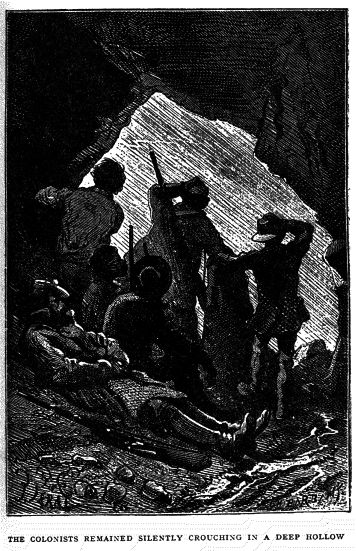
The colonists’ emotion was great. A thousand strange and extraordinary ideas crossed their brains, and they expected some grand and superhuman apparition, which alone could come up to the notion they had formed of the mysterious genius of the island.
At midnight, Harding, carrying the lantern, descended to the beach to reconnoitre.
The engineer was not mistaken. The beginning of an immense excavation could be seen under the water. There the wire, bending at a right angle, entered the yawning gulf.
Cyrus Harding returned to his companions, and said simply—
“In an hour the opening will be practicable.”
“It is there, then?” said Pencroft.
“Did you doubt it?” returned Harding.
“But this cavern must be filled with water to a certain height,” observed Herbert.
“Either the cavern will be completely dry,” replied Harding, “and in that case we can traverse it on foot, or it will not be dry, and some means of transport will be put at our disposal.”
An hour passed. All climbed down through the rain to the level of the sea. There was now eight feet of the opening above the water. It was like the arch of a bridge, under which rushed the foaming water.
Leaning forward, the engineer saw a black object floating on the water. He drew it towards him. It was a boat, moored to some interior projection of the cave. This boat was iron-plated. Two oars lay at the bottom.
“Jump in!” said Harding.
In a moment the settlers were in the boat. Neb and Ayrton took the oars, Pencroft the rudder. Cyrus Harding in the bows, with the lantern, lighted the way.
The elliptical roof, under which the boat at first passed, suddenly rose; but the darkness was too deep, and the light of the lantern too slight, for either the extent, length, height, or depth of the cave to be ascertained. Solemn silence reigned in this basaltic cavern. Not a sound could penetrate into it, even the thunder peals could not pierce its thick sides.
Such immense caves exist in various parts of the world, natural crypts dating from the geological epoch of the globe. Some are filled by the sea; others contain entire lakes in their sides. Such is Fingal’s Cave, in the island of Staffa, one of the Hebrides; such are the caves of Morgat, in the bay of Douarucuez, in Brittany, the caves of Bonifacier, in Corsica, those of Lyse-Fjord, in Norway; such are the immense Mammoth caverns in Kentucky, 500 feet in height, and more than twenty miles in length! In many parts of the globe, nature has excavated these caverns, and preserved them for the admiration of man.
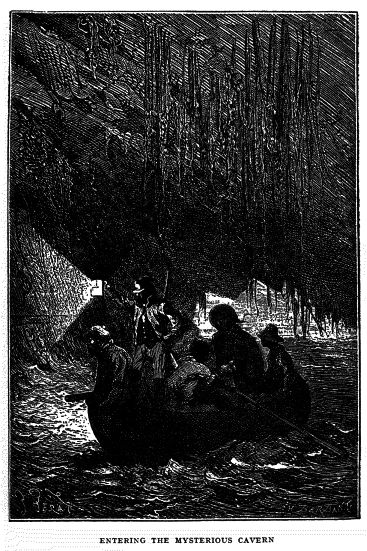
Did the cavern which the settlers were now exploring extend to the centre of the island? For a quarter of an hour the boat had been advancing, making détours, indicated to Pencroft by the engineer in short sentences, when all at once—
“More to the right!” he commanded. The boat, altering its course, came up alongside the right wall. The engineer wished to see if the wire still ran along the side. The wire was there fastened to the rock. “Forward!” said Harding.
And the two oars, plunging into the dark waters, urged the boat onwards.
On they went for another quarter of an hour, and a distance of half-a-mile must have been cleared from the mouth of the cave, when Harding’s voice was again heard. “Stop!” said he.
The boat stopped, and the colonists perceived a bright light illuminating the vast cavern, so deeply excavated in the bowels of the island, of which nothing had ever led them to suspect the existence.
At a height of a hundred feet rose the vaulted roof, supported on basalt shafts. Irregular arches, strange mouldings, appeared on the columns erected by nature in thousands from the first epochs of the formation of the globe. The basalt pillars, fitted one into the other, measured from forty to fifty feet in height, and the water, calm in spite of the tumult outside, washing their base. The brilliant focus of light, pointed out by the engineer, touched every point of rock, and flooded the walls with light. By reflection the water reproduced the brilliant sparkles, so that the boat appeared to be floating between two glittering zones.
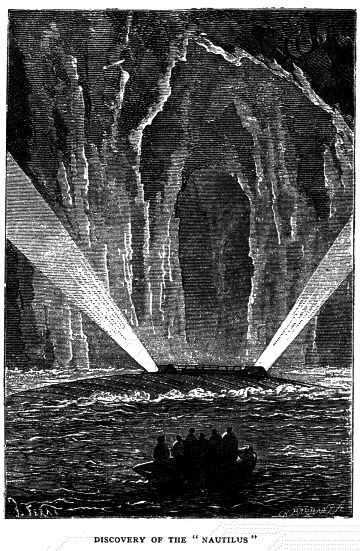
They could not be mistaken in the nature of the irradiation thrown from the centre light, whose clear rays broke all the angles, all the projections of the cavern. This light proceeded from an electric source, and its white colour betrayed its origin. It was the sun of this cave, and it filled it entirely.
At a sign from Cyrus Harding the oars again plunged into the water, causing a regular shower of gems, and the boat was urged forward towards the light, which was now not more than half a cable’s length distant.
At this place the breadth of the sheet of water measured nearly 350 feet, and beyond the dazzling centre could be seen an enormous basaltic wall, blocking up any issue on that side. The cavern widened here considerably, the sea forming a little lake. But the roof, the side walls, the end cliff, all the prisms, all the peaks, were flooded with the electric fluid, so that the brilliancy belonged to them, and as if the light issued from them.
In the centre of the lake a long cigar-shaped object floated on the surface of the water, silent, motionless. The brilliancy which issued from it escaped from its sides as from two kilns heated to a white heat. This apparatus, similar in shape to an enormous whale, was about 250 feet long, and rose about ten or twelve above the water.
The boat slowly approached it. Cyrus Harding stood up in the bows. He gazed, a prey to violent excitement. Then, all at once, seizing the reporter’s arm—
“It is he! It can only be he!” he cried, “he!—”
Then, falling back on the seat, he murmured a name which Gideon Spilett alone could hear.
The reporter evidently knew this name, for it had a wonderful effect upon him, and he answered in a hoarse voice—
“He! an outlawed man!”
“He!” said Harding.
At the engineer’s command the boat approached this singular floating apparatus. The boat touched the left side, from which escaped a ray of light through a thick glass.
Harding and his companions mounted on the platform. An open hatchway was there. All darted down the opening.
At the bottom of the ladder was a deck, lighted by electricity. At the end of this deck was a door, which Harding opened.
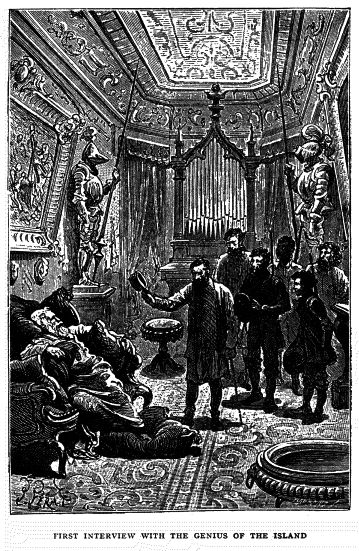
A richly-ornamented room, quickly traversed by the colonists, was joined to a library, over which a luminous ceiling shed a flood of light.
At the end of the library a large door, also shut, was opened by the engineer.
An immense saloon—a sort of museum, in which were heaped up, with all the treasures of the mineral world, works of art, marvels of industry—appeared before the eyes of the colonists, who almost thought themselves suddenly transported into a land of enchantment.
Stretched on a rich sofa they saw a man, who did not appear to notice their presence.
Then Harding raised his voice, and to the extreme surprise of his companions, he uttered these words—
“Captain Nemo, you asked for us! We are here.”
Chapter Sixteen.
Captain Nemo—His first Words—The History of the Recluse—His Adventures—His Sentiments—His Comrades—Submarine Life—Alone—The last Refuge of the Nautilus in Lincoln Island—The Mysterious Genius of the Island.
At these words the reclining figure rose, and the electric light fell upon his countenance; a magnificent head, the forehead high, the glance commanding, beard white, hair abundant and falling over the shoulders.
His hand rested upon the cushion of the divan from which he had just risen. He appeared perfectly calm. It was evident that his strength had been gradually undermined by illness, but his voice seemed yet powerful, as he said in English, and in a tone which evinced extreme surprise—
“Sir, I have no name.”
“Nevertheless, I know you!” replied Cyrus Harding.
Captain Nemo fixed his penetrating gaze upon the engineer as though he were about to annihilate him.
Then, falling back amid the pillows of the divan—
“After all, what matters now?” he murmured; “I am dying!”
Cyrus Harding drew near the captain, and Gideon Spilett took his hand—it was of a feverish heat. Ayrton, Pencroft, Herbert, and Neb, stood respectfully apart in an angle of the magnificent saloon, whose atmosphere was saturated with the electric fluid.
Meanwhile Captain Nemo withdrew his hand, and motioned the engineer and the reporter to be seated.
All regarded him with profound emotion. Before them they beheld that being whom they had styled the “genius of the island,” the powerful protector whose intervention, in so many circumstances, had been so efficacious, the benefactor to whom they owed such a debt of gratitude! Their eyes beheld a man only, and a man at the point of death, where Pencroft and Neb had expected to find an almost supernatural being!
But how happened it that Cyrus Harding had recognised Captain Nemo? Why had the latter so suddenly risen on hearing this name uttered, a name which he had believed known to none?
The captain had resumed his position on the divan, and leaning on his arm, he regarded the engineer, seated near him.
“You know the name I formerly bore, sir?” he asked.
“I do,” answered Cyrus Harding, “and also that of this wonderful submarine vessel—”
“The Nautilus?” said the captain, with a faint smile.
“The Nautilus!”
“But do you—do you know who I am?”
“I do.”
“It is nevertheless many years since I have held any communication with the inhabited world; three long years have I passed in the depths of the sea, the only place where I have found liberty! Who then can have betrayed my secret?”
“A man who was bound to you by no tie, Captain Nemo, and who, consequently, cannot be accused of treachery.”
“The Frenchman who was cast on board my vessel by chance sixteen years since?”
“The same.”
“He and his two companions did not then perish in the Maelstrom, in the midst of which the Nautilus was struggling.”
“They escaped, and a book has appeared under the title of Twenty Thousand Leagues under the Sea, which contains your history.”
“The history of a few months only of my life!” interrupted the captain impetuously.
“It is true,” answered Cyrus Harding, “but a few months of that strange life have sufficed to make you known—”
“As a great criminal, doubtless!” said Captain Nemo, a haughty smile curling his lips. “Yes, a rebel, perhaps an outlaw against humanity!”
The engineer was silent.
“Well, sir?”
“It is not for me to judge you, Captain Nemo,” answered Cyrus Harding, “at any rate as regards your past life. I am, with the rest of the world, ignorant of the motives which induced you to adopt this strange mode of existence, and I cannot judge of effects without knowing their causes; but what I do know is, that a beneficent hand has constantly protected us since our arrival on Lincoln Island, that we all owe our lives to a good, generous, and powerful being, and that this being so powerful, good and generous, Captain Nemo, is yourself!”
“It is I,” answered the captain simply.
The engineer and reporter rose. Their companions had drawn near, and the gratitude with which their hearts were charged was about to express itself in their gestures and words.
Captain Nemo stopped them by a sign, and in a voice which betrayed more emotion than he doubtless intended to show.
“Wait till you have heard all,” he said. (See Note 1.)
And the captain, in a few concise sentences, ran over the events of his life.
His narrative was short, yet he was obliged to summon up his whole remaining energy to arrive at the end. He was evidently contending against extreme weakness. Several times Cyrus Harding entreated him to repose for a while, but he shook his head as a man to whom the morrow may never come, and when the reporter offered his assistance—
“It is useless,” he said; “my hours are numbered.”
Captain Nemo was an Indian, the Prince Dakkar, son of a rajah of the then independent territory of Bundelkund. His father sent him, when ten years of age, to Europe, in order that he might receive an education in all respects complete, and in the hopes that by his talents and knowledge he might one day take a leading part in raising his long degraded and heathen country to a level with the nations of Europe.