Front matter (continued 3)
Reading edition
I had every confidence in our ability to reach the pole, for without the difficulty of ice to encounter, I could see no good reason why we should not. Moreover, the season of the year would insure pleasant weather in high latitudes; there would probably be no detention, as in other expeditions, and it seemed a reasonable presumption that we should reach 90° north, while the summer was yet at its height.
Presently a dense fog came rolling in from the sea, and in a few minutes the air ship was lost to view, although not more than forty or fifty yards from where we were sitting. We continued eating our lunch like a couple of specters on each side of the fire, until, finding that we were getting wet, I got up to go after some oilskins. I thought I knew exactly where the machine was, believing that I had sat down with my back toward it, and at best did not suppose it possible to lose so large an object so close at band. I walked until quite sure that I had covered the distance separating me from it, and then continued to walk on farther. Suddenly I stopped, convinced that I had mistaken the direction. I started upon another course, and after another unsuccessful tramp stopped again. Then I called for Torrence, and told him that I was lost. His voice sounded much farther than I thought it should, and I tried to get back to him by following it. Presently he called out imperatively:
"Stop! don't try to find me. Stand perfectly still until it clears!"
"Why not? if you'll keep on talking I'm sure to find you."
Then he shouted vehemently.
"Stop! for God's sake, stop! You're risking your life with every step. Have you forgotten that we're on the edge of a precipice?"
I had not forgotten it, but his words startled me into realizing the danger of my position, and I stood perfectly still. Strangely enough I had not thought of the possibility of tumbling over the cliff, believing all the while that I was walking in the opposite direction; but now the murmur of the sea on the rocks below convinced me that I was nearer than I had supposed.
"If you move at all," shouted Torrence, "go only one step at a time. I mean, look carefully at each step before you take it."
I could not imagine how I had come so far, for his voice sounded strangely distant.
"Have you moved from where I left you?" I called.
"No," was the answer, "and don't intend to."
"That's right. I think I can find you if you keep talking."
"All right; go ahead; but watch the ground carefully at every step!"
The truth is I could not see much above a yard at a time, and a misstep would have been fatal. Torrence continued to talk, and I slowly advanced in the direction from which his voice seemed to come. Suddenly my way was blocked by a solid wall and in another instant I saw that it was the air ship. I now perceived why the voice had been so faint, for I had wandered clear around the machine, which had intercepted it.
Feeling my way carefully to the ladder I called out that all was well.
"No matter about the skins," came the answer, "let us get off as soon as possible. Go into the saloon and fetch a ball of twine from the locker; tie one end to the step, then make your way slowly!"
I found the twine; groped forward with the ball in my hand, and reached camp without accident. Then we commenced carrying our cook tools back to the boat.
"There is no place like home!" yelled Torrence, returning with the last load. In another minute he had climbed over the side, and drawing a breath of relief, added:
"It is fortunate we travel by air instead of land or water, because we shan't have to wait for the fog!"
A few minutes more and the ladder was hauled in, the gangway closed, the hatch to the upper deck shut down, and we were comfortably established in our cosy cabin. Then Torrence going to his controlling board, pressed a button, moved a lever, turned a screw, and we were swung gently up, and resumed our journey north, 11° west, headed for Spitzbergen, which Torrence said we should reach within twenty-four hours.
I don't know why it was always such an indescribable pleasure to feel clear of earth; and yet this was the fact. The first sensation of being above the ground was a thrill of inexplicable delight. It seemed as if we were lifted into a higher plane of being, morally as well as bodily, involving a certain arrogant sympathy for those left behind. The poor creatures knew so little about life, and it even amazed me to think that I had been one of them for so many years without realizing the depravity of my state. Life without an air ship was not worth the living; but with it, I could answer Mr. Mallock's question without thought or hesitation.
When the fog cleared we were many miles to seaward, and the rock-bound coast of Europe showed only as a dark line against the horizon. Torrence said there was nothing to prevent our going into the cuddy for a sleep, which we needed, that in our present position there was no danger; that collision was impossible, and falling equally so. That the air ship was headed for Spitzbergen, and could take care of herself—in short, that we should be just as safe as if sleeping in the Mustapha. I suggested the possibility of icebergs but he explained that we were above the altitude of the highest ever known in this quarter, and that, moreover, it was improbable that any would be passed at this season and this locality. And so, taking his word for it, we both turned in and slept ten hours without waking. At the end of that time we felt like new men, and climbed up on deck to look out.
A dull gray sea, bounded only by the sky-line, was rushing away beneath, and so far as I could tell, our speed and elevation had remained unchanged. Despite my brother's assurance, I could not help feeling that we had taken an awful risk about the icebergs; but when he told me that the ice masses formed off Spitzbergen were greatly inferior in size to those coming down from Greenland, I was better satisfied. Indeed, it was very rare, he said, that an iceberg in this part of the ocean was more than one hundred and fifty to two hundred feet in height; they were differently shaped, being flat on top, and covering considerable area, but never high; while our own altitude was more than a thousand feet. Torrence had made quite a study of the polar regions, and I had great confidence in his judgment.
On we sped—I cannot say during the day, for there was no night, although we kept a record of the time, and at regular intervals darkened our sleeping apartments to delude ourselves into the belief that it was night above. While on watch we sunk to a lower level, as being warmer, although it was getting to be the time of year when the mercury seldom falls below freezing even in this latitude. Occasional masses of ice were now passed, though none of any considerable size, and I can truthfully say that, except when above the clouds, we had not, so far, suffered from cold.
About thirty hours after leaving the North Cape of Norway the irregular, saw-shaped outline of Spitzbergen peeped above the horizon. Our passage had been uneventful, and as we neared the barren shores of the west island, there was nothing to invite us to linger. We decided, however, to land for a short time before pursuing our journey northward.
Proceeding with care we entered the channel to the east of Prince Charles Foreland, known as Foreland Bay. Moving up this passage to its upper terminal, and then crossing King's Bay, we effected a landing opposite Cape Mitra, on the eastern shore of Cross Bay. The whole country was desolate beyond description, and we only halted for another examination of our vessel before plunging into the great unknown beyond.
We touched earth on a shelly beach, and congratulated ourselves on having reached this high latitude in safety.
Drift wood abounded, and we soon had a roaring fire, with the prospect of a good meal ahead. We took care this time to guard against fog by carrying a line from the air ship to our encampment.
Torrence wanted to shoot a reindeer, an ice fox, or a polar bear before leaving, although neither of us cared to make a sporting tour for fear of getting lost; moreover, the time was valuable. There were no indications of life from our point of landing, although we knew the islands abounded in Arctic game, and that the animals mentioned were plentiful. Torrence seemed particularly anxious to run across a herd of deer, and when I suggested that a white bear would be a finer sight, he shrugged his shoulders and said:
"Perhaps; but I have special reasons for wanting a deer, which I will explain later; meanwhile let us get dinner."
And so we set to work upon the best our larder afforded, feeling that it would probably be our last meal on land for a very indefinite time. Indeed when I thought of the future and the unexplored regions ahead, and the mysteries of the unknown awaiting us, I confess to some nervous apprehension.
The realm we were about to penetrate had been from all time screened from the eyes of man; was it not sacrilege to force the hand of Providence and expose it now?
* * * * *
XII.
We were in the midst of dinner when down the beach came a great, white, swaggering bear, sniffing the air from side to side, for the fumes of bacon, sausage, and fried potatoes which happened just then to be in the pan. The suddenness of the apparition froze every drop of sporting blood in my veins; but this perhaps, is not so much to be marveled at, when it is remembered that we had left our arms and ammunition in the air ship, full fifty yards away, though fortunately in the other direction. Dropping the remains of dinner on the ground, we ran with one accord and mortifying speed to the big machine, tumbled in over the side, and hauled up the ladder with a dexterity never before equalled. Here we armed ourselves with a couple of Winchester rifles, and then crawled up on deck to watch the enemy. It was a painful sight to see our excellent repast scattered right and left, nosed, pawed, and devoured before our very eyes; but it was satisfactory to observe that the beast burned his mouth and paws in his greediness. When he got through licking his chops and sucking his fingers he had time to look around, and catching sight of the air ship, was surprised. Evidently he was familiar with that part of the coast and had never seen such a thing before. We decided to wait until curiosity had brought him nearer, which it was not long in doing. Still sniffing, now probably for danger, the monster slowly approached, and when two-thirds of the distance had been covered, he stopped suddenly, overcome with astonishment. It was our time to fire, and crack went the rifles, almost at the same instant. It had been previously agreed that I was to aim for the head, while Torrence was to shoot immediately behind the shoulder. The animal started up with a snort, surprised and wounded. He showed his teeth and snapped as he caught sight of us, and then turned and began licking his wound. I was surprised that he had not keeled over stone dead, for as the blood trickled down over his long, dirty, white hair it looked to me as if it issued from a vital point, but it was difficult to tell. Presently the sound of our voices renewed his anger, and he came at us, on a gallop. We waited until he touched the vessel, when, just as we were about to fire again, the bear raised himself upon his hind legs as if trying to get a foothold to board us, and rolled over dead without a struggle. We discharged our rifles into the animal's skull as he lay there, and then after a few minutes went to work upon him. It was a great find, as he was large and fat. We soon had him bled, and cut up into convenient sizes. We left the skin for other explorers, not caring to bother with it, but the principal part of the meat was carefully stowed on board. After this adventure we went back and finished our dinner, or rather we cooked another; this time being careful to carry the rifles with us.
As we sat smoking our pipes around the camp fire, after finishing our repast, I asked Torrence why he had been so anxious to kill a reindeer.
"For marks!" he said, blowing a volume of smoke into the air.
"Marks!" I exclaimed in astonishment; "what marks? What are you talking about?"
"Ear marks," he answered, still puffing away at his pipe.
"And why are the ear marks of a Spitzbergen reindeer especially interesting?" I inquired.
Torrence looked at me thoughtfully as he answered:
"Because they have been made by the hand of man!"
"And why shouldn't they be?"
"For a very simple reason. Because man does not inhabit these islands!"
"Then how is your theory supported?"
"By an enormous array of accumulated evidence that there are vast continents to the north of us, which are inhabited both by man, reindeer, and other animals!"
"You mean continent, not continents," I suggested.
"On the contrary; I believe there are continents fully equaling in size Europe, Asia, Africa and the two Americas!"
Had the fellow lost his mind? I looked carefully to see if he were serious, and observing no indications of a joke, answered:
"Your theory might be all right if there was room enough around the pole for all the land you speak of; but as there isn't, I am afraid you'll have to be contented with one very moderate-sized continent, which I will admit it is barely possible may exist. As for its being inhabited, I don't believe it."
"It's a pity, Gurthrie, for you'll have to believe a great deal more than that before you get through with this journey. But speaking of the reindeer, do you know that immense herds of them roam over these islands; and that the enormous numbers which have been killed in former years—amounting to several thousand sometimes, in a single season—tends to support the theory that they have migrated from another land? But that is not all; for these creatures carry with them stronger evidences of a habitable region to the north—for they cannot have migrated from the south."
"And what is that evidence?" I asked.
"The ear marks we were speaking of," continued Torrence, "thousands of these reindeer are marked; that is, they have their ears cut in a way to indicate that it was done by the hand of man. It is the opinion of many hunters in this region that these animals have emigrated from an unknown country to the north; and that is my belief also!"
"But you spoke of continents!" I urged.
"And I still speak of continents. But wait; I do not wish to startle you, or shake your faith in my sanity. What I know, I know; and what I know, you shall soon see for yourself. But mind, we are going into a warmer climate, and we shall find all that I have intimated. But a little at a time; do not strain your mind with thoughts you have never yet learned to assimilate."
I admitted that if it were a fact about the ear marks it was certainly a curious one; whereupon Torrence declared that it was only one out of many reasons for the theory, which he would explain later. Altogether there was a conviction in his manner which was very impressive. I listened to him talk for more than an hour, and must confess that he produced an array of alleged facts that were startling. He ended by declaring that our discoveries would vastly exceed those of Columbus in their magnitude, and that we should go down to history as the greatest of all explorers!
When Torrence stopped talking, our pipes had gone out, and the fire was reduced to a few glowing coals. We got up to make preparations for a final departure into the great unknown, and I confess, with a good deal more awe than I had previously thought possible. If Torrence was oppressed by the contemplation of what we were about to undertake, he only showed it by a more earnest and serious demeanor than he had yet exhibited. For my part, I dreaded to leave the island, overcome with the thought of what might be awaiting us. Beyond this, I was seriously puzzled by my brother's remark about continents, and their size, but could not bring myself to insist on an explanation, which he seemed, for the present, disinclined to give. We had started together, and we must pull together for the rest of the journey, come what might.
We now made a thorough and exhaustive examination of the machine, and were gratified to find that everything was still in perfect order, as we did not wish to land upon an unknown continent without the means of returning. The vessel had been so thoroughly built, regardless of cost, that she seemed as staunch as when she first came out of the hands of the contractors at London. We took aboard several casks of fresh water for drinking, besides our bear meat; put everything to rights, and then shutting ourselves inside, concluded to take a long sleep before resuming our journey northward. Nothing disturbed us; not even a polar bear discovered our position, and when we arose at the end of twenty hours' rest, we partook of another hearty meal, and were ready to move.
Taking our places on deck, Torrence touched the controllers, and in a minute we were suspended a couple of hundred feet above the beach. Then slowly we commenced navigating the tortuous coast, first bearing eastwardly across the bay, and then following up the shore line as far as the Norwegian isles, a reef of rocky keys off the northwest coast. Here we took careful bearings; made allowances for the rather singular behavior of the compass, and then heading the ship due north, bore away upon our course.
I felt as if I were about to sail over the face of an unknown planet, and in a great measure, it was just this that we were destined to accomplish. I was fully alive to the terrors of that mysterious, strangely isolated quarter of our globe, where it seemed as if the Almighty had set his ban against man's advance, by encircling it with an impenetrable barrier, to cross which, every effort, of which history holds any record, was fruitless.
When the granite cliffs of Spitzbergen were fading from our view, Torrence turned to me, and said with emphasis:
"Mark my word! We are going to find a better climate ahead than we have left behind. We are going to find land, and a race of men who are unknown to the world. We are going to find many other things; but put that much down as a record if you will;" and so I have entered it.
We were alone, and with a loneliness never felt before. The last saw-like edge of Spitzbergen had sunk below the water line to the south. Yes, even that terribly Northern foothold must now be looked upon as a southern home, when compared with our present resting place. Should we ever look forward to reaching it, as a tropical paradise—the bourne of all our hopes and expectations? For Spitzbergen had known men; it was a part of our own world, and as I watched it fade and sink away it seemed close to all I had ever known and loved in my dear old earth, where nothing could ever be so solemnly, so awfully foreign as where we were, and where we were going.
Suddenly it became cold, and looking down we saw that the ocean had grown strangely quiet, the sparkle and motion of the waves having left it. Descending to a lower level we saw that we were passing over a field of pack ice, solid and impenetrable; and we slackened speed, and sunk still lower to examine it.
As we slipped along close above its hummocky surface, at the rate of ten or twelve miles an hour, we could appreciate some of the difficulties with which Arctic explorers have had to contend. What a herculean task to forge ahead through such an obstacle, whether with ship or sled! And yet with what absolute ease we seemed about to solve the puzzle of the ages. However, we were still a long way from the pole, and there was no telling what might happen before reaching it. At times I would be seized with a superstitious dread of some awful impending calamity, or of some horrible condition of the earth's surface or atmosphere, which would make it impossible for man to live where we were going. But Torrence was firm and resolute, and if such thoughts ever troubled him, he did not speak of them. I could scarcely believe that we should continue to the end as easily as we had begun, and advance without hindrance into the forbidden mysteries beyond.
It grew colder, although I can truly say, so well were we provided against the weather, that neither of us had suffered, and we continued to sit on deck in our top coats without inconvenience. Torrence made half a turn in the screw controlling our elevation, and we rose slightly higher, as there were dangerous looking inequalities in the ice ahead. We also moderately increased our speed, keeping, however, low enough, and running with just such headway as would enable us to see to the best advantage the formations below and around us.
Presently it began to snow, and the ice field became covered with a tattered sheet, the uneven protuberances sticking through in dirty patches. But it was only a summer shower, which we ran out of in a dozen or twenty miles, leaving the sea of frozen waves and hummocks bare again. Then we came to floes, or extended areas of ice that had not packed, wind-driven into the solid masses behind, but were still shifting about with the current, undecided as to their future course. The crunching and roaring of these masses was horrible. Detached areas, miles in extent, would rush at each other with Titanic power, and meeting, rend the air with deafening crashes like the wrecking of a thousand trains.
Next came the piling up into strange, fantastic shapes. Pyramids, towers, and grim fortifications would threaten each other for a minute, and then slowly advancing, meet with a report like thunder, splitting the air from earth to heaven, and melt into each other, to be again squeezed and piled into new designs. It was an awful, yet fascinating sight. But the worst had not come. Onward we swept over this crunching and grinding world, roaring in agony to free itself from the embrace of the demon Cold, which was slowly but surely stiffening it into immovable forms. And as we advanced, the thundering of the under world grew less, for there was no more movement. The forts, the towers, and the pyramids had become fixed and silent, and a city of weird architecture followed. A city of frozen monuments, deserted streets, of isolated villas, cathedrals, parks, and gardens, lakes of dazzling whiteness, turreted battlements with mounted guns commanding open spaces, and distant rivers threading the land beyond. But a deathlike silence reigned. It was a marvelous change, but a greater still was coming. Looking far to the north we observed that these singular ice forms were growing in size and splendor, so that it seemed advisable to rise a little higher to avoid a collision. But they grew. The forts became lofty houses; the houses cathedrals, and the cathedrals great ragged mountains of ice, with pinnacles reaching skyward.
* * * * *
"This," said Torrence, turning toward me with great solemnity, "is the Palæocrystic Sea—the sea of ancient ice—the sea which man has never crossed. We have passed the limits of the known; beyond lies the mystery of the undiscovered world. A world which you will soon admit is greater, and of far more importance than our own!"
Although I could not gather his meaning, there was an import in his words that appalled me.
* * * * *
And now the scene grew more terrible with each mile of advance. Ages of freezing and thawing, accumulations of snow and ice, had produced a spectacle more awful than words can picture. A sea of mountains and valleys; of cañons black in eternal night. A sea of silence. A sea of death.
* * * * *
But I will not dwell upon the horrors that separate the known from the unknown. The Palæocrystic is simply an unexplored belt of ice surrounding the poles. Indeed it is not known to be unbroken, or to be of equal severity throughout. It might be termed a ribbon of ice mountains, which has been ages in forming, and which probably will not average more than fifty miles in breadth, and at some points, doubtless much narrower. Beyond it we came upon free ice again, and further reached the open polar sea.
Here was a marked change in the temperature, and as the air currents were from the north, the frozen area had little effect. Our thermometer showed a few degrees above freezing, and a tendency to rise still higher.
We now felt that we were fairly launched into an unknown world. A placid ocean stretched beneath to an unexplored horizon.
"Now!" exclaimed Torrence with enthusiasm; "if there are any discoveries to be made, we ought soon to make them."
Taking out a pair of field glasses we searched the skyline from the upper deck.
"No land in sight!" said Torrence; "but if I am not mistaken, yonder is a flock of wild geese, leading our course, and not more than half a mile ahead.
"They might be petrels!" I suggested.
"Whatever they are, I propose to give them a chase. A bird or two for dinner wouldn't be a bad idea!"
Although I had never hunted wild geese in an air ship, I agreed that it ought to be good sport.
XIII.
Steering directly after the geese on an ascending plane, we put on a tremendous spurt and soon had the whole gang squawking and floundering before us. There were hundreds, and when pressed, set the pace at a rate that made the air whizz by like a hurricane. It was intensely exciting. But the air ship was too swift to afford the slightest chance of their escape. In a few minutes we had overtaken them, broken their columns, and flown directly into the flock. Our shotguns were ready, but, strange as it may seem, we did not use them, because more than a dozen of the birds fell dead upon our deck from sheer fright, and we let the others escape. It was a strange experience; a method of hunting probably never indulged in before; and it was not at all surprising that the birds should have been frightened to death. The geese proved to be fat and a great delicacy.
We then dropped to our former level and speed, and resumed the lookout for land. Ice floes were still occasionally met, though steadily diminishing in size and apparent solidity. A few hours later we passed the last of them, and then met only an occasional chunk, or hummock, which seemed to be floating northward. We determined the direction by descending close to the surface of the water, and making a careful examination. There could be no doubt about it; the currents which carried these ice masses were trending northward. It seemed to imply some mystery, as yet unconsidered, although Torrence thought it possible that they might be vortex in character, returning again to their starting point.
At the usual hour we went below to partake of our midday meal, having first reduced our speed to a rate not exceeding ten miles an hour, not wishing to run upon anything startling during the stay below. It was fortunate we had done so, for upon coming on deck again, we saw a small blue line to starboard, apparently not more than a dozen or fifteen miles away.
"Land!" We both shouted in a breath.
Immediately we changed our course in the direction of this island, as it appeared; and while drifting toward it, considered whether we should call it Attlebridge Land or Torrence Island. Suddenly Torrence, clapping his hand to his head, exclaimed:
"If it's what I now believe it to be, we have not the right to name it!"
"And what do you believe it to be?" I asked.
"An island," said he.
"And why have we not the right to name it?"
"Because I believe it has been already discovered. Because I believe it is inhabited!"
"Inhabited!" I shouted; "and by whom?"
"By a man."
"By a man, or by men? Which did you say?"
"I said by a man—by one man—I believe that island has a single inhabitant, but we shall see!"
Again I looked at my brother with curiosity, half-wondering if he were demented.
"I understood you to say that the Palæocrystic Sea was the dividing line between the known and the unknown world.
"And you understood me correctly," he replied,
"There is but one man in the world who knows anything about this island; in fact he is the only man living who has a right to name it."
"I should imagine that the inhabitant you speak of would have an equal right," I observed.
"That is just where you make your mistake," said Torrence with a knowing look. "Were he an ordinary man he might have; but under the circumstances—hardly!"
"And what are the circumstances? Why should he not name it?" I insisted.
"Because he is an idiot!" said Torrence.
I started.
"And how do you know that?"
"If I am wrong we shall soon find out. If I am right we shall equally soon know it!"
He was searching the point of land with his glass, and seemed disinclined to continue the subject, so with rather unpleasant emotions, I concluded to wait for developments. It could not now belong before I should know if there was any foundation for Torrence's talk. Certainly what he had said savored of lunacy.
We now bore down upon the island rapidly, and saw a rocky ledge surmounting a narrow beach, where we concluded to land. The promontory had a flat top, about thirty feet above the sea and we lowered ourselves gently down upon it. Scarcely had we done so than Torrence said:
"We shall probably have to explore in order to find traces of our inhabitant; and I wonder, therefore, if it would not be wiser to sail around the island before disembarking. It would certainly save trouble."
We concluded therefore to take a leisurely tour of discovery, and ascertain the size and general contour before landing; and so without further ado, we rose again, almost as soon as we had touched the ground.
The island was rocky, but not without vegetation, its arable parts being carpeted with vivid green. There was also a quantity of small trees, bearing a peculiar fruit, which neither of us had ever seen before. Inland, it rose into billowy hillocks, to probably an elevation of a couple of hundred feet, near the center. Its shores were indented with a number of bays or inlets, some of which made considerable inroad upon it. To the best of our judgment it was about four miles long, and of very irregular width, as in places these inlets nearly cut it in two. Thousands of pigeons flew out wherever we approached their rocky nestings, but there appeared to be no other animal life.
"And where is your inhabitant?" I asked, when we had gone around the greater part of the coast.
"We may not be able to find him at all," he answered; "I said we should probably discover traces of him if we searched. For my part, I have not given that up."
But the words were scarcely spoken when he sprang to the governing board and halted the vessel. I saw that we were hovering over a green sward which sloped gently to the water's edge near the head of one of the inlets described. Lowering ourselves gradually we landed on a grassy knoll, and Torrence immediately threw out the ladder and went over. I followed him, and in a minute saw what had attracted his attention from above, but which had entirely escaped mine. It was a rough looking stone, set on end, in the sward, and there being no other stones in the vicinity, it presented rather a peculiar appearance, inasmuch as it seemed almost certain that it had been placed there by human hands. We examined it with growing interest. There was something uncanny in finding such an object in such a place. It looked like a monument intended to mark a tomb, or the headstone of a grave in some country churchyard. It was about three feet high, nearly covered with a green mould, and had the appearance of great age.
"This," said Torrence, "is the first indication I have found!"
He was passing his hand over the face of the stone.
"Your single inhabitant must be a giant to plant such a rock as that!" I observed.
"Not at all," said Torrence; "I have no idea that he even touched it."
"Then you think nature placed it there?"
"Neither; but what is this?"
He was still examining the face of the thing studiously, with both hands and eyes. I stooped down to examine it. There was a roughness or indentation, which did not seem to be natural. Scraping the moss away from the crevices, we discovered to my amazement the following inscription, which I herewith give from a careful copy in my note book
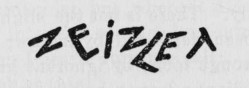
Inscription
There could be no possible doubt about this being an intentional design, but in what tongue, or what it meant was a mystery. We puzzled over it for an hour, when Torrence suggested that they might be English letters, rudely and ignorantly carved. "For instance," he said, "the first might very well be an N. The second is evidently an E; while the third is unmistakably intended for an I. Now the fourth is the same as the first. The fifth cannot well be other than an L. The sixth is the same as the second, and the last is a T." When we looked at it in this way, it seemed clear enough. Indeed what else could it be? But what the word meant, remained a mystery. Suddenly it occurred to us that it might be more than one word. "Suppose," said Torrence, "that the last five letters are intended to form the word 'Inlet'—a pronounced feature of the coast of this island—and that the first two stand for North East. There we seem to have it—North East Inlet—the stone probably refers to something of interest in, or about the North East Inlet of the island!"
Surely we had solved the problem. But when I reminded Torrence that we had been searching for traces of his alleged inhabitant, and that he should not be surprised at this discovery, he said:
"True enough; but exactly where they would be, or what they would look like, or even if this was the right island, I could not tell; but now I feel sure that I am right."
"The stone was evidently put here by some one," I remarked.
"Undoubtedly. There is not the slightest appearance of its having been deposited by nature; and the letters were cut with rough tools, by ignorant hands."
"And you believe a human being could have reached this spot without an air ship?"
"There is not one chance in a million that it could have been done," he replied; "certainly never by the course we have taken. But there are stretches of land reaching far to the north; and in certain seasons, under the most exceptional circumstances, possibly some lost scout of the Arctic seas might have drifted here, had he once pushed his way across the frozen belt. I say it is possible; but that is all. Before we leave we shall know whether it is a fact."
We lingered a few minutes while I made the copy of the inscription, and then climbed back into the air ship, bound for the North East Inlet.
Skimming slowly around the shore we soon discovered the indentation we were looking for, and following up its course for a few hundred yards above the mouth, reached another of those turfy knolls, with which the island abounded. Around this the water ran directly into the land, forming a diminutive lake a little higher up, with grassy slopes upon every side. It was a beautiful spot, entirely protected from the surf, and screened from the winds as well. Indeed, so sheltered and peaceful a nook was it, and withal so inviting, that we decided to descend and look around, having observed nothing extraordinary from above.
"If I do not discover something interesting here," said Torrence, "I shall be disappointed."
Having landed on the hillock above the lake we separated, walking in opposite directions. The ground was covered with a brilliant, mossy turf, where the black bed rock did not protrude; but where it did so, only served to enhance the intensity of color by contrast. I had not walked far when I heard Torrence call:
"Hello! Look at this!"
I hurried over to where he was. There was no doubt about it. He had made a discovery. On a grassy knoll, not far from the water's edge, was a small structure like a tomb, built of rough stones to the height of a man's breast, and about five feet in diameter. It looked old, was moss grown, and covered with a heavy cap stone. We felt convinced that in this cairn was concealed some important secret, and that it was undoubtedly the place referred to. We went immediately to work to remove the upper stone, which we found quite difficult, but by working an iron wedge which we secured from the air ship, it slowly yielded to our endeavors. The stones were closely knitted together, having been set in a rough mortar, made out of some tenacious kind of mud, but we gradually worked them loose, and one by one rolled them on the ground. In half an hour we had an opening large enough to look into. It was dark, but Torrence leaned over the edge and groped about with his hands. Presently he was tugging at something and exclaimed:
"I believe I've got it."
A minute later he pulled out an iron box by a ring in the lid. It was covered with rust, and had a keyhole but no key. We shook it gently. There was something inside, and we tried to raise the lid; but it was immovable. I proposed to pound it open if possible with some of the stones at our feet, but before doing so, we decided to examine the crevices of the cairn for a key. It was well we did, for our search was rewarded by the discovery of an old brass key, covered with green oxide. We polished it up with some sand, but before it would open the box we had to go to the air ship after a little oil to lubricate the chambers. At last we were successful, and turning back the lid looked in; but I drew back with horror at the first glance, for directly under my eyes was the rough, though strongly executed picture of a madman. It was one of those crude, intense drawings that gives the immediate impression of lifelikeness. Old and stained as the picture was, it was evident that the artist had seized upon the most salient features of his subject, and reproduced them with terrible effect. It was the simplest sketch imaginable, but the wild and painful glare of the eyes was intensified by a reddish brown scar. which ran down the middle of the forehead. Directly under this picture, which, by the by, was done upon a piece of old cloth, was this extraordinary inscription

Inscription
Examining the box again we found directly under the picture another paper which upon examination proved to be an outlandish, water-stained document. At the first glance it looked like a foreign language, which we had no doubt it was, but our attention being attracted by certain words that looked like English, we examined it more carefully, and to our amazement discovered that the paper was really in our own language, though evidently executed by such an ignorant hand as scarcely to be recognized as such. We took possession of it, and I here give a careful copy of it, without attempting to reproduce the handwriting, which is almost unintelligible.
"Tu thim az finds these roks and kontents plese rede with kare an in charty's nam help ef he bee livin the pore kretur we shipreke saylers is kompeled to leve on this lonsum plase. Us 3 abil Bodid seamen was reked in the ice from the Brig John W. Saunders, whaler, of the city of Hull. There was 13 others of us wen the ship squeeched and busted, levin us wid nothin but sum vittels and a few valybles, wich we tride to save. We bilt some sleds outen her timbers, and loded thim with sich vittels an truk as we wanted tu sav and started over the ice. God amity nos how fur or wher we traveled tu, hevin no berins no nothin tu go bi, and God amity nos the orful sufferins we suffered. All on us dide but us 3. We traveled over montans ov ice, and it seemed like we kep a travelin fur yers, tho in koors we nos it went so long as thet. Bimby we finds oursels a flotin on a chunk o ice ni az big az a farm. Our vittels was ni gone afore we struk the flotin' ice, and all was ded but us 3 Ned Merrick, Jo Niles and Jan von Broekhuysen who is uf dutch parents but English birth. We kep a flotin on the ice tel the long nite past and the day kum agin; but we sede as how Jan was doin quer and one day he went plum mad and tried to kil us. We tide him down, and then we sited this iland, tho in wut part uf the erth we kan't tel. We sede we wus flotin strate fur here and the sea was ruf but not so kold as before. We dun wut we kud fur our chums as dide but we kudent help oursels, lesen them, and so lef, thim bak on the ice tu rot. Wen we got close tu this iland the sea wus up, and our ice chunk struk a rok and busted afore we landed. Jan von Broekhuysen struk his hed agin a rok and we brung him ashore levin a bludy streke behind. His fored got split in tu and he wuz the orfulest site we ever sede—he warnt moren abut 20 yers o age and that lik he got in the hed or his goin mad wun, plum noked the reckolecshun outen him. He node uz not—nor wher he hed bin, nor wher be wuz, nor his own nam, nor nothin—nor yit kud he speke a single word. We hev heered as how a nok in the hed wud sometimes strik the memry outen man, but niver is we seed one in sich a fix afore. Jan van Broekhuysen node nuthin'. He wuz like tu one jes born—the rok wut split his hed made the terriblest lookin skar we ever seed, and we washed it out and dun the best we kud for him but waz not fix to sow it up agin. He seen us drink the water outen the spring, and he dun so 2. he seen us ketch the birds in the roks and ete um and he dun so 2, he seen us ketch the fish and he dun wut we dun. The frute here is bitter but it helps tu kepe us aliv. Now how long we has lived here we kan't tel, but we iz goin awa in a bote we bilt outen skraps o drift wood and stuff we found preferin tu resk the orful sea and ice agin than tu liv and rot on this place wher man kums not. Jan von Broekhuysen has grode afeerd o us and runs awa wenever we gos ni him and we seldum ketches a site o' him. We has lost all kont o time and don't no how long we has ben here nor wen we kum nor nothin—but ther has ben 1 dark spel and 2 lite spels, and we think it must a ben a yer sence we kum. Siknes and hardship has ni ruined us mind and body, and we don't keer wut bekomes o us. We bilds this ere rok hut around this box wich we fetched with us havin' sum o' our valybles. We makes a pikter of Jan von Broekhuysen and paints that skar on his hed wid our own blud but we douts ef eny man will ever see him agin az he is wilder and skeerier nor a gote. We haz also razed a rok in anuder place for a sine. It is with sorro that we leves our ole komrade—but we kan nether ketch nor tame him. Ef we node wut part uv tho erth we wus in we wud no wher to strik fur, but we don't, and rekon we will both be drownd afore gettin any whers. Ef eny person finds Jan be kind to him. We leves here amejetly. Jan is livin' on birds eggs, birds, and fish, and sum o them qur apples there ain't mutch else tu ete. Kind frends we saz farewel
"Yours Truly,
(Signed) { "NED MERRICK, { "JOE NILES."
The original is very difficult to read, both on account of its peculiar orthography and from its being smirched and weather-stained. We went to the air ship where I recorded this discovery, and then sealed it up in the cairn, carrying the original paper with us.
"Sailor like," observed Torrence, "there is not a date in the paper from beginning to end."
I had not thought of this before.
"He may have been here for years," I added.
"He may," Torrence replied, and then producing a paper from a large packet, asked me what I thought of the signature.
I started, for I recognized it at once. It was one of those I had seen through the keyhole in the hotel Mustapha, and the signature was the same as the one before me—Ned Merrick. I then recalled the fact that I had heard my brother address the mysterious stranger—I mean the sailor we had first met upon the Thames boat, and whom afterward I had seen at the Mustapha—as Merrick. Could it be possible that he was the same who had escaped through the ice belt to this island? I was amazed, but before I could make an inquiry Torrence continued:
"I now am certain that this island is inhabited, as I told you, unless, perchance, the man has died. I am also sure of the continents; for the man Merrick having told me the truth in this most amazing case, it is probable that he has not lied in other matters, especially as he gave me proof, and as his story coincides with my own views. Let us look for Jan von Broekhuysen, then we will proceed upon our voyage."
We made a careful search for this extraordinary individual, but not finding any traces of him, we returned to the vessel and prepared to go.
As we were clearing the coast a creature of scarcely human aspect, clad in a robe of feathers and covered to the waist with a mass of tawny gray hair, appeared to rise out of the sand. He probably emerged from the shelter of some neighboring rock, and stood for a moment looking at us in amazement. On a motion to alter our course, as if to pursue him, the creature disappeared as suddenly and strangely as he had come. He was simply invisible, and it would have been useless to waste our time in an effort to capture him. There was no doubt to our minds that this was Jan von Broekhuysen.
* * * * *
XIV.
Northward again we proceeded on our journey, and from the upper deck surveyed the solitude of an ocean unknown to human eyes. All traces of ice had vanished; the sea was tranquil and the air pleasant. Naturally enough our conversation fell upon the mysterious cairn and its contents.
"In my opinion," said Torrence, "this Jan von Broekhuysen is the most unique creation of our planet. He is the only human being of his kind since creation. I will guarantee that not in a million years has the earth produced such another!"
I asked him what he meant, and suggested the possibility of others having been lost under like circumstances, while admitting the improbability of their having reached such a latitude.
"That is not it at all!" he exclaimed; "Jan von Broekhuysen stands alone, and for this reason. Because he is the only living creature of our race who has been put alone in an uninhabited world, and who has never seen nor communicated with a fellow-creature!"
"You mean since he was twenty years old, for I believe the paper says that was his age," said I.
"No," replied Torrence, "I mean nothing of the kind. I mean that never, for a single instant, has he seen or communicated with a fellow-being until he saw us!"
"I don't understand you. Doesn't the paper say he twenty years old when wrecked?"
"Certainly. But doesn't the paper say that when he struck he lost his memory?"
"But what of that? he's sure to have seen plenty of people in the first part of his life."
"Gurt, that fellow never had any other part to his life. His life began afresh after landing on that island. His past having been wiped out, he was born again. His memory being gone, the past had no existence for him. He knew no more about a previous existence than you or I know about a life before this. Practically he was reincarnated, inasmuch as his brain had lost every picture and every record of the past. He came as a new man to a new world, knowing nothing. The first twenty years of his life was no more his than if it had belonged to another body. I claim that Von Broekhuysen is the most unique creature that ever visited our planet!"
I was impressed, and thought some time before answering. Finally I said:
"It is doubtless a remarkable case, but you must be accurate in your statements, and when you declare that the fellow has never either seen or communicated with a fellow-being since losing his memory, you must not forget his comrades, Niles and Merrick, who were with him for a year afterward; surely he must remember them."
"Not at all," said Torrence; "when those men left him he was only a year old, so to speak. He had entered his new existence but a twelvemonth before; and although he had the size and strength of a man, he was but an infant, so far as his mind was concerned, and I defy any one to recall anything which happened at that time of their lives. No one can remember what happened when he was but a year old. I have thought it all out, old boy, and Von Broekhuysen ought to belong to a museum!"
There was no gainsaying what my brother said. I wanted to ask him how Merrick had made his escape, and what had become of the other fellow, but a look warned me that an appropriate time had not come for these questions. I was impressed with the marvelous way in which Torrence had been prepared for our discovery by this extraordinary man, Merrick, who must have seen more of the mysteries of the Arctic regions than any human being alive.
We were sailing over a sea of vast extent, whose shores were mythical. Whither would it lead us? Although it was the time of year when we might reasonably expect to find moderate weather, even in high latitude, we were amazed to find the air so temperate and pleasant as it was. We sat on deck nearly all the time, when not engaged in eating or sleeping, and often without our top coats. We kept constant watch on the horizon, the water below us, and the sky above; expecting at any moment to discover the outline of some unknown continent, but as the monotony of sky and water continued we began to sympathize with Columbus.
Twenty-four hours after leaving the island, which we agreed to call Von Broekhuysen, we estimated that we could not have come less than four hundred miles, and yet there had not been the slightest indication of land, although we had not changed our course half a degree. It was the same placid, unmarked, and unknown ocean. Whither were we drifting?
It was about here that the meteorological conditions of the atmosphere began to strike me as peculiar. The northern horizon had been subjected to a singular phenomenon for a good many hours, which I ascribed to one of those effects of light so common in these latitudes. It was simply a crescent-shaped cloud, growing in height as we advanced. At first it subtended the segment of an arc of about sixty degrees across the horizon, steadily ascending toward the zenith with our progress. But gradually this form lost its definiteness, and melted into the sky in a mellow haze, which softened the light and obscured the sun. We were glad enough to have the glare off the water, as it had been quite trying, but I was at a loss to account for the phenomenon which had abolished it. If Torrence understood this he failed to explain it to me—advising me to wait and see what would happen. I mention it here as an important fact bearing upon our future discoveries. I had never before seen so peculiar a cloud, retaining a definite form for so long a time, fixed in density and character save that the arc grew as we proceeded; and I naturally puzzled myself a good deal meditating on it. But it was not until later that I ascertained the cause of this astounding phenomenon.
* * * * *
Forty-eight hours after leaving the island we were still floating over the same placid sea, and without indication of land upon any point of the horizon. We were working our way along at the rate of five and twenty knots, under perfect conditions, when a thought struck me.
"How far have we come since leaving the island?" I asked.
Torrence looked at the indicator.
"About six hundred miles," he said.
"Exactly; and as Von Broekhuysen's island is not more than two hundred and fifty from the pole, we must have passed it, and be running down on the other side of the earth. It surely can't be long before we strike the frozen belt again; indeed we ought to be there already. But there hasn't been a block of ice, or a bit of cold weather to speak of yet. How do you account for it?"
"Don't bother about the ice," said Torrence; "you ought to be glad we haven't got any."
"But we ought to have it," I insisted, "according to my calculations——"
"Damn your calculations," he answered laughing; "didn't I tell you I was going to show you a new world, and new continents!"
"Continents! I should enjoy even a shovel full of mud at present."
"Have patience; if Merrick could cross this sea in a dugout, with a cotton sheet, we surely have an equal chance of doing so; although I confess I think he must have struck a strip of land to the east or west which we have missed. But we are on a straight course and bound to come out all right if we keep on."
"You expect to run down then over Alaska?" I inquired.
"I expect nothing of the kind. Wait and you will see."
And I had to wait, for he would say nothing more just then, although I asked him numerous questions.
It was shortly after this that I observed another most singular phenomenon in the sky, which struck me with such amazement that I was filled with awe. About twenty degrees south of the zenith there appeared in the heavens an enormous disk of pale light, only distinguishable from the rest of the sky by being brighter and more of a bluish tinge. I should say it was a hundred times as large as the sun, distinctly defined, and though not brilliant by contrast with that luminary, was probably twice as luminous as the surrounding parts of the sky. There was something so utterly amazing in this sight that I could not take my eyes from it, and even Torrence was impressed, although I could see that he had a plausible explanation in his own mind. When I had stared long and earnestly without observing the slightest change in the appearance, he said:
"When you have got a little more used to things here I will talk plainer. There are mysteries about our planet not even realized; and we are on the high road to solve one of the most astounding."
The disk of light continued. It did not seem to grow larger or smaller, or to change its position in the heavens, and after I had grown weary of looking at it, directed my attention again to the horizon, and was startled by the unexpected appearance of two very singular objects. They were small and very distant, but the glass revealed a couple of dark spots four degrees to the port of our course, and hard upon the sky-line. Later a more careful observation showed a pair of black columns rising directly out of the sea. These objects, whatever they were, now absorbed our entire attention, and we steered directly for them.
* * * * *
Our compass had behaved so strangely of late that we depended in a measure upon the triangulation of the rudder, which we knew was inviolable in a still atmosphere, such as had favored us since leaving Spitzbergen. This feature of our steering apparatus was really very clever, and entirely original with my brother, who had devised it for the special purpose of obviating the difficulties mariners often encounter in Arctic waters from the extreme sensitiveness and uncertain freaks of the magnetic needle. It consisted in a semi-circular dial, accurately inscribed with degrees, minutes, and seconds, upon which an indicator, connected with the rudder bar, acted. Thus any deviation from a given course was accurately recorded by this index finger, and while unaffected by air currents, was thoroughly reliable. Another great advantage in determining our position, lay in the fact that we were enabled by the aid of our speed register to know exactly how fast we were traveling. Of course in a high wind it would be more difficult to utilize these contrivances with accuracy, as another computation that of estimating the velocity and direction of the air current would have to be entered upon a condition which fortunately had not troubled us.
We continued, head on, for the points mentioned, the nature of which, we were unable to decipher, even with the excellent glasses at our command. Although running at a good rate, it was impossible to tell at the end of half an hour whether these dark projections were any nearer than when we had first seen them. The air was clear, and the field of vision extended. The light appeared to differ from that of our own day, being less intense and exceedingly restful and pleasant to the eyes. I can compare it to nothing I know of, although in an inaccurate way it might be said to resemble, on an exaggerated scale, that charming blending of moonlight with the gloaming. It was here that I first noticed what seemed to be an electrical condition of the atmosphere that filled me with the most agreeable sensations. I felt lighter, stronger, in every way healthier, and in better spirits. Torrence also spoke of this, and I am sure that I am right in ascribing it to our environment. The sun itself continued invisible, while the luminous disk referred to remained unchanged. We were indeed entering an unknown world. Where would it end?
After an hour's run we could just perceive that the dark columns ahead were a trifle nearer, though still thoroughly indefinite as to character. Torrence looked at the register. Twenty-five miles an hour.
"They are still at a great distance," he said, "and I propose to hasten my acquaintance with them."
He moved up the speed controller five miles faster, and then we took seats and lighted cigars.
"Why should we not push her up to a mile a minute," I suggested, "and satisfy our curiosity so much the sooner?"
"I don't know," he answered, "there is no reason except a strange apprehension that comes over me sometimes lest we have an accident. We seem so far from all we know."
"I thought you had every confidence."
"So I have. The truth is I am excited. We are on the verge of an astounding discovery, I am dead sure that Merrick is right, and that I am right—but hush—do not ask me yet. I do not want to unnerve you. A little later!"
"You unnerve me a great deal more by not telling me than by telling me. What is it?"
But he was quiet; with his glasses trained carefully on the objects ahead.
At the end of two hours more we appeared only a trifle nearer the columns, although we were undoubtedly seventy miles closer than when first sighted. Torrence was growing nervous. He walked the deck, chewing his cigar. Presently he stopped, and said:
"I can't stand it. I'm going to give her five miles an hour more," and moved up the controller accordingly.
We were now moving at the rate of five and thirty miles an hour, but even at this rapid pace, it was three good hours before we could decide with any certainty the nature of the columns; and then we saw that they were twin mountains of extraordinary height, rising out of the sea. In another hour they were much more distinct, though still very far, and I was at a loss to account for our having seen them at so great a distance at first, except upon the ground of the many singular effects of light and atmosphere which we encountered. Among these was a strange indefiniteness about the horizon, totally differing from the prevailing conditions in other parts of the world. The sky-line blended with the heavens in a kind of atmospheric veil, self-luminous, and illusive. The effect was altogether pleasing, though entirely novel. Occasionally the clouds would be rosy as after sunset, which I again attributed to some electrical condition of the air, possibly the aurora, which, had it been the Arctic night instead of day, I imagined would have made a wonderful display. But this was purely hypothetical on my part, and when I suggested it to Torrence, he looked at me with surprise and said:
"Night! There is no night here!"
"Not now," I replied; "but six months hence there will be."
"Never!" said he; "there is never any night here. It is always as light as this!"
I saw from his mood that it would be useless to argue, and so continued my investigation of the twin mountains, which had grown near enough to be easily inspected with the naked eye. Torrence calculated that they must, have been more than two hundred miles away when first seen.
When we had approached near enough to observe them in detail, we slackened speed. Rising directly out of the ocean, they presented a marvelous picture; for their stupendous height and rugged grandeur is surely not equalled in the world we inhabit. We moved slowly toward them, wishing to take in the scene from our deck to the best advantage. We photographed them at different ranges, and were always surprised to find that our last picture had been so remote. We moved more slowly as we approached, finally reducing the rate to five miles an hour, believing we were within half an hour's run of the shore, but were undoubtedly ten or a dozen miles away at that time.
A stupendous wall of black granite rose before us, to a height which we estimated to exceed twelve thousand feet. This was the mountain upon the left; the one on the right was nearly as high, though not so absolutely precipitous. Between these mountains was a channel about a mile wide. Coming to a halt before these appalling objects, two hundred and fifty feet above the sea, we stood on deck, overwhelmed at the awful sight. Below stretched a crimson beach, running back to a chaotic sand hill, strewn with huge masses of broken stone, from the top of which towered in one unbroken wall the palisade or face of the mountain itself.
Lowering ourselves gently to this beach we landed in a new world and language cannot picture the appalling sublimity of the scene, or describe our emotions.
"Surely these cliffs must mark the end of the earth!" I exclaimed.
"Hush!" said Torrence solemnly; "it is only the beginning!"
He was pale, and I could not help wondering if my face were as white as his.
Craning my neck backward I looked up. A cloud had hidden the top, and I felt dizzy.
* * * * *
XV.
Immediately on landing we made another careful examination of the air ship, and to our intense satisfaction found that she was still in perfect condition. We had come a long journey, and thoroughly tested her powers in varied temperatures and atmospheric conditions, but the distance was as nothing to what was to come.
As we stood on this brilliant beach and looked back at the southern sky I observed that the disk of blue light was a little smaller, and a very little higher in the heavens. Still there was no sun, but this great circular shield was a focus for the dissemination of light upon every side. I stood marveling at it until Torrence called me. He was examining the crimson shells a little higher up the shore.
"Come," he said, "and look at these!"
I walked over to where he was.
The shore was literally covered with pink mollusks, a large percentage of which contained true pearls of extraordinary size and beauty. Torrence was pounding them open with a couple of stones.
"Within a hundred yards of this spot," he said, "lies a fortune greater than the combined wealth of the Rothschilds. In the pearl fisheries of the old world not one shell in a thousand contains a pearl of any value. But here, in these strangely colored mollusks, ninety per cent. enclose gems of extraordinary merit."
He held one up for my inspection.
"Here," he said, "is one which I have opened at random. It is of the first water; of perfect skin and orient; the most delicate texture, and without speck or flaw, and is worth at the lowest estimate one hundred pounds. Without going a dozen steps we can find ten times that value. Some of these pearls are pink, and from what I have seen and heard of them, I do not think they will ever fade——"
"From what you have heard?" I interrupted; "what do you mean?"
"My dear fellow, the shores of this continent are strewn with these shells for hundreds of miles at a stretch, as its mountains are filled with gold and diamonds. Do you not know that Merrick had the value of millions in them. It was from him that I heard of them, and from him that I bought millions of pounds worth."
"Bought!" I exclaimed in astonishment.
"Yes, bought!"
"And with what pray?"
"With a promise," said Torrence "Money was of no use to him, but fame he valued. As you know, he and Niles escaped from Von Broekhuysen Island. Niles was lost, while Merrick alone reached the world we are now in. How he got there, or what his adventures are, it is not necessary to relate; but he did it, and I now know that he found land much nearer the island than we have—but that is unimportant. How he reached his home again is even still more wonderful, and a volume might be written about the man's terrible sufferings and adventures; but his life was embittered by the incredulity, the cold skepticism, and indifference with which he was greeted on every hand, by those who were too bigoted and ignorant to heed his story, or even investigate the proofs of the new world, which he brought with him. The geographical societies of a dozen cities either listened to him as they would to the ravings of a madman, or turned a deaf ear with scorn. And this treatment he received wherever he went, and at the hands of organizations termed scientific, whose plain duty was to listen to the words and test the affidavits of the applicant. But the nature of Merrick's claims was so astounding that no one, high or low, would heed him, and yet he only discovered that which I have always believed in. I, alone, of all the world, gave the fellow proper audience. I saw at once his claim to credence. I promised what he demanded in exchange for his wealth—notoriety. He saw that with the air ship I should be able to prove all that he had ever said, and that I could make his name great among coming generations. He saw that I could upset the position of the wiseacres who had refused to hear him, and make them the butt of their fellows. All this I promised to do, if able, and in exchange for that promise he gave me the few millions in pearls, diamonds, and other precious stones he had brought with him as proofs of his discovery. Gurthrie, have you not yet guessed the nature of that discovery?"
"I should hope so," I answered.
"And what is it?"
"That the North Pole has a continent around it which is blessed with a temperate climate."
"And is that all?"
"That the sky has a luminous disk as big as a cart wheel, that takes the place of the sun!"
"Nothing more?"
"That the electrical condition of the atmosphere is highly beneficial to the nerves."
"Go on!" said Torrence impatiently.
"That pearls and precious stones are as common as dirt!"
"Tell me what else he discovered," exclaimed Torrence, "and be quick about it!"
"Not being Mr. Merrick, I'm sure I don't know," I answered.
"Don't know!" roared Torrence, "do you mean to tell me that you don't know where you are?"
"Somewhere about the role I suppose. I might say ninety degrees north."
My brother looked at me with a singular expression of pity, and then stooping down resumed his work of opening shells with an indifference that exasperated me.
"Where in Heaven's name are we then?" I shouted.
"No matter just now," he answered. "I thought perhaps you would have guessed. I don't want to shock you. Perhaps the truth will dawn on you later; if not I will tell you. Meanwhile, let us gather a few bushels of these pearls. They are of no value here, but they will be if we ever go home again."
And so we set to work under the shadow of those awful cliffs, and in a couple of hours had secured unestimated value in the most perfect specimens conceivable. We packed these away in the air ship in a small sack, and then Torrence proposed that we name the stupendous headland before us "Mount Horror."
I agreed that it would be an excellent name, well adapted to our feelings on approaching it, and descriptive of the gloom and phenomenal aspect of the mountain itself. The one on the opposite side of the channel he suggested we call "Mount Gurthrie," to which I also assented, and entered the names in our chart of discoveries.
It was upon this desolate shore that we cooked our first ration of bear meat, brought all the way from Spitzbergen.
Climbing into the hill beyond the beach among the sand and rocks, we found a quantity of dried seaweed, which we carried down to the shore for a fire. It burned with a crackling noise and pungent smell, so pleasant that we decided to carry some of it away with us, filling some bags, and throwing them on board before leaving. We had quite a picnic over our bear steak and coffee, although it was impossible to divest ourselves of a certain gloom, resulting from the lowering heights above. The air was still, and only the tiniest ripple of a surf came rolling in upon our rosy beach, and the stillness, the cessation of motion, and our extraordinary situation, made me for the first time long for home.
A bird of an unknown species came flying toward us from over the water. Its plumage was brilliant with trailing feathers of red, green, and yellow; while upon its head was a topknot of the same colors. Torrence thought he should like to have it and so fetched his gun. The bird circled above, full of curiosity. Perhaps we were the first human beings it had ever seen. Descending spirally it came at last within easy range, but we had not the heart to kill it. Then, apparently satisfied with its investigation, commenced an upward course, circling away again, just as it had come; only this time aiming its spirals toward the top of the cliff, until lost to view. Torrence then discharged the gun in the air to hear the reverberation from the rocks. The sound was impressive, coming back to us like thunder from the heights. It was probably the first time a gun had ever been discharged in this desolate quarter of the globe, and I was glad it was not in the destruction of life.
When the smoke had cleared away and the echoes ceased, we were attracted by a whirring sound above, and looking up saw thousands of pigeons which our shot had frightened from their nests. We watched them while they skurried about in dismay, until, finding that no harm had been done, they settled back among the rocks again.
* * * * *
We had made a hearty meal and were beginning to think of going when Torrence suggested that we ascend the face of Mount Horror in the air ship instead of taking our way up the channel, or following the precipitous and rugged shore line for another exit. I reminded him that it would probably be cold at such an elevation, but agreed that it would afford a magnificent view of the country. Besides, we wanted to inspect the crater, feeling sure the mountain was an extinct volcano, and so determined to ascend to the highest elevation first, and then continue our journey northward over the country beyond, or through the channel which offered a clear passage in the direction of our course. This chasm through which the river ran was sublime and terrible. A rent in that stupendous rock formation which seemed to dwarf and threaten the very foundations of the earth on which it rested. We could but regard it with feelings of awe. An overpowering desire to escape its depressing influence possessed us.
Safely aboard the air ship we began ascending the wall as if passengers in a huge elevator, which in fact we were. Again the birds flew out, terrified at our approach, some falling dead from sheer fright, a few of which we secured on deck. Hugging this terrible escarpment we were enabled to examine its formation with accuracy. Large blocks of syenitic granite hung loose, ready to drop at any minute and we saw how for ages the cliff had been slowly disintegrating, and receding from the sea by action of storm and catyclism. Lightning had also played its part, and its handwriting was visible on every side. Ledges large enough to hold a house were loaded with nests and eggs of every color and size. We consulted about the feasibility of capturing some of these, by halting and climbing out after them, but concluded to let them go, as the danger was too great. It involved not only the risk in scrambling from the vessel to the ledge, but the additional chance of being smashed by a falling rock from above. Of course in our ascent we were careful to keep far enough away to obviate that possibility.
When we had risen clear above Mount Horror we looked down into the fearful chasm that separated us from Mount Gurthrie. It was a sight never to be forgotten. To the south lay the unspotted ocean; but to the north the land sloped away rapidly, and beyond the highest elevations which, in themselves, were mountains of no mean height, but so far below as to seem trivial; beyond these, I say as far as the eye could reach, extended a beautiful country, with rivers, valleys, lakes and hills, with forest, plain, and mountain. The panorama was entrancing, and the effect on us profound.
Hovering over the crater, which we found just as we expected, we looked down into a black abyss, so vast and awful, that we had no inclination to investigate it, although it was large enough for us to have descended bodily with the air ship. There was no smoke, nor were any sulphurous fumes emitted. Evidently the volcano had been extinct for ages; and we passed rapidly on upon our north bound course, glad enough to have dry land under us once again, and to descend to a lower and warmer level. We were soon down among the foothills, and traversing a well timbered country, rising from time to time to clear the elevations encountered. The panorama that now stretched away before us was one of ravishing beauty, and we took our places on deck with lighted cigars to enjoy it. I suggested that we name the new land "Torrenzia," but Torrence only declared that while people might call it what they pleased, the credit of the new world must go to the man who had first seen it.
"You seem to think there is only one scrap of a continent here," he said, "and Torrenzia may do well enough for one; but remember it is a new world we have entered; and if I am not greatly mistaken we shall find it studded with civilizations equal to any we know. Certainly you are dense, Gurthrie, and stupid to a degree, not to have guessed by this time where we are!"
I did not answer; in fact I was provoked that he should be so secretive with the information he possessed. I confessed to my bewilderment at what we saw but was still in the dark as to the truth.
We now ran rapidly forward over a picturesque country, and through an atmosphere not only temperate but exhilarating. About a hundred miles inland the timber and water courses were less prolific, and fifty miles farther we merged upon a great, treeless plain, covered with short tussocky grass, sand, and rocks. At intervals were to be seen the bones of animals bleaching where they had fallen, the entire skeletons being generally intact. More than once we descended to the ground to examine them, but could not decide whether they were buffalo or some other creature. What surprised us most was the fact that there appeared to be no living ones. But we did not waste our time upon this arid plain, fearing to run short of water, and being particularly anxious to discover if our new world was inhabited. As we sat on deck smoking our cigars, rushing into the gentle breeze ahead, we felt like monarchs, or rather god-like creatures, who owned and ruled a world from above.
We had little time for sleep, our excitement being intense, and the short intervals we spared for an occasional nap, were taken alternately, the one remaining on deck promising the other to wake him as soon as anything of special interest occurred. I had just come above after one of these short siestas and joining my brother observed him looking with unusual interest through the glass at something below.
"What is it now?" I called, leaning over the rail.
At a glance I saw that the nature of the country had changed. No more skeletons; no more sand and rocks, or arid desert, but a great sheet of water lay to our right, while below and beyond were trees and fields, which looked as if they were cultivated; and here and there, at intervals of a mile or two, were undoubtedly the walls of human habitations. I do not say they were houses, for houses have roofs, whereas these edifices were roofless.
"I am sure I have discovered houses," said Torrence; "and I am trying to see if there are any people!"
I took the glass from his hand.
"There is no doubt about it," I exclaimed; "and what is more, they do not appear to be ruins, but houses in perfect repair, judging from their similarity and the condition of the grounds around them. But what kind of climate must these people enjoy to require no roofs? Certainly it can never rain!"
"Nor snow!" he added with a smile.
"What made you think of snow?"
"I thought, perhaps, you were thinking of it," he replied.
"Why?"
"Because you said it was high time we were in the ice belt again!"
I started.
"And how far have we come?" I asked.
"From where?"
He looked carefully at his register and made a calculation. He then said:
"We are now one thousand three hundred and eighty miles from Von Broekhuysen's Island, and about one thousand one hundred and thirty miles north of the North Pole—if you can imagine such a thing—I mean that we have advanced upon a straight line for this distance; and as you see, we have met neither ice, snow, nor cold weather yet!"
I looked above. The great disk of light was still bright in the heavens; I thought a little nearer the zenith than before. Unless there had been some gross miscalculation in our speed we had got to face a physical problem of the most stupendous nature. A problem so appalling that I began to dread the explanation as much as I had recently sought it.
"Yes," I answered in a weak voice, "there is certainly neither ice nor snow here!"
"Nor cold!" added Torrence.
"Nor cold!" I admitted.
"Nor undue heat!" he continued.
"Certainly not. The temperature has been perfect."
"And the air has a vitality unknown to us in the old world," he pursued.
"I grant every word you say. This may be a dream, but it is a paradise!"
"It is not a dream!" cried Torrence; "it is another world; a world within our own. Yonder disk of light in the sky is the opening at the pole through which we have sailed. The earth is a hollow globe, with an opening at each pole, through which the sunlight always enters. For six months it comes through the northern opening, and for six months through the southern. But the change is gradual. With the advent of the southern day, the disk is in the south, fading imperceptibly as the northern light supplants it, and vice versa. The great aurora borealis which illumines the Arctic regions of our world is simply the sunlight pouring through from the southern hemisphere, or the light which enters the earth at the South Pole, discharging itself at the north. For ages our world was believed to be flat; but time and study proved the fallacy. In the days of Hipparchus and Ptolemy, and for centuries after it was believed that the sun revolved around the earth; what a stupendous change in man's knowledge when the opposite was found to be the case. From the days of Columbus to our own—with a few notable exceptions—the world was supposed to be filled with amass of molten material; but within recent years facts observed in the boiling of water have compelled men to abandon that theory and substitute that of a world solid to the core. One by one the theories which have stood on the bed rock of science and been held as irrefutable by the wisdom of the age, have crumbled to pieces, and been supplanted by others; and now the faith in a solid earth is to be shattered, for you and I know that it is hollow—light and inhabited. But let us see what small beginnings led to the change in men's views in the past, and observe how similar they are to those operating now——"
"What!" I interrupted, "do you mean to say that we have sailed through an opening at the pole, and are now in the interior of the earth?"
"That is exactly it," answered Torrence.
"I can't comprehend such a thing. What is the diameter of this opening; and where is the North Pole?"
"The North Pole has no existence except as an imaginary point in space, at least five hundred miles from the surface of the earth. The openings at the so-called poles are more than a thousand miles in diameter, admitting the light of the sun and holding it with a denser and more highly electrified atmosphere than our own, making perpetual daylight, for, as I have told you, when the sun crosses the line, its light is derived through the opening at the opposite pole. The frozen belt surrounding each of these openings mark the regions of the verge, and the distance across this ring is about fifteen hundred miles.
"But the polar regions are declared to be slightly flattened."
"That is because men have penetrated far enough into the verge to mark the change in the earth's convexity, but not far enough to perceive that they had actually begun to enter the sphere itself. But I am coming to that presently. I wish to show you why certain men, in advance of their time, have believed that the earth was a hollow globe, luminous and desirable for man's abode, as we now know it to be; and how, as in some of the greatest discoveries of the past these views have been based on the study of facts as we find them, and not upon theories, which distort facts to maintain themselves. About the year 1470, a Portuguese sailor by the name of Vicente found a piece of curiously carved wood more than a thousand miles to the west of Algarve, a province of southern Portugal. This relic was discovered after a westerly gale of long duration. It set the fellow thinking. It also set Christopher Columbus thinking. Another mariner, by the name of Correa had observed certain flotsam and jetsam under similar circumstances, and was impressed by the fact. Then there was the belief in the mysterious islands of St. Brandam; and nearly 8 thousand miles west of the Canaries was supposed to be the lost island of the Seven Cities, upon which theme you remember Irving's charming story, 'The Adalantado of the Seven Cities.' These and a few other facts led Columbus to stake his life and fortune in sailing into the unknown West for the new world. I now want to show you some of the reasons for believing in a hollow, habitable globe, and to ask if they are not equally as strong as those which guided Columbus."
I was astounded, dazed, and stood trembling by the taffrail, while Torrence proceeded.
XVI.
* * * * *
"Do not be appalled by our discovery," he continued; "it is as simple and natural as that which proved the earth a sphere, when the wisdom of the ages had declared it flat. The old arguments against its rotundity were quite as potent as any ever brought to refute the theory of a hollow globe, first advanced by Captain Symmes. How could the earth be round? Would not all the water run off on the underside? The thing was absurd. 'How could the world be hollow and habitable? Would not the inside be dark? and would not the water drop from the upper to the lower half?' Why does not the moon drop? The land and water above us are so distant, and so screened by the atmosphere as to be invisible even if we were thousands of miles above our present position. The center of gravity lies somewhere within the crust, which is probably nowhere more than a hundred miles thick.
"The inner world is better in every way than the outer. The climate is more uniform and temperate. The electrical conditions of the atmosphere more conducive to longevity and health, and the struggle for existence far less than with us. Here are some of the arguments in favor of a hollow globe, which the so-called wise men have ignored. The uniform migration of herrings to the south. Whence come they, if not from the interior of the earth, for they are never known to return? The assumption is that in search of their food supplies they constantly advance against an opposing current, which takes them through the earth, from pole to pole.
"Arctic explorers have observed in the long night of the polar regions that the north star rises to the zenith at a certain latitude, and then declines over the stern of their vessels as they advance further northward, which is directly in contradiction to what it should do, had they not already reached the verge and begun to pass inward toward the interior. This in itself should be a convincing fact. The Aurora Borealis has never been explained satisfactorily, but you and I know its meaning. Strange plants and birds unknown to our world have from time to time been found upon our most northern shores. As I have already told you, the reindeer of Spitzbergen are marked by the hand of man, but what man no one knows, as the island is uninhabited, and as they could not have come from the south, they must have crossed the ice from some undiscovered country to the north.
"Almost all of the civilized nations have from time to time expended large sums of money in determining the figure of the earth. Arcs of the meridian have been measured again and again; and observations of the pendulum, as well as weight experiments, have been made to determine the force of terrestrial gravity in different localities. The result of these experiments has been to prove that the bulk of the earth, as determined by gravity, differs greatly from the result reached by measurement. This discrepancy has never been satisfactorily accounted for, nor can it ever be, with the present view of the earth's interior, but with Symmes' theory of a hollow globe, as we know it, could be easily explained. But I am coming to still more extraordinary data.
"In the early part of this century two human corpses were found incased in on iceberg, which had presumably floated down from the eastern coast of Greenland. The bodies were perfectly preserved, and clothed in garments entirely different, both in design and material, from those worn by the Esquimaux, or any known race of people. Beyond this, neither the form, shape of skull, or color of skin resembled that of any nationality with which we are familiar. Their discovery created quite a sensation at the time, but as no clew was ever established to their identity, the circumstance was gradually forgotten. Might not these men have been daring explorers, dwellers of the inner earth, and wandering beyond the possibility of return, been lost in the ice and so preserved, perhaps, for centuries?
"About twenty years ago, one Niack Dolê, a Norwegian whaler, discovered in a block of field ice, after a northerly gale of many days' duration, an extraordinary animal, differing from any which he or any of his companions had ever seen before. The little creature was carried home at the end of the voyage, and although thousands of men of experience, and travelers from many parts of the world, saw and examined it, it was impossible to class it with any known species.
"In the year 1855 four wild men were found by some sailors on the ice to the north of Cape Tchelyieskin, in the Tamyr Peninsula, Siberia. They could give no account of themselves, as no one could understand their language. They were cared for, and visited by many people and afterward sent to St. Petersburg where strangers from all parts of the world saw them; but not a single individual was ever able to communicate with them except through the language of signs. They all died within two years of their discovery, and the only established fact concerning them seemed to be that they came from somewhere across the frozen sea to the north, where they had always lived. In appearance these men were unlike any we know. They understood each other perfectly, had a racial resemblance, were fairly intelligent, and would doubtless have mastered the language spoken around them had they lived long enough.
"You may say that this is all very well to show that there is an unknown continent somewhere about the pole, but that it has no bearing on the hollow globe. But the arguments in favor of that I have already shown you from an astronomical, geographical, meteorological and scientific point of view, and yet there is one more I wish to present, which in my opinion is profound and unanswerable.
"In the transit of Venus observations are taken at various points upon the earth's surface. The path which Venus describes across the disk of the sun varies with the position of the observer, so also does the angle of her axis vary with that position. The projection of Venus against the sun occurs when she is at her inferior conjunction, and approaching either node. The node is one of the points where the orbit of a planet intercepts the ecliptic, or the orbit of its primary. In this condition the body of Venus will appear as a dark spot crossing the disk of the sun. Now, in the last transit of Venus, two gentlemen of great ability—Herr Von Pultzner, and an American by the name of Breslyne observed it from a point quite remote from all others. I will give you the exact locality of their observation later, and the reason of their choosing it. I am not going to bother you with scientific terms, but will merely say that when the dark body of Venus was interposed between the earth and the sun, an extraordinary phenomenon presented itself to these men—a phenomenon entirely different from that seen by any other observer. In the center of the planet was a brilliant point of light, around which the opaque substance of the star was visible. Von Pultzner and Breslyne examined this light carefully, and identified it with sunlight. To be concise, they perceived that they were looking directly through Venus at the sun. There was no disputing the fact—the light was analyzed and proved identical with sunlight, the same as that beyond the dark circumference of the planet. These men—both of whom I know to be intelligent and truthful—looked at each other in amazement.