Part 1 — Commentaries On The Seven Stanzas And Their Terms, According To Their Numeration, In Stanzas And Shlokas. (continued 3)
Reading edition
The idea may be traced in the Zoroastrian caves, in the rock-cut temples of India, and in all the sacred square buildings of antiquity that have survived to this day. This is shown definitely by Layard, who finds the four cardinal points, and the four primitive elements, in the religion of every country, under the shape of square obelisks, the four sides of the pyramids, etc., etc. Of these elements and their points the Four Mahârâjahs were the regents and directors.
If the student would know more of them, he has but to compare the Vision of Ezekiel (ch. i.) with what is known of Chinese Buddhism, even in its exoteric teachings, and examine the outward shape of these “Great Kings of the Devas.” In the opinion of the Rev. Joseph Edkins, “they preside each over one of the four continents into which the Hindûs divide the world.... Each leads an army of spiritual beings to protect mankind and Buddhism.”229 With the exception of favouritism towards Buddhism, the four Celestial Beings are precisely this. The Hindûs, however, happen to divide the world into seven continents, exoterically as well as esoterically; and their four Cosmic Devas are eight, presiding over the eight points of the compass and not over the continents.
The “Four” are the protectors of mankind and also the agents of Karma on Earth, whereas the Lipika are concerned with Humanity's hereafter. At the same time they are the four living creatures, “who have the likeness of a man,” of Ezekiel's vision, called by the translators of the Bible, “Cherubim,” “Seraphim,” etc.; by the Occultists, “Winged Globes,” “Fiery Wheels”; and in the Hindû Pantheon, by a number of different names. All these Gandharvas, the “Sweet Songsters,” the Asuras, Kinnaras, and Nâgas, are the allegorical descriptions of the Four Mahârâjahs. The Seraphim are the fiery Serpents of Heaven which we find in a passage, describing Mount Meru as “the exalted mass of glory, the venerable haunt of gods and heavenly choristers ... not to be reached by sinful men ... because guarded by Serpents.” They are called the Avengers, and the “Winged Wheels.”
Their mission and character being explained, let us see what the Christian bible-interpreters say of the Cherubim. “The word signifies [pg 152] in Hebrew, fulness of knowledge; these angels are so called from their exquisite Knowledge, and were therefore used for the punishment of men who affected divine Knowledge.” (Interpreted by Cruden in his Concordance, from Genesis iii. 24.) Very well; and vague as the information is, it shows that the Cherub placed at the gate of the Garden of Eden, after the “Fall,” suggested to the venerable interpreters the idea of punishment connected with forbidden Science or divine Knowledge—one that generally leads to another “Fall,” that of the gods or “God,” in man's estimation. But as the good old Cruden knew nought of Karma, he may be forgiven. Yet the allegory is suggestive. From Meru, the abode of gods, to Eden, the distance is very small, and from the Hindû Serpents to the Ophite Cherubim, the third out of the seven of which was the Dragon, the separation is still smaller, for both watched the entrance to the realm of Secret Knowledge. Ezekiel, moreover, plainly describes the four Cosmic Angels:
I looked, and, behold, a whirlwind, ... a ... cloud and a fire infolding it ... also out of the midst thereof came the likeness of four living creatures ... they had the likeness of a man. And every one had four faces and ... four wings ... the face of a man,230 and the face of a lion ... the face of an ox, and ... the face of an eagle.... Now as I beheld the living creatures, behold one wheel upon the Earth ... with his four faces ... as it were a wheel in the middle of a wheel ... for the spirit of the living creature was in the wheel.231
There are three chief Groups of Builders, and as many of the Planetary Spirits and the Lipika, each Group being again divided into seven sub-groups. It is impossible, even in such a large work as this, to enter into a minute examination of even the three principal Groups, as it would demand an extra volume. The Builders are the representatives of the first “Mind-Born” Entities, therefore of the primeval Rishi-Prajâpati; also of the Seven great Gods of Egypt, of which Osiris is the chief; of the Seven Amshaspends of the Zoroastrians, with Ormazd at their head; of the “Seven Spirits of the Face”; of the Seven Sephiroth separated from the first Triad, etc., etc.232 They build, [pg 153] or rather rebuild, every “System” after the “Night.” The Second Group of the Builders is the Architect of our Planetary Chain exclusively; and the Third, the Progenitor of our Humanity—the macrocosmic prototype of the microcosm.
The Planetary Spirits are the informing spirits of the Stars in general, and of the Planets especially. They rule the destinies of men who are all born under one or other of their constellations; the Second and Third Groups pertaining to other systems have the same functions, and all rule various departments in Nature. In the Hindû exoteric Pantheon they are the guardian deities who preside over the eight points of the compass—the four cardinal and the four intermediate points—and are called Lokapâlas, “Supporters or Guardians of the World” (in our visible Cosmos), of which Indra (East), Yama (South), Varuna (West), and Kuvera (North) are the chief; their elephants and spouses pertaining of course to fancy and afterthought, though all of them have an Occult significance.
The Lipika, a description of whom is given in Commentary 6 of Stanza IV, are the Spirits of the Universe, whereas the Builders are only our own planetary deities. The former belong to the most Occult portion of cosmogenesis, which cannot be given here. Whether the Adepts—even the highest—know this angelic order in the completeness of its triple degrees, or only the lower one connected with the records of our world, is something which the writer is unprepared to say, and she would rather incline to the latter supposition. Of its highest grade one thing only is taught: the Lipika are connected with Karma—being its direct Recorders. The Symbol for Sacred and Secret Knowledge in antiquity was universally a Tree, by which a Scripture or a Record was also meant. Hence the word Lipika, the Writers or Scribes; the Dragons, symbols of Wisdom, who guard the Trees of Knowledge; the “golden” Apple-Tree of the Hesperides; the “Luxuriant Trees” and vegetation of Mount Meru, guarded by Serpents. Juno's giving Jupiter, on her marriage, a Tree with golden fruit, is another form of Eve offering Adam the apple from the Tree of Knowledge.
6. The Lipika circumscribe the Triangle, the First One,233 the Cube, the Second One, and the Pentacle within the Egg234 (a).
[pg 154]
It is the Ring called “Pass Not” for those who descend and ascend;235 who during the Kalpa are progressing towards the Great Day “Be With Us” (b).... Thus were formed the Arûpa and the Rûpa:236 from One Light, Seven Lights; from each of the Seven, seven times Seven Lights. The Wheels watch the Ring....
The Stanza proceeds with a minute classification of the Orders of the Angelic Hierarchy. From the Group of Four and Seven emanates the Mind-Born Groups of Ten, of Twelve, of Twenty-one, etc., all these divided again into sub-groups of Heptads, Enneads, Dodecads, and so on, until the mind is lost in this endless enumeration of celestial Hosts and Beings, each having its distinct task in the ruling of the visible Cosmos during its existence.
(a) The Esoteric meaning of the first sentence of the Shloka is, that those who have been called Lipikas, the Recorders of the Karmic Ledger, make an impassible barrier between the personal Ego and the impersonal Self, the Noumenon and Parent-Source of the former. Hence the allegory. They circumscribe the manifested world of matter within the Ring “Pass Not.” This world is the objective symbol of the One divided into the Many, on the planes of Illusion, of Adi (the “First”) or of Eka (the “One”); and this One is the collective aggregate, or totality, of the principal Creators or Architects of this visible Universe. In Hebrew Occultism their name is both Achath, feminine, “One,” and Achad, “One” again, but masculine. The Monotheists have taken, and are still taking, advantage of the profound esotericism of the Kabalah, to apply the name by which the One Supreme Essence is known, to its manifestation, the Sephiroth-Elohim, and call it Jehovah. But this is quite arbitrary and against all reason and logic, as the term Elohim is a plural noun, identical with the plural word Chiim, often compounded with it. The sentence in the Sepher Yetzirah and elsewhere, “Achath-Ruach-Elohim-Chiim,” denotes the Elohim as androgynous at best, the feminine element almost predominating, as it would read: “One is She the Spirit of the Elohim of Life.” As said, Achath (or Echath) is feminine, and Achad (or Echad) masculine, both meaning One.
Moreover, in Occult metaphysics, there are, properly speaking, two “Ones”—the One on the unreachable plane of Absoluteness and Infinity, [pg 155] on which no speculation is possible; and the second One on the plane of Emanations. The former can neither emanate nor be divided, as it is eternal, absolute, and immutable; but the second, being, so to speak, the reflection of the first One (for it is the Logos, or Îshvara, in the Universe of Illusion), can do so. It emanates from itself—as the upper Sephirothal Triad emanates the lower seven Sephiroth—the seven Rays or Dhyân Chohans; in other words, the Homogeneous becomes the Heterogeneous, the Protyle differentiates into the Elements. But these, unless they return into their primal Element, can never cross beyond the Laya, or zero-point. This metaphysical tenet can hardly be better described than in T. Subba Row's Bhagavadgîtâ Lectures:
Mûlaprakriti [the veil of Parabrahman] acts as the one energy through the Logos [or Îshvara]. Now Parabrahman ... is the one essence from which starts into existence a centre of energy, which I shall for the present call the Logos.... It is called the Verbum ... by the Christians, and it is the divine Christos who is eternal in the bosom of his Father. It is called Avalokiteshvara by the Buddhists.... In almost every doctrine, they have formulated the existence of a centre of spiritual energy which is unborn and eternal, and which exists in the bosom of Parabrahman at the time of Pralaya, and starts as a centre of conscious energy at the time of cosmic activity....237
For, as the lecturer premised by saying, Parabrahman is not this or that, it is not even consciousness, as it cannot be related to matter or anything conditioned. It is not Ego nor is it Non-Ego, nor even Âtmâ, but verily the one source of all manifestations and modes of existence.
Thus in the allegory, the Lipika separate the world (or plane) of pure Spirit from that of Matter. Those who “descend and ascend”—the incarnating Monads, and men striving towards purification and “ascending,” but still not having quite reached the goal—may cross the Circle of “Pass Not,” only on the Day “Be With Us”; that day when man, freeing himself from the trammels of ignorance, and recognizing fully the non-separateness of the Ego within his Personality—erroneously regarded as his own—from the Universal Ego (Anima Supra-Mundi), merges thereby into the One Essence, to become not only one with “Us,” the manifested universal Lives which are one Life, but that very Life itself.
Astronomically, the Ring “Pass Not” that the Lipika trace round “the Triangle, the First One, the Cube, the Second One, and the Pentacle,” to [pg 156] circumscribe these figures, is thus again shown to contain the symbols of 31415, or the coëfficient constantly used in mathematical tables, the value π (pi), the geometrical figures standing here for numerical figures. According to the general philosophical teachings, this Ring is beyond the region of what are called nebulæ in astronomy. But this is as erroneous a conception as that of the topography and descriptions, given in Purânic and other exoteric Scriptures, about the 1008 worlds of the Deva-loka worlds and firmaments. There are worlds, of course, in the esoteric as well as in the profane scientific teachings, at such incalculable distances that the light of the nearest of them, though it has only just reached our modern “Chaldees,” may have left its luminary long before the day on which the words, “Let there be Light,” were pronounced; but these are not worlds on the Devalokic plane, but in our Cosmos.
The Chemist goes to the laya or zero-point of the plane of matter with which he deals, and then stops short. The Physicist or the Astronomer counts billions of miles beyond the nebulæ, and then he also stops short. The semi-initiated Occultist also will represent this laya-point to himself as existing on some plane which, if not physical, is still conceivable to the human intellect. But the full Initiate knows that the Ring “Pass Not” is neither a locality, nor can it be measured by distance, but that it exists in the absoluteness of Infinity. In this “Infinity” of the full Initiate, there is neither height, breadth nor thickness, but all is fathomless profundity, reaching down from the physical to the “para-metaphysical.” In using the word “down,” essential depth—“nowhere and everywhere”—is meant, not depth of physical matter.
If one carefully searches through the exoteric and grossly anthropomorphic allegories of popular religions, even in these the doctrine embodied in the Circle of “Pass Not,” guarded by the Lipika, may be dimly perceived. Thus one finds it even in the teachings of the Vedântin sect of the Visishthadvaita, the most tenaciously anthropomorphic in all India. For we read of the released soul that, after reaching Moksha—a state of bliss meaning “release from Bandha,” or bondage—bliss is enjoyed by it in a place called Paramapada, which place is not material, but made of Suddasattva, the essence, of which the body of Îshvara—the “Lord”—is formed. There, Muktas or Jîvâtmâs (Monads) who have attained Moksha, are never again subject to the qualities of either matter or Karma. “But if they choose, for the [pg 157]sake of doing good to the world, they may incarnate on earth.”238 The way to Paramapada, or the immaterial worlds, from this world, is called Devayâna. When a person has attained Moksha and the body dies:
The Jîva (Soul) goes with Sûkshma Sharira239 from the heart of the body to the Brahmarandra in the crown of the head, traversing Sushumna, a nerve connecting the heart with the Brahmarandra. The Jiva breaks through the Brahmarandra and goes to the region of the Sun (Sûryamandala) through the solar rays. Then it goes, through a dark spot in the Sun, to Paramapada.... The Jîva is directed on its way ... by the Supreme Wisdom acquired by Yoga.240 The Jîva thus proceeds to Paramapada by the aid of Athivâhikas (bearers in transit), known by the names of Archi Ahas ... Âditya, ... Prajâpati, etc. The Archis, etc., here mentioned, are certain pure Souls, etc., etc.241
No Spirits except the “Recorders” (Lipika) have ever crossed the forbidden line of this Ring, nor will any do so until the day of the next Pralaya, for it is the boundary that separates the Finite—however infinite in man's sight—from the truly Infinite. The Spirits referred to, therefore, as those who “ascend and descend,” are the “Hosts” of what are loosely called “Celestial Beings.” But they are, in fact, nothing of the kind. They are Entities of higher worlds in the Hierarchy of Being, so immeasurably high that, to us, they must appear as Gods, and collectively—God. But so must we, mortal men, appear to the ant, which reasons on the scale of its special capacities. The ant may also, for all we know, see the avenging finger of a Personal God in the hand of the urchin who, under the impulse of mischief, destroys, in one moment, its ant-hill, the labour of many weeks—long years in the chronology of insects. The ant, feeling it acutely, may also, like man, attribute the undeserved calamity to a combination of providence and sin, and see in it the result of the sin of its first parent. Who knows, and who can affirm or deny? The refusal to admit, in the whole Solar System, of any other reasonable and intellectual beings than ourselves on the human plane, is the greatest conceit [pg 158] of our age. All that Science has a right to affirm, is that there are no invisible Intelligences living under the same conditions as we do. It cannot deny point-blank the possibility of there being worlds within worlds, under conditions totally different to those that constitute the nature of our world; nor can it deny that there may be a certain limited communication between some of these worlds and our own. The greatest philosopher of European birth, Emmanuel Kant, assures us that such a communication is in no way improbable.
I confess I am much disposed to assert the existence of immaterial natures in the world, and to place my own soul in the class of these beings. It will hereafter, I know not where, or when, yet be proved that the human soul stands even in this life in indissoluble connection with all immaterial natures in the spirit-world, that it reciprocally acts upon these and receives impressions from them.242
To the highest of these worlds, we are taught, belong the seven Orders of the purely divine Spirits; to the six lower ones belong Hierarchies that can occasionally be seen and heard by men, and that do communicate with their progeny of the Earth; a progeny which is indissolubly linked with them, each Principle in man having its direct source in the nature of these great Beings, who furnish us respectively with the invisible elements in us. Physical Science is welcome to speculate upon the physiological mechanism of living beings, and to continue her fruitless efforts in trying to resolve our feelings, our sensations, mental and spiritual, into functions of their organic vehicles. Nevertheless, all that will ever be accomplished in this direction has already been done, and Science can go no farther. She is before a dead wall, on the face of which she traces, as she imagines, great physiological and psychic discoveries, every one of which will be shown later on to be no better than cobwebs, spun by her scientific fancies and illusions. The tissues of our objective framework alone are subservient to the analysis and researches of Physiological Science. The six higher Principles in them will evade for ever the hand that is guided by an animus, which purposely ignores and rejects the Occult Sciences. All that modern physiological research in connection with psychological problems has, and owing to the nature of things could have shown, is that every thought, sensation, and emotion is attended with a re-marshalling of the molecules of certain nerves. The inference drawn by scientists of the type of Büchner, Vogt, and others, that [pg 159] thought is molecular motion, necessitates the fact of our subjective consciousness being made a complete abstraction.
The Great Day “Be With Us,” then, is an expression, the only merit of which lies in its literal translation. Its significance is not so easily revealed to a public, unacquainted with the mystic tenets of Occultism, or rather of Esoteric Wisdom or “Budhism.” It is an expression peculiar to the latter, and as hazy for the profane as that of the Egyptians, who called the same the Day “Come To Us,” which is identical with the former—though the word “be,” in this sense, might be still better replaced with either of the two terms “remain” or “rest with us,” as it refers to that long period of Rest which is called Paranirvâna. “Le Jour de ‘Viens à nous’! C'est le jour où Osiris a dit au Soleil: Viens! Je le vois rencontrant le Soleil dans l'Amenti.”243 The Sun here stands for the Logos (or Christos, or Horus), as the central Essence synthetically, and as a diffused essence of radiated Entities, different in substance, but not in essence. As expressed by the Bhagavadgîtâ lecturer, “it must not be supposed that the Logos is but a single centre of energy which is manifested by Parabrahman. There are innumerable others. Their number is almost infinite, in the bosom of Parabrahman.” Hence the expressions, “The Day of Come to Us” and “The Day of Be With Us,” etc. Just as the Square is the Symbol of the Four sacred Forces or Powers—Tetraktys—so the Circle shows the boundary within the Infinity that no man, even in spirit, or Deva or Dhyân Chohan can cross. The Spirits of those who “descend and ascend,” during the course of cyclic evolution, shall cross the “iron-bound world,” only on the day of their approach to the threshold of Paranirvâna. If they reach it, they will rest in the bosom of Parabrahman, or the “Unknown Darkness,” which shall then become for all of them Light, during the whole period of Mahâpralaya, the “Great Night,” namely, 311,040,000,000,000 years of absorption in Brahman. The Day of “Be With Us” is this period of Rest, or Paranirvâna. It corresponds to the Day of the Last Judgment of the Christians, which has been sorely materialized in their religion.244
As in the exoteric interpretation of the Egyptian rites, the soul of every defunct person—from the Hierophant down to the sacred bull Apis—became an Osiris, was Osirified (the Secret Doctrine, however, [pg 160] teaching that the real Osirification was the lot of every Monad only after 3,000 cycles of Existences); so in the present case. The Monad, born of the nature and the very Essence of the “Seven” (its highest Principle becoming immediately enshrined in the Seventh Cosmic Element), has to perform its septenary gyration throughout the Cycle of Being and Forms, from the highest to the lowest; and then again from man to God. At the threshold of Paranirvâna, it reässumes its primeval Essence and becomes the Absolute once more.
Stanza VI.
1. By the power of the Mother of Mercy and Knowledge (a), Kwan-Yin—the Triple of Kwan-Shai-Yin, residing in Kwan-Yin-Tien (b)—Fohat, the Breath of their Progeny, the Son of the Sons, having called forth, from the lower Abyss,245the Illusive Form of Sien-Tchan246 and the Seven Elements.
This Stanza is translated from the Chinese text, and the names given as the equivalents of the original terms are preserved. The real Esoteric nomenclature cannot be given, as it would only confuse the reader. The Brâhmanical doctrine has no equivalents for these. Vâch seems, in many an aspect, to approach the Chinese Kwan-Yin, but there is no regular worship of Vâch under this name in India, as there is of Kwan-Yin in China. No exoteric religious system has ever adopted a female Creator, and thus, from the first dawn of popular religions, woman has been regarded and treated as inferior to man. It is only in China and Egypt that Kwan-Yin and Isis are placed on a par with the male gods. Esotericism ignores both sexes. Its highest Deity is as sexless as it is formless, neither Father nor Mother; and its first manifested beings, celestial and terrestrial alike, become only gradually androgynous to finally separate into distinct sexes.
(a) “The Mother of Mercy and Knowledge” is called the “Triple” of Kwan-Shai-Yin, because in her correlations, metaphysical and cosmical, she is the “Mother, the Wife and the Daughter” of the Logos, just as in the later theological translations she became the “Father, Son and (female) Holy Ghost”—the Shakti or Energy—the Essence of the Three. Thus in the Esotericism of the Vedântins, Daiviprakriti, the Light manifested through Îshvara, the Logos,247 is at one and the same time the Mother and also the Daughter of the Logos, or Verbum of Parabrahman; while in that of the Trans-Himâlayan [pg 161] teachings, it is—in the Hierarchy of their allegorical and metaphysical theogony—the “Mother,” or abstract ideal Matter, Mûlaprakriti, the Root of Nature; from the metaphysical standpoint, a correlation of Adi-Budha, manifested in the Logos, Avalokiteshvara; and from the purely Occult and cosmical, Fohat, the “Son of the Son,” the androgynous energy resulting from this “Light of the Logos,” which manifests in the plane of the objective Universe as the hidden, as much as the revealed, Electricity—which is Life. Says T. Subba Row:
Evolution is commenced by the intellectual energy of the Logos, ... not merely on account of the potentialities locked up in Mûlaprakriti. This Light of the Logos is the link ... between objective matter and the subjective Thought of Îshvara [or Logos]. It is called in several Buddhist books Fohat. It is the one instrument with which the Logos works.248
(b) “Kwan-Yin-Tien” means the “Melodious Heaven of Sound,” the Abode of Kwan-Yin, or the “Divine Voice.” This “Voice” is a synonym of the Verbum or Word, “Speech,” as the expression of Thought. Thus may be traced the connection with, and even the origin of, the Hebrew Bath-Kol, the “Daughter of the Divine Voice,” or Verbum, or the male and female Logos, the “Heavenly Man,” or Adam Kadmon, who is at the same time Sephira. The latter was surely anticipated by the Hindû Vâch, the goddess of Speech, or of the Word. For Vâch—the daughter and the female portion, as is stated, of Brahmâ, one “generated by the gods”—is, in company with Kwan-Yin, with Isis (also the daughter, wife and sister of Osiris) and other goddesses, the female Logos, so to speak, the goddess of the active forces in Nature, the Word, Voice or Sound, and Speech. If Kwan-Yin is the “Melodious Voice,” so is Vâch “the melodious cow who milked forth sustenance and water [the female principle] ... who yields us nourishment and sustenance,” as Mother-Nature. She is associated in the work of creation with Prajâpati. She is male and female ad libitum, as Eve is with Adam. And she is a form of Aditi—the principle higher than Æther—of Âkâsha, the synthesis of all the forces in Nature. Thus Vâch and Kwan-Yin are both the magic potency of Occult Sound in Nature and Æther—which “Voice” calls forth Sien-Tchan, the illusive form of the Universe out of Chaos and the Seven Elements.
Thus, in Manu, Brahmâ (the Logos also) is shown dividing his body into two parts, male and female, and creating in the latter, who is [pg 162] Vâch, Virâj, who is himself, or Brahmâ again. A learned Vedântin Occultist speaks of this “goddess” as follows, explaining the reason why Îshvara (or Brahmâ) is called Verbum or Logos; why in fact it is called Sabda Brahman:
The explanation I am going to give you will appear thoroughly mystical; but if mystical, it has a tremendous significance when properly understood. Our old writers said that Vâch is of four kinds. [See Rig Veda and the Upanishads.] Vaikharî Vâch is what we utter. Every kind of Vaikharî Vâch exists in its Madhyama, further in its Pashyanti, and ultimately in its Para form.249 The reason why this Pranava is called Vâch is this, that the four principles of the great cosmos correspond to these four forms of Vâch. Now the whole manifested solar system exists in its Sûkshma form in the light or energy of the Logos, because its energy is caught up and transferred to cosmic matter ... the whole cosmos in its objective form is Vaikharî Vâch, the light of the Logos is the Madhyama form, and the Logos itself the Pashyanti form, and Parabrahman the Para aspect of that Vâch. It is by the light of this explanation that we must try to understand certain statements made by various philosophers to the effect that the manifested cosmos is the Verbum manifested as cosmos.250
2. The Swift and the Radiant One produces the seven Laya251Centres (a), against which none will prevail to the Great Day “Be With Us”; and seats the Universe on these Eternal Foundations, surrounding Sien-Tchan with the Elementary Germs (b).
(a) The seven Laya Centres are the seven zero-points, using the term zero in the same sense that Chemists do. It indicates, in Esotericism, a point at which the reckoning of differentiation begins. From these Centres—beyond which Esoteric Philosophy allows us to perceive the dim metaphysical outlines of the “Seven Sons” of Life and Light, the Seven Logoi of the Hermetic and all other philosophers—begins the differentiation of the Elements which enter into the constitution of our Solar System. It has often been asked what is the exact definition of Fohat and his powers and functions, for he seems to exercise those of a Personal God as understood in the popular religions. The answer has just been given in the Commentary on Stanza V. As well said in the Bhagavadgîtâ Lectures, “The whole cosmos must necessarily exist in the one source of energy [pg 163] from which this light [Fohat] emanates.” Whether we count the principles in cosmos and man as seven or only as four, the forces of, and in, physical Nature are Seven; and it is stated by the same authority that, “Prajnâ, or the capacity of perception, exists in seven different aspects corresponding to the seven conditions of matter.” For, “just as a human being is composed of seven principles, differentiated matter in the solar system exists in seven different conditions.”252 So does Fohat. Fohat has several meanings, as already shown. He is called the “Builder of the Builders,” the Force that he personifies having formed our Septenary Chain. He is One and Seven, and on the cosmic plane is behind all such manifestations as light, heat, sound, adhesion, etc., etc., and is the “spirit” of electricity, which is the Life of the Universe. As an abstraction, we will call it the One Life; as an objective and evident Reality, we speak of a septenary scale of manifestation, which begins at the upper rung with the One Unknowable Causality, and ends as Omnipresent Mind and Life, immanent in every atom of Matter. Thus, while Science speaks of its evolution through brute matter, blind force, and senseless motion, the Occultists point to Intelligent Law and Sentient Life, and add that Fohat is the guiding Spirit of all this. Yet he is no personal god at all, but the emanation of those other Powers behind him, whom the Christians call the “Messengers” of their God (in reality, of the Elohim, or rather one of the Seven Creators called Elohim), and we the Messenger of the primordial Sons of Life and Light.
(b) The “Elementary Germs,” with which he fills Sien-Tchan (the Universe) from Tien-Sin (the “Heaven of Mind,” or that which is absolute), are the Atoms of Science and the Monads of Leibnitz.
3. Of the Seven253—first One manifested, Six concealed; Two manifested, Five concealed; Three manifested, Four concealed; Four produced, Three hidden; Four and One Tsan254revealed, Two and One Half concealed; Six to be manifested, One laid aside (a). Lastly, Seven Small Wheels revolving; one giving birth to the other (b).
(a) Although these Stanzas refer to the whole Universe after a [pg 164] Mahâpralaya (Universal Dissolution), yet this sentence, as any student of Occultism may see, refers also by analogy to the evolution and final formation of the primitive (though compound) seven Elements on our Earth. Of these, four Elements are now fully manifested, while the fifth—Ether—is only partially so, as we are hardly in the second half of the Fourth Round, and consequently the fifth Element will manifest fully only in the Fifth Round. The Worlds, including our own, as germs, were of course primarily evolved from the One Element in its second stage—“Father-Mother,” the Differentiated World's Soul, not what is termed the “Over-Soul” by Emerson—whether we call it, with Modern Science, cosmic dust and fire-mist, or with Occultism, Âkâsha, Jîvâtmâ, Divine Astral Light, or the “Soul of the World.” But this first stage of Evolution was in due course of time followed by the next. No World, and no heavenly body, could be constructed on the objective plane, had not the Elements been already sufficiently differentiated from their primeval Ilus, resting in Laya. The latter term is a synonym of Nirvâna. It is, in fact, the Nirvânic dissociation of all substances, merged after a Life-Cycle into the latency of their primary conditions. It is the luminous but bodiless shadow of the Matter that was, the realm of negativeness—wherein lie latent during their period of rest the active Forces of the Universe.
Now, speaking of Elements, it is made the standing reproach of the Ancients, that they “supposed their elements simple and undecomposable.” The shades of our pre-historic ancestors might return the compliment to modern Physicists, now that new discoveries in Chemistry have led Mr. W. Crookes, F.R.S., to admit, that Science is yet a thousand leagues from a knowledge of the compound nature of the simplest molecule. From him we learn that such a thing as a really simple molecule entirely homogeneous is terra incognita in Chemistry. “Where are we to draw the line?” he asks; “is there no way out of this perplexity? Must we either make the elementary examinations so stiff that only 60 or 70 candidates can pass, or must we open the examination doors so wide that the number of admissions is limited only by the number of applicants?” And then the learned chemist gives striking instances. He says:
Take the case of yttrium. It has its definite atomic weight, it behaved in every respect as a simple body, an element, to which we might indeed add, but from which we could not take away. Yet this yttrium, this supposed homogeneous whole, on being submitted to a certain method of fractionation, is resolved into [pg 165]portions not absolutely identical among themselves, and exhibiting a gradation of properties. Or take the case of didymium. Here was a body betraying all the recognized characters of an element. It had been separated with much difficulty from other bodies which approximated closely to it in their properties, and during this crucial process it had undergone very severe treatment and very close scrutiny. But then came another chemist, who, treating this assumed homogeneous body by a peculiar process of fractionation, resolved it into the two bodies praseodymium and neodymium, between which certain distinctions are perceptible. Further, we even now have no certainty that neodymium and praseodymium are simple bodies. On the contrary, they likewise exhibit symptoms of splitting up. Now, if one supposed element on proper treatment is thus found to comprise dissimilar molecules, we are surely warranted in asking whether similar results might not be obtained in other elements, perhaps in all elements, if treated in the right way. We may even ask where the process of sorting-out is to stop—a process which of course presupposes variations between the individual molecules of each species. And in these successive separations we naturally find bodies approaching more and more closely to each other.255
Once more this reproach against the Ancients is an unwarrantable statement. Their initiated philosophers at any rate, can hardly come under such an imputation, since it is they who have invented allegories and religious myths from the beginning. Had they been ignorant of the Heterogeneity of their Elements they would have had no personifications of Fire, Air, Water, Earth, and Æther; their cosmic gods and goddesses would never have been blessed with such posterity, with so many sons and daughters, elements born from and within each respective Element. Alchemy and Occult phenomena would have been a delusion and a snare, even in theory, had the Ancients been ignorant of the potentialities and correlative functions and attributes, of every element that enters into the composition of Air, Water, Earth, and even Fire—the latter a terra incognita to this day to Modern Science, which is obliged to call it motion, evolution of light and heat, state of ignition—defining it by its outward aspects in short, in ignorance of its nature.
But what Modern Science seems to fail to perceive, is that, differentiated as may have been those simple chemical atoms—which archaic philosophy called “the creators of their respective parents,” fathers, brothers, husbands of their mothers, and these mothers the daughters of their own sons, like Aditi and Daksha, for example—differentiated as these elements were in the beginning, still, they were not the compound bodies known to Science, as they are now. Neither Water, Air, [pg 166] nor Earth (a synonym for solids generally) existed in their present form, representing the only three states of matter recognized by Science; for all these and even Fire are productions already recombined by the atmospheres of completely formed globes, so that in the first periods of the earth's formation they were something quite sui generis. Now that the conditions and laws ruling our Solar System are fully developed, and that the atmosphere of our earth, as of every other globe, has become, so to say, a crucible of its own, Occult Science teaches that there is a perpetual exchange taking place, in space, of molecules, or rather of atoms, correlating, and thus changing their combining equivalents on every planet. Some men of Science, and these among the greatest Physicists and Chemists, begin to suspect this fact, which has been known for ages to the Occultists. The spectroscope shows only the probable similarity (on external evidence) of terrestrial and sidereal substance; it is unable to go any farther, or to show whether or not atoms gravitate towards one another in the same way, and under the same conditions, as they are supposed to do on our planet, physically and chemically. The scale of temperature, from the highest degree to the lowest that can be conceived of, may be imagined to be one and the same in and for the whole Universe; nevertheless, its properties, other than those of dissociation and reässociation, differ on every planet; and thus atoms enter into new forms of existence, undreamed of, and incognizable to, Physical Science. As already expressed in Five Years of Theosophy,256 the essence of cometary matter, for instance, “is totally different from any of the chemical or physical characteristics with which the greatest Chemists and Physicists of the earth are acquainted.” And even that matter, during rapid passage through our atmosphere, undergoes a certain change in its nature.
Thus not only the elements of our planet, but even those of all its sisters in the Solar System, differ in their combinations as widely from each other, as from the cosmic elements beyond our solar limits. This is again corroborated by the same man of Science in the lecture referred to above, who quotes Clerk Maxwell, saying “that the elements are not absolutely homogeneous.” He writes:
It is difficult to conceive of selection and elimination of intermediate varieties, for where can these eliminated molecules have gone to, if, as we have reason to believe, the hydrogen, etc., of the fixed stars is composed of molecules identical in [pg 167]all respects with our own.... In the first place we may call in question this absolute molecular identity, since we have hitherto had no means for coming to a conclusion save the means furnished by the spectroscope, while it is admitted that, for accurately comparing and discriminating the spectra of two bodies, they should be examined under identical states of temperature, pressure, and all other physical conditions. We have certainly seen, in the spectrum of the sun, rays which we have not been able to identify.
Therefore, the elements of our planet cannot be taken as a standard for comparison with the elements in other worlds. In fact each world has its Fohat, which is omnipresent in its own sphere of action. But there are as many Fohats as there are worlds, each varying in power and degree of manifestation. The individual Fohats make one universal, collective Fohat—the aspect-entity of the one absolute Non-Entity, which is absolute Be-ness, Sat. “Millions and billions of worlds are produced at every Manvantara”—it is said. Therefore there must be many Fohats, whom we consider as conscious and intelligent Forces. This, no doubt, to the disgust of scientific minds. Nevertheless the Occultists, who have good reasons for it, consider all the forces of Nature as veritable, though supersensuous, states of Matter; and as possible objects of perception to beings endowed with the requisite senses.
Enshrined in its pristine, virgin state within the Bosom of the Eternal Mother, every atom born beyond the threshold of her realm is doomed to incessant differentiation. “The Mother sleeps, yet is ever breathing.” And every breath sends out into the plane of manifestation her protean products, which, carried on by the wave of efflux, are scattered by Fohat, and driven toward or beyond this or another planetary atmosphere. Once caught by the latter, the atom is lost; its pristine purity is gone for ever, unless fate dissociates it by leading it to a “current of efflux” (an Occult term meaning quite a different process from that which the ordinary word implies), when it may be carried once more to the borderland where it had previously perished, and taking its flight, not into Space above but into Space within, be brought under a state of differential equilibrium and happily reabsorbed. Were a truly learned Occultist-Alchemist to write the “Life and Adventures of an Atom,” he would secure thereby the supreme scorn of the modern Chemist, though perchance also his subsequent gratitude. Indeed, if such an imaginary Chemist happened to be intuitional, and would for a moment step out of the habitual groove of strictly “Exact Science,” as the Alchemists of old did, he might be repaid [pg 168] for his audacity. However it may be, “The Breath of the Father-Mother issues cold and radiant, and gets hot and corrupt, to cool once more and be purified in the eternal bosom of inner Space,” says the Commentary. Man absorbs cold pure air on the mountain-top, and throws it out impure, hot and transformed. Thus, the higher atmosphere of every globe, being its mouth, and the lower its lungs, the man of our planet breathes only the “refuse of Mother;” therefore, “he is doomed to die thereon.” He who would allotropize sluggish oxygen into ozone to a measure of alchemical activity, reducing it to its pure essence (for which there are means), would discover thereby a substitute for an “Elixir of Life” and prepare it for practical use.
(b) The process referred to as the “Small Wheels, one giving birth to the other,” takes place in the sixth region from above, and on the plane of the most material world of all in the manifested Kosmos—our terrestrial plane. These “Seven Wheels” are our Planetary Chain. By “Wheels” the various spheres and centres of forces are generally meant; but in this case they refer to our septenary Ring.
4. He builds them in the likeness of older Wheels,257 Placing them on the Imperishable Centres (a).
How does Fohat build them? He collects the Fiery-Dust. He makes Balls of Fire, runs through them, and round them, infusing life thereinto, then sets them into motion; some one way, some the other way. They are cold, he makes them hot. They are dry, he makes them moist. They shine, he fans and cools them (b). Thus acts Fohat from one Twilight to the other, during Seven Eternities.258
(a) The Worlds are built “in the likeness of older Wheels”—i.e., of those that had existed in preceding Manvantaras and went into Pralaya; for the Law for the birth, growth, and decay of everything in Kosmos, from the Sun to the glow-worm in the grass, is One. There is an everlasting work of perfection with every new appearance, but the Substance-Matter and Forces are all one and the same. And this Law acts on every planet through minor and varying laws.
The “Imperishable [Laya] Centres” have a great importance, and [pg 169] their meaning must be fully understood, if we would have a clear conception of the Archaic Cosmogony, whose theories have now passed into Occultism. At present, one thing may be stated. The Worlds are built neither upon, nor over, nor in the Laya Centres, the zero-point being a condition, not a mathematical point.
(b) Bear in mind that Fohat, the constructive Force of Cosmic Electricity, is said, metaphorically, to have sprung, like Rudra from the head of Brahmâ, “from the Brain of the Father and the Bosom of the Mother,” and then to have metamorphosed himself into a male and a female, i.e., polarized himself into positive and negative electricity. He has Seven Sons who are his Brothers. Fohat is forced to be born, time after time, whenever any two of his “Son-Brothers” indulge in too close contact—whether an embrace or a fight. To avoid this, he unites and binds together those of unlike nature, and separates those of similar temperaments. This, as any one can see, relates, of course, to electricity generated by friction, and to the law of attraction between two objects of unlike, and repulsion between those of like polarity. The Seven Son-Brothers, however, represent and personify the seven forms of cosmic magnetism, called in Practical Occultism the “Seven Radicals,” whose coöperative and active progeny are, among other energies, Electricity, Magnetism, Sound, Light, Heat, Cohesion, etc. Occult Science defines all these as super-sensuous effects in their hidden behaviour, and as objective phenomena in the world of sense; the former requiring abnormal faculties to perceive them, the latter cognizable by our ordinary physical senses. They all pertain to, and are the emanations of, still more supersensuous spiritual qualities, not personated by, but belonging to, real and conscious Causes. To attempt a description of such Entities would be worse than useless. The reader must bear in mind that, according to our teaching which regards this phenomenal Universe as a Great Illusion, the nearer a body is to the Unknown Substance, the more it approaches Reality, as being the farther removed from this world of Mâyâ. Therefore, though the molecular constitution of these bodies is not deducible from their manifestations, on this plane of consciousness, they nevertheless, from the standpoint of the Adept Occultist, possess a distinctive objective if not material structure, in the relatively noumenal—as opposed to the phenomenal—Universe. Men of science may term them force or forces generated by matter, or “modes of its motion,” if they will; Occultism sees in these effects Elementals (Forces), and, in the direct causes [pg 170] producing them, intelligent Divine Workmen. The intimate connection of these Elementals, guided by the unerring hand of the Rulers, with the elements of pure Matter—their correlation we might call it—results in our terrestrial phenomena, such as light, heat, magnetism, etc., etc. Of course we shall never agree with the American Substantialists259 who call every force and energy—whether light, heat, electricity or cohesion—an “entity”; for this would be equivalent to calling the noise produced by the rolling of the wheels of a vehicle an entity—thus confusing and identifying that “noise” with the “driver” outside, and the guiding “Master Intelligence” within the vehicle. But we do certainly give that name to the “drivers” and to these guiding “Intelligences,” the ruling Dhyân Chohans, as has been shown. The Elementals, the Nature-Forces, are the acting, though invisible, or rather imperceptible, secondary causes, and in themselves the effects of primary causes behind the veil of all terrestrial phenomena. Electricity, light, heat, etc., have been aptly termed the “Ghosts or Shadows of Matter in Motion,” i.e., supersensuous states of Matter whose effects only we are able to cognize. To expand, then, the simile given above. The sensation of light is like the sound of the rolling wheels—a purely phenomenal effect, having no existence outside the observer. The proximate exciting cause of the sensation is comparable to the driver—a supersensuous state of matter in motion, a Nature-Force or Elemental. But, behind this—just as the owner of the carriage directs the driver from within—stands the higher and noumenal cause, the Intelligence from whose essence radiate these States of “Mother,” generating the countless milliards of Elementals, or Psychic Nature-Spirits, just as every drop of water generates its physical infinitesimal Infusoria. It is Fohat who guides the transfer of the principles from one planet to the other, from one star to another child-star. When a planet dies, its informing principles are transferred to a laya or sleeping centre, with potential but latent energy in it, which is thus awakened into life and begins to form itself into a new sidereal body.
It is most remarkable that, while honestly confessing their entire ignorance of the true nature of even terrestrial matter—primordial substance being regarded more as a dream than as a sober reality—the [pg 171] Physicists should, nevertheless, set themselves up as judges of that matter, and claim to know what it is able and is not able to do, in various combinations. Scientists know this matter hardly skin-deep, and yet they will dogmatize. It is “a mode of motion” and nothing else! But the “force” that is inherent in a living person's breath, when blowing a speck of dust from the table, is also, undeniably, “a mode of motion.” It is as undeniably not a quality of the matter, or the particles of the speck, and it emanates from the living and thinking Entity that breathed, whether the impulse originated consciously or unconsciously. Indeed, to endow matter—something of which nothing is so far known—with an inherent quality called force, of the nature of which still less is known, is to create a far more serious difficulty than that which lies in the acceptation of the intervention of our “Nature-Spirits” in every natural phenomenon.
The Occultists—who, if they would express themselves correctly, do not say that matter, but only the substance or essence of matter, (i.e., Mûlaprakriti, the Root of all) is indestructible and eternal—assert that all the so-called Forces of Nature, electricity, magnetism, light, heat, etc., etc., far from being modes of motion of material particles, are in esse, i.e., in their ultimate constitution, the differentiated aspects of that Universal Motion which is discussed and explained in the first pages of this volume. When Fohat is said to produce Seven Laya Centres, it means that, for formative or creative purposes, the Great Law—Theists may call it God—stays, or rather modifies, its perpetual motion on seven invisible points within the area of the Manifested Universe. “The Great Breath digs through Space seven holes into Laya, to cause them to circumgyrate during Manvantara,” says the Occult Catechism. We have said that Laya is what Science may call the zero-point or line; the realm of absolute negativeness, or the one real absolute Force, the noumenon of the Seventh State of that which we ignorantly call and recognize as “Force”; or again the noumenon of Undifferentiated Cosmic Substance, which is itself an unreachable and unknowable object for finite perception; the root and basis of all states of objectivity and also subjectivity; the neutral axis, not one of the many aspects, but its centre. It may serve to elucidate the meaning, if we try to imagine a “neutral centre”—the dream of those who would discover perpetual motion. A “neutral centre” is, in one aspect, the limiting point of any given set of senses. Thus, imagine two consecutive planes of matter; each of these corresponding to an appropriate [pg 172] set of perceptive organs. We are forced to admit that between these two planes of matter an incessant circulation takes place; and if we follow the atoms and molecules of, say, the lower in their transformation upwards, they will come to a point where they pass altogether beyond the range of the faculties we are using on the lower plane. In fact, for us the matter of the lower plane there vanishes from our perception—or rather, it passes on to the higher plane, and the state of matter corresponding to such a point of transition must certainly possess special, and not readily discoverable, properties. Seven such “Neutral Centres,”260 then, are produced by Fohat, who, when, as Milton has it:
Fair foundations (are) laid whereon to build ...
quickens matter into activity and evolution.
The Primordial Atom (Anu) cannot be multiplied either in its pregenetic state, or its primogeneity; therefore it is called the “Sum Total,” of course, figuratively, as that “Sum Total” is boundless. That which is the abyss of nothingness to the Physicist, who knows only the world of visible causes and effects, is the boundless Space of the Divine Plenum to the Occultist. Among many other objections to the doctrine of an endless evolution and involution, or reäbsorption of the Kosmos, a process which, according to the Brâhmanical and Esoteric Doctrine, is without beginning or end, the Occultist is told that it cannot be, since “by all the admissions of modern scientific philosophy it is a necessity of nature to run down.” If the tendency of nature “to run down” is to be considered so forcible an objection to Occult Cosmogony, how, we may ask, do your Positivists and Free-thinkers and Scientists account for the phalanx of active stellar systems around us? They had eternity to “run down” in; why, then, is not the Kosmos a huge inert mass? Even the moon is only hypothetically believed to be a dead planet, “run down,” and Astronomy does not seem to be acquainted with many such dead planets.261 The query is unanswerable. But apart from this, it must be noted that the idea of the amount of “transformable energy” in our [pg 173] little system coming to an end, is based purely on the fallacious conception of a “white-hot, incandescent sun,” perpetually radiating away its heat without compensation into space. To this we reply that nature runs down and disappears from the objective plane, only to reëmerge after a time of rest out of the subjective, and to reäscend once more. Our Kosmos and Nature will run down only to reäppear on a more perfect plane after every Pralaya. The Matter of the Eastern philosophers is not the “matter” and Nature of the Western metaphysicians. For what is Matter? And above all, what is our scientific philosophy but that which was so justly and so politely defined by Kant as the “science of the limits to our knowledge?” To what have the many attempts made by Science to bind, connect, and define all the phenomena of organic life, by mere physical and chemical manifestations, brought it? To speculation generally—mere soap-bubbles, that have burst one after the other before the men of Science were permitted to discover real facts. All this would have been avoided, and the progress of knowledge would have proceeded with gigantic strides, had only Science and its philosophy abstained from accepting hypotheses merely on the one-sided knowledge of their “matter.” The behaviour of Uranus and Neptune—whose satellites, four and one in number respectively, revolved, it was thought, in their orbits from East to West, whereas all the other satellites rotate from West to East—is a very good instance, as showing how unreliable are all à priori speculations, even when based on the strictest mathematical analysis. The famous hypothesis of the formation of our Solar System out of nebulous rings, put forward by Kant and Laplace, was chiefly based on the assumed fact that all the planets revolved in the same direction. Laplace, relying on this mathematically demonstrated fact in his own time, and calculating on the theory of probabilities, offered to bet three milliards to one that the next planet discovered would have in its system the same peculiarity of motion eastward. The immutable laws of scientific mathematics got “worsted by further experiments and observations.” This idea of Laplace's mistake prevails generally to this day; but some Astronomers have finally succeeded in demonstrating (?) that the error has been in accepting Laplace's assertion for a mistake; and steps to correct the bévue, without attracting general attention, are now being taken. Many such unpleasant surprises are in store for hypotheses of even a purely physical character. What further disillusions, then, may there not be [pg 174] in questions concerning a transcendental, Occult Nature? At any rate, Occultism teaches that the so-called “reverse rotation” is a fact.
If no physical intellect is capable of counting the grains of sand covering a few miles of sea-shore, or of fathoming the ultimate nature and essence of these grains, when palpable and visible on the palm of the Naturalist, how can any Materialist limit the laws which govern the changes in the conditions and being of the atoms in Primordial Chaos, or know anything certain about the capabilities and potency of the atoms and molecules, before and after their formation into worlds? These changeless and eternal molecules—far more numberless in space than the grains on the ocean shore—may differ in their constitution along the lines of their planes of existence, as the soul-substance differs from its vehicle, the body. Each atom has seven planes of being or existence, we are taught; and each plane is governed by its specific laws of evolution and absorption. Ignorant of any, even approximate, chronological data from which to start, in attempting to decide the age of our planet or the origin of the solar system, Astronomers, Geologists, and Physicists, with each new hypothesis, are drifting farther and farther away from the shores of fact into the fathomless depths of speculative ontology.262 The Law of Analogy, in the plan of structure between the trans-solar systems and the solar planets, does not necessarily bear upon the finite conditions, to which every visible body is subject, in this our plane of being. In Occult Science, this Law of Analogy is the first and most important key to cosmic physics; but it has to be studied in its minutest details, and “turned seven times,” before one comes to understand it. Occult Philosophy is the only science that can teach it. How, then, can anyone hang the truth or the untruth of the Occultist's proposition, “the Kosmos is eternal in its unconditioned collectivity, and finite only in its conditioned manifestations,” on this one-sided physical enunciation that “it is a necessity of Nature to run down”?263
A Digression.
With this Shloka ends that portion of the Stanzas relating to the [pg 175] cosmogony of the Universe after the last Mahâpralaya, or Universal Dissolution, which, when it comes, sweeps out of Space every differentiated thing, gods as well as atoms, like so many dry leaves. From this verse onwards, the Stanzas are only concerned with our Solar System in general, with the Planetary Chains therein inferentially, and with the history of our Globe (the Fourth and its Chain) especially. All the verses which follow in this Volume refer only to the evolution of, and on, our Earth. With regard to the latter, a strange tenet—strange from the modern scientific standpoint only, of course—is held, which ought to be made known.
But before entirely new and somewhat startling theories are presented to the reader, they must be prefaced by a few words of explanation. This is absolutely necessary, as these theories clash not only with Modern Science, but, on certain points, contradict earlier statements264 made by other Theosophists, who claim to base their explanations and renderings of these teachings on the same authority as we do.
This may give rise to the idea that there is a decided contradiction between the expounders of the same doctrine; whereas the difference, in reality, arises from the incompleteness of the information given to earlier writers, who thus drew some erroneous conclusions and indulged in premature speculations, in their endeavour to present a complete system to the public. Thus the reader, who is already a student of Theosophy, must not be surprised to find in these pages the rectification of certain statements made in various Theosophical works, and also the explanation of certain points which have remained obscure, because they were necessarily left incomplete. Many are the questions upon which even the author of Esoteric Buddhism, the best and most accurate of all such works, has not touched. On the other hand, even he has introduced several mistaken notions, which must now be presented in their true mystic light, as far as the present writer is capable of so doing.
Let us then make a short break between the Shlokas just explained and those which follow, for the cosmic periods which separate them are of immense duration. This will afford us ample time to take a bird's-eye view of some points pertaining to the Secret Doctrine, which [pg 176] have been presented to the public under a more or less uncertain and sometimes mistaken light.
A Few Early Misconceptions Concerning Planets, Rounds, And Man.
Among the eleven Stanzas omitted, there is one which gives a full description of the formation of the Planetary Chains one after another, after the first cosmic and atomic differentiation had commenced in the primitive Acosmism. It is idle to speak of “laws arising when Deity prepares to create,” for “laws,” or rather Law, are eternal and uncreated; and again Deity is Law, and vice versà. Moreover, the one eternal Law unfolds everything in the (to be) manifested Nature on a sevenfold principle; among the rest, the countless circular Chains of Worlds, composed of seven Globes, graduated on the four lower planes of the World of Formation, the three others belonging to the Archetypal Universe. Out of these seven only one, the lowest and the most material of these Globes, is within our plane or means of perception, the six others lying outside it and being therefore invisible to the terrestrial eye. Every such Chain of Worlds is the progeny and creation of another, lower, and dead Chain—its reïncarnation, so to say. To make it clearer: we are told that each of the planets—of which seven only were called sacred, as being ruled by the highest Regents or Gods, and not at all because the Ancients knew nothing of the others265—whether known or unknown, is a septenary, as also is the Chain to which the Earth belongs. For instance, all such planets as Mercury, Venus, Mars, Jupiter, Saturn, etc., etc., or our Earth, are as visible to us as our Globe, probably, is to the inhabitants, if any, of the other planets, because they are all on the same plane; while the superior fellow-globes of these planets are on other planes quite outside that of our terrestrial senses. As their relative positions are given further on, and also in the diagram appended to the comments on Shloka 6 of Stanza VI, a few words of explanation is all that is needed at present. These invisible companions correspond curiously to that which we call the “principles” in man. The seven are on three material planes and one spiritual plane, answering to the three Upâdhis (Material Bases), and one spiritual Vehicle (Vâhana), of our seven Principles in the human division. If, for the sake of a clearer mental conception, we imagine [pg 177] the human Principles to be arranged as in the following scheme, we shall obtain the following diagram of correspondences:
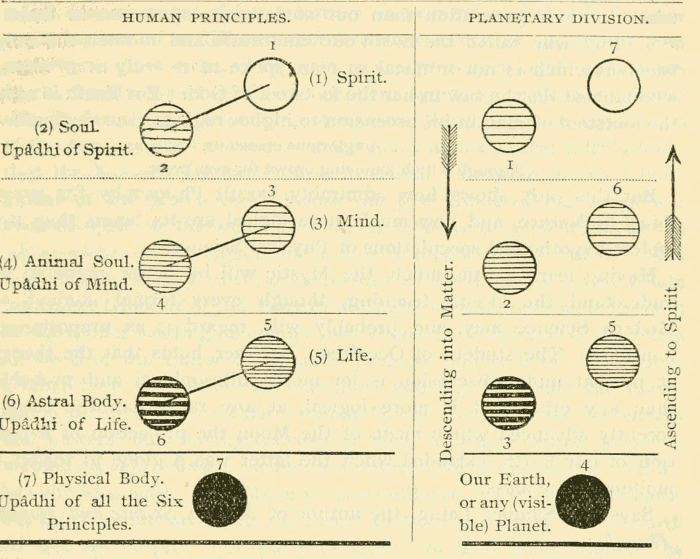
As we are proceeding here from Universals to Particulars, instead of using the inductive or Aristotelean method, the numbers are reversed. Spirit is enumerated the first instead of seventh, as is usually done, but in truth, ought not to be done.
The Principles, as usually named after the manner of Esoteric Buddhism and other works, are: 1, Âtmâ; 2, Buddhi (Spiritual Soul); 3, Manas (Human Soul); 4, Kâma Rûpa (Vehicle of Desires and Passions); 5, Prâna; 6, Linga Sharîra; 7, Sthûla Sharîra.
The dark horizontal lines of the lower planes are the Upâdhis in the case of the human Principles, and the planes in the case of the Planetary Chain. Of course, as regards the Human Principles, the diagram does not place them quite in order, yet it shows the correspondence and analogy to which attention is now drawn. As the reader will see, it is a case of descent into matter, the adjustment—in both the mystic [pg 178] and the physical sense—of the two, and their interblending for the great coming “struggle for life” that awaits both Entities. “Entity” may be thought a strange term to use in the case of a Globe, but the ancient philosophers, who saw in the Earth a huge “animal,” were wiser in their generation than our modern geologists are in theirs; and Pliny, who called the Earth our kind nurse and mother, the only Element which is not inimical to man, spoke more truly than Watts, who fancied that he saw in her the footstool of God. For Earth is only the footstool of man in his ascension to higher regions; the vestibule—
... to glorious mansions,
Through which a moving crowd for ever press.
But this only shows how admirably Occult Philosophy fits every thing in Nature, and how much more logical are its tenets than the lifeless hypothetical speculations of Physical Science.
Having learned thus much, the Mystic will be better prepared to understand the Occult teaching, though every formal student of Modern Science may, and probably will, regard it as preposterous nonsense. The student of Occultism, however, holds that the theory at present under discussion is far more philosophical and probable than any other. It is more logical, at any rate, than the theory recently advanced which made of the Moon the projection of a portion of our Earth, extruded when the latter was a globe in fusion, a molten plastic mass.
Says Mr. Samuel Laing, the author of Modern Science and Modern Thought:
The astronomical conclusions are theories based on data so uncertain, that while in some cases they give results incredibly short, like that of 15 millions of years for the whole past process of formation of the solar system, in others they give results almost incredibly long, as in that which supposes the moon to have been thrown off when the earth was rotating in three hours, while the utmost actual retardation obtained from observation would require 600 millions of years to make it rotate in twenty-three hours instead of twenty-four.266
And if Physicists persist in such speculations, why should the chronology of the Hindûs be laughed at as exaggerated?
It is said, moreover, that the Planetary Chains having their Days and their Nights—i.e., periods of activity or life, and of inertia or death—behave in heaven as do men on earth: they generate their likes, grow old, and become personally extinct, their spiritual principles only living in their progeny as a survival of themselves.
[pg 179]
Without attempting the very difficult task of giving out the whole process in all its cosmic details, enough may be said to give an approximate idea of it. When a Planetary Chain is in its last Round, its Globe A, before finally dying out, sends all its energy and principles into a neutral centre of latent force, a laya centre, and thereby informs a new nucleus of undifferentiated substance or matter, i.e., calls it into activity or gives it life. Suppose such a process to have taken place in the Lunar Planetary Chain; suppose again, for argument's sake—though Mr. Darwin's theory quoted below has lately been upset, even if the fact has not yet been ascertained by mathematical calculation—that the Moon is far older than the Earth. Imagine the six fellow-globes of the Moon—æons before the first Globe of our seven was evolved—just in the same position in relation to each other as the fellow-globes of our Chain now occupy in regard to our Earth.267 And now it will be easy to imagine further Globe A of the Lunar Chain informing Globe A of the Terrestrial Chain, and—dying; next Globe B of the former sending its energy into Globe B of the new Chain; then Globe C of the Lunar creating its progeny Sphere C of the Terrene Chain; then the Moon (our satellite) pouring forth into the lowest Globe of our Planetary Chain—Globe D, our Earth—all its life, energy and powers; and, having transferred them to a new centre, becoming virtually a dead planet, in which since the birth of our Globe rotation has almost ceased. The Moon is the satellite of our Earth, undeniably, but this does not invalidate the theory that she has given to the Earth all but her corpse. For Darwin's theory to hold good, besides the hypothesis just upset, other still more incongruous speculations had to be invented. The Moon, it is said, has cooled nearly six times as rapidly as the Earth.268 “The Moon, if the earth is 14,000,000 years old since its incrustation, is only eleven and two-thirds millions of years old since that stage ...” etc. And if our Moon is but a splash from our Earth, why can no similar inference be established for the Moons of other planets? The Astronomers “do not know.” Why should Venus and Mercury have no satellites, and by what, when they exist, were they formed? The Astronomers do not know, because, we say, Science has only one key—the key of matter—to open the mysteries of Nature, while Occult Philosophy has seven keys and explains that which Science fails to see. Mercury and [pg 180] Venus have no satellites, but they had “parents” just as the Earth had. Both are far older than the Earth, and, before the latter reaches her Seventh Round, her mother Moon will have dissolved into thin air, as the Moons of the other planets have, or have not, as the case may be, since there are planets which have several Moons—a mystery again which no Œdipus of Astronomy has solved.
The Moon is now the cold residual quantity, the shadow dragged after the new body, into which her living powers and principles are transfused. She now is doomed for long ages to be ever pursuing the Earth, to be attracted by and to attract her progeny. Constantly vampirized by her child, she revenges herself on it, by soaking it through and through with the nefarious, invisible and poisoned influence which emanates from the occult side of her nature. For she is a dead, yet a living body. The particles of her decaying corpse are full of active and destructive life, although the body which they had formed, is soulless and lifeless. Therefore its emanations are at the same time beneficent and maleficent—a circumstance finding its parallel on earth, in the fact that the grass and plants are nowhere more juicy and thriving than on graves; while at the same time it is the graveyard, or corpse-emanations, which kill. And like all ghouls or vampires, the Moon is the friend of the sorcerers and the foe of the unwary. From the archaic æons and the later times of the witches of Thessaly, down to some of the present Tântrikas of Bengal, her nature and properties have been known to every Occultist, but have remained a closed book for Physicists.
Such is the Moon from the astronomical, geological, and physical standpoints. As to her metaphysical and psychic nature, it must remain an occult secret in this work, as it was in the volume entitled Esoteric Buddhism, notwithstanding the rather sanguine statement made therein, that “there is not much mystery left now in the riddle of the eighth sphere.”269 These are topics, indeed, “on which the Adepts are very reserved in their communications to uninitiated pupils,” and since they have, moreover, never sanctioned or permitted any published speculations upon them, the less said the better.
Yet, without treading upon the forbidden ground of the “eighth sphere,” it may be useful to state some additional facts with regard to the ex-monads of the Lunar Chain—the “Lunar Ancestors”—as they play a leading part in the coming Anthropogenesis. This brings us [pg 181] directly to the Septenary Constitution of man; and as some discussion has arisen of late about the best classification to be adopted for the division of the microcosmic entity, two systems are now appended with a view to facilitate comparison. The subjoined short article is from the pen of Mr. T. Subba Row, a learned Vedântin scholar. He prefers the Brâhmanical division of the Râja Yoga, and from a metaphysical point of view he is quite right. But, as it is a question of simple choice and expediency, we hold in this work to the time-honoured classification of the Trans-Himâlayan “Arhat Esoteric School.” The following table and its explanatory text are reprinted from the Theosophist, and are also contained in Five Years of Theosophy.270
The Septenary Division In Different Indian Systems.
We give below in a tabular form the classifications adopted by the Buddhist and Vedântic teachers of the principles of man:
“Esoteric Buddhism.” Vedânta. Târaka Râja Yoga.
1. Sthûla Sharîra. Annamayakosha.271 Sthûlopâdhi.272
2. Prâna.273 Prânamayakosha. Sthûlopâdhi.
3. The Vehicle of Prâna.274 Prânamayakosha. Sthûlopâdhi.
4. Kâma Rûpa. Mânomayakosha. Sûkshmopâdhi.
5. Mind (Volitions and feelings); Vijñânam. Mânomayakosha. Sûkshmopâdhi.
6. Spiritual Soul.275 Ânandamayakosha. Kâranopâdhi.
7. Âtmâ. Âtmâ. Âtmâ.
From the foregoing table it will be seen that the third principle in the Buddhist classification is not separately mentioned in the Vedântic division, as it is merely the vehicle of Prâna. It will also be seen that the fourth principle is included in the third Kosha (Sheath), as the same principle is but the vehicle of will-power, which is but an energy of the mind. It must also be noticed that the Vijñânamayakosha is considered to be distinct from the Mânomayakosha, as a division is made [pg 182] after death between the lower part of the mind, as it were, which has a closer affinity with the fourth principle than with the sixth and its higher part, which attaches itself to the latter, and which is, in fact, the basis for the higher spiritual individuality of man.
We may also here point out to our readers that the classification mentioned in the last column is, for all practical purposes, connected with Râja Yoga, the best and simplest. Though there are seven principles in man, there are but three distinct Upâdhis (Bases), in each of which his Âtmâ may work independently of the rest. These three Upâdhis can be separated by an Adept without killing himself. He cannot separate the seven principles from each other without destroying his constitution.
The student will now be better prepared to see that between the three Upâdhis of the Râja Yoga and its Atmâ, and our three Upâdhis, Âtmâ, and the additional three divisions, there is in reality but very little difference. Moreover, as every Adept in Cis-Himâlayan or Trans-Himâlayan India, of the Patanjali, the Âryâsanga or the Mahâyâna schools, has to become a Râja Yogî, he must, therefore, accept the Târaka Râja classification in principle and theory, whatever classification he resorts to for practical and Occult purposes. Thus, it matters very little whether one speaks of the three Upâdhis, with their three Aspects, and Âtmâ, the eternal and immortal synthesis, or calls them the “Seven Principles.”
For the benefit of those who may not have read, or, if they have, may not have clearly understood, in Theosophical writings, the doctrine of the septenary Chains of Worlds in the Solar Cosmos, the teaching is briefly as follows.
1. Everything in the metaphysical as in the physical Universe is septenary. Hence every sidereal body, every planet, whether visible or invisible, is credited with six companion Globes. The evolution of life proceeds on these seven Globes or bodies, from the First to the Seventh, in Seven Rounds or Seven Cycles.
2. These Globes are formed by a process which the Occultists call the “rebirth of Planetary Chains (or Rings).” When the Seventh and last Round of one of such Rings has been entered upon, the highest or first Globe, A, followed by all the others down to the last, instead of entering upon a certain time of rest—or “Obscuration,” as in the previous Rounds—begins to die out. The Planetary Dissolution (Pralaya) is at hand, and its hour has struck; each Globe has to transfer its life and energy to another planet.276
[pg 183]
3. Our Earth, as the visible representative of its invisible superior fellow-globes, its “Lords” or “Principles,” has to live, as have the others, through seven Rounds. During the first three, it forms and consolidates; during the fourth, it settles and hardens; during the last three, it gradually returns to its first ethereal form: it is spiritualized, so to say.
4. Its Humanity develops fully only in the Fourth—our present Round. Up to this Fourth Life-Cycle, it is referred to as “Humanity” only for lack of a more appropriate term. Like the grub which becomes chrysalis and butterfly, Man, or rather that which becomes Man, passes through all the forms and kingdoms during the First Round, and through all the human shapes during the two following Rounds. Arrived on our Earth at the commencement of the Fourth, in the present series of Life-Cycles and Races, Man is the first form that appears thereon, being preceded only by the mineral and vegetable kingdoms—even the latter having to develop and continue its further evolution through man. This will be explained in Volume II. During the three Rounds to come, Humanity, like the Globe on which it lives, will be ever tending to reässume its primeval form, that of a Dhyân Chohanic Host. Man tends to become a God and then—God, like every other Atom in the Universe.
Beginning so early as with the Second Round, Evolution proceeds already on quite a different plan. It is only during the first Round that (Heavenly) Man becomes a human being on Globe A, (rebecomes) a mineral, a plant, an animal, on Globe B and C, etc. The process changes entirely from the Second Round; but you have learned prudence ... and I advise you to say nothing before the time for saying it has come....277
5. Every Life-Cycle on Globe D (our Earth)278 is composed of seven Root-Races. They commence with the ethereal and end with the spiritual, on the double line of physical and moral evolution—from the beginning of the Terrestrial Round to its close. One is a “Planetary Round” from Globe A to Globe G, the seventh; the other, the “Globe Round,” or the Terrestrial.
This is very well described in Esoteric Buddhism, and needs no further elucidation for the time being.
6. The First Root-Race, i.e., the first “Men” on earth (irrespective of form), were the progeny of the “Celestial Men,” rightly called in Indian [pg 184] philosophy the “Lunar Ancestors” or the Pitris, of which there are seven Classes or Hierarchies. As all this will be sufficiently explained in the following sections and in Volume II, no more need be said of it here.
But the two works already mentioned, both of which treat of subjects from the Occult doctrine, need particular notice. Esoteric Buddhism is too well known in Theosophical circles, and even to the outside world, for it to be necessary to enter at length upon its merits here. It is an excellent book, and has done still more excellent work. But this does not alter the fact that it contains some mistaken notions, and that it has led many Theosophists and lay-readers to form an erroneous conception of the Eastern Secret Doctrine. Moreover it seems, perhaps, a little too materialistic.
Man, which came later, was an attempt to present the archaic doctrine from a more ideal standpoint, to translate some visions in and from the Astral Light, to render some teachings partly gathered from a Master's thoughts, but unfortunately misunderstood. This work also speaks of the evolution of the early Races of men on Earth, and contains some excellent pages of a philosophical character. But so far it is only an interesting little mystical romance. It has failed in its mission, because the conditions required for a correct translation of these visions were not present. Hence the reader must not wonder if our volumes contradict these earlier descriptions in several particulars.
Esoteric cosmogony in general, and the evolution of the human Monad especially, differ so essentially in these two books, and in other Theosophical works written independently by beginners, that it becomes impossible to proceed with the present work without special mention of these two earlier volumes, for both have a number of admirers—Esoteric Buddhism especially. The time has arrived for the explanation of some matters in this direction. Mistakes have now to be checked by the original teachings, and corrected. If one of the said works has too pronounced a bias toward materialistic Science, the other is decidedly too idealistic, and at times is fantastic.
From the doctrine—rather incomprehensible to Western minds—which deals with the periodical Obscurations and successive Rounds of the Globes, along their circular Chains, were born the first perplexities and misconceptions. One of such has reference to the “Fifth-” and even “Sixth-Rounders.” Those who knew that a Round was preceded [pg 185] and followed by a long Pralaya, a pause of rest, which created an impassable gulf between two Rounds until the time came for a renewed cycle of life, could not understand the “fallacy” of talking about “Fifth and Sixth-Rounders” in our Fourth Round. Gautama Buddha, it was held, was a “Sixth-Rounder,” Plato and some other great philosophers and minds, “Fifth-Rounders.” How could it be? One Master taught and affirmed that there were such “Fifth-Rounders” even now on Earth; and though understood to say that mankind was yet in the Fourth Round, in another place he seemed to say that we were in the Fifth. To this an “apocalyptic answer” was returned by another Teacher: “A few drops of rain do not make a monsoon, though they presage it.”... “No, we are not in the Fifth Round, but Fifth Round men have been coming in for the last few thousand years.” This was worse than the riddle of the Sphinx! Students of Occultism subjected their brains to the wildest work of speculation. For a considerable time they tried to outvie Œdipus and reconcile the two statements. And as the Masters kept as silent as the stony Sphinx herself, they were accused of “inconsistency,” “contradiction,” and “discrepancies.” But they were simply allowing the speculations to go on, in order to teach a lesson which the Western mind sorely needs. In their conceit and arrogance, and in their habit of materializing every metaphysical conception and term, without allowing any margin for Eastern metaphor and allegory, the Orientalists had made a jumble of the Hindû exoteric philosophy, and the Theosophists were now doing the same with regard to Esoteric teachings. To this day it is evident that the latter have utterly failed to understand the meaning of the term “Fifth and Sixth-Rounders.” But it is simply this: every Round brings about a new development, and even an entire change, in the mental, psychic, spiritual and physical constitution of man; all these principles evolving on an ever ascending scale. Hence it follows that those persons who, like Confucius and Plato, belonged psychically, mentally and spiritually to the higher planes of evolution, were in our Fourth Round as the average man will be in the Fifth Round, whose mankind is destined to find itself, on this scale of evolution, immensely higher than is our present humanity. Similarly, Gautama Buddha—Wisdom incarnate—was still higher and greater than all the men we have mentioned who are called “Fifth-Rounders,” and so Buddha and Shankarâchârya are termed “Sixth Rounders,” allegorically. Hence again the concealed wisdom of the remark, pronounced at the time [pg 186] “evasive”—“a few drops of rain do not make a monsoon, though they presage it.”
And now the truth of the following remark, in Esoteric Buddhism, will be fully apparent:
It is impossible, when the complicated facts of an entirely unfamiliar science are being presented to untrained minds for the first time, to put them forward with all their appropriate qualifications ... and abnormal developments.... We must be content to take the broad rules first and deal with the exceptions afterwards, and especially is this the case with a study, in connection with which the traditional methods of teaching, generally followed, aim at impressing every fresh idea on the memory by provoking the perplexity it at last relieves.
As the author of the remark was himself, as he says, “an untrained mind” in Occultism, his own inferences, and his better knowledge of modern astronomical speculations than of archaic doctrines, led him, quite naturally, and unconsciously to himself, to commit a few mistakes of detail rather than of any “broad rule.” One such will now be noticed. It is a trifling one, still it is calculated to lead many a beginner into erroneous conceptions. But as the mistaken notions of the earlier editions were corrected in the annotations of the fifth edition, so the sixth may be revised and perfected. There were several reasons for such mistakes. They were due to the necessity, under which the Teachers laboured, of giving what were considered as “evasive answers”; the questions being too persistently pressed to be left unnoticed, while, on the other hand, they could only be partially answered. This position notwithstanding, the confession that “half a loaf is better than no bread” was but too often misunderstood, and hardly appreciated as it ought to have been. As a result thereof gratuitous speculations were sometimes indulged in by the European lay-chelâs. Among such were the “Mystery of the Eighth Sphere” in its relation to the Moon, and the erroneous statement that two of the superior Globes of the Terrestrial Chain were two of our well-known planets; “besides the earth ... there are only two other worlds of our chain which are visible ... Mars and Mercury....”279
This was a great mistake. But the blame for it is to be attached as much to the vagueness and incompleteness of the Master's answer as to the question of the learner itself, which was equally vague and indefinite.
It was asked: “What planets, of those known to ordinary Science, [pg 187] besides Mercury, belong to our system of worlds?” Now if by “system of worlds” our Terrestrial Chain, or “String,” was intended, in the mind of the querist, instead of the “Solar System of Worlds,” as it should have been, then of course the answer was likely to have been misunderstood. For the reply was: “Mars, etc., and, four other planets of which Astronomy knows nothing. Neither A, B, nor Y, Z, are known, nor can they be seen through physical means, however perfected.” This is plain: (a) Astronomy as yet knows nothing in reality of the planets, neither the ancient ones, nor those discovered in modern times. (b) No companion planets from A to Z, i.e., no upper Globes of any Chain in the Solar System, can be seen; with the exception of course of all the planets which come fourth in number, as our Earth, the Moon, etc., etc. As to Mars, Mercury, and “the four other planets,” they bear a relation to Earth of which no Master or high Occultist will ever speak, much less explain the nature.
In this same letter the impossibility is distinctly stated by one of the Teachers to the author of Esoteric Buddhism: “Try to understand that you are putting me questions pertaining to the highest Initiation; that I can give you (only) a general view, but that I dare not, nor will I, enter into details....” Copies of all the letters ever received, or sent, with the exception of a few private ones—“in which there was no teaching,” the Master says—are with the writer. As it was her duty, in the beginning, to answer and explain certain points not touched upon, it is more than likely that, notwithstanding the many annotations on these copies, the writer, in her ignorance of English and her fear of saying too much, may have bungled the information given. She takes the whole blame for it upon herself in any and every case. But it is impossible for her to allow students to remain any longer under erroneous impressions, or to believe that the fault lies with the Esoteric system.
Let it then be now distinctly stated that the theory broached is impossible, with or without the additional evidence furnished by modern Astronomy. Physical Science can supply corroborative, though still very uncertain, evidence, but only as regards heavenly bodies on the same plane of materiality as our objective Universe. Mars and Mercury, Venus and Jupiter, like every hitherto discovered planet, or those still to be discovered, are all, per se, the representatives on our plane of such Chains. As distinctly stated in one of the numerous letters of Mr. Sinnett's Teacher: “there are other and innumerable [pg 188]manvantaric Chains of Globes which bear intelligent Beings, both in and outside our Solar System.” But neither Mars nor Mercury belong to our Chain. They are, along with other planets, septenary Units in the great host of Chains of our System, and all are as visible as their upper Globes are invisible.
If it is still argued that certain expressions in the Teacher's letters were liable to mislead, the answer comes: Amen; so they were. The author of Esoteric Buddhism understood it well when he wrote that such are “the traditional modes of teaching ... by provoking the perplexity,” they do or do not relieve—as the case may be. At all events, if it is urged that this might have been explained earlier, and the true nature of the planets given out as they now are, the answer comes that: It was not found expedient to do so at the time, as it would have opened the way to a series of additional questions which could never be answered on account of their Esoteric nature, and thus would only become embarrassing. It had been declared from the first, and has been repeatedly asserted since: (1) That no Theosophist, not even as an accepted Chelâ, let alone lay students, could expect to have the secret teachings explained to him thoroughly and completely, before he had irretrievably pledged himself to the Brotherhood and passed through at least one Initiation, because no figures and numbers could be given to the public, for figures and numbers are the key to the Esoteric system. (2) That what was revealed was merely the Esoteric lining of that which is contained in almost all the exoteric scriptures of the world-religions—preëminently in the Brâhmanas and the Upanishads of the Vedas, and even in the Purânas. It was a small portion of what is divulged far more fully now in the present volumes; and even this is very incomplete and fragmentary.
When the present work was commenced, the writer, feeling sure that the speculation about Mars and Mercury was a mistake, applied to the Teachers by letter for an explanation and an authoritative version. Both came in due time, and verbatim extracts from these are now given.
“... It is quite correct that Mars is in a state of obscuration at present, and Mercury just beginning to get out of it. You might add that Venus is in her last Round.... If neither Mercury nor Venus have satellites, it is because of the reasons ... and also because Mars has two satellites to which he has no right.... Phobos, the supposed ‘inner’ satellite, is no satellite at all. Thus, this remark of long ago by Laplace and now by Faye do not agree, you see. (Read ‘Comptes Rendus,’ [pg 189]Tome XC, p. 569.) Phobos keeps a too short periodic time, and therefore there ‘must exist some defect in the mother idea of the theory,’ as Faye justly observes.... Again, both [Mars and Mercury] are septenary Chains, as independent of the Earth's sidereal lords and superiors as you are independent of the ‘principles’ of Däumling [Tom Thumb]—which were perhaps his six brothers, with or without night-caps.... ‘Gratification of curiosity is the end of knowledge for some men,’ was said by Bacon, who was as right in postulating this truism, as those who were familiar with it before him, were right in hedging off Wisdom from Knowledge, and tracing limits to that which is to be given out at one time.... Remember:
... knowledge dwells
In heads replete with thoughts of other men,
Wisdom in minds attentive to their own....”
“You can never impress it too profoundly on the minds of those to whom you impart some of the Esoteric teachings.”
Here are more extracts from another letter written by the same authority. This time it is in answer to some objections laid before the Teachers. They are based upon extremely scientific, and as futile, reasonings about the advisability of trying to reconcile the Esoteric theories with the speculations of Modern Science, were written by a young Theosophist as a warning against the “Secret Doctrine,” and in reference to the same subject. He had declared that if there were such companion Earths, “they must be only a wee bit less material than our globe.” How then was it that they could not be seen? The answer was:
“... Were psychic and spiritual teachings more fully understood, it would become next to impossible to even imagine such an incongruity. Unless less trouble is taken to reconcile the irreconcilable—that is to say, the metaphysical and spiritual sciences with physical or natural philosophy, ‘natural’ being a synonym to them [men of Science] of that matter which falls under the perception of their corporeal senses—no progress can be really achieved. Our Globe, as taught from the first, is at the bottom of the arc of descent, where the matter of our perceptions exhibits itself in its grossest form.... Hence it only stands to reason that the Globes which overshadow our Earth, must be on different and superior planes. In short, as Globes, they are in coädunition but not in consubstantiality with our Earth, and thus pertain to quite another state of consciousness. Our planet (like all those we see) is adapted to the peculiar state of its human stock, that state which enables us to see with our naked eye the sidereal bodies [pg 190]which are coëssential with our terrene plane and substance, just as their respective inhabitants, the Jovians, Martians and others, can perceive our little world; because our planes of consciousness, differing as they do in degree, but being the same in kind, are on the same layer of differentiated matter.... What I wrote was: ‘The minor Pralaya concerns only our little Strings of Globes. (We called Chains “Strings” in those days of lip-confusion.)... To such a String our Earth belongs.’ This ought to have shown plainly that the other planets were also ‘Strings,’ or Chains.... If he [meaning the objector] would perceive even the dim silhouette of one of such ‘planets’ on the higher planes, he has to first throw off even the thin clouds of the astral matter that stand between him and the next plane.”
It thus becomes patent why we could not perceive, even with the help of the best telescopes, that which is outside our world of matter. Those alone, whom we call Adepts, who know how to direct their mental vision and to transfer their consciousness—both physical and psychic—to other planes of being, are able to speak with authority on such subjects. And they tell us plainly:
“Lead the life necessary for the acquisition of such knowledge and powers, and Wisdom will come to you naturally. Whenever you are able to attune your consciousness to any of the seven chords of ‘Universal Consciousness,’those chords that run along the sounding-board of Kosmos, vibrating from one Eternity to another; when you have studied thoroughly the ‘Music of the Spheres,’ then only will you become quite free to share your knowledge with those with whom it is safe to do so. Meanwhile, be prudent. Do not give out the great Truths that are the inheritance of the future Races, to our present generation. Do not attempt to unveil the secret of Being and Non-Being to those unable to see the hidden meaning of Apollo's Heptachord, the lyre of the radiant god, in each of the seven strings of which dwelleth the Spirit, Soul and Astral Body of the Kosmos, whose shell only has now fallen into the hands of modern Science.... Be prudent, we say, prudent and wise, and above all take care what those who learn from you believe in; lest by deceiving themselves they deceive others, ... for such is the fate of every truth with which men are, as yet, unfamiliar.... Let rather the Planetary Chains and other super- and sub-cosmic mysteries remain a dreamland for those who can neither see, nor yet believe that others can.”