Front matter
Reading edition
Transcriber's Note
This book was transcribed from a scan of the original found at Google Books. I have rotated some images and have corrected the misspelling of "aileron" that appeared many times in the original text.
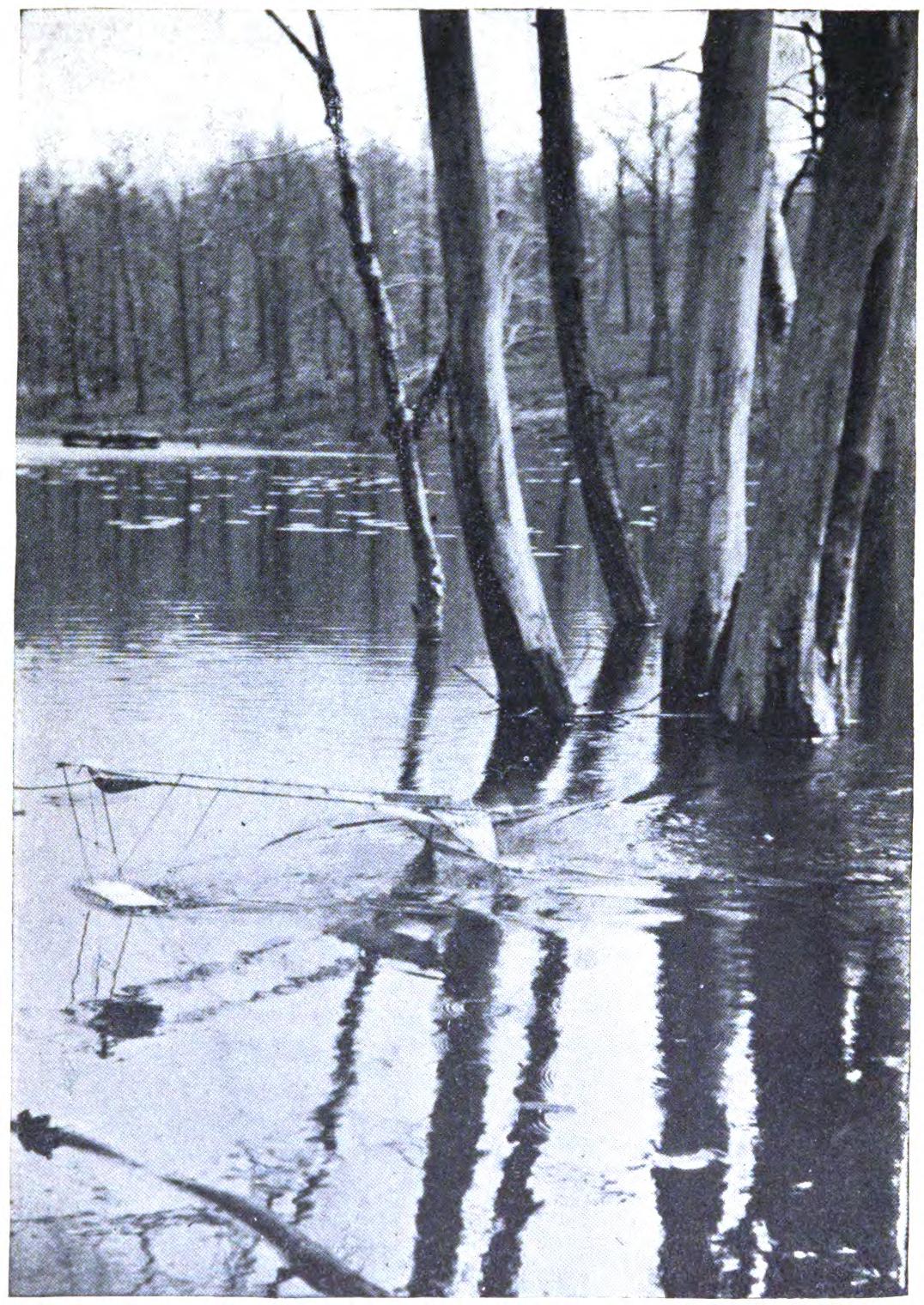
A model aeroplane rising from the water.
THE SECOND BOYS' BOOK
OF MODEL AEROPLANES
BY
FRANCIS A. COLLINS
AUTHOR OF "THE BOYS' BOOK OF MODEL AEROPLANES"
ILLUSTRATED WITH MANY
PHOTOGRAPHS AND DIAGRAMS
BY THE AUTHOR
NEW YORK
THE CENTURY CO.
1911
Copyright 1911, by
The Century Co.
Published October, 1911
THE SECOND BOYS' BOOK OF MODEL AEROPLANES
FOREWORD
It is assumed that the reader is familiar with "The Boys' Book of Model Aeroplanes." Some knowledge of the history of aviation and the early models, big and little, will be found helpful, but not essential, as a preparation for the present volume.
Within the year so much has been learned of the science of model aeroplane construction that an entirely new and more detailed treatment of the subject seems to be justified. Since the length of model aeroplane flights has been increased ten times, their improvement is comparable to that of the large man-carrying machines. The science has become more exact, and the chance of failure reduced, until to-day successful flights are within the reach of all.
In the preparation of this volume thanks are due to the New York Model Aero Club, to Mr. Edward Durrant, Percy Pierce, Cecil Peoli, W. S. Howells, Jr., and to the young gentlemen whose models are illustrated herewith, who, singly and collectively, are doing much for the development of the science in America.
THE SECOND BOYS' BOOK OF MODEL AEROPLANES FOREWORD LIST OF ILLUSTRATIONS CHAPTER I MODEL AEROPLANES OF 1911 CHAPTER II MODEL AEROPLANE TOURNAMENTS CHAPTER III PARLOR AVIATION CHAPTER IV TOOLS AND MATERIALS CHAPTER V THEORY AND PRACTICE OF PLANE CONSTRUCTION CHAPTER VI SCIENTIFIC PROPELLER BUILDING CHAPTER VII ASSEMBLING THE MOTORS CHAPTER VIII DIRECTIONAL CONTROL CHAPTER IX MODEL AEROPLANE DESIGNS CHAPTER X DESIGNING THE SKIDS CHAPTER XI GEARED MOTORS CHAPTER XII LESSONS OF THE MAN-CARRYING AEROPLANES CHAPTER XIII SELECTED QUESTIONS FOR BEGINNERS CHAPTER XIV AMONG THE MODEL BUILDERS CHAPTER XV CURIOSITIES OF THE AIR CHAPTER XVI RULES FOR CONDUCTING MODEL AEROPLANE CONTESTS CONSTITUTION AND BY-LAWS OF A MODEL AEROPLANE CLUB DICTIONARY OF AERONAUTICAL TERMS
LIST OF ILLUSTRATIONS
A model aeroplane rising from the water.
A good specimen of plane building.
"Finish one end of the blade before cutting away the opposite end."
Model aeroplane. Designed by Cecil Peoli.
A variation on a familiar form.
An excellent model designed and built by H. Wakkins.
An original design by Harry McAllister
An interesting experiment in stability
An early model built by E.G. Halpine
An interesting experiment in stability
An early model built by Monroe Jacobs. Note the Ailerons.
A Simple Model Glider
An effective glider built by R.S. Barnaby
An efficient sling-shot glider built by John Roche
Designs for Sling-Shot Gliders.
Paper Gliders. Antoinette Monoplane and Wright Biplane
An excellent glider with wooden planes
A covered-frame sling-shot glider
Percy Pierce launching a model
A French model built of aluminium
Diagram for making the planes
Working drawing of the Flemming Williams model
An imported Flemming Williams model. English record 2600 feet.
Storing energy for a long distance flight
A geared model built by Leslie V. Robinson
An ingenious biplane
A well-proportioned model built by Reginald Overton
A good model intended for long distance work built by A. C. Odom
A beautiful monoplane built by R. Mungokee
Detail of a model built by R. Mungokee
An ingenious application of the dihedral angle
Diagram Showing How To Make A Propeller From A Wooden Blank
Design of Metal Propeller
A test of high aspect ratio planes
A modified Bleriot built by Cecil Peoli
Langley Propeller Blade
A combination of several interesting features
A skilful adjustment of the front plane and skid built by Percy Pierce
Wright Propeller Blade
An efficient model, showing excellent construction, designed by John Caresi
One of the best minimum plane models of 1911
A Metal Motor Anchorage
A Metal Motor Anchorage
A notable model possessing unusual stability. Built by W.S. Howell, Jr.
Front view of model built by W.S. Howell, Jr.
A Metal Skid
An ingenious adjustment of ailerons
Tuning up the model for a flight.
Showing Construction And Mounting Of Propeller And Axle.
An excellent monoplane capable of long flights.
Long-distance model built by Percy Pierce.
Showing An Excellent Way Of Fastening The Propellers To The Framework.
Model built by Rutledge Barry, winner of spectacular flight contest.
A model by Percy Pierce, winner of the indoor long-distance record.
A Motor Anchorage
A serviceable model showing excellent workmanship built by Cecil Peoli
A serviceable model showing excellent workmanship built by Cecil Peoli
Various Steering Devices. "a" and "b," simple aileron forms. "A" novel fin on Vinet plane. "B" L-shaped aileron. "C" vertical rudder (Bleriot type). "D" "Blinkers," an effective rudder. "E" stability planes not unlike the runners of a sleigh.
An excellent piece of workmanship. Model by R. Mungokee
Model with minimum plane surface. Built by A. C. Odom
A — The Famous "one Ouncer." B — A Small Experimental Model. C — A Modified Burgess Webb Model.
Model With Minimum Plane Surface.
An American Fleming Williams built by C. McQueen
One of the earlier models built by Cecil Peoli
A Model With Adjustable Stabilizer.
An Efficient Three-ounce Model.
An All-metal Model Frame.
One of the best models of the year, built by John Caresi
An excellent model, showing careful attention to details. Built by L. V. Brooks
A model with limited plane area built by R. Barry
An interesting experiment in metal frame building by R. Fisher
An aeroplane of simple construction that flies remarkably well, built by R. S. Barnaby
Percy Pierce, winner of the distance record
A well-proportioned model, capable of long flights
A well designed aeroplane built by James MacPherson
A beautiful model built by Stewart Easter
A successful model of 1910 built by E. G. Halpine. Note contrast in plane area
Percy Pierce launching a prize-winning model
Launching the sling-shot gliders
A tractor with large plane forward built by F. W. Curtis
Model built by William Robinson
Front view of the De Lion model
Two of the earlier Peoli models