Part 1 — THE 2ND BATTALION ROYAL DUBLIN FUSILIERS (continued 2)
Reading edition
Watched by the whole army the Durhams advanced against Vaal Krantz, which they took about 4 p.m. amidst the cheers of the onlookers. But with this success the operations practically ended for the day.
The battalion remained all the afternoon in the same position, and then finally bivouacked there, having luckily succeeded in communicating with the transport, so that the men had blankets. Its outposts were pushed well round the southern slopes of Swaartz Kop, thus overlooking the Tugela. A reconnoitring patrol was fired on from the left bank, but otherwise the night passed without incident.
We did not move on the 6th, and had practically nothing to do. The artillery on both sides fired continually, although the damage done must have been very small in proportion to the noise and expenditure of ammunition.
Every one watched with special interest a duel between our heavy artillery and a large Boer gun which had suddenly been unmasked on Doorn Kloof. This gun fired black powder, and its discharge could be plainly seen, but it was apparently run up for every round behind a parapet. It displayed absolute impartiality in its attentions. One round would be directed against the infantry on Vaal Krantz, another covered with dust a field battery on the plain, a third just missed the battalion, while a fourth shell would crash among the trees on Swaartz Kop. All our heavy guns had a try at silencing it, and their efforts sometimes met with partial success. The Boer gun would cease firing for a time, but it always re-appeared when least expected. Towards the evening it became quite lively and put a shell through the pontoon bridge.
The night of February 6th-7th was spent in comparative peace, although the Boer artillery somewhat spoiled the first part of the night by shelling Vaal Krantz. February 7th was a repetition of the 6th, except that the gun on Doorn Kloof paid slightly more attention to our position. The Colonel found it necessary to post a man on the look-out, whose duty it was, on seeing the white puff of smoke, to blow a whistle, whereupon everybody sought the shelter of the nearest and largest boulder. But although, when the huge shell burst, the air seemed unpleasantly full of whizzing iron fragments, no damage was done, and the gun merely mitigated, to some extent, the monotony of idleness.
By this time it was clear that Sir Redvers Buller did not intend to press the attack home, and no one was surprised to find the army in retreat on the morning of the 8th. The battalion acted as rearguard and marched back between the river and Swaartz Kop in widely extended lines. The Boer guns on Doorn Kloof, the shoulder of Spion Kop, and Brakfontein shelled us on our way, and one man of the rear company ('H') was killed, this being our only casualty between February 5th and 8th. The heavy artillery on Mount Alice covered the retreat and prevented the enemy's guns from being too attentive.
The 5th Brigade halted at Springfield, and two days later went on to Pretorius' Farm. On the 18th it made a march of fourteen miles to the Blaukranz River, starting about 3.30 a.m. The day was hot, and as there was no water on the route the newly-joined militia reservists suffered considerably. After a rest of two days the brigade moved to a camp near Gun Hill at Chieveley, where the naval six-inch gun was in position.
The rest of the army was now engaged in the operations against Cingolo and Hlangwane, and the battalion occupied itself in guarding Chieveley, in beginning the construction of a railway to Hussar Hill, and in convoying ammunition to the latter place. This was a somewhat trying task, as during part of the way the convoy became the object of many a Boer shell. The operations against Cingolo and Hlangwane proved successful, and these positions were captured on the 19th. The next day General Hart took the regiment on a reconnaissance towards Colenso. It advanced cautiously on the west of the railway in column of extended companies. The village was found unoccupied, but a party of Boers, holding the horseshoe ridge on the left bank of the Tugela opened a vigorous fire. The leading companies at once doubled forward and lined the right bank, whence they answered the Boer marksmen. The left half-battalion remained in support behind the village. A detachment of Thorneycroft's Mounted Infantry appeared on the scene, and having forded the Tugela above the road bridge, turned the Boers out of their position. Later on in the afternoon a train steamed into Colenso station from Chieveley, and took us back just before dusk.
At 6 a.m. on February 21st, the Connaught Rangers and the Dublin Fusiliers went by train to Colenso, where they were joined by a battery. The horseshoe ridge on the left bank was being held by a detachment of Thorneycroft's Mounted Infantry, but General Hart was desirous of crossing the river with at least part of his force. For this purpose he had brought on the train a boat, which was promptly launched. As, however, the boat was small, and hardly capable of holding more than four men, the General gave orders for the construction of a raft. After some trouble this was ready by 4 p.m., and some two hours later about seven companies of the Connaught Rangers had succeeded in reaching the left bank.
General Hart now received an order to cross early next morning, with three battalions of his brigade, the pontoon bridge, which had been constructed under Hlangwane. The regiment bivouacked in Colenso, and at 5 a.m. on February 22nd marched down the right bank and crossed the bridge. One company had been sent back to Chieveley for the purpose of striking the camp, and with the transport rejoined the battalion about 7 a.m., after the latter had crossed the bridge and taken up a position on the western side of the horseshoe ridge.
Here it stayed the whole day, all ranks passing the time in examining the Boer trenches, and picking up more or less worthless loot. Heavy fighting was taking place in front, but only an occasional shell fell near the ridge.[Back to Contents]
CHAPTER VIII. HART'S AND PIETER'S HILLS—THE RELIEF OF LADYSMITH.
'But since I knew No rock so hard but that a little wave May beat admission in a thousand years, I re-commenced.' Tennyson.
General Hart moved his command in column of route, and the long line soon attracted the notice of the enemy's artillery. It was somewhat trying to the nerves to hear the whistle of a shell coming nearer and nearer, until finally it struck the ground within a few yards of the column. Luckily, the Boers were either using common shell or their shrapnel did not burst, and the battalion had no casualties. Finally the railway was reached, and the brigade turned to the left, each battalion forming column of companies in succession. A halt was made close to the railway line and a short distance to the south of the viaduct over the Onderbrook Spruit. But as a few shells fell dangerously near, and showed that the enemy could still see the brigade, it was moved to the left behind a rocky ridge. The battalion stayed here for the rest of the morning. The Boer gunners fired frequently at the ridge, but the slope of the ground saved us from any losses. Sir Redvers Buller and his staff rode up about mid-day in order to explain to General Hart what was required of him. This was the capture of the hill known as Inniskilling, or Hart's Hill. It could be plainly seen from the summit of the ridge behind which we lay, and all officers and section commanders were called up in order to have a look at it. They were told that it formed the extreme left of the Boer position, and that its capture meant the relief of Ladysmith. General Hart desired all officers to inform their men of the necessity for a resolute assault. Our heavy artillery on the right bank of the Tugela now began to shell the hill, which was quickly covered by the smoke and dust of the lyddite explosions.
Meanwhile, the 2nd Brigade was preparing the way by an assault on a ridge some 1000 yards to the front. They had a tough fight, and their wounded were soon being brought down the railway in trucks and stretchers.
The afternoon was well advanced when the 5th Brigade moved to the attack. The hill to be assaulted lay some 3000 yards to the north-east of the ridge which had been sheltering us, and the nature of the intervening ground forbade a direct advance, which would dangerously expose the left flank. It was necessary to hug the river-bank until a position from which a direct attack became possible was reached.
The brigade at first moved along the railway line in file in the following order: Royal Inniskilling Fusiliers, Connaught Rangers, Royal Dublin Fusiliers, and Imperial Light Infantry. The battalion moved with the left in front. A brigade in file takes up a considerable space, and by the time the regiment could start, a heavy outburst of firing showed that the Inniskilling Fusiliers were already engaged.
The advance along the railway line, through a cutting and over the Onderbrook Spruit, was very slow, since checks were frequent. The Boer artillery missed this favourable opportunity of shelling their foes, luckily for the latter. After crossing Onderbrook Spruit, the column turned to the right and crept along the river. The enemy were sweeping the bank with pompoms and a heavy rifle-fire, but by crouching under the bank the column obtained good cover for the greater part of the way. But every now and then there came an exposed bit of ground over which it was necessary to double, and so narrow was the track that men had often to jump over the wounded or killed.
The Langverwacht Spruit had to be crossed by the railway bridge. As the latter was in full view of the enemy and was being raked by pompom shells and bullets, it proved a great delay to the progress of the column. It was only possible to cross at more or less long intervals. Each man was forced to run the gauntlet by himself, and had to double over as hard as he could. Beyond the bridge complete cover was obtained except for a small stretch of ground by the Boer bridge. Below the latter, the river ran between high hills, and the column was therefore screened from view.
By the time that the leading company of the battalion had cleared 'Pompom' bridge, the Inniskilling Fusiliers were advancing against the Boer position on Hart's Hill. It was about 5 p.m., and the General could not wait until his brigade had concentrated, but sent his troops forward as they arrived. The left half-battalion of the Royal Dublin Fusiliers formed up near a deserted Boer bivouac overlooking the river, and then, without stopping for the right half, advanced to where General Hart was standing.
Lieutenant-Colonel Sitwell was in command of the left half-battalion, and in a short time he was sent for by the General, who told him to advance and help the Inniskilling Fusiliers to capture the hill.
The leading company ('H') was directed to extend to six paces and move forward, the remaining companies ('G,' 'F,' and 'E') following at a distance of 100 yards. No sooner had 'H' company cleared the crest of the hill on which General Hart was standing, than it came under a heavy rifle-fire, principally from the direction of Railway Hill. Lieutenant Lane fell badly wounded—shot clean through the head from one side to another, a wound from which he made a marvellous recovery—and three or four men were hit. The company received the order to double, no easy task down a steep slope strewn with rocks and boulders. The railway line at the bottom of the slope was crossed, and the opposite side of the valley, which was dotted with small trees, ascended. The company had now caught up the lines of the Connaught Rangers, and all climbed up the hill, the crest of which had been gained by the Inniskilling Fusiliers. Although the attacking infantry could not be seen from the Boers on Hart's or Railway Hill, they were still exposed to an enfilade fire from the left.
On arriving with 'H' company at the top of the hill, Lieutenant-Colonel Sitwell found the Inniskilling Fusiliers lying along the crest-line and facing the Boer trenches, which ran at about three hundred yards distance on the far side of the flat plateau. The Inniskillings had already suffered serious casualties, but, on Lieutenant-Colonel Sitwell stating that he had been ordered to charge, claimed the right of leading the assault. To this Colonel Sitwell agreed, but it was decided to wait until the remaining companies of the left half-battalion of the Royal Dublin Fusiliers were up. Meanwhile our guns and the cavalry maxims on the right bank of the Tugela were directing against the enemy's trenches a stream of bullets and shrapnel shells, the latter seeming to burst immediately over the infantry.
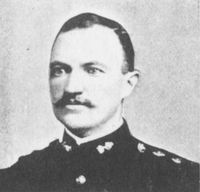
Capt. A. Hensley. Killed at Venter's Spruit.
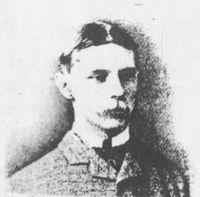
Lieut.-colonel Sitwell. Killed at Hart's Hill.
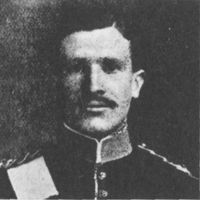
Capt. Maitland. (Gordon Highlanders, attached) Killed at Hart's Hill.
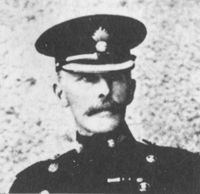
Major F. P. English. Wounded at Venter's Spruit and Zuikerbosch.
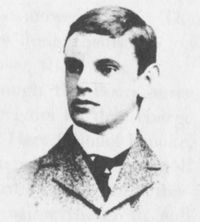
Second Lieut. Dennis. Wounded at Hart's Hill. Died of Enteric at Aliwal North.
Casualties at Tugela Heights (continued).
The sun had set, and the light was already failing by the time that the four companies of the left half-battalion had come up, principally on the left of the Inniskilling Fusiliers. Then the signal to charge was given, and the whole line rose up, and with a yell dashed forward. But it was met by a murderous fire. In the gathering darkness the Boer trenches quivered with the rifle-flashes, and the bullets struck out sparks as they hit the rocks. At such a short range the enemy's marksmen could hardly miss, and the line of charging infantry was almost mowed down. The assault was checked, and the attackers flung themselves on the ground and sought what little cover there was.
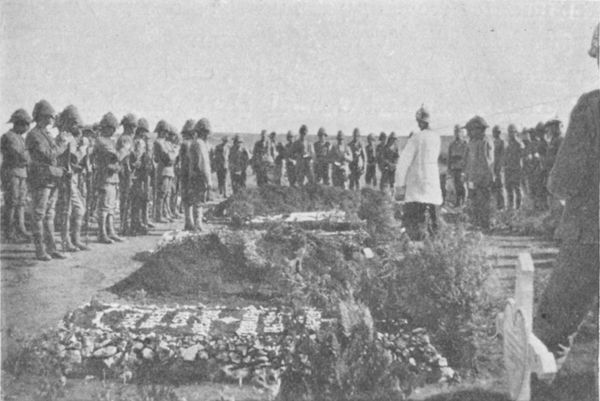
After the Fight.
Luckily night intervened, and, although the Boers never for a moment ceased their fire, the survivors of that charge managed to creep back to the crest. Here Colonel Brooke, of the Connaught Rangers, and Lieutenant-Colonel Sitwell collected them, and took steps to guard against a counter-attack. A low stone wall was built below the crest, and behind this the night was spent.
It was very dark, and the ground, covered with boulders, most difficult to move over. Wounded men lay all over the hill, but there were no doctors, no stretcher-bearers, and no water. It was impossible to help or to move them. Their groans, combined with the intermittent rifle-fire, made sleep difficult.
We had three officers wounded (Lieutenants Lane, Hill, and Dennis), and some twenty casualties. Lieutenant Hill was again hit as he lay, and subsequently lost his foot in consequence.
The infantry crouching behind the stone wall were unable to communicate with the rest of the army. At dawn, however, Major McGrigor, the Brigade-Major, came up to the line and told Colonel Brooke that General Hart wished him to hold on to his position, to which reinforcements would be sent. Colonel Brooke explained that food and water would have to be sent also, and, above all, that his left must be protected. Having promised to do what he could, Major McGrigor returned to his General. With daylight the battle recommenced. The Boers, from their trenches on Hart's and Railway Hills, kept up a vigorous rifle-fire, and were answered as far as possible by the men of the 5th Brigade behind the wall. Our artillery shelled Hart's Hill, and many of their shrapnel which burst short hit the unlucky wounded who were still lying on the plateau.
But the Boers were not content to remain on the defensive. Gradually their skirmishers worked round the left of the hill, moving by the dongas which ran down to the railway line, and were able to fire up into the rear of the defenders of the wall. Part of the latter were extended at right angles to the wall, and endeavoured to drive off the enemy. But the Boers had excellent cover, whereas the infantry crowded together on the hill presented an easy target. Casualties became numerous. The morning wore on, and there were no signs of the promised reinforcements or of the much-needed water and food. It seemed useless to stay on the hill, and about 8 a.m. Colonel Brooke gave the order to retire. As the men rose to their feet and ran down the hill, the rattle of the Boer musketry increased in volume, and the bullets whistled among the retreating soldiers. Lieut.-Colonel Sitwell was killed as he descended the slope, and Captain Maitland, of the Gordon Highlanders, who had been in command of 'G' company since November, was mortally wounded almost at the same time. Luckily, the distance was not very great, and once over the railway line the stream of bullets ceased.
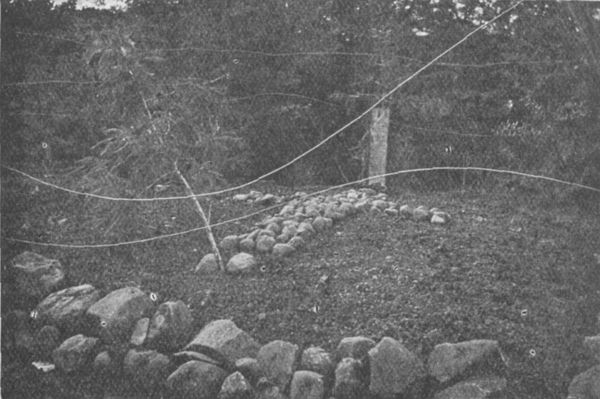
The Grave of Colonel Sitwell and Captain Maitland, Gordon Highlanders (attached), near Railway at Pieter's Hill.
Lieut.-Colonel Sitwell's loss was severely felt. Though he had only recently joined us, he had given numerous proofs of his soldierly ability. He had the benefit of considerable previous war service, and had he lived would doubtless have risen to high rank. Captain Maitland, Gordon Highlanders, had been unable to join his regiment in Ladysmith, and had been attached to the battalion since Estcourt. Over and over again he had proved himself to be a most gallant soldier, and had endeared himself to all his temporary comrades (see Appendix). He commanded 'G' company, which was most unfortunate in respect of its commanders, having no less than six during the war. Colour-Sergeant Connell, however, than whom no braver man lives, was with it throughout.
As the retiring infantry climbed up the slope of Hart's Hollow they met the advancing lines of the 4th Brigade, who had been sent to reinforce the 5th. The latter quickly re-formed—there were not many of the Inniskilling Fusiliers left to re-form—and were able to obtain food after a fast of nearly twenty-four hours.
The right half-battalion, under Major English, had, during the assault of Hart's Hill, watched the right flank towards Pieter's Hill. General Hart proposed that they should attack the Boers in that quarter, but Colonel Cooper, who was with the right half-battalion, pointed out that the day was too far advanced. The right half-battalion spent the night of the 23rd-24th February among the rocks on the hill whence General Hart had directed the attack. About 8 a.m. on February 24th, 'B' company was sent to drive off small parties of the enemy who had crept down the dongas and reached the railway on the left. This company came under a severe fire, and Lieutenant Brodhurst Hill was wounded in the leg, but the Boers were driven back. The 24th was spent in a ceaseless rifle-duel with the enemy, who had brought a gun to bear on the hill. During the afternoon, preparations were made for a fresh attack on Hart's Hill, to be undertaken by Colonel Cooper with two battalions, while General Hart, with the remainder of the force at hand, assaulted Railway Hill. The attack was, however, postponed.
The enemy evidently feared another assault, for in the course of the night of February 24th-25th, they opened a vigorous fire, which disturbed the slumbers of General Hart's force, and created some excitement.
During all this time the unlucky wounded, who had been hit on the 23rd, had been left lying in front of the Boer trenches. It was impossible to help them, since all attempts in that direction had been frustrated by the enemy. But on the morning of Sunday, February 25th, a partial armistice was agreed upon in order to bring in the wounded and to bury the dead. The armistice ended at 6 p.m., and both sides commenced firing immediately afterwards.
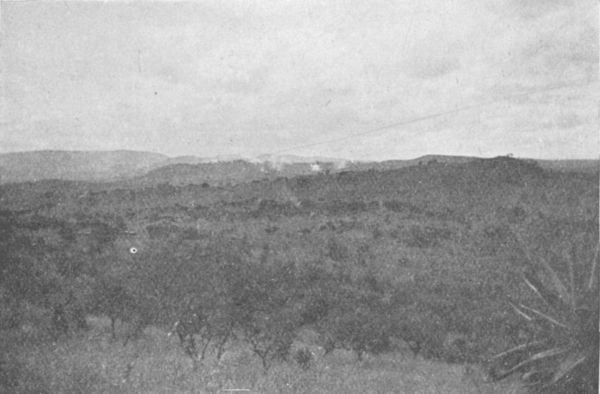
Pieter's Hill. February 27th, 1900.
Meanwhile, Sir Redvers Buller had evolved a new plan of operations, and decided to attack with his combined force the three hills—Pieter's, Railway, and Hart's. For this purpose the greater part of the artillery was brought from the left bank and concentrated on the right bank, opposite the points to be assaulted. It was in position by the 26th, and began a slow bombardment of the Boer trenches. During the night, the pontoon bridge under Hlangwane was dismantled, and carried down to a point below the Boer bridge, where it was relaid, an operation which was not concluded until 10 a.m. on the 27th.
On the day before, the Dublin Fusiliers had been ordered to join temporarily General Barton's Brigade. It left its position among the rocks of Hart's Hollow about 7 a.m. on February 27th, and, moving down the hill through the deserted Boer laager, halted by the pontoon bridge. Here it was joined soon after 9 a.m. by the Irish and Scots Fusiliers, and came under the command of General Barton.
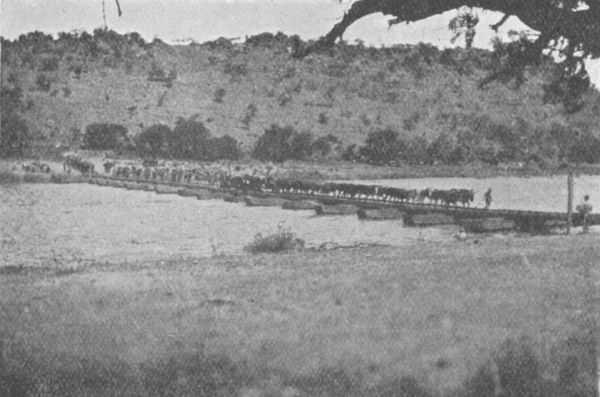
Pontoon Bridge, River Tugela. February 28th, 1900.
The battalion followed the Scots Fusiliers, and moved along the left bank of the Tugela at the foot of a steep ridge, being covered by infantry and maxim fire from the right bank.
After a march of two miles, and at the point where the Klip River joins the Tugela, the 6th Brigade turned to its left and prepared to attack the Boer position, which, lying some two miles from the river, stretched from the ridges north of Eagle's Nest to the various kopjes constituting Pieter's Hill. General Barton directed the Royal Irish Fusiliers to assault the western end of Pieter's Hill and the Scots Fusiliers the eastern, while the 2nd Royal Dublin Fusiliers formed the reserve.
The assault was successful, and the greater part of Pieter's Hill fell into our hands, but the Boers still held a kopje to the north of the hill, and maintained a heavy fire. General Barton, anxious to complete his victory, directed three companies of the battalion and one company of the Scots Fusiliers to advance against the kopje. 'B,' 'C,' and 'H' were the three companies selected, the first named being on the right and the latter on the left, connecting with the Scots Fusiliers. Guided by Captain MacBean, Royal Dublin Fusiliers, Brigade-Major 6th Brigade, the detachment advanced about 2.30 p.m., and came at once under a heavy rifle and pompom fire. The companies pushed forward, however, by successive rushes until they reached a donga some three hundred yards from the kopje. Here further progress was checked for a time, and General Barton ordered forward three companies of the Royal Irish Fusiliers. The latter came up about 5.30 p.m., and, supported by the covering fire of 'B,' 'C,' and 'H' companies, rushed the left of the hill, when the above-mentioned companies of the battalion, led by Captain Venour, assaulted the right. The attack was successful, and the kopje was captured.
During the advance Lieutenants Haskard and Bradford, in command of 'C' and 'H' companies, were wounded, and the engagement cost the regiment nine killed and forty-three wounded. 'D' company, under Lieutenant Ely, towards the close of the afternoon came up on the left of 'H' company, in order to fill the gap between the latter and the Scots Fusiliers.
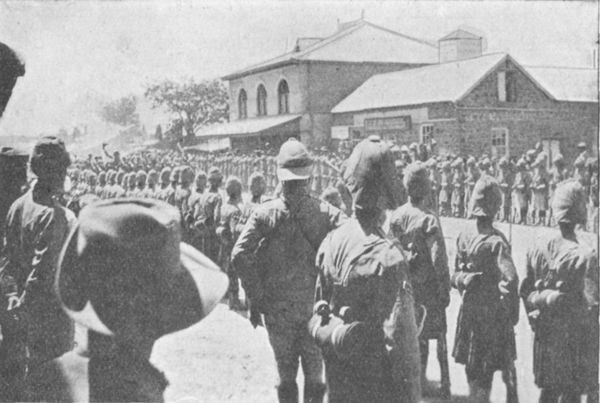
2nd Royal Dublin Fusiliers, heading Relief Troops, marching into Ladysmith, March, 1900.
The three companies which had made their attack on the kopje spent the night on the captured position. Captain Venour, who was the senior officer present, re-formed the men of the Irish and Dublin Fusiliers, and constructed sangars, with a view of warding off a Boer counter-attack. In the meantime 'A,' 'E,' 'F,' and 'G' companies—with whom was Colonel Cooper—were directed to the right, in order to guard the flank of the brigade against the Eagle's Nest position. These companies gained about 2 p.m. a ridge opposite the Eagle's Nest, and overlooking the extensive plain which stretches up to Bulwana Mountain. The enemy opened a well-aimed fire on this ridge, and also brought into action a gun which was placed on the shoulder to the north of the Nest. As the right of the four companies was thrown back towards the Tugela, this Boer gun could nearly enfilade part of the line. Sangars were built, however, and there were not more than three or four casualties in this part of the field. The firing ceased at dusk, but otherwise the night was unpleasant, for it rained, and the waggons could not get near the fighting line, so that the men had to do without their great-coats.
Before daybreak on February 28th the battalion collected its scattered companies and was ready for action. There was no reliable news of what had happened on other parts of the field during the 27th, and the full extent of the victory was still unknown. When daylight came it was evident that the Boers had evacuated the Eagle's Nest, and small parties of them could be seen retiring, while the tents of their laager under Bulwana were gradually diminishing. But even then few could believe that the relief of Ladysmith was practically accomplished.
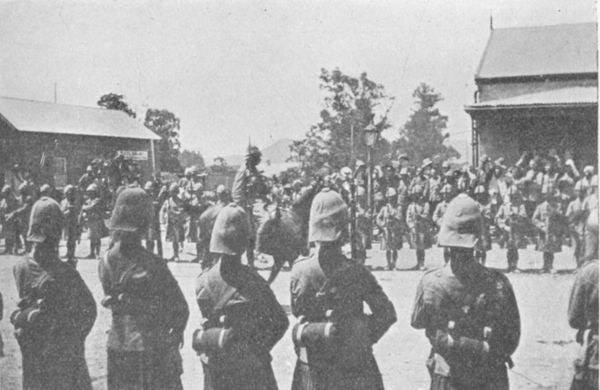
General Sir Redvers Buller, V.C., entering Ladysmith.
Before mid-day an order came, directing the Dublin Fusiliers to move after dinner and join the 11th Brigade, the position of which was not indicated. Major English rode on ahead in order to discover its whereabouts, but by the time he found it, the battalion had gone two miles out of its way. The 11th Brigade was joined about 4 p.m., and the regiment bivouacked between Hart's and Railway Hills. A heavy thunderstorm burst over the country soon after 8 p.m., and made everybody somewhat miserable, although the officers had been cheered by the arrival of the invaluable Corporal Tierney, who, as usual, succeeded in giving them food.
The services of this N.C.O. (now Mess-Sergeant) will never be forgotten by the regiment, as long as an officer who was present with it in South Africa remains in it. Over and over again he brought up food to the officers under heavy fire, and through those desperate thunderstorms. Always cheery, ever ready, there he was in his shirt-sleeves, with a drink and a snack, just as one had resigned oneself to going without anything. A word must also be said in praise of our French chef, M. Burst, who cooked for the officer's mess throughout, and proved himself on all occasions a brave man.
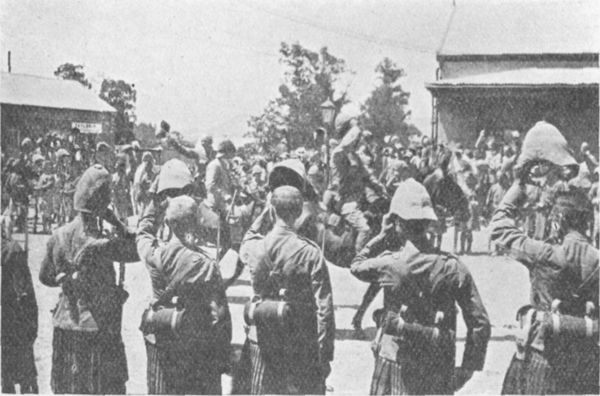
The Dublins are coming—Ladysmith.
After breakfast on March 1st, the 11th Brigade advanced along the railway towards Ladysmith. It was thought that the Boers would be holding Bulwana, and the brigade had orders to attack the hill. But it was soon learnt that the enemy had retired, and we eventually reached Nelthorpe Station about mid-day and bivouacked. Major English and Captain Venour took the opportunity of riding into Ladysmith.
March 2nd was spent at Nelthorpe. On the 3rd, Sir Redvers Buller's army entered Ladysmith, and the honour of leading the army fell to the 2nd Battalion Royal Dublin Fusiliers—an honour which nobody grudged them, on account of the constant fighting they had taken part in since the beginning of the war, and the heavy casualties they had suffered. The route was by the railway bridge, and the streets of the little town were lined by the garrison, who, emaciated but clean, presented a startling contrast to their war-stained relievers.
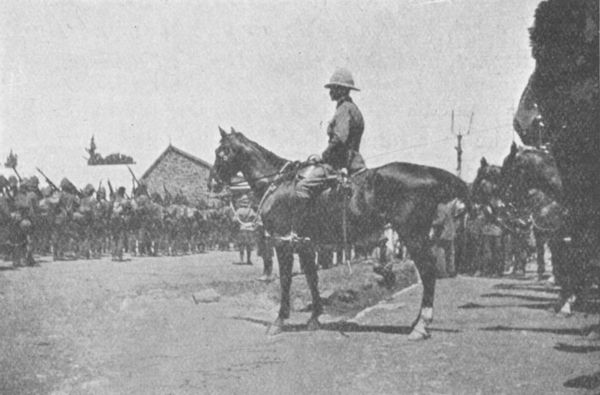
Sir George White watching Relief Force entering Ladysmith.
The entry into Ladysmith, with its enthusiasm and meeting of old friends, formed a fitting ending to the battalion's Natal campaign. Hardly any other unit in the army had suffered such casualties. Only five company officers marched through Ladysmith with it. The others had been killed, wounded, or disabled.[Back to Contents]
CHAPTER IX. THE SIEGE OF LADYSMITH.
'I am shut up.'—Ps. lxxxviii. 8 and Jer. xxxvi. 5.
Chronicle of the part taken by the detachment 2nd Battalion Royal Dublin Fusiliers in the Siege of Ladysmith from November 1st, 1899, to February 28th, 1900. By Lieut. L. F. Renny, 2nd Batt. Royal Dublin Fusiliers.
The detachment which was left behind in Ladysmith when the battalion was ordered to Colenso consisted of two officers, three non-commissioned officers and fifty-one men. The latter were made up by a section of 'G' company which was left on piquet because they could not be relieved in time, and the men of the regimental transport, which had been left behind owing to there being no facility for sending the waggons and animals by train with the battalion.
The morning after the departure of the latter I was ordered by the D.A.A.G. of the divisional troops to proceed to the various camps in Section A, and find convenient space for the transport waggons. I found the necessary ground in rear of the camp of the 1st Battalion Gloucester Regiment, behind the railway cutting leading to the Orange Free State Junction. Here we were joined in the afternoon by Lieutenant H. W. Higginson, who took command, and the section of 'G' company, when the Gloucesters helped us in every way, and made us as comfortable as they possibly could. All that day we were left in comparative peace, there being no firing on either side; but the next morning about 5 a.m. the Boers opened with 'Long Tom' from Pepworth Hill, and commenced a duel of some hour's duration with our naval 4·7, which was placed on Junction Hill. They also kept up a continual cannonade with their long-range twelve-pounders, but did little or no damage, as they had not yet discovered the exact location of our camps.
For the next three or four days we remained in the Gloucester's camp and aided in starting the trenches which eventually formed the fort known as 'Tunnel Hill.' This was by no means pleasant work, as it was carried out under fire, the enemy being very quick at spotting our working parties and remarkably so at obtaining our range. We used to watch with great interest the duel every morning between the two big guns. Once the Boers hoisted a large white flag over their epaulement and proceeded to repair some small damage to their gun—they have very weird ideas about the white flag.
On November 7th our detachment was suddenly ordered to proceed to 'Bell's Spruit,' and form the guard there. I was ordered to hand over our transport to the Army Service Corps, so we took away the majority of the men and brought the strength of our piquet up to thirty-one men; the transport was sent to the railway station yard for the use of the Army Service Corps, where it remained throughout the siege. We were stationed at the mouth of the spruit just where it runs through the ridge opposite the cemetery. Our fortifications consisted of a thick wall with sandbag loopholes running right across the spruit; about fifty yards in front were strips of high and low wire entanglement, making it practically impossible for the enemy to rush the post at night. By night we had to man two sangars placed on the hills on each side of the spruit. I know nothing more productive of bad language than visiting the sentries on those hills in the dark, scrambling over the hugest boulders up a hill like the side of a house. We were not very comfortable at first, there being absolutely no shelter from sun or rain, but after about a week we managed to obtain a couple of railway tarpaulins, and rigged up shelters on the sides of the spruit. We were all very lucky in not getting hit, as the enemy had a nasty habit of bursting shrapnel over the place and sending common shell on to the crests, which produced a shower of rocks, splinters and stones; but although we were in the spruit for seven weeks with absolutely no cover, not a man in the detachment was hit. During our stay in the spruit our rations were exceptionally good, as we got extras in the way of bacon, jam, chocolate, &c.
The night-work at this time was very hard, as everybody not actually on outpost duty had to work at the trenches from 6.30 in the evening till 3 a.m. the next morning. Sleep being impossible in the day-time owing to the heat and a plague of flies, this continual night-work told on the men severely. On November 9th the enemy made a feeble attempt at capturing the place, and came on in considerable numbers against Observation Hill, but were easily repulsed. On the night of December 7th-8th an attack was made on Gun Hill, where the Boers had a 'Long Tom' and a five-inch howitzer, besides one or two small guns. These guns had been annoying us very greatly for the past three weeks, and we were all delighted in the early morning when we heard the attack had been successful, and the guns blown up. We none of us knew anything about this affair till it was over. I was visiting our posts about 2.30 a.m. when I saw two large flashes on Gun Hill; on listening I could not hear any shells travelling or bursting, so concluded the enemy were amusing themselves by firing blank charges. It was not till we saw our column returning at dawn that we solved the problem. We found the spruit very unpleasant in wet weather, as the water used to come down like a mountain torrent and wash away bits of our wall and shelters; after wet nights we used to spend our time in digging our belongings out of the sand, having spent the night sitting on the rocks.
About December 18th, after the failure of General Buller's first attempt to relieve us, there was a general interchange of posts amongst the troops of our section, and the detachment received orders to proceed to the Newcastle Road examining guard. We were all heartily sick of the spruit, and glad of the change. It was about this time that our rations began to be diminished, and we had completely run out of all extras. The post of the examining guard was on the road just inside the ridge which formed our general line of defence, but by night we moved out as a piquet about half a mile on to the veld into a spruit which ran under the Harrismith line, whence we patrolled out to Brooke's Farm, and the surrounding country. I think this was the worst post we had throughout the siege, as we came in for a long spell of wet weather, and night after night had to lie out on the open veld from 8 p.m. till 4 a.m., wet to the skin and miserably cold. The duties on this post came very hard on our men, as we had to find a double and single sentry by day, so that they never got a night in bed, and only about one day in three off duty.
On Christmas Eve the men came into possession of a fine pig, so that we all had pork for our Christmas dinner, a great change from eternal 'trek ox,' but unfortunately nothing stronger to drink than tea. I'm sure it was the first Christmas any of us had spent in such an uncongenial way.
On January 6th the enemy made their desperate attack on Waggon Hill and Caesar's Camp. They seem to have completely surprised our outposts, as they succeeded in crawling up the hill in the dark, and the fighting commenced at 3 a.m. The cannonade all day was something tremendous, 'Long Tom' firing 125 rounds. They kept us pretty busy on our side of the defences as well, but never developed any serious attack. Whilst on this post we were subjected to a continuous and daily course of sniping, the enemy getting on the kopjes behind Brooke's Farm, and firing all day at a range of 2800 yards. At this range the bullets used to whiz over the hill and drop amongst us, although we were only a few yards behind the crest. Higginson and I used to spend hours lying on the crest with rifles and glasses trying to spot them, but never succeeded in doing so, as they used to take up their position before dawn and never move all day.
It was about this time that our men began to show the effects of exposure and constant sentry-go, and several of them went down with fever and rheumatism; but we were extremely lucky throughout the siege, having only one casualty: Private Ward, 'G' company, a reservist, who died of enteric at Intombi Camp.
I forgot to mention that on January 6th our section had to be entirely denuded of supports and reserves in order that they might be sent to Waggon Hill, so that if the enemy had attacked us seriously we should have had a hard job to keep them back.
On January 25th the detachment was ordered to garrison Liverpool Castle, a fort overlooking the Newcastle Road, but we had not been there twelve hours before we were ordered to Tunnel Hill. This latter post consisted of a large main fort capable of holding two hundred men, and two small works about a quarter of a mile on each flank, in all of which we had to find a guard. Our fighting strength was at this time reduced to twenty-seven men, so that they did guard and patrol alternate nights. We had to send out five of the latter during the night about half a mile to the front and a mile laterally along the valley. The confinement in this fort was rather trying, and the eternal manning of the trenches at 4 a.m. very monotonous. After about three weeks on this post I was suddenly seized with a 'go' of fever, and was sent down to a room in one of the houses. When I rejoined the detachment, after a fortnight on the sick list, they had moved to the railway station as guard over the bridge across the Klip River. Here we had to endure rather a severe dose of 'Long Tom'—this gun never missed a day without dropping shells into and round the station, it was one of its favourite spots, and all the tin buildings about bore evidence of its attentions. One shell, pitching in the parcels office, blew the roof off and the floor in, having first penetrated half-a-dozen walls to get there. We had trenches on our side of the river, which we manned, as usual, at 4 a.m. We also had to man them in the afternoon about 5 o'clock, when the train from Intombi Camp was due. This used to be rather a comic proceeding: a 'key' was made in the line about half a mile outside the station, where the train was brought to a standstill, then either Higginson or myself had to walk out and inspect the train to see there were no Boers inside it. We often used to wonder what would have been our lot if the train had been full of them. On our reporting 'all correct' to the Railway Staff Officer (Captain Young, R.E.), the train was allowed to proceed into the station, and the little play was over till the next day. This was undoubtedly the most comfortable job we had, as the men lived in a shed, whilst Higginson and I had a railway carriage.
On the afternoon of February 28th we heard the joyful tidings of General Buller's victory at Pieter's Hill, and in the evening descried Lord Dundonald and his men crossing the plain; our wild excitement may be left to the imagination. I'm sure we all put on about seven pounds of our lost weight at the mere thought of our being at last relieved. Our troubles were not over yet, however, as the next morning we were ordered back to Tunnel Hill, a spot we had learned to loathe with a truly deep loathing. This move was due to our flying column going out to hurry the enemy's retreat, most of the troops in our section taking part in it. For some unknown reason we were kept four or five days in that smelly fort, and it was not till March 7th that we received orders to rejoin the battalion, which was encamped about two miles out of Ladysmith. We all felt as though we had begun a new life; but it was heartbreaking to see the havoc in our regiment; one had to look about to find faces that one recognised.
Our rations were pretty well reduced towards the end of the siege: one biscuit, one pound of horseflesh, two teaspoonfuls of sugar, and a pinch of tea is not much to keep body and soul together, and we were all pretty feeble and pulled down. I think we must have done the record piquet duty of any men in any service, as we were never relieved throughout the whole siege; I suppose this was on account of being left as a separate unit all through, but we certainly thought it rather hard work. It is a wonder that our little detachment stuck out four months' constant exposure with so little sickness, whilst our luck in sitting under that constant shelling without a man being hit was nothing short of providential.
I have merely chronicled the chief moves and duties of the detachment throughout the siege: it would take a small book to set down all our little experiences, details, and troubles.[Back to Contents]
CHAPTER X. ALIWAL NORTH AND FOURTEEN STREAMS.
'But thus much is certain: that he that commands the sea is at great liberty, and may take as much, and as little of the war, as he wish.' Bacon.
After marching through Ladysmith, the battalion proceeded with the 11th Brigade to a camp about three miles to the north of the town and on the left bank of the Klip River. It remained here until March 7th, when it rejoined the 5th Brigade, which was encamped on the south side of the Klip River, and about one mile nearer Ladysmith. On the same date, Colonel Cooper was given the command of the 4th Brigade, and accordingly handed over the battalion to Major Bird.
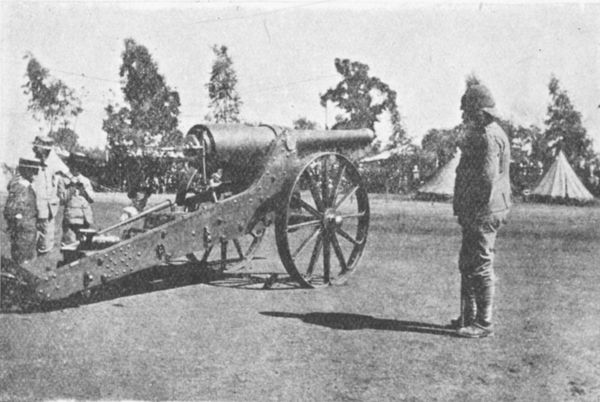
Sergeant Davis in Meditation over 'Long Cecil' at Kimberley. 'Shall I take it for the Officers?'
There was another change of camping-ground on March 12th, the brigade moving to the north-east of Ladysmith, under Surprise Hill. It was an uneventful time, although outpost duties were somewhat severe.
In recognition of the gallantry displayed by the Irish regiments in the Natal campaign, the Queen had directed that the shamrock should be worn by all ranks on St. Patrick's Day. Accordingly, on March 17th, every man wore a piece of green, since shamrock was unobtainable, and the tents were decorated with boughs. A telegram was dispatched to the Queen, who sent the following message in reply:—
'The Queen desires to thank her Dublin Fusiliers for their expression of loyalty.'
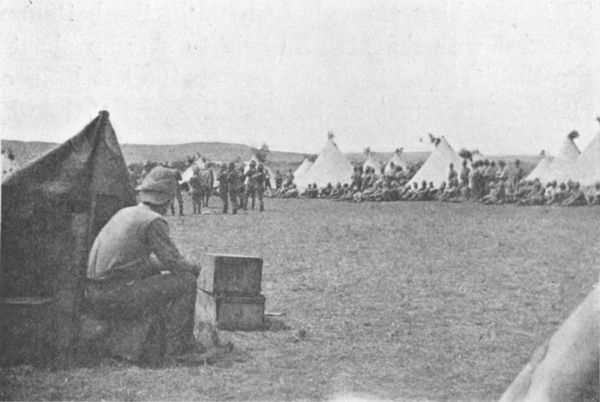
St. Patrick's Day in Camp. Private Monaghan, the regimental Butcher, in foreground.
The battalion also received many congratulatory telegrams from Irish associations and individuals in various parts of the world.
The detachment of the 1st Battalion was sent back to Colenso on March 21st. It had been just over four months with the 2nd Battalion, and had borne its full share of the casualties. Originally numbering eight officers and 287 rank and file, it returned with only two officers and 92 rank and file.
The 5th Brigade moved on the 23rd to Modderspruit, and thence on the next day to Elandslaagte, where it encamped a short distance to the west of the battlefield. Here it stayed for ten days, and, as there was little to do beyond outpost work, the battalion resumed ordinary parades and route marching.
On April 4th, General Warren's Division relieved General Hunter's at Elandslaagte, and the brigade marched back to Modderspruit. The 10th Division (General Hunter), which consisted of the 5th and 6th Brigades, was to proceed to Cape Colony for the relief of Mafeking.
On April 7th, Major Tempest Hicks, 1st Battalion Royal Dublin Fusiliers, arrived from Colenso, and assumed command of the battalion. The 5th Brigade began to move by train to Durban on the 9th, and we were ordered to entrain at 1.45 p.m. on the 10th. But during the morning, heavy firing broke out at Elandslaagte, and, as the enemy seemed aggressive, the troops at Modderspruit were directed to be ready to move to Elandslaagte.
We had struck camp and packed all the baggage in the train, and had, therefore, to lie out in the hot sun for several hours, and await with patience the development of events. The Boers apparently contented themselves by a demonstration, and at 6 p.m. the battalion was allowed to depart. The train reached Colenso at 9 p.m., where the 1st Battalion was encamped, and Maritzburg about 4 a.m. Here, in spite of the early hour, a number of friends, together with a band, were on the platform, and the regiment received a warm greeting. The men were given cigarettes and tobacco.
Durban was reached about 10 a.m. on April 11th, and the battalion at once commenced to embark. The headquarters and about six companies were carried by the Cephalonia, while the remaining two companies went in the Jamaica. They were both slow ships, but the absolute peace, the good food, the clean baths, and many other luxuries, made everybody regret that they were not even slower.
Lieutenant Le Mesurier, who had been captured on October 20th, but had, with Captain Haldane (Gordon Highlanders), effected a plucky escape from Pretoria, rejoined us at East London. Unluckily he at once developed typhoid fever, and had to be left behind.
Aliwal North was not reached until 10.30 a.m. on April 16th. 'H' company had arrived the previous afternoon, and was encamped near the station, but the remainder of the battalion crossed the Orange River, and pitched camp about 600 yards from the bridge, with its outpost line pushed forward on the high ground to the north.
Major Hicks became commandant of Aliwal North, and had no easy task. The town was General Hart's base during the operations for the relief of Wepener, and there was consequently much to be done. Moreover, the surrounding country was disturbed, the Dutch population had to be watched, and there were constant rumours of the approach of commandoes. In the early hours of the 21st, a report reached the commandant that a large body of Boers was marching on the town. He therefore decided to bring the regiment back to the south side of the river, only leaving the piquets on the north bank. We therefore at once struck camp, and, crossing the river, bivouacked near the bridge. But as the report proved to be misleading, camp was re-pitched on a square in the middle of Aliwal North. The outskirts of the town were put into a state of defence, and a series of trenches covered the approaches to the bridge. Although this necessitated much labour, everybody enjoyed their stay at Aliwal. It was a pretty place, with trees and gardens full of roses, with plenty of water, including a hot stream running through the camp, with a well-stocked library, and lastly, but by no means leastly, with a hotel possessing excellent lager beer.
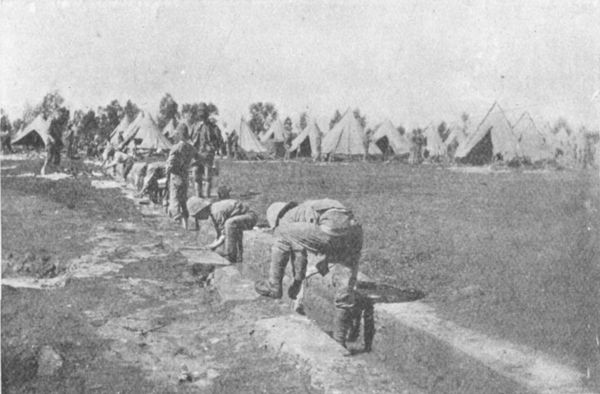
A Wash in hot Water. Aliwal North.
The time passed, in fact, too quickly, for on the 26th news was received of the relief of Wepener, and orders were issued for our movement to Kimberley. We started at once in two trains, the first leaving at midnight the second at 1 a.m. on the 27th. It was a long and monotonous journey, the only breaks in which were stops for the purpose of cooking meals. Kimberley was reached at 10 p.m. on the 28th, and the train stopped the night in the station, going on at 6 a.m. on the 29th to Doornfield, about eight miles north of Kimberley, where the Connaught Rangers and the 6th Brigade were already encamped. Since General Hart, with the Borders and Somersetshire Light Infantry were still near Wepener, Colonel Brooke assumed the command of the brigade.
General Hunter's division had been ordered to relieve Mafeking, and the General decided to cross the Vaal near Windsorton with the 6th Brigade, and to advance up the right bank; while General Paget with the Royal Munster Fusiliers, Connaught Rangers, and Royal Dublin Fusiliers, faced the Boer position at Fourteen Streams. Colonel Mahon's mounted column was to move by Barkley West, and reach Mafeking by sweeping round the Boer flank.
The battalion accordingly left Doornfield by train at 9 a.m. on May 2nd, and about mid-day reached Content, where it detrained and encamped. The next day it marched with the Connaught Rangers to a position about two miles south of Warrenton. The opposite bank of the Vaal was held by the Boers, who were strongly entrenched and had field-guns. On the south bank of the Vaal were the Munster Fusiliers, a battery of field artillery, a six-inch gun mounted on a railway truck, and a balloon, the whole detachment being under Major-General Paget.
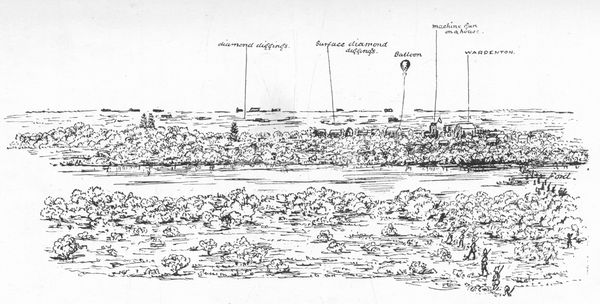
Taking XIV STREAMS on 7th May 1900 at 9.30 a.m. very bad ford. From a sketch by Col. H. Tempest Hicks, C.B.
As all tents had been left at Content, the regiment bivouacked, and remained more or less idle. The Munsters were holding Warrenton, and there was constant sniping between their posts and the Boer trenches. The balloon ascended daily, and the six-inch gun fired an occasional shot, while the enemy's field-guns came into action at intervals. It was a monotonous and unpleasant time for the Connaught Rangers and ourselves, since there was nothing to do, while it was very hot by day and cold by night.
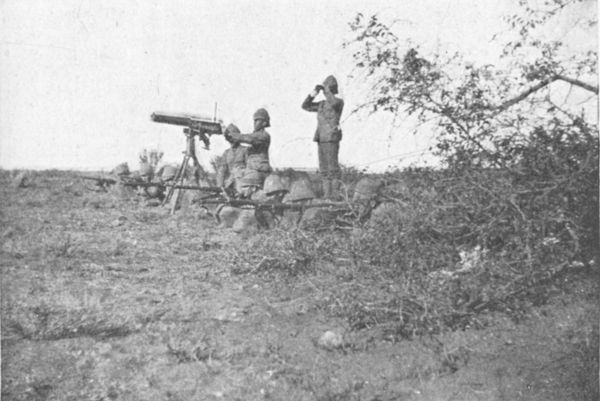
The regimental Maxim in Action at Fourteen Streams.
A little excitement was afforded on May 6th, when the Connaught Rangers and half the battalion made a demonstration against a drift to the east of Fourteen Streams. The object apparently was to draw the Boers' attention from the 6th Brigade, who, after a victory at Rooi Dam, were moving up the right bank. The movement caused a slight amount of sniping, and the detachment returned to the bivouac soon after 2 p.m.
The approach of the 6th Brigade, aided, perhaps, by this demonstration, caused the enemy to evacuate hurriedly their trenches during the afternoon of the 6th. Early on the morning of the 7th, the Connaught Rangers and the right half-battalion started to ford the Vaal at Warrenton.
The river at this point was broad and swift. The ford was a difficult one, being beset by rocks and holes, and it took a considerable time for the column to cross, since the water was up to the men's waists. The left half-battalion under Major Bird moved one and a half miles up the river near Fourteen Streams, where there was a ferry-boat. The latter had been rendered useless by the Boers, but as they had left the wire hawser, it was easy for the Royal Engineers to construct a raft, on which the left half-battalion crossed comfortably and quickly.
The right half-battalion joined the left half at the ferry, and breakfasts were cooked. Before leaving the river-bank everybody made an inspection of the Boer trenches, which formed an exceedingly strong position. They were very deep, and so well adapted to the ground, that it was no easy matter to discover them from the opposite bank. Evidences of the hurried Boer retreat were plentiful in the shape of full ammunition-boxes, half-cooked food, blankets, and kettles. One Boer, who was too ill to march, was captured in the trenches.
After breakfasts, the battalion moved through a piece of ground thickly covered with bush, and eventually bivouacked about one mile from the Vaal, near the railway line. The 6th Brigade halted near the same place, and the whole force was occupied for the next fortnight in covering Fourteen Streams. The important railway bridge at this point had been destroyed by the Boers, and the Royal Engineers, aided by large working parties from the infantry, at once commenced to construct a deviation bridge. This necessitated a great amount of labour, and since, in addition, defensive works had to be made, we were all kept very busy.
The stay at Fourteen Streams was interrupted on May 15th by a movement on Christiana, a town in the Transvaal, reported to be held by a strong party of Boers. The whole of the 10th Division took part in the operations, and were thus the first regular troops to enter the Transvaal. The frontier was crossed at 9 a.m. The advance was through an undulating country, at times thickly covered by bush. Towards the afternoon the brigade halted, as news was received that the mounted troops had entered Christiana. A bivouac was formed in a clearing among the bush, and dinners were cooked.
The next day the brigade marched back to Fourteen Streams, and reached that place early on May 17th, having done some twenty-six miles in nineteen hours. Work on the railway bridge was resumed, and, as the 6th Brigade had not returned, the battalion had to watch a more extensive area. Each company was given a section, and constructed a redoubt.
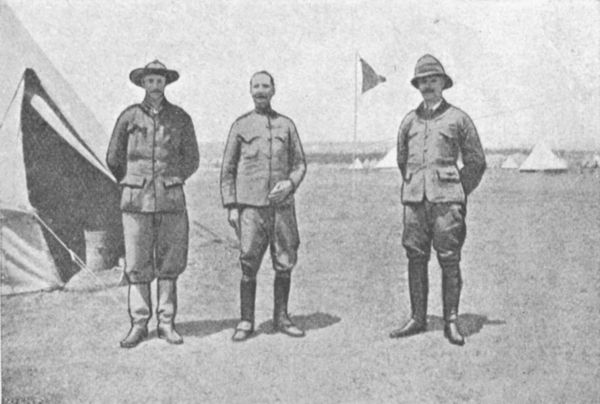
Captain Jervis, General Fitzroy Hart, C.B., C.M.G., and Captain Arthur Hart.
About May 24th, Second Lieutenant Bradford, with twenty-nine men, was sent up the line to garrison Border Siding, where they were picked up three days later.
The deviation bridge over the Vaal having been completed, the battalion was sent forward by train to Vryburg, travelling in two trains. Camp was pitched just outside the station, and for the next two days every one spent their time in buying karosses and in shooting partridges.
The 10th Division, when Mafeking had been relieved by Colonel Mahon, was ordered to march to Johannesburg viâ Lichtenburg. As the first part of the route lay through a country very deficient in water, the division marched in several columns, which followed each other at a day's interval. The battalion left Vryburg on May 30th at 7.30 a.m., and proceeded to Devondale, and on the next day made a march of twenty-two miles to Dornbult, where Captain Mainwaring, with Second Lieutenants Newton and Smith, joined.
Their wanderings before they succeeded in doing so are sufficient evidence how little was known, even to our own staff officers of the whereabouts of the several columns. On arrival at Cape Town in the s.s. Oratava, they were transhipped to the s.s. Ranee and sent to Port Elizabeth. On reporting themselves there they were entrained and sent to Bloemfontein. No one there seemed to know where the regiment was, but at that very time the report arrived of the march on Christiana. Captain Mainwaring then met Captain Carington Smith of the regiment, who was at that time serving in Roberts' Horse (which he later on commanded), and as that officer was shortly going north with some men of his corps, it seemed to both that the speediest way to get to the Dublin Fusiliers was for Captain Mainwaring to be attached to Roberts' Horse. An application to that effect was made to the staff and granted, but shortly afterwards the news of the Christiana column's return to the railway came to hand, so the three officers once more entrained, and proceeded viâ De Aar to Kimberley.
Although Captain Carington Smith did not serve with either battalion during the war, it would not be out of place here to mention the great part he took in it. He commenced by serving in Roberts' Horse, and was with them throughout Lord Roberts' advance to Bloemfontein. In the action at Sanna's Post he was shot through the knee, but resolutely refused to be invalided home. His recovery from this severe wound was little short of marvellous, and he actually managed to rejoin the headquarters of his corps in time to share in the entry into Pretoria. Shortly after this he was again shot at Heidelberg, this time through the other knee, and again made a second and equally marvellous recovery. Towards the end of the war he commanded Roberts' Horse, and later on the South African Light Horse, and his trekking during the campaign amounted to no less than 9000 miles.[Back to Contents]
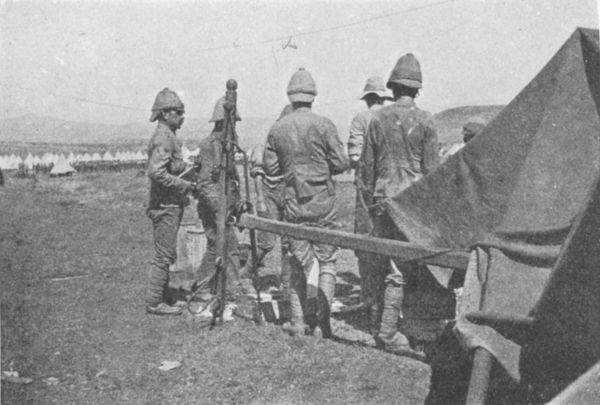
Issuing Queen Victoria's Chocolate. Colour-Sergeant Connel, 'G' Company, on left.