THE LOG BOOM
Reading edition
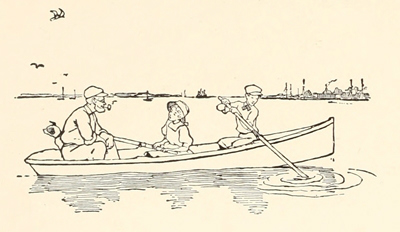
The two children, under the Captain's instruction, learned to row, after a fashion, though the oars of the sharpey were rather heavy for them, and sometimes would catch in the water with disconcerting results. The Captain called it "catching a crab." But it was all great fun, in spite of this.
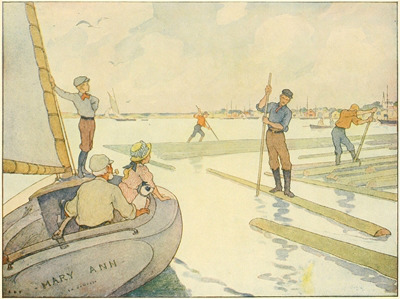
Often Captain Hawes took them sailing in his catboat, the Mary Ann, and one day ran up close to the log "boom" which belonged to the shipyard, and showed them where the lumber came from, for the building of the ship. He explained how it had been cut far up in the back forests and rafted down the rivers to the sea. The great raft was now held in place by a frame of logs outside the others fastened together with "dogs" and chains. Here the children saw the men picking out the special logs they needed, and doing various stunts, paddling and balancing with boathooks. Some would even paddle off to the shipyard on a log, balancing much like a tight-rope walker. But once in a while accidents would happen, and they would get more than wet feet, to the great glee of their comrades.
When the logs reached the shipyard they were sawed into planks by the "whipsawyers," or the machine saws, cut into shape, as they had already seen, by axes and adzes, and fitted to their places in the building of the ship.
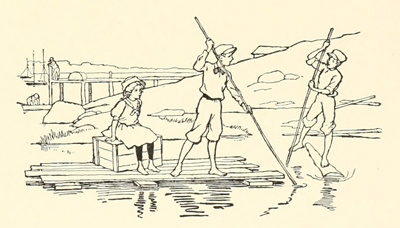
You may be sure the children had to try this game of logging, and they built themselves a raft, of loose boards lying along the beach, and while Betty was the passenger Bob vigorously poled his raft about in the shallows. Patsey Quinn, more ambitious, and used to frequent wettings, boldly imitated the log-men in their balancing feats, not without coming to grief occasionally, though it worried him but little; being in the water to him was much the same as being out of it.
These were busy, happy days for the children; there was always plenty to see or do. Patsey was curious to know about the things of the city, but Bob and Betty felt perfectly sure, at least just now, that the seashore was a much more interesting place.