THE SEAMAN'S FRIEND; CONTAINING A TREATISE ON PRACTICAL SEAMANSHIP, WITH PLATES, A DICTIONARY OF SEA TERMS; CUSTOMS AND USAGES OF THE MERCHANT SERVICE; LAWS RELATING TO THE PRACTICAL DUTIES OF MASTER AND MARINERS.
Reading edition
By R. H. DANA, Jr., AUTHOR OF "TWO YEARS BEFORE THE MAST."
FIFTH EDITION.
BOSTON: PUBLISHED BY THOMAS GROOM. 1847.
Entered, according to Act of Congress, in the year 1841, By R. H. DANA, Jr., in the Clerk's Office of the District Court of Massachusetts.
STEREOTYPED BY GEO. A. & J. CURTIS, NEW-ENGLAND TYPE AND STEREOTYPE FOUNDRY.
Transcriber's Note: Minor typographical errors have been corrected without note. Irregularities and inconsistencies in the text have been retained as printed. The cover of this book was created by the transcriber and is hereby placed in the public domain.
To all sea-faring persons, and especially to those commencing the sea life;—to owners and insurers of vessels;—to judges and practitioners in maritime law;—and to all persons interested in acquainting themselves with the laws, customs, and duties of Seamen;—this work is respectfully dedicated by
THE AUTHOR.
CONTENTS.
PART I.
A PLAIN TREATISE ON PRACTICAL SEAMANSHIP.
CHAP. I.—General Rules and Observations, pages 13—18. Construction of vessels, 13. Tonnage and carriage of merchant vessels, 14. Proportions of spars, 14. Placing the masts, 16. Size of anchors and cables, 16. Lead-lines, 17. Log-line, 17. Ballast and lading, 18.
CHAP. II.—Cutting and fitting Standing Rigging, 19—25. Cutting lower rigging, 19. Fitting lower rigging, 20. Cutting and fitting topmast rigging, 21. Jib, topgallant and royal rigging, 21. Ratling, 23. Standing rigging of the yards, 23. Breast-backstays, 25.
CHAP. III.—Fitting and reeving Running Rigging, 26—29. To reeve a brace, 26. Fore, main, and cross-jack braces, 26. Fore and main topsail braces, 26. Mizzen topsail braces, 27. Fore, main, and mizzen topgallant and royal braces, 27. Halyards, 27. Spanker brails, 28. Tacks, sheets, and clewlines, 28. Reef-tackles, clew-garnets, buntlines, leechlines, bowlines, and slablines, 29.
CHAP. IV.—To rig Masts and Yards, 30—36. Taking in lower masts and bowsprit, 30. To rig a bowsprit, 31. To get the tops over the mast-heads, 31. To send up a topmast, 31. To get on a topmast cap, 32. To rig out a jib-boom, 32. To cross a lower yard, 33. To cross a topsail yard, 33. To send up a topgallant mast, 34. Long, short, and stump topgallant masts, 34. To rig out a flying jib-boom, 34. To cross a topgallant yard, 35. To cross a royal yard, 35. Skysail yards, 35.
CHAP. V.—To send down Masts and Yards, 36—38. To send down a royal yard, 36. To send down a topgallant yard, 37. To send down a topgallant mast, 37. To house a topgallant mast, 37. To send down a topmast, 37. To rig in a jib-boom, 38.
CHAP. VI.—Bending and unbending Sails, 38—42. To bend a course, 38. To bend a topsail by the halyards, 39;—by the buntlines, 40. To bend topgallant sails and royals, 40. To bend a jib, 40. To bend a spanker, 41. To bend a spencer, 41. To unbend a course, 41. To unbend a topsail, 41. To unbend a topgallant sail or royal, 41. To unbend a jib, 41. To send down a topsail or course in a gale of wind, 42. To bend a topsail in a gale of wind, 42. To bend one topsail or course and send down the other at the same time, 42.
CHAP. VII.—Work upon Rigging. Rope, Knots, Splices, Bends, Hitches, 43—53. Yarns, strands, 43. Kinds of rope—cable-laid, hawser-laid, 43. Spunyarn, 44. Worming, parcelling, and service, 44. Short splice, 44. Long splice, 45. Eye splice, 45. Flemish eye, 45. Artificial eye, 46. Cut splice, 46. Grommet, 46. Single and double walls, 46. Matthew Walker, 47. Single and double diamonds, 47. Spritsail sheet knot, 47. Stopper knot, 47. Shroud and French shroud knots, 48. Buoy-rope knot, 48. Turk's head, 48. Two half-hitches, clove hitch, overhand knot, and figure-of-eight, 48. Standing and running bowlines, and bowline upon a bight, 49. Square knot, 49. Timber hitch, rolling hitch, and blackwall hitch, 49. Cat's paw, 50. Sheet bend, fisherman's bend, carrick bend, and bowline bend, 50. Sheep-shank, 50. Selvagee, 50. Marlinspike hitch, 50. To pass a round seizing, 51. Throat seizing, 51. Stopping and nippering, 51. Pointing, 51. Snaking and grafting, 52. Foxes, Spanish foxes, sennit, French sennit, gaskets, 52. To bend a buoy-rope, 52. To pass a shear-lashing, 52.
CHAP. VIII.—Blocks and Purchases, 53—55. Parts of a block, made and morticed blocks, 53. Bull's-eye, dead-eye, sister-block, 53. Snatch-block, tail-blocks, 54. Tackles—whip, gun-tackle, luff-tackle, luff-upon-luff, runner-tackle, watch-tackle, tail-tackle, and burtons, 54.
CHAP. IX.—Making and taking in Sail, 55—67. To loose a sail, 55. To set a course, 55. To set a topsail, 56. To set a topgallant sail or royal, 56. To set a skysail, 56. To set a jib, flying jib, or fore topmast staysail, 56. To set a spanker, 57. To set a spencer, 57. To take in a course, 57. To take in a topsail, 57. To take in a topgallant sail or royal, 58. To take in a skysail, 58. To take in a jib, 58. To take in a spanker, 58. To furl a royal, 59. To furl a topgallant sail, 60. To furl a topsail or course, 60. To furl a jib, 60. To stow a jib in cloth, 61. To reef a topsail, 61. To reef a course, 62. To turn out reefs, 63. To set a topgallant studdingsail, 63. To take in a topgallant studdingsail, 64. To set a topmast studdingsail, 65. To take in a topmast studdingsail, 66. To set a lower studdingsail, 66. To take in a lower studdingsail, 67.
CHAP. X.—General Principles of working a Ship, 68—71. Action of the water upon the rudder; headway, sternway, 68. Action of the wind upon the sails; head sails, after sails, 69. Centre of gravity or rotation, 70. Turning a ship to or from the wind, 70.
CHAP. XI.—Tacking, Wearing, Boxing, &c., 71—77. To tack a ship, 71. To tack without fore-reaching, 73. Tacking against a heavy head sea, 73. Tacking by hauling off all, 73. To trim the yards when close-hauled, 73. Missing stays, 74. Wearing, 74. To wear under courses, under a mainsail, under bare poles, 75. Box-hauling, 75. Short-round, 76. Club-hauling, 76. Drifting in a tide way, 76. Backing and filling in a tide-way, 77. Clubbing in a tide-way, 77.
CHAP. XII.—Gales of Wind, Lying-to, Getting aback, By the Lee, &c., 78—81. Lying-to, 78. Scudding, 79. To heave-to after scudding, 79. Taken aback, 79. Chappelling, 80. Broaching-to, 80. Brought by the lee, 80.
CHAP. XIII.—Accidents, 81—84. On beam-ends, 81. Losing a rudder, 82. A squall, 83. A man overboard, 83. Collision, 84.
CHAP. XIV.—Heaving-to by Counter-bracing, Speaking, Sounding, Heaving the Log, 84—87. Counter-bracing, 84. Speaking, 85. Sounding, 85. Heaving the log, 86.
CHAP. XV.—Coming to Anchor, 87—90. Getting ready for port, 87. Mooring, 88. A flying moor, 89. Clearing hawse, 89. To anchor with a slip-rope, 89. To slip a cable, 90. Coming-to at a slipped cable, 90.
CHAP. XVI.—Getting under Way, 91—95. Unmoor, 91. To get under way from a single anchor, 91. To cat and fish an anchor, 92. To get under way with the wind blowing directly out and riding head to it, 92. To get under way, riding head to the wind, with a rock or shoal close astern, 93. To get under way riding head to wind and tide, and to stand out close-hauled, 93. To get under way wind-rode, with a weather tide, 94. To get under way tide-rode, casting to windward, 94. To get under way tide-rode, wearing round, 94.
A DICTIONARY OF SEA TERMS, 96—130.
PART II.
CUSTOMS AND USAGES OF THE MERCHANT SERVICE.
CHAP. I.—The Master, 131—138. Beginning of the voyage, 131. Shipping the crew, 132. Outfit, provisions, 132. Watches, 133. Navigation, 134. Log-book, observations, 134. Working ship, 135. Day's work, 136. Discipline, 137.
CHAP. II.—The Chief Mate, 138—146. Care of rigging and ship's furniture, 138. Day's work, 139. Working ship, 139. Getting under way, 139. Coming to anchor, 140. Reefing and furling, 140. Duties in port, account of cargo, stowage, 141. Station, watch, and all-hands duties, 142. Log-book, navigation, 145.
CHAP. III.—Second and Third Mates, 146—153. Second Mate.—Navigation, 146. Station; watch duties, 147. Day's work, 147, 149. Working ship, 148, 150. Reefing, furling, and duties aloft, 148. Care of ship's furniture, 151. Stores, 151. Duties in port, 152. Third Mate, 152, 153.
CHAP. IV.—Carpenter, Cook, Steward, &c., 153—158. Carpenter.—Working ship, 153. Seaman's work, helm, duty aloft, station, 154. Work at his trade, 154. Berth and mess, 154. Standing watch, 154. Sailmaker 155. Steward.—Duty in passenger-ships, 156. In other vessels, 156. Relation to master and mate; duty aloft and about decks; working ship, 156. Cook.—Berth, watch and all-hands duty; care of galley; duty aloft, 157. Idlers, 157.
CHAP V.—Able Seamen, 158—163. Grades, 158. Rating, 158. Requisites of an able seaman, 159. Hand, reef, and steer, 159. Work upon rigging, 160. Sailmaking, 160. Day's work, 160. Working ship; reefing; furling, 161. Watch duty, 162. Coasters and small vessels, 162.
CHAP. VI.—Ordinary Seamen, 163—165. Requisites, 163. Hand, reef, and steer; loose, furl, and set sails; reeve rigging, 163. Work upon rigging, 164. Watch duty, 164.
CHAP. VII.—Boys, 165—167. Requisites, wages, 165. Day's work; working ship; duties aloft and about decks, 166.
CHAP. VIII.—Miscellaneous, 167—174. Watches, 167. Calling the watch, 168. Bells, 169. Helm, 170. Answering, 171, (at helm, 170.) Discipline, 172. Stations, 173. Food, sleep, &c., 173.
PART III.
LAWS RELATING TO THE PRACTICAL DUTIES OF MASTER AND MARINERS.
CHAP. I.—The Vessel, pages 175—179. Title, 175. Registry, enrolment and license, 175. Certificate of registry or enrolment, 177. Passport, 177. Sea letter, list of crew, bill of health, clearance, manifest, invoice, bill of lading, charter-party, log-book, list of passengers and crew, list of sea-stores, 178. Medicine-chest, 178. National character of crew, 178. Provisions, 178. Passengers, 179.
CHAP. II.—Master's relation to Vessel and Cargo, 179—187. Revenue duties and obligations, 179. List of crew, 179. Certified copy, 180. Certified copy of shipping articles, 180. Sea-letter, passport, list of passengers, manifest, sea-stores, 180, 181. Unloading, 180, 181. Post-office, 181. Forfeitures, 180, 181, 182. Report, 182. Coasting license, 182. Power to sell and pledge, 182. Keeping and delivering cargo, 185. Deviation, 185. Collision, 186. Pilot, 187. Wages and advances, 187.
CHAP. III.—Master's relation to Passengers and Officers, 187, 188. Treatment of passengers, 187. Removal of officers, 188.
CHAP. IV.—Master's relation to the Crew, 189—195. Shipment, 189. Shipping articles, 189. Discharge, 190. Imprisonment, 191. Punishment, 192. Power of consuls as to punishment, 192, 193, 194.
CHAP. V.—Passengers, 195, 196. Provisions, 195. Treatment, 195. Passage-money, 196. Deportment, 196. Services, 196.
CHAP. VI.—Mates and Subordinates, 197—201. Mates included in 'crew,' 197. Removal, 197. Succession, 198. Log-book; wages; sickness, 198. Punishment, 199. Subordinates, 200. Pilots, 200.
CHAP. VII.—Seamen. Shipping Contract, 201—203. Shipping contract, 201. Erasures and interlineations, 202. Unusual stipulations, 202. Violation of contract, 202.
CHAP. VIII.—Seamen—continued, 204—206. Rendering on board, 204. Refusal to proceed, 204. Desertion or absence during the voyage, 205. Discharge, 206.
CHAP. IX.—Seamen—continued, 207—210. Provisions, 207. Sickness, medicine-chest, 208. Hospital money, 209. Relief in foreign ports, 209. Protection, 210.
CHAP. X.—Seamen—continued, 210—214. Punishment, 210. Revolt and mutiny, 211. Embezzlement, 213. Piracy, 214.
CHAP. XI.—Seamen's Wages, 214—220. Wages affected by desertion or absence, 214;—by misconduct, 216;—by imprisonment, 217;—by capture, 218;—by loss of vessel or interruption of voyage, 218. Wages on an illegal voyage, 220.
CHAP. XII.—Seamen—concluded, 220—223. Recovery of wages, 220. Remedies, 221. Time for commencing suits, 222. Interest on wages, 222. Salvage, 222.
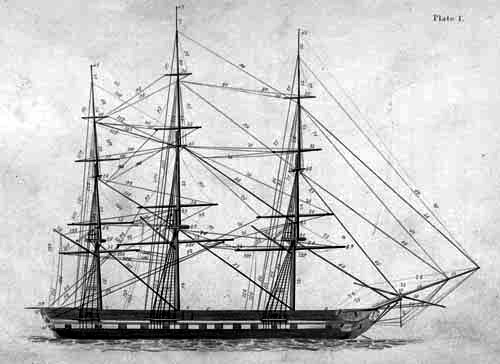
PLATE I. THE SPARS AND RIGGING OF A SHIP.
INDEX OF REFERENCES.
1 Head. 45 Main topmast cross-trees. 89 Main topgallant stay.
2 Head-boards. 46 Mizzen top. 90 Main royal stay.
3 Stem. 47 Mizzenmast cap. 91 Main lifts.
4 Bows. 48 Mizzen topmast cross-trees. 92 Main braces.
5 Forecastle. 49 Fore yard. 93 Main topsail lifts.
6 Waist. 50 Fore topsail yard. 94 Main topsail braces.
7 Quarter-deck. 51 Fore topgallant yard. 95 Main topgallant lifts.
8 Gangway. 52 Fore royal yard. 96 Main topgallant braces.
9 Counter. 53 Main yard. 97 Main royal lifts.
10 Stern. 54 Main topsail yard. 98 Main royal braces.
11 Tafferel. 55 Main topgallant yard. 99 Main rigging.
12 Fore chains. 56 Main royal yard. 100 Main topmast rigging.
13 Main chains. 57 Cross-jack yard. 101 Main topgallant rigging.
14 Mizzen chains. 58 Mizzen topsail yard. 102 Main topmast backstays.
15 Bowsprit. 59 Mizzen topgallant yard. 103 Main topgallant backstays.
16 Jib-boom. 60 Mizzen royal yard. 104 Main royal backstays.
17 Flying jib-boom. 61 Fore truck. 105 Cross-jack lifts.
18 Spritsail yard. 62 Main truck. 106 Cross-jack braces.
19 Martingale. 63 Mizzen truck. 107 Mizzen topsail lifts.
20 Bowsprit cap. 64 Fore stay. 108 Mizzen topsail braces.
21 Foremast. 65 Fore topmast stay. 109 Mizzen topgallant lifts.
22 Fore topmast. 66 Jib stay. 110 Mizzen topgal't braces.
23 Fore topgallant mast. 67 Fore topgallant stay. 111 Mizzen royal lifts.
24 Fore royal mast. 68 Flying-jib stay. 112 Mizzen royal braces.
25 Fore skysail mast. 69 Fore royal stay. 113 Mizzen stay.
26 Main mast. 70 Fore skysail stay. 114 Mizzen topmast stay.
27 Main topmast. 71 Jib guys. 115 Mizzen topgallant stay.
28 Main topgallant mast. 72 Flying-jib guys. 116 Mizzen royal stay.
29 Main royal mast. 73 Fore lifts. 117 Mizzen skysail stay.
30 Main skysail mast. 74 Fore braces. 118 Mizzen rigging.
31 Mizzen mast. 75 Fore topsail lifts. 119 Mizzen topmast rigging.
32 Mizzen topmast. 76 Fore topsail braces. 120 Mizzen topgal. shrouds.
33 Mizzen topgallant mast. 77 Fore topgallant lifts. 121 Mizzen topmast backstays.
34 Mizzen royal mast. 78 Fore topgallant braces. 122 Mizzen topgal'nt backstays.
35 Mizzen skysail mast. 79 Fore royal lifts. 123 Mizzen royal backstays.
36 Fore spencer gaff. 80 Fore royal braces. 124 Fore spencer vangs.
37 Main spencer gaff. 81 Fore rigging. 125 Main spencer vangs.
38 Spanker gaff. 82 Fore topmast rigging. 126 Spanker vangs.
39 Spanker boom. 83 Fore topgallant shrouds. 127 Ensign halyards.
40 Fore top. 84 Fore topmast backstays. 128 Spanker peak halyards.
41 Foremast cap. 85 Fore topgallant backstays. 129 Foot-rope to fore yard.
42 Fore topmast cross-trees. 86 Fore royal backstays. 130 Foot-rope to main yard.
43 Main top. 87 Main stay. 131 Foot-rope to cross-jack yard.
44 Mainmast cap. 88 Main topmast stay.
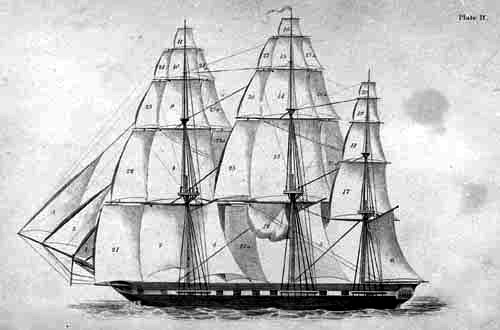
PLATE II. A SHIP'S SAILS.
INDEX OF REFERENCES.
1 Fore topmast staysail. 18 Mizzen topgallant sail.
2 Jib. 19 Mizzen royal.
3 Flying jib. 20 Mizzen skysail.
4 Fore spencer. 21 Lower studdingsail.
5 Main spencer. 21a Lee ditto.
6 Spanker. 22 Fore topmast studdingsail.
7 Foresail. 22a Lee ditto.
8 Fore topsail. 23 Fore topgallant studdingsail.
9 Fore topgallant sail. 23a Lee ditto.
10 Fore royal. 24 Fore royal studdingsail.
11 Fore skysail. 24a Lee ditto.
12 Mainsail. 25 Main topmast studdingsail.
13 Main topsail. 25a Lee ditto.
14 Main topgallant sail. 26 Main topgallant studdingsail.
15 Main royal. 26a Lee ditto.
16 Main skysail. 27 Main royal studdingsail.
17 Mizzen topsail. 27a Lee ditto.
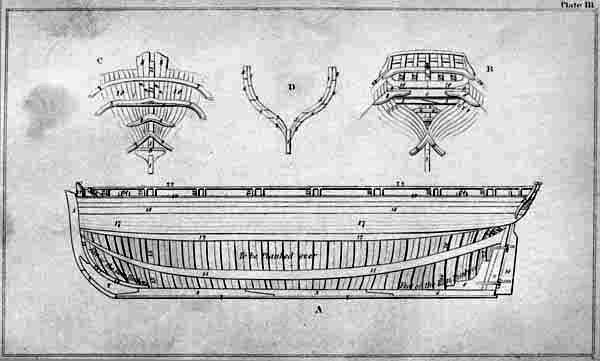
PLATE III. THE FRAME OF A SHIP.
INDEX OF REFERENCES.
A. The Outside. 5 Half transoms.
1 Upper stem-piece. 6 Main transom.
2 Lower stem-piece. 7 Quarter timbers.
3 Gripe. 8 Transom knees.
4 Forward keel-piece. 9 Horn timbers.
5 Middle keel-piece. 10 Counter-timber knee.
6 After keel-piece. 11 Stern-post.
7 False keel. 12 Rudder-head.
8 Stern knee. 13 Counter timbers.
9 Stern-post. 14 Upper-deck clamp.
10 Rudder.
11 Bilge streaks. C. The Inside of the Bows.
12 First streak under the wales. 1 Keelson.
13 Apron. 2 Pointers.
14 Lower apron. 3 Step for the mast.
15 Fore frame. 4 Breast-hook.
16 After frame. 5 Lower-deck breast-hook.
17 Wales. 6 Forward beam.
18 Waist. 7 Upper-deck clamp.
19 Plank-shear. 8 Knight-heads.
20 Timber-heads. 9 Hawse timbers.
21 Stanchions. 10 Bow timbers.
22 Rail. 11 Apron of the stem.
23 Knight-heads.
24 Cathead. D. The Timbers.
25 Fashion timbers. 1 Keelson.
26 Transoms. 2 Floor timbers.
27 Quarter pieces. 3 Naval timbers or ground futtocks.
4 Lower futtocks.
B. The Inside of the Stern. 5 Middle futtocks.
1 Keelson. 6 Upper futtocks.
2 Pointers. 7 Top timbers.
3 Chock. 8 Half timbers, or half top-timbers.
4 Transoms.
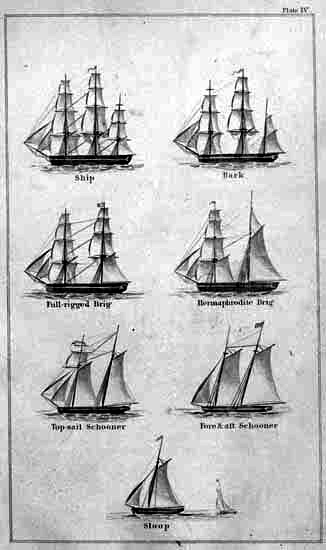
PLATE IV. EXPLANATIONS.
Ship.—A ship is square-rigged throughout; that is, she has tops, and carries square sails on all three of her masts.
Bark.—A bark is square-rigged at her fore and main masts, and differs from a ship in having no top, and carrying only fore-and-aft sails at her mizzenmast.
Brig.—A full-rigged brig is square-rigged at both her masts.
Hermaphrodite Brig.—An hermaphrodite brig is square-rigged at her foremast; but has no top, and only fore-and-aft sails at her main mast.
Topsail Schooner.—A topsail schooner has no tops at her foremast, and is fore-and-aft rigged at her mainmast. She differs from an hermaphrodite brig in that she is not properly square-rigged at her foremast, having no top, and carrying a fore-and-aft foresail, in stead of a square foresail and a spencer.
Fore-and-aft Schooner.—A fore-and-aft schooner is fore-and-aft rigged throughout, differing from a topsail schooner in that the latter carries small square sails aloft at the fore.
Sloop.—A sloop has one mast, fore-and-aft rigged.
Hermaphrodite Brigs sometimes carry small square sails aloft at the main; in which case they are called Brigantines, and differ from a Full-rigged Brig in that they have no top at the mainmast, and carry a fore-and-aft mainsail instead of a square mainsail and trysail. Some Topsail Schooners carry small square sails aloft at the main as well as the fore; being in other respects fore-and-aft rigged. They are then called Main Topsail Schooners.
Ship Bark
Full-rigged Brig Hermaphrodite Brig
Top-sail Schooner Fore & aft Schooner
Sloop
PART I.
CHAPTER I.
GENERAL RULES AND OBSERVATIONS.
Construction of vessels. Tonnage and carriage of merchant vessels. Proportions of the spars. Placing the masts. Size of anchors and cables. Lead-lines. Log-line. Ballast and lading.
Construction of Vessels.—As merchant vessels of the larger class are now built in the United States, the extreme length of deck, from the after part of the stern-post to the fore part of the stem, is from four and a half to four and three fourths that of the beam, at its widest part. The Damascus, of 700 tons' measurement, built at Boston in 1839, and considered a fair specimen of our best freighting vessels, had 150 feet from stem to stern-post, and 32 feet 6 inches extreme breadth. The Rajah, of 530 tons, built at Boston in 1837, had 140 feet length, and 30 feet beam;—being each in length about four and six tenths their beam.
A great contrast to this proportion is exhibited in the most recent statistics (1841) of vessels of the same tonnage in the English navy; as the following table will show.
Tons. Deck. Beam. Proportion.
{ Dido 734 120 ft. 37 ft. 6 in. 3.20
English Navy. { Pilot 492 105 33 6 3.13
{ Alert 358 95 30 4 3.16
American { Damascus 694 150 32 6 4.60
Merchantmen. { Rajah 531 140 30 0 4.66
These may, perhaps, be considered the extremes of ship-building; and between these there is every grade of difference.
Tonnage and Carriage of Merchant Vessels.—The amount a vessel will carry in proportion to her tonnage, depends upon whether, and to what extent, she is full or sharp built. A sharp-built vessel of 300 tons' measurement, will carry just about her tonnage of measurement goods. A sharp-built vessel of 200 tons or under would probably carry less than her measurement; if over 400 tons, she would increase gradually to fifty per cent. above her measurement. A sharp-built vessel of 600 tons, is generally rated at 900 tons carriage. A full-built vessel of 300 tons, after the latest model of American freighting vessels, will carry 525 tons, or seventy-five per cent. above her measurement; and one of 500 tons would carry full double her measurement.
The following table may give a pretty fair average.
TONS OF MEASUREMENT GOODS.
Tonnage. Full built. Sharp built.
300 (.75) 525 (.00) 300
400 (.80) 725 (.40) 560
500 (1.00) 1000 (.50) 750
600 (1.33) 1400 (.50) 900
Proportions of Spars.—There is no particular rule for sparring merchant vessels; some being light, and others heavy sparred; and some having long topmasts and short lower masts, and others the reverse. The prevailing custom now is, to spar them lightly; the main yard being a little less than double the beam; and the others proportioned by the main. Most merchant vessels now have the yards at the fore and main of the same size, for convenience in shifting sails; so that the same topsail may be bent on either yard.
The following table, taken from the "Seamen's Manual," will show the average proportions of the spars of merchant vessels of the largest class, as formerly built.
Main-mast, two and a half times the ship's beam.
Fore-mast, eight ninths of the main-mast.
Mizzen-mast, five sixths of the main-mast.
Bowsprit, two thirds of the main-mast.
Topmasts, three fifths of the lower masts.
Topgallant masts, one half the length of their topmasts.
Jib-boom, the length of the bowsprit.
Main-yard, twice the beam.
Fore-yard, seven eighths of the main-yard.
Maintopsail-yard, two thirds of the main-yard.
Foretopsail-yard, two thirds of the fore-yard.
Crossjack-yard, the length of the maintopsail-yard.
Topgallant-yards, two thirds of the topsail-yards.
Mizzentopsail-yard, the length of the maintopgallant-yard.
Royal-yards, two thirds of the topgallant-yards.
Spritsail-yard, five sixths of the foretopsail-yard.
Spanker-boom, the length of the maintopsail-yard.
Spanker-gaff, two thirds of the boom.
For the thickness of the spars, the same book allows for the lower masts one inch and a quarter diameter at the partners, for every three feet of length; and nine tenths in the middle and two thirds under the hounds, for every inch at the partners. For the yards, one inch at the slings, and half an inch at the yard-arms, within the squares, for every four feet of the length. For the breadth of the maintop, one half of the beam, and of the foretop, eight ninths of the maintop.
The following are the proportions of the spars of the ship Damascus, before mentioned, built in 1839.
Main-mast 74 ft. Head 11 ft. 6 in. Size 26 in.
Fore-mast 70 ft. Head 11 ft. 6 in. Size 25 in.
Mizzen-mast 68 ft. Head 8 ft. 6 in. Size 18 in.
Main and fore topmasts 41 ft. Head 6 ft. 6 in. Size 14½ in.
Mizzen topmast 32 ft. Head 5 ft. Size 9½ in.
Main topgallant-mast 23 ft. (15 ft. with 2 feet head.) Size 9½ in.
Fore topgallant-mast 21 ft. 14 ft. with 2 feet head.) Size 9½ in.
Mizzen topgallant-mast 17 ft. 11 ft. with 18 in. with 2 feet head.)
Main and fore yards 60 ft. yard-arms 2 ft. 6 in.
Main and fore topsail yards 48 ft. yard-arms 3 ft. 6 in.
Main topgallant yard 37 ft. yard-arms 2 ft.
Fore topgallant yard 34 ft. yard-arms 2 ft.
Main royal yard 27 ft. yard-arms 1 ft. 6 in.
Fore royal yard 24 ft. yard-arms 1 ft. 6 in.
Main skysail yard 17 ft.
Fore skysail yard 15 ft.
Cross-jack yard 44 ft. yard-arms 2 ft.
Mizzen topsail yard 35 ft. yard-arms 2 ft. 9 in.
Mizzen topgallant yard 25 ft. yard-arms 1 ft. 6 in.
Mizzen royal yard 16 ft.
Mizzen skysail yard 10 ft.
Bowsprit, out-board 27 ft. Size 26 in.
Jib-boom 42 ft. Head 3 ft. Size 14½ in.
Flying jib-boom 40 ft. Head 3 ft. 6 in.
Main pole 12 ft., 10 above royal-mast, 5 in. in cap.
Fore pole 11 ft., 9 above royal-mast, 4½ in. in cap.
Mizzen pole 9 ft., 7 above royal-mast
Spanker-boom 40 ft.
Spanker-gaff 30 ft.
Swinging-booms 40 ft.
Topmast studdingsail-booms 34 ft.
Topgallant studdingsail-booms 27 ft., yards for do. 17 ft.
Placing the Masts.—For a full-built ship, take the ship's extreme length and divide it into sevenths. Place the foremast one seventh of this length from the stem; the mainmast three sevenths from the foremast, and the mizzenmast two sevenths from the mainmast. If a vessel is sharp-built, and her stem and stern-post rake, her foremast should be further aft, and her mizzenmast further forward, than the rule of sevenths would give. A common rule for placing the foremast, is to deduct three fifths of a ship's beam from her length, for the curvature of the keel forward, which is called the keel-stroke, and place the mast next abaft the keel-stroke.
Size of Anchors and Cables.—Various rules have been adopted for the weight of a ship's anchors. A vessel of 100 tons will generally have a best bower of 6 cwt. and a small bower of 5 cwt.; the weight of both being eleven pounds to a ton of the vessel. As a vessel increases in size, the proportion diminishes. A vessel of 700 tons will usually carry a best bower of 27 cwt. and a small bower of 24 cwt.; the weight of both being seven and a half pounds to a ton of the vessel. The stream should be a little more than one third the weight of the best bower. The anchor-stock should be the length of the shank; its diameter should be half that of the ring, and its thickness one inch at the middle and half an inch at each end for every foot in length. Chain cables are usually ninety fathoms in length, for large-sized vessels, and sixty for small vessels, as schooners and sloops. The regulation of the United States Navy for chain cables, is one inch and a half for a sloop of war, and one and a quarter for brigs and schooners. In the merchant service, a ship of 400 tons would probably have a best bower cable of one and five sixths, and a working bower of one and a quarter inches. A ship of 700 tons would have a best bower of one and five eighths, and a working bower of one and a half inches. Chain cables have a shackle at every fifteen fathoms, and one swivel at the first shackle. Some have two swivels; and formerly they were made with a swivel between each shackle.
Lead-lines.—The hand-lead weighs usually seven pounds, and the hand-line is from twenty to thirty fathoms in length. The deep-sea-lead (pro. dipsey) weighs from fourteen to eighteen or twenty pounds; and the deep-sea-line is from ninety to one hundred and ten fathoms. The proper way to mark a hand-line is, black leather at 2 and 3 fathoms; white rag at 5; red rag at 7; wide strip of leather, with a hole in it, at 10; and 13, 15 and 17 marked like 3, 5 and 7; two knots at 20; 3 at 30; and 4 at 40; with single pieces of cord at 25 and 35.
The deep-sea-line has one knot at 20 fathoms, and an additional knot at every 10 fathoms, with single knots at each intermediate 5 fathoms. It sometimes has a strip of leather at 10 fathoms, and from 3 to 10 is marked like the hand-line.
Log-line.—The rate of a ship's sailing is measured by a log-line and a half-minute glass. The line is marked with a knot for each mile; the real distance between each knot being, however, 1/120 of a mile, since a half-minute is 1/120 of an hour. A knot being thus the same portion of a mile that a half-minute is of an hour, the number of knots carried off while the glass is running out will show the number of miles the vessel goes in an hour. Many glasses, however, are made for twenty-eight seconds, which, of course, reduces the number of feet for a knot to forty-seven and six tenths. But as the line is liable to stretch and the glass to be affected by the weather, in order to avoid all danger of a vessel's overrunning her reckoning, and to be on the safe side, it is recommended to mark forty-five feet to a knot for a twenty-eight second glass. About ten fathoms is left unmarked next the chip, called stray-line. The object of this is that the chip may get out of the eddy under the stern, before the measuring begins. The end of the stray-line is marked by a white rag, and the first knot is forty-five or forty-seven feet from the rag. A single piece of cord or twine is put into the line for the first knot, one knot for the second, two for the fourth, three for the sixth, and so on, a single piece of cord being put in at the intermediate knots.
Ballast and Lading.—A ship's behavior, as the phrase is, depends as much upon the manner in which she is loaded and ballasted, as upon her model. It is said that a vessel may be prevented from rolling heavily, if, when the ballast is iron, it is stowed up to the floor-heads; because this will bring the ship back, after she has inclined, with less violence, and will act upon a point but little distant from the centre of gravity, and not interfere with her stiff carrying of sail. The cargo should be stowed with the weightier materials as near as possible to the centre of gravity, and high or low, according to the build of the vessel. If the vessel is full and low built, the heavy articles should be stowed high up, that the centre of gravity may be raised and the vessel kept from rolling too much, and from being too laborsome. But a narrow, high-built vessel should have the heavy articles stowed low and near the keelson, which will tend to keep her from being crank, and enable her to carry sail to more advantage.
CHAPTER II.
CUTTING AND FITTING STANDING RIGGING.
Measuring and cutting lower rigging and lower fore-and-aft stays. Fitting the same. Measuring, cutting, and fitting topmast rigging, stays, and backstays. Jib, topgallant, and royal stays. Rattling down rigging. Cutting and fitting lifts, foot-ropes, brace-block straps, and pennants. Breast-backstays.
Cutting lower Rigging.—Draw a line from the side of the partners abreast of the mast, on the deck, parallel to the channels, and to extend as far aft as they do. On this line mark the places of each dead-eye, corresponding to their places against the channels. Send a line up to the mast-head, and fasten it to the mast by a nail above the bibbs, in a range with the centre of the mast, and opposite to the side the channel line is drawn upon. Then take the bight of the line around the forward part of the mast, and fasten it to the mast by a nail, opposite the first nail, so that the part between the nails will be half the circumference of the mast-head; then take the line down to the mark on the channel line for the forward dead-eye, and mark it as before; and so on, until you have got the distance between the mast and each mark on the channel line. Now cast off the line from the mast-head, and the distance between the end of the line and each mark will give you the length of each shroud from the lower part of the mast-head. And, to make an allowance for one pair of shrouds overlaying another, you may increase the length of the pair put on second, that is, the larboard forward ones, by twice the diameter of the rigging; the third pair by four times; and so on.
The size of the lower rigging should be as much as eight and a half inches for vessels of seven or eight hundred tons, and from seven and a half to eight for smaller vessels, over three hundred tons.
For the length of the fore, main, and mizzen stays and spring-stays, take the distance from the after part of the mast-head to their hearts, or to the place where they are set up, adding once the length of the mast-head for the collar.
The standing stays should be once and half the circumference of the shrouds.
Fitting lower Rigging.—Get it on a stretch, and divide each pair of shrouds into thirds, and mark the centre of the middle third. Tar, worm, parcel and serve the middle third. Parcel with the lay of the rope, working toward the centre; and serve against the lay, beginning where you left off parcelling. Serve as taut as possible. In some vessels the outer thirds of the swifters are served; but matting and battens are neater and more generally used.
Formerly the middle third was parcelled over the service, below the wake of the futtock staff. Mark an eye at the centre of the middle third, by seizing the parts together with a round seizing. The eye of the pair of shrouds that goes on first should be once and a quarter the circumference of the mast-head; and make each of the others in succession the breadth of a seizing larger than the one below it. Parcel the score of the dead-eye, and heave the shroud taut round it, turning in with the sun, if right-hand-laid rope, and against the sun, if hawser-laid; then pass the throat seizing with nine or ten turns, the outer turns being slacker than the middle ones. Pass the quarter seizings half way to the end, and then the end seizings, and cap the shroud, well tarred under the cap. Make a Matthew Walker knot in one end of the lanyard, reeve the other end out through the dead-eye of the shroud, beginning at the side of the dead-eye upon which the end of the shroud comes, and in through the dead-eye in the channels, so that the hauling part of the lanyard may come in-board and on the same side with the standing part of the shroud. If the shroud is right-hand-laid rope, the standing part of the shroud will be aft on the starboard, and forward on the larboard side; and the reverse, if hawser-laid.
The neatest way of setting up the lower fore-and-aft stays, is by reeving them down through a bull's eye, with tarred parcelling upon the thimble, and setting them up on their ends, with three or four seizings. The collar of the stay is the length of the mast-head, and is leathered over the service. The service should go beyond the wake of the foot of the topsail, and the main-stay should be served in the wake of the foremast. The main and spring stays usually pass on different sides of the foremast, and set up at the hawse-pieces.
The bolsters under the eyes of the rigging should always be covered with tarred parcelling, marled on.
The starboard forward shroud goes on first; then the larboard; and so on. The fore stay and spring stay go over the shrouds; and the head stays always go over the backstays.
Cutting and fitting Topmast Rigging.—For the forward shroud, measure from the hounds of the topmast down to the after part of the lower trestle-trees, and add to that length half the circumference of the mast-head at the hounds. The eye is once and a quarter the circumference of the mast-head. The topmast rigging in size should be three fifths of the lower rigging. For the topmast backstays, measure the distance from the hounds of the mast down to the centre of the deck, abreast of their dead-eyes in the channels, and add to this length one half the circumference of the mast-head. Add to the length of the larboard pair, which goes on last, twice the diameter of the rope. The size of the fore and main topmast backstays is generally one quarter less than that of the lower rigging; and that of the mizzen topmast backstays the same as that of the main topmast rigging. The size of the topmast stays should be once and a quarter that of the rigging. The topmast rigging is fitted in the same manner as the lower. The backstays should be leathered in the wake of the tops and lower yards. The breast-backstays are turned in upon blocks instead of dead-eyes, and set up with a luff purchase. The fore topmast stay sets up on the starboard, and the spring stay on the larboard side of the bowsprit.
All the fore-and-aft stays are now set up on their ends, and should be leathered in their nips, as well as in their eyes.
The main topmast stay goes through a heart or thimble at the foremast-head, or through a hole in the cap, and sets up on deck or in the top; and the mizzen topmast stay sets up at the mainmast-head, above the rigging.
Jib, Topgallant, and Royal Rigging.—The jib stay sets up on its end on the larboard side of the head, and is served ten feet from the boom, and its collar is leathered like that of the topmast stay. The gaub lines or back ropes go from the martingale in-board. The guys are fitted in pairs, rove through straps or snatches on the spritsail yard, and set up to eye-bolts inside of or abaft the cat-heads. The foot-ropes are three quarters the length of the whole boom, and go over the boom-end with a cut splice. Overhand knots or Turks-heads should be taken in them at equal distances, to prevent the men from slipping, when laying out upon them.
The most usual method of fitting topgallant rigging in merchantmen, is to reeve it through holes in the horns of the cross-trees, then pass it between the topmast shrouds over the futtock staff, and set it up at an iron band round the topmast, just below the sheave-hole; or else down into the top, and set it up there. To get the length of the starboard forward shroud, measure from the topgallant mast-head to the heel of the topmast, and add one half the circumference of the topgallant mast-head. Its size should be about five sevenths of the topmast rigging. Each pair of shrouds should be served below the futtock staves. They are fitted like the topmast shrouds. The fore-and-aft stays of long topgallant masts go with eyes, and are served and leathered in the wake of the foot of the sails. The fore topgallant stay leads in on the starboard side of the bowsprit, and sets up to a bolt at the hawse-piece; the main leads through a chock on the after part of the fore topmast cross-trees, and sets up in the top; and the mizzen usually through a thimble on the main cap, and sets up on its end.
The topgallant backstays set up on their end, or with lanyards in the channels; and for their length, measure from the mast-head to the centre of the deck, abreast the bolt in the channels.
The royal shrouds, backstays, and fore-and-aft stays, are fitted like those of the topgallant masts, and bear the same proportion to them that the topgallant bear to the topmast. The fore royal stay reeves through the outer sheave-hole of the flying jib-boom, and comes in on the larboard side; the main through a thimble at the fore jack-cross-trees; and the mizzen through a thimble at the maintopmast cap. The flying jib-stay goes in on the starboard side, and sets up like the jib-stay. The gear of the flying jib-boom is fitted like that of the jib-boom.
Ratling.—Swift the rigging well in, and lash handspikes or boat's oars outside at convenient distances, parallel with the shear-pole. Splice a small eye in the end of the ratlin, and seize it with yarns to the after shroud on the starboard side and to the forward on the larboard, so that the hitches may go with the sun. Take a clove hitch round each shroud, hauling well taut, and seize the eye of the other end to the shroud. The ratlins of the lower rigging should be thirteen, and of the topmast rigging eleven inches apart, and all square with the shear-pole.
Standing Rigging of the Yards.—The first thing to go upon the lower yard-arm, next the shoulder, is the head-earing strap; the next, the foot-ropes; next, the brace-block; and lastly, the lift. The foot-ropes go with an eye over the yard-arm, are rove through thimbles in the end of the stirrups, (sometimes with Turks-heads, to prevent their slipping,) and are lashed to bolts or thimbles, but now usually to the iron trusses. The stirrups fit to staples in the yard, with an eye-splice. The lifts should be single, and fitted with an eye over the yard-arm, and lead through a single block at the mast-head, and set up by a gun or luff tackle purchase, with the double block hooked to a thimble or turned in at the end, and the lower block to an eye-bolt in the deck. Instead of brace-blocks on the fore and main yards, brace-pennants fitted over the yard-arm with an eye are neater. The latest and neatest style of rigging lower yards is to have a strong iron band with eyes and thimbles round each yard-arm, close to the shoulder; and then fit the lift, foot-rope, and brace-pennant, each to one of these eyes, with an eye-splice round the thimble or with a hook. The lower lifts now, for the most part, cross each other over a saddle upon the cap, instead of going through blocks.
The inner ends of the foot-ropes to the topsail, topgallant and royal yards, cross each other at the slings; and on the topsail yard there are Flemish-horses, spliced round thimbles on the boom-iron, and the other end seized to the yard, crossing the foot-rope. A neater mode is to hook the outer end of the Flemish-horse, so that it may be unhooked and furled in with the sails when in port. Next to the foot-ropes go on the brace-blocks, and lastly, the lifts. The rigging to the topgallant and royal yards is fitted similarly to that upon the topsail, except that there is nothing over the yard-arms but foot-rope, brace and lift. The brace to the royal yard fits with an eye. The reef-tackle, studding-sail halyard, and other temporary blocks, are seized to the lower and topsail yard-arms by open straps, so that they may be removed without taking off the lift. The topgallant studding-sail halyard block is often hooked to the boom-iron, under the yard.
The foot-ropes to the spanker-boom should be half the length of the boom, going over the end with a splice, covered with canvass, and coming in one third of the way to the jaws, and seized to the boom by a rose-seizing through an eye-splice. The next to go over the boom-end are the guys, which are fitted with a cut-splice covered with canvass, and have a single block turned in at their other ends. To these single blocks are luff or gun-tackle purchases, going to the main brace-bumpkin. Their length should be two fifths that of the boom. The topping-lifts are usually hooked into a band or spliced into bolts about one quarter the distance from the outer end of the boom, and reeve through single blocks under the top, with a double or single block at their lower ends.
All the splices and seizings of the standing rigging should be covered with canvass, if possible, except in the channels and about the head, where they are too much exposed to the washing of water. A vessel looks much neater for having the ends of the rigging, where eyes are spliced, or where they are set up on their ends aloft or on deck, covered with canvass, and painted white or black, according to the place where they are. The lanyards and dead-eyes of the smaller rigging which sets up in the top may also be covered with canvass. The lanyards, dead-eyes, and turnings-in of the rigging in the channels, should always be protected by scotchmen when at sea, and the forward shroud should be matted or battened all the way up to the futtock staves.
In some smaller merchantmen the lower rigging is not infrequently set up upon its end to bolts in the rail. This is very inconvenient on many accounts, especially as all the seizings have to be come up with, and the nip of the shroud altered, whenever it is at all necessary to set them taut. This soon defaces and wears out the ends; while, with dead-eyes, only the lanyards have to be come up with. Some vessels set up their lower rigging with dead-eyes upon the rail. This is convenient in setting them up in bad weather, but does not give so much spread as when set up in the channels, and presents a more complicated surface to the eye. If the rigging is fitted in this way, you must deduct the height of the rail above the deck from the measure before given for cutting it.
Breast-backstays.—It is not usual, now, for merchant vessels to carry topmast breast-backstays. If they are carried, they are spread by out-riggers from the top. Topgallant and royal breast-backstays are used, and are of great assistance in sailing on the wind. There are various ways of rigging them out, of which the following is suggested as a neat and convenient one. Have a spar fitted for an out-rigger, about the size of one of the horns of the cross-trees, with three holes bored in it, two near to one end, and the third a little the other side of the middle. Place it upon the after horn of the cross-tree, with the last-mentioned hole over the hole in the end of the horn of the cross-tree, and let the after topgallant shroud reeve through it. Reeve the topgallant and royal breast-backstays through the outer holes, and set them up by a gun-tackle purchase, in the channels. [1] The inner end of the out-rigger should fit to a cleat, and be lashed to the cross-tree by a lanyard. When the breast-backstays are to be rigged in, cast off the lanyard, and let the out-rigger slue round the topgallant shroud for a pivot, the inner end going aft, and the outer end, with the backstays, resting against the forward shroud. One of these out-riggers should be fitted on each side, and all trouble of shifting over, and rigging out by purchase, will be avoided.
CHAPTER III.
FITTING AND REEVING RUNNING RIGGING.
Fore braces. Main braces. Cross-jack braces. Fore, main, and mizzen topsail braces. Fore, main, and mizzen topgallant and royal braces. Trusses. Topsail tyes and halyards. Topgallant and royal halyards. Peak and throat halyards. Spanker brails. Fore and main tacks and sheets. Topsail, topgallant and royal sheets and clewlines. Reef-tackles. Clew-garnets. Fore and main buntlines, leechlines, and slablines. Topsail clewlines and buntlines. Bowlines.
To reeve a brace, begin on deck, and reeve to where the standing part is made fast. The fore braces reeve up through a block on the mainmast just below the rigging, down or in through the brace-block on the yard or at the end of the pennant, and the standing part is brought through the cheeks of the mast with a knot inside. The neatest way for reeving the main brace is out through a single block on the brace-bumpkin, out through the brace-pennant-block, in through an outer block on the bumpkin, and seized to the strap of the pennant. Another way is out through the bumpkin block, out or down through the pennant block, and secure the end to the bumpkin or to the fashion-piece below.
The cross-jack braces reeve up through blocks on the after shroud of the main rigging, up through blocks on the yard, one third of the way in from the yard-arm, and are seized to a bolt in the mainmast, or to the after shroud again.
The fore topsail braces reeve up through the blocks secured to the bibbs at the mainmast-head, in through the span-block at the collar of the main stay, up through the block on the yard, and are seized to the main topmast-head; or else up through a block at the topmast-head, down through the brace-block on the yard, and are seized to the collar of the main stay. The last way is the best. The main topsail braces are rove through span-blocks at the mizzen-mast, below the top, up through the blocks on the yard, and are seized to the mizzen topmast-head; or else up through a block at the mizzen-mast-head, down through the block on the yard, and secured to the mizzen-mast. The first way is the best. The mizzen topsail braces reeve up through the leading blocks or fair-leaders on the main rigging, up through blocks at the mainmast-head, or at the after part of the top, up through the yard blocks, and are seized to the cap.
The fore and main topgallant braces are rove up through blocks under the topmast cross-trees, in through span-blocks on the topmast stays, just below their collars, up through the blocks on the yards, and the main are usually seized to the head of the mizzen topgallant mast, and the fore to the topmast stay, by the span-block. The mizzen topgallant braces generally go single, through a block at the after part of the main top-mast cross-trees. The royal braces go single: the fore, through a block at the main topgallant mast-head; the main, through one at the mizzen topgallant mast-head; and the mizzen, through a block at the after part of the main topmast cross-trees.
Halyards.—The lower yards are now hung by patent iron trusses, which allow the yard to be moved in any direction; topped up or braced. The topsail yards have chain tyes, which are hooked to the slings of the yard, and rove through the sheave-hole at the mast-head. The other end of the tye hooks to a block. Through this block a chain runner leads, with its standing part hooked to an eye-bolt in the trestle-tree, and with the upper halyard-block hooked to its other end. The halyards should be a luff purchase, the fly-block being the double block, and the single block being hooked in the channels. Sometimes they are a gun-tackle purchase, with two large single blocks. The lower block of the mizzen topsail halyards is usually in the mizzen-top, the fall coming down on deck.
The fore and mizzen topsail halyards come down to port, and the main to the starboard. The topgallant halyards come down on opposite sides from the topsail halyards; though the fore and main usually come down by the side of the masts. The fore and main topgallant halyards sometimes hoist with a gun-tackle purchase, but the mizzen and all the royal halyards are single.
The throat and peak halyards of the spanker are fitted in the following manner. The outer peak halyard block is put on the gaff, one third of its length from the outer end, or a very little, if any, within the leech of the sail; and the inner one, two thirds in. The blocks are fitted round the gaff with grommet straps, and are kept in their places by cleats. The double block of the peak halyards is strapped to the bolt in the after part of the mizzen cap, and the halyards are rove up through this, in through the blocks on the gaff, the inner one first, the standing part made fast to the double block, and the fall coming on deck. The upper block of the throat halyards is secured under the cap, and the lower block is hooked to an eye-bolt on the jaws of the gaff. This is a two-fold tackle.
The Spanker Brails.—The peak brails reeve through single blocks on the gaff, two on each side, generally span-blocks, and then through the throat brail blocks, as leaders, to the deck. The throat brails reeve through two triple blocks strapped to eye-bolts under the jaws of the gaff, one on each side, through the two other sheaves of which the peak brails lead. Each brail is a single rope, middled at the leech of the sail.
Tacks, Sheets, Clewlines, &c.—It is much more convenient to have the tack and sheet blocks of the courses fastened to the clews of the courses by hooks. Then they can be unhooked when the sail is furled, and, in light weather, a single rope with a hook, called a lazy sheet, can be used, instead of the heavy tacks and sheets with their blocks. This is also much more convenient in clewing up. The main tack is rove aft through the block in the waterways, forward through the block on the sail, and the standing part hooks to the block on deck. The fore tack goes through a block on the bumpkin. The sheets of the courses have the after block hooked to an eye-bolt in the side, abaft the channels, and the forward one hooked to the clew of the sail, the running part reeving through a sheave-hole in the rail. The sheets of all the square sails but the courses run from the clew of the sail, through sheave-holes in the yard-arms, through the quarter blocks, down on deck. The topsail sheets are chain, are clasped to the clews of the sail, and are fitted with a gun-tackle purchase at the foot of the mast. The topgallant and royal sheets are single. The topsail and topgallant clewlines reeve through the quarter-blocks. The royal clewlines are single, and the topsail and topgallant are a gun-tackle purchase.
The reef-tackles of the topsails reeve up through blocks on the lower rigging, or futtock shrouds, down through the block on the yard, down the leech of the sail and through the block on the leech, and are made fast to the yard on their own parts, with a clinch, outside of everything.
The clew-garnets reeve out through blocks under the quarters of the yard, then up through blocks at the clew, and the standing part is made fast to the yard, to the block, or to a strap. The buntlines of the courses reeve through double or triple blocks under the forward part of the top, down forward of the sail, sometimes through thimbles in the first reef-band, and are clinched to the foot of the sail. The leechlines reeve through single blocks on the yard, and are clinched to the leech of the sail. The slabline is a small rope rove through a block under the slings of the yard, and clinched to the foot of the sail. This is not much used in merchant vessels. The topsail clewlines lead like the clew-garnets of the courses. The topsail buntlines reeve forward through single blocks at the topmast-head, down through the thimbles of a lizard seized to the tye, just above the yard, and are clinched to the foot of the sail. The handiest way of reeving the main bowline is to have a single rope with the standing part hooked near the foremast, and reeve it out through a heart in the bridle. This will answer for both sides. The fore bowline may be rove through a single block at the heel of the jib-boom and hooked to the bridle. The bowlines to the other sails are toggled to the bridles and lead forward. Many vessels now dispense with all the bowlines except to the courses. This saves trouble, makes a ship look neater, and, if the sails are well cut, they will set taut enough in the leach, without bowlines.
CHAPTER IV.
TO RIG MASTS AND YARDS.
Rigging the shears. Taking in lower masts and bowsprit. To rig a bowsprit. Getting the tops over the mast-heads. To send up a top-mast. To get on a top-mast cap. To rig a jib-boom. To cross a lower yard. To cross a topgallant yard. To send up a topgallant mast. Long, short, and stump topgallant masts. To rig out a flying jib-boom. To cross topgallant and royal yards. Skysail yards.
Taking in Lower Masts and Bowsprit.—Shore up the beams upon which the heels of the shears will rest, if necessary, from the keelson. Parbuckle the shears aboard, with their heads aft. Raise their heads upon the taffrail, cross them, and pass the shear-lashing. Lash the upper block of a three-fold tackle under the cross, and secure the lower block to the breast-hooks, or to a toggle in the hawse-hole. You may also reeve and secure, in the same manner, a smaller purchase, which shall work clear of the first. Have two forward and two after guys clove-hitched to the shear-head, with cleats to prevent their slipping. Get a girt-line on one shear-head and a small tackle on the other, to slue and cant the mast. Let the fall of the main tackle come through the middle sheave, to prevent the block's sluing in its strap. Reeve large heel tackles to rouse the shears aft with. Put long oak plank shoes under the heels; and, if it be necessary, clap a thwart-ship tackle upon the two heels, or reeve a lashing, and put a stout plank between them, and bowse taut; which will prevent too great a strain coming upon the water-ways. Take the main tackle fall to the capstan; heave round, haul on the forward guy and after heel tackles, and raise the shear to an angle of about eighty degrees with the deck, and so that the main purchase will hang plumb with the partners of the mizzen-mast. Lash a garland to the forward part of the mast, above the centre, and toggle the purchase to it. Heave the mast in over the bulwarks; fit the trestle-trees and after chock; reeve girt-lines by which men may be hoisted when the mast is in; point the mast in, and lower away. Always take in the mizzen-mast first. Get in the main and then the foremast in the same manner, rousing the shears forward, with their shoes, by means of the heel tackles. Having stepped and secured the foremast, carry the forward guys aft and rake the shears over the bows; toggle the lower block of the main tackle to a garland lashed to the upper part of the bowsprit inside of the centre. Put on the cap, and carry tackles or guys from the bowsprit-head to each cat-head, and clap on a heel tackle or guy. Heave the bowsprit, and direct it by the small tackles and guys.
To rig a Bowsprit.—Lash collars for the fore stay, bobstays, and bowsprit shrouds, then for the spring stay, and put on the bees for the topmast stays; fit the man-ropes, pass the gammoning, and set up bobstays and shrouds.
To get the Tops over the Mast-heads.—Place the top on deck abaft the mast; get a girt-line on each side of the mast-head, and pass the end of each under the top, through the holes in the after part; clinch them to their own parts, and stop them to the fore part of the top with slip-stops. Have a guy to the fore and another to the after part of the top. Make the ends of a span fast to the after corners of the top, and bend a girt-line from the mast-head to the bight of the span, and stop it to the forward part of the top. Sway away on the girt-lines. When the fore part of the top is above the trestle-trees, cut the span-stops, and when the after part is above them, cast off the slip-stops. When the lubber-hole is high enough to clear the mast-head, haul on the forward guy, and let the top hang horizontally by the girt-lines. Lower away, place and bolt it.
The fore and main tops are sent up from abaft, and the mizzen from forward. The tops may be got over without the span and girt-line, by stopping the two girt-lines first rove to the middle as well as to the fore part of the top, and cutting the upper stops first.
To send up a Topmast.—Get the topmast alongside, with its head forward. Lash a top-block to the head of the lower-mast; reeve a mast-rope through it, from aft forward, and bring the end down and reeve it through the sheave-hole of the topmast, hitching it to its own part a little below the topmast-head, and stopping both parts to the mast, at intervals. Snatch the rope and sway away. As soon as the head is through the lower cap, cast off the end of the mast-rope, letting the mast hang by the stops, and hitch it to the staple in the other end of the cap. Cast off the stops and sway away. Point the head of the mast between the trestle-trees and through the hole in the lower cap, the round hole of which must be put over the square hole of the trestle-trees. Lash the cap to the mast, hoist away, and when high enough, lower a little and secure the cap to the lower mast-head. (This is when it cannot be put on by hand.) If the cross-trees are heavy, they may be placed in the following manner. Sway away until the topmast-head is a few feet above the lower cap. Send up the cross-trees by girt-lines, and let the after part rest on the lower cap and the forward part against the topmast. Lower away the topmast until the cross-trees fall into their place, and then hoist until they rest on the shoulders. Lash on the bolsters, get girt-lines on the cross-trees to send up the rigging, and then put it over the mast-head, first the shrouds, then the backstays, and lastly the head-stays. Sway the topmast on end, fid it, and set up the rigging.
To get on a Topmast-Cap.—In vessels of the largest class, it may be necessary to send up the cap in the following manner, but it can usually be got up by hand. Or it may be fitted and the rigging put on over it. Send the cap up to the cross-trees by girt-lines, and place the round hole of the cap over the forward hole of the cross-trees; send aloft a topgallant studdingsail boom, and point its upper end through the holes in the cross-trees and cap, and lash the cap to it. Hook a tackle or girt-line to a strap on the lower end of the spar, and sway away until the cap is over the mast-head. Slue the spar so that the cap may come fair, lower away, and place the cap upon the mast-head. Unlash the spar and send it down.
To rig out a Jib-boom.—Point the outer end through the collars of the stays. Reeve the heel-rope through a block at the bowsprit cap, through the sheave-hole at the heel of the boom, and secure the end to an eye-bolt in the cap on the opposite side. Rig the boom out until the inner sheave-hole is clear of the cap. Tar the boom-end, put on the foot-ropes and guys, and reeve the jib stay. Hoist up the martingale and rig it, and reeve the martingale stay and gaub-line. Rig the boom out to its place, and set up the jib and martingale stays.
To cross a Lower Yard.—If the yard is alongside, reeve the yard rope through the jear block at the mast-head, make it fast to the slings of the yard, and stop it out to the yard-arm. Sway away, and cast off the stops as the yard comes over the side, and get the yard across the bulwarks. Lower yards are rigged now with iron trusses and quarter-blocks, which would be fitted before rigging the yard. Seize on the clew-garnet block, and put the rigging over the yard-arm; first the straps for the head-earings, then the foot-ropes, then the brace blocks or pennants, and last the eye of the lift. (The lifts, brace pennants, and foot-ropes are now spliced or hooked into rings with thimbles on an iron band, round the yard-arm, next the shoulders. In this way, there is no rope of any kind round the yard-arm.) Reeve the lifts and braces, get two large tackles from the mast-head to the quarters of the yard, and sway away on them and on the lifts, bearing off and sluing the yard by means of guys. Secure the yard by the iron trusses, and haul taut lifts and braces.
To cross a Topsail Yard.—As topsail yards now have chain tyes, there are no tye-blocks to seize on. The quarter-blocks are first seized on, and the parral secured at one end, ready to be passed. A single parral has an eye in each end, and one end is passed under the yard and over, and the eye seized to the standing part, close to the yard. After the yard is crossed, the other end is passed round the mast, then round the yard, and seized in the same manner. To pass a double parral, proceed in the same manner, except that the seizings are passed so as to leave the eyes clear and above the standing part, and then take a short rope with an eye in each end, pass it round the mast, and seize the eyes to the eyes of the first long rope. The parral is wormed, served and leathered. The parral being seized at one end, put on the head-earing straps, the foot-ropes, Flemish horses, and brace blocks. Bend the yard-rope to the slings, stop it out to the yard-arm, and sway away until the yard is up and down; then put on the upper lift in the top and the lower lift on deck, and reeve the braces. Sway away, cast off the stops, and take in upon the lower lift as the yard rises, till the yard is square; then haul taut lifts and braces and pass the parral.
To send up a Topgallant Mast.—Most merchantmen carry long topgallant masts. In these, the topgallant, royal and skysail masts are all one stick. A short topgallant mast is one which has cross-trees, and above which a fidded royal-mast may be rigged. A stump topgallant mast has no cross-trees, or means for setting a mast above it, and is carried only in bad weather. Some short topgallant masts are rigged with a withe on the after part of the mast-head, through which a sliding-gunter royal-mast is run up, with its heel resting in a step on the topmast cap.
To send up a long topgallant mast, put the jack over the topmast cap, with a grommet upon its funnel for the eyes of the rigging to rest upon; send up the rigging by girtlines, and put the eyes over the jack, first the topgallant shrouds, backstays and stays, then the royal rigging in the same order, with a grommet, then the skysail stay and backstay, and lastly the truck. Reeve a top-rope forward through a block at the topmast-head, through the hole in the cross-trees; through the sheave-hole at the foot of the topgallant mast; carry it up the other side, and make it fast to its own part at the mast-head; stop it along the mast, and bend a guy to the heel. Sway away, and point through the jack; put on the truck, and the skysail, royal and topgallant rigging in their order; slue the mast so as to bring the sheaves of the tyes fore-and-aft; cast off the end of the top-rope, the mast hanging by the stops; make it fast to an eye-bolt on the starboard side of the cap, and sway away. When high enough, fid the mast and set up the rigging.
A short topgallant mast is sent up like a topmast, the cross-trees got over in the same manner; and the fidded royal-mast is sent up like a long topgallant mast.
To rig out a Flying Jib-boom.—Ship the withe on the jib-boom end, reeve a heel-rope through a block at the jib-boom end, and bend it to the heel of the flying jib-boom, and stop it along, out to the end. Haul out on the heel-rope, point through the withe, put on the rigging, in the same order with that of the jib-boom; reeve the guys, martingale, flying jib, royal and skysail stays; rig out, and set up the rigging. The heel of the boom rests against the bowsprit cap, and is lashed to the jib-boom.
The flying jib-boom should be rigged fully out before the fore topgallant mast is swayed on end.
To cross a Topgallant Yard.—Seize on the parral and quarter-blocks; reeve the yard-rope through the sheave-hole of the topgallant mast, make it fast to the slings of the yard, and stop it out to the upper end. Sway away, and when the upper yard-arm has reached the topmast-head, put on the upper lift and brace; sway away again, put on the lower lift and brace, cast off all the stops, settle the yard down square by lifts and braces, and pass the parral lashing.
To cross Royal Yards.—The royal yards are crossed in the same manner as the topgallant yards, except that in most merchantmen they would be sent up by the halyards instead of a yard-rope. If there is not a standing skysail, the quarter-blocks on the royal yard will be single.
Skysail Yards.—If the skysail is a standing sail, the yard is rigged like the royal yard, with lifts and braces, and the sail is fitted with sheets and clewlines; but if it is a flying skysail, the yard has neither lifts nor braces, and the clews of the sail are seized out to the royal yard-arms. There are various ways of rigging a flying skysail, of which the following is believed to be as convenient as any. Let the royal stay go round the mast-head, with a traveller, above the yard, so that the stay may travel up and down the skysail mast. Seize a thimble into the stay, close against the forward part of the grommet; lead the skysail halyards through the thimble, and make them fast to the centre of the yard, which will need no parral, underneath the royal stay. Make fast the ends of two small ropes for downhauls, to the skysail yard, about half way out on each yard-arm, and reeve them through small cleats on the after part of the royal yard, the same distance out on each yard-arm. These may be spliced into a single rope below the yard, which will go through a fair-leader in the cross-trees to the deck. By this means the skysail may be taken in or set without the necessity of sending a man aloft. Let go the halyards and haul on the downhaul, and the yard will be brought close down to the royal yard. To hoist it, let go the downhaul and royal stay, and haul on the halyards. When the royal is taken in, haul the skysail yard down with the royal yard, and furl the sail in with the royal.
CHAPTER V.
TO SEND DOWN MASTS AND YARDS.
To send down a royal yard—a topgallant yard—a topgallant mast. To house a topgallant mast. To send down a topmast. To rig in a jib boom.
To send down a Royal Yard.—If the sail is bent to the yard, furl it, making the gaskets fast to the tye. Cast off the sheets and clewlines, and make them fast to the jack. Be careful to unreeve the clewlines through the quarter-blocks. Cast off the parral-lashing. Overhaul the tye a little, and stop it to the yard, just outside of the quarter-block. If stopped too far out, the yard will not hoist high enough to get the lower lift off. Sway away on the halyards, which will cant the yard and hoist it. When high enough, cast off the lower lift and brace, (being careful not to let the brace go,) and make them fast to the jack. Lower away, and as the upper yard-arm comes abreast of the jack, clap a stop round the yard and tye, near the yard-arm, and cast off the lift and brace, making them fast to the jack. Lower away to the deck.
If the halyards are not single, the yard must be sent down by a yard-rope, like the topgallant yard. In some vessels, instead of making the sheets and clewlines fast to the jack, overhand knots are taken in their ends, and they are let go. The sheets will run out to the topgallant yard-arms, and the clewlines will run to the fair-leaders in the cross-trees. In port, the main royal yard is sent down on the starboard side, and the fore and mizzen on the larboard; but at sea, the tye is stopped out on the lee side, and the yard sent down in any way that is the most convenient.
To send down a Topgallant Yard.—Cast off the sheets, bowlines, buntlines and clewlines, and make them fast to the cross-trees. Reeve a yard-rope through a jack-block at the mast-head, unhook the tye, cast off the parral-lashing, bend the yard-rope to the slings of the yard by a fisherman's bend, and stop it to the quarters of the yard. Sway away, and take off the lifts and braces, as with the royal yard.
To send down a Topgallant Mast.—Hook the top-block to the eye-bolt at the larboard side of the topmast cap; reeve the mast-rope through it, then through the sheave-hole in the foot of the topgallant mast, and hitch its end to the eye-bolt on the starboard side of the cap. Come up the rigging, stays and backstays, and guy the mast-head by them. Hoist a little on the mast-rope, and take out the fid. (The fid should always be fastened to the cross-trees or trestle-trees, by a lanyard.) Lower away until the mast is a little short of being through the cap. Then seize or rack together both parts of the mast-rope just above the sheave-hole; cast off the end of the mast-rope, letting the mast hang by the stops, and hitch it round the mast-head to its own part, below the cap. Then lower away to the deck. If the rigging is to come on deck, round up the mast-rope for a girtline; if it is to remain aloft, lash it to the topmast cap, render the shrouds through the cross-trees, and stop them up and down the topgallant rigging. Sheep-shank the stays and backstays, and set them hand-taut. If the top-mast is also to be sent down, take off the topmast cap and send it on deck.
To house a Topgallant Mast.—Proceed in the same manner, except that when the mast is low enough, belay the mast-rope, pass a heel-lashing through the fid-hole and round the topmast.
To send down a Topmast.—Hook the top-block, reeve the mast-rope through it and through the sheave-hole in the foot of the mast, and hitch it to the staple at the other side of the cap. Lead the fall through a snatch-block, to the capstan. Sling the lower yard, if it is to remain aloft, and unshackle the trusses, if they are of iron. Come up the rigging, stays and backstays, weigh the mast, take out the fid, and lower away. If the rigging is to remain aloft, lash the cross-trees to the lower cap. The rigging should be stowed away snugly in the top, and the backstays be snaked up and down the lower rigging.
To rig in a Jib-boom.—Reeve the heel-rope (if necessary,) come up the stay, martingale stay and guys; unreeve the jib-stay, station hands at each guy, clear away the heel-lashing, haul in upon the guys, and light the boom on board. In most cases the boom will come in without a heel-rope. Make fast the eyes of the rigging to the bowsprit cap, and haul all taut.
CHAPTER VI.
BENDING AND UNBENDING SAILS.
To bend a course. To send up a topsail by the halyards—by the bunt-lines. To bend a topgallant sail—a royal—a jib—a spanker—a spencer. To unbend a course—a topsail—a topgallant sail or royal—a jib. To send down a topsail or course in a gale of wind. To bend a topsail in a gale of wind. To bend one topsail or course, and send down the other at the same time.
To bend a Course.—Stretch the sail across the deck, forward of the mast and under the yard; being careful to have the after part of the sail aft. Seize the clew-garnet blocks to the clews; also the tack and sheet blocks, unless they go with hooks or clasps. Reeve the buntlines through the thimbles of the first reef-band forward, if they are made to go so, and toggle their ends to the foot of the sail, or carry them through the eyelet-holes and clinch them to their own parts. Reeve the clew-garnets and leechlines; carry the bights of the buntlines under the sail, and rack them to their own parts; stop the head of the sail to the buntlines below the rackings; put robands to each eyelet-hole in the head of the sail; fasten the head and reef earings to their cringles, reeving the end of the reef-earings through the head-cringle and taking a bowline with them to their standing parts, and hitching the head-earings to the buntlines. Sway away on the buntlines, leechlines and clew-garnets; when the sail is up, pass the head-earings, reeving aft through the straps on the yard, and forward through the head cringle. Haul out on the earings, making the sail square by the glut, and pass the earings round the yard, over and under, through the head-cringle at each turn, and make the end fast around the first turns. If the sail is new, ride down the head rope on the yard, and freshen the earings. Make fast the head of the sail to the jack-stay by robands, and cast the stops off the buntlines.
To bend a Topsail.—Make fast the head and reef-earings to their cringles, passing the end of each reef-earing through the cringle above its own and making it fast by a bowline to its own part. Put robands to each eyelet-hole in the head. If the sail is to be sent up by the topsail halyards, lay it on deck abaft the foot of the mast, make it up with its head and foot together, having the head and first reef cringles together and out, and also the bowline cringle and the clews out. Bight the sail in three parts on a pair of slings, having the end of the sail that belongs on the opposite yard-arm on top. Have the fly-block of the topsail halyards above the top, and rack the runner to the topmast backstay or after shroud. Hook the lower block to the slings around the sail, hoist the sail up into the top, cast off the slings, unhook the halyards, and pass the upper end of the sail round forward of the mast, ready for bending. (If the vessel is rolling or pitching, with a stiff breeze, the sail may be guyed and steadied as it goes up, by hooking a snatch-block, moused, to the slings around the sail, passing the hauling part of the halyards through it, and through another snatch-block on deck.) Get the clewlines, buntlines, sheets, bowlines, and reef-tackles ready for bending, the clove hooks of the sheets being stopped to the topmast rigging. Hook or clasp the sheets to the clews, reeve the clewlines and reef-tackles, toggle the bowlines, clinch or toggle the buntlines to the foot of the sail, and stop the head to the buntlines. Hoist on the buntlines and haul out on the reef-tackles, bringing the sail to the yard, and then pass the head-earings and make fast the robands as for a course. If the sail is to be sent up by the buntlines, lay the sail on the deck and forward of the mast, overhaul the buntlines down forward of the yard, on each side of the topmast stay and on the same side of the lower stay. Clinch the ends to the foot of the sail, bight them around under the sail and rack the bights to their standing parts, and stop the head of the sail to the standing parts below the rackings. Bend one bowline to the centre of the sail, to guy it in going aloft. Have the earings bent and secured as before described, and the bights of the head-earings hitched to the buntlines. Sway it up to the top, and haul the ends in on each side of the mast; reeve the clewlines and reef-tackles, make fast the bowlines and sheets, the ends of which, if chain, should be racked to the topmast rigging, ready to be made fast to the clews. The gear being bent, hoist on the buntlines, haul out on the reef-tackles, pass the head-earings, cut the stops of the buntlines, and make fast the robands. Middle the sail on the yard by the glut, or by the centre cringle.
To bend Topgallant Sails and Royals.—These are generally bent to their yards on deck; the royals always. After being bent to the yard, they are furled, with their clews out, ready for sending aloft. If the topgallant sail is to be bent aloft, send it up to the topmast cross-trees by the clewlines, or by the royal halyards; and there bend on the sheets, clewlines, buntlines and bowlines, and bring the sail to the yard as with a topsail.
To bend a Jib.—Bend the jib halyards round the body of the sail, and the downhaul to the tack. Haul out on the downhaul, hoisting and lowering on the halyards. Seize the tack to the boom, the hanks to the luff of the sail, and the halyards to its head. Reeve the downhaul up through the hanks and make it fast to the head of the sail. Seize the middle of the sheet-pennant to the clew.
In some vessels the hanks are first seized to the sail, and the jib-stay unrove, brought in-board, and passed down through the hanks, as the sail is sent out, rove in its place and set up. This is more troublesome, and wears out the jib-stay.
To bend a Spanker.—Lower the gaff, and reeve the throat-rope through the hole in the gaff under the jaws, and secure it. Sometimes the head of the luff fits with a hook. Then haul out the head of the sail by the peak-earing, which is passed like the head-earing of a topsail. When the head-rope is taut, pass the lacings through the eyelet-holes, and round the jack-stay. Seize the bights of the throat and peak brails to the leech, at distances from the peak which will admit of the sail's being brailed up taut along the gaff, and reeve them through their blocks on the gaff, and at the jaws, on each side of the sail. The foot brail is seized to the leech just above the clew. Seize the luff of the sail to the hoops or hanks around the spanker mast, beginning with the upper hoop and hoisting the gaff as they are secured. The tack is hooked or seized to the boom or to the mast. Hook on the outhaul tackle. This is usually fitted with an eye round the boom, rove through a single block at the clew, and then through a sheave-hole in the boom.
Some spankers are bent with a peak outhaul; the head traversing on the jack-stay of the gaff.
The Fore and Main Spencers are bent like the spanker, except that they have no boom, the clew being hauled aft by a sheet, which is generally a gun-tackle purchase, hooked to an eye-bolt in the deck.
To unbend a Course.—Haul it up, cast off the robands, and make the buntlines fast round the sail. Ease the earings off together, and lower away by the buntlines and clew-garnets. At sea, the lee earing is cast off first, rousing in the lee body of the sail, and securing it by the earing to the buntlines.
To unbend a Topsail.—Clew it up, cast off the robands, secure the buntlines round the sail, unhook the sheets, and unreeve the clewlines and reef-tackles; ease off the earings, and lower by the buntlines.
A top gallant sail is unbent in the same manner, and sent down by the buntlines. A royal is usually sent down with the yard.
To unbend a Jib.—Haul it down, cast off the hank seizings and the tack-lashing, cast off and unreeve the downhaul and make it fast round the sail, and cast off the sheet-pennant lashings. Haul aboard by the downhaul, hoisting clear by the halyards.
The rules above given are for a vessel in port, with squared yards. If you are at sea and it is blowing fresh, and the topsail or course is reefed, to send it down, you must cast off a few robands and reef-points, and pass good stops around the sail; then secure the buntlines also around it, and cast off all the robands, reef-points and reef-earings. Bend a line to the lee head-earing and let it go, haul the sail well up to windward, and make fast the lee earing to the buntlines. Get a hauling line to the deck, forward; ease off the weather earing, and lower away.
To bend a new topsail in a gale of wind, it has been found convenient to make the sail up with the reef-bands together, the points all being out fair, to pass several good stops round the sail, and send up as before. This will present less surface to the wind. One course may be sent up as the other goes down, by unbending the buntlines from the foot of the old sail, passing them down between the head of the sail and the yard, bending them to the foot of the new sail, and making the new sail up to be sent aloft by them, as before directed. Run the new sail up to the yard abaft the old one, and send the old one down by the leechlines and the head-earings, bent to the topmast studdingsail halyards, or some other convenient rope.
One topsail may be sent up by the topsail halyards, got ready for bending, and brought to the yard, while the old one is sent down by the buntlines.
[Illustration: PLATE V.]
CHAPTER VII.
WORK UPON RIGGING.—ROPE, KNOTS, SPLICES, BENDS AND HITCHES.
Kinds of rope. Spunyarn. Worming. Parcelling. Service. Short splice. Long splice. Eye splice. Flemish eye. Spindle eye. Cut splice. Grommet. Single and double wall. Matthew Walker. Single and double diamond. Spritsail sheet knot. Stopper knot. Shroud knot. French shroud knot. Buoy-rope knot. Half-hitches. Clove hitch. Overhand knot. Figure-of-eight. Bowline. Running bowline. Bowline-upon-a-bight. Square knot. Timber hitch. Rolling hitch. Blackwall hitch. Cat's paw. Sheet bend. Fisherman's bend. Carrick bend. Bowline bend. Sheep-shank. Selvagee. Marlin-spike hitch. Round seizing. Throat seizing. Stopping. Nippering. Racking. Pointing. Snaking. Grafting. Foxes. Spanish foxes. Gaskets. Sennit. To bend a buoy-rope. To pass a shear-lashing.
Those ropes in a ship which are stationary are called standing rigging, as shrouds, stays, backstays, &c. Those which reeve through blocks or sheave-holes, and are hauled and let go, are called the running rigging, as braces, halyards, buntlines, clewlines, &c.
A rope is composed of threads of hemp, or other stuff. These threads are called yarns. A number of these yarns twisted together form a strand, and three or more strands twisted together form the rope.
The ropes in ordinary use on board a vessel are composed of three strands, laid RIGHT HANDED, (1.) or, as it is called, with the sun. Occasionally a piece of large rope will be found laid up in four strands, also with the sun. This is generally used for standing rigging, tacks, sheets, &c., and is sometimes called shroud-laid.
A cable-laid Rope (2.) is composed of nine strands, and is made by first laying them into three ropes of three strands each, with the sun, and then laying the three ropes up together into one, left-handed, or against the sun. Thus, cable-laid rope is like three small common ropes laid up into one large one. Formerly, the ordinary three-stranded right-hand rope was called hawser-laid, and the latter cable-laid, and they will be found so distinguished in the books; but among sea-faring men now, the terms hawser-laid and cable-laid are applied indiscriminately to nine-strand rope, and the three stranded, being the usual and ordinary kind of rope, has no particular name, or is called right-hand rope.
Right-hand rope must be coiled with the sun, and cable-laid rope against the sun.
Spunyarn is made by twisting together two or more yarns taken from old standing rigging, and is called two-yarn or three-yarn spunyarn, according to the number of yarns of which it is composed. Junk, or old rigging, is first unlaid into strands, and then into yarns, and the best of these yarns made up into spunyarn, which is used for worming, serving, seizing, &c. Every merchant vessel carries a spunyarn-winch, for the manufacturing of this stuff, and in making it, the wheel is turned against the sun, which lays the stuff up with the sun.
Worming a rope, is filling up the divisions between the strands, by passing spunyarn along them, to render the surface smooth for parcelling and serving.
Parcelling a rope is wrapping narrow strips of canvass about it, well tarred, in order to secure it from being injured by rain-water lodging between the parts of the service when worn. The parcelling is put on with the lay of the rope.
Service is the laying on of spunyarn, or other small stuff, in turns round the rope, close together, and hove taut by the use of a serving-board for small rope, and serving-mallet for large rope. Small ropes are sometimes served without being wormed, as the crevices between the strands are not large enough to make the surface very uneven; but a large rope is always wormed and parcelled before being served. The service is put on against the lay of the rope.
Splicing, is putting the ends of ropes together by opening the strands and placing them into one another, or by putting the strands of the ends of a rope between those of the bight.
A Short Splice. (3.) Unlay the strands for a convenient length; then take an end in each hand, place them one within the other, and draw them close. Hold the end of one rope and the three strands which come from the opposite rope fast in the left hand, or, if the rope be large, stop them down to it with a rope-yarn. Take the middle strand, which is free, pass it over the strand which is first next to it, and through under the second, and out between the second and third from it, and haul it taut. Pass each of the six strands in the same manner; first those on one side, and then those on the other. The same operation may be repeated with each strand, passing each over the third from it, and under the fourth, and through; or, as is more usual, after the ends have been stuck once, untwist each strand, divide the yarns, pass one half as above described, and cut off the other half. This tapers the splice.
A Long Splice. (4.) Unlay the ends of two ropes to a distance three or four times greater than for a short splice, and place them within one another as for a short splice. Unlay one strand for a considerable distance, and fill up the interval which it leaves with the opposite strand from the other rope, and twist the ends of these two together. Then do the same with two more strands. The two remaining strands are twisted together in the place where they were first crossed. Open the two last named strands, divide in two, take an overhand knot with the opposite halves, and lead the ends over the next strand and through the second, as the whole strands were passed for the short splice. Cut off the other two halves. Do the same with the others that are placed together, dividing, knotting, and passing them in the same manner. Before cutting off any of the half strands, the rope should be got well upon a stretch. Sometimes the whole strands are knotted then divided, and the half strands passed as above described.
An Eye Splice. (5.) Unlay the end of a rope for a short distance, and lay the three strands upon the standing part, so as to form an eye. Put one end through the strand next to it. Put the next end over that strand and through the second; and put the remaining end through the third strand, on the other side of the rope. Taper them, as in the short splice, by dividing the strands and sticking them again.
A Flemish Eye. (6.) Take the end of a rope and unlay one strand. Form an eye by placing the two remaining ends against the standing part. Pass the strand which has been unlaid over the end and in the intervals round the eye, until it returns down the standing part, and lies under the eye with the strands. The ends are then scraped down, tapered, marled, and served over with spunyarn.
An artificial or Spindle Eye.—Unlay the end of a rope and open the strands, separating each rope yarn. Take a piece of wood, the size of the intended eye, and hitch the yarns round it. Scrape them down, marl, parcel, and serve them. This is now usually called a Flemish Eye.
A Cut Splice. (7.) Cut a rope in two, unlay each end as for a short splice, and place the ends of each rope against the standing part of the other, forming an oblong eye, of the size you wish. Then pass the ends through the strands of the standing parts, as for a short splice.
A Grommet. (8.) Take a strand just unlaid from a rope, with all its turns in it, and form a ring of the size you wish, by putting the end over the standing part. Then take the long end and carry it twice round the ring, in the crevices, following the lay, until the ring is complete. Then take an overhand knot with the two ends, divide the yarns, and stick them as in a long splice.
A single Wall Knot. (9.) Unlay the end of a rope. Form a bight with one strand, holding its end down to the standing part in your left hand. Pass the end of the next strand round this strand. Pass the remaining strand round the end of the second strand, and up through the bight which was made by the first strand. Haul the ends taut carefully, one by one.
A single Wall, crowned. (10.) Make the single wall as before, and lay one end over the top of the knot. Lay the second end over the first, and the third over the second and through the bight of the first.
A double Wall. (11.) Make the single wall slack, and crown it, as above. Then take one end, bring it underneath the part of the first walling next to it, and push it up through the same bight. Do the same with the other strands, pushing them up through two bights. Thus made, it has a double wall and a single crown.
A double Wall, double crowned. (12.) Make the double wall, single crowned, as above. Then lay the strands by the sides of those in the single crown, pushing them through the same bight in the single crown, and down through the double walling. This is sometimes called a Tack Knot, or a Topsail Sheet Knot.
A Matthew Walker Knot. (13.) Unlay the end of a rope. Take one strand round the rope and through its own bight; then the next strand underneath, through the bight of the first, and through its own bight; and the third strand underneath, through both the other bights, and through its own bight.