Front matter (continued 2)
Reading edition
He became conscious of a sickening weight on his breast. Little by little recollection returned, explaining it. Life seemed like an ugly task to take up. To be flouted and scorned and knocked down by the woman he desired—a red woman into the bargain! He reflected bitterly that she must have told Charley what had happened. Ralph had a mental picture of the red-skin's shrug, and of being thrown contemptuously into the dugout. A deep, slow rage burned in his breast like a charcoal fire, poisoning his whole being with its fumes.
"If he shows anything in his face when he turns around, I'll smash him!" thought Ralph. "It would do me good to smash his sulky brown face. They shan't laugh at me, damn them!"
To add to the confusion inside him a little voice would make itself heard saying: "Served you right, old man! She's a good girl. She did just the right thing. You acted like a beast!"
This was what really maddened Ralph more than the recollection of his injuries. While he lay there so quietly with his eyes closed, inside him, so to speak, he was trying to shout down that damnable, persistent small voice.
"Ignorant, dull savages! Scum of the earth! How dare they set themselves up against a white man? I'll show them! I've been too friendly with them. Their heads are swelled. I'll put them in their places!"
By and by Nahnya asked: "You feel better now?"
He made believe to be still unconscious.
Leaning forward, she laid two cool fingers on the pulse of his temple. At her touch a keen discomfort filled him; pleasure or disgust?—he could not have told.
By this time they had crossed the lake, and the swiftly passing banks of the river were pressing close on them again. They turned innumerable bends, shot little rapids, and loitered across still pools as before. But the lyrical beauty of the summer's afternoon had departed. Ralph hated it. By and by he lost the river banks, and raising his head he saw that they had come out upon another lake. After what seemed to him like an age consumed in crossing it, they entered the river once more, and finally landed.
Not until they went ashore did Ralph have a glimpse of Nahnya's face. He avoided looking at her as long as he could. In equal degrees he longed and dreaded to find out what she was thinking. When finally his angry, sullen eyes crept sidewise to her face—if she had looked sorry! but no, it was the same old, hard, indifferent mask that fronted him. His unreasonable anger welled up afresh.
"All right, my girl!" he thought. "I'll pay you out yet!"
It was one of the customary camping-places on the river. On each side the fireplace a post had been driven in the earth and a bar laid across, from which depended wooden hooks of various lengths to hang the pails from. Some altruistic traveller had even made a rustic table and a bench for those who were to follow him.
According to their customary routine, they first slung the three little mosquito tents in a row, and then, making a fire, set about preparing supper. There was little speech exchanged between them. It was widely different from the jolly scene of the night before. The matter-of-fact Charley accepted the silence as he had accepted the fun, without question. Ralph could not tell from his expressionless face how much he knew of what had happened. The struggle inside Ralph was keeping his raw susceptibilities agitated as by the application of sandpaper. He was spoiling for a quarrel.
Charley, climbing the bank with a load from the boat, spoke a word over his shoulder to Ralph, who was beside the dugout: "Pakwishegan."
Ralph violently exploded. "If flour is wanted, carry it up yourself!" he cried with an oath. "Who do you think you are, giving orders to a white man!"
The boy looked at him astonished. Putting down his load, he came back for the bag of flour. Ralph went up empty-handed. At the top of the bank he met Nahnya, drawn by the sound of his angry voice.
"What's the matter?" she asked.
"Matter!" cried Ralph. "I suppose you and your brother think you can put it all over me now, don't you? Well you've got another guess!"
It was no sooner out than he wondered what had made him say it. Her astonished eyes reproached him. After a moment's blank regard she seemed to understand, and her face changed.
"You foolish," she said swiftly. "I not tell Charley anything. He only a boy, not much sense yet. I tell him you fall down and hit your head on a stone."
It took him aback. He looked at her dumbly and miserably, but his evil genius applied the lash once more. "I don't care what you tell him!" he cried loudly. He strode to his tent, and lifting the netting, rolled himself in his blankets, and made believe to go to sleep.
The voice was more insistent than ever. "You fool!" it said. "She's generous! She's trying to spare you. You gave yourself away nicely. You're in the wrong. You're acting like a spoiled child, and every minute that passes without your owning up makes it worse!"
Whereat the other party was obliged to shout louder than ever: "I don't care! Ignorant, senseless redskins! What a fool I was to put myself in their hands! I'll make them smart for this!"
He had no supper. By and by he did fall asleep. In the middle of the night he awoke sore and hungry. Further sleep was out of the question. Getting up, he replenished the dying fire. When the flames leaped up, making the little place bright, to save himself he could not help glancing in the direction of Nahnya's little shelter. It was empty.
A swift anxiety seized him. Under the next shelter Charley was sleeping peacefully. Where could she have gone alone at that time of night? Everything about her was so mysterious! Could any danger have overtaken her without awaking him? Perhaps some of her people were camped in the neighbourhood—a man, maybe! At this thought a surprising pain transfixed Ralph's breast.
He thought of the boat, and went stumblingly down the bank to see if it was there. At the bottom of the incline he almost fell over Nahnya. She was lying in the grass with her face hidden in her arms.
Ralph was utterly confused by the discovery. For a moment he stood staring down at her like a clown. "What does it mean?" he thought dully. Her stillness began to frighten him.
"Nahnya!" he whispered sharply.
"Go back to your tent," she muttered.
The words came quick and breathless from her. Ralph put a hand on her shoulder and felt it shake. At that something tight and painful in his own breast snapped in two, and the warm feelings he had done his best to keep out had their way. He dropped to his knees beside her.
"Nahnya, what is it?" he whispered in a voice clumsy and faltering with feeling. "It's not because of me, is it? I'm not worth it. I acted like a brute and a fool. I'm sorry! I've been sorry ever since, but I couldn't get it out!"
She made no effort to control her weeping now. The sound was like little knives hacking at his breast. He longed to take her up in his arms, but a truer instinct warned him not to touch her now.
"Nahnya, don't, don't!" he implored. "You have nothing to feel badly for. I forgot myself. I am ashamed. You make me feel like the lowest worm that crawls."
Gradually her weeping stilled itself. She sat up at last and pressed the back of her hand to her eyes. "I am a fool," she said, "crying like a baby."
There was a deprecating, small, friendly note in her voice that Ralph had never heard before. He had much ado to keep his hands off her. "Why should you feel badly?" he persisted. "You have done nothing but what was right."
"Oh, I think everything goes wrong," she said wistfully. "I think there is a curse upon me that turns men into devils when they look at me. Always wherever I go men act bad to me. What is the matter with me, I think, that makes them bad? I do not know."
"It's not your fault if you are beautiful," he muttered, "and if men have devils in them."
"I do not know," she repeated.
The storm of weeping had left her with a gentleness she had never shown before. She was as friendly as a lonely child. Ralph was terrified of breaking the spell. His tongue stumbled along in incoherent self-reproaches.
"When I come to you at Fort Edward," Nahnya went on, "I think much; are you the same as the other men. I watch you close. I think you have different feelings, and I am glad. I want so much for you to be different. And yesterday we have so much fun. You look at me straight and laugh cleanly. I am sure it is all right. But to-day"—her voice drooped—"to-day you are like all the others!"
"Nahnya, forgive me! I'm ashamed!" he muttered.
"To-night I am thinking what will I do," she continued. "We can't go on together in the same canoe if the devil is roused in you. I feel so bad. I have come so far to get you to cure my mot'er. I think it is no use! Then I cry like a fool!"
"Nahnya, I swear I'll never give you cause again," said Ralph. "Try to believe me! I swear I'll never lay a hand on you except in respect!"
She let him take her hand. He pressed it to his lips. At the act she caught her breath oddly, and snatched the hand away. Poor Ralph thought he had offended her again. There was a silence between them. At length she said very low:
"Ralph, do you think I am a bad woman?"
Ralph almost grovelled at her feet. It was very sweet to her. She listened to his desperate protestations with a hand at her breast, and made no attempt to stay him. When she spoke again her voice was as soft and as charged with feeling as a nightingale's. All she said was:
"It is getting light in the east. We must go to our beds."
V THE RICE RIVER
On the first day of the journey Ralph, according to the immemorial instinct of travellers, started a diary, and illustrated it with rough day to day maps. He wrote it up by the campfire during the long twilights, or while they basked in the sun at the noon spell. Charley never noticed it, but whenever the little black book was produced Nahnya looked curious and oddly annoyed. But she could not very well order Ralph to give it up.
On the afternoon of the day following Ralph's outbreak and their midnight reconciliation her curiosity finally found vent in speech. Passing down the largest of the lakes a strong head wind had blown up, and after struggling against it for a couple of hours, and thoroughly wetting themselves and their baggage without making much progress, Nahnya had ordered a landing. They now lay in rustling grass on a point of land blown upon by the strong fresh wind, and deliciously warmed by the sun. Charley had fallen asleep. When Ralph brought out the diary Nahnya said:
"What do you write in your little book?"
"Just what we see every day," said Ralph.
Nahnya frowned a little. "You promise me you never tell what you see," she said.
"I never will," said Ralph quickly. "No one but myself shall ever read this."
"Maybe some one find it," said Nahnya. "What good is your promise then?"
"It is written in shorthand," he said, exhibiting it. "No one can read it but me."
She was mollified. "It is like the Cree writing that the missionaries teach," she said. "Read it to me," she added with a kind of shy boldness.
Ralph was nothing loath. It was his matter-of-fact self that guided the pencil. "Estimate it seventy-five miles from Hat Lake to Beaver Lake," he began. "Probably less than half that in a straight line, because the river is as crooked as a corkscrew. Called the second lake Beaver Lake because of the hills to the west; a medium size hill for the head, a big hill for the body, and a long, low hill for the tail."
"That is a good name," interrupted Nahnya.
"Couldn't see the whole of Beaver Lake at once, but you head straight down the lake from point to point; then about twenty miles more of river to Breeches Lake. It's shaped like a pair of breeches. As you start down it a long, thin point faces you almost dividing it in two. Nothing doing in the left leg; the right leg goes through. The water of all the lakes is amber coloured, but black as onyx when you look straight down. It's great to see the shores without a tree chopped down, or a house anywhere to spoil the natural effect.
"The river is full of mother wild ducks and their newly hatched families. Comical little puff-balls. Hell to pay when we come along. Old Mis' Duck she plays every trick she knows to lead us away from the family, and the babies they just keep on diving till they are too tired to wiggle their tails any more."
Nahnya laughed.
"Can't tell which way you're going in the river, but all the lakes stretch north and south, so I figure we're travelling due north. Charley bent a piece of tin like a trolling spoon and caught a thumping salmon trout. They call it sapi. Best fish I ever tasted. I call the fourth lake Sword Lake; it's long and narrow and straight, with a bend at the top like a handle. There are hills both sides all the way—bluest I ever saw. We are camped on the point at the beginning of the bend and I can't see what's around it."
"This McIlwraith Lake," said Nahnya.
Ralph made the entry.
"Is that all?" she asked.
"That's all," he said.
"Nothing about me?" she said, archly smiling and wistful, affecting a great surprise.
Ralph, avoiding her eye, shook his head. It was the truth. He could not bare his heart concerning Nahnya, even to the discreet little book.
"Why do you write it?" Nahnya asked.
"Oh, when you take a bully trip you like to have a record of it—to read when you are old, I suppose."
"When you are old I think you will laugh at this," Nahnya said, looking away.
"Think so?" said Ralph.
Half-measures were impossible to Nahnya. When she was on her guard a wall was no stonier; when she gave her confidence she gave it all. To-day her eyes were as open and affectionate as a child's; there was gratitude in their wistful depths, a hint of humility. This in the same girl who had beaten Ralph about the head only the day before!
Ralph, without altogether understanding the change in her, was touched and thrilled by her look. Alas! for his good resolutions. It had been easy the night before under stress of emotion to swear he would never touch her, never alarm her by his passion. He dimly understood that it was her reliance on his promise that made her so free with him to-day, and yet—his arms ached for her a hundred times more than before, and when in the business about camp they accidentally touched each other, the same old unregenerate madness made his brain reel.
Tossed between two thoughts, he was happy and he was miserable. "She does care! She couldn't look at me like that if she didn't! No! She only looks like that because she feels safe from my love-making!"
This was the undercurrent; on the surface all was serene. The combination of strong, cool wind and hot sunshine was delicious. Nahnya was soling the same pair of moccasins, while Ralph, more tractable to-day, shaped and smoothed the handle of his paddle with a knife. Nahnya developed a faculty for asking questions.
"How long you live in Fort Edward, Ralph?"
The initial "R" was difficult for her tongue to encompass. She delicately aspirated his name thus, "Hoo-ralph." He thought the sound of it enchanting.
"Six weeks."
"You like it there?"
"Dull as ditch-water."
"They tell me plenty fun at Fort Edward."
"Not my kind of fun."
"Plenty girls."
"Girls? Lord! Frights!"
"I suppose you like outside fun better, waltz-dancing and high-toned girls and all."
"Society, you mean? I never was much for that."
"Where did you live before you came to Fort Edward?"
"New York, last, working in a hospital."
"I know hospitals. They have good times. The doctors go out with the nurses."
"Not this doctor. Nurses are too—too iodoformy."
"What's that, Ralph?"
"Oh, too professional."
"Some nurses are sweet."
"I never had any luck that way."
"What you do when you go out in New York?"
"Oh, hang round with the fellows, and go to shows. I never had any money."
Nahnya, very intent on her sewing: "Did you know any of the actresses?"
"Lord! No! Not my style at all!"
"Didn't you know any girls in New York?"
"Nary a one!"
"That is too bad! But at your other college you have fun?"
"McGill, yes, plenty doing there."
"Nice girls?"
"Rather! Plenty of 'em. Dear little things!"
A pause here while Nahnya bit the thread with her sharp teeth, and took up the other moccasin. "What is plenty?" she said with a little air of scorn. "There is always one."
"Not for me," Ralph said. "I rushed the bunch."
"Where was your home, Ralph; where you were born?"
"At Millersville in Ontario. One of those sleepy little burgs with a brick Odd Fellows' Hall with blue shades, a Royal Hotel on the corner, and cracked cement sidewalks. They're all alike."
"Ralph never guessed he was being searched through and through by a woman's loving, jealous curiosity"
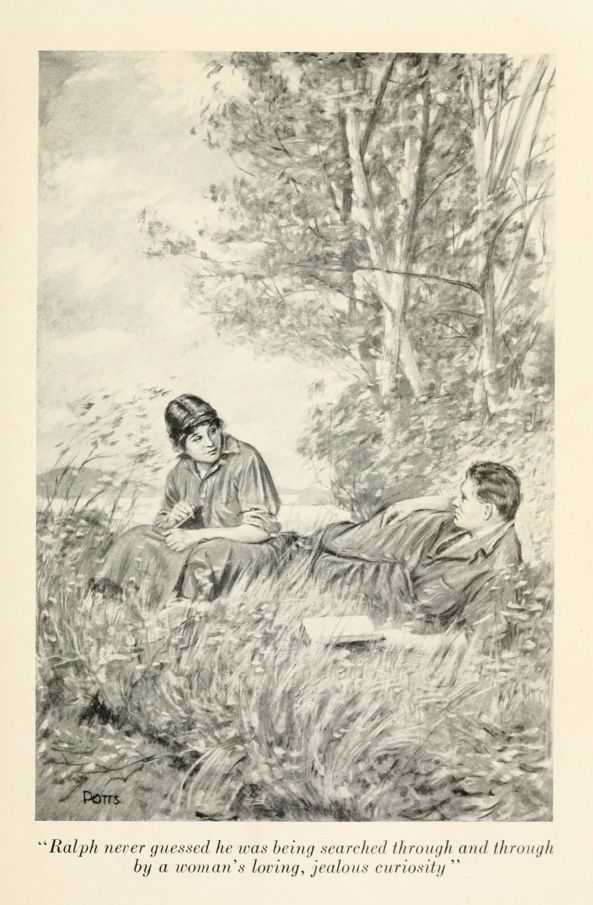
Nahnya had a score of questions to ask about his home and his family. Ralph, as his eyes softened with recollection, grew more outrageously facetious. Nahnya, glancing at him through her lashes, understood. Finally, threading a needle with an elaborately careless air, she remarked:
"I guess you liked the Millersville girls best."
"Print dresses and rosy cheeks," said Ralph dreamily. "Short on fine clothes and long on health and good nature! Choir practice and school picnics and country dances! That was good! There was a girl there——"
"Ah!"
"Patty Lake her name was. We called her Pattycake. She was sweet. Always wore pink, and had two fat, brown braids hanging down her back."
"Well?" a little breathlessly.
"Married the butcher's boy, that's all."
There were many breaks and pauses in this conversation. So off-hand was Nahnya's manner, and such her preoccupation with the needle, that Ralph never guessed he was being searched through and through by a woman's loving, jealous curiosity.
The little black book continued:
"When we left our grassy point and paddled around the big curve in McIlwraith Lake, suddenly we hove in sight of half a dozen whitewashed huts on the shore. And a flag-pole with a flag against the blue! Gave me a regular thrill. The Hudson's Bay Company uses the Union Jack with the letters H.B.C. in white. The fellows up here say it stands for 'Here Before Christ.' As we paddled by, a white man came out of the store and hailed us. Nahnya wouldn't stop. 'Ask too much questions,' she said. This was Fort McIlwraith that I have heard of.
"Immediately afterward we got in the river again. It is deeper and swifter after every lake. Here it is called the Pony River, Nahnya says. There were some ugly snags. Nahnya is a wonder with the paddle. We camped in the middle of a wide, burned-over stretch. It was like a farm-field. You kept looking around for fences and cattle, and a house somewhere.
"Next morning the river slowed up and lost itself among a lot of low islands covered with gigantic cottonwood trees. You could see there was a change coming. As we paddled around the end of an island, me all unawares, we were snatched up—snatched is the word—by a violent green current that raced us down half a mile, and wet us in a rapid before I got my bearings.
"Nahnya says this is the Rice River. It is half a dozen times as big as the Pony. It is a thick, yellowish-green colour like jade, and a funny hissing sound comes up from the surface. Nahnya says it is made by the stones chasing along the stony bottom. It is a gaunt, ragged, bad-tempered looking stream, always gnawing under its banks and bringing the trees down on the run, and then piling the debris in untidy heaps on naked pebble bars in the middle. The cut-banks are astonishing—some of them a hundred feet high, the trees looking like toys along the top edge, waiting their turn to fall over. Out of these smooth slopes, naked as railway embankments, harder strata of earth stick up like castles, with millions of swallows building in them.
"We camped in another burned-out place. This is the loneliest spot on earth almost, and even here man has left his dirty work. The man, red or white, who is responsible for a fire ought to be drawn and quartered. It's ghastly. Nahnya has put the fear of God into Charley. Last thing before we move on she makes him haul water until every spark is quenched. Mosquitoes bad to-night.
"Couldn't sleep. This violent, ugly river, and the ghastly burned-over country, and other things gave me the willies. A brute of a bird flew in circles over the tent half the night, uttering a single croaking note like a cracked funeral bell. Lord! we're a long way off from folks! Fancy Charley and Nahnya taking these trips by themselves. She sleeps like a baby, without ever moving or missing a breath.
"Next day. The old river doesn't look so bad with the sun shining on it. Saw three bears as we went flying down. How does anybody get up this current I wonder. You can't always be going down-stream. Nothing but cut-banks, bars, drift-piles, and vicious little rapids on the bends. Eagles sailing like aeroplanes overhead, and screaming as if they had steel springs in their throats.
"Third day on the Rice River. We have come nearly two hundred miles on this stream, I guess, and not a soul, red or white, not a hut, nor the remains of a hut all the way. The current seems to be slackening, and we lose ourselves in a mess of islands; so I suppose there is something saving for us ahead. This is the sixth day from Gisborne, so we ought to arrive there to-morrow, wherever and whatever 'there' is."
The entries in the little black book ended with these words.
Ralph's diary confined itself discreetly to the visual aspects of the journey, avoiding the psychological. All was not smooth sailing here of course. Ralph was keeping a tight hold on himself that entailed no little nervous strain, and he was apt to break out unreasonably. Nahnya, while generally friendly, had an exasperating way of relapsing at any time into the mysterious inscrutability which maddened him. Only Charley was always the same.
On the afternoon of the third day on the Rice River, after one of the colloquies in Cree with her brother that always irritated Ralph, Nahnya suddenly brought the dugout around in the current, and grounded it on a shelving, stony beach. Charley got out and pulled it up.
"What's this for?" said Ralph, surprised. "It isn't but an hour since we ate."
Nahnya affected not to hear him.
Ralph instantly flew into a passion. "Oh, very well!" he cried. "If you want to be mysterious!"
He strode off and sat down by himself on a drift-log, dignified and sore. He filled his pipe with care, and lighted it. It tasted bad, and he put it back in his pocket.
Nahnya brought cold victuals ashore, and she and Charley sat down together. Ralph, watching out of the corner of his eye, had at least the satisfaction of seeing that she could not eat. She sat with her hands in her lap, unusual for her. He could not see her face. Charley, who could always eat, stuffed himself with moose-meat and cold bannock.
When Charley had eaten as much as he could hold, he carried the remains back to the dugout and put them away. He returned to Nahnya with a coil of light, strong cord in his hands, a tracking-line. Holding it out toward her, he said something in Cree.
To Ralph's astonishment Nahnya sprang up in a rage, snatched the line out of Charley's hands, and soundly boxed his ears. A pretty family quarrel resulted. Charley, thunderstruck at first, answered back in tones of resentful injury. More than once Ralph heard his own name, and wondered mightily what he had to do with it.
Charley flung off, and sat down by himself, and there were the three of them up and down the beach, perfectly sore and unhappy; Ralph in addition mystified by it all.
Ralph was the first to give in. "Oh, I say, this is too ridiculous!" he cried. "Nahnya, come here!"
She went to him with a face like a mask of bronze.
"What's the matter, Nahnya?" he demanded to know. "We're all acting like children!"
She shrugged slightly, and looked away.
Seeing that he would get nothing out of her this way, he changed his tone. "For my part I'm sorry I lost my temper," he said warmly. "Honest, I am."
This told. She frowned and looked uncomfortable; sure sign, as he knew by now, that her feelings were touched.
"We were always going to be friends," he said, following up his advantage. "Is this being friends? What's the matter, Nahnya?"
To his surprise he saw her eyes begin to fill. She made to turn from him, but he caught her wrists and forced her to face him. "Nahnya, I am your friend," he said.
She angrily shook the tears from her eyes. "I one fool!" she muttered. "Like a white woman, I cry when I need sense!"
"What's the matter?" repeated Ralph.
"Let me go!" she said.
He released her.
"I think you going to hate me by and by," she said.
"Why should I hate you?" he demanded.
She gave him an extraordinary look, at once determined and deprecating, and said a little breathlessly: "Ralph, I got to tie your eyes, now."
"Blindfold me?" cried Ralph, amazed. "What for?"
"You must not see where we go now."
"But I gave you my word!" cried Ralph. "I promised I'd say nothing of where I had been or of what I had seen."
"I know," she said, "you will keep your promise. But you must not come back yourself."
Ralph stared at her as if she were a witch. Thus to hit upon his secret intention, scarcely confessed to himself!
After a while she said: "Will you promise never to come back?"
"No!" cried Ralph, very red in the face. "I am a free agent!"
"Then I got to tie your eyes," she said.
"I won't submit to it!" cried Ralph hotly.
She shrugged and turned away. She gave an order to the sulky Charley, and between them they unloaded the dugout. Though it was scarcely four in the afternoon, the three little tents were set up in a row on top of the bank, and every preparation made for spending the night.
The mosquitoes soon drove them in, each under his own shelter, where they lay for the rest of the afternoon, sleeping, sulking, or sorrowing as the case was. They issued out for a hasty, silent supper and turned in again. There was a gorgeous, troubled sunset above the pines across the river, and afterward the evening star came out like a lighthouse in a canary sea with dark blue islands. The hard, swift face of the river mellowed in the fading light, and gleamed with the soft lustre of old, blue stained glass. None of those in the little tents gave any heed.
In the middle of the night Ralph was rudely awakened by the descent of two heavy knees between his shoulders. While he still struggled with the mists of sleep, his wrists were secured behind him. He put up the best fight he could, but his ankles were soon tied, too. Then it was easy to bandage his eyes.
Harder to bear than the indignity of bondage was the pain of betrayal that stabbed him.
"Is this your friendship?" he cried.
There was no answer out of the dark.
VI BLIND MAN'S BUFF
Ralph's struggle only exhausted him, and bruised his wrists and ankles. He gave it up, and lay outwardly quiet, seething with resentment, within. Deprived of his sight, his hearing became preternaturally acute, and he had no difficulty in following the various steps of their preparations for departure. Before the bandage was clapped on his eyes, he had had a glimpse of daylight. He guessed from the poignant freshness of the air in his nostrils that the dawn had just broken.
After the tent had been taken down over his head and carried away, Nahnya and Charley came back to him together. Charley lifted him under the arms, and Nahnya took his feet. Charley's manner of carrying him suggested an insulting indifference that caused Ralph to grind his teeth. They climbed cautiously down the steep bank, finishing with a sudden slide to the bottom, and almost dropping Ralph between them. Charley laughed, and Ralph swore savagely.
They laid him in the dugout, and he heard Charley's steps retreating. Nahnya was arranging the blankets under him.
"Ralph, I sorry," she said in a low voice, sharp with emotion. "I not know anything else to do."
It did not help matters any. He was too full of resentment to give a thought to her side of the case. "This is what I get for trying to do the square thing by you!" he cried. "For holding myself in night and day to keep from distressing you! You worked on my sympathies. You made me think you were on the square. You talked about friendship, and then you attacked me while I was asleep! Oh! I have been nicely taken in!"
He heard no more from her.
They slid the boat off the stones; Nahnya climbed over Ralph to take her place in the stern; and they set off in the current. For hours after that Ralph had nothing to go on but the quiet dip of the paddles, the answering leap of the boat to the thrust of their strong arms, and the drip of the water as the blades were withdrawn. Both brother and sister had a great capacity for silence.
Ralph's frame of mind was anything but an enviable one. It is not pleasant to a man to be confronted by a mystery in the woman he loves. As long as they had been in accord it had troubled him very little; he had looked in her clear eyes, thinking, "whatever may be in store, she's on the square." But when she turned against him all this was changed. Every look, word, act that he had not understood at the time recurred to him charged with a sinister significance. Wounded pride hatefully suggested to him that she was using his love for her to further her own ends.
Nevertheless he could not but admit that for such a hardy villainess some of her acts were strange. He had plenty of time to think things out. He remembered how she had boxed Charley's ears when the boy had first suggested tying him up; he remembered how her eyes had filled, and how sadly she whispered, "I think you going to hate me by and by." This suggested that she might be the victim of circumstances no less than himself. "Why can't she trust me a little?" he thought. "She knows I'd do anything for her!"
Behind all this was the mystery of what lay ahead, hanging like a heavy black curtain athwart his gaze. When a man has his eyes to see, and his arms to fight with, a mystery is pleasantly provocative and stimulating. When he lies blindfolded, bound, and helpless, the darkest apprehensions seize upon him. Thus the weary round continued in Ralph's mind.
The long silence was broken by Nahnya. She uttered in Cree what sounded like a quiet warning. Immediately afterward the dugout lurched violently as under a side blow, spun around, and went on as smoothly as before. For a long time Ralph lay vainly threshing his brain for an explanation of this odd shock.
A new sound slowly stole on his ears, a dull, heavy growl from down the river. He did not need to be told what this was; rapids—but no such rapids as they had shot in the Pony River, or hitherto in the Rice. Those compared with this sound were as the laughter of children to the voice of a giant. The growl became a roar which grew louder with every moment. Ralph's heart began to beat painfully. It is probable that it never occurred to Nahnya, certainly not to Charley, what a refined species of torture they were inflicting on their prisoner. There is no terror like terror of the unseen. "If anything happens I'll drown like a cat in a bag!" thought Ralph. He would not stoop to make any complaint aloud.
Charley and Nahnya stopped paddling, and talked low-voiced; Nahnya gave unmistakable orders. The slight, sharp note of excitement in their voices shook Ralph's breast. From the sounds ahead he pictured a very cataclysm of the waters awaiting them, wilder indeed than any earthly rapids. Little beads of perspiration broke out on his forehead. Oh! for his sight! the use of his arms! But he would not ask it. They started paddling again. The roaring seemed to be on every side of them now. Ralph clenched his teeth and his hands. "Now we're going to take the plunge!" he thought. "Now! Now!" And still it held off, until he could have screamed with the suspense.
And then the dugout seemed to drop from under him, and immediately afterward precipitated itself with a crash against a wall of water. A wave leaped aboard, drenching Ralph to the waist. He thought it was all over, and suddenly ceased to trouble. Charley yelled with pure excitement; the dugout gave a series of mad leaps and plunges, flinging Ralph from side to side like a sack of meal, and suddenly they floated in smooth water again. An uncanny stillness descended on them. A long breath escaped between Ralph's teeth.
There followed what seemed like the greater part of a day to Ralph, with scarcely anything to register the passing of the heavy time. It was perhaps four hours. The sunshine grew warm in his face, and he smelled the pines on shore. High overhead he heard the eagles screaming. Charley complained—of hunger, Ralph guessed, and Nahnya laconically silenced him. At intervals a new sound gave Ralph food for thought. This was the loud, brawling voice of a stream, now on one side, now on the other.
"The whole character of the country must have changed," he thought. "We must be passing between steep hills or mountains for the streams to come tumbling down like that."
The long wait for something to happen was ended by the voice of another great rapid ahead. Ralph's heart began to beat. "Must I go through with that again?" he thought.
But while he was steeling himself for the ordeal, the nose of the dugout grounded, and Charley, springing out, pulled her up on shore.
Ralph was lifted out and laid on a flat rock. There was a long wait. A very real hunger began to assail him. One of the brawling streams came down nearby. From the sounds that reached his ears, Ralph pictured the dugout being dragged across the rock on rollers, and hidden under bushes. Evidently their journey by water was at an end. Nahnya and Charley sat down near him, seemingly to make something. Finally Ralph was lifted up and laid down again, and then, much to his surprise, hoisted on a litter and borne away.
A long journey over rough ground followed, and all uphill, Ralph judged. They never passed out of hearing of the voice of the small stream. They stopped often to rest. Even so, it was wonderful to Ralph how easily they went. He was no light-weight. Once or twice Charley grumbled at taking up the load, and Nahnya angrily silenced him. There was no faltering in her. In spite of his resentment against her Ralph felt a kind of compunction at being carried by a woman. Anyway, his resentment had cooled somewhat; cooled enough to allow him to glance at the oddity of his situation.
"Lord! here's a queer go!" he thought. "What next?"
He was not under any apprehensions of danger to himself.
They went on for an hour or more, and the question of food became of more vital moment to Ralph than of what was before him. The air had the lack of motion and the cool smell of vegetable decay that suggested a deep forest. Finally he was put down for a longer period, and he heard the welcome sound of Charley's axe, and shortly afterward the crackle of the growing fire. In a little while the delicious emanation from baking bannock reached his nostrils, and at last he heard the hissing of the bacon in the pan, which signified the completion of the preparations. A certain anxiety attacked him.
"How the deuce are they going to manage about feeding me?" he thought. "By Gad! if they think they're going to make me go without my dinner——!"
However, Charley presently untied his ankles and his wrists. Ralph tore the bandage from his eyes, stretched himself luxuriously, and looked about him.
They were in the magnificent gloom of a primeval forest. Gigantic trunks of fir and spruce rose on every hand with lofty branches that darkened the heavens. The little patches of sky that showed between seemed immeasurably far off. The fallen monarchs of ages past lay here and there in confusion, rotting by infinitesimally slow degrees. The ground was stony, but stones and fallen trunks alike were largely covered with moss, incredibly soft and thick and green. The moss masked treacherous holes, as Ralph discovered when he attempted to move about. There was no undergrowth except a few spindling berry-bushes, and a low plant with huge leaves called the "devil's club," both pale from lack of sunlight.
The forest grew on a steepish slope. Ralph affirmed to himself that the way home lay straight downhill. He could still hear the voice of the little stream off to one side. He discovered a faintly marked trail that climbed straight from below, and continued on uphill. This explained how Nahnya and Charley had been able to avoid the fallen trunks and the holes. A trail once made never becomes totally effaced. The wildest, most deserted forest wilderness shows such forgotten paths.
So far Ralph's deductions carried him. Later he made a fresh discovery. Facing downhill and looking straight away through the tree trunks, he distinguished the outline of a noble, snow-capped peak a mile or two away. From the direction of the shadows upon it he saw that the sun was slightly to the left of it. As it was now half-past ten or eleven, that peak must therefore be directly south of where he stood. Walking up and down, he searched through the trees and gathered from the suggestions of the outlines of other mountains that the peak was part of a chain running right and left.
Little by little he pieced it all together in his mind. "We shot a big rapid, and paddled for three or four hours, or until we came within hearing of the next big rapid. The big river must flow parallel with that range yonder—that is to say, east and west. I knew it was flowing between mountains. We landed on a big flat rock at the mouth of a stream and struck straight up-hill, which is due north. Blindfolded or not," he said to himself triumphantly, "I guess I won't have much trouble finding my way back if I want to."
Nahnya with a sullen, troubled face, watched Ralph making his observations but offered no comment.
Breakfast or dinner, whichever it was, was eaten in silence. Nahnya and Ralph each wore a mask, and each avoided the other's eyes. Charley was solely concerned with his long-delayed food. Ralph, secretly elated by his own perspicacity, later made no objections to being bound and blindfolded again. It seemed to him rather a ridiculous precaution, because if he ever got as far as this, he would naturally continue by the trail. However, if they wished to give themselves the trouble of carrying him, so be it.
The journey of the morning was repeated, but for a longer period. Ralph marvelled at his bearers' endurance. For at least two hours they toiled with frequent pauses, always uphill. Finally upon laying him down they left him, and he guessed they had come to the next halting-place. A long time passed without his hearing them talk, or hearing any preparations to camp. The possibility of their abandoning him there in the woods occurred to him, causing a disagreeable prickling up and down his spine.
At last he heard Charley's footsteps, and the bandage was removed from his eyes. Still the virgin forest. No sign of Nahnya. More mystifications!
"Where's Nahnya?" demanded Ralph.
"Him come back tepiskow," Charley answered stolidly.
The boy held up a piece of paper with writing upon it for Ralph to read, but held it upside down. Since it did no good to yell at Charley, and Ralph's hands were tied, it was a little while before they came to an understanding. When the paper was finally righted Ralph saw that it was a letter from Nahnya, and once more he was astonished by her. It was written in a hand as fine and precise as a nun's. This strange girl could write as well as steer a canoe!
"To the doctor," it began. (She had made an attempt to spell Ralph, and had given it up.) "If you promise not to go away from here till I get back, Charley will untie the ropes and make you free. If you promise, make a holy cross on this paper for him to see. Annie Crossfox."
Ralph had not by any means forgiven Nahnya her high-handed proceedings, but an extraordinary curiosity modified his anger. He was determined to discover what lay behind all these mysteries. He decided to submit to the promise, and signed to Charley to put the pencil between his teeth. Charley holding up the paper, he made the sign as decreed. Pocketing the paper as a warrant for the proceedings, Charley liberated him.
Ralph walked to and fro to stretch his legs, and to see what he could see. Here there was nothing but endless vistas of the forest whichever way he looked. Because of the higher altitude to which they had climbed, the trees were not of such a staggering magnitude, and there was more undergrowth. He saw gigantic raspberry bushes with pale flowers as big as mallows. The silence was unearthly; not a bird cheeped, not a leaf fluttered.
Ralph was finally reduced to studying the impassive Charley. There was not much reward here. Charley sat with his back against a tree, smoking a pipe, and staring into vacancy. Charley had the faculty of being able to suspend animation when he chose. Ralph wondered why he did not fall asleep. By and by it came to him that the Indian boy was actually uneasy, not the uneasiness of alarm, but of impatience. His head would turn slightly in a given direction, and a desirous look appear in his hard, bright eyes. His head was cocked to listen.
"Nahnya has kept him out of something that he is keen for," Ralph deduced.
Charley prepared a meal, and they ate. Afterward, since there was nothing better to do, Ralph rolled himself in the blanket he had lain on, and slept. When he awoke the indefatigible Charley was cooking another meal. They had eaten it and were smoking; darkness was already creeping through the forest aisles, though far overhead the sky was bright, when without warning the Indian boy sprang up with a whoop, and seizing his hat and gun darted away. Ralph, gazing after him, wondered if he had gone mad. Presently from the same direction he saw Nahnya coming through the trees, followed by an old woman in a black cotton dress. At sight of the girl the recollection of the indignities she had put upon him flamed up in Ralph's breast, and his eyes hardened. He forgot about Charley.
Nahnya, after a quick glance in his face, lowered her eyes. "This my mot'er," she said in a low voice.
The old woman made a bob to the doctor. She was frankly terrified by the sight of him. She did not in any way suggest the mother of Nahnya, being without grace. She looked merely the middle-aged mother of many children. She had jetty hair neatly parted and braided, eyes as stoical as Charley's, and a skin like wrinkled, waxed brown paper. She had the strong, patient look of the aging worker. Ralph, looking from one to the other, could not find the least point of resemblance between mother and daughter. The fact caused him a certain grim satisfaction. His professional eye fixed on the old woman's pitiful, crooked arm.
So it was true after all that Nahnya had fetched him to cure her mother. He felt relieved, but only the more mystified. For why, if everything was plain and aboveboard, had she taken such desperate precautions to insure secrecy? Nahnya was no fool. He angrily gave it up, and turned his back on the old woman, who, as soon as his eye fell upon it, began to soothe the injured arm with deprecating glances toward him. Ralph had already observed with a hard smile that they had brought up his little satchel of instruments and medicaments on the litter. He had made up his mind that nothing should induce him to open it.
The two women had brought packs containing everything needful for a comfortable camp, and they set about making ready for the night. Nahnya said no more to Ralph, nor did she look at him again, but her actions were eloquent. Watching her with sidelong glances, a great uneasiness grew in him. She cut a heap of spruce boughs to make him a soft bed. She roasted a ptarmigan she had brought with her, and when it was done, took it to tempt his appetite before he turned in. She offered it to him silently, with an extraordinary upward look, soft, penitent, and imploring.
The look raised a storm in Ralph's breast. It confused and touched and angered him together. His heart leaped to answer it, and his indignant pride held him back. "Why can't she be open with me?" he thought. "Does she think she can truss me up like a piece of baggage, and then bring me to my knees again with a soft look?" He accepted the offering as his right, without relenting, and Nahnya went sadly back to her own bed beside her mother.
With a great air of unconcern, Ralph crawled between his blankets and resolutely closed his eyes. But the struggle within him went blithely forward. He would, and he would not. She had used him intolerably, and he hated her. She was sorry, and he loved her. The mystery she chose to wrap herself in exasperated him; her quiet resistance to his will maddened the male in him. There were times when he felt as if the only thing that would give him any peace would be to crush her utterly. Then he would remember the look in her eyes which promised a secret heaven for him to whom she chose to open it. Daylight was coming again before Ralph fell asleep.
When he awoke the struggle was over. Such a struggle in him could have but one outcome. His pride caved in. After all, he told himself, he was a doctor, and he could not turn his back on a grievous injury. He did not mean to forgive Nahnya—at least not in a hurry—but he knew he could not forgive himself if he went away leaving a doctor's work undone. Perhaps he was not quite frank with himself in this; perhaps it was only Pride trying to save something from the ruins; perhaps he never would have left Nahnya could he have helped it. Every imaginative heart that loves, loves the sentimental satisfaction of heaping coals of fire upon the head of the beloved one. She would feel sorry she had used him so, but he would be relentless. When she had suffered a great deal—perhaps——
So after breakfast, still scowling like a pirate, he opened his doctor's kit, and issued gruff orders to Nahnya. The sun came out in her face; she said not a word, but flew to do his bidding. Admirable was her capability and her deftness. In no time at all the frightened old woman was made comfortable on a deep bed of spruce boughs, with splints, bandages, and hot water waiting.
When it was all over, and the old woman began to come safely out of the ether, weeping copiously, but vastly relieved in mind, Ralph repacked his satchel viciously. When his purely professional absorption was no longer called for, he ran up the flag of resentment again. Nahnya had said nothing. Once when the danger point was past she had leaned across the patient and squeezed his hand, but he had quickly pulled it away. Her eyes followed him expressing a passion of humble gratitude. It infuriated him; why, he could scarcely have told; perhaps because it was so clear that it was only gratitude, and not the other kind of passion that he was hungry to see there. At any rate he could not support the look. Snapping the valise shut, and tossing it to one side, he strode away leaving the patient to Nahnya.
"It's done," he thought bitterly. "And she's done with me. A lot she cares what I'm suffering. She sacrificed me without a qualm to the old woman. Now she's cured, I can go back, and be hanged to me, I suppose. Well, I don't mean to be fobbed off so easily. I've done my part, and I'm a free agent. I won't leave here till I've unwound every thread of the silly mystery she entangles herself in!"
By and by the old woman fell into a natural sleep, and Ralph was free to leave her. He lit his pipe, and wandered off up the faintly marked trail.
In the perpetual twilight of their camp one got the feeling that this forest rolled on forever, but Ralph had not gone above three hundred yards before he unexpectedly came to one of its boundaries. To the left of the trail it ended at the base of a mighty precipice of naked gray rock. Standing at the edge of the trees and looking right and left the height of rock extended as far as he could see. Looking up, it was too beetling for him to see its summit.
Continuing upon the trail a little way farther, he came to the edge of a gulch, where he could obtain a wider prospect. Looking up now, he had dizzying, foreshortened glimpses of peaks and domes of rock, with a distant view over all of the supreme summit, shaped like a gigantic thumb of rock sticking up out of fields of snow, gilded and dazzling in the sunshine, and incredibly far-flung. It was a stirring experience thus to be brought without warning into the immediate presence of such a God. Ralph gazed, forgetting his private despite against Fortune.
At his feet the gulch came down from the left along the base of the unscalable heights. A trickle of water ran musically in the bottom of it, and was borne off to the right to join the larger stream, beside which they had ascended from the river. The trail crossed the gulch, and disappeared within the forest on the other side. The forest skirted the edge of the gulch, and swept on up concealing all on that side.
Ralph's only view was therefore up the gulch. The floor of it was heaped with broken masses of rock and fallen trees. As he looked, thinking of nothing but the wild beauty of the scene, suddenly his jaw dropped, and he dashed a hand across his eyes to make sure they were not tricking him. For out of a little tangle of living and dead trees at the base of the cliff, about a furlong from him, issued the figure of a man. It was Charley. One would have said that he had issued out of the cliff itself.
VII BOWL OF THE MOUNTAINS
Ralph instinctively fell back among the trees. He had not been seen. Charley was unconcernedly picking his way down over the stones. Drawing back from the trail, Ralph concealed himself until he heard Charley pass on his way to camp. He then clambered down into the gulch, and made his way as fast as he could over the obstructions to the spot where the boy had so surprisingly come into view. Ralph suspected that an alarm would be raised for him as soon as Charley got back to camp.
The place he was making for was in a slight angle of the gulch, and the driftwood was piled in a wild tangle there. Climbing over the fallen trees as he had seen Charley climb down, Ralph came to a little niche of earth that provided a precarious living to three stunted pines and a few berry-bushes, the whole making a natural screen against the cliff. Pushing through it, he found himself looking into a hole in the rock at his feet.
Starting back, he gaped at it a little stupidly. He did not know what he had expected to find—not a hole in the rock! For a moment he doubted the evidence of his senses; it seemed too preposterous. Weird ideas took half shape in his brain and floated away while he stared in the hole. Was it possible they were of another race—creatures existing in the bowels of the earth without sunlight or the stir of air? Why, after travelling hundreds of miles from the world of men, was there need of burying one's self any deeper? Was it the possession of some ghastly secret that made Nahnya's face always wistful? What did it conceal, that hole, a hideous crime, disgrace unimagined—or a treasure?
The opening was about two feet across. Buttressed by the fallen trees below, and screened by the living ones, it was shrewdly hidden. Ralph wondered by what chance it had first been discovered. He lighted a match and dropped it in. It burned until it struck the bottom. It was about fifteen feet deep. There was the trunk of a young pine standing upright within it, reaching to within a foot of the top. Obviously this was used to climb in and out by.
It was like an invitation to enter, but Ralph hesitated. Notwithstanding the reassuring light of day and the solid earth of rocks and trees, the feeling of something uncanny, something more than natural, would not down. When he laughed this away, there remained very human fears. "Who knows what may be down there," he thought, "and what kind of a reception I will receive?" Finally there were compunctions of delicacy. "It's hardly square to break in on their secrets behind their backs," he thought. Recollection of his own injuries wiped this out. "They weren't so careful of my feelings," he told himself.
In the end, perhaps because he was afraid, Ralph was obliged to descend. As he would have put it, he could not take a dare from himself. Swinging his legs over the edge, he felt for the top branch of the pine tree.
At the bottom of the hole he struck another match. There were several pine-knot torches lying at his feet; picking up the longest, he lighted it.
He was in a narrow cleft in the rock, extending obliquely and downward into the mountain. It was necessary to recline partly on his back and inch himself along, holding the sputtering torch at arm's length before him. It was an awkward posture in which to meet danger. But if Charley could come through he could, he thought.
After only a few yards of this he issued suddenly into a much larger chamber, where he was able to stand firmly on his feet. It was a kind of spacious corridor running off to the right and left, and floored with pebbles and sand. Manifestly a stream had once flowed over it, but at present the floor was dry.
The thrilling impressions of a cave brought Ralph's boyhood winging back to him. Thinking of grizzly bears and mountain lions none too comfortably—he was unarmed—he sniffed the air delicately. There was no suggestion of animal effluvium. Anyway, Charley had just passed through. The torch made an extraordinary dancing light on the walls of rock, reminding him of a certain flaring gas-light in the cellar at home. The cave was not like a tunnel with arching roof, as he had always imagined caves, but was still a fissure in the rock, both sides leaning obliquely in the same direction. Overhead the split gradually narrowed; the light of his torch did not penetrate to the top of it.
Ralph was faced by the choice of turning right or left in the corridor. He lowered the torch to look for footsteps. In the patches of sand they were plainly discernible, many of them, almost a beaten path leading off to the right. Besides Charley's, Ralph readily distinguished the prints of Nahnya's small, straight feet, and another foot, evidently her mother's. The sight of all these footsteps had the effect of allaying Ralph's fears, and of strongly stimulating his excitement. Up to this moment he had kept in view the possibility that this cave might be a private affair of Charley's. Now he could no longer doubt that Nahnya's secret, whatever it was, lay at the end of this path. He followed it, feeling himself on the brink of an amazing discovery. Nothing could have turned him back now. "With all her pains to keep me in the dark I have been a little too clever for her!" he thought vaingloriously.
Sometimes the corridor was ten feet wide; sometimes it narrowed down to four. The air had that extraordinary dead quality only to be found in deep caves, but it was quite pure, because the torch burned clearly. The stillness pressed on his ear-drums. The quietest room, the quietest night out of doors, was vibrant and musical by comparison. His own breathing sounded hoarse and laboured in his ears.
Holding the torch high over his head, wrought up to the highest possible pitch, he made his way swiftly over the smooth floor. Rounding a corner of the rock, the flickering light fell on a human figure standing motionless before him. He stopped short with a horrid shock of fright. The torch dropped from his nerveless hand and was extinguished. He slowly screwed down the clamps of self-control, and schooling his voice, hailed the creature. The sound shattered the dark stillness with an incredible, unnatural ring. The sound of his own voice in that place terrified him. The silence that followed upon it was terrible. There was no answer.
Very slowly he forced himself to pick up the torch, to light a match, and to ignite it again. He held it aloft. The figure was still there, motionless. Ralph went forward very gingerly, and saw that it was not human after all, but merely a kind of scarecrow, a stick planted in the sand with a cross-piece on which was hung a coat and hat. Evidently some of Charley's work, placed there for what purpose Ralph could not conceive. He sat down, and wiping his face, allowed his shaking nerves to quiet down.
Proceeding, he heard a murmur which later resolved itself into the sound of running water. Ralph wondered uneasily if there were times when a torrent raced between these rocky walls; he pictured himself swept helplessly upon it, and his skin prickled. In such a place he would not have been surprised by anything. The scarecrow reassured him partly. Plainly it had been set up to stand more than an hour or two. Keeping on he satisfied himself that the water was not coming toward him. The sound increased only in the ratio of his progress toward it.
Soon it was close ahead, not a loud sound, but the musical voice of a rapid, smooth stream. Holding the torch high, its light was reflected in pale gleams up the corridor. The water was coming straight toward him, only to be suddenly and mysteriously diverted.
A few steps farther and he had the explanation. A yawning hole in the floor of the cave received the stream entire without a sound. It simply slipped over the lip of rock, and ceased to be. The absence of any sound of a fall below was uncanny. Ralph tossed a little stone in the hole—and heard nothing. Not until he lay at full length and stuck his head over the edge of the chasm could he hear, above the soft hiss of the descending water, the distant muffled crash of its fall. The height suggested by the sound staggered the senses. Ralph received a new and awful conception of the goodly old phrase: the bowels of the earth.
At one side two logs made a rough bridge over the gap. Ralph continued his way beside the stream, crossing from side to side, and upon occasions when it filled the whole floor, forced to wade. Here there was a faint stir to the air, a hint of freshness, and he instinctively began to look for daylight ahead.
Finally he saw it, far off, a crooked exclamation point of white. He hastened toward it, feeling an unbounded relief. He had been prepared to face—he did not know what—some shape of mystery or terror in the darkness. And here was honest daylight. An insupportable curiosity filled him, forcing him to run and to leap as if but a minute or two of daylight remained.
Arrived in the opening, he flung the remains of his torch in the water. The blessed bright sky was over his head once more. Until he saw it he did not realize how heavily he had been oppressed by underground terrors. At first nothing else was visible to him but the sky and terraces of rock on either side, between which the little stream came tumbling down into the hole. Ralph went up over the rocks like an ape. At the top there was lush green grass starred with flowers. Trees below still obstructed his view. He ran on up the slope of grass until the whole prospect opened to his eye. There he flung himself down to gaze his fill.
He was not disappointed. It surpassed his brightest imaginings. The first glimpse amply repaid him for the trip underground. It was lovelier than any sight he had every beheld, lovelier than any scene he had visited in his dreams. It was itself and it was new. The artist in him experienced the rich, rare satisfaction of beholding a perfect thing. He had to enlarge his conception of beauty to take it in.
It was a valley hemmed all round by craggy mountains, running up to towering, sharp peaks. The mountains held his eye for a while; it was almost his first unobstructed view of earth's mountains in their majesty. They rose, fantastic, overpowering shapes of gray rock with mantles of snow upon their shoulders and bared heads, each as distinct in individuality as an old king. The grandeur of the company set off in poignant contrast the tender loveliness they guarded below. It was well guarded; there was no break in the armed ranks to let in discord from the world.
Below the scene was drunk with strong colour. The middle of the valley was filled for half its length with an exquisite sheet of water, curving away as gracefully as a girl's waist. Its water was of an unreasonable richness of hue that held Ralph's eyes like a charm; neither sapphire nor emerald, but partaking of both. That part of the valley nearest him was like a park—like a dream park. The trees, aspens, and white-stemmed birches were set out in clumps in the riotous grass. Farther up the valley rolled a thick forest. Everywhere there were flowers. The bluebells growing under his hands were as big as thimbles and blue as lazulite. Everything growing, birch trees, flowers, and grass, flaunted itself with a particular vigour and richness, as if the valley were Nature's own nursery, where she perfected her specimens.
The scene was not all Nature's. Off to the left, about half a mile from where Ralph lay, he saw three tepees topping a little rise of grass beside the lake. A column of thin smoke rose above them. Three canoes lay on the shore below. It did not make a discordant note in the scene; the tepees rose from the grass as naturally as trees. Ralph gazed at them with strong curiosity. He saw, or imagined he saw, figures moving in front of them.
The whole scene touched a chord in Ralph's memory; where had he heard of such a hidden valley? such a blue-green lake? So this was Nahnya's secret! He was compelled to readjust his ideas of her again. His dark thoughts at the mouth of the cave seemed foolish to him now. This, her place, was characteristic of the best in her. But why was she so passionately bent on keeping him out of her paradise? This thought raised all his torturing doubts again. He determined to find out what the tepees concealed.
Descending the slope, and crossing the stream, he made his way around through the flowery grass. Never had he seen such wildflowers—bluebells, wild-roses, painter's brush, besides the thickly blossoming berry-bushes, and many a flower he could not name. The trees growing singly or in small groups reached the perfection of their kind. It was too beautiful to seem quite real; Ralph, passing among the snowy trunks in his sober habit, felt a little out of place, like a mortal who had strayed into a fairy-tale.
He crossed another little stream bringing its quota from the mountains to the lake. Where it emptied into the lake at his right it spread out into a miniature delta. Ralph, attracted by the sight of some implements lying in the grass beside the water, went to investigate. He found a shovel, a large shallow bowl, and a smaller bowl all roughly fashioned out of cottonwood.
As he looked into the last-named article, Ralph caught his breath in astonishment. It was half full of gold. No mistaking those clean yellow grains! Ralph had not fallen a victim to the gold-mania of the North; he held the bright metal as lightly as any man, nevertheless his breath quickened and his eyes grew big at the sight of so much in so little. He dug his hands into it and let the stuff run through his fingers. There was enough here to buy the Tewksbury outright, or to buy a string of the best ponies in the country, or to carry a man around the whole world spending royally.
Ralph wondered if ever before gold had been left like this, unguarded under the sky. He moved the bowl a little, and saw that the grass was white beneath. Evidently it had lain there many days. Gold must indeed be plentiful in this valley, or lightly regarded. Dimly in his mind rose the vision of a happier world, where gold was despised like this.
Leaving it where it lay, he went on. Descending into a wooded hollow, the tepees were hidden from him for a while. Climbing a little rise finally, he found himself unexpectedly almost on top of the camp.
Nearest him a ripe and comely Indian girl was stirring a pot over the fire. Beside her on a blanket in the sun sprawled a flourishing, naked infant. At sight of Ralph a piteous gasp hissed between the mother's teeth. Her eyes protruded with terror; she caught the baby tragically to her breast, and cowered over it. It uttered a piercing cry. Beyond the woman an old man squatted on the ground mending a bow. He looked up, and his face, too, froze into a mask of terror. Two half-grown boys came running from the beach, and stood transfixed. The frightened faces of two girls stuck out of a tepee opening.
Ralph was much embarrassed by the suddenness of the effect he created. Never having looked upon himself as an object of terror, their attitudes could not but seem far-fetched and ridiculous to him. He stood as much at a loss as they.
Finally the old man, after a visible struggle with himself, arose and approached Ralph. His features were stiff with anxiety, and his old eyes fixed in a kind of glare. It was evident from his manner that he considered himself bound to show an example to the boys. Not without dignity he held out a trembling hand to Ralph.
"How?" he said.
"You speak English?" said Ralph eagerly.
"Little bit," the old man said, shaping the words with difficulty. "I no see white man, two, three winter. I forget, me." Having said it, he waited with a courteous air for Ralph to speak again. Only deep in his eyes could be seen the working of his harrowing anxiety.
"I am friendly," Ralph said quickly. "I won't hurt anybody."
The old man shrugged deprecatingly. "Not afraid of hurt," he said. He paused, searching for English words to convey what he wished. "We alone here long time," he said. "Forget strangers. Stranger comes—Wah! It is lak sun fall down from the sky!"
Ralph began to understand the effect of his sudden appearance.
"For what you come here?" the old man asked.
Ralph was nonplussed. "Why—why just to see the place," he said.
The old man bowed. His manners were beautiful; the kind of manners, Ralph dimly apprehended, that come only from real goodness of heart. He had never been a big man, and now he was bent and shaky, yet he had dignity. The manifold fine wrinkles of kindliness were about his eyes. He was clad in an old capote made out of a blanket. Around his forehead he wore a black band to keep the straggling gray locks out of his face.
"How you come here?" he asked.
"Through the cave under the mountains," Ralph answered.
"You are the white doctor?" the old man suddenly exclaimed, with a look of extraordinary anxiety.
"I am," said Ralph.
The old man's head dropped on his breast, and a little sound of distress escaped him. He murmured in his own tongue.
"What's the matter?" cried Ralph irritably. "Why shouldn't I come here if I want to take a walk? Do you think I'll bring a plague with me?"
The old man raised an inscrutably sad face. He shrugged. "I not talk," he said. "Got no good words, me. Nahnya will talk. Nahnya is the chief here. She come soon, I think."
"What does it all mean, anyway?" cried Ralph.
"Will you eat?" inquired the old man with his courteous, reticent air. "I sorry I forget before. We have moose-meat."
Ralph was conscious of receiving a rebuke.
"I'm not hungry," he muttered, turning away.
His imperious curiosity soon brought him back. The old man stood as he had left him. "Has this place got a name?" asked Ralph.
"Call Mountain Bowl," was the answer.
A light broke on Ralph. He stared at the Indian with widening eyes. Wes' Trickett's story came rushing back to him. The cave under the mountain, the blue-green lake, the gold beside the little stream! Bowl of the Mountains, of course! So it was true, after all, and he had found it! He looked over the lake with shining eyes.
"Nahnya come," the old man said quietly.
Ralph whirled about in time to see her come flying up the slope, panting, dishevelled, wildly agitated, a flaming colour in her cheeks. At the sight of Ralph she stopped dead, and her hands fell to her sides. She paled. She did not speak, but only bent an unfathomable look on him. Indignation, reproach, and pain were all a part of it, and a kind of hopeless, sad fatalism. It accused him more eloquently than a torrent of invective. He became exquisitely uncomfortable.
"Well, here I am!" he said, trying to carry it off with a touch of bravado.
Still she did not speak. With her mournful, accusing eyes fixed on him, she flung up her arms, palms to the skies, and let them fall. "So be it!" the action said. Turning abruptly, she walked to the edge of the bank and sat down in the grass.
VIII IN THE VALLEY
Ralph, without knowing exactly how it had been brought about, was sensible that he had produced a calamity. Penitence and shame overwhelmed him. He felt like one who has inadvertently killed something beautiful and defenceless. With too much feeling he was dumb. He could only stand off and watch her wretchedly, and reproach himself.
The spectacle of Nahnya's still despair became more than he could bear at last, and he went to her where she sat on the bank. "Nahnya, what is the matter?" he begged to know. "What have I done?"
"Nothing," she said dully. "You not mean bad."
"Then why are you sitting like this? Why did you look at me so when you came?"
"I feel bad," she said simply. "You are here. I not know what will happen now."
"What can happen?" he asked, mystified. "Why shouldn't I come here? Why can't you trust me a little?"
"Trust!" she said with an inexplicable look. "What is trust? You mean good, I think. You are a white man. You can't change that. How can you stop what will happen, anyway?"
"You talk in riddles!" cried the exasperated Ralph. "If you'd been plain and open with me from the first, wouldn't it have saved all this trouble? Why can't you tell me what it is?"
Nahnya twisted her hands painfully together. The quiet voice began to break. "I can't talk," she murmured. "I feel much bad. I have got no right words to tell you."
"Do you want me to go back?" he asked.
She shook her head. "You have found the place," she said. "What does it matter when you go? Stay here. By and by I try to tell you what is in my heart."
"But your mother," said Ralph. "I must go back and see to her."
"Charley and I carry her through the mountain," Nahnya answered. "They are waiting back there. I will send the boys to help Charley carry her here." She raised her voice: "Jean Bateese!"
The old man hastened to them. Nahnya gave him an order in Cree. Continuing in English, she said:
"The doctor will stay with us to-night. He is our friend. Make everything for his comfort."
Her unaffected magnanimity, after he had so grievously injured her, touched Ralph to the quick, and covered him afresh with shame. "Nahnya, I'm so sorry!" he burst out impulsively.
She got up without answering, and walked down to the lake shore. Lifting one of the birch-bark canoes into the water, she got in, and without looking back headed her craft up the lake, paddling with her own grace and assurance.
"Where is she going?" asked Ralph jealously.
The old man spread out his palms deprecatingly. "I do not ask," he said. "She moch lak to go alone. She is not the same as us." Whenever Jean Bateese referred to Nahnya it was with the unquestioning air that an ancient Egyptian might have said: "Cleopatra wills it."
He led Ralph back to the fire. The three tepees stood in a row parallel with the lake shore. Between them were summer shelters of leaves, so that the women could do their household tasks out of doors. Their winter gear, sledges, furs, and snowshoes, was slung up on poles out of harm's way. There were racks for smoking meat and fish, and frames for tanning hides, all carefully disposed to be out of the way. The view from the little esplanade of grass in front was superb.
The two boys were standing near, rigid with astonishment and curiosity. They were a comely pair, sixteen or seventeen years old, with bold, handsome faces that became sullen with shyness at Ralph's approach. Each was naked to the waist and lean as a panther, with a coppery skin that shone in the sun, and muscles that crawled subtly beneath as if endowed with separate life. They wore buckskin trousers, and moccasins embroidered with dyed porcupine quills; their inky hair grew to their shoulders, and each wore a thong about his forehead to confine it.
Here the resemblance ended. He who stood a foot in advance was the taller. He had thin features and an aquiline glance. In the band around his head, unconsciously true to his type, he had stuck an eagle's feather.
"This Ahmek, Marya's son, the brother of Nahnya," said St. Jean Bateese.
The other boy, while an inch or two shorter, was broader in the shoulders. His face was flat with high cheekbones and narrow eyes.
"This Myengeen, my son." The old man spoke a word in Cree, and each boy put forth a bashful hand to Ralph.
Ralph could not remember their uncouth names. The taller boy he thought of afterward as Cæsar; the other as Ching.
St. Jean transmitted Nahnya's order to them, and the two departed in the direction of the cave.
Ralph, notwithstanding his distress on Nahnya's account, could not but be keenly interested in the life of the strange little community that she ruled. Since she withheld the explanation of her unhappiness, he listened eagerly to St. Jean's gossip, and questioned him, hoping to discover a clue there. Though St. Jean had shared in Nahnya's dismay at the white man's coming, he had pride and pleasure in exhibiting their work. Moreover, Nahnya had commanded him to do the honours. Courtesy was this old savage gentleman's ruling force.
"Him good boys," St. Jean said, looking after them proudly. The old man's English gradually came back to him at his need. "I teach him all my fat'er teach me, long tam ago. I teach him to be pain and 'onger and cold, and say not'ing. I teach him mak' canoe. I teach him shoot with the bow."
"Have you no guns?" asked Ralph.
"Our fat'ers got no guns long ago," answered the old man. "Nahnya say bang-bang drive every beast out of our valley. Him not any scare of arrows. We kill sheep and goat on the mountains with arrows. We kill caribou with arrows. My boys good hunters."
"Are there caribou in this little valley?" Ralph asked with surprise.
"N'moya," said St. Jean, shaking his head. "Over the pass up there"—he pointed to the north—"there is another valley. When the first snow come we travel there to kill for winter. Nahnya say we kill only bulls, and him never get scarce."
The simple old man worshipped at two shrines. "Our fat'ers do that" was continually on his lips; or, "Nahnya say so."
If Ralph had been a long-desired guest instead of what he was, an intruder, St. Jean could scarcely have done more. He made Ralph sit on a blanket and brought him a new pair of moccasins. He commanded the young woman to bring food. This was Charley's woman, he explained; her name, Ahahweh. The baby was the first native of the valley; the first of the strong race they meant to establish.
"Don't the boys ever want to get out of the valley?" Ralph asked curiously.
St. Jean shook his head. "N'moya. Him not white men. Him not want what him not see. Him happy enough for good hunting and plenty meat. Pretty soon him take a woman and build lodge."
"Wives?" said Ralph. "Where will you get them?"
"They are here," said St. Jean. "Marya's son will take my girl. My son take Marya's girl. Marya teach the girls all woman's work, lak our people long tam ago. They are good workers."
Ralph remembered the two scared young faces he had seen looking from the tepee. "Suppose the boys are not pleased with the girls you have chosen for them?" he asked.
St. Jean looked at him surprised as by a foolish question. "There are no more girls," he said.
"How long have you been here?" Ralph asked.
"Two summers."
"How about you? Wouldn't you like to see the world again?"
Jean Bateese shook his head. "I am old," he said. "I have seen everything. I have travelled as far as the Landing. I have seen too much white man." Here, feeling that he had been impolite, he hastened to add deprecatingly: "White man good for white man. White man moch bad for red man. Nahnya say so. She is not lak other women. She is more wise than a man."
Ralph had the feeling that he was listening to wisdom from its source.
Jean Bateese waved his hand over the lovely scene before them, and his old eyes grew soft. "This our good hunting-ground," he said. "My boys good hunters. Him get good wife. Him have many good, fat babies. Him live same lak red man live long tam ago. Him forget white man. It is best."
As Ralph listened, the white man's world of artifice and oppression, the world of teeming, disease-ridden cities, the world of place-seeking and money-grubbing seemed like a nightmare to him. He felt as if he were being shown a glimpse of the essential truths of our being. As St. Jean had said in his own way, Nature was best.
Charley's wife, the blooming young Ahahweh, served him his dinner in an agony of bashfulness. The meal consisted of a stew of goat's flesh and rice. Ralph found it good.
"Rice?" he said questioningly.
"Wild rice," said Jean Bateese. "Him grow around the lake more than we can eat. We eat nothing from the white man's store only tea. The tea is near gone. I will miss it," he said with a sigh. "But our fat'ers not drink tea," he added stoutly.
Before Ralph was through eating, the two boys came into camp bearing his patient on the litter. Examining her, he found that she did not appear to have taken any hurt from her journey. Charley, St. Jean Bateese explained, had gone back through the cave to fetch the rest of their belongings from the camp in the woods.
An hour passed, and there was still no sign of Nahnya's return. Ralph became more and more uneasy. St. Jean assured him that it was Nahnya's custom frequently to paddle away by herself, and that they never sought to question her, nor to follow. Meanwhile the old man relaxed none of his efforts to entertain Ralph. He put his pupils through their paces. There was a foot-race in the grass, which Ching won to everybody's surprise, and the chagrined Cæsar was forced to yield up a brass clock-wheel that he wore around his neck. A race between the two canoes across the lake and back followed. This time Cæsar redeemed himself. The lithe young creatures were wholly beautiful in action. Afterward they were sent into the woods with their bows and arrows. By and by Cæsar returned with a brace of rabbits, and Ching brought in a fat porcupine. Ching was held to have won.
"Rabbit him no good meat," St. Jean said. "Man eat rabbit till him can't swallow no more and stay poor."
St. Jean was like a fountain of humble philosophy. Like all philosophers, he frankly rejoiced in a good listener. Ralph for his part was strongly drawn to the gentle, garrulous old man. St. Jean was a real individual. He had lived a real life, and stored a real wisdom from it. This natural life, as Ralph saw it lived before him, and as St. Jean interpreted it to him, satisfied a deep desire in him. This was what he had always been looking for. Nevertheless as he listened his heaviness increased. He could not deny the sad conviction that it was not for him. He was like an old man envying youth. He was an interloper here. He began to understand why Nahnya had been so distressed by his coming. He waited for her return anxiously, but without much hope.
She returned in time for the evening meal. He experienced an immense relief to see her safe. Her face was now composed and inscrutable. She made no overtures toward Ralph. Ralph's meal was served in state apart; baked porcupine and rice cakes. He would have much preferred to join the others, but this was their politeness. None would start eating until he had begun.
Afterward they all gathered in a circle about the campfire. Even old Marya was carried out of the tepee to take a place. Nahnya sat between her mother and Jean Bateese and kept her eyes in cover. Ralph sat on the other side of St. Jean Bateese. From across the fire the several pairs of beady black eyes stared at the white man with a savage, unwinking fixity.
St. Jean Bateese told a story. The words were lost on Ralph, but the quaint and speaking gestures were illuminative. Afterward, in his politeness, St. Jean insisted on repeating the whole tale in English.
"It is said once ver' long tam ago," he began, "when it was winter, when it was snow for the first tam, when the snow still lie on the ground, three men go out hunting early in the morning. Come to a place on the side of a hill where there is moch thick, low scrub. And a bear is gone in there. Them see his tracks, wah! One man go in after him and start bear running. Man call out: 'Him gone to the place where cold comes from!'—what you say north.
"Other man him already gone round to place where cold comes from. Him call: 'Bear gone back fast where comes the noon shadow!'—what you say south. Other man him already gone by side where noon shadow comes from. Him call: 'Bear going quick to the place where the sun fall down!' him call.
"So this way and that way long tam they keep the bear running from one to other. Bam-by the story says one man that come behind, him look down and see the world far, far down, wah! wah! and it was green! It is the truth, that bear him bring them right up into the sky, all tam in that place of thick scrub they think they chase him. And now it was spring!
"The man that come behind him, call to other man next before him: 'Oh, Joining-of-Rivers, we must turn back. Truly into the sky he lead us!' he say to Joining-of-Rivers. Him say not'ing back again.
"Joining-of-Rivers him run between the front man and the back man, and him have his little dog call 'Hold-Tight' run along behind him.
"Bam-by in the time of leaves falling they catch him bear. They kill him. After they kill him they cut many boughs of poplar and much sumach. They throw the bear on the boughs, and skin him and cut up meat. Always when the summer goes the poplars and the sumach redden in the leaf. Why is that? Because they put the bear on top the boughs, and all the leaves are stained with blood. That is why the poplar and the sumach turn red after summer.
"After those three men skin that bear and cut up meat, they throw what is left all around. To place where light first comes in the morning they throw the head. In the winter when the light is near coming there are stars there. They say it is the bear's head. His backbone they throw to the east also. In the winter ver' often you see stars there close together. It is that backbone!"
St. Jean paused, and cast a look around the circle to gather all eyes for the climax of his tale. Though they could not understand these words, they knew what was coming and hung upon the event attentively. Suddenly the old man pointed dramatically to the east. "See!" he cried. "They are coming now, the stars of that hunt! There are four stars in front. They say that is the bear! And the three that come behind is the three men that chase him. Now look hard with your young eyes. Between the middle star and the behind star you see a tiny little star hanging there?"
All the boys and girls looked hard at Ralph. "I see it," he said, perceiving that it was expected of him.
"That is little Hold-Tight the pet of Joining-of-Rivers!" said St. Jean Bateese triumphantly. "That is the end of the story."
Exclamations of high satisfaction were heard around the fire. Clearly these tales never palled. To work and to hunt all day, and to tell poetic tales around the fire! what a complete life! Ralph thought. He glanced at Nahnya, seeking to let her know that he was not alien to her life. Her expression dismayed him. Never had he seen such sadness in a woman's face.
Cæsar spoke up from his side of the fire. "Him say him tell story now," said St. Jean Bateese. As the boy went on with fire in his eye, and shrewd gesticulation imitated from his master, St. Jean translated sotto-voce, for Ralph.
"Little spider happened to be travelling along alone in a certain place, they say. He go alone through the forest eating. Him come to a river, and stand on the edge. Him want to go across ver' bad, but there is no way. They say Spider say: 'Here I stand all tam thinking, Oh! how I want sit on the other side!' Then something big come swimming up against the current. But only his long horns are showing. Spider say again: 'Here I sit all tam thinking, Oh! how I want sit on the other side!'
"Then the beast with long horns, him stop there and say to him: 'Ho! friend! I will take you across this water, but you mus' do something for me.'
"Spider say: 'Come, my young brother, I all tam do what you tell me.'
"So he say to him: 'I all tam swim in the water with my head not out. So you mus' sit and watch for me. Then spider say 'Yes! So Big-horn say, when one small cloud comes tell me. Then I will double up and go back to deep water.'
"Then Spider say: 'Wah! my young brother, what will I do when you double up and go back to deep water?"
"Big-horn say: 'When you tell me and I double up and swim away, you will fall beside the shore. When you say to me your grandfather is coming, that means the thunders roar.'
"So Spider was going along in the water sitting on the horn. When he was going along in the water near the other shore black clouds came. So Spider say: 'Wah! my young brother, your grandfather is coming!'
"Wah! Wah! Towasasuak! All around the water is jump and roar and go white! And where Spider goes he not remember at all. Long tam he not remember nothing. By and by when him get his sense back, he is lying half on the land and half in the water. Him look and all the water is muddy, and him not see this thing with long horns any more, and he hear thunders roaring.
"After that they say Spider travel like anybody else. Ahmek remembers only this far."
The group around the fire broke up without Ralph's having had a chance to get into communication with Nahnya. She baffled every attempt he made. When he saw her leading her mother into the tepee, his heart went down like a stone, thinking he would not see her again until morning.
"Nahnya!" he cried. "Aren't you going to speak to me? You promised!"
She turned with her inscrutable face. "I am coming back," she said. "Wait for me." She paused for an instant, and added: "St. Jean, you stay up, too. We three will talk."
Ralph angrily bit his lip. So it appeared she was still bent on keeping him at arm's length. He wanted no third at their talk.
IX NAHNYA'S STORY
St. Jean Bateese, Nahnya, and Ralph sat by the fire. The flames threw strong, changeable lights up into the three unlike faces; the first ashy brown, the second ruddy brown, and the third ruddy white. The fire held each pair of eyes steadily; it was too disconcerting to look at each other. Nahnya, in the middle, sat on her heels, with her head a little lowered, and her hands clasped loosely in her lap. Ralph was reminded with a little pain at his heart of a picture of Mary Magdalen that he had seen. Throughout the telling of her long story she scarcely ever changed her position.
There was a long silence before anybody spoke. When it became oppressive, St. Jean started to tell the story of the making of the world, but Nahnya silenced him.
"St. Jean," she said, "I have been thinking much what to do. Now I know. Often the doctor was angry against me because I did not tell him all about us. Now I will tell him. I think he is a good man. I think he is not so greedy for gold as other white men. I think when I tell him all he will go away and forget what he has seen."
It sounded like a death warrant to Ralph. "Nahnya——!" he began.
"Wait till I have told you," she said.
She was silent for a space, looking down at her hands, and searching it would seem for the right words to begin. She told her story in a low-pitched, toneless voice that, concealing all, suggested all. When in certain parts of the story her voice threatened to shake, she paused until she could control it. Nahnya had no fine English phrases; therein lay the power of her tale; its bare crudeness went deeper than pathos.