Page 265 INDEX
Reading edition
A
Aahmes, founder of Eighteenth Dynasty, 147
Abnub, 82, 155, 203
Abydos: First Dynasty graves at, 142, 191; Twelfth Dynasty grave at, 150, 199
Achæans: position of, in Homeric poems, 23; manners of, 26; invasion of Greece, 62; influence of, on Cretan customs, 178; conquest of Mycenæ, 182; modifications of Minoan religion by, 247
Achilles: arms of, 27; shield of, 27, 28, 58, 74
Ægean, 13
Ægeus, King of Athens, 10-13
Agamemnon, Tomb of, 37, 42, 43, 45, 46
Agriculture, Minoan, 226
Aigaios, Mount, 136
Aithra, mother of Theseus, 11
Akhenaten, 163, 173, 174, 185, 208
Alabastron of Khyan, 93
Alcinous, Palace of, 25, 26, 47, 49, 56
Altar: in Dictæan Cave, 137; at Shaft-Graves, 251
Amaltheia, 7, 111
Amenemhat III., 150; Labyrinth of, 150-155; pyramid of, 47; cylinders of, 199
Amenhotep, II., 174
Amenhotep III., 158, 162, 173, 174, 184, 185, 208
Amen-Ra, statuette of, in Dictæan Cave, 137
Amor, Amorites, 165
Amorgos, 193
Anatolia, 6; Minoan settlements in, 184
Androgeos, son of Minos, 10
Andromache, 24, 41
Aniconic worship, 245, 246
Aphrodite: aspect of Cretan goddess, 104, 122; identified with Minoan goddess, 247
Aqayuasha invade Egypt, 164
Archon, the King, 108
Argives, 166
Argolid: place of, in Greek history, 22; conquest of, by Achæans, 182
Ariadne, 3, 179; flees with Theseus and deserted by him, 13; Choros of, at Knossos, 103; title of Cretan goddess, 104, 122
Aristides, 'The Unjust,' 240
Armour: Homeric, 26-28, 61; Mycenæan, 61
Army, Minoan, 225, 226
Arrows, deposits of, at Knossos, 110, 225
Artemis Dictynna, aspect of Cretan goddess, 122, 247
Asia, community of religious conceptions between Crete and, 141
Athens: conquered by Minos, 10, 170; place in Homeric poems, 21
Atlantis, Plato's legend of, 257-259
Atreus, Treasury of, 43, 46-48
Axos, 166
B
Babylonia, relations with Crete, 139-142
Page 266 Bacchylides, legend of Theseus and the ring of Minos, 13
Basilica, origin of, 108
Bathroom of Queen's Megaron, 95
Beak-jugs=schnabelkanne, q.v.
Beehive chamber at Knossos, 113, 114
Beehive tombs: at Mycenæ, 46-48, 56; at Orchomenos, 48, 56; at Phæstos, 229
Bliss finds Minoan pottery at Telles-Safi, 167
Boghaz-Keui, treaty between Hittites and Egyptians discovered at, 162
Bosanquet, Mr.: Minoan purple, 133; marine decoration, 204
Boxer Vase, the, 124, 169, 172, 204
Boxing, Minoan, 103
Breasted, H., Egyptian chronology, 148
Britomartis, 122
Bronze, use of, for weapons, 27, 60, 228
Browne, H., 'Homeric Study,' 30-32, 62
Bucchero: deposit of, at Knossos, 66, 189, 191; at Abydos, 142, 143
Bügelkanne=stirrup-vases, q.v.
Bull: fresco of, at Tiryns, 49, 90; at Knossos, 66; relief of, at Knossos, 77, 78, 172; fresco, 88, 89
Bull-god, 105, 252, 253
Bull-grappling, 88-91, 257, 258
Bunarbashi, supposed site of Troy, 38
Burial, 58-60
Burrows, Professor: quoted, 88, 98, 99, 108, 109, 122, 174, 177; Minoan art in Egypt, 185
Button seals, 143, 194
Byblos, Wen-Amon at, 186
C
Callimachus, character of Cretans, 8
Carians expelled by Minos, 9
Carpenter, tools of, 221, 222
Chariots, 225
Cherethites=Cretans, 168
Chieftain Vase, the, 125, 126, 172, 204, 213
Choros built by Dædalus at Knossos, 14
Chronology, Egyptian and Minoan, 147 et seq.
Cilicia, 229
Circle-Graves=Shaft-Graves, 43-46, 172, 205; steles of, 182; altars at, 251
Cists in Temple Repositories, 105
Colonnades, Hall of, 85
Cooking utensils, 218
Copper: export of, 223; use of, in beaten work, 229
Corinth in Homeric poems, 21
Cornaro describes ruins at Knossos, 63
Court: Western, Knossos, 66, 83, 84; Central, Knossos, 68, 70, 85; of the Olive Spout, 88
Cremation, 58-60
Critias, the, legend of Atlantis, 257-259
Cross in Snake Goddess shrine, 107
Cuirass. See Armour
Cuneiform, 81, 142
Cup-Bearer: Fresco of, 67, 68, 173, 206; dress of, 213, 214
Currelly, Mr., 124, 133, 236
Curtius on Treasury of Atreus, 48
Cyclades, 9; influence on Minoan art, 193
Cyprus, 51, 157; Minoan civilization in, 145, 185; export of copper, 223
D
Dædalus, 3; builds Labyrinth, 10, 14; flees to Sicily, 14, 15; makes Choros at Knossos, 103
Daggers from Shaft-Graves, 57, 58
Dahshur, Egyptian jewellery from 229
Danaos, King of Argos and Rhodes 166
Danauna=Danaoi invade Egypt, 165, 166
Page 267 Dancing, Minoan, 103
Dancing-girls, fresco of, 220
Danubian civilization, 181, 182
David, 167, 168
Dawkins, Mr., 126
Dead, disposal of, 58-60, 178
Decimal system, Minoan, 238
Deir-el-Bahri: Eleventh Dynasty temple at, 154; Hatshepsut's temple at, 160; tomb of Senmut, 160
Demeter identified with Minoan goddess, 247
Determinatives in Minoan writing, 235, 240
Diana, of Ephesus, 111
Dictæan Cave, 7, 8, 64, 70, 136, 137, 247, 254
Dionysius of Halicarnassus, 136
Dionysos, 252
Disc, hieroglyphic, of Phæstos, 121, 241, 242
Dolphin Fresco, 224
Dor, 187
Dorian (Dorians): conquest, 2, 4, 33, 62; invasion of Crete, 178, 210
Dörpfeld, Professor, discovers Sixth City of Troy, 40, 41, 50, 51
Double Axe, 246; pillars of, at Knossos, 70; emblem of Divinity, 70;
of Zeus of Labraunda, 70; at Gournia, 130; in Dictæan Cave, 137; on
sarcophagus, 250; Hall of the, 86, 120; in shrines at Knossos, 100, 105
Drainage: at Knossos, 98, 99; at Hagia Triada, 129
Dress: of Minoan women, 73; of men, 74, 213-216
Dungeons of Knossos, 90, 91, 104
Dynasties, Egyptian: First, date of, 148; Third, 146; Fifth, 146; Sixth, 143, 149; Twelfth, 148, 150-155, 199; Thirteenth, 200; Seventeenth, 158, 200; Eighteenth, 158-163; Nineteenth, 163
E
Egypt: relations of, with Crete, 139; chronology of, 147 et seq.
Electrum, 229
Enkomi, 51
Epeus, 103
Erman Egyptian chronology, 148
Ethiopia, King of, obliged to slay himself at command of priests, 254
Europa, mother of Minos, 7, 8, 136
Euryalus, 103
Evans, A. J., 1, 2; purchases hill of Kephala, 64, 65; discoveries at Knossos, 65-116; derivation of Labyrinth, 71; on relief of bull's head, 77, 78; on tablets of Knossos, 79, 80; drains at Knossos, 99; bull's head rhyton, 113; restoration of Queen's Megaron, 115; 'Scripta Minoa' quoted, 121; excavations at Zafer Papoura, 134; at Isopata, 135; Minoan chronology, 149; first destruction of Knossos, 171; date of sack of Knossos, 174; growth of Cretan legends, 179, 180; classification of Minoan periods, 190; origin of spiral, 194; decline of Minoan oil-trade, 222; Minoan writing, 232, 233, 235, 236, 237-238, 239, 240
F
Fetish shrine at Knossos, 111, 237, 245
Fibula, use of, in late Minoan III., 178
Fig-tree, 227
Figurines: ivory, at Knossos, 96; faïence, 105, 106, 156; banjo, 193
Flute on Hagia Triada sarcophagus, 127, 128
Fortifications: of Knossos, 74, 75, 76; of Tiryns and Mycenæ, 75, 138
Page 268 Fresco (Frescoes): bull at Tiryns, 49; at Knossos, 66; Procession at Knossos, 66; Cup-Bearer, 67, 68, 173, 206; of Throne Room, 71, 72; Blue Boy, 73, 90, 172, 202; miniature, 73, 74, 172, 173, 206; toreador, 88, 89; bird, 95, 220; dancing-girls, 220; Dolphin, 224.
Frieze (Friezes): at Tiryns, 49, 56; at Knossos, 56
G
Gallery, the Long, 68-70
Gaming Board, the King's, Knossos, 87, 88, 204
Garstang, Professor, Kamares vase at Abydos, 150, 199
Gath=Tell-es-Safi, q.v.
Gaza, 10
Gezer, Minoan pottery at, 140
Gilliéron, M., reconstruction of relief, 93
God, Minoan: insignificance of, 247; identified with Zeus, 247
Goddess: seal-impression of, 94; Dove Goddess, 100, 107, 245; Snake, 105-107, 130, 156, 245; Minoan supreme deity, 244; representations of, 245, 246; identified with Greek goddesses, 246, 247
Gold: abundance of, in Shaft-Graves, 44, 45 ; absence of, at Knossos, 77
Goldsmith's work at Mokhlos, 134
Gortyna, stele of, 182
Gournia: Minoan houses at, 97, 130, 131, 216; shrine at, 107, 130, 245; Minoan town, 129-132; sack of, 131; stirrup-vases at, 205; furnace near, 228; linear script at, 236
Grote denies historicity of Greek legends, 3, 17
H
Haa-ab-ra, 169
Hagia Triada: Boxer rhyton, 103; villa at, 122; artistic work, 122, 203; vases of, 123-126; sarcophagus, of, 127-129; sanitation of, 129; sack of, 175, 176; bee-hive tomb at, 192; dress on fresco from, 215; linear script at, 235, 236
Hagios Onouphrios, deposita at, 192
Halbherr, Professor: work at Phæstos, 118; discovery of copper at Hagia Triada, 223
Hall of Colonnades, Knossos, 85; of Double Axes, Knossos, 86
Hall, H. R., 155; origin of spiral, 48, 143, 193; sea-route to Egypt, 145; on Labyrinth, 153; Keftiu in tomb of Rekh-ma-ra, 161; identification of Uashasha, 166; Minoan influence on Egyptian art, 185
Hall, Miss, origin of spiral, 193
Harrison, Miss J., on the Minotaur legend, 252
Harvester Vase, the, 124, 125, 129, 172, 204, 213, 226
Hatshepsut, 158, 160, 208, 223
Hawara, Labyrinth at, 150-155
Hawes, Mrs.: carpenters' tools at Gournia, 222; discoveries at Gournia, 97, 107, 129, 130; sack of Knossos, 174
Hector, 41; slays Periphetes, 61; shield of, 61
Helmet. See Armour
Hephæstos makes arms of Achilles, 27, 28
Hera identified with Minoan goddess, 247
Herakleids, return of, 2
Her-hor, 186, 187
Herodotus: on sea-power of Minos, 9, 76, 256; Labyrinth at Hawara, 151, 152;
Greek settlement in Crete, 180
Hesiod: legend of Kronos, 111, 136
Hieroglyphics: Minoan, 64, 78; Egyptian and Hittite, 64, 80, 81
Hilprecht, 141
Hissarlik, site of Troy, 37, 51
Hittites: Treaty with Egypt, 162; absorbed in advance of sea-peoples, 164
Page 269 Hogarth, D. G.: quoted, 20; duration of Mycenæan civilization, 51, 52; on bull's head rhyton, 113; excavations at Zakro, 133, 224; at Dictæan Cave, 136, 137; Greek settlement in Crete, 180; geometric vases of Iron Age, 183, 184; Minoan craftsmanship, 207
Homeric civilization, 21-33; houses, 25, 55; crafts in, 56-58; disposal of dead, 58
Homeric poems, 20; geography of, 54; houses in, 25, 55; crafts in, 56-58
'Horns of consecration,' 94, 95, 100, 130, 246, 249, 250
Horse on seal-impression at Knossos, 112
Houses: Minoan, 97, 216-218; at Gournia, 130, 131; fabric of, 217
Hyksos, 93, 94, 155, 157, 200, 203
Hyria, foundation of, 15
I
Ialysos, Late Minoan III. work at, 209
Icarus, son of Dædalus, 14
Ida, Mount, 92; Kamares cave on, 197
Idæan Cave, 7; bronzes of, 183, 184
Idomeneus in Iliad, 22
Illahun, 97
Imadua, tomb of, 163
Incised ornament, 189, 192, 193
Iron: use of for weapons, 27, 60; in Late Minoan III., 178
Irus, 103
Isopata, royal tomb at, 135, 136, 156, 203
Ittai, Captain of David's bodyguard, 168
J
Jacob, sacred pillar of, at Bethel, 246
Jade, white, discovered at Troy, 140
Juktas, Mount: tomb of Zeus on, 7, 63; springs on, 110
K
Kahun: Twelfth Dynasty town at, 116; papyrus, 148; Kamares ware at, 150, 199
Kairatos River, 76, 176
Kalochærinos, excavations at Knossos, 64
Kamares ware, 92, 118, 120, 137, 150, 172, 197-199
Kamikos besieged by Minos, 15
Kaphtor=Crete and Kefti, 166
Karnak, 151
Kaselles at Knossos, 69
Keftiu, the, 158-163, 259
Kephala, site of Palace of Knossos, 64, 65
Kerkuon slain by Theseus, 11
Khyan: alabastron of, 93, 157, 203; lion of, 157
King, Minoan, relation to religion, 248, 251-255
Kokalos, King of Kamikos, 14
Klytemnestra, Treasury of, 48
Knossos, 5; in Iliad, 22; Palace of, 63-116; ruins at, 63, 64; Neolithic remains at, 66; fortifications of, 74, 75; sack of, 86; Royal Villa, 107-109; Minoan road, 110; Little Palace, 110-113; beehive chamber, 113, 114; Queen's Megaron, 115, 116; sack of, 173-176; reoccupation of, 176, 177, 210; first sack of, 199
Kouphonisi. See Leuke
Kronos, 6, 7, 111
Kuanos, 25, 49, 56, 58
L
Labrys: name of Double Axe, 70; derivation of Labyrinth, 71, 100
Labyrinth, 3, 10, 11, 13, 14, 18; derivation of name, 71, 153; beehive chamber, Knossos, 114; Minoan and Egyptian Labyrinths, 150-155
Lamp, stone, in Royal Villa, 108, 221
Page 270 Lang, Mr. A., Minoan swords, 135
Layard, 140
Legends of Crete, 6-18
Leuke, deposit of purple shell at, 133
Libation table: of Dictæan Cave, 64, 236, 251; of Palaikastro, 236
Light-wells, 217, 220
Linear Script: Class A, 202, 204, 234-236; Class B, 205, 207, 236, 238
Lion Gate, 42-43, 94, 100, 246
Loin-cloth, 213
Loom-weights, 228; at Gournia, 131
Lotus, Minoan use of, 204
Lucian, 136
Lucretius, 136
Luqsor, 151
Lycian pirates, 184
Lyre on Hagia Triada sarcophagus, 127, 128
Lyttos, 136
M
Macalister finds Minoan pottery at Tell-es-Safi, 167
Mackenzie, Dr.: decay of Minoan art, 177; naturalism in Minoan art, 196, 201; character of Minoan religion, 248, 249; Minoan bathrooms, 252
Magazines at Knossos, 68, 69
Mahler, Egyptian chronology, 148
Manetho, history of, 147
Manolis, 68
Mecca, 111
Medinet Habu, reliefs at, 121, 164, 165, 181
Mediterranean race, 212
Megara conquered by Minos, 10, 170
Megaron: Queen's, 95, 115, 116, 220, 221; of Phæstos, 120
Melos, 51, 193
Menelaus, 15, 23; Palace of, 25
Mentuhotep Neb-hapet-Ra, Temple of, 78, 154
Merenptah, 164
Meriones in Iliad, 22
Messara Valley, 117
Metal-working: Homeric and Mycenæan, 56-58; at Knossos, 109
Meyer, Egyptian chronology, 148
Middle Kingdom of Egypt, 82, 93, 94, 150-155
Minoa, 10, 15
Minoan culture: date of beginning of, 147-149; periods of—Early Minoan I., Middle Minoan II., 149, 150-155; Middle Minoan III., 155-157; Late Minoan I., 158; Late Minoan III., pottery of, in Palestine, 167; Middle Minoan II., catastrophe at close of, 170; Early Minoan I., 190, 191; Early Minoan II., 191, 192; Early Minoan III., 192-194; Middle Minoan I., 194-197; Middle Minoan II., 197-200; Middle Minoan III., 200-203; Late Minoan I., 203-205; Late Minoan II., 205-208; Late Minoan III., 208-210; wide diffusion of products of, 209
Minoans: physical characteristics, 211-213; dress, 213-216; houses of, 216-218
Minos: legends of, 3-18; birth of, 7; association with Zeus, 8, 253; Sea-King, 9; conquers Megara and Athens, 10; pursues Dædalus, 14; death of, 15; and Zeus, 105, 136; laws of, 136
Minotaur, 3, 10, 49, 258; relation of legend to Minoan religion, 256
Minyas, Treasury of, 48
Mitanni, 185
Mokhlos: excavations at, 40; necropolis at, 133, 134, 143; gold ring from, 223
Mortars, 227
Mosso, 112, 120; drainage at Hagia Triada, 129; Minoan democracy, 230;
Minoan bath rooms, 252
Mother: the Great, at Rome, 111; Anatolian, 122; Minoan, 244-247
Mouliana, tombs at, 59
Page 271 Murex, 133, 222
Murray, Professor: name of Minos, 8; worship of bull-god in Crete, 253
Mycenæ, 1, 5; in Homeric poems, 22; Lion Gate of, 42, 43; Treasuries of, 42, 43, 46-48; Shaft-Graves, 43-46
Mycenæan civilization, 5, 6; extent of, 50, 51; duration of, 51, 52; inspiration of, 52-54; relation to Homeric civilization, 54-62; crafts of, 56-58; disposal of dead, 58-60
Myres, Mr. J. L.: discovery of Kamares ware, 92, 197; figurines at Petsofa, 132
N
Naturalism, development of, 196, 201
Nausicaa, 24, 26
Naville, excavations at Deir-el-Bahri, 78
Necho, fleet of, circumnavigates Africa, 259
Neolithic Period at Knossos, 188-190
Nestor, 22; cup of, 56
Niffur, 1; drainage at, 141
Nimrûd, carved ivories at, 140
O
Odysseus, 22; palace of, 25; versatility of, 26; brooch of, 56; defeats Irus, 103
Olive-oil, export of, 222
Olive Press, Room of the, 222
Olive Spout, Court of the, 88
Olive-tree, 227
Olympiad, First, 2, 52
Opening the mouth, Egyptian funerary ceremony, 128, 251
Orchomenos, 5; in Homeric poems 22, Treasury of Minyas, 48
P
Palace, Homeric, 25, 55
Palace, the Little, 111
Palaikastro, 124; Minoan town at, 132; deposit of purple shell at, 133; houses at, 216, 217; Linear Script at, 236
Papyrus: Turin, 148; Kahun, 148; Golenischeff, 186
Pashley describes ruins at Knossos, 63
Pasiphae, wife of Minos, 10, 18, 252
Paul, St., Epistle to Titus, 8
Pausanias, on Tomb of Agamemnon, 37, 42, 43
Pelasgi, 161, 167
Pelethites=Philistines, 168
Peloponnese, 6
Pen, the, used in Minoan writing, 241
Penelope, 24
Pepy, statue of, 113
Percentages on Minoan tablets, 238
Perdix slain by Dædalus, 14
Periphetes slain by Hector, 61
Pernier, Dr., stele at Gortyna, 182; work at Phrestos, 118
Perrot, M., Minoan writing, 233
Petrie, Professor: discovers Ægean remains in Egypt, 51; plan of Egyptian town, 97; Egyptian Sed Festival, 255; identification of Zakkaru, 166; Egyptian chronology, 194, 199; Minoan pottery at Abydos, 142, 191; sea-route between Crete and Egypt, 144, 145; Egyptian chronology, 148; Kamares ware at Kahun, 150
Petsofa: figurines, 126, 132, 195, 213, 215; votive offerings at, 168
Phæstos, 5; in Homeric poems, 117; discovery of Palace, 118; Theatral Area, 118, 119; destruction of palace, 119; staircase, 120; Megaron, 120; Central Court, 120; hieroglyphic disc, 121, 122; lords of, destroy Knossos, 171; sack of, 175, 176; earliest buildings at, 197; first sack of Knossos, 200; beehive tombs at, 229; Linear Script at, 236
Page 272 Philistines: on reliefs at Medinet Habu, 121;9 invade Egypt, 165, 166, 186; settle in Palestine, 166-169
Phœnicians: relation to Minoan culture, 53; invention of alphabet, 64; writing, 81, 243; purple dye of, 132, 133; not the Keftiu, 159
Phylakopi, 51; Linear Script at, 236
Pictographs: beginnings of, 194; decline of, 202, 204; development of, 234
Pillars, sacred, 70, 246
Piracy in Homeric poems, 22
Pithoi, 64, 69, 202, 206
Pits. See Dungeons
Plato, legend of Atlantis, 257-259
Pliny, Labyrinth of Hawara, 152
Plutarch, story of Theseus, 103
Polychrome ware, 104, 132, 172; beginnings of, 194, 195; development of, 197-199
Polycrates, sea-power of, 9
Polyphemus, 22
Porcelain plaques on chest, 97
Portico: southern, Knossos, 68; western, 66, 83, 84
Potter's wheel, introduction of, 193
Præsians, account of Greek settlement in Crete, 180
Præsos, 15
Priam, Palace of, 25, 39; Treasure of, 38, 39, 40, 41
Priestesses (Priests) in Minoan religion, 251
Procession, Corridor of the, Knossos, 67
Proclus, portraits of men of Atlantis in Egypt, 259
Procrustes slain by Theseus, 11
Psamtek I., 152, 169
Psychro, 136
Pulosathu = Philistines, q.v.
Punt, Egyptian voyages to, 146
Purple, 133, 222
Q
Querns, Minoan, 227
R
Rahotep, statue of, 113
Ramesseum, 151
Ramses II., Treaty with Hittites, 162
Ramses III.: reliefs of, 121, 181; victory over sea-peoples, 164-166
Rekh-ma-ra, tomb of, 160-162, 207, 208, 214, 223, 259
Religion, Minoan: supreme goddess in, 244, 245; representations of goddess, 245-246; identification of, with Greek goddesses, 246, 247; Minoan god identified with Zeus, 247; absence of temples, 248; family worship, 248; shrines 249, 250; sacrifice and ritual, 250, 251; place of King in, 251-255
Rhea, 6, 7, 111, 122, 136; identified with Minoan goddess, 247
Rhiphæan Mountains, 3
Rhodes, Late Minoan III. work in, 209
Rhyton: from Hagia Triada, 103; bull's head, from Knossos, 113
Ripple ornament, 190
Road, Minoan at Knossos, 110
Rosetta Stone, 80, 162
S
Sack of Knossos, 86
Sacrifice in Minoan worship, 250, 252
Sagalassians=Shakalsha (?), 166
Sahura, King of Fifth Dynasty, 146
Sais, legend of Atlantis at, 257-259
Salamis, late Mycenæan graves at, 59
Samson, 167
Sarcophagus, the, Hagia Triada, 127-129, 213, 250, 251
Sardinia relics of Minoan civilization, 51
Sardinians, 212
Sat-Hathor, 155
Scæan Gate, 39
Page 273 Schliemann, 1, 2, 5; youth of, 34-36; excavates ancient Troy, 38-41, 227; Mycenæ, 42-48; discovers Shaft-Graves, 43-46; excavates Treasury of Atreus, 46-48; excavates at Orchomenos, 48; at Tiryns, 48, 49; considers excavations at Knossos, 64
Schnabelkanne, 39, 192
Script, Minoan, 64, 78-81; Linear, at Gournia, 131
Sculptor's workshop, 86, 87
Scylla betrays Megara, 10
Seager, excavations at Mokhlos, 40, 133, 134, 143
Seal-impressions at Zakro, 133
Seals: Minoan, 143; button, 143
Sea-power: of Minos, 9, 76; of Knossos, 76, 77
Seats, Minoan, 102
Sebek-user, statuette of, 82, 93, 155, 156, 203
'Sed' Festival in Egypt, 255
Sen-mut, tomb of, 160-162, 207, 208, 259
Senusert (Usertsen), II., III., 150; III., 199
Shakalsha invade Egypt, 165, 166
Shield. See Armour
Ships: Minoan, 112, 223; Egyptian, 144
Shoes, Minoan, 213, 214
Shrines: at Gournia, 130, 131, 250; at Knossos, 249, 250, 252
Sicilians, 212
Sicily, 10; relics of Minoan civilization in, 51, 184
Sickles, 226
Sikels=Shakalsha (?), 166
Sinnis slain by Theseus, 11
Sistrum on Harvester Vase, 125
Sitia, 214
Snake Goddess, 105-107, 245, 250; dress of votaress of, 215
Sneferu, King of Third Dynasty, 146
Socrates, 17
Solon, legend of Atlantis, 257-259
Spain, relics of Minoan civilization in, 51, 184, 210
Sparta in Homeric poems, 21
Spratt describes ruins at Knossos 63
Spiral, origin of, 48, 143, 144, 193, 194
Staircase: at Knossos, 85, 86; at Phæstos, 120
Steles of Shaft-Graves, 43
Stillman, 64
Stirrup vases: at Knossos, 81, 108; at Zafer Papoura, 134; tomb of Ramses III., 163; at Gournia and Hagia Triada, 205, 210; prevalence of, in Late Minoan III., 210
'Stoa Basilike,' 108
Suffixes in Minoan Script, 235
Swords: in Shaft-Graves, 44; iron, 60; bronze, at Zafer Papoura, 134, 135; iron, in Late Minoan III., 178; bronze, in Late Minoan I., 204; from Zafer Papoura, 206
T
Tablets, clay, of Knossos, 78-81, 110, 238 et seq.
Tahuti, 69
Tahutmes III., 158, 161, 208
Tahutmes IV., 174
Talent, Babylonian, at Knossos and Hagia Triada, 141
Tarentum, Late Minoan work at 209
Telemachus, 22, 23
Tell-el-Amarna: tablets of, 79; capital of Akhenaten, 163; Minoan pottery at, 185
Tell-es-Safi, Minoan pottery at, 140, 167
Temple repositories, 104-107, 172, 200
Temples: Egyptian, 25; absence of, in Minoan religion, 248
Terpander, invention of lyre, 128
Teumman, 225
Theatral Area: Knossos, 100-104; Phæstos, 101, 197
Thera, Linear Script at, 236
Page 274 Theseus, 3, 9; adventures of, 11; vanquishes Minotaur, 12, 13; marries and deserts Ariadne, 13; brings up ring of Minos, 13, 256
Throne, palace of Knossos, 72
Throne Room: decorations of, 72; impluvium in, 72; date of, 206
Thucydides on sea-power of Minos, 9, 76, 256
Timæus, the, legend of Atlantis, 257-259
Tiryns, 1, 5; in Homeric poems, 22; wall of, 49; frieze, 49; fresco of bull, 49
Tomb paintings, Egyptian, 74
Tools, carpenters' and smiths', at Gournia, 131, 221, 222
Torcello, Late Minoan work at, 209
Toreadors, 88-91; figurines of, 96
Trees, sacred, 245
Trickle ornament, 202, 203
Troy, I; siege of, 22; site of, 37; First City, 38; Second City, 39, 40, 140; Sixth City, 40, 41, 51
Tsountas, 50
Tyi, Queen, 185
U
Uashasha invade Egypt, 165, 166
V
Vaphio cups, 51, 109, 123, 161, 229
Vases: stone, at Knossos, 81, 86, 143; stirrup, 81, 108, 134; Kamares, 92; stone, at Mokhlos, 134, 143; at Isopata, 136
Vases à Étrier=stirrup vases, q.v.
Vasiliki, mottled ware of, 192
Venetian occupation, 63
Villa, Royal, at Knossos, 107-109, 246
Vine, 227
Virgil, 136
W
Water-lily cup, 198
Weaving, 227, 228
Wen-Amon, adventures of, 186, 187
Windows, 217
Women, position of, in Homeric poems, 24
Writing: beginnings of, in Ægean area, 80, 81; Phœnician, 81; Minoan, 234-243
Z
Zafer Papoura, swords from, 206
Zakkaru invade Egypt, 165, 166, 186, 187
Zakro: lotus vase from, 204; seals at, 133, 205, 224; houses at, 216; Minoan town at, 133; pottery at, 133; Zakkaru from, 166, 187; Linear Script at, 236
Zakru pirates, 187
Zeus: birth of, marriage of, to Europa, death and burial of, 7, 8; association with Minos, 8, 105, 136; Double Axe emblem, 70; of Labraunda, 70; fetish idol of, 111; associations with Dictæan Cave, 136, 247; identified with Minoan god, 247
THE END
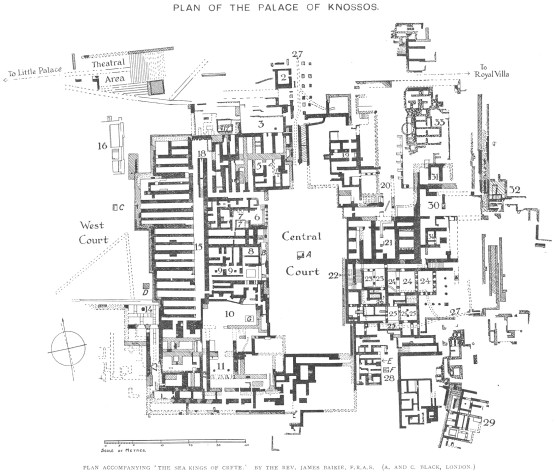
KEY TO NUMBERS
1. Northern Entrance and Portico.
2. Bastion and Guard-House.
3. Northern Piazza.
4. Room of the Flower Gatherer.
5. Room with Stirrup Vases, Walled Pit beneath.
6. Ante room to Throne Room.
7, 7. Throne Room with Tank.
8. Temple Repositories.
9, 9. East and West Pillar-Rooms.
10. Court of the Altar.
11. South Propylæum.
12. Corridor of the Cup Bearer.
13. Corridor of the Procession.
14. West Portico.
15. Long Gallery with Magazines on West Side.
16. North-West House with Bronze Vessels.
17. Northern Bath.
18. Deposit of Pictographic Tablets.
19. North-Eastern Magazines.
20. Corridor of the Draught-Board.
21. Room of the Olive Press.
23, 23. Hall of the Colonnades, with Light-Well.
24, 24, 24. Hall of the Double Axes, with Light-Well.
25, 25, 25, 25. Queen's Megaron, with Light-Wells.
26. Deposit of Ivory Figurines.
27, 27. Built Drains.
28. Court of the Sanctuary.
29. South-East House with Pillar-Room.
30. Court of the Oil-Spout.
31. Magazines with large Pithoi.
32. East Bastion.
33. Early Buildings, partly in continuous use.
34. Sculptor's Workshop (on upper floor).
A. Altar-Base in Central Court.
B. Shrine of the Snake Goddess.
C, D. Altar-Bases in West Court.
E. Shrine of Dove Goddess and Double Axes.
F. Altar-Base in Court of the Sanctuary.
G. Altar Base in Court of the Altar.