Chapter XVI · The History of Ships and Shipping Interests (continued).
Reading edition
Noble Adventurers—The Earl of Cumberland as a Pirate—Rich Prizes—Action with the Madre de Dios—Capture of the Great Carrack—A Cargo worth £150,000—Burning of the Cinco Chagas—But Fifteen saved out of Eleven Hundred Souls—The Scourge of Malice—Establishment of the Slave Trade—Sir John Hawkins’ Ventures—High-handed Proceedings—The Spaniards forced to Purchase—A Fleet of Slavers—Hawkins sanctioned by “Good Queen Bess”—Joins in a Negro War—A Disastrous Voyage—Sir Francis Drake—His First Loss—The Treasure at Nombre de Dios—Drake’s First Sight of the Pacific—Tons of Silver Captured—John Oxenham’s Voyage—The First Englishman on the Pacific—His Disasters and Death—Drake’s Voyage Round the World—Blood-letting at the Equator—Arrival at Port Julian—Trouble with the Natives—Execution of a Mutineer—Passage of the Straits of Magellan—Vessels separated in a Gale—Loss of the Marigold—Tragic Fate of Eight Men—Drake Driven to Cape Horn—Proceedings at Valparaiso—Prizes taken—Capture of the great Treasure Ship—Drake’s Resolve to change his Course Home—Vessel refitted at Nicaragua—Stay in the Bay of San Francisco—The Natives worship the English—Grand Reception at Ternate—Drake’s Ship nearly wrecked—Return to England—Honours accorded Drake—His Character and Influence—Sir Humphrey Gilbert’s Disasters and Death—Raleigh’s Virginia Settlements.
The spirit of adventure, fostered by the grand discoveries which were constantly being made, the rich returns derived from trading expeditions, and from the pillage of our enemies, was at its zenith in the reign of Queen Elizabeth. Nor was it confined to mere soldiers of fortune, for we find distinguished noblemen of ample fortunes taking to the seas as though their daily bread depended thereupon. Among these naval adventurers “there was no one,” says Southey, “who took to the seas so much in the spirit of a northern sea king as the Earl of Cumberland.” He had borne his part in the defeat of the Armada, while still a young man, and the queen was so well satisfied with him, that she gave him a commission to go the same year to the Spanish coast as general, lending him the Golden Lion, one of the ships royal, he victualling and furnishing it at his own expense. After some fighting he took a prize, but soon after had to cut away his mainmast in a storm, and return to England. “His spirit remaining, nevertheless, higher than the winds, and more resolutely by storms compact and united in itself,” we find him [pg 292]shortly afterwards again on the high seas with the Victory, one of the queen’s ships, and three smaller vessels. The earl was not very scrupulous as regards prize-taking, and captured two French ships, which belonged to the party of the League. A little later he fell in with eleven ships from Hamburg and the Baltic, and fired on them till the captains came on board and showed their passports; these were respected, but not so the property of a Lisbon Jew, which they confessed to have on their ships, and which was valued at £4,500. Off the Azores, he hoisted Spanish colours, and succeeded in robbing some Spanish vessels. The homeward-bound Portuguese fleet from the East Indies narrowly escaped him; when near Tercera some English prisoners stole out in a small boat, having no other yard for their mainsail than two pipe-staves, and informed him that the Portuguese ships had left the island a week before. This induced him to return to Fayal, and the terror inspired by the English name in those days is indicated by the fact that the town of about 500 houses was found to be completely empty; the inhabitants had abandoned it. He set a guard over the churches and monasteries, and then calmly waited till a ransom of 2,000 ducats was brought him. He helped himself to fifty-eight pieces of iron ordnance, and the Governor of Graciosa, to keep on good terms with the earl, sent him sixty butts of wine. While there a Weymouth privateer came in with a Spanish prize worth £16,000. Next we find the earl at St. Mary’s, where he captured a Brazilian sugar ship. In bringing out their prize they were detained on the harbour bar, exposed to the enemy. Eighty of Cumberland’s men were killed, and he himself was wounded; “his head also was broken with stones, so that the blood covered his face,” and both his face and legs were burnt with fire-balls. The prize, however, was secured and forwarded to England.
Cumberland himself held on his course to Spain, and soon fell in with a ship of 400 tons, from Mexico, laden with hides, cochineal, sugar, and silver, “and the captain had with him a venture to the amount of 25,000 ducats,” which was taken. They now resolved to return home, but “sea fortunes are variable, having two inconstant parents, air and water,” and as one of the adventurers134 concisely put it, “these summer services and ships of sugar proved not so sweet and pleasant as the winter was afterwards sharp and painful.” Lister, the earl’s captain, was sent in the Mexican prize for England, and was wrecked off Cornwall, everything being lost in her, and all the crew, save five or six men. On the earl’s ship, contrary winds and gales delayed them so greatly that their water failed; they were reduced to three spoonfuls of vinegar apiece at each meal; this state of affairs lasting fourteen days, except what water they could collect from rain and hail-storms. “Yet was that rain so intermingled with the spray of the foaming sea, in that extreme storm, that it could not be healthful: yea, some in their extremity of thirst drank themselves to death with their cans of salt water in their hands.” Some ten or twelve perished on each of as many consecutive nights, and the storm was at one time so violent that the ship was almost torn to pieces; “his lordship’s cabin, the dining-room, and the half deck became all one,” and he was obliged to seek a lodging in the hold. The earl, however, constantly encouraged the men, and the small stock of provisions was distributed with the greatest [pg 293]equality; so at last they reached a haven on the west coast of Ireland, where their sufferings ended. On this voyage they had taken thirteen prizes. The Mexican prize which had been wrecked would have added £100,000 to the profits of the venture, but even with this great deduction, the earl had been doubly repaid for his outlay.
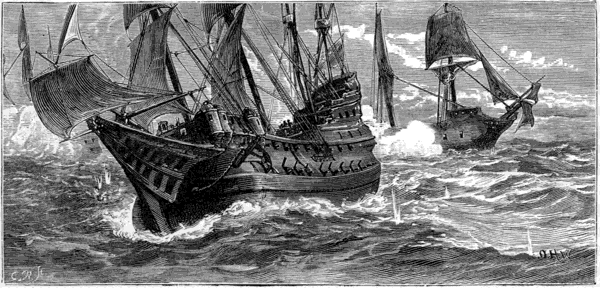
THE EARL OF CUMBERLAND AND THE “MADRE DE DIOS.”
The earl’s third expedition was a failure, but the fourth resulted in the capture of the Madre de Dios, one of the largest carracks belonging to the Portuguese crown. In this, however, some of Raleigh’s and Hawkins’ ships had a share. Captain Thomson, who came up with her first, “again and again delivered his peals as fast as he could fire and fall astern to load again, thus hindering her way, though somewhat to his own cost, till the others could come up.” Several others worried the carrack, until the earl’s ships came up about eleven at night. Captain Norton had no intention of boarding the enemy till daylight, if there had not been a cry from one of the ships royal, then in danger, “An you be men, save the queen’s ship!” Upon this the carrack was boarded on both sides. A desperate struggle ensued, and it took an hour and a half before the attacking parties succeeded in getting possession of the high forecastle, “so brave a booty making the men fight like dragons.” The ship won, the boarders turned to pillage, and while searching about with candles, managed to set fire to a cabin containing some hundreds of cartridges, very nearly blowing up the ship. The hotness of the action was evidenced by the number of dead and dying who strewed the carrack’s decks, “especially,” says the chronicler, “about the helm; for the greatness of the steerage requiring the labour of twelve or fourteen men at once, and some of our ships beating her in at the stern with their ordnance, oftentimes with one shot slew four or five labouring on either side of the helm; whose room being still furnished with fresh supplies, and our artillery still playing upon them with continual volleys, it could not be but that much blood should be shed in that place.” For the times, the prisoners were treated with great humanity, and surgeons were sent on board to dress their wounds. The captain, Don Fernando de Mendoza, was [pg 294]“a gentleman of noble birth, well stricken in years, well spoken, of comely personage, of good stature, but of hard fortune. Twice he had been taken prisoner by the Moors and ransomed by the king; and he had been wrecked on the coast of Sofala, in a carrack which he commanded, and having escaped the sea danger, fell into the hands of infidels ashore, who kept him under long and grievous servitude.” The prisoners were allowed to carry off their own valuables, put on board one of Cumberland’s ships, and sent to their own country. Unfortunately for them, they again fell in with other English cruisers, who robbed them without mercy, taking from them 900 diamonds and other valuable things. About 800 negroes on board were landed on the island of Corvo. Her cargo consisted of jewels, spices, drugs, silks, calicoes, carpets, canopies, ivory, porcelain, and innumerable curiosities; it was estimated to amount to £150,000 in value, and there was considerable haggling over its division, and no little embezzlement; the queen had a large share of it, and Cumberland netted £36,000. The carrack created great astonishment at Dartmouth by her dimensions, which for those days were enormous. She was of about 1,600 tons burden, and 165 feet long; she was of “seven several stories, one main orlop, three close decks, one forecastle (of great height) and a spar deck of two floors apiece.” Her mainmast was 125 feet in height, and her main-yard 105 feet long. “Being so huge and unwieldly a ship,” says Purchas, “she was never removed from Dartmouth, but there laid up her bones.”
In 1594 the earl set forth on his eighth voyage, with three ships, a caravel, and a pinnace, furnished at his own expense, with the help of some adventurers. Early in the voyage they descried a great Indian ship, whose burden they estimated at 2,000 tons. Her name was the Cinco Chagas (the Five Wounds), and her fate was as tragical as her name. She had on board a number of persons who had been shipwrecked in three vessels, which, like herself, had been returning from the Indies. When she left Mozambique for Europe, she had on board 1,400 persons, an enormous number for those days; on the voyage she had encountered terrible gales, and after putting in at Loanda for water and supplies, and shipping many slaves, a fatal pestilence known by the name of the “mal de Loanda,” carried off about half the crew. The captain wished to avoid the Azores, but a mutiny had arisen among the soldiers on board, and he was forced to stand by them, and by this means came into contact with the Earl of Cumberland’s squadron off Fayal. The Portuguese had pledged themselves to the ship at all hazards, and to perish with her in the sea, or in the flames, rather than yield so rich a prize to the heretics. Cumberland’s ships, after harassing the carrack on all sides, ranged up against her; twice was she boarded, and twice were the assailants driven out. A third time the privateers boarded her, one of them bearing a white flag; he was the first of the party killed, and when a second hoisted another flag at the poop it was immediately thrown overboard. The English suffered considerably, more especially among the officers. Cumberland’s vice-admiral, Antony, was killed; Downton, the rear-admiral, crippled for life; and Cave, who commanded the earl’s ship, mortally wounded. The privateers seem, in the heat of action, almost to have forgotten the valuable cargo on board, and to have aimed only at destroying her. “After many bickerings,” says the chronicler, “fireworks flew about interchangeably; at last the vice-admiral, with a culverin shot at hand, fired the carrack in her stern, and the rear-admiral [pg 295]her forecastle, * * * * then flying and maintaining their fires so well with their small shot that many which came to quench them were slain.” The fire made rapid headway, and P. Frey Antonio, a Franciscan, was seen with a crucifix in his hand, encouraging the poor sailors to commit themselves to the waves and to God’s mercy, rather than perish in the flames. A large number threw themselves overboard, clinging to such things as were cast into the sea. It is said that the English boats, with one honourable exception, made no efforts to save any of them; it is even stated that they butchered many in the water. According to the English account there were more than 1,100 on board the carrack, when she left Loanda, of whom only fifteen were saved! Two ladies of high rank, mother and daughter—the latter of whom was going home to Spain to take possession of some entailed property—when they saw there was no help to be expected from the privateers, fastened themselves together with a cord, and committed themselves to the waves; their bodies were afterwards cast ashore on Fayal, still united, though in the bonds of death.
The earl afterwards built the Scourge of Malice, a ship of 800 tons, and the largest yet constructed by an English subject, and in 1597 obtained letters patent authorising him to levy sea and land forces. Without royal assistance, he gathered eighteen sail. This expedition, although it worried and impoverished the Spaniards, was not particularly profitable to the earl. He took Puerto Rico, and then abandoned it, and did not, as he expected, intercept either the outward-bound East Indiamen, who, indeed, were too frightened to venture out of the Tagus that year, or the homeward-bound Mexican fleet. This was Cumberland’s last expedition, and no other subject ever undertook so many at his own cost.
The Elizabethan age was otherwise so glorious that it is painful to have to record the establishment of the slave-trade—a serious blot on the reign—one which no Englishman of to-day would defend, but which was then looked upon as perfectly legitimate. John Hawkins (afterwards Sir John) was born at Plymouth, and his father had long been a well-esteemed sea-captain, the first Englishman, it is believed, who ever traded to the Brazils. The young man had gained much renown by trips to Spain, Portugal, and the Canaries, and having “grown in love and favour” with the Canarians, by good and upright dealing, began to think of more extended enterprises. Learning that “negroes were very good merchandise in Hispaniola, and that store of them might easily be had upon the coast of Guinea,” he communicated with several London ship-owners, who liked his schemes, and provided him in large part with the necessary outfit. Three small vessels were provided—the Solomon, of 120 tons, the Swallow, of 100, and the Jonas, of forty. Hawkins left England in October, 1562, and proceeding to Sierra Leone, “got into his possession, partly by the sword and partly by other means, to the number of 300 negroes at the least, besides other merchandise which that country yieldeth.” At the port of Isabella, Puerto de Plata, and Monte Christo, he made sale of the slaves to the Spaniards, trusting them “no farther than by his own strength he was able to master them.” He received in exchange, pearls, ginger, sugar, and hides enough, not merely to freight his own vessels, but two other hulks, and thus “with prosperous success, and much gain to himself and the aforesaid adventurers, he came home, and arrived in September, 1563.”
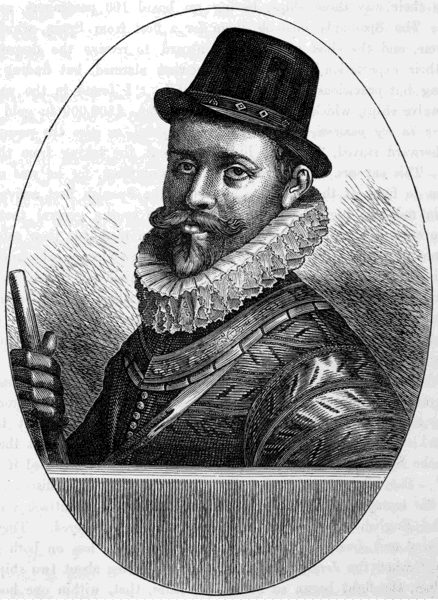
SIR JOHN HAWKINS.
[pg 296]
The second expedition was on a larger scale, and included a queen’s ship of 700 tons. Hawkins arriving off the Rio Grande, could not enter it for want of a pilot, but he proceeded to Sambula, one of the islands near its mouth, where he “went every day on shore to take the inhabitants, with burning and spoiling their towns,” and got a number of slaves. Flushed with easy success, Hawkins was persuaded by some Portuguese to attack a negro town called Bymeba, where he was informed there was much gold. Forty of his men were landed, and they dispersing, to secure what booty they could for themselves, became an easy prey to the negroes, who killed seven, including one of the captains, and wounded twenty-seven. After a visit to Sierra Leone, which he left quickly on account of the illness and death of some of his men, he proceeded to the West Indies, where he carried matters with a high hand at the small Spanish settlements, at which very generally the poor inhabitants had been forbidden to trade with him by the viceroy, then stationed at St. Domingo. To this he replied at Borburata, that he was in need of refreshment and money also, “without which he could not depart. Their princes were in amity one with another; the English had free traffic in Spain and Flanders; and he knew no reason why they should not have the like in the King of Spain’s dominions. Upon this the Spaniards said they would send to their governor, who was three-score leagues off; ten days must elapse before his determination could arrive; meantime he might bring his ships into the harbour, and they would supply him with any victuals he might require.” The ships sailed in and were supplied, but Hawkins, “advising himself that to remain there ten days idle, spending victuals and men’s wages, and perhaps, in the end, receive no good answer from the governor, it were mere folly,” requested licence to sell certain lean and sick negroes, for whom he had little or no food, but who would recover with proper treatment ashore. This request, he said, he was forced to make, as he had not otherwise wherewith to pay for necessaries supplied to him. He received a licence to sell thirty slaves, but now few showed a disposition to buy, and where they did, came to haggle and cheapen. Hawkins made a feint to go, when the Spaniards bought some of his poorer negroes, “but when the purchasers paid the duty and required the customary receipt, the officer refused to give it, and instead of carrying the money to the king’s account, distributed it to the poor ‘for the love of God.’ ” The purchasers feared that they might have to pay the duty a second time, and the trade was suspended till the governor arrived, on the fourteenth day. To him Hawkins told a long-winded story, concluding by saying that, “it would be taken well at the governor’s hand if he granted a licence in this case, seeing that there was a great amity between their princes, and that the thing pertained to our queen’s highness.” The petition was taken under consideration in council, and at last granted. The licence of thirty ducats demanded for each slave sold did not, however, meet Hawkins’ views, and he therefore landed 100 men well armed, and marched toward the town. The poor townspeople sent out messengers to know his demands, and he requested that the duty should be 7½ per cent., and mildly threatened that if they would not accede to this “he would displease them.” Everything was conceded, and Hawkins obtained the prices he wanted. Fancy a modern merchant standing with an armed guard, pistol in hand, over his customers, insisting that he would sell what he liked and at his own price!
[pg 297]
But all this is nothing to what happened at Rio de la Hacha. There he spoke of his quiet traffic (!) at Borburata, and requested permission to trade there in the same manner. He was told that the viceroy had forbidden it, whereupon he threatened them that he must either have the licence or they “stand to their own defence.” The licence was granted, but they offered half the prices which he had obtained at Borburata, whereupon he told them, insultingly, that “seeing they had sent him this to his supper, he would in the morning bring them as good a breakfast.”135 Accordingly, early next day he fired off a culverin, and prepared to land with 100 men, “having light ordnance in his great boat, and in the other boats double bases in their noses.” The townsmen marched out in battle array, but when the guns were fired fell flat on their faces, and soon dispersed. Still, about thirty horsemen made a show of resistance, their white leather targets in one hand and their javelins in the other, but as soon as Hawkins marched towards them they sent a flag of truce, and the treasurer, “in a cautious interview with this ugly merchant,” granted all he asked, and the trade proceeded. They parted with a show of friendship, and saluted each other with their guns, the townspeople “glad to be sped of such traders.”
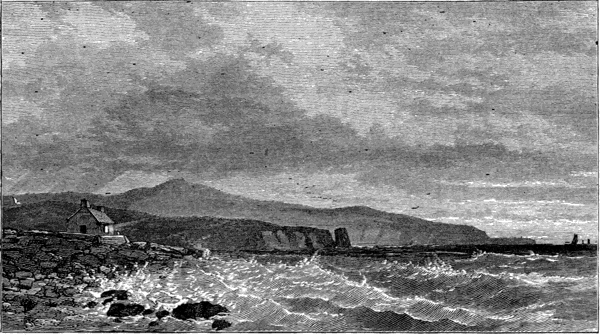
ON THE COAST OF CORNWALL.
On the return voyage, contrary winds prevailed, “till victuals scanted, so that they were in despair of ever reaching home, had not God provided for them better than their deserving.” They arrived at Padstow, in Cornwall, “with the loss,” says the narrative printed in Hakluyt’s collection, “of twenty persons in all the voyage, and with great profit to the venturers, as also to the whole realm, in bringing home both gold, [pg 298]silver, pearls, and other jewels in great store. His name, therefore, be praised for evermore. Amen!” They did not consider that they had been engaged in a most iniquitous traffic, nor was it, indeed, the opinion of the times. “Hawkins,” says Southey, “then, is not individually to be condemned, if he looked upon dealing in negroes to be as lawful as any other trade, and thought that force or artifice might be employed for taking them with as little compunction as in hunting, fishing, or fowling.” He had a coat of arms and crest bestowed upon him and his posterity. Among other devices it bore “a demi-Moor, in his proper colour, bound and captive, with annulets on his arms,” &c.
On his next expedition for slaving purposes he had six vessels. Herrera136 says that two Portuguese had offered to conduct this fleet to a place where they might load their vessels with gold and other riches, and that the queen had been so taken with the idea that she had supplied Hawkins with two ships, he and his brother fitting out four others and a pinnace. The force on board amounted to 1,500 soldiers and sailors, who were to receive a third of the profits. When the expedition was ready, the Portuguese deserted from Plymouth, and went to France, but as the cost of the outfit had been incurred, it was thought proper to proceed. Hawkins obtained, after a great deal of trouble, less than 150 slaves between the Rio Grande and Sierra Leone. At this juncture a negro king, just going to war with a neighbouring tribe, sent to the commander asking his aid, promising him all the prisoners who should be taken. This was a tempting bait, and 120 men were sent to assist the coloured warrior. They assaulted a town containing 8,000 inhabitants, strongly paled and well defended, and the English losing six men, and having a fourth of their number wounded, sent for more help; “whereupon,” says Hawkins, “considering that the good success of this enterprise might highly further the commodity of our voyage, I went myself; and with the help of the king of our side, assaulted the town both by land and sea, and very hardly, with fire (their houses being covered with dry palm-leaves), obtained the town, and put the inhabitants to flight, where we took 250 persons, men, women, and children. And by our friend, the king of our side, there were taken 600 prisoners, whereof we hoped to have had our choice; but the negro (in which nation is seldom or never found truth) meant nothing less, for that night he removed his camp and prisoners, so that we were fain to content us with those few that we had gotten ourselves.” They had obtained between 400 and 500, a part of which were speedily sold as soon as he reached the West Indies. At Rio de la Hacha, “from whence came all the pearls,” the treasurer would by no means allow them to trade, or even to water the ships, and had fortified the town with additional bulwarks, well manned by harquebusiers. Hawkins again enforced trade, by landing 200 men, who stormed their fortifications, at which the Spaniards fled. “Thus having the town,” says Hawkins, “with some circumstance, as partly by the Spaniards’ desire of negroes, and partly by friendship of the treasurer, we obtained a secret trade, whereupon the Spaniards resorted to us by night, and bought of us to the number of 200 negroes.”
This voyage ended most disastrously. Passing by the west end of Cuba, they [pg 299]encountered a terrific storm, which lasted four days, and they had to cut down all the “higher buildings” of the Jesus, their largest ship; her rudder, too, was nearly disabled, and she leaked badly. They made for the coast of Florida, but could find no suitable haven. “Thus, being in great despair, and taken with a new storm, which continued other three days,” Hawkins made for St. Juan de Ulloa, a port of the city of Mexico. They took on their way three ships, having on board 100 passengers, and soon reached the harbour. The Spaniards mistook them for a fleet from Spain, which was expected about that time, and the chief officers came aboard to receive the despatches. “Being deceived of their expectation,” they were somewhat alarmed, but finding that Hawkins wanted nothing but provisions, “were recomforted.” “I found in the same port,” says Hawkins, “twelve ships, which had in them, by report, £200,000 in gold and silver; all of which being in my possession, with the king’s island, as also the passengers before in my way thitherward stayed, I set at liberty, without the taking from them the weight of a groat.” This savours rather of impudent presumption, for he was certainly not in good condition to fight at that period. Next day the Spanish fleet arrived outside, when Hawkins again rode the high horse, by giving notice to the general that he would not suffer them to enter the port until conditions had been made for their safe-being, and for the maintenance of peace. The fleet had on board a new viceroy, who answered amicably, and desired him to propose his conditions. Hawkins required not merely victuals and trade, and hostages to be given on both sides, but that the island should be in his possession during his stay, with such ordnance as was planted there, and that no Spaniard might land on the island with any kind of weapon. These terms the viceroy “somewhat disliked” at first, nor is it very surprising that he did; but at length he pretended to consent, and the Spanish ships entered the port. In a few days it became evident that treachery was intended, as men and weapons in quantities were being transferred from and to the Spanish ships, and new ordnance landed on the island. Hawkins sent to inquire what was meant, and was answered with fair words; still unsatisfied, he sent the master of the Jesus, who spoke Spanish, to the viceroy, and “required to be satisfied if any such thing were or not.” The viceroy, now seeing that the treason must be discovered, retained the master, blew his trumpet, and it became evident that a general attack was intended. A number of the English crews ashore were immediately massacred. They attempted to board the Minion and Jesus, but were kept out, with great loss on both sides. “Now,” says Hawkins, “when the Jesus and the Minion were gotten about two ships’ lengths from the Spanish fleet, the fight began so hot on all sides, that, within one hour, the admiral of the Spaniards was supposed to be sunk, their vice-admiral burnt, and one other of their principal ships supposed to be sunk. The Spaniards used their shore artillery to such effect that it cut all the masts and yards of the Jesus, and sunk Hawkins’ smaller ships, the Judith only excepted.” It had been determined, as there was little hope to get the Jesus away, that she should be placed as a target or defence for the Minion till night, when they would remove such of the stores and valuables as was possible, and then abandon her. “As we were thus determining,” says Hawkins, “and had placed the Minion from the shot of the land, suddenly the Spaniards fired two great ships which were coming directly with us; and having no means to avoid the fire, it bred among the men a [pg 300]marvellous fear, so that some said, ‘Let us depart with the Minion;’ others said, ‘Let us see whether the wind will carry the fire from us.’ But, to be short, the Minion’s men, which had always their sails in readiness, thought to make sure work, and so, without either consent of the captain or master, cut their sail.” Hawkins was “very hardly” received on board, and many of the men of the Jesus were left to their fate and the mercy of the Spaniards, “which,” he says, “I doubt was very little.” Only the Minion and the Judith escaped, and the latter deserted that same night. Beaten about in unknown seas for the next fourteen days, hunger at last enforced them to seek the land; “for hides were thought very good meat; rats, cats, mice, and dogs, none escaped that might be gotten; parrots and monkeys, that were had in great price, were thought then very profitable if they served the turn of one dinner.” So starved and worn out were they, [pg 302]that about a hundred of his people desired to be left on the coast of Tabasco, and Hawkins determined to water there, and then, “with his little remain of victuals,” to attempt the voyage home. During this time, while on shore with fifty of his men, a gale arose, which prevented them regaining the ship; indeed, they expected to see it wrecked before their eyes. At last the storm abated, and they sailed for England, the men dying off daily from sheer exhaustion, the pitiful remainder being scarcely able to work the ship. They at last reached the coast of Galicia, where they obtained fresh meat, and putting into Vigo, were assisted by some English ships lying there. Hawkins concludes his narrative as follows:—“If all the miseries and troublesome affairs of this sorrowful voyage should be perfectly and thoroughly written, there should need a painful man with his pen, and as great a time as he had that wrote the lives and deaths of the martyrs.”
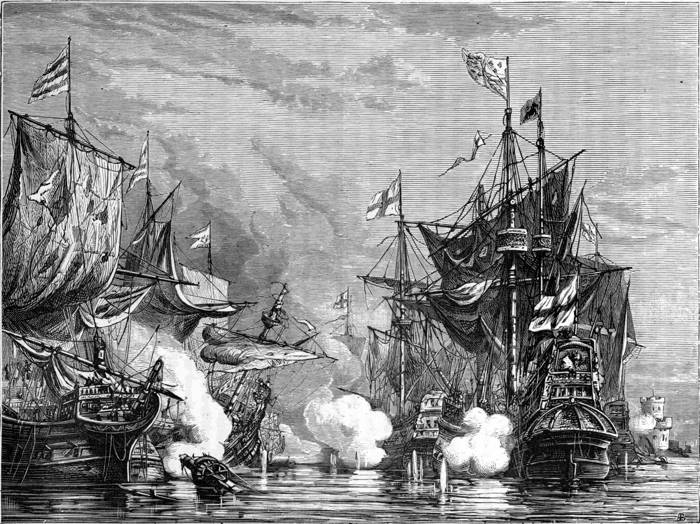
HAWKINS AT ST. JUAN DE ULLOA.
The Judith, which made one of Hawkins’s last fleet, was commanded by Francis Drake, a name that was destined to become one of the most famous of the day, and very terrible to the Spaniards. In this last venture he lost all that he had accumulated by earlier voyages, “but a divine, belonging to the fleet, comforted him with the assurance, that having been so treacherously used by the Spaniards, he might lawfully recover in value of the King of Spain, and repair his losses upon him wherever he could.” This comfortable doctrine consoled him. “The case,” says Fuller, “was clear in sea divinity.” Two or three minor voyages he made to gain knowledge of the field of operation, and in the West Indies made some little money “by playing the seaman and the pirate.” On May 24th, 1572, he sailed from Plymouth, in the Pascha, of seventy tons, his brother accompanying him in the Swan, of only twenty-five tons; they had three pinnaces on board, taken to pieces and stowed away. The force with which he was to revenge himself on the Spanish monarch, numbered seventy-three men and boys, all told. In the Indies he was joined by Captain Rowse, of an Isle of Wight bark, with thirty-eight men on board. Let us see how they sped.
It was known that there was great treasure at Nombre de Dios, and thither the little squadron shaped its course. The town was unwalled, and they entered without difficulty, but the Spaniards received them in the market-place with a volley of shot. Drake returned the greeting with a flight of arrows, “the best ancient English complement,” but in the attack received a wound in his leg, which he dissembled, “knowing that if the general’s heart stoop, the men’s will fall.” He arrived at the treasury-house, which was full of silver bars, and while in the act of ordering his men to break it open, fainted from the loss of blood, and his men, binding up the wound, forcibly took him to his pinnace. It was time, for the Spaniards had discovered their weakness, and could have overcome them. Rather disappointed here, Drake made for Carthagena, and took several vessels on his way. He learned from some escaped negro slaves, settled on the isthmus of Darien, that the treasure was brought from Panama to Nombre de Dios upon mules, a party of which he might intercept. Drake’s leg having healed, he was led to an eminence on that isthmus, where, from a great tree, both the Pacific and Atlantic might be seen. Steps had been cut in the trunk of this huge tree, and at the top “a convenient arbour had been made, wherein twelve men might sit.” Drake saw from its summit that great Southern Ocean (the Pacific Ocean) of which he had heard something already, and “being inflamed with [pg 303]ambition of glory and hopes of wealth, was so vehemently transported with desire to navigate that sea, that falling down there upon his knees, he implored the divine assistance, that he might at some time or other sail thither, and make a perfect discovery of the same.”137 Drake was the first Englishman to gaze on its waters.
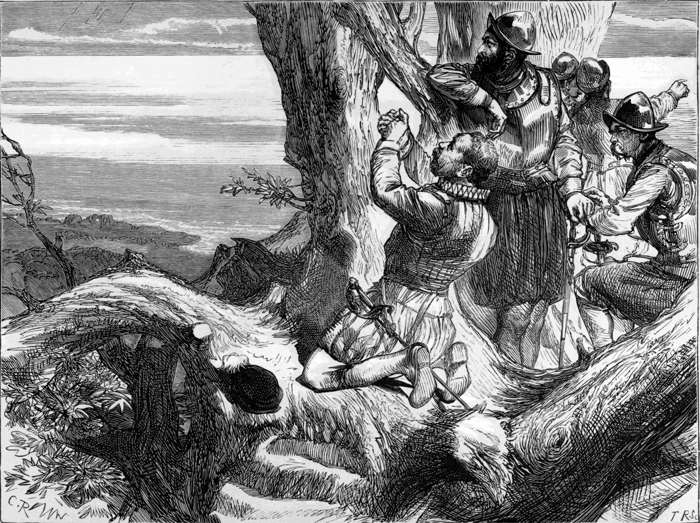
DRAKE’S FIRST VIEW OF THE PACIFIC
On the isthmus, Drake encountered an armed party of Spaniards, but put them to flight, and destroyed merchandise to the value of 200,000 ducats. Soon after he heard “the sweet music of the mules coming with a great noise of bells,” and when the trains came up, he found they had no one but the muleteers to protect them. It was easy work to take as much silver as they would, but more difficult to transport it to the coast. They, in consequence, buried several tons, but one of his men, who fell into the hands of the Spaniards, was compelled by torture to reveal the place, and when Drake’s people returned for a second load it was nearly all gone. When they returned to the coast where the pinnaces should have met them, they were not to be seen, but in place, seven Spanish pinnaces which had been searching the coast. Drake escaped their notice, and constructing a raft of the trees which the river brought down, mounted a biscuit sack for sail, and steered it with an oar made from a sapling, out to sea, where they were constantly up to their waists in water. At last they caught sight of their own pinnaces, ran the raft ashore, and travelled by land round to the point off which they were laying. They then embarked their comrades with the treasure, and rejoined the ship. One of their negro allies took a great fancy to Drake’s sword, and when it was presented to him, desired the commander to accept four wedges of gold. “Drake accepted them as courteously as they were proffered, but threw them into the common stock, saying, it was just that they who bore part of the charge in setting him to sea, should enjoy their full proportion of the advantage at his return.” Drake made the passage home to the Scilly Isles in the wonderfully short period of twenty-three days. Arriving at Plymouth on a Sunday, the news was carried into the church during sermon time, and “there remained few or no people with the preacher,” for Drake was already a great man and a hero in the eyes of all Devon.
John Oxenham, who had served with Drake in the varied capacities of soldier, sailor, and cook, was very much in the latter’s confidence. Drake had particularly spoken of his desire to explore the Pacific, and Oxenham in reply, had protested that “he would follow him by God’s grace.” The latter, who “had gotten among the seamen the name of captain for his valour, and had privily scraped together good store of money,” becoming impatient, determined to attempt the enterprise his late master had projected. He reached the isthmus to find that the mule trains conveying the silver were now protected by a convoy of soldiers, and he determined on a bold and novel adventure. “He drew his ship aground in a retired and woody creek, covered it up with boughs, buried his provisions and his great guns, and taking with him two small pieces of ordnance, went with all his men and six Maroon guides about twelve leagues into the interior, to a river which discharges itself into the South Sea. There he cut wood and built a pinnace, ‘which was five-and-forty feet by the keel;’ ” embarked in it, and secured for himself the honour of [pg 304]having been the first Englishman to sail over the waters of the blue Pacific. In this pinnace he went to the Pearl Islands, and lay in wait for vessels. He was successful in capturing a small bark, bringing gold from Quito, and scarcely a week later, another with silver from Lima. He also obtained a few pearls on the islands.
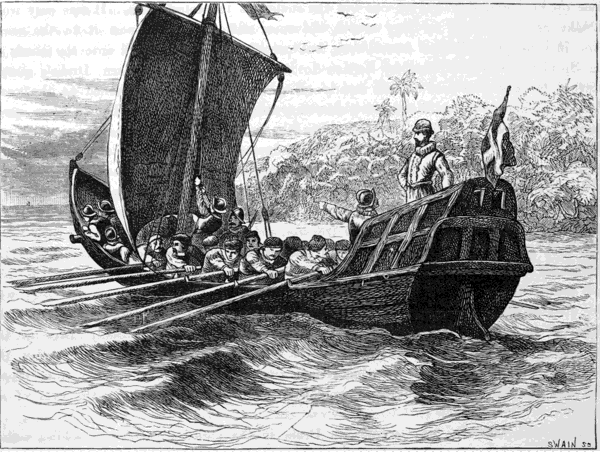
OXENHAM EMBARKING ON THE PACIFIC.
So far, fortune had followed Oxenham, and to his own want of caution is due the fact that this prosperous state of affairs was soon reversed. He had dismissed his prizes when near the mouth of the river, and had allowed them to perceive where he was entering. The alarm was soon given; first, indeed, by some negroes who hastened to Panama. Juan de Ortega was immediately dispatched with 100 men, besides negro rowers, in four barks. After entering the river, a four days’ search rewarded him by the discovery of the pinnace with six Englishmen on board, who leaped ashore and ran for dear life; one only was killed at this juncture. Ortega discovered in the woods the hut in which Oxenham had concealed the treasure, and removed it to his barks. Meantime, Oxenham, whose men had been disputing over the division of spoils, had been to a distance for the purpose of inducing some of the Maroon negroes to act as carriers, and returning with them, met the men who had escaped from the pinnace, and those who were fleeing from the hut. “The loss of their booty at once completed their reconcilement; he promised larger shares if they [pg 305]should succeed in re-capturing it; and marched resolutely in quest of the Spaniards, relying upon the Maroons as well as upon his own people.” But Ortega and his men were experienced in bush-fighting, and they succeeded in killing eleven Englishmen, and five negroes, and took seven of Oxenham’s party prisoners. He, with the remnant of his party, went back to search for his hidden ship; it had been removed by the Spaniards. And now the latter sent 150 men to hunt the Englishmen out, while those whom they failed to take were delivered up by the natives. Oxenham and two of his officers were taken to Lima and executed; the remainder suffered death at Panama.
The greatest semi-commercial and piratical voyage of this epoch is undoubtedly that of Drake, who reached the South Seas138 viâ the Straits of Magellan—the third recorded attempt, and the first made by an Englishman—and was the first English subject to circumnavigate the globe. Elizabeth gave it her secret sanction, and when Drake was introduced to her court by Sir Christopher Hatton, presented him a sword, with this remarkable speech: “We do account that he which striketh at thee, Drake, striketh at us!” The expedition, fitted at his own cost, and that of various adventurers, comprised five vessels; the largest, his own ship, the Pelican, being only 100 tons. His whole force consisted of “164 men, gentlemen, and sailors; and was furnished with such plentiful provision of all things necessary as so long and dangerous a voyage seemed to require.” The frames of four pinnaces were taken, to be put together as occasion might require. “Neither did he omit, it is said, to make provision for ornament and delight; carrying to this purpose with him expert musicians, rich furniture (all the vessels for his table, yea, many belonging to the cook-room, being of pure silver) with divers shows of all sorts of curious workmanship, whereby the civility and magnificence of his native country might, among all nations whither he should come, be the more admired.”139 Few of his companions knew at the outset the destination of his voyage; it was given out that they were bound merely for Alexandria.
The expedition sailed on November 15th, 1577, from Plymouth, and immediately encountered a storm so severe that the vessels came near shipwreck, and were obliged to put back and refit. When they had again started under fairer auspices, Drake gave his people some little information as to his proposed voyage, and appointed an island off the coast of Barbary as a rendezvous in case of separation at sea, and subsequently Cape Blanco, where he mustered his men ashore and put them through drills and warlike exercises. Already, early in January, he had taken some minor Spanish prizes, and a little later, off the island of Santiago, chased a Portuguese ship, bound for Brazil, “with many passengers, and among other commodities, good store of wine.” Drake captured and set the people on one of his smaller pinnaces, giving them their clothes, some provisions, and one butt of wine, letting them all go except their pilot. The provisions and wine on board the prize proved invaluable to the expedition. From the Cape de Verde Islands they were nine weeks out of sight of land, and before they reached the coast of Brazil, when near the equator, “Drake, being very careful of his men’s health, let every one of them blood with [pg 306]his own hands.” On nearing the Brazilian coast, the inhabitants “made great fires for a sacrifice to the devils, about which they use conjurations (making heaps of sand and other ceremonies), that when any ships shall go about to stay upon their coast, not only sands may be gathered together in shoals in every place, but also that storms and tempests may arise, to the casting away of ships and men.” Near the Plata they slaughtered large numbers of seals, thinking them “good and acceptable meat both as food for the present, and as a supply of provisions for the future.” Further south, they found stages constructed on the rocks by the natives for drying the flesh of ostriches; their thighs were as large as “reasonable legs of mutton.” At a spot which Drake named Seal Bay, they remained over a fortnight. Here they “made new provisions of seals, whereof they slew to the number of from 200 to 300 in the space of an hour.” Some little traffic ensued with the natives, all of whom were highly painted, some of them having the whole of one side, from crown to heel, painted black, and the other white. “They fed on seals and other flesh, which they ate nearly raw, casting pieces of four or six pounds’ weight into the fire, till it was a little scorched, and then tearing it in pieces with their teeth like lions.” At the sound of Drake’s band of trumpeters they showed great delight, dancing on the beach with the sailors. They were described as of large stature. “One of these giants,” said the chaplain of the expedition, “standing with our men when they were taking their morning draughts, showed himself so familiar that he also would do as they did; and taking a glass in his hand (being strong canary wine), it came no sooner to his lips, than it took him by the nose, and so suddenly entered his head, that he was so drunk, or at least so overcome, that he fell right down, not able to stand; yet he held the glass fast in his hand, without spilling any of the wine; and when he came to himself, he tried again, and tasting, by degrees got to the bottom. From which time he took such a liking to the wine, that having learnt the name, he would every morning come down from the mountains with a mighty cry of ‘Wine! wine! wine!’ continuing the same until he arrived at the tent.”140
After some trouble caused by the separation of the vessels, the whole fleet arrived safely at the “good harborough called by Magellan Port Julian,” where nearly the first sight they met was a gibbet, on which the Portuguese navigator had executed several mutinous members of his company, some of the bones of whom yet remained. Drake himself was to have trouble here. At the outset the natives appeared friendly, and a trial of skill in shooting arrows resulted in an English gunner exceeding their efforts, at which they appeared pleased by the skill shown. A little while after another Indian came, “but of a sourer sort,” and one Winter, prepared for another display of archery, unfortunately broke the bow-string when he drew it to its full length. This disabused the natives, to some extent, of the superior skill of the English, and an attack was made, apparently incited by the Indian just mentioned. Poor Winter received two wounds, and the gunner coming to the rescue with his gun missed fire, and was immediately shot “through the breast and out at back, so that he fell down stark dead.” Drake assembled his men, ordering them to cover themselves with their targets, and march on the assailants, [pg 307]instructing them to break the arrows shot at them, noting that the savages had but a small store. “At the same time he took the piece which had so unhappily missed fire, aimed at the Indian who had killed the gunner, and who was the man who had begun the fray, and shot him in the belly. An arrow wound, however severe, the savage would have borne without betraying any indication of pain; but his cries, upon being thus wounded, were so loud and hideous, that his companions were terrified and fled, though many were then hastening to their assistance. Drake did not pursue them, but hastened to convey Winter to the ship for speedy help; no help, however, availed, and he died on the second day. The gunner’s body, which had been left on shore, was sent for the next day; the savages, meantime, had stripped it, as if for the sake of curiously inspecting it; the clothes they had laid under the head, and stuck an English arrow in the right eye for mockery. Both bodies were buried in a little island in the harbour.”141 No farther attempt was made to injure the English, who remained two months in the harbour, but friendly relations were not established. A more serious event was to follow.
One Master Doughtie was suspected and accused of something worse than ordinary mutiny or insubordination. It is affirmed in a history of the voyage published under the name of Drake’s nephew, that Doughtie had embarked on the expedition for the distinct purpose of overthrowing it for his own aggrandisement, to accomplish which he intended to raise a mutiny, and murder the admiral and his most attached followers. Further, it is stated, that Drake was informed of this before he left Plymouth; but that he would not credit “that a person whom he so dearly loved would conceive such evil purposes against him.” Doughtie had been put in possession of the Portuguese prize, but had been removed on a charge of peculation, and it is likely that “resentment, whether for the wrongful charge, or the rightful removal, might be rankling in him;” at all events, his later conduct, and mutinous words, left no alternative to Drake but to examine him before a properly constituted court, and he seems to have most reluctantly gone even to this length.142 He was “found guilty by twelve men after the English manner, and suffered accordingly.” “The most indifferent persons in the fleet,” says Southey, “were of opinion that he had acted seditiously, and that Drake cut him off because of his emulous designs. The question is, how far those designs extended? He could not aspire to the credit of the voyage without devising how to obtain for himself some more conspicuous station in it than that of a gentleman volunteer; if he regarded Drake as a rival, he must have hoped to supplant, or at least to vie with him; and in no other way could he have vied with him but by making off with one of the ships, and trying his own fortune” (which was afterwards actually accomplished by others). Doughtie was condemned to death. “And he,” says a writer, quoted by Hakluyt, “seeing no remedy but patience for himself, desired before his death to receive the communion; which he did at the hands of Master Fletcher, our minister, and our general himself accompanied him in that holy action; [pg 308]which being done, and the place of execution made ready, he, having embraced our general, and taken his leave of all the company, with prayer for the queen’s majesty and our realm, in quiet sort laid his head to the block, where he ended his life.” One account says that after partaking of the communion, Drake and Doughtie dined at the same table together, “as cheerfully, in sobriety, as ever in their lives they had done; and taking their leave by drinking to each other, as if some short journey only had been in hand.” A provost marshal had made all things ready, and after drinking this funereal stirrup-cup, Doughtie went to the block. Drake subsequently addressed the whole company, exhorting them to unity and subordination, asking them to prepare reverently for a special celebration of the holy communion on the following Sunday.
And now, having broken up the Portuguese prize on account of its unseaworthiness, and rechristened his own ship, the Pelican, into the Golden Hinde, Drake entered the Straits now named after Magellan, though that navigator termed them the Patagonian Straits, because he had found the natives wearing clumsy shoes or sandals: patagon signifying in Portuguese a large, ill-shaped foot. The land surrounding the straits is high and mountainous, and the water generally deep close to the cliffs. “We found the strait,” says the first narrator, “to have many turnings, and as it were, shuttings up, as if there were no passage at all.” Drake passed through the tortuous strait in seventeen days. Clift, one of the historians of the expedition, whose narrative is preserved in Hakluyt’s collection of “Voyages,” says of the penguins there, three thousand of which were killed in less than a day, “We victualled ourselves with a kind of fowl which is plentiful on that isle (St. George’s in the Straits), and whose flesh is not unlike a fat goose here in England. They have no wings, but short pinions, which serve their turn in swimming; their colour is somewhat black, mixed with white spots under their belly, and about their necks. They wall so upright that, afar off, a man would take them to be little children. If a man approach anything near them, they run into holes in the ground (which be not very deep) whereof the island is full, so that to take them we had staves with hooks fast to the end, wherewith some of our men pulled them out, and others being ready with cudgels did knock them on the head, for they bite so cruelly with their crooked bills, that none of us were able to handle them alive.”
Drake’s vessels, separated by a gale, were driven hither and thither. One of them, the Marigold, must have foundered, as she was never again heard of. The two remaining ships sought shelter in a dangerous rocky bay, from which the Golden Hinde was driven to sea, her cable having parted. The other vessel, under Captain Winter’s command, regained the straits, and “anchoring there in an open bay, made great fires on the shore, that if Drake should put into the strait also, he might discover them.” Winter proceeded later up the straits, and anchored in a sound, which he named the Port of Health, because his men, who had been “very sick with long watching, wet, cold, and evil diet,” soon recovered on the nourishing shell-fish found there. He, after waiting some time, and despairing of regaining Drake’s company, gave over the voyage, and set sail for England, “where he arrived with the reproach of having abandoned his commander.”
Drake was now reduced to his own vessel, the Golden Hinde, which was obliged [pg 309]to seek shelter on the coast of Terra del Fuego. The winds again forced him from his anchorage, and his shallop, with eight men on board, and provisions for only one day, was separated from him. The fate of these poor fellows was tragical. They regained the straits, where they caught and salted a quantity of penguins, and then coasted up South America to the Plata. Six of them landed, and while searching for food in the forests, encountered a party of Indians, who wounded all of them with their arrows, and secured four, pursuing the others to the boat. These latter reached the two men in charge, but before they could put off, all were wounded by the natives. They, however, succeeded in reaching an island some distance from the mainland, where two of them died from the injuries received, and the boat was wrecked and beaten to pieces on the rocks. The remaining two stopped on the island eight weeks, living on shell-fish and a fruit resembling an orange, but could find no water. They at length ventured to the mainland on a large plank some ten feet in length, which they propelled with paddles; the passage occupied three days. “On coming to land,” says Carter, the only survivor, “we found a rivulet of sweet water; when William Pitcher, my only comfort and companion (although I endeavoured to dissuade him) overdrank himself, and to my unspeakable grief, died within half an hour.” Carter himself fell into the hands of some Indians, who took pity on him, and conducted him to a Portuguese settlement. Nine years elapsed before he was able to regain his own country.
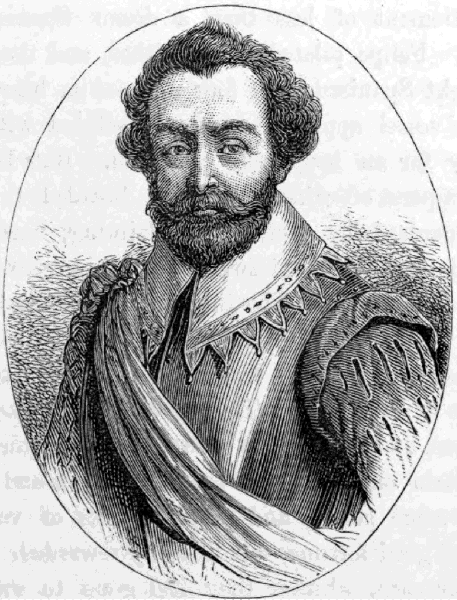
SIR F. DRAKE.
Meantime Drake was driven so far to the southward, that at length he “fell in with the uttermost part of the land towards the South Pole,” or in other words, reached Cape Horn. The storm had lasted with little intermission for over seven weeks. “Drake went ashore, and, sailor-like, leaning over a promontory, as far as he safely could, came back [pg 310]and told his people how that he had been farther south than any man living.” At last the wind was favourable, and he coasted northward, along the American shore, till he reached the island of Mocha, where the Indians appeared at first to be friendly, and brought off potatoes, roots, and two fat sheep, for which they received recompense. But on landing for the purpose of watering the ship, the natives shot at them, wounding every one of twelve men, and Drake himself under the right eye. In this case no attempt was made at retaliation. The Indians doubtless took them for Spaniards. Drake, continuing his voyage, fell in with an Indian fishing from a canoe, who was made to understand their want of provisions, and was sent ashore with presents. This brought off a number of natives with supplies of poultry, hogs, and fruits, while Felipe, one of them who spoke Spanish, informed Drake that they had passed the port of Valparaiso—then an insignificant settlement of less than a dozen Spanish families—where a large ship was lying at anchor. Felipe piloted them thither, and they soon discovered the ship, with a meagre crew of eight Spaniards and four negroes on board. So little was an enemy expected, that as Drake’s vessel approached, it was saluted with beat of drum, and a jar of Chili wine made ready for an hospitable reception. But Drake and his men wanted something more than bumpers of wine, and soon boarded the vessel, one of the men striking down the first Spaniard he met, and exclaiming, “Abaxo perro!” (Down, dog!) Another of the crew leaped overboard and swam ashore to give an alarm to the town; the rest were soon secured under hatches. The inhabitants of the town fled incontinently, but the spoils secured there were small. The chapel was rifled of its altar-cloth, silver chalice, and other articles, which were handed over to Drake’s chaplain; quantities of wine and other provisions were secured. The crew of the prize, with the exception of the Greek pilot, were set ashore, and Drake left with his new acquisition, which when examined at sea was found to contain one thousand seven hundred and seventy jars of wine, sixty thousand pieces of gold, some pearls, and other articles of value. The Indian who had guided them to this piece of good fortune, was liberally rewarded.
At a place called Tarapaca, whither they had gone to water the ship, they found a Spaniard lying asleep, and keeping very bad guard over thirteen bars of silver, worth four thousand ducats. Drake determined to take care of it for him. At a short distance off, they encountered another, who, with an Indian, was driving eight llamas, each carrying a hundredweight of silver. It is needless to say that the llamas were conveyed on board, plus the silver. At Arica two ships were found at anchor, one of which yielded forty bars of silver, and the other a considerable quantity of wine. But these were as trifles to that which followed.
Drake had pursued a leisurely course, but in spite of this fact, no intelligence of the pirate’s approach had reached Lima. The term “pirate” is used advisedly, for whatever the gain to geographical science afforded by his voyages, their chief aim was spoil, and it mattered nothing whether England was at war with the victims of his prowess or not. A few leagues off Callao harbour (the port of Lima), Drake boarded a Portuguese vessel: the owner agreed to pilot him into Callao, provided his cargo was left him. They arrived at nightfall, “sailing in between all the ships that lay there, seventeen in number,” most of which had their sails ashore, for the Spaniards had had, as yet, no [pg 311]enemies in those waters. They rifled the ships of their valuables, and these included a large quantity of silk and linen, and one chest of silver reales. But they heard that which made their ears tingle, and inflamed their desires for gain; the Cacafuego, a great treasure ship, had sailed only a few days before for a neighbouring port. Drake immediately cut the cables of the ships at Lima, and let them drive, that they might not pursue him. “While he was thus employed, a vessel from Panama, laden with Spanish goods, entered the harbour, and anchored close by the Golden Hinde. A boat came from the shore to search it; but because it was night, they deferred the search till the morning, and only sent a man on board. The boat then came alongside Drake’s vessel, and asked what ship it was. A Spanish prisoner answered, as he was ordered, that it was Miguel Angel’s, from Chili. Satisfied with this, the officer in the boat sent a man to board it; but he, when on the point of entering, perceived one of the large guns, and retreated in the boat with all celerity, because no vessels that frequented that port, and navigated those seas, carried great shot.” The crew of the Panama ship took alarm when they observed the rapid flight of the man, and put to sea. The Hinde followed her, and the Spanish crew abandoned their ship, and escaped ashore in their boat. The alarm had now been given in Lima, and the viceroy dispatched two vessels in pursuit, each having two hundred men on board, but no artillery. The Spanish commander, however, showed no desire to tackle Drake, and he escaped, taking shortly afterwards three tolerable prizes, one of which yielded forty bars of silver, eighty pounds’ weight of gold, and a golden crucifix, “set with goodly great emeralds.” One of the men having secreted two plates of gold from this prize, and denied the theft, was immediately hanged.
But it was the Cacafuego that Drake wanted, and after crossing the line he promised to give his own chain of gold to the first man who should descry her. On St. David’s Day, the coveted prize was discovered from the top, by a namesake of the commander, one John Drake. All sail was set, but an easy capture was before them; for the Spanish captain, not dreaming of enemies in those latitudes, slackened sail, in order to find out what ship she was. When they had approached near enough, Drake hailed them to strike, which being refused, “with a great piece he shot her mast overboard, and having wounded the master with an arrow, the ship yielded.” Having taken possession, the vessels sailed in company far out to sea, when they stopped and lay by. She proved a prize indeed: gold and silver in coin and bars, jewels and precious stones amounting to three hundred and sixty thousand pieces of gold were taken from her. The silver alone amounted to a value in our money of £212,000. It is stated that Drake called for the register of the treasure on board, and wrote a receipt for the amount! The ship was dismissed, and Drake gave the captain a letter of safe conduct, in case she should fall in with his consorts. This, as we know, was impossible.
Drake’s plain course now was to make his way home, and he wisely argued that it would be unsafe to attempt the voyage by the route he had come, as the Spaniards would surely attack him in full force, the whole coast of Chili and Peru being aroused to action. He conceived the bold notion of rounding North America: in other words, he proposed to make that passage which has been the great dream of Arctic explorers, and which has only, as we shall hereafter see, been once made (and that in a very partial sense) by Franklin and [pg 312]M’Clure. His company agreed to his views: firstly to refit, water, and provision the ship in some convenient bay; “thenceforward,” says one of them, “to hasten on our intended journey for the discovery of the said passage, through which we might with joy return to our longed homes.” They sailed for Nicaragua, near the mainland of which they found a small island with a suitable bay, where they obtained wood, water, and fish. A small prize was taken while there, having on board a cargo of sarsaparilla, which they disdained, and butter and honey, which they appropriated. Drake now sailed northward, and most undoubtedly reached the grand bay of San Francisco. Californian authorities concede this. The “Drake’s Bay” of the charts is an open roadstead, and does not answer the descriptions given of the great navigator’s visit. He had peaceful interviews with the natives, and took possession, in the fashion of those days, of the country, setting up a monument of the queen’s “right and title to the same, namely, a plate nailed upon a fair great post, whereupon was engraven her Majesty’s name, the day and year of our arrival there, ... together with her highness’s picture and arms in a piece of sixpence (!) of current English money under the plate, where under also was written the name of our general.” History does not tell us the fate of that sixpence, but the title, New Albion, bestowed on the country by Drake, remained on the maps half way into this century, or just before the discovery of gold in California. The natives regarded the English with superstitious awe, [pg 313]and could not be prevented from offering them sacrifices, “with lamentable weeping, scratching, and tearing the flesh from their faces with their nails, whereof issued abundance of blood.” “But we used,” says the narrator quoted by Hakluyt, “signs to them of disliking this, and stayed their hands from force, and directed them upwards to the living God, whom only they ought to worship.” After remaining there five weeks, Drake took his departure, and the natives watched the ships sadly as they sailed, and kept fires burning on the hill-tops as long as they continued in sight. “Good store of seals and birds” were taken from the Farralone Islands. Many an egg has the writer eaten, laid by the descendants of those very birds: they are supplied in quantities to the San Francisco markets. Drake’s attempt at the northern passage was now abandoned.
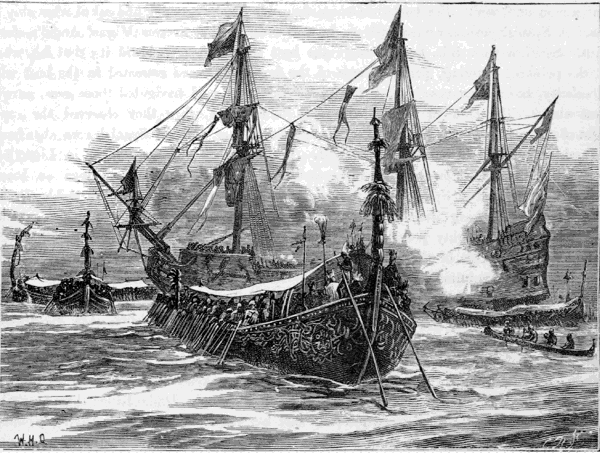
DRAKE’S ARRIVAL AT TERNATE.
Sixty-eight days was Drake’s ship—containing one of the most valuable freights ever held in one bottom—in the open sea, during which time no land was sighted; at the end of this period the Pelew, Philippine, and Molucca Islands were successively reached. At Ternate, Drake sent a velvet cloak as a present to the king, requesting provisions, and that he might be allowed to trade for spices. The king was amiable and well disposed; he sent before him “four great and large canoes, in every one whereof were certain of his greatest states that were about him, attired in white lawn of cloth of Calicut, having over their heads, from the one end of the canoe to the other, a covering of thin perfumed mats, borne up with a frame made of reeds for the same use, under which every one did sit in his order, according to his dignity, to keep him from the heat of the sun. * * * The rest were soldiers which stood in comely order, round about on both sides; without whom sat the rowers in certain galleries, which being three on a side all along the canoes, did lie off from the side thereof three or four yards, one being orderly builded lower than another, in every of which galleries were fourscore rowers. These canoes were furnished with warlike munitions, every man, for the most part, having his sword and target, with his dagger, besides other weapons, as lances, calivers, darts, bows and arrows; also every canoe had a small cast-base (or cannon) mounted at the least one full yard upon a stock set upright.” These canoes or galleys were rowed about the ship, those on board doing homage as they passed. The king soon arrived in state, and was received “with a salute of great guns, with trumpets sounding, and such politic display of state and strength as Drake knew it was advisable to exhibit.” Many presents were made to the king, who in return sent off provisions of rice, fowls, fruits, sugar-cane, and “imperfect and liquid sugar” (presumably molasses). Next day there was a grand reception ashore; the king, covered with gold and jewels, under a rich canopy embossed with gold, professing great friendship. The fact was that his own father had been assassinated by the Portuguese, and he himself had besieged and taken their Fort St. Paul’s, and compelled them to leave it. He was, doubtless, anxious for some alliance which might strengthen his hands against the Portuguese. Drake, however, had no commission, nor desire at that time to engage his country to any such treaty; his principal object now was to get home safely with his treasure. He, however, successfully traded for a quantity of cloves and provisions.
Off Celebes, the Hinde became entangled among the shoals, and while running under full sail, suddenly struck on a rock, where she stuck fast. Boats were got out to see whether [pg 314]an anchor might not be employed to draw the ship off, but the water all round was very deep, no bottom being found. Three tons of cloves, eight guns, and certain stores were thrown overboard, but to no purpose. Fuller says quaintly, that they “threw overboard as much wealth as would break the heart of a miser to think on’t; with much sugar, and packs of spices, making a caudle of the sea round about. Then they betook themselves to their prayers, the best lever at such a dead lift indeed, and it pleased God that the wind, formerly their mortal enemy, became their friend.”143 To the joy of all, the Hinde glided off the rocks, and almost uninjured. On the way home they visited Barateva, Java, the Cape, and Sierra Leone, being singularly fortunate in avoiding the Portuguese and Spanish ships. The Hinde arrived safely at Plymouth on September 26th, 1580, having been nearly three years on her eventful voyage. Drake was received with great honour, and was knighted by the queen. She gave orders that his little ship should be laid up at Deptford, and there carefully preserved as a monument of the most remarkable voyage yet made. Elizabeth honoured Drake by banqueting on board, and his fame spread everywhere through the kingdom. The boys of Westminster School set up some Latin verses on the mainmast, of which Southey gives the following free translation—
“On Hercules’ Pillars, Drake, thou may’st plus ultra write full well,
And say, I will in greatness that great Hercules excel.”
And again—
“Sir Drake, whom well the world’s end knows, which thou didst compass round,
And whom both poles of heaven once saw which north and south do bound,
The stars above will make thee known if men here silent were;
The sun himself cannot forget his fellow-traveller.”
Drake’s series of victories over the Spaniards, and the repulse which occurred just before his death are details of history which would fill a volume. He received a sailor’s funeral at Puerto Bello, his body being committed to the deep in a leaden coffin, with the solemn service of the English Church, rendered more impressive by volleys of musketry, and the booming of guns from all the fleet. A poet of the day says—
“The waves became his winding sheet, the waters were his tomb;
But for his fame the ocean sea was not sufficient room.”
No single name in naval history has ever attained the celebrity acquired by Drake. The Spaniards, who called him a dragon, believed that he had dealings with the devil; “that notion,” says Southey, “prevented them from feeling any mortification at his successes, * * * and it enhanced their exultation over the failure of his last expedition, which they considered as the triumph of their religion over heresy and magic.” The common people in England itself, more especially in the western counties, believed any quantity of fables concerning him, some of them verging on childishness. He had only to cast a chip in the water when it would become a fine vessel. “It was not by his skill as an engineer, and the munificent expenditure of the wealth which he had so daringly obtained, that Drake supplied Plymouth with fresh water; but by mounting his horse, [pg 315]riding about Dartmoor till he came to a spring sufficiently copious for his design, then wheeling round, pronouncing some magical words, and galloping back into the town, with the stream in full flow, and forming its own channel at the horse’s heels.” One of the popular stories regarding him is briefly as follows. When Sir Francis left on one of his long voyages, he told his wife that should he not return within a certain number of years she might conclude that he was dead, and might, if she so chose, wed again. One version places the time at seven, and another at ten years. During these long years the excellent lady remained true to her lord, but at the end of the term accepted an offer. “One of Drake’s ministering spirits, whose charge it was to convey to him any intelligence in which he was nearly concerned, brought him the tidings. Immediately he loaded one of his great guns, and fired it right through the globe on one side, and up on the other, with so true an aim that it made its way into the church, between the two parties most concerned, just as the marriage service was beginning. ‘It comes from Drake!’ cried the wife to the now unbrided bridegroom; ‘he is alive! and there must be neither troth nor ring between thee and me.’ ”
Drake is described as of low stature, but well set, and of an admirable presence. His chest was broad, his hair nut-brown, his beard handsome and full, his head “remarkably round,” his eyes large and clear, his countenance fresh, cheerful and engaging. “It has been said of him that he was a willing hearer of every man’s opinion, but commonly a follower of his own,” which, as a rule, was really sure to be judicious. He had a quick temper, and once offended, was “hard to be reconciled,” but his friendships were firm; he was ambitious to the last degree, and “the vanity which usually accompanies that sin laid him open to flattery.” He was affable with his men, who idolised him as the grand commander and skilful seaman that he most undoubtedly was.
In spite of the rich prizes so often taken, a competent authority says: “The expeditions undertaken in Elizabeth’s reign against the Spaniards are said to have produced no advantage to England in any degree commensurate with the cost of money and expense of life with which they were performed.” But we must never forget the wonderful development of the navy which resulted; the splendid training acquired by our sailors, and the grand gains to geographical science.
The opening of colonisation and trade with America—so far as England is concerned—is due to Sir Humphrey Gilbert, and his step-brother, Sir Walter Raleigh. From their comparatively insignificant attempts at settling parts of that vast northern continent what grand results have accrued! The acorn has become a mighty, wide-spreading oak, sheltering the representatives of every nationality.
When Sir Humphrey Gilbert proposed to Queen Elizabeth the settlement of a colony in the New World, she immediately assented, and granted him letters patent as comprehensive and wide-spreading as ever issued by papal sanction. She accorded free liberty to him, his heirs and assigns for ever, to discover and take possession of any heathen and savage lands not being actually possessed by any Christian prince or people; such countries, and all towns, castles or villages, to be holden by them of the crown, payment of a fifth of all the gold and silver ore discovered being required by the latter. The privileges seemed so great that “very many gentlemen of good estimation drew unto Sir [pg 316]Humphrey to associate with him in so commendable an enterprise.” But divisions and feuds arose, and Gilbert went to sea only to become involved in a “dangerous sea-fight, in which many of his company were slain, and his ships were battered and disabled.” He was compelled to put back “with the loss of a tall ship.” The records of this encounter are meagre, but the disaster retarded for the time his attempt at colonisation, besides impairing his estate.
Sir Humphrey’s patent was only for six years, unless he succeeded in his project, and in 1583 he found means to equip a second expedition, to which Raleigh contributed a bark of 200 tons, named after him, the little fleet numbering in all five vessels. The queen had always favoured Gilbert, and before he departed on this voyage, sent him a golden anchor with a large pearl on it, by the hands of Raleigh. In the letter accompanying it, Raleigh wrote, “Brother, I have sent you a token from her Majesty—an anchor guided by a lady, as you see. And, further, her highness willed me to send you word, that she wished you as great a good hap and safety to your ship, as if she herself were there in person, desiring you to have care of yourself as of that which she tendereth; and, therefore, for her sake you must provide for it accordingly. Further she commandeth that you leave your picture with me.” Elizabeth’s direct interest in the rapidly increasing maritime and commercial interests of the day was very apparent in all her actions.
Bark Raleigh was the largest vessel of the expedition, two of the others being of forty, and one of twenty tons only. The number of those who embarked was about 260, and the list included carpenters, shipwrights, masons, and smiths; also “mineral men and refiners.” It is admitted that among them there were many “who had been taken as pirates in the narrow seas, instead of being hanged according to their deserts.” “For solace of our people,” says one of the captains under Gilbert, “and allurement of the savages, we were provided of music in good variety, not omitting the least toys, as morris-dancers, hobby-horse, and May-like conceits to delight the savage people, whom we intended to win by all fair means possible.” The period of starting being somewhat late in the season, it was determined to sail first for Newfoundland instead of Cape Florida, as at the former Gilbert knew that he could obtain abundant supplies from the numerous ships employed in the abundant cod-fisheries. The voyage was to commence in disaster. They sailed on June 11th, and two days later the men of the Bark Raleigh hailed their companions with the information that their captain and many on board were grievously sick. She left them that night and put back to Plymouth, where, it is stated, she arrived with a number of the crew prostrated by a contagious disease. Some mystery attaches to this defection; “the others proceeded on their way, not a little grieved with the loss of the most puissant ship in their fleet.” Two of the fleet parted company in a fog; one of them was found in the Bay of Conception, her men in new apparel and particularly well provided, the secret being that they had boarded an unfortunate Newfoundland ship on the way, and had pretty well rifled it, not even stopping at torture where the wretched sailors had objected to be stripped of their possessions. The other vessel was found lying off the harbour of St. John’s, where at first the English merchants objected to Gilbert’s entry, till he assured them that he came with a commission from her Majesty, and had no ill-intent. On the way in, his vessel struck on a rock, whereupon the other captains sent to the rescue, [pg 318]saved the ship, and fired a salute in his honour. His first act was to tax all the ships for his own supply; the Portuguese, in particular, contributed liberally, so that the crews were “presented, above their allowances, with wines, marmalades, most fine rusk or biscuit, sweet oil, and sundry delicacies.” Then the merchants and masters were assembled to hear his commission read, and possession of the harbour and country for 200 leagues every way was taken in the name of the queen. A wooden pillar was erected on the spot, and the arms of England, engraved on lead, were affixed. The lands lying by the water side were granted to certain of the adventurers and merchants, they covenanting to pay rent and service to Gilbert, his heirs and assigns for ever.
Some of the before-mentioned pirates of the expedition gave Sir Humphrey a considerable amount of trouble while at St. John’s, some deserting, and others plotting to steal away the shipping by night. A number of them stole a ship laden with fish, setting the crew on shore. When ready to sail, he found that there were not sufficient hands for all his vessels, and the Swallow was left for the purpose of transporting home a number of the sick. He selected for himself the smallest of his fleet, the Squirrel, described as a “frigate” of ten tons, as most suitable for exploring the coasts. But that which made him of good heart was a sample of silver ore which one of his miners had discovered; “he doubted not to borrow £10,000 of the queen, for his next voyage, upon the credit of this mine.”
For eight days they followed the coast towards Cape Breton, at the end of which time the wind rose, bringing thick fog and rain, so that they could not see a cable’s length before them. They were driven among shoals and breakers, and their largest ship was wrecked in a moment. “They in the other vessel,” says Hayes,144 “saw her strike, and her stern presently beaten to pieces; whereupon the frigate in which was the general, and the Golden Hinde cast about, even for our lives, into the wind’s eye, because that way carried us to the seaward. Making out from this danger, we sounded one while seven fathoms, then five, then four, and less; again deeper, immediately four fathom, then but three, the sea going mightily and high. At last we recovered (God be thanked!) in some despair to sea room enough. All that day, and part of the night, we beat up and down as near unto the wreck as was possible, but all in vain. This was a heavy and grievous event to lose our chief ship, freighted with great provision; but worse was the loss of our men, to the number of almost a hundred souls; amongst whom was drowned a learned man, an Hungarian, born in the city of Buda, called thereof Budæus, who out of piety and zeal to good attempts, adventured in this action, minding to record in the Latin tongue, the gests and things worthy of remembrance happening in this discovery to the honour of our nation. Here, also, perished our Saxon refiner, and discoverer of inestimable riches. Maurice Brown, the captain, when advised to shift for his life in the pinnace, refused to quit the ship, lest it should be thought to have been lost through his default. With this mind he mounted upon the highest deck, where he attended imminent death and unavoidable,—how long, I leave it to God, who withdraweth not his comfort from his servants at such a time.” Of the company only ten were saved in a small pinnace which was piloted to Newfoundland.
[pg 319]
Meantime, on board the remaining vessels, there was much suffering, and Sir Humphrey was obliged to yield to the general desire, and sail for England, having “compassion upon his poor men, in whom he saw no lack of good will, but of means fit to perform the action they came for.” He promised his subordinate officers to set them forth “royally the next spring,” if God should spare them. But it was not so to be.
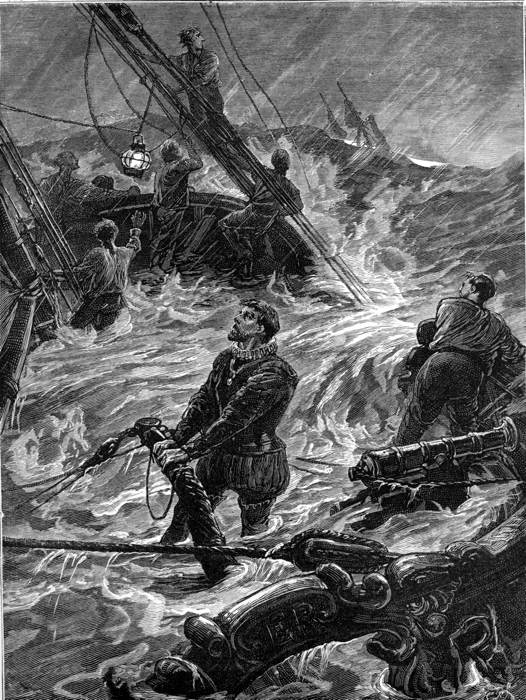
THE DEATH OF SIR HUMPHREY GILBERT.
Sir Humphrey Gilbert was entreated, when one day he had come on board the Hinde, to remain there, instead of risking himself “in the frigate, which was overcharged with nettage, and small artillery,” to which he answered, “I will not forsake my little company going homewards, with whom I have passed so many storms and perils.” A short time afterwards, while experiencing “foul weather and terrible seas, breaking short and high, pyramidwise, men which all their life had occupied the sea never saw it more outrageous,” the frigate was nearly engulfed, but recovered. Gilbert, sitting abaft with a book in his hand, cried out to the crew of the Hinde in the following noble words, so often since recorded in poetry and prose: “Courage, my lads! We are as near to heaven by sea as by land!” That same night the lights of the little vessel were suddenly missed, and Gilbert and his gallant men were engulfed in the depths for ever. Of such men we may appropriately say with the poet Campbell—
“The deck it was their field of fame,
And Ocean was their grave.”
The Hinde reached Falmouth in safety, though sadly shattered and torn.
But the spirit of enterprise then prevailing was not to be easily quashed, and only a few months after the failure of poor Gilbert’s enterprise, we find Sir Walter Raleigh in the field. He obtained letters of patent similar to those before mentioned, and was aided by several persons of wealth, particularly Sir Richard Greenville and Mr. William Saunderson. Two barks, under Captains Amadas and Barlow, were sent to a part of the American continent north of the Gulf of Florida, and after skirting the coast for one hundred and twenty miles, a suitable haven was found, the land round which was immediately taken for the queen with the usual formalities. After sundry minor explorations they returned to England, where they gave a glowing account of the country. It was “so full of grapes that the very beating and surge of the sea overflowed them.” The vegetation was so rich and abundant that one of the captains thought that “in all the world the like abundance is not to be found,” while the woods were full of deer and smaller game. The cedars were “the highest and reddest in the world,” while among smaller trees was that bearing “the rind of black cinnamon.” The inhabitants were kind and gentle, and void of treason, “handsome and goodly people in their behaviour, as mannerly and civil as any of Europe.” It is true that “they had a mortal malice against a certain neighbouring nation; that their wars were very cruel and bloody, and that by reason thereof, and of civil dissensions which had happened of late years amongst them, the people were marvellously wasted, and in some places the country left desolate.” These little discrepancies were passed over, and Elizabeth was so well pleased with the accounts brought home, that she named the country Virginia; not merely because it was discovered in the reign of a virgin queen, but “because it did still seem to retain the virgin purity and plenty [pg 320]of the first creation, and the people their primitive innocence.” These happy natives were described as living after the manner of the golden age; as free from toil, spending their time in fishing, fowling, and hunting, and gathering the fruits of the earth, which ripened without their care. They had no boundaries to their lands, nor individual property in cattle, but shared and shared alike. All this, which was rather too good to be absolutely true, seems to have been implicitly believed. The letters of patent, however, granted to poor Sir Humphrey Gilbert, and subsequently to Sir Walter Raleigh, mark a most important epoch in the world’s history, for from those small starting-points date the English efforts at colonising America—the great New World of the past, the present, and the future. Where then a few naked savages lurked and lazed, fished and hunted, forty millions of English-speaking people now dwell, whose interests on and about the sea, rising in importance every day, are scarcely excelled by those of any nation on the globe, except our own. Some points in connection with this colonisation, bearing as they do on the history of the sea and maritime affairs, will be treated in the succeeding volume.
The reader, who while living “at home in ease,” has voyaged in spirit with the writer over so much of the globe’s watery surface, visiting its most distant shores, will not be one of those who under-rate
“The dangers of the seas.”
Nor will current events allow us to forget them. “The many voices” of ocean—as Michelet puts it—its murmur and its menace, its thunder and its roar, its wail, its sigh, rise from the watery graves of six hundred brave men, who but a few weeks ago formed the bulk of two crews, the one of a noble English frigate, the other a splendid German ironclad, both lost within sight of our own shores. Early in this volume wooden walls were compared with armoured vessels, and we are painfully reminded by the loss of both the Eurydice and Grosser Kurfüst how unsettled is the question in its practical bearings. Its discussion must also be resumed as a part of the history of ships and shipping in the ensuing volume. Till then, kind reader, adieu!
END OF VOLUME I.
Cassell, Petter, Galpin & Co., Belle Sauvage Works, London, E.C.