Vocal Musick: Or, Plain and Easy Directions to Sing by Notes, wherein with a little Help, any one who is Musically given, may be perfected in a short time.
Reading edition
Musick, especially Vocal, has been of such high Esteem in all Ages, that it is accounted no less than a Divine Science producing such Concordance, and Harmony, that it cheereth and rejoyceth the Hearts of Men, and is delightful to every Creature. It is certainly an Addition to the joy in Heaven, where the Saints and Angels sing Halleluja's and Songs of Praises before the Throne of God. St. Austin tells us, that it is the Gift of God to Men, as well as to Angels, and a Representation and Admonition of the sweet consent and Harmony which his Wisdom hath made in the Creation and Administration of the World. But not to Prologue on what everywhere so much commends it self, I shall Sum up what in that Nature is expedient in a few Verses, and so proceed to the Subject Matter, viz.
Nature, which is the vast Creations Soul,
That steady curious Agent in the whole,
The Art of Heaven, the Order of this Frame
Is only Musick in an other Name:
And as some King Conquering what was his own
Hath choice of various Titles to his Crown,
So Harmony on this Score now, that then,
Yet still is all that takes and governs Men:
Beauty is but Composure, and we find
Content is but the Concord of the Mind;
Friendship the Unison of well tun'd Hearts,
Honour the Chorus of the noblest Parts.
And all the Worlds good on which we can reflect
Is Musick to the Ear, or to the Intellect.
There are to make up a Musical Harmony computed seven Notes; now in the easiest way expressed by the Seven letters of the Alphbet, viz. A. B. C. D. E. F. G. And If it so fall out, that a Voice or Musick gradually rise or fall more than Seven Notes; The subsequent 8th, 9th, or 10th, will in the same order proceed, bearing the like Relation each to the other, as the 1st. 2d. 3d, &c. to which they respectively are Eights. And so that from hence every Eighth Note, being in Nature alike, is called by the name of that to which it is in an Eighth; however above or below it; and for the better understanding the various Musical Compositions out of these Notes, Musicians have devised and make use of Lines and Characters, that as a Language they may be understood and Communicated by Book, for the Instruction of the unlearned: As in the following Introductory Example, you will perceive;
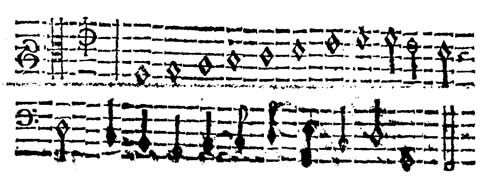
In this example, before I come nearer to particulars in general, observe first, that those Characters you observe at the beginning of the Lines, are termed Cliffs or Claves, Keys to open and signify what part or pitch of Voice, viz. the Treble, Mean, or Basse properly the Notes belong to; as likewise on what Line or Space the Seven letters expressing the Notes is placed. And then again, the five Lines and Spaces between them are useful, as Steps or Gradations whereon the degrees of Sound are to be expressed, or the Notes ascending and descending: Then Thirdly, the Characters placed on the five Lines, express the Notes themselves, or stand for them; and their difference in form, signify their quality, whether they be longer or shorter.
Your care must therefore be in this, and the Chapters following, to consider well in the first place, the Gam-ut, to learn the use of the Cliffs: Next to that, the Names of the Lines and Spaces, whereby you may readily know how to call a Note, as it stands on any of the Lines; and Thirdly, How you should Sing those Notes in right Tune, as well by degrees, as leaps; and last of all, to give each Note its due Quantity of Time.
This in general, being observed, and seriously weighed; that you may take a prospect of your task, I from it proceed to the Gam-ut, so far as I think necessary to my present design, which is to let you understand by it the use of the Cliffs, with the order and distances of the Notes, as the Parts in a Body lye together.
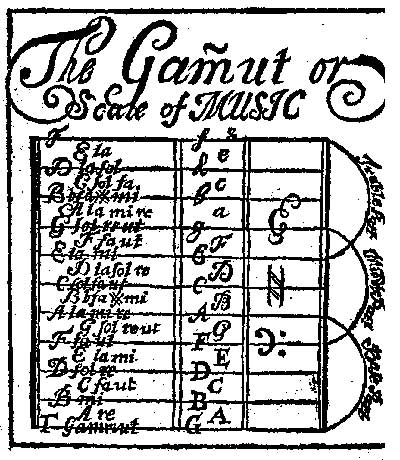
The consistence of this Scale is of Eleven Lines, with the Intermediate Spaces, and contains the places of all the Notes that are made use of Ordinarily in Vocal Musick. In the first Column you will find placed the Old Notes, being set down, that you may see what they are. And in the Second Column you are shewed which of the Seven letters properly belongs to each Line and Space. The Third Column contains the Cliffs, or signed Keys, demonstrating how many degrees of Notes they are one above another, which once Circumspectly observed and known, the other degrees of Distance are with more ease computed. And here
Five of these Lines, with their Spaces, are usually sufficient for the pricking down any Tune, for which reason this Scale is divided into Three Parts or Staves, compassed in with Arched Lines; and of these the lowermost five are proper and belonging to the Bass, and are known by this mark on the Line of F. usually, therefore called the F. Fa-ut Cliff or Key; because it opens to us the letters standing on the other Lines and Spaces, as in the ensuing Chapter will appear. As for the uppermost five Lines, they contain the highest of the Notes, and so belong to the Treble or highest Part. The Key to which is marked in this manner, and sometimes G S. on the lower Line but one.


The middle part or Tenor, usually takes in two of the upper Treble Lines; also two of the Bass Lines, that in the middle only being proper to it self, known by this mark placed on it, for the Cliff or Key, its place being properly in the middle Line, however it is many times placed on one or other of the other Lines; and note which ever the Cliff stands on, that Line is the place of C. and accordingly the other Lines are to be reckoned: Sometimes likewise we find the Bass Cliff is removed to the middle Line, and upon such removal, that Line is F, &c. and tho' this manner of Shifting the Cliff is troublesome, yet Custom and Practice having made the knowing of them necessary, you ought to be very well understanding in the manner of them, if you would be well skilled in Vocal or Instrumental Musick.

The Names of the Lines and Spaces.
Having thus far plainly proceeded to Introduce the beginner or learner, I now lead a step further to the Names of the Lines and Spaces, which is a thing very Materal in the beginning of learning. For in the Gam-ut having seen how the Notes lye together in a Body, it will be proper to know how you must take them into parts according to the several Cliffs, which are three in number, three beginning usually, as most common with the uppermost. And in these your first care will be to learn the Names of the Lines and Spaces, which are opened to you by the Cliff or Key; and these are in number Seven, expressed in the Seven letters, A. B. C. D. E. F. G. which for a more perfect Sounds sake, and other reasons to be given, you must pronounce or call La, B, Ce, D, Læ, Fâ, G. and this Fa must be pronounced broad, &c.
These and the like Names the Notes receive for two Reasons; the first is, because the Voice is best sent forth in expressing some Syllable; as likewise that this number of Notes might be known by as many distinct Names, as for their places in the Cliffs: See the Plate following.
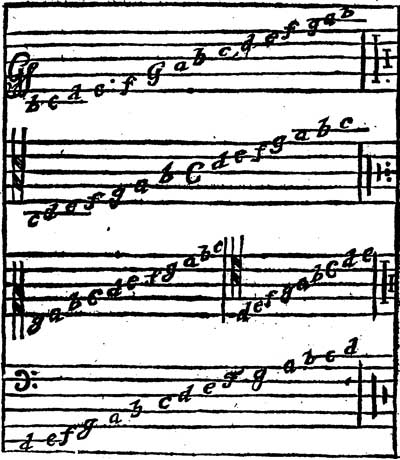
And it will be very necessary, that you should begin with and keep to one Cliff at the first, as it pleases you to chuse, or as either of the three best agrees with your Voice for a high or low Pitch.
Having gone through all the Rules, and being perfect in that, then it is fit you should proceed to the other. There is no need you should meddle or trouble your self with the Tenor or C Cliff because it keeps no certain place; you must observe however, before you go further, to be ready at naming the Lines and Spaces, so readily to tell, as soon as you look on them, what letter any Line or Space is called or named by.
As for the rest, the Cliff leads you to them, for beginning there, and Ascending, you will find the letters lying in Order, and in descending; it is only your naming them backwards.
The dash Lines, which you perceive above and below, are added only when the Notes Ascend above the Staff, or descend below it.
Directions as to the Distances of one Note from another, as to Sound.
In this case, the distances are not all equal, but that in the rising and falling of any Eight Notes, there are two lesser distances; and these are named Semitones, or the Half Notes, which must be well observed and known, in remarquing their places in the Staff of Lines; and the better to have them in your Memory at all times take a rule from certain Rhimes that point at their places, viz.
In every octave there are half Notes two,
Which do to us their proper places shew;
One half Note you will find from B to Ce,
The other half one lyes twixt Fa and Le.
The octave mentioned as an Eighth, and this Rule denotes the ordinary places where you are to Sing the Half Notes, when there are no Flats or Sharps placed or set in the Lines, viz. between B and Ce, and twixt Le and Fâ; these Flats and Sharps you will find thus marked and when the Semitones, or Half Notes are shifted, they are known by them when they are found upon the Lines.

Music
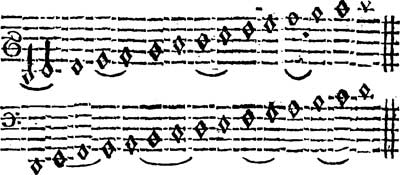
Observe, that in these Staves or Lines, you find the Notes Gradually Ascending, of which the Pairs marked with Arches are half a Note distant.
This Marginal Figure, shews to the Eye the distance of the Seven Notes one from another, the Letters Guiding or Directing to the Particulars, whereas you perceive B, Ce, and Lâ, Fa, lying near unto the rest, so must their Sounds be nearer when you come to Tune your Voice in harmony, &c. and the better to express with your Voice, and so observe the difference between half and whole distances of Notes; Sing often over these six Mona-Syllables, viz. One, Two, Three, Four, Five, Six, distinctly, as is to be observed in the Tune of Six Bells; and when you have done it many times, Sing only One, Two, Three, Four, and there stop, repeating three four by them selves for they are Semitones distant in Sound, and the rest are alone, or a whole Note distant each from the next; so that by a little Judicial Observation you will perceive the three and four Bells to be a lesser distant in Sound, than the other.
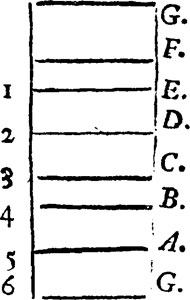
The Figures or Number 1, 2, 3, 4, 5, 6, in the foregoing Marginal Figures, shew the several distances to the Eye of the Six Notes where Le is the first, D the Second, &c. and the third and fourth, are Ce, B, distant half a Note or Tune.
Directions for the Tuning of Notes, &c.
The properest and most easy way for Tuning your Notes rightly, must be considered either in following the Voice of one skilled in Musick, or Singing, or some such Tuned Instrument, as is accomodated with Frets or are the readiest and only ways as yet made use of by Practitioners. That of a Matter being most common, but where none of these can be had by the party desirous to Learn, I shall lay down the following Directions, which will very much Instruct one that hath a Musical Ear, especially such a one as has heard, and can Sing the Notes of the Six Bells, of which, I presume, there are few, whose Genius Leads them to the Science of Musick, are Ignorant.
Let me put then, Supposing that you can Sing, One, Two, Three, Four, Five, Six, right; then shall I by the help of these Notes, proceed to set you further in the right, and lead you to all the rest.
Consider well then, that beginning to Sing the first Note, let it stand on what Line or Space it will, you may Sing it with what Tune you think fit, either higher low, (as to the pitch of your Voice) but with this caution, that you reckon how many Notes you have above or below it, that your Voice in its pitch may be so managed as to reach them both without Squeaking or Grumbling, or any harsh or rough Indecency of Sound.
For applying which six Notes, observe this first Example;
Make your beginning with the first Bar, and with a high Voice Sing the Six Notes you view on the Staff divers times, calling them over by the Number, viz. One, Two, Three, Four, Five, Six, as in the foregoing Section; when that is done; Sing the same Notes by their Names, viz. La, G, Fâ, Le, D, Ce, in the Tune of six Bells.
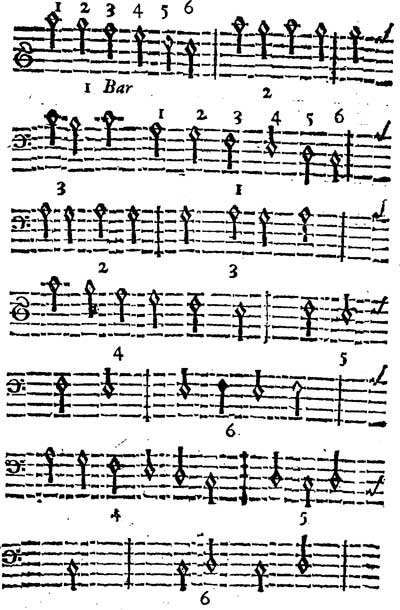
2. In the Second and third Bars, you must Sing the two first Notes of the six by themselves, forward and backward: Repeat all six in the fourth Bar, and in the fifth and sixth Bars, let the two last Notes be repeated, viz. D, Ce, forward and backward, and these Notes are a whole Tone distant, and by often repeating these Notes in the second, third fourth and fifth Bars, you will be better capable to know and distinguish their distance from the Letter.
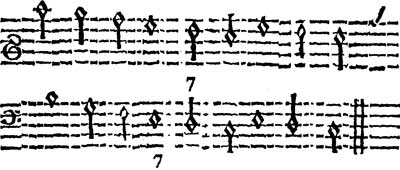
In the Seventh Bar repeat the last three often over after all the six. First, down, Le, D, Ce, Le, D, Ce, &c. and then proceed backwards, as Ce, D, Le, Ce, D, Le, &c.
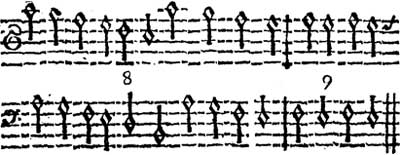
Observe in this Eighth Bar after all six often to repeat the four first, as, La, G, Fa, Le, and when you sing them particularly, observe the two Notes Fâ, Le, by reason their distance is a Semitone; wherefore you must take notice in the Ninth Bar to Sing them by themselves so many times as you can conveniently fix them in your Memory, as to their distance, for in this you will find it somewhat difficult to Sing the half Notes true in their proper places.
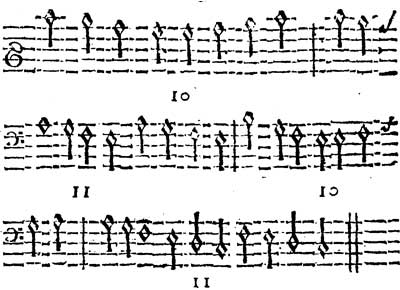
Observe here in the tenth Bar to Sing the four first Notes in their order downwards and upwards, and in the Eleventh Bar you must first Sing the six Notes in their proper order: After this repeat the four last Notes, viz. Fâ, Le, D, Ce, taking Notice to leave out the two first Notes, viz. La, G, continually observing to Mark the Semitone between Fâ, Le, which two Notes you must Sing by themselves in the Twelfth Bar.
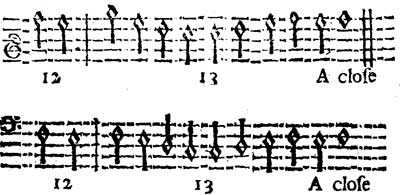
Take notice now further, that in the thirteenth Bar you Sing Fâ, Le, D, Ce, down and up, as you find them pricked, and observe especially the three last, viz. Fâ, Le, Fa, for this reason, viz. that it is a common close or ending of Tunes.
Also observe, if in any place you doubt you Sing right a repeated part of the six Notes, premised as are noted in the Eleventh and Thirteenth Bars: Let all the six Notes be Sung over again in order, and so proceed distinctly to try at the Parts themselves.
The Second Example.
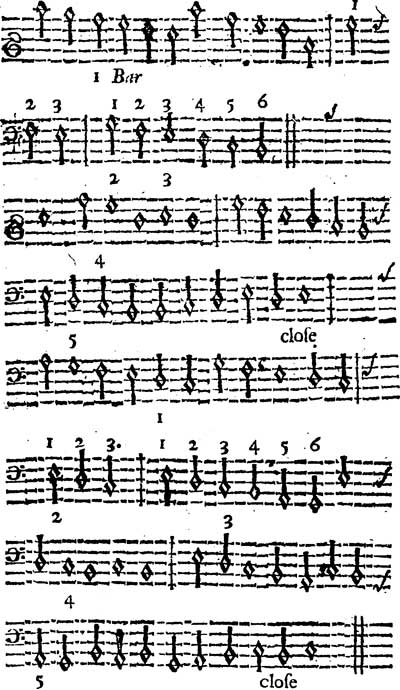
You having now gone over the former Examples, must proceed by the same clue of Six Notes to descend three Gradations or Steps lower, viz. to G. which is to the Second Note of the first six, an Octave or Eighth.
First then, in the first Bar you must begin with a high pitch in your Voice, and so having Sung, as in the former Examples, La, G, Fâ, Le, D, Ce, leave out La, and only Sing the Five last: Then repeat only three in the Second Bar, viz. the three last La, D, Ce, calling them now not by those names, but by that of One, Two, Three, and though the names are altered, you must not alter the Tune or Tone.
Having thus proceeded, observe in the third Bar to Sing the Six Notes from Le, to G, naming them as the Bells One, Two, Three, Four, Five, Six; In such a manner, that the three first of these be in Tune, the same with the three last of the former Six; after, as I said, you have Sung them as the Bells, viz. One, Two, Three, Four, Five, at least four or five times, then as often Sing them again by their proper Names, viz. Le, D, Ce, B, La, G.
Observe again, that in the fourth Bar you Sing the four first Notes, La, D, Ce, B, about four times over; after that repeat Ce, B, by themselves taking good notice of their distance or differences, which is a Semitone like to Fâ, Le above, &c.
Consider once more, as to this Example, as to the fifth Bar after all the six are Sung by you, repeat the last four, viz. Ce, B, Lâ, G, do it often over, keeping them up in the same Tone they had in all six, by which means Ce and B will be distant half a Note, whereupon Sing them backward, viz. G, Lâ, B, Ce, and at the end repeat D Ce, as you did Le Fâ at the thirteenth Bar before set down.
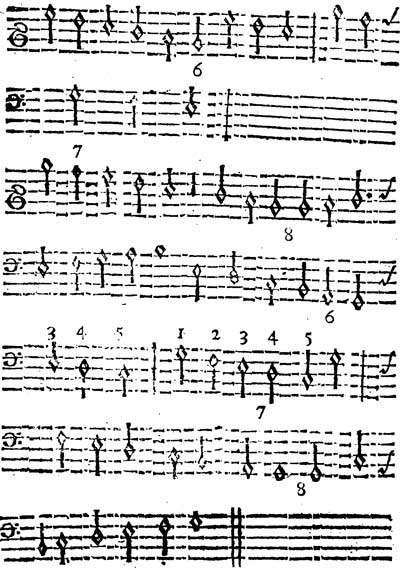
Observe further now in these Six Bars, that when you have Sung all six in order, Sing the three first Le, D, Ce, and there stop; then proceed to Sing those three over again in the same Tune, nor calling them Le, D, Ce, but Three, Four, Five; do it several times, and so proceed to the Seventh Bar, adding two Notes above, and Sing them on the five Bells, viz. One, Two, Three, Four, Five, three or four times; then call them by their names, viz. G, Fâ, Le, D, Ce, then proceed to the Eighth Bar, and add to the other five D, La, G, to make up an Octave, keeping in your Mind the distances, as you Sing them in the former Examples; and by this means you have the whole Octave or Eight Notes from G to G, which must be practised down and up, and when you are perfect in it, so as to Sing your distances true with the Semi-tones in their right places, the following directions will lead you through the rest of the Notes to Sing any other Octave, beginning at any other Letter.
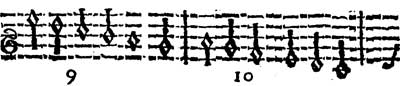
Begin at Le again in the Ninth Bar, and begin the six Notes, viz. Le, D, Ce, B, La, G, in proper order, that done, repeat the two last Notes, viz. La, G, by themselves: so proceed to the tenth Bar, and Sing La, G, Fâ, Le, D, Ce, so that La and G, may be the same in Tune as you found them in the former Six; and if so be your Voice will not reach Ce, at the pitch you began the first Bar, then Sing as far as you can, or begin at Le, at the ninth Bar higher, Singing these three last Bars distinctly from the Foregoing.
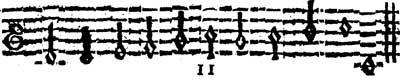
In the Eleventh Bar you must Sing backward, your six last Notes, viz. Ce, D, Le, Fâ, G, La. rising from Ce, to La, so going one step Backward to G, rise to Ce, as in the foregoing fifth Bar, which is an Octave to the lower Ce. And thus much may suffice for the Beginner to practice on, which, if well understood, will bring him in to Sing Notes in any Tune.