THE SCHOOL-GIRLS' TREASURY
Reading edition
OR,
STORIES FOR THOUGHTFUL GIRLS.
BY
LUCY ELLEN GUERNSEY
PROTESTANT EPISCOPAL SOCIETY FOR THE PROMOTION OF EVANGELICAL KNOWLEDGE,
NO. 2, BIBLE HOUSE, NEW YORK.
1870.
Entered according to Act of Congress, in the year 1870, BY "THE PROTESTANT EPISCOPAL SOCIETY FOR THE PROMOTION OF EVANGELICAL KNOWLEDGE," In the Clerk's Office of the District Court of the United States for the Southern District of New York.
ST. JOHNLAND STEREOTYPE FOUNDRY, SUFFOLK CO., N. Y.
THIS VOLUME IS PUBLISHED BY SPECIAL CONTRIBUTION OF THE
SUNDAY-SCHOOL OF THE CHURCH OF THE INCARNATION,
NEW YORK.
CONTENTS.
ANNA, OR, "MAKE THE BEST OF IT"
DORA, OR, "WON'T YOU EVER TELL?"
ESTHER'S BAD DAY, OR, "I COULDN'T HELP IT"
MARTHA, OR, "CHARITY THINKETH NO EVIL"
MARY, OR, "SHE MADE ME DO IT"
LOUISA, OR, "JUST ONE MINUTE"
THE SCHOOL-GIRLS' TREASURY
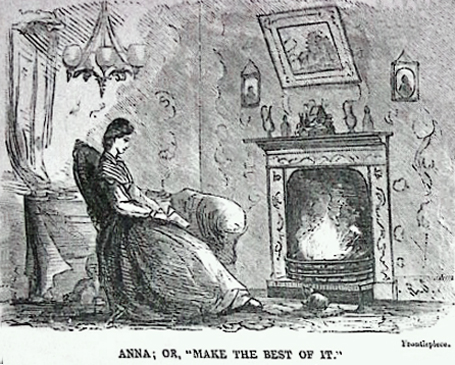
ANNA, OR, "MAKE THE BEST OF IT." Frontispiece.

ANNA,
OR,
MAKE THE BEST OF IT.
YOU would not oftener see a pleasanter parlor than the one where Anna was sitting. It was handsomely and tastefully furnished, with abundance of pictures and prints on the walls. There were pretty chintz curtains to the one large window, and the couches and chairs were covered with the same material. There was a bright blazing fire burning in the grate, and a pretty kitten sat purring on the rug before it. The gas was lighted, and a table at Anna's elbow was strewn with books and magazines.
Yet Anna sat in her comfortable chair before the fire, looking very doleful indeed, and she had been sitting so for a whole hour. She had a book in her hand, but she was not reading: her eyes were apparently fixed on the kitten before the fire, and it was easy to see that a very little would make them overflow with tears. In fact, Anna felt very unhappy, and—in spite of her long frocks which she had worn for a full half year—very babyish indeed.
Anna had been left at home to keep house for a week, while her father and mother and the two younger children went to visit her grandfather. Anna had expected a very dear friend to stay with her while her father and mother were gone. Lillie Adams was to have come by the evening train, and Anna had caused a dainty hot supper to be prepared for her; but instead of her friend, the postman brought a hurried letter from Lillie Adams, saying that her father had been suddenly called abroad on business and wished her to go with him: so she was going to Germany upon three days' notice, instead of coming to visit Anna.
This was a grievous disappointment, no doubt, and it was no wonder that Anna felt it; but she was not going to work to meet it in the right way.
She was making the worst instead of the best of the case. She would not eat a mouthful of the supper which had been prepared for her friend; she betook herself to none of her usual evening employments, but sat moodily before the fire, picturing to herself the merry group which would be assembled at her grandfather's fireside, and the delightful bustle in which Lillie Adams was engaged preparing to go abroad. And contrasting these things with her own lonely condition and the long tiresome week of solitude which was before her. There was great danger of the eyes overflowing, after all: when the opening of the door and the entrance of the cook made a moment's diversion.
Caroline Davis was a colored woman who had lived with Mrs. Grey ever since her marriage, and was regarded as a friend and counsellor by all the family, from the oldest to the youngest, especially by the children. She was apt to "speak her mind," as she said, on all occasions, especially when she thought she saw any of the children going wrong, and she had come to speak her mind now to her favorite, Miss Anna.
"Miss Anna!" said she, planting herself in front of her. "Ain't you going to eat any supper?"
"I don't want anything, thank you, Caroline," said Anna, in a doleful tone.
"You'd better have something," persisted Caroline. "I've got some splendid batter cakes, just baked, and a chocolate cake such as you like; and I'll make you a famous cup of coffee."
"I don't think I want any, thank you, Caroline," repeated Anna, still more dolefully, though she was conscious of certain stirrings within at the mention of the chocolate cake and other dainties.
Caroline took a step forward, and placed her arms a-kimbo, as she was apt to do when disposed for an argument. "Look here, honey," said she. "Do you calculate to go on this way all the time your pa and ma are away? Because, if you do, I think I'd better write to them to come home again."
Anna smiled, in spite of herself. "I hav'n't made any calculations about the matter, Caroline. My calculations have not turned out so well that I should want to make any more," she added, rather bitterly.
"Just so, honey. You've been disappointed, I don't deny it; and no wonder you feel bad. But the question is, are you going to feel as bad as you can, or are you going to make the best of it? You know what the Bible says about taking up the cross, Miss Anna, my dear. Now this disappointment is a cross that He has sent you, and the question is whether you are going to take it up and bear it like a Christian or sit down on the ground and fret under it, like a baby?"
Anna seemed a good deal interested by this view of the case. "But it hardly seems right to call such a thing as this a cross," said she.
Caroline smiled. "Well, I don't call it the biggest kind of a cross," said she, "that is compared to what some folks have to carry—old Mrs. Williams, for instance, with her bad leg and her rheumatic shoulders and her poor consumptive daughter. Still it is a cross for you to be disappointed of your friend's visit, and to have to stay alone all the week; but I would not make it any worse than it is, if I were you. Now I shall go and get your supper and bring it to you in here, and I guess you'll find you want some, after all."
Anna sat thinking, after Caroline left the room, but it was with quite a different expression of face.
"How silly I am!" she was saying to herself. "Only yesterday I was reading the lives of Margaret Rogers and Lady Jane Gray, and wishing I had lived in times when there were some great things to do; and hear I am actually crying like a baby over the very first thing that comes to try my strength, and sitting down as though them were no more to be done in the world, because Lillie Adams is going to Europe. I won't be such a fool, and that is all about it. Come, Pussy, get up and make yourself agreeable!"
Pussy was very ready to exert herself for Anna's benefit and her own, and the two were in the midst of a famous romp, when Caroline entered with her dainty tray of provisions.
"There, now! I call that something like!" said she, much pleased with the change. "Come and eat your supper, honey, while it is hot."
Anna disposed of her batter-puffs and other good things in a way which showed that her trouble had not entirely destroyed her appetite, and she could not deny that she enjoyed her supper.
"Caroline," said she, "you know that breakfast shawl Aunt Anna left here? It is rather faded, but not at all worn out. I have been thinking that I might ravel it out and make it over with some stripes of a new bright color. That would make it quite pretty again, and it would be nice and warm for Mrs. Williams' lame shoulders."
"That is an excellent notion of yours, my dear. The old lady needs a shawl, I know, and she likes bright colors, too: and she will think all the more of the shawl if it is your own work."
Anna was one of those people who, when they think of a project for the benefit of another, like to set about it directly; so she went up-stairs and brought down the old shawl and a large basket of bright-colored worsteds, of many different shades.
The rest of the evening quickly passed away in ravelling out the shawl and contriving the best way of making it over so as to be better than before. And Anna was surprised when Caroline came in and said it was nine o'clock.
"Are you going to have prayers to-night, Miss Anna?"
Anna hesitated. She felt very shy about reading and praying before the servants.
"I would, if I were you," said Caroline. "You see you are the head of the house, now that your father and mother are away."
"And I am sure we need to ask God's protection all the more when we are separated one from the other," thought Anna. "No, I will not give way to false shame. I may as well begin now as any time. Yes, Caroline, we will have prayers, if you will tell Jane and Albert to come in."
Anna's heart beat fast when she began to read, but she tried to fix her mind upon the sacred words, and by the time she came to the prayers, she was ready to pray with all her heart.
"Well, I didn't believe Miss Anna would read prayers!" she heard Jane say, after the servants had left the room. "She is such a shy young lady, generally. You know for all she plays so well, how she hates to play before company."
"She is her father's own daughter," replied Caroline. "When she knows she ought to do a thing she does it; I tell you she isn't ashamed to confess her Lord before men, and He won't be ashamed to confess her in the great day!"
"Was that confessing Christ, I wonder?" thought Anna. "I suppose it was, in one way, though I did not think of it at the time. I am glad I did read, at any rate."
Some of Anna's unpleasant feelings returned when she found herself in her own room up-stairs. It seemed so very lonely without papa and mamma in the next room and the boys overhead, and she began to wonder whether she was going to be afraid.
"But, after all, what is there to be afraid of?" she said to herself. "The bell-rope hangs close to my head and I have only to pull it to call Caroline and Albert in a minute. Besides it is God who takes care of me when my father and mother are here, and He can do it just as well when they are away!"
So Anna read her chapters and said her prayers, and learned her two verses to repeat in the morning, as was the custom of the family; and then went bravely to bed without even looking under the bed, as she did sometimes when her parents were at home. She had thought she should lie awake and listen for suspicious noises; but, as it happened, the first noise she heard was the ringing of the first bell in the morning.
"Now, what had I better do to-day?" she said to herself, as she was dressing. "I have no particular work, and there is nothing to be done about the house. O dear, I wish it was not vacation and all the girls I care about were not away. But then if it is vacation, that is no reason why I should be idle; I mean to practise two hours instead of one, and try to get those waltzes perfectly that papa likes so much."
"And what else shall I do? I believe I will try painting a picture all by myself, and see what I can make of it. Miss Jeffrey says I ought to be able to work by myself now, and I am sure she will be pleased if I have something pretty to show her when school begins again. I will copy that chromo which Aunt Anna gave mamma; and if it turns out nicely, it will be a pretty present for one of the old ladies at the Home."
Anna read prayers after breakfast, and then, after dusting the drawing-room, she sat down for two hours of vigorous practise. Then she began her picture, and by dinnertime she had her paper prepared, her outline drawn, and her first tints washed in.
"There! I have made a good beginning!" said she, looking at her work with great satisfaction. "And if nothing happens, I shall have finished it before mamma comes home, and before school begins again. I mean to work at music and painting in the morning and take a good long walk every afternoon. Then I will work at Mrs. Williams' shawl in the evening, and that will use up my time nicely."
Something was destined to happen, however, which sadly interfered with all these calculations. When Anna returned from her walk that afternoon, she saw that the blinds of the front bed-room were opened.
"I wonder if Lillie can have come, after all!" she said to herself, as she quickened her steps.
She was met at the door by Caroline with a face which promised no good news.
"Has any one come?" she asked.
"Well, yes, honey, somebody has come, though I'm afraid it isn't any one you want to see very bad."
"Not Aunt Dorinda!" exclaimed Anna, rather more loudly than was prudent, considering the tone in which she spoke.
"Hush, my dear! She will hear you! Yes, it is Aunt Dorinda, sure enough! Never mind, honey, we can't help it now. We must only make the best of it, that's all."
"Aunt Dorinda, of all people!" thought Anna, as she went to her room to take off her hat. "Well, there is an end to all my fine plans. However, as Caroline says, there is no help for it now. Poor thing, I suppose I may as well have her for a little while as anybody else. I must just leave off studying painting and study patience, that is all."
Poor Aunt Dorinda! She was a woman of a good deal of talent. She was tolerably rich, and decidedly well educated; and she fully intended to be a Christian, and to do a great deal of good in the world; and yet there was not one of all the families she visited who did not dread to see her come into the house, or who did not feel relieved when she went away.
All this inconsistency is easily explained. Aunt Dorinda never did or could mind her own business, and let the affairs of other people alone. She was possessed with a great desire to do good, and she was always making presents; but she wished always to do good exactly in her own way; and her presents were generally accompanied with remarks and admonitions which rendered them bitter pills to those who were obliged to accept them.
"So it seems I have come just in the nick of time!" said she to her niece, after the first greeting. "I do wonder your mother should have you to keep house alone. I don't suppose you know anything about it."
"I don't have very much housekeeping to do, Aunt Dorinda," replied Anna. "Caroline is the housekeeper when mamma is away. And I did not expect to be alone either, for Lillie Adams was coming to stay with me, only she was obliged to go away unexpectedly."
"Worse and worse! Two giddy heads are worse than one. I am surprised that your mother should think of leaving you alone with such a vain worldly girl as Lillie Adams."
"Lillie is neither vain nor worldly, Aunt Dorinda!" said Anna, with spirit. "She was confirmed last Easter, and the is a good Christian girl, if ever there was one."
"Don't tell me that, Anna Grey!" returned Aunt Dorinda, angrily. "Haven't I seen her with my own eyes with three ruffles on the lower skirt of her dress and as many on the upper? Do you call that being a Christian?"
"Lillie does not follow her own taste in dress," said Anna, smiling in spite of herself. "Her stepmother dresses her. Lillie said to me that she preferred to dress more plainly; but Mrs. Adams had always been so kind and good to her, that she did not like to contradict her on a matter of no great importance. You know, Aunt Dorinda, how devotedly Mrs. Adams nursed Lillie through her long illness, after she had that dreadful accident. Papa himself said that Lillie owed her life and health more to her stepmother's nursing than to his skill. Mrs. Adams gave up everything to her."
"O yes, I know!" said Aunt Dorinda, scornfully. "I heard all that when I talked to Lillie as I did about her dress."
"'What of that?' said I. 'You ought to follow your own convictions of duty, whatever your stepmother may say.'"
"And all Lillie did was to toss head and say that 'her convictions of duty led her to honor her father and mother.'"
"What time do you have tea?"
"At seven-o'clock, aunt, because it is more convenient to papa: but I will order it earlier, if you are hungry, after your ride."
"Well, I am surprised!" This was Aunt Dorinda's favorite phrase. "I should think your father, being a physician, would know better than to eat so late in the evening. Half-past five is the very latest hour that any one ought to eat."
Anna could not help thinking that her father, being a physician, would be likely to know what was good for himself and his family; but she said nothing, and ordered tea at half-past five, thinking that at least she would have a good long evening to work.
Aunt Dorinda, came down at tea-time, bringing a very large work-basket with her. She shook her head at the biscuits, declaring them very unwholesome, but managed to eat a fair share of them nevertheless, with a due proportion of stewed oysters and other good things.
Anna tried to keep her entertained by asking questions about different relatives and family friends; but she found there was not one of them all who had not displeased Aunt Dorinda in some way or other, generally by having opinions of their own about the management of their private affairs. Aunt Dorinda was one of those people who think that they are always right, and therefore always entitled to find fault with others. She had, as it were, cut out a pattern of Christian character according to her own notions of perfection, and she went about the world trying this pattern upon all her acquaintances, and endeavoring to pare and prune them or else to stretch them to fit it. She frowned and shook her head when Anna brought out her crochet work, after tea.
"Always at that useless fancy work!" said she. "Why do you not do something useful? How much better to be working for some poor person or for the missionaries, than to be spending your time in such idle pursuits!"
"But this is for a poor person, aunt," said Anna, determined not to be vexed. "It is for old Mrs. Williams, at the Home."
"How absurd, Anna! Making such a fanciful thing for a poor woman who is dependent for her daily bread! You might buy a woollen shawl for half the money, which would do her just as much good and save your time and your funds."
"I don't think so, aunt! You see this shawl did not cost me any money, except twenty-five cents for some scarlet-shaded wool. Aunt Anna left it here when she went away and told me to give it to some poor person. And almost all the new wool I am using is made up of odds and ends left from different pieces of work."
"Then why not give her the shawl just as your aunt left it?"
"Because it would not be as acceptable, aunt. Mrs. Williams loves pretty things and colors, and she will like the shawl all the better if it is my own work."
"Humph! I suppose you flatter yourself that you are doing all that work for Mrs. Williams and not for your own amusement?"
"Yes, aunt, I think so," said Anna, simply.
"Well, here is the proof. I have in this basket some shirts to be made up for a missionary at the west. Let me see you put away that senseless worsted, and stitch one of these bosoms."
"I cannot do it this evening, aunt, because papa does not like to have me do fine work in the evening," said Anna, speaking pleasantly, though she felt annoyed. "But I will stitch it to-morrow, with pleasure."
"We shall see when to-morrow comes!" said Aunt Dorinda, rather ungraciously. "I hope no new excuse will turn up in the meantime. There now, child, you need not color so and look so vexed. I mean all for your good, and you know I always say just what I think to everybody."
"But you don't like it one bit, when people say what they think to you!" thought Anna, but she did not say so.
She began asking about the missionary to whom the shirts were to be sent, and about other missionaries; and the rest of the evening passed over very comfortably.
"We have prayers at nine o'clock, Aunt Dorinda," said Anna, when the clock struck the hour.
"Indeed!" said Aunt Dorinda. "Who conducts them, now that your father is away?"
"I did last night and this morning," replied Anna. "I thought perhaps you would do so to-night."
"You had better do just as you would if I were not here," said Aunt Dorinda. "I will see how you manage, and tell you if there is room for improvement."
Anna did not feel any more devotional for the thought that Aunt Dorinda was criticising her; but she tried to collect herself and to think of nothing but the solemn duty in which she was engaged; and she succeeded better than she expected.
"Why don't you pray in your own words?" was Aunt Dorinda's first question.
"Because, aunt, I think that the words in the book are better than any I could use. And besides," added Anna, rather, timidly; "if I were to try to pray in my own words before others, I am afraid I should be thinking more of the words and of how to express myself than of the sense."
"Do you think then that all those who pray in their own words before others are thinking more of the words than of the sense?" asked Aunt Dorinda, sharply.
"No, aunt, not at all. I was only speaking of myself. And I don't see either why I should use my own words when I have such good and suitable words all ready for me."
"I am afraid you have no proper spirit of devotion," said Aunt Dorinda, severely. "I am afraid you have never learned to pray in the true spirit of prayer."
Anna was too much hurt to reply, and perhaps it was as well she did not do so. She went to her room feeling tired, discouraged and unhappy. Was it really tree that she had never learned to pray, and had none of the true spirit of devotion? Had all her enjoyments in the Church services and in her private devotions been a delusion? Had she done wrong, after all, in performing the duty which it had been so hard for her to undertake? And if she had been wrong so far, how was she to set herself right?
"Oh, how I do wish mamma was at home!" said she, sighing. "She would tell me what I ought to do. And how am I to get on with Aunt Dorinda, all alone, for a week?"
Anna took up her little book of texts for every day in the year. It had been given her by her Sunday-school teacher with the advice that she should learn the text for every day, and keep it in mind as a topic for meditation. She opened to the day of the month, and her eyes fell on the words:
"All things work together for good to them that love God."
"'All things,'" she thought. "And 'to them that love God.' Do I love Him? Yes, I am sure I do. Aunt Dorinda says it is very hard to tell whether we love God or not; but I don't see why it should be so. I don't find it hard to tell whether I love my other friends or not. Yes, I am sure I love Him, and if so, this promise is for me."
"Then there must be some way in which Aunt Dorinda's visit may do me good. I do not see how, unless in teaching me to be patient at being contradicted and put out of my way. Mamma says of me sometimes that I am very pleasant when I am pleased. Well, I must learn to be pleasant when I am not pleased. I know that Aunt Dorinda, does really mean to be good and kind, and I must try to remember that and have patience with the rest. I suppose I shall have to give up my painting and work at those shirt-bosoms, but that is no great sacrifice, after all, and the shirts will do somebody good. It isn't the heaviest kind of a cross, as Caroline says, after all."
By the time Anna had finished her prayers and reading, she felt once more contented and happy. She went to sleep with the words of praise upon her lips and in her heart, and awoke feeling cheerful and brave, and ready to "make the best of anything that should happen."
That day Anna not only stitched the shirt-bosom, putting aside her painting for the purpose, but she nearly finished the garment. She did not, however, think it necessary to give up Mrs. Williams' shawl, though her aunt went out in the afternoon and bought some marvellously coarse yarn expressly that Anna might, as she said, have no excuse for that senseless fancywork: thinking that her poor old friend had quite as much claims upon her as a person she had never seen, and whom even her aunt did not know.
Aunt Dorinda stayed three days, and then received a letter which decided her to go back directly. Anna helped her to pack with a right good will, and she drew a long breath of relief as Aunt Dorinda drove away.
"Well, she's gone!" said Caroline. "She means to be a good woman, I don't doubt, but she is a trial. There's one thing I must say, Miss Anna, my dear, that you might learn from your aunt, and that is to mind your own business, and not interfere with other folks, even when you think you know more than they do. It is just that which makes her so disagreeable, and makes her do harm where she wants and means to do good. And you know, honey, you do interfere sometimes, even with your mother."
Anna blushed. "I know it. I was thinking of that very thing last night."
"Well, then, that is one way to make the best of Aunt Dorinda. Try to be like her in wishing to do good and to help others; and learn from her, not to spoil all the good you do by dictating and interfering so as to make people dislike you. I tell you, honey, these disagreeable Christians have a great deal to answer for."
The remaining days of the week passed pleasantly and quickly to Anna; but she was a good deal disappointed when, on Saturday, she received a letter from her father, saying that they should not be at home for three days longer.
"Three more days!" she thought. "But then I shall have time to finish my picture and my shawl; and I am sure mamma will be pleased with them."
Thus you have seen how by a brave and cheerful spirit Anna was enabled to enjoy the time which at first seemed likely to pass so heavily; and how by a spirit of Christian gentleness and humility she contrived to extract real good out of what might have made her only fretful and unhappy.
Try, my dear girls, to do likewise. Try to make the best of whatever happens, and when, as it seems, there is no best to be made, try to receive your trouble as a cross from the hand of your kind and loving Heavenly Father, and pray for His grace to sanctify your affliction, and be assured He will teach you to "make the best of it."
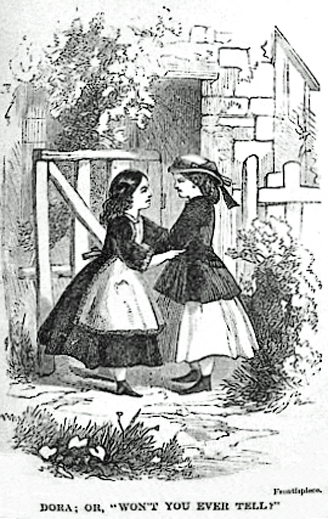
DORA, OR, "WON'T YOU EVER TELL?" Frontispiece.

DORA,
OR,
"WON'T YOU EVER TELL?"
"WON'T you ever tell as long as you live and breathe?" said Dora Hayes to Eva Morrison.
"No," replied Eva, thoughtlessly.
"Just as true as you live?" repeated Dora.
"I don't know," said Eva, taking a second thought. "I always do tell mother everything."
"Then I shall not tell you!" returned Dora, tossing her head. "If you are such a baby as that, I shall never tell you anything. I should think you would be ashamed to run and tell m—a—a everything you hear."
And Dora tossed her head and laughed in a very ill-bred, disagreeable manner.
"Well, I am not ashamed, and I don't want any of your secrets, Dora Hayes," said Eva, coloring, but speaking very decidedly. "My mother is the best friend I have in the world, and I love her dearly, and I don't know who I should tell things to, if not to her. So you may keep your great secret to yourself."
"But this is something that somebody said about you," said Dora, seeing that she had made a mistake in laughing at Eva.
"So much the worse," returned Eva, boldly, though she felt her curiosity excited. "I don't want to know what people say about me, and you ought never to repeat conversation either. You know what the doctor said about that in catechism class only yesterday."
And Eva turned away, and sitting down at a distance, she occupied herself in learning her lesson till school began. A good many times in the course of the day, she found herself wondering what it was that Dora wanted to tell her; but she put the thought resolutely away. And by the next morning, she had almost forgotten the matter.
Eva's parents were among the richest people in the place. Eva herself was always prettily and fashionably dressed: she had plenty of pocket-money to spend, and she had been in vacation to Saratoga and Newport, and even to London and Paris with her parents.
According to the usual course of story-books, Eva ought, I suppose, to be represented as proud, and haughty, and vain. I am glad to say that she was nothing of the sort. She was a kindhearted, truthful, good girl, always ready to help her school-mates in their lessons and to amuse them with telling stories of what she had seen. She was, for that matter, not nearly so proud as her classmate and most particular friend Amy Preston.
Amy was the daughter of a widow lady, who kept a fancy-store in the place where Eva lived. Mrs. Preston was the widow of an artist. She might have had a home with her husband's relatives, but like a good and sensible woman as she was, she preferred supporting herself by the beautiful work she had learned to do abroad, and by selling materials for embroidery and other fancywork; and this she did with an honesty and energy which made her very much respected. Mrs. Preston had only one child, and she wished to give her such an education as would enable her to support herself if it became necessary. Her own business was prosperous enough to enable her to afford it: so she kept Amy at the best school in the place and allowed her to take music lessons of the same master who taught Eva Morrison.
Eva had "taken," as the girls say, to Amy Preston from the very first; but it was a good while before Amy responded to her advances. For Amy was proud, as perhaps was only natural, and she was afraid that people would say she flattered and courted the heiress. She persisted for a good while in being very cool to Eva, but at last Eva's loving frankness and persevering kindness won the day, and the two girls were now the best friends in the world.
Mrs. Morrison entirely approved of this friendship. She had known Mrs. Preston for years, and she did not believe that Eva was likely to learn anything bad from Amy. Besides, Amy was a good scholar and very industrious; and Mrs. Morrison thought she might have a good influence over Eva, who was inclined to be rather lazy over all her lessons but music and drawing.
We have said that Amy was proud, and that it was only natural that she should be so. There is a certain sort of pride, if pride it can be called, which is very proper. I mean the feeling which makes people prefer helping themselves, when they are able, to being helped by others; and causes them to be cautious and delicate about receiving expensive presents, and the like.
But this very proper feeling may be carried too far, and too far Amy certainly did carry it. She would walk home from school in the rain rather than ride in the carriage which Mr. Morrison sent for Eva. She would not receive the smallest present from Eva without making her one in return; and it was a long time before she would consent to borrow from Eva's large library of story-books.
In fact, Amy was jealous of her friend's wealth and so-called station. It often happens that we go on indulging very serious faults, just because we will not allow ourselves to call these faults by their right names. Thus we call anger just resentment, and pride self-respect, and blunt rudeness sincerity, and so on.
If Amy had really become aware that she was cherishing envy and jealousy, she would have been shocked, for she was trying very hard to be a Christian. But she christened her fault by the pretty name of self-respect. When the cow-bird lays her egg in the sparrow's nest, the sparrow cherishes it and brings up the intruder as her own; but the cow-bird hatches sooner, and grows faster than the young sparrows, and very soon turns them all out of the nest. So this intruder, which Amy called self-respect, was rapidly outgrowing all the gentle virtues of charity, humility and love in Amy's heart, and was getting ready, when occasion served, to turn them all out and keep the nest to itself.
The occasion was not very far off. There was one girl in the school who entirely disapproved of the warm friendship which existed between Eva and Amy, and that was Dora Hayes. Dora was a far-away cousin of Eva's and would have liked to be very intimate with her. Dora had no pride to prevent her from accepting any amount of obligations from her rich relations, and she would have boarded, and lodged, and dressed at Mr. Morrison's expense the year round without having her feelings hurt or her gratitude excited in the least degree.
Dora was always hanging about Eva, contriving to sit next to her, and fishing for invitations to visit her. But Eva, though she was, or meant to be, kind to Dora, did not like her. She thought her both mean and deceitful, as indeed she was. And while she sometimes made her presents and lent her books, she would never encourage Dora's attempts at intimacy.
This was very vexatious to Dora. She laid it all to Eva's friendship with "that Preston girl," as she called her, and this friendship she determined somehow or other to break up. She had begun upon Eva, but, as we have seen, with little success. Eva would not promise not to tell, and would not hear her wonderful secret at any price. Dora was very much vexed, but she was not one to give up easily any point she had set her heart upon. She determined to try and see what she could do with Amy.
Amy frequently staid in the store and attended to customers when her mother was obliged to be out. Dora knew this, and that very afternoon, finding Amy alone, she pretended to want to select a worsted pattern, and began upon Amy while she was looking over Mrs. Preston's large stock of patterns.
"You and Eva Morrison are great friends," said she.
"Yes," answered Amy, rather shortly, as if she would add, "what is that to you?"
"Eva is a good girl," continued Dora. "She is very generous, at least of things which don't cost her anything; but she is queer about some things. I wish she would not act as she does, but there is no use in my saying anything to her, and I shall not try again. Eva has never been kind to me," added Dora, with a sigh; "but still she is my cousin, and I love her, though I do see her faults. Poor thing, every one flatters her, so it is no great wonder if she does think she does anybody a great favor by noticing them."
"That is a pretty pattern for your cushion!" said Amy, who was beginning to feel uncomfortable, and to wish Dora would go away. "And it is easy to work. Why don't you take that?"
"There is not enough variety about it," answered Dora, delighted to perceive the effect of her words. "I want something prettier. As I was saying, it is no wonder that Eva is set up to think that she does you a great honor by noticing you, though I must say I think you do as much for her as she does for you."
"I don't know—" Amy began.
".Of course you don't know—how should you?" interrupted Dora. "Nobody likes to make mischief, and so nobody tells you what Eva says. I think myself it is a shame that you should not hear it, because people know how Eva goes on; and, of course, they think you know it too, and just keep on with her for what you get out of her."
"I don't get anything out of her!" said Amy, coloring.
"I know you don't, really, and that is just why I say it is a shame for Eva to say so!"
"To say what?" asked Amy, in a tone of irritation. "If you have anything to tell me, Dora, I wish you would speak it out, and have done with it!"
"Oh, well, if you want me to tell you, of course I can. Well, a certain person said to Eva the other day, 'I do wonder how you can make a friend of Amy Preston!' 'Oh!' said Miss Eva, contemptuously. 'Amy is a very cheap friend. She does not want as much as some people to keep her friendship!'"
"What did she mean by that?" asked Amy.
"Why, I suppose she meant that you, being poor, would be thankful for small favors. And then she laughed and said: 'We know what we are about. Amy gets what she wants, and I got what I want!' I suppose she gives you a great many presents, doesn't she?"
"No, indeed, she does not, because I will not take them!" replied Amy.
"Well, I am surprised!" said Dora. "I thought from what I have heard Eva say, that she more than half-clothed you. She gave you the dress you have on, didn't she? I understood her so."
"She never gave me a dress in the world!" exclaimed Amy, vehemently. "Nor anything else to wear. It is a likely story, indeed, that I should accept such presents from anybody."
"Well there, I didn't believe it!" said Dora. "I said all the time I didn't; but you see your dress being just like the one Eva wore last winter, people naturally believe the story. I don't see why Eva should tell every one, if she did give you an old dress. I always thought we were not to let our left hand know what our right hand did. Eva pretends to be such a Christian, too! I don't see how she can do so; though, for my part, I never can see that people who make great pretensions to religion air better than any one else."
If it had not been for that little imp of envy and jealousy which Amy had been nursing and potting under the pretty name of self-respect, she would never have given credit to a story so entirely inconsistent with what she had known of her friend's character. She would have seen through Dora at once, and treated her insinuations and stories with the contempt they deserved. But the jealous spirit was whispering in her ear that it was no more than was to be expected, or than she deserved for running after a girl so much richer than herself. She therefore answered angrily:
"If Eva Morrison says she ever gave me a dress, or anything of the kind, she tells a lie, and you may tell her I say so! I should think she would be ashamed of herself to be such a hypocrite—pretending to be so fond of me and then telling such falsehoods about me. I have a great mind to say I will never speak to her again!"
"I wouldn't, if I were you," said Dora, delighted with her success. "But, Amy, don't you ever tell Eva that I told you. It would make no end of trouble in the family, if you should, because my father and Mr. Morrison are in business together. By the way, it is not true, is it, that Mr. Morrison set your mother up in business?"
"Of course not! Mother had money enough from the sale of my father's pictures to set herself up in business, and have something to spare!"
"There, I didn't believe it when she said so. Well, Amy, I don't like any of these patterns. I think I will go down to Mrs. Mercer's and see if she has anything prettier."
Dora went away very much delighted with the success of her scheme, and leaving Amy feeling more unhappy than she had ever done in all her life before. She loved Eva dearly, and was deeply grieved that her friend should have been so treacherous toward her. But her pride was also wounded, and she listened to the counsels of pride rather than to those of affection. The latter advised her to go at once to Eva, tell her what she had heard, and ask an explanation; but pride told her that such a course would be mean and degrading, and would show her to be wanting in self-respect. It would have been well for Amy if, like Eva, she had been in the habit of telling everything to her mother; but she was very reserved by nature, and rarely spoke to any one of her own feelings.
She brooded over what she had heard all that day and the next, and by the time she was ready to go to school on Monday morning, she had fully made up her mind never to have any more to do with Eva Morrison.
Consequently, when Eva came to meet her with outstretched hands, as usual, Amy met her with averted eyes, and the coolest of nods, and going directly to her place, she began to study with all her might.
"What in the world ails Amy?" asked one of the girls, who had seen the meeting.
"Oh, nothing I guess!" replied Eva, though she wondered at her friend's manner. "People don't always feel alike, you know!"
"There is more about it than that," said Dora, who had been watching the meeting. "Only you never will listen to anything, I could tell you all about the matter."
"Well, what can you tell!" asked Eva, carelessly.
"I shall not say anything unless you promise not to tell, you know."
"I shall not promise, Dora, though it is not likely that I shall tell. I am not apt to repeat things."
"Well, then, Amy says you are a regular little liar and hypocrite, and she won't have any more to do with you. She says she has been patronized by you long enough."
"I did not know that I had patronized her at all," said Eva. "I am sure I never meant to do so."
"Yes, but then you see Amy is of such a jealous disposition that she thinks you mean to patronize her, whether you do or not!"
"She is naturally rather jealous, I think," said Eva; "but I can hardly believe that she called me a liar or a hypocrite!"
"She did, for I heard her!" said Dora. "I was in the store, picking out a pattern."
Eva might have asked who Amy was talking to, but she did not think of that.
"Well, all I can say is, that I am sorry!" said she, sighing. "But I hope Amy will think better of it. I am sure she will if she knows what is good for herself, for I know she cannot be happy while she is doing me such an injustice."
"So you really didn't speak to Eva this morning!" said Dora, joining Amy as she was walking homeward. "I did not bellow you would keep your resolution, but I was glad you did, especially after what Eva said."
"What did she say?" asked Amy, feeling rather ashamed as she spoke.
"Oh, she tossed her head, and said you had got a jealous fit; but she guessed you would get over it. You knew what was good for yourself too well to quarrel with her, and if you did you would get the worst of it—that was one comfort. You see, she thinks she has you under her thumb, so she can do as she pleases with you."
"She will find herself mistaken!" said Amy, proudly. "I am not dependent upon her, I am thankful to say."
"But, after all, Amy, when you are under so many obligations to her—"
"Under what obligations, I should like to know?"
"Why, doesn't she pay your school bills? I understood so."
"Of course not! My mother pays my school bills! What do you mean?"
"Well, Amy, you need not bite my head off. I don't wonder you are angry. I am sure I should be, but you needn't blame me. Anyhow, if I were you, I would show that I did not mean to be domineered over, or coaxed either. 'But Amy has such a way with her—she can twist any one round her finger,' as she says."
"She will not twist me round her finger," said Amy. "I am not such a fool as she takes me for."
Eva went home that night very much grieved. She had made many advances to Amy during the day, but they had all been repelled, and with so much coldness and rudeness that she did not know how to go any farther. She did not more than half believe what Dora had told her, and yet the words were not without their influence upon her mind.
"Amy must know she is wrong," she argued, "and that is what makes her so unwilling to make up. O dear! I don't know what to do! I believe I will tell mother all about it, and see what she says."
"How many times have you sighed during the last half hour, Eva?" asked Mrs. Morrison that evening, as she and Eva were sitting together knitting by the firelight.
The evenings were growing long and cool, and the open fire seemed very pleasant and cheerful.
"What is the matter?"
"I don't know, mamma—yes, I do know, too, I suppose!" answered Eva, rousing herself. "I did not know that I sighed, though."
"Has anything unpleasant happened in school?" asked Mrs. Morrison.
"Yes, mamma—that is, not exactly in school; but something very unpleasant has happened, and the worst of it is, I don't know what to do about it."
"Suppose you tell me the story," said Mrs. Morrison. "Perhaps I shall be able to advise you."
Eva sat down at her mother's feet on the rug, and told her the whole story as far as she knew it.
"Somebody has been making mischief," was Mrs. Morrison's comment.
"That is what I suppose, mamma, and I think I know who the somebody is. I believe it is Dora Hayes."
"You should not say so unless you have good reasons," said her mother. "Why do you think so?"
Eva told her reasons.
"It looks so, certainly," remarked Mrs. Morrison. "Well, Eva, it is always a great comfort when we can find a plain Scripture rule to guide our conduct in difficult places, and I think there is one which applies exactly to such cases as this."
"What do you mean, mamma?"
"'If thy brother trespass against thee go and tell him his fault between him and thee alone,'" repeated Mrs. Morrison. "Does not that rule seem to throw some light upon your path?"
"I don't know—yes, I suppose it does. And yet—after the way Amy has treated me to-day, I do not feel very much like going to her!"
"Take care, Eva! Don't listen to the whispers of pride. Remember you do not know what provocation Amy may think she has had."
"If she thought I had done wrong, why did not she come and tell me so, instead of sulking and refusing to speak to me?" said Eva.
"Perhaps she did not feel like it, after the way she thought you had treated her," said Mrs. Morrison, smiling. "At any rate, Eva, her conduct is not the rule for yours."
Eva sat silent for a few minutes. She had her pride as well as Amy, and she had been deeply mortified at the way in which Amy had repelled her really generous advances.
But Eva had this advantage over her friend, that she called her faults by their right names and combatted them as faults, instead of coaxing and nursing them as virtues.
"Well, mamma, I will do as you say," said she, at last. "I believe it will be the best way. I don't think Amy will refuse to hear me, and if she does, I shall be no worse off than I am now."
"That is right, my dear," said her mother. "But, Eva, don't forget to ask for grace to be gentle and humble. Remember 'Charity suffereth long and is kind.' Even if Amy is unreasonable, do not get out of patience with her. You do not know what provocation she may think she has received."
As soon as breakfast was over, Eva put on her hat, and set out to find Amy. Mrs. Preston lived in a pretty house in the suburbs, and Eva was tolerably sure of finding Amy at work in her flower-garden, where even at this late season she always found something to do.
Amy was busy among her flowers, as Eva expected, and just as Eva came up, Amy opened the side gate to throw some dry stems into the street. She started when she saw Eva, and seemed about to turn away, but Eva gave her no time. She walked up to her friend, and holding out both hands, said, with her usual frank manner: "Now, Amy, I want to have you tell me what all this trouble is about."
Amy colored. "Surely you know as well as I do!" said she, trying to speak coldly.
"I know nothing at all!" replied Eva. "Only that Dora Hayes says that you called me a liar and a hypocrite, and, as she has told me such a story about you, I think it very likely that she has told you something about me."
"It was what she told me you said that made me call you so!" said Amy, just ready to cry.
"So I supposed, and therefore I want to know what it was. Now let us sit down on the stops and have it all out. What did she say?"
Amy began to feel a little ashamed of herself, by this time, and to see that she had been hasty to believe evil of her friend. She began at the beginning and told Eva all that Dora had said about her.
"I thought she had had a hand in it," said Eva, when the story was finished. "She came to me in the first place and wanted to tell me something that I was never to tell—something somebody had said about me; but I told her that I always told mother everything, and that I never wanted to hear what people said about me, so she subsided. The truth of the matter is this. Dora was teasing me one day to give her my amber necklace, which I would not do."
"'You would give it to Amy Preston in a minute, if she asked you,' said she; 'you think more of that shop-girl than you do of me, though I am your cousin.'"
"'Well,' said I, half laughing, 'you see, Dora, Amy is a cheaper friend than you are. She never wants anything and you want everything.'"
"So much for that! As for the dress story, there is a little foundation for that, too. Dora asked me a few days ago if that was my old dress you were wearing."
"'Of course,' said I. 'Amy wears all my dresses and I wear hers. That is the way we show our regard for each other.'"
"'But don't you really give her dresses?' she asked."
"All the girls laughed, for every one knows how proud you are about receiving presents, Amy."
"And I said, to carry on the joke, 'To be sure I do! I buy all her clothes and books, and my father pays her school bills.'"
"You see, Amy—though you must not tell any one—papa really does pay Dora's school bills, and mamma gives her a great many things; and I thought perhaps by giving her such a hint, I would make her hold her peace, and so I did. As for the rest, it is a sheer manufacture out of whole cloth. I should think you ought to have known me better, Amy."
Amy colored scarlet. "Well, Eva, I suppose I ought, but then you see—there is such a difference—in short you are rich and I am poor, and if you were in my place, you would see how natural it is to be jealous."
"It may be natural, but I cannot think it's right," said Eva. "I don't think poor people ought to be jealous of rich people, any more than rich people ought to despise poor people. Besides, Amy, I should never think of calling you poor. But did Dora say anything else?"
"Never mind what she said," replied Amy. "I ought never to have listened to her. But it was not so much what she said as what she insinuated. However, I was a fool to mind her, for I know of old just what a mischievous thing she is. She has tried it upon me before. When I first came to school, she told me some of the girls made a fuss because I was a shop-girl, and I don't suppose there was any truth in that either."
"Not one word, I dare say. But now, Amy, promise me one thing. If ever you think I have done wrong, just come to me as I have come to you and ask me about it. If we do so, we shall never have any lasting quarrels, I am sure, and no tattler can make mischief between us. Isn't it almost time to go to school? I will wait for you and we will go together."
Amy kept Eva waiting while she went up to her own little room, and there in a short but earnest prayer, asked God's forgiveness for her jealousy and unkindness and begged Him to pour into her heart "that most excellent gift of charity, the very bond of peace and of all virtue, without which whosoever liveth is counted dead before Him."
Dora stared in wonder when she saw Amy and Eva enter the school-room in their old fashion, with their arms round each other's waists.
"So you two have made up your quarrel," she said, in recess, with her disagreeable laugh. "Well, it is a fine thing to have a forgiving temper, especially when it is so much to one's own advantage as it is to Amy's, in this case."
"There is nothing to forgive, as it happens," answered Eva, coolly. "Somebody told Amy a set of stories about me which were either entirely false or else misrepresented, but when she came to hear the truth it was all right again."
"Amy Preston, you are as mean as you can be," exclaimed Dora. "You promised not to tell."
"I did not promise not to tell," said Amy. "However, I did not tell."
"How did Eva find out then, I should like to know?"
"Because," said Eva, answering for her friend; "you came to me and told what Amy said about me. And I remember what I heard an old Scotch woman say about talebearers, that a dog which would fetch a bone would carry a bone."
Depend upon it, girls, the old Scotch woman's proverb speaks the truth. A person who will come and tell you a story about what somebody has said of you, will tell that person what you have said about them; and in neither case will the story be the exact truth. Never listen for a moment to such tales, if you can help it; and if you cannot help listening, let the words go "in at one ear and out at the other."
If, however, you think your friend has offended you, go and ask her about it kindly and frankly; and two to one the offence will vanish into thin air.
But again, I say, never listen to talebearers, for "the words of a talebearer are as wounds."
"Where no wood is, there the fire goeth out: so where there is no talebearer the strife ceaseth."—(Prov. xxvi. 20.)

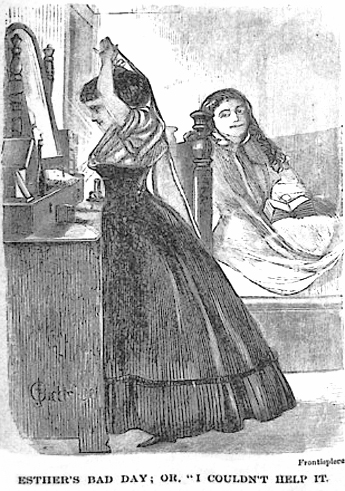
ESTHER'S BAD DAY, OR, "I COULDN'T HELP IT." Frontispiece.

ESTHER'S BAD DAY,
OR,
"I COULDN'T HELP IT."
IT was a good while after six and a very bright sunny spring morning, yet Esther was not yet out of bed, when somebody knocked at her door.
"O dear!" said she, in a sleepy, pettish tone, "I wish people would only let me alone a minute. Come in!"
The last words were spoken aloud, and a very pretty girl, some years older than Esther, opened the door. She was partly dressed and had her comb and brush in her hand.
"Why, Etty, not up yet!" she exclaimed. "I thought you would be nearly dressed. I came to ask if I might finish my dressing by your glass, for papa wants the painters to begin on my room as soon as they come."
"Of course you can," replied Etty, not very graciously, however. "What time is it?"
"About half-past six. You ought to be up, Etty."
"Oh, there is plenty of time."
"I don't know. Time slips away very fast in the morning."
Eleanor went back to her roam to look for something she wanted. When she came back, Etty had scrambled up to the end of the bed next the window, and, still in her night-gown, and with her hair hanging over her shoulders, was reading a story-book, which she had drawn from under her pillow. In the book, perhaps, might be found the cause of her morning sleepiness. When a little girl reads in bed till her candle burns out, she is apt to be rather heavy-headed next morning.
"You will be late for breakfast," said Eleanor. "I fear I shall be late myself, I have been so hindered; but, Etty, I am sure you will be behindhand."
"O no, I sha'n't. I can dress in ten minutes, easily."
"You cannot dress properly in ten minutes," said Eleanor, busily tying up her hair; "and, Etty, there is something else besides dressing to be done before you go down-stairs."
Etty shrugged her shoulders impatiently but made no answer.
Eleanor went on with her dressing, and said no more till she had finished. Then turning to, Etty, who was still reading, she said, seriously:
"Now, Etty, you have only fifteen minutes left. You may get ready for breakfast, perhaps, if you lose no more time."
"Do let me be, Eleanor!" answered Etty, angrily. "I know what I am about! I wish you would go away and mind your own business!"
"Very well," said Eleanor, and quietly gathering up her dressing things she left the room without another word.
Etty looked at the clock and then at her book.
"I will only read to the end of this paragraph," said she. "That will not take long, and I can easily get ready after that."
But it is not always easy to stop at the end of a paragraph, and Etty read on till she was startled by hearing the church clock strike seven, followed by the energetic ringing of the breakfast-bell at the foot of the stairs.
"O dear!" exclaimed Etty, throwing down her book and scrambling out of bed. "Now I shall be late again; that will be the third time this week, and uncle will be angry. It is all Eleanor's fault. She ought to have made me got up."
Etty hastened to dress, but as usually happens at such times, she found that the more she hurried, the less she got on. She broke her boot-lacing and could not find another. She had been in such a hurry to get to her story-book the night before, that she had neglected to braid up her hair, and it was all hanging in what nurses call "witch-knots," and the more she pulled at it, the worse it snarled.
"Now where is that ribbon! I am sure it was here last night. I suppose Eleanor has put it out of place. O dear, I do wish people would keep out of my room and let my things alone!" snapped Etty, tumbling over the things on the dressing-table.
"There, now!" As she spoke, she overturned a tall bottle of cologne, which, with its pretty bronze holder, had been one of her birthday presents. She had often been told never to set the bottle down out of the holder, but she had a trick of leaning it against the side of the glass.
The tall bottle fell on a pretty hand-mirror with a carved frame, and both were broken to pieces. At this new calamity, Etty burst into tears, and throwing her brush to the farther end of the room, she flung herself down on the floor and cried so as to be heard all over the house.
The family were becoming tolerably well used to Etty's "tantrums," and as they were at prayers, nobody moved till the prayer was finished.
"Please, aunt, may I go and see what ails Etty?" said Stella. She was Etty's younger sister, but as she slept with Eleanor, she had not seen Etty that morning.
"No, my dear, I will go myself," said Mrs. Grey.
Stella said no more, but she looked very uncomfortable, not to say distressed.
"You need not look so unhappy, my dear Stella," said Eleanor. "You don't think mamma will be unkind to Etty, do you?"
"No," said Stella, "aunt is never unkind to any one; but Etty does go on so when she gets one of her bad days. Aunt is not used to her, and I am afraid she will be very much displeased."
When Mrs. Grey went up-stairs, she found Etty still lying on the floor, crying and sobbing.
"What is the matter now?" asked Mrs. Grey. "Why are you not ready for breakfast?"
"O dear, I wish I was dead! I wish I was dead!" sobbed Etty.
"Etty, if I ever hear you say that again, I shall punish you!" said Mrs. Grey. "Stop crying directly, and tell me what all this is about. How came this bottle broken, and the mirror, too? And here is the cologne running all over the bureau. What have you been about?"
"It is all Eleanor's fault," sobbed Etty, getting up from the floor. "She came in here to dress, and she has put all my things out of place so that I cannot find anything; and looking for my hair ribbon, I knocked down the bottle and broke it and—" Etty was going to wish herself dead again, but she stopped just in time.
"Is not this your ribbon?" asked Mrs. Grey, taking up one which was hanging on the glass in plain sight.
"I don't care, I could not find it," Etty was beginning, but her aunt stopped her.
"I do not want to hear any more now. Dress yourself and come down-stairs as quickly as you can?"
Esther and Stella Grey were orphan children, who had come to live with their uncle and aunt. Mr. and Mrs. Grey had adopted the children as their own, and treated them kindly in every respect.
Stella was very happy in her new home—happier in fact than she had ever been before. She was a quiet little thing, very gentle and good; but not at all pretty, and not particularly bright.
Etty, on the contrary, was both pretty and intelligent; but she was far from being as pleasant a child to live with as her sister. Esther had always been the favorite with her mother, who was not by any means a sensible woman. Ever since she could remember she had been petted and indulged, and talked about before her face as "a very peculiar nervous child," "a child requiring very delicate management," till she had learned to think that she was really something remarkable; whereas she was only a passionate little girl, whose health had been injured by over indulgence, and whose disposition had been almost spoiled by her being permitted to tyrannize over her younger sister as much as she pleased, and to indulge in such fits of passion as we have seen, on the least provocation.
Mrs. Grey soon found out that she had undertaken a very troublesome task; but she was a kind good woman and used to children, and she was determined to do the best she could by the poor spoiled child.
When Etty came down at last, she found breakfast over. Her uncle was reading the paper, Eleanor was washing the breakfast dishes, and Stella dusting the room.
"Come, Etty, eat your breakfast," said her aunt, kindly, but decidedly. "Eleanor wants to put away the table."
Etty took her seat with a very dissatisfied face. "Everything is as cold as it can be!" said she, pettishly. "And I can't bear fish-balls."
"Well, there are plenty of nice potatoes, and bread and butter."
"I hate—" Etty was beginning, but Mr. Grey stopped her.
"Eat your breakfast and say no more about it, Esther!" said he, sharply. For he had nerves as well as his niece, and her whining grated upon them sadly. "You have made quite disturbance enough for one morning."
Etty shrugged her shoulders and made up a face, but she was afraid of her uncle and said nothing more. She drank two cups of coffee and was just about pouring out a third, when her aunt stopped her.
"No more, Etty! Two of those cups are quite enough for any little girl."
Etty rose from the table with a flounce, and gave the coffee pot a push which sent it off the table. Stella was close by and caught it, but not in time to save Etty's dress from a deluge.
"There now, see what you made me do, you awkward little toad!" exclaimed Etty, angrily, giving her sister a push. "I wish you were a thousand miles off, Stella Grey. You are always getting me into trouble."
Stella, who was used to her sister's hasty speeches, did not reply; but Eleanor answered for her. She was very fond of Stella, and did not like to hear her falsely accused. "Why, Etty, Stella did not touch you. She caught the pot and risked her own hands to save you from being scalded. You ought to be ashamed to speak so to your sister!"
"Never mind," whispered Stella. "Don't say anything to her, you only make her worse."
"Etty," said Mr. Grey, "go up and change your dress, and don't come down again till you are in a good humor. Let me hear no crying, or slamming of doors, either," he added, sharply. "We have had quite enough for once. I begin to wish that child had never come into the house," he said to Mrs. Grey, as Etty left the room, followed presently by Stella. "She destroys the whole comfort of the family."
"She is certainly very troublesome," replied Mrs. Grey, sighing. "However, we must have patience. I really think she is improving. She has not had one of these bad days in some time."
"Since when?" asked Mr. Grey.
"Since last week," answered his wife, smiling. "She used to have them every other day when she first came. But I begin to think with you that we shall have to be more decided with her. However, we will try to get on quietly to-day, so that the pleasure of the excursion may not be spoiled for poor Stella."
Meantime Stella was up-stairs coaxing Etty to stop crying and change her dress so as to be ready for their lessons at nine o'clock.
"Come, Etty, do," she urged. "You will not be ready when Miss Beach comes, and then you will have a bad mark again. Do put on your other dress."
"I won't!" said Etty, passionately. "I wish I was dead! They would never dare to treat me so if my own mother was alive, but because I am an orphan they think they can abuse me as they please."
"Oh, Etty, how can you say so? I think they are so kind."
"They may be kind enough to you, but they are not kind to me," retorted Etty. "You know they are not, but you don't care what becomes of me. If you had loved mamma, you would not be so contented here. But you never did. I do really believe you are glad she is dead, because you know she always loved me the best."
Stella could bear a good deal from Etty, but this was too much. She burst into tears, and ran out of the room.
Etty, having succeeded in hurting somebody's feelings, began to feel better herself. She knew that she had uttered a wicked falsehood, but she did not mind what she said at such times. She grew quite cheerful over the wound she had inflicted on her unoffending sister, and by the time Miss Beach rang the bell, she was ready to come down-stairs singing and as pleasant as possible, her face making a great contrast to poor Stella's red eyes and trembling lips.
But cheerfulness which is built on the suffering of others is not likely to be very lasting, and a new cause of trouble soon appeared. Notwithstanding, Etty's so-called talents, she was backward in her lessons; and reading till twelve o'clock the night before did not tend to make her head clear. She found her sums in arithmetic unusually puzzling, and made so many mistakes in her Latin rules that she had to study them over again. She could not make sense of her reading lesson, and declared there was no meaning in it, and she was all the more cross that Stella's Latin lesson was unusually good. By the end of the school hours, she was once more in a thoroughly bad humor.
"Well, are the lessons finished?" asked Mrs. Grey, entering the school-room at twelve o'clock. "Come then, girls, hurry and dress yourselves, that you may be ready when the carriage comes."
"Where are we going, aunt?" asked Stella.
"Wait patiently, and you will see," replied Mrs. Grey, smiling. "Only be sure you are ready by one o'clock, for there will be no time to lose in waiting. Put on your gray skirts, and dresses that can be easily washed. Your ginghams will be the best."
"I shall not wear my gingham dress—so!" said Etty, as they went up-stairs. "I shall wear my new muslin."
"I am afraid aunt will not like it," replied Stella. "She said anything that would wash."
"Well, and won't the muslins wash, stupid?"
"Yes, I suppose so, but you would hardly want to have your new dress done up so soon. I shall put on the gingham."
"I declare, I won't go with you, if you do, Stella Grey," said Etty, stamping her foot.
"You will not look fit to be seen."
But Stella was learning to have her own way, when she knew she was in the right. She said no more but went to her room and dressed herself as her aunt had directed.
Etty, meantime, was fretting and fuming over her toilet as usual, because she could not make up her mind what to wear. She would not wear the gingham—that was all about it. The muslin was pretty enough for anything, but Etty had forgotten to sew on certain hooks and eyes without which the sash could not be worn, and the dress without the sash could not be thought of.
Finally she pitched upon the most unsuitable thing of all—a black barege, her very best summer dress, which she had not yet worn. She was just fastening it, when her aunt called to her from the stairs: "Be sure you put on your thickest boots, Etty!"
"Those thick leather boots with this thin dress—how they will look!" said Etty. "I am sure my cloth boots will be thick enough this dry day. It has not rained for a week."
Etty had lost so much time in making up her mind that she was not ready when the carriage came to the door.
"Come, children, we have no time to lose!" called out Mr. Grey. "Are you ready?"
"I am ready," said Stella, entering Etty's room. "Shall I help you, Etty? But what made you put on that dress?"
"Because I don't want to look like a charity school-girl, as you do!" was Etty's snappish reply. "Every one will think you are a servant!"
"No, indeed! I am not half fine enough for a servant," said Stella, shrewdly. "But come, Etty; do hurry. What hat are you going to wear? Let me get it for you."
"Do go along and leave me alone!" said Etty, crossly. "You are trying to hinder me on purpose to get me found fault with."
"Come, children," again called Mr. Grey. "We cannot wait for you any longer."
Stella ran down-stairs to say that Etty would be ready in a minute.
When all were in the carriage, Etty came down. In the bustle of getting settled and driving off, Mrs. Grey did not notice her dress, and it was not till they had gone several squares that she observed how Etty had disobeyed her orders.
"Why, Etty!" she exclaimed. "What made you put on that dress, of all others? You will have it utterly spoiled."
"There is no help for it now," said Mr. Grey. "If Etty spoils her dress, she must take the consequences. She will not have another new one at her disposal to spoil this summer."
Etty flounced and frowned, but said nothing till they came to the steamboat, which was just ready to leave the dock. Then a new trouble came up. She declared that she could not and would not go on board the boat—that she knew she should be drowned, and that Stella should not go either.
"Very well," said Mr. Grey. "Then, get into the carriage and go home, but Stella shall go, if she chooses. Come, make up your mind one way or the other; but do not stand there making yourself ridiculous any longer."
This was new treatment to Etty, who was used to being soothed, and petted, and admired for her weak nerves and delicate sensibilities. But she had no notion of being left behind, and finally went on board the boat, just the moment before the plank was taken away.
The party were to proceed to a rocky point some miles off, spend the afternoon in exploring it, and return in the evening, when the steamboat would call for them. The place was beautiful and the weather lovely—the luncheon was very nice.
And all might have been pleasant only for Etty.
She spoiled every one's comfort. She would go nowhere where the rest wanted to go: she persisted in being afraid where there was no danger, and in being foolhardy in dangerous places, and she cried five different times in three hours. Her dress was torn in a dozen different places before the day was over, and her thin boots cut to pieces so that she could hardly walk, and the stones hurt her at every stop.
"Now I am going to rest a while and then we will go and see the cave," said Mr. Grey, when they had finished their lunch; "but none of you must venture on the rocks without me. They are dangerous in many places."
Stella was searching for shells on the sandy beach, near the place where they had lunched, when Etty joined her.
"I am going up there to get some of those wild-flowers, instead of poking about here," said she, pointing to some flowering shrubs which grew at a little distance, "and I want you to go with me."
"Uncle said we must not go on the rocks without him, you know," said Stella.
"He did not say on these rocks: he said on the rocks by the cave."
"He said on the rocks," persisted Stella; "and I know we ought not to go."
"Of course you won't go if I want you to," said Etty. "It is enough for you to know that I wish to do anything to set you against it. I don't care, I shall go alone."
"Please don't," pleaded Stella, but Etty was already on the rocks.
In a few minutes Mr. Grey, who was taking a little nap, was startled by a cry of distress.
There stood Etty on a narrow ledge, over a deep pool, clinging to a small, slender bush, and screaming with all her might; while Stella, with a pale face but steady step; was walking along the dangerous path towards her sister.
"Stop, Stella, I command you!" called Mr. Grey. "Etty, keep still and be quiet. I will see what can be done."
But Etty was past hearing reason. As Stella drew near her, she threw herself forward and seized hold of her sister. Stella tottered, lost her balance, and both the children fell into the pool below. When Etty came to herself she was lying on the bed, in a room of the fisherman's little house on the point, with Eleanor and the fisherman's wife attending upon her, but Stella was not to be seen.
"Keep still, Etty," said Eleanor, as Etty tried to rise.
"But where is Stella? I want Stella!" cried Etty.
"Stella cannot come to you, and you must not go to her," said Eleanor, seeing that Etty was determined to get up. "You have done terrible mischief by your perverseness and folly, Esther, and the only amends you can make is to try and do no more."
There was something in Eleanor's tone which quieted Etty at once.
"Is Stella dead?" she asked, in an awestruck whisper.
"No—at least we hope not—but she has not revived yet, and we fear that her head is hurt. Be quiet now, and drink the tea Mrs. Fiske is bringing you."
It was a long time before Stella came to herself, and when she did, she knew no one. She was carried on board the steamer and laid on one sofa and Etty on another. As the boat drew near to the wharf, Stella opened her eyes, and seeing her aunt bending over her, she said, feebly: "Please, aunt, don't scold Etty."
Etty hid her face and cried bitterly but silently, as she remembered all her unkind speeches to Stella. She was put to bed in her own room, and left alone for what seemed an age. At last Mrs. Grey came in and sat down by her bed.
"Oh, aunt, how is Stella?" exclaimed Etty, starting up.
"She is better," replied her aunt. "The doctor hopes she will live. You ought to be very thankful." Mrs. Grey paused a little and then said: "Etty, what has been the matter to-day? What has made you behave so badly?"
"I don't know, aunt," replied Etty. "It has been one of my bad days."
"What do you suppose makes you have bad days, Etty?"
"I don't know, aunt," repeated Etty. "I can't help them."
"Are you sure of that, Etty? I am not so, by any means."
Etty looked surprised.
"Let us go over the day's history and see if it could not be helped. What was the first trouble?"
"Being late for breakfast, aunt—no, breaking the cologne bottle was the first trouble."
"Well, both of these troubles came from the same source—not getting up in time. How did that happen?"
"I was so sleepy, aunt."
"You should not have been sleepy. From half-past nine till six is long enough for any little girl to sleep. Did you go to bed as soon as you came up-stairs?"
Etty hesitated.
"I know you did not," continued Mrs. Grey. "Your candle was new last night and it was more than half burned out this morning. What were you doing?"
"Reading, aunt."
"Then the first trouble came from your disobeying my direct commands. Could you not help that?"
"Yes, aunt, I suppose so."
"And could you not have got up when Eleanor called you?"
"Yes, aunt."
"Then here were two troubles which certainly could have been helped, and which being helped would have prevented most of the others. I will pass over your conduct at the breakfast-table and at your lessons; but could you not have dressed yourself as I told you instead of following your own perverse fancy?"
"I did not want to wear that dress," murmured Etty.
"That was no reason at all, Etty. When you are commanded to do a thing by those who stand in the place of your parents, your liking or not liking is no excuse for disobeying. Now, to go on to the great trouble of all. Did you not hear your uncle tell you not to go upon the rocks?"
"Yes, aunt."
"And could you not have helped going where you were told not to go?"
Etty was ashamed to excuse herself by saying that she wanted the flowers, so she said nothing. She was beginning to see that her troubles had been of her own making.
"In every one of these cases you could have 'helped it,' as you say, by merely doing your duty," continued Mrs. Grey. "If you had risen in time, you would not have been hurried and fretted in getting ready for breakfast. You would not have broken your bottle, and spoiled my table, and lost your own temper, and put yourself out of tune for the whole day. If you had trusted your uncle as you ought, you would not have made yourself ridiculous on the wharf as you did. If you had not been so perverse and unreasonable you would not have spoiled your best dress and your own temper as well as that of every one else. To conclude, if you had obeyed your uncle to-day, you would not have run heedlessly into danger, and thus have sacrificed perhaps the life of your poor little sister."
"Do you think Stella will die, aunt?" asked Etty.
"I cannot tell. She is very dangerously hurt, and even if she should live, it may be months before she can walk. Now tell me, Etty, could you not have helped all these things?"
"Well, I cannot help crying when anything troubles me," said Etty. "I have so much feeling."
"Feeling for yourself, Etty, not for other people. Selfish feeling, which makes you hard-hearted and unkind even to your poor little sister, who would do anything in the world for you. Selfish feeling, which shows that you have never learned to love God or your neighbors, but only to love and please yourself—which will and does make you a torment to yourself and all about you."
"I shall say no more now, Etty, only to recommend you to ask God for the light of His Holy Spirit to teach you to see yourself as you really are. There is no use in trying to cure people unless they can be convinced that they are sick, and there is no use in talking of amendment to one who cannot see that she is to blame. I shall pray for you, my child, and I shall continue to take care of you as well as I can, but I do not know what is to become of you unless you learn to be a better girl."
"Please don't go away, aunt," sobbed Etty: "don't leave me alone. Indeed I will try to be a good girl, if you will forgive me."
"I forgive you, my dear Etty, but there is One whom you have offended more than you have me, whose pardon you ought to ask."
"Please ask Him for me, aunt!" whispered Etty. "And ask Him to make Stella well."
Mrs. Grey knelt by Etty's bedside, and prayed, and for the first time in her life Etty really joined in a prayer.
She wanted very much to see Stella, but her aunt said no, and for once Etty minded without a word.
When Mrs. Grey left her, Etty slipped out of bed, and kneeling down, she prayed herself, with many tears, that her Father in Heaven would spare her dear sister; and that she herself might have grace to be a good girl. That prayer was the beginning of a new life to Etty.
Then feeling a little comforted she rose from her knees. As she did so she felt a sharp pain in her foot, so sharp that she almost screamed. She had felt a pain in the foot a good many times during the afternoon, but her pride would not let her speak of it, lest her aunt should say something about her thin boots.
"O dear, what a wicked little fool I have been!" said she to herself. "Now I have hurt my foot and I dare say I shall have to sit still and be waited on, instead of waiting on Stella."
So it turned out. The next day Etty's foot was found to be so bruised and inflamed that she could not put it to the floor. Here was an end to all her hopes of helping her aunt and waiting upon Stella. Instead of that, she had to be carried up and down-stairs for a month, like a baby, and all she could do for any one was to give as little trouble as possible. She had taken a severe cold which settled in her eyes, already weakened by reading at night, and she could hardly use them at all.
This confinement was one of the best things that ever happened to Etty. She learned for the first time to appreciate the kindness of those who took care of her. She learned to be thoroughly weary of idleness, and to find it a privilege to be employed. She found out too that much as she might try, she could not be a good girl without help from above, and she learned to pray earnestly for the help of God's Holy Spirit. Her "bad days" became fewer and farther between, and at last ceased entirely.
Stella, was ill for a long time, and has never been as well as she was before her fall: but she is happier than ever before, for Etty is now always kind and affectionate to her.
Dear girls, be careful how you excuse your faults by saying you "can't help it!" Remember that you can always have God's help by asking for it in faith and humility, and with Him on your side, you have no right to say that you "cannot help" doing what is wrong.

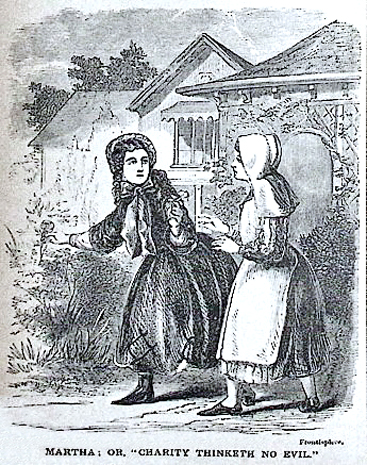
MARTHA, OR, "CHARITY THINKETH NO EVIL." Frontispiece.

MARTHA,
OR,
"CHARITY THINKETH NO EVIL."
"I HAVE just been to see Betty Allis," said Emily Dunbar to her cousin Martha. "She is a great deal better, but she is not able to go to school."
"Then she has really been sick!" said Martha.
Emily looked at her in surprise.
"What do you mean, Martha? Of course she has been sick. She would not be very likely to stay out of school just now, unless she was obliged to do so."
"I don't know that!" returned Martha.
"If a girl has been working for a prize, and finds out that she is not likely to get it after all, it may be very convenient to stay out of school a week or two, and then say, at last: 'Oh, of course, I had no chance. I lost so much time by being sick.'"
"Martha, you have no business to say such things," said Emily. "Betty is not that sort of girl at ell."
"I think she is exactly that sort of girl!" interrupted Martha.
"And besides," continued Emily, smiling, "I think it as likely as not that Betty will gain the prize, after all. She was ever so far before the rest of us, and she has only been out of school a week, you know."
"Very likely she will. She is a rich man's daughter, and I am a poor man's child; though I dare say she is not so rich as she pretends."
"I don't see that Betty makes any pretence at all," said Emily. "She seems to me as quiet and unpretending as any girl in school, and I don't think you have any right to accuse Miss Lyman of partiality. The fact is, Martha, you have taken such a dislike to Betty Allis, that it makes no difference what she does."
"Well, I have a right to dislike her," replied Martha. "She has treated me shamefully, and she is just as proud, and artful, and hateful, as she can be."
"Who is so proud, and artful, and hateful, Martha?" asked Miss Margaret, who had been sitting all the time behind the blinds of the window which opened on the verandah where the girls were now talking. "Those are hard words to apply to any one."
Martha did not answer, but Emily said:
"We were talking about Betty Allis, Aunt Margaret."
"I am surprised at that," replied Aunt Margaret. "I have always thought her a very nice girl."
"And so does almost every one," said Emily; "but Martha does not like her."
"Well, I do not, and I have good reasons for not liking her," said Martha. "She never loses a chance of provoking and spiting me."
"How does she provoke you?" asked Aunt Margaret.
Martha did not reply.
"Come, Martha, if Betty has done so many bad things, you can surely tell of some of them."
"Well, she puts on such airs, for one thing," said Martha. "You would think she owned a whole gold mine, to hear her. The other day, several of the girls were talking about examination dresses. Miss Lyman wants all our class to wear white with black ribbons, on account of Annie Grey's death, you know. Some one asked Betty who was going to make her dress. 'Oh, I am not going to have a new dress made,' she answered, with such an air. 'Mamma likes me to wear white, and I have plenty of white dresses.'"
"I did not see that she put on any airs at all," remarked Emily. "She just said it as a matter-of-course, and she does wear white a great deal."
"Well, what else, Martha?" asked Aunt Margaret.
"Well, last March, when there was snow on the ground, I went over to carry auntie something. I was in a hurry and did not stop to dress myself, but just put on mother's plaid shawl, and tied my old worsted scarf round my neck. I was hurrying along, for I did not want to meet anybody, when I heard some one call me. I turned round, and there was Miss Betty, dressed up in her blue plush frock, and her cape trimmed with sable fur, holding up my old scarf as if it burned her fingers. 'Why, Martha, is it you?' said she, in a tone of affected surprise. 'I did not know you. I found this scarf lying on the snow, and hurried to come up with you, thinking it might be yours.' I could have boxed her ears with a good will."
"But why? I do not see anything wrong in that."
"She did it just to mortify me!" said Martha. "She knew I should be ashamed of such a dirty old thing."
"And so you ought to be," said Aunt Margaret. "I tell you, you will meet with a great mortification some day if you are not more neat in your dress and habits. But I do not see that Betty was to blame. From what you say, it seems that she had not recognized you when she spoke. I dare say she thought you were some poor body, to whom the scarf would be a serious loss."
"I don't see what business she had in the lane," said Martha.
"Probably the same business that you had," replied Emily. "She goes over to the Home two or three times a week to read to Mrs. Grimes, the blind woman, and I suppose she has a right to take the shortest road, if she pleases."
"That going over to the Home is just another specimen of her," said Martha. "She likes to have the old ladies make a fuss over her, and to have all the managers say what a charitable, amiable girl Betty Allis is. You would not catch her doing any such thing unless she were sure that people would hear of it."
"Martha, how can you say so?" interrupted Emily. "You know how she helped poor Julia Curtis with her lessons, all the time her eyes were weak, so that she might not lose her place in school. The girls all wondered how Julia could keep up so well; but nobody would have known it if little Fanny had not let out the secret: for Betty made Julia promise not to tell."