THE SAVAGE SOUTH SEAS by Ernest Way Elkington
Reading edition
AGENTS
America The Macmillan Company
64 & 66 Fifth Avenue, New York
Canada The Macmillan Company of Canada, Ltd.
27 Richmond Street West, Toronto
India Macmillan & Company, Ltd.
Macmillan Building, Bombay
309 Bow Bazaar Street, Calcutta
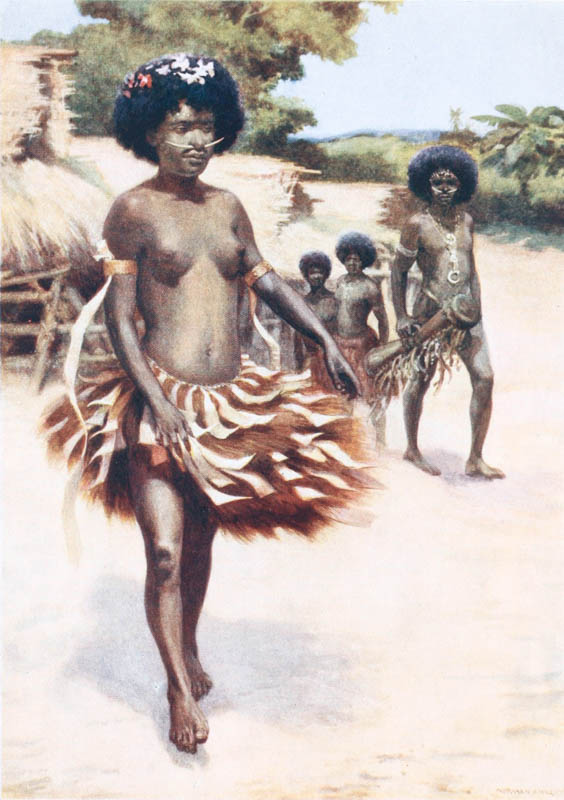
OFF TO THE DUBU DANCE, BRITISH NEW GUINEA
NOTE
There are various ways of spelling some of the place-names of the South Sea Islands, e.g. Samari, Tupusuli, and Elevera are so spelt in this book, but the forms Samarai, Tupuselei, and Ela-Vara are commonly met with. Ambryn, however, is a misprint for Ambrym.
CONTENTS PART I • BRITISH NEW GUINEA I • Chiefly historical—Concerning certain discoverers, their aims and ambitions—The story of New Guinea, the Solomons and New Hebrides, and some things that might be altered • 3 II • New Guinea natives—Port Moresby and its two native villages—Huts on poles and trees—Native superstition and its result on two tribes • 13 III • Natives who grow crops of hair—A word or two about the women—Duties of married women—How they carry their babes, and the philosophy of childhood • 25 IV • Concerning love and grief—How love is made in New Guinea, and some of the charms used to ensure love and constancy—The grief of a New Guinea widow • 37 V • Some native dances and queer costumes—Novel blackmailing methods—Woman’s vanity and a censured dance • 48 VI • Outrigger Canoes, their appearance and construction—The famous Lakatois—How the natives catch their fish; and a few words about fish that climb trees—A trip down the coast, and an unpleasant experience • 57 PART II • THE SOLOMON ISLANDS VII • South Sea traders good and bad; their ups and downs—Nicolas the Greek—The Mambare river massacre—Some queer creatures with queerer ways—“A fitting end to a wasted life” • 71 VIII • Natives who have had no chance; their villages without streets and their curious huts—The tambu and canoe houses—An unlucky trader • 84 IX • Solomon Islands—Ingova’s head-hunters—How whole tribes were wiped out—Savage invasions and clever tactics • 94 X • Clothes and the men—Love of adornment—Natives who are not keen on eating—Methods of cooking their food—Betel-nut chewing • 104 XI • Some clever ways of catching fish—How the bonito is landed—Native nets—Pig-hunting—The sly opossum and the crocodile • 113 XII • A curious religion—Burying the dead, and some graveyards—Dances and music—Native artists and how fire is made • 124 XIII • What “hope” is to the Solomon islander—The use of the evil eye • 134 PART III • THE NEW HEBRIDES XIV • Islands that are advancing rapidly—Native houses with modern improvements—A horrible method of getting rid of the old men, and other burial ceremonies • 143 XV • Ancestor worship the religion of the New Hebrides—Temples and strange figures, and some sacred dances • 153 XVI • Concerning witchcraft—More about burials—The gentle art of making love—The rain-makers • 163 XVII • Native clothing and ornaments—Their arts and industries, their canoes and weapons, and their way of fishing • 172 XVIII • The cultivation of copra—The labour traffic when slavery really existed, and the traffic in natives of to-day • 183 XIX • A short sketch of the missionary work in the South Seas—Concerning John Williams, James Chalmers, and others • 193 SKETCH MAP OF THE SOUTH SEA ISLANDS • 204 INDEX • 205
LIST OF ILLUSTRATIONS 1. Off to the Dubu Dance—British New Guinea • Frontispiece 2. By Reef and Palm • 6 3. Off to Market, British New Guinea • 14 4. Motu Village from the Sea • 18 5. The Island of Elevera from the Mission Station, Port Moresby, British New Guinea • 20 6. Tree House in British New Guinea • 22 7. Motu Village, Port Moresby, British New Guinea • 24 8. In the Pile Dwellings at Hanuabada, Port Moresby, British New Guinea • 26 9. Native of British New Guinea, showing the manner of wearing the hair • 30 10. A New Guinea Dandy • 32 11. Woman with Baby in bag. Fairfax Island, British New Guinea • 34 12. Dinner Time at Kwato, British New Guinea • 36 13. A Kaivakuku, Roro Tribe, Central Division, British New Guinea • 48 14. Harvest Dance, New Guinea • 50 15. Ready for the Dubu Dance • 52 16. The Dubu at Rigo, British New Guinea • 54 17. Tattooing, British New Guinea. • 56 18. Large Trading Canoes, British New Guinea • 58 19. Old Women making Pottery, British New Guinea • 60 20. Spearing Fish, British New Guinea • 62 21. Marine Village, Tupusuli, British New Guinea • 64 22. Natives of the New Hebrides having a drink • 66 23. Gold Miners leaving a trading ship, British New Guinea • 72 24. Johnnie Pratt with his Ivory Nuts at Simbo, Solomon Islands • 74 25. Solomon Island Boy climbing after green cocoa-nuts, near Gavutu, New Florida • 80 26. Solomon Island Village, near Marau Sound, New Florida • 84 27. Early Morning, Gavutu, Solomon Islands • 86 28. Old Ingova’s War Canoe House, Rubiana Lagoon, New Georgia, Solomon Islands • 90 29. On the Fringe of a primæval Forest, Solomon Islands • 92 30. Portrait of a Solomon Island Cannibal • 94 31. Sacred Skull Shrines, British Solomon Islands • 96 32. Ingova’s Head-hunters, British Solomon Islands • 98 33. A Canoe showing the “Totoishu,” New Georgia, Solomon Islands • 100 34. A Lagoon in New Florida, Solomon Islands • 102 35. Native of New Georgia wearing Sunshade; a sort of crownless hat made of grasses: it can be worn at any angle • 104 36. A Rubiana Native, Solomon Islands • 106 37. A Stormy Day in Rubiana Lagoon, Solomon Islands • 108 38. Cooking the Meal, British New Guinea • 110 39. The Reef near Simbo, Solomon Islands • 114 40. Native Archer shooting Fish, British Solomon Islands • 116 41. Searching for small Octopi on the Reef at low tide, Samari, British New Guinea • 118 42. The Home of the Crocodile, British Solomon Islands • 122 43. A Shrine or Tomb of a Chief at Simbo, Solomon Islands • 126 44. Solomon Islander playing the “Ivivu” or Flute • 130 45. A Tapu Virgin, British Solomon Islands • 136 46. Beneath a Banyan Tree, Malekula Island, New Hebrides • 142 47. The Rapids, Williams River, Island of Eromanga, New Hebrides • 144 48. Mount Marion, the active Volcano, Island of Ambryn, New Hebrides • 146 49. A Village in Santo, New Hebrides • 148 50. Chief’s House, Ambryn, New Hebrides • 150 51. The “M’aki” Ground and the Jaws of the sacred Pigs, New Hebrides • 154 52. A Memorial Effigy, Malekula, New Hebrides • 156 53. Drum Grove at Mele, New Hebrides • 158 54. Leaving Santo, a View of the Mountains, New Hebrides • 162 55. A Sacred Man, Aoba, New Hebrides • 164 56. The Stone “Demits,” or the Souls, with their attendant wooden figures, Malekula Island, New Hebrides • 168 57. Old Cannibal Chief whom the Artist met on the Island of Aoba, New Hebrides • 172 58. Type of Man from the Island of Tanna, New Hebrides • 174 59. Finishing off a Canoe, British New Guinea • 176 60. Old War Canoes, near Malekula, New Hebrides • 178 61. Havannah Harbour, Rathmoy, New Hebrides • 180 62. Passing the Reef, Aoba, New Hebrides • 182 63. The Island of Samari, British New Guinea • 184 64. A Trader receiving Cocoa-nuts, Aoba, New Hebrides • 186 65. Copra Boys off to the Shore, New Hebrides • 188 66. The “Blackbirders” in the Solomon Islands • 190 67. A Yam Shed on the Island of Tierra Espiritu Santo, New Hebrides • 192 68. The Artist’s Guide on Malekula, New Hebrides • 196