THE SANDMAN'S HOUR (continued 2)
Reading edition
The king was ready to do anything, and so the strange-looking man began his work, but before he would do anything for the king he insisted upon having half the kingdom given into his hands, and when this was done he set to work. No one was allowed to be near him, and the king was left alone in the castle with him.
One morning, not long after, the king saw what looked to be a sea of green all around the castle, but it really was a bed of green leaves, and soon there appeared white flowers among the leaves, and then the strange man told the king to walk among them.
Soon the king felt a drowsy feeling stealing over him, and he sat down in the midst of the sea of green and in a few minutes he was sound asleep.
Then the strange man began to repeat something in a sing-song tone and wave his hands over the sleeping king. He walked among the leaves and flowers, repeating his queer rhyme, and the leaves and flowers grew taller and taller until the king could not be seen, and the man moved away, still chanting:
"Poppy, poppy, flower of sleep,
Your drowsy spell around him keep,
For I can all his kingdom take
If you do not let him wake."
The poppies grew until they reached the top of the castle, and every one who went near to look for the king fell under the spell of their strange power until the people around gave it up and the strange man became king; he built a new castle and the old one was forgotten.
All went well with the new king until a young man called at his castle and asked him about the old king, and the servants told him how the strange flowers had grown around the castle and no one could go near, and that every one thought that the old king was dead.
The new king, when he heard that the stranger was asking for the old king, had him driven from the castle.
"Tell your master," said the stranger to the servants, "that he will hear from me again."
The stranger went into the woods, where there lived an old witch, and at midnight they came out and went to the castle among the strange flowers.
The witch held her hands high over her head and waved them up and down, saying all the time:
"Poppy, poppy, sleepy flower,
Now I have you in my power.
I would have you shorter grow
Until the sleeping one you show."
Down came the tall flowers and bushes until the young man cried out, "Here he is," and then the flowers ceased to grow small. The witch knelt beside the sleeping king and whispered in his ear:
"Awake, good king, 'tis break of day,
And drive the false king far away."
The king opened his eyes and looked at the witch and the young man beside her. "What has happened?" he asked.
"I will leave you to tell him," said the witch. "The sun is up and I must go."
"When you offered to give half your kingdom to the one who could make you sleep," said the young man, "I set out for your castle with a box which contained a strange flower that had the power to make people sleep, but it had to be used with the greatest care, and I alone knew the secret of using it, for it was given to my grandmother by an old witch doctor.
"Before I could reach you I was overtaken by a band of robbers and the box stolen. They made me tell what I intended doing with the flower, on pain of death, but I did not tell the whole secret. Then they put me in a cave and rolled a stone in front of it too heavy for me to move, and left. I was almost dead from starvation when I was found by some peasants, who nursed me until I was well enough to travel, when I hurried here, only to find that one of the band of robbers had taken your whole kingdom after putting you to sleep with the charmed flower.
"He drove me from the castle when he heard that I was asking for you, and if it had not been for the witch who lives in the wood I should not have been able to awaken you. She knew the secret, as she is the daughter of the witch who gave the flower to my grandmother."
When the king heard the strange story he hurried with the young man to the castle where the robber king lived. He was asleep when they arrived, and the servants, who did not like their new master, ran out to meet the old king, and when they heard what had happened they went back to the castle and bound the robber while he slept, and when he awoke he was so frightened that he promised to tell where the rest of his band could be found if they would spare his life.
This they promised to do, and the country was rid of these bad men, for they were put on a ship and made to work the rest of their lives.
The king was so grateful to the young man who rescued him that he made him his heir, and when the king died he left him his kingdom.
headpiece to Little China Doll
LITTLE CHINA DOLL
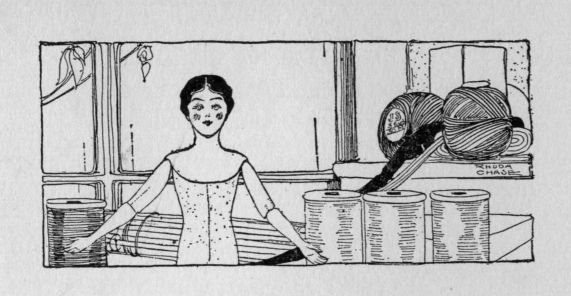
In a shop window sat a little China Doll. She had been in the store so long she could not remember ever living in any other place.
Long, long ago there were other china dolls, but one by one some little girl had carried them away and she was left alone. China Doll had black painted hair and big, staring eyes, and her lips and cheeks were very red. Her body was filled with sawdust and her hands and arms to the elbow were china, as were her feet and legs to her knees.
By and by wax dolls came to the store; they had real hair, all curls, and eyes that would open and close, and poor China Doll was set back in the window, and after a while she was put in a box on the shelf and taken out only once a year--at Christmas-time--when she was dusted and put in the window again. She felt very lonely with so many stylish wax dolls, and as she had given up hope of ever being chosen by any little girl, she was glad when the little old lady who kept the store put her back in the box on the shelf.
At last there came a time when the children no longer came to the store, but went to the big city for their toys, and China Doll and the little old store-keeper grew old together.
China Doll sat in the window all the time now, with tape and thread and other useful things, but was the only thing little folk could want.
One day in summer a tally-ho stopped in front of the store, and a party of young people came in. They bought a number of things and filled the old store with their laughter. Suddenly the prettiest girl reached into the window and took out China Doll. "Oh, you dear, quaint little doll!" she said. "My grandmother has one just like this, girls, and I have asked her many times to give it to me to make a French pincushion, but she will not let me have it."
Oh, how China Doll's heart beat! Could it be true that she was going at last? Yes, the pretty girl bought her and took her away on the tally-ho.
The next day she dressed China Doll in the prettiest silk dress, such a one as she had dreamed of years ago, with an overskirt and purled sleeves. Then she made her the dearest poke-bonnet trimmed with little roses. She also made her a pair of kid boots.
When China Doll was all dressed the pretty girl put a ribbon over her arm, and on each end was a little bandbox. Then she stood China Doll on her dressing-table and used the little boxes for pincushions. And there China Doll lived a very happy life, which teaches that all things come to those who wait.
headpiece to The Disorderly Girl
THE DISORDERLY GIRL
Louise was just going out of the door with her sled when her mother called to her. Louise hesitated, for she knew that her mother was calling her to make her play-room tidy and she wanted to go coasting with the other children.
She went back slowly and asked, "What is it, mother?"
"Your play-room must be put in order before you can go out to play," her mother replied. "You have had plenty of time this week to do it, but you have neglected it, and now you cannot put it off another day."
"Why can't Jane do it?" asked Louise.
"Jane will clean the room," her mother replied, "but it is your duty to pick up the books and toys that are strewn around."
Louise pouted, but she knew that she must do as her mother said, and she took off her hat and coat and went up to her play-room. She went in and closed the door. It certainly was a very disorderly-looking room. Books were on the floor and games were on the table, doll clothes were strewn in all parts of the room.
Louise had picked up most of the things when she saw from the window her little friend Clara passing the house. "Clara!" she called, "wait for me, I have to put my play-room in order before I can go coasting." But Clara would not wait.
Louise closed the window, threw herself on the couch, and began to cry, saying she thought it was mean everybody was going coasting but her.
All at once she saw two little girls walking toward her. They looked just like her dolls--Bella and Emily--only they were as large as herself.
Louise tried to get up, but she was unable to move.
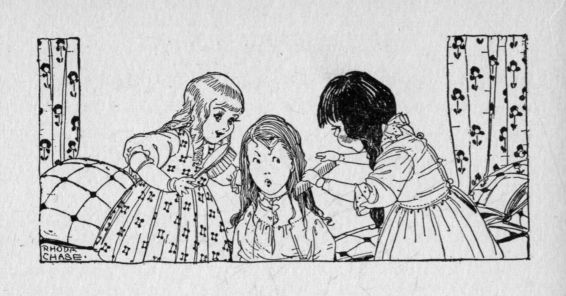
"Let us undress her," said Bella Doll, coming over to Louise and lifting her by one arm.
"Yes," said Emily Doll, "and comb her hair."
Then Louise knew what had happened--she had turned into a doll and the dolls had become little girls.
The doll girls undressed Louise and put on her nightdress, pulling it over her head in the most careless manner, Louise thought. Then they combed her hair, pulling it terribly.
"I wonder how she likes to have her hair pulled," said Bella Doll.
"She knows how it feels, now," said Emily.
"I think she better go out," said Bella Doll, "instead of going to bed," and they dressed her in a thin white dress. "Now we will take her out in the cold; that is the way she does with us."
They fastened her clothes with pins and pushed them right through her body, and after she was dressed they changed their minds about taking her out and threw her on the floor and began playing games.
"I wonder if they are going to leave me here," thought Louise. "Some one will be sure to step on me." Just then she saw a Teddy Bear lying on his side under the couch. "Why are you under there?" Louise asked.
"The little girl who was playing with me dropped me back of the couch a week ago," he said, "and I have been here ever since, and you will probably remain on the floor where you are now, for she never picks up her toys. She is a very careless girl."
Louise did not reply, for just then Emily Doll came over to the couch for a book and pushed Louise out of the way with her foot. Bella Doll set out a croquet set and one of the balls hit Louise on the head. Then Emily dropped her book and said: "Come along, Bella, let us go outdoors."
Louise watched them as they went out. "Oh, this is the way she always leaves her room," said Teddy Bear, for he could not see from under the couch there were two little girls, and thought it was Louise who went out of the door. "She never thinks of us," the Teddy Bear continued, "or how uncomfortable we may be, for she is a very careless and untidy girl."
The door opened and Bella Doll came in. She went over to the couch for her hat and Louise saw her foot over her head. "She will break me if she steps on me," cried poor Louise, and she jumped up as she cried aloud. There she was on the couch. She had been asleep. She got up and finished her work, when suddenly she thought of the Teddy Bear, and looked under the couch. There he was on his side just as she had seen him in her dream. Louise picked him up and set him in a chair; then she looked at Bella's clothes to make sure there were no pins pricking her, and after looking at Emily also she put both of them in a comfortable place. Her books were put on a shelf, and she resolved never again to let her room get so untidy or to let her dolls or Teddy Bear suffer from neglect. "Perhaps they do feel things," she said. "Anyway, I'll be sure not to hurt them or let them be in uncomfortable positions, for I was very miserable lying on the floor thinking I might be stepped upon."
headpiece to The Wise Old Gander
THE WISE OLD GANDER
Once there lived a farmer who was not a good caretaker. He did not have a house for the hens and chickens and geese and ducks, and Old Fox, who lived in a hole over the hill, never had any trouble in getting a nice goose or a fat hen for his supper or breakfast.
"Something must be done at once," said Madam Goose. "There will be no one left in the whole yard if this keeps on. Why, only last night Madam Gray Hen was carried off and she has left all those little chicks; it is really too awful to think of."
"But what can we do?" asked Gray Goose. "The rooster does not know, for I heard one of his family ask him, and he only said the master should take better care of us."
"So he should," replied Madam Goose, "but he doesn't, so we must care for ourselves unless we wish to be carried off, too. Let us go to the gander; he may be able to help us."
"Come with us," they called to the rooster and black hen who were talking together; "we are going to see the gander and ask him to help us to be rid of Old Fox over the hill."
The gander stretched out his neck and blinked his eyes as he listened to their tale of woe.
"You are right, something must be done," he said; "and you are quite right in coming to me also. I will think over the matter and give you my advice later."
"Later!" screamed Madam Goose. "Later there will be no need for advice; there will be no one to give it or to advise. What we need is advice at once, and something that will rid us of Old Fox under the hill. He is eating the whole yard, one by one."
"Well, well," answered the gander, standing on one foot and then on the other. "I will think over the matter for a short time and then tell you my decision. You know, my dear madam, that great minds must have quiet to think out important matters. Leave me, I beg of you all, for a little while."
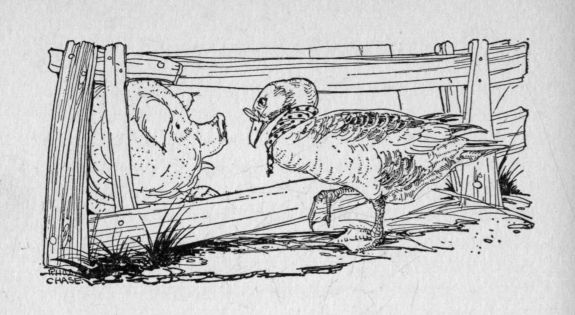
As soon as the gander was alone he waddled over to the pig-pen. "Mr. Pig," he said, "I am going to ask your advice. Old Fox over the hill is carrying off all the fowls and something must be done."
"Ugh, ugh," grunted the pig. "I can tell you what will frighten him away. I will stay awake to-night and grunt at him; he will know better than to linger where I am."
"Thank you, thank you, Mr. Pig," said the gander, backing away from the pig-pen. "I will tell my friends, and I am sure they will feel safe to-night."
"Conceited fellow," said the gander. "I guess it will take more than his grunts to scare that foxy fellow."
Then he went to the donkey. "He isn't very wise," thought the gander, "but sometimes those who have the least wisdom speak wisdom without knowing it.
"Mr. Donkey, I have come to ask your advice. Old Fox is carrying off our hens and geese. Something must be done to stop him, or soon there will be none left."
"Quite so; quite so. I see; I see, Mr. Gander," said the donkey. "You have come to the right place for advice. Now go back to your friends and tell them to have no fear; I will take the matter in hand."
"But what are you going to do?" asked the gander.
"Why, my dear sir, I am going to bray at Old Fox when he comes. I am going to bray at him, and you will see he will not stay long when he hears my commanding voice."
"Oh, how can I ever thank you?" said the gander, walking away. "I will tell my friends at once that you will take care of them to-night."
"Foolish old donkey," said the gander to himself. "I guess Old Fox has heard a donkey bray before this. I'll try the cow next.
"Madam Cow, Old Fox is carrying off all the fowls, one by one, and if something is not done at once to stop him, there will be none of us left. What would you advise?"
"Oh, don't ask me, Mr. Gander," said the cow. "All I can do is to moo, and Old Fox would no more mind that than the wind blowing. I wish I were wise enough to advise you, but I am not. But if I can help you in any way let me know."
"Thank you, Madam Cow," said the gander, waddling away. "You may hear from me. We never can tell when we shall need the help of our friends."
The next one the gander visited was the cat.
"Can you help me, Madam Puss?" began the gander. "We fowls are all in trouble; Old Fox carries off one or more of our number every night, and something must be done to stop it at once."
The cat opened her mouth very wide and yawned, and the gander wondered if he had been wise, after all, in asking her for advice in this matter.
But Puss closed her mouth with a snap and sat up.
"Of course I can help you," she said. "Did you ever see my claws?"
The gander backed away as Puss held them up to his view.
The gander confessed that he had not and Puss went on: "Well, leave it to me to protect the barnyard; that dog Rover never seems to think about anything but eating and sleeping. I will yowl and spit at Old Fox when he comes to-night, and I can tell you and your friends he will not come again."
"Thank you, thank you, Madam Puss," said the gander, running away.
"My, but that was a narrow escape for me!" said the gander. "She positively looks awful when she opens her mouth. I seem to be getting advice, but not the kind that will save my friends; they all feel sure they can scare Old Fox, but not one of them will be able to; I don't know that all of them together would--"
The gander stopped still and held up his head. "I have it," he said, "I have the very plan; I will get them all together and each shall do his part. I believe we can scare Old Fox away for good and all time."
The gander went to the dog and he promised to bark. "Of course, there is no need of having the others around if I do that," said the dog. "But bring them along if you like; every little helps."
That night the donkey, the dog, the cat, the cow, and the pig were gathered in the barnyard; each one protested that the others were not needed, all but the cow; she was modest, and said she would help. Then the rooster came and offered to crow and the geese were to quack.
"Now you all must hide," said the gander, "and don't move until Old Fox gets right in the middle of the yard; then jump up and do your worst."
Old Fox waited until it was very late, and then crept over the hill and up to the farm. He listened, and, hearing no sound, he crept into the barnyard. He was just about to reach a fat goose when all the animals began. The dog barked, the pig squealed, the donkey brayed, the cow mooed, the geese quacked, the rooster crowed, and Puss, true to her word, yowled and sprang at Old Fox, who was so frightened at the terrible noise he forgot to run until Puss struck at him with her sharp claws; then he took to his swiftest speed, and away he went over the hill and far away, and was never again seen near that farm.
He told some of his friends that a most horrible animal lived there and must have eaten all the hens and geese and was big enough to eat them, for he saw at least twenty feet and claws and heads of all sizes.
headpiece to Dinah Cat and the Witch
DINAH CAT AND THE WITCH
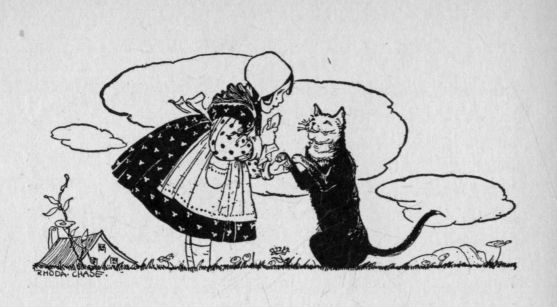
Once upon a time there was a little girl named Betty. She was an orphan, and a bad landlord turned her out of her home. The only friend she had was a black cat named Dinah. Betty was crying as she walked along the road, and Dinah Cat ran beside her, rubbing against her feet. All at once she ran in front of Betty and stood on her hind legs. "Do not cry, mistress," she said. "I'll take care of you."
Betty was so surprised to hear Dinah Cat speak that she stopped crying at once. "You poor Dinah Cat," she said, "what can you do? We must go to the city, and if I can find work we shall be able to live; if not, you must take care of yourself, for you can catch mice and keep from starving."
"You come with me, mistress," answered Dinah Cat, "and you will not need to work and you will not starve." And she put out her paw for Betty to take and walked alongside her. When they came to a path leading into the wood Dinah Cat led Betty along this path until they were in front of two very large trees which had grown together, but there was a big opening in the trunk. "We'll go in here," said Dinah Cat, and as they stepped through they were in a hall. She led Betty up the stairs to a room where there was a snowy-white bed and pretty furnishings. "Dinner will be served as soon as you are dressed, mistress," said Dinah Cat.
After she had gone Betty looked around, and in the closets she found pretty dresses which just fitted her. She put on one of them, and in a few minutes she was ready for dinner. Just then she heard a soft, scratching noise at the door, and when she opened it Dinah Cat walked in.
"How do you like your new home, mistress?" she asked.
"Very much," Betty answered. "But we cannot live in such a nice house. We have no money, and, besides that, this house must belong to some one. And this dress I have on must belong to some little girl. I should not wear it."
"The dress did belong to a little girl," said Dinah Cat, "but she cannot wear it now, and she wants you to have it. And do not fret about the house. It belongs to me. I cannot tell you any more just now, but you need not worry any more about anything, for you are to live here, if you wish, after you have dinner, for then you will meet a boy, and you may not like him."
Dinah Cat led Betty into a room where the table was set for three persons, and when they were seated a boy about Betty's age came in and sat with them. He wore his hat, and a thick veil hung from it.
"I am sorry I cannot remove my hat," he said, in a very sweet voice, "and I will go away if you'd rather I would."
"Oh no," said Betty, feeling very much like an intruder. "I am very grateful to you for letting me stay, and I will help to do the work."
"You do not need to work," said the boy. "If you will stay we will be very glad."
Betty did not once get a glimpse of his face, he lifted the veil so carefully. And there sat Dinah Cat, using her knife and fork like any lady. Betty smiled to herself when she thought of her eating from a saucer.
Suddenly Dinah Cat slid out of her chair and crawled under it, and the little boy trembled so that his chair shook. Betty looked around to find the cause of their strange behavior, and saw standing in the doorway an old woman with a staff in her hand. She hobbled over to where Dinah Cat sat and raised the staff. Betty thought she was going to strike her.
"Don't you hurt Dinah Cat!" she cried, running toward the old witch, who was so startled that she dropped the staff, and Betty picked it up.
"Don't let her have it again," said the boy; "that is the cause of all our trouble."
Betty threw the staff in a closet and locked the door. All this time the witch was stepping backward toward the door by which she entered, and she grew smaller with each step. By the time she was out of the house she looked like a black speck, and a breeze blowing just then carried her out of sight. "But how shall we ever be ourselves again?" said the boy. "She has gone, and here we are, in this state."
"Perhaps the stick will do it," said Dinah Cat.
Betty wondered what they meant, and the boy told her that Dinah Cat was his sister before the witch changed her into a cat, and made his face so hideous that he had to wear a veil, and they had lived very happily together. "But one day the old witch came and wanted to live with us, and we let her for a while, but she was so cross and made us so unhappy we told her she must go away. Then she brought all this change upon us, and every once in a while she returns and frightens us, for we do not know what she will change us into next."
"Let me get the stick," said Betty. "Perhaps we can change Dinah Cat to your sister again."
Betty opened the door of the closet, and instead of the stick there was a bright streak of light, and walking on it was a little Fairy who held a wand in her hand.
"You will soon be happy again," she told them. "I have destroyed the stick and the old witch will never return."
Then she walked over to Dinah Cat and touched her with her wand and there stood a little girl about Betty's age in place of the black cat.
"Now close your eyes," said the Fairy, "for I want the boy to remove his veil, and his face is not pleasant to look upon."
Betty did as the Fairy told her, but I am sorry to tell you that she peeked a very little. Betty closed her eyes tight after the first glimpse and waited for the Fairy to tell her to open them again, and when she did there stood the boy with a very smiling face. His sister ran to him and put her arms around him. "Now we shall be happy," she said, "and Betty will live with us. How can we thank you?" she asked the Fairy.
"Oh, I shall be repaid by seeing you all happy," the Fairy replied. "And now I must go."
"Will we see you again?" asked Betty.
"No," answered the Fairy. "I only appear when people are in trouble, and you will never need me again."
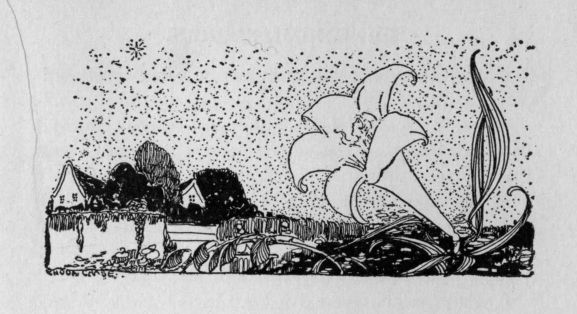
headpiece to The Star and the Lily
THE STAR AND THE LILY
Once there bloomed in a garden a beautiful white lily, on a long stalk so tall that she towered over all the flowers that bloomed near her.
Of course, the sunflowers at the back of the garden were much taller and the hollyhocks that grew in front of the sunflowers were taller, too, and also the sweet peas. But they were not near the beautiful lily. Beside her bloomed pansies and poppies, and many other beautiful flowers, but they were not so tall as the lily.
A rose-bush growing near the lily noticed that she drooped and did not look as happy as usual one morning, and she asked what had happened.
"Oh, I am thinking of some one I love," answered the lily, with a sigh.
"That should not bring a sigh or make you look sad, my fair friend," said the rose. "Love should make you happier than anything else in the world."
"Yes, I suppose it should," answered the lily, "but my love is so far away I am not sure that I am loved in return."
"Oh, immodest lily!" said the rose. "I thought you the most modest of all of us, and here you are in love with some one you do not know. Tell me about it, do?" said the rose, alert with interest.
"I will tell you, dear rose," said the lily, "and perhaps you can tell me how to win the love of my beloved, or how I can overcome my great love for him."
"I will do anything I can for you, my dear," said the rose, "but do tell me quick all about your love-story."
"One night," began the lily, "when everything was quiet in the garden and all the other flowers were fast asleep, I happened to raise my head and open my petals. The moonlight was streaming over the garden, and I looked around at all the sleeping flowers and wondered how I happened to awake at that hour, when, looking up to see the moon in all her splendor, I beheld a beautiful star looking down at me.
"At first I thought it was looking at the whole garden, but then I knew all the others were asleep and I must be the one it was smiling at, for it twinkled and brightened as I gazed at it.
"I lowered my head and slyly looked again, and still the star was looking, and every time it saw me raise my head it would twinkle a smile at me. The next night I wanted to make sure it was I that the star really smiled at, and when it was bedtime I only bowed my head and did not sleep.
"Then when the garden was still and I was sure you all slept I again raised my head and saw my star smiling straight down at me.
"This time I was sure I was the only one that the star could be smiling at, and I raised my head and opened my petals and let all the perfume of my heart go up to him, and I did not feel that I was bold, for we were all alone and he smiled down upon me, his love for two nights.
"But now I am sorrowful, for it is day and I cannot see my beloved. He seems only to show his love for me at night. What shall I do, dear rose? I am not strong enough to stay awake all day and all night too. Soon I will die if I do, and yet I cannot live if I do not see my star each night. That is why I sigh and look so sad, for I might sleep all night some time and my star will think I do not love him."
The rose shook her head. "I cannot advise you, my friend," she said; "you are in love with some one far above you, and are not even sure you are loved in return. Be wise and sleep through the night as the rest of us do, and give up this uncertain lover."
But the lily only drooped her head and sighed, and that night looked for her lover again, but the sky was dark and no bright smile greeted the poor lily. All night she gazed into the dark sky, and when the first light of day came she was still looking for her lover.
The rose looked at her when the sun came upon them that morning, but the lily did not raise her head; she was too full of sorrow to lift her face to the sun, and by and by the rose saw that she was drooping lower and lower, so she spoke to her.
"Lily," she said, leaning closer to her, "raise your head and let the sun cheer you. You will die if you do not open your petals and get the light and air."
But the poor lily was past caring for sun or air; her petals were limp and her stalk withered.
The rose leaned closer to her as she faintly answered, and this is what she heard:
"Good-by, my friend; I shall bloom no more. My bright star hid his face from me last night and I have no desire to live longer. Perhaps I may see him after I am gone from here, and if that is true I shall be happy, but I cannot live here and not see his face.'"
The wind blew through the garden just then and took the lily from her stem, scattering her petals far out of the garden.
"Poor lily!" murmured the rose, "she went the way we all will go, but her heart was broken and she died before her time. If she had only looked for love here in the garden instead of looking so far above her she might be blooming now, poor lily."
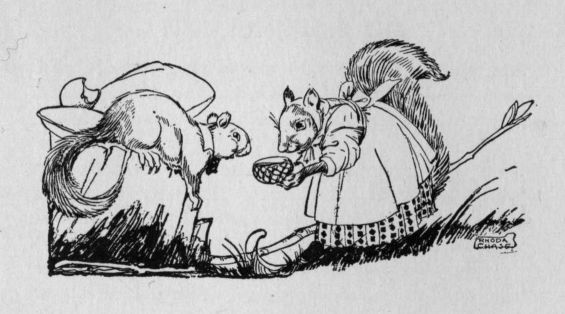
headpiece to Lazy Gray
LAZY GRAY
All the other squirrels called him Lazy Gray, which was really not a very nice name for a squirrel to have, but it fitted this squirrel, and I am going to tell you how he came to be called by such an unpleasant name.
When Lazy Gray was born there were three little squirrels in his family, but he was the youngest and his mother thought he was the prettiest, and all the rest of the family used to wait on him a great deal, and his mother did not ask him to do errands or to climb trees or any other of the hard tasks that most squirrels have to do. And Lazy Gray took advantage of the kindness of his mother and his brothers and sister, and used to ask them to wait on him. When he was thirsty and wanted a drink of water he would call to his mother and say, "I am thirsty"; and she would take a nutshell and go down to the brook and fill it with nice cool water and bring it to him for him to drink. And sometimes he wouldn't even say "Thank you" when he had finished.
And he used to make his brothers go on long journeys through the woods to get a particular kind of nut of which he was very fond; and if they happened to bring him one that was not good he would find fault with them and tell them that they did not know good nuts from bad ones.
All through the summer he fooled away his time sleeping and lying in the sun and never a single nut did he gather for himself. But when fall came and his two brothers were taken ill, his mother said that he would have to help her gather nuts because she could not gather enough to last the whole family through all the long winter. Lazy thought it was very hard that he should be called upon to work for his brothers even if they were sick, and he complained very bitterly about how hard it was for him to climb trees all day and store nuts. Whenever he could he stole away and lay down behind a rock and kept hidden until his mother came and found him. And then she would tell how, when it got cold and there was snow all over the ground and he was hungry, he would wish that he had been a good squirrel and had gathered the nuts while he could.
But he did not believe her and said, "Oh, I have gathered all the nuts I shall want and am not going to work any more," and then he would go to sleep again.
Weeks passed by, and it grew colder and colder and the snow came, and all the squirrels began to draw on their stores of nuts. Lazy found that he got pretty hungry sometimes and that the habit of eating and drinking all he wanted in the summer made him want to eat and drink all he wanted in the winter. And as he had never taught himself self-denial, he ate all he wanted, and very early in the winter he began to see that the nuts he had gathered would not last him half-way through the winter, and almost before he knew it his whole store was exhausted and he had nothing to eat.
Then he asked his mother to let him have some of the nuts that she had gathered, and being a kind mother, she let him have just as many as she could, but she still had to keep some for his sick brothers. When she would not give him all he thought he ought to have he decided that he would go over to a neighboring tree and ask a squirrel over there for some of his nuts, and for weeks he went from one tree to another begging nuts, until every squirrel in the woods hated to see him coming, for they knew he was going to beg food that he should have gathered for himself.
At last he became so much of a nuisance that all the squirrels in the wood held a meeting and decided that each one of them would give two nuts to "Lazy," as they now all called him, and that he would have to live for the rest of the winter on the store they contributed or else starve.
When Lazy saw what a small store of nuts he would have to live upon until spring he was frightened, for he had eaten almost as many nuts as there were there in a week.
But he knew he had to make them last, so he ate very sparingly, and his sides began to be less plump and his cheeks less full, and by springtime he was a pretty sorry-looking squirrel, with his ribs showing plainly through his sides and his bushy tail looking bigger than the whole of the rest of him.
But it taught him a good lesson, and early in the next summer, just as soon as there were any nuts to be had, he began to store them away, and when winter came again he had a big hole in the tree filled full and his mother was much pleased.
"You see," she told him, "how wicked it is not to provide for the future and store up things that are necessary against the time when you will need them."
And Lazy agreed with her and told her that never again so long as he lived would he merit the name of "Lazy."
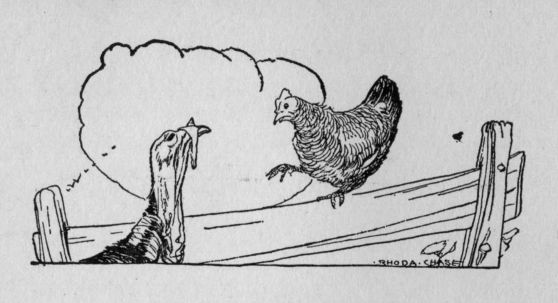
headpiece to The Old Gray Hen
THE OLD GRAY HEN
"Oh, dear!" said the Old Gray Hen, "what a life this is! Up in the morning at the break of day in answer to the summons of that crowing rooster; scratch all the forenoon for worms; sit on a nest and leave a beautiful egg there, and in half an hour along comes somebody and takes the egg and I never see it again. Then every spring I am put on a lot of eggs that I never saw before and am supposed to sit there until a brood of chickens are hatched out, and then for weeks I have to scratch for them as well as for myself. I don't see anything in this sort of life, and I propose to change it until it is more to my liking and more as the life of such a fine hen as I am ought to be."
Old Daddy Gander happened along just as the Gray Hen finished talking to herself. "What's the trouble this morning?" he asked. "Why all this sputtering and spluttering? One would think that the whole barnyard had turned upside down and the corn had all fallen off into the sky."
"There's matter enough," said Gray Hen. "What have we fowls to live for? I scratch and you waddle and you waddle and I scratch, and what does it all amount to? Something has got to be done, and, if no one else will do it, why, I shall. Things are going to be different with me."
"I guess I'll keep on as I am," said old Daddy Gander as he waddled away. "I might make them worse than they are, and they are not so bad, anyway."
"Good morning, Gray Hen," said Madam Duck. "What a fine day we are going to have! The water will be nice and warm for my ducklings, and I can give them a good swim in the pond."
"It is neither a good morning nor is it going to be a fine day, and as for swimming in the pond, if I had to mother a lot of children with as homely feet as your brood has I would want to keep them in the water all the time so that no one would see them."
"What a mean disposition Gray Hen has!" said Madam Duck to the turkey gobbler as she went on her way to the pond. "I tried to be agreeable to her and she insulted me and spoke so unkindly of my children that I felt quite like crying."
"I almost wish that she had been a little more unkind," said the gobbler, "for I have never seen a duck crying and I imagine it might be an almost sight. Perhaps Gray Hen needs some of my good advice, and I will walk over shortly and see her."
But the old gobbler was saved his trouble, for in a few minutes he saw Gray Hen coming down the path toward him. As she came up to him he said: "What a miserable feeling morning this, Mrs. Hen; my feathers will none of them lie straight, and every worm that I have tasted for breakfast has been bitter."
"You are quite right," said Gray Hen. "It is just like all the mornings recently, uncomfortable and disagreeable, and there does not seem to be any promise of anything better."
"You are quite right," said the gobbler. "What the gander and the duck see in the present to be so satisfied with I don't understand, and as to the future, I don't know why we should expect any more of that than the past."
"I have always felt," said Gray Hen, "that you, Mr. Gobbler, never got half your deserts in this barnyard. Everybody seems to think that the rooster, because he crows every morning at sunup, is the wisest bird in the yard, but as for me, I have always held you in greater esteem and have often spoken of the nobility of your looks and the regal way in which you walk about the place. If I had any voice in the matter I should suggest that you be recognized as superior to the rooster. But, you see, the hens have nothing to say, although some day I feel sure that it will be different."
"You are very kind," said the gobbler, "and I feel as you do, while I have no wish to be ruler of the yard, that the hens should have more to say. You should at least have independence and do as you like."
"Oh, I have determined on that already," said Gray Hen, and she told him how she had decided to lay no more eggs and to scratch as little as she had to.
"Well," said the gobbler, "I must be off and see that none of those turkey hens get so far into the wood that they cannot find their way back again. I certainly gave the kind of advice she wanted," he said, when he had got out of her hearing, "and that was easier than getting into an argument. And, besides that, discontented people and animals are always so much more comfortable if they think others are just as unhappy as they are."
Old Gray Hen, however, was as good as her word. She stopped laying eggs and the amount of gravel that she scratched was scarcely worth mentioning. She stole worms from the younger chickens, who were too polite to punish a hen so old as she was, and, altogether, she became a general nuisance to all the rest of the barnyard flock.
They could not protect themselves, but Farmer Johnson, walking through the yard one day, noticed that the Old Gray Hen's toes had grown to a most unusual length. "I guess she doesn't do much scratching," he said as he passed along, "and I suspect she doesn't lay many eggs. I must ask mother about it when I get back to the house."
"No," said Mother Johnson, when he asked her, "I haven't found an egg in Gray Hen's nest for a month or more."
"She won't pay to winter, then," said Farmer Johnson. "We had better eat her." And the following Sunday, when Farmer Johnson sat down for dinner, they brought a big platter of steaming fricassee to the table and that was the end of Old Gray Hen.
A day or two after, when the gobbler happened to meet Madam Duck, she said: "I hear that Gray Hen has left us."
"Yes," said the gobbler, "and I hope she is happier than she was here, but her contentment was greatest when others were distressed."
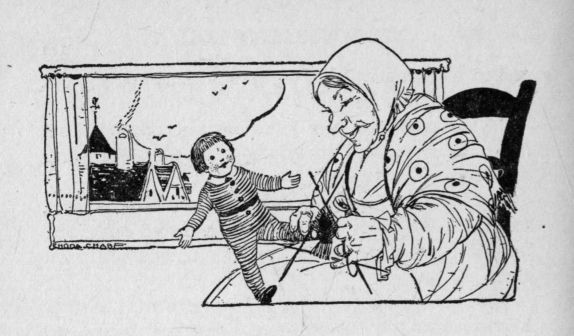
headpiece to The Worsted Doll
THE WORSTED DOLL
Good Mother Munster and her husband Jacob had five daughters. Of course they loved them dearly, but they often wished for a son.
"Then he could help me in the shop," said Jacob, who was a maker of dolls. "Not that I would exchange one of our girls for a boy," he added, "but I wish we had a son as well as the five girls."
Whether the stork heard this talk between Jacob and his wife and took offense because they questioned his judgment, or whether he thought Jacob and his wife had their number of children, I do not know; but he never called again at their door and their daughters grew up to womanhood without a brother.
One day Jacob hurried in from his shop, which was back of his house. He was very much excited, and talked so fast that good Mother Munster could not understand half he said.
"They want worsted dolls," he explained at last, "two dozen worsted dolls to be sent across the water in time for Christmas."
Jacob raised his hands with a gesture of despair, for at his shop they did not make worsted dolls, and he could not understand why any one should want them.
"There is plenty of time to make them," Mother Munster said. "The girls and I can knit them, and we will make half of them girls and half of them boy dolls." And so the knitted dolls were begun by good Mother Munster and her daughters.
One day when Mother Munster was knitting on the last doll, which was a boy, she began to think how much she would miss them when they were finished and sent across the sea.
"I will make you extra large," she said as she added a few stitches to the length and breadth of the doll, "and if I could I would knit you a tongue so you could talk and legs that you could run on, and have you like a live boy."
Mother Munster knitted as she thought, and though she did not know it, she knitted all her wishes into the boy doll's body, so that when he was finished he could do all the things she had wished.
But he was a wise little fellow, and did not betray himself for fear he would not be shipped across the water with the other dolls, and he wanted to see the world.
It was a long journey to the other side of the ocean, and the boy doll thought it never would end. But by and by he was taken from the big packing-case and with other dolls placed in a window of a big shop.
"I wish some one would speak to me," thought the boy doll, but not a word did the other dolls utter, and as he did not wish to appear forward he kept silent also.
One day a lady came into the store and carried Boy Doll away with her, and then one night he was put on a tree trimmed with glittering ropes of tinsel.
A little girl came into the room after a while, and when she saw Boy Doll she exclaimed, "Oh, I hope the boy doll is for me!"
"So do I," thought Boy Doll, "for I am sure you will talk to me."
And sure enough he was given to the little girl. "I am so glad you were for me," she told him, "for I do need a father for my doll family."
"Dear me," thought Boy Doll, "what a responsibility to be forced upon me so suddenly!" And not a word could he speak in reply to the little girl, because he was so surprised.
The little girl took him into a large room, which was the home of her doll family.
"This is your husband, Rosamond," she said to a large French doll, "and his name is Theodore. And this is your father," she told a group of small dolls; "he has come to live with you.
"I hope you will be a good father to them," she said to Theodore. But Boy Doll was so overcome that his tongue clung to the roof of his mouth and he was silent.
Theodore, as we may call him now, was placed in a large arm-chair, and the little girl left him with his family.
His grand-looking wife held her head very high and cast a look of disdain at poor Theodore, for she was not pleased to have a worsted doll for a husband, and the children, following the example of their mother, looked at their new father and giggled.
"Oh, why did I leave good Mother Munster?" thought Theodore. "She wanted a son and she would have loved me."
He sat very still for a while. He was thinking what he should do; he knew that as the father of a family he should be respected, and here were his children laughing at him.
If it were not for the haughty French wife he might exert his authority, but Theodore was a little afraid of her.
"I'll begin with the children," he said at last, "and that may impress Rosamond."
So while the children were giggling and whispering Theodore suddenly jumped up from his chair.
Of course he was very stiff in his movements, as he did not have any joints, and the children laughed out and said, "Our father hasn't any joints in his legs."
The stern look on Theodore's face soon quieted them, however, and by the time he reached them they were quite afraid. Theodore cleared his throat and put his hands behind him.
"It is very evident," he said, "that you need a father, for your manners are shockingly bad. What is your name?" he asked, taking one of them by the shoulder.
"Etta," she answered.
"And yours?" he said, pointing to another.
"May," was the reply.
"And yours, and yours, and yours, and yours, and yours, and yours?" he asked, receiving in turn the names of Sally, Freda, Maude, Cora, Dora, and Ida.
"I shall divide you into two groups of four each," he said, after hearing the names. "One will be the Etta-May-Sally-Freda group, and the other will be the Maude-Cora-Dora-Ida group. That will simplify matters for me, and I can talk to four at one time. Ettamaysallyfreda," he called.
"Yes, father," answered all four at once.
"If I ever hear you giggle again as you did when I appeared I shall punish you severely."
"Yes, sir," answered the trembling dolls.
"Maudecoradoraida," said Theodore, in a stern voice.
"Yes, father," answered the second group.
"If you behave again in the manner you did when I first came to this house you will be punished in a way you will remember."
"Yes, sir," answered the four dolls.
Theodore turned away and with all the dignity he could muster walked toward his wife.
Rosamond's head was not held so high now, for her husband's manner with the children had shown her that he intended to be master in his home.
"When do we dine?" he asked.
"We have no regular hour," she answered.
"We will dine at seven," said Theodore; "breakfast at eight; the hour for lunch you may please yourself about, as I shall not be here. The children will not dine with us," he added. "And now I should like to see my room."
Rosamond, who was as completely subdued as the children, very meekly did as she was told, and Theodore found himself master without any further trouble.
But he could not forget good Mother Munster, and while he knew he should be content in the bosom of his family, he found his thoughts often with Mother Munster, across the water.
It was not an easy matter being the father of a family. If he felt like jumping or lying on the floor, there were the children, and he must not lose his dignity for a moment. "I would rather be a son," he said, "than be the father of a family. If I could get back to Germany and good Mother Munster I should be quite happy."
Of course this was not the proper feeling for a husband and father to have, but you must remember that Theodore had all this thrust upon him before he had any of the joys of boyhood.
One day he heard the family where he lived talking about going abroad, and saw the big trunks being packed.
"Oh dear," thought Theodore, "I wonder if they will take me with them. Perhaps they will go to Germany where the good Mother Munster lives."
And then Theodore thought a very wicked thought. "I will get into one of the trunks and hide," he said, "and if I can find the German village where Mother Munster lives I will not come back to be the father of a family, but I will stay with good Mother Munster and be her little boy."
Of course that was deserting his family, but Theodore did not know anything about how wrong that was, and so one day when he was left alone in the room with the trunks he climbed over the side of one of them and hid himself between the folds of a dress, without saying good-by to his wife or children.
Theodore did not feel safe until the men came for the trunks, and then his heart leaped for joy. After a long time the trunks were opened in a hotel, and Theodore wondered what they would say when they found him.
"Here is Theodore," said the mother to her little girl, when she found him inside her dresses. "I wonder how he got in my trunk."
The little girl had not brought any of her dolls and she was so pleased to see Theodore that she hugged him.
Theodore felt guilty when he thought of what he intended to do, but his love for Mother Munster was deeper than that for his family.
After many weeks of visiting different places, Theodore had almost given up hope of seeing Mother Munster again, when one day he heard them say, "We will go to Berlin to-morrow."
"Berlin, Berlin," repeated Theodore. "Where have I heard that name before?" Then all at once it came to him that it was in Germany and that not far from there was the village where Mother Munster lived.
He could hardly keep from jumping for joy.
One morning after they had been in Berlin for a week the father of the little girl said, "We are to visit a little village to-day where they make dolls."
"I will take Theodore," said the little girl, "for I want to get a girl doll just like him."
They rode quite a distance on the train, and then in a carriage, and stopped at a house that made Theodore's heart thump so loudly that he feared they would hear it, for the house was the home of good Mother Munster, and there standing in the doorway was the dear old lady herself.
They went into the kitchen and the little girl put Theodore on a chest which stood in the room.
In the excitement of seeing the doll-shop she forgot to take him with her, and as soon as Theodore found himself alone he slipped off the chest and hid behind it.
When the little girl came back from the shop she had a large doll in her arms and she quite forgot Theodore.
A few days after, when Mother Munster was cleaning her kitchen, she moved the chest, and there was Theodore with his arms stretched up toward her.
Mother Munster picked him up. "Why, it is my boy!" she said. "How ever did you get here?" she asked. Then she thought of the little girl. "I hope she does not send for you," she said, and she held Theodore tightly in her arms.
"So do I," said Theodore, and although he did not speak out loud Mother Munster seemed to understand.
"You'd rather live here, hadn't you?" she asked. "I will put you on this seat in the corner and you shall be my little boy. All the girls have gone to homes of their own, and Jacob and I are very lonely.
"Look, Jacob," she said as he came in the door, "here is the worsted doll I made to send across the water. He has come back to live with us, and so at last we have a son."
Jacob smiled. He didn't think much of worsted dolls, but he took Theodore by one hand. "You have traveled a long distance, son," he said, "since you left here, and can tell Mother Munster and me all about what you have seen as we three sit by the fire in the long winter evenings." And so Theodore found a mother and father and lived a happy and peaceful life undisturbed by the cares of a family.
But sometimes he dreams and awakens himself by calling, "Ettamaysallyfreda," or "Maudecoradoraida." And when he makes sure it is only a dream he turns over and goes to sleep again with a smile of contentment on his face which plainly says, "Theodore, you are a lucky man."
THE END
* * * * * * * *
Books by ABBIE PHILLIPS WALKER
Sandman's Christmas Stories The Sandman's Hour Sandman's Twilight Stories Sandman Tales Told by the Sandman Sandman's Rainy Day Stories Sandman's Stories of Drusilla Doll Sandman's Good-Night Stories Sandman's Might-Be-So Stories Sandman's Fairy Stories
Harper & Brothers Publishers