BOOK IV. Concerning the New Heavens and New Earth, AND Concerning the Consummation of all Things.
Reading edition
CHAP. I.
The Introduction; That the World will not be annihilated in the last Fire: That we are to expect, according to Scripture and the Christian Doctrine, new Heavens and a new Earth, when these are dissolv’d or burnt up.
We are now so far advanc’d in the Theory of the Earth, as to have seen the End of two Worlds; one destroy’d by Water, and another by Fire. It remains only to consider, whether we be yet come to the 183final Period of Nature; the last Scene of all Things, and consequently the utmost Bound of our Enquires: Or, whether Providence, which is inexhausted in Wisdom and Goodness, will raise up, from this dead Mass, new Heavens and a new Earth; another habitable World, better and more perfect than that which was destroyed: That, as the first World began with a Paradise, and a State of Innocency; so the last may be a kind of Renovation of that happy State, whose Inhabitants shall not die, but be translated to a blessed Immortality.
I know ’tis the Opinion of some, that this World will be annihilated, or reduc’d to nothing, at the Conflagration, and that would put an End to all farther Enquiries. But whence do they learn this? From Scripture or Reason, or their own Imagination? What Instance or Example can they give us of this they call Annihilation? Or what Place of Scripture can they produce, that says, the World, in the last Fire, shall be reduc’d to nothing? If they have neither Instance nor Proof of what they affirm, ’tis an empty Imagination of their own, neither agreeable to Philosophy, nor Divinity: Fire does not consume any Substance; it changes the Form and Qualities of it, but the Matter remains. And if the Design had been Annihilation, the employing of Fire would have been of no Use or Effect: For Smoke and Ashes are at as great a Distance from Nothing, as the Bodies themselves out of which they are made. But these Authors seem to have but a small 184Tincture of Philosophy, and therefore it will be more proper to confute their Opinion from the Words of Scripture, which hath left us sufficient Evidence, that another World will succeed after the Conflagration of that we now inhabit.
The Prophets, both of the Old and New Testament, have left us their Predictions concerning new Heavens and a new Earth. So says the Prophet Isaiah, ch. lxv. 17. Behold I create new Heavens and a new Earth, and the former shall not be remembered, or come into Mind; as not worthy our Thoughts, in comparison of those that will arise when these pass away. So the Prophet St. John in his Apocalypse, when he was come to the End of this World, says, And I saw a new Heaven and a new Earth: For the first Heaven and the first Earth were passed away, and there was no more Sea, Apoc. xxi. 1. Where he does not only give us an Account of a new Heaven and a new Earth in general; but also gives a distinctive Character of the new Earth, that it shall have no Sea. And in the 5th Verse, he that sate upon the Throne says, Behold I make all Things new: which, consider’d with the Antecedents and Consequents, cannot be otherwise understood than of a new World.
But some Men make Evasions here, as to the Words of the Prophets, and say, they are to be understood in a figurative and allegorical Sense; and to be apply’d to the Times of the Gospel, either at first or towards the latter End of the World; so as this new Heaven and new 185Earth, signify only a great Change in the moral World. But how can that be, seeing St. John places them after the End of the World? And the Prophet Isaiah connects such Things with his new Heavens and new Earth, as are not compatible to the present State of Nature, ch. lxv. However, to avoid all Shuffling and Tergiversation in this Point, let us appeal to St. Peter, who uses a plain literal Style, and discourses downright concerning the natural World. In his 2d Epist. and 3d Chap. when he had foretold and explain’d the future Conflagration, he adds, But we expect new Heavens and a new Earth, according to his Promises. These Promises were made by the Prophets; and this gives us full Authority to interpret their new Heavens and new Earth to be after the Conflagration. St. Peter, when he had describ’d the Dissolution of the World in the last Fire, in full and emphatical Terms, as the passing away the Heavens with a Noise; the melting of the Elements, and burning up all the Works of the Earth; he subjoins, Nevertheless (notwithstanding this total Dissolution of the present World) we, according to his Promises, look for new Heavens and a new Earth, wherein dwelleth Righteousness. As if the Apostle should have said, Notwithstanding this strange and violent Dissolution of the present Heavens and Earth, which I have describ’d to you, we do not at all distrust God’s Promises, concerning new Heavens and a new Earth, that are to succeed these, and to be the Seat of the Righteous.
186Here’s no room for Allegories, or allegorical Expositions, unless you will make the Conflagration of the World an Allegory: For, as Heavens and Earth were destroyed, so Heavens and Earth are restored; and if, in the first Place, you understand the natural material World, you must also understand it in the second Place; they are both Allegories, or neither. But to make the Conflagration an Allegory, is not only to contradict St. Peter, but all Antiquity, sacred or prophane. And I desire no more Assurance, that we shall have new Heavens and a new Earth, in a literal Sense, than we have that the present Heavens and Earth shall be destroyed in a literal Sense, and by material Fire: Let it therefore rest upon that Issue, as to the first Evidence and Argument from Scripture.
Some will fancy, it may be, that we shall have new Heavens and Earth, and yet that these shall be annihilated: They would have these first reduc’d to nothing, and then others created, spick and span new, out of nothing. But why so, pray, what’s the Humour of that? Lest Omnipotency should want Employment, you would have it to do, and undo, and do again; as if new-made Matter, like new Cloaths, or new Furniture, had a better Gloss, and was more credible. Matter never wears; as fine Gold, melt it down never so often, it loses nothing of its Quantity: The Substance of the World is the same, burnt or unburnt, and is of the same Value and Virtue, new or old; and we must not multiply the Actions of Omnipotency without Necessity. God does not make, or unmake 187things, to try Experiments: He knows beforehand the utmost Capacities of every thing, and does no vain or superfluous Work. Such Imaginations as these, proceed only from want of true Philosophy, or the true Knowledge of the Nature of God and of his Works, which should always be carefully attended to in such Speculations as concern the natural World. But to proceed in our Subject.
If they suppose Part of the World to be annihilated, and to continue so, they philosophize still worse and worse: How high shall the Annihilation reach? Shall the Sun, Moon, and Stars be reduc’d to nothing? But what have they done, that they should undergo so hard a Fate? Must they be turn’d out of Being for our Faults? The whole material Universe will not be annihilated at this Bout, for we are to have Bodies after the Resurrection, and to live in Heaven. How much of the Universe then will you leave standing? or how shall it subsist with this great Vacuum in the Heart of it? This Shell of a World is but the Fiction of an empty Brain; for God and Nature, in their Works, never admit of such gaping Vacuities and Emptinesses.
If we consult Scripture again, we shall find that that makes mention of a Restitution and Reviviscency of all Things, at the End of the World, or at the Coming of our Saviour. St. Peter, whose Doctrine we have hitherto follow’d, in his Sermon to the Jews, after our Saviour’s Ascension, tells them, that he will come again, and that there will be then a Restitution of all Things, such as 188was promised by the Prophets. The Heavens, says he, must receive him until the Time of Restitution of all Things; which God hath spoken by the Mouth of his holy Prophets, since the World began, Acts iii. 21. If we compare this Passage of Saint Peter’s, with that which we alledged before, out of his Second Epistle, it can scarce be doubted but that he refers to the same Promises in both Places; and what he there calls a new Heaven, and a new Earth, he calls here a Restitution of all Things: For the Heavens and the Earth comprehend all, and both these are but different Phrases for the Renovation of the World. This gives us also Light how to understand what our Saviour calls the Regeneration or Reviviscency, when he shall sit upon his Throne of Glory, and will reward his Followers an hundred-fold, for all their Losses in this World, besides everlasting Life, as the Crown of all, Mat. xix. 28, 29. I know, in our English Translation, we separate the Regeneration from sitting upon his Throne, but without any Warrant from the Original. And seeing our Saviour speaks here of bodily Goods, and seems to distinguish them from everlasting Life, which is to be the final Reward of his Followers; this Regeneration seems to belong to his Second Coming, when the World shall be renew’d or regenerated, and the Righteous shall possess the Earth.
Other Places of Scripture that foretel the Fate of this material World, represent it always as a Change, not as an Annihilation. St. Paul says, The Figure of this World passeth away, 1 Cor. vii. 31. The Form, Fashion, and 189Disposition of its Parts, but the Substance still remains: As a Body that is melted down and dissolv’d, the Form perishes, but the Matter is not destroyed. And the Psalmist says, the Heavens and the Earth shall be chang’d, Psal. cii. 26. which answers to this Transformation we speak of. The same Apostle, in the eighth Chapter to the Romans, ver. 21, 22, 23, 24. shews also, that this Change shall be, and shall be for the better, and calls it a Deliverance of the Creation from Vanity and Corruption, and a Participation of the glorious Liberty of the Children of God; being a sort of Redemption, as they have a Redemption of their Bodies.
But seeing the Renovation of the World is a Doctrine generally receiv’d, both by antient and modern Authors, as we shall have Occasion to shew hereafter, we need add no more, in this Place, for Confirmation of it. Some Men are willing to throw all Things into a State of Nothing at the Conflagration, and bury them there, that they may not be oblig’d to give an Account of that State of things that is to succeed it. Those who think themselves bound in Honour to know every thing in Theology that is knowable, and find it uneasy to answer such Questions and Speculations as would arise upon their admitting a new World, think it more advisable to stifle it in the Birth, and so to bound all Knowledge at the Conflagration. But surely so far as Reason or Scripture lead us, we may and ought to follow, otherwise we should be ungrateful to Providence, that sent us those Guides, provided we be always duly 190sensible of our own Weakness: And, according to the Difficulty of the Subject, and the Measure of Light that falls upon it, proceed with that Modesty and Ingenuity, that becomes such fallible Enquirers after Truth, as we are. And this Rule I desire to prescribe to my self, as in all other Writings, so especially in this; where, though I look upon the principal Conclusions as fully prov’d, there are several Particulars, that are rather propos’d to Examination, than positively asserted.
CHAP. II.
The Birth of the new Heavens and the new Earth, from the second Chaos, or the Remains of the old World: The Form, Order, and Qualities of the new Earth, according to Reason and Scripture.
Having prov’d from Scripture, that we are to expect new Heavens, and a new Earth, after the Conflagration; it would be some Pleasure and Satisfaction to see how this new Frame will arise, and what Foundation there is in Nature for the Accomplishment of these Promises. For, though the Divine Power be not bound to all the Laws of Nature, but may dispense with them when there is a Necessity; yet it is an Ease to us in our Belief, when we see them both conspire in the same 191Effect. And in order to this, we must consider in what Posture we left the demolish’d World, what Hopes there are of a Restauration. And we are not to be discourag’d, because we see Things at present wrapt up in a confus’d Mass; for, according to the Methods of Nature and Providence, in that dark Womb usually are the Seeds and Rudiments of an Embryo-World.
Neither is there, possibly, so great a Confusion, in this Mass, as we imagine: The Heart, an interior Body of the Earth, is still entire; and that Part of it that is consum’d by the Fire, will be divided, of its own accord, into two Regions. What is dissolv’d and melted, being the heaviest, will descend as low as it can, and cover and inclose the Kernel of the Earth round about, as a molten Sea or Abyss; according as it is explain’d and set down in the precedent Book. But what is more light and volatile, will float in the Air; as Fumes, Smoke, Exhalations, Vapours of Water, and whatsoever terrestrial Parts can be elevated and supported by the Strength of Fire. These, all mingled together, of different Sizes, Figures, and Motions, will constitute an opake Cloud, or thick Region of Darkness round the Earth; so as the Globe of the Earth, with its Atmosphere, after the Conflagration is finished, will stand much-what in the Form represented in this Scheme.
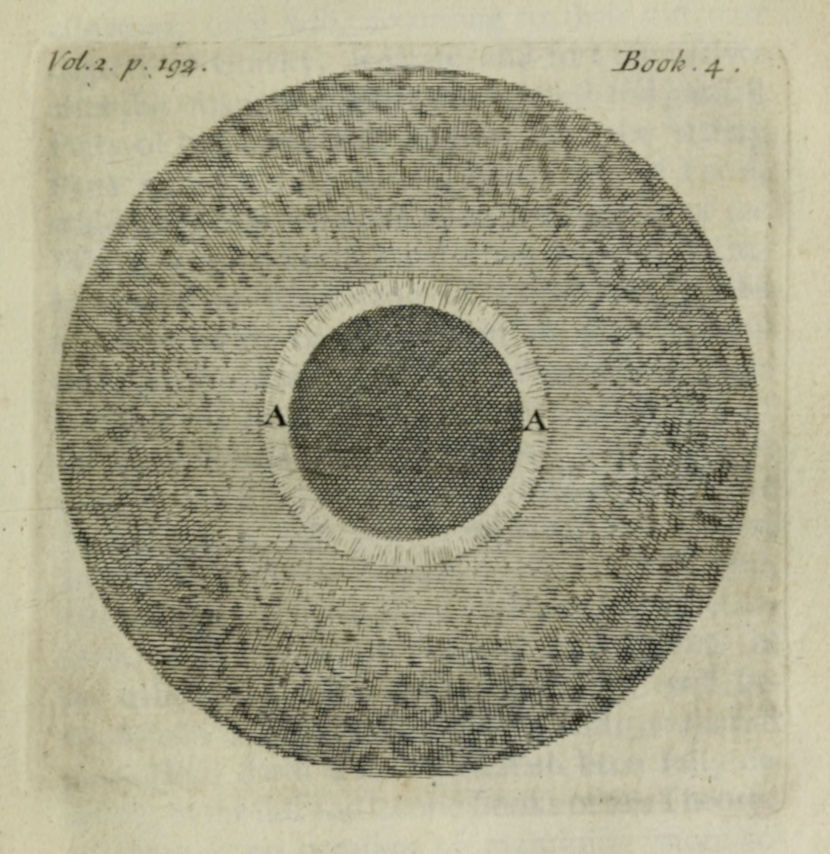
Book 4 Figure 1.
Now as to the lower of these two Regions, the Region of melted Matter, A. A. we shall have little Occasion to take Notice of it; seeing it will contribute nothing to the Formation of the new World. But the upper Region, or all 192above that Orb of Fire, is the true Draught of a Chaos; or a Mixture and Confusion of all the Elements, without Order or Distinction. Here are Particles of Earth, and of Air, and of Water, all promiscuously jumbled together by the Force and Agitation of the Fire. But when that Force ceases, and every one is left to its own Inclination, they will, according to their different degrees of Gravity, separate and sort themselves after this manner: First, the heaviest and grossest Parts of the Earth will subside, then the watery Parts will follow; then a lighter sort of Earth, which will stop, and rest upon the Surface of the Water, and compose there a thin Film or Membrane. This Membrane or tender Orb is the first Rudiment, or Foundation of a new habitable Earth: For, according as terrestrial Parts fall upon it, from all the Regions and Heights of the Atmosphere, or of the Chaos, this Orb will grow more firm, strong, and immoveable, able to support it self and Inhabitants too. And having in it all the Principles of a fruitful Soil, whether for the Production of Plants, or of Animals, it will want no Property or Character of an habitable Earth. And particularly, will become such an Earth, and of such a Form, as the first paradisaical Earth was, which hath been fully describ’d, in the first and second Books of this Theory.
There is no occasion of examining more accurately the Formation of this second Earth, seeing it is so much the same with that of the first; which, is set down fully and distinctly, in the fifth Chapter of the first Book of this 193Theory. Nature here repeats the same Work, and in the same Method; only the Materials are now a little more refin’d, and purg’d by the Fire: They both rise out of a Chaos, and that, in effect, the same in both Cases; for though in forming the first Earth, I suppos’d the Chaos or confus’d Mass, to reach down to the Center, I did that only for the Ease of our Imagination; that so the whole Mass might appear more simple and uniform. But in reality, that Chaos had a solid Kernel of Earth within, as this hath; and that Matter which fluctuated above in the Regions of the Air, was the true Chaos, whose Parts, when they came to a Separation, made the several Elements, and the Form of an habitable Earth, betwixt the Air and Water. This Chaos, upon Separation, will fall into the same Form and Elements; and so, in like manner, create or constitute a second Paradisaical World.
I say, a Paradisaical World; for it appears plainly, that this new-form’d Earth must agree with that primigenial Earth, in the two principal and fundamental Properties. First, it is of an even, entire, uniform, and regular Surface, without Mountains or Sea. Secondly, that it hath a straight and regular Situation to the Sun, and the Axis of the Ecliptick. From the Manner of its Formation, it appears manifestly, that it must be of an even and regular Surface. For the Orb of liquid Fire, upon which the first Descent was made, being smooth and uniform every where, the Matter that fell upon it would take the same Form and Mould: And so the second 194or third Region, that were superinduc’d, would still imitate the Fashion of the first; there being no Cause or Occasion of any Inequality. Then as to the Situation of its Axis, this Uniformity of Figure would determine the Center of its Gravity to be exactly in the Middle, and consequently there would be no Inclination of one Pole, more than another, to the general Center of its Motion; but, upon a free Libration in the liquid Air, its Axis would lie parallel with the Axis of the Ecliptick where it moves. But these Things having been deduc’d more fully in the second Book about Paradise and the primigenial Earth, they need no further Explication in this Place.
If Scripture had left us several distinct Characters of the New Heavens, and the New Earth, we might, by comparing with those, have made a full Proof of our Hypothesis. One indeed St. John hath left us in very express Terms; There was no Sea there, he says: His Words are these: And I saw a New Heaven, and a New Earth; for the first Heaven and the first Earth were passed away; AND THERE WAS NO MORE SEA. This Character is very particular, and you see it exactly answers to our Hypothesis; for in the new form’d Earth, the Sea is cover’d and inconspicuous, being an Abyss; not a Sea; and wholly lodg’d in the Womb of the Earth. And this one Character, being inexplicable upon any other Supposition, and very different from the present Earth, makes it a strong Presumption that we have hit upon the true Model of the 195new Heavens and new Earth which St. John saw.
To this Sight of the new Heavens and new Earth, St. John immediately subjoins the Sight of the new Jerusalem, ver. 2. as being contemporary, and, in some respects, the same Thing. ’Tis true, the Characters of the new Jerusalem, in these two last Chapters of the Apocalypse, are very hard to be understood; some of them being incompatible to a terrestrial State, and some of ’em to a celestial; so as it seems to me very reasonable to suppose, that the new Jerusalem, spoken of by St. John, is two-fold: That which he saw himself, ver. 2. and that which the Angel shewed him afterwards, ver. 9. For I do not see what need there was of an Angel, and of taking him up into a great and high Mountain, only to shew him that which he had seen before, at the Foot of the Mountain: But however that be, we are to consider, in this Place, the terrestrial new Jerusalem only, or that which is the new Heavens and new Earth. And as St. John hath joined these two together, so the Prophet Isaiah hath done the same thing before, Chap. lxv. 17, 18. when he had promised new Heavens and a new Earth, he calls them under another Name, Jerusalem; and they both use the same Character in Effect, in the Description of their Jerusalem. Ver. 19. Isaiah says, And I will rejoice in Jerusalem, and joy in my People, and the Voice of weeping shall be no more heard in her, nor the Voice of crying, Apoc. xxi. 3, 4. St. John says also in his Jerusalem, God shall 196dwell with them, and they shall be his People: And he shall wipe away all Tears from their Eyes; and there shall be no more Death, neither Sorrow, nor Crying, neither shall there be any more Pain. Now in both these Prophets, when they treat upon this Subject, we find they make frequent Allusions to Paradise and a paradisaical State; so as they may be justly taken as a Scripture Character of the new Heavens and the new Earth. The Prophet Isaiah seems plainly to point at a paradisaical State, throughout that Chapter, by an universal Innocency, and Harmlesness of Animals; and Peace, Plenty, Health, Longevity or Immortality of the Inhabitants. St. John also hath several Allusions to Paradise, in those two Chapters where he describes the new Jerusalem, Ch. xxi. and Ch. xxii. And in his Discourse to the seven Churches, in one Place (Ch. ii. 7.) To him that overcometh is promised, to eat of the Tree of Life, which is in the midst of the Paradise of God. And in another Place (Ch. iii. 12.) To him that overcometh is promised, to have the Name of the new Jerusalem writ upon him. These I take to be the same Thing, and the same Reward of Christian Victors; the new Jerusalem, or the new Heavens and new Earth, and the Paradise of God. Now this being the general Character of the new Earth, that it is paradisaical; and the particular Character that it hath no Sea; and both these agreeing with our Hypothesis, as apparently deducible from those Principles, and that Manner of its Formation which we have set down; we cannot but allow, that the Holy 197Scriptures, and the natural Theory agree in their Testimony, as to the Conditions and Properties of the New Heavens and New Earth.
From what hath been said in this and the precedent Chapter, it will not be hard to interpret what St. Paul meant by his habitable Earth to come; Τὴν οἰκουμένην τῆς μέλλουσαν; πατὴρ τοῦ μέλλοντος αἰῶνος, Isai. ix. 6. which is to be subjected to our Saviour, and not to the Angels. In the second Chapter to the Hebrews, ver. 5. he says, For unto the Angels hath he not put in Subjection the WORLD TO COME; so we read it, but, according to the strictest and plainest Translation, it should be the habitable Earth to come. Now, what Earth is this, where our Saviour is absolute Sovereign; and where the Government is neither Human, nor Angelical, but peculiarly Theocratical? In the first Place, this cannot be the present World, or the present Earth, because the Apostle calls it future, or the Earth to come. Nor can it be understood of the Days of the Gospel; seeing the Apostle acknowledges, ver. 8. that this Subjection, whereof he speaks, is not yet made. And seeing Antichrist will not finally be destroyed till the Appearance of our Saviour, (2 Thess. ii. 8.) nor Satan bound, while Antichrist is in Power; during the Reign of these two (who are the Rulers of the Darkness of the World) our Saviour cannot properly be said to begin his Reign here, Ephes. vi. 12. ’Tis true, he exercises his Providence over his Church, and secures it from being destroyed: He can, by a Power paramount, stop the Rage either of 198Satan or Antichrist; Hitherto ye shall go, and no farther. As sometimes when he was upon Earth, he exerted a Divine Power, which yet did not destroy his State of Humiliation; so he interposes now when he thinks fit, but he does not finally take the Power out of the Hands of his Enemies, nor out of the Hands of the Kings of the Earth. The Kingdom is not deliver’d up to him, and all Dominion and Power; Ch. vii. 13, 25, 26. That all Tongues and Nations should serve him. For St. Paul can mean no less in this Place than that Kingdom in Daniel, Heb. ii. 8. seeing he calls it putting all Things in Subjection under his Feet, and says that it is not yet done. Upon this account also, as well as others, our Saviour might truly say to Pilate, Joh. xviii. 36. My Kingdom is not of this World. And to his Disciples, The Son of Man came not to be ministred unto, but to minister, Matt. xx. 28. When he comes to receive his Kingdom, he comes in the Clouds of Heaven (Dan. vii. 13, 14.) not in the Womb of a Virgin. He comes with the Equipage of a King and Conqueror: with Thousands and Ten Thousands of Angels; not in the Form of a Servant, or of a weak Infant, as he did at his first coming.
I allow the Phrase αἰὼν μέλλων, or in the Hebrew עולם הבא, the World to come, is sometimes used in a large Sense, as comprehending all the Days of the Messiah, whether at his first or second coming, (for these two comings are often undistinguished in Scripture) and respect the moral World, as well as the natural. But the Word οἰχομένη, Orbis habitabilis, 199which St. Paul here uses, does primarily signify the natural World, or the habitable Earth, in the proper use of the Word amongst the Greeks, and frequently in Scripture, Luke iv. 5. and xxi. 26. Rom. x. 18. Heb. i. 6. Apoc. iii. 10. Neither do we here exclude the moral World, or the Inhabitants of the Earth, but rather necessarily include them: Both the natural and moral World to come, will be the Seat and Subject of our Saviour’s Kingdom and Empire, in a peculiar Manner. But when you understand nothing by this Phrase but the present moral World, it neither answers the proper Signification of μέλλουσα, nor of οἰκουμένη, of the first or second Part of the Expression; and tho’ such like Phrases may be used for the Dispensation of the Messiah in Opposition to that of the Law, yet the height of that Distinction or Opposition, and the fulfilling of the Expression, depends upon the second coming of our Saviour, and upon the future Earth or habitable World, where he shall reign, and which does peculiarly belong to him and his Saints.
Neither can this World to come, or this Earth to come, be understood of the Kingdom of Heaven. For the Greek Word will not bear that Sense, nor is it ever us’d in Scripture for Heaven. Besides, the Kingdom of Heaven, when spoken of as future, is not properly till the last Resurrection and final Judgment. Whereas this World to come, which our Saviour is to govern, must be therefore that Time, and will then expire. For all his Government as to this World, expires at the Day of Judgment, 1 Cor. 200xv. 24, &c. and he will then deliver up the Kingdom into the Hands of his Father, that he may be all in all: Having reigned first himself, and put down all Rule and all Authority and Power. So that St. Paul, in these two Places of his Epistles, refers plainly to the same Time, and the same Reign of Christ; which must be in a future World, and before the last Day of Judgment, and therefore, according, to our Deductions, in the new Heavens and the new Earth.
CHAP. III.
Concerning the Inhabitants of the new Earth. That natural Reason cannot determine this Point. That according to Scripture, the Sons of the first Resurrection, or the Heirs of the Millennium, are to be the Inhabitants of the new Earth. The Testimony of the Philosophers, and of the Christian Fathers, for the Renovation of the World. The first Proposition laid down.
Thus we have settled the true Notion, according to Reason and Scripture, of the new Heavens and new Earth: But where are the Inhabitants, you’ll say? You have taken the Pains to make us a new World, and now that it is made, it must stand empty. When the first World was destroyed, there were eight Persons preserv’d, with a Set of living Creatures of every Kind, as a Seminary or Foundation of another World; but the Fire, 201it seems, is more merciless than the Water; for in this Destruction of the World, it does not appear that there is one living Soul left, of any sort, upon the Face of the Earth. No Hopes of Posterity, nor of any Continuation of Mankind, in the usual Way of Propagation; and Fire is a barren Element, that breeds no living Creatures in it, nor hath any Nourishment proper for their Food or Sustenance.
We are perfectly at a Loss therefore, so far as I see, for a new Race of Mankind, or how to People this new-form’d World. The inhabitants, if ever there be any, must either come from Heaven, or spring from the Earth; there are but these two Ways. But natural Reason can determine neither of these, sees no Track to follow in these unbeaten Paths, nor can advance one Step farther. Farewell then, dear Friend; I must take another Guide, and leave you here, as Moses upon Mount Pisgah, only to look into that Land, which you cannot enter. I acknowledge the good Service you have done, and what a faithful Companion you have been, in a long Journey; from the Beginning of the World to this Hour, in a Tract of Time of six thousand Years. We have travelled together thro’ the dark Regions of a first and second Chaos; seen the World twice shipwreck’d: Neither Water, nor Fire, could separate us; but now you must give place to other Guides.
Welcome, Holy Scriptures, the Oracles of God, a Light shining in Darkness, a Treasury of hidden Knowledge; and where Human Faculties cannot reach, a seasonable Help and 202Supply to their Defects. We are now come to the utmost Bounds of their Dominion; they have made us a New World, but, how it shall be inhabited, they cannot tell; know nothing of the History or Affairs of it. This we must learn from other Masters, inspir’d with the Knowledge of Things to come: And such Masters we know none, but the holy Prophets and Apostles. We must therefore now put our selves wholly under their Conduct and Instruction, and from them only receive our Information concerning the moral State of the future habitable Earth.
In the first place therefore, the Prophet Isaiah tells us, as a Preparation to our farther Enquiries, The Lord God created the Heavens, God himself that formed the Earth, he created it not in vain, he formed it to be inhabited, Isa. xlv. 18. This is true, both of the present Earth and the future, and of every habitable World whatsoever. For to what purpose is it made habitable, if not to be inhabited? That would be, as if a Man should manure, and plough, and every Way prepare his Ground for Seed, but never sow it. We do not build Houses, that they should stand empty, but look out for Tenants as fast as we can; as soon as they are made ready and become tenantable. But if Man could do things in vain, and without Use or Design, yet God and Nature never do any thing in vain; much less so great a Work as the making of a World; which if it were in vain, would comprehend ten thousand Vanities or useless Preparations in it. We may therefore, in the first place, safely conclude, 203that the new Earth will be inhabited.
But by whom will it be inhabited? This makes the second Enquiry. St. Peter answers this Question for us, and with a particular Application to this very Subject of the new Heavens and new Earth: They shall be inhabited, he says, by the Just or the Righteous. His Words which we cited before, are these; when he had described the Conflagration of the World, he adds, But we expect new Heavens and a new Earth, WHEREIN DWELLETH RIGHTEOUSNESS. By Righteousness here, it is generally agreed, must be understood righteous Persons; for Righteousness cannot be without righteous Persons. It cannot hang upon Trees, or grow out of the Ground; ’tis the Endowment of reasonable Creatures. And these righteous Persons are eminently such, and therefore call’d Righteousness in the Abstract, or purely righteous without Mixture of Vice.
So we have found Inhabitants for the new Earth, Persons of an high and noble Character; like those describ’d by St. Peter, (1 Eph. ii. 9.) A chosen Generation, a royal Priesthood, an holy Nation, a peculiar People. As if into that World, as into St. John’s new Jerusalem, nothing impure or unrighteous was to be admitted, Apoc. xxi. 27. These being then the happy and holy Inhabitants; the next Enquiry is, Whence do they come? From what Off-spring, or from what Original? We noted before, that there was no Remnant of Mankind left at the Conflagration, as there was at the Deluge; nor any Hopes of a Restauration 204that Way. Shall we then imagine that these new Inhabitants are a Colony wafted over from some neigbouring World; as from the Moon, or Mercury, or some of the higher Planets? You may imagine what you please, but that seems to me not imaginary only, but impracticable: And that the Inhabitants of those Planets are Persons of so great Accomplishments, is more than I know; but I am sure they are not the Persons here understood; for these must be such as inhabited this Earth before. We look for new Heavens and new Earth, says the Apostle: Surely to have some Share and Interest in them, otherwise there would be no Comfort in that Expectation. And the Prophet Isaiah said before, I create new Heavens and a new Earth, and the former shall come no more in Remembrance; but be YOU glad and rejoyce for ever in that which I create. The Truth is, none can have so good Pretensions to this Spot of Ground we call the Earth, as the Sons of Men, seeing they once possessed it; and if it be restor’d again, ’tis their Propriety and Inheritance. But ’tis not Mankind in general that must possess this new World, but the Israel of God, according to the Prophet Isaiah; or the Just, according to St. Peter; and especially those that have suffer’d for the Sake of their Religion. For this is that Palingenesia, as we noted before, that Renovation, or Regeneration of all Things, where our Saviour says, those that suffer Loss for his Sake, shall be recompensed, Matth. xix. 28, 29.
But they must be then raised from the Dead. 205For all Mankind was destroyed at the Conflagration: and there is no Resource for them any other way, than by a Resurrection. ’Tis true: and St. John (Apoc. xx.) gives us a fair Occasion to make this Supposition, that there will be some raised from the Dead, before the general Day of Judgment. For he plainly distinguisheth of a first and second Resurrection, and makes the first to be a thousand Years before the second, and before the general Day of Judgment. Now, if there be truly and really a two-fold Resurrection, as St. John tells us; and that a Thousand Years Distance from one another: It may be very rationally be presum’d, that those that are raised in the first Resurrection, are those Just that will inhabit the New Heavens and New Earth; or whom our Saviour promis’d to reward in the Renovation of the World.
For otherwise, who are those Just that shall inhabit the New Earth, and whence do they come? Or when is that Restauration which our Saviour speaks of, wherein those that suffer’d for the Sake of the Gospel shall be rewarded? St. John says, the Martyrs, at this first Resurrection, shall live again, and reign with Christ: Which seems to be the Reward promis’d by our Saviour, to those that suffer’d for his sake, and the same Persons in both Places. And I saw the Souls of them (says St. John) that were beheaded for the Witness of Jesus, and for the Word of God; and which had not worshipped the Beast, &c. and they lived and reigned with Christ a Thousand Years, Apoc. xx. 4. 206These, I say, seem to be the same Persons, to whom Christ had before promis’d and appropriated a particular Reward. And this Reward of theirs, or this Reign of theirs, is upon Earth; upon some Earth, new or old, not in Heaven. For, besides that we read nothing of their Ascension into Heaven after their Resurrection; there are several Marks that shew, it must necessarily be understood of a State upon Earth. For Gog and Magog came from the four Quarters of the Earth, and besieged the Camp of the Saints, and the beloved City, ver. 9. That Camp and that City therefore were upon the Earth. And Fire came down from Heaven, and devoured them. If it came down from Heaven, it came upon the Earth. Farthermore, those Persons that are raised from the Dead, are said to be Priests of God and of Christ, and to reign with him a thousand Years, ver. 6. Now these must be the same Persons with the Priests and Kings, mention’d in the fifth Chapter, ver. 10. which are there said expressly to reign upon Earth, or that they should reign upon Earth. It remains therefore only to determine, what Earth this is, where the Sons of the first Resurrection will live and reign. It cannot be the present Earth, in the same State, and under the same Circumstances it is now: For what Happiness or Privilege would that be, to be called back into a mortal Life, under the Necessities and Inconveniencies of sickly Bodies, and an incommodious World; such as the present State of Mortality is, and 207must continue to be, till some Change be made in Nature. We may be sure therefore, that a Change will be made in Nature, before that Time, and that the State they are rais’d into, and the Earth they are to inhabit, will be, at least, Paradisaical; and consequently can be no other than the New Heavens and New Earth, which we are to expect after the Conflagration.
From these Considerations, there is a great Fairness to conclude, both as to the Characters of the Persons, and of the Place or State, that the Sons of the first Resurrection will be Inhabitants of the New Earth, and reign there with Christ a Thousand Years. But seeing this is one of the principal and peculiar Conclusions of this Discourse, and bears a great Part in this last Book of the Theory of the Earth, it will deserve a more full Explication, and a more ample Proof, to make it out. We must therefore take a greater Compass in our Discourse, and give a full Account of that State which is usually call’d the Millennium; the Reign of the Saints a Thousand Years, or the Kingdom of Christ upon Earth. But before we enter upon this new Subject, give me leave to close our present Argument, about the Renovation of the World, with some Testimonies of the antient Philosophers, to that purpose. ’Tis plain to me, that there were among the Antients several Traditions, or traditionary Conclusions, which they did not raise themselves, by Reason and Observation, but received them from an unknown 208Antiquity. An Instance of this is the Conflagration of the World; a Doctrine as antient, for any Thing I know, as the World it self; at least as antient as we have any Records, and yet none of those Antients that tell us of it, give any Argument to prove it. Neither is it any Wonder, for they did not invent it themselves, but receiv’d it from others without Proof, by the sole Authority of Tradition. In like manner the Renovation of the World, which we are now speaking of, is an antient Doctrine, both amongst the Greeks and Eastern Philosophers: But they shew us no Method how the World may be renew’d, nor make any Proof of its future Renovation; for it was not a Discovery which they first made, but receiv’d it with an implicit Faith, from their Masters and Ancestors: And these traditionary Doctrines were all Fore-runners of that Light which was to shine more clearly at the Opening of the Christian Dispensation; to give a more full Account of the Fate and Revolutions of the natural World, as well as of the moral.
The Jews, ’tis well known, held the Renovation of the World, and a Sabbath after Six Thousand Years; according to the Prophecy that was current among them; whereof we have given a larger Account in the precedent Book, Chap. v. And that future State they called עולם הבא, Olam Hava, or the World to come, which is the very same with Saint Paul’s habitable Earth to come, ἡ οἰκουμένη ἥ μέλλουσα, Heb. ii. 6. Neither can I easily believe, that those Constitutions of Moses 209that proceed so much upon a septenary, or the Number seven, and have no Ground or Reason, in the Nature of the Thing, for that particular Number. I cannot easily believe, I say, that they are either accidental or humoursome, without Design or Signification; but that they are typical, or representative of some Septenary State, that does eminently deserve and bear that Character. Moses, in the History of the Creation, makes six Days Work, and then a Sabbath: Then, after six Years, he makes a Sabbath-Year; and after a Sabbath of Years, a Year of Jubilee, Levit. xxv. All these lesser Revolutions seem to me to point at the grand Revolution, the great Sabbath or Jubilee, after six Millenaries; which, as it answers the Type in point of Time, so likewise in the Nature and Contents of it; being a State of Rest from all Labour, and Trouble, and Servitude; a State of Joy and Triumph, and a State of Renovation, when Things are to return to their first Condition and pristine Order. So much for the Jews.
The Heathen Philosophers, both Greeks and Barbarians, had the same Doctrine of the Renovation of the World current amongst them, and that under several Names and Phrases; as of the Great Year, the Restauration, the Mundane Periods, and such-like. They suppos’d stated and fix’d Periods of Time, upon Expiration whereof there would always follow some great Revolution of the World, and the Face of Nature would be renewed: particularly after the Conflagration, the Stoicks always suppos’d a new World to succeed, or 210another Frame of Nature to be erected in the Room of that which was destroyed. And they use the same Words and Phrases upon this Occasion that Scripture useth. Chrysippis calls it Apocatastasis (Lact. l. 7. c. 23.) as St. Peter does, Acts iii. 21. Marcus Antonius in his Meditations, several times calls it Palingenesia, as our Saviour does, Matt. xix. 28. And Numenius hath two Scripture words, Resurrection and Restitution, (Euseb. præp. Ev. l. 7. c. 23.) to express this Renovation of the World. Then as to the Platonicks, that Revolution of all Things hath commonly been call’d the Platonick Year, as if Plato had been the first Author of that Opinion; but that’s a great Mistake; he receiv’d it from the Barbarick Philosophers, and particularly from the Ægyptian Priests, amongst whom he liv’d several Years, to be instructed in their Learning. But I do not take Plato neither to be the first that brought this Doctrine into Greece: For, besides that the Sibylls, whose Antiquity we do not well know, sung this Song of old, as we see it copy’d from them by Virgil in his fourth Eclogue; Pythagoras taught it before Plato, and Orpheus before them both; and that’s as high as the Greek Philosophy reaches.
The Barbarick Philosophers were more antient; namely, the Ægyptians, Persians, Chaldeans, Indian Brackmans, and other Eastern Nations. Their Monuments indeed are in a great measure lost; yet from the Remains of them which the Greeks have transcribed, and so preserv’d in their Writings, we see plainly 211they all had this Doctrine of the future Renovation. And to this Day the Posterity of the Brackmans in the East-Indies retain the same Notion, that the World will be renew’d after the last Fire. You may see the Citations, if you please, for all these Notions, in the Latin Treatise, Ch. v. which I thought would be too dry and tedious to be render’d into English.
To these Testimonies of the Philosophers of all Ages, for the future Renovation of the World, we might add the Testimonies of the Christian Fathers, Greek and Latin, antient and modern. I will only give you a bare List of them, and refer you to the Latin Treatise (Chap. ix.) for the Words or the Places. Amongst the Greek Fathers, Justin Martyr, Irenæus, Origen: The Fathers of the Council of Nice, Eusebius; Basil; the two Cyrils, of Jerusalem and Alexandria: The two Gregories, Nazianzen and Nyssen; St. Chrysostom, Zacharias Mitylenensis; and of later Date, Damascen, Oecumenius, Euthymius, and others. These have all set their Hands and Seals to this Doctrine. Of the Latin Fathers, Tertullian, Lactantius, St. Hillary, St. Ambrose, St. Austin, St. Jerome; and many later Ecclesiastical Authors. These, with the Philosophers before-mention’d, I count good Authority, sacred and prophane; which I place here as an Out-guard upon Scripture, where our principal Force lies. These three united, and acting in Conjunction, will be sufficient to prove this first Post, and to prove our first Proposition, which is this; That after the Conflagration of this World, 212there will be new Heavens and a new Earth; and that Earth will be inhabited. (Propos. I.)
CHAP. IV.
The Proof of a Millennium, or of a blessed Age to come, from Scripture. A View of the Apocalypse, and of the Prophecies of Daniel, in reference to this Kingdom of Christ and of his Saints.
We have given fair Presumptions, if not Proofs, in the precedent Chapter, that the Sons of the first Resurrection will be the Persons that shall inhabit the new Earth, or the World to come. But to make that Proof complete and unexceptionable, I told you, it would be necessary to take a larger Compass in our Discourse, and to examine what is meant by that Reign with Christ a thousand Years, which is promis’d to the Sons of the first Resurrection, by St. John in the Apocalypse; and in other places of Scripture is usually call’d the Kingdom of Christ, and the Reign of the Saints: And by Ecclesiastical Authors, in Imitation of St. John, it is commonly styled, the Millennium. We shall indifferently use any of these Words or Phrases; and examine, first, the Truth of the Notion and Opinion, whether, in Scripture, there be any such an happy State promised to the Saints under the Conduct of Christ; and then we will proceed 213to examine the Nature, Characters, Place and Time of it. And I am in hopes when these Things are duly discuss’d and stated, you will be satisfied that we have found out the true Inhabitants of the new Heavens and new Earth; and the true Mystery of that State which is called the Millennium, or the Reign of Christ and of his Saints.
We begin with St. John, whose Words in the xxth Chapter of the Apocalypse, ver. 1, 2, 4, 5, 6. are express, both as to the first Resurrection, and as to the Reign of those Saints that rise with Christ for a Thousand Years; Satan in the mean Time being bound, or disabled from doing Mischief, and seducing Mankind. The Words of the Prophet are these; And I saw an Angel come down from Heaven, having the Key of the bottomless Pit, and a great Chain in his Hand. And he laid hold on the Dragon, that old Serpent, which is the Devil and Satan, and bound him a Thousand Years. And I saw Thrones, and they sat upon them, and Judgment was given unto them; And I saw the Souls of them that were beheaded for the Witness of Jesus, and for the Word of God, and which had not worshipped the Beast, neither his Image, neither had received his Mark upon their Foreheads, or in their Hands; and they lived and reigned with Christ a thousand Years. But the rest of the Dead lived not again until the thousand Years were finished. This is the first Resurrection. Blessed and holy is he that hath part in the first Resurrection; on such the second Death hath no Power, but they shall be Priests of God, and of Christ, and shall reign with him a thousand Years. These 214Words do fully express a Resurrection, and a Reign with Christ a thousand Years. As for that particular Space of Time, of a Thousand Years, it is not much material to our present Purpose: but the Resurrection here spoken of, and the Reign with Christ, make the Substance of the Controversy, and in effect prove all that we enquire after at present. This Resurrection, you see, is call’d the first Resurrection, by way of Distinction from the second and general Resurrection; which is to be placed a Thousand Years after the first. And both this first Resurrection, and the Reign of Christ, seem to be appropriated to the Martyrs in this Place: For the Prophet says, The Souls of those that were beheaded for the Witness of Jesus, &c. they lived and reigned with Christ a Thousand Years. From which Words, if you please, we will raise this Doctrine; that those that have suffer’d for the Sake of Christ, and a good Conscience, shall be raised from the Dead a Thousand Years before the general Resurrection, and reign with Christ in an happy State. This Proposition seems to be plainly included in the Words of St. John, and to be the intended Sense of this Vision; but you must have Patience a little as to your Enquiry into Particulars, till, in the Progress of our Discourse, we have brought all the Parts of this Conclusion into a fuller Light.
In the mean time there is but one Way, that I know of, to evade the Force of these Words, and of the Conclusion drawn from them; and that is, by supposing that the first Resurrection here mention’d, is not to be understood in a 215literal Sense, but is allegorical and mystical, signifying only a Resurrection from Sin to a spiritual Life: As we are said to be dead in Sin, and to be risen with Christ, by Faith and Regeneration. This is a manner of Speech which St. Paul does sometimes use, as Eph. ii. 6. and ver. 14, and Col. 3. 1. But how can this be applied to the present Case? Were the Martyrs dead in Sin? ’Tis they that are here rais’d from the Dead: Or, after they were beheaded for the Witness of Jesus, naturally dead and laid in their Graves, were they then regenerate by Faith? There is no Congruity in Allegories so apply’d. Besides, why should they be said to be regenerate a Thousand Years before the Day of Judgment? or to reign with Christ, after this Spiritual Resurrection, such a limited Time, a Thousand Years? Why not so to Eternity? For in this allegorical Sense of rising and reigning, they will reign with him for everlasting. Then, after a Thousand Years, must all the Wicked be regenerate, and rise into a Spiritual Life? ’Tis said here, the rest of the Dead lived not again, until the Thousand Years were finished, ver. 5. That implies, that at the End of these Thousand Years, the rest of the Dead did live again; which, according to the Allegory, must be, that, after a Thousand Years, all the Wicked will be regenerate, and rais’d into Spiritual Life. These Absurdities arise upon an allegorical Exposition of this Resurrection, if apply’d to single Persons.
216But Dr. Hammond, a learned and worthy Divine, (but one that loves to contract and cramp the Sense of Prophecies) making this first Resurrection allegorical, applies it not to single Persons, but to the State of the Church in general: The Christian Church, he says, shall have a Resurrection for a Thousand Years; that is, shall rise out of Persecution, be in a prosperous Condition, and an undisturbed Profession of the true Religion, for so long a Time. But this agrees with the Prophecy as little as the former; if it be a State of the Church in general, and of the Church then in being, why is this Resurrection apply’d to the Martyrs? Why are they said to rise; seeing the State they liv’d in, was a troublesome State of the Church, and it would be no Happiness to have that reviv’d again? Then as to the Time of this Resurrection of the Church, where will you fix it? The Prophet Daniel places this Reign of Christ, at, or after the Dissolution of the fourth Monarchy; and Saint John places it a Thousand Years before the last Day of Judgment. How will you adjust the allegorical Resurrection of the Church to these Limits? Or if, in point of Time, you was free, as to Prophecy, yet how would you adjust it to History? Where will you take these Thousand Years of Happiness and Prosperity to the Church? These Authors suppose them past, and therefore must begin them either from the first Times of the Gospel, or from the Time of Constantine. Under the first Ages of the Gospel, were, you know, the great Persecutions 217by the Heathen Emperors; could those be call’d the Reign of Christ and of his Saints? Was Satan then bound? Or was this Epocha but a thousand Years before the Day of Judgment? And if you begin this Resurrection of the Church from the Days of Constantine, when the Empire became Christian, how will you reckon a thousand Years from that Time, for the Continuance of the Church in Peace and Purity? For the Reign of Christ and of his Saints must necessarily imply both those Characters. Besides, who are the rest of the Dead, (ver. 5.) that lived after the Expiration of those thousand Years, if they began at Constantine? And why is not the second Resurrection and the Day of Judgment yet come? Lastly, you ought to be tender of interpreting the first Resurrection in an allegorical Sense, lest you expose the second Resurrection to be made an Allegory also.
To conclude; The Words of the Text are plain and express for a literal Resurrection, as to the first, as well as the second; and there is no allegorical Interpretation that I know of, that will hold through all the Particulars of the Text, consistently with it self and with History. And when we shall have proved this future Kingdom of Christ from other Places of the Apocalypse, and of Holy Writ, you will the more easily admit the literal Sense of this Place; which, you know, according to the receiv’d Rule of Interpreters, is never to be quitted or forsaken, without Necessity: But when I speak of confirming this Doctrine from other Passages of Scripture, I 218do not mean as to that definite Time of a Thousand Years, for that is no where else mention’d in the Apocalypse, or in Scripture, that I know of; and seems to be mention’d here, in this Close of all Things, to mind us of that Type that was propos’d in the Beginning of all Things, of six Days and a Sabbath; whereof each Day comprehends a Thousand Years, and the Sabbath, which is the Millennial State, hath its Thousand; according to the known Prophecy of Elias, Book III. Ch. v. which, as I told you before, was not only receiv’d among the Jews, but also own’d by very many of the Christian Fathers.
To proceed therefore to other Parts of St. John’s Prophecies, that set forth this Kingdom of Christ; the Vision of the Seven Trumpets is one of the most remarkable in the Apocalypse; and the Seventh Trumpet, which plainly reaches to the End of the World, and the Resurrection of the Dead, opens the Scene to the Millennium; hear the Sound of it, Ch. xi. 15, 16, 17, 18. The seventh Angel sounded, and there were great Voices in Heaven, saying, The Kingdoms of this World are become the Kingdoms of our Lord, and of his Christ, and he shall reign for ever and ever. And the four and twenty Elders, which sat before God on their Seats, fell upon their Faces, and worshipped God; saying, we give thee Thanks, O Lord God Almighty, which art, and wast, and art to come; because thou hast taken to thee thy great Power, and hast reigned. And the Nations were angry, and thy Wrath is come, and the Time of the Dead, that they should be judged, 219and that thou shouldest give Reward unto thy Servants the Prophets, and to the Saints, and them that fear thy Name, small and great, and shouldest destroy them that destroy the Earth, &c. This is manifestly the Kingdom of Christ; and with this is joined the Resurrection of the Dead, and the rewarding of the suffering Prophets and Saints, as in the xxth Chapter. This is that Mystery of God that was to be finished in the Days of the Voice of the seventh Angel, as is said in the xxth Chap. ver. 7. As he hath declared to his Servants the Prophets; namely, the Mystery of this Kingdom, which was foretold by the Prophets of the Old Testament, and more especially by Daniel, as we shall see hereafter.
The new Jerusalem (as it is set down, Apoc. xxi. 2, 3, 4, 5, 6, 7.) is another Instance or Image of this Kingdom of Christ. And the Palm-bearing Company, Chap. vii. 9, &c. are some of the Martyrs that shall enjoy it. They are plainly describ’d there as Christian Martyrs; (ver. 14.) and their Reward, or the State of Happiness they are to enjoy, (ver. 15, 16, 17.) is the same with that of the Inhabitants of the new Jerusalem, Ch. xxi. 2, 3, 4, &c. as, upon comparing those two Places, will easily appear. Farthermore, at the Opening of the Seals, Chap. v. which is another principal Vision, and reaches to the End of the World, there is a Prospect given us of this Kingdom of Christ, and of that Reward of his Saints. For when they sing the new Song to the Lamb, (ver. 9, 10.) they say, Thou art worthy to take the Book, and to open the Seals thereof; for thou 220wast slain and hast redeemed us to God, by thy Blood; and hast made us into our God Kings and Priests, and we shall reign on the Earth. This must be the same State, and the same Thousand-Years-Reign mention’d in the xxth Chap. where ’tis said, (Ver. 6.) the Partakers of it shall be Priests of God, and of Christ, and shall reign with him a Thousand Years.
Another completory Vision, that extends it self to the End of the World, is that of the Seven Vials, Chap. xv. and xvi. And as at the Opening of the Seals, so at the pouring out the Vials, a triumphal Song is sung, and ’tis call’d the Song of Moses and of the Lamb, Ch. xv. 3. ’Tis plainly a Song of Thanksgiving for a Deliverance, but I do not look upon this Deliverance as already wrought, before the pouring out of the Vials, tho’ it be plac’d before them; as often the grand Design and Issue of a Vision is plac’d at the Beginning: It is wrought by the Vials themselves, and by their Effusion, and therefore upon the pouring out of the last Vial, the Voice came out of the Temple of Heaven, from the Throne, saying, Consummatum est; It is done, Ch. xvi. 17. Now the Deliverance is wrought, now the Work is at an End; or, the Mystery of God is finished, as the Phrase was before, concerning the 7th Trumpet, Chap. x. 7. You see therefore this terminates upon the same Time, and consequently upon the same State, of the Millennium; and that they are the same Persons that triumph here, and reign there, Chap. xx. you may see by the same Characters given to both of them, Ch. xv. 2. Here, 221those that triumph, are said to have gotten the Victory over the Beast, and over his Image, and over his Mark, and over the Number of his Name, Ch. xx. 4. And there, those that reign with Christ, are said to be those that had not worshiped the Beast, neither his Image, neither had received his Mark upon their Foreheads, or in their Hands. These are the same Persons therefore, triumphing over the same Enemies, and enjoying the same Reward.
And you shall seldom find any Doxology or Hallelujah in the Apocalypse, but ’tis in Prospect of the Kingdom of Christ, and the Millennial State: This is still the Burthen of the sacred Song, the Complement of every grand Vision, and the Life and Strength of the whole System of Prophecies in that Book: Even those Hallelujahs that are sung at the Destruction of Babylon, in the xixth Chapter, ver. 6, 7. are rais’d upon the succeeding State, the Reign of Christ. For the Text says, And I heard as it were a Voice of a great Multitude, and as the Voice of many Waters, and as the Voice of mighty Thunders, saying, Hallelujah: For the Lord God Omnipotent reigneth. Let us be glad and rejoyce, and give Honour to him: For the Marriage of the Lamb is come, and his Wife hath made her self ready. This appears plainly to be the new Jerusalem, if you consult the 21st Ch. ver. 2. And I John saw the Holy City, new Jerusalem, coming down from God out of Heaven, prepared as a Bride adorned for her Husband. ’Tis, no doubt, the same Bride and Bridegroom, in both Places; 222the same Marriage or Preparations for Marriage, which are compleated in the Millennial Bliss, in the Kingdom of Christ and of his Saints.
I must beg your patience a little longer, in pursuing this Argument throughout the Apocalypse; As towards the latter End of St. John’s Revelation, this Kingdom of Christ shines out in a more full Glory; so there are the Dawnings of it in the very Beginning and Entrance into his Prophecies. As at the Beginning of a Poem, we have commonly, in a few Words, the Design of the Work, in like Manner Ch. i. 5, 6. St. John makes this Preface to his Prophecies, From Jesus Christ, who is the faithful Witness, the first begotten of the Dead, and the Prince of the Kings of the Earth; unto him that loved us, and washed us from our Sins in his own Blood; and hath made us Kings and Priests unto God and his Father; to him be Glory and Dominion for ever and ever, Amen. Behold, he cometh in the Clouds, &c. In this Prologue the grand Argument is pointed at, and that happy Catastrophe and last Scene, which is to crown the Work, the Reign of Christ and of his Saints at his second Coming. He hath made us Kings and Priests unto God; this is always the Characteristick of those that are to enjoy the Millennial Happiness, as you may see at the Opening of the Seals, Ch. v. 10. and in the Sons of the first Resurrection, Ch. xx. 6. And this being joined to the Coming of our Saviour, puts it still more out of Doubt. That Expression also, of being washed from our Sins in his Blood, is repeated again both at the Opening of the Seals, 223chap. v. 9. and in the Palm-bearing Company, chap. vii. 14. both which Places we have cited before, as referring to the Millennial State.
Give me Leave to add farther, that as in this general Preface, so also in the introductory Visions of the seven Churches, there are, covertly or expresly, in the Conclusion of each, glances upon the Millennium; as in the first to Ephesus, the Prophet concludes, chap. ii. 7. He that hath an Ear, let him hear, what the Spirit says to the Churches: To him that overcometh, will I give to eat of the Tree of Life, which is in the midst of the Paradise of God. This is the Millennial Happiness which is promised to the Conqueror; as we noted before concerning that Phrase. In like manner in the second to Smyrna, he concludes, chap. ii. 11. He that overcometh, shall not be hurt of the second Death. This implies, he shall be Partaker of the first Resurrection, for that’s the Thing understood; as you may see plainly by their being joyn’d in the xxth Chapter ver. 6. Blessed and holy is he that hath Part in the first Resurrection; on such the second Death hath no Power, but they shall be Priests of God and of Christ, and shall reign with him a thousand Years. In the third to Pergamus, the Promise is, chap. ii. 7. To eat of the hidden Manna, to have a white Stone, and a new Name written in it: But seeing the Prophet adds, which no Man knoweth, saving he that receiveth it, we will not presume to interpret that new State, whatsoever it is, chap. ii. 26, 27. In Thyatira, the Reward is, To have Power over the Nations, and to have the 224Morning Star; which is to reign with Christ, who is the Morning Star, in his Millennial Empire: Both these Phrases being us’d in that Sense in the Close of this Book, Ch. iii. 5. In Sardis the Promise is, To be cloathed in white Raiment, and not to be blotted out of the Book of Life. And you see afterwards the Palme bearing Company are cloathed in white Robes, Ch. vii. 9, 14. and those that are admitted into the new Jerusalem, Chap. iii. 12. are such as are written in the Lamb’s Book of Life, Ch. xxi. 27. Then as to Philadelphia, the Reward promised there does openly mark the Millennial State, by the City of God; new Jerusalem which cometh down out of Heaven from God, compar’d with Ch. xxi. 2. Lastly, to the Church of Laodicea is said, Ch. iii. 21. To him that overcometh will I grant to sit with me in my Throne. And that is the usual Phrase to express the Dignity of those that reign with Christ, in his Millennial Kingdom; as you may see, Apoc. xx. 4. Matt. xix. 28. Dan. vii. 9, 13, 14. So all these Promises to the Churches aim at one and the same thing, and terminate upon the same Point: ’Tis the same Reward express’d in different Ways; and seeing it is still fix’d upon a Victory, and appropriated to those that overcome, it does the more easily carry our Thoughts to the Millennium, which is the proper Reward of Victors, that is, of Martyrs and Confessors.
Thus you see how this Notion and Mystery of the Millennial Kingdom of Christ, does both begin and End the Apocalypse, and run thorough all its Parts, as the Soul of that Body of Prophecies; 225a Spirit or Ferment that actuates the whole Mass. And if we could thoroughly understand that illustrious Scene, at the Opening of this Apocalyptical Theatre in the ivth and vth Chapter, I do not doubt but we should find it a Representation of the Majesty of our Saviour in the Glory of his future Kingdom; but I dare not venture upon the Explication of it, there are so many Things of Difficulty, and dubious Interpretation, coucht under those Schemes. Wherefore having made these Observations upon the Prophecies of St. John, we will now add to them some Reflections upon the Prophecies of Daniel: that by the Agreement and Concurrence of these two great Witnesses, the Conclusion we pretend to prove, may be fully established.
In the Prophecies of Daniel there are two grand Visions, that of the Statue or Image, Chap. ii. and that of the four Beasts, Chap. vii. and both these Visions terminate upon the Millennium, or the Kingdom of Christ. In the Vision of the Statue, representing to us the four great Monarchies of the World successively, whereof by the general Consent of Interpreters, the Roman is the fourth and last, after the Dissolution of the last of them, a fifth Monarchy, the Kingdom of Christ, is openly introduc’d, in these Words: And in the Days of these Kingdoms, shall the God of Heaven set up a Kingdom, which shall never be destroyed; and the Kingdom shall not be left to other People, but it shall break in Pieces, and consume all those Kingdoms, and it shall stand for ever, Ch. ii. ver. 44. This may be verified, in some 226measure, by the first coming of our Saviour in the Days of the fourth Kingdom, when his Religion, from small Beginnings, in a short Time over-spread the greatest Part of the known World. As the Stone cut out without Hands, became a great Mountain, and filled the whole Earth, ver. 34, 35. but the full and final Accomplishment of this Prophecy cannot be till the second coming of our Saviour. For not till then will he, Ver. 35, break in pieces and consume all those Kingdoms; and that in such a manner, that they shall become like the Chaff of the Summer-threshing Floor, carried away by the Wind; so as no Place shall be found for them. This, I say, will not be done, nor an everlasting Kingdom erected in their place, over all the Nations of the Earth, till his second coming, and his Millennial Reign.
But this Reign is declared more expresly, in the Vision of the four Beasts, Ch. vii. ver. 13. For after the Destruction of the fourth Beast, the Prophet says, I saw in the Night Visions, and behold one like the Son of Man, came with the Clouds of Heaven, and came to the Antient of Days, and they brought him near before him: And there was given him Dominion, and Glory, and a Kingdom, that all People, Nations and Languages should serve him; his Dominion is an everlasting Dominion, which shall not pass away; and his Kingdom that which shall not be destroyed. Accordingly, he says, Ver. 21, 22. The last Beast, and the little Horn, made war against the Saints, until the Antient of Days came, and Judgment was given to the Saints of the most High; and 227the Time came that the Saints possessed the Kingdom. And lastly, in Pursuit still of the same Argument, he concludes to the same Effect in fuller Words, ver. 26, 27. But the Judgment shall sit, and they shall take away his Dominion, to consume and to destroy it unto the End. And the Kingdom and Dominion, and the Greatness of the Kingdom under the whole Heaven, shall be given to the People of the Saints of the most High; whose Kingdom is an everlasting Kingdom, and all Dominions shall serve and obey him.
Here is the End of the Matter, says the Prophet, Chap. vii. ver. 28. Chap. xii. ver. 13. Here is the Upshot and Result of all; here terminate both the Prophecies of Daniel and St. John, and all the Affairs of the terrestrial World. Daniel brings in this Kingdom of Christ, in the Conclusion of two or three Visions; but St. John hath interwoven it every where with his Prophecies, from first to last: And you may as well open a Lock without a Key, as interpret the Apocalypse without the Millennium. But after these two great Witnesses, the one for the Old Testament, the other for the New, we must look into the rest of the sacred Writers; for tho’ every single Author there, is an Oracle, yet the Concurrence of Oracles is still a farther Demonstration, and takes away all Remains of Doubt or Incredulity.
228
CHAP. V.
A View of other Places of Scripture concerning the Millennium or future Kingdom of Christ. In what Sense all the Prophets have borne Testimony concerning it.
The Wife of Zebedee came to our Saviour, and begg’d of him, like a fond Mother, that her two Sons might sit, one at his Right Hand, the other at his Left, when he came into his Kingdom, Matt. xx. 21. Our Saviour does not deny the Supposition, or general Ground of her Request, that he was to have a Kingdom; but tells her, the Honours of that Kingdom were not then in his Disposal. He had not drunk his Cup, nor been baptiz’d with his last Baptism; which were Conditions, both to him and others, of entring into that Kingdom. Yet, in another place, (Matt. xix. 28.) our Saviour is so well assur’d of his Interest and Authority there, by the Good-will of his Father, that he promises to his Disciples and Followers, that for the Losses they should sustain here, upon his Account, and for the Sake of his Gospel, they should receive there an hundred-fold, and sit upon Thrones with him, judging the Tribes of Israel. The Words are these: And Jesus said unto them, Verily I say unto you, that ye which have followed me, in the Regeneration or Renovation, when the Son of Man shall sit in the Throne of his Glory, ye also shall sit upon twelve Thrones, judging 229the twelve Tribes of Israel. These Thrones, in all Reason, must be understood to be the same with those, which we mention’d in the foregoing Chapter out of Daniel vii. 9. and Apocal. xx. 4. and therefore mark the same Time, and the same State. And seeing, in those Places, they plainly signify the Millennial State, or the Kingdom of Christ and of his Saints, they must here signify the same, in this Promise of our Saviour to his suffering Followers. And as to the Word Palingenesia, which is here translated Regeneration, ’tis very well known, that both the Greek Philosophers, and Greek Fathers, use that very Word for the Renovation of the World; which is to be, as we shall hereafter make appear, at or before the Millennial State.
Our Saviour also, in his Divine Sermon upon the Mount, makes this one of his Beatitudes, Blessed are the Meek, for they shall inherit the Earth: But how, I pray, or where, or when, do the Meek inherit the Earth? Neither at present, I am sure, nor in any past Ages. ’Tis the great ones of the World, ambitious Princes and Tyrants, that slice the Earth amongst them; and those that can flatter them best, or serve them in their Interests or Pleasures, have the next best Shares: But a meek, modest and humble Spirit, is the most unqualified Person that can be, for a Court, or a Camp; to scramble for Preferment, or Plunder. Both he, and his self denying Notions, are ridicul’d, as Things of no Use, and proceeding from Meanness and Poorness of Spirit. David, who was a Person 230of an admirable Devotion, but of an unequal Spirit; subject to great Dejections, as well as Elevations of Mind; was so much affected with the Prosperity of the Wicked in this World, that he could scarce forbear charging Providence with Injustice. You may see several Touches of a repining Spirit in his Psalms, and in the lxxiiid Psalm, compos’d upon that Subject, you have both the Wound and the Cure. Now this Beatitude pronounc’d here by our Saviour, was spoken before by David, Psal. xxxvii. 11. the same David, that was always so sensible of the hard Usage of the Just in this Life. Our Saviour also, and his Apostles, preach’d the Doctrine of the Cross every where, and foretell the Sufferings that shall attend the Righteous in this World. Therefore neither David, nor our Saviour, could understand this Inheritance of the Earth, otherwise than of some future State, or of a State yet to come. But as it must be a future State, so it must be a terrestrial State; for it could not be call’d the Inheritance of the Earth, if it was not so. And ’tis to be a State of Peace, as well as Plenty, according to the Words of the Psalmist, But the Meek shall inherit the Earth, and shall delight themselves in the abundance of Peace. It follows therefore from these Premisses, that both our Saviour, and David, must understand some future State of the Earth, wherein the Meek will enjoy both Peace and Plenty; and this will appear to be the future Kingdom of Christ, when, upon a fuller Description, we shall 231have given you the Marks and Characters of it.
In the mean time, why should we not suppose this Earth, which the Meek are to inherit, to be that habitable Earth to come, which St. Paul mentions (Heb. ii. 6.) and represents as subject to our Saviour in a peculiar Manner, at his Disposal, and under his Government, as his Kingdom? Why should not that Earth be the Subject of this Beatitude, the promis’d Land, the Lot of the Righteous? This I am sure of, that both this Text and the former deserve our serious Thoughts; and tho’ they do not expresly, and in Terms, prove the future Kingdom of our Saviour, yet upon the fairest Interpretations they imply such a State. And it would be very uneasy to give a satisfactory Account, either of the Regeneration or Renovation, when our Saviour and his Disciples shall sit upon Thrones; or of that Earth which the Meek shall inherit: Or, lastly, of that habitable World, which is peculiarly subject to the Dominion of Jesus Christ, without supposing, on this side Heaven, some other Reign of Christ and his Saints, than what we see, or what they enjoy, at present.
But to proceed in this Argument, it will be necessary, as I told you, to set down some Notes and Characters of the Reign of Christ and of his Saints, whereby it may be distinguish’d from the present State and present Kingdoms of the World: And these Characters are chiefly three, Justice, Peace, and Divine Presence or Conduct, which uses to be called Theocracy. By these Characters it is sufficiently distinguish’d from the Kingdoms 232of this World; which are generally unjust in their Titles or Exercise, stain’d with Blood, and so far from being under a particular Divine Conduct, that Human Passions and Human Vices are the Springs that commonly give Motion to their greatest Designs: But more particularly and restrainedly, the Government of Christ is oppos’d to the Kingdom and Government of Antichrist, whose Characters arc diametrically opposite to these, being Injustice, Cruelty, and human or diabolical Artifices.
Upon this short View of the Kingdom of Christ, let us make Enquiry after it amongst the Prophets of the Old Testament; and we shall find, upon Examination, that there is scarce any of them, greater or lesser, but take notice of this mystical Kingdom, either expresly, or under the Types of Israel, Sion, Jerusalem, and such-like. And therefore I am apt to think, that when St. Peter, in his Sermon to the Jews, Acts iii. says, all the holy Prophets spoke of the Restitution of all Things, he does not mean the Renovation of the World separately from the Kingdom of Christ, but complexly, as it may imply both. For there are not many of the old Prophets that have spoken of the Renovation of the natural World, but a great many have spoken of the Renovation of the moral, in the Kingdom of Christ. These are St. Peter’s Words, Acts iii. 19, 20, 21. Repent ye therefore, and be converted, that your Sins may be blotted out, when the Times of refreshing shall come from the Presence 233of the Lord. And he shall send Jesus Christ which before was preached unto you; whom the Heavens must receive until the Times of RESTITUTION OF ALL THINGS. The Apostle here mentions three Things, the Times of refreshing, the second coming of our Saviour, and the Times of Restitution of all Things: And to the last of these he immediately subjoins, which God hath spoken by the Mouth of all his holy Prophets, since the World began. This Restitution of all Things, I say, must not be understood abstractly from the Reign of Christ, but as in Conjunction with it; and in that Sense, and no other, it is the general Subject of the Prophets.
To enter therefore into the Schools of the Prophets, and enquire their Sense concerning this Mystery, let us first address our selves to the Prophet Isaiah, and the royal Prophet David; who seem to have had many noble Thoughts or Inspirations upon this Subject. Isaiah, in the lxvth Chapter, from the xviith Verse to the End, treats upon this Argument; and joins together the Renovation of the natural and moral World, as St. Peter, in the Place fore-mentioned, seems to do: And accordingly the Prophet, having set down several natural Characters of that State, as Indolency and Joy, Longevity, Ease, and Plenty, from ver. 18. to the 24th, he there begins the moral Characters of Divine Favour, and such a particular Protection, that they are heard and answer’d before they pray. And lastly, he represents it as a State of universal Peace and Innocency, ver. 23. The Wolf and the Lamb shall feed together, &c.
234This last Character, which comprehends Peace, Justice and Innocency, is more fully display’d by the same Prophet, in the xith Chapter, where he treats also of the Kingdom of Christ. Give me leave to set down his Words, ver. 4, 5, 6, 7, 8, 9. But with Righteousness shall he judge the Poor, and reprove with Equity, for the Meek of the Earth: and he shall smite the Earth with the Rod of his Mouth, and with the Breath of his Lips shall he slay the Wicked. And Righteousness shall be the Girdle of his Loins, and Faithfulness the Girdle of his Reins. The Wolf also shall dwell with the Lamb, and the Leopard shall lie down with the Kid; and the Calf and the young Lyon, and the Fatling together, and a little Child shall lead them. And the Cow and the Bear shall feed, and their young Ones shall lie down together; and the Lyon shall eat Straw like the Ox. And the sucking Child shall play on the Hole of the Asp, and the weaned Child shall put his Hand on the Cockatrice-Den. They shall not hurt nor destroy in all my holy Mountain; for the Earth shall be full of the Knowledge of the Lord, as the Waters cover the Sea. Thus far the Prophet. Now if we join this to what we noted before, from his lxvth Chapter, concerning the same State, ’twill be impossible to understand it of any Order of Things, that is now, or hath been hitherto in the World; And consequently it must be the Idea of some State to come, and particularly of that which we call the future Kingdom of Christ.
The same pacifick Temper, Innocency and Justice, are celebrated by this Prophet, when 235the Mountain of the Lord shall be established in the Top of the Mountains, Chap. ii. 2, 4. And he shall judge amongst the Nations, and shall rebuke many People; and they shall beat their Swords into Plow-shares, and their Spears into Pruning-hooks. Nation shall not lift up Sword against Nation, neither shall they learn War any more. And as to Righteousness, he says, in the xxiiid Chapter, Behold a King shall reign in Righteousness, and Princes shall rule in Judgment, &c. These Places, I know, usually are apply’d to the first coming of our Saviour; the Peaceableness of his Doctrine, and the Propagation of it thro’ all the World. I willingly allow this to be a true Sense, so far as it will go: But ’tis one thing to be a true Sense to such a Degree, and another thing to be the final Sense and Accomplishment of a Prophecy. The Affairs of the first and second coming of our Saviour are often mingled together in the Prophecies of the Old Testament; but in that Mixture there are some Characters whereby you may distinguish what belongs to his first, and what to his second coming; what to the Time when he came to suffer, and what to the Time when he shall come to reign. For Instance, in these Prophecies recited, though there are many Things very applicable to his first coming, yet that Regality which is often spoken of, and that universal Peace and Innocency that will accompany it, cannot be verified of his coming in the Flesh, seeing it is plain, that in his State of Humiliation he did not come as a King, to 236rule over the Nations of the Earth, (Matt. xx. 21. Luke xxiii. 42.) And he says himself expresly, That his Kingdom is not of this World, John xviii. 36. And the Prayer of Salome, and of the good Thief upon the Cross, suppose it not then present, but to come. Then as to the Establishment of Peace in his Kingdom, it does not at all appear to me that there is more Peace in the World now, than there was before our Saviour came into it; or that the Christian Parts of the World are more peaceable than the Unchristian. Therefore these great Promises of a pacifick Kingdom, which are express’d in Terms as high and emphatical as can be imagin’d, must belong to some other Days, and some other Ages, than what we have seen hitherto.
You’ll say, it may be, ’Tis not the Fault of the Gospel that the World is not peaceable, but of those that profess it, and do not practice it. This is true, but it does not answer the Prophecy; for that makes no Exception, and by such a Reserve as this, you may elude any Prophecy. So the Jews say, their Messiah defers his coming beyond the Time appointed by Prophecy, because of their Sins; but we do not allow this for a good Reason. The Israelites had their promised Canaan, tho’ they had render’d themselves unworthy of it; and by this Method of interpreting Prophecies, all the Happiness and Glory promised in the Millennial Kingdom of Christ may come to nothing, upon a pretended Forfeiture. Threatnings indeed may have a tacit Condition; God may be better than his Word, and, upon 237Repentance, divert his Judgments; but he cannot be worse than his Word, or fail of Performance, when, without any Condition express’d, he promises or prophecies good Things to come: This would destroy all Assurance of Hope or Faith. Lastly, this Prophecy concerning pacifick Times or a pacifick Kingdom, is in the lxvth Chapter of Isaiah, subjoin’d to the Renovation of the Heavens and the Earth, and several Marks of a Change in the natural World; which Things we know did not come to pass at the first coming of our Saviour; there was no Change of Nature then, nor has been ever since: And therefore this happy Change, both in the natural and moral World, is yet to come.
But, as we said before, we do not speak this exclusively of the first coming of our Saviour, as to other Parts of these Prophecies; for no doubt that was one great Design of them. And in the Prophecies of the Old Testament, there are often three Gradations, or gradual Accomplishments; the first, in some King of Israel, or some Person or Affair relating to Israel, as National only: The second, in the Messiah at his first coming: And the last, in the Messiah, and his Kingdom at his second coming. And that which we affirm and contend for, is, that the Prophecies fore-mentioned have not a final and total Accomplishment, either in the Nation of the Jews, or at the first coming of our Saviour; and this we abide by.
The next Prophet that we mention’d as a Witness of the future Kingdom of Christ, is David; who, in his Psalms, seems to be pleas’d 238with this Subject above all others: And when he is most exalted in his Thoughts and prophetical Raptures, the Spirit carries him into the Kingdom of the Messiah, to contemplate its Glory, to sing Praises to its King, and triumph over his Enemies, Psal. lxviii. Let God arise, let his Enemies be scattered; Let them also that hate him flee before him: As Smoak is driven away, so drive them away; at Wax melteth before the Fire, so let the Wicked perish at the Presence of God: But let the Righteous be glad, &c. The plain Ground he goes upon in this Psalm, is the Deliverance out of Ægypt, and bringing the Israelites into the Land of Canaan; but when he is once upon the Wing, he soars to an higher Pitch (ver. 18.) from the Type to the Antitype; to the Days of the Messiah, the Ascension of our Saviour; and, at length, to his Kingdom and Dominion over all the Earth, ver. 32, &c. The xlvth Psalm is an Epithalamium to Christ and the Church, or to the Lamb and his Spouse. And when that will be, and in what State, we may learn from St. John, Apoc., xix. 7, 8. and chap. xix. 2, 9. Namely, after the Destruction of Babylon, in the New Jerusalem’s Glory. The Words and Matter of the two Prophets, answer to one another. Here, in this Psalm, there is a Fight and Victory celebrated as well as a Marriage; and so there is in that xixth Chapter of Saint John. Here the Prophet says, Gird thy Sword upon thy Thigh, O most Mighty, with thy Glory and thy Majesty. And in thy Majesty ride prosperously because of 239Truth and Meekness and Righteousness; and thy right Hand shall teach thee terrible Things. Thy Throne, O God, is for ever and ever: The Scepter of thy Kingdom is a right Scepter, &c. Psal. xlv. 3, 4, 6. There St. John says, having describ’d a Conqueror on a white Horse, Out of his Mouth goeth a sharp Sword, that with it he should smite the Nations, and he shall rule them with a Rod of Iron; and he treadeth the Wine-press of the Fierceness and Wrath of Almighty God: And he hath on his Vesture, and on his Thigh a Name written, KING of KINGS, and LORD of LORDS, Apoc. xix. 15, 16. This is the same glorious Conqueror and Bridegroom in both Places; and this Victory is not gain’d, nor these Nuptials compleated, till the second Coming of our Saviour.
In many other Psalms there are Reflections upon this happy Kingdom, and the Triumph of Christ over his Enemies, as Psal. ii. Psal. ix. Psal. xxi. and xxiv. and xlvii. and lxxxv. and cx. and others. In these, and such-like Psalms, there are Lineaments and Colours of a fairer State than any we have yet seen upon Earth. Not but that in their first Instances and Grounds they may sometimes respect the State of Israel, or the Evangelical State; but the Eye of the Prophet goes farther; this does not terminate his Sight: His Divine Enthusiasm reaches into another World; a World of Peace, and Justice, and Holiness; of Joy, and Victory, and Triumph over all the Wicked; and consequently such a World, as neither we nor our Fathers, have yet seen. This is an Account of two Prophets David, 240and Isaiah; and of what they have more openly declar’d concerning the future Kingdom of Christ. But to verify St. Peter’s Words, in that fore-mention’d Place, Acts iii. 21. viz. That all of the Holy Prophets since the World began, have spoken of the Restauration of all Things at the second coming of Christ. I say, to verify this Assertion of St. Peter, we must suppose, that, where the Prophets speak of the Restauration and future Glory of Judah and Jerusalem, they do, under those Types, represent to us the Glory and Happiness of the Church in the future Kingdom of Christ: And most of the Prophets, in this Sense, and under these Forms, have spoken of this Kingdom; in foretelling the Restauration of Jerusalem and Sion; and happy Days, Peace, Plenty, and Prosperity to the People of Israel.
Most of the Prophets, I say, from Moses to Malachi, have spoken of this Restauration. Moses, in the xxxth of Deut. ver. 4, 5, 9. David also in many of those Psalms we have cited: Isaiah, besides the Places fore-mentioned, treats amply of this Subject, chap. li. and in several other Places. So likewise the Prophets Ezekiel, Daniel, Hosea, Joel, Amos, Obadiah, Micah, Zephaniah, Haggai, Zachary, Malachi: All these have, either expresly, or under the Types of Jerusalem and Sion, foretold happy 241Days, and a glorious Triumph to the Church of God. And seeing in the New Testament, and in the Prophecies of St. John, the Christian Church is still represented, as under Persecution and Distress, till the Fall of Anti-christ, and the millennial Kingdom; ’tis then, and not till then, that we must expect the full Accomplishment of these Prophecies; the Restauration that St. Peter says was spoken of, by all the Prophets; and the Mystery, which St. John says (Apoc. x. 7.) was declared by his Servants the Prophets, and would be finish’d under the seventh Trumpet, which ushers in the Kingdom of Christ.
It would be too long to examine all these Places in the Prophets, which you may consult at Leisure. However, it cannot seem strange that Jerusalem should be us’d in a typical or allegorical Sense, seeing we often find such Applications of it in the New Testament; as Gal. iv. 26. Heb. xii. 22. Apoc. iii. 12. And ’tis very natural that Jerusalem restor’d, should signify the same thing as new Jerusalem; and therefore that St. John, by his new Jerusalem, intended the same thing, or the same State, that the antient Prophets did by their Restauration of Jerusalem. And it neither can be understood in a literal Sense, which, I believe, you will not contend for, they must both be interpreted of the future Happiness and Glory of the Church in the Kingdom of Christ.