Part 3 — INDEX
Reading edition
Abantu charms, 39; origin of the name Zimbabwe, 234
Abyssinia, Mr. Salt’s exploration in, 229
Ælian on vultures, 185; on Egyptian sacrifice, 209
Æthiopia, Sabæan city in, 230
Africa, Phœnician circumnavigation, 225; Arab extension in, 229; Arab opposition to Portuguese, 235; Roman penetration through, 239; extent of Portuguese influence in, 243 East: Greek and Roman knowledge of, 225; ancient gold-mining population, 228; Sabæan possession of, 229; Portuguese enterprise, 230; wild tribes of, 232; Abou Zeyd’s description of the Zindj tribes, 233; wealth of gold in, 234; curious birds, 292 South: British Chartered Company of, expedition assisted by, 4; Dr. Emil Holub’s work on, 95 South-East: ancient products sent as tribute to Egypt, 226
Alvarez, Pory’s translation of, 240; on the god of the Monomatapa, 342
Agatharcides on the wealth of the Sabæans, 227
Agizymba, Ptolemy’s mention of, 239
Aizanes, King, victory of, 229
Anderson, Mr. A. A., rock carvings discovered in Bechuanaland by, 199, 200
Aphrodite, stone head of, worshipped by the Ismaelites, 195
Arab settlement at Rhapta, 224
Arabia, tower worship in, 116; Himyaritic supremacy in, 186; Herodotus on native worship, 190; Herr Kremer on the ancient cult, 195; Biblical allusions to wealth of, 220, 227; ancient knowledge of monsoons, 224; trading emporia on the Red Sea, 225; exportation of gold to Rome, 227; Horace on wealth of, 227; ancient enterprise, 229; Sabæan cities in, 230; Herr Kremer on tribal system of totems, 331
Argonautic expedition, 225
Ashmolean Museum, stone carvings from the Soudan in, 186
‘Asiâ, De,’ by M. De Barros, 238
Asia Minor, mythical inhabitants of, 222
Axume, Abyssinia, ancient Greek inscription at, 229
Bacoto, ancient Portuguese market in Mazoe valley, 295
Bahrein islands, Persian Gulf, tombs in, 121
Ba-kalahari tribe, 14
Bakalanga tribes in Natal, 33
Ba-mangwato tribe at Palapwe, 23; beer-drinking, 25; witch-doctors, ib.; superstition, ib.; women of and civilisation, 27
Bandiri, early Portuguese influence at, 298
Bandula, kraal of, 374
Ba-Ngwatetse tribe, 7; soldiers, 10
Baobab trees, 135
Ba-quaina tribe, 15
Baramazimba, a fantastic kraal near Zimbabwe, 85
Barbosa, Duarte, on the gold trade of Sofala, 231
Baretto, disastrous campaigns of, 243
Ba-rolongs of Mafeking, 7
Barros, De, on the Mashonaland ruins, 238
Basuto skill in stone-building, 347
Batuen, chief of Kanya, 6, 7; under missionary influence, 8; his tribal gatherings, 9; his household, ib.; his slaves and soldiers, 10; his parents, ib.
Bechuanaland, British influence in, 5; Crown colony in, 6; boundaries of, ib.; roads through, ib.; ‘Ally Sloper’ in, 7; cattle disease, 8; inoculation of oxen, ib.; native justice, 9; native soldiers, 10; funeral of a chief, ib.; music and dancing, 11, 12; marriage and divorce, 13; derivation of name, 15; tribal worship of crocodiles, ib.; produce, 16; gardens and fields, ib.; jungle travel, 17; flora and fauna, 18; cattle stations, 19; tribal migration, 21; Border Police at Macloutsie, 22; baboons at Palapwe, 24; drought in, 30; rock carvings discovered by Mr. Anderson, 199, 200
Beira, waste of provisions at, 283; steamer from, to Cape, 302; journey from Umtali to, 365; unhealthy condition of port, 385; proposed railway to the interior, 386
Benoula, in ’Mtoko’s kraal, 327; accompanies author on a visit to the lion priest at Lutzi, ib.
Bessa range, as viewed from Zimbabwe, 75
Béthencourt, Portuguese commandant at Massi-Kessi, 370
Bocarro, Antonio, on Portuguese exploration in Africa, 243; on the empire of the Monomatapa, 339
Bochiko, village chief in Kunzi’s country, 312; his remarkable appearance, 313; his wives and children, ib.
Bœotia, relics from Thebes, 205
Boer expedition in Mashonaland, 244
Bondoro worship in Mangwendi’s country, 340
Britain, ancient, tin ingots found in, 216; mythical inhabitants of, 222
British Association, expedition to Mashonaland assisted by, 4
British Chartered Company of South Africa. See ‘Chartered’
British Museum, Egyptian pillow in the, 37; African musical instruments, 81; Phœnician sepulchral stelæ in, 189; lebes from temple at Naucratis, 201; iron bells from the Congo, 311, 312
Brittany, avenues of menhirs near Carnac, 132
Bufwa mountains, 43
Buzi river, early Portuguese influence on the, 298
Cabiri ruins at Hadjar Kem in Malta, 116
Cahal, Alvarez de, Portuguese explorer, 231; his entry into Sofala harbour, ib.; Arab gold-laden dhows, ib.
Cairo, Portuguese at, 230
Cambridge, cylindrical object from Cyprus in Fitzwilliam Museum at, 204
Carnac, Brittany, avenues of menhirs near, 132; mythical builders of, 222
Charter fort, Makalanga tribes at, 32; arrival of expedition at, 277; parting with native servants, ib.
Chartered Company of South Africa, author’s obligations to, 4; pioneers in Mashonaland, 240; difficulty in catering at Fort Salisbury, 282; punishment of Kaffirs by officers of, 299
Chekatu, village of, 254; Matabele raid on, ib.; female barber at, ib.
Cherumbila, native chief, 89; visit to his kraal, 90; description thereof, ib.; his raids upon neighbouring tribes, ib.; interview with, ib.; Matabele, raid upon, ib.; his hospitality, 91
Chibi’s country, 44; native iron-smelting, 45; pot-making, ib.; granaries, 48; rats and mice, ib.; native costumes, 49
Chiburga, Monomatapa’s stronghold for wives, 267
Chiburwe mountain, north of Matindela, ruins of fort near, 100, 135, 140; gigantic baobab tree, 140; Makalanga outpost, 267; holes for Isafuba game, ib.; miserable villages around, ib.; trackless forests in vicinity, 268; ruin there, ib.
Chidima, the Monomatapa of; Portuguese accounts of, 331, 332; silver-mining at, 332
Chigono village, 355; its wonderful position, ib.
Chilondillo fort, ruins of, 135
Chilonga fort, ruins of, 100
Chimbi river, underground passage near, 346
Chimoia, kraal of, 375; fertility of country, 376; lions in vicinity, 377
China, Celadon pottery from, in Zimbabwe, 204
Chipadzi village in Mazoe valley, 294; ruins near, ib.
Chipiez, M. See Perrot and Chipiez, MM.
Chipunza’s village, wall-building in, 339; interesting ruin near, 346; aspect of the country, 348; camping in, ib.; native craving for salt, 351; interview with chief, 351; savage etiquette, ib.; beer and beer-drinking, 351, 352; native courtesy, 352; fortress at, 353; Chipadzi’s tomb, ib.
Colonial Institute, Mr. E. A. Maund’s lecture at the, on ancient gold-mining in Mashonaland, 290
Conder, Major, on the circular ruin near the Lundi river, 103
Congo river, discovery of iron bells on the, 211
Corvo on Portuguese exploration in Africa, 243; on the ancient gold-mines in Mazoe valley, 295; on early Portuguese enterprise in Mashonaland, 296
Couto, Portuguese author, 33
Covilham, Pedro de, Portuguese explorer, 230; his death in Abyssinia, ib.
Cyprus, Phœnician coin found in, 186; excavations in, 204
Dalmatia, ingot mould found in, 216
Dapper’s description of Mashonaland ruins, 240
Deir-el-Bahari, monuments of, 226
Delft pottery in Mazoe valley, 296
Dendema in occupation of Zendj tribes, 233
Denderah, zodiac of, 186
Diodorus on tin ingots found in ancient Britain, 216; on the Egyptian gold-mines at Wadi Allaga, 218
Dutch nomenclature, 17, 18
Dyer, Mr. Thiselton, Director of Kew Gardens, on the age of the baobab, 135, 136
Edrisi, geographer, on Zendj tribes of East Africa, 233
Egyptian gold-mines in Wadi Allaga, 218; commerce on the Red Sea, 226
Elibi river, ruin near, 99
Emesa, Syria, temple of the sun at, 204
Eratosthenes, historian, on Arabian tribes, 229
Evans, Sir John, on ingot mould found in Dalmatia, 216
Ezekiel’s denunciation of Tyre, 227
Fallow-paunches, a wild tribe of the Kalahari desert, 14
Falmouth, ingot of tin found in harbour of, 216; Sir Henry James’s pamphlet on, ib.
Farao, Signor, governor of Senna, on regal burials at Magonio, 346
Fitzwilliam Museum at Cambridge, cylindrical marble object from Cyprus, 204
Forbes, Major, destruction of Kaffir village by, 299
France, mythical inhabitants of, 222
Gama, Vasco da, Portuguese explorer, 230
Gambidji country, 270; extent of, 272; tattooed women in, 305
Gamitto, Portuguese traveller, on lion worship, 331
Gasetsive, chief of Kanya, 8; death and funeral of, 10; visit to his widow, ib.
Gaza, kraal of, 314
Geographical Society, Royal, expedition assisted by, 4; Museum at Lisbon, 212
Girandali, native bearer from Kunzi’s kraal, 312
Glaser, Herr Edward, Arabian traveller, 230
Godobgwe stream, 50
Gona, village of, 257; larder trees at, 257, 258; savage ornaments of inhabitants, 258; growth of tobacco, ib.; rice-fields, ib.; prosperity of kraal, ib.
Gouveia, a Portuguese half-caste in ’Mtoko country, 318
Greece, mythical inhabitants of, 222; ancient legends of, 225
Gungunyana, Zulu chief, raids of, 263
Gutu, Makalanga chief of Gona, 257
Hadjar Kem, Malta, Cabiri temple ruins at, 116
Hampden, Mount, isolation of, 285
Harris, Mr. F. R., Secretary of British South Africa Company, his letter to Chief ’Mtoko, 302
Hartley Hills, gold workings near, 289
Hatasou, Queen of Egypt, ingots of gold sent from kingdom of Punt to, 221; native expedition in reign of, 226
Hayman, Captain, conquers Portuguese at Massi-Kessi, 368; guns and ammunition captured by troops of, 369
Heany and Johnson, Messrs., pioneer work in Mashonaland, 371; failure of their expedition, 377
Hepburn, Mr., missionary at Palapwe, 24
Herodian’s description of the sacred cone in Syrian temple, 204
Herodotus on the origin of the phallus, 188; on the worship of the Arabians, 190; on Egyptian sacrifice, 209; on the circumnavigation of Africa, 225
Hierapolis, Mesopotamia, temple at, 117, 185; phalli in temple at, 188
Himyaritic supremacy in Arabia, 186; inscriptions, 230
Hippalus and his knowledge of monsoons, 224
Hogarth, Mr., and the excavations at Paphos, in Cyprus, 204
Holub, Dr. Emil, ‘Seven Years in South Africa’ by, 95
Horace on Arabian wealth, 227
Horapollo on the vulture, 185
Iguzu, native servant attached to author’s expedition, 278; accompanies author to chief ’Mtoko’s country, 302
Ikomo, brother to the chief of Zimbabwe, 73; his kraal on Zimbabwe hill, 75; taking leave of, 84
Imiridzi, village of, 256; knitting industry at, ib.
Impakwe river, Mr. E. A. Maund’s description of ruins, 99; Mr. Moffat’s account, ib.
Inyagurukwe, native search for gold at, 337
Inyamanda, arrival of expedition at, 34; trade at, ib.; scarcity of meat, 35; human vultures, ib.; flora, ib.; villages, ib.; rock tunnel, ib.; family charms, 39; view from summit of rock, 41
Inyota mountain, ancient gold-workings in, 294
Inyuni range, as viewed from Zimbabwe, 75
Isafuba game, holes for, 267
Ishmaelites, fetichism of, 195
James, Sir Henry, on tin ingot found in Falmouth Harbour, 216
John II., King of Portugal, equips an expedition to Africa, 230
Johnson, Mr. See Heany and Johnson, Messrs.
Jomvga, a curious granite mountain in Kunzi country, 315
Jumbo mine in Mazoe valley, 296
Kaaba stone at Mecca, 195
Kaffir beer, 58; language, ib.; cemetery near Zimbabwe, 121; habitation, 179; tribes at Zimbabwe, 210; instruments enumerated by Dos Santos, 212; manufacture of iron ingots, 218; death-wailing in villages, 303
Kalahari desert route, 14
Kalimazondo, kraal of, 334; interview with chief, ib.; camp of Mr. Selous at, 335
Kanya, road to, 7; town of, 9; its inhabitants, ib.; character of scenery, 11
Karnak, Egyptian temples at, 138
Kerbela, Mohammedan burial at, 121
Khama, native chief, 6; cattle disease in country of, 8; migration of his tribe, 21; his reputation, 23; his power and intolerance, 25; his religious enthusiasm, ib.; prohibits beer-drinking among his tribe, 25; his discipline, 26; interview with, 28
Kharabit, Sabæan king, East Africa in possession of, 229
Kimberley, purchases at, 5
Kirk, Sir John, at Quiloa, 205
Kremer, Herr, on the solstitial use of emblems, 186; on the ancient cult of Arabia, 195; his allusions to stone-worship, ib.; on the Arabian system of totems, 331
Kum, Mohammedan burial at, 121
Kunzi country, description of chief, 306; iron-smelting furnace in, 307; hospitality of chief’s brother Gwadeli, 308; interesting relics obtained by author, 309; woman’s dress of woven bark fibre, ib.; fetichism in, 310; bathing and washing, ib.; chief’s wives, 311; native fishing, ib.; dainty viands, 312; love of salt, ib.; hand-clapping and greetings, ib.; native bracelets, 313; Mount Jomvga, 315
Limpopo river, ruins near junction with the Elibi, 99; ancient gold-mines in vicinity, ib.
Linchwe, native chief, 6, 11
Lisbon, Geographical Society’s Museum at, 212
Livingstone, Dr., at Shoshong, 23
Livouri range, as viewed from Zimbabwe, 75
Lobengula, King of Matabeleland, 6; raids of, 22, 237, 263; and plural births, 316
Lockyer, Prof. Norman, on Egyptian temples at Karnak, 138; on the zodiac of Denderah, 186
Lopodzi river, 375
Lotsani river, crossing the, 29
Louvre, Phœnician column of marble in the, 188; remarks by MM. Perrot and Chipiez, 189
Luanhe, ancient Portuguese market in Mazoe valley, 295
Lucian’s ‘De Syriâ Deá,’ 117; description of the temple at Hierapolis, 185; allusion to Greek amulets, 187
Lundi river, crossing the, 42; adjacent population, 43; agriculture near, 44; ruins in vicinity, 100; description of circular fort ruin near, ib.; dimensions of ruin, 156; ornamental patterns on ruined temple, 164
Luti, village of, 261
Lutilo mountain, 261; deer in vicinity, ib.
Lutzi, author’s stay at village of, 316; interview with lion priest, 328; festivities at, 330
Macloutsie, Border Police at, 22
Madera, Portuguese Colonel, boycotts English immigrants in Mapanda’s country, 379
Mafeking, stay of expedition at, 5; routes from, 6; Ba-rolong tribe of, 7
Mafusaire, village of, 271; first white lady in, ib.; tomb of a chief, ib.
Magonio mountains, 346
Makalanga tribes, 32; their vanity, 37; ornaments for head, 38; witchcraft, 39; domestic implements, ib.; anklets and necklaces, 40; character, 55; religion, 56; musical instruments, 57; Arabian influence, ib.; beer brewing, ib.; female brewers, 58; custom of hand-clapping, 66; festivities and funerals, 77; graves at Zimbabwe, 79; sacrificial feasts, ib.; playing the piano, 80; songs and music, 82; outdoor games, 85; interior of hut, 86; their ingenuity, 248; a native born without hands, 253; dread of Shangan tribe, 263; fear of horses, 271; architectural features of country, 275; native drawings, 276; rice-fields, 277
Makoni chief, visit to, 284; his village and its inhabitants, 354
Makonyora village, 347
Makori post station, 251
Malozo’s kraal, presentation of beer in, 314; hair-dressing in, ib.
Malta, temple ruins in, 116
Mandigo, kraal of, 377; tsetse pest, ib.; abandoned waggons near, ib.
Mangwendi’s country, ruined villages, 83; journey through, 314; visit to ruins, 336; description of chief’s kraal, 339, 342; Bondoro worship in, 340; sacrifice in, ib.; ploughing season, 341; wives and children of chief, 342; author’s departure from, 343
Manicaland, mountains of, 261, 354; valleys of, 355
Mapanda’s country, waste of provisions in, 283; desperate condition of English immigrants, 379; corrugated iron palaces, 381; camp attacked by lions at night, ib.; ducking a Jew in the Pungwe, 382; British colony in, ib.; island game on the Pungwe river, ib.; island village of chief, 383
Mapandera, village of, 294
Maphartes, a Sabæan dependency, 224
Marib, the ancient Saba and capital of the Sabæan kingdom in Arabia, 105; ruins of elliptic temple, 177
Marico district, Transvaal, ruins of stone huts in, 139
Marinus of Tyre on Semitic fetichism, 194; his vagueness of information, 224
Mashah, a Makalanga native engaged by author, 247; his life and adventures, ib.
Mashanani, native servant attached to author’s expedition, 278; accompanies author to chief ’Mtoko’s country, 302
Mashonaland, departure of expedition for, 5; roads to, 6; cattle disease en route, 8; Government, 30; interpreters, 31; pioneers, 32; intercourse with natives, ib.; tribal feuds, 33; Portuguese in, ib.; description of country, 34; granite hills, ib.; native head-rests, 36; skin-polishing, 38; dollasses, or wooden charms, 39; witchcraft, ib.; domestic and other implements, 39, 40; Zulu raids, 43; native agriculture, ib.; iron-smelting, 45; female decoration, 47; quaintness of scenery, 50; quadrupeds diseases, 51; ‘salted horses,’ ib.; ‘drunk sickness’ among oxen, ib.; discovery of gold, 52; bridge-building, 53; tree-barking, ib.; caterpillars as food, ib.; sleeping in the forest, 54; forest scenery, ib.; native game pits, 55; beer-brewing, 57; Kaffir language, 58; ‘trekking’ for three months, 59; camp life and work at Zimbabwe, 60; native gunpowder manufacture, 72; cotton-spinning, ib.; native war-dance, 75; festivities and funerals, 77; native pianos, 80; travelling in the wilds, 84; extraordinary block of granite near Zimbabwe, 85; Arabian influence in, 86; Umgabe’s kraal, 87; direful experience of a swamp, 90; archæology of ruined cities, 95; ancient gold-mines, 99; situation of the Great Zimbabwe ruins, 103; architecture, 148; description of temples, ib.; religious symbolism of birds, 186; commerce of the ancients, 204; gold-mining, 215; ancient gold-workings, 218; Arabian gold-diggers, 220; geography and ethnology of ruins, 223; ancient output of gold, 228; confusion in topography, 234; Portuguese accounts of ruins, 238; first pioneers of Chartered Company, 240; Toroa ruins, ib.; early Arab trading, 241; Boer expeditions, 244; unoccupied fertile land, 269; scanty population, ib.; highest point in the country, 272; future Capital of gold-fields, 279; planting of British flag, ib.; the ‘Mashonaland Times and Zambesia Herald,’ 280; government stores, ib.; hospital huts, ib.; native engineering skill in Mazoe valley, 288; Mr. E. A. Maund’s lecture on ancient gold-mining in the ’Mswezwe district, 290; eland meat, 291; destruction of early Portuguese mission, 296; winter in, 298; native tattooing, 305; native fishing, 311; forest monotony, 315; domestic animals, 318; politics and religion, 326; privations of expedition, 343; highest inhabited spot, 354; magnificence of country, 362; tsetse fly, 363; Scotch enterprise, 365; Heany and Johnson’s pioneer work, 371; Portuguese convicts, 373; native bearers, ib.; Pungwe route, 378; fauna, 380; proposed railway from Beira port to the interior, 386; geography and meteorology, 389; list of stations astronomically observed, with altitudes, 398; progress from November 1891 to May 1893, 405. See also Zimbabwe.
Masoudi, El, Arabian historian, 116; on the Sabæan temples, 148; on ancient stone-worship in Arabia, 194; on Zindj tribes of East Africa, 232
Masoupa in the Ba-Ngwatetse country, 11; native dancing and music, ib.; heathenism, 12
Masouvo river, and Mazoe valley, 295
Massapa mines and the Queen of Sheba’s gold, 295; ancient Portuguese market in Mazoe valley, ib.
Massi-Kessi, early Portuguese influence at, 298; journey to, 366; its Portuguese reminiscences, 367; golden bullets, 368; Chartered Company at, ib.; engagement between Portuguese and English, 369; treaty concerning, ib.; Portuguese hospitality, 370
Masunsgwe, Mount, visit to, 337
Matabeleland, King of, 6; native raids on Shoshong, 22; raid upon Cherumbila’s tribe, 90; raids on Chekatu, 254; raids in Mazoe valley, 288
Matimbi, village of, 277; description of chief; ib.
Matindela, ruins at, 100, 136, 262; baobab trees, 135; temple and walls, 137, 156; meaning of the word, guinea-fowl, 263; curious fruit, ib.; gigantic trees, 264; honey-birds, 265; destruction around, ib.; profusion of game, ib.; hunting parties in locality, ib.; game laws of the Makalangas, 266
Matzaire, chief of Chekatu village, 254
Mauch, Karl, German traveller in Mashonaland, 117, 244
Maund, Mr. E. A., on the ruins at Tati and on the Impakwe, 99; on ancient gold-mining in Mashonaland, 290
Maunga tribe, 354
Mazoe valley, ruins in, 99, 135; ruins of fort in gold-fields, 100; author’s trip to, 284; native kraals, 286; Mr. Selous’ hunting expedition, ib.; huts and their inhabitants, 287; hand-made pottery of natives, ib.; native beer, ib.; huts of Mr. Fleming, gold prospector, 288; ancient gold-mines, ib.; mountain caves, ib.; Matabele raids, ib.; native engineering skill, 288; enormous output of gold in ancient times, 289; modern invasion, ib.; Rothschild’s, Cherry’s, and Lockner’s settlements, 291; lemon-trees in, ib.; Mr. Nesbit’s hospitality, ib.; visit to Yellow Jacket mine, ib.; kindness of prospectors, ib.; meat of the eland, ib.; lion-shooting, 292; curious birds, ib.; description of ruin, ib.; valuable agricultural country, 294; Chipadzi’s village, ib.; Mapandera’s kraal, ib.; Portuguese in, 295; ancient Portuguese markets in, ib.; Major Forbes’s punishment of Kaffirs, 299; modern agricultural farms, 300
Mecca, Kaaba stone at, 195
Mediterranean, prehistoric excavations on the, 209
Meshed, Mohammedan burial at, 121
Mesopotamia, temple at Hierapolis, 117; Sabæan temples, 148
Metemo fort, ruins of, 100, 135, 261
Metzwandira, author’s Makalanga body-servant, 248
Midianites, sacred tower of the, 116
Mineni river, accident on, 371
Mines, Royal School of, cast of ingot of tin found in Falmouth Harbour, 216
M’lala, village of, 44; stomach decoration among women, 46; costumes of natives, 49; witch doctor, ib.
Mocaranga tribe, land of, 32; Dos Santos’ account, 237; Bocarro’s description of race, 339
Moffat, Dr., at Shoshong, 23
Moffat, Mr., political agent in Matabeleland, 99
Molopolole river, 15
Mondoro, or lion priest, in ’Mtokoland, 326; interviews with, 327
Monomatapa, empire of, 32; civilisation, 215; Portuguese travellers on wealth of emperor, 234; confusion of name, ib.; Father dos Santos’ description of the people, 236; Leo Africanus’ account of ruins, 240; Da Costa’s letter to the King of Portugal concerning ruins, 242; stronghold for chief’s wives at Chiburga, 267; Portuguese account of Monomatapa, 331, 332; their treaty with chief, 352
Monteiro, Portuguese traveller, on the Zambesi tribes, 237; on lion worship, 331
Montfaucon, M., on tower worship, 116
Montsoia, native chief, 7
M’shagashi river, 53
’Mswezwe, shafts in river district, 289; Mr. E. A. Maund on ancient gold-mining at, 290
’Mtasa, lord of the Nica tribe, 356; mountains in country of, ib.; British in possession of kraal, 357; conflicting interests of England and Portugal in land of, 357, 359; Bushman drawings in village, 359
’Mtigeza, chiefs around Mount Wedza, 273; their fortress, ib.; interior of huts, 276
’Mtoko country, presents for chief, 284; author’s embassy to, 301; births and marriages, 316; marauding transactions, 317; native customs, ib.; language, 318; cattle, ib.; chief’s kraal, 319; description of women, ib.; Zambesi influence, 321; chief’s indignation with author, ib.; a state visit, 323; nervousness of chief, 324; description of presents, ib.; chief’s opinion of the white lady, 325; hospitality of the natives, ib.; politics and religion, 326; the Mondoro, or lion priest, 327; bucolic prosperity, ib.; imminence of civil war, 328; early struggles with the Portuguese, 331; Bushman drawings, 333
Muali, the god of the Makalangas, 57, 341
Muchienda, village of, 258; native game-hunting, ib.
Musungaikwa country, tattooed women in, 305
Mwairari river, crossing the, 268
Mycene, Dr. Schliemann’s discoveries at, 185;
Naka pass, 43
Nakab al Hajar, Arabia, ruins of castle at, 105; temple, 177
Nankin china in Mazoe Valley, 296
Natal, Bakalanga tribes in, 33
Naucratis, lebes from temple at, in British Museum, 200
Necho, Pharaoh, B.C. 600, 225
Nejed, Lower, monoliths in, 119
Nesbit, Mr., mining commissioner, in Mazoe valley, 291
Neves Fereira, English immigrants boycotted by Portuguese governor of, 379
Nhaya, Pedro de, Portuguese commander, 231; his capture of Sofala, ib.
Nica tribe, lord of the, 356
’Nyagowe river, gold in quill found in, 309
Nyanger, camping at, 343; curious grotto, 344; Bushman drawings on rocks, ib.; graves in cave, ib.; cemeteries in the open, 345; ruins of temple, 346
Nyangombwe mountains, 375
’Nyatzetse river, crossing the, 261; agriculture near, ib.
Odzani river, dangerous crossing of, 360
Odzi river, the boundary between Mashonaland and Manicaland, 356
Ophir, land of, theory concerning, 228
Palapwe, migration of natives to, 21; Ba-mangwato tribe at, 23; description of country, 24; mission-house, ib.; cascade, ib.; babooks, ib.; native services, ib.; church building, ib.; discipline of chief, 26; native women, 27; departure of expedition, 29
Palgrave, Arabian traveller, 118
Paphos, Cyprus, excavations at, 204
Payva, Alfonso de, Portuguese explorer, 230
Pegado, Captain Vicento, Portuguese governor of Sofala, 239
Pelasgi, mythical race of, 222
Penuel, the sacred tower of the Midianites, 116
‘Periplus of the Red Sea,’ anonymous author of, 224; his geographical speculations, 225
Perrot and Chipiez, MM., on art history in Sardinia, 117, 118; their work on ‘Phœnicia,’ 186; on the Phœnician column in the Louvre, 189
Persia, Mohammedan burial in, 121
Philips, Mr. G., on the Zimbabwe and Tati ruins, 96
Phœnicia, temple construction in, 116; coin found in Cyprus, 186; symbols, 188; Biblical allusions to wealth of Arabia and, 227; intimacy with Sabæa, ib.; ancient enterprise, 229
Pigafetta’s description of Mashonaland ruins, 240
Pilan, chief of Masoupa, 6, 12
Pliny, vagueness of information as to source of ancient Merchandise, 224
Portuguese in Mashonaland, 33; expeditions in Africa, 230; failure of expeditions through Arab jealousy, 235
Providential Pass, 50, 75; Cherumbila’s tribe at, 90; Matabele raid upon, ib.
Ptolemy, vagueness of information as to source of ancient merchandise, 224; mention of Agizymba nation, 239; on Roman penetration through Africa, ib.
Pungwe river, early Portuguese influence on the, 298; at Sarmento, 378; its imposing appearance, 379; infested with crocodile and hippopotami, 379, 385; fauna of adjacent country, 380; dangerous sandbanks, 384
Punt, kingdom of, its doubtful whereabouts, 221; wealth of the people, ib.; ingots of gold sent to Queen Hatasou, ib.; conquered by Egyptians, 226; theory concerning the land of Punt, 228
Quiloa, Sir John Kirk at, 205; Arab settlement at, 241
Ramatlabama river, 7
Red Sea, Egyptian commerce on the, 226; Arabian and Phœnician enterprise in region of, 228
Renaudot, M., on Arab experience of savage tribes in East Africa, 233
Revwe river and valley, 367
Rhapta, Arab settlement at, 224; Dean Vincent on the situation of, ib.
Rome, its importation of gold from Arabia, 227
Rothschild’s settlement in Mazoe valley, 291
Rusapi river, Chipunza’s kraal on the, 348
Sabæa, its intimacy with Phœnicia, 227; wealth of; ib.; Arabian and Æthiopian cities named alike, 230
Sabi river, 32; ruins of forts, 100; situation of ruins, 103; author’s expedition to region of, 247; valley scenery, 259; view of mountains, 261; ruined villages and deserted fields near, 263; Zulu raids on Makalanga villages, ib.; its magnificence, 268; bathing and washing in, 269
Salisbury fort, daub huts of, 279; fever and famine, 280; growth of townships around, ib.; newspaper established, ib.; civil and military administration, ib.; hospital huts, ib.; Benedictine sisters and Jesuit father, ib.; anniversary dinner of pioneers at hotel, 281; the question of supplies, ib.; Chartered Company’s difficulty in catering, 282; influx of adventurers, ib.; danger of famine, 283; Mr. Selous in search of food waggons, ib.; arrival of provisions, ib.; climate of, ib.; author’s departure for Mazoe valley, 284; his return therefrom, 294; farewell to friends, 303; trading with Kunziland natives, 309
Salt, Mr., in Abyssinia, 229
Salvador, San, iron bells discovered at, 212
Sangwe river, Mapandera’s kraal on, 294
Santos, Father dos, Portuguese traveller, 32; on Kaffir instruments, 212; his description of the Monomatapa tribe, 236; allusion to lemon-trees in Mazoe valley, 291; on sacrifice among the Mocarangas, 341; on feasting in Mangwendi’s country, 341; burial of chiefs, 346; on early Portuguese travellers, 352
Sardinia, round towers in, 116; MM. Perrot and Chipiez on history of art in, 117
Sargon, annals of, 227
Sarmento, deserted coaches at, 378; climate of, 380
Schliemann, Dr., discoveries of, at Mycene, 185
Science, British Association for the Advancement of, expedition assisted by, 4
Sechele, native chief, 6, 14; capital and residence, 15
Sechuana language, 8; superstition, 10; dancing, 11; marriage laws, 12; religion, 25
Sekatu, village of, 255; growth of cucumbers at, ib.
Selous, Mr., at Providential Pass, 50; in search of provisions for Fort Salisbury, 283; hunting expedition in Mazoe valley, 286; in chief ’Mtoko’s kraal, 321; at Kalimazondo’s kraal, 335
Selynia, pond of, 20
Semitic nations, monopolising policy of, 223
Shamsi, Queen of Arabia, 227
Shangan tribes, 32; raids on Sabi river region, 263
Shashi river, 30; ruins in vicinity, 95
Sheba, Queen of, and the Massapa gold-mines, 295
Shoshong, journey to, 17; arrival at, 20; hills of, ib.; missionaries at, 21; traders at, ib.; exodus of natives from, ib.; water famine, ib.; tribal raids on, 22; ruins of, ib.; Dr. Livingstone and Dr. Moffat at, 23
Sibibabira, village of, 251
Sikkome, father of Khama, 26
Silveira, Father, Portuguese Jesuit, martyrdom of, 235, 296
Sindito, chief of Sekatu village, 255; hospitality of, ib.
Siorma in occupation of Zendj tribes, 233
Sirwah, elliptic temple at, 177
Smet, village of, 272
Sofala, Arabian writers on gold of, 230; Portuguese in possession, 231; Duarte Barbosa on the gold trade, ib.; ancient historian’s account of, ib.; tribes of cannibals near, 232; golden mountains near, 234; manufacture of brass ornaments, ib.; Portuguese governor at, 239
Solomon, King, expedition of, 226
Soudan, carving from the, 186
Stonehenge, mythical builders of, 222
Swan, Mr. Robert McNair Wilson, cartographer to expedition, 5; on the orientation and measurements of Zimbabwe ruins, 141; on the geography and meteorology of Mashonaland, 389; his astronomical observations, with altitudes of stations, 398
Syria, Phœnician temple of the sun at Emesa, 204
Taif, Arabia, stone-worship at, 195
Tatagora valley, scenery in, 285; the machabel tree, ib.; junction of river with Mazoe, 290
Tati, ruins of, 95; description thereof by Mr. G. Philips and Mr. E. A. Maund, 96
Taungs, native settlement at, 6
Thebes, Bœotia, relics from, 205
Tiglath Pileser II., Assyrian inscriptions concerning, 227
Todd, Dr., of the ‘Magicienne,’ succours English immigrants in Mapanda’s country, 379
Tokwe river, 50
Toroa, Leo Africanus on ruins of, 240
Torrend, Father, on Mashonaland, 33
Transvaal, ruins of stone huts in the Marico district, 139
Truro Museum, ingot of tin from Falmouth Harbour, 216
Tuli fort, 30
Tyre, Ezekiel’s denunciation of, 227; Zechariah on wealth of, 228
Umfanipatza, village of, 251
Umgabe, chief of Zimbabwe, 65; his personal appearance, 66; his brother Ikomo, 73; visit to Umgabe’s kraal, 86; his intoxicated condition, ib.; uncomfortable quarters, ib.; situation of kraal, 87; his well-filled granaries, 88; domestic commodities, ib.
Umliwan district, fertility of, 371
Umtali, trip to, 284; ancient gold-mining at, 290; B.S.A. camp at, 360; arrival of author, 361; importance of, 363; Portuguese remains near fort, 364; journey to Beira, 365
Umzilikatze, Zulu warrior, 237
Varoma, Mount, at Zimbabwe, 160
Victoria fort, fever at, 50; dearness of provisions, ib.; horse sickness, 51; sour grass, 52; discovery of gold near, ib.; bridge-building in vicinity, 53; Sir John Willoughby at, 74; departure for Sabi river, 251; prospecting for gold, 289
Vincent, Dean, on the situation of Rhapta, 224
Vryberg, arrival and departure of expedition, 5; native settlement at, 6
Wadi Allaga gold-mines, 218
Wedza, Mount, highest point in Mashonaland, 272; iron-smelting at, ib.; chiefs in vicinity, 273
Willoughby, Sir John, at Fort Victoria, 74; visits the expedition at Zimbabwe, ib.; interviews the chief’s brother, Ikomo, and threatens him, ib.
‘Wissenschaft, Akademie der,’ by Herr Kremer, 186, 195
Yandoro, a village in Kunzi’s country, 312
Yellow Jacket mine, visit to, 298
Yemen, temples and fortresses in, 176
Yenya mountains, 356
Zambesi river, Zimbabwes in region of, 237; early Portuguese influence on the, 298
Zamopera, village of, 270; its inhabitants, ib.
Zechariah on the wealth of Tyre, 228
Zendj tribes, 233; iron trade with Indians, 234
Zeyd, Abou, on the wild Zindj tribes of East Africa, 233
Zimbabwe, tribes around, 32; sickness among oxen, 51; adjacent forests, 54; description of the country, 55; fever in camp, ib.; character of natives, 55; arrival of expedition, 59; camp life, 60; flora of, ib.; alarming fire, 63; visitors in camp, 64; ruins, 64, 99, 103; daily work, 64; evening concerts, 65; visit of Umgabe, district chief, ib.; native wages, 69; difficulties with workmen, ib.; provisions and marketing, 70; native ingenuity, 71; ornaments and snuff-boxes, 72; the chief’s brother in camp, 73; trouble with natives, ib.; kraal of Ikomo, 75; Amazonian dance, ib.; graves among the ruins, 79; musical instruments, 80, 81; excursions from, 82; beer-making, 83; locust-eating, 84; migratory spirit of the natives, scenery around, 85; Mr. G. Philips’s description of the ruins, 96; prominent features of the Great Zimbabwe ruins, 104; excavation work, ib.; religious purport of ruined towers, 115; sacrifice, 117; Kaffir cemetery, 121; description of hill fortress, 122; labyrinthine nature of buildings, 128; gold-smelting furnaces and caves, 131; ruins of Little Zimbabwe, 135; orientation and measurements of ruins by Mr. R. M. W. Swan, 141; nature worship, ib.; astronomical observations, 147, 170, 173; architectural features, 148; coin of Byblos, 150; soapstone monoliths, 167; ancient builders, 176; discoveries during excavation, 179; traces of recent Kaffir habitation, ib.; soapstone carvings, ib.; religious symbolism of birds, 186; circumcision practised by the ancients, 188; ancient veneration for stones, 191; geological fragments, 193, 194; old-world worship, 194; artistic skill of the ancients, 196; fragments of soapstone bowls, 197; Phœnician work, ib.; proto-Arabian lettering on bowls, 200; world-wide commerce of the ancients, 204; Celadon pottery from China, ib.; Persian and Arabian wares, ib.; Monomatapa rule, 205; ceramic art, 207; bronze and iron weapons and implements, 209; ruins scoured by Kaffirs for centuries, 210; excavation of iron weapons and implements, 211; discovery of iron bells, ib.; gold-smelting furnace, 215; Arabian origin of gold-diggers, 220; discovery of gold-smelting crucibles, 221; derivation of name, 234; modern exploration of ruins by a German traveller, 244; thirst for gold among the ancients, 279
Zindj tribes in Africa, 231; Abou Zeyd’s description of, 233
Zulu raids in Mashonaland, 43; successes under Umzilikatze, 237
Zygabenus on Ishmaelite stone-worship, 195
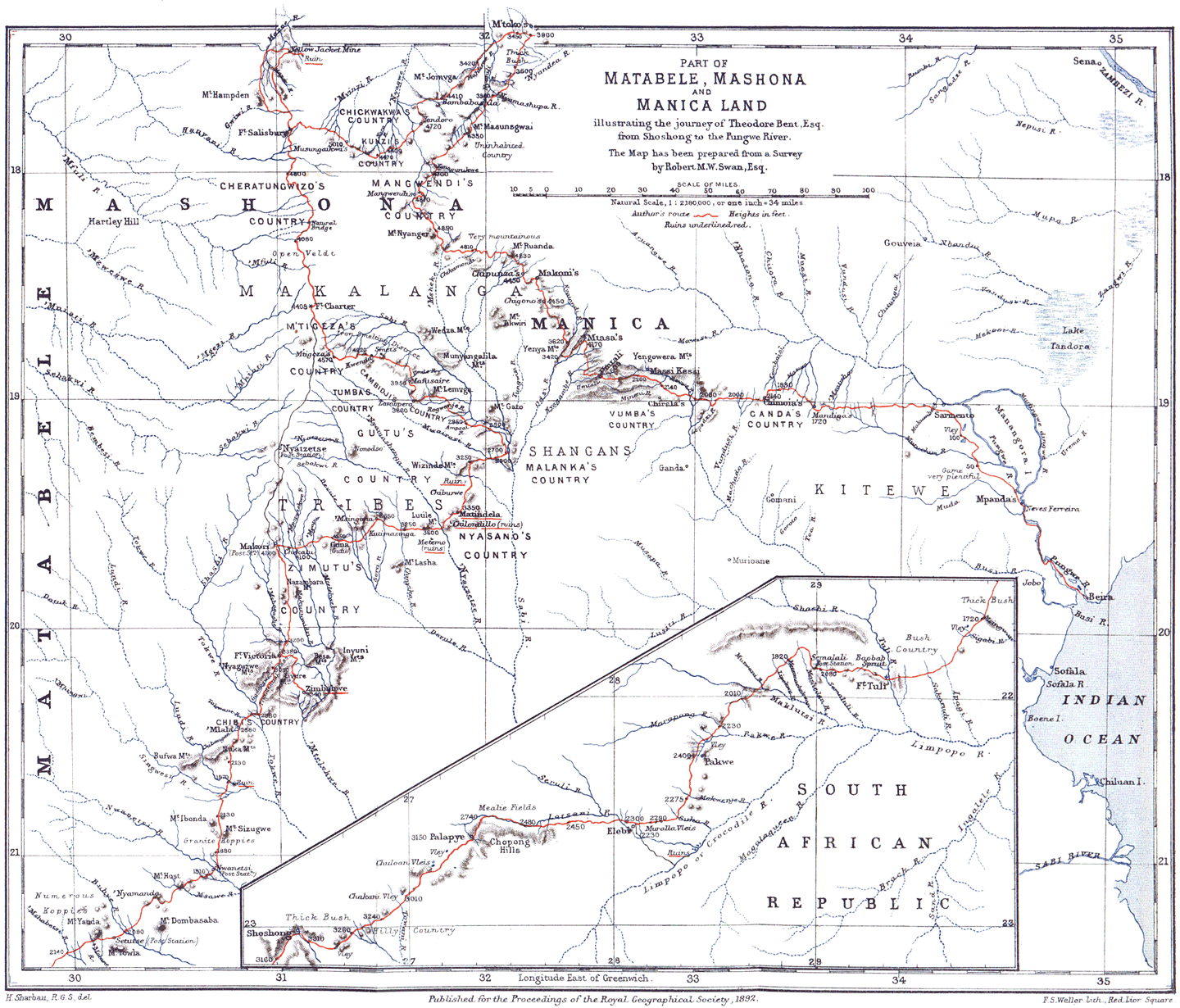
Part of MATABELE, MASHONA and MANICA LAND
Spottiswoode & Co. Printers, New-street Square, London.