SECTION ONE Flying Saucer Crashes and Alien Bodies
Reading edition
The most puzzling and intriguing element of the complex series of events now known as the Roswell Incident, are the alleged sightings of alien bodies. The bodies turned what, for many years, was just another flying saucer story, into what many UFO proponents claim is the best case for extraterrestrial visitation of Earth. The importance of bodies and the assumptions made as to their origin is illustrated in a passage from a popular Roswell book:
Crashed saucers are one thing, and could well turn out to be futuristic American or even foreign aircraft or missiles. But alien bodies are another matter entirely, and hardly subject to misinterpretation.[3]
The 1994 Air Force report determined that project Mogul was responsible for the 1947 events. Mogul was an experimental attempt to acoustically detect suspected Soviet nuclear weapon explosions and ballistic missile launches.[4] Mogul utilized acoustical sensors, radar reflecting targets and other devices attached to a train of weather balloons over 600 feet long. Claims that the U.S. Army Air Forces recovered a “flying disc” in 1947, were based primarily on the lack of identification of the radar targets, an element of weather equipment used on the long Mogul balloon train. The oddly constructed radar targets were found by a New Mexico rancher during the height of the first U.S. flying saucer wave in 1947.[5] The rancher brought the remnants of the balloons and radar targets to the local sheriff after he allegedly learned of the broadcasted reports of flying discs. However, following some initial confusion at Roswell Army Air Field, the “flying disc” was soon identified by Army Air Forces officials as a standard radar target.[6]
From 1947 until the late 1970s, the Roswell Incident was essentially a non-story. The reports that existed contain only descriptions of mundane materials that originated from the Project Mogul balloon train—“tinfoil, paper, tape, rubber, and sticks.”[7] The first claim of “bodies” appeared in the late 1970s, with additional claims made during the 1980s and 1990s. These claims were usually based on anecdotal accounts of second- and third-hand witnesses collected by UFO proponents as much as 40 years after the alleged incident. The same anecdotal accounts that referred to bodies also described massive field operations conducted by the U.S. military to recover crash debris from a supposed extraterrestrial spaceship.
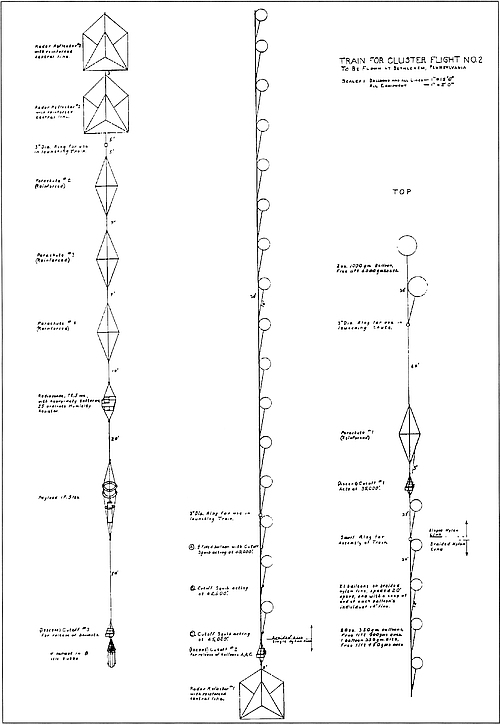
Fig. 3. An illustration of a Project Mogul balloon train similar to one found on a ranch 75 miles northwest of Roswell, N.M. in June 1947, which contains all of the “strange” materials described as part of a “flying disc.” Initial confusion at Roswell AAF and delayed identification of this equipment was the first in a series of unrelated events now known as the “Roswell Incident.” TRAIN FOR CLUSTER FLIGHT NO. 2 To Be Flown at Bethlehem, Pennsylvania
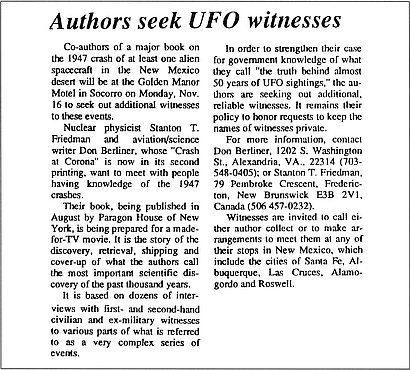
A technique used by some UFO authors to collect anecdotal corroboration for their theories was to solicit cooperating witnesses through newspaper announcements. For example, one such solicitation appeared in the Socorro (N.M.) Defensor Chieftain on November 4, 1992, on behalf of Don Berliner and Stanton T. Friedman, the authors of the book Crash at Corona. This request solicited persons to provide information about the supposed crashes of alien spacecraft in the Socorro area.[8]*
* Socorro, N.M. is situated at the northwest boundary of White Sands Missile Range, the largest military test range in the United States. Since the 1940s, White Sands and the surrounding areas of New Mexico have been the site of a high volume of military test and evaluation activity, including the launch and recovery of anthropomorphic dummies carried aloft by high altitude balloons.
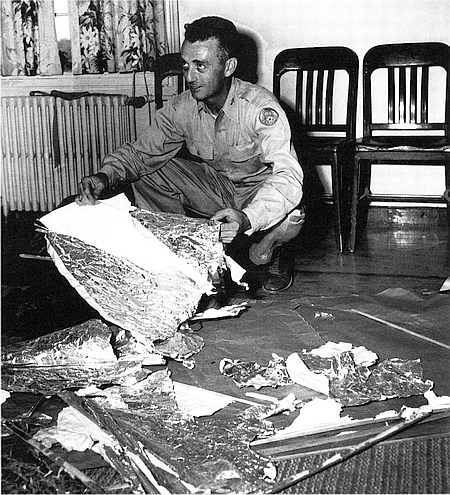
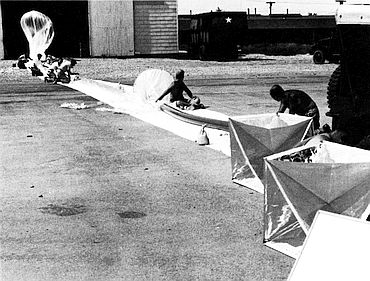
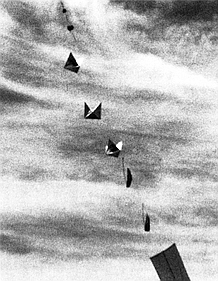
Fig. 4. (left) Maj. Jesse Marcel, an intelligence officer from Roswell Army Air Field, with the debris found 75 miles northwest of Roswell in June 1947. When compared to a standard radar target used by project Mogul, it is clear that they are the same object. (Courtesy, Special Collections Division, the University of Texas at Arlington Libraries, Arlington, Tex.) Fig. 5 & 6. (Below, left and right) Constructed of aluminized paper glued and taped to a balsa wood frame, several ML-307B/AP radar targets were used on the Mogul balloon train to make it visible to radar. (U.S. Air Force photos)
Go to transcription of text
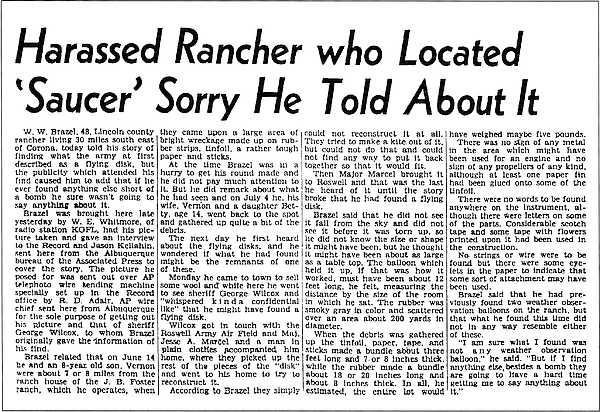
Fig. 7. This account from the July 9, 1947 Roswell Daily Record, described the materials “tinfoil, paper, rubber, tape, and sticks” found on the ranch 75 miles northwest of Roswell, in June 1947.
In response to the newspaper announcement, two scientists central to the actual explanation of the “Roswell” events, Professor Charles B. Moore, a former U.S. Army Air Forces contract engineer, and Bernard D. Gildenberg, retired Holloman AFB Balloon Branch Physical Science Administrator and Meteorologist, came forward with pertinent information.[9] According to Moore and Gildenberg, when they met with the authors their explanations that some of the Air Force projects they participated in were most likely responsible for the incident, they were summarily dismissed. The authors even went so far as to suggest that these distinguished scientists were participants in a multifaceted government cover-up to conceal the truth about the Roswell Incident.
Go to transcription of text
Fig. 8. Announcement from the November 4, 1992 Socorro (N.M.) Defensor Chieftain soliciting witnesses of flying saucer crashes in New Mexico. When former Air Force scientists responded to advise the authors that Air Force projects were most probably responsible for the UFO accounts, they were summarily dismissed by the authors who placed the announcement, and then were accused of participating in a cover-up.
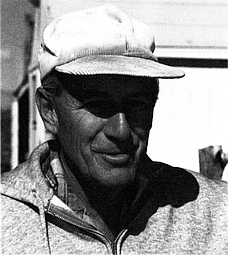
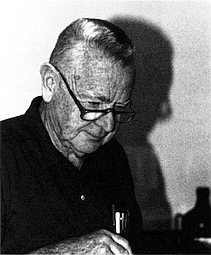
Fig. 9. (Left) B.D. “Duke” Gildenberg served as the civilian meteorologist, engineer, and physical science administrator for the Holloman AFB Balloon Branch from 1951–1981. Gildenberg actively participated in thousands of high altitude balloon operations, including the flights that dropped anthropomorphic dummies at off-range locations throughout New Mexico. Gildenberg, the “father” of Air Force scientific ballooning, was instrumental in identifying the many actual Air Force activities now known as the “Roswell Incident.” Fig. 10. (Right) Charles B. Moore, Professor Emeritus of Atmospheric Physics at the New Mexico Institute of Mining and Technology, was the project engineer for New York University under contract to the U.S. Army Air Forces to develop high altitude balloon technology for Project Mogul. Moore launched the balloon train on June 4, 1947, that when combined with other events, are now known as the “Roswell Incident.”
Since many of the Roswell accounts and allegations were collected by irregular methods and are not specifically documented, the series of events as alleged by UFO theorists has become very complex and requires clarification. Therefore, the following section will briefly examine some of the more confusing elements of the Roswell stories, specifically, the multiple crash sites and complex scenarios, in order to facilitate an objective analysis of actual events.
1.1 The “Crash Sites,” Scenarios, and Research Methods
The “Crash Sites”
From 1947 until the late 1970s, the Roswell Incident was confined to one alleged crash site. This site, located on the Foster Ranch approximately 75 miles northwest of the city of Roswell, was the actual landing site of a Project Mogul balloon train in June 1947.[10] The Mogul landing site is referred to in popular Roswell literature as the “debris field.”
In the 1970s, the 1980s and throughout the 1990s, additional witnesses came forward with claims and descriptions of two other alleged crash sites. One of these sites was supposedly north of Roswell, the other site was alleged to have been approximately 175 miles northwest of Roswell in an area of New Mexico known as the San Agustin Plains.[11] What distinguished the two new crash sites from the original debris field were accounts of alien bodies.
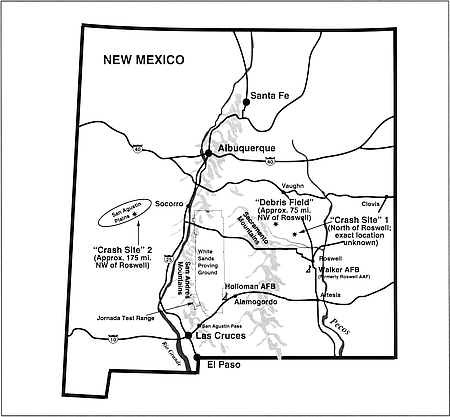
Fig. 11. Map of New Mexico depicting the “crash sites” and “debris field.”
“It must be emphasized that the claims of bodies only became part of the Roswell Incident after 1978, when they were erroneously linked to the July 1947 retrieval of Project Mogul components.”
The Scenarios
UFO enthusiasts have attempted to explain the obvious contradiction of multiple impact sites involving only one alien craft through the introduction of complicated scenarios. These scenarios have become increasingly convoluted since the proponents of each crash site must make allowances to have “their” flying saucer at the correct time and place—the actual Mogul balloon train landing site in early July, 1947—in order to “fit” with the rest of the story. The actual Project Mogul landing site, 75 miles northwest of Roswell, lends credibility, and more importantly establishes a time frame, for the other accounts that include reports of bodies. Flying saucer enthusiasts use the documented presence of U.S. Army Air Forces personnel at the Mogul site in July 1947, who were there to retrieve the Mogul balloon train, to provide the nucleus of unrelated and much later accounts that include reports of “bodies.” It must be emphasized that the claims of “bodies” only became part of the Roswell Incident after 1978, when they were erroneously linked to the July 1947 retrieval of Project Mogul components.
In general, “Roswell Incident” scenarios claim that a disabled alien craft momentarily touched down at the site 75 miles northwest of Roswell, leaving behind parts of the spaceship (material that has been subsequently identified as components of a Mogul balloon train) to create the original “debris field.” The scenarios further contend that the damaged craft again became airborne and flew to its final crash site, at either the location north of Roswell or 175 miles northwest of Roswell on the San Agustin Plains.
Regardless of the dispute over the location, an element common to most scenarios was that, once recovered, the bodies were supposedly transported to the hospital at Roswell Army Air Field for autopsy. Also common to these theories is that the bodies were later shipped from Roswell AAF to another facility, usually Wright-Patterson AFB, Ohio (or a host of other facilities—this is another area of further disagreement among UFO theorists) for further evaluation and ultimate deep-freeze storage.
Research Methods
In an attempt to untangle this collection of complicated assertions and determine if there was any validity to the reports of bodies, Air Force researchers faced the task of sorting through and examining anecdotal testimony of hundreds of witnesses. However, a large number of the accounts were eliminated by applying previously established facts to the testimonies. The July 1994 report to the Secretary of the Air Force clearly presented and documented these facts:
a. The U.S. Army Air Forces did not recover an extraterrestrial vehicle and alien crew. This conclusion was based on extensive research that included a thorough review of both classified and unclassified materials at record depositories, archives, libraries and research facilities throughout the nation. Of the millions of pages of material reviewed, there was no mention of any activities that even tangentially suggested such an event. Additionally, former and retired Air Force members and civilian contract scientists were located and released from any possible nondisclosure agreements they may have entered into regarding past classified activities. This release allowed them to freely discuss with Air Force researchers, or any other persons, information related to this issue. These releases were issued at the express written direction of the Secretary of the Air Force. Interviews with these persons yielded no information supporting extraterrestrial claims or any other unusual activities.
b. The reports of bodies were not associated with Project Mogul. The Mogul balloon train did not, was not designed to, nor could it carry passengers. Neither did it carry hazardous materials that would have caused injury, death, or mutilation to persons who may have come in contact with any of its components.
c. Actual events, if any, that inspired reports of bodies did not occur in 1947. Based on extensive examinations of U.S. Army Air Forces activities in 1947, no evidence was found to support allegations that the Army Air Forces was involved in any uncommon operations other than the retrieval of the Mogul balloon train in the Roswell area in July 1947. Examination of research and development projects, aircraft crashes, errant missiles and possible nuclear accidents yielded no information to support a 1947 claim.
In light of these documented facts, the hundreds of anecdotal accounts were reduced to a few. Eliminated were accounts that were likely descriptions of materials known to be part of the Project Mogul balloon train and accounts describing transportation of these materials.
From the remaining testimony, Air Force researchers developed the following set of working hypotheses to assist in identifying the actual events, if any, matching those described by the witnesses.
a. Due to the number and great detail provided in some of the accounts, it was likely that some event(s) actually did occur.
b. Due to the many similarities of the two crash site descriptions and the considerable distance between them, it was likely that more than one event with similar characteristics was the basis for these accounts.
c. Since the account of bodies at the Roswell Army Air Field hospital did not contain elements similar to reports of the two crash sites, it was likely that this account was unrelated to the crash site accounts. (The hospital account will be addressed separately in Section Two of this report.)
The remaining testimony was examined with regard both to the facts and to working hypotheses to determine if there were common threads or links connecting any of the accounts. If similarities were found, the next step was to determine if they were related to an actual event. Finally, if there were actual event(s), were they part of U.S. Air Force or U.S. Government activities?
Common Threads
Careful examination of the testimony revealed that primary witnesses of the two “crashed saucer” locations contained descriptions common to both. These areas of commonality contained both general and detailed characteristics. However, before continuing, the accounts were carefully examined to determine if the testimony related by individual witnesses were of their own experiences and not a recitation of information given by other persons. While many aspects of the remaining accounts were judged to be similar, other aspects were found to be significantly different. The accounts on which the analysis is based were determined, in all likelihood, to have been independently obtained or observed by the witnesses.
General Similarities. The testimony presented for both crash sites generally followed the same sequence of events. The witnesses were in a rural and isolated area of New Mexico. In the course of their travels in this area, they came upon a crashed aerial vehicle. The witnesses then proceeded to the area of the crash to investigate and at some distance they observed strange looking “beings” that appeared to be crewmembers of the vehicle. Soon thereafter, a convoy of military vehicles and soldiers arrived at the site. Military personnel allegedly instructed the civilians to leave the area and forget what they had seen. As the witnesses left the area, the military personnel commenced with a recovery operation of the crashed aerial vehicle and “crew.”
Detailed Similarities. Along with general similarities in the testimonies, there also existed a substantial amount of similar detailed descriptions of the “aliens,” and the military vehicles and procedures allegedly used to recover them.
The first obvious similarity was the descriptions of the aliens. Mr. Gerald Anderson, an alleged witness of events at the site 175 miles northwest of Roswell, recalled, “I thought they were plastic dolls.”[12] Mr. James Ragsdale, an alleged witness of the site north of Roswell, stated, “They were using dummies in those damned things.”[13] Another alleged witness to a “crash” north of Roswell, Frank J. Kaufman, recalled that there was “talk” that perhaps an “experimental plane with dummies in it” was the source of the claims.[14]
Additional similarities were also noted. Mr. Vern Maltais, a secondhand witness of the site 175 miles northwest of Roswell, described the hands of the “aliens” as, “They had four fingers.”[15] Anderson characterized the hands as, “They didn’t have a little finger.”[16] He also described the heads of the aliens as “completely bald”[17] while Maltais described them as “hairless.”[18] The uniforms of the aliens were independently described by Anderson as “one-piece suits ... a shiny silverish-gray color”[19] and by Maltais as “one-piece and gray in color.”[20] The date of this event was also not precisely known. Maltais recalled that it may have occurred “around 1950”[21] and another secondhand witness, Alice Knight stated, “I don’t recall the date.”[22]
Witnesses of different sites also used the terms “wrecker”[23] and “six-by-six”[24] when they described the military vehicles present at the different recovery sites. One witness described seeing a “medium sized Jeep/truck”[25] and another witness described seeing a “weapons carrier”[26] (a weapons carrier is a mid-sized Jeep-type truck).
The Research Profile
When the general and specific similarities were combined, a profile emerged describing the event or activity that might have been observed. The profile, which contains elements common to at least two, and in some cases, all of the accounts, established a set of criteria used to determine what the witnesses may have observed. The profile is as follows:
a. An activity that, if viewed from a distance, would appear unusual.
b. An activity of which the exact date is not known.
c. An activity that took place in two rural areas of New Mexico.
d. An activity that involved a type of aerial vehicle with dolls or dummies that had four fingers, were bald, and wore one-piece gray suits.
e. An activity that required recovery by numerous military personnel and an assortment of vehicles that included a wrecker, a six-by-six, and a weapons carrier.
Based on this profile, research was begun to identify events or activities with these characteristics. Due to the location of the sites, attention was focused on Roswell AAF (renamed Walker AFB in 1948), White Sands Missile Range and Holloman AFB, N.M. The aerial vehicles assigned or under development at these facilities were aircraft, missiles, remotely-piloted drones, and high altitude balloons. The operational characteristics and areas where these vehicles flew were researched to determine if they played a role in the events described by the witnesses.
Missiles and Drones. Missiles and drones were determined not to have been responsible for the accounts.* The areas where the alleged crashes took place were, in all likelihood, too far from the White Sands Missile Range. Missiles were equipped with a self-destruct mechanism that was activated if it strayed off-course or out of the White Sands Missile Range. There was never a program that required a dummy or doll to be placed inside a missile or a drone. However, missiles were launched from White Sands carrying monkeys and other small animals aloft for scientific research.[27] These projects were well documented, and none of these missiles landed near either of the two crash sites.
* From September 1961 until March 1965 12 Atlas F intercontinental ballistic missiles (ICBMs) were deployed by the 579th Strategic Missile Squadron in areas surrounding Walker AFB, N.M. These missiles were determined not to have been involved in the Roswell Incident.
Aircraft. Aircraft seemed just as unlikely as missiles to have been responsible for the extraterrestrial claims as outlined in the profile. Although additional research revealed the significant role dummies played in the test and evaluation of aircraft emergency escape systems, these dummies were used on board aircraft and on the high-speed test track at Holloman AFB. However, aircraft test flights demanded strict adherence to established flight profiles over the instrumented portions of the White Sands Missile Range, many miles from the alleged crash sites. Dummies used on the high-speed track remained in the immediate vicinity of the track facilities at Holloman AFB. This geographical impossibility ruled out dummies that were ejected from aircraft and those used on the high-speed track as a cause of alleged alien sightings. (Aircraft accidents will be discussed extensively in Section Two of this report.)
Figs. 12 & 13. Missiles (left) and drones (right) under development at Holloman AFB, N.M. were determined not to have been involved in the “Roswell Incident.” (U.S. Air Force photos)
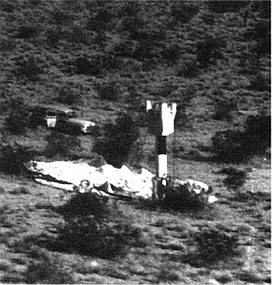
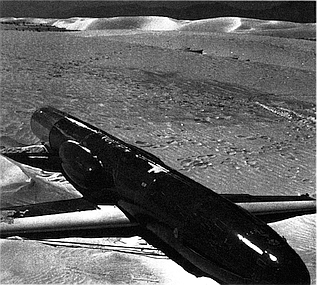
High Altitude Research Balloons. The only vehicles not yet evaluated as a possible source of the accounts were high altitude research balloons. Previous reviews of early research balloon flight records revealed that trajectories of high altitude balloons were, at times, unpredictable and did not usually remain over Holloman AFB or White Sands Missile Range.[28] Many of the scientific payloads required recovery so the data collected during flight could be returned to the laboratory for analysis.
These characteristics seemed to fit at least some of the research profile. Atmospheric sampling apparatus or weather instruments, the typical payload of many high altitude balloons, could hardly have been mistaken for space aliens. A careful examination of the instruments carried aloft by the high altitude balloons revealed that one unique project used a device that very likely could be mistaken for an alien—an anthropomorphic dummy.
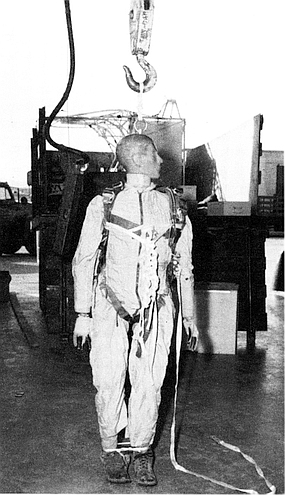
An anthropomorphic dummy is a human substitute equipped with a variety of instrumentation to measure effects of environments and situations deemed too hazardous for a human. These abstractly human dummies were first used in New Mexico in May 1950, and have been used on a continuous basis since that time.[29]
In the 1950s, anthropomorphic dummies were not widely exposed outside of scientific research circles and easily could have been mistaken for something they were not. Today, anthropomorphic dummies, better known as crash test dummies, are easily identifiable and are even the “stars” of their own automotive safety advertising campaign. During the 1950s when the U.S. Air Force dropped the odd-looking test devices from high altitude balloons in its program to study high altitude human free-fall characteristics, public awareness and stardom were decades away. It seems likely that someone who unexpectedly observed these dummies at a distance would believe they had seen something unusual. In retrospect, when interviewed over 40 years later, they could accurately report that they had seen something very unusual.
With the introduction of anthropomorphic dummies as a possible explanation for the reports of bodies, another element of the research profile appeared to be satisfied. Specific information that described the locations, methods, and procedures used to employ the dummies was required before any definitive conclusions could be drawn. To gather this detailed information, research efforts were concentrated on high altitude balloon operations and the specific projects that utilized balloon-borne anthropomorphic dummies.
Fig. 14. (Left) Example of an anthropomorphic dummy carried aloft by U.S. Air Force high altitude balloons. These dummies landed at numerous locations throughout New Mexico during the 1950s. (U.S. Air Force photo) Fig. 15. (Right) Newspaper advertisement depicting anthropomorphic dummies “Vince and Larry” “stars” of the successful advertising campaign by the National Highway Traffic Safety Administration to encourage use of safety belts. (Courtesy of NHTSA)
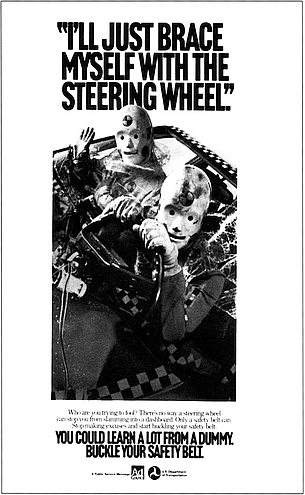
Go to transcription of text

Test Dummies Used by the U.S. Air Force
Since the beginning of manned flight, designers have sought a substitute for the human body to test hazardous new equipment. Early devices used by the predecessors of the U.S. Air Force were simply constructed parachute drop test dummies with little similarity to the human form. Following World War II, aircraft emergency escape systems became increasingly sophisticated and engineers required a dummy with more humanlike characteristics.
Parachute Drop Dummies
During World War I research and development of the first U.S. military parachute was underway at McCook Field, Ohio. To test the parachute, engineers experimented with several types of dummies, settling on a model constructed of three-inch hemp rope and sandbags with the approximate proportions of a medium-sized man.[30] The new invention was soon known by the nickname “Dummy Joe.” Dummy Joe is said to have made more than five thousand “jumps” between 1918 and 1924.[31]
By 1924, parachutes were required on military aircraft with their serviceability tested by dummies dropped from aircraft.[32] For this routine testing, several types of dummies were used. The most common type is shown in figures 17 and 18. Parachutes were individually drop-tested from aircraft until the early stages of World War II, when, due both to increased reliability and large numbers of parachutes in service, this routine practice was discontinued. Nonetheless, test dummies were still used frequently by the Parachute Branch of Air Materiel Command (AMC) at Wright Field, Ohio, to test new parachute designs.
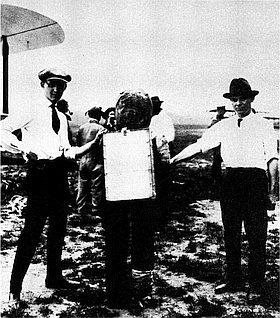
Fig. 16. “‘Dummy Joe,’ the hero of five thousand jumps” is shown here with engineers J.J. Higgins (left) and Guy Ball at McCook Field, Ohio in 1920. (U.S. Air Force photo)
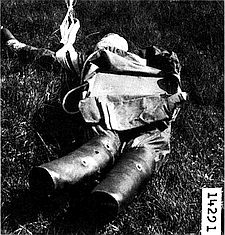
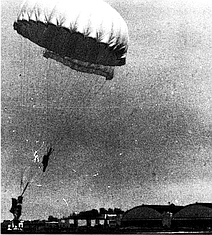
Fig. 17. (Left) Early rope and sandbag dummy used to test parachutes. (U.S. Air Force photo) Fig. 18. (Right) Parachute drop dummies in use at Wright Field, Ohio. The historic Flight Test hangars, Hangars 1 and 9, can be seen in the background. (U.S. Air Force photo)
Anthropomorphic Dummies
The ejection seat had been developed and used successfully by the German Luftwaffe during the latter stages of World War II. The utility of this invention was realized when the U.S. Army Air Forces obtained an ejection seat in 1944.[33] To properly test the ejection seat, the Army Air Forces required a dummy that had the same center of gravity and weight distribution as a human, characteristics that parachute drop dummies did not possess. In 1944, the USAAF Air Materiel Command contracted with the Ted Smith Company of Upper Darby, Pa. to design and manufacture the first dummy intended to accurately represent a human.[34] The dummy had the same basic shape as a human, but with only abstract human features, and “skin” made of canvas.
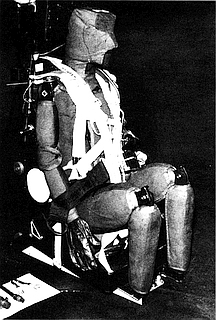
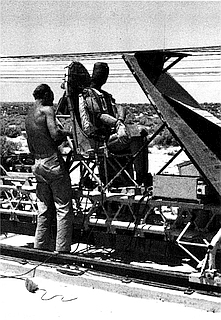
Figs. 19 & 20. (Left & Right) These early anthropomorphic dummies, manufactured by the Ted Smith Co., of Upper Darby, Pa., were used by the Army Air Forces beginning in 1944. They were replaced by a more realistic dummy in 1949. (Right) “Oscar Eightball,” the name given to this early model anthropomorphic dummy by Col. John P. Stapp, is shown following a run of the high-speed track at Muroc AAF (now Edwards AFB), Calif., in 1947. (U.S. Air Force photos)
In 1949, the U.S. Air Force Aero Medical Laboratory submitted a proposal for an improved model of the anthropomorphic dummy.[35] This request was originated by the renowned Air Force scientist and physician John P. Stapp, now a retired Colonel, who conducted a series of landmark experiments at Muroc (now Edwards) AFB, Calif., to measure the effects of acceleration and deceleration during high-speed aircraft ejections.[36] Stapp required a dummy that had the same center of gravity and articulation as a human, but, unlike the Ted Smith dummy, was more human in appearance. A more accurate external appearance was required to provide for the proper fit of helmets, oxygen masks, and other equipment used during the tests. Stapp requested the Anthropology Branch of the Aero Medical Laboratory at Wright Field to review anthropological, orthopedic, and engineering literature to prepare specifications for the new dummy.[37] Plaster casts of the torso, legs, and arms of an Air Force pilot were also taken to assure accuracy.[38] The result was a proposed dummy that stood 72 inches tall, weighed 200 pounds, had provisions for mounting instrumentation, and could withstand up to 100 times the force of gravity or 100Gs.
In 1949, a contract was awarded to Sierra Engineering Company of Sierra Madre, Calif., and deliveries began in 1950.[39] This dummy quickly became known as “Sierra Sam.”
In 1952, a contract for anthropomorphic dummies was awarded to Alderson Research Laboratories, Inc., of New York City.[40] Dummies constructed by both companies possessed the same basic characteristics: a skeleton of aluminum or steel, latex or plastic skin, a cast aluminum skull, and an instrument cavity in the torso and head for the mounting of strain gauges, accelerometers, transducers, and rate gyros.[41] Models used by the Air Force were primarily parachute drop and ejection seat versions with center of gravity tolerances within one quarter inch.
Over the next several years the two companies improved and redesigned internal structures and instrumentation, but the basic external appearance of the dummies remained relatively constant from the mid 1950s to the late 1960s. Dummies of these types were most likely the “aliens” associated with the “Roswell Incident.”
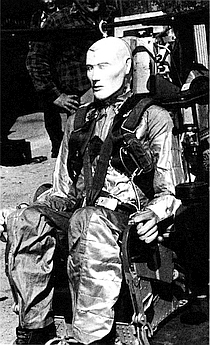
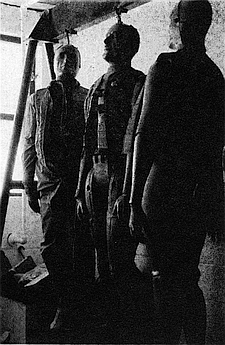
Figs. 21 & 22. Examples of a “Sierra Sam” (left) and Alderson Laboratories anthropomorphic dummies (right) of the type dropped from balloons at off-range locations throughout New Mexico during the 1950s. (U.S. Air Force photos)
1.2 High Altitude Balloon Dummy Drops
From 1953 to 1959, anthropomorphic dummies were used by the U.S. Air Force Aero Medical Laboratory as part of the high altitude aircraft escape projects High Dive and Excelsior.[42] The object of these studies was to devise a method to return a pilot or astronaut to earth by parachute, if forced to escape at extreme altitudes.[43]
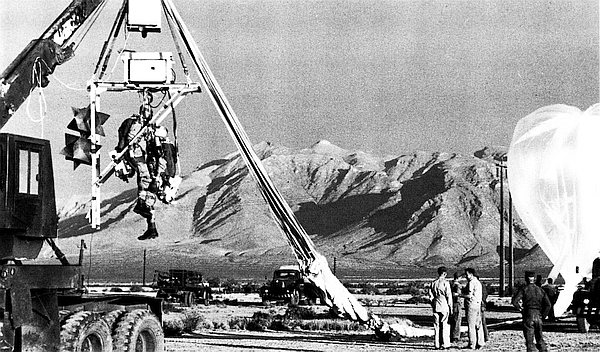
Fig. 23. Project High Dive anthropomorphic dummy launch, White Sands Proving Ground, N.M., June 11, 1957. (U.S. Air Force photo)
Anthropomorphic dummies were transported to altitudes up to 98,000 feet by high altitude balloons. The dummies were then released for a period of free-fall while body movements and escape equipment performance were recorded by a variety of instruments. Forty-three high altitude balloon flights carrying 67 anthropomorphic dummies were launched and recovered throughout New Mexico between June 1954 and February 1959.[44] Due to prevailing wind conditions, operational factors and ruggedness of the terrain, the majority of dummies impacted outside the confines of military reservations in eastern New Mexico, near Roswell, and in areas surrounding the Tularosa Valley in south central New Mexico.[45] Additionally, 30 dummies were dropped by aircraft over White Sands Proving Ground, N.M. in 1953. In 1959, 150 dummies were dropped by aircraft over Wright-Patterson AFB, Ohio (possibly accounting for alleged alien “sightings” at that location).[46]
Anthropomorphic Dummy Launch and Landing Locations
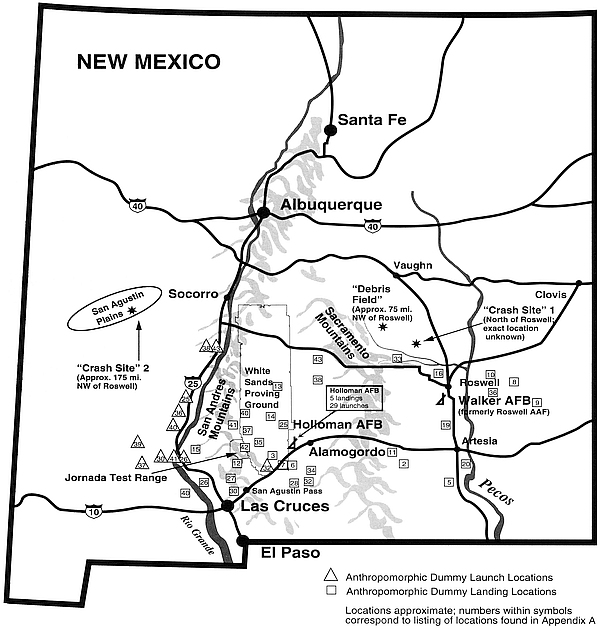
Source: Test records of U.S. Air Force aeromedical project no. 7218, task 71719 (High Dive) and project no. 7222, task 71748 (Excelsior).
A number of these launch and recovery locations were in the areas where the “crashed saucer” and “space aliens” were allegedly observed.
Following the series of dummy tests, a human subject, test pilot Capt. Joseph W. Kittinger, Jr., now a retired Colonel, made three parachute jumps from high altitude balloons. Since free-fall tests from these unprecedented altitudes were extremely hazardous, they could not be accomplished by a human until a rigorous testing program using anthropomorphic dummies was completed.
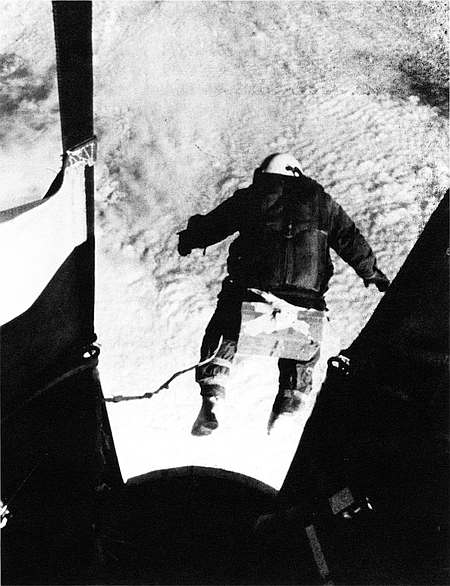
Fig. 25. “Lord, take care of me now,” were Capt. Joseph W. Kittinger, Jr.’s words as he exited the Excelsior III balloon gondola at 102,800 feet on August 16, 1960, over White Sands Proving Ground, N.M. Kittinger’s courageous scientific achievement remains, to this day, the highest parachute jump ever accomplished. (U.S. Air Force photo)
A Cover-Up?
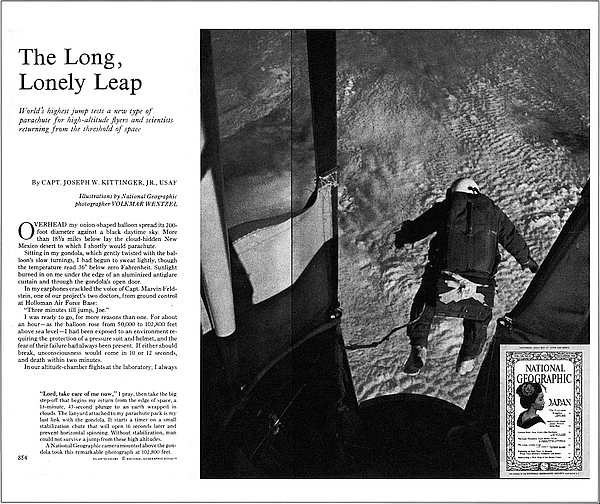
Countering claims of a cover-up, Air Force projects that used anthropomorphic dummies and human subjects were unclassified and widely publicized in numerous newspaper and magazine stories, books, and television reports. These included a book written by test pilot Kittinger, The Long, Lonely Leap, another book, Man High, by Man High Project Scientist, Lt. Col. David G. Simons (MC), a feature article in National Geographic, and cover stories in Life, Collier’s, Popular Mechanics, and Time.[47] A characterization of Kittinger’s record parachute jump even appeared in the adolescent magazine, MAD.[48] The intense public interest in High Dive, Excelsior and other aero medical projects conducted at Holloman AFB also resulted in a 1956 Twentieth Century Fox full-length motion picture, On the Threshold of Space (see page 38).
Fig. 26. This photo of Capt. Joseph W. Kittinger, Jr. taken by a remotely operated camera on the Excelsior III gondola, was featured in the December 1960 National Geographic.
Go to transcription of text
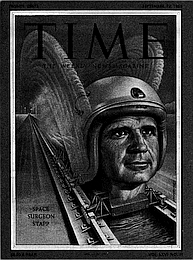
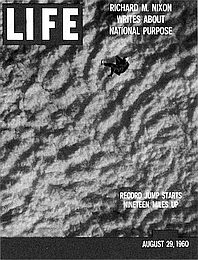
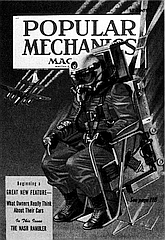
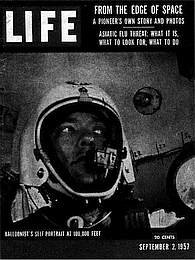
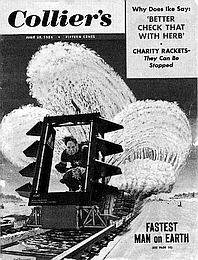
Fig. 27. Contemporary magazines that featured experiments at Holloman AFB, N.M. Clockwise from top left, Time, September 12, 1955; Life, August 29, 1960; Popular Mechanics Magazine, (center) January 1951; Collier’s, June 25, 1954; and Life, September 2, 1957.
Dummy Drop Procedures
For the majority of the tests, dummies were flown to altitudes between 30,000 and 98,000 feet attached to a specially designed rack suspended below a high altitude balloon.[49] On several flights the dummies were mounted in the door of an experimental high altitude balloon gondola.[50] Upon reaching the desired altitude, the dummies were released and free-fell for several minutes before deployment of the main parachute.
Fig. 28. (Left) Witnesses at both flying saucer “crash” sites stated that a “wrecker” was used in the recovery of the “alien” craft. This was a likely reference to the M-342 five-ton wrecker, used to launch and recover anthropomorphic dummies. Fig. 29. (Right) Three tests utilized anthropomorphic dummies mounted in the door of an experimental Project High Dive gondola. This launch took place on October 8, 1957, in front of curious onlookers at the public picnic area of White Sands National Monument, N.M. (U.S. Air Force photo)
The dummies used for the balloon drops were outfitted with standard equipment of an Air Force aircrew member. This equipment consisted of a one-piece flightsuit, olive drab, gray (witnesses had described seeing aliens in gray one-piece suits) or fuchsia in color, boots, and a parachute pack.[51] The dummies were also fitted with an instrumentation kit that contained accelerometers, pressure transducers, an oscillograph, and a camera to record movements of the dummy during free-fall.[52]
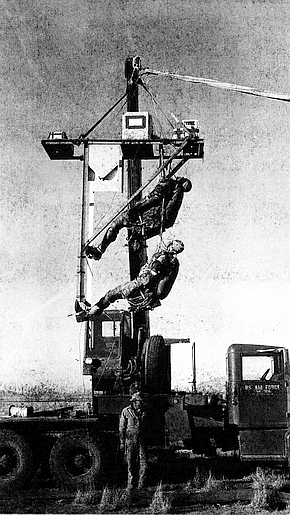
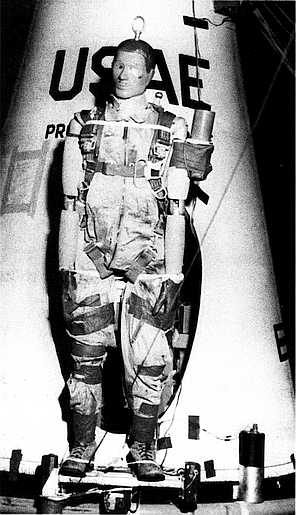
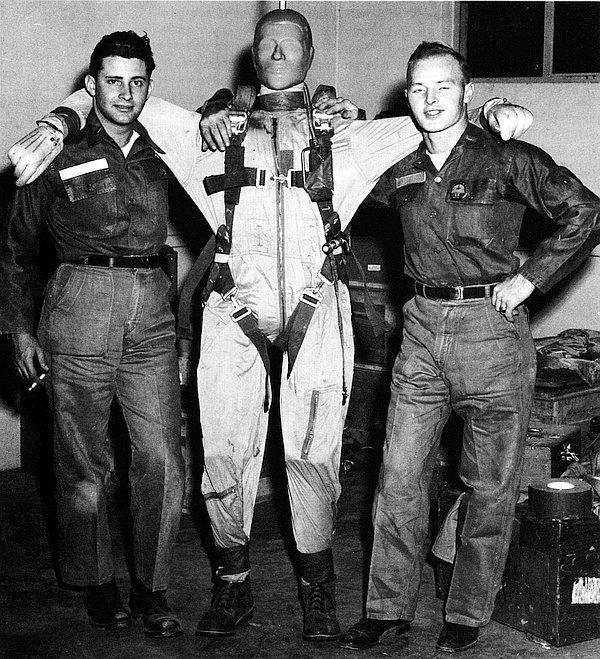
Fig. 30. A “Sierra Sam” with High Dive Project Officers 1st Lts. Eugene M. Schwartz (left) and Raymond A. Madson (right). This dummy is outfitted in a “sage green” colored flightsuit (a shade of gray) with red tape sealing its neck, wrists, and ankles. (U.S. Air Force)
Recoveries of the test dummies were accomplished by personnel from the Holloman AFB Balloon Branch.[53] Typically, eight to twelve civilian and military recovery personnel arrived at the site of an anthropomorphic dummy landing as soon as possible following impact. The recovery crews operated a variety of aircraft and vehicles. These included a wrecker, a six-by-six, a weapons carrier, and L-20 observation and C-47 transport aircraft—the exact vehicles and aircraft described by the witnesses as having been present at the crashed saucer locations.[54] On one occasion, just southwest of Roswell, a High Dive project officer, 1st Lt. Raymond A. Madson, even conducted a search for dummies on horseback[55] (see statement in Appendix B).
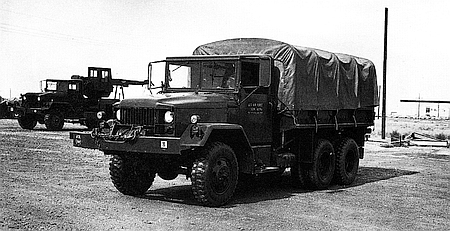
Fig. 31. An M-35 2½-ton cargo truck, commonly referred to as a “six-by-six,” were used by the Holloman Balloon Branch to launch and recover anthropomorphic dummies and suspension racks at numerous locations throughout New Mexico. (U.S. Air Force photo)
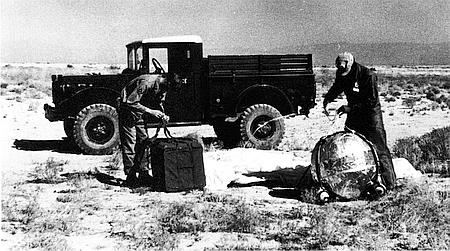
Fig. 32. M-37 ¾-ton utility trucks, known as “weapons carriers,” were used for high altitude balloon recoveries by the Holloman Balloon Branch during the 1950s. Here, recovery technicians use an M-37 to retrieve an Aero Medical gondola from a location on Holloman AFB, N.M. (U.S. Air Force photo)
To expedite the recoveries, crews were prepositioned with their vehicles along a paved highway in the area where impact was expected.[56] On a typical flight the dummies were separated from the balloon by radio command and descended by parachute.[57] Prompt recovery of the dummies and their suspension racks, which usually did not land in the same location resulting in extensive ground and air searches, was essential for researchers to evaluate information collected by the instrumentation and cameras. To assist the recovery personnel, a variety of methods were used to enhance the visibility of the dummies: smoke grenades, pigment powder, and brightly colored parachute canopies.[58] Also, recovery notices promising a $25 reward were taped to an exposed portion of a dummy.[59] Local newspapers and radio stations were contacted when equipment was lost.[60]
The Bravest Man
America was introduced to Col. John Paul Stapp on December 10, 1954, when he became known as both the “the bravest” and “the fastest” man on earth. Stapp earned these titles following a rocket sled test that accelerated him to 632 miles per hour. He reached this speed in just five seconds—faster than a .45 caliber bullet—and was decelerated to a stop in 1.4 seconds, subjecting his body to more than 42 times the force of gravity! While this was America’s introduction to Col. Stapp, the 1954 rocket sled test that examined aircraft restraint devices and human responses to accelerative/decelerative forces and windblast, was just one of many achievements of this legendary Air Force physician.
Born in Bahia, Brazil to American missionary parents, Stapp sold pots and pans door to door during the Depression while he earned both undergraduate and graduate degrees in zoology and chemistry at Baylor University. He went on to earn a doctorate in biophysics from the University of Texas, and a doctorate in medicine from the University of Minnesota.
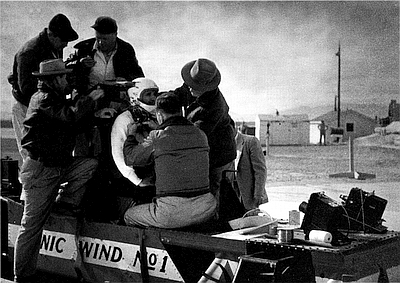
Fig. 33. The first “space doctor,” Lt. Col. John P. Stapp (now a retired Colonel) being strapped into the rocket sled Sonic Wind No 1, on December 10, 1954, at Holloman AFB, N.M. Courageously, Stapp was his own volunteer subject on 29 rocket sled tests and earned two awards of the Legion of Merit and the Cheney Award for valor and self-sacrifice. (U.S. Air Force photo)
In 1944 Stapp entered the U.S. Army Air Forces and became a flight surgeon. From 1946 to 1963, due to his unique qualifications in biophysics and medicine, he conducted a series of acceleration/deceleration experiments on the high-speed track at Muroc (now Edwards AFB), Calif.,[61] and later at Holloman AFB, N.M. Developments from these and other studies resulted in innovations which have saved many lives. These included improved safety belt restraint systems and design specifications for aircraft and automobiles, aircraft ejection and emergency escape systems, refinement of automobile airbag systems, and development of the modern anthropomorphic test dummy.
As commander of the U.S. Air Force Aeromedical Field Laboratory at Holloman AFB, N.M. and later the Aero Medical Laboratory at Wright-Patterson AFB, Ohio, Stapp won support for the Air Force manned high altitude balloons projects—Man High and Excelsior. As a testament to his thorough safety preparations, these and other extremely hazardous projects administered by Stapp, did not result in a single debilitating injury to a test subject. These projects helped pave the way for future flights of both high altitude aircraft such as the X-15, and of spacecraft for the Mercury, Gemini, and Apollo programs. In fact, Stapp’s expertise was called upon to assist in the selection of the initial cadre of astronauts, the “Mercury Seven.”
He retired from the Air Force in 1970, but not before amassing a collection of awards and honors. These included two awards of the Legion of Merit for rocket sled experiments, the Cheney Award for 1954, and membership in the National Aviation Hall of Fame.
In association with the Society of Automotive Engineers, Stapp continues to participate in annual conferences in which industry experts assemble to discuss vehicle safety issues. The conferences, now in their 40th year bear his name: the Stapp Car Crash Conferences.
In 1991, in recognition of a lifetime of unselfish dedication to scientific research, Stapp was awarded the National Medal of Technology, bestowed upon him at the White House by President George Bush.
He is married to the former Lillian Lanese, a former soloist with the Ballet Theater of New York, and resides in Alamogordo, N.M. At 87 years old he continues to maintain a dizzying pace of travel and lectures.
It is not an exaggeration that virtually every person who has safely operated, or ridden in, an automobile, aircraft, or spacecraft, has benefited from the genius of Col. John Paul Stapp, and owes this brave scientist, physician, and visionary, a great deal of thanks.
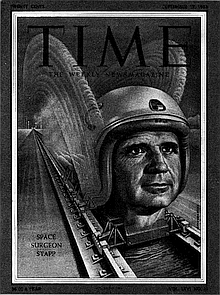
Fig. 34. September 12, 1955 edition of Time featuring Col. John P. Stapp and his rocket sled experiments at Holloman AFB, N.M.
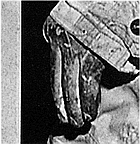
Despite these efforts, the dummies were not always recovered immediately; one was not found for nearly three years and several were not recovered at all.[62] When they were found, the dummies and instrumentation were often damaged from impact.[63] Damage to the dummies included loss of heads, arms, legs and fingers.[64] This detail, dummies with missing fingers, appears to satisfy another element of the research profile—aliens with only four fingers.
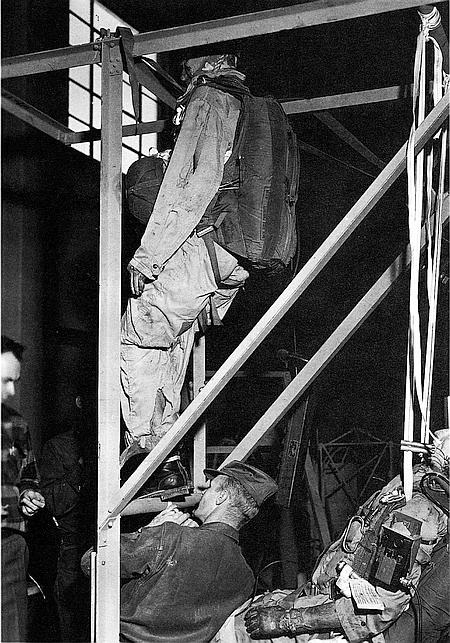
Fig. 35. Rough treatment and parachute failures during balloon drops often caused damage to the hands of the dummies. This detail, “beings” with “four fingers,” was related by two witnesses as a distinguishing feature of the Roswell aliens. (U.S. Air Force photo)
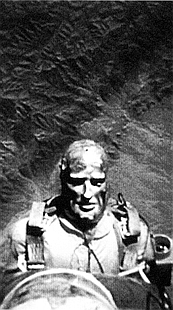
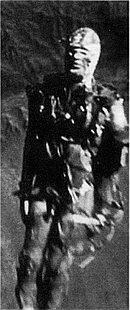
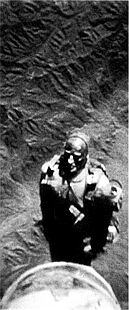
Figs. 36–38. Actual photographs of an Alderson Laboratories type anthropomorphic dummy falling away from its suspension rack at high altitude over New Mexico. Fig. 37 (center) appears on the cover of this publication. (U.S. Air Force photos)
Go to transcription of text
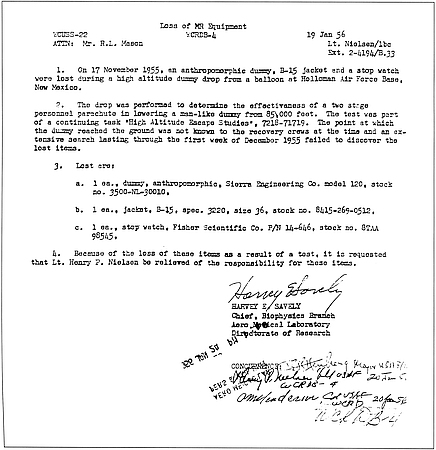
Fig. 39. Memo taken from Project High Dive files explaining the loss of a dummy near Roswell, N.M. in November 1955.
What may have contributed to a misunderstanding if the dummies were viewed by persons unfamiliar with their intended use, were the methods used by Holloman AFB personnel to transport them. The dummies were sometimes transported to and from off-range locations in wooden shipping containers, similar to caskets, to prevent damage to fragile instruments mounted in and on the dummy.[65] Also, canvas military stretchers and hospital gurneys were used (a procedure recommended by a dummy manufacturer) to move the dummies in the laboratory or retrieve dummies in the field after a test.[66] The first 10 dummy drops also utilized black or silver insulation bags, similar to “body bags” in which the dummies were placed for flight to guard against equipment failure at low ambient temperatures of the upper atmosphere.[67]
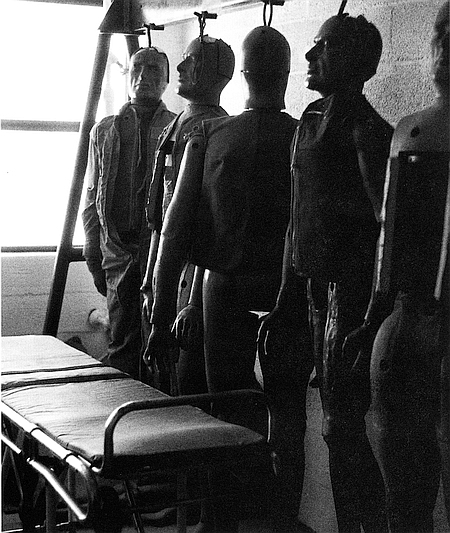
Fig. 40. Air Force personnel used stretchers and gurneys to pick up 200-pound dummies in the field and to move them in the laboratory. (U.S. Air Force photo)
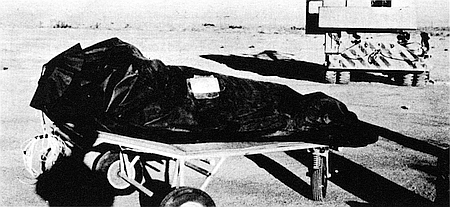
Fig. 41. For the first 10 balloon flights, dummies were placed in insulation bags to protect temperature-sensitive equipment. These bags may have been described by at least one witness as “body bags” used to recover alien victims from the crash of a flying saucer. (U.S. Air Force photo)
On one occasion northwest of Roswell, a local woman unfamiliar with the test activities arrived at a dummy landing site prior to the arrival of the recovery personnel.[68] The woman saw what appeared to be a human embedded head first in a snowbank and became hysterical. The woman screamed, “He’s dead!, he’s dead!”[69]
It now appeared that anthropomorphic dummies dropped by high altitude balloons satisfied the requirements of the research profile. However, the review of high altitude balloon operations revealed what appeared to be explanations for some other sightings of odd objects in the deserts and skies of New Mexico.
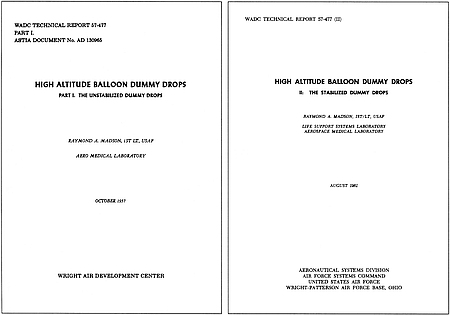
Go to transcription of text
Figs. 42 & 43. These reports detailed the methods and procedures used for the dummy tests. They may be obtained from the National Technical Information Service (NTIS), Springfield, Va.
1.3 High Altitude Balloon Operations
Research has shown that many high altitude balloons launched from Holloman AFB, N.M., were recovered in locations, and under circumstances, that strongly resemble those described by UFO proponents as the recovery of a “flying saucer” and “alien” crew. When these descriptions were carefully examined, it was clear that they bore more than just a resemblance to Air Force activities. It appears that some were actually distorted references to Air Force personnel and equipment engaged in scientific study through the use of high altitude balloons.
Since 1947, U.S. Air Force research organizations at Holloman AFB, N.M., have launched and recovered approximately 2,500 high altitude balloons. The Air Force organization that conducted most of these activities, the Holloman Balloon Branch, launched a wide range of sophisticated, and from most perspectives, odd looking equipment into the stratosphere above New Mexico. In fact, the very first high altitude data gathering balloon flight launched from Alamogordo Army Airfield (now Holloman AFB), N.M., on June 4, 1947, was found by the rancher and was the first of many unrelated events now collectively known as the “Roswell Incident.”
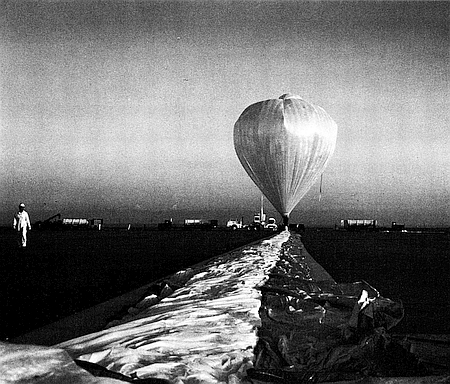
Fig. 44. Inflation of a U.S. Air Force 626 ft. long, 34.6 million cu. ft. research balloon on August 13, 1972. This balloon was launched from Roswell Industrial Air Center (formerly Roswell AAF), Roswell, N.M., to test components of the NASA Viking space probe. (photo by Ole Jorgeson)
On the Threshold of Space
In 1956, Twentieth Century Fox released On the Threshold of Space, a full-length motion picture based on Air Force aero medical projects conducted at Holloman AFB, N.M. Starring Guy Madison, John Hodiak, and Dean Jagger, this drama chronicled the high altitude balloon experiments of projects High Dive/Excelsior and the high-speed track studies conducted by Col. John P. Stapp. Filmed on location at Holloman AFB, Air Force personnel, high altitude balloons, aircraft, vehicles, and other equipment, including the actual anthropomorphic dummies responsible for sightings of aliens, were used in the making of this film.
In an ironic twist, in 1990 the television program Unsolved Mysteries, featured a segment on the Roswell Incident. The program, hosted by actor Robert Stack, depicted a dramatized version of the claims of “aliens,” space ships and mysterious government recovery crews. Interestingly, a review of newspapers from 1956 announcing the Hollywood premiere of On the Threshold of Space, listed Stack among the persons scheduled to attend this star-studded event.[70]
Fig. 45. Lobby card of the 1956 Twentieth Century Fox release, On the Threshold of Space starring Guy Madison (seated) and Martin Milner (right).
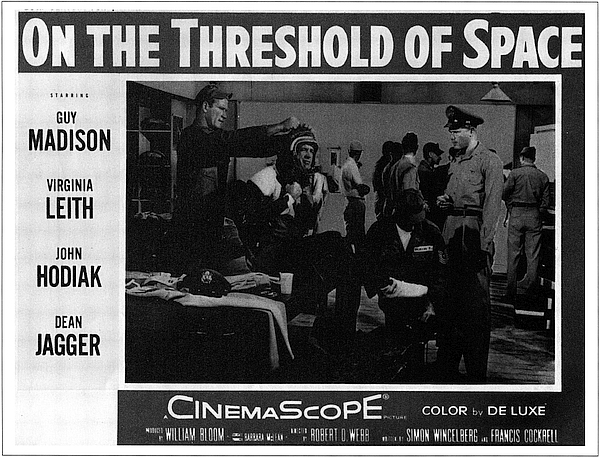
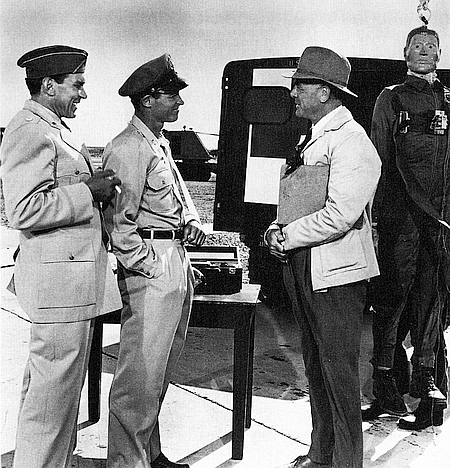
Fig. 46. Publicity photograph from On the Threshold of Space with (from left) Cameron Mitchell, Guy Madison and Dean Jagger. Scenes from the movie clearly depict the actual anthropomorphic dummies described nearly 40 years later as extraterrestrial “aliens.”
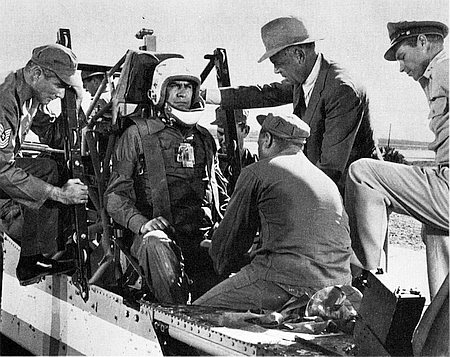
Fig. 47. Col. J. P. Stapp’s historic 1954 rocket sled test was re-created for On the Threshold of Space (see figure 33, page 31).
High Altitude Polyethylene Research Balloons
In 1946, as a result of research conducted for project Mogul, Charles B. Moore, a New York University graduate student working under contract for the U.S. Army Air Forces, made a significant technological discovery: the use of polyethylene for high altitude balloon construction.[71] Polyethylene is a lightweight plastic that can withstand stresses of a high altitude environment that differed drastically from, and greatly exceeded, the capabilities of standard rubber weather balloons used previously. Moore’s discovery was a breakthrough in technology. For the first time, scientists were able to make detailed, sustained studies of the upper atmosphere. Polyethylene balloons, first produced in 1947 for Project Mogul, are still widely used today for a host of scientific applications.
High altitude polyethylene balloons and standard rubber weather balloons differ greatly in size, construction, and utility. The difference between these two types of balloons historically has been the subject of misunderstandings in that the term “weather balloon” is often used to describe both types of balloons.
High altitude polyethylene balloons are used to transport scientific payloads of several pounds to several tons to altitudes of nearly 200,000 feet. Polyethylene balloons do not increase in size and burst with increases in volume as they rise, as do standard rubber weather balloons. They are launched with excess capacity to accommodate the increase in volume. This characteristic of polyethylene balloons makes them substantially more stable than rubber weather balloons and capable of sustained constant level flight, a requirement for most scientific applications.
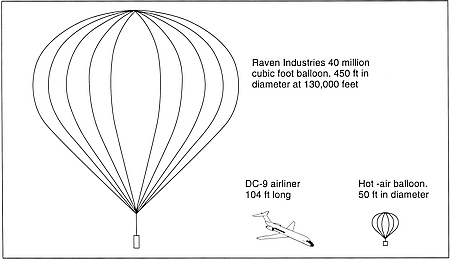
Fig. 48. Relative sizes of a modern high altitude polyethylene research balloon, an airliner, and a hot-air balloon. Inaccurate characterizations of the giant high altitude research balloons as “weather balloons” (which are typically 15 feet in diameter) has historically been the source of confusion. (courtesy of Mike Smith, Raven Industries) Raven Industries 40 million cubic foot balloon. 450 ft in diameter at 130,000 feet DC-9 airliner 104 ft long Hot-air balloon. 50 ft in diameter
The initial polyethylene balloons had diameters of only seven feet and carried payloads of five pounds or less.[72] As balloon technology advanced, payload capacities and sizes of balloons increased. Modern polyethylene balloons, some as long as several football fields when on the ground, expand at altitude to volumes large enough to contain many jet airliners. Polyethylene balloons flown by the U.S. Air Force have reached altitudes of 170,000 feet and lifted payloads of 15,000 pounds.[73]
During the late 1940’s and 1950’s, a characteristic associated with the large, newly invented, polyethylene balloons, was that they were often misidentified as flying saucers.[74] During this period, polyethylene balloons launched from Holloman AFB, generated flying saucer reports on nearly every flight.[75] There were so many reports that police, broadcast radio, and newspaper accounts of these sightings were used by Holloman technicians to supplement early balloon tracking techniques.[76] Balloons launched at Holloman AFB generated an especially high number of reports due to the excellent visibility in the New Mexico region. Also, the balloons, flown at altitudes of approximately 100,000 feet, were illuminated before the earth during the periods just after sunset and just before sunrise. In this instance, receiving sunlight before the earth, the plastic balloons appeared as large bright objects against a dark sky. Also, with the refractive and translucent qualities of polyethylene, the balloons appeared to change color, size, and shape.
The large balloons generated UFO reports based on their radar tracks.[77] This was due to large metallic payloads that weighed up to several tons and echoed radar returns not usually associated with balloons. In later years, balloons were equipped with altitude and position reporting transponders and strobe lights that greatly diminished the numbers of both visual and radar UFO sightings.
One classic misidentification of a Holloman balloon that was mistaken for a UFO, was launched on October 27, 1953.[78] According to the following account published in a widely distributed 1958 history of Air Force balloon operations, Contributions of Balloon Operations to Research and Development at the Air Force Missile Development Center Holloman Air Force Base, N. Mex. 1947–1958, a suspected Holloman balloon was tracked both visually and by radar over London, England on November 3, 1953.
“English accounts of the incident contained such statements as ‘tremendous speed,’ ‘practically motionless,’ ‘circular or spherical and white in color,’ ‘emitting or reflecting a fierce light.’ Altitude was reported as 61,000 feet—and as no research balloon had recently been sent up from Britain, there was ample room for local saucer enthusiasts to claim the ‘unidentified flying object’ as proof of their theories. A much likelier explanation, however, is that this was really the balloon launched from Holloman on 27 October.”[79]
High Altitude Balloon Payloads
Over the years, payloads transported by high altitude polyethylene balloons ranged from simple radio transmitters to anthropomorphic dummies to sophisticated satellite components and NASA interplanetary space probes. Many of these payloads, some of which weighed many tons, were not what someone would typically envision as being associated with a balloon. Examples of payloads flown in New Mexico by Air Force high altitude balloons can be found on pages 52 and 53 at the end of this section.
Research projects of the late 1940’s and 1950’s conducted at Holloman AFB which began with the Project Mogul flights in June 1947, covered a wide spectrum of scientific research. One important experiment in space biology measured the effects of exposure to cosmic ray particles on living tissues.[80] Other projects gathered meteorological data and collected air samples to determine the composition of the atmosphere.[81] The first high altitude photographic reconnaissance project, a forerunner to today’s reconnaissance satellites, Project 119L, also used high altitude balloons launched at Holloman AFB.[82]
As early as May 1948, polyethylene balloons coated or laminated with aluminum were flown from Holloman AFB and the surrounding area.[83] Beginning in August 1955, large numbers of these balloons were flown as targets in the development of radar guided air to air missiles.[84] Various accounts of the “Roswell Incident” often described thin, metal-like materials that when wadded into a ball, returned to their original shape. These accounts are consistent with the properties of polyethylene balloons laminated with aluminum. These balloons were typically launched from points west of the White Sands Proving Ground, floated over the range as targets, and descended in the areas northeast of White Sands Proving Ground where the “strange” materials were allegedly found.
In 1958 the first manned stratospheric balloon flights were made from Holloman AFB (see page 102). In 1960, balloon tests of components of the first U. S. reconnaissance satellite were also flown at Holloman AFB. In the 1960’s, 70’s, and 80’s high altitude balloons were used in support of Air Force, and other U.S. Government and university sponsored research projects. Instrument testing of atmospheric entry vehicles for the National Aeronautics and Space Administration (NASA) space probes is one prominent example.
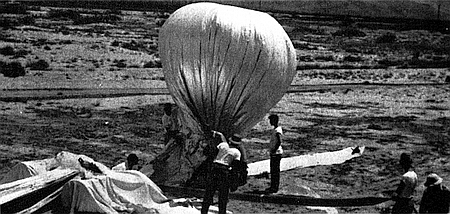
Fig. 49. Holloman Balloon Branch personnel prepare a polyethylene balloon laminated with aluminum to serve as a target for radar guided missiles over White Sands Proving Ground, N.M. (U.S. Air Force photo)
High Altitude Balloons and America’s First Satellite
An illustration of the important contributions of the Holloman AFB Balloon Branch, and the necessity for a rapid recovery of a high altitude balloon payload, were evaluations of components of the first U.S. satellite-based reconnaissance system, code named Corona.
The Soviet Union had already beaten the U.S. into space with the launch and orbit of Sputnik I on October 4, 1957. The next achievement in the quest for space superiority were the physical recovery of a payload that had been in orbit.[85] The Discoverer satellite, the sensor used in the Corona program, was to be propelled into orbit and then eject a capsule containing an American flag to enable the U.S. to claim this honor.[86]
The Discoverer program had been plagued by failure with 10 unsuccessful missions in 1959 and 1960. With the eyes of the nation watching, and the Soviets testing a similar system, more failures could not be tolerated. To test the faulty components of the Discoverer, U.S. Air Force high altitude balloons at Holloman AFB were determined to be the most expedient method of conducting the evaluations.
In April 1960, Discoverer XI, on the launch pad at Vandenberg AFB, Calif., was put into a hold pending results of the balloon tests.[87] The first test at Holloman AFB on April 5th was unsatisfactory due to a parachute failure.[88] On April 8th, with pressure mounting, the Balloon Branch launched another balloon with the Discoverer capsule. This test, in which the capsule was dropped over White Sands Missile Range and recovered immediately, was a total success.[89] The results were relayed by telephone from the Balloon Control Center at Holloman AFB to the launch pad at Vandenberg AFB where the countdown resumed.[90] Despite the successful balloon drop, Discoverer XI and Discoverer XII were failures.[91] Therefore, balloon testing continued throughout the summer of 1960.
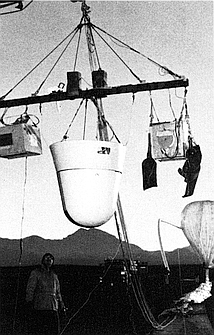
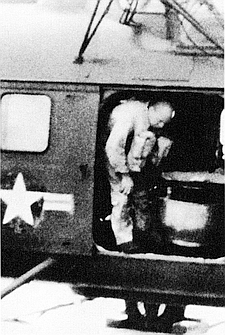
Fig. 50. (Left). A Holloman Balloon Branch launch crew prepares a nosecone of the Discoverer satellite for a high altitude balloon flight at Holloman AFB, N.M. in April 1960. (U.S. Air Force photo) Fig. 51. (Right). A U.S. Navy helicopter aboard the USS Haiti Victory is shown here with the capsule from the Discoverer XIII satellite. It was recovered from the Pacific Ocean 330 miles northwest of Hawaii on August 11, 1960. (U.S. Air Force photo)
Finally, on August 11, 1960, Discoverer XIII successfully ejected a capsule and, amid much fanfare, the first recovery of a manmade object that had orbited the earth was accomplished.[92] This first successful mission of an American satellite, made possible in part by Holloman AFB high altitude balloons, enabled the U.S. to beat the Soviets and claim the honor of the first space recovery by only nine days.[93]
The Surveyor (Moon), Voyager-Mars (Mars), Viking (Mars), Pioneer (Venus), and Galileo (Jupiter) spacecraft were tested by Air Force high altitude balloons before they were launched into space.
Viking and Voyager-Mars Space Probes. Examples of unusual payloads, not likely to be associated with balloons, were qualification trials of NASA’s Voyager-Mars and Viking space probes. Both of these spacecraft looked remarkably similar to the classic dome-shaped “flying saucer.”
In 1966–67 and 1972, eight of the UFO lookalikes were launched by the Balloon Branch from the former Roswell Army Air Field (now Roswell Industrial Air Center), N.M.[94] The spacecraft were transported by Air Force balloons to altitudes above 100,000 feet and released for a period of self-propelled, supersonic, free-flight prior to landing on the White Sands Missile Range.[95] While the origins of the “Roswell” scenarios cannot be specifically traced to these vehicles, their flying saucer-like appearance, and the fact that they were launched exclusively from the original “Roswell Incident” location, leaves an impression that perhaps these odd balloon payloads may have played some role in the unclear and distorted stories of at least some of the “Roswell” witnesses.
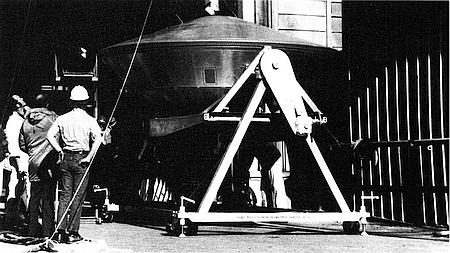
Fig. 52. A NASA Viking space probe is rolled out of its assembly building at Martin Marietta Corporation in Denver, Colo. (NASA)
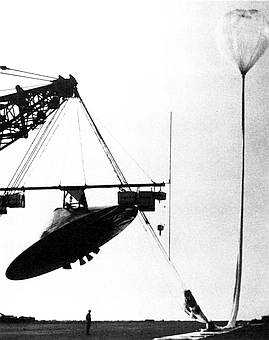
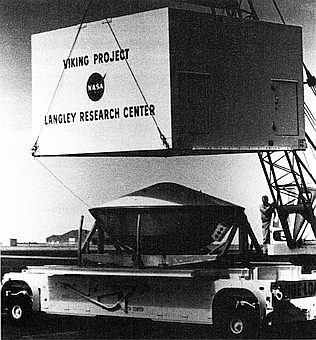
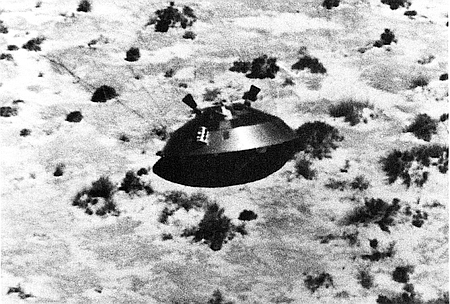
Fig. 53. (Above Left) The aeroshell of a NASA Voyager-Mars space probe just prior to launch at Walker AFB, N.M. (formerly Roswell AAF). (U.S. Air Force photo) Fig. 54. (Above Right) This NASA Viking flying saucer-like space probe was test flown by U. S. Air Force high altitude balloons in 1972 at the former Roswell Army Air Field. (NASA) Fig. 55. (Left) Following a supersonic test flight in 1972, a Viking space probe awaits recovery at White Sands Missile Range, N.M. (NASA)
Tethered Balloons. The Holloman Balloon Branch, in addition to high altitude research activities, also conducted low altitude tethered balloon flights. It appears that descriptions of these balloons may have become part of the “Roswell Incident.”
Most standard shaped tethered balloons are readily identified when near the ground or when the tether is visible. Other experimental tethered balloons are not so easily identified. During the 1960s, Balloon Branch personnel flew experimentally shaped tethered balloons from deep canyons of central New Mexico. To a distant observer, from a vantage point above the canyon rim, where the tether and ground anchors are not visible, an experimental tethered balloon might lead some persons to speculate as to the oddly shaped balloon’s origin and purpose. One design of a low altitude tethered balloon may have inspired at least one account of an “alien” craft. In The Truth About the UFO Crash at Roswell, the authors published a drawing of a crashed alien spaceship allegedly based on a drawing given to them by an anonymous witness.[96] When this drawing is compared to a photograph of an experimental tethered balloon flown at Holloman AFB in March 1965, the similarities are undeniable.[97] The tethered balloon and the NASA space probes are just two examples of the uncommon technologies that were flown in New Mexico by the Holloman Balloon Branch.
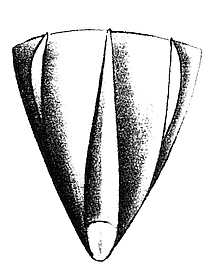
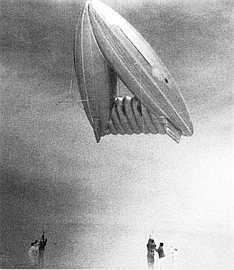
Fig. 56. (Left) A drawing from a popular UFO book, The Truth About the UFO Crash at Roswell, depicts an alien spacecraft allegedly drawn by an anonymous witness. (The Truth About the UFO Crash at Roswell) Fig. 57. (Right) A tethered “Vee” balloon shown here at Holloman AFB, N.M. in March 1965. This experimental balloon, is strikingly similar to the “alien” craft. (U.S. Air Force photo)
Today, the Air Force maintains a reduced but still highly capable high altitude balloon program at Holloman AFB. The Space and Missile Command, Test and Evaluation Unit (SMC/TE, OL-AC) represents the sole Department of Defense high altitude research balloon capability. The ability of a U.S. Air Force high altitude balloon to lift a scientific payload to more than 100,000 feet, above 99 per cent of the earth’s atmosphere, for days at a time, presents a profoundly useful scientific tool at a fraction of the cost of a space research platform. Recent tests that utilized Holloman balloons included atmospheric sampling and gravity measurement experiments, high altitude astronomic studies, weapons systems evaluations, and gamma ray detection experiments. While most tests continue to be launched from the permanent balloon launch facility at Holloman AFB, U.S. Air Force balloon crews have recently launched balloons from numerous field locations in the U.S. (including two sites in Roswell), as well as Alaska, Panama, and Antarctica.
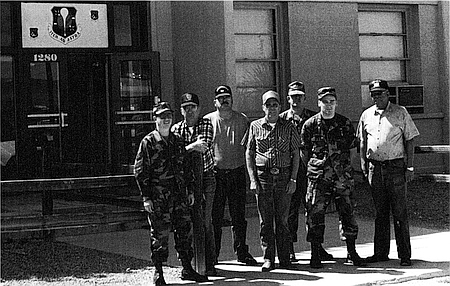
Fig. 58. Present members of the Holloman Balloon Branch in front of the Balloon Operations Center, Building 850, at Holloman AFB, N.M., (from left) TSgt. Roger J. Welch, Mr. Joseph Fumerola, Mr. Alvin W. Hodges, Mr. Joseph Longshore, MSgt. Ray A. Pitts, Sr., Amn. John Witkop, and Mr. Harvey L. Harris. (U.S. Air Force photo)
Balloon and Payload Recoveries
UFO theorists support their claims of an extraordinary occurrence in the New Mexico desert by describing mysterious U.S. military personnel, operating a variety of vehicles and aircraft that always seem to arrive shortly after the crash of a “flying saucer.” When carefully scrutinized, the descriptions of the mystery crews, their equipment, methods, and the areas where the recoveries allegedly occurred—in targeted high altitude balloon recovery areas—indicates that Holloman Balloon Branch activities were most likely responsible for the claims.
To successfully recover high altitude balloons, balloon recovery technicians regularly ventured far from Holloman AFB. In most instances the balloons and their scientific payloads were recovered from predetermined recovery areas. These regularly targeted areas, located in Arizona, West Texas, and New Mexico, included the area surrounding Roswell.[98] From 1947 to the present, the Roswell area has been the site of hundreds of balloon and payload recoveries (including those that carried anthropomorphic dummies).[99]
The regularly targeted areas were the result of the evolution of high altitude balloon control techniques developed at Holloman AFB. These techniques were based on meteorological, geographical, and operational conditions that exist in New Mexico. These factors, combined with ample amounts of skill and experience of balloon controllers at Holloman AFB, determined the impact points of Holloman high altitude balloons.
Many of the procedures used to position Air Force balloons are described in General Philosophy and Techniques of Balloon Control, and Meteorological Aspects of Constant-Level Balloon Operations in the Southwestern United States, both by Bernard D. Gildenberg (see statement in Appendix B).[100] Gildenberg served as the Holloman Balloon Branch Meteorologist, Engineer, and Physical Science Administrator from 1951 until 1981. During this period, Gildenberg, a recognized world expert in upper atmospheric wind patterns, pioneered methods to launch, control, track, and recover high altitude balloons. Many of these methods are still used today by the U.S. Air Force and by research organizations throughout the world.
Interaction with Civilians
In several accounts, unsubstantiated allegations have been made that military personnel who retrieved equipment from rural areas of New Mexico intimidated and threatened civilians. Contrary to these charges, Balloon Branch personnel enjoyed good relations with the local community and often solicited their assistance in the area of a balloon or payload landing. In the flat, featureless desert areas of southeastern New Mexico near Roswell, the parachutes, payloads, the balloons themselves, and circling chase aircraft often drew crowds of curious onlookers from the local community. In fact, so many civilians were often present at balloon or payload landing sites, the scene was described by longtime civilian Balloon Branch recovery supervisor, Robert Blankenship, as being like the “circus coming to town.”[101]
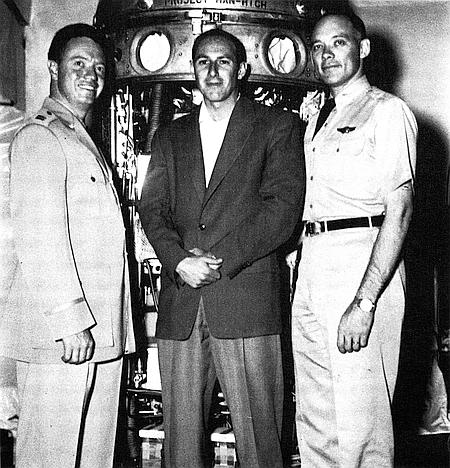
Fig. 59. Bernard D. “Duke” Gildenberg (center) Balloon Branch Meteorologist, is shown here in May 1957 in front of the Man High I gondola. With Gildenberg are Man High I pilot Capt. Joseph W. Kittinger, Jr. (left), and Man High project scientist/pilot, Lt. Col. David G. Simons (MC). When Gildenberg attempted to inform UFO theorists that high altitude balloon projects were likely responsible for some of the UFO claims, his explanations were rejected, See also pages 8 & 9. (U.S. Air Force photo)
Allegations that civilians were threatened or told to “forget what they saw” are profoundly inaccurate. Threats, intimidation, or other types of misconduct by Balloon Branch personnel would have served no purpose since without the cooperation of local persons, many recoveries would not have been possible.[102]
Most balloon recoveries were coordinated in advance with local law enforcement agencies.[103] If a balloon or payload landed on private property and the owner could not be located, Balloon Branch operating instructions dictated that the local sheriff or police must be contacted.[104] In situations where local persons arrived at balloon landing sites before the recovery crews, they were simply asked to “step back” to allow recovery personnel to secure the balloon equipment.[105] If these persons inquired as to the purpose of a balloon flight, they were informed by technicians that it was a U.S. Air Force scientific study and were given a telephone number at Holloman AFB if they required additional information. At Holloman AFB, individuals qualified to answer detailed questions responded to these inquiries. There was never a reason to mislead or threaten individuals who observed balloon operations. Relations with local citizens were good, and Balloon Branch personnel and equipment were a common sight to residents in areas with high incidences of balloon operations.
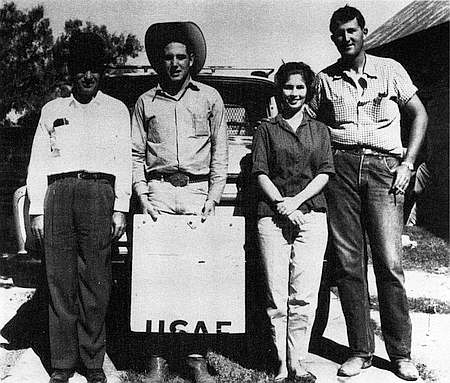
Fig. 60. (Right) This ranch family assisted in the recovery of a Project Stargazer high altitude balloon payload and is shown here with a panel from the unmanned gondola. (U.S. Air Force photo)
In a few instances, situations arose when persons not familiar with the procedures and equipment used by the Balloon Branch misunderstood their activities. Such misunderstandings occurred several times during the 1970s and 1980s when recovery crews not only attracted the attention of local citizens while coordinating balloon recoveries, but also drew the attention of federal law enforcement agencies.[106]
Checks with the local sheriff revealed that the trucks and circling aircraft in the desert near Roswell were part of a balloon recovery mission, and not a drug smuggling operation. Apparently, balloon recoveries appeared to be something suspicious even to federal agents.
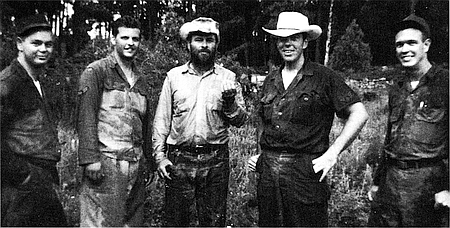
Fig. 61. A typical Holloman Balloon Branch recovery crew is shown here with a man known as “The hermit” who assisted them in a balloon recovery northwest of Silver City, N.M. in the 1960s. (photo collection of Robert Blankenship)
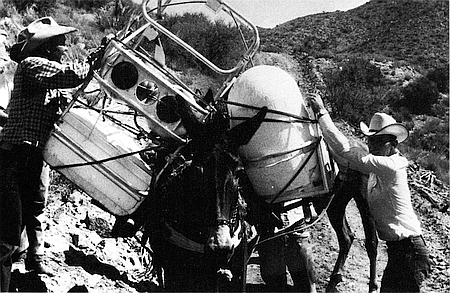
Fig. 62. A mule (named Ida) was borrowed from a local rancher when a balloon payload landed in difficult terrain 20 miles north of Wickenburg, Ariz. in October 1966. (U.S. Air Force photo)
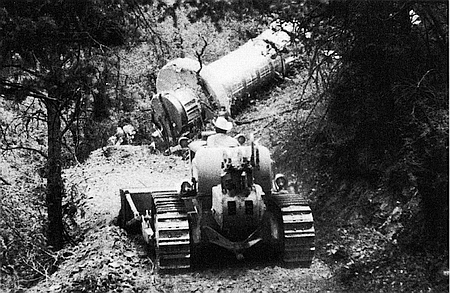
Fig. 63. On occasion, Air Force balloon recovery crews rented or borrowed equipment from local residents. This bulldozer was rented for one recovery in the Sacramento mountains west of Roswell. (photo collection of Robert Blankenship)
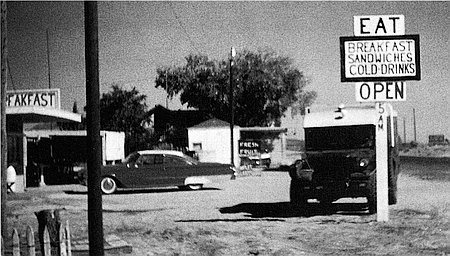
Fig. 64. Balloon Branch vehicle at roadside café. This M-43 ¾-ton field ambulance, converted by the Holloman Balloon Branch into a communications vehicle, was a common sight in the areas surrounding Roswell during the 1950s and early 1960s. (photo collection of Ole Jorgeson)
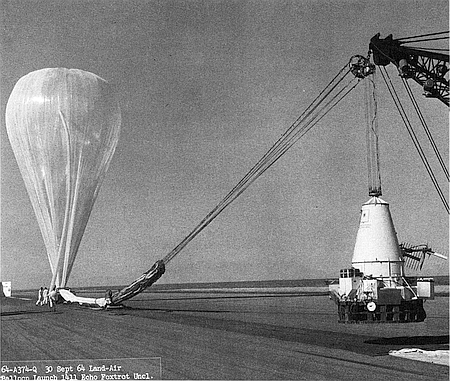
Figs. 65 & 66. Examples of unusual payloads flown by Air Force high altitude balloons at Holloman AFB, N.M. (U.S. Air Force photos)
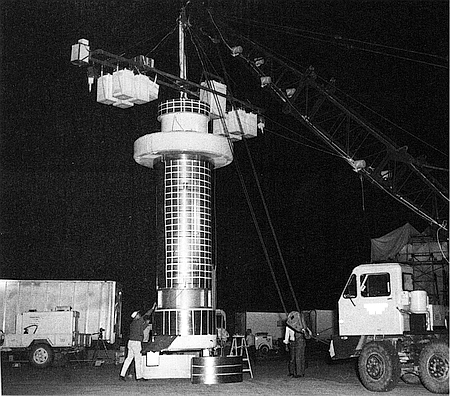
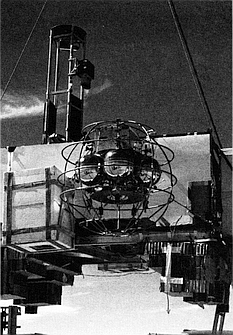
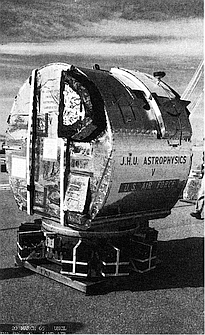
Fig. 67. (Left) This U.S. Army communications payload was flown at Holloman AFB, N.M. on September 30, 1976. (U.S. Army photo) Fig. 68. (Right) Payload launched by an Air Force high altitude balloon from Holloman AFB, N. M. on March 20, 1965. This payload was a scientific experiment for The Johns Hopkins University Astrophysics Laboratory. (U.S. Air Force photo)
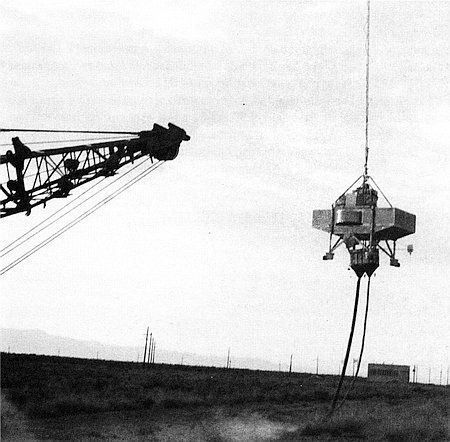
Fig. 69. High altitude balloon payload launched from Holloman AFB on September 14, 1976. (U.S. Air Force photo)
1.4 Comparison of Witnesses Accounts to U.S. Air Force Activities
Were they aliens or dummies? This question can be answered by comparing witness testimony and the Air Force projects of the 1950s, High Dive and Excelsior. Both of these projects employed anthropomorphic dummies flown by high altitude balloons and appeared to satisfy the requirements of the previously established research profile:
a. An activity that if viewed from a distance would appear unusual.
b. An activity for which the exact date was not likely to have been known because many dummies were dropped over a six-year period (1953–1959).
c. An activity that took place in many areas of rural New Mexico.
d. An activity that involved a type of aerial vehicle with dummies that had four fingers, were bald and wore one-piece gray suits.
e. An activity that required recovery by numerous military personnel and an assortment of vehicles that included a wrecker, a six-by-six, and a weapons carrier.
The testimony used in the following comparison, an undocumented mixture of firsthand and secondhand re-countings, are the actual statements, not the interpretations of UFO proponents, that are presented to “prove” the Earth was visited by extraterrestrial beings and the U.S. Air Force has covered up this fact since 1947. This comparison is augmented by references to photographs whenever possible to illustrate the undeniable similarities between the descriptions provided by the witnesses and the equipment and methods employed by the Air Force projects.
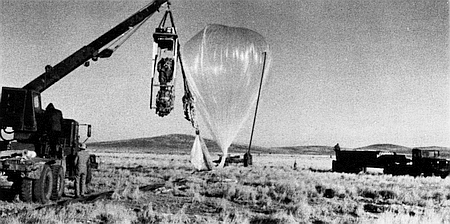
Fig. 70. Project High Dive anthropomorphic dummy launch. (U.S. Air Force photo)
“Crash” Site 1 (Allegedly North of Roswell)
This summarized account is the basis for the alleged “flying saucer” crash site north of Roswell.* The exact location is not known since the witness, Mr. James Ragsdale, in two separate sworn statements, has described two different sites, many miles apart.[107] This account was excerpted from an interview with Mr. Ragsdale by author Donald Schmitt. A transcript of the complete interview is included in Appendix C.
* In The Truth About the UFO Crash at Roswell (Avon Books, 1994, p. 131), the authors provided a corroborating account for this testimony from a 96-year-old man who was in ill health, whose interview was not tape recorded, and has since died. According to the book, the man’s “wife and daughter said that he was easily confused” and “memories of his life were jumbled and reordered.”
The Account
James Ragsdale
“They was using dummies in those damned things”[108]
Testimony attributed to Ragsdale, who is deceased, states that he and a friend were camping one evening and saw something fall from the sky. The next morning, when they went to investigate, they saw a crash site:
“One part [of the craft] was kind of buried in the ground and one part of it was sticking our [out] of the ground.” “I’m sure that [there] was bodies ... either bodies or dummies.” “The federal government could have been doing something they didn’t want anyone to know what this was. They was using dummies in those damned things ... they could use remote control ... but it was either dummies or bodies or something laying there. They looked like bodies. They were not very long ... [not] over four or five foot long at the most.” “We didn’t see their faces or nothing like that ... we had just gotten to the site and the Army ... and all [was] coming and we got into a damned jeep and took off.”
This testimony then describes an assortment of military vehicles used to recover the “bodies”: “It was two or three six-by-six Army trucks a wrecker and everything. Leading the pack was a ’47 Ford car with guys in it.... It was six or eight big trucks besides the pickup, weapons carriers and stuff like that.” Ragsdale also said that before he left the area he observed the military personnel “gathering stuff up” and “they cleaned everything all up.”
Assessment
In his testimony, Ragsdale made numerous references to equipment, vehicles, and procedures consistent with documented anthropomorphic dummy recoveries for projects High Dive and Excelsior. The repeated use of the term “dummy” and the witness’ own admission that “they was using dummies in those damned things” and “I’m sure that was bodies ... either bodies or dummies” leaves little doubt that what he described was an anthropomorphic dummy recovery.
Based on testimony attributed to this witness, the confusion could have resulted from the fact that he observed these activities from a distance. If the witness was even a short distance from the odd looking anthropomorphic dummies, it would be logical for him to believe, when interviewed 35 to 40 years after the event, that he “thought they were dummies or bodies or something.” Also, for some of the high altitude drops, the dummies did not separate from the suspension rack and “rode the rack” to the ground without deployment of a parachute.[109] If the parachutes of the dummies or parachutes of the rack assembly did not deploy (a common occurrence during the early dummy drops), then they free-fell from up to 98,000 feet.[110] As a result of these malfunctions, the arms and legs of the dummies were often separated from the body on impact.[111] This may account for the witness’ description of bodies [not] “over four or five foot” tall.
Another portion of his testimony suggesting that the witness observed an Air Force high altitude balloon and dummy recovery was the statement: “The federal government could have been doing something because they didn’t want anyone to know what this was ... they was using dummies in those damned things ... they could use remote control.” Balloon controllers used remote control to relay commands to the balloon control package to valve gas and drop ballast.[112] The dummies themselves were also dropped from the suspension rack by remote control.[113]
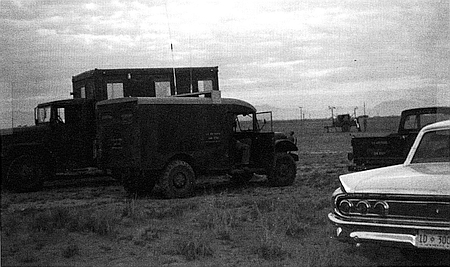
Fig. 71. Numerous vehicles and various types of equipment, were often present at high altitude balloon and anthropomorphic dummy launch and recovery locations. (photo collection of Ole Jorgeson)
The witness also described a Balloon Branch procedure that required the area of a balloon or payload landing to be restored to its original condition. It was evident in the statements “They cleaned everything all up” and “They began gathering the stuff up.” Thoroughly cleaning a balloon or dummy landing site and removing any debris deposited there was a standard procedure to maintain good community relations and avoid legal claims that could arise over property damages or livestock losses.[114] Cattle were known to ingest scraps of polyethylene balloon material that sometimes littered entire fields following a balloon failure or flight termination.[115]
The military vehicles described were also consistent with recovery and communications vehicles used during the 1950s to retrieve anthropomorphic dummies and suspension racks.[116] The witness stated he saw a “wrecker,” a “six-by-six,” a “weapons carrier,” a “’47 Ford car,” and a “pickup.” The “wrecker” was most likely a M-342 5-ton wrecker that was assigned to the Balloon Branch for launch and recovery operations.[117] Other vehicles described were also the type used to launch and recover anthropomorphic dummies. The “six-by-six” is a likely reference to a M-35 2½-ton cargo truck; “weapons carriers” were the common name of a Dodge M-37 ¾-ton utility truck. References to “the pickup” and a “’47 Ford car,” were likely descriptions of other civilian and military vehicles often present at high altitude balloon launch and recovery locations.
“Crash” Site 2 (Allegedly 175 miles Northwest of Roswell)
This purported flying saucer “crash” site is allegedly 175 miles northwest of Roswell in an area of New Mexico known as the San Agustin Plains.[118] The contention that a flying saucer crashed at this location and was recovered by the U.S. military is supported by three principal testimonies, two secondhand and one firsthand.
The Secondhand Accounts
These accounts were related by Mr. Vern Maltais and Ms. Alice Knight, who were acquainted with the alleged original eyewitness, Mr. Grady L. Barnett, who is deceased. Unless otherwise noted, the following statements appeared on footage used to prepare a video, Recollections of Roswell Part II, by The Fund for UFO Research (see Appendix C).
Alice Knight
“I don’t recall the date”[119]
“I don’t remember whether it was before my husband and I were married or after, I don’t recall the date. But he [the eyewitness] saw a UFO fall ... and he got nearly to the site ... but they got nearly up to the UFO but it was close enough that you could see some creatures. He said they didn’t look like human beings out there. And along came government cars and trucks. I guess it was government. You know it was a long time ago ... and they told him to go on back and forget that they ever saw anything, and that’s all I recall.”
Assessment
This brief testimony suggests that the witness did not know the date of this event. It also appears that the “creatures” were seen from a distance, as evidenced by the statement, “They got nearly up to the UFO but it was close enough that you could see some creatures.” The testimony also seems consistent with a description of anthropomorphic dummies as the witness stated they “didn’t look like human beings.”
Vern Maltais
“Their heads were hairless ... no eyebrows, no eyelashes, no hair”[120]
This secondhand witness alleged that the eyewitness told him he observed “beings” from a “flying saucer that had burst open” that were “about three and a half to four feet tall, very slim ... their heads were hairless, with no eyebrows, no eyelashes, no hair” with “sort of a pear-shaped head.” He also related that “the beings were ... not exactly like human beings ... similar but not exactly.” He described that the hands of the beings “were not covered” ... and [they] only had “four fingers.” He also related that the clothing of the beings was “one-piece and gray in color”.[121] The witness concluded that “As they [the witnesses] were just starting to look things over really closely, the military moved in and gave them a briefing to not say anything about it.”
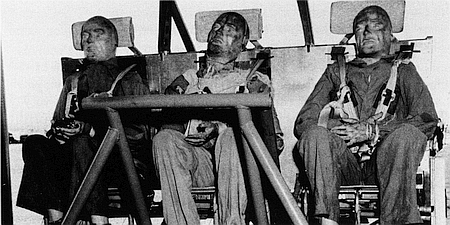
Fig. 72. “Their heads were hairless ... no eyebrows, no eyelashes, no hair,” a likely description of Alderson Laboratories type anthropomorphic dummy. These Alderson dummies, of the same type used for Projects High Dive/Excelsior, were used to test NASA’s Apollo spacecraft three-man couch at Holloman AFB, N.M. in 1965. (U.S. Air Force photo)
Assessment
This description of events also indicates that the eyewitness apparently did not closely examine the scene and was “just starting to look things over” when the military arrived. As with the previous testimony, from a distance the dummies were likely to look, as described by the witness, “not exactly like humans ... similar but not exactly.” The description of the flying saucer that had “burst open” is a likely description of the dummy suspension rack that was open on the sides (see figures 74, 75, 76). The detailed descriptions of the “beings” as “about three and a half to four feet tall, very slim in stature ... their heads were hairless, with no eyebrows, no eyelashes, no hair,” with “hands that were not covered” and “had only four fingers,” is a likely description of an Alderson Research Laboratories model anthropomorphic dummy. The head of the Alderson dummy was “bald” and the area of the eyebrows protruded but had no “hair” (see figure 72). Also, a distinguishing feature of the Alderson dummy, unlike the Sierra dummy, was that it had individual fingers not covered by gloves that were often damaged during the tests resulting in the loss of fingers (see figures 35, 73, 75).
Due to the secondhand nature of these accounts, even UFO theorists were not convinced that this “incident” actually occurred. Corroborating testimony of a firsthand witness was necessary to verify these claims. The firsthand testimony is examined next.
The Firsthand Account
This testimony became part of the Roswell Incident in 1990 following an episode of the television program Unsolved Mysteries.[122] Following a dramatized re-creation on the program, persons with information concerning this event were encouraged to call a special toll free telephone number.
From the outset, some UFO theorists were skeptical of this testimony due to the amount of detail provided from the witness who was only five years old in 1947. In fact, UFO organizations sponsored a conference in February 1992 to evaluate the testimony for authenticity.[123] The witness was asked to take a polygraph examination, which he passed.[124] Many UFO enthusiasts remained skeptical of the claims and denounced this testimony as “no more than a fabrication.”[125]
Unless otherwise noted, two sources of testimony attributed to the witness have been used in this examination; interviews used to prepare the video Recollections of Roswell Part II by the Fund for UFO Research (see Appendix C) and Crash at Corona by Don Berliner and Stanton Friedman (passages from this book were used only when exact quotations of the witness were indicated).
Gerald Anderson
“I thought they were plastic dolls ... I didn’t think they were real”[126]
Anderson related that as a five-year-old boy on an outing with his family in west central New Mexico, they stumbled upon the crash of some type of aerial vehicle.[127] When he first saw the craft he thought it was a “blimp.”[128] According to Anderson he “didn’t really get very close,”[129] but thought he saw four bandaged crewmembers and at first he “thought they were plastic dolls.”[130] He also described attempts by persons in his party to communicate with one of the “crewmembers.”[131] Soon after, other civilians arrived (some wearing pith helmets) followed by military personnel in an assortment of vehicles and aircraft commanded by a “redheaded captain.”[132] The military personnel, after “screaming and hollering” at the civilians “this is a military secret,” started a recovery operation of the alien craft and crew.[133] Anderson also recalled that the military personnel threatened some of the civilians with imprisonment or death before escorting them out of the area.[134]
Assessment
Anderson’s choice of the terms “blimp” to describe the crashed vehicle, and “dolls” to describe the “crew,” strongly suggests that a balloon with an anthropomorphic dummy payload was the foundation for this testimony. He also provided an abundance of supporting details that accurately described vehicles, aircraft, equipment, and procedures used by the Holloman AFB Balloon Branch to launch and recover anthropomorphic dummies.
An aspect of this testimony that is not accurate is the alleged threats and intimidation of civilians by military personnel. The use of such heavy-handedness was not a tactic used by the Air Force. A careful review of official records and interviews with numerous persons who actively participated in and were responsible for the conduct of Air Force members on high altitude balloon recovery operations revealed that these allegations are untrue.[135] Additionally, the witness alleges that the military personnel were “screaming and hollering” “this is a military secret.”[136] This statement might lead uninitiated persons to believe that the witness observed something highly classified and that by telling everyone present that it was a “military secret” would somehow help it to remain so. However, logic dictates that if something was classified “screaming and hollering” it was “secret,” would compromise it and not serve to protect its classification. This application of logic, combined with the fact that the launch and recovery of anthropomorphic dummies was unclassified, widely publicized, and often observed by local civilians, indicates that the witness’ recollections are in error. There was never a reason to disrespect, “scream,” “holler,” or forbid any person from talking about the launch or recovery of anthropomorphic dummies.
The “Crewmembers.” The statement “I thought they were plastic dolls” seems an odd choice of words to describe an extraterrestrial being and is a likely reference to an anthropomorphic dummy whose skin was made of plastic.[137] This description is similar to that of the sole witness of the other crash site, north of Roswell, who described the “aliens” as “dummies.”[138] Other references provided by this witness further indicate that anthropomorphic dummies were the basis for these descriptions. The heads of the “crewmembers” were described as “completely bald” with “no visible ears ... just a rise ... and then a hole.”[139] This is an accurate description of Alderson Research Laboratories model dummies that did not have “hair” and had either plastic “ears” molded to the head or a circular opening where a “demountable ear” or additional instrumentation was attached (see figure 22).[140] The statement “they didn’t have a little finger,”[141] a detail very similar to one provided by another witness, also appears to be a description of dummies manufactured by Alderson Laboratories that were often damaged during the balloon tests resulting in the loss of fingers.
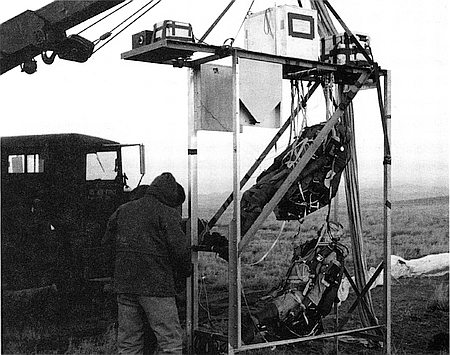
Fig. 73. “Some kind of container, a metal box,” was described as laying on the ground near the alleged aliens. This appears to be a reference to boxes containing electrical components of the remote controlled systems positioned on the top of the dummy suspension rack. (U.S. Air Force photo)
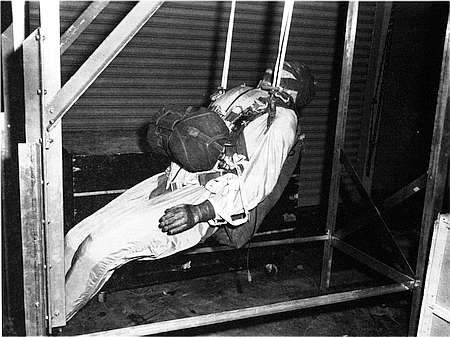
Fig. 74. “They looked like they had some sort of bandages on ’em ... over his ... arm ... around his midsection and partially over his shoulder”—witness description of tape and nylon webbing used to prevent arms and legs from flailing, and parachute harness that had chest and shoulder straps. Tape was also used to secure the removable back plate of the head (also see figs. 29, 30, 73, 75). (U.S. Air Force photo)
The assertion that “they were all wearing one-piece suits ... a shiny silverish-gray color,” “trimmed in ... maroon-like cording”[142] is a likely reference to a standard issue, gray, Air Force flightsuit used to outfit the dummies and red duct-type tape used in the tests that prevented air from filling the flightsuit (see fig. 30).[143] The recollection that “crewmembers” had “bandages”[144] on their bodies were likely references to tape and nylon webbing used to prevent flailing of a dummy’s arms and legs during tests.[145] A reference to a bandage “around his [the crewmember’s] midsection and partially over his shoulder”[146] is a likely reference to the standard B-4 or B-5 parachute with chest and shoulder straps worn by the dummies.[147]
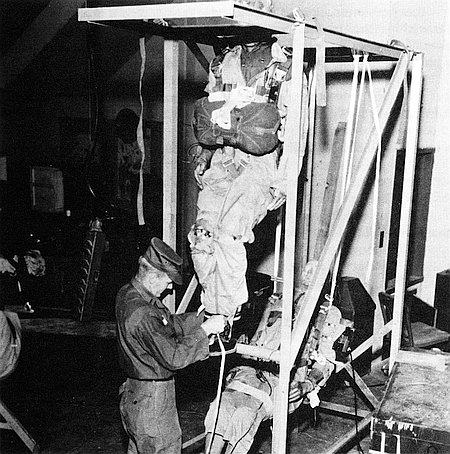
Fig. 75. “Its uniform was torn in a couple spots ... their uniforms were in pretty sad shape”—witnesses description of secondhand flightsuits that were used repeatedly on tests; tears and other damage were common. In this photo, 1st Lt. Raymond A. Madson “rigs” a dummy to its suspension rack for project High Dive at Holloman AFB, N.M. (U.S. Air Force photo)
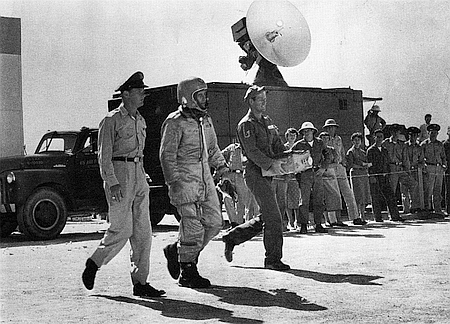
Fig. 76. A witness described at least one person at a “crash” site wearing a pith helmet. In the 1950s, the pith helmet was part of the Air Force uniform and was often worn on balloon launches and recoveries. In this publicity photo from On the Threshold of Space, Air Force members at Holloman AFB who were extras in the film can be seen wearing pith helmets. (also see figure 49)
The “Craft.” In what appears to be a clear reference to a balloon, was that when he saw the crashed vehicle he “thought it was a blimp.”[148] Additional descriptions of cables that “went from one kind of a package of components to another kind of package” and a “metal box” were likely references to the balloon control package that was positioned on top of the dummy suspension rack.[149] A further reference to a balloon payload is the statement that on a hot New Mexico day the crashed vehicle was “ice cold, it felt like it just came out of the freezer.”[150] This accurately describes a physical condition known as “cold soaking” common to high altitude payloads that had recently been exposed to sub-zero temperatures of the upper atmosphere.
Military Aircraft. The witness also described two aircraft of the same type used for anthropomorphic dummy recoveries as having been involved in the activity he witnessed. One aircraft was described as a “C-47” and another as an “observation aircraft ... a high-winged aircraft.”[151] These were a C-47 and a L-20 aircraft used extensively by the Balloon Branch during the mid 1950s for tracking and recovering anthropomorphic dummy balloon flights.[152] This testimony also described aircraft that were typically overhead during a recovery and an established procedure of landing on a rural road or in a field to reach isolated balloon launch or recovery locations.[153]
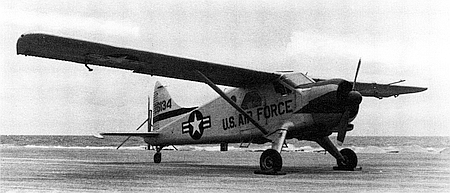
Fig. 77. “An observation aircraft ... a high-winged aircraft”—a witness’s probable reference to a U.S. Air Force L-20 aircraft used extensively by Holloman AFB crews to track and recover anthropomorphic dummies. (U.S. Air Force photo)
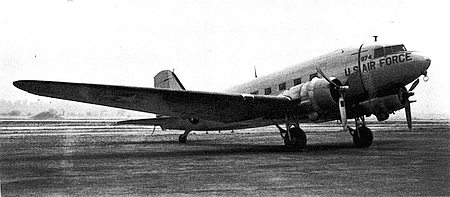
Fig. 78. Described as present at a flying saucer “crash” site was a C-47 aircraft. This is a probable reference to a U.S. Air Force C-47 transport aircraft used to move equipment to launch sites distant from Holloman AFB. These aircraft were also used for aerial tracking of high altitude balloon flights including those that flew anthropomorphic dummies. (U.S. Air Force photo)
Military Vehicles. Numerous military vehicles, several of which were described by other witnesses as having been at the other crash site north of Roswell, were also described. Witnesses at the two different sites described a “wrecker” and a “six-by-six,” both of the type used for anthropomorphic dummy recoveries.[154] The account also described two vehicles unique to the Balloon Branch that were used for the majority of high altitude balloon recoveries during the mid- to late-1950s.
The witness described a “jeep-like truck that had a bunch of radios in it”.... There was a guy sittin’ in there wearin’ earphones and he was talking on the radio.“[155] This is a likely description of a Dodge M-37 ¾-ton utility truck, known as a weapons carrier, that had been specially modified to carry radio equipment for balloon recovery operations. The Holloman AFB Balloon Branch modified these vehicles in 1953, ruling out the possibility that the witness observed them in 1947, when such vehicles were not available to organizations performing balloon operations.[156] The other vehicle described and used by the Balloon Branch were “military ambulances.”[157] During the mid-1950s, the Balloon Branch modified three M-43 ¾-ton ambulances for use as balloon recovery and communications vehicles.[158] These vehicles were used for anthropomorphic dummy launch and recovery missions to relay messages to circling recovery aircraft and the balloon operations center at Holloman AFB.[159] The witness also described “a trailer with a motor on it, like a generator.”[160] This is a likely description of a 1½-ton cargo trailer with an MB-19 15 Kilowatt diesel generator. These generators were used primarily on balloon launch sites during the 1950s and 1960s (see fig. 71).
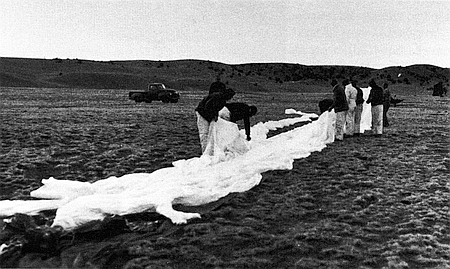
Fig. 79. “Stretching stuff out on the ground, dragging stuff out of trucks”—a likely witness reference to high altitude balloon inflation procedure that required the balloon to be stretched out on a protective ground cloth prior to inflation. (U.S. Air Force photo)
Balloon Branch Procedures. Descriptions of military personnel “stretching stuff out on the ground, dragging stuff out of trucks”[161] is a likely description of a balloon launch procedure that required the fragile polyethylene balloon and its protective ground cloth to be removed from a launch vehicle and laid out on the ground prior to inflation. Another procedure described by the witness was an apparent reference to a balloon recovery practice of recording the names of civilians who observed high altitude balloon recoveries.[162] The witness stated that military personnel “took everybody’s name and everything,”[163] which was a procedure to ensure payment of a $25 dollar reward to persons who assisted in the recovery. This procedure was also necessary to settle future claims of property damage caused by the balloon, payload, or recovery vehicles.[164]
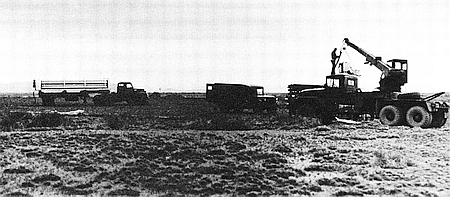
Fig. 80. Witnesses described a “tanker,” “military ambulances,” a “6 × 6,” and a “wrecker”—probable references to (from left) a helium tank trailer, a M-43 ambulance (converted to a communications vehicle), a M-35 cargo truck (partially obscured), and a M-342 wrecker. These vehicles were used for off-range launch and recovery operations of anthropomorphic dummies for Project High Dive/Excelsior. Shown here is a May 29, 1957 dummy launch near Hatch, N.M. (also see figs. 23, 28, 64, 71, 81). (U.S. Air Force photo)
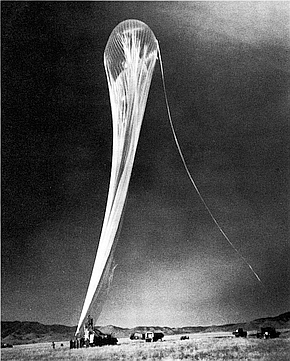
Fig. 81. Scene typical of a mid- to late 1950s off-range high altitude balloon launch. (U.S. Air Force photo)
Summary
When the claims offered by UFO theorists to prove that an extraterrestrial spaceship and crew crashed and were recovered by the U.S. Air Force are compared to documented Air Force activities, it is reasonable to conclude, with a high degree of certainty, that the two “crashes” were actually descriptions of a launch or recovery of a high altitude balloon and anthropomorphic dummies. This conclusion was based on the remarkable similarities and independent corroboration between the witnesses who described both of the “crash sites.” Statements such as “they was using dummies in those damned things” and a characterization of the crashed vehicle as, “I thought it was a blimp” are two of the many similarities. The extensive detailed descriptions provided by the witnesses, too numerous to be coincidental, were of the equipment, vehicles, procedures, and personnel of the Air Force research organizations who conducted the scientific experiments High Dive and Excelsior.
Though it is clear anthropomorphic dummies were responsible for these accounts, the specific locations of the events described was difficult, if not impossible, to determine since the witnesses were not specific. A witness to the “crash site” north of Roswell, Mr. James Ragsdale, was not certain of the actual location as evidenced by a change in his sworn testimony that moved the site many miles from its original location.[165]
However, since Ragsdale reportedly lived or worked in the Roswell, Artesia, and Carlsbad, N.M. areas during the period when the dummies were used, it is likely he described one or more of the nine documented dummy recoveries in areas near there.
Reports of the other crash site, allegedly 175 miles northwest of Roswell on the San Agustin Plains, is likely based on descriptions of more than one launch and recovery of anthropomorphic dummies. Since one witness, Gerald Anderson, described procedures consistent with the launch and recovery of high altitude balloons, it is likely that he witnessed both of these activities, with at least one that included an anthropomorphic dummy payload.
The two secondhand witnesses to this “crash,” Vern Maltais and Alice Knight, could have related descriptions from any of the dummy launch or landing sites. However, Maltais and Knight repeatedly described the impact location of the flying saucer as on the San Agustin Plains. One possible explanation is that the witnesses, in the 30 or more years since they were told the story by the original eyewitness, Mr. Barney Barnett, a soil conservation engineer who reportedly traveled extensively throughout New Mexico, may have confused San Agustin Plains with San Agustin Pass or San Agustin Peak, an area in the San Agustin Mountains of New Mexico. These areas are just outside the boundary of the White Sands Missile Range and the adjacent Jornada Test Range. Numerous anthropomorphic dummy balloon flights terminated and were recovered in this area. Furthermore, if the civilians witnessed dummy landings on either the White Sands Missile Range or the Jornada Test Range, both test areas and restricted U.S. Government reservations, then this explains why they may have been told to leave the landing site. In the popular Roswell scenarios, witnesses were allegedly instructed by military personnel to leave the area because they witnessed something of a highly classified nature. This would be unlikely since the witnesses described projects that utilized anthropomorphic dummies which were unclassified. It is likely, however, that if the witnesses ventured onto one of these ranges they were instructed to leave, not because of classified activities, but for their own safety.
These conclusions are supported by official files, technical reports, extensive photographic documentation, and the recollections of numerous former and retired Air Force members and civilian employees who conducted Projects High Dive and Excelsior. The descriptions examined here, provided by UFO theorists themselves, were so remarkably—and redundantly—similar to these Air Force projects that the only reasonable conclusion can be that the witnesses described these activities. These many similarities are summarized in Table 1.1.
The next section will examine the accounts of “aliens” at the hospital at Roswell Army Air Field. As previously stated, due to the lack of general or detailed similarities with testimony of the two rural “crash sites,” the hospital account was determined not to be associated with these reports.
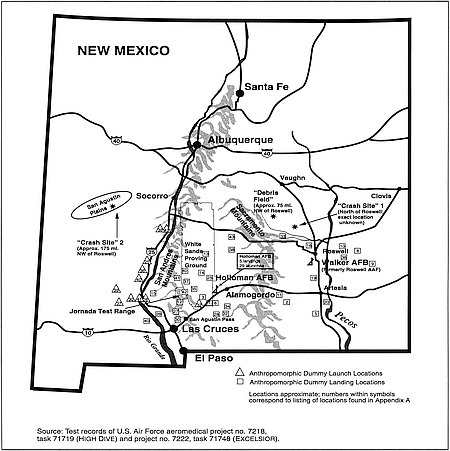
Fig. 82.
Source: Test records of U.S. Air Force aeromedical project no. 7218, task 71719 (High Dive) and project no. 7222, task 71748 (Excelsior).
Table 1.1 Comparison of Testimony to Actual Air Force Equipment, Vehicles, and Procedures Used to Launch and Recover Anthropomorphic Dummies
Notes: “Crash Site” 1—Site North of Roswell “Crash Site” 2—Site 175 miles Northwest of Roswell Shaded areas indicates corroboration between witnesses. Boxed shaded areas indicates corroboration between witnesses at different “crash” sites.
Witness Description Air Force Equipment/Procedure “Crash Site”
The “Aliens”
1. “They was using dummies in those damned things.”[166] Ragsdale Reference to anthropomorphic dummies (figs. 11, 14, 21–22, 29, 30–33, 35, 40, 72–75, 45). Site 1
2. “I thought they were plastic dolls”[167] Anderson Reference to anthropomorphic dummies that had plastic skin. Site 2
3. “an experimental plane with dummies in it”[168] Kaufman Reference to anthropomorphic dummies. Site 1
4. “I’m sure that was bodies ... either bodies or dummies.”[169] Ragsdale Reference to anthropomorphic dummies. Site 1
5. “it was either dummies or bodies or something laying there.”[170] Ragsdale Reference to anthropomorphic dummies. Site 1
6. “his eyes was open, staring blankly”[171] Anderson Reference to anthropomorphic dummies. Site 2
7. “not exactly like human beings ... similar, but not exactly.”[172] Maltais Reference to anthropomorphic dummies. Site 2