I. THE EXTINCT.
Reading edition
If it is a scene of painful interest, as surely it is to a well-constituted mind, to stand by and watch the death-struggles of one of the nobler brutes,—a dog or an elephant, for example,—to mark the failing strength, the convulsive throes, the appealing looks, the sobs and sighs, the rattling breath, the glazing eye, the stiffening limbs—how much more exciting is the interest with which we watch the passing away of a dying species. For species have their appointed periods as well as individuals: viewed in the infinite mind of God, the Creator, from the standpoint of eternity, each form, each race, had its proper duration assigned to it—a duration which, doubtless, varied in the different species as greatly as that assigned to the life of one individual animal differs from that assigned to the life of another. As the elephant or the eagle may survive for centuries, while the horse and the dog scarcely reach to twenty years, and multitudes of insects are born and die within a few weeks, so one species may have assigned to its life, for aught I know, a hundred thousand years as its normal period, and another not more than a thousand. If creation was, with respect to the species, what I have elsewhere proved it was with respect to the individual,[1]—a violent irruption into the cycle of life—then we may well conceive this to have taken place at very varying relative periods in the life-history of the different species;—that is to say, that at a given date, (viz., that of creation) one species might be just completing, ideally, its allotted course, another just commencing, and a third attaining its meridian.
Certain it is, that not a few species of animals have died during the present constitution of things. Races, which we know on indubitable evidence to have existed during the dominion of man, have died out, have become extinct, so that not a single individual survives. The entire totality of individuals which constituted the species, have, in these cases, ceased to be. Some of these seem to have died at a very early era of human history; but others at a comparatively recent period, and some even within our own times. Even within the last twenty years several animals have been taken, of which it is highly probable that not a single representative remains on the earth; while there are others yet again, which we know to be reduced to a paucity so extreme, that their extinction can scarcely be delayed more than a few years at most. Thus we may consider ourselves as standing by the dying-beds of these creatures, with the consciousness that we shall soon see them no more; that the sentence is gone forth against them; that their sands are running to the last grains, and that no effort of ours can materially prolong their existence. The facts from which these conclusions are drawn are highly curious, and I shall endeavour to lay them, with as much brevity as they will allow, before my readers.
On that prochronic hypothesis, by which alone, as I conceive, the facts revealed by geological investigation can be reconciled with the unerring statements of Scripture,—every word of which is truth, the truth of a "God that cannot lie,"—we may assume the actual creation of this earth to have taken place at that period which is geologically known as the later Tertiary Era, or thereabout. When, on the third day, "the waters under the heaven were gathered together into one place, and the dry land appeared," it is not necessary to suppose that the form assumed by the emerging land was immediately that which it now has; we may, on the other hand, I think, assume as likely, that successive or continuous changes of elevation followed, which have been protracted, perhaps constantly decreasing in extent and force, to the present hour.[2]
Perhaps between the six days' work of Creation and the Noachic Flood, Europe became much altered in outline, and in elevation. It may have been, at first, a great archipelago, agreeing with the epithet by which it is designated in early Scripture, "the Isles,"[3] and by which it was subsequently known for ages. The Pyrenees, the Alps, and the Apennines, already emerged, were slowly uniting, and the Carpathians, the Balkan, the Taurus, and the Caucasus, were uprearing, while the vast regions to the north were still an expanse of open sea. England was probably united with the newly-formed European continent, and embraced Ireland in one great mass of unbroken land, which stretched far away into the Atlantic. Volcanoes were active in the north of Ireland, and in the west of Scotland, pouring forth those floods of fiery lava which have cooled into the columnar forms seen at the Giant's Causeway and the Cave of Fingal. Slowly the north of Europe emerged, and the great south-west expanse of Britain sank beneath the sea, leaving, it may be, the large island of Atlantis in mid-ocean, to be submerged by a later catastrophe.
Probably changes very similar were coevally taking place in Asia and North America, while the vast flat alluvial regions of South America were, perhaps, even still more recently formed, and a great Pacific continent was in course of subsidence, of which Australasia and Polynesia are the existing remains.
Such changes of elevation, and of the continuity of land, must effect considerable alterations of climate; and, therefore, it is not surprising to know that, in earliest ages, animals and plants flourished in regions to which they would now be altogether unfitted, and that many races existed then which have since died out; for geological and climatal modifications are among the most easily conceivable causes of the decease of species.
In the great swamps of emerging Germany, and in the, as yet, only half-drained valleys of Switzerland, lurked then the heavy Dinothere. Huger than the hugest elephant, he carried an enormous body of twenty feet in length, vast and barrel-like, which even his columnar limbs of ten feet long scarcely sufficed to raise from the ground. His uncouth head, elephantine in shape, was furnished with a short proboscis; and two tusks, short and strong, projected from the lower jaw, not curving upward, as in the elephant, but downward, as in the walrus. In the teeming marshes lurked this ungainly beast, half immersed, digging out with his mighty pickaxe-tusks the succulent roots that permeated the soft soil, which his sensitive trunk picked up, and conveyed to his mouth.
On the southern slopes of the slowly-rising Himalayas, already clothed with forests of teak, and palm, and bamboo, revelled the Sivathere, another heavy creature, of the bulk of a rhinoceros, and therefore not more than half equalling the German colossus. He too was a strange subject. With a proportionally enormous head, in form somewhat between that of the elephant and of the rhinoceros, minute sunken piggish eyes, and a short proboscis like that of the tapir, he carried two pairs of dissimilar horns. On the forehead were placed one pair, seated upon bony cores, not unlike those of our short-horn oxen. Behind these there rose another pair, large and massive, which were palmated and branching, like those of the fallow-deer, but on a gigantic scale. What sort of a body, and what kind of limbs, furnished the complement of this curiously-compound head, we do not exactly know; but surely it must have been a very remarkable form, as it browsed quietly and blamelessly, among the luxuriant shrubs of those sun-facing slopes.
In the same regions a land Tortoise of enormous bulk, far vaster than the vastest of now existing species, to which that ponderous one which will march merrily away with a ton weight on its back, is a mere pigmy, shook the earth with its waddle, and the forests with its hoarse bellowing. Broad roads, like our highways, were beaten by it through the jungle, along which it periodically travelled to the cool springs, leisurely sauntering, and tarrying to munch the fleshy gourds and cactuses that bordered its self-made track.
The plains of Siberia, stretching away towards the Arctic Ocean, sheltered countless hosts of huge pachydermatous quadrupeds. A species of Rhinoceros, not less bulky than those of the present age, roamed to the very verge of the Icy Sea; its hide, tough and leathery, was destitute of folds, but was clothed with tufts of rigid gray hair,—an ornament which is denied to our existing degenerates. Two horns, the front one of unusual massiveness and length, were seated, as in several of the African kinds, one behind the other, and were wielded by a head of great strength and development.
More remarkable still was that great hairy Elephant, called the Mammoth, which appears to have swarmed in those cold plains by myriads. Of equal dimensions to the Indian species of the present age, this denizen of the north had far more enormous curving tusks, and instead of the naked hide of those we are familiar with, his body was encased in black hair, with a thick under stratum of red curled wool, and bore a long mane on the ridge of the neck.
There was, at the same time, a quadruped, nearly allied to the elephants, but differing from them in some technical characters. With a body equally bulky, but considerably longer, it had shorter limbs, a broader head, small tusks in the lower, as well as large curving ones in the upper jaw, and probably a trunk intermediate between the elephant's and the tapir's. Truly cosmopolite as this great Mastodon was, for we dig up his bones from all parts of the world, he had his head-quarters in North America, where, from his dimensions and his numbers, he must have formed a very characteristic feature of the primeval swamps and forests. There, with his tusks, he grubbed up the young trees, whose juicy roots he ground down with his great mammillary molar teeth, or chewed up to a pulp the sapwood of the recent branches and spicy twigs. And ever and anon he would resort to the broad saline marshes,—the "Licks," as they are now called,—to lick up the crystallised salt on their margins, so grateful to all herbivorous quadrupeds. Here, in his eagerness to gratify his palate with the pungent condiment, he would press farther and farther into the treacherous quagmire, till he began to sink, and then, in his terror, he would plunge and flounder, getting more and more deeply bemired, till at length he could struggle no more, and the bog would close over him, and he would be no more seen till some spectacled geologist of this nineteenth century, note-book in hand, would go and dig up his remains, marvelling at the freshness with which they had been preserved in the antiseptic peat.
But let us look at South America, where, as the great back-bone chain of the Andes is being elevated out of the sea, the torrents and cataracts are pouring down from its sides immense quantities of crumbled rock and pasty mud, which, deposited upon the vast tabular field, brought by the upheaving just to the level of the sea, forms that grand alluvial plain unequalled on the face of the globe for extent, which is clothed with the mighty forests of Guiana and Brazil, or with the tall grass and thistles of the Pampas. The torrents still fall; and, meandering through this glorious plain, unite and form the most majestic of rivers, ever depositing the rich alluvium, and thus sensibly augmenting, to this day, the breadth of their noble continent, and their own length.
Strange creatures riot here in these primal ages. The young land, hot and moist,—moist with the unevaporated water of the depositing rivers, and hot with the influence of the submarine volcano which is lifting it, as well as with the beams of the tropical sun,—brings forth from its steaming bosom, the most gigantic trees in the most profuse luxuriance. And animal life teems too, in this riant vegetation. Millions of insects,—ants, and termites, and beetles,—are busy at work upon the trunks of the great trees, eating them down, and swarming in their immense populous nests, beyond all imaginings. Surely they will soon eat up the entire forest, dense and rapid as it grows, and there will be nothing left but cities of insects. No fear! See those great waddling beasts[4] with stout short legs, and enormous hoof-like claws so bent inward that the creatures are obliged to walk on the edge of their paws,—they are equally busy with the insects, tearing apart with their powerful claws the earthy nests as fast as they are built, and devouring the makers themselves by wholesale. Here is a wonderful creature, a vast armadillo, with a body as big as a rhinoceros, covered with a convex oval shield, formed of hexagonal plates accurately fitted to each other. See how he approaches a fallen tree, which his unerring instinct tells him is perforated through and through, and filled with the swarming millions of ants; with his powerful jaws he munches up the entire mass; the thin and papery partitions of the dusty wood are ground to powder, and the ants are licked in and chewed into a black pulp between those curious cylinders of teeth.
But lo! here are mightier creatures yet! See the vast Mylodon, the Scelidothere, and the still more colossal Megathere. Ponderous giants these! The very forests seem to tremble under their stately stride. Their immense bulk preponderates behind, terminating in a tail of wonderful thickness and solidity: the head is mean and awakens no terror; the eye lacks lustre and threatens no violence, though the whole form betokens vast power, and the stout limbs are terminated by the same stout, inbent, sharp hoof-claws. One of them approaches that wide-spreading locust-tree; he gazes up at the huge mud-brown structures that resemble hogsheads affixed to the forks of the branches, and he knows that the luscious termites are filling them to overflowing. His lips water at the tempting sight; have them he must. But how? that heavy sternpost of his was never made for climbing; yet see! he rears himself up against the tree; is he about to essay the scaling? Not he: he knows his powers better. He gives it one embrace; one strong hug; as if to test its thickness and hold upon the earth. Now he is digging away below, scooping out the soft soil from between the roots,—and it is marvellous to note how rapidly he lays them bare with those great shovel-like claws of his. Now he rears himself again; straddles wide on his hind feet, fixing the mighty claws deep in the ground; plants himself firmly on his huge tail, as on the third foot of a tripod, and once more grasps the tree. The enormous hind quarters, the limbs and the loins, the broad pelvis, the thick spinal cord supplying abundant nervous energy to the swelling muscles, inserted in the ridged and keeled bones, all come into play, as a point d'appui for the Herculean effort. "And now conceive the massive frame of the Megathere convulsed with the mighty wrestling, every vibrating fibre reacting upon its bony attachment with the force of a hundred giants: extraordinary must be the strength and proportions of the tree, if, when rocked to and fro, to right and left, in such an embrace, it can long withstand the efforts of its assailant."[5] It yields; the roots fly up; the earth is scattered wide upon the surrounding foliage; the tree comes down with a thundering crash, cracking and snapping the great boughs like glass; the frightened insects swarm out at every orifice; but the huge beast is in upon them; with his sharp hoofs he tears apart the crusty walls of the earth-nests, and licks out their living contents, fat pupæ, eggs and all, rolling down the sweet morsels, half sucking, half chewing, with a delighted gusto that repays him for all his mighty toil.
While the heavy giant is absorbed in his juicy breakfast, see, there lounges along his neighbour, the Macrauchen. Equally massive, equally heavy, equally vast, equally peaceful, the stranger resembles a huge rhinoceros elevated on much loftier limbs; but his most remarkable feature is an enormously long neck, like that of the camel, but carried to the altitude of that of the giraffe. Thus he thrusts his great muzzle into the very centre of the leafy trees, and gathering with his prehensile and flexible lip the succulent twigs and foliage, he too finds abundance of food for his immense body, in the teeming vegetation, without intruding upon the supply of his fellows.
And what enormous mass is suddenly thrust up out of the quiet water of yonder igaripé? A hoarse, hollow grunt, as it comes up, tells us that it is alive, and now we discern that it is the head of an animal—the Toxodon. Half hidden as it is under the shadow of the fan-palms, and the broad, arrowy leaves of the great arums that grow out of the lake, we see the little piggish eyes, set far up in the great head, and wide apart, peeping with a curious union of stupidity and shrewdness; the immense muzzle and lips; the broad cheeks armed with stiff projecting bristles; and, as the creature opens its cavernous mouth to seize a floating gourd, an extraordinary array of incurving teeth, strangely bowed so as to make a series of arches of immense power. Now, with his strong front teeth, he tears up the great fleshy arum-roots from the clay of the bank, and grinds them to pulp; and now, with another grunt, the vast bristly head sinks beneath the water, and we see it no more. Hundreds of other creatures are straying around,—sloths, bats, and monkeys, and birds of gay plumage, on the trees; ant-eaters and cavies, lizards and snakes, on the ground; butterflies and humming-birds hovering in the air; tapirs and turtles and crocodiles in the waters;—but these are matters of course:—we are only thinking of such as have passed away and left no descendants to perpetuate their forms to our own times.
Away to the great Austral land—in our day minished to the insular Australia and New Zealand and a few satellite isles—but then, in the morning of creation, possibly stretching far to the north and on either hand, so as to include the scattered groups of Polynesia in one great continent, and even to reach so far as Madagascar on the west. This was the region of gigantic fowls, and of marsupial quadrupeds. Kangaroos of eight or nine feet in stature leaped over the primeval bush, and wombats and dasyures of elephantine bulk burrowed in the hill sides, and great lion-like beasts prowled about the plains. But surely the most characteristic feature of the scene was impressed by the birds! Vast struthious birds, which would have looked down with supreme contempt on the loftiest African ostrich, whose limb-bones greatly exceeded in bulk those of our dray horses, whose three-toed feet made a print in the clay some eighteen inches long, and whose proud heads commanded the horizon from an elevation of twelve feet above the ground,—terrible birds, whose main development of might was in the legs and feet, being utterly destitute of the least trace of wings—these strode swiftly about the rank ferny brakes, possessing a conscious power of defence in the back stroke of their muscular feet, and fearless of man or beast, mainly nocturnal in their activity, concealing themselves by day in the recesses of the dense forests, where the majestic trees were interwoven with cable-like climbers, or couching in the midst of tall reeds and aroideous plants that margined the great swampy lakes of these regions.
But what of our own land? What of these distant isles of the Gentiles in that early day, when the enterprising sons of Cain, migrating from the already straitened land of Nod, were pushing their advancing columns, with arts and arms, in all directions over the young earth? Did any of them reach to the as yet insular Europe, settling themselves along the margins of its deep gulfs and draining basins? Perhaps they did, and even explored the utmost limits of the great Atlantic island, on the remains of which we live. What did they find here? A land of mountain and valley, of plain and down, of lake and river, of bog and fell, of forest and field, in some features much as now: where the oak, and elm, and ash covered great tracts, and the birch and fir clothed the hills; but where the yew and the laurel grew side by side with the custard-apple and the fan-palm, and the ground was overrun with trailers of the gourd and melon kind, but where grasses were few and scarce, the exquisite order Rosaceæ, with its beautiful flowers and grateful fruit, was rarely seen, and the aromatic Labiatæ—the thyme, and mint, and sage—were as yet unknown.
And the beasts that already tenanted this fair land were for bulk and power worthy of the domain. The Dinothere and the Mastodon wallowed and browsed where great London now crowds its princely palaces. Through the greenwood shades of the forests of oak wandered hippopotamuses and rhinoceroses of several kinds, the long-tusked mammoth, and two or three species of horses. Two gigantic oxen—a bison and a urus—roamed over the fir-clad hills of Scotland, and a curious flat-headed ox, of small size and minute horns, made Ireland its peculiar home. That island, too, was the metropolis of a colossal fallow-deer, whose remains, ticketed as those of the Irish Elk, astonish us in our museums. It stood seven feet in height at the withers, and waved its branching antlers, eleven feet wide, twelve feet and upwards above the ground;[6] yet its magnificent stature could not preserve it from a not infrequent fate, that of becoming intombed in the deep bogs of its native isle. Britain had, moreover, a stag of scarcely less gigantic proportions, with the reindeer of the north, and the smaller kinds with which we are now familiar.
All these herbivores, and numberless smaller genera, some now extinct, some surviving, were kept in check by powerful predatory tyrants, for whose representatives we must now look to the jungles of India or the burning karroos of Southern Africa. The Lion and the Tiger stalked over these isles, and a terrible tiger-like creature, the Machairode, of even superior size and power to the scourge of the Bengal jungle, with curved and saw-edged canine-teeth, hung upon the flanks of the cervine and bovine herds, and sprang upon the fattest of them. Then, too, there was a vast Bear, huger and mightier than the fearful grizzly bear of America, which haunted caves, and prowling around forced down with its horrid paws the shaggy bull, and broke his stout neck by main force, and dragged the body home to devour at leisure. And many of these caves, the holes and chasms of the limestone districts, were inhabited by a gigantic species of Hyena, which seems to have existed in great numbers, so that the caverns are strewn all over, from end to end, with thousands of teeth and disjointed bones, both of the hyenas themselves and of the other carnivores; shewing that there they lived and died in successive generations; and, mainly, of other creatures, of very varied species, great and small, most of them cracked, and crushed, and gnawed, shewing the plain marks of the powerful conical teeth of those obscene nocturnal animals.
Thus I have endeavoured to draw a picture, vague and imperfect, I know, of some of the more remarkable and prominent features of the primeval earth, limiting the sketch to those forms which we know only by their fossil remains. In endeavouring to paint their contour and general appearance, and still more their habits and instincts, conjecture must be largely at work—a conjecture, however, which takes for its basis the anatomical exigencies of the osseous structure, and the analogy of existing creatures the most nearly related to the fossil.
These forms, many of them so huge and uncouth, are well known as having tenanted various regions of the earth during what is known as the Tertiary Era, in its later periods. They certainly do not exist in those regions now. When did their life—their species-life—terminate? I have been assuming that they were upon the earth, as living sentient beings, in the earliest age of what we call the historic period—that is, according to the chronology of the Word of God, which must be true, within the last six thousand years. This assumption is so heterodox, that unsupported by evidence, it would be generally rejected; let us then inquire what evidence there is that man was an inhabitant of the globe contemporaneously with these huge giants of the bestial creation.
I do not pretend to offer positive evidence concerning the synchronism of all the animals I have been describing with man; but, as there is no doubt that they were all contemporaneous, inter se, if we can attain to good grounds for concluding his co-existence with some of them, it may be no unfair presumption that the case was so with the others.
And first, with respect to the Colossochelys Atlas, that vast fossil land tortoise of the Sewalik hills, in the north of India, whose carapace may have covered an area of twelve or fifteen feet in diameter, and whose entire length, as in walking, when head and tail were protruded, could not have been much less than thirty feet. The discoverers of this interesting relic, Dr Falconer and Major Cauntley, have discussed the question of its probable cessation of existence with some care; and they have come to the conclusion "that there are fair grounds for entertaining the belief, as probable, that the Colossochelys Atlas may have lived down to an early period of the human epoch, and become extinct since." This they infer on two grounds: first, from the fact that, in the same strata, which are not limited to the Sewalik hills, but extend, with the remains of this immense tortoise, all over the great Indian area, from Ava to the Gulf of Cambay, other tortoises, crocodiles, &c., which were contemporary with the Colossochelys, have survived to the present time; and, secondly, from mythologic and cosmogonic traditions of many eastern nations, having reference to a tortoise of such gigantic size as to be associated in the current fables with an elephant.[7]
Elian, the Greek naturalist, quoting Megasthenes, a still older authority, who resided several years in India, and who collected a good deal of interesting information concerning the country, reports that in the sea around Ceylon there were found tortoises of such enormous dimensions that huts were made of their shells, each shell being fifteen cubits (or twenty-two feet) long; so that several people were able to find comfortable shelter under it from the rain and sun.[8] And both Strabo and Pliny[9] assert that the Chelonophagi, who inhabited the shores of the Red Sea and the Persian Gulf, converted the enormous shells of the turtles which they caught into roofs for their houses and boats for their little voyages. It has been suggested that the Colossochelys may have given origin to these statements; but I rather think the great sea-turtles of the genus Chelone are referred to, the convex shells of which are known in our own day to reach to a length of eight feet or upwards.
The circumstances attending the discovery of the rhinoceros and elephant of Siberia are very curious and interesting; since of them we have not the fossilised skeletons, but the carcases preserved in a fresh state, as if just dead, with (in one case) the flesh upon the bones in an eatable state, and actually forming the food of dogs and wolves, the skin entire, and covered with fur, and even the eyes so perfectly preserved that the pupils could be distinctly seen.
In 1771, in the frozen gravelly soil of Wilhuji, in the northern part of Siberia, an animal was found partially exposed. It was twelve feet in length; its body was enveloped in a skin which had the thickness and firmness of sole-leather, but was destitute of folds. Short hair, strongly planted in the pores of the skin, grew on the face in tufts; it was rigid in texture, and of a grey hue, with here and there a black bristle, larger and stiffer than the rest. Short ash-grey hair was observed to clothe the legs, in moderate profusion. The eyelids and eyelashes were still visible; the remains of the brain were still in the cavity of the skull, and the flesh of the body, in a putrefying condition, was still beneath the skin. On the nose there were indications of a horn having been seated, around which the integument had formed a sort of fold.
Thus the creature was known to be a Rhinoceros, and the head and feet were lifted, and conveyed to St Petersburg, where they are still preserved in the Imperial Museum. Men of science soon remarked that in very many points this specimen differed from any species now known; and, indeed, a hairy rhinoceros was, in itself, an anomaly. Subsequent investigations have revealed that the same species, known as Rhinoceros tichorhinus, inhabited Siberia in great numbers, and is now extinct.
Nearly thirty years afterwards a still more interesting revelation occurred. The shores of the Icy Ocean had yielded a vast number of tusks, not distinguishable from those of the known elephants, and capable of being worked up by ivory-manufacturers, so that they occupied a well-recognised place in the commercial markets, and they constitute to this day the principal supply of the Russian ivory-turners. A fisherman living at the mouth of the Lena, being one day engaged in collecting tusks, saw among some ice-blocks an uncouth object. The next year he observed it still further exposed, and in the following season, 1801, he saw that it was an enormous animal, having great tusks, one of which, with the entire side of the carcase, projected from the frozen mass. He knew it to be a Mammoth, for so the fossil elephants were called, and observed it with interest. The next season was so cold that no change took place; but in 1803, the melting of the ice proceeded so far that the gigantic animal fell down from the cliff entire, and was deposited on the sand beneath. The following season the fisherman, Schumachoff, cut out the tusks, which he sold for fifty rubles, and two years after this the scene was visited by Mr Adams, in the service of the Imperial Court, who has given an interesting account of his observations, made, it must be remembered, in the seventh year after the first discovery:—
"I found the Mammoth," observes this gentleman, "still in the same place, but altogether mutilated ... the Jakutski of the neighbourhood having cut off the flesh, with which they fed their dogs during the scarcity. Wild beasts, such as white bears, wolves, wolverines, and foxes, also fed upon it, and the traces of their footsteps were seen around. The skeleton, almost entirely devoid of its flesh, remained whole, with the exception of one fore-leg. The head was covered with a dry skin; one of the ears, well preserved, was furnished with a tuft of hairs. All these parts have necessarily been injured in transporting them a distance of 7330 miles (to St Petersburg); but the eyes have been preserved, and the pupil of one can still be distinguished.
"The Mammoth was a male, with a long mane on the neck. The tail and proboscis were not preserved. The skin, of which I possess three-fourths, is of a dark-grey colour, covered with reddish wool and black hairs; but the dampness of the spot, where it had lain so long, had in some degree destroyed the hair. The entire carcase, of which I collected the bones on the spot, was nine feet four inches high, and sixteen feet four inches long, without including the tusks, which measured nine feet six inches along the curve. The distance from the base or root of the tusk to the point is three feet seven inches. The two tusks together weighed three hundred and sixty pounds, English weight, and the head alone four hundred and fourteen pounds.
"I next detached the skin of the side on which the animal had lain, which was well preserved. This skin was of such extraordinary weight that ten persons found difficulty in transporting it to the shore. After this I dug the ground in different places, to ascertain whether any of its bones were buried, but principally to collect all the hairs which the white bears had trod into the ground while devouring the flesh. Although this was difficult from the want of instruments, I succeeded in collecting more than a pood (thirty-six pounds) of hair. In a few days the work was completed, and I found myself in possession of a treasure which amply recompensed me for the fatigues and dangers of the journey, and the considerable expenses of the enterprise.... The escarpment of ice was thirty-five to forty toises high; and, according to the report of the Tungusians, the animal was, when they first saw it, seven toises below the surface of the ice, &c. On arriving with the Mammoth at Borchaya, our first care was to separate the remaining flesh and ligaments from the bones, which were then packed up. When I arrived at the Jakutsk, I had the good fortune to repurchase the tusks, and from thence expedited the whole to St Petersburg. The skeleton is now in the Museum of the Academy, and the skin still remains attached to the head and feet. A part of the skin, and some of the hair of this animal were sent by Mr Adams to Sir Joseph Banks, who presented them to the Museum of the Royal College of Surgeons. The hair is entirely separated from the skin, excepting in one very small part, where it still remains attached. It consists of two sorts, common hair and bristles, and of each there are several varieties, differing in length and thickness. That remaining fixed on the skin is of the colour of the camel, an inch and a-half long, very thick-set, and curled in locks. It is interspersed with a few bristles about three inches long, of a dark-reddish colour. Among the separate parcels of hair are some rather redder than the short hair just mentioned, about four inches; and some bristles nearly black, much thicker than horse hair, and from twelve to eighteen inches long. The skin, when first brought to the Museum, was offensive; it is now quite dry and hard, and where most compact, is half-an-inch thick. Its colour is the dull black of the living elephants."[10]
To me this narrative possesses an intense interest, and I have gazed with great curiosity on the bit of dried and blackened leather that is preserved in the Museum in Lincoln's-Inn-Fields, knowing it to have presented the primal freshness of life within the present century. I cannot help thinking that both the rhinoceros and this elephant roamed over the plains of Siberia, not only since the creation of man, but even since the Deluge. The freshness of their state shews that the freezing up of their carcases must have been sudden, and immediate upon death. What supposition so natural as that, perhaps in a blinding snowstorm, they slipped into a crevice in the ice-cliff, were snowed up instantly, and thus preserved by the antiseptic power of frost to this age? The glaciers of the north may hold multitudes more of these and kindred creatures, some of which may yet be disinterred, or thawed out, and may lift yet more the curtain which so tantalisingly covers the conditions of their life-history. These two huge Pachyderms are certainly extinct now; yet their remains, scattered over so vast an area, are everywhere associated with those of other animals which were indubitably contemporary with them, and whose species-life is continued to our own times. Some of these, as the great bear and the musk-ox of the sub-polar regions, we know to be in the habit of migrating northward in spring, and southward in autumn. That no lack of suitable food would be found, even in such high latitudes, for browsing quadrupeds, appears from the fact that, even beyond the parallel of 75° north, large birch-trees are found embedded in the cliffs, in abundance sufficient to be largely used as common fuel, and still retaining their woody fibre, their bark, branches, and roots. The climate then was not greatly different from what it is now, when the birch, as a tree, reaches to about 70°.
It is interesting to observe that both this elephant and this rhinoceros were inhabitants of England also; and that at the same period as the cavern bear, the hyena, the lion, and the machairode, the baboon, the bison, and the urus, the Irish elk, and the extinct horse; at the same time too, as the rein-deer, the stag, the black bear, the wolf and fox, the beaver, the wild cat, the hare, and rabbit, the otter and badger, the wild hog, the rat and mouse, all our present shrews, the mole, the stoat and polecat, the noctule and the horse-shoe bats. And curious it is to note, as we go over this list, how some of the creatures enumerated are long extinct everywhere, some have been long extinct in England, but are still found elsewhere, some have more recently become extinct here, but at different eras, some are nearly extinguished, and some are yet abundant in different degrees.
I do not attach much importance to the traditions of the Siberians, that the tusks and skeletons which they find belonged to a large subterraneous animal, which could not bear the light; nor to those of the Chinese, respecting a similar burrowing quadruped of prodigious bulk, which they call, by a sort of irony, tyn-schu, or the mouse that hides himself. The fables may have easily been formed from the observation of the fossil bones, and do not necessarily imply any memory of the living original.
The two examples of the exhumation of Pachydermata in a fresh state, which I have given in detail, are by no means the only cases that have occurred. It is the universally-received belief throughout Siberia, that Mammoths have been found with the flesh quite fresh and filled with blood; probably meaning that the animal juices flowed when thawed. Isbrand Ides mentions a head on which the flesh, in a decaying state, was present; and a frozen leg, as large as the body of a man; and Jean Bernhard Müller speaks of a tusk, the cavity of which was filled with a substance which resembled coagulated blood.
Again, in the voyage of Sarytschew, particulars are given of the discovery of a Mammoth on the banks of the Alaseia, a river which flows into the Arctic Ocean, beyond the Indigirska. It had been dislodged by a flood, and somewhat injured; but the carcase was still almost entire, and was covered with the skin, to which in some places long hair remained attached.
These statements might reasonably have been esteemed either fables or gross exaggerations, but for the subsequent discovery of the rhinoceros and elephant whose remains have been brought to Europe. Read in the light of these accounts, the earlier stories take the dignity of authentic history; and it is interesting to note how well these details agree with those observed by the accurate Adams;—the long hair, for example, with which the Alaseia carcase was clothed being the very counterpart of that upon the Lena elephant; though à priori we should have looked for a very different condition in the integument of these huge Pachyderms.
If we look now at the great Mastodon, that elephantine beast, which with a stature equal to that of the tallest African elephant combined a much greater length of body and bulk of limb, we shall see some reason for concluding that the period of its decease is not indefinitely removed from our own era. Its remains occur in greatest abundance in North America; and it is interesting to observe that among several of the aboriginal tribes of Red men there were extant traditions of the Mastodon as a living creature. Dim, vague, and distorted these traditions are; but so far from our rejecting them in toto on that account, we ought rather to consider these characters as evidence of their antiquity. When semi-savage nations present us with orally-preserved accounts of very remote objects or actions, we look, as a matter of course, for a considerable element of the wild, and extravagant, and absurd in them. If we found nothing but what was reasonable, and consistent, and intelligible, we should say in a moment, this account cannot have been transmitted very far. The question, in the case before us, is not, we must remember, the precise habits and instincts of the Mastodon, but whether the Indians knew anything at all of the Mastodon having ever been a living animal. Now, as I have observed, they had. M. Fabri, a French officer who had served in Canada, informed Buffon that the Red men spoke of the great bones which lay scattered in various parts of that region as having belonged to an animal which, after their oriental style, they named Le Père aux Bœufs. The Shawnee Indians believed that with these enormous animals there existed men of proportionate development, and that the Great Being destroyed both with thunderbolts. Those of Virginia stated that, as a troop of these terrible quadrupeds were destroying the deer, the bisons, and the other animals created for the use of the Indians, the Great Man slew them all with His thunder, except the big bull, who, nothing daunted, presented his enormous forehead to the bolts, and shook them off as they fell, till, being at last wounded in the side, he fled towards the great lakes, where he is to this day.
Evidence of the comparatively-recent entombment of these remains exists, however, of another character. They do not in general appear to have been rolled, but to have lived where they are now found; in some instances, as along the Great Osage River, being imbedded in a vertical position, as if the animals had been suddenly bogged in the swampy soil. Nor is there any great accumulation of earth upon them generally. All along the edges of that great saline morass called, from the abundance of these animal relics, Big Bone Lick, and on the borders, the skeletons are found sunk in the soft earth, many of them not more than a yard or two below the surface, and some even scarcely covered. With them are found in large numbers the bones of the existing bison, the wapiti-stag, and other herbivores, which still throng to the same place, for the same reasons, and meet the same fate.
Comparative anatomy determines, from the structure of the bones of the head in the Mastodon, that it must have carried a proboscis like that of the elephant. This, though wholly fleshy, has left traces of its existence. Barton reports that, in 1762, out of five skeletons which were seen by the natives, one skull still possessed what they described as a "long nose" with the mouth under it. And Kalm, in speaking of a skeleton, discovered by the Indians in what is now the State of Illinois, says that the form of the trunk was still apparent, though half decomposed. The preservation of these perishable tissues in this case must doubtless be attributed to the salt with which the bog-earth is saturated. Still more recently a skeleton was found in Virginia, which contained a very interesting proof of the food of the animal: a mass of twigs, grass, and leaves, in a half-bruised state, enclosed in a sort of sac, lay within the cavity of the body, doubtless the contents of the stomach. Some of the twigs could be identified as those of existing species of trees and shrubs, among them a species of rose, still common in the region.
All this is very strong evidence that the deposition of these remains cannot have taken place in a very remote era,—that, in fact, it must have been since the general deluge recorded in the Word of God.
Hugh Miller has an interesting observation concerning the actual date of geologic phenomena in North America, compared with that of their counterparts in the Old World. He says, "The much greater remoteness of the mastodontic period in Europe than in America is a circumstance worthy of notice, as it is one of many facts that seem to indicate a general transposition of at least the later geologic ages on the opposite sides of the Atlantic. Groups of corresponding character on the eastern and western shores of this great ocean were not contemporaneous in time. It has been repeatedly remarked that the existing plants and trees of the United States, with not a few of its fishes and reptiles, bear in their forms and constructions the marks of a much greater antiquity than those of Europe. The geologist who set himself to discover similar types on the eastern side of the Atlantic, would have to seek for them among the deposits of the later tertiaries. North America seems to be still passing through its later tertiary ages; and it appears to be a consequence of this curious transposition, that while in Europe the mastodontic period is removed by two great geologic eras, from the present time, it is removed from it in America by only one."[11]
Professor Agassiz has expressed opinions of the same character, adducing the present existence in America of several forms of animals, which are known in this hemisphere only in a fossil state.[12]
I cannot refrain from adding the following combination of fact and speculation, from the pen of an accomplished traveller in Mexico. It opens up a new train of ideas:—
"Some time before our visit, a number of workmen were employed on the neighbouring estate of Chapingo, to excavate a canal over that part of the plain from which the waters have gradually retired during the last three centuries. At four feet below the surface, they reached an ancient causeway, of the existence of which there was of course not the most remote suspicion. The cedar piles, by which the sides were supported, were still sound at heart. Three feet below the edge of this ancient work, in what may have been the very ditch, they struck upon the entire skeleton of a Mastodon, embedded in the blue clay. Many of the most valuable bones were lost by the careless manner in which they were extricated; others were ground to powder on their conveyance to the capital, but sufficient remained to prove that the animal had been of great size. My informant measured the diameter [qu. circumference?] of the tusk, and found it to be eighteen inches.
"Though I should be very glad to take shelter under the convenient Quien sabe? the use of which I have suggested to you, I could not avoid, at the time I was in Mexico, putting my isolated facts together, and feeling inclined to believe that this country had not only been inhabited in extremely remote times, when the valley bore a very different aspect from that which it now exhibits, or which tradition gives it, but that the extinct race of enormous animals, whose remains would seem, in the instance I have cited, to be coeval with the undated works of man, may have been subjected to his will, and made instrumental, by the application of their gigantic force, to the transport of those vast masses of sculptured and chiselled rock which we marvel to see lying in positions so far removed from their natural site.
"The existence of these ancient paved causeways also, not only from their solid construction over the flat and low plains of the valley, but as they may be traced running for miles over the dry table-land and the mountains, appears to me to lend plausibility to the supposition; as one might inquire, to what end the labour of such works, in a country where beasts of burden were unknown?
"But I leave this subject to wiser heads and bolder theorists. Had the Mammoth of Chapingo been discovered with a ring in his nose, or a bit in his mouth, a yoke on his head, or a crupper under his tail, the question would have been set at rest. As it is, there is plenty of room for conjecture and dispute."[13]
With respect to the great extinct Mammalia of South America, we find Mr Darwin, to whom we are indebted for our knowledge of so many of them, continually expressing his wonder at the comparatively modern era of their existence. After having enumerated nine vast beasts, which he found imbedded in the beach at Bahia Blanca, within the space of 200 yards square, and remarked how numerous in kinds the ancient inhabitants of the country must have been, he observes that "this enumeration belongs to a very late tertiary period. From the bones of the Scelidotherium, including even the kneecap, being entombed in their proper relative positions, and from the osseous armour of the great armadillo-like animal being so well preserved, together with the bones of one of its legs, we may feel assured that these remains were fresh and united by their ligaments when deposited in the gravel with the shells. Hence we have good evidence that the above-enumerated gigantic quadrupeds, more different from those of the present day than the oldest of the tertiary quadrupeds of Europe, lived whilst the sea was peopled with most of its present inhabitants."[14]
Of the remains of the Mylodon, and of that strange semi-aquatic creature the Toxodon, he says, they appeared so fresh that it was difficult to believe they had lain buried for ages under ground. The bones were so fresh, that they yielded, on careful analysis, seven per cent. of animal matter, and when heated in the flame of a spirit-lamp, they not only exhaled a very strong animal odour, but actually burned with a small flame.
Mr Darwin's interest was excited by the evidences everywhere present of the immensity of this extinct population. "The number of the remains imbedded in the great estuary-deposit which forms the Pampas, and covers the gigantic rocks of Banda Oriental, must be extraordinarily great. I believe a straight line drawn in any direction through the Pampas would cut through some skeleton or bones.... We may suppose that the whole area of the Pampas is one wide sepulchre of these extinct gigantic quadrupeds."[15]
The whole plain of South America from the Rio Plata to the Straits of Magellan has been raised from the sea within the species-life of the existing sea-shells, the old and weathered specimens of which, left on the surface of the plain, still partially retain their colours! Darwin infers, as certain, from data which he has adduced, that the Macrauchen, that strange giraffe-necked pachyderm, lived long after the sea was inhabited by its present shells, and when the vegetation of the land could not have been other than it is now. And if the Macrauchen, then the Toxodon, the Scelidothere, the Megathere, the Mylodon, the Glyptodon, the Glossothere, and all the rest of the quaint but mighty host of gone giants, that once thronged these austral plains.
Evidence for the recent existence of the colossal ostrich-like birds of New Zealand is stronger still. It is about twenty-one years since the first intimation was given to scientific Europe of the remains of such animals, through some bones sent by the Rev. W. Williams to Dr Buckland. From these, and a collection soon afterwards sent home, Professor Owen established the genus Dinornis, identifying five species, the largest of which, D. giganteus, he concluded to have stood about ten feet in height. The remains have since been obtained in great profusion, and the result of further investigations by the Professor has been the establishment of three other genera, viz., Palapteryx, Nestor, and Notornis,—the latter a large bird allied to the Rails and Coots.
A very interesting communication from Mr Williams accompanied one of the consignments, extracts of which I will quote. It bears date "Poverty Bay, New Zealand, 17th May 1842." "It is about three years ago, on paying a visit to this coast, south of the East Cape, that the natives told me of some extraordinary monster, which they said was in existence in an inaccessible cavern on the side of a hill near the river Wairoa; and they shewed me at the same time some fragments of bone taken out of the beds of rivers, which they said belonged to this creature, to which they gave the name of Moa. When I came to reside in this neighbourhood I heard the same story a little enlarged; for it was said that this creature was still existing at the said hill, of which the name is Wakapunake, and that it is guarded by a reptile of the Lizard species, but I could not learn that any of the present generation had seen it. I still considered the whole as an idle fable, but offered a large reward to any who would catch me either the bird or its protector." These offers procured the collection of a considerable number of fossil bones, on which Mr Williams makes the following observations:—
"1. None of these bones have been found on the dry land, but are all of them from the banks and beds of fresh-water rivers, buried only a little distance in the mud.... All the streams are in immediate connexion with hills of some altitude.
"2. This bird was in existence here at no very distant time, though not in the memory of any of the inhabitants: for the bones are found in the beds of the present streams, and do not appear to have been brought into their present situation by the action of any violent rush of waters.
"3. They existed in considerable numbers,—(an observation which has since been abundantly confirmed.)
"4. It may be inferred that this bird was long-lived, and that it was many years before it attained its full size. (The writer grounds this inference on the disparity in dimensions of the corresponding bones, supposing that they all belonged to one and the same species; which, however, was an erroneous assumption.)
"5. The greatest height of the bird was probably not less than fourteen or sixteen feet. The leg-bones now sent give the height of six feet to the root of the tail.
"Within the last few days I have obtained a piece of information worthy of notice. Happening to speak to an American about these bones, he told me that the bird is still in existence in the neighbourhood of Cloudy Bay, in Cook's Straits. He said that the natives there had mentioned to an Englishman belonging to a whaling party, that there was a bird of extraordinary size to be seen only at night, on the side of a hill near the place, and that he, with a native and a second Englishman, went to the spot; that, after waiting some time, they saw the creature at a little distance, which they describe as being about fourteen or sixteen feet high. One of the men proposed to go nearer and shoot, but his companion was so exceedingly terrified, or perhaps both of them, that they were satisfied with looking at the bird, when, after a little time, it took the alarm, and strode off up the side of the mountain.
"This incident might not have been worth mentioning, had it not been for the extraordinary agreement in point of the size of the bird [with my deductions from the bones]. Here are the bones which will satisfy you that such a bird has been in existence; and there is said to be the living bird, the supposed size of which, given by an independent witness, precisely agrees."
ENCOUNTER WITH A MOA.
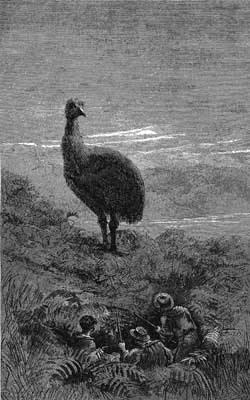
The story told of the whaler appears to me to bear marks of truth. The bold essay to explore, the terror inspired by the gigantic figure, especially in the solemnity of night, the description of the manners of the bird running and striding, so like those of the Apteryx, with which its bones shew the Moa to have been closely allied, and the inglorious return of the party without achieving any exploit, are all too natural to permit the thought that no more than inventive power has been at work.
And well may the colossus have inspired fear. The bones sent to London greatly exceed in bulk those of the largest horse. The leg-bone of a tall man is about one foot four inches in length, and the thigh of O'Brien, the Irish giant, whose skeleton, eight feet high, is mounted in the Museum of the Royal College of Surgeons, is not quite two feet. But the leg-bone (tibia) of the Dinornis we know measured as much as two feet ten inches, and we have no reason to suppose, considering the disparity that exists in the specimens examined, that we have seen by any means the largest.
Additional reason for supposing these magnificent birds to have existed not long ago, is found in the fact that specimens of their eggs have been preserved. The circumstances attendant on the discovery and identification of these possess a remarkable interest. In the volcanic sand of New Zealand Mr Walter Mantell found a gigantic egg, which we may reasonably infer to be that of either Dinornis or Palapteryx, of the magnitude of which he gives us a familiar idea by saying that his hat would have been but just large enough to have served as an egg-cup for it. This is the statement of a man of science, and therefore we may assume an approximate degree of precision in the comparison.
I do not know the size of Mr Mantell's hat, but I find that the transverse diameter of my own is six inches or a little more. If we may take this as the shorter diameter of the ovoid, the longer would probably be about eight and a half inches; dimensions considerably greater than those of the Ostrich's egg (which are about six and a quarter in length), but not what we should have expected from a bird from twelve to fourteen feet in height. And this the rather when we consider that the egg of the New Zealand Apteryx, to which these birds manifest a very close affinity, is one of dimensions that are quite surprising in proportion to the bulk of the bird. The Apteryx is about as big as a turkey, standing two feet in height, but its egg measures four inches ten lines by three inches two lines in the respective diameters. The egg of the Dinornis giganteus, to bear the same ratio to the bird as this, would be of the incredible length of two feet and a half, by a breadth of one and three quarters! Possibly this specimen, though indubitably the egg of one of this great family of extinct birds, may after all be that of one of the subordinate species.
But about the same time as Mr Mantell's discovery, one of equal interest was made in Madagascar. The master of a French ship obtained, in 1850, from natives of the island, three eggs, of far greater size, and fragments of the leg-bones of an immense bird. These, on their arrival at Paris, formed the subjects of valuable investigations by M. Isidore Geoffroy St Hilaire[16] and Professor Owen.[17]
The native statement was, that one of the eggs had been found entire in the bed of a torrent, among the debris of a land-slip; that a second egg, with some fragments of bone, was subsequently found in a formation which is stated to be alluvial; a third egg, which the natives had perforated at one end, and used as a vessel, was also found. This last egg was broken in the carriage, the other two arrived in Europe entire.
These two, though nearly alike in size, differed considerably in their relative proportions and shape, the one being shorter and thicker, with more equal ends than the other. The following table shews the dimensions of both compared with those of an ostrich's egg:—
Ovoid egg. Ellipsoid egg. Ostrich egg.
ft. in. li. ft. in. li. ft. in. li.
Longer circumference 2 10 9 2 9 6 1 6 0
Shorter circumference 2 4 3 2 5 6 1 4 6
Extreme length 1 0 8 1 0 5 0 6 4
M. Geoffroy St Hilaire estimates the larger of the two to contain 10⅛ quarts, or the contents of nearly six eggs of the Ostrich, or sixteen of the Cassowary, or a hundred and forty-eight of the Hen, or fifty thousand of the Humming bird.[18]
The fragments of bone indicated a bird of the same natural affinities as the New Zealand colossi, and of dimensions not widely remote from theirs. Professor Owen thinks that it did not exceed in height or size Dinornis giganteus, and that there is a probability that it was slightly smaller. The Madagascar bird has been named Æpyornis maximus.
The fragments of the egg of the New Zealand bird (still uncertain as to the species to which it is to be referred) shew that the shell was absolutely thinner, and therefore relatively much thinner than that of the Ostrich's egg; the air-pores, too, have a different form, being linear, instead of round, and the surface is smoother. In these qualities, the New Zealand egg resembles that of the Apteryx; in the thickness and roughness of the egg of Æpyornis there is more similarity to those of the Ostrich and Cassowary. The colour of the Madagascar egg is a dull greyish yellow; but it is possible that this may be derived from the soil in which it has long been imbedded. The fragments of the New Zealand egg are white, like the eggs of the Apteryx and Ostrich: those of the Emu and Cassowary are light green.
The willing fancy suggests the possibility that, in an island of such immensity as Madagascar, possessing lofty mountain-ranges, covered with the most magnificent forests, where civilised man has only yet touched one or two spots on the seaward borders, but where these slight explorations have educed so many wondrous animals, so many strange forms of vegetable life, the noble Æpyornis may yet be stalking with giant stride along the fern-fringed hill-sides, or through the steaming thickets; though in the more contracted area of New Zealand its equally ponderous cousins, the Dinornis and the Palapteryx, may have sunk beneath the persevering persecutions of man.
Yet another item of evidence bearing on the recent if not present existence of these great fowls has recently come to light:—the most interesting discovery that one of the genera whose fossil remains had been found associated with theirs is really extant in New Zealand. I refer to the Notornis.
At a meeting of the Zoological Society of London, held on the 13th November 1850, Dr Mantell made the following communication relative to this discovery:—
"It was in the course of last year, on the occasion of my son's second visit to the south of the middle island, that he had the good fortune to secure the recent Notornis, which I now submit, having previously placed it in the hands of the eminent ornithologist Mr Gould, to figure and describe. This bird was taken by some sealers who were pursuing their avocations in Dusky Bay. Perceiving the trail of a large and unknown bird on the snow, with which the ground was then covered, they followed the footprints till they obtained a sight of the Notornis, which their dogs instantly pursued, and, after a long chase, caught alive in the gully of a sound behind Resolution Island. It ran with great speed, and on being captured uttered loud screams, and fought and struggled violently. It was kept alive three or four days on board the schooner, and then killed, and the body roasted and eaten by the crew, each partaking of the dainty, which was declared to be delicious. The beak and legs were of a bright red colour. My son secured the skin, together with very fine specimens of the Kapapo or ground parrot (Strigops), a pair of Huias (Neomorpha), and two species of Kiwikiwi, namely Apteryx Australis, and A. Oweni. The latter very rare bird is now added to the collection of the British Museum."
"Mr Walter Mantell states, that, according to the native traditions, a large Rail was contemporary with the Moa, and formed a principal article of food among their ancestors. It was known to the North Islanders by the name 'Moho,' and to the South Islanders by that of 'Takahe;' but the bird was considered by both natives and Europeans to have been long since exterminated by the wild cats and dogs; not an individual having been seen or heard of since the arrival of the English colonists. On comparing the head of the bird with the fossil cranium, and mandibles, and the figures and descriptions in the 'Zoological Transactions' (Plate lvi.), my son was at once convinced of their identity. It may not be irrelevant to add, that in the course of Mr Walter Mantell's journey from Banks's Peninsula along the coast to Otago, he learned from the natives that they believed there still existed in that country the only indigenous terrestrial quadruped, except a species of rat, which there are any reasonable grounds for concluding New Zealand ever possessed. While encamping at Arowenua, in the district of Timaru, the Maoris assured them that about ten miles inland there was a quadruped which they called Káureke, and that it was formerly abundant, and often kept by their ancestors in a domestic state as a pet animal. It was described as about two feet in length, with coarse grizzly hair; and must have more nearly resembled the otter or badger than the beaver or the Ornithorhynchus, which the first accounts seem to suggest as the probable type. The offer of a liberal reward induced some of the Maoris to start for the interior of the country where the Káureke was supposed to be located; but they returned without having obtained the slightest trace of the existence of such an animal. My son, however, expresses his belief in the native accounts, and that, if the creature no longer exists, its extermination is of very recent date. In concluding this brief narrative of the discovery of a genus of birds once contemporary with the colossal Moa, and hitherto only known by its fossil remains, I beg to remark that this highly interesting fact tends to confirm the conclusions expressed in my communication to the Geological Society, namely, that the Dinornis, Palapteryx, and related forms, were coeval with some of the existing species of birds peculiar to New Zealand, and that their final extinction took place at no very distant period, and long after the advent of the aboriginal Maoris."
Mr Gould then read a paper pointing out the zoological characters of the bird discovered by Mr Mantell, which he had no hesitation in identifying as the species formerly characterised, from its osseous remains, by Professor Owen, under the name of Notornis Mantelli. Mr Gould, in adverting to the extreme interest with which the present existence of a species which was certainly contemporary with the Moa must be regarded, pointed out, from the preserved skin, which was on the table, how accurate a prevision of its character had been made by Professor Owen, when investigating the fragments from which our first knowledge of it had been derived.[19]
At length I come home to Great Britain and Ireland—the "nice little, tight little islands" where so many of our sympathies properly centre, where natural-history facts and all other facts interest us so much more than parallel facts elsewhere, and where, above all, there are so many more lights streaming into the darkness, and bringing out truth. Let us again look back to the period of the Bison, and Reindeer, and Elk, of the Elephant, and Hippopotamus, and Rhinoceros, of the Lion and the Hyena, and the great Cave Bear, and search among the vanishing traces of the far past for glimpses of evidence when their age ceased to be.
Some dim light falls on the obscurity from the discovery of the fossil remains of man himself—the human bones found by Dr Schmerling in a cavern near Liege, the remains mentioned by M. Marcel de Serres and others in several caverns in France, associated with fossil relics of this period. But more from the occurrence of flints, apparently fashioned by human art, in superficial deposits, together with the same extinct fossils of the tertiary. Even at the very moment that I write this sheet, my eye falls on the report[20] of an important meeting of the Ethnological Society, for the purpose of discussing this very subject of "The flint implements found associated with the bones of extinct animals in the Drift." Many of the leading geologists and archæologists were present, for the matter has become one of absorbing interest, conflicting, as the facts seem to do, with some assumptions received as unquestioned verities in Geology.
These flints, which seem indubitably to have been chipped into the forms of arrow-heads, lance-heads, and the like, have been found in France in large numbers, as also in other parts of the continent, and in England. They resemble those still used by some savage tribes. In this very neighbourhood, as in the cavern called Kent's Hole near Torquay, and in one more recently examined at Brixham, they are found mixed up with the bones of the Rhinoceros, of the Cave Bear, and the Hyena, At Menchecourt, near Abbeville, they occur in a deposit of sand, sandy clay, and marl, with bones of the same animals, and others, their contemporaries. Concerning this bed, Mr Prestwich, in a paper read before the Royal Society, May 26, 1859, says that it must be referred to those usually designated as post pliocene, but that the period of its deposit was anterior to that of the surface assuming its present outline, so far as some of its minor features are concerned. "He does not, however, consider that the facts of necessity carry man back in past time more than they bring forward the great extinct mammals towards our own time, the evidence having reference only to relative, and not to absolute time; and he is of opinion that many of the later geological changes may have been sudden, or of shorter duration than generally considered. In fact, from the evidence here exhibited, and from all that he knows regarding the drift phenomena generally, the author sees no reason against the conclusion that this period of man and the extinct mammals—supposing their contemporaneity to be proved—was brought to a sudden end by a temporary inundation of the land; on the contrary, he sees much to support such a view on purely geological considerations."[21]
At the meeting of the Ethnological Society just held, there seems to have been an increasing tendency to admit the hypothesis of the continuance of the Mammalia of the Tertiary into the human era. Mr Evans, who exhibited specimens taken at a depth of twenty to thirty feet, from a stratum of coarse fresh-water gravel, lying on chalk, and containing an entire skeleton of an extinct Rhinoceros, and overlaid by sandy marl containing existing shells, shewed that the deposit had certainly not been disturbed till the present time, so that the gravel, the bones, and the flints had been deposited coetaneously. He suggested "that the animals supposed to have become extinct before man was created might have continued to exist to more recent periods than had been admitted." And this opinion found support from other leading geologists.
That this conclusion would throw the existence of man to an era far higher than that assigned to him by the inspired Word, is, I know, generally held; and certain investigations, made in the alluvial deposit of the Nile,[22] are considered to prove that man has been living in a state of comparative civilisation in the Nile Valley for the last 13,500 years. But that conclusion absolutely rests on the supposition that the rate of increase formed by the annual deposit of the Nile mud has been always exactly the same as now,—a supposition, not only without the least shadow of proof, but also directly contrary to the highest probability, nay, certainty, in the estimation of those who believe in the Noachian deluge. For surely the drainage of the entire plain of North Africa after that inundation must have produced an alluvium of vast thickness in a very brief time; while beneath that deposit the works of the antediluvian world might well be buried. Yet the possibility of there ever having been any greater rate of deposit than within the last 3000 years, the recorder of those investigations, in his unseemly haste to prove the Bible false, strangely leaves wholly out of his consideration.
So, doubtless, concerning other deposits containing fossil remains, whose extreme antiquity is assumed from the known rate of surface-increase now, we ought to remember that we have not a tittle of proof that the rate of increase has not at certain remote periods been suddenly and immensely augmented. There are many facts on record which tend to shew that the rate at which geologic changes take place in certain localities affords no reliable data whatever to infer that at which phenomena apparently quite parallel have occurred in other localities. An upheaval or a subsidence of one part of a country may rapidly effect a great change in the amount of soil or gravel precipitated by streams, without destroying or changing their channels, and yet the deposit may be made sufficiently gradually to allow the burial of shells or of bones of creatures which lived and died on the spot.
The degradation of a cliff, either suddenly or gradually, might throw a vast quantity of fragments into a rapid stream, and cause a deposit of gravel of considerable breadth and thickness in a comparatively short period of time,—say a century or two.
Sir Charles Lyell has adduced examples of very rapid formation of certain stony deposits, which should make us cautious how we assert that such and such a thickness must have required a vast number of years. In one of them there is a thickness of 200 or 300 feet of travertine of recent deposit, while in another, a solid mass thirty feet thick was deposited in about twenty years. There are countless places in Italy where the formation of limestone may be seen, as also in Auvergne and other volcanic districts.[23]
From these and similar considerations it seems to me by no means unreasonable that the four thousand years which elapsed between the Creation and the commencement of Western European history should have been amply sufficient for many of those geological operations whose results are seen in what are known as the later Tertiary deposits,—the crag, the drift, the cavern-accumulations, and the like. And, as a corollary to this, that the great extinct Mammalia may have extended into this period, and thus have been contemporary with man, for a greater or less duration, according to the species; some, probably, having been extinguished at a very early period of the era, while others lived on to the time I have named, or even later.
But have we nothing better for this conclusion than an assumption of the possibility, and a more or less probable conjecture? Yes; we have some facts of interest to warrant it, or I should not have ventured to introduce the subject in this work. There are facts,—besides the admixture of human workmanship with the animal remains in undisturbed deposits—direct evidence, not altogether shadowy, of the co-existence of the extinct animals with living men.
And first, I would mention some circumstances bearing analogy to the exhumation of the fresh Pachyderms of Siberia. Some years ago, a portion of the leg of an Irish Elk, so-called, (Megaceros hibernicus,) with a part of the tendons, skin, and hair upon it, was dug up with other remains from a deposit on the estate of H. Grogan Morgan, Esq., of Johnstown Castle, Wexford, and is now in that gentleman's possession. This leg was exhibited, and formed the subject of a lecture at the time by Mr Peile, veterinary surgeon, Dublin.
It has been ascertained that the marrow in some of the bones blazes like a candle; that the cartilage and gelatine, so far from having been destroyed, were not apparently altered by time.[24] Archdeacon Maunsell actually made soup of the bones, and presented a portion thereof to the Royal Dublin Society (whether they enjoyed it I have not heard; it must have been "a little high," I fear). They are frequently used by the peasantry for fuel. On the occasion of the rejoicings for the victory at Waterloo, a bonfire was made of these bones, and it was observed that they gave out as good a blaze as those of horses, often used for similar purposes.[25]
Pepper, in his "History of Ireland," states that the ancient Irish used to hunt a very large black deer, the milk of which they used as we do that of the cow, and the flesh of which served them for food, and the skin for clothing. This is a very remarkable record; and is confirmed by some bronze tablets found by Sir William Betham, the inscriptions on which attested that the ancient Irish fed upon the milk and flesh of a great black deer.
According to the "Annals of the Four Masters," Niel Sedamin, a king of Ireland before the Christian era, was so called because "the cows and the female deer were alike milked in his reign." The art of taming the wild deer and converting them into domestic cattle is said to have been introduced by Flidisia, this monarch's mother. Deer are said to have been used to carry stones and wood for Codocus when his monastery was built, as also to carry timber to build the castle of a king of Connaught. These may have been red deer, but as there is good proof that the giant deer was really domesticated, it seems more likely that such offices should have been performed by the latter than by the former.
An interesting letter from the Countess of Moira, published in the "Archæologia Britannica," gives an account of a human body found in gravel under eleven feet of peat, soaked in the bog-water; it was in good preservation, and completely clothed in antique garments of deer-hair, conjectured to be that of the Giant Elk.
A skull of the same animal has been discovered in Germany in an ancient drain, together with several urns and stone-hatchets. And in the museum of the Royal Dublin Society there exists a fossil rib bearing evident token of having been wounded by some sharp instrument which remained long infixed in the wound, but had not penetrated so deep as to destroy the creature's life. It was such a wound as the head of an arrow, whether of flint or of metal, would produce.
In the year 1846, a very interesting corroboration of the opinion long held by some that the great broad-horned Deer was domesticated by the ancient Irish, was given by the discovery of a vast collection of bones at Lough Gûr, near Limerick. The word Gûr is said to mean "an assemblage," so that the locality is "the Lake of the Assemblage," commemorating perhaps the gathering of an army or some other host at the spot. In the midst of the lake is an island, which is described as being so completely surrounded with bones and skulls of animals "that one would think the cattle of an entire nation must have been slaughtered to procure so vast an assemblage."
The skulls are described as belonging to the following animals:—The giant deer (females); a deer of inferior size; the stag; another species of stag; the fallow deer; the broad-faced ox; the hollow-faced ox; the long-faced ox; another species of ox; the common short-horned ox; the goat; and the hog.
The principal points of interest centred in the Giant Deer or so-called Irish Elk. The skulls of these, as of all the larger animals, "were broken in by some sharp and heavy instrument, and in the same manner as butchers of the present day slaughter cattle for our markets, and in many cases the marrow-bones were broken across, as if to get at the marrow."
Of course, if this was indubitable, the conclusion was inevitable, that the Giant Deer was not only contemporary with man, but was domesticated by him with other quadrupeds, and used for food. Professor Owen, however, contended that the skulls of the Giant Deer were not females but males, from which the horns had been forcibly removed, and that the holes in the foreheads were made by the violent wrenching off of the horns tearing away a portion of the frontal bone from which they grew.
In reply to this opinion, Mr H. D. Richardson of Dublin, whose personal acquaintance with the relics of this noble species is peculiarly extensive, shewed that certain variations of proportion on which the learned Professor relied to prove the skulls to be male, were of no such value, individual animals presenting great discrepancies in these respects: that the total absence of cornuous peduncles from the sides of the forehead, and of the elevated bony ridge, conclusively proved the sex to be female, which was permanently destitute of horns; and that in no case could it be said that the ridge was forced away, since the violence was confined to a small hole in the centre of the forehead.
To put the matter to test, Mr Richardson experimented on two perfect male skulls. In the one instance the force was applied to the beam of the horns, and the result was their fracture where they are united to the peduncles. In the other case the force was applied to the peduncles themselves, to ascertain whether it was possible to wrench them and the ridge away from the face, when the consequence was, that the skull was completely riven asunder. Indeed to any one who looks at the position of the horns in this animal, and their implantation, it must be self-evident that their violent removal must tear away the entire forehead, and not leave a central hole. Mr Edward Newman who subsequently examined the specimens speaks decidedly on this point:—"I have not the least hesitation in expressing my firm conviction that the fractures were the result of human hands, and were the cause of the death of the animals. These two fractured skulls correspond too exactly with each other, and with that of a bullock with which I compared them, to have resulted from accident: the edges of the fractures wore the appearance of having been coeval with the interment or submergence of the skulls, and presented a very strikingly different appearance from a fracture recently made, and which I had the opportunity of examining. There were several skulls of the male of the same species, one bearing enormous antlers, but none exhibiting the slightest trace of frontal fracture."[26]
A circumstance of much importance is that these skulls were found in company with those of many well-known domestic animals, as the ox, the goat, and the hog. These skulls were similarly fractured. As it is evident that their demolition was produced by the butcher's pole-axe, why not that of the elk-skulls?
"At the first cursory glance, it may appear somewhat strange that the skulls of the males should invariably have been found entire, and that even the recent discovery at Lough Gûr should form no exception.
"I do not, however, find any difficulty here. In the first place, we may fairly suppose that males, like our bulls, were not equally prized as food. In the second place, the size, as well as the position of the antlers, would render it next to an impossibility to give the desired blow with the pole-axe. In the third place, the greater strength and thickness of the skull would almost to a certainty render the blow unavailing; and in the fourth place, supposing the females domesticated, and the occasional tenants of sheds and other buildings, we may well imagine that the males were excluded from such buildings by the enormous size of their antlers. Perhaps a few only of the males, as in our cattle, were suffered to become adult, one male sufficing for many females. Perhaps the males were allowed free range, the females only being permitted at stated seasons to accompany them. In fine, the more we investigate probabilities, the more we reason from present experience and knowledge, the less difficulty shall we find in the way of believing the gigantic deer of Ireland an animal coeval with man and subservient to his uses."[27]
In a communication subsequently made to the Zoologist by Mr Richardson, he gives the following additional evidence:—"In the collection of the late Mr Johnston, of Down, which had been left by his uncle, an attorney, and in which everything was labelled with the accuracy and precision of that profession, is a small brass spear, with a piece of wood still in the socket, with a label, stating it to have been found in a marl-pit, among the bones of a deer. An excise-officer told me that he saw, found in a marl-pit, at Mentrim in Meath, the skeleton of a deer, and a man, and a long knife: the latter, I believe, is rather a short sword, now, I think, in the collection of Mr Petrie, of Dublin, who told me that some such tradition had accompanied it into his possession.... Dr Martin informs me that on the banks of the river Suir, near Portland, Waterford, and on nearly every farm, are found, near springs, spaces of frequently seventy feet in diameter, consisting of stones, broken up as if for roads, and lying together in a mass. These stones were evidently purposely broken, and all much of one size, and are charred. These spaces are many feet in depth. The tradition respecting them is current among the peasantry, that here in olden time, a great deer was killed and baked in these stone-pits, the stones having been previously heated like a kiln, and they also distinguish the animal as the 'Irish Elk.' These places are called in Irish by a name signifying the 'Buck's Den.'"
SPEARING THE ANCIENT ELK.
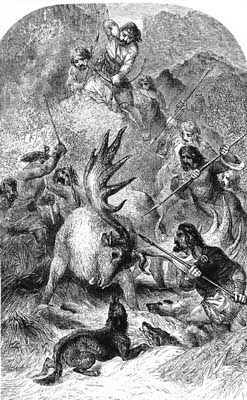
From all these testimonies combined, can we hesitate a moment in believing that the Giant Deer was an inhabitant of Ireland since its colonisation by man? It seems to me that its extinction cannot have taken place more than a thousand years ago. Perhaps at the very time that Cæsar invaded Britain the Celts in the sister isle were milking and slaughtering their female elks, domesticated in their cattlepens of granite, and hunting the proud-antlered male with their flint arrows and lances. It would appear, that the mode of hunting him was to chase and terrify him into pools and swamps, such as the marl-pits then were; that, having thus disabled him in the yielding bogs, and slain him, the head was cut off, as of too little value to be worth the trouble of dragging home; that the under jaws and tongue were cut off; and that frequently the entire carcase was disjointed on the spot, the best parts only being removed. This would account for the so frequent occurrence of separate portions of the skeleton, and especially of skulls, in the bog-earth. No doubt so large an animal would not long survive in a state of freedom, after an island so limited in extent as Ireland became peopled throughout; and supposing the females to have been domesticated, it is quite conceivable that the difficulty or even danger of capturing or domesticating the males, may have caused the species soon to become extinct in captivity, when it no longer continued to exist in a wild state. Thus we may perhaps account for the certainly remarkable fact that no native Irish name has been recognised as belonging to it;—remarkable, because the Irish tongue is particularly rich in distinctive names for natural objects. There exists a very curious ancient poem in that language which professes to enumerate the whole fauna of the island. It is founded on the legend that Fian MacCumhaill was made prisoner by Cormac MacArt, king of Erinn; that the victor promised to give him freedom on condition that, as a ransom, a pair of each wild animal found in Ireland were brought before him on the green of Tara. Cailte MacRonain, the foster-brother of the captive general undertook the task, and succeeded in bringing the collection before the king within a twelvemonth; and in the poem, he is supposed to narrate to St Patrick the detail and result of his enterprise. Of this poem, which is considered to be as early as the ninth century, the reader may like to see the following translation by Mr Eugene Curry, containing the zoological portion:—
"I then went forth to search the lands, To see if I could redeem my chief, And soon returned to noble Tara, With the ransom that Cormac required. "I brought with me the fierce Geilt,[28] And the tall Grib[29] with talons, And the two Ravens of Fid-dá-Beann, And the two Ducks of Loch Saileann. "Two Foxes from Sliabh Cuilinn, Two Wild Oxen[30] from Burren, Two Swans from the dark wood of Gabhran, And two Cuckoos from the wood of Fordrum. "Two Toghmalls[31] from Fidh-Gaibhle, Which is by the side of the two roads, And two Otters after them, From the brown-white rock of Dobhar. "Two Gulls from Tralee hither, Two Ruilechs[32] from Port Lairge (Waterford), Four Snags[33] from the River Brosna, Two Plovers from the rock of Dunán. "Two Echtachs[34] from the lofty Echtghe, Two Thrushes from Letter Longarie, Two Drenns[35] from Dun Aife, The two Cainches[36] of Corraivte. "Two Herons from the hilly Corann, The two Errfiachs[37] of Magh Fobhair, The two Eagles of Carrick-na-Cloch, Two Hawks from the wood of Caenach. "Two Pheasants from Loch Meilge, Two Water-hens from Loch Eirne, Two Heath-hens from the Bog of Mafa, Two Swift Divers from Dubh Loch. "Two Cricharans[38] from Cualann, Two Titmice from Magh Tualang, Two Choughs from Gleann Gaibhle, Two Sparrows from the Shannon. "Two Cormorants from Ath Cliath, Two Onchus[39] from Crotta Cliach, Two Jackdaws from Druim Damh, Two Riabhogs[40] from Leathan Mhaigh. "Two Rabbits from Dumho Duinn, Two wild Hogs from circular Cnoghbha, Two Peatáns[41] from Creat Roe, Two wild Boars[42] from green-sided Tara. "Two Pigeons out of Ceis Corann, Two Blackbirds out of Leitir Finnchoill, Two black Birds (?) from the strand of Dabhan, Two Roebucks from Luachair Deaghaidh. "Two Fereidhins[43] from Ath Loich, Two Fawns from Moin mor, Two Bats out of the Cave of Cnoghbha, Two Pigs[44] from the lands of Ollarbha. "Two Swallows out of Sidh Buidhe, Two Iaronns[45] from the wood of Luadraidh, Two Geisechtachs[46] from Magh Mall, Two charming Robins from Cnamh Choill. "Two Woodcocks from Coillruadh, Two Crows from Lenn Uar, Two Bruacharans[47] from Sliabh-da-Ean, Two Barnacle-Geese from Turloch Bruigheoil. "Two Naescans[48] from Dun Daighre, Two Yellow-ammers from the brink of Bairne, Two Spireogs[49] from Sliabh Cleath, Two Grey Mice from Limerick. "Two Corncrakes from the Banks of Shannon, Two Wagtails from the brinks of Birra, Two Curlews from the Harbour of Galway, Two Sgreachógs[50] from Muirtheimhne. "Two Geilt Glinnes[51] from Glenn-a-Smoil, Two Jackdaws from great Ath Mogha, Two fleet Onchus[52] from Loch Con, Two Cats out of the Cave of Cruachain. "Two Goats from Sith Gabhran, Two Pigs[53] of the Pigs of Mac Lir, A Ram and Ewe both round and red, I brought with me from Aengus. "I brought with me a Stallion and a Mare, From the beautiful stud of Manannan, A Bull and a white Cow from Druim Cain, Which were given me by Muirn Munchain."
No known allusion occurs in this poem to the Giant Deer.[54] First, however, we must remember that no small number of the animals mentioned are quite unrecognisable; and that of those names to which an explanation is given, many are probably incorrectly rendered. Secondly, if it could be absolutely shewn that no allusion exists to that fine beast, it would not at all disprove its existence a thousand years before. Supposing that the Megaceros became extinct soon after the colonisation of Ireland, and that this was several centuries before the Christian era, the distinctive name by which it had been known might well have died out and become extinct also, among a people unacquainted with letters. Or if a dim tradition of the animal and of its name still lingered here and there, it might well be omitted from a catalogue which professed to give the creatures actually collected in a living state at a given period. It would have been interesting to have been able to identify the Great Elk, but its introduction would have been a glaring anachronism.
The enumeration of nearly a hundred and sixty quadrupeds and birds either indigenous to or naturalised in Ireland at so early a period, possesses, I say, a peculiar interest.
If the editor's suggestion is correct, that the Echtach was a bovine animal, then we have three distinct mentions of this family in the poem,—the Wild Oxen, the Echtachs, and the Bull and White Cow. The second and third of these were probably domesticated animals; the first one expressly "Wild." Now at least five distinct species of Oxen are known to have inhabited Europe and the British Isles during the later periods of the Tertiary era, which have been named respectively, Bison priscus, Bos primigenius, frontosus and longifrons, and Ovibos moschatus. Of these, skulls of Bos frontosus and B. longifrons have been dug up in some numbers in Ireland. Some of these bear, in the perforation of the forehead, evident proof of having been slaughtered secundum artem, and therefore of having been domesticated. But one large skull of the longifrons type, now in the Museum of the Royal Irish Academy, has a cut in the forehead, into which can be accurately fitted several of the narrow bronze "celts," or arrow-heads so frequently dug up in Ireland; a pretty fair proof that this animal was killed by the hunter's arrow, and was therefore wild.
No bovine animals of the true taurine race are now known to exist in an aboriginally wild state; but at the epoch of our earliest historical knowledge of central and western Europe it was far otherwise. Cæsar, describing, under the name of Urus, certain wild oxen of the great Hercynian forest, says, "These Uri are little inferior to elephants in size, but are bulls in their nature, colour, and figure. Great is their strength, and great their swiftness, nor do they spare man or beast when once they have caught sight of him. These, when trapped in pitfalls, the hunters unsparingly kill. The youths, exercising themselves by this sort of hunting, are hardened by the toil, and those among them who have killed most, bringing with them the horns, as testimonials, acquire great praise. But these Uri cannot be habituated to man, nor made tractable, not even when taken young. The great size of the horns, as well as the form and quality of them, differs much from those of our oxen."