Front matter
Reading edition
Cover art
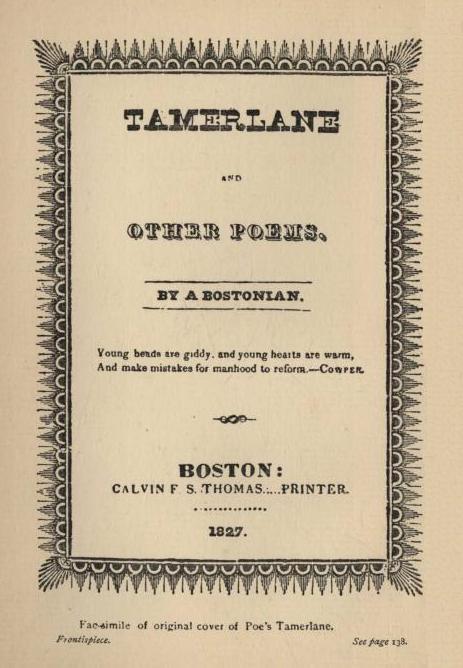
Facsimile of original cover of Poe's Tamerlane. Frontispiece. See page 138.
THE ROMANCE
OF
BOOK-COLLECTING.
BY
J. H. SLATER,
EDITOR OF 'BOOK PRICES CURRENT;' AUTHOR OF 'EARLY EDITIONS,' 'ROUND AND ABOUT THE BOOKSTALLS,' 'THE LIBRARY MANUAL,' 'ENGRAVINGS AND THEIR VALUE,' ETC., ETC.
NEW YORK: FRANCES P. HARPER. 1898.
CONTENTS.
CHAPTER.
IN EULOGY OF CATALOGUES
A COMPARISON OF PRICES
SOME LUCKY FINDS
THE FORGOTTEN LORE SOCIETY
SOME HUNTING-GROUNDS OF LONDON
VAGARIES OF BOOK-HUNTERS
HOW FASHION LIVES
THE RULES OF THE CHASE
THE GLAMOUR OF BINDINGS
THE HAMMER AND THE END
CHAPTER I.
IN EULOGY OF CATALOGUES.
There are plenty of people—in fact, they are in the great majority even among bookish men—who regard antiquated sale-catalogues in the light of so much rubbish, and yet, when intelligently consulted, these memorials of a bygone day not only have their uses, but are positively interesting. Truly enough they are not popular, like the last new novel which, for one reason or another, has taken the town by storm, and it would not pay to reprint a single one of them, even the best or most important that has ever held the frequenters of auction-rooms spell-bound.
Sometimes a 'parcel' will be sold for what it will fetch, and on investigation may prove to contain a few simple-minded pamphlets on subjects of no importance, 'and others,' the latter consisting of book-catalogues of the last or the earlier portion of the present century. This happens sufficiently often to make it possible for a bookish enthusiast of an antiquarian turn of mind to lose himself with marvellous rapidity in a maze of old-time dispersions. But the enthusiast, unless very determined indeed, knows better than to choke his library with such material. He is aware that an exhaustive index is indispensable to the proper appreciation of such literature, and to make that would occupy his nights indefinitely.
And so it comes to pass that old sale-catalogues of books are consigned for the most part to the rubbish-heap, or perhaps sent to the mills, to reappear later on in another guise. They may be scarce in the sense that, if you wanted a particular one, it could only be got with great difficulty, and at considerable expense (here the art of selling to advantage comes in), or perhaps not at all. This, however, makes no matter, for the fact remains that such things are not inquired for as a general rule, and that an occasional demand is insufficient to give them any kind of a status in the world of letters.
Some five or six years ago a member of the Johnson Club, a literary society which meets at intervals in various parts of London, but more particularly in Fleet Street, discovered a catalogue of the sale of the old Doctor's library, neatly marked with the prices each book had brought. Whether this was a sale post mortem or a casual interlocutory dispersal at the instance of some soulless creditor, I do not know. In any case the relic was a find—a fact which the bookseller who bought it was not slow to appreciate, for he at once assessed its value, to the society man, at something like forty shillings. This was paid without demur, because at the time all the other Johnson catalogues were in mufti, and it had struck no one to exhibit them, and also because it was, under the circumstances of the case, a very desirable memorial to present to the society which flourishes on the fame of the great lexicographer. Here, at any rate, is one exceptional instance of an old catalogue possessing a distinct pecuniary value up to £2, and though the noise this discovery made in certain circles led to a general search and the rescue of other copies, the circumstances are not in the least affected on that account.
From a literary or even a sentimental standpoint, a long story, full of speculation and romance, might be written on Dr. Johnson's long-forgotten catalogue. We might, for instance, trace, by the aid of Boswell, many of the books mentioned in it to the very hand of the master himself. We might conjecture the use he made of this volume or that in his 'Lives of the Poets,' 'The Vanity of Human Wishes,' or in the ponderous Dictionary that cemented his fame, and by way of interlude beguile an hour occasionally by contrasting the character of the books he affected with the quality of those on the shelves of some modern Johnson, assuming, of course, that his counterpart is to be found. Then we might look at the prices realized, and compare them with those ruling at the present day. Some books then in fashion are, we may be sure, now despised and rejected, others have not been appreciably affected by the course of time, while others, again, are now sought after throughout the world, and are hardly to be met with at all. There is no old catalogue whatever which is not capable of affording considerable instruction if we only read between the lines.
Then, again, there is one speculation that no true book-lover can stifle; it haunts him as he passes the barrows with their loads of sermons and scholastic primers, and it is this: 'Time works wonders.' Some day may not this heterogeneous mass of rubbish produce as fine a pearl as ever a diseased oyster was robbed of? May not fashion go off at a tangent, and dote on lexicons or what not? There have been men—Rossi, for example, who was so saturated with the suspicion that fashion might change any moment that the stalls by which he passed were 'like towns through which Attila or the Tartars had swept, with ruin in their train'—who would buy any book whatever, whether they wanted it or not, on the bare chance of someone else wanting it, either at the time or in the days to come.
Such may be the outcome of a too eager perusal of catalogues, focussed till it produces an absorbing passion, which only departs with life itself. After a time discrimination, naturally enough, becomes impossible, and whole masses of books are bought up for what they may become, not for what they are. This may appear to be an ignoble sort of pastime, but in reality it is far otherwise, since wholesale purchasers of this stamp are invariably well read, and know more about their author than his mere name. I personally was acquainted with a bookworm who absorbed whole collections at a time. His house was full of books; they were under the beds, in cupboards, piled up along the walls, under the tables and chairs, and even on the rafters under the roof. If you walked without due care, you would, more likely than not, tumble over a folio in the dark, or bring down a wall of literature, good, bad, or indifferent, on your head. This library was chaotic to the general, though the worm himself knew very well where to burrow for anything he required, and, what is more to the point, would feed for hours on volumes that few people had ever so much as heard of. The monetary value of his treasures did not trouble him, though one of his favourite anecdotes related to the hunting down of a fourth folio Shakespeare, which, after much haggling, he purchased for a song from a poor woman who lived in an almshouse. When the delight of the chase was over, he recompensed her to the full market value, thereby proving that, in his case at least, a greed for books does not necessarily carry with it a stifled conscience. Sad to relate, this bibliophile died like other men, and the collection of a lifetime came to the inevitable hammer. Most of his books then proved to be portions of sets. If a work were complete in, say, ten volumes, he would perhaps possess no more than five or six of the full number in various bindings and editions, while others, though complete, were imperfect, and many were in rags. Yet among the whole there were some pearls of great price. Even in his day the fashion had changed in his favour.
Now, this changing of fashion which is always going on cannot be prophesied at haphazard, or perhaps even at all; but if there is a way of forestalling it, it is by the careful comparison of prices realized for books of a certain kind at different periods of time, and this can only be accomplished by a study of catalogues. The book-man likes to think that history repeats itself in this as in other matters, and that what has happened once will probably occur again in process of time. Nay, he might, without any great stretch of credulity. persuade himself that it must occur, if only he live long enough. That's the rub, for half a dozen lifetimes might not be sufficient to witness a return to favour of, say, the ponderous works of the Fathers, which were in such great demand a couple of centuries ago. As of them, so of many other kinds of books which are only read now by the very few. Some day they will rise again after their long sleep, but not for us.
As a corollary to this eulogy of catalogues, let us take a few of them and see where the book-man's steps are leading him. In his wanderings abroad he must many a time be painfully conscious of the fact that his own quest is that of everyone else whose tastes are similar to his own. Let a first edition of the immortal 'Angler' so much as peep from among the grease and filth of a rag-and-bone shop, and a magnetic current travels at lightning speed to the homes of a score or more of pickers-up of unconsidered trifles, who forthwith race for the prize. How they get to know of its existence is a mystery. Perhaps some strange psychological influence is at work to prompt them to dive down a pestilential alley for the first and last time in their lives. Did you ever see a millionaire groping in the gutter for a dropped coin? His energy is nothing to that of the book-man who has reason to suspect—why he knows not—that here or there may perhaps lie hid and unrecognised a volume which fashion has made omnipotent. And his energy is not confined to himself alone, for one decree of a naughty world changes not—it is ever the same: What many men want, more men will search for; what one man only has, many will want. The path of the book-hunter is trodden flat and hard with countless footsteps, and this is the reason why it is so unsatisfactory to look specially for anything valuable.
We may take it, therefore, that, though hunting for books may be a highly exhilarating pastime, it is seldom remunerative from a pecuniary point of view. There are, no doubt, hundreds of thousands of good and useful volumes which can be bought at any time for next to nothing; but they have no halo round them at the moment, and so they are abandoned to their fate by the typical collector, who insists not only on having the best editions in exchange for his money, but that his books shall be of a certain description—that is to say, of a kind to please him, or which for the time being is in great demand.
And men are pleased at various times by books of a widely different character, as the old catalogues tell us plainly enough. In 1676, when William Cooper bookseller, dwelling at the Sign of the Pelican in Little Britain, held the first auction sale ever advertised in England—that of the library of Dr. Lazarus Seaman—works critical of the Fathers and Schoolmen; learned and critical volumes of distressing profundity, appealed to the comparative few who could read and write sufficiently well to make reading a pleasurable experience. Poetry is absent entirely. Shakespeare and Milton are elbowed out by Puritan fanatics who fulminate curses against mankind. No doubt, if a book-man of those days had been asked what kind of literature would be in vogue a couple of centuries hence, he would have pointed to Seaman's collection and replied, 'Books like those can never die. So long as learning holds its sway over the few, they will be bought and treasured by the many.' In this he would have been wrong, for few people care nowadays for volumes such as these. The times have changed utterly, and we with them.
At this same sale was a book which sold for less than almost any other, and it lay hidden away under this bald and misleading title: 'Veteris et Novi Testamenti in Ling. Indica, Cantabr. in Nova Anglia.' Simply this, and nothing more. No statement as to date, condition or binding appears in Cooper's catalogue, and yet this Bible is none other than John Eliot's translation into the Indian language, with a metrical version of the Psalms in the same vernacular, published at Cambridge, Mass., in 1663-61. An auctioneer of the present day would print the title of this volume in large capitals, and tell us whether or no it had the rare dedication to King Charles II., of pious memory, which was only inserted in twenty copies sent to England as presents. If it had, then this book, wherever it may be, is now worth much more than its weight in gold, for at Lord Hardwicke's sale, held in London on June 29, 1888, such a desirable copy was knocked down for £580.
Why this immense advance in price, seeing that probably there is no man in England to-day who could read a single line of John Eliot's free translation? The reason is plain. Since 1661 sleepy New England has vanished like the light canoes of countless Indians, and in the busy United States there has grown up a great demand for anything which illustrates the early history of North America. Had such a contingency struck old Lazarus Seaman, he would have made his will to suit the exigences of the case, and perhaps taken more interest in John Eliot and his missionary enterprises than anyone did at the time, or has done since.
It may perhaps be said that Seaman's library must have been of a special kind, one which such a learned divine might be expected to gather within his walls; but as a matter of fact this was not so. Between 1676 and 1682, October to October in each of those years, exactly thirty sales of books were held by auction in London, among them the libraries of Sir Kenelm Digby, Dr. Castell, the author of the 'Lexicon Heptaglotton,' Dr. Gataker, Lord Warwick, and other noted persons. The general character of all the seventeenth-century catalogues which time has spared for our perusal is substantially the same. Every one of them reflects the taste and fashion of the day, as did Agrippa's magic glass the forms of absent friends. Still harping chiefly on theology! as Polonius might say, these catalogues are crammed with polemics and books of grave discourse. Anything which could not, by hook or by crook, be dragged, as to its contents, within the circumference of the fashionable craze, was disposed of for a trifling sum. Even in 1682 the learned world, or at least our narrow corner of it, was inhabited almost entirely by crop-eared Puritans, with sugar-loaf hats on their heads and broad buckles to their shoes, and by Philosophers. True! Cromwell had gone to his account, and Charles II. held Court at St. James's and elsewhere, but the King and his merry companions were not reading men unless a profound knowledge of 'Hudibras,' that book which Pepys could not abide the sight of, could make them so. The anti-Puritans patronized Butler, and doted on Sir Charles Sedley, the Earl of Rochester and a few more, who scribbled love-verses by day, and gambled and fought and drank at night. But these worshipped Thalia and Erato only, with music and dancing and other delights, and knew nothing of solid hard work by the midnight oil. They had no books to speak of, and the few they had were light and airy like themselves, and for the most part as worthless.
On November 25, 1678, a great sale was held at the White Hart, in Bartholomew Close. The books were 'bought out of the best libraries abroad, and out of the most eminent seats of learning beyond the seas,' or, more truthfully, had been removed from the shops of seven London book-sellers who had combined to rig the market. Books of all kinds were dispersed at this sale, which continued de die in diem till the heptarchy was satisfied. Were the members of this pioneer combination alive now, they would weep to think that they gave away on that occasion—practically gave away—scores of what have long since become aristocrats among books. Americana were there in plenty, and some of these are now so extremely rare and valuable that they are hardly to be procured for love or money; some few, indeed, have completely disappeared, tossed lightly aside, probably by disgusted purchasers, or carted back again to the shops from whence they came, to be stacked once more till they perished utterly of damp and neglect, moth, mice and rust. On the other hand our old friends, the Puritans, revelled in grim folios bought up at prices which, the change in the value of money notwithstanding, would hardly be exceeded now. Walton's 'Biblia Sacra Polyglotta' was an immense favourite, a distinction it doubtless deserved, and, indeed, deserves yet, though we can see that Walton must have 'gone down' woefully in the last hundred years, when we come to calculate the necessaries of life that could be bought then with a piece of gold, and to contrast them with the meagre display such a sum would purchase now. The truth perhaps, is that, although education was less widely diffused in the days of the Stuarts, it was more deep and thorough. A savant was then like a huge octopus that devastates whole districts, and daily grows fatter and more bloated at the expense of everything that moves within reach of its spreading tendrils.
To this effect are we taught by these ancient catalogues, which, however, do not exhaust all their interest in mere matters of prices and fashion. We can learn much from their pages and advertisements of the manners and customs of our ancestors in Bookland. It seems that there were travelling auctioneers a couple of centuries ago who prefaced their remarks with eulogies of the Mayor and Corporation of each town at which they stopped, by way, no doubt, of securing their patronage. Sales began at eight o'clock in the morning then, and went on, with a mid-day interval for refreshment, until late at night. Sometimes the auctioneer sold by the candle-end; that is to say, lit a morsel of candle on putting up some coveted volume for competition, and knocked it down to him who had bid the most when the light flickered out. This was, distinctly, an excellent method for bolstering up excitement, for every splutter must have been good for a hasty advance, regretted very possibly when the modicum of tallow entered on a fresh lease of life. When not selling by the candle-end, an auctioneer would dispose of about thirty lots in the course of an hour, and was quite willing to accept the most trifling bids. Business is more rapidly conducted now, for few auctioneers stop to curse their fate, or to regale their audience with anecdotes, as one George Smalridge, who in 1689 wrote and published a skit on the prevalent way of doing business, says was quite the usual custom in his day. His tract is written in Latin, under the title 'Auctio Davisiana,' and gives a fanciful account of the extraordinary proceedings that took place at the sale of the books of Richard Davis, an ancient bookseller of Oxford, who had fallen into the clutches of the bailiffs. The auctioneer commences with a dirge said, or perhaps sung, over the miserable Davis: 'O the vanity of human wishes! O the changeableness of fate and its settled unkindness to us,' etc. Each book is extolled at length, and there are pages of lamentation and woe as Hobbes of Malmesbury, his 'Leviathan,' 'a very large and famous beast,' is knocked down, by mistake, for the miserable sum of five pieces of silver.
An exhaustive chapter on early book auctions would necessarily commence with the dispersion of the stock of Bonaventure and Abraham Elzevir at Leyden in April, 1653; but the Elzevirs must look to themselves, nor are these remarks intended to be even approximately full. Rather are they discursive, and in praise of catalogues in the mass; intended merely to put someone else with more space and time at his disposal in the way of rescuing them from the neglect into which they have fallen. The next chapter is more specific, for in that we will take a very famous sale of less antiquity, and endeavour to draw comparisons between then and now. And these comparisons will perhaps be very odious, for they will necessarily appeal directly to the cupidity of every bookworm that breathes, to every book-hunter who prowls around in search of rarities, and returns home—empty handed.
CHAPTER II.
A COMPARISON OF PRICES.
The important sale to which reference was made in the last chapter is that of the library of John, Duke of Roxburghe, which was dispersed on May 18, 1812, and forty-one following days, by Robert H. Evans, a bookseller of Pall Mall. This sale is of extreme interest for two reasons. In the first place, the collection was the most extensive, varied, and important that had hitherto been offered for sale in England, or indeed, anywhere else; and, secondly, it may fairly be regarded in the light of a connecting-link between the old state of things and the new. The Roxburghe library was not 'erected,' as Gabriel Naudæus has it, on traditional principles; it was of a general character that appealed to all classes of book-men. On the other hand, it was not quite such a library as a collector of large means might be expected to get together at the present day, for the tendency is now to specialize, and in any case many of the books that the Duke obviously took an interest in are of such little importance now, and so infrequently inquired for, that they would most assuredly be refused admission to any private library of equal importance and magnitude. Even a general lover would hardly be likely to manifest much interest in a number of volumes on Scots law or to hob-a-nob with Cheyne, who in 1720 wrote a book on the gout, or with Sir R. Blackmore, notwithstanding that eminent physician's great experience of the spleen and vapours. That lore of this kind has its merits I dispute in no way, but it is not exactly of a kind to interest the modern collector, who, even if he aim at all branches of literature alike, would much prefer to have his legal and medical instruction boiled down, so to speak, to the compass of a good digest or cyclopædia.
Nevertheless, May 18, 1812, is among the fasti of those who to a love of letters add a passion for books. It is the opening day of the new régime—the birthday, in fact, of those who revel in first editions and early English texts. Brunet said that the 'thermometer of bibliomania'—objectionable word!—'attained its maximum in England' during these forty-two days of ceaseless hammering, and Dibdin went perfectly insane whenever he thought of this 'Waterloo among book-battles,' as he called it. Everyone of course knows the chief episode; that struggle between Earl Spencer and the Marquis of Blandford for the 1471 Boccaccio, in its faded yellow morocco binding, and how the latter carried it off for £2,260, a most idiotic price to pay, as subsequent events abundantly proved; for seven years later, when Lord Blandford's library came to be sold, the coveted volume was acquired by his former rival for considerably less than half the money. It now reposes in state at Manchester, or, as some choose to say, is in prison there, though it is perhaps too much to expect that all good things should be forcibly removed to London, as some greedy Metropolitans wish them to be.
The Duke of Roxburghe's library comprised rather more than 10,000 works in about 30,000 volumes, and the auctioneer's method of classifying this large assortment was so peculiar that he feels constrained to apologize for it in a rather extensive preface.
'For instance,' says he, 'the Festyvale of Caxton, printed in two columns, of which no other copy is at present known, may be found classed with a small edition of the Common Prayer of one shilling value.'
The 'Festyval' brought £105, and the little Prayer-Book, which proves to have been printed at London in 1707, 8s. 6d., which is more than it would be at all likely to sell for now. But what about Caxton's lordly tome; how much might that be expected to bring in case it should once again find its way into the open market? Judging from the present price of Caxtons, perhaps five or six times the money would not be an impossible figure, but there is no telling. It might bring more, even though it has the misfortune to belong to the second edition, for only six copies are known, and several of those are imperfect. Of the first edition of 1483, only three perfect copies are to be met with, and that is, of course, quite a different matter. The auctioneer need not, as it happens, have sought to excuse himself so energetically for placing good and bad books side by side, for the whole catalogue is arranged under subjects, and to do otherwise would have been manifestly impossible. He might, however, have entered somewhat more fully into detail as to condition and binding, for some of the books were, confessedly, 'thumbed to tatters,' and a suspicion that this or that 'lot' may be so afflicted lurks in every page of the catalogue.
The first book brought to the hammer at this sale; the preliminary bombshell which, to pursue Dibdin's metaphor, was the signal for a furious cannonade, consisted of the 'Biblia Sacra Græca,' printed by Aldus in 1518. This is the first complete edition of the Bible in Greek, and an important book on that account. It brought £4 15s., and any book-hunter might heartily pray for half a dozen copies now, on the same terms, for the present auction value runs to about six times as much. In fact, a sound copy sold only the other day for £27. So, too, Schoiffer's Latin Bible, printed at Mayence in 1472, folio, would be considered cheap now at £8 8s., assuming nothing was wrong with it. In 1893 a copy in oak boards brought £20 exactly. On the other hand, Baskerville's Bible, Cambridge, 1763, was excessively dear at £10 15s., seeing that a very fair copy can be got at the present time for about £1 10s. Collectors of Bibles are responsible for much of the terrible confusion that takes place when we begin to draw comparisons in matters of filthy lucre. If a Bible come from a noted press, or is an original edition of its version, or very old indeed, then up goes the price, especially if it be printed in English. One would have thought that Baskerville being an Englishman, and a fine printer in his way, would have been good for much more than £1 10s. But no; he has not been dead long enough, for the collectors have made it a rule that no English Bible printed after 1717 is any good at all, and consequently that the 'Vinegar Bible' is the last book of the kind in point of date worth looking at, unless, indeed, exception be made in favour of one of the six large-paper copies of Bentham's Cambridge Bible of 1762, which are reported to have luckily escaped a conflagration. The late Mr. Dore, who was a strong man on the subject of old Bibles, says that a little research would reveal the existence of many more than the traditional half-dozen copies, so perhaps, after all, the conflagration is a myth. But if Baskerville's Bible brought what we should now consider to be an outrageous sum, what shall be said of 'The Holy Bible, illustrated with Prints, published by T. Macklin, six volumes, folio, 1800,' which went for £43, incomplete though it was. Some £2 10s. for the whole seven volumes is not at all an uncommon auction price at the present day, and this amount and more would most certainly be swallowed up by the binding alone. What it comes to is that among all these books of theology, Biblical comment, criticism, polemics, sermons, and works of the Fathers, prices have fallen since 1812, except in those cases where collectors have stepped in to rescue old Bibles, works associated with some great religious revolution, or specimens of rare typography from the presses of old and noted printers.
For instance, there was here another Caxton called 'The Prouffytable boke for Mane's Soul,' folio, described as 'a beautiful copy,' which went for £140, and 'A Lytell Treatyse called Lucydarye,' 4to., Wynkyn de Worde, which brought £10. During the last dozen years the former book has appeared twice. At the Earl of Aylesford's sale in March, 1888, it brought (in company with 'The Tretyse of the Love of Jhesu Christ,' by Wynkyn de Worde, 1493) £305, and in July, 1889, an inferior copy, badly wormed, sold for £100.
These are the sort of books beloved by large public libraries, which are fast swallowing up the few that remain. From a pecuniary point of view it would perhaps pay some rich book-hunter of the Lenox type to buy up everything of the kind he could lay his hands on, though the worst of speculations such as these is that the interest on the money invested has a tendency to swell the principal, and so to add enormously to the original cost.
Among books that have gone down in price since the Duke of Roxburghe made his famed collection are those classical works of the ancients which were at that time all the rage. Virgil is no longer a name to conjure with, unless he happen to rank as a sound copy of the editio princeps. The first edition of Virgil was printed by Sweynheym and Pannartz at Rome, without date (1469?), and the Duke, notwithstanding the search of a lifetime, never came across a copy of that. Not more than seven copies can now be traced, and only two of these have come to the hammer for more than a hundred years. One, though imperfect, realized 4,101 francs at the La Vallière sale held at Paris in 1784, and the other £590 at the Hopetoun House sale at London in February, 1889. Then Homer is also a most desirable companion if he happen to have been printed at Florence, in two volumes, folio, 1488. About £100 is his price under those circumstances. Speaking generally, however, unless the printer comes to the rescue of a Greek or Latin classic, it may fairly be said to have fallen on an unappreciative generation. Scores upon scores of volumes, the very flowers of classic days, edited by Cunningham, Heyne, Person, and other first-rate scholars of the last century, are to be met with in this bulky catalogue at sums varying from £2 to £3 each. In an old book of this class, a copy of Epictetus, edited by Heyne, and published at Dresden in 1756, was a slip of paper with a memorandum of the price at which it had been purchased in 1760. It was a bookseller's bill for £1 12s., made out to one 'Mr. Richard Cosgrove,' doubtless a good customer in his day. I have the book now, and it cost me fourpence, as much as it was worth. At the Duke of Roxburghe's sale a copy of this same edition brought £1 4s. This, no doubt, is rather an extreme case, but it will serve to illustrate the general principle sought to be enunciated, namely, that eighteenth-century classics are, for the most part, but wastepaper, for the simple reason that only a comparatively small number of people can read them. The learning of the schools may be deep and thorough—to assert the contrary would be to offend many excellent scholars of our own day; but it is nevertheless extremely probable, to say the least, that there are more books of the kind than there is any demand for, and so they litter the stalls, braving the wind and rain, till they are rescued by the merest chance and given house-room for a brief space.
In the opinion of many collectors the word 'poetry' only embraces English verse of a certain period, or written by certain people. The Duke's library was particularly rich in ancient English verse, lyric and dramatic, and some of the prices realized were very high. Webbe's 'A Discourse of English Poetrie,' 4to., 1586, brought £64, and 'The Paradyse of Daintie Devises,' 4to., 1580, £55. A curious collection of some thousands of ancient ballads, in three large folio volumes, sold for £477 15s. This collection, which was stated to be the finest in England, was originally formed for the celebrated library of the Earl of Oxford in the beginning of the eighteenth century, and was even then supposed to excel the Pepys collection at Cambridge. It came from the Harleian Library, and was purchased and afterwards largely added to by the Duke, who managed to secure a ballad printed by Leprevik at Edinburgh in 1570, a ballad quoted in 'Hamlet,' of which no other copy was known to exist, and many other extraordinary rarities. Dibdin was present when the 'poetry' was competed for, and bought several hundred pounds' worth of books, either on his own or somebody else's account, the whole of which he could easily have stowed away in his capacious pockets.
Naturally enough, the works of Shakespeare would first be turned to by anyone who held this catalogue in his hand for the first time. There are nearly three pages of closely printed entries referring to the great dramatist, and the only conclusion that can be arrived at is that in 1812 the early quartos must have been, if not exactly common, at any rate of no great rarity. It would be impossible to argue that Shakespeare was not then appreciated, for the contrary is well known to have been the fact. The late Mr. Halliwell-Phillipps in after-years talked of picking up early quartos for a few shillings each, and lamented that, for some mysterious reason which he found himself unable to explain, they had suddenly become scarce. Very likely he himself had excited a keen desire to possess them in the breasts of those who read his numerous books, or—publish it not in Gath!—the bulk of them may have fallen into unappreciative hands, and been used to light the fires withal.
However this may be, the early Shakespearian quartos, now of great price, were disposed of at the Roxburghe sale for only a little more, and occasionally for less, than the first editions of Marlowe, Massinger, and several other of the chief Elizabethan dramatists. A copy of the first folio sold, it is true, for £100, but the second only brought £15, the third £35, and the fourth £6 6s. This record, in the face of £84 for Boydell's edition in nine volumes, folio, 1802—a work which may now be expected to sell for £5 or £6, even with some of the illustrations after Smirke and others in proof state—is most extraordinary.
But let us get to the quartos and compare the prices of then and now. The first-named are those realized at the Roxburghe sale; those in brackets are modern, and authenticated with dates and items complete. There is more scope for reflection here, and a whole volume might be written on the mutability of fashion. 'Much a-doe about Nothing,' first edition, 4to., London, 1600, £2 17s. (the Gaisford sale, April 23, 1890, £130); 'A Midsommer Night's Dreame,' first edition, 4to., 1600, £3 3s. (ibid., £116); 'The Merchant of Venice,' by Roberts, first edition, 4to., 1600, £2 14s. (the Cosens sale, November 11, 1890, £270); 'Pericles, Prince of Tyre,' 4to., 1619, 5s. (the Lakelands Library, March 12, 1891, £37); 'Pericles, Prince of Tyre,' 4to., 1635, 14s. (ibid., £15); 'Romeo and Juliet,' second, or first complete edition, 4to., 1599, £12 12s. (the Perkins sale, July 10, 1889, £164); 'King Lear,' 4to., 1608, £6 12s. (the Brayton-Ives sale, New York, March 5, 1891, $425); 'Sir John Oldcastle,' first edition, 4to., 1600, 19s. (the Gaisford sale, April 23, 1890, £46).
These modern prices are small in comparison with what might have been, for none of the copies above mentioned were in the finest condition. If we want first-rate records we must go further back—to the Daniell sale, for instance, held in 1864, when thousands of pounds were paid as a matter of course for a selection of these little quarto volumes, which had successfully eluded the greasy fingers of generations of playgoers, the fires of disgusted Puritans, and the ignorance of our own people. Never shall we see nearly three thousand distinct lots of English poetry as previously defined disposed of at one single sale again, never again will prices rule so low. Many of these books are not to be met with at all in our generation, no matter what price may be offered for them, seeing that, as an old book-hunting friend used to say, they have become 'scandalously uniquitous.'
In addition to early English texts, the great Duke had amassed a splendid collection of romances of the Quixotic school, known in polite circles as the Table Ronde. He was not content, it seems, with the printed editions, but also collected many manuscripts on vellum, illustrated with beautiful illuminations. Among these curious manuscripts were several which had been used and translated by the celebrated Walter de Mapes for the entertainment of his Sovereign, Henry II. The printed books of this character, some of which occasionally, though very rarely, gladden the hearts of romantic bibliophiles, included the twenty-four small volumes recounting the exploits of Amadis of Gaul, published at Lyons and Paris in 1577, etc., and also several duplicates, £16 16s. A fairly good set, without the duplicates, brought £4. 4s. in April, 1887—a dreadful drop, considering the demand there is for books of the kind. Still, this particular work has undoubtedly fallen, for another copy produced only £6 the June following. Nor, should I imagine, would 'L'Histoire du Noble Chavelier Berinus,' a quarto book printed at Paris, without date, sell for as much as £7 7s. at the present time, or 'Le Livre de Beufves de Hautonne,' folio, Paris, 1502, for £13 13s., or 'L'Histoire Merveilleuse du Grand Chan de Tartarie,' folio, 1524, for £22.
The twelve pages devoted to the enumeration of works of chivalry and romance glow with the martial achievements of Palmerin of England, Godeffroy de Boulion, Perceforest, Roy de la Grande Bretaigne, Perceval le Galleys, and scores of other champions who went about rescuing damsels in distress, sleeping in enchanted castles, and challenging the whole civilized race of men, one at a time, to mortal combat. Perceforest, by the way, in six folio volumes, Paris, 1528, went for £30, a fact worthy of note, inasmuch as another copy sold, a few months ago, for £10 l0s. Of all the knights of ancient days, the regal Perceforest was the least worthy of credence, which is saying a great deal. His folios bristle with dragons, necromancers of the worst type, heroic rescues, combats with giants, devils, and all kinds of monsters who strove, and in vain, to destroy this past-master of Quixotic enterprise. That such books did at one time exercise considerable influence over adventurous spirits is undoubted. They were the only novels of the day, the only bit of light reading to be had in the interval between one tourney and another.
Passing by a large and almost complete collection of the separately published works of Robin Greene, that unfortunate who bought a groat's worth of wit with a million of repentance, we come to the Voyages and Travels, and note, as before, the differences in prices. Hakluyt's 'Collection of Voyages,' 2 vols., folio, 1589-99, brought £4. 14s. 6d. (the Holding sale, January 17, 1895, £16; the Langham sale, June 19, 1894, £375, second edition, 3 vols., folio, which contained the map by Molyneux, of which only twelve copies are known. This copy belonged to the first issue, without the cartouche about Sir Francis Drake, which was subsequently added); 'Hakluytus Posthumus; or, Purchas his Pilgrimes,' 5 vols., folio, 1625-26, £42 (the Toovey sale, February 26, 1894, £51); 'Sir Francis Drake Revived,' 1652, and 'The World Encompassed by Sir Francis Drake,' 1652, the two pieces 7s. (the Hawley sale, July 2, 1894, £6 5s.); 'Cooke's Voyages,' 8 vols., 4to., 1773-84, with the large plates bound in two folio volumes, £63 (December 5, 1893, at Christie's, £3 12s., and on many other occasions for about the same amount); Eden's 'History of Travayle in the West and East Indies,' London, 1577, £6 10s. (the Thornhill sale, April 15, 1889, £10 5s.; the Wimpole Sale, June 29, 1888, £18 10s., original binding); Vancouver's 'Voyage of Discovery to the North Pacific Ocean,' 3 vols., 4to., and folio atlas of plates, 1798, £8 18s. (the Holding sale, January 17; l895, £5 5s.). It would be more than tedious to pursue this comparative analysis further. Suffice it to say that as a rule the prices realized in 1812 for books of travel were greater than would be realized now under similar circumstances, especially when the journeys undertaken were about the foot-worn Continent of Europe or in the various English counties. Pennant's 'Journey from Chester to London,' for example, is now a book of small account, yet the Duke of Roxburghe's copy sold for £7 15s.
Works relating to America are, curiously enough, almost absent from the Duke's catalogue, and it may fairly be taken for granted that at the beginning of the present century no one cared much about them. This will explain the extreme scarcity of many of these books now, for what people think lightly of they take no care to preserve. Hundreds and thousands of Americana must have been torn to fragments or otherwise destroyed in past days. Often of small size, they would escape the notice of lovers of folios, nor is their general appearance sufficiently imposing to appeal to those who value a book strictly in proportion to its external beauty. The Duke had only a few works of travel in any way relating to America, and as the list may be interesting, I have thought it best to transcribe it verbatim et literatim:
Schmidel 'Navigatio in Americam,' 4to., Norib., 1599. £1 6s.
Las Casas's 'Discoveries, etc., of the Spaniards in America,' Lond., 1699, 3s. 6d.
'History of the Bucaniers of America,' 4to., Lond., 1684, £2 6s.
Hennepin's 'Discoveries in America,' 8vo., Lond., 1698, 3s.
'Voyage dans l'Amerique,' par La Hontan, 2 vols., 8vo. La Haye, 1703, and 'Dialogues avec un Sauvage de l'Amerique,' par La Hontan, 8vo., Amst., 1704, the two volumes 7s. 6d.
Hontan's 'Voyages to North America,' 2 vols., 8vo., Lond., 1735, 6s. 6d.
Joutel's 'Voyage to the Missisippi,' 8vo., Lond., 1714, 4s.
Jones' 'Present State of Virginia,' 8vo., Lond. 1724, 2s.
Carver's 'Travels in N. America,' with plates, 8vo., Lond., 1778, 10s.
Long's 'Voyages and Travels in N. America,' 4to., Lond., 1791, 11s. 6d.
'Histoire des Antilles,' par Père du Tertre, 3 vols., 4to., Paris, 1667, £2 2s.
Blome's 'Description of Jamaica,' etc., 8vo., Lond., 1678, 8s.
Gage's 'Travels in America and the W. Indies,' 8vo., Lond., 1699, 2s. 6d.
Wafer's 'Description of the Isthmus of America,' 8vo., Lond., 1699, 9s.
'Collectio Peregrinationum in Indiam Orientalem et in Indiam Occidentalem, 19 partibus comprehensa, cum multis figuris Fratrum De Bry, 4 vols., folio, Francof., £51 9s.
This 'Collectio Peregrinationum,' or Grands Voyages of Theodore de Bry, nearly always makes its appearance in the auction-room in sections. Nine of the parts, including the Additamentum, all first editions, with the plates and maps, sold on July 1, 1895, for £18 10s.
And now we must take a final leave of the Duke of Roxburghe and the collection which he got together during the course of a long life of painstaking and critical research. His catalogue is worth comparing with several important records of the present day, but to do this thoroughly would involve a tabulated analysis quite out of keeping with a work such as I am engaged upon. There is magic in comparisons, for they tell us what to avoid, and it may be that by their aid we could in a measure take fashion by the forelock and jump the years to come. Such a consummation is possible, but life is rounded too narrowly by the present, and therefore too short to make it worth anyone's while to endeavour to peep into futurity.
CHAPTER III.
SOME LUCKY FINDS.
The book-hunter whose heart is in his quest never tires of tales of lucky discoveries, and of rare books bought for a song. This is natural enough, and, moreover, authentic details of some great find invariably stimulate his eagerness, and encourage him to persevere in the search for what he is repeatedly being told—as though he of all men did not know it already—is only to be met with casually, and by the merest of accidents. Now that all of us have settled among ourselves what books are rare, and desirable to possess on that account, as well as for many other reasons, everyone is, of course, naturally anxious to obtain the credit and still more the solid advantages of a startling discovery. It is each man for himself, and that perhaps is the reason why book-men of the old school invariably dressed in staid and sober black, like Sisters of Charity, to show the world at large that charity in matters that relate to their pursuit is dead. What man among the whole fraternity would give away his suspicions that, in such and such a place, something may lie hidden? Rather would he make his way to the spot, in fear lest some other explorer might not, after all, have forestalled him, and during his journey there look to the right and the left of him, and get lost in crowds, as part of a deep design to shake off any other bookworm who, knowing his hunting instincts and great experience, might perchance be shadowing his footsteps. It has, indeed, been seriously questioned more than once by learned divines whether any collector, and more especially a collector of books, can by any possibility reach the kingdom of heaven, seeing that the inestimable gift of charity is by him regarded of such little account that he would do anything rather than practise it. It were best, however, to leave such polemical discussions to those who take an interest in them, and content ourselves with saying that the bookman's ways are necessarily tortuous, and his route through life circuitous.
It is next to impossible to open any book about books without meeting with instances of lucky finds, and the most curious part of the matter is that the stories are invariably more or less the same. Like the literary man's collection of stock phrases, which he uses with or without variation as occasion may require, and at judicious intervals, so these records of the chase strike us as being peculiarly liable to recur. From their opening sentences we know them—nay, the very mention of a place or a name is often sufficient to make an adept take up his parable and finish the narration. Let a man but whisper Hungerford Market, and we know that he is going to tell us of the fishmonger's shop where about half a century ago 'autograph signatures of Godolphin, Sunderland, Ashley, Lauderdale, Ministers of James II.; Accounts of the Exchequer Office, signed by Henry VII. and Henry VIII.; Wardrobe Accounts of Queen Anne; Secret Service Accounts, marked with the "E.G." of Nell Gwynne; a treatise on the Eucharist, in the boyish hand of Edward VI.; and a disquisition on the Order of the Garter in the scholarly writing of Elizabeth,' were rescued from the eaters of fried plaice, and the tender mercies of the barbaric tradesman who supplied them. Mr. Rogers Rees, of 'Diversions of a Bookworm' fame, got this story from somewhere, though he perhaps would not know it now, for it has been altered and added to in a score or more of competing publications. Then there are stories of Resbecque, who had a nose for a book second to that of no hound for a fox, of Naude, Colbert, the great Pixerecourt, and many more. It would be a shame to dish up these plats again, for to make them palatable they would have to be seasoned with imaginative details—an objectionable, not to say fraudulent, practice at its best.
There is one story, however, which must be raked up, and then decently buried again, for it is to be hoped that we shall hear no more of it. It is perhaps not so well known as many of the rest, but in any case would not be mentioned here except as an almost unique illustration of the vicissitudes to which any book, however scarce and valuable it may be, is occasionally liable. It is, stripped of its glosses, to the following effect: When the library at Thorneck Hall was weeded of its superfluous books, the butler, who superintended the operation, came across a perfect copy of Dame Juliana Berners' 'Boke of St. Albans,' printed by an unknown typographer in 1486. One would have thought that the quaintness of the type, to say nothing of the extraordinary character of the coloured coats of arms and other illustrations, would at least have prompted inquiry; but no! it was thrown lightly aside, and in due course disposed of to a pedlar for ninepence. He in his turn sold it to a chemist at Gainsborough for four times the amount, and the chemist got £2 for his bargain from a bookseller, who, notwithstanding the fact that a very imperfect copy had been disposed of at the Duke of Roxburghe's sale many years before, positively sold it to another bookseller for £7. He, at any rate, was somewhat better informed, though not much, for once more the volume changed hands, this time to Sir Thomas Grenville, for £80. These transactions did not take place in the Middle Ages, but in the forties of the present century, and the wonder is that anyone with the slightest knowledge of books could have flown in the face of Dibdin's valuation of £420, which was at the time a matter of common knowledge. The butler may be honestly forgiven, and the pedlar commiserated with, the chemist even excused; but the two booksellers have no hope of redemption. The imperfect Roxburghe copy brought £147, and was resold at the White Knights sale for £84. In 1882 a perfect copy made its appearance at Christie's, and was knocked down for £630, being about a third less than the purchaser had made up his mind to pay for it had circumstances compelled. The life of a book is more often than not like the life of a horse. You use it, and little by little strip it of its value till it becomes a wreck and can be used no more. The 'Boke of St. Albans,' in company with many other treasured volumes, is not, however, for use, but a thing of sentiment, with a value that will probably continue to increase, till the leaves crumble before the touch of time.
Stories such as this are the book-man's tonic; they pick him up from the despondency into which he has fallen through lack of sustenance, and encourage him to believe that extreme scarcity is not always the reason of failure, but rather that all things come at last to him who can work and can wait, as indeed they do, for instances of good luck in the matter of discovering books, though perhaps not numerous when personal experience alone is considered, are common enough in the aggregate. Here is a comparatively recent instance of good fortune:
In the summer of the year 1893 a London bookseller, who must be nameless, was offered a small library, then stored in a provincial town some thirty miles away. The owner copied the title-pages of a few of the books, and these were of such a character that the bookseller went over and eventually paid the price asked. What that amount was I am unable to state, but have good reason to suppose that it was less than £50. The majority of the volumes were, as is usually the case with old-fashioned and not particularly noticeable libraries, almost worthless. There were sermons preached in the long-ago to sleeping congregations, tracts and pamphlets on nothing in particular, an old and well-thumbed Prayer-Book or two of no importance, and the usual ponderous family Bible in tarnished gilt. On a casual survey, the whole of the books might have passed muster at a third-rate auction, and yet the bookseller was only too glad to see them safely housed in London. The reason was this: Among the refuse were Americana, some of extreme rarity, such as those who deal in such books are perpetually on the look-out for, and rarely find, even at their full value. As these books were publicly sold the following December, we are in a position to see what the bookseller got in return for his money, which, as I have said, was probably less than £50. The prices realized are given, so that there may be no mistake about the matter:
1. An Act for Exportation of Commodities, Incourage Manufactures, Trade, Plantations, four sheets, printed on one side only, in Black Letter, 1657, 8vo. £1 10s.
2. Hakluyt's Principal Navigations, Voyages, Traffiques, and Discoveries of the English Nation, 3 vols. in 2, Black Letter, 1599-1600, folio. £6 5s.
3. Josselyn's Account of Two Voyages to New England, 1674, 12mo. £6 15s.
4. Gabriel's Historical and Geographical Account of the Province and Country of Pennsilvania, and of New Jersey, 1698, 12mo. £31.
5. The Book of the General Lawes and Liberties concerning the Inhabitants of Massachusetts, 1658. Printed according to the order of the Court, Cambridge (Mass.), 1660, small folio. £109.
6. Heath's A Journal of Travels from New Hampshire to Caratuck, on the Continent of North America, 1706, 4to. £5 15s.
7. Frampton's Joyfull Newes out of the New-found Worlde, 1596, 4to. £4 15s.
8. Brereton's Briefe and True Relation of the Discoverie of the North Part of Virginia, 1602, 4to. £179. This copy had a few leaves mended.
9. Captain John Smith's Description of New England, 1613, 4to. £5.
10. Mourt's Relation or Journal of the Beginning and Proceedings of the English Plantation Settled at Plimoth in New England, 1622, 4 to. £40. Title and corner of the first leaf mended.
11. A Briefe Relation of the Discovery and Plantation of New England, 1622, 4to. £40.
12. Captain Thomas James's Strange and Dangerous Voyage in his intended Discovery of the North-West Passage, 1633, 4to. £17.
13. A Relation of Maryland, together with a Map of the Country. These Bookes are to be had at Master William Deasley, Esq., his house on the back side of Drury Lane, neere the Cockpit Playhouse; or, in his absense, at Master John Morgan's House in High Holborne, over against the Dolphin, London, Sept. 8, A.D. 1635. £76. This copy had the rare map.
14. Captain Luke Fox. North-West Fox, or Fox from the North-West Passage, 1635, 4to. £18.
15. Castell's A Short Discoverie of the Coast and Continent of America, 1644, 4to. £17.
16. Morton's New England's Memorial, printed at Cambridge (Mass.), 1669, 4to. £47.
17. Lederer's Discoveries in Three Several Marches from Virginia to the West of Carolina, 1672, 4to. £36.
And a few others, realizing a grand total of £658 odd for twenty-four works.
This remarkable collection of books of American interest is probably the most important that has ever been met with in such a way. It may have been formed a couple of centuries ago by someone who took a burning interest in the 'New-found Worlde,' as old Frampton calls America, and for various reasons was unable to go there. Or it may be that it was got together at a later date, as the presence of Heath's 'Journal of Travels' seems to suggest, by some bookish prophet, with an eye to the main chance. If so, it is a pity that he did not live long enough to reap the reward of his foresight and energy, though, after all, even had he done so, cui bono? Suppose he gave £5 for the whole collection a hundred years ago—and surely this is on the right side, for Hakluyt's 'Principal Navigations' would itself be worth as much in those days—even then he would be woefully out of pocket for his pains, for his £5 would, at compound interest, have increased to the best part of £2,500. It is this little matter of interest that upsets all calculations, and makes us all lying prophets, so far as money is concerned.
Another extremely fortunate find was made, in 1896, in Hampshire. Can such things be? Can any man be born to such a heritage of luck? It seems that Mr. M. H. Foster, who recently bought the Cams Hall estate in the county named, took it into his head to explore the mansion, and in doing so came across a number of old volumes which had been abandoned by the late proprietor. They lay, dusty and cobwebbed, in an old cupboard, and instead of consisting of forgotten ledgers and day-books, as would have been the case if any less fortunate gentleman had been concerned, proved to be of the greatest value. There was Caxton, writ large, among them—several Caxtons in fact, one being 'Justinian's Law,' such an exceedingly scarce book that a later edition once sold in London for £1,000—so at least it is said, though I have no record of the circumstance. At any rate, there is very little doubt that the volume in question would bring that amount or near it, and again let it be asked, Can any mortal living enjoy such favour from the gods? As in the case of the Thorneck Hall 'Boke of St. Albans,' so in that of the Cams Hall 'Justinian's Law '; how can such books be overlooked? Their very type betrays them sufficiently, one would think, to make it impossible for anyone, however careless, to pass them by.
Wholesale and very valuable discoveries like these are naturally of such infrequent occurrence that when one is made the news of it is disseminated far and wide, and commented upon in all the newspapers, which are nothing now if not literary, at least to some extent. Isolated finds, the picking up of some single object of interest or value, is the most the book-man reasonably hopes for in these days, and so long as he confines his desires within such narrow bounds it is hard indeed if he never reap an occasional success, such as that reported of a Melbourne gentleman, who only a few months ago picked out of a box labelled 'Fourpence each' a first edition of 'Sordello,' with an inscription in the handwriting of the author himself. Browning had written on the flyleaf, 'To my dear friend, R. H. Horne, from R. B.,' which, though certainly autographically less important than if he had signed his name in full, is yet a very pretty and cheap souvenir of an eminent poet. This R. H. Horne, who was himself a versifier, and once celebrated as the author of 'Orion,' emigrated to Australia in 1852, and became a Goldfields Commissioner at Ballarat. When he left there and came to England again, the book must have been left to the mercies of the Melbourne streets, in which presumably it existed till rescued from the low depth of misery which the miscellaneous box is supposed to imply.
Amongst a lot of old paper recently received at a mill in Andover, Connecticut, was a Bible which some Goth had sold by weight. In it was an inscription, 'This Bible was used in the pulpit by Rev. Stephen West, pastor in Stockbridge, Mass., from 1759 to 1818.' This book was perhaps not so important from a worldly point of view as 'The Art of Cookery made Plain and Easy; By a Lady,' which the late Mr. Sala rescued from oblivion in the Lambeth Marshes, as will shortly be related; but the Rev. Stephen West was a very noted personage in his day, and there are hundreds of people, more particularly in America, who would be very glad to possess a memorial of him. He was the author of the well-known 'Essay on Moral Agency,' 1794, the 'Sketches of the Life of the Rev. S. Hopkins,' 1805, and other books which in their day enjoyed a very extensive circulation.
Mr. Sala's discovery of Mrs. Glasse's cookery-book was due to his habit of prowling round the old bookstalls of the Metropolis, particularly those which line the narrow streets of Lambeth Marshes and the New Cut. On a Sunday morning these places are like a fair, and, literally, scores of peripatetic booksellers, who for the most part follow another occupation the remaining days of the week, take their stand with barrows piled high with lore. The mob pull the volumes about, and haggle over the prices, so that the stock displayed is not, on the whole, in the best possible condition. Still, sometimes you do meet with a well-preserved rarity, as Mr. Sala did when he purchased 'The Art of Cookery made Plain and Easy,' 1747, thin folio, for six humble pennies. He had the book bound by a first-rate craftsman, and when it came at last to the inevitable hammer some two or three years ago, it sold for £10, and was reasonably worth considerably more. Only five or six copies of this edition are known to be in existence, but of the second edition, which also appeared in 1747, only one copy is known, according to the Rev. Richard Hooper, whose unique specimen contains an inscription worth reproducing. It runs as follows:
'Steal not this Book my honest Frend for Fear the Galowss should be your hend and when you Die the Lord will say and wares that Book you stole away.'
Cooks are proverbially greasy people, and a book passing through their hands is apt to return like 'Tom and Jerry' from those of a prize-fighter or sporting publican. Still, 201 persons subscribed to the first edition of Mrs. Glasse, and 282 to the second, and some were neither cooks nor publicans, but members of the aristocracy, who might be expected to treat their books with some show of respect. But perhaps they expressly bought them for the use of their cooks, and handed them over to the kitchen authorities, in which case their rarity is accounted for. All old cookery-books, and not merely Mrs. Glasse's famous work, are rare, because they are books of practical utility meant to be consulted in a republic of pots and pans, and grease and litter; but Mrs. Glasse's guide is more desirable than most other English books of the kind, because there is a sentiment hanging around it like a halo, by reason of words which are not to be found therein, 'First catch your hare.'
For my part, whenever I see a cookery-book flaunting it on a street barrow, I rescue it at once, for I have a belief, rightly or wrongly, that some of these days there will be a very great demand for old works of the kind. There is a present disposition to return to ancestral dishes which means the resuscitation of 'The Skilful Cook,' 'The Good Housewife's Jewel,' 'The Queen's Closet Opened,' 'The Ladies' Practice,' and many other volumes where the necessary recipes are to be found. For some time past, indeed, recipe-books of all kinds have practically disappeared from the stalls where once they were so numerous. 'They're miking a lot of 'em hup at the West Hend,' said a stall proprietor, jerking his thumb in the direction of Belgravia, from which it must be understood, not that any manufactory of forgeries is as yet established there, but merely that the upper ten think a great deal of old recipe-books, and are buying them up for their cooks to practise with.
It is sadly to be feared that the paper-mills grind many good books exceeding small at times. This is to be conjectured by reason of the fact that every now and then a consignment is stopped and rescued just as it is about to be transformed into pulp. What happens once, is, we may be sure, repeated at intervals, though direct evidence may be wanting to convict the paper-maker. Evidence of this character is, however, occasionally forthcoming, as, for example, in the case of the sixth volume of Dr. Vallancey's 'Collectanea de Rebus Hibernicis,' which was published in two divisions in 1804. The previous five volumes are comparatively common, but both parts of volume six are very scarce, nearly all the copies having been accidentally sold for waste-paper, and treated as such. Charles Dickens's 'Village Coquettes' and also Swinburne's 'A Song of Italy' were once much rarer books than they are now, and commanded a great deal more money in the market. Neither book sold well when published, and a very considerable 'remainder' was stacked in quires in the publishers' cellars. One day these Augean stables were cleaned out, and the 'Village Coquettes' and 'A Song of Italy' were saved from the mill by the merest of accidents, with the result that the former book went down fifty per cent. in the market, and the latter to next to nothing. These finds were noised abroad, with the result that they were robbed of most of their importance. Imagine, if we can, a great discovery of a hundred copies of Shakespeare's first folio. And imagine also a journal of credit getting hold of the news and noising it abroad, as it would do when it had satisfied itself that there was at least a substratum of truth in the story. The result we know. Half the value of the find would vanish away on the instant, and rightly so, too, as a strict moralist would doubtless insist.
Sometimes, though not often, some of the literary auctioneers will make a mistake, and in the most unaccountable manner include a rarity in a 'parcel' of rubbish. A good copy of the first edition of Cocker's 'Decimal Arithmetic,' 1685, was picked up in this way a short time ago, though not in London, and at Leeds a dealer bought an original and very interesting letter in Shelley's autograph, which had somehow or other slipped among a number of school-books of trifling value. It is the easiest thing in the world to make a mistake where books are concerned, more particularly when they consist of pamphlets and other works which lie in a small compass. Folios can take care of themselves, but a man needs to have a first-rate all-round knowledge who would essay to catalogue a good old-fashioned miscellaneous library.
In France, sale-catalogues are prepared by experts, who are called in to assist the auctioneers; in London the auctioneers keep their own cataloguers, and in the country towns they seek the assistance of booksellers, or do the work themselves. If a sale is advertised to be held at a house where furniture is the chief attraction, the presence of a comparatively small number of books acts like a magnet, and people are attracted from far and near in the hope that something good will fall to their share. Sometimes they are rewarded, more frequently not; for what everybody is looking for is almost sure to be detected by several, if it exist at all, and then, of course, the price is run up. Still, occasionally, a whole roomful of experts will miss a bargain which stares them in the face. Unaccountable as it may seem, I myself once bought for £1 a first-rate copy of Alken's 'National Sports of Great Britain,' 1821, a scarce folio book full of coloured plates. It was wedged in among a quantity of furniture, and had escaped observation, although there were several booksellers in the room.
The highest form of genius to be met with in book-men is, however, the capacity possessed by a very few of them to detect the author of an anonymous book by reference to the style in which it is written. If we happened to meet with 'Swellfoot the Tyrant' for a trifling sum, and passed it by, we should deserve our fate, for the authorship is so generally and widely known that there is no excuse for any book-man who is unacquainted with the facts surrounding it. But were we to discover another poem by Shelley, which no one had ever heard of before, and also be able to prove conclusively that he must, ex necessitate, have been the author of it, that indeed would be a triumph of skill. Some few books have been rescued in this way, 'Alaric at Rome,' for instance, which was discovered and assigned to Matthew Arnold simply and solely by reference to the style. 'Alaric at Rome' made a sensation when the authorship came to be known, and book-hunters were searching high and low, and giving commissions in hot haste. A few copies were unearthed in this way, but the number was exceedingly small, not more than two or three, I believe, and the pamphlet, for it is nothing more, is at this moment an object of deep interest to the few, who are in reality very many, when we come to reflect that none but perhaps half a dozen can ever hope to possess it.
When we get into bookland, more particularly into that secluded corner of it where specialists assemble to compare notes and exhibit their treasures, confusion springs up on the instant. The specialist cannot always know his business thoroughly. If you mention a particular book which comes within his purview, he will probably tell you how many copies of it are known to exist, and where they are, how many of the total number are cropped, and to what extent, and whether the titles have been 'washed' or otherwise renovated. He knows accurately the original cost in money of each, and how much each would be likely to sell for in case it were brought to the hammer. All this is, of course, good and solid information, but it is too microscopically minute and exact to interest anyone outside a very small circle. To most of us these details are unimportant, and yet every lucky find must pass some specialist, who assigns to it its proper position in point of excellence, and makes it keep its place. For this reason I have been charged with the offence of speaking about him as though he were a common bookworm, ready to feed on anything that came in his way, which is, of course, flat treason, not by any means to be silently borne by the elite.
CHAPTER IV.
THE FORGOTTEN LORE SOCIETY.
Common-sense tells us that 'finds,' as they are popularly called, must necessarily be made by the purest of accidents. Valuables of any kind, though frequently lost or mislaid, seldom remain unappropriated for long, and to search for them with intent is to be too late in such a large preponderance of cases that it is not worth while to go to the trouble of doing so. A 'find,' as I take the word to mean in a popular sense, is the discovery of something of special interest or value, followed by its acquisition at a price which is, at market rates, very much less than it is worth. The price paid is the gist of the find in the popular eye, though there is no denying that, in the case of genuine literature, this is about the most unsatisfactory view that can be taken of the matter.
If an extremely scarce or interesting book, for which one has, perhaps, been searching for years, is at last acquired at any price whatever, the 'find' is none the less real, merely because the cost is great, though we should have hard work to convince the ordinary book-buyer that this is so. He is of opinion that money can buy anything, books not excepted, and in that he is assuredly wrong, for there are many books which are not to be procured at any price, simply because they have disappeared as though they had never been. We know they once lived, because they are referred to by name in contemporary reviews, or have perhaps been reprinted; but now they are as dead as the 'Original Poetry' of Victor and Cazire, which can be traced to the pages of the Morning Chronicle of September 18, 1810, and to a couple of reviews of the day, but of which no copy is now known.
It was this 'Original Poetry' that first suggested the idea of a society to promote the systematic search for 'rare and curious volumes of forgotten lore,' as Edgar Poe felicitously has it. These poems were the production of Shelley and a friend—probably his cousin, Harriet Grove—but had hardly been published a week when Stockdale, the publisher, inspecting the book with more attention than he previously had leisure to bestow, recognised one of the pieces as having been taken bodily from 'The Monk.' Shelley then suppressed the entire edition in disgust, but not before nearly a hundred copies had been put into circulation. The question is, Where are these derelicts now? It is incomprehensible that all can have been consigned to the flames or torn to pulp. Most probably one at least has survived the wrack of time and neglect, and may be lying perdu in the garret or rubbish-heap of some old farmhouse, in which Shelley is but little known, and 'Victor' and 'Cazire' absolute strangers both. And if this particular book, why not many others, which, though not absolutely lost, are yet so very rarely met with that it is the ambition of every book-hunter, great or small, to track them down?
As the world is not inhabited entirely by specialists, the inference is that books of all kinds, good as well as indifferent, lie hidden away in obscure places, waiting the coming of some appreciative explorer who will rescue them from the neglect of many years, and restore them to the world from whence they came. It is no use advertising in these cases. Every week, year in and year out, stereotyped advertisements appear in all sorts of likely and unlikely journals, and nothing ever seems to come of them. They are read, doubtless, by the very people whose goods and chattels stand in need of a thorough overhauling; but they do not know the real extent of their possessions, and usually have a fine contempt for articles of small bulk—a by no means unusual circumstance, be it said, even in educated circles, for it is on record that, when Sion College was burned down, many priceless volumes in the library were destroyed simply because the attendants, at the risk of their lives, devoted all the time available to the rescue of folios.
Thus it came to pass that Prynne's miscellaneous writings were for the most part saved, while other treatises, of far more importance, but smaller in size, were licked up by the flames, and so perished. The natural instinct of human beings is to place confidence in weight, and to ascribe wisdom to bulk. For centuries this idea prevailed throughout Europe, and doubtless prompted Nicolai de Lyra to write those hundreds of folios of commentary on the New Testament which at one time were the mournful heritage of thousands. So also the great Baxter reaped much renown by reason of his seventy folios or quartos, causing Bayle to remark, 'Perhaps no copying clerk who ever lived to grow old amidst the dust of an office ever transcribed so much as this author has written.'
The real book-hunter of to-day is, however, fortunately free of the ancient superstition, and knows very well that as a general rule the scarcest printed books are those which are small in size. To the people at large this is not so, and thus it is that pamphlets of extreme rarity, small volumes which you can hold in your hand with ease, or carry in an inner pocket with comfort, are neglected and eventually forgotten, and doubtless destroyed in sheer ignorance, more often than we care to think of. It was with the object of rescuing some of these that the Forgotten Lore Society first saw the light seven years ago. This, indeed, was not its real name, but the title is a good one, and as descriptive of the objects sought to be attained as any other that could be invented. The idea was to search the country for neglected books in the hope that something at least might be discovered among the heaps of ancestral rubbish that time and the elements are fast bringing to decay.
Now, I venture to state that the more anyone of impartial judgment considers facts and probabilities, the more he must be satisfied that this was no Quixotic scheme. In some instances it is plain that even the most protracted and thorough search would be mere waste of time, as, for instance, in the case of Byron's 'Fugitive Pieces,' 1806, which is known to have been entirely destroyed, with the exception of three copies, all of which can be accounted for. But, then, the operations of the society were not confined to odd volumes, but to rarities of any kind and in any number that Providence might see fit to throw in its way. If not Byron, then Shelley, or Burns, or those older authors whose very names are synonyms for extreme scarcity, such, for example, as Brereton, Whitbourne, W. Hamond, Bullinger, and the scores who have written seventeenth-century poems and composed old music to sing them to. Have all practically vanished, or are they merely under the lock of a combination of indifference and ignorance for a time? That was the question.
With this society I was connected as an ordinary member, and allotted a certain acreage over which to roam, on the distinct understanding that any advantage was to accrue to the benefit of the members as a whole. Elaborate rules were drawn up, and every imaginable contingency fully provided for. There was no lack of money, and no want of enterprise or enthusiasm; yet the project failed for the simplest of all reasons—but one which had apparently never entered into the calculations of the promoters. Spread over England, and some parts of Scotland and Ireland, were over a hundred book-men, all of them thoroughly well versed in literature of a certain kind, but, with few exceptions, rigorous specialists, who affected particular authors or subjects, and knew little outside the restricted circle they had made their own. Let any one of these be drawn within the vortex of his favourite branch of study, and I am sure that he would have acquitted himself admirably; but what was wanted in a matter of this kind was a general and extensive acquaintance with the market, and not a knowledge, however deep or profound, of the lives of authors long since dead, and of what they wrote, and the circumstances that attended the publication of their works. This, unfortunately, was the information with which most of the members set out to search the countryside, and the mistakes they made would be sufficient to excite the laughter of even the tyro were they but published. A perfect Iliad of woes tracked the footsteps of each member of this society wherever he went, and it is not at all surprising that it eventually languished and was finally dissolved. A few of these mistakes may, however, be set down with the object of showing how easy it is to tumble into error, and at the same time to be perfectly satisfied that the mistake, if any, is on the wrong shoulders.
Every collector of Mr. Ruskin's works knows that on December 14, 1864, he delivered a lecture at the Town Hall, Manchester, and that this lecture was printed and published in that city, in pamphlet form, under the title of 'The Queens' Gardens.' He is also aware that only three copies of the pamphlet are known to exist, and if he is very well informed indeed he will know who has them, and where they got them from, and at what price. A portion of this information was in the possession of a member at Bath, who, as he said, had accidentally discovered a copy of the 'book' in a parcel of odds and ends that was to be sold by auction the following day. In his letter he requested a reply by telegram first thing in the morning saying to what price he was to go, as he had reason to believe that other persons beside himself were aware of the circumstance. There was no time for explanations, so the wire was sent, though the word 'book' came with a very suspicious ring. It was as well perhaps that the limit was intentionally put low, or there is no telling to what absurd price the parcel of miscellanea might not have been forced by his eagerness. As it was, it was bought for £2 10s., or about six or seven times as much as it was worth, for 'The Queens' Gardens' was not the coveted pamphlet at all, but the book known as 'Sesame and Lilies' (and not even the first edition of that), published by Smith, Elder and Co. in 1865, which contains the reprints of the two lectures (1) 'Of Kings' Treasuries,' (2) 'Of Queens' Gardens.' It was evident that this sort of thing had only to become general and the society would be ruined, for all payments came from the common fund. When the error was pointed out, the member cavilled and argued, but could not be convinced. He was certain that he had bought the true and original 'Queens' Gardens,' and darkly hinted at secession.
On another occasion a member bought 'Friendship's Offering,' for 1840, merely because it contains 'The Scythian Guest.' He, too, could not be persuaded that the error was his rather than that of the bookseller who sold it him. Times without number one edition was mistaken for another; over and over again were imperfect or tattered volumes bought at prices that would have been impossible but for the London treasury of this secret society. 'No good comes,' says old John Hill Burton, 'no good comes of gentlemen buying and selling'—a dictum which was manifestly applicable here. Had the confident purchaser of 'Queens' Gardens' been confronted with Nichols's 'Herald and Genealogist,' he would have been in his element, for he was an adept in the lore of armorials and pedigrees, and had a fine collection of volumes of that kind. Outside these subjects he knew but little, which for all practical purposes is infinitely worse than knowing nothing at all.
Another grievous error resulted in the purchase of Shakespeare's 'Venus and Adonis,' 'The Rape of Lucrece,' 'The Passionate Pilgrim,' and 'Sonnets to Sundry Notes of Musick,' at a good round sum. The pieces were bound up together in dilapidated calf, and as each had a separate pagination there may have been just a shadow of excuse for the payment of £2, which was the price demanded. But this book was merely Lintott's first collected edition, a work which might have been manufactured expressly for the behoof of innocent purchasers, so antiquated and primitive does it look. Had it been Cote's collected edition of 1640, instead of Lintott's comparatively worthless, and certainly very careless, production, which he took good care not to date, all would have been well; but this was never at any time likely to be the case, for the price was dead against a supposition of the kind. Price is, indeed, often a most valuable guide to the real worth of a book; though this is not always the case, as the following anecdote of a circumstance that happened to myself abundantly proves. I took the greatest pains to trace every step in the history I am about to unfold, and know that the details are true.
It is the custom of many booksellers to send out their catalogues in alphabetical order, and had only my name been Abbot, or even Abrahams, this account of an accident which can hardly fade from my memory would probably have never been written. The Forgotten Lore Society would have reaped most of the benefit certainly, but, on the other hand, I should have been rich in the consciousness of having obtained for a mere trifle one of the finest known copies of an extremely rare piece, and one of the few of any quality that have ever come into the market at any price.
The society had not been in working order a month, when one of those extraordinary strokes of luck which often fall to the share of the gambler at the commencement of his career, and as certainly desert him at the end of it, happened to me. It was brought late one evening by a bookseller's catalogue which I, being much occupied at the time, threw aside till a more convenient season. They say that strange psychological influences often work out the destiny of men, although they know it not, and some such influence must have been haunting me then, for contrary to all custom, and notwithstanding the fact that to catch the last post was a matter of imperative necessity, I found that the catalogue had an altogether exceptional if not unique attraction. Do what I might, I could not forget its existence, nor could I make satisfactory progress with the work which had, whether I liked it or not, to be finished and out of the house half an hour before midnight at the latest. So the catalogue was opened, curiously enough, at a place at which there was no reason it should open, for after a while I lost it and had some difficulty in finding it again. It had opened, however, at page 8, and the first entry that caught my eye was this, word for word exactly:
114. Hornem (Horace) The Waltz: an Apostrophic Hymn. By Horace Hornem, Esq.: 410., 1813, unbound. 3s. 6d.
Now, there are, of course, two early editions of 'The Waltz,' one the quarto above-named, and the other an octavo published in 1821, and it was quite likely, and indeed more than probable, that the bookseller, with his mind's eye fixed on the excessively scarce issue of 1813, might have unconsciously written it down instead of the comparatively common octavo. Another hypothesis suggested itself, namely, that the entry was designed to bring customers to his place of business, and that 'The Waltz' of 1813 had no existence there in fact. Such devices for making trade are not unknown, and this might very well be one of them. Nevertheless, I determined to test the matter, and though the laugh is greatly to my discomfort even at this distance of time, I do not mind admitting that I was, metaphorically speaking, glued to the doorstep long before the shop opened in the morning. To sit there in reality I could not for shame, so I walked about Oxford Street within bowshot, ready to besiege the door in case any other snapper-up of unconsidered trifles should show an anxiety to forestall his brethren of the chase. Even when the shop opened, I did not walk in immediately, nor when there did I brutally ask point-blank for the coveted treasure. An uneasy conscience pointed out that, if there were anything in the matter, too great an anxiety might give rise to suspicion, and 'The Waltz' would in that case be difficult to find. I bought another book, which I did not want, and not till then suggested number 114.
'Gone,' said the clerk, looking at his copy of the catalogue.
'Gone?' said I.
'Yes,' he replied, 'sold yesterday.'
I thought at the time that a trace of a smile played about the corners of his mouth as he said this, and I should not wonder if that were so, for the bookseller afterwards told me that his place had been besieged for many days by hungry bookworms, who had sauntered in one after the other in the most careless manner imaginable, and asked for this very 'Waltz.' 'They positively danced on the pavement,' he said, 'when they found it had gone,' and with this small joke he was fain to mollify himself, for it was the literal truth that in an evil moment he had sold a pearl of great price for the beggarly sum of 3s. 6d. He did not know to whom; he had never seen the man before, and 'in all probability,' he added with a sigh, 'I shall never see him again.'
The subsequent history of one of the finest, if not the finest, copies of Byron's quarto 'Waltz' in existence is as follows: The original purchaser sold it to a dabbler in books for 10s., and he in his turn disposed of it for £4 to a man who, though not a bookseller, occasionally acted as such, and was thoroughly conversant with every move of the market. He had no difficulty in selling it by telegram, and the price paid—£60—was not, under the circumstances, in the least too high, for the copy was as fresh and clean as when it left the publishing offices of Sherwood, Neely, and Jones more than eighty years ago, and had not been tampered with in any way.
The suggestion that the price demanded for a book is often a test of its real worth is both proved and avoided by this story. As I did not, as it happened, secure the 'Waltz,' I feel sorry for the bookseller, and would point out to him that it is impossible for anyone, bookseller or not, to be acquainted with every volume and pamphlet that has ever been published. He made a mistake of such grave consequences to himself that he is not at all likely to make another of the same kind. His sin merely consisted in either not knowing who 'Horace Hornem, Esq.,' really was, or more probably in momentarily and yet irrevocably confusing that pseudonym with some other which he may have had in his mind at the time. This is a very common source of error, and very probably accounts for the incident. On the other hand, the action of the intermediate holder in selling the book for £4 is inexplicable and inexcusable. Had he said 10s. 6d., and thus made 6d. on the transaction, he would have had the excuse of absolute ignorance in his favour, but £4 is such a curious and yet significant amount that there can be no question that he at any rate knew sufficiently well what he was about to make the absence of proper inquiry on his part a positive crime. Any such value as £4 placed on a pamphlet of twenty-seven pages is in itself such an indication of value that no anxious would-be purchaser of any scarce and yet insignificant-looking book dare offer anything like the amount for it. He must either pay the full price or near it, which is more honest, as well as more satisfactory in the long-run or swallow his principles and tender next to nothing with a nonchalant air.
Personally I feel sorry that the gotten Lore Society had such a small measure of success, for it deserved well. The management was too vicarious for the times, and, moreover, its object was not the buying and selling of books, which one man, if he have sufficient capital, can do as well as twenty. To rescue mean-looking but valuable literature from certain destruction was its one and only study, and the realization of its dreams was only accomplished very partially because, as I have hinted, the members of the association were specialists moving in narrow grooves. The few successes that can be placed to its credit would, however, have been its curse had it dealt hardly and uncharitably with the ignorant people who on more than one occasion parted with small fortunes (to them) for the price of a day's subsistence. To buy a perfectly clean copy of Thackeray's 'Second Funeral of Napoleon' for 2s. was a work of art, for the old woman who sold it, in order to buy tea, as it subsequently transpired, wanted more, and yet was so thoroughly saturated with suspicion that she would probably have refused to sell at any price had more been offered. The book was acquired for that sum, as I have said, after much discussion and with many misgivings, at least on one side; but when bought, the circumstances altered, and she found herself possessed of more money than she had had the control of at one time in her life before, for it is, I think, to the credit of the Forgotten Lore Society that it voluntarily paid into the Post-Office Savings Bank a sum of £10 to the order of the seller a few days after the transaction was carried through. Such finds as these were, however, few and far between. In nearly every case such books as the ignorant are possessed of are very inferior, and, what is perhaps not surprising, assessed by their owners at ridiculous prices.
It was part of the business of the society to advertise for books in country journals, and to while away a few moments I give the gist or the actual text of some of the replies received. One correspondent wrote to say that he hadn't got no books, but would sell us a fox-terrier pup, if that would do instead, and then he proceeded to enumerate at great length what he called its 'pints,' concluding with the remark that he had sent it off that very evening by passenger, train. It turned up, sure enough, in the morning, sorrowful of countenance, a snarling, disreputable cur, which we were only too glad to feed and return to its home without delay.
This was an instance, fortunately very rare, of the wilful substitution of one article for another of a totally different kind; but nearly every letter we took the trouble to answer proved to be misleading in one way or another, and not a few contained a series of palpable untruths. There would be no advantage in reproducing many of these epistles, and, moreover, the circumstances surrounding them are not of sufficient interest to warrant more than a passing notice. Suffice it to say that they were mere vendors' glosses, not to be taken au serieux. The number of books with 'magnificent plates' or in 'splendid condition' that turned out on inspection to be the tramps and tatterdemalions of bookish society was very surprising. Some few, however, were very curious, and others so quaint in diction that I have no hesitation in copying them either wholly or in part. Here is one: