IX
Reading edition
AMPHIBIOUS LIFE
To the parents who desire to lead the child's mind through a long sequence of thought from the lower to the higher life, the amphibian affords an easy step in this ascending scale. And among amphibians that familiar and picturesque harbinger of spring, the frog, and his cousin the friendly toad, are the best adapted.
Children are always interested in frogs because they jump so well. This suggests a starting-point for making their closer acquaintance. Why do they jump so well? It is because of their long hind legs. A little watching of either frog or toad will show exactly how the legs are used and wherein they differ from, and also resemble, the child's own legs. The little hands of the frog and toad, their way of sitting, leaning on their short arms, their eagerness to snap up a tempting fly, the queer tongue fastened the other way round from ours, and its lightning-like speed which is a result of this same position in the mouth,—a hundred interesting things can be learned about the toads and frogs.
Toads are very easily tamed, and make most amusing as well as useful pets if there is a garden to be protected from marauding insects. They generally have a hole or corner to which they come home regularly at night, and with a little patience can be so tamed that they will take food, of living insect or even of scraps of meat, from the child's hand. Their power to gormandize seems unlimited, and the number of insects they can swallow without protest is almost incredible. They will keep a small garden quite free from slugs and other pests. They have no bad habits, do not bark at night, or chase cats, or bite, or steal, or insist upon coming into the house, or scratch up the flower-beds. Some accuse them of causing warts, but this is not true. When handled, they sometimes give forth an acrid liquid from the skin, which stings the mouths of tormenting dogs and smears meddling fingers. But this, though unpleasant, does no harm. Many people have handled toads freely and never had a wart; many others who have never touched a toad have had many warts.
The toad may be ugly to look at, but that is not his fault. To many, he is more comical than ugly, and no creature has more beautiful eyes than this same homely toad. He is one of the most useful of animals, and should never be killed or ill treated.
The frog is less familiar to us than the toad, living as he does in the water or in wet places. Boys often take delight in killing him, having theories of the terrible influence he exercises in the affairs of man. He is as harmless as the toad and of value in keeping down insect pests, since these are also his food.
In the spring of the year, the frogs and toads will be heard chirping, the frog in particular sometimes filling the night with his din. The earliest of these voices comes from the smaller green frogs, or "peepers," as they are often called because of the peeping noise they make. The deep bass croak comes from the large bull-frog, so named from his size and not from his sex, for there are female bull-frogs. When the frogs begin to peep, the children will enjoy making an excursion in quest of frogs' eggs. These will be found in any pond where the voice of the frog is heard, and can be taken with a long-handled dipper or by wading,—the latter practice to be cautiously indulged in northern latitudes at this time of year, as the water may yet be very cold.
The eggs are gray, spherical, about as large as sweet-pea seeds, and have a black spot on one side. They are found embedded many together in a colorless jelly-like substance. The egg-mass should be handled carefully and put whole into a jar or pail of water and thus carried home. It should not stand with the sun shining directly on it, and when the water is changed, every other day, that which is used should be of about the same temperature as that removed. Water drawn cold from the pipes will sometimes kill the eggs.
If all goes well, in a few days the eggs will hatch. Out of them will hatch, not frogs, but tadpoles, or pollywogs, as they are also called. Everyone likes to watch a tadpole—certainly every child does. As soon as the eggs hatch, the surrounding jelly substance may be thrown away, merely as a matter of convenience. Its use is to protect the eggs and to afford the first food for the tadpole. If left too long in the water, it becomes broken up, discolored and unpleasant. The tadpoles should have fresh water every day or two, care again being exercised not to use it too cold, and they must be fed. They will eat almost anything, crumbs of crackers or bread, and bits of raw meat or fish being very acceptable. If they are well fed on meat or fish, they will grow faster and change earlier into frogs. Indeed, by underfeeding tadpoles a person can keep them a whole year from undergoing the changes they would have normally undergone in a few weeks. The large bull-frog tadpoles naturally take two years to develop, though a very nutritious diet may possibly hasten them.
Tadpoles at Different Stages of Growth
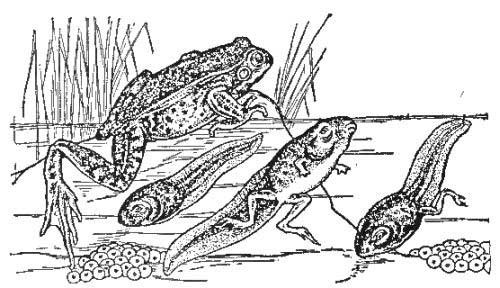
The tadpole has very small eyes, a very small mouth, and tiny gill openings like a fish. Indeed, so far as its life at this stage is concerned, to all intents and purposes it is a fish. It cannot live out of the water, it breathes by gills, it swims by its tail, but it has no fins. It wiggles about the jar or tank in a very lively way, and ought to have water weeds or stones to hide under, and pebbles or gravel in the bottom of the receptacle.
The ordinary tadpole, if well fed, astonishes and delights his young keepers in a few days by putting forth a pair of tiny hind legs, which generally trail behind him when he swims, though he often kicks with them, perhaps for exercise. He grows larger and his legs longer, and one day a row of fingers may be seen peeping out of his gill slit, as though out of an armhole, and then he will thrust out a forearm, then another from the other gill slit. After this, changes are rapid, and his keepers should put a stone or some firm object in the water, reaching above the surface, so that he can climb up into the air; for now his lungs are rapidly forming, and soon he can no longer breathe by gills. At this stage, his tail begins to disappear. It does not fall off, as some think, but its substance is absorbed into his body until no tail is left. Finally, his head changes its shape, his baby mouth is replaced by a wide frog mouth, his eyes stand out with projecting lids, his ear-plates showing back of them, and we have a full-grown frog.
To the child who understands the origin of the fish eggs a few questions which he can easily answer himself will be enough to call attention to the important differences, and also to deepen the impression of the unity of life as expressed in flower, fish, and frog. The ova of the frog develop in an ovary exactly as do the ova of a fish; they develop in the same way and at the maturity of the animal. The fertilizing cells develop like those of the fish. In both cases, the reproductive elements are laid, shed, or born, when the time comes. Before the eggs of the frogs and toads are laid they have no albuminous covering. The moisture that envelops them swells up into the jelly-like mass upon coming in contact with water.
There are important differences between the frog and the fish. The frog is a more complex animal and, so to speak, more difficult to create, and it lays fewer eggs. Since there are fewer eggs they must be more carefully fertilized; that is, the fertilizing material must be sure to come in contact with all of them. Consequently at the moment when the eggs are finding their way into the water they are fertilized; not within the female body, but just as they are leaving it.
The child accustomed to notice what he sees will observe the paired frogs in the pond. He can be told that they take this position just before the eggs are laid so that every egg will surely be fertilized. In the amphibious animals the relation of the two parents is closer than in the fishes, but yet there is no union between them, that appearing only when it is necessary. The stern law of necessity governing every step of the reproductive function may be made very impressive to the young mind; also the reign of law throughout life.
To explain frankly, simply, and scientifically such phenomena as that of the paired frogs will tend to rob them of dangerous interest. Not to speak of them will not prevent the child's seeing them, and his imagination may foster much less wholesome thoughts.
There are frogs and toads that care for their young, but parental affection in this form of life is rare. The eggs are laid in a favorable spot, and then left. Toads as well as frogs lay their eggs in the water. The instinct of the toad leads it to seek the water at the egg-laying season, as its tadpole, like that of the frog, can live only in the water. At other seasons of the year the toad does not enter the water.
Frogs' eggs are laid in compact masses, while toads' eggs are laid in strings or ropes; and in this way they can be recognized, though after they have once hatched the tadpoles of both are so much alike that they cannot be told apart. Sometimes the children will be disappointed because the tadpole does not change into a frog nor yet into a toad. It gets its four legs but does not lose its tail; it never loses its tail. In short, it is not a frog or a toad, but a salamander or water-lizard, which lays eggs similar to those of the frog, and whose young upon first hatching look very much like young tadpoles.
If eggs are found in a pond where frogs are not heard or seen, they will almost always turn out to be the eggs of a salamander.