Chapter VI · CHE-KA TYRANNY
C. J. (Charles James) Hogarth translation
Wild beasts should be shot, but not wantonly teased and tormented.—A. P. Polonsky.
The instigators of the Red Terror did more than afford full scope to lawlessness outside Che-Ka premises; they also established within those premises a complete system of illegality, and a mere glance at official comments on lists of shot will bring before the imagination an unforgettable spectacle of outrage. Frequently persons were shot by order of officials who did not so much as know what the accusations had been, or even the victims’ names. “Shot—Names unknown”!
On June 18, 1918, Gorky’s journal, the Novaya Zhizn or “New Life,” published an interview with Dzherzhinsky and Zachs, who expounded to the journalist the policy of the Che-Ka, whilst Dzherzhinsky, in particular, said:
Those who accuse us of secret murder do so wrongly. As a matter of fact, the Che-Ka consists of eighteen tested revolutionaries, is representative both of the Party’s Central Committee and of the Party’s Central Executive, and can pass a sentence of death only by an unanimous decree—one dissentient vote alone being sufficient to save an accused’s life. Above all things our strength lies in the fact that we know nor brother nor friend, and treat with especial severity any colleague found wanting in rectitude. Hence the Che-Ka’s personal reputation stands above suspicion. Also, it is swiftly that we deal out justice: it is seldom that we allow more than one or two or, at most, three days to elapse between arrest and sentence. At the same time, that does not mean that our findings are not invariably well-founded. The possibility of a mistake is always present, but as yet no instance of such a contretemps has occurred, and the best proof of what I say is to be found in our protocols, which will show that, in most cases, a criminal, on being confronted with a mass of circumstantial evidence, at once confesses to his guilt. And how could guilt be made clearer than by a confession from the accused himself?
True, the correspondent of the Novaya Zhizn next referred to rumours as to employment of physical violence during examinations of prisoners; but Zachs at once replied:
Rumours of that kind are false; and the more so because we make it our particular business to exclude from our labours any element which threatens to prove unworthy of sharing in those labours.
Whence, as I will show, the interview constituted a tissue of lies.
Callousness in Executions
For one thing, the above-named officials’ assertion that eighteen members were required to pass a death sentence was false. All too frequently such a sentence was passed by two or three members alone—even by one after a “people’s justice” had been empowered with the capital penalty.[171]
“It is swiftly that we deal out justice.” Well, possibly Dzherzhinsky and his kind did deal out justice swiftly on occasions of mass shootings. At the same time, I know of innumerable cases when things were otherwise, and months passed before the accused was even questioned, and, from first to last, the proceedings with regard to a given prisoner occupied more than a year before they reached their inevitable end in execution.
“We are accused of secret murder.” Quite so. Seldom were shootings officially reported, even though on September 5, 1918, during the height of a wave of Red terrorism, a resolution of the Council of People’s Commissaries called for “compulsory publication both of names of the shot and of reasons for applying the supreme punitive measure!”
The exact manner of fulfilling this resolution, so far as practice was concerned, can be gained by perusing casual announcements in the Central Che-Ka’s Weekly, whose purpose was “co-ordination and direction of the provincial Che-Kas[* Ka’s?]’ activities.” To take a particularly instructive illustration. On Oct 26, 1918, six weeks after Madame Kaplau’s attempt upon Lenin, No. 6 of the Weekly published what purported to be a list of the persons shot for the deed. Yet though, in reality, the number of the shot had amounted to several hundreds, the list’s total amounted only to ninety, and in sixty-seven instances gave no Christian name or patronymic, and in two instances only some initials, and in eighteen instances only a surname and the social status—“Razoumovsky, ex-lieutenant-colonel”; “Kotomazov, ex-student”; “Mouratov, co-operative employee”; and so forth. And only in ten instances was any reason for the execution appended, with, even so, the accused merely described as “an obvious counter-revolutionary,” or “a White Guard,” et cetera, et cetera. And though the list also contained such entries as “Khvostov, ex-Minister of the Interior, and a counter-revolutionary,” and “Vistorgov, Arch-Priest,” the reader was left to guess that a bare entry of “Maklakov” referred to another man who had been a Minister of the Interior. True, in the latter case, the identity was easy enough to discern; but what of the many plain Zhichkovskys and Ivanovs and Zhelinskys and so forth who figured with him? No one was to be allowed to know who they had been. Nor, probably, will anyone ever know.
And if the central authority’s orders were carried out by that authority’s central subordinate organisations in such a manner, what must have been the case in provinces remote from the centre? Well, there the Terror assumed forms truly bestial, and official reports of shootings became even more obscure than reports of shootings in the metropolitan neighbourhood. “Thirty-nine prominent landowners have been shot after arrest for connection with the counter-revolutionary organisation known as ‘The Union to Support the Provisional Government’”; “Six adherents of the late Imperial régime have been shot”; and so forth. Or a few names would be published over a note that the remaining, unnamed persons in the list had met with a like fate.
And the same procedure continued even after what Moroz, the notorious Che-Ka employee, described (in No. 6 of the Weekly) as “chaotic disorder” had passed away. Whence Dzherzhinsky’s denial that his Che-Ka committed secret murder was out of place. It did so in every sense of the term. Sometimes it passed a death sentence without even having seen the person whom it was condemning, or even listened to a plea on his behalf. Also, it was seldom that the names of the condemners themselves appeared, or that the permanent identity of a Che-Ka’s personnel became public property. (In passing, shootings carried out without any notification of occurrence, or of names, acquired the special or technical name of “blind-alley” shootings.)
Hence, what impudence must have been needed for a man like Chicherin to reply to a correspondent of the Chicago Tribune, when the latter inquired how many persons had been shot “by order of secret tribunals,” and what the fate of the surviving members of the Tsar’s family had been:
In Russia no such thing as a “secret tribunal” exists. And as regards the number of persons shot by order of the Che-Ka, the number has already been published. Nor do I know anything about the Tsar’s daughters, save that I have read in some journal that they are now supposed to be residing in America![172]
Again, Dzherzhinsky spoke of “confessions of guilt from the accused himself.” Well, I myself have heard such “confessions” made—made under pressure of threats, at the point of a revolver. So also have many other inmates of Che-Ka gaols.
“Rumours that we employ physical violence are false.” We shall see about that, and in the meanwhile it may be said that Che-Kas inflicted the most excruciating of tortures, and that the Che-Kas which inflicted them were not exclusively Che-Kas sitting in the more remote provinces. For human life came to be so valueless in Soviet Russia that Golodin (a deputy sent from Moscow to sit on the Che-Ka of Kungur) put things in a nutshell when he said: “Nowadays, neither suspicion nor investigation, nor even proof, is needed for the shooting of an accused. When the step is deemed advisable one can just shoot, and have done with it.”
Next, let us consider some of the published reasons for executions, as occasionally set forth in the official and semi-official Bolshevist press. They are significant. Sometimes we come across a reason at least definite to the point of describing the “criminal” as “a cunning and crafty counter-revolutionary,” or as “a wife fully cognisant of her husband’s activities,” or as “the son,” or “the daughter,” “of a general” (these examples are from the registers of Petrograd); but more often was the “crime” set down, with amazing effrontery, as, in the case of Gorokhov, a peasant, and others, “assaulting a commissary”; in the case of Rogov, a shopkeeper, as “using his premises for intrigue against the Soviet”; and so forth, and so forth. Moreover, many were just described as “Shot in the ordinary course of the Red Terror,” and there is nothing excessively explicit about “twenty well-known White Guards,” “Zvierev, a doctor and a White Guard,” “sixteen koulaki,” “an ex-member of the Constitutional Democratic Party,” “a counter-revolutionary by conviction,” and entries of the same kind. In fact, I possess a host of cuttings from the official press to swell these instances, but anyone could obtain them by scanning the first six issues of the Weekly.
One list brought especial grief to all who had known the victims named. That list was a list comprising the names of men once prominent in the educated world of Russia, and including, amongst others, such intellectuals as N. N. Stchepkin, A. D. Apferov, A. S. Apferov, A. A. Volkov, A. I. Astrov, V. I. Astrov, N. A. Ogorodnikov, K. K. Chernoevitov, P. V. Gerasimov (who was shot under the name of “Grekov”), S. A. Kniazikov, and many more—the names numbering, in all, sixty-six, and appearing in the journals of Moscow on September 23, 1919. These murders the conscience of Society will never to the end forgive. And this applies especially in the cases of A. I. Astrov and V. I. Astrov, who were shot as “spies in Denikin’s employ” because in their house there had allegedly been found (1) “a plan for reorganising our legal courts and means of transport and commissariats when the Soviet Power shall fall,” and (2) “a proclamation to the Volunteer Army.”
But why, also, were N. I. Lazarevsky and Prince Oukhtomsky and others shot? The official report is dated September 1, and says of Lazarevsky that
he had ever been a convinced supporter of a Social Democratic régime, and looked for the Soviet Power speedily to come to an end, and prepared plans in connection with the problems of (a) reorganisation of local self-government, (b) disposition of various Soviet paper currency issues, and (c) re-establishment of the credit system on Russian territory;
whilst of Prince S. A. Oukhtomsky, the sculptor, it was said in the report that “he had betrayed to an organisation engaged in transmitting information to foreign parts certain items concerning the condition of our Russian museums [!], and prepared an article on the subject for the White press.” And another of those shot was the poet Goumilev.
Similar to this report was a report of the trial of N. N. Stchepkin. The same document added that “Maria Alexandrovna Yakoubovskaya, a member of the Constitutional Democratic Party, and a school teacher, had been found to be in communication with an agent of Kolchak’s”; but as a matter of fact the lady’s real “crime” had been that on August 29, 1919, a few days before the Bolshevists were expelled from the city of Kiev, she had been found in a house where some other arrests (arrests in no way connected with her) were about to be carried out. At the same period the Kievan Izvestia published 127 names of persons as shot for “themselves carrying out mass shootings of workers and members of the Communist Party in localities recently vacated by Denikin and Petlura”: and though these persons may really have been the sworn foes of the workers and the poorer peasants, which the report declared them to have been, we have only the Bolshevists’ word for the fact.
Again, take events in Odessa. We read:
Nikiforov, an ex-magistrate, and subsequently caretaker at the works of the Odessa Shipping and Transport Company, has been shot for attempting evasion of mobilisation, for refusing to work for the good of Soviet Russia, and for obtaining his post at the aforesaid works solely for the purpose of engaging in espionage and propaganda amongst unenlightened members of the proletariat.
And an old lady named Sigismundova was shot for having received a letter from her officer son at Varna! She was shot, that is to say, for “having been in communication with an agent of the Entente, and of the Entente’s hireling Wrangel.”[173] And in Odessa, in 1919, General Baranov was shot merely for having taken a photograph of the Catherine II Memorial in that city—the said memorial having had the misfortune to be situated in the very square confronting the local Che-Ka’s premises.[174]
We have seen that revolutionary tribunals shot, in addition, persons convicted of such offences as drunkenness and petty theft. And the same thing happened to an individual who was found to be in possession of an officer’s badges, and to another for having “criminally recovered a son’s body,” and to a butcher of Moscow for having “insulted” images of Marx and Engels by calling them “scarecrows,”[175] and to some doctors of Kronstadt for having “made themselves popular with the local workers.” So need we wonder that the Communist officials of Ivanovo-Voznesensk threatened similarly to shoot anyone who concealed, or failed to register, a sewing-machine,[176] or that Mitayev, the commandant of Vladikavkaz, vowed to “cleanse from off the face of the earth” anyone selling intoxicating liquor,[177] or that the commissary of posts and telegraphs at Baku issued an order that any telephone girl found guilty of tardy response to a call, or of response to a call “in an uncivil manner,” should be shot within twenty-four hours?[178]
True, of death sentences passed the All-Russian Che-Ka kept protocols; but did Dzherzhinsky really imagine that protocols like those drawn up in Kiev during 1919 were good enough to go upon? No. 4 of the Berlin review Na Chouzhoi Storonyé (“In Foreign Parts”) published some astonishing Kievan returns of the sort, and also some cognate returns drawn up by the All-Ukrainian Che-Ka under friend Latzis. Which returns, with their original seals and signatures, now lie lodged in the archives of the Denikin Commission. From them let us take an example or two. They show that once (so easy is it to sign a death warrant) the All-Ukrainian Che-Ka decided fifty-nine cases at a sitting, and that on May 19, 1919, the same Che-Ka not only got through its ordinary routine work for the day, but also tried forty “personal” cases, and passed, in twenty-five of those cases, a sentence of death. And the sentences must have been (to use Dzherzhinsky’s word) “well-founded,” for the returns which give them do not so much as mention the antecedent “crimes.” And the same applies to some executions carried out at Kharkov when two Che-Ka employees named Portugeis and Feldmann, as they shot the prisoners, merely achieved such a brief and rough jotting down of notes in pencil as, for example, “Baeva—Shot as an incorrigible criminal.”[179]
But, of course, to a Che-Ka employee, to an individual who despised the old ethics, the old “bourgeois prejudices,” such proceedings would seem no more than “trials in legal form terminating in justified shooting.” Indeed, Sigal of Odessa, an ex-Che-Ka official, and at one time an ex-student of the University of Novorossisk, stated, in answer to a question from the Denikin Commission, that it had been quite a common practice for the Che-Ka’s secretary merely to send out word that “the trial must be conducted in such a manner as to result in at least fifteen persons being sent to the wall.”
And the same callousness with regard to human life frequently caused two or more persons to be shot through the fact that both or all of them bore the same or similar names. This might happen accidentally, or it might purposely be done to avoid any possibility of a mistake. I myself know of such a case when, in Odessa, three doctors named so wholly dissimilarly as Volkov, Valsov, and Vorobiev were shot in a batch[180]; whilst in another case a man named Ozerov was shot before the “people’s prosecutor” had discovered an error to have been made—whereupon the rightful Ozerov was shot as well.[181] We find several such cases in Averbuch’s book The Che-Ka of Odessa.
Again, the same Che-Ka once received information concerning some “counter-revolutionary activities” said to have been carried on by a man called Aaron Chonsir, but not at the same time, unfortunately, the man’s address: wherefore the “people’s prosecutor” engaged in the case ordered the local street directory to be looked through, and then caused eleven persons of the accused’s name to be arrested and imprisoned. Only after a fortnight of enquiries which included several applications of torture were two out of the eleven Chonsirs selected, and shot. And the reason why still as many as two were shot (although the original indictment had called for the arraignment only of one) was that the “inquisitional department” had not been able to make up its mind even with regard to the pair chosen, and so had made sure of bagging the real “counter-revolutionary” by shooting both the one and the other. Similarly a responsible witness who could not well be suspected of attempting to colour his testimony has stated that once an ex-assistant procurator named A. S. Baranov was shot in mistake for an officer of the same name; also, that once the witness was present in a cell when the name of “Vivordtsev, Alexey” was called out, as denoting a certain prisoner destined for execution, and when the only Vivordtsev in the cell was pointed out to the authorities, but stated to possess the initials K. M., the authorities, undeterred, replied: “Never mind the exact name! All that we want is a Vivordtsev.” Lastly, an educated landowner testified before the Denikin Commission that a peasant named Yakov “Khromoy” (“the Lame”) of the village of Yavkino was shot in mistake for a perfectly sound Yakov belonging to the same village, whereas the man executed was (as his name implied) a cripple.
Occasionally, however, the lives of persons placed in such a position were saved at the last moment by a lucky accident. Cases of the sort occurred under the “inquisitional departments” at Moscow, and similar ones are to be found recorded both in the British White Book and in The Che-Ka; whilst Nilostonsky tells of like incidents in Kiev.
In fact, “inadvertent” executions became so frequent as at last to give rise to a special class of victims, and to acquire the name of, in Che-Ka parlance, “mistakes.” In 1918, when the Che-Ka of Moscow discovered a secret organisation of ex-officers known as the Levshinsky Club, all ex-officers, without exception, who happened to live in the Levshinsky Perëonlok[182] were arrested, and thrown into the Butyrka Prison—where, for fellow inmates, they had the persons who had been arrested in connection with the Lockhart affair. And of these ex-officers (who numbered in all, twenty-eight) only six lived to tell the tale. And take the following:
In Brounitsy, near Moscow, the commissaries took to shooting anyone whose looks in any way displeased them. Hence there was no need at all for the local executive committee to assemble: one of its members needed merely to say, “We have decided to, etcetera, etcetera,” and nothing remained to be done save to send Red Guards for the victim, to give him a spade with which to dig his own grave, to take him to the courtyard of the local riding-school, to shoot him there, and to bury him.
All of which things at least help us to understand passages in Latzis’ statistical articles which state that “shootings had to be employed to intimidate the population,” or “to produce the required effect,” or “to kill any leanings towards sabotage and conspiracy,” and the rest. In Yaroslav, for example, he and his party shot hostages merely on the ground that a rising of koulaki was anticipated, though it had not actually come to pass. And on February 11, 1919, Mr. Alston wrote to Lord Curzon:
According to the Bolshevists, the only way to forestall counter-revolutionary movements in this town (Ekaterinburg) is anticipatorily to terrorise the inhabitants.[183]
But perhaps the vilest episode of all was the shooting of a whole family of hostages in Elizabetgrad during the May of 1920, when the four little daughters of an officer, children from seven to three years old, were shot along with their grandmother of sixty-nine!
A passing thought is: How came “counter-revolutionaries” sometimes to be shot forthwith, and sometimes to be kept until later? There would seem to be a mystery here. When, during the autumn of 1918, a policy of shooting ex-Tsarist Ministers was entered upon, Bouligin, the ex-Minister of the Interior, had his life spared during the year just named, but on September 5, 1919, was brought before the Che-Ka of Petrograd, and tried for having pursued a reactionary policy as long ago as 1905! “Wherefore it is resolved that Citizen Bouligin be shot, and have his property confiscated, and handed over to the Executive Committee, for transference to certain workers in a State factory.”[184]
Perhaps this was one of the protocols which Dzherzhinsky declared to be “well-founded”?
Physical Outrage and Torture
If the reader will recall what has been said in connection with Che-Kas, he will scarcely doubt—nay, he will feel certain—that physical outrage was practised in Che-Ka dungeons. The appeal to European public opinion framed by the Paris Executive Committee of the Russian Constituent Assembly in no way exaggerated when it protested against “the present orgy of political murder in Russia, with employment of physical torture and physical injury.” For all that has ever been written about the ancient Russian prisons—in particular, about “the Russian Bastille,” as the Schlüsselburg Fortress, the repository of olden-time important political offenders, has been called—pales before the prisons and the prison system established by the Soviet Government. And we have seen how Peter Kropotkin declared the Soviet’s prison conditions, and the practice of seizing hostages, to constitute a return to the old methods of torture.
During my confinement in the Butyrka Gaol I became acquainted with a Dr. Moudrov of Moscow, whose “offence” I do not know—I only know that he had never had any definite indictment framed against him, and that, inasmuch as he had spent several months in the Che-Ka building’s dungeons before being transferred to the Butyrka, he had become so acclimatised to the prison atmosphere as to be able to be entrusted by the prison authorities with the duties of medical officer to the establishment (previously no medical staff at all had been in existence there), and dealt so efficiently with the prevailing epidemic of typhus as to be left unexamined by the Che-Ka. But at length a day arrived when he passed from us in the very midst of his mission of healing, and never returned; and soon afterwards we heard that he had been shot. No explanation has ever been forthcoming for this insensate deed of cruelty, and probably it would be impossible to present one. All that the Izvestia of October 17 said was that Dr. Moudrov “had formerly been a member of the Constitutional Democratic Party.”
Another encounter in the prison similarly affected me. When, during the summer of 1922, I was summoned to give evidence in the great trial of Social Revolutionaries that was then held, I happened to walk from the cells to the court beside a thin, middle-aged man whom, on the way, I contrived to engage in a little conversation, and thereby discovered to be a Colonel Perkhourov who had taken part in the Savinkov rising at Yaroslavl in 1918, and been thrown into the Che-Ka building’s cells, and, though those cells were, supposedly, only a place of detention pending inquiry, half-starved, allowed no books or interviews, and conceded no facilities for exercise. And though I could not clearly ascertain whether until now he had escaped the authorities’ memory, or whether he had purposely been held over for the present occasion, at all events I found him being conducted to the court in the same capacity (as a witness) as myself. But no sooner had the proceedings begun than he found himself transferred from amongst the witnesses to amongst the accused! And later he was taken to Yaroslavl, and, according to an officially published statement, shot.
These are examples with which I myself came in contact: but there were hundreds of others. And if this kind of thing could happen in the centre of the country, at a time when the anarchical conditions of the Bolshevists’ early days of rule were supposed to have given place to a semblance of regular and established order, what must have happened in far-removed provinces where there sat enthroned despotism in its vilest forms?
Well, there was torture in progress there. For the mere fact of having to live for months, for years, in daily expectation of death alone constituted torture. And so did the provincial Che-Kas’ universal system of mock shootings; and during the time that I was in the Butyrka I had many such cases of shootings personally related to me by informants whose veracity I have no reason to doubt, seeing that they were confiding to me their narratives whilst the shock communicated to their nerves by their horrible experiences had not yet wholly faded. Amongst others who were subjected to such an ordeal were some prominent co-operative officials of Petrograd who had been “tried” before the Supreme Revolutionary Tribunal during the autumn of 1920: and in their case the torture took the form of nightly being led out as though for execution, and forced, despite the intense frost, to strip to the last shred of clothing, and witness real executions of other prisoners before being led back to their cells for the whole ghastly “rehearsal” to be repeated a few nights later.
But sometimes persons subjected to this mental torture would so lose their self-control as to make any admission rather than be compelled to go through the experience again. An American named Kalmatiano who was sentenced to death at the Lockhart trial, and subsequently reprieved, told V. A. Miakotin and myself, when the three of us were lying in the Butyrka gaol together, that thrice he and a fellow-accused named Fride had been taken out of prison as though for execution, and that though, on May 10, 1920, he was informed that his sentence had been commuted, his sentence of death had been passed as long previously as the year 1918, and meanwhile he had had to spend the whole of the intervening time in daily expectation of being shot.
A Madame E. O. Kolbasina who was imprisoned with us has since related[185] a similar experience told her by a fellow inmate. The scene of the experience was the Che-Ka’s building in Moscow, and the following is the lady’s account of what happened:
Convicted of offering a bribe of 100,000 roubles for the life of an officer, I was conducted to the basement of the building as though for execution, and saw there a number of corpses clad only in strips of clothing. How many of them were there I do not know, but in particular I remember two—the corpse of a woman and the corpse of a man, the latter clad only in a pair of socks. In each case the dead people had been shot through the back of the head, and the floor actually felt slippery to my feet with blood. Unwilling to undress myself, I left it to the executioners to do it for me, but they shouted, “Undress, you!” and I felt my hands raise themselves mechanically, and automatically undo the buttons of my cloak, and take it off. And just as I was going to do the same with my gown I heard a voice reach me as though half-muffled, as though filtered through cotton-wool, and say, “Kneel down,” whilst at the same moment I felt myself pushed on to one of the heaps of corpses—as a matter of fact, on to a corpse that was still quivering, and emitting gasps! And then the voice from a distance came to me again, and seemed to say as in a whisper, “Up again, you, and quickly!” whilst someone gave a tug at my arm, and I saw Romanovsky, the “people’s prosecutor,” standing before me with a grin on his face—ah, you know the look of that foul, low, underhand countenance!—and saying to me: “How now, Ekaterina Petrovna?”—for also you know how he calls his victims by their Christian names and patronymics—“how now, Ekaterina Petrovna? You have had a little scare, have you—a little shock to the nerves? But that is nothing, nothing. At all events it may make you feel rather more disposed to be communicative with us in future. Is not that so?”[186]
And Madame N. Davidova, for her part, has noted the following:
To-day we heard that ... the Baroness T—gen was not shot, after all, but only her husband and some others.
Yet she had to stand by and see it done, as supposedly she waited for her own turn to arrive! Only when everyone else had been shot was she told that she herself had been reprieved, and made to clean up the execution room, and wash away her husband’s and his companions’ blood.... Her hair, I have been told, has turned completely grey.
A propos of the Saratov ravine, a narrator has said in The Che-Ka:
During the October of 1919 two young women were brought to the ravine, stripped of their clothing, and, under threat of a revolver, made to stand at the edge of the yawning abyss—this being done in order to force them to disclose where some relatives were. And [the narrator adds] when later I saw these young women their hair had turned white.
Consider also the mental and physical agonies which Ivan Ivanovich Kotov, an ex-member of the Russian Constituent Assembly, must have endured in 1918 as he was being dragged to slaughter from the hold of a barge after having had a leg and an arm broken, and an eye gouged out![187]
The Che-Ka of Ekaterinodar, in particular, went in for intimidatory measures, and an example of them is seen in the case of a Doctor Shestakov who, after being taken across the river Kuban, and forced there and then to dig his own grave, and in every way led to suppose that he was about to be executed, was fired at only with a volley of blank cartridges. And a man named Korvin-Piotrovsky was treated similarly, and again and again, with, as a finishing touch, a cruel flogging, information that his wife and ten-year-old daughter had also been arrested, and an enforced witnessing of their subjection to a “mock” execution similar to those which had so often been inflicted upon himself.
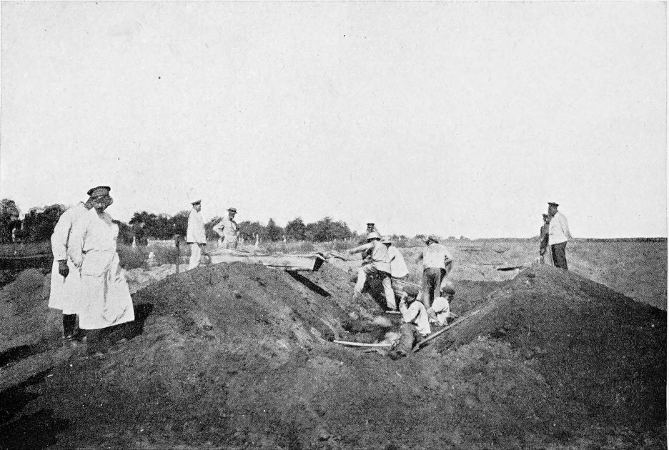
Exhuming Bolshevists’ victims at Odessa.
[See page 152.
Again, according to an article in The Che-Ka:
Tortures in these districts [Ekaterinodar and Kuban] are both physical and mental. And Ekaterinodar has a particular method of their application, as follows. The victim is laid upon his back on the floor of his dungeon, whilst two burly Che-Ka employees tug at his head, and two others at his shoulders, until the muscles of his neck are absolutely stretched and taut. Then a fifth man falls to beating the victim’s neck with a blunt instrument—usually the butt-end of a revolver—until, the neck swelling, blood gushes from the mouth and nostrils, and frightful agony is suffered. And I will tell you also how a Madame Dombrovskaya, an ex-school teacher, was tortured in her solitary confinement cell. It seems that the accusation against her had been that there had been discovered at her house a suit case of officers’ clothing which the officer concerned, a relative of hers, had left with her for safe keeping whilst the Denikin régime had been operative in the town. Also, it seems that though Madame Dombrovskaya had confessed to this “crime,” the Che-Ka had been informed that she had by her jewellery which another relative, a general, had deposited in her keeping: wherefore on receipt of this fresh information, she was ordered to be tortured until she should reveal where the jewellery might be. For a beginning she was raped and outraged generally—the raping taking place in order of seniority of torturers, with a man called Friedmann raping her first, and the others in regular sequence. And, that done, she was questioned further as to the whereabouts of the jewellery, and further tortured by having incisions made into her body, and her finger tips nipped with pliers and pincers. Until at last, in her agony, with the blood pouring from her wounds, she confessed that the jewels were hidden in an outbuilding of her house. The same evening (the date being November 6) she was shot, and when she had been dead about an hour, one of the Che-Ka’s employees searched the outbuilding indicated, and duly found hidden there—a plain gold brooch and a few rings! Again, in a certain Caucasian village the usual instrument of torture was an iron “glove,” a solid, glove-shaped piece of metal studded on the outside with nails, and able, when slipped onto the torturer’s right hand, to inflict blows causing not only terrible pain through their mere weight, but also suppuration through the multiplicity of the nail wounds which they produced. This torture was applied to, amongst others, a citizen named Leliavin, a man from whom the Che-Ka desired to obtain information as to the whereabouts of a hoard of Tsarist gold coins which he was reported to have got concealed. As for the town of Armavir, the local Che-Ka’s instrument of torture was the “wreath,” an ordinary leathern strap into one end of which an iron nut was let, and into the other end a screw, so that, the strap having been fixed around the victim’s head, the nut and the screw could be drawn together until the extreme compression of the scalp caused indescribable pain.[188]
In Piatigorsk the head of the local Che-Ka’s “operative department” used to accompany “questionings” with strokes from a rubber whip—as many as twenty strokes at a time. Once, also, the fellow ordered some nurses who had rendered first aid to some wounded Cossacks to be given fifteen lashes apiece.[189] It was the practice of this Che-Ka, too, to thrust pins under prisoners’ finger-nails. In general, it conducted its “inquiries” on a basis of flagellation with whips and ramrods and clenched fists. We have evidence also that similar treatment was accorded to Admiral Miazgovsky at Nikolaev in 1919; whilst the Dielo once published a statement as to how a citizen of Lougansk had been tortured by having ice-cold water poured over his naked body, and his finger-nails wrenched backward with steel pliers, and his body pricked all over with needles, and slashed with razors.[190] And on another occasion a correspondent of the same journal[191] wrote with regard to Simferopol: “The Che-Ka there has invented new forms of torture by injecting into the rectum enemas charged with powdered glass, and holding lighted candles beneath the generative organs.” In Tsaritsin the victims were variously laid upon a heated grid, thrashed with iron rods or metal-tipped flails of rubber, or subjected to twistings of the arms until the bones were broken.[192]
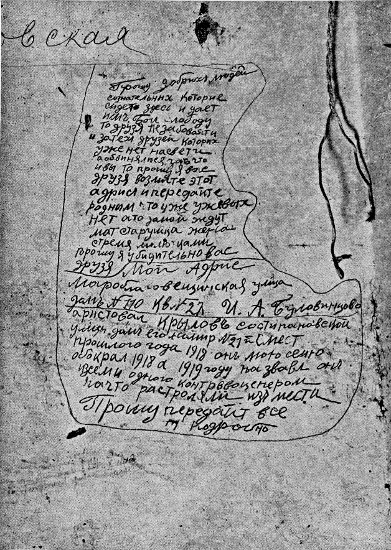
An inscription written by a prisoner on a cell wall in Kiev.
[See page 168.
A whole chapter in Averbuch’s book is devoted to the tortures practised in Odessa, with the Che-Ka’s system of fetters, confinement in pitch-dark cells, castigation with rods a centimetre thick and cat-o’-nine-tails of plaited leather, crushings of hands with pincers, and suspensions by the neck. And amplification of Averbuch’s descriptions is to be found in the materials collected by the Denikin Commission, which detail two cases of mock shooting. In the first case the victim was thrust into a crate which already contained a dead body, and shot at so that only one ear was singed—then removed until his tormentors should see fit to repeat the torture; and in the second case the proceedings consisted of forcing the victim to dig what he believed to be his own grave in a condemned cell which had had scratched across one of its walls: “Twenty-seven bodies lie buried here.” This second case, of course, was designed to intimidate only; much as when, in a third case, a man was nightly awakened by the jailor, led out into the courtyard, and, on the jailor being bidden to “take him back again, and let him live through the rest of the night,” restored to his cell. Also, in Odessa members of the Che-Ka used to visit the cells several times a day, and say mockingly: “By to-night you will have become something different.”[193]
In 1919, when an important trial of political prisoners was proceeding in Moscow, armed guards were posted over the prisoners whilst they were in the cells, and the cells would be periodically visited by female Communists, who said to the guards: “These prisoners are spies. Shoot them at once if they attempt to escape.” But most abominable of all were the doings of the female president of the Che-Ka of Penza, a woman called Boche, in the year 1918. They grew so bad that at last the central authorities had to insist upon her retirement. And during the winter of 1920 it was the practice of the twenty-year-old male head of the Che-Ka of Vologda to seat himself on a chair beside the frozen river, have a pile of sacks prepared, send to the gaol for the captives due for the day’s “questioning,” and, having caused the wretches to be thrust into the sacks, keep them immersed in a hole in the ice whilst he subjected them to examination. But at length his case, like the case of the woman Boche, attracted the notice of the central authorities, and, on his being medically examined, he was found to be insane.
In Tiumen the chief mode of torture was to beat the prisoners with rubber rods.[194] And of the Urals Che-Ka’s methods we can form an idea when we read, from the pen of a Madame Froumkina:
Meder was brought into the shed and compelled to kneel down beside one of the walls. Shots then were fired at him—to his right first of all, and then to his left. And then Goldin, the “people’s prosecutor,” said: “Unless you surrender to us your son, you will be shot. But we shall not shoot you at once. We shall do so only when we have broken your arms and legs.” And the next day this was done.
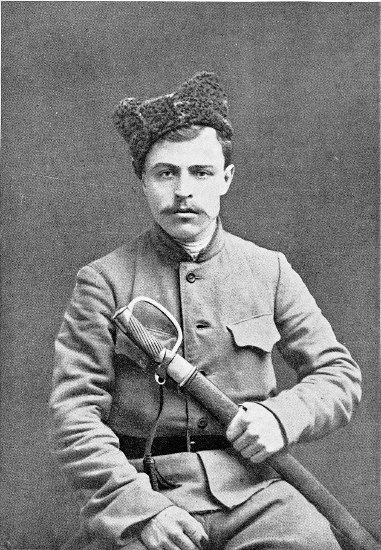
Saenko, commandant of the Che-Ka of Kharkov, a notorious torturer and executioner.
[See page 166.
In the prison of Novocherkassk a “people’s prosecutor” once thrust two revolvers into a victim’s mouth in such a manner as to hitch the sights upon the victim’s teeth, and bring away both them and portions of the gum bones.[195]
Next, consider the execution of General Roussky and his companions, as detailed in the materials collected by the Denikin Commission:
The executioners forced their victims to kneel down and stretch out their necks. Then they slashed at the necks with swords, but in some cases, through inexpertness, failed to deal a fatal blow at the first attempt, and had to deliver five or more blows before the hostage with whom they were dealing finally was slaughtered. It was with his own hand that Artabekov, the head of the Che-Ka, stabbed General Roussky. And some of the victims had their arms and legs cut off before finally having their necks severed.
And now the time has come for me to tell of the “heroic” deeds of Saenko, head of the Che-Ka of Kharkov. This man first came into prominence at the time when, in 1919, the city was occupied by the Bolshevists before their subsequent evacuation of the same. Hundreds of victims then passed through his maniacal, sadistic hands. An eye-witness has related how, when first this witness entered the Che-Ka cells, he was struck with the terrified aspect of the prisoners, and enquired the cause of their fear. Said they: “Saenko has been here, and taken away Syichev and Bielochkin for examination. And he has promised that this evening he will come and see some more of us.” And, sure enough, a few minutes later, the Syichev in question, a boy of nineteen, re-entered the cells leaning upon a couple of Red Guards, and looking like a ghost. His comrades cried, “What has been done to you?” and he replied, “Oh, Saenko has been examining me.” His right eye was one huge bruise, his right cheekbone seemed to have been laid open with a revolver butt, four of his front teeth were missing, his neck was covered with bruises, his left shoulder-blade had been gashed all over, and on his back were thirty-seven contusions and abrasions. And in this manner Saenko had been “examining” victims for five days past, so that in the end one of the victims, the man Bielochkin, died of his injuries in the prison infirmary. A favourite trick of Saenko’s was to keep digging the point of a knife into the examinee’s body for about a centimetre’s distance, and twisting it about. He would do this right in front of the “people’s prosecutor” and the rest of the Che-Ka staff.
And to the foregoing the witness has added an account of the executions which Saenko duly carried out, as threatened, on the evening of the day mentioned.
At nine o’clock he entered the cells with an Austrian staff-captain named Klochkovsky. Sodden with drink or drugs, he then ordered three prisoners named Pshenichny, Ovcherenko, and Bielonsov, to be taken out into the courtyard, and, having divested them of their clothing, fell, with “Comrade Klochkovsky,” to cutting and stabbing at their naked bodies from the lower portions upwards. Daggers were used for the purpose, and the stabbings made to ascend to the victims’ trunks only very gradually. And when he had completed the three executions he returned to the cells and, all covered with blood, said to the rest of the prisoners: “Do you see this blood? Well, that is the fate which befalls anyone who opposes me and the Workers’ and Peasants’ Party.” And, that said, an employee of the Che-Ka seized hold of Syichev (the lad who had been so cruelly beaten that morning), dragged him out into the yard, and forced him to look at Pshenichny’s body. And because the body was still heaving the employee at length killed it outright with a revolver shot; after which he hit Syichev several times with a sword sheath, and drove him back into the cells.
An idea of the mental agonies suffered by prisoners at Kharkov can be gained from inscriptions since found on the dungeon walls. Such inscriptions are: “For four days past I have been flogged. I lost consciousness, and then was forced to sign a ready-written protocol. I signed it because I could bear the torture no longer”; and “I have been given 800 strokes with a ramrod, until I am like a piece of raw meat”; and “At seven o’clock on March 6 —— was shot, aged twenty-three”; and “What a chamber of suffering this cell is!”; and “Abandon hope, all ye who enter here!” And we have further confirmation of the horrors undergone in Kharkov’s “chambers of suffering” from survivors’ stories, from experiences related by persons who contrived to escape from the Che-Ka’s clutches. For the most part, that Che-Ka’s “investigations” were conducted at night-time, and accompanied with such threats of flogging and shooting that often enough victims would “confess” to crimes which existed only in the imagination of the Che-Ka’s agents. But should even such threats be unsuccessful, “confessions” would be extorted with beatings with ramrods until the victim lost consciousness. Two officials prominent in these doings were an ex-hairdresser’s assistant named Miroshinchenko and an eighteen-year-old youth named Iesel Mankin. Once the former threatened a servant girl named Kanisheva with a revolver until she “confessed” to having harboured some officers; and once the latter said to a victim as he covered him with his weapon, “Your life will depend upon your answering me correctly.” And in time the Che-Ka began to add moral tortures to physical: executions began to be carried out in such close proximity to the cells that the other prisoners could plainly hear the rifle shots as they issued from the small, dark kitchen which Saenko had converted into a torture and execution chamber. And when later, in June of the year in question, Denikin’s searchers inspected the room, they found there two pood-weights so tied together with an arshin-long section of rubber piping as to form a kind of flail, with the straw covering of the floor sodden with the blood of the slaughtered, and the wall facing the door seamed and scarred with bullet marks, and the other walls bespattered with blood and fragments of scalp, and hair, and particles of brain, and the floor littered with similar fragments. And when 107 corpses were disinterred in the adjacent concentration camp the most horrible atrocities became revealed—terrible traces of flogging, shattered ribs and leg bones, fractured skulls, amputated hands and feet, heads attached to the trunk only with a strip of cartilage, patches where the skin had been burnt off with red-hot instruments, stripes branded upon the back, and general mutilations.
The first body to be exhumed was the body of Zhakobritsky, an ex-cornet of the 6th Hussars. He must have been cruelly beaten before death, for some of his ribs had been fractured, and there were thirteen scars on the body caused by pressure against some red-hot, circular implement. All the scars were on the front of the body save for a single stripe burnt upon the back. The skull of another corpse was found flattened into a single, smooth, round disk about a centimetre in thickness. Such expatulation of the head could have been caused only by enormous pressure between two flat objects. On a woman whose identity we could not establish we found seven stab and shot wounds. Also, manifestly she had been thrown into the grave before death.
And the Commission discovered corpses of persons who had been scalded from head to foot with boiling liquid, and of persons who had been slowly (beginning with wounds intended only to torture, not to prove of a fatal character) hacked to death.[196] And in every town in the region where concealed hiding-places had been available were corpses in a similar condition brought to light. Particularly was this the case at Odessa, Nikolaev, and Tsaritsin. True, where some corpses with fractured skulls were found in a quarry near the first-mentioned place, the fractures may have been caused by a fall, and what seemed external traces of torture may have been due to prolonged contact with the soil, and the conclusions of the examining doctors may have been made through inability to distinguish between ante-mortem changes and post-mortem, between macerations and scald wounds, between testicles swollen with decomposition and testicles ruptured before death; yet, even so, testimony both oral and photographic goes to show that no natural cause whatsoever could have caused the corpses to look as they did when at length exhumation brought them to light. Again, granted that some of the tales of physical tortures equal to those practised by the Inquisition in Spain may have been exaggerations, our conscience is not likely to feel relieved by knowing that tortures in Russia of the twentieth century can be a degree, but only a degree, less cruel than tortures in Spain of the centuries of the Inquisition; and though one may draw a certain moral satisfaction from the circumstance that the staff of the Anatomical Theatre to which the Che-Ka of Odessa sent some of the corpses of its victims testified that none of those corpses “bore traces of physical violence,” one will scarcely feel satisfied that no tortures at all were practised in Odessa, or do more than conclude that the number of cases in which torture was inflicted may have been small in comparison with the huge total of victims, or that, as luck would have it, no corpses of tortured had happened to be sent to the Theatre concerned. Moreover, it may be added that in most instances the evidence relating to torture that was given before the Denikin Commission came from persons who might justifiably be supposed to have been pro-Bolshevist in their sympathies.
But to return to Saenko’s exploits in Kharkov. An ex-prisoner of Kharkov, a Social Revolutionary, has written[197]:
In proportion as Denikin’s forces drew nearer to the town, the bloodthirsty hysteria of the local Che-Ka increased. And it was then that the real “hero” made his appearance upon the scene. This was Saenko, a man originally a minor official, a member of the local revolutionary tribunal, but now notorious amongst his panic-stricken fellows, and one who held in his hand the lives of all the prisoners in the place. Nightly his motor-car would drive up to the prison to remove inmates. Usually he shot them with his own hand, and once he shot a patient suffering from typhus. A fellow small of stature, with the whites of his eyes gleaming prominently, and his features constantly on the twitch, this Saenko would brandish a revolver in his trembling hand, and rush about the building like a madman. At first he selected for his victims only persons who had actually been sentenced; but during the two days immediately preceding the evacuation he took to selecting his victims indiscriminately from the prisoners at large, and then and there driving them out into the yard, and hitting at them with the flat of his sword as they went. And on the last day of all (though by then the gaol had become strangely silent) the place resounded with volley and individual firing from early morning until late at night—the small prison-yard seeing slaughtered, on that day, 120 persons.
Such the narrative of one of the twenty or thirty prisoners who were fortunate enough subsequently to be evacuated. And another ex-prisoner has given us a description of the previous sorting-out—a terrible process which lasted for three hours:
The rest of us were made to wait in the office whilst the whole odious examination took place. An over-dressed youth entered the office from an adjoining room, a name was called out, and a party of Red Guards proceeded to the proper cell. As we waited we could picture to ourselves the dungeons and their two thousand half-alive, half-dead inmates stretched upon wretched bunks—tossing to and fro in agonised anticipation—tossing to and fro amid a silence of night broken only by gun-fire close to the town, and by single revolver shots from the horrible shambles where human beings were being done to death!... Presently a door could be heard opening in the corridor, and we knew that to a confused accompaniment of heavy footsteps, groundings of rifle-butts, and the rattle of a lock, someone was raising aloft a lantern, and someone else searching lists with a gnarled finger, and someone else—lying upon a bunk, and trembling with a trembling that convulsed both heart and brain.... “Is it I?”... A name would be called. Then slowly, very slowly, fear would temporarily release its grip—temporarily the heart would begin to beat more evenly.... “Is it I?” No. Not, at all events, yet. Then the person summoned would begin to dress himself with fingers benumbed with terror, unequal to the task. Upon that a Red Guard would tell him to make haste. “Hurry up!” the Guard would repeat. “There is no time to waste.”... How many victims passed before us during those three hours I do not know, or should find it difficult to say. I only know that many, many, many did so pass before us—men more dead than alive, men walking with unseeing eyes. Nor did their “trial” take long. “Trial,” indeed! It consisted merely of the head of the tribunal (or his secretary, dressed in a smart tunic) looking at some lists and saying “Remove him.” Whereupon the condemned was led out of the office by another door.
And take this description of the horrible incidents of the Kharkov prison evacuation, as given in the Denikin materials:
Soon after midnight on June 9, the prisoners in the concentration camp in Chaikovskaya Street were awakened by a sound of shots within the prison, and long, as they listened, could hear firing, and footsteps of warders in the corridors, and snappings of bolts, and the heavy, lagging tread of condemned as they were taken from the cells, and Saenko and his assistants marching from door to door, and the officials calling out names, and “Come out, you!” and “Collect your things!” so loudly that they must have been audible even in the farthest dungeons.... And automatically, one after another, too weary in body and soul to protest, the condemned rose, and crept towards the doorway leading to the staircase of death. And presently, clad only in their shirts, or altogether naked, they knelt down before a large, newly-dug grave. And, lastly, Saenko, Edward, and Bondarenko moved from prisoner to prisoner, and methodically shot each of them through the back of the head, so that blood and brains came flying from the shattered skulls, and body after body sank forward upon their still warm predecessors.... The executions lasted for more than three hours, and over fifty persons were put to death. And next morning, when news of the executions reached the inhabitants, and friends and relatives of the deceased assembled in Chaikovskaya Street, and were standing there, suddenly the doors of the kommandatur flew open, and there issued thence two shabbily dressed men, with Saenko and Ostapenko, armed with revolvers, behind them. And just as the two unknown men reached the half-way point of the plank spanning a large, open grave beside the prison wall, two shots caught them, and they sank forward.... Finally Saenko dispersed the crowd by having them beaten with rifle-butts—he himself shouting: “Do not be afraid that I am not going to bring the Red Terror to an end! I am going to bring it to an end by shooting every one of you.”
The same eye-witness[198] has described also the journey from Kharkov to Moscow. And what he says confirms our information concerning Saenko, since he relates how the latter shot further prisoners en route. And confirmation is to be found also in the Denikin materials. Our eye-witness says:
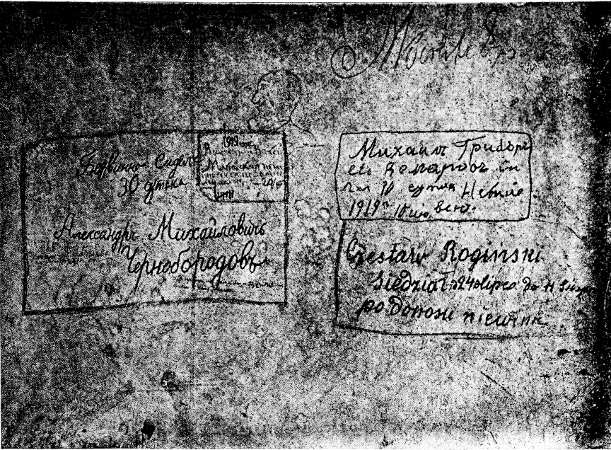
Inscriptions written by prisoners on a cell wall in Kiev.
[See page 174.
Stories concerning Saenko are still current in Kharkov, and represent no more than the truth. Once I myself saw him shoot a sick prisoner on a stretcher; whilst on another occasion he killed a prisoner with a dagger in the presence of a comrade of ours, who subsequently told us of the deed. Also, once when one of a party of prisoners who were in his custody managed to escape, he atoned for that contretemps by shooting the first upon whom his eye happened to alight. He was a man whose eyes were always bleary and inflamed, like the eyes of a man under the influence of either morphia or cocaine. And whenever he was in this state the symptoms of his sadism would become more than ever pronounced.
And Nilostonsky’s book, Der Blutrausch des Bolschewismus (a work based mostly upon the findings of the Röhrberg Commission, which carried out its investigations immediately after the occupation of Kiev by the Volunteer Army during the August of 1919), gives us an even more harrowing picture:
On the eve of the evacuation of Kiev every possible victim was murdered by the Che-Ka. During the night of August 26, 1919, at 5 Sadovaya Street, no fewer than 127 persons were done to death by the provincial Che-Ka, whilst (as there was little time to spare) 100 others were shot in the garden of the Che-Ka building proper, and seventy in the building in Elizabetinskaya Street, and as many more on the premises of the Chinese Che-Ka, and fifty-one railwaymen on the premises of the railway Che-Ka, and others in buildings belonging to the tribunals of Kiev. The primary reason for these butcheries was a desire to have no prisoners at all to remove, and the secondary reason a lust to wreak vengeance in return for Denikin’s successful advance. In one lot of Che-Ka buildings some prisoners were still found alive, since the Bolshevists had been in such a hurry as to be forced to abandon them. And terrible their condition was when found! They looked like corpses, and could scarcely move, but gazed at us with fixed, unseeing eyes.
And with that Nilostonsky goes on to describe the appearance of a “human slaughter-house” (he asserts that that had come actually to be the official appellation of such places) when, later, the Denikin Commission inspected one.
The place had formerly been a garage, and then the provincial Che-Ka’s main slaughter-house. And the whole of it was coated with blood—blood ankle deep, coagulated with the heat of the atmosphere, and horribly mixed with human brains, chips of skull-bone, wisps of hair, and the like. Even the walls were bespattered with blood and similar fragments of brain and scalp, as well as riddled with thousands of bullet holes. In the centre was a drain about a quarter of a metre deep and wide, and about ten metres long. This led to the sanitary system of the neighbouring house, but was choked to the brim with blood. The horrible den contained 127 corpses, but the victims of the previous massacre had been hurriedly buried in the adjacent garden. What struck us most about the corpses was the shattering of their skulls, or the complete flattening out of those skulls, as though the victims had been brained with some such instrument as a heavy block. And there were corpses the heads of which were altogether missing. But in these cases the missing heads cannot possibly have been cut off. They must have been wrenched off. In the main, bodies were identifiable only if they still had left on them some such mark as a set of gold-mounted teeth—left, of course, only because the Bolshevists had not had time to extract it. And in every case the corpses were naked. Also, though it had been the Bolshevists’ rule to load their victims on to wagons and lorries as soon as massacred, and take them outside the town for burial, we found that a corner of the garden near the grave already described had in it another, older grave, and that this second grave contained eighty bodies which in every instance bore almost unimaginably horrible wounds and mutilations. In this grave we found corpses with, variously, entrails ripped out, no limbs remaining (as though the bodies had literally been chopped up), eyes gouged out, and heads and necks and faces and trunks all studded with stab wounds. Again, we found a body which had had a pointed stake driven through its chest, whilst in several cases the tongue was missing. And placed together in one corner of the grave we found a medley of detached arms and legs, as well as, near the garden fence, some corpses which bore no sign at all of death by violence. It was only a few days later that, on these unmarked bodies being subjected to post-mortem examination, our doctor discovered their mouths and throats and lungs to be choked with earth. Clearly the unfortunate wretches had been buried alive, and drawn the earth into their respiratory organs through their desperate efforts to breathe. And it was persons of all ages and of both sexes—old, and middle-aged, and women and children—that we found in the grave. One woman was lying tied with a rope to her daughter, a child of eight; and both bore shot wounds. Further, a grave in the yard of the building yielded the body of a Lieutenant Sorokin (accused of espionage on behalf of the Volunteer Army) and the cross on which he had been crucified a week before our arrival. Also, we found a chair like a dentist’s chair which still had attached to it straps for the binding of its tortured victims. And the whole of the concrete floor around the chair was smeared with blood, and the chair itself studded with clots of blood, and fragments of human skin, and bits of hairy scalp. And the same with the premises of the district Che-Ka, where, similarly, the floor was caked with blood and fragments of bone and brain. There, too, a conspicuous object was the wooden block upon which the victims had had to lay their heads for the purpose of being brained with a crowbar, with, in the floor beside it, a traphole filled to the brim with human brain-matter from the shattering of the skulls.
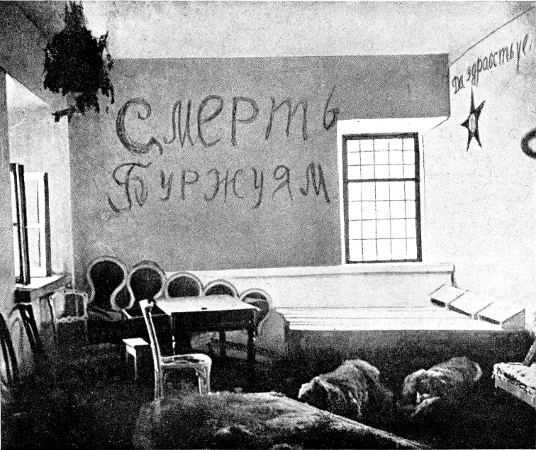
A torture-chamber at Kiev, with “Death to the Bourgeoisie!” scrawled across a wall.
[See page 176.
Again, here is a description of a form of torture which the Chinese Che-Ka of Kiev employed:
The person to be tortured was first of all tied to a wall or a stake. Then an iron tube a few inches in diameter was clamped to him by one of its ends, and a live rat inserted into the other end, and the end covered over with wire netting, and the tube held over a flame until the rat became so maddened by the heat as to attempt at all costs to escape by gnawing its way out through the human victim’s body. And so the torture would be continued for hours—sometimes all through the night into the following day, and in any event until the victim died. And the Commission found that the following form of torture also had been employed in Kiev. The person to be tortured had been buried to the neck in the ground, and left there until consciousness had failed, when he had been dug out again.
And then he had been re-buried to the neck until once more unconsciousness had supervened. And so on, and so on, indefinitely. And inasmuch as the Bolshevists had been treating some victims in this manner just before they evacuated Kiev, they had, in the hurry of their departure, left some of the victims in statu quo—to be dug out, of course, by the Volunteers.
In fact, each Che-Ka seems to have had its speciality in torture. Kharkov, for instance, under Saenko, went in primarily for scalpings and hand flayings; and in Voronezh the person to be tortured was first stripped naked, and then thrust into a nail-studded barrel, and rolled about in it, or else branded on the forehead with a five-pointed star, or, if a member of the clergy, “crowned” with barbed wire. As for the Che-Kas of Tsaritsin and Kamishin, it was their custom to saw their victims’ bones apart, whilst Poltava and Kremenchoug made it their special rule to impale clergy (once, in the latter place, where a ruffian named Grishka was in command, eighteen monks were transfixed in a single day). Also, inhabitants have testified that Grishka would burn at the stake any peasant who had been prominent in a rebellion, and sit on a chair to enjoy the spectacle. The Che-Ka of Ekaterinoslav, again, went in for crucifixion and death by stoning, and the Che-Ka of Odessa for putting officers to death by chaining them to planks, and slowly, very slowly, pushing them into furnaces, or else tearing their bodies on a capstan wheel, or else immersing them in a boiler of water heated to simmering point, and then flinging them into the sea, before finally consigning them to the flames again.
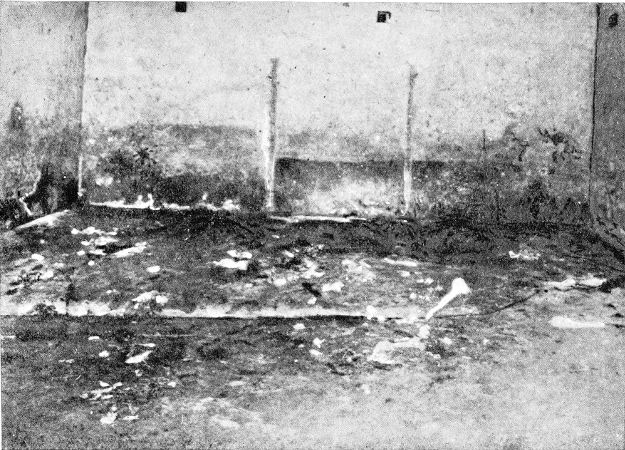
A corner of a coach-house on the premises of one of the Kievan Che-Kas where prisoners were shot. The floor is littered with chips of skull bone, clots of brain, etc.
[See page 178.
In fact, the list of tortures is endless. Another Kievan method was to thrust the living victim into a rough coffin already containing a decomposing body, and to fire shots over him as he lay there, and then inform him that he was going to be buried, and bury him (with the decomposing body) for about half an hour, and, lastly, disinter him again for further “questioning.” And, seeing that all this might be repeated more than once, can we wonder that sometimes the victim lost his reason?
Similarly, the well-known report of the Kievan Sisters of Mercy mentions the local practice of locking up living prisoners with dead. And the statement is confirmed by a Latvian lady who was imprisoned for “espionage” in 1920, and has related that, after being flogged with a whip, and having her finger-tips pounded with an iron implement, and her head screwed into an iron circlet, she was pushed into a cellar.
Very soon the dim light of the electric globe enabled me to realise that I was standing amongst corpses, and to recognise the corpse of an acquaintance of my own, of a lady who had been shot the previous day! And everything had blood upon it, so that all my garments became stained.... At last my surroundings horrified me to the point that I could feel cold sweat break out on my brow.... What happened next I do not know. I only know that when I regained consciousness I was back in my own cell.[199]
The following is an extract from a statement issued from the central bureau of the Social Revolutionary Party:
In Kerensk victims usually were tortured with subjection to sudden changes of temperature. First they were put into a steaming bathhouse, and then led forth, naked, into the snow. And at Alexievskoe and other villages in Voronezh Province the victims would similarly be taken naked into the winter-bound street, and soused with cold water until they became living statues of ice. And at Armavir the “death wreath” was the implement most used. That is to say, the victim would have his head encircled with a leather strap fitted at the ends with an iron nut and a screw, and the nut and the screw be joined together, and the head increasingly compressed. Lastly, the Che-Ka of a Caucasian stanitya used an iron-studded “glove” that was made to be worn on the executioner’s hand.
In his book Russia during Four Years of Revolution S. S. Maslov writes:
Possibly the reader may say that these instances of cruelty were isolated instances; but alas, and to humanity’s shame, they were not so. For example, the practice of transforming living persons into statues of ice was widespread in Orel Province whenever levyings of “extraordinary revolutionary tax” were toward; and once in the Malo-Archangel district the tax-gathering detachment placed a merchant named Yinshkevich upon a red-hot stove until his due was paid; and in Voronezh Province, in 1920, some peasants who were in arrears with their food-tax were subjected to the method of “persuasion” of being let down a well, immersed at the bottom of it, brought up, and once more plied with demands for payment of the tax in full.
In passing it may be said that this author did not go solely to “counter-revolutionary” sources for his information, but collected information also from fellow-prisoners of the Democratic and Socialist Parties.
In the present supposedly civilised age one would rejoice to be able to believe that some of these stories were exaggerations; but to do so is difficult when whole companies of persons stand vouchers for them. A trustworthy correspondent of the Dni of May 13, 1923, writes thus concerning Georgia and the Transcaucasian Che-Ka:
The Che-Ka confines its prisoners in damp, deep, hidden dungeons for weeks at a time, and meanwhile leaves them practically without food, and practically even without water. And beds and tables and chairs are not to be found in those dungeons, but instead, the captives have to lie on a floor compounded of knee-deep mud and blood, and nightly to do battle with the rats. And if even those surroundings fail to affect a prisoner, he is taken downstairs to a lower, a wholly pitch-dark cellar of a kind to make the blood congeal in his veins and render him insensible with the cold. And then he is taken upstairs again, and once more told to inform against his associates and organisation. And if he should still prove recalcitrant he is a second time relegated to the cellar—and so on until he either dies or reveals the “information” required, no matter how improbable that “information” may be. And in other cases victims will be awakened by Che-Ka agents in the small hours of the morning, and taken into the courtyard, and subjected to a blank volley or two in imitation of a real execution, and lastly, half alive and half-dead, relegated to the cellar. Of late, too, much use has been made of the “wreath of death.” Rakaobadye, the Social Democrat, was subjected to the torture until he agreed to enter the Che-Ka’s service, but later regained his freedom, and told his comrades of his experiences.[200]
Sometimes denunciations of tortures inflicted during “investigations” appeared even in the Soviet press itself. Especially was this the case in the early days of Bolshevism, before the usurping Party’s members had all ceased to be shocked by the fact that outrage and violence were perpetrated in their “Socialist-run” prisons. In a letter “Do medieval torture chambers still exist?” which was dispatched to the Muscovite Izvestia on January 26, 1919, by a Communist who had been arrested, and temporarily interned, through an error, the writer stated:
My arrest was accidental, and came about through the fact that I happened to be discovered in a house where (as I learnt later) counterfeit Kerensky notes had been manufactured. But, for all that, I had to spend ten days in prison before the authorities even questioned me, and meanwhile I suffered greatly in mind.
And, next, speaking of the “Investigatory Commission” attached to one of the quarters of the city of Moscow, the writer said:
Persons in that prison were flogged until their senses left them, and then, still unconscious, taken down to a cellar which had been the refrigerator chamber, and thenceforth beaten for eighteen hours out of the twenty-four. Things of the sort so impressed me that I nearly lost my reason.
Again, in the Pravda of March, 1919, we are informed that the Che-Ka of Vladimir kept a special den for “pricking prisoners’ heels with needles,” and that when an imprisoned Communist appealed to public opinion with the words, “One is as much afraid to live as to work, now that even the most reputable of workers may at any time, if domiciled in the provinces, find himself in the position in which I am now,” the matter only attracted official attention because a Communist happened to be concerned, whereas thousands of similar cases had already been passed over in silence. “I blush for your torture chamber,” also wrote L. Reisner to the Che-Ka of Petrograd in December 1918. But his words were looked upon as “sentimentality,” and few protesting voices joined in, and even they speedily gave way to the chorus. In February, 1919, the Pravda cited a case which it roundly declared to illustrate the actual advantages of mock shootings: the case being one of a well-to-do peasant who had refused to meet a requisitional order for 20 poods-weight of grain by way of “extraordinary food tax,” and had been imprisoned, and still refused to pay, and had then been stood up against the local churchyard wall, and again refused to pay, and, lastly, had had a shot fired about his ears, and—oh, miracle of miracles!—at length agreed to pay what was owing.
An equally amazing item is to be found in the Che-Ka’s Weekly,—an item which furnishes us with yet further historical proof of our point, and was headed “Why does the Che-Ka hesitate?”
Tell us [asked the signatories of the article—the head of the Che-Ka of Nolinsk, and others] why you did not subject that fellow Lockhart[201] to the most refined of all possible tortures, and thereby wrest from him the information which we require, and also the budget of valuable addresses which such an official always possesses? Why, we repeat, did you allow him to leave your premises without having been subjected to such tortures as would have made the blood of every counter-revolutionary in the land run cold?... Away with such shilly-shallying! When a dangerous rascal has been caught he should have all the information possible extracted from him, and then be dispatched to a better world.
This was an article in an official journal,[202] and that journal the very journal which purported to be “imparting wise direction to the activities of local Che-Kas, and propagating the ideas and methods of warfare which the All-Russian Che-Ka itself employs”! However, at the sixth Congress of Soviets the representatives of the All-Russian Che-Ka assented to this by saying: “We recognise that it is time for shilly-shallying and namby-pamby methods to be eliminated from our dealings with the bourgeoisie and the bourgeoisie’s servants.”
Hence, from the moment when the Che-Ka’s slogan of “Show no mercy to the bourgeois rabble!” first rang out in the provinces that slogan was bound to be interpreted by the provincial officials as at once a call for and a sanction of cruelty, and to nullify in advance the Che-Ka’s subsequent instructions that a watch be kept over the “legality” of the proceedings of provincial executive committees. And this was the more bound to be so because those instructions were theoretical rather than practical.[203] For the provinces, of course, took their cue from the centre, where, as British reports have stated, a precedent for torture was set in the torturing of Kannegiesser, the assassin of Uritsky. But is it, or is it not, the case that Madame Kaplau, the assailant of Lenin, also was tortured? At all events, rumours to that effect gained currency in Moscow; and though I cannot, for my own part, feel sure on the point, I do know this much: that one night whilst I was lying in the Butyrka, a night which I now believe to have been the night immediately following the Lenin attempt, we could hear that someone was being tortured in the building, and long lay listening to the sounds. Also, although, in those days, it was as unusual for news of torturings to reach the public ear as it is now, I did at least hear of the “safes trial” in August, 1920, and learn about the details of seating the victims upon ice (and the rest) which were laid before the Supreme Revolutionary Tribunal. And the picture becomes more vivid still when we read of the great political trial in Turkhestan in October, 1919, when the accused, to the number of twelve or so, repudiated the evidence which they were alleged previously to have given before the local Che-Ka, and pointed out that their signatures to the “confessions” had been extorted through torture, and thus caused the Tribunal to question the “special detachment” of the Che-Ka which had inflicted the torture, and thereby to elicit the fact that torture had been a regular item of that Che-Ka’s routine. “Upon this,” a correspondent of the Volya Rossii[204] who was present has said, “sobs and cries arose in the hall, and made the building re-echo:” with the result that the judges disregarded the fact that the counsel for the prosecution dubbed the protests “mere bourgeois lamentations,” and uttered a formal condemnation of what had been done.
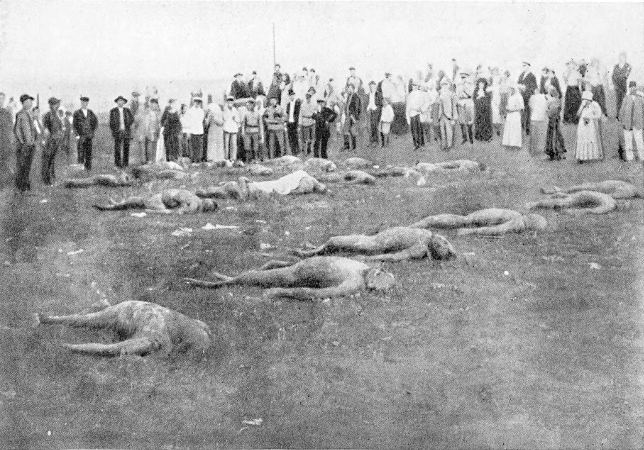
Kharkov victims.
[See page 188.
And only recently the Izvestia[205] of Moscow reported a session of the provincial court of Omsk at which there were tried one Hermann, commandant of the district militia at Sherbanov, a fellow militiaman of his, and a Dr. Troitsky on a charge of having tortured prisoners during examination by pouring hot sealing-wax upon the victims’ palms, arms, necks, and scalps, and then tearing away the wax, and, with it, whole patches of skin. “We cannot,” the President of the Court moralised, “tolerate such methods of inquiry, for they are worthy, rather, of the Spanish Inquisition.” Yet they were “methods of inquiry” which had received practically the sanction of “law,” and we gain additional information of value on the subject from the Socialistichesky Vestnik. To that journal a correspondent wrote:
Last spring persistent rumours and disclosures of certain occurrences caused the provincial court of Stavropol to appoint a special commission of enquiry into torturings said to have been inflicted by the local criminal investigation department.... The commission found that, in addition to floggings, suspensions, and other physical violence, the following means of torment had been employed. (a) First of all there had been confinement in “the hot cellar,” a dark, sunken cell three paces long, and oneand-a-half paces wide, with the floor of the cell cut into steps. For purposes of torment as many as eighteen persons at once had been placed in this cell, so that, there not being standing-room for them all, some of them had had to remain constantly supported upon their companions’ shoulders, whilst the atmosphere had been such that a lamp would not burn in it, nor matches strike. Yet the prisoners had been left there for from forty-eight to seventy-two hours, and, meanwhile, given neither food nor water, nor yet permission to leave the cell for natural purposes. And even women, as well as men, had been incarcerated there—a case in point being a certain Madame Weitzmann. (b) Secondly, there had been confinement in “the cold cellar,” a vault communicating with the shaft of a disused icehouse. In this case prisoners had been wholly divested of their clothing, and lowered into the shaft of the icehouse on a sliding ladder; after which the ladder had been withdrawn, and cold water poured upon the prisoners. And this torture had been inflicted even during seasons of severe frost, and in some cases included pourings of as many as eight bucketfuls of water upon a single prisoner.... (c) Thirdly, there had been measurement [compression] of the skull.
Also, it appeared that this criminal investigation department had been shooting prisoners for alleged attempts to escape, and, in the April of 1922, used the pretext for putting to death, in particular, a certain Mastriukov. In fact, when the commission of inquiry issued its findings they were findings based upon testimony both of victims and of eye-witnesses, upon discoveries made by qualified medical men, upon results of post-mortem examinations, and upon confessions of Che-Ka employees, the actual inflicters of the tortures—the plea of these last being that they had acted only on the express orders of a certain Grigorovich who was head of the local C.I.D., head of the local executive committee, and head of the local provincial committee of the Communist Party. Also, they said, they had received instructions from Povetsky, Grigorovich’s assistant, and from Topishev, judicial adviser to the C.I.D., and carried out the tortures with these two officials’ personal help. Yet, though the commission ordered the persons inculpated to be arrested and proceeded against, their arrest was found to be impracticable owing to the fact that a certain Chernobrovy, head of the local O.G.P.U., concealed them for a while on premises attached to his official quarters, and then produced in their justification a secret circular issued by the Central Che-Ka itself which laid it down that if, during a process of “investigation” of prisoners, or a preliminary enquiry with regard to prisoners, the latter should resist circumstantial evidence, confrontation, and “threats,” and refuse to confess to their imputed crimes, “the old and proven remedy” should be applied to them. The origin of the circular had, apparently, been as follows. During the summer of 1921 Voul, a notorious “people’s prosecutor” attached to the Che-Ka of Moscow, had been accused of employing inquisitional torture and violence, and, upon that, had threatened to send in his resignation on the ground that, should torture be debarred him, he would not be responsible for preventing any further increase of “banditism” in Moscow: and this threat had so frightened Menzhinsky that the latter had forthwith accorded Voul licence to pursue his inquisitional methods as before, and issued the foregoing “old and proven remedy” circular. Hence the usual result happened, and none of the Stavropol officials who had employed torture were arrested—the only persons to be arrested being persons who had displayed an altogether uncalled-for amount of zeal and initiative in probing Stavropol’s criminal-investigatory mysteries! And we have detailed confirmation of this from a letter published in No. 1 of the journal Pouti Revolutsyi (“Roads to Revolution”), one of the Left Social Revolutionary Party’s journals.
Akin to the Stavropol business was a Turkhestan affair. In Turkhestan the chief inflicter of torture was, for a while, an ex-circus clown named Drozhin, a member of, and an executioner employed by, the local Che-Ka. In time, however, this man was dismissed from his post on a torture charge—only to be reappointed, on the strength of his record as a “questioner,” to the post of local political commissary.[206] And how we can imagine the exploits of the ex-circus clown in his new rôle! Not that we know very much about his exploits in that particular quarter of the world. What we do know about him is his career in a kindred sphere at the other end of Russia, at Archangel. I have before quoted a report in The Che-Ka dealing with the concentration camp at Kholmogory; and although I am not personally aware of the identity of the author of the report, of the man who, in the face of every possible danger and difficulty, travelled to the far North to collect for himself authentic information concerning horrors which had reached our ears even in Moscow, it was in Moscow that subsequently he sought for means of assistance for the unfortunate prisoners in the “Camp of Death,” and I was present when a paper was read on his behalf. The paper proved to be even more terrible than his report had been: so much so that we sat petrified, and realised at once that no possible means of help was conceivable. And if I cite a few details from the paper, they will help the reader to realise what life conditions were in that inferno of a camp.
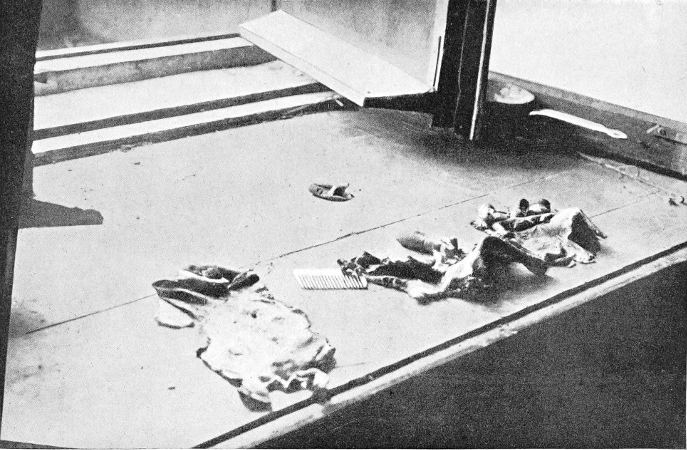
Human “gloves,” flayings of human hands, found in a torture chamber at Kharkov after the Bolshevists’ departure.
[See page 196.
So long as the abominably cruel Bakhoulis was commandant of the place, persons were shot in large numbers for purely trivial offences. Truly detestable are the tales told of him! Amongst other things, he made it his practice to divide his prisoners into groups of ten, and punish a whole group if any one of its members committed an offence. Once a member of a group escaped, and could not be found; whereupon the other nine were shot forthwith; and when the actual offender himself was caught he also received a sentence of death, and was led to the side of a ready-dug grave, and cursed at for a while by the commandant, and, lastly, hit over the head in such a manner as to fall, half-stunned, into the grave, and be buried alive. This incident I had from one of the camp guards themselves. Later, when Bakhoulis had been transferred to the command of the camp at Portaminsk, the most northerly camp of all (situated about a hundred versts north of Archangel), he continued his Kholmogory practices there, and caused the prisoners to be fed upon dried fish alone (so that they never saw bread) and, in general, gave full rein to his cruelty. In particular it is said that of 200 prisoners whom he removed thither from Kholmogory very few survived. I found the very name of Portaminsk to inspire captives with fear, so much had the name come to mean practically a death sentence. Yet the conditions of Portaminsk differed little from those obtaining at Kholmogory.[207]
Further details as to life in the Portaminsk disused Monastery reach us in a private letter secretly conveyed to Petrograd.[208]
Once, as we were starting work at six o’clock in the morning, and had not yet left the courtyard, one of the prisoners, a man recently recovered from typhus, and therefore still weak from the attack, fainted away: whereupon the commandant declared him not to be genuinely ill, and, to punish him for “malingering,” had him stripped stark naked, thrust into an icy-cold cell, and pelted with snow. Later the man died of the chill then caught.
Also the writer records how a sick man who failed to keep up with a prison convoy proceeding from one village to another was shot before his comrades’ very eyes. And another eye-witness has written:
The following may give you an idea of the abominations committed here. Whilst some prisoners were digging sand for building purposes in front of the commandant’s house he noticed that they sat down for a rest. Accordingly, without moving from his place at the window, he drew his revolver, fired, and killed and wounded several of the party. Upon that the prisoners went on hunger strike; and on this coming to the ears of Moscow, a commission of enquiry was dispatched to Portaminsk, and the commandant removed. But the new commandant, a sailor from the “Gangut,” is just as cruel as his predecessor, and haphazard shootings of prisoners by guards before their comrades’ eyes are as common as ever.
The mere fact that in six months, during the years 1921 and 1922, 442 prisoners out of 1200 died should show us what were the conditions of confinement in the North.
At Kholmogory prisoners would be thrown into a pitch-dark cell, or confined in buildings known respectively as “the cold tower” and “the white house”—the latter an isolated edifice the one small room of which had no lavatory attached, and at times would be made to hold as many as forty persons. Typhus patients confined there had to spend the ten days before the “crisis” of the malady without any sort of medical attention, and it was quite a common thing for prisoners to lose their reason whilst in the building.
And since we in Moscow could gain only fragmentary news of such happenings, and were ourselves in the power of officials who stood indemnified against punishment for their acts, how could we voice a protest with safety, even if it had been possible for us to voice one? More than once during my time in the Butyrka Gaol I have known prisoners whom I had seen undergoing ill-treatment whilst under examination subsequently beseech me to keep silence on the subject. The prison doctors themselves were forbidden to disclose that floggings of prisoners were being practised, and once when a Dr. Sheglov gave some Socialists a certificate that they had been subjected to physical outrage he was sent into exile at Archangel, and allotted for his portion of hard labour the task of clearing away sanitary refuse. Of floggings outside the prison we did hear news, whilst also we heard of a Social Democrat named Treigav being thrust into a cell which measured three paces by two, and made to share it with a Chinese lunatic who had homicidal mania. These and other instances of the sort are to be found detailed in Nos. 1 and 14 of Revolutsionnaya Rossia. Again, a letter secretly conveyed to us from a Left Social Revolutionary named Shebalin told how he had been tortured (in Petrograd) by having his arms and legs beaten with a revolver butt, his eye-sockets and testicles prodded and compressed until he had swooned with the agony, and his body flogged in such a manner as to leave no weals or blood, but cause the blood of the flagellation to pour from his throat alone.[209] And similar to his statements concerning compression of the testicles was evidence given by Sinovary before the tribunal at Lausanne. Besides, I myself knew Shebalin, who for six months had been my fellow-prisoner in the Butyrka, and therefore can testify that he was a man incapable of telling a lie, or even of exaggerating.
I can assure you (he wrote), that this letter is being sent to you from a torture establishment the régime and the resources of which outdo even those of the ancient “Bastilles of Russia,” the Fortress of Schlüsselburg and the Fortress of Petropavlovsk—in both of which I have been imprisoned for offending the Imperial Crown.
Also, the letter mentioned certain cunningly devised cells which had just been contrived on the Gorokhovaya Street premises of the Petrograd Che-Ka—little cramped, icy-cold rooms walled with double linings of cork so as to prevent all sounds whatsoever from reaching the outside world. And there, our informant said, prisoners were “questioned” by being frozen and burnt and otherwise tortured—usually for between five and ten days at a stretch, or even for a month.[210] And in a book written abroad, but based primarily upon materials which the author had brought with him from Russia, S. S. Maslov has stated that it was a common, almost a universal, thing for prisoners to be kicked and beaten with rifle and revolver butts all over their bodies. Also, he cites an instance of barbarism which is the more characteristic of the Bolshevist “justice,” whose principles are so enthusiastically extolled in the Soviet press as “tending less to punish than to reform” in that the instance had no sort of relation to politics.
In Moscow, during the May of 1920, some juvenile pickpockets of from eleven to fifteen years of age were arrested, thrown into a cellar on the Che-Ka’s premises, and kept separate from the rest of the prisoners. For the Che-Ka had decided to put these children to an official use, and obtain, through them, the names of pickpockets with whom the children had associated in the past. Yet, though the authorities cajoled and threatened, the children persisted in saying that they knew nothing whatsoever on the subject, and all inquiries proved fruitless. Next, employees of the Che-Ka entered the cell, and beat the children with their fists, and, as the victims fell under the blows, stamped upon them with their heels. And then the children did promise to inform against their late companions, but, never having known those companions’ real names, had to be driven about the streets in motor-cars and tram-cars, or else taken to the railway stations, on the chance that, en route, they might be able to point out one or more of the culprits wanted. And though on the first day the children persistently avoided denunciation of any former comrades, they were so cruelly beaten for this when they returned to the Che-Ka building in the evening, and every evening afterwards, that at last they did begin to betray old associates, and then, through fear of further floggings, even to inform against perfectly innocent persons, persons whom they had never known at all. And when this had been going on for three weeks or so, orders were received for the children to be transferred from the premises of the Che-Ka to the Butyrka Gaol: by which time the children were emaciated, bruised all over, clad in rags, stamped with fear until they had come to look like little animals constantly confronting death, given to trembling, and apt to moan and weep even during their sleep at night. Then, after two or three weeks in the Butyrka Gaol, orders came for them to be restored to the Che-Ka premises: and I have since been told by prisoners who had often and long been confined in gaol that they had never before in their lives—no, not even during their imprisonment in Siberia—heard such terrible cries as those children uttered when they realised that they were going to be taken to the Che-Ka’s cellars again. Indeed, my informants said, they had never before felt such burning hatred of their oppressors as when their tear-dimmed vision beheld those young creatures’ suffering, and saw their young forms being marched away to the yard in a frenzy of weeping.
And only recently I heard that at Irkutsk an old revolutionary named Kulikovsky had been done to death during examination by an agent of the O.G.P.U. And I have since read in the journal Dni the details of the occurrence: how that when Kulikovsky refused to reply to his torturer’s questions the latter battered him with a revolver-butt until, with skull fractured, the old man fell and died.
The Amount of Licence accorded to Executioners
I have said that Saenko was a sadist, and described some of his doings. And from writings by the Socialist Karelin we obtain also items concerning Saenko’s chief assistant, the sailor Edward, a fellow who would fall to friendly talk and jest with a group of prisoners, and then suddenly draw his revolver and shoot one of the wretches through the back of the neck.
And from a writer named Averbuch, a man well acquainted with affairs in Odessa, we hear of the abominable doings of Kalinchenko, the head of the Che-Ka of that city. To his fantastic whims and crazy dispensation of “justice” many stories are due. For example, once he celebrated his nameday by sending to the local prison for “three of the fattest bourgeois to be obtained,” and, in his drunken frenzy, shooting them then and there. And Averbuch also has written:
Once when I called at the Café Astra (a place frequented almost exclusively by Bolshevist officials) I heard from Vaska the executioner’s own lips the story of his shooting of two bourgeois. Yes, he described to me their agonies of mind before death, their kissings of his hands and feet, their beggings for mercy. And he added: “After all, I have only done my duty as a revolutionary.”
At Odessa, too, there was an executioner named Johnson, a man sent thither from Moscow. And of him Averbuch has written[211]:
Before long the fellow’s name became a synonym for everything that was cruel and vile. For only he, only this Johnson, only this negro executioner, could skin a victim before killing him, or cut off a prisoner’s limbs, one by one, during the ordeal of examination.
Yet was Johnson the only ruffian who could do such things? At a Bolshevist exhibition held in Moscow during the years 1920–21 one of the exhibits was a pair of “gloves” which had been ripped from the human hand; and though the Bolshevists represented this pair to be an example of atrocities committed by the Whites, rumours as to Saenko taking “gloves” from victims at Kharkov had reached Moscow much earlier than that, and “gloves” of the sort had actually been found in the basement of the Che-Ka’s premises, whilst Anarchists subsequently brought from Kharkov to the Butyrka had unanimously testified to perpetrations of the abomination in question. Yet Lounacharsky, a member of the Party thus exhibiting Saenko’s “gloves” as a sample of cruelty committed by the opposite side,[212] had said at a session of the Soviet held on December 4, 1918: “Although we are accused of a Hottentot standard of morality, we are not going to admit the impeachment”!