William Le Queux (continued 4)
Reading edition
“What does he want with a tyre when he hasn’t got a car?”
I stood in silence. What, indeed, did that man want with one of the new tyres? Had he merely come down there to have further words with me, or did he require a cover for some specific purpose?
My mind, however, was made up. I had resolved to go to New Scotland Yard, and, even though tardily, to place the whole of the facts before the Criminal Investigation Department. Therefore I got out the “forty-eight” and drove along the Hammersmith Road and Knightsbridge, across St. James’s Park, and through Storey’s Gate to Whitehall. I alighted in the big courtyard of the police headquarters, where a number of motor-’buses were drawn up for inspection, and entered the large stone hall, when a constable came forward to inquire my business.
I handed him my card, explaining that I wished to see one of the detective inspectors upon a confidential matter, and was shown upstairs and along a wide corridor to a bare waiting-room.
For some ten minutes I remained there, when the door opened, and I found myself face to face with a middle-aged, pleasant-faced man, who was one of the most noted and experienced officers of the department.
For a moment I held my breath. I recollected all the threats that had been made of Mabel’s peril if I dared to speak the truth.
The detective-inspector closed the door behind him, and, wishing me a polite “Good morning,” inquired my business.
I told him. Yes; I blurted forth the truth, and made a clean breast of the whole matter.
But the instant I had done so I bitterly repented it.
I realised something which I had not before recognised.
I saw that, even though my dear wife were missing and in peril, I was a fool—an utter idiot—for having dared to breathe a word.
My injudicious statement had only rendered the enigma still more complicated than hitherto.
Chapter Twenty Three.
The Unexpected Happens.
The shrewd officer seated at the table with me, a pen in his hand, heard my narrative to the end, now and then making brief memoranda.
Presently he exclaimed:
“Would you kindly excuse me? I’d like another gentleman to hear this story.” And he rose and left.
A few minutes later he returned with a rather taller, clean-shaven man, slightly younger, who had on a dark overcoat and carried a silk hat in his hand.
“This is Mr Holford,” said the first officer, introducing me. “He’s just told me a very remarkable story, which I’d like you to hear for a moment.”
Then, turning to me, he asked me to repeat briefly what I had alleged.
The new-comer, seating himself, listened attentively to every word which fell from my lips. I noticed that he exchanged curious glances with his brother officer.
“Your main reason, then, for telling us this story is in order to compel those responsible for your wife’s absence to reveal her whereabouts, I take it?” asked the younger man.
“Exactly.”
“The false telegram was dispatched from Turin, eh?”
“Yes. Cannot you communicate with the Italian police concerning it?”
“And pray what good would result?” he queried. “After long delay we might perchance get the original of the telegram, but I don’t see that that would assist us very far. When people send bogus messages they generally disguise their handwriting.”
“Well, I leave it to you to take what steps you like to assist me,” I said. “My sole object is to find my lost wife.”
“Naturally, my dear sir,” observed the officer. “We’ll first take down your statement in writing.” And then the man I had first seen wrote at my dictation a brief summary of the mysterious death of Professor Greer and its attendant complications and my suspicion of Kershaw Kirk.
“Well, we’ll place this before the Commissioner to-day. Perhaps you’ll call to-morrow; say about this time. We will then let you know our opinion and our intentions.”
With that I was compelled to be satisfied, and I left the waiting-room full of hope that by that bold move of mine I might gain knowledge of the whereabouts of my well-beloved.
How I existed throughout that day I cannot tell. I tried to attend to my business, but in vain. I was wondering what action was being taken by my sinister-faced neighbour who lived in Whitehall Court under another name, and who seemed to possess a dual personality.
At last the hour came when again I turned the car into Scotland Yard, and once more was ushered upstairs into that bare waiting-room wherein so many stories of crime are related.
Presently, after a lengthy wait, the two officers entered together and greeted me.
“Well,” commenced the elder of the pair with some slight hesitation, “we’ve placed your statement before the Commissioner, Mr Holford, and he has very carefully considered it. He has, however, decided that it is not a matter for our department.”
“What?” I gasped. “A man can be foully done to death here in London, and yet the police refuse to believe the story of an honest man—a man who is a witness!”
“We do not doubt you in the least degree, Mr Holford,” the other assured me, speaking very quietly.
“But you do!” I exclaimed in quick anger. “I’ve told you that a crime has been perpetrated.”
“My dear sir,” said the officer, “we get many startling stories told here almost hourly, and if we inquired into the truth of them all, why, we’d require a department as big as the whole of Whitehall.”
“What I told you yesterday is so strange and extraordinary that you believe I’m a madman,” I said. “I see it in your faces.”
“Excuse me, but that is not the point,” he protested. “We are only officers, Mr Holford. We are not the commander. The chief has given his decision, and we are compelled to obey, however much we may regret our inaction.”
“So you refuse your aid in assisting me to find my wife?”
“No. If we can help you to discover Mrs Holford, we willingly will. Perhaps you’ll kindly give us her description, and we’ll at once circulate it through all our channels, both here and abroad. But,” added the man, “I must first tell you that we can hold out very little hope. The number of missing wives reported to us, both here at headquarters and at the various local stations in the metropolitan area, is sometimes dozens in a day. Most of the ladies have, we find on inquiry, gone away of their own accord.”
“But this case is different. My wife has not!” I asserted. “She has been enticed away by a telegram purporting to come from me.”
“And that’s really nothing unusual. We have heard of ladies arranging with other people to send urgent messages in the names of their husbands. It is an easy way of escape sometimes.” And he smiled rather grimly.
“Then, to put it plainly, I’ve nothing to hope for from you?” I snapped.
“Very little, I fear, sir.”
“And this is our police system which was only recently so highly commended by the Royal Commission of Inquiry!” I blurted forth. “It’s a scandal!”
“It is not for us to make any comment, my dear Mr Holford,” said the elder of the two officers. “The Commissioner himself decides what action we take upon information we may receive. I dare say,” he added, “our decision in this case does appear to you somewhat strange, but—well, I may as well point out that there is a special feature in it which does not appear to you—an outsider.”
“What special feature can there be, pray? A well-known man has been assassinated. Surely, therefore, it is the duty of the police to stir themselves and make every inquiry!”
“We have only your statement for that. As far as we or the public are aware, Professor Greer is travelling somewhere on the Continent.”
“But, if you disbelieve me, go to Kershaw Kirk, in Whitehall Court, or to the Professor’s daughter down at Broadstairs, or to Pietro Merli, who keeps a newsagent’s in the Euston Road. Each of these persons knows the truth, and would speak—if compelled.”
“The Commissioner has had all those names before him, but in face of that he has decided not to enter into this matter. His decision,” said the officer, “is irrevocable.”
“Then our police system is a perfect farce!” I cried. “No wonder, indeed, we have in London a host of undiscovered crimes! The man Kirk laughed at you here as blunderers!” I added.
But the pair only exchanged glances and grinned, causing me increased anger.
“In any other city but London the police would, upon my information, at once institute inquiry!” I declared. “I’m a tax-payer, and am entitled to assistance and protection.”
“We have already offered to assist you to discover the whereabouts of Mrs Holford,” the elder man pointed out politely.
“Then inquire of this man Kirk, or Seymour, as he calls himself, in Whitehall Court,” I said. “He can tell you where she is—if he chooses.”
“You suspect him of having a hand in her disappearance? Why?” inquired the other detective officer.
I related clearly and succinctly the facts upon which my belief was based and of the description given of my wife’s companion by the hotel-manager in Florence.
The officer slowly shook his head.
“That’s scarcely conclusive, is it? The description is but a vague one, after all.”
“Well,” I said bitterly as I rose, “if you refuse to assist me, I must, I suppose, seek redress elsewhere. May I see the Commissioner myself?”
“You can make formal application, if you like. But I don’t expect he will see you. He has already fully considered the matter.” And that was all the satisfaction accorded me.
“Then I’ll do something!” I cried. “I’ll get a question asked in the House. It’s a scandal that, with Professor Greer killed in his own home, you refuse to bestir yourselves. After all, it seems quite true, as has been recently alleged, that the police are nowadays so fully occupied in regulating the speed of motor-cars that they have no time for the investigation of crime.”
I noticed that at my threat to have a question asked in the House, one of the officers pulled a rather wry face. The Metropolitan Police were not fond, I knew, of questions being put about them. I chanced to know rather intimately a member for a country division, though to get the question put would necessitate my explaining the whole affair.
Yet was not Mabel’s liberty—nay, perhaps her very life—at stake?
“You’ve told us very little regarding this friend of yours, Mr Kershaw Kirk, whom you appear to suspect so strongly,” the younger of the two men remarked at last. “Who is he?”
“An adventurer,” I replied quickly. “I have no doubt whatever upon that point.”
The man pursed his lips dubiously.
“May it not be that you are somewhat prejudiced against him?” he ventured to suggest.
“No. He was in the house at the time when the Professor’s body was cremated in his own furnace. If you went to Sussex Place you would probably discover some remains among the ashes.”
“Do you allege, then, that you were an actual witness of the cremation?” asked the officer.
“No; I found him in the house.”
“And, later on, you discovered the furnace alight, eh?”
“Yes.”
“Then it is only a surmise on your part, after all, my dear sir,” remarked the detective, twisting a pen between his fingers as his dark eyes were fixed upon mine. “The actual evidence is really nil. That is just the view taken by the Commissioner.”
“But my wife is in the hands of the assassins,” I cried. “You can’t deny that!”
“Is there any actual, evidence of it? None, as far as we can see,” he declared. “Would it not be natural for your wife, on failing to find you in Florence, either to wire to her sister at home or to return home at once? She did neither, which only goes far to prove that she did not desire to return to London.”
“You suggest that she has purposely left me?” I cried, staring at the man in a frenzy of angry resentment.
“I suggest nothing, Mr Holford. Pray don’t misunderstand me. I merely put before you the facts in order to obtain a logical conclusion. Only one can be arrived at—she had some motive for not returning to her home. If she had, then how are we to find her? She would, no doubt, purposely cover her tracks.”
“But she was with that man, the man who—”
“And that just bears out my argument,” interrupted the detective.
“But may she not have been prevented from sending any message home?” I suggested, though that very point he had made had, I confess, been the one which had continually obsessed me.
Both the detectives shook their heads.
“No,” replied the elder of the two. “We are both agreed, as the Commissioner also believes, that your wife would not be held a prisoner. Criminals do not hold women prisoners nowadays, except in works of fiction. No,” he added, “depend upon it, Mr Holford, when you discover the truth, you will find that your wife was acquainted with one or other of these friends of yours, and that her disappearance was part of a plan.”
The story of the message received by Mabel while I was in Scotland flashed across my mind. I recollected all that Gwen had so guardedly related to me.
But I stirred myself quickly. No, a thousand times no! I would never believe evil of Mabel before I had absolute proof in black and white. The mystery of her disappearance was as great and inexplicable as the problem of who killed Professor Greer?
Chapter Twenty Four.
Two Men Consult.
Beside myself with fear and anxiety regarding the woman I loved so well, I again called that very same evening upon Kirk at Whitehall Court, but on doing so was informed by the lift man that he was out.
A suggestion then occurred to me that he might have gone over to his other abode at Bedford Park, therefore I returned, and at last knocked at his door.
His sister answered my summons, and saying that her brother was at home, ushered me into his presence.
I found him in his old velvet jacket seated in his high-backed arm-chair before a glowing fire, his pet parrot near him; and as I entered he greeted me coldly, without deigning to shake my hand.
“Well, Holford,” he exclaimed, stretching his slippered feet lazily towards the fire, “so you have, after all, proved a traitor, eh?”
“A traitor? How?” I asked, standing near the fireplace and facing him.
“You have been telling some extraordinary stories about me at Scotland Yard, I hear,” he said with a grin.
“Ah!” I cried. “Then you are a detective, after all? My surmise was right from the first!”
“No,” he replied very quietly, “you were quite wrong, my dear sir; I’m not a detective, neither professional nor amateur, nor have I anything whatever to do with Scotland Yard. They may be sad blunderers there, but they do not accept every cock-and-bull story that may be told them.”
“I told them no cock-and-bull story!” I protested angrily. “I told them the actual truth!”
“And that after all the warnings I have given you!” he said in a tone of bitterest reproach. “Ah! you are unaware of the extreme gravity of that act of yours. You have broken faith with me, Holford, and by doing so, have, I fear, brought upon me, as upon others, a great calamity.”
“But you are so mysterious. You have never been open and above-board with me!” I declared. “You are full of mystery.”
“Did I not tell you on the first evening you sat here with me that I was a dealer in secrets?” he asked, blowing a cloud of smoke from his cigar.
“No, Holford,” went on my mysterious neighbour, very seriously, “you are like most other men—far too inquisitive. Had you been able to repress your curiosity, and at the same time preserve your pledge of secrecy, matters to-day would have been vastly different, and, acting in concert, we might have been able to solve this extraordinary enigma of Professor Greer’s death. But now you’ve been and made all sorts of wild statements to the Commissioner of Police. Well, it has stultified all my efforts.”
He spoke with such an air of injured innocence that I hesitated whether I had not, after all, somewhat misjudged him. Yet as I looked into that grey, crafty face I could not help doubting him. It was true that he had taken me into his confidence, but was it not done only for his own ingenious and devilish purpose?
“My wife is lost,” I observed at last. “It is her loss that has, perhaps, led me to say more than I would otherwise have done.”
“And love for your wife makes you forget your word of honour given to me, eh?” he asked. “Your code of honour is distinctly peculiar, Mr Holford,” he added, with biting sarcasm. “I, of course, regret that Mrs Holford has fallen a victim to the machinations of our enemies, but surely even that is no excuse for a man to act treacherously towards his friend.”
“That is not the point,” I declared. “You have never satisfied me as to your motive in taking me to Sussex Place and exhibiting to me the evidence of the crime.”
“Because—well, because, had I done so, you would not have understood. Some day, perhaps, you will know; and when you learn the truth you will be even more astounded than you are to-day. Meanwhile, I can assure you that you suspect me entirely without cause.”
“Then why were you in the house at the time the traces of the crime were being effaced in the furnace?” I asked in a hard voice.
He hesitated for a moment, and I thought his bony hand trembled slightly.
“For reason’s of my own,” he replied at last. “You allowed me to wriggle out of a very tight corner, and I intended to show you my gratitude, had you given me an opportunity.”
“I desire no expression of gratitude, Mr Kirk,” I replied, with dignified disgust. “All I require is a statement from you concerning the whereabouts of my dear wife. Give me that, and I’m satisfied to retire from the whole affair altogether.”
“Because you have now realised that Scotland Yard refuse their assistance, eh?” he asked, with an evil grin. “Are you not now agreed with me that our much-praised Criminal Investigation Department, with all its hide-bound rules and its tangle of red-tape, is useless? It is not the men who are at fault—for some of them are the finest and best fellows in the whole metropolis—but the system which is radically wrong.”
I was bound, after my experience, to agree with him. But again I referred to Mabel, and to the manner in which she had been decoyed from home.
“You hear that, Joseph?” he exclaimed, turning to his feathered pet, who had been chatting and screeching as we had been speaking. “This gentleman suspects your master, Joseph. What do you say?”
“You’re a fool for your pains! You’re a fool for your pains!” declared the bird. “Poor Jo-sef! Poor Jo-sef wants to go to bed!”
“Be quiet! You’ll go to bed presently,” answered the queer, grey visaged, sphinx-like man, who, turning again towards me, and looking me straight in the face, once more assured me that I was foolish in my misapprehension of the truth.
“To me it really does not matter who killed Professor Greer, or who has usurped his place in the world of science,” I said. “My only aim now is to recover my lost wife. Antonio, when I met him in Rome, was anxious that, in exchange for information concerning her, I should consent to keep a still tongue as to what had occurred in Sussex Place.”
“Rubbish, my dear sir!”—and Kirk laughed heartily. “What can Antonio possibly know? He’s as ignorant and innocent of the whole affair as you are yourself.”
“How do you know that, pray?”
“Well, am I not endeavouring to elucidate the mystery?” he asked.
“And you know more than you will tell me?”
I said.
“Perhaps—just a little.”
“Yet you desire that I should still trust you implicitly, that I should give myself into your hands blindly and unreservedly—you, who lead this dual existence! In Whitehall Court you are a wealthy man of leisure, while here you pose as shabby and needy.”
“I may be shabby, Mr Holford, for certain purposes—but needy never! I have, I’m thankful to say, quite sufficient for my wants,” he exclaimed, correcting me. “And as for my dual existence, as you term it, have I ever endeavoured to conceal it from you?”
“Tell me—once and for all—are you aware of my wife’s whereabouts?” I demanded in frantic anxiety. “Can’t you see that this suspense is turning my brain?”
“Yes, it is very unfortunate—and still more unfortunate that I can afford you no satisfaction. The fact of Mrs Holford’s prolonged absence is as great a mystery to me as to yourself.”
“Scotland Yard will render me no help,” I said in bitter chagrin.
“Probably not—after the amazing story you told them,” was his rather spiteful response.
“What am I to do?”
“Remain patient and watchful,” he said. “Believe in me, and try and persuade yourself that, after all, I’m not an assassin,” he smiled.
I held my breath for a few seconds. Here was the crux of the whole matter. He was still cleverly and ingeniously endeavouring to lead me into a false sense of security—to make me believe that he was innocent of all knowledge of that most astounding tragedy in Sussex Place.
Ah! his was indeed a clever ruse. But my eyes were now opened, so I only smiled within myself at the futility of his crafty and clever attempt further to mislead and cheat me.
A man was with my wife, passing himself off as myself—Henry Holford, motor engineer. And yet I could look to no one for counsel, advice, or aid!
Now that the police had refused to inquire into the death of poor Greer, the attitude of my weird, grey-faced neighbour had become more defiant. He was full of bitter reproaches, yet at the same time entirely heedless of my future actions.
Once or twice while speaking to me he turned, as was his habit, to Joseph the parrot, addressing asides to his pet, causing the bird to screech noisily, grow excited, and make idiotic responses.
“Mark me, Mr Holford,” he said at length, “you did a most foolish thing to betray me to Scotland Yard. In you I’m most disappointed, I assure you. My confidence was misplaced.”
“I understand you’ve been to my garage and in my absence purchased an Eckhardt tyre,” I remarked.
“Well?” he said, opening his eyes slightly. “I only came down to see you, but when I found you absent I bought a tyre as an excuse.”
“And you expect me to believe that, eh?” I asked, with a dry laugh.
“You can believe it or not believe it, just as you think fit,” was his quick reply. “I have no use for motor-tyres, not possessing a car.”
I grinned in disbelief, recollecting the air of secrecy with which he had examined the tyre on the first occasion he had called upon me, and also the effect produced upon him later when I told him of the two other men who had called to inspect the tyre.
I think I remained with him for nearly an hour. Then, after he had told me that his intention was to stay in England, at least for the present, I left him and walked back to my desolate home, where, Gwen having retired, I sat for a further hour in my den, deeply thinking.
That Kirk was in some secret way in association with the bogus Professor was plain. Was it not, then, more than likely that they would ere long meet again? If I kept a wary eye upon him, I might, I saw, discover something of great interest.
Who could this man be who led a dual existence for no apparent cause; this man who was narrow-minded and penurious in Bedford Park, yet was wealthy and open-handed in Whitehall Court?
As I calmly reviewed the whole extraordinary situation I saw that, in turn, I mistrusted the whole of the actors in that bewildering drama. Ethelwynn, the calm, sweet, clear-eyed girl, so content in her great love for Leonard Langton, though she had actually witnessed her father lying dead and cold, yet now refused to presume his death! Why? Doctor Flynn I disliked instinctively; Langton was evidently playing a double game, having denied all knowledge of Kirk, whereas the latter was his friend; Antonio and Pietro were away; while Kirk himself, silent and cunning, was pretending a complete ignorance which was only ill-feigned.
And the most important point of all was that not a breath of suspicion of the Professor’s death had yet leaked out to the public.
Thus, utterly bewildered, I again retired to rest.
Early astir next morning, I set watch upon Kirk’s movements, assisted by Dick Drake, my clean-shaven, bullet-headed chauffeur. A few moments before eleven he came forth, thinly clad and shabby, as he generally appeared in Chiswick, and, walking to Ravenscourt Park Station, took a third-class ticket to Westminster, whence he walked to a rather grimy house situate in Page Street, a poor neighbourhood lying behind the Abbey. There he remained for some time, after which, fearing lest he should recognise me, I directed Drake to follow him, and returned to the garage.
At six that evening my man returned, tired and hungry, reporting that Kirk had gone to a house in Foley Street, Tottenham Court Road, the number of which he gave me, and after ten minutes there he had eaten his luncheon at a bar in Oxford Street. Then he had taken train from Holborn Viaduct to Shortlands, near Bromley, where he had made a call at a small villa residence not far from the station.
The door of the house had been opened by a tall, thin man in a dark blue jersey, who, he said, had the appearance of a foreigner, and Kirk had stayed inside for nearly two hours. When at last he came out, the tall man had walked with him to the station, and bade him adieu on the platform.
“But,” added Drake, “that gentleman’s a pretty ’cute one, sir. He spotted me.”
“H’m, that’s unfortunate,” I said. “You were a bit too bold, I fear.”
Of course I had told him nothing of the reason why I was watching the man who had evinced such interest in the Eckhardt tyre.
“I exercised all the caution possible,” Drake declared, “but he doubled back upon me down at Shortlands and thus tricked me. He didn’t say anything, but only laughed in my face.”
The story of the foreigner at the villa at Shortlands struck me as somewhat remarkable, and I resolved to go there on the morrow and investigate. I now held all Kershaw Kirk’s movements in suspicion.
Next day I rose with the fixed intention of going at once down to Shortlands, that district of suburban villadom, but hardly had I risen from the table where I had breakfasted in silence with Gwen, when something occurred to turn the tide of events into an entirely different channel.
Indeed, by that sudden and unexpected occurrence I knew that I had at last advanced one step towards the knowledge of who killed Professor Greer behind those locked doors in Sussex Place.
Chapter Twenty Five.
A Plot Fails.
What actually occurred was this. I had risen from the table when Annie entered with a telegram which, on opening, I found to be an urgent message from Langton, at Broadstairs, begging me to go there at once, as he had some important information to communicate to me.
From the time-table I found that a fast train left Victoria in an hour, and full of excitement I bade good-bye to Gwen, promising to wire her the result of the interview.
Soon after noon I strode down the steep street of the quiet little watering-place so beloved by Dickens. On that February day it was very chilly, and very deserted, but gaining the parade I crossed the footbridge, and, continuing past the Grand Hotel, went along the top of the cliffs beyond the town, to where stood the late Professor’s seaside red-brick home.
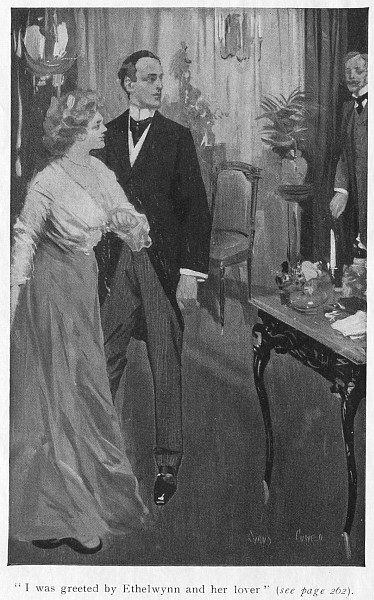
In the small but pretty drawing-room I was greeted by Ethelwynn and her lover, who were standing talking near the fire as I entered. The girl looked delightfully sweet in a pale blue blouse and dark brown skirt, her splendid hair dressed in a style that suited her admirably, while he, on his part, presented the appearance of the typical clean-limbed, well-bred Englishman. They were, indeed, a handsome pair.
“It’s very good of you, Mr Holford, to come down so quickly!” the girl exclaimed, as she took my hand. “Leonard wants to have a serious chat with you.”
And yet this was the girl who was privy to her father’s tragic end. Was it possible that her lover also knew the truth?
Langton invited me to a chair, and commenced by haltingly apologising for bringing me down from London.
“We, however, considered it necessary,” he went on; “necessary in the interests of us all that there should exist a clear and perfect understanding between us.”
“In what manner?” I asked Langton.
“Well,” he said, “it has come to our knowledge that you have been relating a most extraordinary story regarding Ethelwynn’s father. You declare that he died under suspicious circumstances.”
“Whatever I’ve said is the truth—the plain and absolute truth,” I declared openly. “Mr Kirk introduced me into the house in Sussex Place, where I saw the poor Professor lying dead in his laboratory.”
“Ah!” cried the girl quickly, her manner suddenly changing. “Then you are a friend of Kirk’s—not of my father?”
“That is so,” I admitted. “And in Kirk’s company I saw your father lying dead through violence.”
“And you’ve dared to put forward this story as an absolute fact!” Langton cried. “Do you happen to know who Kershaw Kirk really is?”
“No; I’d very much like to know,” I said, full of anxiety. “Who is he?”
“If you knew, you would, I think, have hesitated before you went to the police with such a fairy tale as yours.”
“It is no fairy tale, Mr Langton!” I declared very earnestly. “I have with my own eyes seen the Professor lying dead.”
“But you forget that my father went to Edinburgh on that night, and wired me from there next day,” the girl pointed out, fixing her splendid eyes on mine with unwavering gaze.
“I forget no point of the remarkable affair, Miss Greer,” I said quietly. “As a matter of fact, I followed the man believed to be your father to Scotland.”
“You—you followed him?” gasped Langton, while the girl’s cheeks grew paler. “Did you see him? Did you speak with him?”
“No; but I discovered some rather interesting facts which, when the time arrives, I intend to put forward as proof of a very remarkable subterfuge.”
The pair exchanged meaning glances in silence. The girl was seated in an arm-chair opposite to me, near the fire, while Langton stood upon the hearthrug, with his hands thrust with feigned carelessness into his pockets.
“The whole affair was no doubt most cleverly-planned, thanks to the ingenuity of Kirk. The servants were all in ignorance of anything unusual—all save Antonio, who, as you know, has escaped to the Continent.”
“Escaped!” The pretty girl laughed uneasily. “The last I heard of him was that he was with my father, travelling in Hungary.”
“When?”
“Four days ago.”
“How can I find them? What is the Professor’s address?” I asked.
“He has no fixed abode. My last letter I sent to the Poste Restante in Buda-Pesth.”
In this I saw an intention still to preserve the secret of the impostor’s whereabouts.
“But it was not my intention in asking you down, Mr Holford, to go into details of what may, or may not, have happened. We—that is, Ethelwynn and myself—know the truth.”
“Then tell it to me—relieve this burden of a crime which is oppressing me?” I begged. “Let me know the truth, and let me at least regain my lost wife.”
“Well? And if we did?” asked Ethelwynn, after a pause. “We should only lay ourselves open to an unjust retaliation.”
Were not those the words of a woman who possessed some guilty knowledge, if not herself guilty of parricide? I saw their frantic desire to close my mouth, so I let them proceed, smiling within myself at their too apparent efforts to avoid the revelations which must inevitably result.
“I do not follow your meaning,” I said. “Why should I retaliate, if you are not responsible for my wife’s absence?”
She glanced uneasily across to her lover, who exclaimed:
“As far as I see, the whole thing lies in a nutshell, Mr Holford. You have been misinformed, and have made a ridiculous and quite unfounded statement concerning Professor Greer—one which seriously reflects upon his daughter, his household, and his friends. Therefore—”
“Then does his daughter actually deny having seen him, as I saw him, lying dead in the laboratory?” I interrupted.
“I have never seen my father lying dead!” declared the girl in a low, faltering tone which in itself showed her to be uttering an untruth. “Your story is entirely unfounded.”
“Then let me tell you one thing more, Miss Greer,” I said plainly. “I myself knelt at your side with Kirk when we found you in the dining-room lying, as we thought, lifeless. There was a white mark upon your face. See! It has hardly disappeared yet; there are still traces—a slight red discoloration!”
The girl held her breath at this allegation. That mark upon her cheek condemned her. Even her lover, for a moment, could not reply.
“Ah,” he said at last, “the loss of Mrs Holford has upset you, and causes you to make all sorts of wild and ridiculous statements, it seems. Kirk says they would not listen to you at Scotland Yard—and no wonder!”
“Then you know Kirk, eh—you who denied all knowledge of him when we first met!” I cried. “It was he who placed the poor Professor’s remains in the furnace in the laboratory, for from the ashes I recovered various scraps of his clothing which are now in my possession.”
“Rubbish, my dear sir!” laughed the young man. “You don’t know Kirk—or who he is!”
“I know him to be an adventurer who has two places of residence,” I said.
“But an adventurer is not necessarily a scoundrel,” Langton replied. “Many a good-hearted wanderer becomes a cosmopolitan and an adventurer, but he still retains all the traits and all the honour of a gentleman.”
“Not in Kirk’s case!” I cried.
“You’ve evidently quarrelled with him,” remarked Langton.
“I’ve quarrelled with him in so far as I mean to expose the secret assassination of Professor Greer and those who, for their own purposes, are making pretence that the dead man is still alive,” I answered boldly.
“By the latter, I take it, you mean ourselves?” observed the dead man’s daughter.
“I include all who lie, well knowing that the Professor is dead and all traces of his body have been destroyed,” was my meaning response.
“What’s this story of yours about Miss Greer presenting an appearance of death?” asked Langton. “Tell me—it is the first time I’ve heard this.” In a few brief sentences I told them of our discovery in the dining-room, and of the removal of the girl in a cab on that foggy night.
At my words both looked genuinely puzzled.
“What do you say to that?” asked her lover.
“I know nothing—nothing whatever of it!” she declared. “I can only think that Mr Holford must be dreaming.”
“Surely not when, with my own hands, I held a mirror to your lips to obtain traces of your breath!” I exclaimed. “Ask Antonio. He will tell you how he and his brother Pietro placed you in a cab at Kirk’s orders.”
“At Kirk’s orders?” echoed the young man. “Ask him for yourself,” I said.
They were both full of surprise and anxiety at what I had alleged.
Was it possible that I had been mistaken in Ethelwynn’s attitude, and that she genuinely believed that her father still lived? But that could not be, for had she not seen him dead with her own eyes? No. The girl, aided by her lover, was carrying out a cunningly-devised scheme effectively to seal my lips.
My wife Mabel had, before her disappearance, been in communication with the impostor whom Ethelwynn had apparently taken under her protection. This was a point that was most puzzling. Could this girl and my wife have been secretly acquainted? If so, then it was more than probable that she might have knowledge of Mabel’s whereabouts.
Again I referred to the loss of my wife, declaring that if I found her I would willingly forgo all further investigation into the Professor’s death.
The handsome girl exchanged glances with her lover, glances which showed me plainly that they were acting in accordance with some premeditated plan. Leonard Langton was a sharp, shrewd, far-seeing man, or he would never have held the appointment of private secretary to Sir Albert Oppenheim.
“Well, Mr Holford,” he said, “why don’t you speak candidly and openly? You are, I take it, eager to make terms with your enemies, eh?”
“But who are my enemies?” I cried blankly. “As far as I’m aware, I’ve made none!”
“A man arouses enmity often without intention,” was his reply. “I cannot, of course, tell who are these enemies of yours, but it is evident from your statement the other day at Wimpole Street that they are responsible for your wife’s disappearance.”
“Well,” I said, “you are right. I am open to make terms if Mabel is given back at once to me.”
“And what are they?” asked Ethelwynn, whose very eagerness condemned her.
“Pardon me, Miss Greer,” I said rather hastily, “but I cannot discern in what manner my matrimonial affairs can interest you.”
“Oh—er—well,” she laughed nervously, “of course they don’t really—only your wife’s disappearance has struck me as very remarkable.”
“No, Miss Greer,” I said, “not really so remarkable as it at first appears. My own inquisitiveness was the cause of her being enticed away, so that I might be drawn off the investigation I had undertaken—the inquiry into who killed Professor Greer.”
Her cheeks went paler, and she bit her lip. Her whole attitude was that of a woman aware of a bitter and tragic truth, yet, for her own honour, she dared not divulge it. She undoubtedly held the secret—the secret of her father’s death. Yet, for some purpose that was yet a complete enigma, she was protecting the impostor who had stepped into the dead man’s shoes.
The pair had brought me down there in order to entrap me—most probably a plot of Kirk’s. Their intention was to mislead and deceive me, and at the same time to secure my silence. But in my frantic anxiety and constant dread I was not easily entrapped. I had seen through the transparency of Kirk’s attitude, and I had likewise proved to my own satisfaction that, however much of the truth Leonard Langton knew, the girl of the innocent eyes was feigning an ignorance that was culpable, for within her heart she knew the truth of her father’s tragic end, even though she calmly asserted that he still lived and was in the best of health.
I had believed on entering that room, the windows of which looked out upon that grey-green wintry sea, that I should learn something concerning my dear wife, that I should perhaps obtain a clue to her whereabouts.
But as I fixed my eyes upon those of Ethelwynn Greer, I saw in them a guilty knowledge, and by it knew that in that direction hope was futile.
True, she had sounded me as to what undertaking I was ready to give, but the whole situation was so horrible and so bewildering that I could not bring myself to make any compact that would prevent Greer’s assassin being exposed.
So, instead, I sat full of chagrin, telling the pair much which held them in fear and apprehension.
It was evident that I knew more than they had believed I did, and that Langton was filled with regret that he had invited me there.
What, I wondered, could possibly be Ethelwynn’s motive in concealing her father’s death? I recollected how the assassin must have brushed past her in the Red Room to enter the laboratory on that fatal night, and that he must have again passed her on leaving.
Did she awake and recognise him, or had she herself been an accomplice in securing her father’s sudden and tragic end? Who could tell? In that startling suggestion I found much food for deep reflection.
Chapter Twenty Six.
I Scent the Impostor.
A whole fortnight went past. Mabel’s silence was inexplicable.
The house in Sussex Place was still in the hands of the caretaker, and, though I watched both Doctor Flynn and Leonard Langton in secret, the results of my vigilance were nil.
I was in despair. Refused assistance by Scotland Yard, and treated as an enemy by Kershaw Kirk, I could only sit with Gwen at home and form a thousand wild conjectures.
Advertisements for news of Mabel had brought no word of response. Indeed, it seemed much as though the theory of those two detectives was the correct one, namely, that she had left me of her own will, and did not intend to return. Gwen, indeed, suggested this one day, but I made pretence of scouting it. Mabel’s mother, who now lived up in Aberdeenshire, had written two letters, and I had been compelled to reply, to tell a lie and say that she was away at Cheltenham.
My business I neglected sadly, for nowadays I seldom went to the garage. Kirk was, I understood, living in Whitehall Court, but I did not call upon him. What was the use? I had tried every means of learning where Mabel was, but, alas! there seemed a conspiracy of silence against me. I had left no effort unexerted. Yet all had been in vain.
Antonio had, according to Ethelwynn, joined “the Professor” in Hungary. Was not that, in itself, sufficient evidence of collusion? As for Pietro, inquiry I made in the Euston Road showed that he had not yet returned to England.
Many times I felt impelled to go out to Buda-Pesth and endeavour to trace the pair. But I hesitated, because, finding Ethelwynn’s statements unreliable in some particulars, I feared to accept what she said as the truth. Would it not be to her interest to mislead me and send me off upon a wild-goose chase?
No man in the whole of our great feverish London was so full of constant anxiety, frantic fear, and breathless bewilderment as myself. Ah, how I existed through those grey, gloomy March days I cannot explain. The mystery of it all was inscrutable.
I should, I knew, be able to satisfy myself as to poor Mabel’s fate if only I could clear up the mystery of who killed Professor Greer.
This tension of nerves and constant longing for the return of the one for whom I held such a great and all-absorbing love was now telling upon my health. I ate little, and the mirror revealed how pale, careworn, and haggard I had become. Since the dawn of the New Year I was, alas! a changed man. In two months I had aged fully ten years.
From inquiries I made of men interested in science and in chemistry I had discovered how great a man was the dead Professor, and how beneficial to mankind had been certain of his discoveries. Fate—or is it some world spirit of tragic-comedy?—plays strange pranks with human lives now and then, and surely nothing more singular ever happened in our London life of to-day than what I have already narrated in these pages.
And to that thin, grey-faced neighbour of mine—the man who led a double life—was due the blame for it all. Though I made every endeavour and every inquiry, I could not learn what was his profession. That he was a man of means, a constant traveller, and well known in clubland, was all the information I could obtain.
You will wonder, perhaps, why I did not go again to Whitehall Court and force the truth from the fellow’s lips. Well, I hesitated, because in every argument I had had with him he had always won and always turned the tables upon myself. I had made a promise which, however justifiable my action, I had, nevertheless, broken. I had denounced him to the police, believing that I should see him arrested and charged. Yet, on the contrary, the authorities refused to lift a finger against him.
What could I think? What, indeed, would you have thought in the circumstances? How would you have acted?
One morning I had gone out early with Drake, trying the chassis of a new “twenty-four,” and finding ourselves in front of the grey old cathedral at Chichester, we pulled up at the ancient “Dolphin” to have luncheon. My mind had been full of Mabel all the way, and though I had driven I had paid little or no attention to the car’s defects. Dick Drake, motor enthusiast as he was, probably regarded my preoccupied manner as curious, but he made no comment, though he had no doubt noted all the defects himself.
I had lunched in the big upstairs room—a noble apartment, as well known to travellers in the old coaching days as to the modern motorist—and had passed along into another room, where I lit a cigarette and stretched myself lazily before the fire.
A newspaper lay at hand, and I took it up. In my profession I have but little leisure to read anything save the motor-journals; therefore, except a glance at the evening paper, I, like hundreds of other busy men, seldom troubled myself with the news of the day.
I was smoking and scanning the columns of that morning’s journal when my eyes fell upon a heading which caused me to start in surprise. The words read, “Steel Discovery: New High-Speed Metal with Seven Times Cutting Power of Old.”
The short article read as follows:
“Few prophecies have been more quickly justified than that of Professor Greer at the Royal Institution on December 16th last. He then said:
”‘As to Mr Carnegie’s prophecy on the decadence of British steel metallurgy, this exists only in the imagination of that gentleman. So far as quality is concerned, Britain is still first in the race for supremacy.
”‘I am strongly of opinion that in a very short time the best high-speed steel will be a back number. It is probable that a year hence there will be on the market British steel with a quadruple cutting power of any now known to metallurgy.’
“The prophecy has come true. Professor Greer, lecturing again at the Birmingham Town Hall last night, stated that the firm of Edwards and Sutton, of the Meersbrook Works, Sheffield, of which Sir Mark Edwards is the head, have, after his lengthened experiments, placed on the market a steel with from three to seven times the cutting power of existing high-speed steel, and which, in contradistinction to present material, can be hardened in water, oil, or blast.
“The new steel, whose cutting power is almost incredible, said the Professor, will not call for any alteration in present machinery.”
The impostor had actually had the audacity to lecture before a Birmingham audience! His bold duplicity was incredible.
I re-read that remarkable statement, and judged that this new process of his must have been purchased by the great firm of Edwards and Sutton, whose steel was of world repute. His was, I presumed, an improvement upon the Bessemer process.
That a man could have the impudence to pass himself off as Greer was beyond my comprehension. As Waynflete Professor at Oxford he would, I saw, be well known, even if he did not go much into society. And yet he had stood upon the platform in the Town Hall of Birmingham and boldly announced a discovery made by the man whose identity he had so audaciously assumed.
This action of the impostor, who had no doubt sold the Professor’s secret at a high figure to a well-known firm, absolutely staggered belief.
I called Drake, mounted upon the ugly chassis again, and together we sped post-haste back to London. At ten that night I was in the Grand Hotel at Birmingham, and half an hour later I called at the house of a certain Alderman named Pooley, who was a member of the society before which the bogus Professor had lectured on the previous evening.
I had some little difficulty in inducing him to see me at that late hour. He was a busy solicitor, and his servant referred me to his office in Bull Street, where, she said, he would see me in the morning. But, being pushful, Mr Pooley at last consented to see me.
“Yes,” he said, as I sat with him in his dining-room, “it is quite true that Professor Greer lectured before us last night, and made a most interesting announcement—one which seems to have caused a good deal of stir in the world of metallurgy. The papers were full of it to-day.”
“I understood the Professor was abroad,” I remarked rather lamely.
“So he was. He came home specially to fulfil a long-standing engagement. He promised us to lecture, and gave us the date as far back as November last.”
“Do you know where he arrived from?” I inquired.
“Yes. He dined with us here before the lecture, and stayed with us the night. He told us at dinner that he had just returned from Roumania.”
“Then he did not leave Birmingham until this morning!” I cried. “Ah, how I wish I had known! Have you any idea where he has gone?”
“I went with him to the station this morning, and he took a ticket to Sheffield—to visit Sir Mark Edwards, I believe. He met at the station a friend who had been to the lecture and who had stayed at the Grand that night. He was introduced to me as Mr Kirk. Do you know him?”
“Kirk?” I gasped. “Yes; a tall, thin, grey-haired man—Mr Kershaw Kirk.”
“Yes. They travelled together,” said the Alderman. “It seemed as though Kirk came from London to meet the Professor, who had returned by the Hook of Holland to Harwich, and came on by the through carriage to Birmingham.”
“And you believe that Kirk has gone with the Professor to visit Sir Mark Edwards?” I exclaimed eagerly.
“I think so. If you sent a letter to the Professor at Sir Mark’s address, it’s quite probable that he would get it.”
“Had you ever met the Professor before?” I inquired.
“No, never. Of course I knew him well by repute.”
“Did he mention that Edwards and Sutton were old friends of his?”
“I gathered that they were not. He had simply concluded an arrangement with them for working his process as a matter of business. Indeed, he mentioned that Sir Mark Edwards had invited him for a few days.”
“Then they are not friends of long standing?” I asked.
“Probably not. But—well, why do you ask such curious questions as these, Mr—Holford? What, indeed, is the motive of all this inquiry? The Professor is a well-known man, and you could easily approach him yourself,” the keen solicitor remarked.
“Yes, probably so. But my inquiry is in the Professor’s own interest,” I said, because I had to make my story good. “As a matter of fact, I have learnt of an attempt to steal the secret of his process, and I’m acting for his protection. When my inquiries are complete, I shall go to him and place the whole matter before him.”
“Your profession is not that of a detective?” he suggested, with a laugh.
“No; I’m a motor engineer,” I explained bluntly. “I know nothing, and care less, about detectives and their ways.”
Then I apologised for disturbing him at that hour and made my way back in the cab that had brought me to the centre of the city.
I left New Street Station at two o’clock in the morning—cold, wet, and cheerless—and at half-past four was in the Midland Hotel at Sheffield, sleepy and fagged.
The night-porter knew nothing of Sir Mark Edwards’ address; therefore I had to wait until eight o’clock, when some more intelligent member of the hotel staff came on duty.
Everyone of whom I inquired, however, seemed ignorant; hence I took a cab and drove to the great works of the firm—a huge, grimy place, with smoky chimneys and heaps of slag, an establishment employing several thousand hands, and one of the largest, if not the largest, in Hallamshire. Here I was informed that Sir Mark resided thirty miles distant, at Alverton Hall, close to the edge of Bulwell Common, famed for its golf links.
Therefore at ten o’clock I took train there, and, finding a fly at the station, drove direct to the Hall to face and denounce the man who was an accomplice of assassins, if not the assassin himself, and a bold, defiant impostor.
The fly, after traversing a country road for a mile or so, suddenly entered the lodge-gates and proceeded up a splendid avenue of high bare elms, until we drew up at the entrance to a fine old Elizabethan mansion, the door of which was thrown open by a liveried manservant.
I held my breath for a second. My chase had been a long and stern one.
Then I inquired for the honoured and distinguished guest—who I had already ascertained at the works in Sheffield was supposed to be staying there—and was ushered with great ceremony into the wide, old-fashioned hall.
At last the impostor was near his unmasking. At last I would be able to prove to the world who killed Professor Greer!
Chapter Twenty Seven.
Several Revelations.
Alverton Hall, a noble old mansion, had been purchased by the Sheffield steel magnate Sir Mark Edwards some ten years before. In addition, I heard that he owned a beautiful place in Glamorganshire and rented a great deer-forest in Scotland. He was one of England’s manufacturing princes, whose generosity to charitable institutes and to the city of Sheffield was well known, and whose daughter had, only a year ago, married into the peerage.
A short, bluff, bald-headed old fellow, he spoke quickly, almost snappishly, when I was ushered into his presence in a small, cosily-furnished room that looked out upon a fine old-world terrace, with a Jacobean garden beyond.
“It is true that I’m expecting Professor Greer on a visit here,” he said, with a broad Hallamshire accent, in reply to my question. “Who, may I ask, are you?”
I explained that I was an intimate friend who desired to see him immediately upon very important business, and that I had come down from London for that purpose.
“Well,” replied the short, active little man, “I expected him yesterday, and cannot think why he has not arrived.”
“You have had some important business dealings with him, Sir Mark, I see from yesterday’s paper?”
“Yes, very important. He made a statement in Birmingham explaining his discovery.”
“I suppose it is a most important one?”
“Most important. It opens up a new era in the British steel trade and places us in the foremost rank. At this moment no other steel in the world can compete with that from our Meersbrook Works, thanks to the Professor.”
“You’ve known him a long time, I presume?”
“I’ve not known him personally very long,” was Sir Mark’s reply. “He is a man who has kept himself very much to himself. But, of course, as you know, his reputation is worldwide. He is bringing with him his agent, Mr Kirk.”
“His agent!” I echoed, astounded. “You know him?”
“Of course. I’ve had several dealings with him. He was with us in Vienna a week or so ago.”
“And was Greer there also?”
“Of course,” replied the steel manufacturer. “The contract was arranged there.”
“And who else was with him?”
“No one to my knowledge—except an English lady who lived at the Continental in the Praterstrasse, while we were at the Grand. She seemed to be a friend of the Professor, for one evening he introduced me to her. By the way, her name was very similar to yours, I think—Holworth or Holford.”
“That was in Vienna?” I gasped.
“Yes. He introduced me in Leidinger’s restaurant, in the Karntnerstrasse.”
“And the lady—what was she like? Young or old?” I inquired breathlessly.
“Young,” was his answer.
And, proceeding, he gave me a perfect description of Mabel!
“What was her attitude towards the Professor?”
“She appeared to be most eager to protect him from any suspicion of fraud. She seemed to regard me with some misgivings—I know not why. Indeed, the reason of her being in Vienna and mixed up in the business struck me as altogether remarkable, for, truth to tell, I prefer not to deal with the fair sex in matters of pure business. I’m a plain man,” he added, with a strong burr in his voice, “and I believe always in straightforward dealing, whether it be in paying a workman a day’s wage or carrying out a Government contract.”
“This is all very interesting to me, Sir Mark,” I said, without, however, telling him that the lady in question was my lost wife. “You appear not to have approved of the lady’s connection with the sale of the patent?”
“I didn’t, I frankly tell you,” he said. “I told Kirk my mind quite plainly, but he assured me that the lady was a great friend of the Professor.”
I bit my lip savagely. How was it that Mabel, my dear, beloved wife, had allied herself with that pair of adventurers? What could have been the story told to her to induce her to become the catspaw of men of that stamp?
It was on the tip of my tongue to tell the great steel magnate that he had purchased a secret which did not belong to the seller, and that the “Professor Greer” he knew was not the real discoverer. But I hesitated. Before I spoke I would unmask this impostor and his “agent,” Kershaw Kirk.
A word from me to this shrewd, hard-headed man of business, and the two would, I felt assured, find themselves in the hands of the police.
Yes, I now held the trump card. At any moment the pair might drive up to pay their promised visit to Sir Mark. And when they did, what an awkward surprise would await them!
I laughed within myself when I realised how innocently they would fall into my vengeful hands.
So communicative and pleasant was the bald-headed man that I went one step further, daring to ask:
“I presume the price your firm paid for the secret of the new process was a substantial one?”
“A very large one,” he replied. “A big sum down, as well as a handsome royalty. This must be the second fortune which Greer has made. He has received a lot of money for his process of hardening armour-plates. The Admiralty use only plates hardened by the Greer process, for here, as in many other things, England is still ahead of Germany.”
“Have you ever been to the Professor’s house in London?” I asked.
“Never. He has, however, invited me to dine there next week.”
“Next week!” I cried. “Then, of course, you’ll go? You’ll probably find Kershaw Kirk there.”
“Yes,” he laughed; “most probably. He’s a strange man—isn’t he?—and most influential.”
“He’s certainly strange, but as regards his influence, I know nothing,” was my quick reply.
“Why, my dear sir, his influence is enormous! He can go direct to quarters where we are entirely debarred!” declared my companion, as I sat back in the chair listening to these revelations.
“How? I don’t follow you.”
“Well,” he declared, “to me, the reason of Kirk’s influence is a complete mystery, but it has been conclusively proved more than once that he has the entrée to the highest quarters, and the ear of the authorities.”
I laughed.
“I suppose he has misled you into the belief that he has, Sir Mark. He’s a boaster—like many other men of his stamp.”
“He’s a boaster and a trifle eccentric, I admit. Yet I have myself had experience of his undoubted influence. He’s in some position of great trust.”
“There, I fear, I must differ, Sir Mark. I happen to know him well, and I think one day ere long you’ll discover that his powers are merely imaginary.”
The short, bald-headed man shrugged his shoulders dubiously, whereat, in order not to go contrary to his opinion, I turned our conversation into a different channel. I had already learned much of interest, but much, too, that had caused me a twinge of despair.
We spoke of other things, and apparently impressed by the fact that I was eager to meet Greer, he invited me to wait until he and Kirk arrived.
“But they may not be coming, after all,” I said. “They may have changed their minds.”
“I think that hardly probable,” Sir Mark replied. “They have been delayed, though I’ve ascertained that they left Birmingham to come direct here.”
I told him nothing of my visit to Alderman Pooley, but my only fear was that, with the report of the bogus Professor’s speech appearing in the papers, the impostor had become alarmed and again made himself scarce. To me it appeared much as though he and his accomplices had never intended the announcement to get into the papers. Indeed, even Sir Mark had expressed himself surprised at reading the report, understanding that the meeting was a purely private one of the learned society which had invited him to lecture.
I smoked a cigar with the affable little man, and then he left me, being called to the telephone. When he re-entered the room, he said:
“I’ve been speaking to the Professor. It seems that he’s at home, at his house in London. He was recalled suddenly by telegram, and not having been home since his return from the Continent he was compelled to obey the summons. He promises to come here next Monday.”
My heart sank once more within me. The truth was just as I had feared! The report of his speech in the papers had alarmed him, and he was no doubt on his way abroad again, having netted a goodly sum from Messrs Edwards and Sutton for a secret filched from the unfortunate man who had been assassinated.
“Then I’ll go back to London at once,” I announced; and, without betraying my anxiety to my bald-headed friend, who had been so cleverly victimised, I bade him adieu, and an hour later left Bulwell for London.
In the grey March afternoon I alighted from a hansom before that well-remembered door of the Professor’s house in Sussex Place. I did not for one moment believe him to be there. He had, of course, escaped long ago. In Edinburgh and in Glasgow I had been close at his heels, as I had also been in Birmingham, yet he had always cleverly evaded me.
To my amazement my ring was answered by Antonio—sleek, smiling, yet as evil-faced as ever!
“Is your master at home?” I asked sharply, for I certainly had not expected to meet the man who had escaped to Italy, and who had afterwards threatened me.
“No, signore,” was his bland reply. “He is out at present.”
“Then he—he’s at home again?”
“Yes, signore. He returned unexpectedly yesterday.”
“And Miss Ethelwynn?”
“The signorina is still at Broadstairs; we expect her up to-morrow.”
“And my wife, Antonio—where is she?” I inquired, looking him straight in the face.
“Ah, how can I tell, Signor Holford? Have I not already told you that I am entirely ignorant of her whereabouts?” And he exhibited his bony palms.
“You have been with your master in Hungary or in Roumania, I hear?”
“Certainly! Why not?” he said, as we stood within the wide hall. “But the Signor Kirk is upstairs in the study. Perhaps you will care to see him? I believe he has been trying to telephone to you at Chiswick.”
I started in eager anticipation.
“Of course, I’ll see Mr Kirk,” I said.
And endeavouring to steady my nerves and control my temper, I mounted the thickly-carpeted stairs to the room I so well remembered.
The point which puzzled me was whether I should now boldly accuse Kirk of duplicity and fraud. If I did, I feared that, to the bogus Professor, he might give the alarm, and that he would again slip through my fingers.
On my way to the study I resolved upon a purely diplomatic course. I would not let Kirk know of my visits to Birmingham and Sheffield, or even that I had noticed the report of the Professor’s announcement.
For a second I held my breath. Then I turned the handle of the door and boldly entered.
“Why, my dear Holford,” cried Kirk, jumping up from the writing-chair and grasping my hand as though delighted at my visit, “I’ve been trying to get on to you at your garage three times this morning, but your people have been engaged. You must be pretty busy down there—eh?”
The thin-faced man was, indeed, a perfect actor.
“I called to see Antonio,” I said. “I heard he had returned.”
“Then it is fortunate—most fortunate,” he said. “I am awaiting the return of someone who is very desirous indeed of making your acquaintance. It was for that reason that I’ve been trying to ring you up.”
My lips parted in an incredulous smile. So the impostor was anxious to meet me—doubly anxious, no doubt, because he was aware that I knew the truth of poor Greer’s death.
Yes, I would meet and unmask him.
Chapter Twenty Eight.
“No Trumps.”
In the failing London light, as Kirk rose and stood near the window, his countenance was even more sinister and more mysterious than ever. About his lips played that enigmatical, sarcastic smile which so tantalised and irritated me. Here was a man who had actually deceived the hard-headed Sheffield magnate into a belief that he possessed power and influence, while, in reality, he was only a clever adventurer.
“Sit down, Holford,” he said, in a cheery voice, inviting me to a big leather arm-chair. “The time has come when it is very necessary for you and me to arrive at some clear and definite understanding.”
“Yes,” I cried, “I agree with you. Have I not asked you all along for a clear statement of facts? Have I not urged you to tell me where I can find my wife?”
“You have,” he said, leaning against the big, old-fashioned mahogany table piled with books and scientific periodicals. “But until the present I have been unable to satisfy you. Even now I am still in a great measure in the dark as to the—well, the unfortunate occurrence, shall we call it?—which took place in this house.”
“But you have, I understand, been acting in concert with the man who calls himself Greer?” I remarked. “You’ve been with him abroad!”
“I don’t deny that. Why should I?”
I shrugged my shoulders impatiently. His evasion was always cunning, always well-contrived.
“When you first brought me here,” I said, “it was to obtain my assistance to discover who killed Professor Greer, and—”
“And you made a promise which you did not keep!” he interrupted. “Hence I have been unable to keep faith with you. Is not that quite feasible?”
“My wife’s disappearance is the point which most concerns me,” I said. “The other matter is, to me, of secondary importance. If you cared to divulge, you could tell me my wife’s whereabouts. I happen to know that she has been in Vienna, staying at the Hôtel Continental, and she has been seen in your company, Mr Kirk.”
“Now that’s really quite smart of you!” he laughed, with a patronising air, his grey face changing slightly, I thought. “I wonder how you came to know that?”
“The source of my information does not matter,” I said sharply. “Suffice it that it is a reliable one.”
“Well,” he laughed, “since that evening when you sat with me in Bedford Park I’ve been compelled to be active, and I’ve discovered quite a number of things which at that time I never dreamed—facts that have amazed me, as they will, before long, amaze you, Holford.”
“Nothing can amaze me in this crooked affair,” I declared. “You sought my aid in an endeavour to discover who killed Professor Greer, yet, having gained my confidence, you at once abused it!” I cried, with bitter reproach.
“That is your present opinion,” he said, with a keen, crafty look.
“An opinion based upon your actions towards me!” I exclaimed hotly.
“My dear Holford,” he said, “now let us speak quite frankly, as man to man.” And he bent towards me in an eager attitude. “I put it to you whether, in the circumstances—not overlooking the fact that Scotland Yard has refused you assistance—to forget what you saw that night upstairs in the laboratory, to place it aside as though you never witnessed it, is not the best plan?”
“Ah, you wish still to hush up the tragedy!” I cried. “The reason is, of course, quite obvious.”
“You misinterpret my words. I wish to avoid bringing scandal upon innocent folk,” Kirk replied quickly. “You once gave me a pledge of secrecy, and you broke it. Will you give me another?”
“And if I gave it,” I asked, not without some hesitation, “would these precious friends of yours give me back my wife?”
“I cannot answer for others. Personally, I will do all I can to assist you,” was his somewhat evasive reply.
“Why do you wish to extract this promise from me?” I demanded dubiously.
“Because—well, because you must give it. You must remain silent, Holford. It is imperative!”
“You really ask too much of me,” I laughed sarcastically. “I know the ghastly truth. You showed it to me of your own accord—you yourself drew me into this dark, mysterious affair, and now you coolly demand my silence, because you are, I suppose, interested in the money realised by the sale of Professor Greer’s secret.”
“Ethelwynn Greer makes the same demand as myself,” he said calmly. “Surely you don’t believe that the girl has participated in any shamefully obtained profits?”
“The girl saw her father dead, and now refuses to admit it,” I responded.
“How do you know that she did?” he asked. “What actual evidence have you upon that point, beyond my word—repeated from the story told to me by Antonio?”
“Ah! so Antonio is changing his tale in order to fit the new order of events—is he?”
“Well,” Kirk said, after a brief pause, “that there is a new order of events—as you put it—I admit. Yet, whatever they may be, your silence, Holford, as well as mine, is imperative. You hear that!” he added, looking straight into my face.
“To hear and to heed are scarcely synonymous,” I remarked in anger. I was incensed with this man who refused to give me any satisfaction concerning Mabel, and yet commanded my silence.
Was it not a very curious feature of the affair, I reflected, that Ethelwynn had ingeniously approached me, offering me news of Mabel in return for my undertaking to make no further inquiry into her father’s secret death? How much did Langton know, and what was the extent of the knowledge of that friend of his, the specialist in diseases of the throat and nose?
For a few moments I sat in silence, longing for the return of the bogus Professor, the man whom I had followed through Edinburgh and Glasgow, yet who had so very cleverly escaped my vigilance.
I was anxious to meet him, and to see what kind of man he could be. As an impostor he was, it seemed, shameless and bold beyond human credence.
How many thousands had Edwards and Sutton paid to him for that great secret that was not his own?
Antonio, suave and cringing, suddenly put his head in at the door, asking:
“Did you ring, signore?”
“No!” I cried, rising angrily, “Mr Kirk did not ring. I suppose you’ve been listening outside—eh? You are one of the accomplices in the murder of your master—and by Heaven, you shall pay for it! If Scotland Yard will not help me, then I’ll take the law into my own hands and give the public an illustration of the red-tape and the uselessness of the police!”
“The signore is a little excited!” was the man’s quiet remark to Kirk.
“Excited, by Heaven!” I cried. “I’ll be fooled no longer by any of you—band of assassins that you are! You ask me to believe that black is white, and tell me that my own eyes deceive me. But I’ll be even with you yet—mark me!”
“Pray calm yourself, Holford,” said Kirk, shifting his position slightly and still leaning easily against the table, “No good can be served by recrimination.”
The man’s cunning was unequalled; his ingenuity almost superhuman. Once I had held him in awe, but now, knowing the truth, that I held information which it was his earnest desire to suppress, I felt triumphant.
“I admit,” he said, still speaking calmly, as Antonio disappeared and shut the door—“I admit that there are certain ugly facts—very ugly facts which are difficult to forget, but is it not better to be merciful to the innocent and living than to revenge the dead?”
“You desire to seal my lips, my dear sir,” I said. “Why don’t you speak quite plainly?”
“Yes,” he admitted, “I make that appeal to you because—well, for several very strong reasons—Ethelwynn’s future being one.”
“And what, pray, need I care for that girl’s future, now that mine has been wrecked by the devilish machinations of you and your gang?” I cried in bitter anger.
“Your denunciation is quite uncalled for, Holford!” he exclaimed.
“It is not,” I protested. “You know where my wife is, and you refuse to tell me!” was my quick answer.
“Please don’t let us discuss that further,” he urged. “The point is whether you will, or you will not, regard all you saw in this house a couple of months ago as entirely confidential.”
“Why?”
“For reasons which you shall know later. I regret that I cannot explain at this moment, because I should be breaking a confidence,” he responded. “But,” he added, looking at me very seriously, “a life—a woman’s life—depends upon your silence!”
I hesitated a moment.
“Ah, I see!” I cried. “Then the girl conspired to encompass her father’s end, and is now in fear of the impostor!”
“I must leave you to your own opinion,” he said, with a shrug of his thin shoulders. Then, turning away to the window, he thrust his hands into his pockets, and, with that cosmopolitan air of his, he hummed a verse of that catchy song of the boulevards he so often sang.
Chapter Twenty Nine.
I am Faced with Another Difficulty.
The careless manner in which Kirk seemed to treat the grave issue of my life enraged me. This man, who in Chiswick posed as shabby and broken-down, was certainly no ordinary person. He was a shrewd, clever adventurer, possessed of resources that had even astonished Sir Mark Edwards. He had entrapped me, for some hidden reason of his own, and now he held me in a hateful bondage.
But with the vivid recollection of Mabel upon me, I resolved to defy this enemy of mine at all costs. I was only awaiting the return of the false Professor to unmask the pair, to call a constable, and to give them both in charge.
What the result would be, I cared not. I should, however, at least be afforded an opportunity to make revelations in the police-court which they would find it somewhat awkward to refute. Surely by doing this I should be performing a work of public benefit? The pair were clever swindlers, reaping the harvest from that secret discovered by the unfortunate man who had been purposely killed.
“You appear, Mr Kirk, to consider me an absolute fool!” I said, interrupting his song.
“I do, my dear Holford, I do. You have acted against your own interests, and even now you are spitting against the wind.”
“You desire my silence, yet you offer me nothing in return!” I said.
“Oh, you want payment!” he cried. “My dear sir, you have only to name your own price. We shall not quarrel over it, I can assure you.”
“No,” I said angrily, “I desire no blood-money, even though it is to save Ethelwynn Greer. I have all along suspected her of some complicity in the affair, although on the night you removed her to that house in Foley Street she accused you of the crime!”
He started quickly and turned to me, his countenance slightly paler.
“Repeat that,” he said quietly.
I did so. I told him how I had followed him to Foley Street, of the screams and words I had heard while standing in the fog outside the house.
“H’m. So you think I’m guilty of the crime, eh?” he said simply.
“I repeat the girl’s allegation against you,” I said. “And yet this same girl now declares that the Professor is not dead!” Then I added: “He was dead when we were together in the laboratory, was he not? Come, speak plainly!”
“Certainly he was!”
“And men do not come to life again when once dead, do they?”
“But this is an unusual case, I tell you. He—”
“However unusual, you cannot alter the laws of life and death,” I declared.
“Well, my dear Holford, how I wish I could reveal to you one simple truth. It would astound you, no doubt, but it would at the same time alter your opinion of me.”
“Oh, of course,” I laughed bitterly. “You’re not so black as you’re painted—you who have conspired to hold my wife aloof from me—you who for aught I know have told her some infamous tale which has caused her to look upon me with doubt and horror! I have recently learnt that she was acquainted with this man who calls himself Ernest Greer, and that, before she left my roof, she received word in secret from him.”
“Your wife’s affairs are surely of no interest to me, Holford,” said the grey-faced old scoundrel. “I am merely putting forward to you a simple matter of business—in a word, making a proposal for your consideration.”
“A proposal which I will never accept—never, you understand!” I added with emphasis.
“Not if I appeal to you on behalf of Ethelwynn, on behalf of a girl whose very life is dependent upon your silence?” he asked earnestly.
“The punishment for murder is death,” was my hard response.
He regarded me steadily, without speaking. I saw that he realised my steadfastness of purpose, and that I meant to reveal the truth to all the world.
“But,” he cried at last, “you surely will not act as a fool, Holford! I told you on the night we first sat together of the great issues that depended upon your silence, and I repeat it now.”
“Why did you entice me into this complicated tangle of crime and mystery?” I demanded quickly. “Tell me that.”
“Because—well—” And he hesitated. “Because I—I was a fool—I admit it frankly. I ought never to have approached you. Three days later I regretted it deeply.”
“Regretted it because you found, to your surprise, that you had no fool to deal with!” I cried.
“No; because I had made a mistake in another direction. But—but, hark?”
I listened and heard a footstep outside on the stairs.
“The Professor!” Kirk exclaimed. “He has returned. I’ll introduce you.”
I rose from my chair, my teeth set together, my hand gripping the edge of the table.
An instant later the door opened, and I stood boldly face to face with the impostor.
Kirk, with that calm suavity of manner that so annoyed and irritated me, introduced us.
But I bowed coldly to the well-dressed, elderly impostor, a man with keen, deep-set eyes, and a short, scrubby grey beard, asking of my companion:
“Is this farce really necessary, Mr Kirk, when I know the truth?”
The new-comer looked askance at his accomplice, who gave him a quick, meaning look.
“Ah! my dear Mr Holford!” exclaimed the bogus Professor, “I’ve been most anxious to meet you for a considerable time. This is a great pleasure.”
“And one which I most heartily reciprocate,” was my hard reply. “I’ve been endeavouring to find you for a long time. I followed you in Edinburgh, in Glasgow, and later on in Birmingham.”
“Then surely it is a rather happy circumstance that we have met to-day?” he said, rather fussily.
“Happy for me, but perhaps unhappy for you!” I replied, with a dry laugh.
“Why?”
“Because I now intend to expose your very clever plot. The secret you have sold to Sir Mark Edwards does not belong to you at all, but to Professor Ernest Greer, the man who was killed in the room yonder—in his own laboratory!”
His lips grew paler and set themselves hard. I saw in his dark eyes an expression of fear. He held me in terror—that was quite plain.
“Holford, you are mistaken,” declared Kirk.
“In what way?” I demanded.
“Professor Ernest Greer stands before you!”
“No!” I cried. “This man is the impostor—the impostor who wrote to my wife, and enticed her from her home.”
“I wrote to Mrs Holford, certainly,” was the fellow’s cool reply. “But without any evil intent; of that she will herself assure you.”
“Where is she?”
“You will, no doubt, see her before very long, and she will explain the reason of her absence.”
“Ah!” I said, “you adventurers dare not tell me the truth with your own lips. Remember, I saw the Professor lying dead in this house. You cannot induce me to believe that my eyes deceived me!”
“And yet you see the Professor alive before you now!” declared Kirk with a triumphant laugh.
But I made a gesture of disgust, declaring that I refused to be fooled further.
“You are not being fooled, Mr Holford,” asserted the man in a calm, distinct voice, as he opened the door and called to Antonio.
The grave-eyed manservant entered in a few seconds, and as he did so the new-comer said: “Antonio, will you please tell this gentleman who I am?”
“You are my dear master, signore—the Signor Professor Ernest Greer.”
“I already know, Antonio, that you’re a clever liar,” I cried, “so you can retire.”
“The Signorina Ethelwynn has just arrived, signore,” remarked the highly respectable manservant.
“Ah! then tell my daughter to come up?” he cried. “She will no doubt satisfy Mr Holford that I am no impostor.”
“Miss Ethelwynn saw her father lying dead, as I did; how, therefore, can she identify you as her deceased parent? Have you a half-brother, or some relation strongly resembling you?”
“No, I have not,” was his quick reply. “I am simply Professor Ernest Greer, whom a thousand persons living can identify.”
At that moment the fair-haired girl neatly attired in fur jacket, tailor-made skirt, and toque entered, and, with a spring, fell into the impostor’s arms and kissed him.
That piece of acting was, without doubt, perfect. Yet I stood aside and smiled. Had not Kirk previously admitted to me that his earnest endeavour was to secure my silence?
“Am I your father?” asked the dark-eyed man of Ethelwynn, standing with his hand upon her shoulder.
“Of course you are, dear dad! Why?”
“Because this gentleman will not believe it!” he laughed.
“This is my father, Mr Holford,” the girl declared, turning to me.
“But did not you, with your own eyes, see your father dead in his laboratory?” I asked seriously. “Are you not being misled, as these men are trying to mislead me?” I suggested.
She hesitated, glancing towards the man who posed as the Professor as though expecting him to reply for her.
“No,” I went on, “this is a conspiracy—a plot to place this man in a dead man’s shoes. And you know it, Miss Ethelwynn.”
“I tell you he’s my father!” the girl persisted. “Cannot you believe us?”
“Not without some independent proof,” I said. This persistence angered me.
“Then what proof do you require?” asked the man. “Shall I call the park-keeper at Clarence Gate? He has known me and seen me every day for a number of years.”
“Call him, if you wish,” I said, though, truth to tell, I did not intend to be longer fooled by the ingenious machinations of Kirk and his gang.
Antonio was sent to find the park-keeper, who, in due time, appeared, carrying his gold-laced hat in his hand.
“You’ve known Professor Greer a long time?” I asked the white-headed man.
“Several years, sir,” was his quick reply.
“And do you recognise this gentleman as the Professor?” I asked.
“Certainly, sir; I saw him pass in at the gate this morning. He’s cut off his beard, and that makes a bit of difference to a man, you know!”
He laughed.
“You have no hesitation in identifying him, eh?” I asked. “You’ll be able to swear to him in a court of law?”
“Yes, sir, in any court of law. The Professor’s been very kind to me, once or twice; therefore it isn’t likely that I forget either his face or his voice.”
This bewildered me. Was it possible that this impostor was the Professor’s twin brother? I felt confident that Kirk was continuing some very ingenious conspiracy. Was not his suggestion to me that I should forget the tragedy sufficient proof of double-dealing?
I thanked the park-keeper, who withdrew with Antonio, whereupon Kirk asked me whether I was not satisfied.
“No,” I said, “and I shall never be satisfied until I discover the identity of the man who killed Professor Greer.”
“But Professor Greer stands before you!” declared Ethelwynn; “nobody killed him!”
“So you wish me to believe,” I said with a smile, “but as my secrecy has been demanded on your account, I can only suspect that you were, in some way, implicated in the crime.”
She went pale as death. My words, I saw, had a startling effect upon her. She looked first at Kirk and then at the man posing as her father—the man who had secured many thousands of pounds for a secret that was not his own.
“Then you refuse to accept even the park-keeper’s testimony?” Kirk remarked, while the man who had assumed the Professor’s identity walked across to the writing-table and began looking at some letters lying upon it.
“I do; my intention is to unmask you all!” The impostor, the fading light falling upon his clear-cut countenance, turned quickly, and upon his face rested an expression of deadly fear that I had not previously noticed. Hitherto his attitude had been one of bold unconcern. But now, realising my determination, he had grown alarmed. He saw that he had carried the imposture too far.
“Ethelwynn,” he said, in a low, strained voice, “I—I wish to speak with Mr Holford. Will you leave us for a little while, dear. Go into the Red Room, and we’ll join you there later.”
“My dear sir,” I exclaimed, “I don’t desire to hear any more of your denials.”
“I’ll go, dad, of course,” replied the girl, who, in obedience with his suggestion, left the room.
I turned to follow her, but with a sudden movement he placed himself before the door, exclaiming anxiously:
“Mr Holford, pray hear me for one moment, I beg of you. I want to tell you something—to confess!”
“Ah!” I laughed triumphantly. “At last! you will confess! Good! I am all attention.”
“Listen carefully to the facts, Holford,” urged Kirk. “The Professor’s peril lies in the knowledge possessed by one man—yourself. It is therefore but just that you should know the truth.”
“I do not expect the truth from you,” I laughed. “How can I, after all that has passed?”
“The deceit I’ve practised upon you has been imperative,” was his audacious answer.
“Let me explain,” interrupted the impostor, advancing to the fireplace near which I stood. “First, I repeat that I am Professor Ernest Greer, and that this is my house. My statement can be verified later, but for the present I ask you to accept it as the truth. My old friend here, Kershaw Kirk, is not an adventurer, though he so often poses as such. But it is under necessity, for his real profession is that of a confidential agent of the British Government, the trusted head official of our Intelligence Department.”
At this I smiled incredulously, wondering what fantastic story he was about to relate, for even then I did not recognise him by the photograph I had obtained just before going up to Scotland. He was thinner, and his eyes were quite unlike those of the photograph, being narrower and deeper set.
“The plain facts are as follows,” he went on, after a second’s pause. “I had been experimenting until I had discovered an easy method of obtaining from the air those subtle elements helium and neon. My success had incidentally confirmed Sir William Ramsay’s estimation that the proportion of neon and helium in the atmosphere was about one to two in each hundred thousand, when a suggestion occurred to me that my process of hardening armour-plates might be improved upon, and a substance of great cutting power created. My experiments were long and tedious, but were at last crowned with success. I very foolishly gave, in the French scientific journal Cosmos, some account of these experiments, and a month later I was secretly informed by Kirk that the German Government—always our rivals where improvements in war material are concerned—was actively endeavouring to obtain my secret. As you know, I always kept my laboratory locked, and allowed no one within upon any pretext. My only confidante was my daughter Ethelwynn.”
And again he paused, glancing across at where Kirk stood, narrow-eyed and silent.
“Well,” he went on, “after another month had passed, Kirk returned from Germany, where he had been upon a secret mission for the Government, and then he urged me to exercise the greatest care. A very clever German agent, by name Max Leftwich, who had resided in London for some years, had been instructed to obtain my secret at all hazards. Kirk warned me that he was a man of remarkable tact and ability, and that under his control were fully a dozen agents rendering him assistance. It was he who had obtained for his employers in Berlin the secret of our new submarine boat, and who had controlled the survey of the Suffolk coast in view of the coming invasion. I confess that I laughed at Kirk’s fears—fears which were repeated to me by one of the Lords of the Admiralty only a week later. I saw no reason, however, for any serious apprehension. My laboratory was always locked, and could not be entered either from the skylight or conservatory, while the only keys of those double doors were secure upon my chain. But, alas! I had, like many another man, foolishly lulled myself into a sense of false security.”
And he sighed as he again paused.
Chapter Thirty.
I Discover much that is Amazing.
“Well,” continued the dark-eyed man, “the rude awakening came in the following way. The thirteenth of January was on Sunday. Kirk, who had been engaged in watching the movements of the secret agent Leftwich, sent me a telegram telling me to leave for Edinburgh at 11:30 that evening, and asking me, if I intended to carry out this suggestion, to raise and lower the drawing-room blind three times at a quarter past five. By that I knew that the German agent and his friends had some desperate game afoot and that Kirk, astute and active, intended to prevent them carrying out their object.”
“If anyone obtained access to the laboratory, then, they could steal the secret?” I asked.
“They could obtain specimens of the steel which might be analysed,” he said. “And these specimens, in conjunction with the written results of my experiments, kept in the safe here, in this room, would, of course, place my process in their hands.”
“Then you were acting in obedience with Kirk’s suggestion,” I said. “He wished you to go to Scotland out of the way, eh?”
“Exactly. He had previously been ordered by the Government to keep watch over me, for it was known by the Intelligence Department that Germany would make a desperate attempt to obtain the secret of what, to them, would be a most valuable process in the preparation of steel for use in their new navy.”
“And you made the signal to Kirk?”
“Yes. I told Ethelwynn nothing, fearing to alarm her. I merely remarked that I was compelled to go to Scotland, my intention being to take her with me at the last moment. I did not dress that night, it being Sunday. We dined at eight, and afterwards Antonio packed my bags. After dinner my daughter went up to the drawing-room, while I came in here to the study, in order to write some letters and attend to one or two things before departing. At a quarter to ten I recollected that I should remove a small crucible from the furnace wherein I had placed it that afternoon, and, passing through the Red Room, I found, to my great surprise, the two doors leading to the laboratory had been unlocked, and were slightly ajar.
“Suspecting something amiss, I dashed in, to find to my amazement an intruder there—the man Leftwich, dressed exactly to resemble myself! He had in his hand some specimens of the new steel, and as I entered noiselessly he was in the act of bending over a memorandum book, reading some notes I had made that day. You may imagine how amazed I was to see my second self standing there before me! I faced him, demanding to know what he wanted. I saw that he must have entered with keys made from wax impressions somehow taken from my own, and that his object in making up to resemble me was in order to pass upstairs within sight of the watchful Antonio or any of the other servants. Indeed, it was afterwards proved that Antonio saw him pass up immediately after dinner, and believed him to be myself.”