RAISIN DISTRICTS. (continued 2)
Reading edition
In Central California, the raisin industry is gradually spreading from the original center around Fresno, the greater freedom from rain and the better facilities for irrigation being great inducements for the settlers to engage in the growing and curing of the raisin grapes. The San Joaquin valley is especially adapted to the production of raisins, the Fresno raisin district being by far the largest, and now producing almost one-half of the raisin crop of the State. In San Bernardino county and district, the raisins are also grown to great profit and with great facility, and are of equal quality with those of the interior of the State. But the raisin industry is here gradually giving way to the culture of oranges and other citrus fruits, and the increase in the raisin acreage has therefore not been so great as in the San Joaquin valley. In El Cajon, irrigation is not used, and the raisins produced there are very similar to the Malaga raisins, but through absence of irrigation the crops are smaller than in any of the other districts in the State. In Los Angeles and Orange county district, the raisin industry has suffered immensely from the ravages of the vine plague, an as yet entirely mysterious disease, and the output of raisins there has dwindled down to almost nothing. But the farmers of the district are ready to replant whenever there are any prospects that the vines will do well again.
In the interior of California, north of Solano and Yolo counties, large quantities of raisin grapes have been planted during the last few years, both in the foothill valleys, out on the plains, and in the bottom lands of the Sacramento, Yuba and Feather rivers, etc. Raisins of very good quality have been produced in that part of the State for years in limited quantities, but it is yet a question to what extent that section can compete with the central and southern parts of the State. In Sutter county around Yuba City the cultivation of a seedless raisin grape is advancing rapidly, the raisins made from it being of excellent quality and finding a ready market.
Acreage and Crops.
—The quantity of raisin-vines planted cannot be estimated correctly; but it is certain that at least sixty-five thousand acres of Muscat vines are now set out in the State, including grapes in bearing, as well as vines lately set out.
California enjoys a climate peculiarly adapted to the culture and curing of the raisin grape. The summers are warm and rainless, the winters again moderately rainy. The interior is free from injurious fogs and heavy dews, while the most southern coast is only visited by warm fogs, which are not greatly harmful to the grapes. Irrigation is practiced almost everywhere, except in El Cajon valley, and in some of the northern districts of the State, but even there it is no doubt that judicious irrigation would be beneficial and greatly increase the crop. The demand for California raisins has kept pace with the improvements in curing and packing, and has steadily increased from year to year. What the future has in store only the future can tell, but it is almost certain that first-class raisins will always be in demand, while inferior grades may from time to time bring lower prices. The ruling price of raisins in sweatboxes, as they may be had from those growers who do not pack themselves, has been from four to five cents per pound. Of late years, the tendency is developing to pay according to quality, and from three to seven cents was the ruling price for unpacked raisins in sweatboxes during last season (1889). This practice will greatly promote the raisin industry and encourage growers to grow large grapes and fine bunches, and to cure their raisins well. It will also benefit the buyers, who will know what they pay for, and who will be able to furnish better grades, and more of the best grades than formerly, when good, bad and indifferent raisins brought five cents per pound.
The raisin crop of 1889 did not exceed one million boxes. Should we venture upon a statement as to the distribution of the same among the various counties or districts of the State, the following figures would be found as near correct as it is possible to get them:
Fresno district 475,000 twenty- pound boxes.
Tulare 15,000 “ “ “
Kern 4,000 “ “ “
Yolo and Solano 120,000 “ “ “
Scattering 25,000 “ “ “
San Bernardino 265,000 “ “ “
Orange and Los Angeles 8,000 “ “ “
San Diego 75,000 “ “ “
987,000 “ “ “
YOLO AND SOLANO.
Location and Acreage.
—The district is situated north of San Francisco Bay, bordering on it as well as on the Sacramento river, and is a part of the Sacramento valley. The number of acres overreaches seven thousand, and is increasing yearly. The principal vineyards are those of the late G. G. Briggs at Davisville, Solano county, with three hundred acres, and at Woodland in Yolo county, four hundred and sixty acres; E. Gould, also at Davisville, two hundred acres; H. M. Larou, at same place, about fifty acres; sundry vineyards around Davisville, fifty acres; around Woodland and Capay valley, some four hundred acres;—or in full bearing more than two thousand acres. The district comprises the southern part of Yolo and the northern part of Solano counties. The grape used for raisins is principally the Muscat of Alexandria, except the vineyard of R. B. Blowers, which is composed exclusively of Gordo Blanco. The Muscat of Alexandria is generally preferred, as it makes a fine raisin and bears well.
Soil and Climate.
—The soil varies somewhat; the best is a deep gray, alluvial bottom-land soil; other soils are not much thought of for Muscatel raisin grapes. The average depth of water is about eighteen feet from the surface. It is not necessary, as a rule, to first level the land, as the ground is very level naturally. The rainfall averages thirteen inches. The most rain falls in January and February; the least falls in August. There is seldom a shower in the summer, but about November 1st rains are almost always certain to interfere with the drying of the grapes. Sometimes the rain comes in October, when it causes considerable damage to the grapes and partially dried raisins. There is very little dew in summer time, but plenty in October and also some in September. The temperature is considerably modified by the nearness of the bay. It reaches in the hottest part of the summer one hundred and fourteen degrees Fahrenheit in the shade, but only for a day or two. The average highest is about ninety degrees Fahrenheit in the shade, while the heat almost every day in July and August shows eighty-five degrees Fahrenheit in the shade. Thus this district is considerably cooler than the San Joaquin valley and San Bernardino county, but warmer than Los Angeles and San Diego districts. There are heavy frosts in winter, when at times even the thermometer falls to eighteen degrees Fahrenheit, although this is the extreme low temperature, six or seven degrees of frost being more common. There is spring frost in April one year in every three or four, and the vineyards are then smoked to prevent injury to the vines. Irrigation is not needed to produce crops, only to produce larger crops, as it increases the yield fifty per cent. Generally two irrigations a year are needed, the first one in early summer, the other later, when the berries have begun to ripen. Water from ditches is used and carried to the vines in furrows only, no flooding being practiced.
The Vineyard.
—In planting, cuttings are used principally, but rooted vines are preferred by some. The distances most common are ten by ten feet each way, one vineyard being set ten feet by sixteen feet. The vines bear the third year. The ground is plowed and cross-plowed, the first plowing being from the vines, and the second to the vines. Harrowing and cultivating both ways are secondary operations, continued to the middle of May, but seldom later. Hoeing the vines finishes the work of the soil in the middle or end of May.
In pruning, the crowns are never raised over six inches above the ground, from seven to eight spurs are left on large vines, and each spur is pruned to two or three eyes each. Formerly more eyes, say from four to five, were left on each cane, but it was found that this was too many, hence the change to two or three eyes. Summer pruning is practiced by some, but not by all; there is yet a controversy in regard to its usefulness. When practiced, the vines are cut six or eight inches from the tops, and this is done not later than June. Sulphuring is in use everywhere; the vines are sulphured two times, once before and once after the bloom. Sulphured vines do not suffer from mildew. Colure, or the dropping of the young berries, is not common, the Muscat of Alexandria even setting well. The leaf-hopper (Erythroneura comes) is more common in some years than in others. They eat the leaves and cause the grapes to sunburn. Grasshoppers have never caused any damage. Grape moths are more or less common, but never troublesome. Black-knot is often seen on neglected vines, but is rare in old vineyards well cared for.
The Crop.
—The grapes ripen in September, generally from the first to the tenth. The drying and curing occupies three weeks. The bunches are placed on trays made of pine two feet by three. Several growers have artificial dryers, which are needed for curing the second crop. The sweatboxes are large enough to contain seventy pounds of raisins, and are eight inches deep. In the Briggs raisin vineyard, the following brands are packed: three crown Layer Muscatels; two crown Layer Muscatels; one and two crown Loose Muscatels; Dehesas and Seedless Muscatels. The raisins are seldom sold in sweatboxes, and no fixed price is known for such raisins. Most growers pack their own raisins. The oldest raisin vineyard is that started by the late G. G. Briggs, and now owned by his widow. The most renowned vineyard was that owned by R. B. Blowers of Woodland, which has of late years been mostly replaced by other crops. Raisin land can be had for from one hundred to one hundred and fifty dollars per acre. This is vacant land of the very best quality. An average profit of fifty dollars per acre is realized, although some have made more money out of their vines. A yield of two or three tons of grapes per acre is common. As regards prices of labor, etc., the following were those most common last season: Man and team, who boards himself and animals, three dollars and twenty-five cents per day, can plow one and a half acres of vineyard well. Pruning, one man, one dollar per day, can prune three hundred vines, or three-fourths of an acre. Laborers generally board themselves. The raisins of this district were the first ones in the State or on this continent to attract attention, and they were the first which successfully competed with Spain. The crop of 1889 reached one hundred and twenty thousand boxes.
NORTHERN CALIFORNIA.
General Remarks.
—The Muscatel and Sultana raisin grapes grow almost everywhere in the State, and it is therefore natural enough that the planting of raisin-vines should have increased considerably of late years, even in localities situated outside of those raisin districts mentioned, which have already made a success of the raisin industry. Below will be found a few notices from various such places which aspire to raisin fame, some of which have yet to make their reputation in this line. These notices are partly taken from the San Francisco Chronicle, which paper went to the trouble and expense of collecting such statistics at the beginning of the year. It must be remembered, however, that these statements are more or less approximate. As will be seen, all these localities here mentioned lie in the interior or the Sacramento valley proper, enjoying an inland climate. The climate in this valley is somewhat like that of the San Joaquin valley, of which it is an extension. Only the heat in summer is less, the rain in winter is more profuse, the showers in the spring of the year are later and those of the fall are earlier.
Placer County.
—At Rocklin J. P. Whitney has two hundred and fifty acres of raisin grapes, and is the largest raisin-maker in the county. There are not over three hundred and fifty acres of Muscats devoted to raisin-making in the county, and the total output this year was about four hundred tons, most of which was shipped directly East. The first carload of Muscat raisins sent East was shipped from the Whitney vineyard about ten years ago. A large area of Muscat and other vineyards will be planted this season, but none for raisin-making.
Yuba County.
—The raisin industry has received but little attention in Yuba county, although it has long been known that raisins of superior quality can be produced here. The area in raisin-vines is about three hundred acres, which will probably be increased by several hundred acres this season. Less than a hundred acres are in bearing. The raisin vineyards planted last season are chiefly at Colmena, midway between Marysville and Wheatland. The Muscatel grape is planted to some extent, but the favorite grape is the Thompson Seedless, a new variety of great promise.
Sutter County.
—The raisin industry of Sutter county dates back to the year 1876, and the venture was first made by the late Dr. S. R. Chandler three miles south of this city. The area now in raisin vineyard is about six hundred acres, three-fourths of which are in bearing. The crops marketed and prices received are about as follows: Three thousand twenty-pound boxes at $1.65 per box; eight hundred sacks of one hundred pounds each, at five cents a pound; five hundred and twenty-five sacks of dried grapes of one hundred pounds each, at three cents a pound. The home consumption is extensive, but is not estimated. The county is well adapted to raisin growing and curing, and received the second prize at the late Oroville State Citrus Exposition. Muscatel and Thompson Seedless are the favorite grapes. The soil of this county is very rich and warm, and no irrigation has been practiced.
Colusa County.
—In the immediate vicinity of Colusa there are about one hundred and fifty acres in bearing, and fully one hundred acres more will be set out the coming season. The crop of raisins in 1888 was very insignificant; but in 1889 the Colusa canneries packed forty tons in boxes. The prices ranged from $1.75 to $2.25 per box, according to quality. These figures refer only to the territory lying within a radius of eight miles of Colusa. Some of the finest raisin grapes in the county are grown near College City, and the entire output was at least eighty tons of raisins. Many of the people around Orland are reported as going into the business on a large scale. The ranchers in and near the foothills are also producing raisins of excellent quality. A single vineyard of fifteen hundred acres is being planted in one place in the foothills.
Butte County.
—While Butte produces a fair quality of raisins, her vineyards are yet young and are just coming into bearing. The older vines are those of General Bidwell, at Chico, covering about one hundred acres, and those of Oroville and Mesilla valley, embracing about the same area. A large number of young vines have been set out during the past two years, and these number 52,200 near Oroville, 77,480 at Palermo, 67,200 at Thermalito, 20,570 at Wyandotte, 25,000 at Central House, 50,500 at Gridley, and something over 50,000 near Chico. These have nearly all been planted within the past two years, but a limited number are three years old. In the foothills are a number of small vineyards, but it is impossible to ascertain the acreage and product, though the total of each is not large. Practically the bearing vines of Butte number between 300 and 400 acres. The one and two year old vineyards embrace about 350 acres, so that a conservative estimate for the total raisin vineyards of the county, young and old, would be 700 acres. The raisins are all boxed and sold directly by the vineyardists, the local demand taking nearly the whole crop. The area to be planted this year will not exceed 250 acres.
Tehama County.
—The area planted to grapes in Tehama county is over ten thousand acres. The greater part of the fruit grown is used for wine, and probably one-third for raisins. All the raisins produced here are packed in boxes, and a large portion is used in home consumption, while the remainder is shipped. Probably about ten thousand boxes in bulk and packed will cover the yield.
Shasta County.
—The raisin industry of Shasta county is only in its infancy. There are 147 acres planted to raisin grapes within a radius of fifteen miles from Redding. The largest acreage of raisin grapes is in Happy valley. There are patches of grapes all through the foothills. Probably not over one thousand boxes of raisins were shipped. The planting of raisin grapes continues every year. Raisins are made by many small growers, and sold here at an average of six cents per pound.
FRESNO AND SAN JOAQUIN VALLEY.
General Remarks.
—The San Joaquin valley is well adapted to raisins along its whole length almost, but especially in its central and southern parts. The farther we go south in the valley, the drier is the climate, and the less is the rainfall in the autumn of the year, both conditions favoring the curing of the grapes. The present raisin center is around Fresno City, where over twenty-five thousand acres are planted to raisin grapes, principally Muscatels; but from this locality the industry has been constantly spreading, until at present the other counties in the valley, viz., Merced, Tulare and Kern, can show a good acreage of young vines. Next after Fresno, Tulare county produces the largest quantity of raisin grapes, and produces raisins of the very highest quality. The principal raisin vineyards in that county are situated in the Mussel Slough district, on the rich bottom lands formed by the former delta of Kings river; of late, the planting of raisin grapes has extended to other parts of the county as well. In Kern county few old raisin vineyards exist, the oldest one being situated on the Livermore ranch, being a part of the Haggin and Carr tract. Several hundred new acres have been planted there this spring, especially in the Rosedale, Lerdo and Virginia Colonies, as well as on the plains near Delano. I need here hardly say that the raisins of Fresno, Tulare, Kern and Merced counties should be all classed together, as the climate in these various localities is one and the same, with only a slight and gradual change as to rainfall as we go south in the valley. If there will, in the course of time, be found some difference as regards quality in the raisins of these various localities in the San Joaquin valley, this difference will not be due to any great difference in the climate, but to the variety of soil on which the grapes are grown. The raisins are only grown on the level lands, situated from three to four hundred feet above the sea.
Extent and Location.
—The Fresno district contains about thirty thousand acres, out of which about twelve thousand are in good or full bearing. Merced county has about two thousand acres, nearly all very young vines. Kern county has probably about one thousand acres, also very young vines, and some thirty acres of old vines. Tulare county has about seven thousand acres of Muscats, a large part of which is in full or good bearing. Many vineyards, large and small, are being planted in these counties this year, but enough attention is not paid to proper soil and to locality, and here, as elsewhere in the State, many of these vineyards will not turn out as the owners expect they will. In Fresno county, the old vineyards are planted principally around Fresno City, while in late years other raisin districts or sub-districts are growing into prominence around Malaga, Sanger, Selma, Fowler and Madera. The varieties used are principally the Gordo Blanco Muscatel, much mixed with the Muscat of Alexandria. There are some few acres of Sultanas and White Corinths, and of late many Malagas have been planted.
Soils and Climate.
—There are several different varieties of soils in the district,—the red or chocolate-colored sandy loam principally east of the railroad, the white, ashy soil west of the railroad, and the very sandy soil, generally occurring in elevated ridges. We have also the deep, gray-colored bottom land in the river bottoms or along the rivers and creeks. The best grades of the chocolate and reddish loams, and of the river bottom soil, is considered the best for raisins. The very sandy soil and the alkali soil should not be used for raisin purposes. The climate is warm and dry during the summer, while the winters are not very rainy. From seven to ten inches of rain are an average in Fresno; south to Kern the rainfall decreases, five and a half inches being an average around Delano. Towards the northern end of the valley, the rainfall increases, and in Merced county varies between ten and twenty inches, fifteen inches being a high average. In no portion of the raisin-producing portion of the valley can raisin grapes be grown without irrigation, the natural rainfall being entirely insufficient. The lowest temperature is about eighteen degrees Fahrenheit in Fresno, generally in January, while the highest is one hundred and eighteen degrees Fahrenheit in the shade in July and August. The lowest temperature is reached once in from three to five years, and the highest quoted is similarly scarce. The high average in summer time is one hundred and ten in the shade, and for three months of the year the thermometer every day can be counted on to vary between one hundred and one hundred and ten in the shade. In the winter, twenty degrees Fahrenheit is often reached, and the end of December and January may be counted on as being cold and frosty. These figures all refer to the level plain land, where the most of the vineyards are planted, and not to the foothills or the thermal belt, nor to the high Sierra Nevada, where snow and ice are common, and where glaciers cover many of the highest mountain peaks. The most rainfall occurs from December to February, and the rain continues more or less scattering to April and May. There is only very seldom a shower in the summer, one perhaps in three years. In the mountains, the fall rains commence about the middle of August, on the plains again in October and November, sometimes even later. Dew is rare in summer time, but common from the beginning of October. Fog is rare, sometimes an unwelcome visitor in November, but never known at any other time of the year. Spring frosts are almost unknown, and occur only once in from five to eight years.
Irrigation.
—Irrigation is practiced wherever raisins are grown. The water is taken from the rivers,—from Kings river in the Fresno district, and from the Merced, Kaweah and Kern rivers, etc., in the other districts. Before irrigation was begun in the Fresno districts, there were from fifty to sixty feet of dry soil before the natural water level was reached; but this has been so changed through a few years of constant irrigation, that now in places the land is subirrigated or moist to the surface, while in places even the soil requires to be drained, and no other irrigation is now needed except to allow the water to flow in the main or secondary canals, from which it seeps and keeps the soil filled with water, the moisture rising from below. The irrigation when practiced is done by flooding or by irrigating in furrows. New land must be irrigated until it becomes subirrigated; but, when once this is done, no separate irrigation becomes necessary. Many vineyards planted on subirrigated land which was once dry land have never since been irrigated.
The Vineyard.
—The general distance of the vines is eight by eight or ten by ten feet, varying in different vineyards. Of late, there have been some efforts made to improve upon these distances, and to have them planted closer one way than the other, say five by ten or six by twelve feet. The vines begin to bear the second and third years, and if planted on proper soil should pay the fourth year and give an income the fifth year. Some vines have been known to pay the third year, there being much difference in this respect. Both cuttings and rooted vines are used, rooted vines having been preferred during the last few years. The ground is plowed in various ways in the winter time, according to the ideas of the owner. Cross-plowing is sometimes practiced. The general rule is to first plow one way, and then to cross-cultivate repeatedly until the soil is level and the weeds are destroyed. In wet places, the cultivation is kept up until July, but in proper places the working of the soil is finished in the early part of June.
Pruning and Other Operations.
—The heads of the vines are kept low,—from six to sixteen inches above the ground. The canes are cut to two or three eyes, and the number of canes left vary from five to fifteen or more. The pruning is done between December and February. Summer pruning is practiced by some, but not by all growers, there being considerable difference of opinion as to the value of this operation. Sulphuring is practiced by all growers, some sulphuring only once, but the best vineyards are sulphured three or more times. Oidium or mildew never appears in sulphured vineyards. Some few growers sulphur with great success against the colure or dropping of the grapes. Leaf-hoppers are common, but do no great harm. Grasshoppers and grape caterpillars were troublesome one or two seasons, but have not reappeared of late. Black-knot is common in many places.
The Crop.
—The grapes begin to ripen in the middle of August, or from the middle of August to the first of September, and at the latter date the first boxes of cured and packed raisins are generally heralded through the press. The first grapes dry in from seven to ten days, but the later grapes require three weeks or more. The drying continues through September, and for the second crop through October and even in November, or until the rains set in. The grapes are dried on trays two by three or three by three feet. The sweatboxes are generally two by three feet and from six to eight inches high. A large number of brands are packed, such as Imperial Clusters, Dehesas, Layers, Loose and Seedless. The common price for raisins in sweatboxes is from three and a half to six cents, five and five and a half cents being the average for good layers. Good land for raisin purposes can be had for one hundred dollars per acre, but nearer the town of Fresno is held higher. Bearing raisin vineyards have changed hands at as high as $1,000 per acre. From one hundred to two hundred and fifty boxes of raisins are realized per acre, and the profits vary from seventy-five to two hundred and fifty dollars per acre, according to location, soil, management, etc. From thirty to fifty dollars per acre is spent yearly in many vineyards. Few dipped raisins are produced. Some dipped Sultanas have brought seven cents in the San Francisco market. Last season about four hundred and seventy-five thousand boxes were produced in the Fresno district, and some twenty thousand boxes more in the other parts of the San Joaquin valley.
SAN BERNARDINO COUNTY AND RIVERSIDE.
Location and Acreage.
—San Bernardino county, California, is entirely an inland county, sheltered by low and high hills from the ocean. Fogs and dew are rare, in places unknown, and the county offers unusual advantages for raisin-growing. The vineyards are widely distributed through the county in different localities or raisin centers, all of which are greatly similar as to climatic conditions, except as regards altitude. The San Bernardino vineyards are the highest elevated above the sea of any in California. Below will be found a list of the raisin centers in the county, with the number of acres and their altitude above the sea. It must be understood that each locality has a large extension as regards altitude, and varies in many instances several hundred feet; this fact being indeed a characteristic of the San Bernardino county vineyards. The raisin centers in San Bernardino county are:
Riverside, 1,500 acres. Altitude above sea, 900 to 1,000 feet.
Redlands, 800 “ “ “ “ 1,200 “ 1,600 feet.
Highlands, 400 “ “ “ “ 1,500 feet.
Ontario, 500 “ “ “ “ 983 “ 2,350 feet.
Cucamonga, —— “ “ “ “ 900 “ 1,500 feet.
Etiwanda, 700 “ “ “ “ 1,200 feet.
There are several other localities where raisin vineyards are found in smaller quantities, and it is safe to estimate the number of acres in the county at over five thousand. Nearly all these vineyards are situated on mesa lands, by which is meant the lands situated between the river bottoms and the foothills. As a consequence, the surface water is never near the top, but generally far down, and even continued irrigation would not be liable to raise it much higher, as the water will as rapidly drain off through the substrata, which generally consists of sandy soil and gravel. The land is in fact well drained, and differs in this respect from the plains of the San Joaquin valley. In Riverside, the surface water is from thirty to fifty feet down, and only in one or two vineyards situated deep down in the arroyo is the surface water as shallow as ten feet. These latter vineyards are never irrigated. In Redlands the surface water is at an average of thirty feet on the mesa lands. In Ontario the surface water is even deeper, and found at from seventy to eight hundred feet, and the shallowest water in the district is, according to Mr. W. E. Collins, twenty-five feet below the surface. It is the general belief in the San Bernardino district that deep water is necessary for, or at least beneficial to, raisin grapes, and that shallow surface water is conducive to all kinds of diseases. In this I cannot agree, as contrary to my own experiences and to the experiences of the Spanish growers.
Climate.
—As regards temperature, there is some difference in the various districts. A true comparison between them and other districts is almost impossible, as the signal service thermometers are placed at unequal heights above the ground, and in localities with very different characteristics. It can, however, be said that the winter climate of the district is much milder during the winter than that of the plains of the San Joaquin valley, and very similar to the Orange county and the San Diego districts. In Riverside and Redlands, the thermometer seldom reaches one hundred and nine degrees Fahrenheit in the shade during the summer, and in winter seldom goes below twenty-four degrees Fahrenheit, while twenty-eight or twenty-seven degrees Fahrenheit is no unusual occurrence once every year, but is considered the extreme of the season. It may thus be seen that raisin vineyards and orange orchards may be and actually are grown side by side in every part of San Bernardino county, and this is a distinct characteristic of the district, which, however, it shares with Orange and San Diego counties. The warmest months are August and September, and October is generally fine for drying. So is November, and only twice (in 1885 and 1889) has there been any serious difficulty in drying the grapes. In two other years the crop has suffered slightly, but during the majority of seasons in the months of November there has not been any rain on the mesa lands, and it is this absence of fall rains which makes it possible for the raisin-grower to dry his crop without any other appliances than raisin-trays. Dew and fogs are very rare, and occur only very seldom during the summer months. When they do occur at this time, they are of but short duration, and last perhaps only from five to seven o’clock in the morning. In the fall of the year, in October and November, the desert wind blows warm and dry, and hastens the drying of the raisins. It may blow three or four times during the season, but has also been known to be entirely absent. The rain in the winter season is light, in Riverside twelve inches being an exceptionally wet season. From six to eight inches are the usual rainfall, while again the actual average for Riverside is six and one-fourth inches. In Ontario the rainfall in 1887 was 8.21 inches, and in 1888 9.23 inches.
Irrigation.
—In Riverside grapes cannot be grown without irrigation on the mesa lands, with the exception of one or two localities in the arroyo. In the Ontario district, raisin grapes may be grown without irrigation in the center of the valley, but on the mesas, higher on the sides, they must be irrigated, and even in localities where they could be grown without artificial irrigation the same is always practiced whenever it can be obtained. Less water is, however, needed than in the San Joaquin valley, but more than would suffice in El Cajon. Through the nature of the gravelly subsoil, the raisin land cannot fill up with water. Seepage is only possible to a limited degree; summer irrigation is always required. The vines are irrigated three times a year, in April, June and August. The system of furrows is used, and a ten-inch flow is considered enough to irrigate one acre of grapes during one day and night each time. In Ontario the raisin grapes are irrigated every five weeks, not, however, while they are in bloom, as it is considered best to wait until the berries are well set. In Redlands, one irrigation after the winter rain ceases is considered enough, even on soil with thirty feet to water.
Soils.
—The soil in San Bernardino county varies considerably. In Riverside and Redlands the best soil is a reddish loam, with some sand and gravel. But in Riverside we also find sandy soil of lighter color and strength, which, however, is less suited to grapes. In Ontario the soil varies from a heavy clayey adobe to a lighter but very rich sandy loam of a grayish color. The very sandy soil in some river bottoms, especially around Lugonia, has, through experience, been found to be entirely unsuited to the raisin grapes.
The Vineyards.
—The variety used for raisins is nearly entirely the Muscat of Alexandria, although several vineyardists call these grapes incorrectly the Gordo Blanco. I saw nowhere this variety, but I suppose some must have been imported there. In planting, cuttings have been preferred, probably because they are the cheapest, and because the value of rooted vines has not been properly understood. The vines are set, almost everywhere, eight by eight, only in a few vineyards nine by nine feet. There is, however, a growing belief that eight by ten feet or eight by twelve feet is better than the old accepted eight by eight feet. But I believe that this tendency to give the vines greater room will, in course of time, be followed by the opposite tendency to plant them closer, at least one way, and give more room the other way. The Muscat of Alexandria begins to bear in three years, and in four years will pay fifty dollars per acre. The practice of plowing is, in Riverside, to first plow towards the vines in the fall, and then, when the vegetation has begun in the spring, the soil is turned back towards the center of the space between the rows, or from the vines. Then the soil is cultivated with chisel-tooth cultivators, both crosswise and lengthwise, also similarly after every irrigation. But this practice is not entirely the same everywhere, and the different vineyardists have here as elsewhere different ideas, even in regard to the most common farm or vineyard practices. Pruning was formerly done much closer than now, but it was found that by close pruning the vines bore less. To-day from fifteen to twenty spurs are left on the strongest vines, and on every spur about two eyes. From twenty to twenty-five spurs were found to be too much; with such quantity of spurs the vines produce smaller and inferior grapes. Some vines which were pruned with twenty-five spurs last year have this year been given nine or ten spurs only, so as to enable them again to recover and grow strong, when the quantity of spurs will again be increased to fifteen. Summer pruning is used by some, but not by others. It does not, according to observation, injure the vine, but produces always a second crop, which is difficult to cure. Sulphuring the vines is practiced by some, but not by all, growers. A great many cannot see the use and value of sulphur. No one sulphurs for colure or the dropping of the grape, which is quite a common occurrence. The vines, however, never suffered from the leaf-hopper nor the grape caterpillars, but sunscald is not uncommon, nor is black-knot.
The Crop.
—The Muscat grapes begin to ripen in Riverside later than in the San Joaquin valley, and picking commences between the 10th and the 30th of September. Highlands is said to be two weeks later than Riverside. The first crop is ready to turn in two weeks, and is ready for the sweatbox in three weeks’ time. For drying, trays are used, and about twenty pounds are placed on each tray. These trays are all made of pine or fir. Redwood has been found unsuitable, as imparting both a color and a taste to the raisins if accidentally wet by early showers in the fall. Size of trays, two by three feet, with a cleat nailed at the short ends, but none at the long ends of the trays. Sweatboxes receive the raisins when they leave the trays. Formerly the sweatboxes were much larger and deeper than now, eight or even twelve inches in depth not being unknown. Of late sweatboxes are made two by three feet, or of the exact size of the trays, and not over six inches in depth. A greater depth makes the boxes too heavy to handle, and also causes the bunches to break. The packing of the raisins in Riverside and in the Southern California raisin districts generally is done by the method known as “top up.” That is, the first raisins are placed in the bottom of the box and successive layers are placed on top, until finally the top layer is put on the last. The lever press for the compression of the layers is a Riverside invention. A modification of this press is now in use in nearly all districts where the “top-up” method of packing is practiced. The brands packed are as follows: Three Crown London Layers, Two Crown London Layers, Three Crown Loose Muscatels, Two Crown Loose Muscatels, and Muscatels in sixty-pound sacks; also Seedless Muscatels in sacks of sixty and thirty pounds respectively. Cotton sacks are commonly used for the two latter brands. The brands are apt to vary from year to year, according to the fancy or ideas of the packers, new ones of which are in the field every year. Only those who both produce and pack have anything like established brands. The prices paid for raisins in sweatboxes have varied in different years. In 1887 and 1888, the price was from four and one-half to five cents per pound. In 1889, the price rose to five and five and three-fourths cents, and in one or two instances six cents were paid.
The Profits and Other Items.
—The profit varies, of course, greatly, but an average profit may be considered to be from about $125 to $150 per acre. The yield of an acre is variable, but from eight to ten tons of fresh grapes is said not to have been uncommon. In some cases the yield has been much higher and the profit larger. I have from trustworthy source the statement that one vineyardist who owns only a few acres, I believe only five, and who has given all his time and attention to these vines, has realized as much as $430 per acre. This I quote only as an instance of what might be done with care and expense in an exceptionally favored locality. Some few growers have realized $250 profit on each of a few acres, which also is to be considered exceptional. I believe my former statement of $150 per acre as being reliable and attainable by all San Bernardino county raisin-growers who have good land, and who give their vines sufficient care. As another instance of a high yield, I copy below an account of the vintage of C. Newton Ross of Etiwanda, San Bernardino county, California. The article appeared in the Press and Horticulturist of Riverside, September 27th, and I have every reason to consider it trustworthy. The writer adds that the yield is extraordinary. “Mr. Ross has seventeen acres of 8,000 vines five years old from which he picked 8,648 trays of grapes that average twenty-five pounds to the tray, or a total of 108 tons of grapes, which will make thirty-six tons of raisins,—equal to 3,600 boxes,—over 200 boxes to the acre. This is the first picking only, and it is estimated that the second crop will be half as large as the first, which will give a total yield of 318 boxes to the acre. Mr. Ross has sold his first crop at five and one-half cents per pound in the sweatbox, which will give him an income of $242 an acre on the first crop, and half as much more on the second crop if he succeeds in saving it in good shape, or a total income of $363 per acre on his crop. Mr. Ross estimates that $50 an acre will cover the entire cost of taking care of the vineyard and putting the crop in the sweatbox, and this would leave him a net income of $313 an acre for his vineyard, which is ten per cent on $3,130 per acre.” But, I may add, it is not likely that such a profit can be realized year after year.
As regards care of the vineyard and expenses of running the same, they vary, of course, and are estimated at from twenty dollars upwards. But the best vineyardists spend from thirty to forty dollars per acre in the care of an acre, but in this do not include interest, trays bought, etc., nothing in fact but “care.”
Vines were first planted in Riverside by Judge John Wesley North in 1873. Vacant land that is suitable for raisins may be had with water for $250 per acre. Some land with choice locations is held at higher prices. The highest yield of raisins in San Bernardino has been 290,000 boxes in 1888. Of this Riverside produced 150,000 boxes, Etiwanda 30,000 boxes, and Ontario 15,000 boxes. The raisin shipments from Riverside during the fall of 1889, up to December 12th, amounted, according to the Daily Press, to 216,000 boxes. There was a balance on hand of 7,000 boxes, making the total production 223,000 boxes. It is estimated that the value of this crop was $3,500,000 at wholesale. Later advices give to the county 265,000 boxes as last season’s crop. The San Bernardino raisins are superior both as regards quality and size, and raisin growing and curing is a profitable business, eminently suited to the settler with small means, who cannot invest large capital, nor can afford to wait long for a return. No dipped or sulphured raisins have ever been produced in the district, although dipped raisins would prove profitable. Especially does this refer to the second crop, which ripens enough to make good raisins, but which cannot be cured when the early rains set in.
ORANGE COUNTY AND SANTA ANA.
General Remarks.
—On account of the vine disease which has been injuring the Orange county raisin and wine vineyards, this district has a special interest to every one engaged in grape-growing. While the country has received a hard blow through the injury and destruction of so many of its vineyards, still it is likely that it will recover and rise as soon as the vine disease leaves.
Location.
—The Orange county raisin district lies close to the sea. Of all raisin districts, it is nearest the ocean, the average distance of the raisin vineyards from the latter being eight to twelve miles, some few perhaps a little more. As will be seen, the district resembles in this respect some of the Mediterranean districts, such as Malaga and Smyrna, where the vineyards come within actual reach of the sea fogs. On one side of the Orange county district we have the ocean, on the opposite side it is bordered by rather high foothills, beyond which are the San Bernardino county vineyards, some forty to sixty miles away.
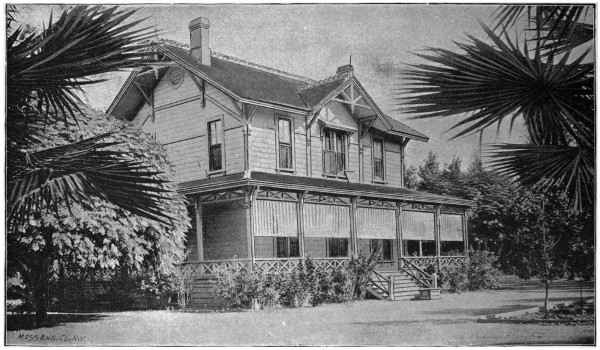
A Raisin-grower’s Residence at Fresno.
Climate.
—The nearness to the ocean modifies the climate much. The temperature is more even all the year round than anywhere else on the coast where raisins are grown. The extreme of heat is 105 degrees; in fact, July 27, 1889, it was 104 degrees Fahrenheit in the shade, while in the winter it seldom goes lower than 28 degrees Fahrenheit, and indeed very, very rarely as low as that. In many places there is no frost at all, except, perhaps, one in April, which, of course, cannot but prove damaging to the vines. This absence of heavy frost, which is beneficial to every other semi-tropical product, is not favorable to the vine. The grape requires heavy frost to become dormant. The farther south we go the less frost and the less grapes, at least of the Asiatic kind. There are, as we know, native grapes even in tropical countries, but they are adapted to their surroundings and cannot be considered here. The proximity to the coast modifies the air considerably. With 100 degrees Fahrenheit in the shade, which is an exception here, I felt as warm as I do in the San Joaquin valley with the mercury at 114;—the two extremes in both places affect us just the same. The air here is certainly much more moist, which again must have a marked effect upon the vine, and in no small degree promote fungoid growths, or parasites generally. In this respect, then, the coast vineyard must certainly be at a disadvantage. The fog is not an unusual visitor in the district between the coast and the foothills, which, in fact, covers the whole area ever planted in raisin grapes. For days in succession every morning is foggy, and the fog condenses on the leaves of the trees and falls under them in real showers, making the adjoining and underlying road wet. For a few days again the sun will rise bright, again to be followed by foggy mornings. By from nine to eleven o’clock the fog is again gone and the sun shines brightly. Every evening and morning there is a heavy dew, and every branch, leaf or grass is then dripping wet. Several mornings when the fog was in I found the thermometer at 62 degrees Fahrenheit, while at noon it rose to over 100.
Soils and Ripening.
—The soil here is the very best, and I doubt if the same fine quality of soil is found anywhere else in California over the same extended territory. I ride for miles and miles, everywhere the finest and richest loam of a gray color, sometimes a little drawing towards slate blue, sometimes again towards yellowish. It is immensely rich, and can hardly be improved. There is, however, especially near Orange, a different kind of soil consisting of the sand loam, but intermixed with very coarse gravel. This soil is warmer but consequently not so rich. The grapes ripen on it two weeks earlier, but yield only one-half as much as those on the richest loam along the creeks. The vines planted here were alone the Muscat of Alexandria. Strangely enough I find no traces of Sultanas or currant, which latter, it seems, should be especially adapted to the coast climate.
The Vineyards.
—In planting a vineyard, rooted vines were seldom used. Cuttings grew so readily and so well that they were much preferred. I am told that five per cent loss was unusual. It must be remarked that the moister is the air the better it is for any kind of cuttings. The moisture sustains and nourishes the wood while it is making roots. As to distances, I remarked nothing new. Eight by eight or eight by ten feet seems the generally adopted way. The nature of the soil and climate make higher cultivation a necessity. McPherson Bros., who packed the largest quantity of raisins and owned the finest vineyards, told me that they plowed and cross-plowed and cultivated from fourteen to sixteen times every season; in fact they never ceased working the ground. The pruning was begun in December, or as soon as the leaves began to turn and fall. To begin with, only a few spurs were left on every vine, and on every spur three eyes, including the bottom eyes, but experience taught that that way was not the very best. Gradually more space was given the vines, and now from fifteen to twenty spurs to a vine in full bearing is considered proper. Summer pruning is only practiced in some of the vineyards where the ground is quite wet. The most profitable vineyards were irrigated. The nearer the coast the more moisture there is in the soil. Thus three miles west of Santa Ana the ground is always moist enough to grow grapes, but as we come nearer the foothills to the east, the moisture is farther down. At Tustin, Orange, and especially at McPherson, irrigation was practiced in all first-class vineyards. Some were irrigated in the winter only, and this was considered the best; others again were irrigated also once in summer,—a practice the best vineyardmen considered unnecessary and even injurious. I found land near the town of Santa Ana moist one inch below the surface, where no irrigation had even been practiced. Sulphuring was used everywhere to counteract the oidium. For this purpose powdered sulphur was dusted through the vines as soon as the grapes were as large as small shot. From three to four sulphurings were used every year with a week between each. Sulphuring for the colure or dropping of grapes was not known; in fact I am informed that this colure was seldom known. Besides mildew, there are few enemies to the vine here. Grasshoppers, leaf-hoppers and grape moths have never been known to molest the vines. When the late vine-plague struck the country the vineyardists were entirely unused to fight any enemy of the vines besides the oidium. Sunscald of the berries was not known.
The Crop and its Curing.
—The grapes begin to ripen in the end of August, say about the twenty-fifth, on the gravelly soil, but on the cooler and richer bottom land very much later, or about the middle of September. The harvest then begins; the grapes are picked on trays two and a half by three feet and placed to dry in the sun; the drying takes two or three weeks or more, and is accomplished with some difficulty. Two years the grapes had to be carried out to the Mojave desert, to be dried there. The trays are placed among the vines in such a way that the trays from three rows are placed in one. To protect them from the fog and dew, they are covered with canvas. This is done in two ways. One way is to put small pegs on one side of the trays. The long canvas is furnished at intervals with rings, which are slipped over the pegs and thus held steady on one side. In the daytime the other end of the canvas is simply thrown back over the pegs; in the night-time the canvas is again turned over the trays, resting directly on the grapes. The other and better way is to run three wires along the row of trays, one on each side of the trays. The canvas is furnished with rings on each long side, which are made to run on the wire. The center wire is run a little higher up, and here and there simply supported by posts. It takes comparatively little time every evening to run the canvas along the wires and cover the trays. The expense is considerable, both in furnishing and preparing the canvas, and in maintaining and operating it. The peculiar climatic conditions of the district, however, necessitate some such contrivance for the drying of the grapes. The vines seldom bear a second crop of any importance. Sometimes in October the district is visited by a warm and dry desert wind called the Santa Ana wind. It comes from the cañon of the Santa Ana river, and originates, no doubt, in the Mojave desert, and rising high up in the air is again precipitated over the hills on the lowlands towards the ocean. This Santa Ana wind is always welcome. It hastens the drying of the grapes just as the Terral or land winds from the plains of La Mancha hasten the drying of the grapes of Malaga in Spain.
Yield and Profits.
—The yield is quite small on the gravelly soil, at the most being three tons of green grapes to the acre, on richer land from six to seven tons, and in rare instances ten tons to the acre. I heard of one vineyard where the owner had sold from twenty acres of Muscatels thirty-three tons of raisins and fifty-six tons of green grapes, equal to about 155 tons from the lot. Another lot of three-year Muscatels bore ten tons to the acre,—indeed a very unusual yield anywhere for Muscatels. I hear reports of some wonderful yields and high profits, but am informed by the most experienced and trustworthy that $125 per acre is an average profit which can be relied upon year after year. The first Muscat vines were planted near Orange, now the station of McPherson, about 1873, by McPherson Bros. The acreage in grapevines in the Orange county district was about 8,000 acres; but probably over half of it is wine grapes. The highest output of raisins was 170,000 boxes of twenty-pounds each.
SAN DIEGO AND EL CAJON.
Location and Acreage.
—The El Cajon and Sweetwater valleys are the raisin centers of San Diego county. The former contains about four thousand acres of Muscat vines, the latter about five hundred acres. Magnificent-looking Muscat grapes are also grown within three miles of San Diego. Escondido is by many pronounced superior for raisin grapes to any of the other places; but El Cajon is the present center of the raisin industry, and is likely to remain so for years. The raisin-growing section of the two valleys lies from about fifteen to seventeen miles from the coast line, and at an altitude of from 450 to 500 feet. The arable land in El Cajon valley contains 50,000 acres, or perhaps less, and consists of the rolling bottom of the valley, but which can in no way be classed as bottom land. The land partakes more of the characteristics of mesa or upland, and extends on all sides, slightly undulating upon the sides of the hills. Lower hills and behind them, again, higher hills surround the valley, and the high peaks beyond the Cuyamaca Mountains reach 4,500 feet or more. None of these hills or mountains in sight are covered with timber of any kind, and even the valleys are without the usual sycamores. Only in the very narrow bottom of the creek is there a vegetation of willows and shrubbery.
Climate and Rainfall.
—The rainfall of the valley varies considerably. It has been known to be as little as six inches and as much as twenty, the average probably being about twelve inches, distributed as generally elsewhere in California,—during the winter months. In summer time it seldom rains,—perhaps a shower in two or three years. September is the warmest month, or at least the month with the greatest number of warm days. The highest temperature reached in the shade in El Cajon is 105 degrees Fahrenheit, and in Sweetwater valley 108, and the coldest in the winter twenty-four degrees Fahrenheit on the upper mesa land, while on the lower land, close to the river, the temperature falls low enough to kill orange trees, probably somewhere about eighteen degrees Fahrenheit. September is freer from fog than any other month. During the other summer months there is fog in the morning two days out of three. The fog, however, is warm and pleasant to all but consumptives, but, nevertheless, leaves behind a soaking dew on all vegetation, and is even heavy enough to moisten the dust on the roads. The moisture on this mesa land—by which is meant all the land between the hills, which are too steep to be plowed, and the actual river bottom lands—is near the surface. In the El Cajon and Sweetwater valleys, the water is found on this mesa at from eight to twenty feet, or at an average of from twelve to fifteen feet. On little hills or knobs in the valley the water is found at about the same depth. It is strange that with the water so near the surface no perennial vegetation of either shrubbery or trees should be found on this land. The grapevines will grow on it without irrigation; in fact none is used anywhere now, but no doubt it would prove profitable to irrigate somewhat, so as to increase the crops of grapes. Water can be had through the Cuyamaca flume, but has so far not been used. The vines do not grow after August 1st, and may stop growing sooner.
Soils.
—The soils of the district are of four kinds: First, reddish clay mixed with gravel, the color changing between light chocolate and deep reddish. This soil is considered by many the most desirable. Second, a steel or slate gray adobe with much gravel of a coarse nature. Third, black adobe with little gravel. Fourth, alluvial sandy soil, apparently consisting of decomposed granite mixed with much vegetable matter. This soil is coarse, of a dark steel-gray color, very easily worked; it is considered the best for raisins, but it contains streaks where they will not grow and prove profitable. The last-named soil goes gradually over into common alluvial soil of a sandy nature. The two last-named soils are found principally in the Sweetwater valley.
The Vines and the Vineyard.
—In planting, cuttings are generally used, not because they are most preferred, but because good rooted vines cannot be obtained. The distance to, and the difficulty of reaching, this district was formerly such that roots would suffer in transit and would rapidly dry, while cuttings could be had handy and fresh. The vines, originally planted eight by eight feet, have been given more distance of late, some vineyardists planting them eight by twelve feet, while others prefer twelve by twelve or ten by twelve feet. The varieties used are the Muscat of Alexandria only. This variety happened to be the one that was imported first from Riverside, I believe, and it was afterwards propagated by every one. The variety as grown in El Cajon is the type of Muscat of Alexandria with oblong berries, large clusters with loosely hanging berries and large strong stems. The shape of the vines is erect, with a few center shoots, strong and upright. The vines commence bearing the second year, and are said to pay expenses of caring for in the third year, but I think it would be safer to say in the fourth year.
As regards cultivation and plowing, many plow both ways and harrow and cultivate crosswise several times until the 1st of June, when, on account of the dryness of the soil, no more weeds start and no cultivation of any kind is needed. The large majority of the vineyards are splendidly kept, not a weed being seen anywhere for miles around. Winter pruning commences as soon as the leaves fall. In former years from five to nine spurs were left in pruning and two or three eyes on each spur, but it has been found profitable and judicious to leave more spurs, so as to take the sap in the spring, and now from twelve to fifteen spurs with two or three eyes each are left every winter. Spring or summer pruning has only been practiced the last two seasons, and being found very profitable is now adopted by everybody. The vines are not pinched, but headed well back as soon as the grapes are well set. This method has in this district the following advantages: It gives better shade to the bunches on account of the production of a strong second growth; it causes the bunches to fill better, and, finally, it leaves more room between the rows of the vines. I was told that any of these three advantages would warrant the system of summer pruning to be generally adopted. The valley has been unusually free from any insect pest, such as leaf-hoppers (Erythroneura comes) caterpillars, grasshoppers, etc., but suffers from mildew, not, however, to the extent that the presence of almost daily fogs would lead us to suppose. Sulphuring is now practiced to some extent, but not as much as it should be. The sulphur is applied with bellows as soon as the berries are the size of shot, but not before. Sulphuring for colure, or the dropping of the grapes when very small, is not practiced, nor was it ever suspected that it would help. Colure is quite common, much more so on sandy soil. Sunscald is frequent but not bad. I saw quite a number of grapes scalded on every vine, but not enough to warrant any special measures to be taken as a protection. The grapes have during this and last year ripened by the first days of September, but it is generally much later, or at about the 10th of September, when the vintage usually commences. The picking was, until last year, done by white labor, but the same was so very difficult to obtain that Chinese were then employed. They gave satisfaction to some, while to others not. Some of the principal growers are this year (1889) going to employ Chinese help at $1.25 per day, at which price they board themselves.
The Crop.
—The grapes are dried on redwood trays made of sawed redwood shingles, three-eighths of an inch thick. The trays are made two by three feet. The best growers are this year going to assort the grapes when putting them on the trays. This was never done before, but will be of great advantage. A tray will average eighteen pounds of fresh grapes, which will take about one month to dry,—never less than three weeks. There is but little second crop, generally none that can be saved. September is the warmest month, or else the grapes could not be dried. At a temperature of 103 degrees Fahrenheit, it was found that grapes scalded or cooked while on the trays. This is, however, very rarely the case. From ninety-five to one hundred degrees is considered the best temperature at which the best raisins are made. The sweatboxes used formerly were two by three feet and ten inches deep; but of late eight inches and six inches in depth is considered the best, on account of the facility with which they can be handled. As to packing, many advocate twenty-pound boxes, that are only four and one-half inches deep, contending that they will hold twenty pounds of loose raisins. Few Dehesas are put up, the general brands being three crown London layers, and three crown loose Muscats. Some are also put up in fancy paper boxes. This year the valley has two packing companies, who buy raisins in sweatboxes, and pay from four to five and a half cents per pound. The yield per acre is from two to three tons of green grapes, I should say this year nearer two than three tons. I saw, however, some that would average five tons per acre, but this land was favorably situated in a moister place than is generally found in Sweetwater valley, and the vines were yet growing on August 21st. I heard of much greater yields, so extraordinary indeed that they are not likely to return again. From five to seven tons to the acre is a really rare yield, even on the best land, where the water is within six or seven feet of the surface. This shows me conclusively that judicious irrigation would materially increase the crop, and greatly improve the uniform size of the berries. The profit on an acre of bearing Muscat vines is from fifty to one hundred and twenty-five dollars per acre. The latter is the most any one realized, and thirty-five dollars is considered a good profit. The expense of running a vineyard is hard to ascertain, but those best informed told me that forty dollars per acre would be an average; this of course includes everything. The small amount of weeds and the absence of irrigation materially lessens the expenses of the El Cajon vineyards.
Good vineyard or raisin land can be had for seventy-five dollars per acre. No vineyards in bearing have changed hands. Last year’s (1888) pack of the whole of San Diego county was variously estimated at from twenty to thirty thousand boxes, and this year at sixty thousand boxes of twenty pounds each.
The unanimous verdict of the best growers in El Cajon is that want of moisture is the greatest drawback to raisin culture there. And I agree with them in this, but also think it might to some extent be remedied, as water for irrigation is close at hand. At last I must say a few words as to the quality of the El Cajon and Sweetwater valley raisins. They are very sweet, highly flavored, the skin is thin, and the seeds are small and few. But while some of the berries are of very large size, there are comparatively few which would be considered large, and even the best bunches have too many small berries. The grapes that had plenty of water were simply magnificent, and a general irrigation system would greatly improve the size of the grapes, as well as the quality of the crop. The best selected raisins from this valley must be counted as among the very best. The constant fog injures the bloom on the raisins to some extent, and most raisins that I saw were in this respect deficient; but their color generally was very good. The Sweetwater valley raisins are in this respect finer than those of El Cajon; they are also farther inland, and have less fog. The Escondido raisins are said to be superior, but I saw none of them. While many vines have been planted in this locality of late, only one or two small vineyards are in bearing.
OTHER RAISIN DISTRICTS.
Of late raisin grapes have been planted in considerable quantities in Salt river valley and in Gila river valley in Arizona, but the outcome of the venture is yet unknown, at least to us. The growers of Arizona claim for their localities the advantage of great earliness, as the grapes ripen there in July, or a month earlier than in California.
In the Argentine Republic in South America it is said that the Spanish immigrants have planted many raisin grapes during the last few years. In Australia we are also informed that dipped raisins, and perhaps even sun-dried ones, have been produced, but even there the result is unknown to us. So far these raisins have cut no figure in the general market, but it is not improbable that many localities in those vast countries will be found where Muscat grapes can be profitably grown and cured.