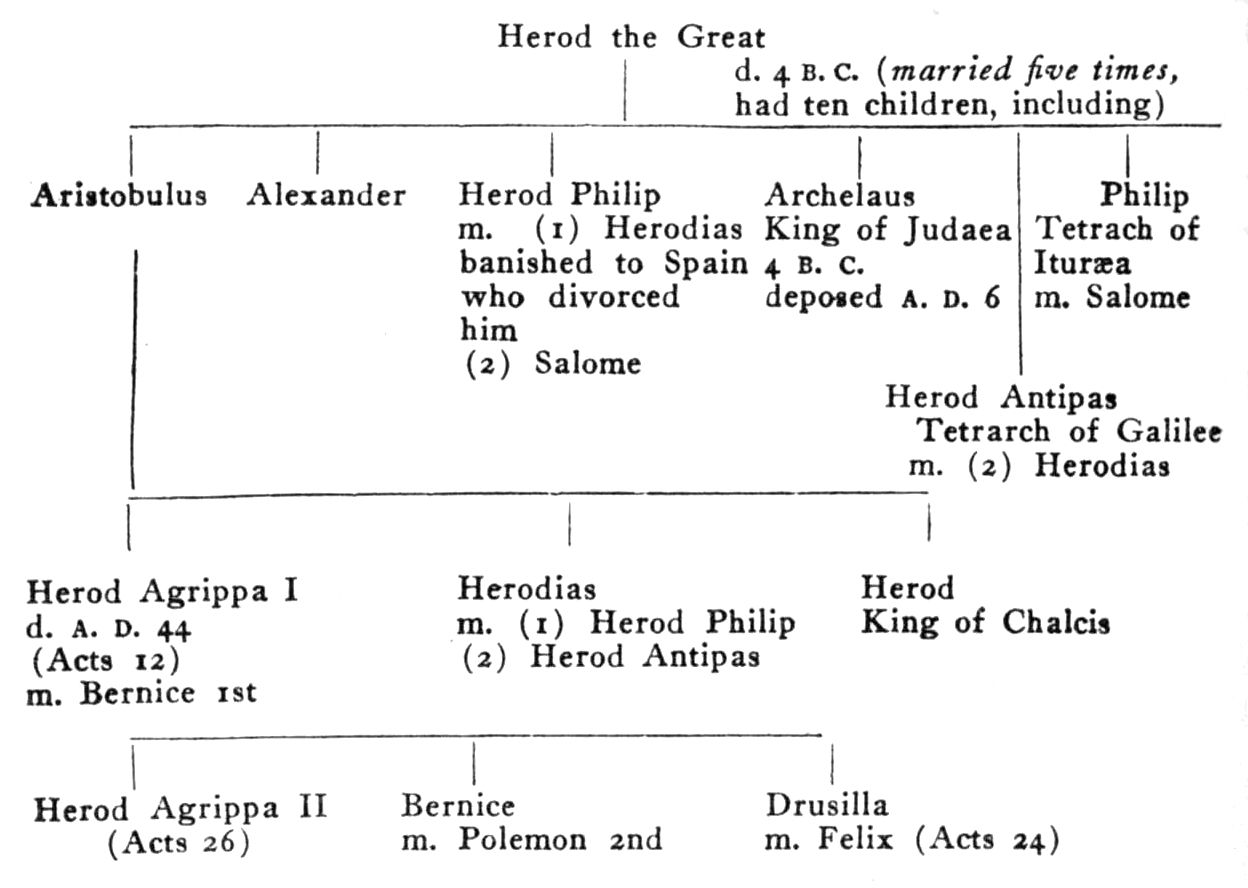
THE FAMILY OF HEROD THE GREAT
Reading edition
Titus, Vespasian’s son, not yet thirty, will be more fully described in the chapter on the fall of Jerusalem. Keep him distinct in your mind from Titus, the Greek evangelist of Crete, who became Bishop.
Philemon, the merchant of Colossé, Paul’s friend, was converted to the new faith in Corinth or Athens.
Who were “the friends in Cæsar’s household” of whom Paul wrote? Bishop Lightfoot shows of the forty-three Christianized Jews and Greeks, who met Paul when he reached Rome, and whose names may be found in the letter to the Romans; many were in Roman governmental positions of trust. Their names can be found scattered through the Acts and the apostolic letters to Rome and Asia.
There seems almost no reason to doubt that the great Epaphroditus, the Greek lover of learning, to whom Josephus dedicated his volume, was the same benevolent Greek of Philippi who supplied Paul with money for his needs in Rome, and who carried Paul’s letter to the Philippians, and who seems to have been under surveillance with Paul in Rome; for in Rome, even if his eyesight would have permitted Paul to follow his mechanical means of supporting himself by tentmaking, there was not the same demand as in the East for tents for desert travel, or in Greece for maritime sailcloth. Aquila and Priscilla, who came later in the Apollos story, like Paul, were tentmakers. Paul’s knowledge of seafaring was gained as sailcloth maker.
Always when religious faith wanes, necromancy, clairvoyance, sorcery thrive. The Old World with its dying faiths both Roman and Grecian, was now overrun with sorcerers of every description, practising wonder-working and miracles by methods variously known as Black Magic and White Magic. The knowledge of the methods underlying these powers was undoubtedly drawn from India and Persia. Some workers were good and some were bad. Some miracles were fraudulent and some were undoubtedly genuine—using the word “miracle” in the sense of wonder-working; only the Christians, the Essenes, the Gnostics, the Nazarenes refused to work these wonders for profit. For some reason or other, probably because they had lost faith in God, and learned magic from the Persians and the Babylonians, the Jews had become great sorcerers in Paul’s day. More will be given of this in the chapter on Apollos. It is given also in the Acts.
The reference of Onesimus to the luminous look, or radiance round Paul in the half dark, and the old Idumean’s legend of Antioch’s invading soldiers finding nothing in the Holy of Holies of the Temple between the Cherubim and Seraphim but a little thin blue flame, would have been laughed out of any court of evidence by science ten years ago. Not so to-day. The study of wireless waves is opening the door to the wonder-world of these waves.
The caution to Timothy as the old soldier put it, “to beware the widows,” and Paul’s somewhat severe injunctions regarding women to the churches of Ephesus and Corinth arose from great trouble from the activities of two women called Euodias and Syntyche, of whom nothing more is known than that they were quarreling in the church of Clement at Philippi, who wrote some of the finest and most universally accepted Epistles, which are not in the New Testament. Clement will be quoted later. He was Bishop of Rome about the time John “fell asleep.” Turner, one of the most critical of the higher critics, in his studies on Early Church History, explains why Clement’s Letters are not in our New Testament. They were not disinterred from Alexandria till 1628, when they were sent in a present to Charles I, which was seventeen years after the King James Version came out. Any one who wants to follow up how desperately dissatisfied the King James translators felt with their work, should read the Journals of Evelyn, a most devout churchman, on his conversation with the survivors among the translators. Such letters as Clement’s should be in supplementary readers in every Sunday School and Church in the land.
While Paul seems to have been prisoner in Rome for certainly two years, and before coming to Rome, prisoner in Cæsarea for at least as long, he was not without friends in both places. Philip’s four daughters, who were prophetesses or teachers, resided in Cæsarea; and Paul seems to have had great latitude in seeing his friends. This was because he was not only a Jew but a Roman citizen.
The tendency of modern scholarship is to regard Luke, the physician, as “the man from Macedonia,” who begged for help. The Greek scholar is supposed to have accompanied Paul as medical helper.
When Onesimus left Rome carrying the personal letter to Philemon, in 64 A.D. or thereabouts, he also carried along with one Tychicus the circular letter to the Colossians. These facts can be found in the postscript to the Epistles, which ought rather to be called simply Letters with advice for the guidance of the Christians.
In the Philemon Letter, I have followed the Weymouth translation, rather than the King James Version, or the Revised Version. In fact, I had read Philemon in the old versions many times before I saw its beauty. Then one day, I happened to read it in Spanish, and the old message in a new language of peculiarly graphic imagery shocked me into a visualization of the picture—the old fighter down and out in chains awaiting death, the slave running to him for safety, and the crippled prisoner pleading for, not his own, but the boy’s freedom. Then, I hunted up the best modern translation I could get—which was Weymouth’s; and the picture struck me as one of the most pathetic and beautiful recorded in the New Testament. No longer I saw Paul as the hunter of heretics, the fanatical convert, the tireless preacher of a new creed, but as a little old man in chains waiting for the headsman’s axe and writing to Timothy: “I am now ready to be offered, and the time of my departure is at hand. I have fought a good fight, I have finished my course, I have kept the faith.” This was before his second trial. Then there follow the sad brave lines, “Demas hath forsaken me . . . only Luke is with me . . . At my first answer no man stood with me, but all men forsook me . . . the Lord stood with me and strengthened me . . . I was delivered out of the mouth of the lion.” In other words, they could not throw Paul to the wild beasts because he claimed his Roman citizenship; so they slew him with the headsman’s axe.
How do we know Onesimus was a mere boy, when with Paul in Rome? This question will be answered fully in the chapter on John and Apollos. Suffice to say, Rome had such a surplus of slaves from conquest—there were more than 30,000 Jews enslaved after the fall of Jerusalem in 70 A.D.—that only those between the ages of eighteen and thirty were considered of the slightest monetary value. Past thirty, they had either won their freedom in war, in gladiatorial combat, by purchase, or had been “worked out” and relegated to the mines, or the farm plantations, or the galley ships, to die. Onesimus would not have been worth passage money back to Philemon, if he had been old. The value of a slave had fallen to $18 of modern money at this time. Human life was the cheapest and least sacred thing in the world market. Slavery was the dry rot eating away the underpinnings of the Roman Empire; for while, of a population of a million and a half in Rome at this time, a tenth of the people rolled in a luxury undreamed before or since, that tenth lived by sapping the life blood of the slave hordes, who numbered in Rome alone, almost a million of the populace.
The theater and judgment hall at Cæsarea, where Paul pleaded his case before the young Herod rulers, are fully described in Josephus, or in such modern works as have already been mentioned, or in Dr. Taylor’s Paul (1881). The city, itself, was reputed to have a population of 200,000; but it was detested by the Jews and chiefly peopled by Greeks, Phœnicians, Romans, and the riff-raff of Rome’s Asiatic world. Jerusalem was to the Jew the Holy City but Cæsarea was the city of the conqueror. Here were held the carnivals, the free feasts, the races where the chariot wheels wore grooves in the stones, the gladiatorial combats, the torture of prisoners, the wild-beast combats, and all the hippodrome exhibitions by which Rome tried to hold the populace loyal. Josephus gives a description of the Herod here who had caused the death of James, the great scene in the judgment hall, when the Herod, who was Bernice’s first husband, appeared in coat of silver mail; how the owl flying in was observed as an omen of ill; and the King fell in a fit of apoplexy either from overeating or intestinal troubles.
By the time Paul and Peter perished in Rome, more than nine Christian bishops had been tortured in the public forums and relegated as broken wrecks to the mines. All these details will be found in the authorities already quoted.