Chapter XXVI · [430] (continued 3)
Reading edition
How is a fresh path ever formed? All paths are paths of discharge, and the discharge always takes place in the direction of least resistance, whether the cell which discharges be 'motor' or 'sensory.' The connate paths of least resistance are the paths of instinctive reaction; and I submit as my first hypothesis that these paths all run one way, that is from 'sensory' cells into 'motor' cells and from motor cells into muscles, without ever taking the reverse direction. A motor cell, for example, never awakens a sensory cell directly, but only through the incoming current caused by the bodily movements to which its discharge gives rise. And a sensory cell always discharges or normally tends to discharge towards the motor region. Let this direction be called the 'forward' direction. I call the law an hypothesis, but really it is an indubitable truth. No impression or idea of eye, ear, or skin comes to us without occasioning a movement, even though the movement be no more than the accommodation of the sense-organ; and all our trains of sensation and sensational imagery have their terms alternated and interpenetrated with motor processes, of most of which we practically are unconscious. Another way of stating the rule is to say that, primarily or connately, all currents through the brain run towards the Rolandic region, and that there they run out, and never return upon themselves. From this point of view the distinction of sensory and motor cells has no fundamental significance. All cells are motor; we simply call those of the Rolandic region, those nearest the mouth of the funnel, the motor cells par excellence.
A corollary of this law is that 'sensory' cells do not awaken each other connately; that is, that no one sensible property of things has any tendency, in advance of experience, to awaken in us the idea of any other sensible properties which in the nature of things may go with it. There is no a priori calling up of one 'idea' by another; the only a priori couplings are of ideas with movements. All suggestions of one sensible fact by another take place by secondary paths which experience has formed.
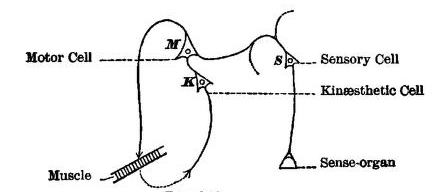
Fig. 87.
The diagram (Fig. 87)[505] shows what happens in a nervous system ideally reduced to the fewest possible terms. A stimulus reaching the sense-organ awakens the sensory cell, S; this by the connate or instinctive path discharges the motor cell, M, which makes the muscle contract; and the contraction arouses the second sensory cell, K, which may be the organ either of a 'resident' or 'kinæsthetic,' or of a 'remote,' sensation. (See above, p. 488.) This cell K again discharges into M. If this were the entire nervous mechanism, the movement, once begun, would be self-maintaining, and would stop only when the parts were exhausted. And this, according to M. Pierre Janet, is what actually happens in catalepsy. A cataleptic patient is anæsthetic, speechless, motionless. Consciousness, so far as we can judge, is abolished. Nevertheless the limbs will retain whatever position is impressed upon them from without, and retain it so long that if it be a strained and unnatural position, the phenomenon is regarded by Charcot as one of the few conclusive tests against hypnotic subjects shamming, since hypnotics can be made cataleptic, and then keep their limbs outstretched for a length of time quite unattainable by the waking will. M. Janet thinks that in all these cases the outlying ideational processes in the brain are temporarily thrown out of gear. The kinæsthetic sensation of the raised arm, for example, is produced in the patient when the operator raises the arm, this sensation discharges into the motor cell, which through the muscle reproduces the sensation, etc., the currents running in this closed circle until they grow so weak, by exhaustion of the parts, that the member slowly drops. We may call this circle from the muscle to K, from K to M, and from M to the muscle again, the 'motor circle.' We should all be cataleptics and never stop a muscular contraction once begun, were it not that other processes simultaneously going on inhibit the contraction. Inhibition is therefore not an occasional accident; it is an essential and unremitting element of our cerebral life. It is interesting to note that Dr. Mercier, by a different path of reasoning, is also led to conclude that we owe to outside inhibitions exclusively our power to arrest a movement once begun.[506]
One great inhibitor of the discharge of K into M seems to be the painful or otherwise displeasing quality of the sensation itself of K; and conversely, when this sensation is distinctly pleasant, that fact tends to further K's discharge into M, and to keep the primordial motor circle agoing. Tremendous as the part is which pleasure and pain play in our psychic life, we must confess that absolutely nothing is known of their cerebral conditions. It is hard to imagine them as having special centres; it is harder still to invent peculiar forms of process in each and every centre, to which these feelings may be due. And let one try as one will to represent the cerebral activity in exclusively mechanical terms, I, for one, find it quite impossible to enumerate what seem to be the facts and yet to make no mention of the psychic side which they possess. However it be with other drainage currents and discharges, the drainage currents and discharges of the brain are not purely physical facts. They are psycho-physical facts, and the spiritual quality of them seems a codeterminant of their mechanical effectiveness. If the mechanical activities in a cell, as they increase, give pleasure, they seem to increase all the more rapidly for that fact; if they give displeasure, the displeasure seems to damp the activities. The psychic side of the phenomenon thus seems, somewhat like the applause or hissing at a spectacle, to be an encouraging or adverse comment on what the machinery brings forth. The soul presents nothing herself; creates nothing; is at the mercy of the material forces for all possibilities; but amongst these possibilities she selects; and by reinforcing one and checking others, she figures not as an 'epiphenomenon,' but as something from which the play gets moral support. I shall therefore never hesitate to invoke the efficacy of the conscious comment, where no strictly mechanical reason appears why a current escaping from a cell should take one path rather than another.[507] But the existence of the current, and its tendency towards either path, I feel bound to account for by mechanical laws.
Having now considered a nervous system reduced to its lowest possible terms, in which all the paths are connate, and the possibilities of inhibition not extrinsic, but due solely to the agreeableness or disagreeableness of the feeling aroused, let us turn to the conditions under which new paths may be formed. Potentialities of new paths are furnished by the fibres which connect the sensory cells amongst themselves; but these fibres are not originally pervious, and have to be made so by a process which I proceed hypothetically to state as follows: Each discharge from a sensory cell in the forward direction[508] tends to drain the cells lying behind the discharging one of whatever tension they may possess. The drainage from the rearward cells is what for the first time makes the fibres pervious. The result is a new-formed 'path,' running from the cells which were 'rearward' to the cell which was 'forward' on that occasion; which path, if on future occasions the rearward cells are independently excited, will tend to carry off their activity in the same direction so as to excite the forward cell, and will deepen itself more and more every time it is used.
Now the 'rearward cells,' so far, stand for all the sensory cells of the brain other than the one which is discharging; but such an indefinitely broad path would practically be no better than no path, so here I make a third hypothesis, which, taken together with the others, seems to me to cover all the facts. It is that the deepest paths are formed from the most drainable to the most draining cells; that the most drainable cells are those which have just been discharging, and that the most draining cells are those which are now discharging or in which the tension is rising towards the point of discharge.[509] Another diagram, Fig. 88, will make the matter clear.
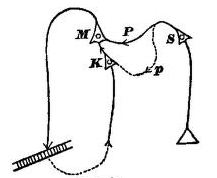
Fig. 88.
Take the operation represented by the previous diagram at the moment when, the muscular contraction having occurred, the cell K is discharging forward into M. Through the dotted line p it will, according to our third hypothesis, drain S (which, in the supposed case, has just discharged into M by the connate path P, and caused the muscular contraction), and the result is that p will now remain as a new path open from S to K. When next S is excited from without it will tend not only to discharge into M, but into K as well. K thus gets excited directly by S before it gets excited by the incoming current from the muscle; or, translated into psychic terms: when a sensation has once produced a movement in us, the next time we have the sensation, it tends to suggest the idea of the movement, even before the movement occurs.[510]
The same principles also apply to the relations of K and M. M, lying in the forward direction, drains K, and the path KM, even though it be no primary or connate path, becomes a secondary or habitual one. Hereafter K may be aroused in any way whatsoever (not as before from S or from without) and still it will tend to discharge into M; or, to express it again in psychic terms, the idea of the movement M's sensory effects will have become an immediately antecedent condition to the production of the movement itself.
Here, then, we have the answer to our original question of how a sensory process which, the first time it occurred, was the effect of a movement, can later figure as the movement's cause.
It is obvious on this scheme that the cell which we have marked K may stand for the seat of either a resident or a remote sensation occasioned by the motor discharge. It may indifferently be a tactile, a visual, or an auditory cell. The idea of how the arm feels when raised may cause it to rise; but no less may the idea of some sound which it makes in rising, or of some optical impression which it produces. Thus we see that the 'mental cue' may belong to either of various senses; and that what our diagrams lead us to infer is what really happens; namely, that in our movements, such as that of speech, for example, in some of us it is the tactile, in others the acoustic, Effectsbild, or memory-image, which seems most concerned in starting the articulation (Vol. I. pp. 54-5). The primitive 'starters,' however, of all our movements are not Effectsbilder at all, but sensations and objects, and subsequently ideas derived therefrom.
Let us now turn to the more complex and serially concatenated movements which oftenest meet us in real life. The object of our will is seldom a single muscular contraction; it is almost always an orderly sequence of contractions, ending with a sensation which tells us that the goal is reached. But the several contractions of the sequence are not each distinctly willed; each earlier one seems rather, by the sensation it produces, to call its follower up, after the fashion described in Chapter VI, where we spoke of habitual concatenated movements being due to a series of secondarily organized reflex arcs (Vol. I. p. 116). The first contraction is the one distinctly willed, and after willing it we let the rest of the chain rattle off of its own accord. How now is such an orderly concatenation of movements originally learned? or in other words, how are paths formed for the first time between one motor centre and another, so that the discharge of the first centre makes the others discharge in due order all along the line?
The phenomenon involves a rapid alternation of motor discharges and resultant afferent impressions, for as long a time as it lasts. They must be associated in one definite order; and the order must once have been learned, i.e., it must have been picked out and held to more and more exclusively out of the many other random orders which first presented themselves. The random afferent impressions fell out, those that felt right were selected and grew together in the chain. A chain which we actively teach ourselves by stringing a lot of right-feeling impressions together differs in no essential respect from a chain which we passively learn from someone else who gives us impressions in a certain order. So to make our ideas more precise, let us take a particular concatenated movement for an example, and let it be the recitation of the alphabet, which someone in our childhood taught us to say by heart.
What we have seen so far is how the idea of the sound or articulatory feeling of A may make us say 'A,' that of B, 'B,' and so on. But what we now want to see is why the sensation that A is uttered should make us say 'B,' why the sensation that B is uttered should make us say 'C,' and so on.
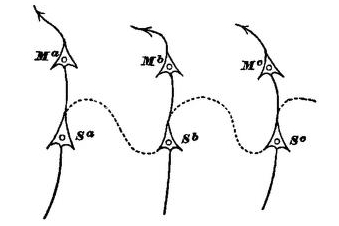
Fig. 89.
To understand this we must recall what happened when we first learned the letters in their order. Someone repeated A, B, C, D to us over and over again, and we imitated the sounds. Sensory cells corresponding to each letter were awakened in succession in such wise that each one of them (by virtue of our second law) must have 'drained' the cell just previously excited and left a path by which that cell tended ever afterwards to discharge into the cell that drained it. Let Sa, Sb, Sc in figure 89 stand for three of these cells. Each later one of them, as it discharges motorwards, draws a current from the previous one, Sb from Sa, and Sc from Sb. Cell Sb having thus drained Sa, if Sa ever gets excited again, it tends to discharge into Sb; whilst Sc having drained Sb, Sb later discharges into Sc, etc., etc.—all through the dotted lines. Let now the idea of the letter A arise in the mind, or, in other words, let Sa be aroused: what happens? A current runs from Sa not only into the motor cell Ma for pronouncing that letter, but also into the cell Sb. When, a moment later, the effect of Ma's discharge comes back by the afferent nerve and re-excites Sa, this latter cell is inhibited from discharging again into Ma and reproducing the 'primordial motor circle' (which in this case would be the continued utterance of the letter A), by the fact that the process in Sb, already under headway and tending to discharge into its own motor associate Mb, is, under the existing conditions, the stronger drainage-channel for Sa's excitement. The result is that Mb discharges and the letter B is pronounced; whilst at the same time Sc receives some of Sb's overflow; and, a moment later when the sound of B enters the ear, discharges into the motor cell for pronouncing C, by a repetition of the same mechanism as before; and so on ad libitum. Figure 90 represents the entire set of processes involved.
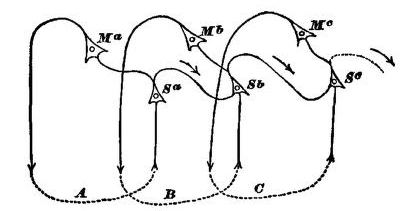
Fig. 90.
The only thing that one does not immediately see is the reason why 'under the existing conditions' the path from Sa to Sb should be the stronger drainage-channel for Sa's excitement. If the cells and fibres in the figure constituted the entire brain we might suppose either a mechanical or a psychical reason. The mechanical reason might lie in a general law that cells like Sb and Mb, whose excitement is in a rising phase, are stronger drainers than cells like Ma, which have just discharged; or it might lie in the fact that an irradiation of the current beyond Sb into Sc and Mc has already begun also; and in a still farther law that drainage tends in the direction of the widest irradiations. Either of these suppositions would be a sufficient mechanical reason why, having once said A, we should not say it again. But we must not forget that the process has a psychical side, nor close our eyes to the possibility that the sort of feeling aroused by incipient currents may be the reason why certain of them are instantly inhibited and others helped to flow. There is no doubt that before we have uttered a single letter, the general intention to recite the alphabet is already there; nor is there any doubt that to that intention corresponds a widespread premonitory rising of tensions along the entire system of cells and fibres which are later to be aroused. So long as this rise of tensions feels good, so long every current which increases it is furthered, and every current which diminishes it is checked; and this may be the chief one of the 'existing conditions' which make the drainage-channel from Sa to Sb temporarily so strong.[511]
The new paths between the sensory cells of which we have studied the formation are paths of 'association,' and we now see why associations run always in the forward direction; why, for example, we cannot say the alphabet backward, and why, although Sb discharges into Sc, there is no tendency for Sc to discharge into Sb, or at least no more than for it to discharge into Sa.[512] The first-formed paths had, according to the principles which we invoked, to run from cells that had just discharged to those that were discharging; and now, to get currents to run the other way, we must go through a new learning of our letters with their order reversed. There will then be two sets of association-pathways, either of them possible, between the sensible cells. I represent them in Fig. 91, leaving out the motor features for simplicity's sake. The dotted lines are the paths in the backward direction, newly organized from the reception by the ear of the letters in the order C B A.
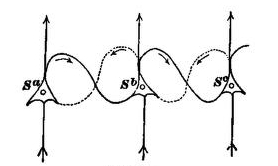
Fig. 91.
The same principles will explain the formation of new paths successively concatenated to no matter how great an extent, but it would obviously be folly to pretend to illustrate by more intricate examples. I will therefore only bring back the case of the child and flame (Vol. I. p. 25), to show how easily it admits of explanation as a 'purely cortical transaction' (ibid. p. 80). The sight of the flame stimulates the cortical centre S1 which discharges by an instinctive reflex path into the centre M1 for the grasping-movement. This movement produces the feeling of burn, as its effects come back to the centre S2; and this centre by a second connate path discharges into M2, the centre for withdrawing the hand. The movement of withdrawal stimulates the centre S3, and this, as far as we are concerned, is the last thing that happens. Now the next time the child sees the candle, the cortex is in possession of the secondary paths which the first experience left behind. S2, having been stimulated immediately after S1, drained the latter, and now S1 discharges into S2 before the discharge of M1 has had time to occur; in other words, the sight of the flame suggests the idea of the burn before it produces its own natural reflex effects. The result is an inhibition of M1, or an overtaking of it before it is completed, by M2.—The characteristic physiological feature in all these acquired systems of paths lies in the fact that the new-formed sensory irradiations keep draining things forward, and so breaking up the 'motor circles' which would otherwise accrue. But, even apart from catalepsy, we see the 'motor circle' every now and then come back. An infant learning to execute a simple movement at will, without regard to other movements beyond it, keeps repeating it till tired. How reiteratively they babble each new-learned word! And we adults often catch ourselves reiterating some meaningless word over and over again, if by chance we once begin to utter it 'absent-mindedly,' that is, without thinking of any ulterior train of words to which it may belong.
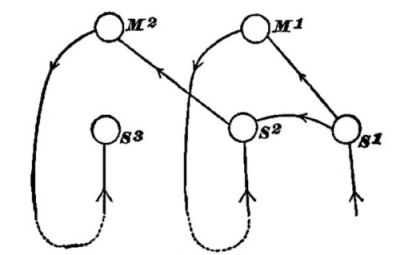
Fig. 92.
One more observation before closing these already too protracted physiological speculations. Already (Vol. I. p. 71) I have tried to shadow forth a reason why collateral innervation should establish itself after loss of brain-tissue, and why incoming stimuli should find their way out again, after an interval, by their former paths. I can now explain this a little better. Let S1 be the dog's hearing-centre when he receives the command 'Give your paw.' This used to discharge into the motor centre M1, of whose discharge S2 represents the kinæsthetic effect; but now M1 has been destroyed by an operation, so that S1 discharges as it can, into other movements of the body, whimpering, raising the wrong paw, etc. The kinæsthetic centre S2 meanwhile has been awakened by the order S1, and the poor animal's mind tingles with expectation and desire of certain incoming sensations which are entirely at variance with those which the really executed movements give. None of the latter sensations arouse a 'motor circle,' for they are displeasing and inhibitory. But when, by random accident, S1 and S2 do discharge into a path leading through M2, by which the paw is again given, and S2 is excited at last from without as well as from within, there are no inhibitions and the 'motor circle' is formed: S1 discharges into M2 over and over again, and the path from the one spot to the other is so much deepened that at last it becomes organized as the regular channel of efflux when S1 is aroused. No other path has a chance of being organized in like degree.
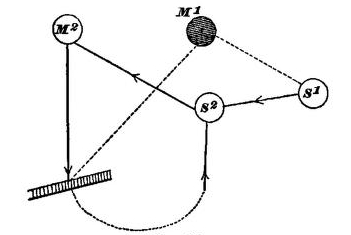
Fig. 93.