Chapter II
Reading edition
THE elementary forms used in ornament form the next division. It is assumed that the space is given that we are required to ornament; for example, a ceiling, a wall, a frieze, a panel, or a carpet. The boundary-lines are the enclosing lines of our space or field, which may be subdivided. This subdividing is called the setting-out. We have now to think of the forms and character of the ornament we propose to adopt.
It is now advisable to give illustrations of the various elementary forms used in ornament. As lines, either straight or curved, are the basis of all ornament, we begin with the straight line. It would be difficult to overrate the value of the straight line in ornament. The qualities of stability, firmness, and repose given by upright and horizontal lines are well illustrated by the mouldings round rectilinear panels, by cornices and pilasters, and by reeded and fluted ornaments. All frets are composed of straight lines. The illustrations from Fig. 3 to Fig. 23 are specimens of straight-lined ornaments. Taking the band or two horizontal parallel lines in Fig. 3, and marking off equidistant points on the upper and on the lower one, only alternating, and drawing vertical lines from these points, we obtain the basis of a large class of frets. Figs. 4, 6, 7, and 8 show further developments of the fret. Figs. 5 and 18 show the elements of some Saracenic or Moresque frets, of which Figs. 11, 21, and 22 are developments. Figs. 6, 8, 12, 13 and 14
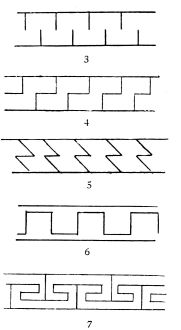
Figs. 3 to 7.—Straight-lined ornaments.
are Greek frets; 7 and 20 are Chinese. Fig. 9 is a Gothic nail-head ornament; 10 is of German origin; 19 is a Japanese key pattern; and Fig. 23 is derived from the plaiting of rushes, ribbons, straws, or from herring-bone brick-work, and is common to prehistoric and Byzantine work.
Frets are more appropriate to flat surfaces than to concave or convex ones; they may, however, be used on slightly concave surfaces, such as the inside bevels of plates or dishes; then their vertical lines will compose well, by radiating from the centre of the plate. The square within square, and double and single frets, shown at Figs. 8 and 15, were often
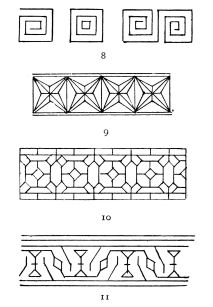
Figs. 8 to 11.—Straight-lined ornaments.
used in conjunction by the Greeks, and earlier by the Egyptians, on the ceilings of their tombs (Fig. 16), both singly, and alternating with spirals and circular ornaments. (See Fig. 43.)
The zigzag is another straight-lined form largely used as ornament; it was used by the Egyptians and Early Greeks as the symbol of water (Figs. 28, 165).
Lozenges and diamonds are other elements of straight-lined ornament, and form the basis of many repeating patterns in woven stuffs, paper-hangings, and tiles. Triangles, squares, hexagons, octagons,
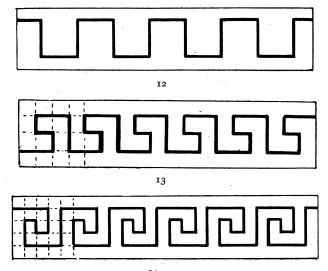
Figs. 12 to 14.—Greek frets.
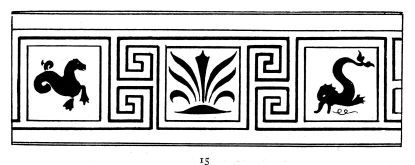
Fig. 15—Fret and panel border, Greek.
and other polygons are also used largely as constructive bases in pattern-designing.
After the straight line, the curved is the other element in ornament. It is pre-eminently the type of grace, and the “line of beauty.” Whether seen in the outline of the cloud, the wave, or the rounded limb of the human figure, the eye takes a delight in
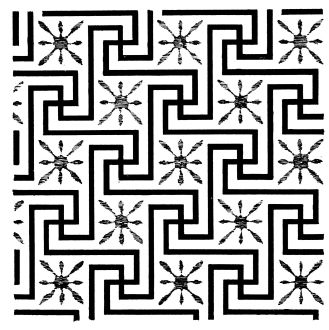
Fig. 16.—Egyptian ceiling fret.
tracing out the flowing curve. We have closed curves in such figures as the circle, ellipse, oval, figure of eight, and in the vesica piscis, or fish-shape, the latter being composed of two arcs of a circle of the same radius, touching each other at their opposite extremities. The parabola, hyperbola, &c., are open curves; such figures as the meander (Fig. 29), the spiral (Fig. 24), the scroll (Fig. 25), and the swag or festoon (Fig. 27), are also open curves. When the festoon is formed of links and hangs like a chain from two points, it is called a catenary, and is practically identical with the lines of festoons and the loopings of drapery.
18 19 20
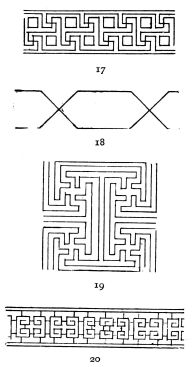
Figs. 17 to 20.—Straight-lined ornaments
In the illustrations, we have at Fig. 30 circles touching each other; this is the framework of some diapers and repeating forms. Next we come to circles intersecting each other. Fig. 31 is a pattern common alike to Saracenic, Egyptian, and Japanese diapers. Fig. 32 is a border ornament of the same pattern with a centre.
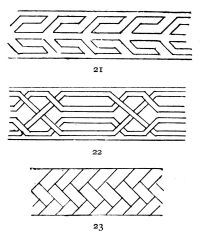
Figs. 21 to 23.—Straight-lined ornaments.
An effective disc border, like that made by savage tribes from cut shells, is shown at Fig. 33, and a development of the latter is that of Fig. 34, taken
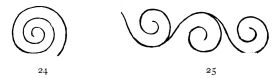
Figs. 24. 25.—Spiral and Scroll.
from Assyrian tesseræ, small oblong pieces of stone or metal, on which the pattern was incised, and often alternating with the guilloche (Figs. 37, 38, 39, and 40). The guilloche was an important pattern in Assyrian work, in Greek moulding decoration, and in their flat painted ornament.
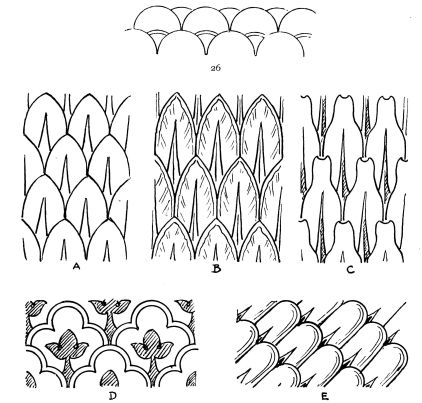
Fig. 26. A, B, C, D, E.—Scale-work (imbricated).
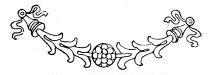
Fig. 27.—Festoon (catenary).

Fig. 28.—Zigzag. Fig. 29.—Meander.
Figs. 35 and 36 are further examples of ornament obtained from the circle and its segments; the former being the Gothic ball-flower. Imbricated or scale ornament was much used for roofs, to ornament small columns and circular mouldings. Examples are given at Fig. 26, A, B, and C.
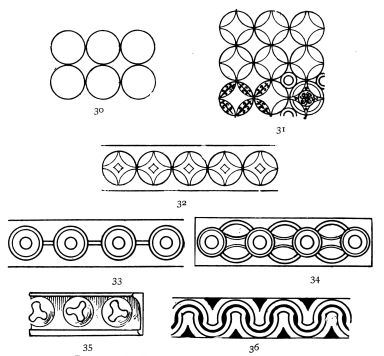
Figs. 30 to 36.—Ornaments mostly derived from the circle.
We now pass from the circle to the spiral,[5] from which a great part of ornamental forms are derived.
Fig. 41 is an Egyptian wave scroll, and 42 is the familiar Greek wave. Fig. 43 is from an Egyptian ceiling; all these contain the spiral as their chief characteristic. Fig. 44 shows two intersecting meanders,
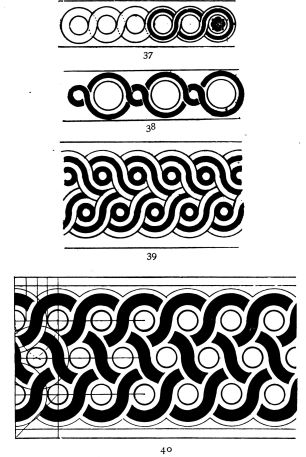
Figs. 37 to 40.—Ornaments mostly derived from the circle.
47 is a scroll intersected by a meander, 46 is an eccentric meander, 45 is the scroll or antispiral of the cyma recta, and 48 is the double spiral of the cavetto decoration. Fig. 70 is the ornament on the Greek cyma reversa or ogee, called by the French rais de cœur; 71 is a Roman variety.
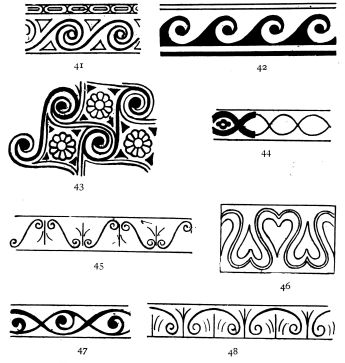
Figs. 41 to 48.—Ornaments chiefly based on spiral curves.
Fig. 50 shows the anatomy or centre lines of the purely æsthetic Greek pattern developed at Fig. 49. Figs. 51 and 52 are additional examples. Fig. 53 is one of the scrolls, and in Fig. 54 is shown the irregular meanders and spiral curves forming the stand for the tripod on the roof of the choragic monument of Lysikrates.
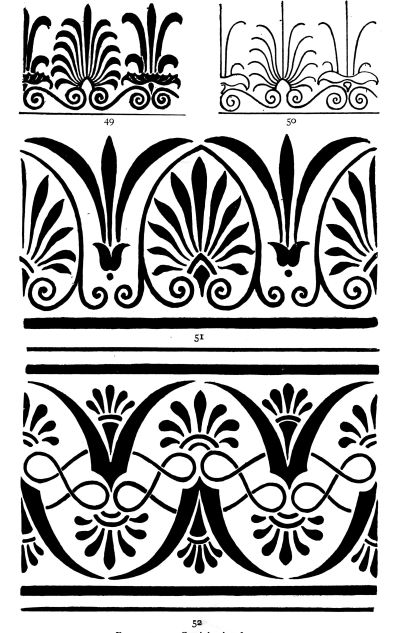
Figs. 49 to 52.—Greek borders from vases.
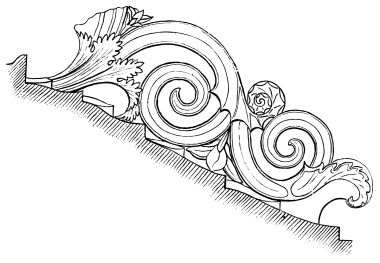
Fig. 53.—Scroll ornament on the slope of the roof of the choragic monument of Lysikrates.
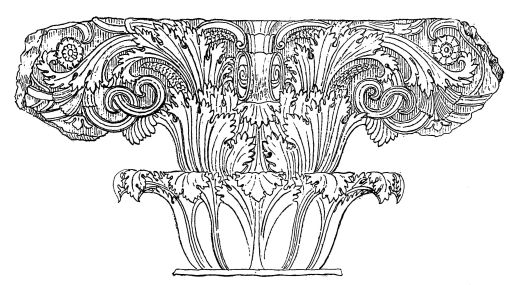
Fig. 54.—Portion of the tripod stand on top of the roof of the monument of Lysikrates.