CONCLUDING CHAPTER. (continued 2)
Reading edition
At Brill Church, in Buckinghamshire, the communion table, on an elevation of one step, is inclosed with rails, within an area of eight feet by six feet and a half, and a bench is fixed to the wall on each side; an innovation made at this period, in order that the communicants might receive the sacrament sitting. The communion table in Wooten Wawen Church, Warwickshire, though perfectly plain in construction, is unusually long and large, and appears to have been set up by the Puritans at this period, so that they might sit round or at it.
To the removal of the communion table from the east end of the chancel may be attributed the usage which, in the middle of the seventeenth century, began to prevail of constructing close and high seats or pews, without regard to that uniformity of arrangement which had hitherto been observed; and many seats were now so constructed that those who occupied them necessarily turned their backs on the east during the ministration of prayer and public service. The erection of unseemly galleries, which have greatly tended to disfigure our churches, was another consequence of the innovation on the ancient arrangement of pewing.
After the Restoration the communion tables were again restored to their former position at the east end of the chancel; and in Evelyn’s Diary for 1661-2, we find the change of position in his parish church thus noticed: “6 April. Being of the vestry in the afternoone, we order’d that the communion table should be set as usual altarwise, with a decent raile in front, as before the rebellion.”
The altar rails were now generally restored, and in most instances we find those in our churches to be of a period subsequent to the Restoration, as the details in the workmanship evince. In the church accounts of St. Mary’s, Shrewsbury, for 1662, we find a “memorandum that this year the rayles about the communion table wer new sett up, and the surplice was made.” In Wormleighton Church, Warwickshire, the altar rails have on them the date of 1664; and the communion table, which is quite plain, is of the same character and era.
But a return, after the Restoration, to the former usages of the Anglican church was not made without great opposition; and accordingly we find objections stated to the bowing to the altar and to the east, to the preaching by book, to the railing in of the altar, to the candles, cushion, and book thereon, to the bowing at the name of Jesus, and to the organs as “popish-like music, and too much superstition250-*.”
When the rood was taken down at the Reformation, a custom began to prevail of fixing up in its stead or place, against the arch leading into the chancel, the upper part of which was in consequence blocked up by it, and facing the congregation, so as to be seen by them, the royal arms, with proper heraldic supporters; but it does not clearly appear that this was done in consequence of any express law or injunction to that effect, though it may perhaps have served to denote the king’s supremacy. We seldom, however, find the royal arms of earlier date than the Restoration, in the twenty years previous to which they appear to have been generally taken down. In Brixton Church, Isle of Wight, on some plain wooden panelling between the tower and a gallery at the west end are the remains of the royal arms, which, from the style in which they have been painted with the rose and thistle, appear coeval with the reign of James the First; they are surmounted by a crown, below which is an open six-barred helme. These arms appear to have been removed from their original position against the chancel-arch, and are now much mutilated. In the church accounts, St. Mary’s, Shrewsbury, for 1651, is a charge of 1l. 8s. “for making the states armes.” In Anstey Church, Warwickshire, the arms of the commonwealth, put up during the inter-regnum, were taken down not many years back. The little church of St. Lawrence, in the Isle of Wight, still retains the royal arms put up at the Restoration in 1660.
Excepting the rood-loft galleries, we have few galleries in our churches of a period antecedent to the latter part of the seventeenth century. At the west end of Worstead Church, Norfolk, over the west door, is a gallery erected in 1550, at the cost of the candle called the Bachelor’s Light. At the west end of the nave in Leighton Buzzard Church is a gallery erected in 1634; and at the west end of Piddletown Church, Dorsetshire, is a gallery with the date of its erection, 1635.
From about the period of the Revolution, in 1688, we may trace the commencement of a custom, still partially prevailing, of setting up the pulpit and reading-pew in the middle aisle, in front of the communion table; so that during the whole of the service the back of the minister was turned to the east, and the view of the communion table obstructed; but we have not found any pulpit thus placed of an earlier period.
We still retain, in the Anglican church, the usage of placing two candlesticks and candles upon the communion table, in compliance with the injunctions of King Edward the Sixth, together also with an offertory dish; of reading the lessons from the eagle desk, and of saying the Litany at the litany-stool. These practices are, however, more particularly observed in our cathedrals and college chapels than in our parochial churches, in most of which they have fallen into desuetude.
To conclude, in the language of the synod held in 1640: “Whereas the church is the house of God, dedicated to his holy worship, and therefore ought to remind us both of the greatness and goodness of his Divine Majesty; certain it is that the acknowledgment thereof, not only inwardly in our hearts, but also outwardly with our bodies, must needs be pious in itself, profitable unto us, and edifying unto others: we therefore think it meet and behoveful, and heartily commend it to all good and well-affected people, members of this church, that they be ready to tender unto the Lord the said acknowledgment, by doing reverence and obeisance, both at their coming in and going out of the said churches, chancels, or chapels, according to the most ancient custom of the primitive church in the purest times, and of this church also for many years of the reign of Queen Elizabeth.
“The reviving, therefore, of this ancient and laudable custom we heartily recommend to the serious consideration of all good people, not with any intention to exhibit any religious worship to the communion table, the east, or church, or any thing therein contained, in so doing; or to perform the said gesture in the celebration of the holy eucharist, upon any opinion of a corporal presence of the body of Jesus Christ on the holy table or in the mystical elements, but only for the advancement of God’s majesty, and to give him alone that honour and glory that is due unto him, and no otherwise; and in the practice or omission of this rite we desire that the rule of charity prescribed by the apostle may be observed, which is, that they which use this rite despise not them who use it not, and that they who use it not condemn not those that use it.”
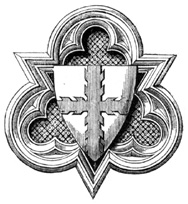
“... a bloodie crosse he bore, The deare remembrance of his dying Lord, For whose sweete sake that glorious badge he wore, And dead, as living, ever him ador’d: Upon his shield the like was also scor’d.”
“Calix vero et alia necessaria praeparentur in credentia cooperta linteo, antequam sacerdos veniat ad altare.”—Ibid.
“After our hartie comendaco̅n̅s.—Whereas we are credibly informed that there are divers tabernacles for Images, as well in the fronture of the roodeloft of the cathl church of Bristol, as also in the frontures, back, and ends of the walles wheare the com̅n̅ table standeth, for asmoch as the same churche shoulde be a light and good example to th’ ole citie and dioc. we have thought good to direct these our lr̅e̅s unto you, and to require youe to cause the said tabernacles to be defaced & hewen downe, and afterwards to be made a playne walle, wth morter, plastr, or otherways, & some scriptures to be written in the places, & namely that upon the walle on the east end of the quier wheare the com̅n̅ table usually doth stande, the table of the co̅m̅andts to be painted in large caracters, with convenient speed, and furniture according to the orders latly set furthe by vertue of the quenes mats co̅m̅ission for causes ecclesiasticall, at the coste and chardges of the said churche; whereof we require you not to faile. And so we bed you farewell. From London, the xxi. of December, 1561.”—Britton’s Bristol Cath. p. 52.
OXFORD: Printed by T. Combe, Printer to the University.—May 10, 1841
Published by J. H. Parker, Oxford.
SECOND EDITION.
In the Press, with many additional Wood-Cuts,
A GLIMPSE
AT THE
MONUMENTAL ARCHITECTURE
AND
SCULPTURE OF GREAT BRITAIN,
FROM THE EARLIEST PERIOD TO THE EIGHTEENTH CENTURY.
By MATTHEW HOLBECHE BLOXAM.
THIRD EDITION, ENLARGED.
2 Vols. 8vo. 1l. 4s.
A GLOSSARY OF TERMS
USED IN
GRECIAN, ROMAN, ITALIAN,
AND
GOTHIC ARCHITECTURE.
Exemplified by Seven Hundred Wood-Cuts.
Published by J. H. Parker, Oxford.
PREPARING FOR PUBLICATION.
A COMPANION TO THE GLOSSARY
OF
ARCHITECTURE,
FORTY PLATES ENGRAVED BY JOHN LE KEUX;
Containing Four Hundred additional Examples, with descriptive Letter-Press, a Chronological Table, and Index of Places.
PREPARING FOR PUBLICATION, IN 2 VOLS. 8vo.
SOME ACCOUNT
OF THE
DOMESTIC ARCHITECTURE of ENGLAND
FROM THE NORMAN CONQUEST TO THE REFORMATION.
BY R. C. HUSSEY, Esq.
Illustrated by numerous Engravings, from original drawings, of EXISTING REMAINS.
3 Vols. 8vo, 2l. 18s. 3 Vols. 4to, 5l. 10s.
MEMORIALS OF OXFORD.
BY JAMES INGRAM, D.D.
President of Trinity College.
THE ENGRAVINGS BY JOHN LE KEUX.
Transcriber’s Note
The following errors and inconsistencies have been maintained.
Misspelled words and typographical errors:
Page Error
26 (fig. 5.). has an extra . following the )
76, fn. * ἴχθυς should read ἰχθύς
79 isuse should read disuse
104 rom should read from
106 pannels should read panels
145 First word in chapter was not in small caps
156, fn † 1236. De Baptismo should have an open quote mark before “De”
192 each which should read each of which. The word “of” did not print in the original text, although a space is present for it.
The following words had inconsistent hyphenation:
wood-work / woodwork zig-zag / zigzag
The following words had inconsistent spelling:
Botolph / Botulph Higham Ferrars / Higham Ferrers Sherbourne / Sherborne Wooten Wawen / Wotten Wawen