Note 1 bis — Chapter XIX · PHOSPHORUS AND THE OTHER ELEMENTS OF THE FIFTH GROUP
George Kamensky translation
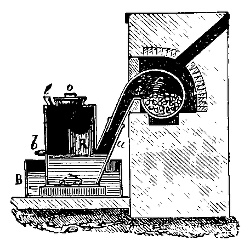
Fig. 83.—Preparation of phosphorus. The mixture is calcined in the retort c. The vapours of phosphorus pass through a into water without coming into contact with air. The phosphorus condenses in the water, and the gases accompanying it escape through i.
[1 bis] By subjecting the pyrophosphate to the action of sulphuric or hydrochloric acid it is possible to obtain a fresh quantity of the acid salt from the residue, and in this manner to extract all the phosphorus. It is usual to take burnt bones, but mineral phosphorites, osteolites, and apatites may also be employed as materials for the extraction of phosphorus. Its extraction for the manufacture of matches is everywhere extending, and in Russia, in the Urals, in the Government of Perm, it has attained such proportions that the district is able to supply other countries with phosphorus. A great many methods have been proposed for facilitating the extraction of phosphorus, but none of them differ essentially from the usual one, because the problem is dependent on the liberation of phosphoric acid by the action of acids, and on its ultimate reduction by charcoal. Thus the calcium phosphate may be mixed directly with charcoal and sand, and phosphorus will be liberated on heating the mixture, because the silica displaces the phosphoric anhydride, which gives carbonic oxide and phosphorus with the charcoal. It has also been proposed to pass hydrochloric acid over an incandescent mixture of calcium phosphate and charcoal; the acid then acts just as the silica does, liberating phosphoric anhydride, which is reduced by the charcoal. It is necessary to prevent the access of air in the condensation of the vapours of phosphorus, because they take fire very easily; hence they are condensed under water by causing the gaseous products to pass through a vessel full of water. For this purpose the condenser shown in fig. 83 is usually employed.