ILLUSTRATIONS (continued 7)
Reading edition
Night was falling as we drove into the lazy-looking Provençal town of Digne, where all was green and sleepy, at peace with itself and the world at large. Even the beautiful Doric château d'eau was green with moss, and the water of its fountain laughed in sleep; the famous basilica showed grey through green lichen; its wonderful rose window had a green frame of ivy, and the strange, sculptured beasts guarding the door had saddles of green velvet mould.
We slept at Digne, and made an early morning start, the car plunging us almost from the first into scenery which only Gustave Doré could have imagined. Gnome villages and elfin castles clung to slim pinnacles of rock which seemed to swing, like blown branches, against the sky. Wild grey mountains bristled with rocky spines, and trails of scarlet foliage poured like streams of blood down their rough sides, completing the resemblance to fierce, wounded boars.
Our road was a road of steep gradients, leading us through gorges of a grandeur which would have been called appalling when the world was a little younger, and more in awe of savage Nature. If a midge could be provided with a proportionately tiny motor car, and sent coasting at full tilt down a greased corkscrew, from the handle to the sharp end of the screw, the effect would have been somewhat that of our Mercédès leaping down the steep defiles. We were vaguely conscious now and then that a river far below us clamoured for our bones; on one side we had a precipice, on the other a sheer face of towering cliff.
Gorges, glorious gorges! a plethora of gorges. No sooner were we out of one, and drawing breath in a valley of golden sunshine and silver river, but we were back in another majestic cañon. Finest of all, perhaps, was the dark Clou de Rouaine; yet when we sprang out into daylight to throw ourselves into the village of Les Scaffarels, wonders did not cease. Now we were in the true hinterland of the gay, blue-and-gold Riviera, following the course of the Var, down to Nice, not many miles away. Wide and pebbly in its bed by the bright pleasure town, here it led us through a succession of more gorges, thundered us through rock tunnels, swept us over bridges, and at last tumbled us into sight of a marvel which must throw the whole seven of Dauphiné out of focus. It was the town of Entrevaux, and to my shame I had never heard of it. Where the narrow valley opens into a broad one, and the green, swift flowing river sweeps in a sickle-curve round the base of a high rock, Entrevaux shoots far up into the sky. The river bathes its dark walls, protected by devices dear to the hearts of mediæval Vaubans. Pepper-castor sentry-boxes jut out over the water; a great drawbridge with portcullis, triple gateway, and neat contrivances for pouring oil and molten lead upon besiegers, alone gives access to the town; while behind the old crowded houses a fortified stairway in the rock leads dizzily up to a stronghold clamped upon a towering peak—a peak like a black, giant wine-bottle, slender-necked, with the fort castle for the cork.
"If the Boy could see this with me!" I thought. And then, because this place was like a fairy place, I remembered the fairy prince's ring. Never had I followed his instructions; but I rubbed it now, and wished that the genie of the ring would give me back the Little Pal at Monte Carlo.
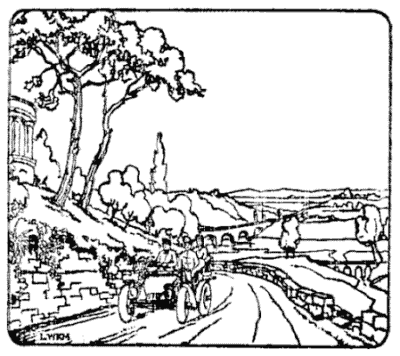
After Entrevaux, picturesque Puget-Theniers was an anticlimax; though other fairy towns peered down from high crags and sheer hillsides where they hung by wires caught in spider webs—and though we passed through other gorges of grim beauty, my thoughts had flown ahead of our swift car. I was glad when at last we came into sight of a fair white city lying on the blue curve of a bay and ringed with green hills, glad that our journey was all but ended; for the fair city was Nice.
CHAPTER XXX
The Day of Suspense
"Will you make me believe that I am not sent for...? Go to, go to, thou art a foolish fellow!" —Shakespeare.
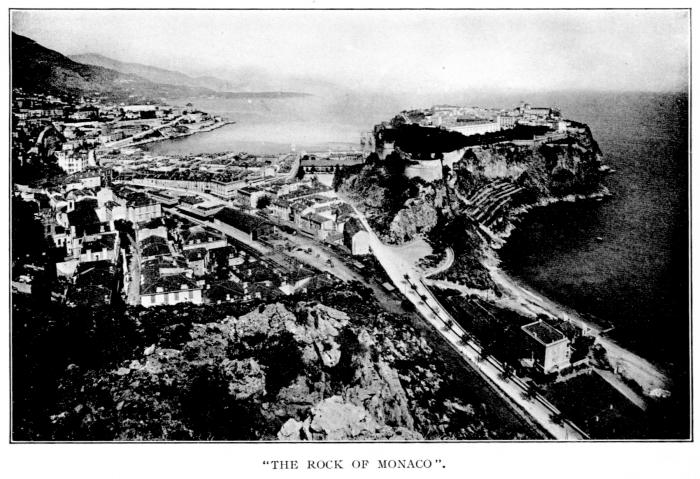
From Nice to Monte Carlo over the Upper Corniche, was for us a spin of less than two hours; and after that most beautiful drive in the world, we slowed down before the green-shaded loggia of the Royal, early in the afternoon. The hotel was only just open for the season, and it was possible to have a choice of rooms. Jack selected a glass-fronted suite, with a view more beautiful than any other in the extraordinary little principality:
"Magic casements Opening on the foam of perilous seas In faëry lands forlorn."
which were, respectively, the harbour, and the rock of Monaco (as old as Hercules), with its ancient towers dark against a sky of pearl.
I was given a peep into Molly's salon, which appeared to be a sort of crystal palace, with its two window-walls curtained by trailing roses; and Jack kept me for a moment at the door.
"I suppose we shall meet for dinner about eight, won't we, no matter what we may all choose to do meanwhile?" said he.
"Well—er—no," I mumbled, feeling a little foolish. "I have—er—a sort of engagement for to-night. I think I mentioned it before."
"What, to meet that missing Boy of yours?" asked Jack, in a chaffing tone, so tactlessly loud that it must have been distinctly audible to the ladies in the adjoining room, the door of which was open. "Isn't that rather a mad idea? You were vaguely engaged to meet your pal, I believe you said, on the night after your arrival, at the Hôtel de Paris, for dinner. But considering the fact that, if you'd walked down as you then intended, instead of motoring, you would have been a fortnight on the way, isn't it fantastic to expect that he'll turn up?"
"Not quite as fantastic as you think," I retorted, remembering the terms of the Boy's letter, which had not been confided to Jack, in their exactness. "Anyhow, I'm going on the off chance."
"You apparently credit the youth with clairvoyance, my dear chap. Supposing he has come down here, how could he know that you'd arrived?"
"I wired him from Digne, telegraphing to the Poste Restante at Monte Carlo, where he would certainly think of enquiring, if he took much interest in my movements. In that message I made it very clear that I should expect him to stick to our bargain, and I have an impression that he will."
"He may. But, look here, my dear fellow,"—Jack now had the decency to lower his voice,—"have you no red blood in your veins? Mercédès—the real Mercédès—nearly restored to health and spirits by her run with us through splendid air and scenery, is to unveil her charms this evening at dinner. You have irreverently nicknamed her the Perpetual Mushroom. To-night, you will see—but you don't deserve to be told what you will see, if you haven't the curiosity to find out at the first opportunity for yourself."
"Second opportunities, like second thoughts, are better than first," said I. "I shall he delighted to take the second opportunity of meeting Miss Mercédès—by the way, what is her other name? You always seemed to take it for granted that I knew; but if it was ever mentioned in the summer, I've forgotten."
"You should be ashamed to admit that you could deliberately and stoically forget a charming young lady's name, and you don't deserve to have your memory jogged. You shall be told the heiress's name when you meet her, and not before."
"I must possess my soul in patience until to-morrow, then," I replied, "for to me one pal in the bush is worth twenty heiresses in the hand, and I am now going out to scour the said bush."
"Which means the Casino, no doubt."
"I shall stroll in, when I've got rid of the dust. The Rooms are the place to come across people."
"All right, gang your ain gait, my son, and I suppose I must wish you luck. Daresay we shall see each other before bedtime."
A few hours later, I was walking down through the gardens, on my way to the Casino. The young grass, sown last month, had already become green velvet, and the flowers were as fresh as if they had been created an hour ago. The air smelled of La France roses and orange blossoms, though I saw neither. Some pretty Austrian girls were walking about in muslin frocks and gauzy hats, though by this time, in England, women were putting on their fur boas in deference to autumn; and a few days ago I had been lost in a snowstorm on a middle-sized mountain of Savoie.
As I drew near to the big white Casino, strains of music came to me from the terrace, and thinking that the Boy might be there listening to the band, I went through the tunnel and came out on the beautiful flower-decked plateau overhanging the sea. Out of season though it was, a great many people were sitting there, drinking tea or coffee, and listening to "La Paloma."
The windows of the Casino were open, protected by awnings; birds were taking their last flight, before going to bed in some orange or lemon tree. The place was more charming than in the high season; but the face I looked for was not to be seen, and I deserted the Terrace for the Rooms.
I had not been to "Monte" since the Boer war; and when I had gone through the formalities at the Bureau, and entered the first salle, it struck me strangely to find everything exactly as I had left it years ago.
The same heavy stillness, emphasised by the continuous chink, chink of gold and silver, and broken only by the announcement of events at different tables: "Onze, noir, impair et manque";—"Rien ne va plus";—"Zèro!"
The same onze; the same rien n'va plus; the same zèro heralded in the same secretly joyous, outwardly apologetic tone, by the croupiers fortunate enough to produce it. The same croupiers too;—(or do croupiers develop a family likeness of face, of voice, of coat, as the years go chinking zeroly on?). The same players, or their doppelgängers; the same pictured nymphs smiling on the ornate walls. But there was no Boy, no Boy's sister; and suddenly it occurred to me that I was foolish to expect him. He was too childlike in appearance to have obtained a ticket of admission to the gambling rooms.
Since it was useless to look for him here, and no other place seemed promising at this hour, there was nothing to do but pass the moments until time to change for dinner. Accordingly I watched the tables. Once, like most men of my age, I had been bitten by the roulette fever and had wrestled with "systems" in their thousands, not so much for the mere "gamble," as for the joy of striving to beat the wily Pascal at his own invention.
In those old days the wheel had been like a populous town for me, inhabited by quaint little people, each living in his own snug house; the Little People of Roulette. Not a number on the board but his face was familiar to me; I would have known him if I had met him in the street. There was sly, thin, dark little Dix, always sneaking up on tiptoe when you did not want him, and popping out behind your back. Business-like, successful, bustling Onze; tactless but honest Douze; treacherous yet fascinating Treize; blundering Seize; graceful, brunette Dix-Sept; and the faithful, friendly Vingtneuf; feminine Rouge; brusque, virile Noir; mean little, underbred Manque, and senile Passe; priggish Pair with his skittish young wife; the Dozens, nouveaux-riches, thinking themselves a cut above the humbler Simple Chances in Roulette Society; the upright, unbending Columns; the raffish Chevaux; the excitable Transversales, and the brilliant Carrés; charming on first acquaintance, but fickle as friends; the twin, blind dwarfs, the Coups des Deux; these and many more, down to the wretched, worried Intermittances, ever in a violent hurry to catch a train but never catching it. I could see them all, still; but I saw them pass with calmness now, for I wanted to find the Boy.
CHAPTER XXXI
The Boy's Sister
"A little thing would make me tell ...how much I lack of a man." —Shakespeare.
The palace clock over in Monaco was striking eight as I reached the steps of the Hôtel de Paris. Eight had been the hour appointed. Now, here were both the Hour and the Man: but where was the Boy?
I walked into the gay restaurant, with its window-wall, and the long rank of candle-lit tables ready for dinner. Twenty people, perhaps, were dining; but there was no slim figure in short black jacket, Eton collar, and loose silk tie; no curly chestnut head; no blue-star eyes. Cordially disliking everybody present, I marched down the length of the room, and took a corner table, which was laid for four. On the sparkling snow of the damask cloth burned a bonfire of scarlet geraniums, and two red-shaded wax candles, of the kind which the Boy used to call "candles with nostrils," made wavering rose-lights on the white expanse.
I sat down, and an attentive waiter appeared at my elbow, having apparently shot up from the floor like a pantomime demon.
"Monsieur desires dinner for one?" he deferentially enquired.
"I am expecting one or perhaps two friends," I replied. "I will wait for them half an hour. If they do not come by the end of that time, I will dine alone."
"Will Monsieur please to regard the menu?"
"Yes, thanks."
He put it in my hand with an appetizing bow, which would have been almost as good as an hors d'œuvre had my mood been appreciative of delicacies. But it was not; neither could I fix my mind upon the ordering of a dinner. My eyes would keep jumping to the glass door at the far end of the room. "I want the best dinner the house can serve," I said, meanly shifting responsibility. "Not too long a dinner, but—oh well, you may tell the chef I depend upon his choice."
"I quite understand, Monsieur. A dinner to please a lady, is it not?"
"Yes. Something to please a lady." Was there not the Boy's sister to be catered for in case she should come? In thinking of him I must not forget her. But then, how improbable it was that my poor dinner would be tasted by either!
"And for wine, Monsieur?"
I ordered at random the brand of champagne which had seemed like nectar to the Boy and me that evening in far away Aosta, when the compact of our friendship was first made. But yes, certainly, it was to be had. And it should in an all little moment be on the ice.
The waiter glided away to make that little moment less, and I was left to measure it and its brothers. One after another they passed. What a pity the moment family is such a large one! I stared at the glass door. Other men's friends came in by it, but not mine. I glared at the window close to which I sat. The peculiarly theatrical effect of daylight melting into night, as seen at Monte Carlo and nowhere else, added to the sensation of suspense I felt, as when the curtain is about to rise on the crowning act of an exciting play.
The scene out there in the Place was exactly like a setting for the stage. The great white Casino, with the constant va et vient to and from the open doorway; the bubbly domes of the fantastically Moorish café across the way; the velvet grass, unnaturally green in the electric light; the flower beds in the garden a mosaic floor of coloured jewels; the air blue as a gauze veil, with diamonds shining through its meshes; and over all a serene arch of hyacinth sky, pulsing with smouldering ashes-of-rose just above the purple line of mountain-tops.
A carriage drove quickly past the window, and stopped, far on at the main door of the hotel. More people for dinner; but not the Boy. I indistinctly saw a tall man and two ladies in long evening cloaks step out; then I turned my eyes elsewhere.
Over on the brightly lighted balcony of the Café de Paris opposite, the "out-of-season" musicians were playing "Sole Mio," and the yearning strains of that simple, hackneyed Italian love song stirred my veins oddly.
The glass door down at the other end of the room opened, and the movement there caught my eyes. A girl came in, alone, and stood still as if looking for someone—her slender white figure, in its long flowing cloak, clearly outlined against a darker background. She was alone, and there was nobody to introduce us, no one to tell me who she was, but the beautiful face as so marvellously like one I knew, that I jumped up instantly. The Boy's sister! She must have come, with friends, and be looking for him. Then, he was here, or would be!
I have a vague remembrance of treading on several trains as I went to meet her, intending to introduce myself, as her brother had not arrived. The restaurant seemed suddenly to have become a mile long, and she was at the other end of it. So was I, at last, holding out my hand to the white girl with a large black hat, and diamond pins winking in the curly chestnut hair which they held in place.
She was so astonishingly like him! Now that I had come closer, the resemblance was incredible. The hair; the soft oval of the little face; the eyes—the great, star-eyes!
I forgot everything but that one figure, lily-white, and swaying like a lily, as it stood. Luckily, there was no one near to see, or think of us. The diners dined, as if this were an ordinary night, as if there might be other such nights again.
"Who are you?" I said as if in a dream.
A wave of colour swept up from the small, firm chin, to the rings of chestnut hair. "I—why, I'm the Boy's sister," a low voice stammered. "He—sent me. I've a letter from him. My friends are outside. They will be here soon, but I—I came. You are—I suppose you are Man––"
"And I know you are Boy, Boy himself. I mean, he never was—for heaven's sake tell me—but no, I don't need to ask. I've got my Little Pal back again, that's all."
"Oh, if I'd been sure you would guess—if I had known you would talk to me like this, I should not have dared to come."
"Yes, you would. For you are brave; and you owed me this."
"I'm ashamed to look you in the face. What must you think of me?"
"Think? I'm past thinking. I'm thanking the gods. If I could think at all it would be of myself, that I was a fool not to—and yet, was I a fool? You were a boy then. Even the Contessa––"
"Oh, don't! Where can we sit? I must tell you everything—explain everything. I can't wait. In a few minutes Molly and Jack will come."
"Good heavens!"
"Yes. Didn't you guess? I'm the Perpetual Mushroom,—Mercédès—Roy—Laurence. Oh, Man, Man, how have I dared everything—and most of all this meeting? To fight that duel would have been easier. I think I would never have ventured after all, I would have stayed a Mushroom always, and let the Boy be buried and forgotten; but Molly wouldn't let me."
"God bless Molly."
I suppose I must have led her to my table, for at this juncture we found ourselves there.
"Will Monsieur have dinner served?" breathed a voice out of the hazy unrealities that shut us two in alone together.
"Dinner by-and-bye," I heard myself murmuring, as one brushes away a buzzing insect. "Yes,—dinner by-and-bye—for four."
"Man," the Girl began; and then was silent.
"Little Pal," I answered, and she visibly gathered courage.
"You know what a great blow I had, and how it made me very ill," she went on. "It was Molly Randolph who persuaded me that a complete change, and living in the open air—the open air of other countries where no one knew me or my troubles—would cure my heart, and mind, too."
(Oh, what a Molly! What might she not do for this sad, bad, mad old world, if she would but set up for a specialist in the mind and heart line!)
"She didn't help me make the plan that—I finally carried out. You see, she had to be married, and whisked off to England, when she had half finished my cure. One night when I was lying awake, the thought came to me—of a thing I might do. It fascinated me. It wouldn't let me get away from it. At first, it was only a fantastic dream; but it took shape, and reality, till it was able to plead its own cause and argue its own advantages. A girl is handicapped. She can't have adventures; she must have a chaperon. A boy is free. Besides—I wanted to get away from men. As a boy, I could take Molly's advice, and travel, and be a regular gipsy if I liked.
"My hair had been cut short when I was ill. That made me feel as if the thing really was to be. One day I sent out and bought some—some clothes, ready made, and put them on. That settled it, for I was sure no one would ever know me, or the truth. One thing suggested another. I thought of travelling with a caravan—then I changed my mind to donkeys, and that led to Innocentina. I'd gone out with her up into the mountains, donkey-back, every day from Mentone two years ago. She had talked to me about Aosta. Her mother's people came from there. Always since, I had wanted to go. I wrote her. I began to make preparations for a long journey."
"You got the bag!" I exclaimed.
"Oh, that bag! I should have died if any English-speaking person had found it, and read my diary, which was to be used—partly—as notes for a book—if I should ever write it. I would have offered even a bigger reward, if you had let me. But I must go on:—they will come—Molly and Jack. I went out to Lucerne, where Innocentina joined me with the donkeys; but it wasn't till we were away in the wilds that—that the Boy appeared. I didn't mean to visit any very big towns afterwards, for it wasn't civilisation I wanted; but—you came into the story, and I did lots of things I hadn't meant to do—because of you, Man."
"And I did lots of things I hadn't meant to do—because of you, Boy."
"It was doing different things from what I planned that worked all the mischief. If we hadn't gone to Aix, we wouldn't have gone up Mont Revard; and if we hadn't gone up Mont Revard, the Prince wouldn't have had to vanish."
"If he hadn't, would the Princess have appeared—for me? Or would she always have been passing—passing—I not dreaming of her presence, though she was by my side?"
"Who can tell? Each event in life seems to be propped up against all the others, like a tower of children's bricks. Anyway, we did go, and Something had sent up to the snowy top of that mountain in Savoie the very last man in the world—except one—I would have chosen to meet. It was—his brother—the younger brother of the man I had found out. He wasn't sure of me, I could tell: for he had never seen me with my hair short; and I had got so thin, and my face so brown; but he suspected, and he is a gossiping sort of fellow. If he had had a chance to see me by daylight, he would have been sure, and then there would be some wild story flashing all over America. That is why I ran away. But it hurt me to leave you like that, Man."
"It cut off all my arms and legs, and my head, and left me only a trunk," I murmured.
"I couldn't think what else to do; indeed, I could hardly think at all. But I knew Molly and Jack were going to Chambéry to spend a day, and I thought I might catch them there, if I hurried. You see, Molly and I wrote to each other sometimes, though I never said a word about you. I didn't dream you'd knew them, until one day you announced things you'd said to Molly in a letter, which—which—well, things which would need a lot of explanation, too difficult for black and white."
"By Jove!" I exclaimed. "Now I know where I'd seen your handwriting before. It was in a letter which Molly dropped almost on my head, from a balcony at Martigny, and there was a photograph––"
"Oh, you didn't see it?"
"That's what Molly asked. I satisfied her that I hadn't."
"Suppose you had—before you met me! But never mind. I did find them at Chambéry. They'd just arrived, and I told Molly everything."
"What did she say?"
"Oh, she just lent me some of her clothes, and said they'd take me with them in the automobile, out of danger's way until we could decide on a plan. I bought the thing you call a 'mushroom' in a shop, and we were starting off next morning when—you came along. Well––"
"Well?"
"Molly and Jack were in a very awkward position: for I had said to Molly that I felt I could never face you again—never, anyhow, as the Boy, and that he had gone out of your life irrevocably. There I sat in the motor car, and there were you in the street. You can't imagine how I felt. It would have been horrid for them—your best friends—to leave you stranded, and—I didn't want that either. I couldn't help feeling there'd be a tremendous fascination in being so near you, with my face hidden, you not knowing, if only the strain of it needn't last too long; and Molly just cut the Gordian knot of the scrape, as she always does. She assured me that being in the same car need commit me to no decision as to what I would do in the end. But—you remember how she drew you out, about your feeling for the Boy, how you missed him, and how you were going all the way down to Monte Carlo on the bare chance of his being there? Well, she meant me to hear every word, and I did. After that—after that—I—couldn't give you up. I don't believe I could, anyway, when I'd straightened things out in my mind. I'd told you that you would never see the Boy again, and you never will; but Molly said that was no reason why you shouldn't see the Boy's sister. I wrote a note from him to you, for myself to bring to-night, and I thought—I hoped—you might perhaps believe––"
"You couldn't have hoped it," I broke in. "Say that you came to give me back my Little Pal, whom you had stolen from me."
"It may be. I don't know, myself. I couldn't foresee what would happen. As I heard you say, about motoring down steep hills, I just hurled myself into space, and trusted to Providence."
"Now I understand all that was mysterious in myself," I said. "My heart, not being such a fool as my head, was trying continually to telegraph the truth about the Little Pal to my brain, which couldn't get the message right, as there was far too much electricity flying about in the atmosphere. Now I know why I loved the Boy so dearly, because he was you; because he was that Other Half which every man is always unconsciously looking for, round the world, and hardly ever finds."
"Oh, Man, do you really care—like that? Do you love me—love 'for sure' this time?"
"Sure for this time, and for Eternity. There never really was, there never will be, any other woman in my life except you: for you are my Life and my World."
"You don't hate me for my masquerade?"
"Hate you! I'll prove to you whether I––"
"Why does your face look suddenly different, Man? Why do you stop?"
"Because—I've remembered something that I'd forgotten."
"What?"
"Your horrible money."
"Don't you think I knew you'd forgotten? Oh, Man, the money would be horrible indeed, if you should let it come between us, but you won't, will you? We belong to each other; your following me here proves it beyond doubt. I've known for weeks that I never truly cared for anyone else, for I love you, and can't do without you."
"Then there's nothing on earth that shall come between us. Money or no money, what does it matter, after all? Will you finish the journey of Life with me, my Little Pal—my Love?"
The star-eyes answered. And at that moment Molly and Jack came in.