Front matter
Reading edition
Author of "The Metal Man," "The Green Girl," etc.
Illustrated by MOREY
Even the Lick Observatory, which was built at the summit of Mount Wilson, 5885 feet high, at tremendous expense, cannot satisfy the astronomers. An observatory that would reach about twice that height, such as the one built by the scientist in this story, would be more likely to hit the mark. Certainly, the views obtained of the Moon, and even of Mars, through our present apparently gigantic telescopes, undoubtedly call for a higher observatory, fitted with a more enormous telescope, which will some day be established. What may be seen then cannot be foretold with certainty. But that's where the imagination—with scientific visualizations—enters. Mr. Williamson's writing is not new to our readers. At that, this story is sure to make stronger friends for him, and add many new ones to his ever fast-growing list of admirers.
[Transcriber's Note: This etext was produced from Amazing Stories January 1931. Extensive research did not uncover any evidence that the U.S. copyright on this publication was renewed.]
CHAPTER I
Ten Million Eagles Reward!
"Space Flier Found Drifting with Two Hundred Dead! Notorious Interplanetary Pirate—Prince of Space—Believed to Have Committed Ghastly Outrage!"
Mr. William Windsor, a hard-headed, grim-visaged newspaperman of forty, stood nonchalantly on the moving walk that swept him briskly down Fifth Avenue. He smiled with pardonable pride as he listened to the raucous magnetic speakers shouting out the phrases that drew excited mobs to the robot vending machines which sold the yet-damp news strips of printed shorthand. Bill had written the account of the outrage; he had risked his life in a mad flight upon a hurtling sunship to get his concise story to New York in time to beat his competitors. Discovering the inmost details of whatever was puzzling or important or exciting in this day of 2131, regardless of risk to life or limb, and elucidating those details to the ten million avid readers of the great daily newspaper, The Herald-Sun, was the prime passion of Bill's life.
Incidentally, the reader might be warned at this point that Bill is not, properly speaking, a character in this narrative; he is only an observer. The real hero is that amazing person who has chosen to call himself "The Prince of Space." This history is drawn from Bill's diary, which he kept conscientiously, expecting to write a book of the great adventure.
Bill stepped off the moving sidewalk by the corner vending machine, dropped a coin in the slot, and received a copy of the damp shorthand strip delivered fresh from the presses by magnetic tube. He read his story, standing in a busy street that rustled quietly with the whir of moving walks and the barely audible drone of the thousands of electrically driven heliocars which spun smoothly along on rubber-tired wheels, or easily lifted themselves to skimming flight upon whirling helicopters.
Heliographic advices from the Moon Patrol flier Avenger state that the sunship Helicon was found today, at 16:19, Universal Time, drifting two thousand miles off the lunar lane. The locks were open, air had escaped, all on board were frozen and dead. Casualties include Captain Stormburg, the crew of 71 officers and men, and 132 passengers, of whom 41 were women. The Helicon was bound to Los Angeles from the lunarium health resorts at Tycho on the Moon. It is stated that the bodies were barbarously torn and mutilated, as if the most frightful excesses had been perpetrated upon them. The cargo of the sunship had been looted. The most serious loss is some thousands of tubes of the new radioactive metal, vitalium, said to have been worth nearly a million eagles.
A crew was put aboard the Helicon from the Avenger, her valves were closed, and she will be brought under her own motor tubes to the interplanetary base at Miami, Florida, where a more complete official examination will be made. No attempt has been made to identify the bodies of the dead. The passenger list is printed below.
Military officials are inclined to place blame for the outrage upon the notorious interplanetary outlaw, who calls himself "The Prince of Space." On several occasions the "Prince" has robbed sunships of cargoes of vitalium, though he has never before committed so atrocious a deed as the murder of scores of innocent passengers. It is stated that the engraved calling card, which the "Prince" is said always to present to the captain of a captured sunship, was not found on the wreck.
Further details will be given the public as soon as it is possible to obtain them.
The rewards offered for the "Prince of Space," taken dead or alive, have been materially increased since the outrage. The total offered by the International Confederation, Interplanetary Transport, Lunar Mining Corporation, Sunship Corporation, Vitalium Power Company, and various other societies, corporations, newspapers, and individuals, is now ten million eagles.
"Ten million eagles!" Bill exclaimed. "That would mean a private heliocar, and a long, long vacation in the South Seas!"
He snorted, folded up the little sheet and thrust it into his green silk tunic, as he sprang nimbly upon the moving sidewalk.
"What chance have I to see the Prince of Space?"
About him, the slender spires of widely spaced buildings rose two hundred stories into a blue sky free from dust or smoke. The white sun glinted upon thousands of darting heliocars, driven by silent electricity. He threw back his head, gazed longingly up at an amazing structure that rose beside him—at a building that was the architectural wonder of the twenty-second century.
Begun in 2125, Trainor's Tower had been finished hardly a year. A slender white finger of aluminum and steel alloy, it rose twelve thousand feet above the canyons of the metropolis. Architects had laughed, six years ago, when Dr. Trainor, who had been an obscure western college professor, had returned from a vacation trip to the moon and announced his plans for a tower high enough to carry an astronomical observatory giving mountain conditions. A building five times as high as any in existence! It was folly, they said. And certain skeptics inquired how an impecunious professor would get funds to put it up. The world had been mildly astonished when the work began. It was astounded when it was known that the slender tower had safely reached its full height of nearly two and a half miles. A beautiful thing it was, in its slim strength—girder-work of glistening white metal near the ground, and but a slender white cylinder for the upper thousands of feet of its amazing height.
The world developed a hungry curiosity about the persons who had the privilege of ascending in a swift elevator to the queer, many-storied cylindrical building atop the astounding tower. Bill had spent many hours in the little waiting room before the locked door of the elevator shaft—bribes to the guard had been a heavy drain upon a generous expense account. But not even bribery had won him into the sacred elevator.
He had given his paper something, however, of the persons who passed sometimes through the waiting room. There was Dr. Trainor, of course, a mild, bald man, with kindly blue eyes and a slow, patient smile. And Paula, his vivaciously beautiful daughter, a slim, small girl, with amazingly expressive eyes. She had been with her father on the voyage to the moon. Scores of others had passed through; they ranged from janitors and caretakers to some of the world's most distinguished astronomers and solar engineers—but they were uniformly reticent about what went on in Trainor's Tower.
And there was Mr. Cain—"The mysterious Mr. Cain," as Bill had termed him. He had seen him twice, a slender man, tall and wiry, lean of face, with dark, quizzical eyes. The reporter had been able to learn nothing about him—and what Bill could not unearth was a very deep secret. It seemed that sometimes Cain was about Trainor's Tower and that more often he was not. It was rumored that he had advanced funds for building it and for carrying on the astronomical research for which it was evidently intended.
Impelled by habit, Bill sprang off the moving walk as he glided past Trainor's Tower. He was standing, watching the impassive guard, when a man came past into the street. The man was Mr. Cain, with a slight smile upon the thin, dark face that was handsome in a stern, masculine sort of way. Bill started, pricked up his ears, so to speak, and resolved not to let this mysterious young man out of sight until he knew something about him.
To Bill's vast astonishment, Mr. Cain advanced toward him, with a quick, decisive step, and a speculative gleam lurking humorously in his dark eyes. He spoke without preamble.
"I believe you are Mr. William Windsor, a leading representative of the Herald-Sun."
"True. And you are Mr. Cain—the mysterious Mr. Cain!"
The tall young man smiled pleasantly.
"Yes. In fact, I think the 'mysterious' is due to you. But Mr. Windsor——"
"Just call me Bill."
"——I believe that you are desirous of admission to the Tower."
"I've done my best to get in."
"I am going to offer you the facts you want about it, provided you will publish them only with my permission."
"Thanks!" Bill agreed. "You can trust me."
"I have a reason. Trainor's Tower was built for a purpose. That purpose is going to require some publicity very shortly. You are better able to supply that publicity than any other man in the world."
"I can do it—provided——"
"I am sure that our cause is one that will enlist your enthusiastic support. You will be asked to do nothing dishonorable."
Mr. Cain took a thin white card from his pocket, scrawled rapidly upon it, and handed it to Bill, who read the words, "Admit bearer. Cain."
"Present that at the elevator, at eight tonight. Ask to be taken to Dr. Trainor."
Mr. Cain walked rapidly away, with his lithe, springy step, leaving Bill standing, looking at the card, rather astounded.
At eight that night, a surprised guard let Bill into the waiting room. The elevator attendant looked at the card.
"Yes. Dr. Trainor is up in the observatory."
The car shot up, carrying Bill on the longest vertical trip on earth. It was minutes before the lights on the many floors of the cylindrical building atop the tower were flashing past them. The elevator stopped. The door swung open, and Bill stepped out beneath the crystal dome of an astronomical observatory.
He was on the very top of Trainor's Tower.
The hot stars shone, hard and clear, through a metal-ribbed dome of polished vitrolite. Through the lower panels of the transparent wall, Bill could see the city spread below him—a mosaic of fine points of light, scattered with the colored winking eyes of electric signs; it was so far below that it seemed a city in miniature.
Slanting through the crystal dome was the huge black barrel of a telescope, with ponderous equatorial mounting. Electric motors whirred silently in its mechanism, and little lights winked about it. A man was seated at the eyepiece—he was Dr. Trainor, Bill saw—he was dwarfed by the huge size of the instrument.
There was no other person in the room, no other instrument of importance. The massive bulk of the telescope dominated it.
Trainor rose and came to meet Bill. A friendly smile spread over his placid face. Blue eyes twinkled with mild kindliness. The subdued light in the room glistened on the bald dome of his head.
"Mr. Windsor, of the Herald-Sun, I suppose?" Bill nodded, and produced a notebook. "I am very glad you came. I have something interesting to show you. Something on the planet Mars."
"What——"
"No. No questions, please. They can wait until you see Mr. Cain again."
Reluctantly, Bill closed his notebook. Trainor seated himself at the telescope, and Bill waited while he peered into the tube, and pressed buttons and moved bright levers. Motors whirred, and the great barrel swung about.
"Now look," Trainor commanded.
Bill took the seat, and peered into the eyepiece. He saw a little circle of a curious luminous blue-blackness, with a smaller disk of light hanging in it, slightly swaying. The disk was an ocherous red, with darker splotches and brilliantly white polar markings.
"That is Mars—as the ordinary astronomer sees it," Trainor said. "Now I will change eyepieces, and you will see it as no man has ever seen it except through this telescope."
Rapidly he adjusted the great instrument, and Bill looked again.
The red disk had expanded enormously, with great increase of detail. It had become a huge red globe, with low mountains and irregularities of surface plainly visible. The prismatic polar caps stood out with glaring whiteness. Dark, green-gray patches, splotched burned orange deserts, and thin, green-black lines—the controversial "canals" of Mars—ran straight across the planet, from white caps toward the darker equatorial zone, intersecting at little round greenish dots.
"Look carefully," Trainor said. "What do you see in the edge of the upper right quadrant, near the center of the disk and just above the equator?"
Bill peered, saw a tiny round dot of blue—it was very small, but sharply edged, perfectly round, bright against the dull red of the planet.
"I see a little blue spot."
"I'm afraid you see the death-sentence of humanity!"
Ordinarily Bill might have snorted—newspapermen are apt to become exceedingly skeptical. But there was something in the gravity of Trainor's words, and in the strangeness of what he had seen through the giant telescope in the tower observatory, that made him pause.
"There's been a lot of fiction," Bill finally remarked, "in the last couple of hundred years. Wells' old book, 'The War of the Worlds,' for example. General theory seems to be that the Martians are drying up and want to steal water. But I never really——"
"I don't know what the motive may be," Trainor said. "But we know that Mars has intelligent life—the canals are proof of that. And we have excellent reason to believe that that life knows of us, and intends us no good. You remember the Envers Expedition?"
"Yes. In 2099. Envers was a fool who thought that if a sunship could go to the moon, it might go to Mars just as well. He must have been struck by meteorites."
"There is no reason why Envers might not have reached Mars in 2100," said Trainor. "The heliographic dispatches continued until he was well over half way. There was no trouble then. We have very good reason to think that he landed, that his return was prevented by intelligent beings on Mars. We know that they are using what they learned from his captured sunship to launch an interplanetary expedition of their own!"
"And that blue spot has something to do with it?"
"We think so. But I have authority to tell you nothing more. As the situation advances, we will have need for newspaper publicity. We want you to take charge of that. Mr. Cain, of course, is in supreme charge. You will remember your word to await his permission to publish anything."
Trainor turned again to the telescope.
With a little clatter, the elevator stopped again at the entrance door of the observatory. A slender girl ran from it across to the man at the telescope.
"My daughter Paula, Mr. Windsor," said Trainor.
Paula Trainor was an exquisite being. Her large eyes glowed with a peculiar shade of changing brown. Black hair was shingled close to her shapely head. Her face was small, elfinly beautiful, the skin almost transparent. But it was the eyes that were remarkable. In their lustrous depths sparkled mingled essence of childish innocence, intuitive, age-old wisdom, and quick intelligence—intellect that was not coldly reasonable, but effervescent, flashing to instinctively correct conclusions. It was an oddly baffling face, revealing only the mood of the moment. One could not look at it and say that its owner was good or bad, indulgent or stern, gentle or hard. It could be, if she willed, the perfect mirror of the moment's thought—but the deep stream of her character flowed unrevealed behind it.
Bill looked at her keenly, noted all that, engraved the girl in the notebook of his memory. But in her he saw only an interesting feature story.
"Dad's been telling you about the threatened invasion from Mars, eh?" she inquired in a low, husky voice, liquid and delicious. "The most thrilling thing, isn't it? Aren't we lucky to know about it, and to be in the fight against it!—instead of going on like all the rest of the world, not dreaming there is danger?"
Bill agreed with her.
"Think of it! We may even go to Mars, to fight 'em on their own ground!"
"Remember, Paula," Trainor cautioned. "Don't tell Mr. Windsor too much."
"All right, Dad."
Again the little clatter of the elevator. Mr. Cain had come into the observatory, a tall, slender young man, with a quizzical smile, and eyes dark and almost as enigmatic as Paula's.
Bill, watching the vivacious girl, saw her smile at Cain. He saw her quick flush, her unconscious tremor. He guessed that she had some deep feeling for the man. But he seemed unaware of it. He merely nodded to the girl, glanced at Dr. Trainor, and spoke briskly to Bill.
"Excuse me, Mr. Win—er, Bill, but I wish to see Dr. Trainor alone. We will communicate with you when it seems necessary. In the meanwhile, I trust you to forget what you have seen here tonight, and what the Doctor has told you. Good evening."
Bill, of necessity, stepped upon the elevator. Five minutes later he left Trainor's Tower. Glancing up from the vividly bright, bustling street, with its moving ways and darting heliocars, he instinctively expected to see the starry heavens that had been in view from the observatory.
But a heavy cloud, like a canopy of yellow silk in the light that shone upon it from the city, hung a mile above. The upper thousands of feet of the slender tower were out of sight above the clouds.
After breakfast next morning Bill bought a shorthand news strip from a robot purveyor. In amazement and some consternation he read:
Prince of Space Raids Trainor's Tower
Last night, hidden by the clouds that hung above the city, the daring interplanetary outlaw, the self-styled Prince of Space, suspected of the Helicon outrage, raided Trainor's Tower. Dr. Trainor, his daughter Paula, and a certain Mr. Cain are thought to have been abducted, since they are reported to be missing this morning.
It is thought that the raiding ship drew herself against the Tower, and used her repulsion rays to cut through the walls. Openings sufficiently large to admit the body of a man were found this morning in the metal outer wall, it is said.
There can be no doubt that the raider was the "Prince of Space" since a card engraved with that title was left upon a table. This is the first time the pirate has been known to make a raid on the surface of the earth—or so near it as the top of Trainor's Tower.
Considerable alarm is being felt as a result of this and the Helicon outrage of yesterday. Stimulated by the reward of ten million eagles, energetic efforts will be made on the part of the Moon Patrol to run down this notorious character.
CHAPTER II
Bloodhounds of Space
Two days later Bill jumped from a landing heliocar, presented his credentials as special correspondent, and was admitted to the Lakehurst base of the Moon Patrol. Nine slender sunships lay at the side of the wide, high-fenced field, just in front of their sheds. In the brilliant morning sunlight they scintillated like nine huge octagonal ingots of polished silver.
These war-fliers of the Moon Patrol were eight-sided, about twenty feet in diameter and a hundred long. Built of steel and the new aluminum bronzes, with broad vision panels of heavy vitrolite, each carried sixteen huge positive ray tubes. These mammoth vacuum tubes, operated at enormous voltages from vitalium batteries, were little different in principle from the "canal ray" apparatus of some centuries before. Their "positive rays," or streams of atoms which had lost one or more electrons, served to drive the sunship by reaction—by the well-known principle of the rocket motor.
And the sixteen tubes mounted in twin rings about each vessel served equally well as weapons. When focused on a point, the impact-pressure of their rays equaled that of the projectile from an ancient cannon. Metal in the positive ray is heated to fusion, living matter carbonized and burned away. And the positive charge carried by the ray is sufficient to electrocute any living being in contact with it.
This Moon Patrol fleet of nine sunships was setting out in pursuit of the Prince of Space, the interplanetary buccaneer who had abducted Paula Trainor and her father, and the enigmatic Mr. Cain. Bill was going aboard as special correspondent for the Herald-Sun.
On the night before the Helicon, the sunship which had been attacked in space, had been docked at Miami by the rescue crew put aboard from the Avenger. The world had been thrown into a frenzy by the report of the men who had examined the two hundred dead on board.
"Blood sucked from Helicon victims!" the loud speakers were croaking. "Mystery of lost sunship upsets world! Medical examination of the two hundred corpses found on the wrecked space flier show that the blood had been drawn from the bodies, apparently through curious circular wounds about the throat and trunk. Every victim bore scores of these inexplicable scars. Medical men will not attempt to explain how the wounds might have been made.
"In a more superstitious age, it might be feared that the Prince of Space is not man at all, but a weird vampire out of the void. And, in fact, it has been seriously suggested that, since the wounds observed could have been made by no animal known on earth, the fiend may be a different form of life, from another planet."
Bill found Captain Brand, leader of the expedition, just going on board the slender, silver Fury, flagship of the fleet of nine war-fliers. He had sailed before with this bluff, hard-fighting guardsman of the space lanes; he was given a hearty welcome.
"Hunting down the Prince is a good-sized undertaking, from all appearances," Bill observed.
"Rather," big, red-faced Captain Brand agreed. "We have been after him seven or eight times in the past few years—but I think his ship has never been seen. He must have captured a dozen commercial sunships."
"You know, I rather admire the Prince—" Bill said, "or did until that Helicon affair. But the way those passengers were treated is simply unspeakable. Blood sucked out!"
"It is hard to believe that the Prince is responsible for that. He has never needlessly murdered anyone before—for all the supplies and money and millions worth of vitalium he has taken. And he has always left his engraved card—except on the Helicon.
"But anyhow, we blow him to eternity on sight!"
The air-lock was open before them, and they walked through, and made their way along the ladder (now horizontal, since the ship lay on her side) to the bridge in the bow. Bill looked alertly around the odd little room, with its vitrolite dome and glistening instruments, while Captain Brand flashed signals to the rest of the fleet for sealing the locks and tuning the motor ray generators.
A red rocket flared from the Fury. White lances of flame darted from the down-turned vacuum tubes. As one, the nine ships lifted themselves from the level field. Deliberately they upturned from horizontal to vertical positions. Upward they flashed through the air, with slender white rays of light shooting back from the eight rear tubes of each.
Bill, standing beneath the crystal dome, felt the turning of the ship. He felt the pressure of his feet against the floor, caused by acceleration, and sat down in a convenient padded chair. He watched the earth become a great bowl, with sapphire sea on the one hand and green-brown land and diminishing, smokeless city on the other. He watched the hazy blue sky become deepest azure, then black, with a million still stars bursting out in pure colors of yellow and red and blue. He looked down again, and saw the earth become convex, an enormous bright globe, mistily visible through haze or air and cloud.
Swiftly the globe drew away. And a tiny ball of silver, half black, half rimmed with blinding flame, sharply marked with innumerable round craters, swam into view beyond the misty edge of the globe—it was the moon.
Beyond them flamed the sun—a ball of blinding light, winged with a crimson sheet of fire—hurling quivering lances of white heat through the vitrolite panels. Blinding it was to look upon it, unless one wore heavily tinted goggles.
Before them hung the abysmal blackness of space, with the canopy of cold hard stars blazing as tiny scintillant points of light, at an infinite distance away. The Galaxy was a broad belt of silvery radiance about them, set with ten thousand many-colored jewels of fire. Somewhere in the vastness of that void they sought a daring man, who laughed at society, and called himself the Prince of Space.
The nine ships spread out, a thousand miles apart. Flickering heliographs—swinging mirrors that reflected the light of the sun—kept them in communication with bluff Captain Brand, while many men at telescopes scanned the black, star-studded sweep of space for the pirate of the void.
Days went by, measured only by chronometer, for the winged, white sun burned ceaselessly. The earth had shrunk to a little ball of luminous green, bright on the sunward side, splotched with the dazzling white of cloud patches and polar caps.
Sometimes the black vitalium wings were spread, to catch the energy of the sun. The sunship draws its name from the fact that it is driven by solar power. It utilizes the remarkable properties of the rare radioactive metal, vitalium, which is believed to be the very basis of life, since it was first discovered to exist in minute traces in those complex substances so necessary to all life, the vitamins. Large deposits were discovered at Kepler and elsewhere on the moon during the twenty-first century. Under the sun's rays vitalium undergoes a change to triatomic form, storing up the vast energy of sunlight. The vitalium plates from the sunshine are built into batteries with alternate sheets of copper, from which the solar energy may be drawn in the form of electric current. As the battery discharges, the vitalium reverts to its stabler allotropic form, and may be used again and again. The Vitalium Power Company's plants in Arizona, Chili, Australia, the Sahara, and the Gobi now furnish most of the earth's power. The sunship, recharging its vitalium batteries in space, can cruise indefinitely.
It was on the fifth day out from Lakehurst. The Fury, with her sister ships spread out some thousands of miles to right and left, was cruising at five thousand miles per hour, at heliocentric elevation 93.243546, ecliptic declination 7°, 18' 46" north, right ascension XIX hours, 20 min., 31 sec. The earth was a little green globe beside her, and the moon a thin silver crescent beyond.
"Object ahead!" called a lookout in the domed pilot-house of the Fury, turning from his telescope to where Captain Brand and Bill stood smoking, comfortably held to the floor by the ship's acceleration. "In Scorpio, about five degrees above Antares. Distance fifteen thousand miles. It seems to be round and blue."
"The Prince, at last!" Brand chuckled, an eager grin on his square chinned face, light of battle flashing in his blue eyes.
He gave orders that set the heliographic mirrors flickering signals for all nine of the Moon Patrol fliers to converge about the strange object, in a great crescent. The black fins that carried the charging vitalium plates were drawn in, and the full power of the motor ray tubes thrown on, to drive ahead each slender silver flier at the limit of her acceleration.
Four telescopes from the Fury were turned upon the strange object. Captain Brand and Bill took turns peering through one of them. When Bill looked, he saw the infinite black gulf of space, silvered with star-dust of distant nebulae. Hanging in the blackness was an azure sphere, gleaming bright as a great globe cut from turquoise. Bill was reminded of a similar blue globe he had seen—when he had stood at the enormous telescope on Trainor's Tower, and watched a little blue circle against the red deserts of Mars.
Brand took two or three observations, figured swiftly.
"It's moving," he said. "About fourteen thousand miles per hour. Funny! It is moving directly toward the earth, almost from the direction of the planet Mars. I wonder——" He seized the pencil, figured again. "Queer. That thing seems headed for the earth, from a point on the orbit of Mars, where that planet was about forty days ago. Do you suppose the Martians are paying us a visit?"
"Then it's not the Prince of Space?"
"I don't know. Its direction might be just a coincidence. And the Prince might be a Martian, for all I know. Anyhow, we're going to find what that blue globe is!"
Two hours later the nine sunships were drawn up in the form of a great half circle, closing swiftly on the blue globe, which had been calculated to be about one hundred feet in diameter. The sunships were nearly a thousand miles from the globe, and scattered along a curved line two thousand miles in length. Captain Brand gave orders for eight forward tubes on each flier to be made ready for use as weapons. From his own ship he flashed a heliographic signal.
"The Fury, of the Moon Patrol, demands that you show ship's papers, identification tags for all passengers, and submit to search for contraband."
The message was three times repeated, but no reply came from the azure globe. It continued on its course. The slender white sunships came plunging swiftly toward it, until the crescent they formed was not two hundred miles between the points, the blue globe not a hundred miles from the war-fliers.
Then Bill, with his eye at a telescope, saw a little spark of purple light appear beside the blue globe. A tiny, bright point of violet-red fire, with a white line running from it, back to the center of the sphere. The purple spark grew, the white line lengthened. Abruptly, the newspaperman realized that the purple was an object hurtling toward him with incredible speed.
Even as the realization burst upon him, the spark became visible as a little red-blue sphere, brightly luminous. A white beam shone behind it, seemed to push it with ever-increasing velocity. The purple globe shot past, vanished. The white ray snapped out.
"A weapon!" he exclaimed.
"A weapon and a warning!" said Brand, still peering through another eyepiece. "And we reply!"
"Heliograph!" he shouted into a speaking tube. "Each ship will open with one forward tube, operating one second twelve times per minute. Increase power of rear tubes to compensate repulsion."
White shields flickered. Blindingly brilliant rays, straight bars of dazzling opalescence, burst intermittently from each of the nine ships, striking across a hundred miles of space to batter the blue globe with a hail of charged atoms.
Again a purple spark appeared from the sapphire globe, with a beam of white fire behind it. A tiny purple globe, hurtling at an inconceivable velocity before a lance of white flame. It reached out, with a certain deliberation, yet too quickly for a man to do more than see it.
It struck a sunship, at one tip of the crescent formation.
A dazzling flash of violet flame burst out. The tiny globe seemed to explode into a huge flare of red-blue light. And where the slim, eight-sided ship had been was a crushed and twisted mass of metal.
"A solid projectile!" Brand cried. "And driven on the positive ray! Our experts have tried it, but the ray always exploded the shell. And that was some explosion! I don't know what—unless atomic energy!"
The eight sunships that remained were closing swiftly upon the blue globe. The dazzling white rays flashed intermittently from them. They struck the blue globe squarely—the fighting crews of the Moon Patrol are trained until their rays are directed with deadly accuracy. The azure sphere, unharmed, shone with bright radiance—it seemed that a thin mist of glittering blue particles was gathering about it, like a dust of powdered sapphires.
Another purple spark leapt from the turquoise globe.
In the time that it took a man's eyes to move from globe to slim, glistening sunship, the white ray had driven the purple spark across the distance. Another vivid flash of violet light. And another sunship became a hurtling mass of twisted wreckage.
"We are seven!" Brand quoted grimly.
"Heliograph!" he shouted into the mouthpiece. "Fire all forward tubes one second twenty times a minute. Increase rear power to maximum."
White rays burst from the seven darting sunships, flashing off and on. That sapphire globe grew bright, with a strange luminosity. The thin mist of sparkling blue particles seemed to grow more dense about it.
"Our rays don't seem to be doing any good," Brand muttered, puzzled. "The blue about that globe must be some sort of vibratory screen."
Another purple spark, with the narrow white line of fire behind it, swept across to the flier from the opposite horn of the crescent, burst into a sheet of blinding red-violet light. Another ship was a twisted mass of metal.
"Seven no longer!" Brand called grimly to Bill.
"Looks as if the Prince has got us beaten!" the reporter cried.
"Not while a ship can fight!" exclaimed the Captain. "This is the Moon Patrol!"
Another tiny purple globe traced its line of light across the black, star-misted sky. Another sunship crumpled in a violet flash.
"They're picking 'em off the ends," Bill observed. "We're in the middle, so I guess we're last."
"Then," said Captain Brand, "we've got time to ram 'em."
"Control!" he shouted into the speaking tube. "Cut off forward tubes and make all speed for the enemy. Heliograph! Fight to the end! I am going to ram them!"
Another red-blue spark moved with its quick deliberation. A purple flash left another ship in twisted ruin.
Bill took his eye from the telescope. The blue globe, bright under the rays, with the sapphire mist sparkling about it, was only twenty miles away. He could see it with his naked eye, drifting swiftly among the familiar stars of Scorpio.
It grew larger very swiftly.
With the quickness of thought, the purple sparks moved out alternately to right and to left. They never missed. Each one exploded in purple flame, crushed a sunship.
"Three fliers left," Bill counted, eyes on the growing blue globe before them. "Two left. Good-by, Brand." He grasped the bluff Captain's hand. "One left. Will we have time?"
He looked forward. The blue globe, with the dancing, sparkling haze of sapphire swirling about it, was swiftly expanding.
"The last one! Our turn now!"
He saw a tiny fleck of purple light dart out of the expanding azure sphere that they had hoped to ram. Then red-violet flame seemed to envelope him. He felt the floor of the bridge tremble beneath his feet. He heard the beginning of a shivering crash like that of shattering glass. Then the world was mercifully dark and still.
CHAPTER III
The City of Space
Bill lay on an Alpine glacier, a painful broken leg inextricably wedged in a crevasse. It was dark, frightfully cold. In vain he struggled to move, to seek light and warmth, while the grim grip of the ice held him, while bitter wind howled about him and the piercing cold of the blizzard crept numbingly up his limbs.
He came to with a start, realized that it was a dream. But he was none the less freezing, gasping for thin, frigid air, that somehow would not come into his lungs. All about was darkness. He lay on cold metal.
"In the wreck of the Fury!" he thought. "The air is leaking out. And the cold of space! A frozen tomb!"
He must have made a sound, for a groan came from beside him. He fought to draw breath, tried to speak. He choked, and his voice was oddly high and thin.
"Who are——"
He ended in a fit of coughing, felt warm blood spraying from his mouth. Faintly he heard a whisper beside him.
"I'm Brand. The Moon Patrol—fought to the last!"
Bill could speak no more, and evidently the redoubtable captain could not. For a long time they lay in freezing silence. Bill had no hope of life, he felt only very grim satisfaction in the fact that he and Brand had not been killed outright.
But suddenly he was thrilled with hope. He heard a crash of hammer blows upon metal, sharp as the sound of snapping glass in the thin air. Then he heard the thin hiss of an oxygen lance.
Someone was cutting a way to them through the wreckage. Only a moment later, it seemed, a vivid bar of light cleft the darkness, searched the wrecked bridge, settled upon the two limp figures. Bill saw grotesque figures in cumbrous metal space suits clambering through a hole they had cut. He felt an oxygen helmet being fastened about his head, heard the thin hiss of the escaping gas, and was once more able to breathe.
Again he slipped into oblivion.
He awoke with the sensation that infinite time had passed. He sat up quickly, feeling strong, alert, fully recovered in every faculty, a clear memory of every detail of the disastrous encounter with the strange blue globe-ship springing instantly to his mind.
He was in a clean bed in a little white-walled room. Captain Brand, a surprised grin on his bluff, rough-hewn features, was sitting upon another bed beside him. Two attendants in white uniform stood just inside the door; and a nervous little man in black suit, evidently a doctor, was hastily replacing gleaming instruments in a leather bag.
A tall man appeared suddenly in the door, clad in a striking uniform of black, scarlet, and gold—black trousers, scarlet military coat and cap, gold buttons and decorations. He carried in his hand a glittering positive ray pistol.
"Gentlemen," he said in a crisp, gruff voice, "you may consider yourselves prisoners of the Prince of Space."
"How come?" Brand demanded.
"The Prince was kind enough to have you removed from the wreck of your ship, and brought aboard the Red Rover, his own sunship. You have been kept unconscious until your recovery was complete."
"And what do you want with us now?" Brand was rather aggressive.
The man with the pistol smiled. "That, gentlemen, I am happy to say, rests largely with yourselves."
"I am an officer in the Moon Patrol," said Brand. "I prefer death to anything——"
"Wait, Captain. You need have none but the kindest feelings for my master, the Prince of Space. I now ask you nothing but your word as an officer and a gentleman that you will act as becomes a guest of the Prince. Your promise will lose you nothing and win you much."
"Very good, I promise," Brand agreed after a moment. "——for twenty-four hours."
He pulled out his watch, looked at it. The man in the door lowered his pistol, smiling, and walked across to shake hands with Brand.
"Call me Smith," he introduced himself. "Captain of the Prince's cruiser, Red Rover."
Still smiling, he beckoned toward the door.
"And if you like, gentlemen, you may come with me to the bridge. The Red Rover is to land in an hour."
Brand sprang nimbly to the floor, and Bill followed. The flier was maintaining a moderate acceleration—they felt light, but were able to walk without difficulty. Beyond the door was a round shaft, with a ladder through its length. Captain Smith clambered up the ladder. Brand and Bill swung up behind him.
After an easy climb of fifty feet or so, they entered a domed pilot-house, with vitrolite observation panels, telescopes, maps and charts, and speaking tube—an arrangement similiar to that of the Fury.
Black, star-strewn heavens lay before them. Bill looked for the earth, found it visible in the periscopic screens, almost behind them. It was a little green disk; the moon but a white dot beside it.
"We land in an hour!" he exclaimed.
"I didn't say where," said Captain Smith, smiling. "Our landing place is a million miles from the earth."
"Not on earth! Then where——"
"At the City of Space."
"The City of Space!"
"The capital of the Prince of Space. It is not a thousand miles before us."
Bill peered ahead, through the vitrolite dome, distinguished the bright constellation of Sagittarius with the luminous clouds of the Galaxy behind it.
"I don't see anything——"
"The Prince does not care to advertise his city. The outside of the City of Space is covered with black vitalium—which furnishes us with power. Reflecting none of the sun's rays, it cannot be seen by reflected light. Against the black background of space it is invisible, except when it occults a star."
Captain Smith busied himself with giving orders for the landing. Bill and Brand stood for many minutes looking forward through the vitrolite dome, while the motor ray tubes retarded the flier. Presently a little black point came against the silver haze of the Milky Way. It grew, stars vanishing behind its rim, until a huge section of the heavens was utterly black before them.
"The City of Space is in a cylinder," Captain Smith said. "Roughly five thousand feet in diameter, and about that high. It is built largely of meteoric iron which we captured from a meteorite swarm—making navigation safe and getting useful metal at the same time. The cylinder whirls constantly, with such speed that the centrifugal force against the sides equals the force of gravity on the earth. The city is built around the inside of the cylinder—so that one can look up and see his neighbor's house apparently upside down, a mile above his head. We enter through a lock in one end of the cylinder."
A vast disk of dull black metal was now visible a few yards outside the vitrolite panels. A huge metal valve swung open in it, revealing a bright space beyond. The Red Rover moved into the chamber, the mighty valve closed behind her, air hissed in about her, an inner valve was opened, and she slipped into the City of Space.
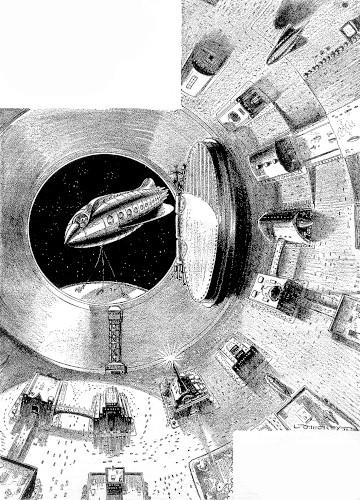
A huge metal valve swung open in it, revealing a bright space beyond.... An inner valve was opened, and Red Rover slipped into the City of Space.
They were, Bill saw, at the center of an enormous cylinder. The sides, half a mile away, above and below them, were covered with buildings along neat, tree-bordered streets, scattered with green lawns, tiny gardens, and bits of wooded park. It seemed very strange to Bill, to see these endless streets about the inside of a tube, so that one by walking a little over three miles in one direction would arrive again at the starting point, in the same way that one gets back to the starting point after going around the earth in one direction.
At the ends of the cylinder, fastened to the huge metal disks, which closed the ends, were elaborate and complex mechanisms, machines strange and massive. "They must be for heating the city," Bill thought, "and for purifying the air, for furnishing light and power, perhaps even for moving it about." The lock through which they had entered was part of this mechanism.
In the center of each end of the cylinder hung a huge light, seeming large and round as the sun, flooding the place with brilliant mellow rays.
"There are five thousand people here," said Captain Smith. "The Prince has always kept the best specimens among his captives, and others have been recruited besides. We are self-sustaining as the earth is. We use the power of the sun—through our vitalium batteries. We grow our own food. We utilize our waste products—matter here goes through a regular cycle of life and death as on the earth. Men eat food containing carbon, breathe in oxygen, and breathe out carbon dioxide; our plants break up the carbon dioxide, make more foods containing the same carbon, and give off the oxygen for men to breathe again. Our nitrogen, our oxygen and hydrogen, go through similar cycles. The power of the sun is all we need from outside."
Captain Smith guided his "guests" down the ladder, and out through the ship's air-lock. They entered an elevator. Three minutes later they stepped off upon the side of the great cylinder that housed the City, and entered a low building with a broad concrete road curving up before it. As they stepped out, it gave Bill a curious dizzy feeling to look up and see busy streets, inverted, a mile above his head. The road before them curved smoothly up on either hand, bordered with beautiful trees, until its ends met again above his head.
The centrifugal force that held objects against the sides of the cylinder acted in precisely the same way as gravity on the earth—except that it pulled away from the center of the cylinder, instead of toward it.
A glistening heliocar came skimming down upon whirling heliocopters, dropped to rubber tires, and rolled up beside them. A young man of military bearing, clad in a striking uniform of red, black, and gold, stepped out, saluted stiffly.
"Captain Smith," he said, "the Prince desires your attendance at his private office immediately with your guests."
Smith motioned Bill and Captain Brand into the richly upholstered body of the heliocar. Bill, gazing up at the end of the huge cylinder with a city inside it, caught sight, for the first time, of the exterior of the Red Rover, the ship that had brought them to the City of Space. It lay just beside the massive machinery of the air-lock, supported in a heavy metal cradle, with the elevator tube running straight from it to the building behind them.
"Look, Brand!" Bill gasped. "That isn't the blue globe. It isn't the ship we fought at all!"
Brand looked. The Red Rover was much the same sort of ship that the Fury had been. She was slender and tapering, cigar-shaped, some two hundred feet in length and twenty-five in diameter—nearly twice as large as the Fury. She was cylindrical, instead of octagonal, and she mounted twenty-four motor tubes, in two rings fore and aft, of twelve each, instead of eight.
Brand turned to Smith. "How's this?" he demanded. "Where is the blue globe? Did you have two ships?"
A smile flickered over Smith's stern face. "You have a revelation waiting for you. But it is better not to keep the Prince waiting."
They stepped into the heliocar. The pilot sprang to his place, set the electric motors whirring. The machine rolled easily forward, took the air on spinning helicopters. The road, lined with green gardens and bright cottages, dropped away "below" them, and other houses drew nearer "above." In the center of the cylinder the young man dextrously inverted the flier; and they continued on a straight line toward an imposing concrete building which now seemed "below."
The heliocar landed; they sprang out and approached the imposing building of several stories. Guards uniformed in scarlet, black and gold standing just outside the door held ray pistols in readiness. Smith hurried his "guests" past; they entered a long, high-ceilinged room. It gave a first impression of stately luxury. The walls were paneled with rich dark wood, hung with a few striking paintings. It was almost empty of furniture; a heavy desk stood alone toward the farther end. A tall young man rose from behind this desk, advanced rapidly to meet them.
"My guests, sir," said Smith. "Captain Brand of the Fury, and a reporter."
"The mysterious Mr. Cain!" Bill gasped.
Indeed, Mr. Cain stood before him, a tall man, slender and wiry, with a certain not unhandsome sternness in his dark face. A smile twinkled in his black, enigmatic eyes—which none the less looked as if they might easily flash with fierce authority.
"And Mr. Win——or, I believe you asked me to call you Bill. You seem a very hard man to evade!"
Still smiling enigmatically, Mr. Cain took Bill's hand, and then shook hands with Captain Brand.
"But—are you the Prince of Space?" Bill demanded.
"I am. Cain was only a nom de guerre, so to speak. Gentlemen, I welcome you to the City of Space!"
"And you kidnaped yourself?"
"My men brought the Red Rover for me."
"Dr. Trainor and his daughter——" Bill ejaculated.
"They are friends of mine. They are here."
"And that blue globe!" said Captain Brand. "What was that?"
"You saw the course it was following?"
"It was headed to intersect the orbit of the earth—and its direction was on a line that cuts the orbit of Mars where that planet was forty days ago."
The Prince turned to Bill. "And you have seen something like that blue globe before?"
"Why, yes. The little blue circle on Mars—that I saw through the great telescope on Trainor's Tower."
A sober smile flickered across the dark lean face of the Prince.
"Then, gentlemen, you should believe me. The earth is threatened with a dreadful danger from Mars. The blue globe that wrecked your fleet was a ship from Mars. It was another Martian flier that took the Helicon. I believe I have credit for that ghastly exploit of sucking out the passengers' blood." His smile became grimly humorous. "One of the consequences of my position."
"Martian fliers?" echoed Captain Brand. "Then how did we come to be on your ship?"
"I haven't any weapon that will meet those purple atomic bombs on equal terms—though we are now working out a new device. I had Smith cruising around the blue globe in our Red Rover to see what he could learn. He was investigating the wrecks, and found you alive."
"You really mean that men from Mars have come this near the earth?" Captain Brand was frankly incredulous.
"Not men," the Prince corrected, smiling. "But things from Mars have done it. They have already landed on earth, in fact."
He turned to the desk, picked up a broad sheet of cardboard.
"I have a color photograph here."
Bill studied it, saw that it looked like an aerial photograph of a vast stretch of mountain and desert, a monotonous expanse of gray, tinged with green and red.
"A photograph, taken from space, of part of the state of Chihuahua, Mexico. And see!"
He pointed to a little blue disk in the green-gray expanse of a plain, just below a narrow mountain ridge, with the fine green line that marked a river just beside it.
"That blue circle is the first ship that came. It was the things aboard it that sucked the blood out of the people on the Helicon."
Captain Brand was staring at the tall, smiling man, with a curious expression on his red, square-chinned face. Suddenly he spoke.
"Your Highness, or whatever we must call you——"
"Just call me Prince. Cain is not my name. Once I had a name—but now I am nameless!"
The thin dark face suddenly lined with pain, the lips closed in a narrow line. The Prince swept a hand across his high forehead, as if to sweep something unpleasant away.
"Well, Prince, I'm with you. That is, if you want an officer from the Moon Patrol." A sheepish smile overspread his bluff features. "I would have killed a man for suggesting that I would ever do such a thing. But I'll fight for you as well as I ever did for the honor of the Patrol."
"Thanks, Brand!" The Prince took his hand, smiling again.
"Count me in too, of course," said Bill.
"Both of you will be valuable men," said the Prince.
He picked up a sheaf of papers, scanned them quickly, seemed to mark off one item from a sheet and add another.
"The Red Rover sets out for the earth in one hour, gentlemen. We're going to try a surprise attack on that blue globe in the desert. You will both go aboard."
"And I'm going too!" A woman's voice, soft and a little husky, spoke beside them. Recognizing it, Bill turned to see Paula Trainor standing behind them, an eager smile on her elfinly beautiful face. Her amazing eyes were fixed upon the Prince, their brown depths filled, for the moment, with passionate wistful yearning.
"Why, no, Paula," the Prince said. "It's dangerous!"
Tears swam mistily in the golden orbs. "I will go! I must! I must!" The girl cried out the words, a sobbing catch in her voice.
"Very well, then," the Prince agreed, smiling absently. "You father will be along of course. But anything will be likely to happen."
"But you will be there in danger, too!" cried the girl.
"We start in an hour," said the Prince. "Smith, you may take Brand and Windsor back aboard the Red Rover."
"Curse his fatherly indifference!" Bill muttered under his breath as they walked out through the guarded door. "Can't he see that she loves him?"
Smith must have heard him, for he turned to him, spoke confidentially. "The Prince is a determined misogynist. I think an unfortunate love affair was what ruined his life—back on the earth. He left his history, even his name, behind him. I think a woman was the trouble. He won't look at a woman now."
They were outside again, startled anew by the amazing scene of a street of houses and gardens, that curved evenly up on either side of them and met above, so that men were moving about, head downward directly above them.
The heliocar was waiting. The three got aboard, were lifted and swiftly carried to the slender silver cylinder of the Red Rover, where it hung among the ponderous machinery of the air-lock, on the end of the huge cylinder that housed the amazing City of Space.
"I will show you your rooms," said Captain Smith. "And in an hour we are off to attack the Martians in Mexico."
CHAPTER IV
Vampires in the Desert
Forty hours later the Red Rover entered the atmosphere of the earth, above northern Mexico.
It was night, the desert was shrouded in blackness. The telescopes revealed only the lights at ranches scattered as thinly as they had been two centuries before.
Bill was in the bridge-room, with Captain Smith.
"The blue globe that destroyed your fleet has already landed here," Smith said. "We saw both of them before they slipped into the shadow of night. They were right together, and it seems that a white metal building has been set up between them."
"The Prince means to attack? In spite of those purple atomic bombs?" Bill seemed surprised.
"Yes. They are below a low mountain ridge. We land on the other side of the hill, a dozen miles off, and give 'em a surprise at dawn."
"We'd better be careful," Bill said doubtfully. "They're more likely to surprise us. If you had been in front of one of those little purple bombs, flying on the white ray!"
"We have a sort of rocket torpedo that Doc Trainor invented. The Prince means to try that on 'em."
The Red Rover dropped swiftly, with Smith's skilled hands on the controls. It seemed but a few minutes until the dark shadow of the earth beneath abruptly resolved itself into a level plain scattered with looming shapes that were clumps of mesquite and sagebrush. The slim silver cylinder came silently to rest upon the desert, beneath stars that shone clearly, though to Bill they seemed dim in comparison with the splendid wonders of space.
Three hours before dawn, five men slipped out through the air-lock. The Prince himself was the leader, with Captains Brand and Smith, Bill, and a young officer named Walker. Each man carried a searchlight and a positive ray pistol. And strapped upon the back of each was a rocket torpedo—a smooth, white metal tube, four feet long and as many inches thick, weighing some eighty pounds.
Dr. Trainor, kindly, bald-headed old scientist, was left in charge of the ship. He and his daughter came out of the air-lock into the darkness, to bid the five adventurers farewell.
"We should be back by night," said the Prince, his even white teeth flashing in the darkness. "Wait for us until then. If we don't come, return at once to the City of Space. I want no one to follow us, and no attempt made to rescue us if we don't come back. If we aren't back by tomorrow night we shall be dead."
"Very good, sir," Trainor nodded.
"I'm coming with you, then," Paula declared suddenly.
"Absolutely you are not!" cried the Prince. "Dr. Trainor, I command you not to let your daughter off the ship until we return."
Paula turned quickly away, a slim pillar of misty white in the darkness. Bill heard a little choking sound; he knew that she had burst into tears.
"I can't let you go off into such danger, without me!" she cried, almost hysterical. "I can't!"
The Prince swung a heavy torpedo higher on his shoulders, and strode off over bare gravel toward the low rocky slope of the mountain that lay to northward, faintly revealed in the light of the stars. The other four followed silently. The slender sunship, with the old scientist and his sobbing daughter outside the air-lock, quickly vanished behind them.
With only an occasional cautious flicker of the flashlights the five men picked their way over bare hard ground, among scattered clumps of mesquite. Presently they crossed a barren lava bed, clambering over huge blocks of twisted black volcanic rock. Up the slope of the mountain they struggled, sweating under heavy burdens, blundering into spiky cactus, stumbling over boulders and sagebrush.
When the silver and rose of dawn came in the purple eastern sky, the five lay on bare rock at the top of the low ridge, overlooking the flat, mesquite-covered valley beyond. The valley floor was a brownish green in the light of morning, the hills that rose far across it a hazy blue-gray, faintly tinged with green on age-worn slopes.
Like a string of emeralds dropped down the valley lay an endless wandering line of cottonwoods, of a light and vivid green that stood out from the somber plain. These trees traced the winding course of a stream, the Rio Casas Grandes.
Lying against the cottonwoods, and rising above their tops, were two great spheres of blue, gleaming like twin globes of lapis lazuli in the morning light. They were not far apart, and between them rose a curious domed structure of white, silvery metal.
Each of the five men lifted his heavy metal tube, leveled it across a boulder before him. The Prince, alert and smiling despite the dust and stain of the march through the desert, spoke to the others.
"This little tube along the top of the torpedo is a telescope sight. You will peer through, get the cross hairs squarely upon your target, and hold them there. Then press this nickeled lever. That starts the projectile inside the case to spinning so that inertia will hold it true. Then, being certain that the aim is correct, press the red button. The torpedo is thrown from the case by compressed air, and a positive ray mechanism drives it true to the target. When it strikes, about fifty pounds of Dr. Trainor's new explosive, trainite, will be set off.
"Walker, you and Windsor take the right globe. Smith and Brand, the left. I'll have a shot at that peculiar edifice between them."
Bill balanced his torpedo, peered through the telescope, and pressed the lever. The hum of a motor came from the heavy tube.
"All ready?" the Prince inquired.
"Ready," each man returned.
"Fire!"
Bill pressed the red button. The tube drove heavily backward in his hands, and then was but a light, sheet-metal shell. He saw a little gleam of white light before him, against the right blue globe, a diminishing point. It was the motor ray that drove the torpedo speeding toward its mark.
Great flares of orange light hid the two azure spheres and the white dome between them. The spheres and the dome crumpled and vanished, and a thin haze of bluish smoke swirled about them.
"Good shooting!" the Prince commented. "This motor torpedo of Trainor's ought to put a lot of the old fighting equipment in the museum—if we were disposed to bestow such a dangerous toy upon humanity.
"But let's get over and see what happened."
Grasping ray pistols, they sprang to their feet and plunged down the rocky slope. It was five miles to the river. Nearly two hours later it was, when the five men slipped out of the mesquites, to look two hundred yards across an open, grassy flat to the wall of green trees along the river.
Three great heaps of wreckage lay upon the flat. At the right and the left were crumpled masses of bright silver metal—evidently the remains of the globes. In the center was another pile of bent and twisted metal, which had been the domed building.
"Funny that those blue globes look like ordinary white metal now," said Smith.
"I wonder if the blue is not some sort of etheric screen?" Brand commented. "When we were fighting, our rays seemed to take no effect. It occurred to me that some vibratory wall might have stopped them."
"It's possible," the Prince agreed. "I'll take up the possibilities with Trainor. If they have such a screen, it might even be opaque to gravity. Quite a convenience in maneuvering a ship."
As they spoke, they were advancing cautiously, stopping to pick up bits of white metal that had been scattered about by the explosion.
Suddenly Bill's eyes caught movement from the pile of crumpled metal that had been the white dome. It seemed that a green plant was growing quickly from among the ruins. Green tendrils shot up amazingly. Then he saw on the end of a twisted stalk a glowing purple thing that looked somehow like an eye.
At first sight of the thing he had stopped in amazement, leveling his deadly ray pistol and shouting, "Look out!"
Before the shout had died in his throat, before the others had time to turn their heads, they caught the flash of metal among the twining green tentacles. The thing was lifting a metal object.
Then Bill saw a tiny purple spark dart from a bright little mechanism that the green tendrils held. He saw a blinding flash of violet light. His consciousness was cut off abruptly.
The next he knew he was lying on his back on rocky soil. He felt considerably bruised and battered, and his right eye was swollen so that he could not open it. Struggling to a sitting position, he found his hands and feet bound by bloody manacles of unfamiliar design. Captain Brand was lying on his elbow beside him, half under the thin shade of a mesquite bush. Brand looked much torn and disheveled; blood was streaming across his face from a gash in his scalp. His hands and feet also were bound with fetters of white metal.
"What happened?" Bill called dazedly.
"Not so loud," Brand whispered. "The thing—a Martian left alive, I guess it is. Must have been somewhere out in the brush when we shot. It blew us up with an atomic bomb. Smith and Walker dead—blown to pieces."
"And the Prince?"
"I can speak for myself."
Hearing the familiar low voice, Bill turned. He saw the Prince squatted down, in the blazing sunshine, hands and feet manacled, hat off and face covered with blood and grime.
"Was it that—that green thing?" Bill asked.
"Looks like a sort of animated plant," said the Prince. "A bunch of green tentacles, that it uses for hands. Three purple eyes on green stalks. Just enough of a body to join it all together. Not like anything I ever saw. But the Martians, originating under different conditions, ought to be different."
"What is going to happen now?" Bill inquired.
"Probably it will suck our blood—as it did to the passengers of the Helicon," Brand suggested grimly.
Windsor fell silent. It was almost noon. The desert sun was very hot. The motionless air was oppressive with a dry, parching heat; and flies buzzed annoyingly about his bleeding cuts. Wrists and ankles ached under the cruel pressure of the manacles.
"Wish the thing would come back, and end the suspense," Brand muttered.
Bill reflected with satisfaction that he had no relatives to be saddened by his demise. He had no great fear of death. Newspaper work in the twenty-second century is not all commonplace monotony; your veteran reporter is pretty well inured to danger.
"Glad I haven't anyone to worry about me," he observed.
"So am I," the Prince said bitterly. "I left them all, years ago."
"But you have someone!" Bill cried. "It isn't my business to say it, but that makes no difference now. And you're a fool not to know. Paula Trainor loves you! This will kill her!"
The Prince looked up, a bitter smile visible behind the bloody grime on his thin dark face.
"Paula—in love with me! We're friends, of course. But love! I used to believe in love. I have not been always a nameless outcast of space. Once I had name, family—even wealth and position. I trusted my name and my honor to a beautiful woman. I loved her! She said she loved me—I thought she meant it. She used me for a tool. I was trustful; she was clever."
The dark eyes of the Prince burned in fierce anger.
"When she was through with me she left me to die in disgrace. I barely escaped with my life. She had robbed me of my name, wealth, position. She named me the outlaw. She made me appear a traitor to those who trusted me—then laughed at me. She laughed at me and called me a fool. I was—but I won't be again!"
"At first I was filled with anger at the whole world, at the unjust laws and the silly conventions and the cruel intolerance of men. I became the pirate of space. A pariah. Fighting against my own kind. Struggling desperately for power."
For a few moments he was moodily silent, slapping at the flies that buzzed around his bloody wounds.
"I gained power. And I learned of the dangers from Mars. First I was glad. Glad to see the race of man swept out. Parasites men seemed. Insects. Life—what is it but a kind of decay on a mote in space? Then I got a saner view, and built the City of Space, to save a few men. Then because the few seemed to have noble qualities, I resolved to try to save the world.
"But it is too late. We have lost. And I have had enough of love, enough of women, with their soft, alluring bodies, and the sweet lying voices, and the heartless scheming."
The Prince fell into black silence, motionless, heedless of the flies that swarmed about him. Presently Brand contrived, despite his manacles, to fish a packet of cigarettes from his pocket, extract one, and tossed the others to Bill, who managed to light one for the Prince. The three battered men sat in dazzling sun and blistering heat, smoking and trying to forget heat and flies and torturing manacles—and the death that loomed so near.
It was early noon when Bill heard a little rustling beyond the mesquites. In a moment the Martian appeared. A grotesque and terrifying being it was. Scores of green tentacles, slender and writhing, grew from an insignificant body. Three lidless, purple eyes, staring, alien, and malevolent, watched them alertly from foot-long green stalks that rose above the body. The creature half walked on tentacles extended below it, half dragged itself along by green appendages that reached out to grasp mesquite limbs above it. One inch-thick coil carried a curious instrument of glittering crystal and white metal—it was a strange, gleaming thing, remotely like a ray pistol. And fastened about another tentacle was a little metal ring, from which an odd-looking little bar dangled.
The thing came straight for the Prince. Bill screamed a warning. The Prince saw it, twisted himself over on the ground, tried desperately to crawl away. The thing reached out a slender tentacle, many yards long. It grasped him about the neck, drew him back.
In a moment the dreadful being was crouching in a writhing green mass above the body of the manacled man. Once he screamed piteously, then there was no sound save loud, gasping breaths. His muscles knotted as he struggled in agony against the fetters and the coils of the monster.
Bill and Captain Brand lay there, unable either to escape or to give assistance. In silent horror they watched the scene. They saw that each slender green tentacle ended in a sharp-edged suction disk. They watched the disks forcing themselves against the throat of the agonized man, tearing a way through his clothing to his body. They saw constrictions move down the rubber-like green tentacles as if they were sucking, while red drops oozed out about the edge of the disks.
"Our turn next," muttered Captain Brand.
"And after us, the world!" Bill breathed, tense with horror.
A narrow, white beam, blindingly brilliant, flashed from beyond the dull green foliage of the mesquite. It struck the crouching monster waveringly. Without a sound, it leapt, flinging itself aside from the body of the Prince. It raised its curious weapon. A tiny purple spark darted from it.
A shattering crash rang out at a little distance. There was a thin scream—a woman's scream.
Then the white ray stabbed at the monster again, and it collapsed in a twitching heap of thin green coils, upon the still body of the Prince.
A slender girl rushed out of the brush, tossed aside a ray pistol, and flung herself upon the monster, trying to drag it from the Prince. It was Paula Trainor. Her clothing was torn. Her skin was scratched and bleeding from miles of running through the desert of rocks and cactus and thorny mesquite. She was evidently exhausted. But she flung herself with desperate energy to the rescue of the injured man.
The body of the dead thing was light enough. But the sucking disks still clung to the flesh. They pulled and tore it when she tugged at them. She struggled desperately to drag them loose, by turns sobbing and laughing hysterically.
"If you can help us get loose, we might help," Bill suggested.
The girl raised a piteous face. "Oh, Mr. Bill—Captain Brand! Is he dead?"
"I think not, Miss Paula. The thing had just jumped on him. Buck up!"
"See the little bar—it looks like a sliver of aluminum—fastened to the metal ring about that coil?" Brand said. "It might be the key for these chains. End of it seems to be shaped about right. Suppose you try it?"
In nervous haste, the girl tore the little bar from its ring. With Brand's aid, she was able to unlock his fetters. The Captain lost no time in freeing Bill and removing the manacles from the unconscious Prince.
The thin, rubber-like tentacles could not be torn loose. Brand cut them with his knife. He found them tough and fibrous. Red blood flowed from them when they were severed.
Bill carried the injured man down to the shade of the cottonwoods, brought water to him in a hat from the muddy little stream below. In a few minutes he was conscious, though weak from loss of blood.
Captain Brand, after satisfying himself that Paula had killed the Martian, and that it was the only one that had survived in the wreckage of the blue globes and the metal dome, set off to cross the mountain and bring back the sunship.
When the Red Rover came into view late that evening, a beautiful slender bar of silver against the pyrotechnic gold and scarlet splendor of the desert sunset, the Prince of Space was hobbling about, supported on Bill's arm, examining the wreckage of the Martian fliers.
Paula was hovering eagerly about him, anxious to aid him. Bill noticed the pain and despair that clouded her brown eyes. She had been holding the Prince's head in her arms when he regained consciousness. Her lips had been very close to his, and bright tears were brimming in her golden eyes.
Bill had seen the Prince push her away, then thank her gruffly when he had found what she had done.
"Paula, you have done a great thing for the world," Bill had heard him say.
"It wasn't the world at all! It was for you!" the girl had cried, tearfully.
She had turned away, to hide her tears. And the Prince had said nothing more.
The Red Rover landed beside the wreckage of the Martian fliers. After a few hours spent in examining and photographing the wrecks, in taking specimens of the white alloy of which they were built, and of other substances used in the construction, they all went back on the sunship, taking the dead Martian and other objects for further study. Brand took off for the upper atmosphere.
"Captain Brand," the Prince said as they stood in the bridge-room, "since the death of poor Captain Smith this morning, I believe you are the most skillful sunship officer in my organization. Hereafter you are in command of the Red Rover, with Harris and Vincent as your officers.
"We have a huge task before us. The victory we have won is but the first hand in the game that decides the fate of Earth."
CHAPTER V
The Triton's Treasure
"I must have at least two tons of vitalium," the Prince of Space told Bill, when the newspaperman came to the bridge of the Red Rover after twenty hours in the bunk. The Prince was pale and weak from loss of blood, but seemed to suffer no other ill effects from his encounter with the Martian.
"Two tons of vitalium!" Bill exclaimed. "A small demand! I doubt if there is that much on the market, if you had all the Confederation's treasury to buy it with."
"I must have it, and at once! I am going to fit out the Red Rover for a voyage to Mars. It will take that much vitalium for the batteries."
"We are going to Mars!"
"The only hope for humanity is for us to strike first and to strike hard!"
"If the world knew of the danger, we could get help."
"That's where you come in. I told you that I should need publicity. It is your business to tell the public about things. I want you to tell humanity about the danger from Mars. Make it convincing and make it strong! Say anything you like so long as you leave the Prince of Space out of it. I have the body of the Martian that attacked me preserved in alcohol. You have that and the wreckage in the desert to substantiate your story. I will land you at Trainor's Tower in New York tonight. You will have twenty-four hours to convince the world, and raise two tons of vitalium. It has to be done!"
"A big order," Bill said doubtfully. "But I'll do my best."
The city was a bright carpet of twinkling lights when the Red Rover darted down out of a black sky, hovering for a moment over Trainor's Tower. When it flashed away, Bill was standing alone on top of the loftiest building on earth, in his pocket a sheaf of manuscript on which he had been at work for many hours, beside him a bulky package that contained the preserved body of the weird monster from Mars.
He opened the trapdoor—which was conveniently unlocked—took up the package, and clambered down a ladder into the observatory. An intent man was busy at the great telescope—which pointed toward the red planet Mars. The man looked understandingly at Bill, and nodded toward the elevator.
In half an hour Bill was exhibiting his package and his manuscript to the night editor of the Herald-Sun.
"The greatest news in the century!" he cried. "The Earth attacked by Mars! It was a Martian ship that took the Helicon. I have one of the dead creatures from Mars in this box."
The astounded editor formed a quick opinion that his star reporter had met with some terrifying experience that had unsettled his brain. He listened skeptically while Bill related a true enough account of the cruise of the Moon Patrol ships, and of the battle with the blue globe. Bill omitted any mention of the City of Space and its enigmatic ruler; but let it be assumed that the Fury had rammed the globe and that it had fallen in the desert. He ended with a wholly fictitious account of how a mysterious scientist had picked him up in a sunship, had told him of the invaders from Mars, and had sent him to collect two tons of vitalium to equip his ship for a raid on Mars. Bill had spent many hours in planning his story; he was sure that it sounded as plausible as the amazing reality of the Prince of Space and his wonderful city.
The skeptical editor was finally convinced, as much by his faith in Bill's probity as by the body of the green monster, the scraps of a strange white metal, and the photographs, which he presented as material evidence. The editor radioed to have a plane sent from El Paso, Texas, to investigate the wrecks. When it was reported that they were just as Bill had said, the Herald-Sun issued an extra, which carried Bill's full account, with photographs of the dead monster, and scientific accounts of the other evidence. There was an appeal for two tons of vitalium, to enable the unknown scientist to save the world by making a raid on Mars.
The story created an enormous sensation all over the world. A good many people believed it. The Herald-Sun actually received half a million eagles in subscriptions to buy the vitalium—a sum sufficient to purchase about eleven ounces of that precious metal.
Most of the world laughed. It was charged that Bill was insane. It was charged that the Herald-Sun was attempting to expand its circulation by a baseless canard. Worse, it was charged that Bill, perhaps in complicity with the management of the great newspaper, was making the discovery of a new sort of creature in some far corner of the world the basis for a gigantic fraud, to secure that vast amount of vitalium.
Examination proved that the wrecks in the desert had been demolished by explosion instead of by falling. A court injunction was filed against the Herald-Sun to prevent collection of the subscriptions, and Bill might have been arrested, if he had not wisely retired to Trainor's Tower.
Finally, it was charged that the pirate, the Prince of Space, was at the bottom of it—possibly the charge was suggested by the fact that the chief object of the Prince's raids had always been vitalium. A rival paper asserted that the pirate must have captured Bill and sent him back to Earth with this fraud.
Public excitement became so great that the reward for the capture of the Prince of Space, dead or alive, was raised from ten to fifteen million eagles.
Twenty-four hours later after he had been landed on Trainor's Tower, Bill was waiting there again, with bright stars above him, and the carpet of fire that was New York spread in great squares beneath him. The slim silver ship came gliding down, and hung just beside the vitrolite dome while eager hands helped him through the air-lock. Beyond, he found the Prince waiting, with a question in his eyes.
"No luck," Bill grunted hopelessly. "Nobody believed it. And the town was getting too hot for me. Lucky I had a getaway."
The Prince smiled bitterly as the newspaperman told of his attempt to enlist the aid of humanity.
"About what I expected," he said. "Men will act like men. It might be better, in the history of the cosmos, to let the Martians have this old world. They might make something better of it. But I am going to give humanity a chance—if I can. Perhaps man will develop into something better, in a million years."
"Then there is still a chance—without the vitalium?" Bill asked eagerly.
"Not without vitalium. We have to go to Mars. We must have the metal to fit our flier for the trip. But I have needed vitalium before; when I could not buy it. I took it."
"You mean—piracy!" Bill gasped.
"Am I not the Prince of Space—'notorious interplanetary outlaw' as you have termed me in your paper? And is not the good of the many more than the good of the few? May I not take a few pounds of metal from a rich corporation, to save the earth for humanity?"
"I told you to count me in," said Bill. "The idea was just a little revolutionary."
"We haven't wasted any time while you were in New York. I have means of keeping posted on the shipments of vitalium from the moon. We have found that the sunship Triton leaves the moon in about twenty hours, with three months production of the vitalium mines in the Kepler crater. It should be well over two tons."
Thirty hours later the Red Rover was drifting at rest in the lunar lane, with ray tubes dead and no light showing. Men at her telescopes scanned the heavens moonward for sight of the white repulsion rays of the Triton and her convoy.
Bill was with Captain Brand in the bridge-room. Eager light flashed in Brand's eyes as he peered through the telescopes, watched his instruments, and spoke brisk orders into the tube.
"How does it feel to be a pirate?" Bill asked, "after so many years spent hunting them down?"
Captain Brand grinned. "You know," he said, "I've wanted to be a buccaneer ever since I was about four years old. I couldn't, of course, so I took the next best thing, and hunted them. I'm not exactly grieving my heart out over what has happened. But I feel sorry for my old pals of the Moon Patrol. Somebody is going to get hurt!"
"And it may be we," said Bill. "The Triton will be convoyed by several war-fliers, and she can fight with her own rays. It looks to me like a hard nut to crack."
"I used to dream about how I would take a ship if I were the Prince of Space," said Captain Brand. "I've just been talking our course of action over with him. We've agreed on a plan."
In an hour the Prince and Dr. Trainor entered the bridge. Paula appeared in a few moments. Her face was drawn and pale; unhappiness cast a shadow in her brown eyes. Eagerly, she asked the Prince how he was feeling.
"Oh, about as well as ever, thanks," the lean young man replied in a careless voice. His dark, enigmatic eyes fell upon her face. He must have noticed her pallor and evident unhappiness. He met her eyes for a moment, then took a quick step toward her. Bill saw a great tenderness almost breaking past the bitter cynicism in those dark eyes. Then the Prince checked himself, spoke shortly:
"We are preparing for action, Paula. Perhaps you should go back to your stateroom until it is over."
The girl turned silently and moved out of the room. Bill thought she would have tottered and fallen if there had been enough gravity or acceleration to make one fall.
In a few minutes a little group of flickering lights appeared among the stars ahead, just beside the huge, crater-scarred, golden disk of the moon.
"The Triton and her convoy!" shouted the men at the telescopes.
"All men to their stations, and clear the ship for action!" Captain Brand gave the order.
"Two Moon Patrol sunships are ahead, cruising fifty miles apart," came the word from the telescope. "A hundred miles behind them is the Triton, with two more Patrol fliers twenty-five miles behind her and fifty miles apart."
Brand spoke to the Prince, who nodded. And Brand gave the order.
"Show no lights. Work the ship around with the gyroscopes until our rear battery of tubes will cover the right Patrol ship of the leading pair, and our bow tubes the other."
The whir of the electric motors came from below. The fliers swung about, hanging still in the path of the approaching Triton.
"All ready, sir," came a voice from the tube.
A few anxious minutes went by. Then the Red Rover, dark and silent, was hanging squarely between the two forward Patrol ships, about twenty-five miles from each of them.
"Fire constantly with all tubes, fore and aft, until the enemy appears to be disabled," Brand gave the order. The Prince spoke to him, and he added, "Inflict no unnecessary damage."
Dazzling white rays flashed from the tubes. Swiftly, they found the two forward sunships. The slender octagons of silver shone white under the rays. They reeled, whirled about, end over end, under the terrific pressure of atomic bombardment. In a moment they glowed with dull red incandescence, swiftly became white. A bluish haze spread about them—the discharge of the electric energy carried by the atoms, which would electrocute any man not insulated against it.
From the three other ships flaming white rays darted, searching for the Red Rover. But they had hardly found the mark when Brand ordered his rays snapped out. The two vessels he had struck were but whirling masses of incandescent wreckage—completely out of the battle, though most of the men aboard them still survived in their insulated cells.
The Prince himself spoke into the tube. "Maneuver number forty-one. Drive for the Triton."
Driven by alternate burst from front and rear motor tubes, the Red Rover started a curiously irregular course toward the treasure ship. Spinning end over end, describing irregular curves, she must have been an almost impossible target.
And twice during each spin, when her axis was in line with the Triton, all tubes were fired for an instant, striking the treasure ship with a force that reeled and staggered her, leaving her plates half-fused, twisted and broken.
Three times a ray caught the Red Rover for an instant, but her amazing maneuvers, which had evidently been long practised by her crew, carried her on a course so erratic and puzzling that the few rays that found her were soon shaken off.
Before the pirate flier reached the Triton, the treasure vessel was drifting helpless, with all rays out. The Red Rover passed by her, continuing on her dizzily whirling course until she was directly between the two remaining fliers.
"Hold her still," the Prince then shouted into the tube. "And fire all rays, fore and aft."
Blinding opalescent rays jetted viciously from the two rings of tubes. Since the Red Rover lay between the two vessels, they could not avoid firing upon each other. Her own rays, being fired in opposite directions, served to balance each other and hold her at rest, while the rays of the enemy, as well as those of the pirate that impinged upon them, tended to send them into spinning flight through space.
Blinding fluorescence obscured the vitrolite panels, and the stout walls of the Red Rover groaned beneath the pressure of the hail of atoms upon them. Swiftly they would heat, soften, collapse. Or the insulation would burn away and the electric charge electrocute her passengers.
The enemy was in a state as bad. The white beams of the pirate flier had found them earlier, and could be held upon them more efficiently. It was a contest of endurance.
Suddenly the jets of opalescence snapped off the pirate. Bill, gazing out into star-dusted space, saw the two Patrol vessels spinning in mad flight before the pressure of the rays, glowing white in incandescent twisted ruin.
A few minutes later the Red Rover was drifting beside the Triton holding the wrecked treasure-flier with electromagnetic plates. The air-lock of the pirate vessel opened to release a dozen men in metal vacuum suits, armed with ray pistols and equipped with wrecking tools and oxygen lances. The Prince was their leader.
They forced the air-lock of the Triton, and entered the wreck. In a few minutes grotesque metal-suited figures appeared again, carrying heavy leaden tubes filled with the precious vitalium.
The Red Rover was speeding into space, an hour later, under full power. The Prince of Space was in the bridge-room, with Bill, Captain Brand, Dr. Trainor, and Paula. Bill noticed that the girl seemed pathetically joyous at the Prince's safety, though he gave her scant attention.
"We have the two tons of vitalium," said the Prince. "Nearly forty-six hundred pounds, in fact. Easily enough to furnish power for the voyage to Mars. We have the metal—provided we can get away with it."
"Is there still danger?" Paula inquired nervously.
"Yes. Most of the passengers of the Triton were still alive. When I gave her captain my card, he told me that they sent a heliographic S.O.S. as soon as we attacked. Some forty or fifty fliers of the Moon Patrol will be hot on our trail."
The Red Rover flew on into space, under all her power. Presently the lookouts picked up a score of tiny flickering points of light behind them. The Moon Patrol was in hot pursuit.
"Old friends of mine," said Captain Brand. "Every one of them would give his life to see us caught. And I suppose every one of them feels now that he has a slice of that fifteen million eagles reward! The Moon Patrol never gives up and never admits defeat."
Tense, anxious hours went by while every battery was delivering its maximum current, and every motor tube was operating at its absolutely highest potential.
Paula waited on the bridge, anxiously solicitous for the Prince's health—he was still pale and weak from the adventure in the desert. Presently, evidently noticing how tired and worried she looked, he sent her to her stateroom to rest. She went, in tears.
"No chance to fight, if they run us down," said Captain Brand. "We can handle four, but not forty."
Time dragged heavily. The Red Rover flew out into space, past the moon, on such a course as would not draw pursuit toward the City of Space. Her maximum acceleration was slightly greater than that of the Moon Patrol fliers, because of the greater number and power of her motor tubes. Steadily she forged away from her pursuers.
At last the flickering lights behind could be seen no longer.
But the Red Rover continued in a straight line, at the top of her speed, for many hours, before she turned and slipped cautiously toward the secret City of Space. She reached it in safety, was let through the air-lock. Once more Bill looked out upon the amazing city upon the inner wall of a spinning cylinder. He enjoyed the remarkable experience of a walk along a street three miles in length, which brought him up in an unbroken curve, and back to where he had started.
It took a week to refit the Red Rover, in preparation for the voyage to Mars. Her motor ray tubes were rebuilt, and additional vitalium generators installed. The precious metal taken from the Triton was built into new batteries to supply power for the long voyage. Good stocks of food, water, and compressed oxygen were taken aboard, as well as weapons and scientific equipment of all variety.
"We start for Mars in thirty minutes," Captain Brand told Bill when the warning gong had called him and the others aboard.
CHAPTER VI
The Red Star of War
The Red Rover slipped out through the great air-lock of the City of Space, and put her bow toward Mars. The star of the war-god hung before her in the silver-dusted darkness of the faint constellation of Capricornus, a tiny brilliant disk of ocherous red. The Prince of Space, outlawed by the world of his birth, was hurtling out through space in a mad attempt to save that world from the horrors of Martian invasion.
The red point that was Mars hung almost above them, it seemed, almost in the center of the vitrolite dome of the bridge. "We are not heading directly for the planet," Captain Brand told Bill. "Its orbital velocity must be considered. We are moving toward the point that it will occupy in twenty days."
"We can make it in twenty days? Three million miles a day?"
"Easily, if the vitalium holds out, and if we don't collide with a meteorite. There is no limit to speed in space, certainly no practical limit. Acceleration is the important question."
"We may collide with a meteorite you say? Is there much danger?"
"A good deal. The meteorites travel in swarms which follow regular orbits about the sun. We have accurate charts of the swarms whose orbits cross those of the earth and moon. Now we are entering unexplored territory. And most of them are so small, of course, that no telescope would reveal them in time. Merely little pebbles, moving with a speed about a dozen times that of a bullet from an old-fashioned rifle."
"And what are we going to do if we live to get to Mars?"
"A big question!" Brand grinned. "We could hardly mop up a whole planet with the motor rays. Trainor has a few of his rocket torpedoes, but not enough to make much impression upon a belligerent planet. The Prince and Trainor have a laboratory rigged up down below. They are doing a lot of work. A new weapon, I understand. I don't know what will come of it."
Presently Bill found his way down the ladder to the laboratory. He found the Prince of Space and Dr. Trainor hard at work. He learned little by watching them, save that they were experimenting upon small animals, green plants, and samples of the rare vitalium. High tension electricity, electron tubes, and various rays seemed to be in use.
Noticing his interest, the Prince said, "You know that vitalium was first discovered in vitamins, in infinitesimal quantities. The metal seems to be at the basis of all life. It is the trace of vitalium in chlorophyl which enables the green leaves of plants to utilize the energy of sunlight. We are trying to determine the nature of the essential force of life—we know that the question is bound up with the radioactivity of vitalium. We have made a good deal of progress, and complete success would give us a powerful instrumentality."