THE POST-OFFICE IN NEW YORK
Reading edition
List of New York City postmasters from 1687 to date: William Bogardus April 4, 1687 Henry Sharpas April 4, 1692 Richard Nichol (Postmaster in 1732) Alexander Colden (Postmaster in 1753-75) Ebenezer Hazard October 5, 1775 William Bedloe (Postmaster in 1785, appointed after close of Revolutionary War) Sebastian Bauman February 16, 1796 Josias Ten Eyck January 1, 1804 Theodorus Bailey April 2, 1804 Samuel L. Gouverneur November 19, 1828 Jonathan I. Coddington July 5, 1836 John L. Graham March 14, 1842 Robert H. Morris May 3, 1845 William V. Brady May 14, 1849 Isaac V. Fowler April 1, 1853 John A. Dix May 17, 1860 William B. Taylor January 16, 1861 Abram Wakeman March 21, 1862 James Kelly September 19, 1864 Patrick H. Jones April 27, 1869 Thomas L. James March 17, 1873 Henry G. Pearson April 1, 1881 Thomas L. James (acting) April 21, 1889 Cornelius Van Cott May 1, 1889 Charles W. Dayton July 1, 1893 Cornelius Van Cott May 23, 1897 Edward M. Morgan (acting) October 26, 1904 William R. Willcox January 1, 1905 Edward M. Morgan (acting) July 1, 1907 Edward M. Morgan September 1, 1907 Edward M. Morgan (reappointed) December 14, 1911 Robert F. Wagner April 22, 1916. Declined Thomas G. Patten March 16, 1917 Edward M. Morgan (reappointed) July 1, 1921
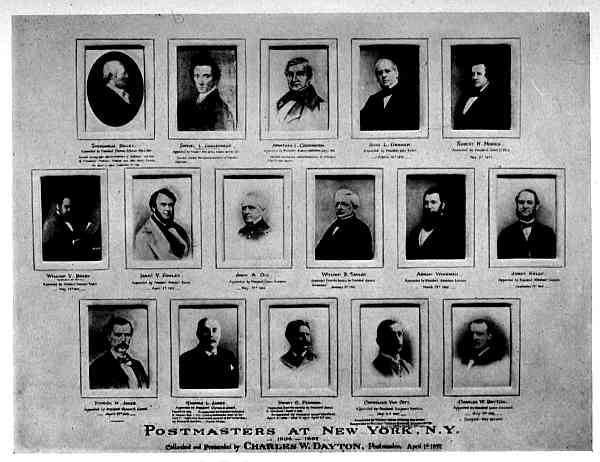

Some of the Early Postmasters of New York City.
Early New York
The first ships which arrived after the settlement of New York as New Amsterdam brought letters, and the first post-office, such as it was, began to function about the time the city was founded.
When vessels arrived, those letters relating to the cargoes were delivered to merchants; persons who welcomed the ships received their letters by hand. If a letter was unclaimed, it was left with a responsible private citizen until called for.
In time a system of voluntary distribution was developed, which became known as the "Coffee House Delivery." It was naturally popular and continued for over a century. At first this method of delivery was used by vessels and by people from distant points who left their mail for delivery at some well-known tavern. Here it reposed in a box accessible to all, or it was tacked to the surface of a smooth board with tape or brass-headed nails and placed in a conspicuous part of the tavern.
In the year 1710 the postmaster-general of Great Britain designated a "chief letter office" in the City of New York, Philadelphia having been the headquarters of the Colonial organization up to that time. In the following year arrangements were completed for the delivery of Boston mail twice a month, and a foot-post to Albany was proposed.
In 1740 a complete road was blazed from Paulus Hook, Jersey City, to Philadelphia, over which the mail was carried on horseback between Philadelphia and New York.
Alexander Colden was postmaster here at the time of the Revolution, but when the British troops took possession of New York, the office was abolished by the provost-marshal and for seven years little correspondence not connected with the movement of troops was handled.
William Bedloe, after whom Bedloe's Island was named, was the first postmaster after the war, but in 1786 Sebastian Bauman succeeded him.
The New York General Post-office To-day
The world's greatest post-office to-day is the New York General Post-office, located at Eighth Avenue and West 33d Street, but a short block from the West Side Office of the Manufacturers Trust Company, and we are glad to be able to include in this booklet a message to our readers from Hon. E. M. Morgan, Postmaster, who directs the activities of that great organization.