ADDENDA.
Reading edition
Since the Catalogue was printed, the members of the Committee entrusted with its publication have had the opportunity of consulting The Halifax Philatelist for the current year (1889), the numbers of which had not previously been seen by them.
The May number contains a copy of a recently-published Canadian postal notice, referring to certain alterations in the rates, &c.; and in the numbers for January and February Mr. Donald A. King has two further papers upon the stamps of Nova Scotia; while the April number contains a letter from a correspondent upon the bisected stamp of New Brunswick. The Committee consider it advisable to reproduce here all the four articles mentioned, feeling sure their contents will be of interest to philatelists, and help to add further to the completeness of the postal history of each of the provinces.
CANADA.
“The Canada Two Cent Registration Stamp will soon be a thing of the past. The following is the official order in connection with it:
“‘NOTICE TO THE PUBLIC.
“‘Changes in Postage Rates under Authority of Post Office Act, 1889.
“‘The rate of postage upon Letters posted in Canada, addressed to places within the Dominion or in the United States, will be three cents per ounce instead of three cents per half ounce as heretofore.
“‘Upon drop Letters posted at an office from which Letters are delivered by letter carrier, the postage rate will be two cents per ounce instead of one cent per half ounce. The rate of postage upon drop Letters, except in the cities, where free delivery by letter carrier has been established, will be one cent per ounce.
“‘The fee for the registration of a Letter or other article of mail matter will be five cents upon all classes of correspondence passing within the Dominion. For the present, and until further instructed, the registration fee may be prepaid by using the two cent registration stamps and postage stamps to make up the amount.
“‘Letters insufficiently prepaid will be charged double the deficiency as heretofore, provided at least a partial prepayment has been made.
“‘Letters posted wholly unpaid will be sent to the Dead Letter Office for return to the writer.
“‘John G. Haggart, Postmaster-General.
“‘Post Office Department, Ottawa, 8th May, 1889.’”
NEW BRUNSWICK.
“COMMENTS ON THE SPLIT STAMPS OF NEW BRUNSWICK.
“(To the Editor of ‘The Halifax Philatelist.’)
“Having examined your plate of Nova Scotia split stamps and oddities, I would like to mention a few notes on the split or provincial stamps of New Brunswick. In the catalogue list of the Nova Scotia Philatelic Association I find that there are but two of these split or provisional stamps offered, both Nova Scotia Six Pence, cut diagonally and used as Three Pence, and not one split New Brunswick.
“To all appearances, and from what I can learn, I think there were very few of these provisional stamps of New Brunswick used, and therefore they are very rare. I have never seen but three or four on the original envelopes, and have but two in my collection—a Ten Cent, vermilion, New Brunswick, cut in half vertically, and used as a Five Cent stamp. It is on the original envelope, and is postmarked ‘St. John, Nov. 5, 1860,’ and ‘Kingston, Nov. 6, 1860.’ I have also heard of the Ten Cent, vermilion, being cut diagonally instead of vertically, but have not seen any so used.
“As the second issue of New Brunswick first came into use in 1860, I presume the supply of Five Cent stamps ran short, and thus suggested the splitting of the Ten Cent, vermilion, stamps.
“I have also heard of the Six Penny stamps being cut both diagonally and horizontally, and used as Three Penny, but have not seen but one so used.
“Can any of my brother collectors tell what rate was charged for single or double letters to Australia in 1860? On the 9th of this month I received from New Brunswick an envelope which had been sent out to Melbourne, Australia, in 1860. It was mailed at Kingston, N.B., in May, 1860, and went viâ London. On the envelope, which is yellow, are a One Shilling, violet, and one half of a Six Pence, yellow, cut in half diagonally, and presumably used as Three Pence, making a total of fifteen pence, quite a high rate for a single letter, as such I presume it to be. The Six Penny stamp is very bright, but the One Shilling is somewhat faded.
“I would like to know if any of the readers of The Halifax Philatelist have ever seen any of the high values thus combined, as I think they are very rare, and should occupy a prominent place in the representation of New Brunswick stamps in all collections.
Fred. Northrup, Port Jervis, N. Y.
“[The split stamps of New Brunswick are no doubt scarce, but they are not more so than any of the other B. N. A. Provinces. Canada seems to be the only one which did not do this, as split stamps from there are very scarce. The rate on a half-ounce Letter from Nova Scotia to Victoria was one shilling and threepence, and we presume it was the same from New Brunswick.—Editor of The Halifax Philatelist.]”
From the above letter, we can therefore add the following at the bottom of the issue of May 13th, 1860, on page 30 of the Catalogue:
Variety.—The Ten Cents is known cut in two diagonally, and also vertically.
5 c. (half 10 c.), scarlet-vermilion.
NOVA SCOTIA.
“SOME OFFICIAL DOCUMENTS RELATING TO THE FIRST ISSUE OF NOVA SCOTIA STAMPS.
“The postal service of the British-American provinces, until the year 1851, was directly under the control of the English Post Office Department. This, with the high rate of postage, the insufficient mail accommodation, and the stringent laws against a private person carrying or delivering a Letter on the post road, was the cause of innumerable complaints on the part of the Colonies, and gave the English Post Office officials the trouble of sending out long despatches.
“The Colonies complained that the English Post Office took a large amount of revenue, derived from the postal service, which the Colonies were not able to lose out of the country. The English officials said that there was an annual deficit in Nova Scotia alone of £2,000 per annum. This state of things existed for years, and every annual report of the Post Office Commissioners which was laid on the table of the local Legislature was full of complaints under this head. To give a specimen from one of the reports of these Post Office Commissions, the following is extracted from their annual report for the year 1844 in Nova Scotia. After speaking in favour of a large reduction in postal rates, they say: ‘This, with the use of post stamps from dies authorized by the proper authorities, would render the transit of Letters and Papers less complicated, and give the relief required by the people.’
“To this no answer was returned till some time in 1845, when a long despatch was received from the Postmaster-General of Great Britain, Lord Lonsdale, who thus gives his Department’s views of the issue of postage stamps for Nova Scotia as follows: ‘The suggestion that postage stamps for Letters should be introduced into Nova Scotia is one which I cannot recommend your lordship (Viscount Falkland, then Governor of Nova Scotia) to entertain, as I cannot but consider that considerable objections exist to such a measure, and particularly from the facility which it would afford to the circulation of forged stamps, with but little chance of detection; while it is believed that the offence, if committed in the United Kingdom, could not be punished in the Colony, while on the other hand if committed in the Colony it could be visited with no penalty on parties in the United Kingdom.’ This will give some idea of the narrow-mindedness of the English postal administration of that time.
“As a specimen of the postal accommodation of the province, see this: From Halifax to Truro, by the coach road, was a distance of eighty-three miles, and between those two points there were only two post-offices for all the people between these places. The mail couriers were not allowed to deliver mail on the way.
“At last by a united effort of all the Colonies (Canada, New Brunswick, Nova Scotia, Newfoundland, and P. E. Island), the English Government turned over the postal administration to the different provincial governments. From this date (July 1st, 1851), the interesting part of the postal history of these provinces commences.
“In the Post Office Department’s Letter Book the first reference to postage stamps is in the following letter:
“‘Halifax, April 21st, 1851.
“‘Sir,—As the period is fast drawing near when the reduced rate of postage is to take effect in Nova Scotia, and as I perceive, by the Provincial Act that provincial stamps are to be provided for the convenience of the public, and not being aware that any steps have been taken by the Government to obtain them, I request to be informed whether His Excellency would authorize me to make application for a supply from the authorities of the General Post Office.
“‘I would beg to suggest that a requisition for 5,000 sheets or more be made, each sheet containing 240 heads, which, at threepence, would be equal to £15,000, or £3 for each sheet.
“‘Also, £5,000 of Six Penny stamps for double Letters, or Letters exceeding the half ounce; and also sixty “defacing stamps,” for the use of the several postmasters throughout the province.
“‘I would further suggest that the head should be something similar to that represented in the margin; the field to be blue instead of red, or any other colour His Excellency would prefer.
“‘This supply would, I imagine, be sufficient for the first introduction of this reduced rate, when, should His Excellency think proper, other arrangements could be made for keeping up the supply.
“‘Should the Lieutenant-Governor approve of this proposition, I will apply to the Post Office in London by the next packet.
“‘I have, etc.,
“‘(Signed) A. Woodgate.
“‘The Honourable Joseph Howe.’”
“A copy of the design mentioned in this letter is on the margin of the Letter Book. It is a large rectangular shape, in centre the head of the Queen, of a type somewhat like the early Mauritius, excepting that there is not any crown or wreath on head. This is drawn on a square of red—at top, ‘POSTAGE;’ bottom, ‘Three Pence’ in small script writing; left side, ‘NOVA’ reading up, and at right side ‘SCOTIA’ reading down; in each corner a small square, with figure ‘3’ in it. The whole look of the design is much like the early Mauritius.
“The ‘defacing’ or cancelling stamp’s design was very much like the one adopted, being the same oval shape; but the lines on the face were perpendicular instead of horizontal, and the space for inserting the office a diamond instead of circular shape.
“This design for stamps did not likely go further than the office of the Provincial Secretary, to whom it was written, and it appears that stamps must have been ordered before this, as there does not appear to be time enough between this date and that when stamps were issued (September 1st, 1851) to have designs approved of and plates prepared. It is more than probable that the Hon. Joseph Howe, the Provincial Secretary, who, I am informed, was in London the winter previous, had designs then submitted to him and approved of, and ordered the necessary stamps without the knowledge of the Postmaster-General. At the same time he apparently had the power to decide on the design of the New Brunswick stamps, as may be inferred from the following memorandum; or perhaps the stamps of both Colonies were bought together for the sake of economy. The memorandum is dated July 8th, 1851, and is copied from the same letter-book:
“‘MEMO.
“‘When Mr. Howe made the application for stamps, it was proposed that, after the first supply had arrived, the plates could have been sent out, and impressions taken off by engravers in Halifax. As Mr. Saunders, however, seems to report against the proposition, I would beg to suggest, for the consideration of the Government, that £10,000 worth of stamps for Nova Scotia, and a similar amount for New Brunswick; viz.—
3d. £5,000
6d. £2,500
1s. £2,500
be furnished for immediate use; or, should this amount be considered too small, to double the above numbers.
“‘I would also recommend that 200 half-pound canisters of obliterating ink be also provided—100 for the use of this province, and 100 for New Brunswick—and directions for its use.
“‘(Signed) A. W.
“‘W. H. Keating, Esq., July 8th, 1851.’
“What amount of stamps was ordered could not be found out, nor can any trace of further orders be found until 1857, when an application letter was sent to the Provincial Secretary, and which will be copied later on.
“It was mentioned in above letter that a proposal was made that the plates should be sent out, and stamps wanted could be printed from here. This seems to be the opinion among English philatelists, as Mr. W. A. S. Westoby says in a letter to me of February 6th, 1888, that he was informed by the makers of the plates—Messrs. Perkins, Bacon, and Co.—that the plates of the Nova Scotia and New Brunswick stamps were sent out here on the same day—August 6th, 1851.
“On receipt of this, I wrote Mr. F. M. Passow, who was chief clerk of the Nova Scotian Post Office Department, to enquire whether the plates ever came here. He said, ‘I doubt if the plates were ever sent out to Halifax; I never saw them.’ To make this positive, we find, in the letter to the Provincial Secretary above referred, indisputable evidence that the plates were in England in 1857. The letter is as follows:
“‘General Post Office, Halifax, July 2nd, 1857.
“‘Sir,—The stock of postage stamps procured from England some time ago being nearly exhausted, I have the honour to request that you will be good enough to issue the necessary directions to Mr. Stanford, No. 6, Charing Cross, London, for a further demand; viz.—
10,000 sheets of 3d. postage stamps, value £20,000
2,500 ” 6d. ” ” £10,000
1,250 ” 1s. ” ” £10,000
Each sheet to contain 160 labels of Three Penny, Six Penny, and One Shilling stamps, making each sheet of the value of £2, £4, and £8 respectively, and to be the colour of those affixed on the margin.
“‘The last supply of stamps was furnished by Mr. Trelawney Saunders, who has transferred his business to Mr. Stanford. In applying for these postage labels, therefore, it will be necessary you should furnish Mr. Stanford with your authority to produce the key for opening the box containing the dies, which are now in the possession of the engravers, Messrs. Perkins, Bacon, and Petch, who also are in possession of a key for the safe custody of the dies.
“‘It is particularly requested that the stamps may be forwarded at as early a period as possible, those remaining on hand being not only nearly expended, but much injured. When making the requisition, it would be as well to caution the engravers not to pack the parcels too close; for when they are strictly confined they adhere, and become useless, as was the case with some of the packages in the last supply furnished.
“‘I have, &c. &c.
“‘(Signed) A. Woodgate.
“‘The Hon. C. H. Tupper, M.D., M.P.T., Halifax.’
“Only two requisitions for stamps (those of July 8th, 1851 and July 2nd, 1857) for Nova Scotia can be found, although no doubt more than two supplies were sent.
“Of those the Three Pence, dark blue, Six Pence, yellow-green, and the light shade of the One Shilling, are the earlier issue. After examination of a large number of specimens of the two lower values on the original cover, a dark blue Three Pence or yellow-green Six Pence is seldom found after November, 1857. From that date the light blue Three Pence and dark green Six Pence is the rule. At the time the last supplies were sent out, in 1857, some sheets of the Three Pence and Six Pence were printed on an intensely blue paper, as I have in my collection a Six Pence on this blue paper split and used as Three Pence on original cover, postmarked ‘Lunenburg, Dec, 7, 1859,’ and an entire one, on envelope from same place, ‘Feb. (date indistinct), 1860.’ The Three Pence is on a much bluer paper than the ordinary dark shades of same on blue paper of the earlier issue. Of the Six Pence on blue paper I have only seen four specimens, and I have examined a large number of that value.
“The later printing of the Three Pence was on a white paper, which was tinted blue on face by the ink, or insufficiently-cleaned plates. The Six Pence is on a paper which shows a somewhat bluish shade in it.
“D. A. King.”
“DATE OF ISSUE OF THE ONE PENNY NOVA SCOTIA.
“While the exact date of issue of the Three Pence, Six Pence, and One Shilling Nova Scotia stamps has been discovered, that of the One Penny has only been guessed at. Having lately been fortunate enough to procure access to the letter-books of the Nova Scotia Post Office Department, I have been enabled to make the date almost exact, as will be seen by the following letter of the Postmaster-General of Nova Scotia, and copied from the letter book of that Department:
“‘Halifax, May 12th, 1853.
“‘Sir,—I have the honour to request that I may be furnished with a supply of [A]200 sheets of One Penny stamps (amounting to £100), for the use of the Post Office in this Province.
“‘(Signed) A. Woodgate, Postmaster-General.
“‘Receiver-General of Nova Scotia.’
“This is the first mention of the One Penny stamps in the letter-book, and the date of issue should, I think, be taken from that application. In the letter-book containing copies of letters to deputies, the first requisition for One Penny stamps is from the Postmaster of Amherst, the answer to which, here given, is:
“‘Halifax, June 30th, 1853.
“‘Sir,—I beg to enclose herewith, agreeably to your request, postage stamps to the amount of £2 5s.; viz., one sheet of Three Pence and sixty labels of One Penny stamps. Also a supply of the proper printed applications, one of which I will thank you to fill up and return to this office with the acknowledgment.
“‘I am, &c. &c.,
“‘(Signed) C. H. H.
“‘Postmaster, Amherst.’
“Amherst was then one of the largest towns of this Province, outside of the capital, and the amount of the One Penny required shows the small use of this value outside Halifax. The requisitions show that this was the usual number of One Penny stamps asked for, sometimes a little more, and very often less, and, being used as they were for a merely town or drop postage, accounts for their scarcity.
“D. A. King.”
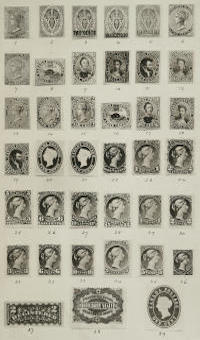
1 2 3 4 5 6
7 8 9 10 11 12
13 14 15 16 17 18
19 20 21 22 23 24
25 26 27 28 29 30
31 32 33 34 35 36
37 38 39
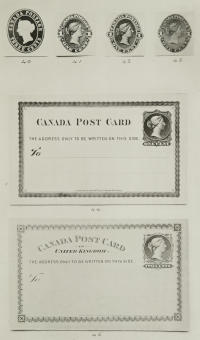
40 41 42 43
44
45
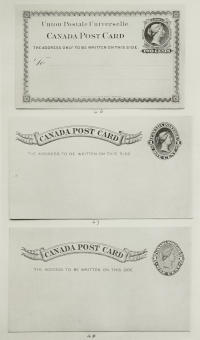
46
47
48
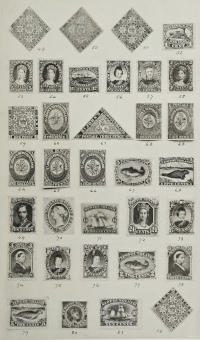
49 50 51 52
53 54 55 56 57 58
59 60 61 62 63
64 65 66 67 68
69 70 71 72 73
74 75 76 77 78
79 80 81 86
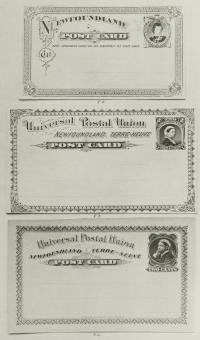
82
83
84
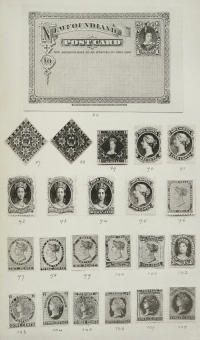
85
87 88 89 90 91
92 93 94 95 96
97 98 99 100 101 102
103 104 105 106 107 108