THE PORTSMOUTH ROAD
Reading edition
WORKS BY THE SAME AUTHOR.
ENGLISH PEN ARTISTS OF TO-DAY: Examples of their work, with some Criticisms and Appreciations. Super royal 4to, £3 3s. net.
THE BRIGHTON ROAD: Old Times and New on a Classic Highway. With 95 Illustrations by the Author and from old prints. Demy 8vo, 16s.
FROM PADDINGTON TO PENZANCE: The Record of a Summer Tramp. With 105 Illustrations by the Author. Demy 8vo, 16s.
A PRACTICAL HANDBOOK OF DRAWING FOR MODERN METHODS OF REPRODUCTION. Illustrated by the Author and others. Demy 8vo, 7s. 6d.
THE MARCHES OF WALES: Notes and Impressions on the Welsh Borders, from the Severn Sea to the Sands o’ Dee. With 115 Illustrations by the Author and from old-time portraits. Demy 8vo, 16s.
REVOLTED WOMAN: Past, Present, and to Come. Illustrated by the Author and from old-time portraits. Demy 8vo, 5s. net.
THE DOVER ROAD: Annals of an Ancient Turnpike. With 100 Illustrations by the Author and from other sources. Demy 8vo. [In the Press.
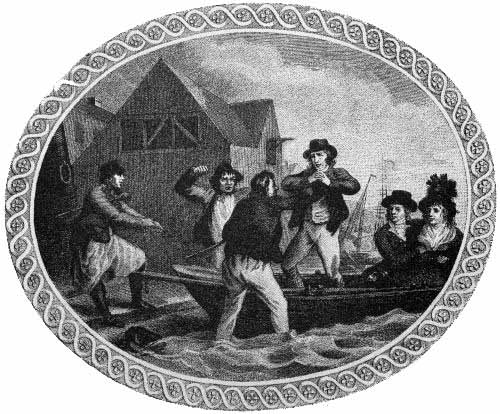
From a painting by George Morland.
“Till, woe is me, so lubberly, The vermin came and pressed me.”
THE PORTSMOUTH ROAD AND ITS TRIBUTARIES:
TO-DAY AND IN DAYS OF OLD.
By CHARLES G. HARPER, AUTHOR OF The Brighton Road, Marches of Wales, Drawing for Reproduction, &c., &c., &c.
Illustrated by the Author, and from Old-time Prints and Pictures.
London: CHAPMAN & HALL Limited 1895 (All Rights Reserved.)
Richard Clay & Sons, Limited, London & Bungay.
To HENRY REICHARDT, Esq.
My dear Reichardt,
Here is the result of two years’ hard work for your perusal; the outcome of delving amid musty, dusty files of by-gone newspapers; of research among forgotten books, and pamphlets curious and controversial; of country jaunts along this old road both for pleasures sake and for taking the notes and sketches that go towards making up the story of this old highway.
You will appreciate, more than most, the difficulties of contriving a well-ordered narrative of times so clean forgotten as those of old-road travel, and better still will you perceive the largeness of the task of transmuting the notes and sketches of this undertaking into paper and print. Hence this dedication.
Yours, &c., CHARLES G. HARPER.
There has been of late years a remarkable and widespread revival of interest in the old coach-roads of England; a revival chiefly owing to the modern amateur’s enthusiasm for coaching; partly due to the healthy sport and pastime of cycling, that brings so many afield from populous cities who would otherwise grow stunted in body and dull of brain; and in degree owing to the contemplative spirit that takes delight in scenes of by-gone commerce and activity, prosaic enough, to the most of them that lived in the Coaching Age, but now become hallowed by mere lapse of years and the supersession of horse-flesh by steam-power.
The Story of the Roads belongs now to History, and History is, to your thoughtful man, quite as interesting as the best of novels. Sixty years ago the Story of the Roads was brought to an end, and at that time (so unheeded is the romance of every-day life) it seemed a story of the most commonplace type, not worthy the telling. But we have gained what was of necessity denied our fathers and grandfathers in this matter—the charm of Historical Perspective, that lends a saving grace to experiences of the most ordinary description, and to happenings the most untoward. Our forebears travelled the roads from necessity, and saw nothing save unromantic discomforts in their journeyings to and fro. We who read the records of their times are apt to lament their passing, and to wish the leisured life and not a few of the usages of our grandfathers back again. The wish is vain, but natural, for it is a characteristic of every succeeding generation to look back lovingly on times past, and in the retrospect to see in roseate colours what was dull and, neutral-tinted to folk who lived their lives in those by-gone days.
If we only could pierce to the thought of æons past, perhaps we should find the men of the Stone Age regretting the times of the Arboreal Ancestor, and should discover that distant relative, while swinging by his prehensile tail from the branches of some forest tree, lamenting the careless, irresponsible life of his remote forebear, the Primitive Pre-atomic Globule.
However that may be, certain it is that when our day is done, when Steam shall have been dethroned and natural forces of which we know nothing have revolutionized the lives of our descendants, those heirs of all the ages will look back regretfully upon this Era of ours, and wistfully meditate upon the romantic life we led towards the end of the nineteenth century!
The glamour of old-time travel has appealed to me equally with others of my time, and has led me to explore the old coach-roads and their records. Work of this kind is a pleasure, and the programme I have mapped out of treating all the classic roads of England in this wise, is, though long and difficult, not (to quote a horsey phrase suitable to this subject) all “collar work.”
CHARLES G. HARPER.
35, Connaught Street, Hyde Park, London, April 1895.
SEPARATE PLATES
PAGE
1. The Press Gang. By George Morland. Frontispiece.
2. Old “Elephant and Castle,” 1824 22
3. “Elephant and Castle,” 1826 30
4. Admiral Byng 48
5. A Strange Sight Some Time Hence 52
6. The Shooting of Admiral Byng 56
7. William Pitt 74
8. The Recruiting Sergeant 90
9. Road and Rail: Ditton Marsh, Night 94
10. The “New Times” Guildford Coach 98
11. The “Tally-ho” Hampton Court and Dorking Coach 104
12. Mickleham Church 108
13. Brockham Bridge 114
14. Esher Place 120
15. Lord Clive 124
16. Princess Charlotte of Wales 128
17. The “Anchor,” Ripley 142
18. Guildhall, Guildford 148
19. Castle Arch 152
20. An Inn Yard, 1747. After Hogarth 162
21. The “Red Rover” Guildford and Southampton Coach 166
22. St. Catherine’s Chapel. After J. M. W. Turner 170
23. Mary Tofts 178
24. New Godalming Station 184
25. The Devil’s Punch Bowl 194
26. Hindhead. After J. M. W. Turner 198
27. Tyndall’s House 208
28. Samuel Pepys 236
29. John Wilkes 240
30. Sailors Carousing. From a Sketch by Rowlandson 252
31. The “Flying Bull” Inn 268
32. Petersfield Market-Place 278
33. The “Coach and Horses” Inn 298
34. Catherington Church 320
35. An Extraordinary Scene on the Portsmouth Road. By Rowlandson 330
36. The Sailor’s Return 334
37. True Blue; or Britain’s Jolly Tars Paid Off at Portsmouth, 1797. By Isaac Cruikshank 338
38. The Liberty of the Subject, 1782. By James Gillray 346
ILLUSTRATIONS IN TEXT
PAGE
The Revellers 12
Edward Gibbon 19
“Dog and Duck” Tavern 28
Sign of the “Dog and Duck” 29
Jonas Hanway 43
“If the shades of those antagonists foregather” 44
The First Umbrella 46
The “Green Man,” Putney Heath 70
The Windmill, Wimbledon Common 74
Mr. Walter Shoolbred 97
Boots at the “Bear” 102
The “Bear,” Esher 103
Burford Bridge 111
The “White Horse,” Dorking 112
The Road to Dorking 113
Castle Mill 117
Cobham Churchyard 137
Pain’s Hill 139
Fame up-to-Date 142
Herbert Liddell Cortis 146
Market-House, Godalming 176
Charterhouse Relics 189
Gowser Jug 190
Wesley 191
Bust of Nelson 192
Tombstone, Thursley 204
Thursley Church 205
Sun-dial, Thursley 206
“Considering Cap” 223
Milland Chapel 260
“The Wakes,” Selborne 261
Badge of the Selborne Society 267
The “Flying Bull” Sign 271
The “Jolly Drovers” 272
“Shaved with Trouble and Cold Water” 284
Edward Gibbon 288
Windy Weather 304
Benighted 319
Dancing Sailor 361