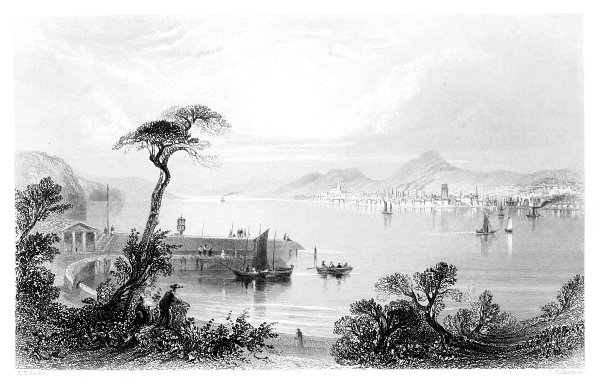
DUNDEE. ENTRANCE TO THE PORT.
Reading edition
"Here busy commerce spreads her sail; The Tay flows broad and free; And sea and river, hill and dale. Pay tribute to Dundee."
Highly favoured by nature in point of situation, Dundee has enjoyed, from the remotest period of our national history, many facilities for the encouragement of trade. But it is only in more recent times that she has risen to that eminence which now places her among the first-rate commercial towns of the empire. That laudable spirit of enterprise which has encircled the whole island with new or improved ports and harbours, has operated most beneficially for those of Dundee; where, within the last twenty or thirty years, almost every improvement which either science could suggest or wealth accomplish has been carried into effect.
On the return of peace in 1815, the first great impulse was given to the manufactures and commerce of Dundee, by the renovation and extension of the harbour. Prior to that epoch, the accommodation provided for shipping was adapted to the most limited commerce only. One small pier and two or three clumsy erections in a state of dilapidation, and which it required a boat to reach, constituted the sole protection afforded to the shipping, and the only convenience for discharging or loading. Although the spirit of enlightened enterprise had been at work for several years, it was only at this late period that application was made to Parliament, and a bill obtained for separating the harbour from the other branches of the common good, and for investing the management of it for a term of years in district commissioners, who were selected partly from the magistrates, and partly from the public bodies of the town. Great pains were taken to procure the best plans; and after all preliminaries had been settled, the work was begun and carried on with such extraordinary activity, that, although everything was finished in the most substantial manner, all was accomplished within the time specified. The plan comprised the new harbour, consisting of a wet-dock of about six acres; a tide-harbour of much greater extent; a graving-dock, capable of containing three of the largest merchant-vessels frequenting the Tay; extensive carpenters' and other yards for ship-building; wide and capacious quays, affording berthage for about thirty vessels to load or discharge at the same time. From the first moment that measures were taken to ensure this superior accommodation, the number and tonnage of the ships were increased by their owners, and the trade and commerce of the port most materially improved. The expenditure incurred by these great public works, though amounting, from 1815 to 1833, to £242,000, or upwards, was judiciously (says our Statistical authority) applied, and with great advantage both to the private trust and to the public at large.
When the plan for the new harbour was adopted in 1815, it was considered to be so extensive, especially when compared with what preceded it, that it was generally believed that the accommodation it promised would exceed the necessities of the trade of Dundee for many years; but this was so far from the fact, that some years ago the want of sufficient berthage became so much a subject of complaint, that measures were taken as soon as possible to remedy the evil. A new harbour-bill was applied for, and obtained, vesting the shore-dues permanently in a board of trustees. A plan was adopted for extending the tide-harbour, and for converting the greater part of it into a wet-dock, and for other improvements, rendered necessary by the rapidly increasing trade and commerce of the town, all of which have been completed.
In population, trade, and manufactures, as above stated, Dundee has advanced faster perhaps than any town so situated in the United Kingdom. There are men now living who remember when its population was less than one-fifth of what it now is; and when its harbour was a crooked wall, affording shelter to only a few fishing or smuggling-craft; when its spinning-mills were things unknown and unthought of; and when its trade was hardly deserving of the name.[11]
DUNDEE, FROM THE OPPOSITE SIDE OF THE TAY.