BOOK THREE The Wheel
Reading edition
CHAPTER ONE THE TEMPLE OF CHANCE
1.
MONTE CARLO is various kinds of a jewel. In the morning it glitters like a diamond; in the afternoon it gleams like a great pearl of the Orient; in the evening it glows with the mellow lustre of a sapphire. It has its moods of invincible beauty. There are times when one wonders if it is real and not the fabric of a dream. But of all its moods its glamour is, perhaps, most felt in that mellow moment that precedes the setting of the sun. From earth and sky exhales a great serenity. In the golden air, a thousand windows shine like casements of romance, the sea melts placidly into the tranquil sky, and the mountains breathe tenderness and calm.
It was at such a moment, reassuring to the soul, that Hugh, for the first time, mounted the seven steps that led to the temple of chance. The sun gleamed on the brass rods of the carpet, gleamed on the gold braid of the four porters who guarded the entrance, gleamed on the buttons of the little page boys that swung open the double doors. Behind the glass partition, leaning on a brass rail, and scrutinizing every one who climbed the steps, were three detectives. Characteristic of the place,—the eager welcome; the watching detectives!
Hugh mounted the steps and paused at the top, just as he had seen so many others pause to look over the scene.
Beyond the “Cheese,” the central garden was a vivid emerald, enamelled with patterns of pansies; a breeze, pure and delicious, rustled the palms. Daintily dressed children were throwing crumbs to the lethargic pigeons. A shining Rolls Royce floated past and anchored in front of the Hotel de Paris, while a tall negro in a swallow-tail uniform descended in stately fashion and opened its doors. The space in front of the Café de Paris was starred with striped umbrellas and coloured with gay groups. The Roumanian orchestra was playing with sparkling abandon and a crowd was whirling around the “Cheese.” The English dominated the throng;—tall, thin women with patrician noses, tall, thin men with grey hair and lean, fresh faces. It was a suave picture of elegance and ease.
Turning to the left Hugh entered the bureau of admission. The Nice train had just come in and behind the high curved counter the clerks cowered before the clamouring crowd. Seated at a commanding desk was the chief of the bureau, an owl like man with a crabbed air; he was the final arbitror, the judge from whom there was no appeal. Before him was a Swiss aubergiste who was trying to explain that if the clothes he wore were not good enough for the Casino, he could change them for better. Another rejected one, a stout woman who had foolishly given her occupation as a dress-maker, was pointing out that the lady ahead of her who had just been granted a card was a femme galante, one of her clients who even owed her money. But to such protests no attention was paid. A blank look, a shrug of the shoulders,—that was all. Judged by Casino standards and found wanting, they had to go away disconsolate.
Hugh, however, had no such trouble. A brisk little interpreter bustled up; and he slipped a bill into the man’s hand. He was pushed forward in front of the others.
“This gentleman is known to me,” said the interpreter with fluent audacity. “He is a celebrated artist dramatic de Londres.”
So Hugh assumed the air of a jeune premier, and with many polite smiles was handed a card.
“Now,” he murmured, “for the next step in the gambler’s progress!” A courteous flunkey ushered him into the atrium, a galleried hall designed to impress the visitor and put him in the proper frame of mind to enter the Rooms. It was of staid richness, of sober dignity. Through a vista of marble columns Hugh saw a circular refreshment counter, and nearby a bulletin board where a group were reading the latest despatches from the ends of the earth. On leather-padded benches men were smoking cigarettes, and women gossiping and criticizing all who passed. Other men and women strolled up and down, taking a breath of air after a strenuous spell at the tables. He overheard scraps of conversation.
“Well, I’ve made my day, but the bank gave me a hard fight for it.” “Yes, a martingale’s deadly. It will always get you in the end.”
Looking towards the left he saw three mysterious doors. From the center one a stream of people was pouring, with an expression on their faces of either impassivity or disgust, elation was rare. By the side doors another crowd was entering. Those to the left were eager and excited; those to the right calm and blasé. These were the respective doors for the visitor and the habitué. It was through the visitors’ door that Hugh passed. At last! He was on the threshold of the greatest gambling room on earth.
First impression,—nasal. How could people breathe such air? It struck him like a blow in the face. It was so thick, so richly human,—a compound of physical exhalations, cheap cosmetics and disease. It almost daunted him. Second impression,—oral. A confused murmur of many voices. A discreet rumble, punctuated by the acrid cries of the croupiers and the click of rakes on counters. Third impression,—visual. To the right and left were walls of human backs surrounding pools of light. The light came from green shaded lamps that hung from heavy cords. Peering over a triple row of shoulders he caught a glimpse of a green table and a scuttling ball.
He passed through a smaller room into a great central one. In contrast with the restful dignity of the atrium it was of a brilliant beauty. Huge columns of honey-coloured onyx seemed to strike the note of the decoration. Everything was in the same key, from the padded seats of yellow leather to the Watteau-like panels painted on the wall. Two immense chandeliers were tangles of gilt on which lights clustered like grapes on a vine. Everything seemed to shine, glisten, reflect. Even the inlaid floor was lustrous with the polish of a million gliding feet. Just as he had called the smaller room by the entrance the “Grey Room,” so he called this the “Hall of Light.” From the gleaming floor to the vast dome it suggested light.
There were five tables, and each was besieged by gamblers. Those in the outer row stretched and strained to get their money on the table, marking the numbers in glazed note-books, shouting their manner of staking, squabbling and scrambling for their gains. Hugh felt a little bewildered.
As he stood there a very curious thing happened. A tall, distinguished-looking woman, wearing a cream-coloured mantle, advanced to the centre of the hall. She took from under her mantle a plate of white china and deliberately let it fall to the floor. At the sharp crash those nearest turned, and in an instant she was surrounded by a curious crowd. Then as quietly as she had come she backed out and disappeared. Two attendants in light blue came forward and calmly gathered up the debris. The crowd, laughing, returned to the tables.
While Hugh was wondering what it meant, the affable little Mr. Jarvis Tope bustled up to him. Mr. Tope wore a white waistcoat and white spats, and was, as the French say, “pinned at the four corners.” His round red face was wreathed in a smile of welcome.
“Ha! young man, so at last you venture into the cave of the dragon. Well, it’s good to see a fresh face among so many stale ones. What was all the excitement about?”
Hugh told him of the lady and the plate. Tope laughed.
“Oh, is that all! Didn’t you know that to break china on the floor of the Casino is supposed to change one’s luck? It’s rather a desperate resort. The lady you saw must have been hard hit. Women believe in those things, mascots and so on. They bet on the number of their cloakroom check; they have their favourite tables and believe that the croupier can control the ball. Every woman who believes in any of these things is a fool; it’s astonishing how many are fools. Come, I’ll explain the game to you.”
Going to what Mr. Tope called the “Suicide Table,” they pushed themselves into the triple row of standing spectators till they were behind the seat holders. These had a sphynx-like air of absorption. Piles of counters were methodically stacked before them, and their little note-books were scrupulously neat. Some were marking down dots and zig-zag lines, some columns of figures. They played occasionally and with deliberation. They were the regulars, the system workers, who sat every day in the same place at the same table.
While Mr. Tope was explaining the different methods of playing, Hugh felt a light touch on his arm. Looking round he saw a sweet if somewhat over-emphasized face smiling up at him. The girl wore a bonnet that seemed to be made of tiny lilac flowers, and her hands were daintily gloved. Hugh thought at first that she had mistaken him for somebody else.
“Listen, Monsieur. Lend me a louis. It will bring you luck.”
But Mr. Tope frowned. “Don’t do it. Pretend you have no money.”
Hugh awkwardly refused, and with a little grimace the girl went away.
“One of the parasites of the place,” said Mr. Tope. “The Casino’s full of them. She spotted you at once for a newcomer. She’s on the watch for greenhorns. Now she’ll tell her sisterhood that you turned her down, and you’ll be less pestered. Never speak to a woman you don’t know on the floor of the Casino. In the end it will cost you money.”
“I wonder the management doesn’t stop that sort of thing.”
“They encourage everything that speeds up the gambling. Morality doesn’t exist as far as they are concerned. All they want is to get your coin; and in the end they usually do.”
“Do they get yours?”
“Oh, yes, I lose sometimes. There’s a class of people who tell you they never lose. They’re known as the liars.”
“That was a very pretty girl who spoke to me.”
“Yes. There’s a story about her. She was engaged to a Frenchman who went to America and established himself in business. He sent her money to buy her trousseau, and to pay her passage over. She was crazy about him, all eagerness to join him; but she was tempted to risk a little of the money at the tables. In the end she lost it all. She dared not tell him, so she never answered his letters. Since then she has lived a hectic existence. She’s an incurable gambler. A ruined life.... But come, I want to introduce you to two of the oldest habitués of the Rooms, veterans like myself. Mr. Galloway MacTaggart of Strathbungo.”
Hugh was forthwith presented to a tall wiry man, who enveloped his hand in a large dry grip. He had a grim spectacled face and thin-grey whiskers.
“Welcome, malad,” said Mr. MacTaggart. “The Fraternal Order o’ the Veeatic bids ye welcome tae this den o’ ineequity. And noo, if ye’ll alloo me, I’ll present ye tae the Grand Maister, Mr. Gimp o’ Cincinnati. Mr. Gimp has the disteenction o’ bein’ the auldest member.”
Mr. Gimp was small and wiry. He was the neatest man Hugh had ever seen; even his eyes were neat. He had a puckered pink face, and white silky hair like the floss of the thistle. His moustache was like a wisp of cotton. He extracted the thumb of his right hand from the armhole of his waistcoat and presented two fingers for Hugh to wag solemnly.
“Gimp’s feeling peevish,” said Mr. Tope. “He’s just won five francs and lost ten.”
“Never play the goddamn game,” snorted Mr. Gimp. “When you catch me putting a cent on those tables, you can call me a goddamn fool and kick me round the ‘Camembert.’”
“Well, after coming here for thirty years without missing a season you ought to have enough of it.”
“Darned sight too much. No place for a respectable man! Never enter the Rooms unless I’m obliged to. Just come in now to look for a friend. A hotbed of crooks and courtesans. Yes, and spies. Look at that damn inspector edging nearer to see if he can’t hear what we are talking about. Bah! Look at that woman now. Why, she’d make a rotten egg smell like a rose. Well, I can’t stand it any longer. I’m off to breathe God’s good air. Au revoir.”
With that Mr. Gimp stalked virtuously away. “He’s always like that,” remarked Mr. MacTaggart dryly. “An’ if ye come in the Casino an ’oor from noo ye’ll find him smokin’ his cigarette in the atrium. He’s one o’ the fixtures o’ the place. It wouldna’ be complete withoot him. An’ there’s a whole lot mair in the same boax. A man frae Brazeel went aff his heid in the Rooms the ither day. ‘Puir Chap!’ they were a-sayin’, but I telt them, ‘He’s nae worse nor the rest o’ us. We’re a’ daft in this establishment.’ Whit’s yer impression o’ it, young man?”
“I’m surprised to see so many old people in the Rooms.”
“That’s right. Gamblin’s the last infirmity of ignoble minds. When folks are ower dodderin’ for wine an’ wimmen, gamblin’s a’ that’s left tae them. Look at that auld Bianca there. They say she wis the mistress o’ the King o’ Italy. Whit things she must hae seen! Noo she goes roon like a spectre mumblin’ an’ breakin’ wind every time she plays. Weel, I’m feelin’ auld an’ tired masel. Ma nerves are no whit they were. There’s nae doot it gets ye. It’s a crool, crool game....”
They sought the fresher air of the atrium and lighting their cigarettes sat down on a recessed divan of padded leather.
“MacTaggart is our great hope,” said Mr. Tope. “He is patience and pertinacity personified. He has now been sitting at the same place at the same table from the beginning of the play to the end for two years.”
“For three years,” said Mr. MacTaggart. “I’ve got the record o’ two hundred thoosand consecutive coups.”
“MacTaggart claims he knows more about roulette than all the rest of us put together.”
“So I do. Ye’re like a lot o’ children. Ye ken naethin’. When ye’ve spent night after night for three years compilin’ an’ analyzin’ permanencies, ye’ll begin tae hae some glimmerin’ o’ the mysterious workin’s o’ the laws o’ chance. I’ve studied the game noo for twenty years and I’m jist beginnin’ tae know a little, a verry little.”
“Look!” said Mr. Tope, “there’s that poor little Emslie girl waiting as usual for her mother.”
On one of the benches near the exit from the Rooms Hugh saw a slight girl with a very sweet face. Her chestnut hair was braided behind and her colouring was fresh, and girlish. She sat with her slim hands clasped in her lap, looking anxious and forlorn.
“That,” said Mr. Tope, who seemed to know everything and everybody, “is one of the hardest cases. She’s only sixteen, and has been left a few thousand pounds by her grandfather. But her mother’s a gambler enragée. She’s lost all her own money, and now they say she’s playing with the girl’s.”
At that moment a woman came from the Rooms, and the girl ran to her eagerly. The woman was tall and handsome, and her face was alight with joy. Opening her gold chain bag, she showed the girl the contents. They both laughed, almost hysterically, and went off arm in arm. With a start Hugh recognized the cream-coloured cape; it was the lady who had broken the plate.
2.
In the days that followed Hugh came to know the great building intimately. He gave fanciful names to the various Rooms. Beyond the “Hall of Light,” as he called the main gambling room, was the “Hall of Gloom.” In decoration it was heavy, dark, depressing. There was something Teutonic about it, even to the panels of lumpish Amazons that filled in the wall spaces. On the only occasion he played there, he came away whistling the “Dead March.”
To the right of the “Hall of Light” was a little gem of a room which contained only one table. He called it the “Room of the Opium Dreamer,” on account of the exquisitely painted ceiling of naked nymphs voluptuously sprawling on fleecy clouds. Its windows looked on the terrace and often he pulled aside the silken blind to marvel at the radiant beauty of the sea. The air in this room was unusually bad.
Beyond this was what he called the “Hall of the Three Graces,” on account of the huge wall panel that dominated it. It represented three nude women against a Florentine background. Mr. Tope gave him some curious information about this picture.
“These,” he said, “were three demi-mondaines, frequenters of the Casino. They claimed to be Swiss: but it turned out that they were Austrian spies in the pay of Germany.”
Hugh looked at them with a new interest.
“When war was declared all three cleared out in a hurry. The directer himself had to get away. He had, they say, gotten the Casino Company to acquire the golf links on Mont Agel, and right under the eyes of the French garrison he had all prepared for the installation of a wireless outfit. It was an ex-captain of Uhlans. His son made a demonstration in favour of Germany in front of the Casino and was mobbed.... Oh, this was a great place before the war, a hotbed of treason. I’m told the French Government had to put pressure on the Government of Monaco to clear them out. And now they’re creeping back again.”
3.
Hugh soon came to recognize the various types that frequented the place. The women known as the skimmers particularly interested him. They haunted the Rooms, hovering over the tables and waiting for a chance to grab the stakes of others. They were the cause of most of the disputes. In the course of an afternoon a dozen of these rows would occur. As a rule, the croupiers discreetly professed ignorance of the cause. Although the disputants often called one another nasty names, Hugh saw them come to blows only on one occasion.
A Russian woman, said to be a princess ruined by the Bolshevics, was playing steadily. Twice a Frenchwoman with a face like a bulldog, reached out and grabbed her winning stake. The Russian looked puzzled, but said nothing; she only watched and waited. As the Frenchwoman reached forward a third time she cried “Thief!”
The Frenchwoman promptly slapped her face. The Russian looked at her in steady contempt, shrugged her shoulders and turned to go. Then a fury seized her, and swinging round, she struck the Frenchwoman a violent blow, clutched at her hat, her hair, tugged, scratched, slapped, a very wild cat of fury. The attendants separated them. The Russian was marched off; the Frenchwoman dried her tears and declared triumphantly that the other would lose her ticket. But presently when the attendants returned, she, too, was led off. Hugh never saw either of them in the Casino again.
He spent long hours studying the play. He took down numbers and poured over the permanencies. He felt quite at home now. He had a monthly card, and was confident, even eager to begin. One evening he left the Rooms with his mind made up.
“To-morrow I cease to be a spectator. To-morrow I commence to play.”
CHAPTER TWO A GAMBLER’S DÉBUT
1.
“MARGOT, would you mind coming here a moment?”
The girl was drying her hands after washing the supper dishes. “Yes, monsieur.”
“Oh, I say, I wish you wouldn’t call me ‘monsieur.’ It sounds as if I were treating you like a servant.”
The girl was silent. Hugh went on.
“Why can’t you call me by my first name, as I do you? If you don’t, I shall think you dislike me.”
“Oh, please don’t think that. I would do anything to please you.”
“Then why be so unfriendly?”
“I don’t mean to. But ... it’s hard.”
“Why?”
“Well ... there’s such a difference between us. I am only a poor girl, a nobody. You are....”
“No better than you are. Perhaps I’ve had just as hard a struggle in life as you have. I’ve always been poor. I’m poor now. I want to think you are my little sister, and I am your big brother. You must do the same.”
“I’ll try. Please give me a little time. Perhaps, it will be easier.”
“All right. And now please come here. I’d like you to look at something.”
He was sitting at the table with a big green book before him. Each page was filled with columns and columns of figures. His face was eager, his eyes sparkling.
“You know, I’m going to begin playing to-morrow.”
“Oh, please don’t. It’s terrible how it gets a hold of you. And in the end it always means ruin.”
“You don’t know me. I’m a pretty obstinate sort of chap. I’m going to gamble. Maybe I wanted to do so all along, and only waited for the excuse you’ve given me.”
“What excuse?”
“To win back the money you lost.”
“You’re not going to gamble on my account.”
“Of course, I am.”
“I will refuse to take the money.”
“All the same I am going to win it.”
“After that you’ll stop?”
“I don’t know.... There, don’t be so frightened. Come closer and look at these figures.”
On a sheet of paper he had made the following diagram:

“The seven dots,” he explained, “represent a run of seven or more on any of the simple chances. The run breaks as you see, then returns once again. It’s a well-known formation. Well, I’ve got to get that before I begin to play.”
“But it doesn’t happen very often,—only three or four times at a table in the course of the day’s play.”
“Yes, but I have the run of all the tables, fourteen of them. I can range the whole place. By glancing over the shoulders of those who are taking numbers, I can tell if there is anything in my line. When I find the combination I am seeking, I start staking in louis the sums I have marked.”
“You only stake one the second time....”
“Yes, that’s a buffer. I neither win nor lose if I gain that coup. I have to do that in order to ease up on my progression. Otherwise it would increase too rapidly. Then on the third, fourth, and fifth terms of my progression, I stand to win a louis only, but on the sixth term I win two louis, and on the seventh term, four. I use this progression because I have only a hundred louis at my disposal. I want to make a progression of seven terms, and I want my gains to increase as my stake increases. The great defect of the ordinary martingale is that you often find yourself obliged to risk quite a big sum to win a single unit.”
She continued to look at the figures frowningly.
“You see,” he went on eagerly, “to beat me the bank will have to follow up the first big run of seven or more by a second of eight, after a single break. Now I have examined a book of the records of the play at the second table for a whole year, and I haven’t found a single case of this happening. So you see, I feel pretty safe. I only want to make three wins a day, three louis. At that rate, in about seven weeks I shall have all your money back. You can return to Paris, start your shop, and live happily ever after. Great scheme, isn’t it?”
“What if you lose?”
“I can’t. It isn’t conceivable.”
“In roulette it’s always the inconceivable that happens.”
“No, I’m quite convinced. Armed with this system, I am going to the Casino just as confidently as if I were going to draw money from the bank. Of course, I know it means patience, watching, walking miles between tables; but that will be fun. I don’t want to win too easily.”
He continued to pore over his records, and she went softly about her work. When she had finished she looked toward him. In the shaded lamp-light his face was joyously eager; he was tapping his white teeth with his pencil, and his eyes were absorbed.
“Good-night,” she said timidly.
“Good-night,” he answered absently, without looking up.
2.
He worked very late over his permanencies and awoke to bright sunshine, and the fragrance of fresh coffee.
He had divided the room in two by a heavy green curtain. The part with the door and the little cabinet de cuisine was the living part; the other was for sleeping. This he had divided still further by a grey curtain so that they each had a little compartment with a bed. The girl seemed doubtful of this arrangement at first.
“I don’t see why it matters,” he said indignantly, “whether there is a curtain or a three foot wall between us. Remember we are brother and sister. Honour and decency are better protectors than bolts and bars.”
With this fine sentiment he disposed of her objections. There was no doubt he thoroughly believed it; and when he retired more or less weary behind his curtain, he slept as calmly as if he were alone in the room.
On this particular morning, having slept late and well, he rose light-heartedly, singing as he dressed. When he entered that part of the room that served them in common, he found that Margot had set his breakfast on the table, and was preparing to go to market. She was dressed like the women of the country, with a shawl over her bright hair. Each morning she would ask him:
“What would you like for lunch?”
“Oh, anything; I don’t care.”
“No, don’t say you don’t care. You know I like to please you.”
Then he would think profoundly. “I tell you what, ... Give me ... a surprise.”
With a gesture of despair she would go away. She was rather a good cook, but he seldom noticed what he ate. Now he stopped her as she was going out. “Had your breakfast?”
“Oh, yes, long ago.”
“I wish you would call me in the morning so that we can take it together. I like you to talk to me while I’m eating. Sit down and talk now. You’re not in such a hurry. Come, take a cigarette.”
“You know I never smoke.”
“I wish you would. It’s so chummy. Anyway, sit down. That’s right. Your hair’s lovely when it glistens in the sunshine. You know, you’re looking ever so much better already. Your chin is getting round, and there is actually a delicate rose colour in your cheeks. Your face is far more English than French. Some day if you’ll pose for me, I’ll paint you. This coffee’s awfully nice....” As he rattled on in his gay manner, the girl listened with a grave smile. There was a curious look in her eyes, a tenderness almost maternal.
“I say,” he went on, “I didn’t tell you I went to the Pension Paoli yesterday. I had a talk with Terese, the black-eyed Terese. She gave me some news.”
“Yes, what?”
“You remember that unsavoury sort of a chap who made such a bad impression on everybody,—I used to call him the Rat.”
“I never liked him.”
“Well, do you know what the mystery was that seemed to surround him? The poor harmless fellow was a priest, a curé who had slipped away from his flock, dressed in everyday clothes, and was having a good time. I don’t blame him, poor devil. He wanted to be free, to taste life just once, before going back to his black skirts and his prayer-book. I expect he’s doing bitter penance for it now. He was recognized by an old abbé and there was no end of a row. He was haled off by two burly priests, crying like a child.”
“It just shows how one should never judge people.”
“And you remember those two Swede women?”
“They enjoyed eating so much.”
“Yes, and they declared some one had entered their room and stolen money? That, too, was wrong. The mother came the other day to the pension and told madame the money had been found. The girl had put it between the pages of a very dull novel. When she came to finish the book she found the bills. So all’s well that ends well.” The girl said nothing. She remembered that he had once suspected her of taking this money, and the thought still pained her. “Come on,” he continued gaily, “let’s go out together. Remember to-day I leap into the arena. To-day I make my début as a gambler.”
3.
It was half past ten when Hugh entered the Casino.
The Rooms in the forenoon presented a very different aspect from the one with which he was familiar. The air, though stagnant, was not obnoxious. The rumble of voices was subdued to a discreet hum. Only five roulette tables were running. Every one had an air of knowing every one else. In place of the fever and scrabble of the afternoon there was a suave and amiable courtesy. The regular Monte Carloites were taking advantage of the morning calm to play their systems. Hugh stood by the table where the majority of the system-players were. They were mostly ageing men, neatly dressed, bespectacled, business-like. The records in their tiny note-books were scrupulously kept from day to day. They played but seldom, and then generally with flat stakes. At the end of the season their books showed probably only modest gains. The little old lady who took down the numbers for the Monte Carlo Gazette worked at this table. Every day, year after year, she sat there, dressed in rusty black, looking rather sour. She made quite a lot of money by giving up her place for a small consideration to any who would pay for it.
Next to Hugh stood a very shabby old man. His trousers were baggy and frayed, his braid-trimmed coat of a pattern of a bygone day. He had a weak chin, bulging eyes, a heavy grey moustache, and a curious air of faded gentility. He had been pointed out to Hugh as an Italian nobleman, the Count Viviano, who had gambled away all his estates and now lived on a small pension. The old man stood for a long time gazing at the table in a strangely absorbed manner. Hugh, who saw things with an artist’s eye, noticed that his hands had big veins and a glazed look. They trembled almost constantly and were the only sign of emotion in a figure otherwise calm.
Suddenly the old man began to fumble in the pocket of his waistcoat and drew forth a blue oblong placque representing a thousand francs. He waited till the ball had been spun, then reaching over unsteadily, placed it on the first dozen. He tried to look unconcerned. He lost. Again the ball was spun and again Hugh saw him fumble, draw out another pale blue placque, and place it tremblingly on the same dozen as before. Again he lost. The next time he put a blue placque on both the first and second dozen. Alas! the third dozen came. He seemed in doubt whether to stay or go away. His agitation was pitiable. Again the ball was spun. Many looked at him to see what he would do. Just at the last moment, he drew from another pocket two more blue placques, and put one on the first dozen, the other on the third. Was ever such infernal luck! The second dozen won.
Curious and commiserating glances were cast at him.
The old count looked dazed. With shaking hands he took from the inside of his coat a shabby pocket-book and drew from it all the money it contained, a hundred franc note and a few small ones. He threw them on the first dozen. Again he lost. He was broke.
And as he stood there like a man in a dream, as if to mock him, the first dozen came again and again. Six times it repeated, and each time the man seemed to grow older, more crushed, more hopelessly stricken. He continued to look at the table as if fascinated; then, with the saddest face Hugh had ever seen, he slowly left the room.
Another figure now attracted the attention of the onlookers. A tall man was plastering the table with louis and Hugh recognized Mr. Fetterstein. He looked the typical captain of industry, solid, powerful, dominating. His face, slightly Jewish in type, was bold, and massive. His eyes changed from a twinkle of amusement to a look of profound concentration. There was something unshakable about him. He played imperturbably. When he lost, he laughed; when he gained, he seemed indifferent. At present he was winning. He had covered the number fourteen and all its combinations. Fourteen came. He repeated, again putting the maximum on fourteen. There was a murmur. Fourteen again. Once more he put the maximum on fourteen. The croupier who spun the ball looked nervous and worried. The Chef looked at him with a frown, as if to say, “There are thirty-five other numbers. As you value your promotion avoid the fourteen.” Again the man spun. A great shout went up.... Fourteen.
As he was paid with the usual impressive deliberation, Mr. Fetterstein folded up the wad of mille notes he had gained and put them away. He had won over thirty thousand francs,—but what was that to him, a millionaire? He went on playing, but the croupier who had been throwing was changed.
Hugh saw many people whom he knew, among them the Calderbrook family. The ladies were playing a lively game and, even this early in the morning, looked rather excited. On his way out, he passed the forlorn Emslie girl in the atrium, waiting for her mother, and in the vestibule, he encountered Mr. Gimp rolling a cigarette. The little man nodded curtly. His puckered pink face and his snowy white hair gave the impression of frostiness.
When Hugh reached home he said to Margot:
“You know, I was so interested watching every one I forgot to play. Well, this afternoon....”
4.
In the afternoon the trains and yellow busses from Nice had disgorged their tourist hordes and turned the Casino into a welter of humid humanity. There were cheap-trippers taking a flutter, skimmers from the slums of Nice, sight-seers from every land under the sun, flaunting femmes de luxe, evil faces of the underworld,—the whole mob of strange invaders which a Monte Carloite finds so little to his liking. As fourteen tables were running, Hugh soon found an opportunity to try his system. He made three wins in the course of two hours. In neither case had he to fall back on his progression. He was elated and having finished for the day, amused himself by making sketches of the crowd.
By and by he wandered to the first trente-et-quarante table where a big game was going on. An American millionairess was playing as high as the limit allowed. She had before her a heap of pink placques, like cakes of soap, representing five thousand francs each; she tossed them around as carelessly as if they had no value. At one end of the table, Hugh noticed a tall distinguished-looking Englishman with an eye-glass; at the other, the Twitcher.
Hugh was admiring the superb insouciance of the American woman, who had lost twenty-five thousand francs in five minutes when he suddenly saw the Twitcher throw a bundle of mille notes on the red. There were evidently twelve of them, a maximum. By Jove! the Twitcher certainly was going it! Hugh watched with breathless interest. At the same time he saw the Englishman throw a similar sum on the black. The table was covered with big notes and placques. Every one awaited the turn of the cards with breathless interest.
“Couleur perd.”
The Twitcher had lost his twelve thousand francs. His face grew very pale. Then he reached forward. Just as the croupier was about to rake in his wad of bills he grabbed them up again, and crammed them into his pocket.
“I made a mistake,” he announced calmly. “I meant to play on black.”
“But Monsieur has lost....”
“I don’t care. I’ve got my money back. If you want to get it, you will have to take it from me. But I warn you I will make a desperate fight for it. It is all I have in the world. If I lose it, I am ruined. I will then kill myself. All I have, I have lost in this cursed den of thieves. You won’t get this without a struggle. And again, I warn you, I am armed.”
The crowd fell back, seemingly admiring his daring. Two lackeys in blue and gold advanced threateningly, but the Twitcher put his hand to his hip pocket in a significant fashion.
“Look out,” he said quietly. “I am going away. If any one lays a hand on me I will defend myself.”
Then with a leisurely gait and air of triumph he walked out of the Casino.
The whole thing was over in a moment. The inspectors came crowding round. The floor director, a bandy-legged, pot-bellied man with a stubby grey beard, hurried up; he was joined by another man with goggle eyes and a face like a mulatto. They talked, gesticulated, shrugged their shoulders. There was nothing to be done. A fracas on the floor of the Casino, that was inconceivable! Legally they could not claim the money. It was a gambling debt. Let it go!
So the storm subsided. The croupiers recovered from their stupefaction. They raked in the other winnings and paid the winners. Among the latter was the tall Englishman who had played on black. He did not seem to understand French. He kept saying: “Mo-ah! Mo-ah!” and point to his stake. They paid him one by one twelve crisp bills of one thousand francs each. He deliberately folded up the notes and went away.
That evening Hugh returned from a walk by way of Beausoleil. Outside of a café of the lower sort, he saw two men smoking. In spite of the darkness, he recognized the Twitcher and the tall Englishman. Hugh was so curious, that he sat down and ordered something to drink. He had not waited long when two men approached from the other direction. They were Bob Bender and the detective Krantz. Bob stepped before the drinking couple.
“Well, you brought it off,” he said in a not unfriendly way.
The tall Englishman laughed. “Yes, damn you, we got twelve thousand out of you.”
Krantz stepped forward. “Let me congratulate you, gentlemen. It is not every one gets ahead of us so easily. But we do not forget. I would strongly advise you to go away immediately.” Again the Englishman laughed.
“Bah! What do we care for you now? We have crossed the frontier. We are on French soil. We snap our fingers at your little tin-pot Principality.”
Krantz smiled pleasantly. He spoke in his silky voice, rubbing his hands together. Again Hugh noticed that the little finger of the right was missing.
“We know all about you,” he purred. “We have your record in France, England, America. We don’t want you here. You had better get out.”
“What if I refuse?”
“Refuse! Well....” Krantz rubbed his hands still harder and continued in his cheerful, chirping way, “Listen....” With his lips he blew a shrill, peculiar whistle. From the shadow across the road half a dozen dark shapes detached themselves.
“After all,” said Krantz, “the frontier is very near, the other side of the street, to be precise. It would be easy to take you over there by force. Once we have you, ... there’s no saying what might happen.”
The Englishman made a grimace. He seemed to reflect. Finally he banged his hand on the table.
“You go to hell,” he said.
Krantz blandly said good-night, and taking Bob Bender by the arm went quietly away. The mysterious shadows across the street melted again into the deeper shadow. But the Twitcher and the Englishman did not laugh any more. Presently the Englishman rose.
“I expect he’s right. We’d better go.”
Hugh went thoughtfully homeward.
“Well, that’s one system,” he said to himself, “that will take some beating.”
5.
In the weeks that followed he had no difficulty in making his three louis a day, and in no case did he need to go beyond the fourth term of his progression. It was sometimes difficult to find the combination necessary for his coup; but once he found it, he played with an almost mechanical assurance and considered the louis of gain as good as in his pocket. He had earned it.
His favourite among the rooms was the “Hall of the Three Graces.” It was brilliant with many mirrors, and the chandeliers were like cascades of light. The air was better too. At the end table, sitting directly under the Three Graces, Mr. MacTaggart played his system. His grave air of a church elder seemed to be a standing reproach to what he called, “Them shameless hussies above ma heid.”
In the pauses between play, Hugh became familiar with the strange characters of the place. He knew them by their nicknames, and made sketches of them in his note-book. He never wearied of watching these détraqués of the game. He would sit for hours on one of the couches of padded leather, forgetting to play in his absorbed interest.
Often after he had gained his “day,” he would escape from the fetid air of the Rooms, from the sordid eyes in the mean faces, from the monotony of excitement, and seek a quiet corner of the Café de Paris. There he would sit and smoke, pervaded by a sense of utter content: his strenuous moment over. The Casino was paying for his tea, his cakes. The Casino was his banker, his provider, a charitable institution erected for his benefit. He looked at it, so peaceful in the afternoon sunlight. No hint of the scrabbling mob behind its biscuit-coloured walls.
Perhaps after all it was not so black as they painted it. Perhaps it did not do all the harm they claimed. People amused themselves, lost money they could afford to lose, went away satisfied. No, it was a very charming institution indeed. It was very good to him. It would give him all the money he wanted. He was drunk with success. He loved the place.
Then suddenly ... woof! his system went all to pieces.
CHAPTER THREE THE SMILES AND FROWNS OF FORTUNE
1.
“I SAY, Margot, I think I’ll go to the Casino to-night.”
The girl looked at him in surprise. It had been his habit after supper to light his pipe and read until bedtime, or else work at his eternal permanencies. She had enjoyed these quiet evenings in the glow of the shaded lamp, bending over a bit of embroidery, listening to the puff of his pipe, and the rustle of his Daily Mail.
“I didn’t make the ‘necessary’ to-day,—only a couple of louis. The Rooms were so squalid I got a beast of a headache, and had to take a walk on the hill. I’ll get that extra win this evening.”
“Oh, please don’t go. Something tells me if you do you’ll be unlucky.”
“Nonsense. It’s not a question of luck. My system is misfortune proof. Luck or no luck it will win. If you are lonely, why don’t you go to the cinema, and amuse yourself?”
But Margot did not want to go out, so with a last glance at her sweet face under its coils of gold he left the room.
“Good little sort,” he thought. “I’m really getting very fond of her.”
As he emerged from the huddle of houses, a moon the shape and colour of a musk melon was rising from the sea. The two cement arms of the harbour held in their closed fists the harbour lights, one emerald, the other ruby.
“The green of hope,” he thought, “aye, and the crimson of tragedy.” He walked slowly up the steep hill, reflecting that three months ago he would have climbed it only with an effort. How this place had bucked him up! He must be careful though. Too much Casino, bad air, excitement,—that was already affecting him. Witness his splitting headache that afternoon. He doubted, though, if he could stay away from it now. It certainly got one,—roulette! The great wheel which symbolized all the smaller wheels whirled you helplessly with it! It was like an eddy in which the players were circling, getting nearer and nearer the centre, until ... down to ruin. Ah! the Wheel! the Wheel! In the evening he found the Casino quite different from the rest of the day. The asthmatic system-players of the morning were in their beds; the cheap-trippers and skimmers of the afternoon had returned to Nice; only four roulette tables were running and the quietness was almost startling.
This was the time when the great hotels poured forth their streams of wealth and fashion, the hour of the élite. Seated on one of the yellow divans beside the money changing booths, he watched the parade. The men wore dinner jackets and their faces were flushed with wine. They had been playing golf or tennis, or motoring in long, luxurious cars; now armed with tickets for the private rooms they came to cap the day with the excitement of losing a few hundred louis. With sparkling eyes and a fluttering air of excitement, their women followed them. Some of them were half naked, like savages. Many had the arms of washerwomen and the speckled shoulders of kitchen maids. Others were skraggy, with flat greenish busts and stringy necks. Each sought to outvie the other in the gorgeousness of her raiment. There were robes of shimmering beads, robes of rich brocade, robes of delicate lace, robes of exquisite embroidery, robes trimmed with gold, and robes hung with lustrous sequins. There were old ugly women in lovely dresses, worthless women with small fortunes on their backs. This luxury and extravagance had something barbaric about it. Hugh had never seen anything like it before. It seemed as if these people had dressed up purposely to amuse him.
“Who toils to keep it up?” he wondered. “What suffering and sacrifice lies behind it? It’s enough to make a chap turn socialist.”
After a while he rose. A number of women with elaborately painted faces were going from table to table, pretending to watch the game, but turning to gaze at some man player with a peculiar little smile. If he took no notice they would sidle off again.
Hugh saw many people he knew, among them Mrs. and Miss Calderbrook. The Calderbrook family seemed to live in the Rooms now. This evening Mr. Calderbrook was not with them, and they were taking advantage of his absence to play with louis instead of five franc pieces. When Hugh saw them lose five louis, he shook his head in mock warning, but they were too engrossed to notice him. Their faces were flushed, their eyes excited. He saw Mrs. Calderbrook take a bill of five hundred francs from her purse and change it into red chips. He was wondering if she was going to risk it all at one time, when his attention was distracted; his own moment to play had come.
The even numbers had been up eight times running; then there had been a break to the odd; then another even. This was his chance. He put a louis on the odd. He lost. He put another louis on the odd. Again he lost. This time he was rather pleased, for it was his buffer stake, and if he had won he would have been where he started. He settled down to his defence. He put three louis on the odd. A loss. He increased it to six. Again a loss. It was beginning to be interesting. Only once before had he gotten so far in his progression. Still with calm assurance he put twelve louis on the odd. Curiously enough the number twelve came up. Lost! Then quite suddenly all his confidence deserted him. He began to get frightened. He fumbled in his pockets. The next stake was to be twenty-five louis. Quick! the ball was already spinning. He handed a note for five hundred francs to the croupier.
“Impair....”
Then he heard the monotonous cry of the spinner: “Numero deux, pair, noir et manque.”
It was incredible, a conspiracy against him. It seemed as if the odd numbers had ceased to exist. He was down to his last stake, fifty-two louis. As he threw it on the table a strange recklessness surged up in him, the irresponsibility that takes hold of the gambler and makes him risk his last dollar on the spin. He had a miserable moment of suspense, then with a nonchalant air the spinner twitched away the ball. Number twenty....
He had lost everything. He was dazed. The great Hall of Light seemed to be full of dark shadows, and the faces of those around him touched with mockery. He was turning to go when a hand gripped his arm. He beheld at his elbow the contumelious countenance of Mr. Gimp.
“How much d’ye want?” snapped the little man, opening a large pocket-book.
“Nothing. I’ve lost everything. Broke! Couldn’t pay you if I borrowed.”
“How much d’ye want?”
Hugh scarcely knew what he was saying. “I’ve lost two thousand. I’d probably win it back this time if I could go on. It can’t always keep coming even.”
“Here, take this two thousand.”
“I don’t want to.”
“Take it, I say.”
Hugh took the notes and threw them on the impair just as the ball was slackening its spin. “Numero treize, noir, impair et manque.”
He had won at last. He took from the table the four thousand francs, and returned Mr. Gimp his two bills, saying:
“You shouldn’t have done that.”
“I know I shouldn’t.”
“Well, I don’t know how to thank you. You saved me. But there.... Bang goes my system.”
“Mighty good job, too. Your system was no use. You were playing against a phenomenon. Don’t you see the phenomenon was lying in wait for you, and sooner or later you were going to go up against it. Bah! this rotten place. Let’s go into the atrium and have a smoke. When I see these fools all crazy over that rotten wheel I am ashamed of the human race.”
Sitting on her usual seat near the door was the Emslie girl; she seemed very tired and started up every time any one came out.
“There!” said Mr. Gimp fiercely, “just look at that kid. Should be in her bed hours ago. Waiting for her fool of a mother who is playing like the devil in the salon privé. If you were to open that woman’s head you’d find a roulette wheel instead of a brain.”
As Hugh left the Casino the night air seemed delicious. The moon was now perfect in shape,—a moon worthy even of Monte Carlo, dappling the oily swell of the harbour with pools of playful quicksilver. He sat on a bench and watched it till his serenity returned.
When at last he entered their room, the lamp was turned very low and behind the grey curtain that divided them he heard the girl breathing gently.
2.
After breakfast next morning, Hugh sat figuring over his green book of permanencies. Finally he said:
“See here, Margot, I think I’ll have to change my system.”
“Why, what’s the matter with it?”
“Well ... you see I have to walk about so much between the tables. It tires me out.”
“I thought you didn’t like to ‘win too easily’?”
“Oh, I don’t mind not winning easily.”
“Ah! you’ve been losing.”
“No, I haven’t. My capital’s intact and I have five hundred francs of gain. But ... well, I’m tired of it. I want a change.”
“What are you going to try now?”
“I call it a pattern system. You see I set the bank a task....”
“I don’t see.”
“Look here then. Look at this diagram.”
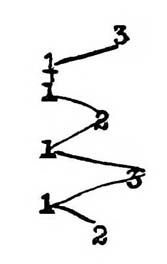
“These figures represent the dozens arranged in three columns. They form a certain pattern, a pattern of seven. Now I sit comfortably at a table (no more walking for me), and take down numbers, arranging both the dozens and columns in three rows. When my figures begin to accumulate, I look back to see if I cannot find a coincidence between the pattern I am making, and the one that has gone before. When I find this, and the pattern duplicates as far as the sixth figure I simply bet that it won’t go as far as the seventh. That is to say, suppose I get a second set of figures similar to those I have set down here as far as the sixth, I simply bet against the repetition of the last. Am I clear?”
“Not very,—but I understand.”
“What do you think of it?”
“Fantastic.”
“Not at all. I am defying the bank to repeat the same combination of dozens or columns in a comparatively short space of time. The odds are overwhelmingly in my favour. You see in this game one has certain advantages over the bank. One can choose one’s moment to enter, and one can retire when one wants. Also one can make a progression.”
“Are you making one?”
“Yes, I begin by putting a hundred francs between the two dozens on which I am betting. If that should fail, I will increase to three hundred francs, and then if necessary to a thousand. In the first two cases I win fifty francs, in the third a hundred. I would always bet, of course, against the corresponding dozen or column of the combination I am following. In short, to finally beat me the bank needs to produce a coincidence of nine. That, you must admit, is extraordinary.”
“It is a game of the devil. Anything may happen.”
“Well, I’m going to get four wins a day. That will mean two hundred francs. At that rate in about ten days I will have your two thousand francs, and you can go back to Paris and start your little shop.”
“You seem in a hurry to get rid of me.”
“No, it’s not that.... But you know we can’t go on like this indefinitely. It would look queer. I have to think of your reputation.”
“Don’t bother about my reputation. As for your own, and the opinion of your friends ... well, I am very discreet, am I not? We never go out together.”
“No, no one need ever know. And after all we have nothing to reproach ourselves with. We’re playing the game like two good pals. Our consciences are clear.”
He let the matter drop there; but the question of Margot’s future worried him. He knew he would always be interested in her, and that it would hurt him if any ill befell her; he was beginning to think of her as if she were really his sister.
3.
Hugh found his new system absorbing, but very fatiguing. Looking back through rows of figures for coinciding groups was something of a mental strain. When, however, his opportunity came to play, he did so with calm certitude. In no instance was he beaten. It seemed as if the powers of correspondence exhausted themselves after the sixth term.
Sitting snugly at one of the tables with pencil and note-book, he would lose all sense of his surroundings. He was alone with the wheel; the rest was a dream. Vaguely he was aware of players reaching over his shoulders, and of the monotonous voices of bored croupiers. Sometimes a dispute would arouse him from his distraction and amuse him a little; but though he often could have settled it, he never “butted in.” It was none of his business. Also he never handed any one their winnings. The one time when he had done so he had handed to the wrong person. Fortunately it had been only a question of ten francs and the bank had promptly paid a second time. After that, however, when people asked him to pass money he gave them a rake and let them get it for themselves.
During the long hours at the table Hugh entered into conversation with his various neighbours, and made many of these gambling acquaintances so easily made, so easily unmade. Roulette is a destroyer of reserve; its courtesies mean nothing, and people who chat at the table, when they meet afterwards on the terrace, stare frigidly.
Of these acquaintances the only one with whom he became in any way friendly was a one-legged Irishman with red hair, Major Fitzoswald. He played a dashing game, always building around the number thirty-two. When he won he won heavily; but more often he lost. He had a jolly little wife and four children, ranging from a baby to a girl of seven; and when he had finished gambling in the afternoon, he would hobble out of the Casino on his crutches and join them in the sand pit near the dove-cot. It was said that he had lost his leg in a glorious action on the Somme front.
One day Hugh was amazed to see Mr. Gimp actually playing. The little man was standing erect and business-like at the trente-et-quarante table opposite the American millionairess. She had a tiny mannikin in front of her as a mascot. On one finger was an immense diamond, and around her neck glimmered a double string of superb pearls. Her blonde beauty suggested pearls; and her wide-set blue eyes, mobile mouth and very strong white teeth made her look like a happy child. Every time she played Mr. Gimp would play on the opposite chance. But while the honey-coloured beauty threw on heaps of placques, now rising to rose, now dropping to azure, Mr. Gimp played only a modest louis. Behind his hand he whispered to Hugh:
“This is the best system of all. It’s known as ‘playing the corpse.’ You get opposite a big player and play the contrary. When they have to make a progression, you win on all its terms. It goes without saying they’re dead ones from the start. The Casino will get their money. You’re playing on the side of the Casino, that’s all. And while the Casino is taking big risks, you are taking small ones. ‘Playing the corpse,’—it’s the only sure system I know. It’s a shame to take the money. You know I hate gambling like hell; but if there’s easy money lying round a man’s a damn fool if he don’t pick it up.”
When Hugh returned late in the afternoon the beautiful American was still playing, and opposite her, methodically putting on his single louis, was the pertinacious Mr. Gimp.
4.
One day Hugh arrived home for luncheon looking exultantly happy. The table was neatly set, and the girl was in the little cabinet where she cooked.
“Hurrah! Margot. I’ve got something for you.”
“I can’t come for a minute. I’m cooking two soles I bought in the market. I saw you coming, so I put them on.”
“All right. How jolly the place looks. How nice you keep everything. We’ll both be sorry to leave it.”
The girl turned suddenly. Her voice trembled.
“Leave it! Why?”
“Hang it, one can’t stay here always. I’m feeling stronger than ever I did in my life. I want to get out and do things. And you?”
“I’ve never been so happy as I’ve been here.”
“I really believe I can say the same. It’s been awfully jolly. What a pity all pleasant things must end! We both have the future to face. But I’ll take care you have your share of happiness. That’s why I’m giving you this....”
“What is it?”
“Look out. The fish is burning. Finish frying and you’ll see.”
He threw an envelope on her plate, and she went back to the little gas-stove. He watched her with pleasure. She was so slim and trim in her pink apron, with her hair massed in shining coils round her head. She had so much of it that she scarcely knew what to do with it. He liked her eyes, too. They were a brave, sympathetic blue. Her face was English in its open frankness. It was wonderful how she had changed. A softness had replaced her sharp lines and the hollows had become curves. Her mouth had lost its hopeless look, and was now tenderly sweet.... He almost regretted what he was going to do. Well, she would always be his little sister; he would never lose sight of her.
She brought the fish and potatoes, and sat down. As she took up the envelope he watched her eagerly. She opened it and drew out two crisp bills for a thousand francs each. Her face grew pale.
“What’s this?” she faltered.
“It’s yours,” he exulted. “I had a splendid morning. Got two hundred francs ever so easily. Now that I’ve made up the sum you need, you can start for Paris to-morrow if you like.”
She pushed the money away from her.
“I don’t want it. It’s yours. I can’t take it.”
“What? Why, I won it for you! It was for you I gambled; for you I risked my capital. It’s given me the rarest pleasure doing this for you; now you mustn’t spoil all by refusing.”
“But I do refuse,” she cried fiercely. “It’s your money. How can I take it?”
“Oh, rot! You’ll make me cross in a minute. Granted it was an absurd idea on my part to make the Casino pay you back this money, what else was there to do? I couldn’t leave you in the hole. I had to do something for you. This way appealed to me as being both original and amusing. Come now ... if you like, consider it a loan, you can pay me back some day. There! It’s the solution of all your difficulties. It will establish you,—perhaps be the beginning of a modest fortune. Think of that bright little bonnet-shop on the Boulevard du Montparnasse. How happy you’ll be there. And I’ll come and see you....”
“If I take it as a loan, will you stop gambling?”
“Oh, come now, that’s absurd. Why should I? It really amuses me very much and I’m sure to win. The Casino owes me a living. It’s like a bank from which I draw a little every day. It would be a shame to stop.”
“You’re like all the rest. I’ve seen it coming over you for some time. You’re getting to think of nothing but roulette. You used to go for long walks, spend your time in the open air; now you’re either in the Rooms or working over permanencies. In the end you’ll lose everything.”
“Nonsense. I tell you I understand the game now. I can get my living at it. It only needs prudence, patience, judgment. A man can start with five francs and win a fortune. The great mass of the people are fools. They play anyhow. But I tell you it takes brains to play that game. There are the laws of chance, the calculation of probabilities.... Oh, I know I can win. I tell you, I can win....”
“I’ve heard the others say that,” she answered scornfully. “Once I thought the same. It’s all an illusion. In the end it’s ruin.”
“All right. You won’t take that money?”
“No.”
He was angry. He wanted to shake her. The air was charged with hostility. “I’m sorry,” he said. “You’ve made me feel like a fool.” Rising he left the house. The two little crisp soles remained untasted on their plates.
CHAPTER FOUR SHIFTS AND STRESSES
1.
IN his irritation and perplexity, he went for a long walk by the shore.
“Confound the girl!” he thought. “What right has she to be so proud! Pride is for those who can afford it. There she was, sick, desperate, without one sou. I saved her from goodness knows what. And now, behold! When she ought to be humble, she throws up her head, turns independent, refuses my further help....”
With his stick he switched savagely at a clump of geraniums that stained a villa wall.
“Confounded fool that I was ever to have anything to do with her. These sudden quixotic impulses! They always lead to trouble. Damn! It was none of my business. Who could have blamed me if I had let her go her own way? And yet ... that would have worried me enormously. Her own way! What would it have been? I’d hate to think of any harm coming to her. No, I feel I am bound to protect her....”
He sat down and stared at the sea. He watched the same wave washing the same rock it had washed for centuries. Its monotonous persistency soothed his spirit.
“After all, she’s a jolly, good little sort. She’s made me feel a fool, though. She knew all along I was only gambling for her sake. She might have let me know she wouldn’t take the money. Maybe the whole idea was silly, sentimental.... No, it wasn’t. It was a good sporting proposition. Any other chap would have done it. Besides, it amused me. I got all the reward I wanted in the fun of winning. I made gambling a virtue instead of a vice. I played the knight-errant fighting for the fair lady with chips for a weapon and a roulette table for the field of battle.”
He felt better. He rose and began to flip flat stones over the water.
“She’s got to take the money. It’s hers. I don’t want it. Why won’t she take it? If she had been a princess instead of a poor working girl I could have understood. I don’t mind if she regards it as a loan. There’s no harm in that. An honest loan. Haven’t I been decent and honourable? Haven’t I treated her with every respect? Haven’t I been like a brother to her? Why can’t she accept my aid? Ridiculous, I call it. Girls are funny. Hanged if a chap can understand them....” Having had enough of stone flipping, he lit a cigarette and resumed his seat on the rock.
“Well, what’s to be done? The present state of affairs can’t go on forever. I rather wish it could, though—it’s been so nice having her there. She’s made the place so homey, looked after me so well. Don’t think I’ve ever been so happy. But there! It would be dangerous to go further. We have each our own way to make in the world, and our ways don’t lie together. If she won’t take the money I must do something else to help her. I have to go on helping her. Poor kid! She’s had a devil of a time up to now. I’m sorry if I have hurt her feelings.... I’ll go home and make it up.”
But instead of going home he found himself drawn irresistibly to that great “centre of depravity” (as Mr. Gimp called it), the Casino. He was leaning moodily against one of the columns of the atrium when the doors leading to the Opera House belched forth a weird crowd of Monegasques.
The opera is one of Monte Carlo’s delusions, for though it is widely advertised as one of the attractions of the place, a large proportion of the seats are given away to the natives, those descendants of Sæacen pirates who now plunder the visitor by modern methods. It is as if the company that exploits the Principality, having planted the Casino in their midst and forbidden them to enter the gambling rooms, was trying to make up to them in other ways. The same seats are filled night after night by swarthy folk, barbarously bedecked in flaunting finery. The laundress or lodging-house keeper of the Condamine smirks across the stalls at the butcher or the baker of the upper town, who, in turn, bows deeply to the bureaucrat who lives on the Rock, and is wondering if his dress shirt will last the season without another washing.
As Hugh watched the crowd he heard a voice suddenly address him:
“You’re not going into that monkey-show, are you?”
Looking round he saw Mrs. Belmire seated near him, holding an unlighted cigarette. She wore a gorgeous gown of egg-yolk yellow and pea-pod green. Under a modified Gainsborough hat, her mahogany-tinted hair rippled over her shell-pink ears.
“Give me a light, please! I’m dying for a smoke. Just been in the Rooms and lost fifty louis. Isn’t it silly of me? I’ve seen you playing quite a lot lately. Have you been lucky?”
Hugh was discreet. “No, not very. I play a small game. Just for chicken-feed.”
“Well, as long as you don’t lose, you’re lucky enough. I say, you can take me for tea to the Café de Paris, if you like.”
Hugh was flattered. They found a place in the restaurant from which they could watch the dancing. Mrs. Belmire looked rather stunning, and he was proud of being her escort. They listened to the confident music, ate chocolate cake and drank insipid tea.
“I bought two new hats to-day,” said Mrs. Belmire. “They cost a lot of money. I’m sure when I get them home I’ll hate them. I always like to have a pal with me, when I chose a new hat. I wish you’d been with me to help me choose.”
Hugh expressed a polite regret, with an uneasy feeling that his privilege in such an event might not be confined to choosing. Mrs. Belmire went on to talk about herself with an engaging frankness and almost childlike egoism. She elaborately displayed the confidence that is supposed to engender confidence; but Hugh was cautious.
“I suppose you’re going to the automobile show to-morrow,” she said. “You’re crazy about cars, aren’t you? I am. When my husband was alive, I used to drive our car myself. I drive a good deal here. My men friends are very nice to me, and take me for such jolly spins. You must take me some afternoon. By the way, where do you hang out now?”
“I’m living in the Condamine,” said Hugh vaguely.
“Are you? You’re lucky. I have had to give up my apartment. Lost so much playing at the club that I had to draw in my horns. I’m now staying at an Italian pension on the sea front,—Pizzicato’s. It’s very nice. The cooking’s Italian. To-day we had eels for lunch; I didn’t know they were eels till I had finished, or else I don’t believe I should have enjoyed them so much. You must lunch with me some day. I had General Jenkinson yesterday. You don’t know him, do you?”
“No, I don’t think I do,” said Hugh with a doubtful inflection.
“Delightful man. Oh, I say, my friend who looks so like you, Paul Vulning, is on his way here. You’ll probably meet him.”
All the time she talked—and it was principally of herself—Hugh could see that she was trying to find out more about him. For his part it pleased him to baffle her. Her manner was breezy, her voice ringing; he liked her, and judging by the smiling regard in her nut-brown eyes she liked him. It was nearly seven o’clock when she said: “There now, you’ve been awfully decent to me. Perhaps, you wouldn’t mind driving me to my hotel.”
Hugh called a voiture and accompanied her to the Pension Pizzicato. At the door she held his hand.
“I say, if you aren’t very comfortable where you’re staying, why not come here? I wish you would. There’s such a nice room next mine, and not too dear. Do say you’ll take it.”
Hugh hesitated. “I’ll think over it.”
“Yes, do. And I say,—won’t you lunch with me to-morrow?”
“I’m afraid I can’t. I’ve got a friend coming to see me.”
“Bring your friend, too. Tell him you know a very jolly Englishwoman you would like him to meet.”
“I’ll see. I’ll ask my friend.”
She shook his hand warmly. So as not to look cheap he took the voiture back. It cost him twenty francs, which with the thirty francs for tea made fifty.
“A charming woman,” he thought, “but expensive,—damned expensive. I mustn’t cultivate her.”
2.
He had dinner at Quinto’s Restaurant. He knew that Margot would be waiting for him at home, but his meeting with Mrs. Belmire had made him a little arrogant. He resolved to give the girl a lesson.
“Let her worry,” he said to himself; “it will do her good.”
After dinner he had intended to take a walk, but the Casino drew him like a magnet. Good old Casino! So friendly, so inviting, so generous. Down the long, pansy-patterned sward of the garden, between the proud palms he could see its portico, goldenly aglow. The big yellow hotel-bus from Cap D’Ail dashed up to the door, small figures in evening dress got out and mounted the seven carpeted steps. He was conscious suddenly that he, too, wanted to play. Yes, more than anything in the world he wanted to gamble.
More brilliant than ever seemed the “Hall of Light.” Nearly all the men were in evening dress. Perhaps it was the influence of Mrs. Belmire, but for the first time Hugh felt out of place in his serge suit.
“I must get a dinner jacket,” he thought, “and all that goes with it.” Then came a second thought: “Why not make the bank buy me one? If I can win a thousand francs! By Gad! I’ll try it.”
He had his capital, two thousand francs, in his pocket. He felt strangely elated. Perhaps it was the flush of his recent success, perhaps the flask of Chianti he had taken with his dinner. He changed a note of five hundred francs into the red counters that represent louis, and began to play a game between two tables. He bet that one table would not repeat the colour that had just come up on the other. When he lost he made a progression. It was lively and exciting, and after playing an hour he found his twenty-five louis had increased by ten.
Two hundred francs for his dress suit in sixty minutes,—that wasn’t bad. Now with his winnings he could afford to be a little reckless; so as the impair at one table had come up seven times running, he played pair with a hundred francs,—and lost. Cheerfully he put another hundred on pair for the next spin: he lost. Too bad! All his winnings gone. He felt nettled. He would get them back quickly enough. He would go on backing pair for the break in the run. He put on a hundred: impair. He doubled: again impair. He martingaled to four hundred: alas! still impair.
His feeling of resentment had now given way to one of alarm. He had lost seven hundred. Then just as the ball was thrown, moved by a sudden desperate impulse, he tossed the rest of his capital, thirteen hundred francs, on the table. There ... if he won, he would gain six hundred francs; if he lost, he would have—the emotion. He felt his heart beating thickly. He saw a woman close by turn and look at him curiously. He contrived a careless smile. Then, inexorable as fate, he heard the colourless voice of the croupier: Thirteen. Impair again; he had lost.
He stood looking stupidly at his little pile of money, his no longer. As if to torment him the croupier raked it in with what seemed an unnecessary show of indifference. It had happened all so quickly. He was stunned, sick. He looked round, but there was no Mr. Gimp to save him this time. He felt at that moment he would have traded his soul for money to go on. A run of fourteen on impair,—it was incredible.
The woman who had glanced at him was a little old Jewess known as the “Swallow.” She was dressed in rusty fragments of black crepe, held together by a host of safety pins. She had a bit of pale blue silk wound in a weird fashion about her throat, and another bit of the same in her musty black bonnet. On her hands she had black lace mittens over rusty black gloves, from the fingers of which her nails emerged. Her face, covered with a white veil and a thick coating of bluish-white powder, was precisely like the waxen face of a corpse.
As his stake was swept away, Hugh saw this ghoulish creature begin to play on the pair and win time after time. She was taking advantage of his bad luck. Pair came six times running. He went into the refreshment room and ordered a brandy and soda.
While he was drinking it, the old Jewess waddled in. The black tail of her dress, which gave her her name, wiggled after her. She ordered coffee, then fumbling in a mildewed looking bag, took from it the black stump of a cigar and lit it carefully. She sat puffing her cigar, and watching Hugh, the black eyes in her corpse-like face snapping with pure malice. He gulped down the rest of his brandy and went out quickly. He hated the place, loathed it.
As he descended the long, sloping road to the Condamine, the lights seemed to glitter in cruel mockery. The harbour lamps turned to green and red serpents wriggling on the varnished blackness of the water; the lamps of the quay thrust downward silver octopus-arms. Everything was reptilian, abhorrent. He was ruined.
Softly he crept up to the familiar room. The lamp was turned low and a simple supper set for him. In every corner he could see some evidence of Margot’s neatness and care. She was sleeping; he heard her steady breathing from behind the curtain. For the first time he pulled it aside a little, and peered in. Her hair was a bright disorder on the pillow. She had been crying a good deal for her eyes were red and swollen. He would have liked to waken her, to beg her forgiveness. As he turned away he saw on the table where he had left it, the envelope containing the two thousand francs.
The sight hardened him. She was still too proud to take it. He, too, could be proud. If it came to a contest of wills, he would prove himself the stronger. He sat down, sullen, bitter, brooding. Then temptation came to him. He looked at the money lying in the envelope. It was hers, absolutely hers but ... why not borrow it, play with it, win back what he had lost? He felt sure he could win this time,—sure.
Bah! what a demoralizing business gambling was! Here he was throwing all his pride to the winds, wanting to sneak away with this money that was to establish her in business, to risk it on the tables. How ashamed he would be if she knew! But she need not know. He could return it in an hour’s time. After all, in a sense, was it not his? Had he not a right to borrow it? He took it up, then laid it down again.
“No, damn it! It’s not playing the game.”
Then after another spell of morose musing, his hand went out to it once more.
“Well, there’s no use leaving it there. I might as well put it in my pocket.”
He did so, and then continued to sit moodily staring at the lamp. He began to fidget restlessly. Finally he said:
“I don’t feel a bit sleepy. I’ll just go back to the Casino and watch awhile.”
Already, having money in his pocket, he began to feel better. As he climbed the long hill, he knew quite well what he was going to do. Even as he entered the “Hall of Light” he was thinking:
“The pair played me a scurvy trick to-night. It owes me a good turn now.”
Going to the same table he laid a thousand francs on pair. He lost.... He was becoming callous. These flimsy bits of paper no longer represented real money. He threw the second of them on pair. If he lost, what matter! He would then be finished, purged clean, cured of gambling forever. A good job too. Let him lose.... He won. He saw them lay a thousand franc counter beside his bill. He looked at the two contemptuously. With a nod to the croupier he left them there for the next spin. He even strolled away a little and watched the play at the neighbouring table. A curious and thrilling sensation this,—to know that your fate is being decided behind your back. Looking round, as if casually, he saw that the ball had dropped and that they were not raking in his money. Then he saw them add to it two other counters of a thousand each. With a hand that trembled a little he took up four thousand francs and went home.
The lights were joyous again, the place adorable. So he thought, as he hurried to their quiet room. Softly he replaced the two thousand francs in the envelope. He listened again to her breathing. Once more he peeped through the curtain. Her face was like that of a tired, fevered child. He felt a curious surge of affection for her, a warmth that was nigh to tenderness. With a happy sense of her nearness, he sought his own bed and immediately fell asleep.
3.
On rising next morning, he found she had set the table for breakfast, but the envelope was gone.
“I’m going away,” she told him. “I’ll do anything you ask. I don’t want to be a bother to you.”
“Don’t think I want to be rid of you. Still you must see that, all things considered, it will really be for the best.”
She was pale, but seemed cheerful and resigned. All day she went about making her preparations for departure.
“I’ll take the train for Paris to-morrow,” she announced.
He was unprepared for the suddenness of her going.
“Oh, not to-morrow,” he said; “wait till the day after. We’ll spend to-morrow together, go picnicking.”
She agreed and they took the train next morning to La Turbie. They made a fire among the rocks and ate a cold paté, cheese and fruit, as happy as two children. Hugh went to get some water to make tea. When he returned, he found the girl cowering at the foot of a big rock. She had slipped and fallen, while gathering flowers. The distance was about ten feet. She was all right, she assured him, excepting her foot which hurt her badly. She could not walk, so he had to lift her and carry her to the road. He was greatly distressed. At the village he got a voiture and they returned slowly to Monte Carlo.
He summoned a doctor who said that she had sprained her ankle badly and must rest for a week or two without putting her foot to the ground.
“That’s very awkward,” she told the doctor. “I intended going to Paris to-morrow.”
“Impossible, madame,” he said; Hugh also echoed the word, “Impossible.” She submitted to this decision with a resignation that was almost too cheerful. Hugh was sympathetic gentleness itself. He did the marketing with the joyousness of a boy, and even attempted to cook under her direction. Whenever he found himself free, he hastened to the Casino to gamble; roulette was rapidly becoming an obsession with him.
Propped with pillows in the big wicker arm-chair he had bought her, Margot would sit and watch him. How his teeth gleamed when he laughed. She loved the look of him, tall, slim, with his fair hair brushed smoothly back, his fine sensitive face, his eloquent dark eyes. He made a graceful picture even when swathed in a white apron and frying eggs.
“He is so good, so kind, so patient,” she sighed. “My conscience hurts me. Oh, if he only knew I slipped from that rock on purpose.”
CHAPTER FIVE THE GAMBLER’S PROGRESS
1.
IN two weeks Margot was able to limp about; and, as nothing more was said about her departure, she quietly reassumed her household duties. Hugh was happy. He was free to gamble. Morning, afternoon and evening he was at the Casino. He invented fantastic systems and enthusiastically tried them out, or like a hawk hovered over a table watching for a likely chance. A picker-up of unconsidered trifles, he called himself. He was patient, prudent, intelligent. He believed in the calculation of chances; and, best of all, he had an intuition that was reasonably reliable. He loved the game, but most of all he loved to turn out his pockets in the morning, and to hand Margot a fistful of money with the remark: “There! that’s for the house. By Gad! it’s a great thing to live on the fat of the land at the cost of the Casino.”
One day while doing her marketing the girl was stopped by a tall dark man. She stared a moment. She could scarcely believe her eyes: Florent Garnier. How changed! He was stout, prosperous-looking, even pompous. He had a fancy waistcoat, with a heavy gold chain, a broad-brimmed Borsolino, and a diamond pin sparkling in a rather loud tie. Yes, he was a big, handsome, important-looking man.
“Ha! ha! You are surprised, my little Margot,” he laughed. “I’m altered, am I not? When you saw me last, I was the lean Parisian workman. You remember I was thrown into prison. That rascal Popol,—he croaked in Laboisiniere. Black smallpox. Good job! I’d have killed him when I got out. Well, soon after that, my uncle, a big contractor in Lyons, died leaving me everything. I’m a rich man now.”
“Then you’re not a socialist any more?”
“Bon sang! No! How can I be? I’m a patron. Socialists don’t believe in patrons. No one remains a socialist after he has acquired a little property. It changes one’s ideas entirely. Socialism is for those who have nothing and don’t see any prospect of having anything, except by grabbing from those who have. We’re all on the grab, the Socialist as much as every one else. Oh, I know them. The leaders are exploiters of the proletariat. Socialism is only a stepping stone to political power.”
They were in the market place, close by the rock of Monaco. Margot had a filet of vegetables on her arm, a shawl on her head. As he talked Florent gesticulated, a big diamond ring flashing on his brown hand.
“Yes,” he went on, “socialism is based on a wrong conception of human nature. It believes that if you scratch the man, you find the saint; whereas what you really find is the savage. Human nature is selfish and nothing will ever change it. Socialism believes in the unselfishness of human nature. That’s its fundamental error. Then again, it’s contrary to justice. It believes in paying all workers equally. The good worker is to receive the same wage as the poor. That is unjust. Yet the moment you begin paying one man more than another you institute capitalism.... But there! Come, let us sit at that café under the arches and talk of yourself. What are you doing? Not married, I hope.”
“No, I’m housekeeper to an English gentleman.”
“Ah! I’m not married either. Not for want of chances though. Somehow there’s no one I fancy. Listen, Margot,—let’s go to Nice this afternoon, if you can get away from your place. Say it’s your cousin. Do come. We’ll have a good time.”
After supper that night as Hugh sat pouring over his permanencies, the girl looked up from her sewing.
“You will be surprised to hear I had an offer of marriage this afternoon.”
He gazed at her abstractedly. “No, I’m not surprised. You’re really awfully sweet, you know. I expect you’ve had many. Well, I hope he’s a fine chap.”
“Yes, he is. He has a big business and makes lots of money.”
“Good. That’s the great thing,—money! You know, I think this system I’m working on will make lots of money. Already it’s made a fortune on paper. Well, when’s it coming off?”
“What?”
“The marriage, of course.”
“Oh, I’ve not accepted him. I don’t want to marry. I’m too happy as I am.”
“What! Refuse such a good offer! Are you crazy?”
“Maybe. You see I’m foolish enough to think that one should love the man one marries, and I don’t love this one.”
“I accept the rebuke. Well, my dear girl, don’t make any mistake. At the same time I’d be sorry to lose you just yet. We seem to rub along so nicely together.”
“Do we? Then you don’t want me to marry?”
“Why, certainly. If you find the right man. My dear child, your happiness will always be my first consideration.”
“Do you still want me to go back to Paris?”
“Please yourself about that. I must admit I’m beginning to get so used to you I’d miss you awfully.”
With that he took his hat and went off to the Casino. She was used to his brusque ways, but she looked after him rather anxiously. He seemed to think of nothing now but his hateful roulette. At meal-time he ate abstractedly and over his cigarette he stared thoughtfully at columns of figures. He took little notice of her. She was jealous; jealous of a game of chance, jealous of the wheel.
2.
He was, indeed, becoming more and more engrossed. He spent hours talking to that profound student of roulette, Galloway MacTaggart. One evening he told the big spectacled Scotchman of the time he had so nearly come a cropper.
“Ah! ma lad,” said MacTaggart, “if it’s the simple chances ye want tae play, don’t play the pair and the impair. They’re the maist treacherous o’ the three. The black and red are the maist popular. The colour catches folk’s fancy. But for steady, logical playin’, play the passe and the manque. There’s no many do it, but Ah’ve tested it oot, an’ it’s the maist conseestent o’ the three. I can’t tell ye why, but there ye are.”
Mr. Gimp put him onto another twist in the game. “When you see a big bunch of money staked on one of the simple chances, put a louis on the opposite one. You’ll have a win three times out of five. It stands to reason. You’re playing with the bank instead of against it. And you know the bank’s winning a million a week.”
Learning a little here, and a little there, Hugh became more and more identified with that crafty band that contrives to make a living out of the Casino. Their numbers are few but their tenacity undeniable. Year after year these lean, neat men and fat, frowsy women manage with a few hundred francs of capital to scratch up the daily louis or so necessary to provide them with food, shelter, and clothing. They are known as the Limpits, because they hang on. Their faces are anxious until they have made what they call “the material”; then they relax pleasantly.
He was a member of the inner circle, one of those who meet at the Casino as at a club, discussing the gossip of the moment, the latest plunger, the latest decavé, the latest suicide. Jarvis Tope was the recognized president of the Casino Gossip Circle. He seemed to know everything and everybody.
“You remember,” he said one day, “that Italian nobleman, the Count Viviano, old, dried-up, proud-looking fish; said to have gambled away lands, castles, fortunes over these tables? Well, he was found last week in a bare room in Beausoleil; nothing in it at all, nothing. He was lying stark naked on the floor, a perfect skeleton. Literally starved to death.... Ah! there’s the Princess. I see she has pawned her set of sables. Poor thing! Excuse me, I must go and inquire after her health.”
He toddled after a weird looking Russian woman who was said to have had all her family massacred by the Bolshevics.
Hugh became more and more conscious of a growing air of suspicion in the Rooms. The inspectors seemed to be keeping an unusually close watch scrutinizing all who played with unwonted keenness. There was an anxious expression on the faces of the directors who emerged from the mirror doors that open by hidden springs. And one day in a circular window high over the “Hall of Lights,” Hugh saw a peering face; that of Krantz, the great Krantz, and he, too, looked anxious.
It was Mr. Gimp who enlightened him. Mr. Gimp took from his pocket a reddish counter with “20” marked on it in silvery letters.
“What’s that? Tell me?” he asked, handing it to Hugh.
“Why, it’s a chip for a louis,—Casino money.”
“Yes, it’s a chip for a louis, but is it Casino money?—that’s the question—I don’t know. You don’t know. They don’t know. Nobody knows.”
“What do you mean?”
“I mean that it may be Casino money, or it may be an exact imitation. When I say exact I mean so perfect that not even an expert with a magnifying glass can tell the difference. You couldn’t even call it a counterfeit, for it may be a duplication of Casino money. Don’t you see what they’re up against? Since the war they can’t play with silver and gold. They’ve got to issue these damn things and any crook can make them. Once they’re in circulation who’s going to tell them from the genuine ones?”
“But can they do nothing to check it?”
“What can they do? If it was a case of the big blue hundred franc chips they might keep some sort of tabs on them. They are all numbered and the numbers only run up to ten thousand. But when you come to the louis counters there must be about a million of them and they have no distinctive mark of any kind. It’s them that make the Casino people such an easy mark. You see notices all over the place imploring you to cash in before you leave the building, but half of the players don’t do it. They take the chips away in their pockets. They are used around the town like cash; they are accepted as payment for hotel bills. It’s impossible to keep track of them. Why, they say there are over a hundred thousand francs worth of false counters in circulation right now. And the number’s increasing every day. There’s a gang hard at work this very minute shooting them out. I tell you, son, it’s one of the slickest gangs that ever hit this dump. No one knows who they are. I may be one of them. You may be one of them.”