Front matter (continued 2)
Matthew Josephson translation
And Paponat, his bright eyes profoundly whirling, rubbed his hands gleefully.
CRONIAMANTAL
You look like me!
PAPONAT
Not much. I am happy to live, while you die beside the fountain.
CRONIAMANTAL
But the happiness which you proclaim, do you not forget it? and forget mine? You resemble me! The happy man rubs his hands. Smell them. What do they smell like?
PAPONAT
The odour of death.
CRONIAMANTAL
Ha! ha! ha! The happy man has the same odour as death! Rub your hands. What difference between the happy man and the corpse! I am also happy, although I don't want to rub my hands. Be happy, rub your hands. Be happy! again! Now do you know it, the odour of happiness?
PAPONAT
Farewell. If you make no case for the living, there is no way of talking to you.
And as Paponat disappeared into the night where glittered the innumerable eyes of the celestial animals of impalpable flesh, Croniamantal rose suddenly thinking to himself: "Well—enough of the beauties of Nature and of the thoughts she evokes. I know enough about that for a long time; we had better return to Paris and try to find that exquisite little Tristouse who loves me madly."
XIII. MODES
Paponat who came back that night from the Meudon woods where he had gone in search of adventure arrived just in time to take the last boat. He had the good luck to run into Tristouse Ballerinette there.
"How are you, young lady?" he asked. "I just saw your lover, Croniamantal, in the woods. He is on the verge of going mad."
"My lover?" said Tristouse. "He is not my lover."
"He is said to be. At least they have been saying he is, in our literary and artistic circles, ever since yesterday."
"They can say whatever they want," said Tristouse firmly. "Anyway I shall have nothing to be ashamed about in such a lover. Is he not handsome and has he not a great talent?"
"You are right. But my, what a pretty hat you have, and what a pretty dress! I am very much interested in the fashions."
"You are always very elegant, Mr. Paponat. Give me the address of your tailor and I shall tell Croniamantal about it."
"Quite useless, he would not use it," said Paponat laughing. "But tell me now, what are the women wearing this year? I have just come from Italy and I am not in touch with things. Please tell me all about it."
"This year," began Tristouse, "the modes are very bizarre and familiar, simple and yet full of fantasy. All material belonging to the different processes of Nature may now enter into the composition of a woman's costume. I have seen a robe made of cork. It was certainly as good as the charming evening gowns of towel which created such a rage at premieres. A great couturier is thinking of launching tailor-made costumes of the backs of old books, bound in calf. Charming! All literary women will want to wear it, and one can approach them and whisper into their ears under the guise of reading the titles of the books. Fish-skeletons are also worn much with hats. You may see delightful young girls, very often, wearing cloaks à la Saint-Jacques de Compostelle; their costume, so it is said, is starred with Saint Jacques shells. Porcelain, stone work and china have suddenly taken an important place in the sartorial art. These materials are worn in belts, on hat-pins, etc.; I have had the good luck to see an adorable reticule all made of the glass eyes that oculists use. Feathers are used not only to decorate hats with, but shoes, gloves, and next year they will even be used with umbrellas. Shoes are being made of Venetian glass and hats out of Bohemian crystal. Not to mention oil-painted gowns, highly colored woolens, and robes bizarrely spotted with ink. In the Spring many will wear dresses made of puffed gold leaf, with pleasant shapes, giving lightness and distinction. Our aviatrices will wear nothing else. For the races there will be the hat made of toy balloons, about twenty at a time being used, giving a luxuriant effect, and very diverting explosions from time to time. The mussel-shell will be worn on slippers. And note that they are beginning to dress with living animals. I met a woman who wore on her hat at least twenty birds; canaries, goldfinches, robins, held by a string tied to their feet, all singing at the top of their voices and flapping their wings. The head-dress of an ambassadress, ever since the last Neuilly fair is made up of a coil of about thirty snakes. 'For whom are those snakes that hiss overhead?' asked the little Romanian attaché with his Dacian accent, who was supposed to be quite a ladies' man. I forgot to tell you that last Wednesday I saw a lady on the boulevards with a ruff having little mirrors laid together and pasted to the material. In the sunlight the effect was sumptuous. One might have thought it a gold mine on a promenade. Later it began to rain and the lady resembled a silver mine. Nutshells make pretty buttons, especially if they are interspersed with filberts. A robe embroidered with coffee grains, cloves, cloves of garlic, onions, and bunches of raisins, is proper to wear when visiting. Fashion is becoming practical and no longer spurns any object, but ennobles all. It does for these things what romanticists do with words."
"Thank you," said Paponat, "you have given me a great deal of information and told it charmingly."
"You are too kind," replied Tristouse.
XIV. ENCOUNTERS
Six months passed. For the last five Tristouse Ballerinette had been the mistress of Croniamantal, whom she loved passionately for eight days. In exchange for this love, the lyrical youth had rendered her glorious and immortal forever by celebrating her in marvellous poems.
"I was unknown," she mused, "and now he has made me illustrious among all the living.
"I was thought ugly because of my thinness, my large mouth, my bad teeth, my irregular features, my crooked nose. Now I am beautiful and all men tell me so. They mocked at my clumsy and jerky gait, at my sharp elbows which, when I walked, moved like the feet of geese.
"What miracles are born of the love of a poet! But how heavily a poet's love weighs! What sorrows accompany it, what silences to endure! Now that the miracle has been accomplished, I am beautiful and renowned. Croniamantal is ugly, he has wasted his property in a short time; he is poor, lacking in elegance, no longer gay; the slightest of his gestures make him a hundred enemies.
"I love him no longer. I need him no longer, my admirers are enough for me. I shall rid me of him gradually. But that is going to be very annoying. Either I must go away, or he must disappear, so that he doesn't bother me, and so that he isn't able to reproach me."
And after eight days, Tristouse became the mistress of Paponat, although still seeing Croniamantal, whom she treated more and more coldly. The less she came to see him, the more desperately he cared for her. When she did not come at all, he spent hours in front of the house she lived in in the hope of seeing her come out, and if by chance she did, he would escape like a thief, fearing that she might accuse him of spying on her.
* * *
It was by running around after Tristouse Bailerinette that Croniamantal continued his literary education.
One day as he was wandering about Paris, he suddenly found himself at the Seine. He crossed a bridge and walked for some time, when suddenly perceiving before him M. François Coppée, Croniamantal regretted that this passerby was dead. But there is nothing against talking with the dead, and the encounter passed off very pleasantly.
"Come," thought Croniamantal, "to a passerby he would appear to be nothing but a passerby, and the very author of the Passerby.[11] He is a clever and spiritual rhymester, with some feeling for reality. Let us speak to him about rhyme."
The poet of the Passerby was smoking a dark cigarette. He was dressed in black, his visage black; he stood bizarrely on a high stone, and Croniamantal saw quite easily by his pensive air that he was composing verses. He came alongside of him and after having greeted him, said brusquely:
"Dear master, how sombre you seem."
He replied courteously.
"It is because my statue is of bronze. That exposes me constantly to scorn. Thus the other day."
Passing by one day the negro Sam MacVea Seeing I was the blacker, sat down and muttered: 'Yea.'
"See how adroit those lines are. Did you notice how well the couplet I just recited for you rhymes for the eye."
"Indeed," said Croniamantal, "for it is pronounced Sam MacVee, like Shakespeer."
"Well here is something that comes off better," continued the statue:
Passing by one day the negro Sam MacVea Christened this tablet with a flask of eau-de-vie.
"There is a bit of refinement that ought to appeal to you. It is the rime riche, the perfect rhyme to delight the ear."
"You certainly enlighten me on the rhyme," said Croniamantal. "I am very happy, dear master, to have met you in passing by."
"It is my first success," replied the metallic poet. "But I have just composed a little poem bearing the same title: it is about a gentleman who passes by. The Passerby, across the corridor of a railroad coach; he perceives a charming lady with whom, instead of going only to Brussels, he stops at the Dutch frontier:
They passed at least eight days at Rosendael He tasted the ideal, she the real In all things, it chanced, their ways differed, It was from veritable Love they suffered.
"I call your attention to the last two lines, which through rhyming somewhat imperfectly contain a subtle dissonance, which is further emphasized by the fact of their being morbidly feminine rhymes."
"Dear master," exclaimed Croniamantal, "speak to me of vers libre."
"Long live liberty!" cried the bronze statue.
And having saluted him, Croniamantal went his way looking for Tristouse.
* * *
On another day Croniamantal was walking along the boulevards. Tristouse had missed an appointment with him, and he hoped to find her in a tea room where she sometimes went with her friends. He turned the corner of the rue Le Peletier, when a gentleman, dressed in a pearl-grey cape, accosted him, saying:
"Sir, I am going to reform literature. I have found a superb subject: it is about the sensations of a well bred young bachelor who permits an improper sound to escape in an assemblage of ladies and young people of good family."
Croniamantal was properly amazed at the novelty of the subject, but understood at once how much it would take to test the sensibilities of the author.
Croniamantal fled... A lady stepped on his feet. She was also an authoress, and did not neglect to inform him that this incident would furnish him with a subject of fresh and delicate character.
Croniamantal took to his heels and reached the Pont des Saint Pères where three people were disputing over the subject of a novel and begged him to decide who was right; it was about the case of an officer.
"Fine subject," cried Croniamantal.
"Listen," said his neighbor, a bearded man, "I claim that the subject is too new and too unusual for the present day public."
And the third man explained that it was about an officer of a restaurant company, the man who held office, who presided over the soiled dishes...
Croniamantal did not reply to them but made off to visit an old cook who wrote verse, and at whose place he hoped to find Tristouse at tea time. Tristouse was not there, but Croniamantal was hugely entertained by the mistress of the house who declaimed some poems to him.
It was a poetry that was full of profundity, and in which words had a new meaning entirely. Thus archipel was only used in the sense of papier buvard.[12]
* * *
Some time later, the rich Paponat, proud of being the lover of the renowned Tristouse, and desirous of not losing her, for she did him honor, decided to take his mistress for a trip through Central Europe.
"Fine," said Tristouse, "but we will not travel as lovers, for even though you are nice to me, I don't love you enough, or at least I force myself to the point of not loving you. We shall travel as two friends, and I shall dress up as a young man; my hair is rather short, and I have often been told that I have the air of a handsome young man."
"Very well," said Paponat, "and since we both are in need of repose we shall make our retreat in Moravia in a convent of Brünn where my uncle, the prior of Crepontois, retired after the expulsion of the monks. It is one of the richest and finest convents in the world. I shall present you as one of my friends, and have no fear, we shall be taken for lovers just the same."
"That suits me," said Tristouse, "for I love to pass for that which I am not. We leave tomorrow."
XV. VOYAGE
Croniamantal went perfectly mad upon hearing of the departure of Tristouse. But at this time he began to become famous, and as his poetical repute waxed so did his vogue as a dramatist.
The theatres played his plays and the crowd applauded his name, but at the same moment the enemies of poets and poetry were increasing in number and growing in audacious hatred.
He only became more and more sorrowful, his soul shrinking within his enfeebled body.
When he learned of the departure of Tristouse he did not protest, but simply asked the concierge if she knew the destination of the voyage.
"All that I know," said the woman, "is that she has gone to Central Europe."
"Very well," said Croniamantal, and returning to his quarters he gathered up the several thousand francs he still possessed and took the train for Germany at the Gare du Nord.
On the following day, Christmas eve, the train was engulfed in the enormous terminal of Cologne. Croniamantal, carrying a little valise, descended last from his third-class coach.
On the platform of the opposite track the red cap of the station master, the spiked helmets of policemen, and the silk hats of high functionaries indicated that an important person was awaited by the next train. And to be sure Croniamantal heard a little old man, with quick gestures, explaining to his fat wife who gaped with astonishment at the spiked helmets, the red cap, and the silk hats:
"Krupp... Essen... No orders... Italy."
Croniamantal followed the crowd of passengers who had come in on his train. He walked behind two girls, who must have been pigeon-toed, so much did their gait resemble that of the goose. They kept their hands concealed under short cloaks; the head of the first one was covered with a small black hat, from which there dangled a bouquet of blue roses, as well as some straight, black feathers, with the stem trimmed except at the tip, which trembled as if with cold. The hat of the other girl was of a soft, almost brilliant felt, an enormous knot of satinette shrouding her with ridicule. They were probably two servant maids out of a job, for they were pounced upon at the exit by a group of strait-laced and ugly ladies wearing the ribbon of the Catholic Society for the Protection of Young Girls. The ladies of the Protestant Society for the same purpose stood a little further off. Croniamantal following behind a stout man with a short, hard and russet beard, dressed in green, descended the stairway that led to the vestibule of the station.
Outside he saluted the Dome, solitary in the midst of the irregular square which it filled with its bulk. The station heaped its modern mass close to the huge cathedral. Hotels spread their signs in hybrid languages and appeared to hold their respectful distance from the gothic colossus. Croniamantal sniffed the odour of the town for a long time. He seemed to be disappointed.
"She is not here," he said to himself, "my nose would smell her, my nerves would vibrate, my eyes would see her."
He crossed the town, passed the fortifications on foot as if driven by un unknown force along the main road, downstream, on the right bank of the Rhine. And in truth, Tristouse and Paponat had arrived the night before in Cologne, taken an automobile and continued their journey; they had taken the right bank of the Rhine in the direction of Coblenz, and Croniamantal was following their trail.
Christmas eve came. An old prophet of a rabbi from Dollendorf, just as he was venturing upon the bridge which links Bonn with Buel, was repulsed by a violent gust of wind. The snow fell in a great rage. The sound of the gale drowned all the Christmas songs, but the thousand lights of the trees glittered in each house.
The old Jew swore:
"Kreuzdonnerwetter... I shall never get to Haenchen... Winter, my old friend, thou canst avail nothing against my old and joyous carcass, let me cross without hindrance this old Rhine which is as drunken as thirty-six drunkards. As to myself, I bend my steps toward the noble tavern frequented by the Borussians only to tipple in company with those white bonnets and at their cost, like a good Christian, although I am a Jew."
The sound of the gale doubled in fury, strange voices made themselves heard. The old rabbi shivered and raised his head crying:
"Donnerkeil! Ui jeh, ch, ch, ch. Eh! Say, up there, you ought to go about your business instead of making life miserable for poor happy devils whose fate sends them abroad on such nights... Eh! mothers, are you no longer under the domination of Solomon? ...Ohey! Ohey! Tseilom Kop! Meicabl! Farwaschen Ponim! Beheime! You want to prevent me from drinking the excellent Moselle wines with the students of Borussia who are only too happy to toast with me because of my science and my inimitable lyricism, not to mention all my talents for sorcery and prophecy.
"Accursed spirits! know ye that I might have drunk also Rhine wines, not to mention the wines of France. Nor should I have neglected to polish off some champagne in your honor, my old friends!... At midnight, the hour when the Christkindchen is made, I should have rolled under the table and have slept at least during the brawling... But you unchain the winds, you make an infernal uproar during this saintly night which should have been peaceful... as to being calm, you seem to be twisting his pigtail up there, sweet ladies... To amuse Solomon, no doubt... Lilith! Naama! Aguereth! Mahala! Ah! Solomon, for thy pleasure they are going to kill all the poets on this earth.
"Ah Solomon! Solomon! jovial king whose entertainers are the four nocturnal spectres moving from the Orient to the North, thou desirest my death, for I am also a poet like all the Jewish prophets and a prophet like all the poets.
"Farewell drunkenness for tonight... Old Rhine, I must turn my back to thee. I am going back to prepare me for death and dictate my last and most lyrical prophecies..."
A horrible crash, like a stroke of thunder, burst just then. The old prophet pressed his lips together, lowering his head and looking down; then he bent down and held his ear quite close to the ground. When he straightened up he murmured:
"The earth herself can no longer suffer the unbearable contact with poets."
Then he took his way across the streets of Buel, turning his back on the Rhine. When the rabbi had traversed the railroad track he found himself before a crossing and as he hesitated not knowing which to take, he lifted his head again by chance. He saw before him a young man with a valise coming from Bonn; the old rabbi did not recognize the person and cried to him:
"Are you mad to go out in such weather, sir?"
"I am hurrying to rejoin someone whom I have lost and whose track I am following," replied the stranger.
"What is your profession," cried the Jew.
"I am a poet."
The prophet stamped with his foot and as the young man disappeared he cursed him horribly because of the pity he felt, then lowering his head he went to look at the signposts along the road. Wheezing, he took the road straight ahead of him.
"Happily the wind is fallen... at least one can walk... I had thought at first that he was coming to kill me. But, no, he will probably die even before me, this poet who is not even a Jew. Well, let us go quick and merrily to prepare us a glorious death."
The old rabbi walked faster; with his long cloak he gave the effect of a returned spirit, and some children who were returning from Putzchen after the Christmas Tree party passed him crying with terror, and for a long time they threw stones in the direction in which he had disappeared.
* * *
Croniamantal covered in this way part of Germany and the Austrian Empire; the force that propelled him drew him across Thuringia, Saxony, Bohemia, Moravia, up to Brünn, where he decided to stop.
On the very night of his arrival, he scoured the town. Along the streets surrounding the old palace enormous Swiss guards in breeches and cocked hats, were standing before the doors. They leaned on long canes with crystal heads. Their gold buttons gleamed like the eyes of cats. Croniamantal lost his way; he wandered about for some time in poor streets where shadows passed vividly across drawn blinds. Officers in long blue coats passed by. Croniamantal turned to glance at them, then he walked outside of the town with night coming on, to look at the sombre mass of the Spielberg. While he was looking at the old state prison, he heard the sound of feet dose by and then saw three monks pass gesticulating and talking loudly. Croniamantal ran after them and asked them directions.
"You are French," they said; "come with us."
Croniamantal examined them and noticed that they wore above their frocks little beige cloaks that were very elegant. Each one carried a light cane and wore a melon-shaped hat. On the way one of the monks said to Croniamantal:
"You have wandered far from your hotel, we will show you the way if you wish. But if you care to, you may certainly come to the convent with us: you will be well received because you are a foreigner and you can pass the night there."
Croniamantal accepted joyfully, saying:
"I shall be very glad to come, for aren't you brothers to me, who am a poet."
They began to laugh. The oldest, who wore a gold-framed lorgnon and whose belly puffed out of his fashionable waistcoat, raised his arms and cried:
"A poet! Is it possible!"
And the two others, who were thinner, choked with laughter, bending down and holding their bellies as if they had the colic.
"Let us be serious," said the monk with the lorgnon, "we are going to pass through a street inhabited by the Jews."
In the streets, at every step, old women standing like pines in a forest, called them, making signals.
"Let us flee from this stench," said the fat monk, who was a Czech and who was called Father Karel by his companions.
Croniamantal and the monks stopped at last before a great convent door. At the sound of the bell the porter came to let them in. The two thin monks said good-bye to Croniamantal, who remained alone with Father Karel in a parlor that was richly furnished.
"My child," said Father Karel, "you are in a unique convent. The monks who inhabit it are all very proper people. We have old archdukes, and even former architects, soldiers, scientists, poets, inventors, a few monks expelled from France, and some lay guests of good breeding. All of them are saints. I, myself, such as you see me, with my lorgnon and my pot-belly, am a saint. I shall show you your room, where you may stay until nine o'clock; then you will hear the bell ring and I shall come to look for you."
Father Karel guided Croniamantal through long corridors. Then they went up a stairway of white marble and on the second floor, Father Karel opened a door and said:
"Your room."
He showed him the electric button and left.
The room was round, the bed and the chairs were round; on the chimney piece a skull looked like an old cheese.
Croniamantal stood by the window, under which spread the teeming darkness of a large monastery garden, from which there seemed to rise laughter, sighs, cries of joy, as if a thousand couples were embracing each other. Then a woman's voice in the garden sang a song which Croniamantal had heard before:
...Croquemitaine Wears the rose and the lilac The King is a-coming —Hello Germaine —Croquemitaine Wilt thou come back again?
And Croniamantal began to sing the rest:
—Hello Germaine I come to love among thine arms.
Then he heard the voice of Tristouse continuing the couplet.
And voices of men here and there, sang airs that were strange or grave, while the cracked voice of an old man stuttered:
Vexilla regis prodeunt...
At this moment Father Karel entered the room, as a bell rang full force.
"Well, my boy! Listening to the sounds of our fine garden? It is full of memories, this earthly paradise. Tychobrahé made love there with a pretty Jewess who said to him all the time: Chazer,—which means pig in the jargon.[13] I myself, have seen such and such an archduke play with a pretty boy whose behind was shaped like a heart. Let us come to dinner."
They arrived in a vast refectory still empty, and the poet examined at his leisure the frescoes which covered the wall.
One was of Noah, dead-drunk on a couch. His son Cham was uncovering his nakedness, that is to say the root of a vine naively and prettily painted whose branches served as a genealogical tree, or something of the sort, for they had painted the names of all the abbés in red letters on all the leaves.
The marriage of Cana showed a Mannekenpis pissing wine into the casks while the spouse, at least eight months with child, offered her belly to someone who was writing on it in charcoal: TOKAI.
And then again there was a fresco of the soldiers of Gideon relieving themselves of the awful colic caused by the water they had drunk.
The long table that covered the middle of the hall was spread with a rare sumptuousness. The glasses and decanters were of Bohemian cut-glass, and of the finest red crystal. The superb silver pieces glittered on the whiteness of the cloth strewn with violets.
The monks arrived one by one, their hoods on their heads, arms folded on their breasts. On entering they greeted Croniamantal and took their accustomed places. As they came in, Father Karel informed Croniamantal of their name and what country they came from. The table was soon filled and Croniamantal counted fifty-six of them. The Abbé, an Italian with narrow eyes, said grace and the repast began, but Croniamantal anxiously awaited the arrival of Tristouse.
A bouillon was served in which there swam little brains of birds and sweet peas...
* * *
"Our two French guests have just left," said a French monk who had been the prior of Crepentois. "I could not hold them here: the companion of my nephew was just singing in the garden in his pretty soprano voice. He almost fainted at hearing some one in the convent sing the close of the song. They left just now and took the train, for their automobile was not ready. We shall send it on to them by rail. They did not impart to me the destination of their journey, but I think that the pious children are bound for Marseilles. At least, I think I heard them talk of that town."
Croniamantal, pale as a sheet, rose, then:
"Excuse me, good fathers," he said, "but it was wrong of me to accept your hospitality. I must go away, do not ask me the reason. But I shall keep a fond memory of the simplicity, the gaiety, the liberty that reign here. All that is dear to me to the highest degree, why, why, alas, can I not profit of it?"
XVI. PERSECUTION
At this time prizes for poetry were being awarded every day. Thousands of societies had been founded for this purpose and their members lived on the fat of the land, while making upon fixed dates large benefices to poets. But the 26th of January was the day upon which the largest associations, companies, boards of directors, academies, committees, juries, etc., of the whole world bestowed their awards. Upon this day 8,019 prizes for poetry were distributed, the total of which aggregated 50,005,225 francs.[14] On the other hand, since the taste for poetry had never spread among any class of the population of any country, public opinion had risen powerfully against the poets who were called parasites, lazy, useless, and so forth. The 26th of January of this year passed without incident, but on the following day the great newspaper, La Voix, published at Adelaide (Australia) in the French language, contained an article by the distinguished agricultural chemist Horace Tograth (a German born at Leipzig), whose discoveries and inventions had frequently seemed to border on the miraculous. The article, entitled The Laurel, contained a sort of chronology of the culture of the laurel in Judea, in Greece, in Italy, in Africa and in Provence. The author gave counsel to those who had laurel trees in their gardens, indicating the multiple usage of the laurel, as a food, in art, in poetry, and its rôle as a symbol of poetic glory. He then began to talk of mythology, making allusions to Apollo and the fable of Daphné. Finally, Horace Tograth changed his tone brusquely and concluded his article as follows:
"And furthermore, I say candidly, this useless tree is still too common, and we have less glorious symbolisms to which people attribute the famous savour of the laurel. The laurel holds too large a place upon our overpopulated earth, the laurels are unworthy of living. Each one of them takes the place of two in the sun. Let them be chopped down, and let their leaves be feared as a poison. Hitherto symbols of poetry and literary science, they are nothing more today than that death-glory which is to glory as death is to life, and as the hand of glory is to the key.
"True glory has abandoned poetry for science, philosophy, acrobatics, philanthropy, sociology, etc. ...Poets are good for nothing more nowadays than to receive money which they do not earn, since they scarcely ever work and most of them (except for the minstrels) have no talent and no excuse whatsoever. As to those who have some gifts, they are even more obnoxious, for if they receive nothing they make more noise than a regiment and din our ears with their being persecuted. None of these people have any raison d'être. The prizes which are awarded them are stolen from workers, inventors, scientists, philosophers, acrobats, philanthropists, sociologists, and so forth. The poets must disappear. Lycurgus would have banished them from the Republic, we too must banish them. Otherwise, the poets, lazy fiefs, will become our princes and while doing nothing, live off our work, oppressing us, and mocking us. In short, we must rid ourselves immediately of the poets' tyranny.
"If the republics and the kings, if the nations do not take care, the race of poets, too privileged, will increase in such proportions and so rapidly that in a short time no one will want to work, invent, teach, do dangerous feats, heal the sick and improve the lot of unfortunate men."
An enormous stir greeted this article. It was telegraphed or telephoned everywhere, all the newspapers reproduced it. A few literary journals followed their quotations from Tograth's article with mocking reflections as to the scientist; there were doubts as to his mental state. They laughed at the terror which he manifested over the lyric laurel. However, the journals of commerce and information made great ado about his warnings. They even said that the article in La Voix was a work of genius.
The article by Horace Tograth had been a singular pretext, admirably fitted to fan the blaze of hatred for poetry. It made its appeal through the traditional sense of the supernatural, whose memory lies in all well born men, and to the instinct for preservation which all beings feel. That was why nearly all Tograth's readers were thunderstruck, aghast, and wanted to lose no occasion to obliterate poets, who, because of the great numbers of prizes they received, were the subjects of the jealousy of all classes of the population. The majority of the newspapers advocated that the government take measures leading to the prohibition of all poetry prizes.
In the evening, in a later edition of La Voix, the agricultural chemist, Horace Tograth, published a new article, which, like the other, telephoned or telegraphed everywhere, carried popular emotion to a climax in the press, among the public and the governments. The scientist concluded as follows:
"World, choose between thy life and poetry; if serious measures are not taken, civilization is done for. Thou must not hesitate. From tomorrow on begins the new era. Poetry will exist no longer, the lyres too heavy for old inspirations will be broken. The poets will be massacred."
* * *
During the night, life went on just as usual in all the cities of the globe. The article, telegraphed everywhere, had been published in the special editions of the local newspapers and snatched up by the hungry public. The people all sided with Tograth. Ring-leaders descended into the streets and, mingling with the aroused mobs, excited them further. But most governments held sittings that very night and passed legislation which provoked an indescribable enthusiasm. France, Italy, Spain and Portugal decreed that all poets established on their territory should be imprisoned at once pending the determination of their lot.
Foreign poets who were absent and sought to re-enter the country risked being condemned to death. It was cabled that the United States of America had decided to electrocute any man who avowed his profession to be that of poetry.
It was telegraphed that in Germany also a decree had been passed ordering all poets in verse or prose found on the imperial territory to be incarcerated until further orders. In fact, all of the States on earth, even those who possessed nothing but meager little bards lacking in all lyricism took measures against the very name of poetry. Only England and Russia were exceptions. The laws went into effect at once. All poets who were found on French, Italian, Spanish and Portuguese territory were arrested on the following day, while the literary magazines appeared all garbed in black, lamenting the new terror. Dispatches toward noon told how Aristenetius Southwest, the great Negro poet of Haiti, had been cut into pieces and devoured by an infuriated populace of negroes and mulattoes. At Cologne, the Kaiserglocke had sounded all night and in the morning Herr Professor Doktor Stimmung, author of a medieval epic in forty-eight cantos, having gone out to take the train for Hanover, was set upon by a troop of fanatics who beat him with sticks, crying: "Death to the poet!"
He took refuge in the cathedral and remained locked in there with a few beadles, by the excited population of Drikkes, Hanses, and Marizibills. These last particularly, were beside themselves with rage, invoking the Virgin, Saint Ursula and the Three Royal Magi in platdeutsch. Their paternosters and pious oaths were interspersed with admirably vile insults to the professor-poet, who owed his reputation chiefly to the unisexuality of his morals. His head to the ground, he was nearly dying of fear under the big wooden statue of Saint Christopher. He heard the sounds of masons walling up all the gates of the cathedral and resigned himself to die of hunger.
Toward two o'clock it was telegraphed that a sexton poet of Naples had seen the blood of Saint January boil up in the holy phial. The sacristan had gone out to proclaim the miracle and had hastened to the harbor front to play buck-buck. He won all that he desired at this game and a knife thrust in the breast to the bargain.
Telegrams everywhere announced the arrests of poets, one after another, and the electrocution of the American poets was made known early in the afternoon.
In Paris, several young poets of the left bank, who had been spared on account of their lack of notoriety, organized a demonstration extending from the Closerie des Lilas to the Conciergerie, where the "prince of poets" was imprisoned.[15]
Troops arrived to disperse the demonstrators. The cavalry charged. The poets drew their firearms and defended themselves but the people rushed in and took a hand in the mêlée. The poets were strangled and so was everyone else who came to their defense.
Thus began the great persecution which swept rapidly throughout the entire world. In America, after the electrocution of the famous poets, they lynched all the negro minstrels and even many persons who had never in their lives written a rhyme; then they fell upon the whites of literary Bohemia. It was learned that Tograth, after having personally directed the persecution in Australia, had embarked at Melbourne.
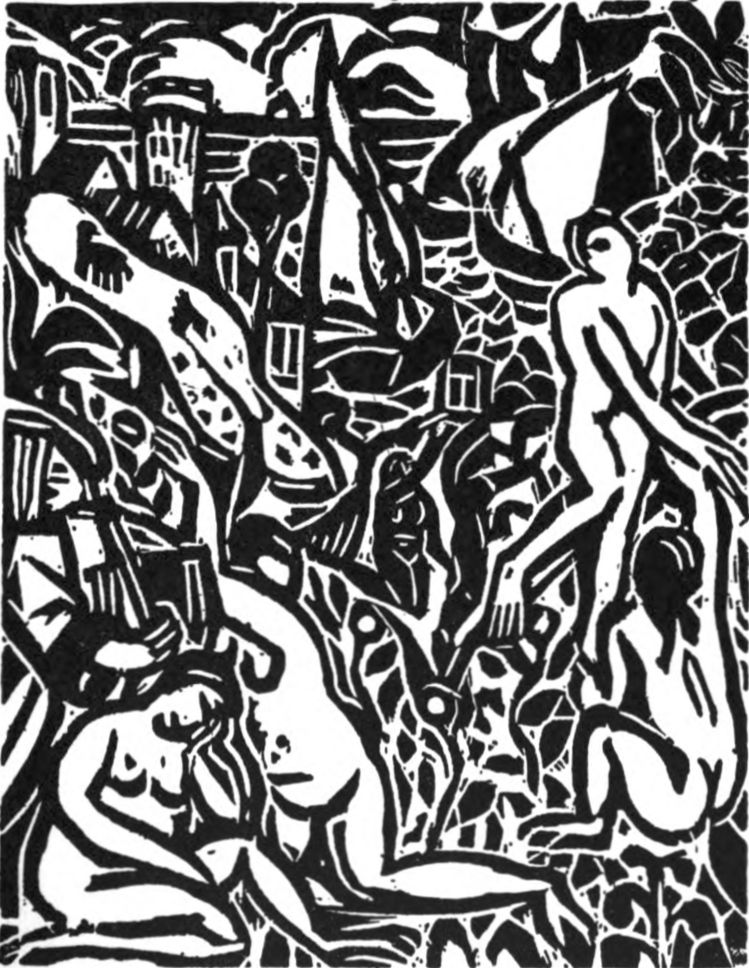
André Dérain
XVII. ASSASSINATION
Like Orpheus, all the poets felt violent death staring them in the face. Everywhere, publishers had been pillaged and collections of verse burnt. The admiration of all went out to Horace Tograth who, from far off Adelaide (Australia), had succeeded in unloosing this storm which seemed destined to destroy poetry forever. This man's knowledge, they said, bordered on the miraculous. He could drive away clouds or bring on rain anywhere he pleased. Women, once they had seen him, were ready to do his bidding. For the rest, he did not disdain either feminine or masculine virginities. As soon as Tograth had seen what enthusiasms he had evoked in the whole world, he announced that he would visit the principal cities of the globe, after Australia had been rid of its erotic and elegiac poets. And indeed some time later uprisings of the population were heard of in Tokyo, Pekin, Yakutsk, Calcutta, Buenos Ayres, San Francisco, Chicago, upon the appearance of the terrible German, Tograth. Wherever he went, he left an unearthly impression on account of his "miracles" (which he called scientific), and his extraordinary healings, all of which lifted his repute as a scientist and a thaumaturgist to sublime heights.
On May 30, Tograth debarked at Marseilles. The people were massed along the quays; Tograth landed from the steamer in a launch. No sooner was he recognized than cries, shouts, toasts, from innumerable gullets mingled with the sound of the wind, the waves and the sirens of the vessels. Tograth, tall and thin, was standing up in the launch. As it approached the land, the features of the hero could be distinguished more and more clearly. His face was smooth-shaven and blue, his mouth almost lipless, disfigured by an ugly cut; he had a receding chin which gave him the appearance, one might have said, of a shark. His brow rose straight up, very high and very large. Tograth was dressed in a pasty white costume, his shoes also being white and high-heeled. He wore no hat. As soon as he placed his foot upon the soil of Marseilles the furor of the crowd rose to such heights that when the quays were cleared three hundred people were found dead, strangled, trampled, crushed. Several men seized the hero and raised him upon their shoulders while they sang and shouted, and women threw flowers at him all the way to the hotel where a suite had been prepared for him and managers, interpreters and bell-boys were waiting to greet him.
* * *
On the same morning, Croniamantal coming from Brünn had arrived at Marseilles to look for Tristouse who had been there since the evening before with Paponat. All three mingled in the crowd which acclaimed Tograth before the hotel where he was to stop.
"Happy tumult," said Tristouse, "You are not a poet, Paponat, you have learned things which are worth infinitely more than poetry. Is it not true, Paponat, that you are in no way a poet?"
"Indeed, my dear," replied Paponat, "I have rhymed at times in order to amuse myself, but I am not a poet, I am an excellent business man and no one knows better than I how to manage an estate."
"Tonight you must mail a letter to La Voix of Adelaide; you must tell them all that, and so you will be safe."
"I shall not fail to do that," said Paponat. "Did you ever hear of such a thing, a poet! That goes for Croniamantal."
"I hope to God," said Tristouse, "that they will massacre him in Brünn where he expects to find us."
"But there he is right now," whispered Paponat. "He is in the crowd. He is hiding himself and hasn't seen us."
"I wish they would hurry up and massacre him," sighed Tristouse. "I have an idea that that will happen soon."
"Look," exclaimed Paponat, "here comes the hero."
* * *
The cortège which accompanied Tograth arrived at the hotel, and he was permitted to descend from their shoulders. Tograth turned to the crowd and addressed them:
"Citizens of Marseilles, in thanking you I could employ, if I wished, compliments that are fatter than your world-renowned sardines. I could, if I wished, make a long speech. But words will never quite encompass the magnificence of the reception which you have accorded me. I know that there are maladies in your midst that I might heal not only with my knowledge but with that which scientists have accumulated for myriads of years. Bring forth the sick, and I shall heal them."
A man whose cranium was as bald as that of an inhabitant of Mycona cried:
"Tograth! god-like mortal, all puissant savantissimo! Give me a luxuriant mane of hair."
Tograth smiled and asked that the man approach him: then he touched the denuded head, saying:
"Thy sterile pate shall be covered with an abundant vegetation, but remember always this favor by hating the laurel."
At the same time as the bald man, a little girl approached. She implored Tograth:
"Sweet man, sweet man, look at my mouth, my lover with a blow of his fist has broken several teeth. Return them to me."
The scientist smiled and put his finger into her mouth, saying: "Now thou canst chew, thou hast excellent teeth. But in return, show us what thou hast in thy bag."
The girl laughed, opening her mouth in which the new teeth gleamed; then she opened her bag, excusing herself:
"What a funny idea, before everybody! Here are my keys, here an enamelled photograph of my lover; he really looks better than that."
But the eyes of Tograth were greedy; he had perceived all folded up in her bag several Parisian songs, rhymed and set to Viennese airs. He took these papers and after having scrutinized them, asked:
"These are nothing but songs, hast thou no poems?"
"I have a very lovely one," said the girl. "It was the bell-boy of the Hotel Victoria wrote it for me before he left for Switzerland. But I never showed it to Sossi."
And she proffered Tograth a little rose sheet of paper on which was written a pathetic acrostic.
My dear beloved, ere I go away,
And thy love, Maria, I betray,
MARIA Rail and sob, my sweet, once more—again,
If you'd come with me to the woods, we twain,(!)
All would be sweeter; our parting would not pain.
"It is not only poetry," exclaimed Tograth, "it is idiotic."
And he tore up the paper and threw it into the ditch, while the girl knocked her teeth in fright and cried:
"Sweet man, good man, I did not know that it was bad."
Just then Croniamantal advanced close to Tograth and apostrophized the crowd:
"Carrion, assassins!"
They burst into laughter. They yelled:
"Into the water with him, the rat."
And Tograth, looking Croniamantal in the face, said:
"My good brother, let not my affluence disturb you. As for me, I love the people, even though I stop at hotels which they do not frequent."
The poet let Tograth talk, then he continued to address the crowd:
"Carrion, laugh at me, your joys are numbered, each one of them will be torn from you one by one. And do you know, o people, what your hero is?"
Tograth smiled and the crowd became all attention. The poet continued:
"Your hero, o populace, is Boredom bringing Misery."
A cry of astonishment issued from all the throats. Women crossed themselves. Tograth wanted to speak, but Croniamantal seized him suddenly by the neck, threw him to the ground and held him there with his foot on the man's chest, while he spoke:
"He is Boredom and Misery, the monstrous enemy of man, the Behemoth glutted with debauchery and rape, dripping the blood of marvellous poets. He is the vomit of the Antipodes, and his miracles deceive the clairvoyant no more than the miracles of Simon the Magi did the Apostles. Marseillais, Marseillais, woe that you whose ancestors come from the most purely lyrical land, should unite with the enemies of poetry, with the barbarians of all the nations. What a strange miracle, this, of the German returned from Australia! To have imposed it upon the world and to have been for a moment stronger than creation itself, stronger than immortal poetry."
But Tograth who was able to extricate himself at last, arose, soiled with dust and drunk with rage. He asked:
"Who are you?"
"Who are you, who are you?" cried the crowd.
The poet turned toward the east and in exalted tones said:
"I am Croniamantal, the greatest of living poets. I have often seen God face to face, I have borne the divine rapture which my human eyes tempered. I was born in eternity. But the day has come, and I am here before you."
Tograth greeted these last words with a terrible burst of laughter, and the first ranks of the crowd seeing Tograth laugh, took up his laughter, which, in bursts, in rolls, in trills, was soon communicated throughout the entire populace, even to Paponat and Tristouse Ballerinette. All of the open mouths yawned at Croniamantal, who became ill at ease. Interspersed with the laughter were shouts of:
"Into the water with the poet!... Burn him, Croniamantal!... To the dogs with him, lover of the laurel!"
A man who was in the first ranks and carried a heavy club gave Croniamantal a blow, causing him to make a painful grimace which doubled the merriment of the crowd. A stone, accurately thrown, struck the nose of the poet and drew blood. A fish merchant forced his way through the mob and, confronting Croniamantal, said:
"Hou! the raven. I remember you, all right, you're a policeman who wanted to pass for a poet; there, cow; take that, story teller."
And he gave him a terrific slap, spitting in his face. The man whom Tograth had cured of alopecia came to him and said:
"Look at my hair, is it a false miracle or not?"
And lifting his cane, he thrust it so adroitly that he gouged out Croniamantal's right eye. Croniamantal fell over backward, women threw themselves upon him and beat him. Tristouse jumped up and down with joy, while Paponat tried to calm her. But she went over and with the end of her umbrella stuck out Croniamantal's other eye, while he, seeing her in this last moment of sight, cried:
"I confess my love for Tristouse Ballerinette, the divine poesy that consoles my soul."
"Shut up, vermin!" cried the crowd of men, "there are ladies here."
The women went away soon, and a man who was balancing a large knife on his open hand threw it in such a way that it landed right in the open mouth of Croniamantal. Other men did the same thing. The knives stuck in his belly, his chest, and soon there was nothing more on the ground than a corpse bristling with points like the husk of a chestnut.
XVIII. APOTHEOSIS
Croniamantal dead, Paponat brought Tristouse Ballerinette back to the hotel, where she relapsed into nervous fainting-spells. They were in a very old building and by chance Paponat discovered, wrapped up in cardboard, a bottle of water of the Queen of Hungary which dated from the 17th Century. This remedy worked rapidly. Tristouse recovered her senses and immediately went to the hospital to claim the body of Croniamantal which was turned over to her without delay.
She arranged a decent burial for him and placed over his tomb a stone on which there was engraved the following epitaph:
Walk lightly and your silence keep, To leave untroubled his good sleep.
Then she went back to Paris with Paponat who soon left her for a mannikin of the Champs-Élysées.
Tristouse did not regret him very long. She went into mourning for Croniamantal and climbed up to the Montmartre, to the Bird of Benin's who began to pay court to her, and after he had what he desired they began to talk of Croniamantal.
"I ought to make a statue to him," said the Bird of Benin, "For I am not only a painter but also a sculptor."
"That's right," said Tristouse, "we must raise a statue to him."
"Where?" asked the Bird of Benin; "The government will not grant us any ground. Times are bad for poets."
"So they say," replied Tristouse, "but perhaps it isn't true. What do you think of the Meudon woods?"
"I thought of that, but I dared not say it. Let's go to the Meudon woods."
"A statue of what?" asked Tristouse, "Marble? Bronze?"
"No, that's old fashioned. I must model a profound statue out of nothing, like poetry and glory."
"Bravo! Bravo!" cried Tristouse clapping her hands, "A statue out of nothing, empty, that's lovely, and when will you make it?"
"Tomorrow, if you wish; we shall go and dine, pass the night together, and in the morning we shall go to the Meudon woods where I shall make this profound statue."
* * *
No sooner said, than done. They went and dined with the élite of the Montmartre, returned to sleep at midnight and on the next morning at nine o'clock, after having armed himself with a pick-axe, a spade, a shovel and some boasting-chisels, they took the road for the pretty Meudon woods, where they met the Prince of Poets, accompanied by his little friend, quite happy over the pleasant days he had spent in the City-prison.
In the clearing, the Bird of Benin set to work. In a few hours he had dug a trench of about a meter and a half in breadth and two in depth.
Then they had lunch on the grass.
The afternoon was devoted by the Bird of Benin to sculpturing the interior of the monument to Croniamantal.
On the following day, the sculptor came back with workingmen who fixed up an armed cement wall, six inches broad on top, and eighteen inches broad at the base, so that the empty space had the form of Croniamantal, and the hole was full of his spectre.
* * *
On the next day, the Bird of Benin, Tristouse, the Prince of Poets and his little friend came back to the statue which was heaped up with earth which they had gathered here and there, and at nightfall they planted a fine laurel tree, while Tristouse Ballerinette danced and sang:
No one loves thee thou art lying Palantila Mila Mima When he was lover to the queen He was king while she was queen 'Tis true, 'tis true that I love him Croniamantal way down in the pit Can that be right Let us gather the sweet marjoram At night.
THE END