POEMS OF THE THIRD PERIOD. (continued 2)
Reading edition
FEMALE JUDGMENT.
Man frames his judgment on reason; but woman on love founds her verdict; If her judgment loves not, woman already has judged.
FRIDOLIN; OR, THE WALK TO THE IRON FOUNDRY. A gentle was Fridolin, And he his mistress dear, Savern's fair Countess, honored in All truth and godly fear. She was so meek, and, ah! so good! Yet each wish of her wayward mood, He would have studied to fulfil, To please his God, with earnest will. From the first hour when daylight shone Till rang the vesper-chime, He lived but for her will alone, And deemed e'en that scarce time. And if she said, "Less anxious be!" His eye then glistened tearfully. Thinking that he in duty failed, And so before no toil he quailed. And so, before her serving train, The Countess loved to raise him; While her fair mouth, in endless strain, Was ever wont to praise him. She never held him as her slave, Her heart a child's rights to him gave; Her clear eye hung in fond delight Upon his well-formed features bright. Soon in the huntsman Robert's breast Was poisonous anger fired; His black soul, long by lust possessed, With malice was inspired; He sought the Count, whom, quick in deed, A traitor might with ease mislead, As once from hunting home they rode, And in his heart suspicion sowed. "Happy art thou, great Count, in truth," Thus cunningly he spoke; "For ne'er mistrust's envenomed tooth Thy golden slumbers broke; A noble wife thy love rewards, And modesty her person guards. The tempter will be able ne'er Her true fidelity to snare." A gloomy scowl the Count's eye filled: "What's this thou say'st to me? Shall I on woman's virtue build, Inconstant as the sea? The flatterer's mouth with ease may lure; My trust is placed on ground more sure. No one, methinks, dare ever burn To tempt the wife of Count Savern." The other spoke: "Thou sayest it well, The fool deserves thy scorn Who ventures on such thoughts to dwell, A mere retainer born,— Who to the lady he obeys Fears not his wishes' lust to raise."— "What!" tremblingly the Count began, "Dost speak, then, of a living man?"— "Is, then, the thing, to all revealed, Hid from my master's view? Yet, since with care from thee concealed, I'd fain conceal it too"— "Speak quickly, villain! speak or die!" Exclaimed the other fearfully. "Who dares to look on Cunigond?" "'Tis the fair page that is so fond." "He's not ill-shaped in form, I wot," He craftily went on; The Count meanwhile felt cold and hot, By turns in every bone. "Is't possible thou seest not, sir, How he has eyes for none but her? At table ne'er attends to thee, But sighs behind her ceaselessly?" "Behold the rhymes that from him came His passion to confess"— "Confess!"—"And for an answering flame,— The impious knave!—to press. My gracious lady, soft and meek, Through pity, doubtless, feared to speak; That it has 'scaped me, sore I rue; What, lord, canst thou to help it do?" Into the neighboring wood then rode The Count, inflamed with wrath, Where, in his iron foundry, glowed The ore, and bubbled forth. The workmen here, with busy hand, The fire both late and early fanned. The sparks fly out, the bellows ply, As if the rock to liquefy. The fire and water's might twofold Are here united found; The mill-wheel, by the flood seized hold, Is whirling round and round; The works are clattering night and day, With measured stroke the hammers play, And, yielding to the mighty blows, The very iron plastic grows. Then to two workmen beckons he, And speaks thus in his ire; "The first who's hither sent by me Thus of ye to inquire 'Have ye obeyed my lord's word well?' Him cast ye into yonder hell, That into ashes he may fly, And ne'er again torment mine eye!" The inhuman pair were overjoyed, With devilish glee possessed For as the iron, feeling void, Their heart was in their breast, And brisker with the bellows' blast, The foundry's womb now heat they fast, And with a murderous mind prepare To offer up the victim there. Then Robert to his comrade spake, With false hypocrisy: "Up, comrade, up! no tarrying make! Our lord has need of thee." The lord to Fridolin then said: "The pathway toward the foundry tread, And of the workmen there inquire, If they have done their lord's desire." The other answered, "Be it so!" But o'er him came this thought, When he was all-prepared to go, "Will she command me aught?" So to the Countess straight he went: "I'm to the iron-foundry sent; Then say, can I do aught for thee? For thou 'tis who commandest me." To this the Lady of Savern Replied in gentle tone: "To hear the holy mass I yearn, For sick now lies my son; So go, my child, and when thou'rt there, Utter for me a humble prayer, And of thy sins think ruefully, That grace may also fall on me." And in this welcome duty glad, He quickly left the place; But ere the village bounds he had Attained with rapid pace, The sound of bells struck on his ear, From the high belfry ringing clear, And every sinner, mercy-sent, Inviting to the sacrament. "Never from praising God refrain Where'er by thee He's found!" He spoke, and stepped into the fane, But there he heard no sound; For 'twas the harvest time, and now Glowed in the fields the reaper's brow; No choristers were gathered there, The duties of the mass to share. The matter paused he not to weigh, But took the sexton's part; "That thing," he said, "makes no delay Which heavenward guides the heart." Upon the priest, with helping hand, He placed the stole and sacred band, The vessels he prepared beside, That for the mass were sanctified. And when his duties here were o'er, Holding the mass-book, he, Ministering to the priest, before The altar bowed his knee, And knelt him left, and knelt him right, While not a look escaped his sight, And when the holy Sanctus came, The bell thrice rang he at the name. And when the priest, bowed humbly too, In hand uplifted high, Facing the altar, showed to view The present Deity, The sacristan proclaimed it well, Sounding the clearly-tinkling bell, While all knelt down, and beat the breast, And with a cross the Host confessed. The rites thus served he, leaving none, With quick and ready wit; Each thing that in God's house is done, He also practised it. Unweariedly he labored thus, Till the Vobiscum Dominus, When toward the people turned the priest, Blessed them,—and so the service ceased. Then he disposed each thing again, In fair and due array; First purified the holy fane, And then he went his way, And gladly, with a mind at rest, On to the iron-foundry pressed, Saying the while, complete to be, Twelve paternosters silently. And when he saw the furnace smoke, And saw the workmen stand, "Have ye, ye fellows," thus he spoke, "Obeyed the Count's command?" Grinning they ope the orifice, And point into the fell abyss: "He's cared for—all is at an end! The Count his servants will commend." The answer to his lord he brought, Returning hastily, Who, when his form his notice caught, Could scarcely trust his eye: "Unhappy one! whence comest thou?"— "Back from the foundry"—"Strange, I vow! Hast in thy journey, then, delayed?"— "'Twas only, lord, till I had prayed." "For when I from thy presence went (Oh pardon me!) to-day, As duty bid, my steps I bent To her whom I obey. She told me, lord, the mass to hear, I gladly to her wish gave ear, And told four rosaries at the shrine, For her salvation and for thine." In wonder deep the Count now fell, And, shuddering, thus spake he: "And, at the foundry, quickly tell, What answer gave they thee?" "Obscure the words they answered in,— Showing the furnace with a grin: 'He's cared for—all is at an end! The Count his servants will commend.'" "And Robert?" interrupted he, While deadly pale he stood,— "Did he not, then, fall in with thee? I sent him to the wood."— "Lord, neither in the wood nor field Was trace of Robert's foot revealed."— "Then," cried the Count, with awe-struck mien, "Great God in heaven his judge hath been!" With kindness he before ne'er proved, He led him by the hand Up to the Countess,—deeply moved,— Who naught could understand. "This child, let him be dear to thee, No angel is so pure as he! Though we may have been counselled ill, God and His hosts watch o'er him still."
THE GENIUS WITH THE INVERTED TORCH.
Lovely he looks, 'tis true, with the light of his torch now extinguished; But remember that death is not aesthetic, my friends!
THE COUNT OF HAPSBURG. 38 A BALLAD. At Aix-la-Chapelle, in imperial array, In its halls renowned in old story, At the coronation banquet so gay King Rudolf was sitting in glory. The meats were served up by the Palsgrave of Rhine, The Bohemian poured out the bright sparkling wine, And all the Electors, the seven, Stood waiting around the world-governing one, As the chorus of stars encircle the sun, That honor might duly be given. And the people the lofty balcony round In a throng exulting were filling; While loudly were blending the trumpets' glad sound, The multitude's voices so thrilling; For the monarchless period, with horror rife, Has ended now, after long baneful strife, And the earth had a lord to possess her. No longer ruled blindly the iron-bound spear, And the weak and the peaceful no longer need fear Being crushed by the cruel oppressor. And the emperor speaks with a smile in his eye, While the golden goblet he seizes: "With this banquet in glory none other can vie, And my regal heart well it pleases; Yet the minstrel, the bringer of joy, is not here, Whose melodious strains to my heart are so dear, And whose words heavenly wisdom inspire; Since the days of my youth it hath been my delight, And that which I ever have loved as a knight, As a monarch I also require." And behold! 'mongst the princes who stand round the throne Steps the bard, in his robe long and streaming, While, bleached by the years that have over him flown, His silver locks brightly are gleaming; "Sweet harmony sleeps in the golden strings, The minstrel of true love reward ever sings, And adores what to virtue has tended— What the bosom may wish, what the senses hold dear; But say, what is worthy the emperor's ear At this, of all feasts the most splendid?" "No restraint would I place on the minstrel's own choice," Speaks the monarch, a smile on each feature; "He obeys the swift hour's imperious voice, Of a far greater lord is the creature. For, as through the air the storm-wind on-speeds,— One knows not from whence its wild roaring proceeds— As the spring from hid sources up-leaping, So the lay of the bard from the inner heart breaks While the might of sensations unknown it awakes, That within us were wondrously sleeping." Then the bard swept the cords with a finger of might, Evoking their magical sighing: "To the chase once rode forth a valorous knight, In pursuit of the antelope flying. His hunting-spear bearing, there came in his train His squire; and when o'er a wide-spreading plain On his stately steed he was riding, He heard in the distance a bell tinkling clear, And a priest, with the Host, he saw soon drawing near, While before him the sexton was striding." "And low to the earth the Count then inclined, Bared his head in humble submission, To honor, with trusting and Christian-like mind, What had saved the whole world from perdition. But a brook o'er the plain was pursuing its course, That swelled by the mountain stream's headlong force, Barred the wanderer's steps with its current; So the priest on one side the blest sacrament put, And his sandal with nimbleness drew from his foot, That he safely might pass through the torrent." "'What wouldst thou?' the Count to him thus began, His wondering look toward him turning: 'My journey is, lord, to a dying man, Who for heavenly diet is yearning; But when to the bridge o'er the brook I came nigh, In the whirl of the stream, as it madly rushed by With furious might 'twas uprooted. And so, that the sick the salvation may find That he pants for, I hasten with resolute mind To wade through the waters barefooted.'" "Then the Count made him mount on his stately steed, And the reins to his hands he confided, That he duly might comfort the sick in his need, And that each holy rite be provided. And himself, on the back of the steed of his squire, Went after the chase to his heart's full desire, While the priest on his journey was speeding And the following morning, with thankful look, To the Count once again his charger he took, Its bridle with modesty leading." "'God forbid that in chase or in battle,' then cried The Count with humility lowly, 'The steed I henceforward should dare to bestride That had borne my Creator so holy! And if, as a guerdon, he may not be thine, He devoted shall be to the service divine, Proclaiming His infinite merit, From whom I each honor and earthly good Have received in fee, and my body and blood, And my breath, and my life, and my spirit.'" "'Then may God, the sure rock, whom no time can e'er move, And who lists to the weak's supplication, For the honor thou pay'st Him, permit thee to prove Honor here, and hereafter salvation! Thou'rt a powerful Count, and thy knightly command Hath blazoned thy fame through the Switzer's broad land; Thou art blest with six daughters admired; May they each in thy house introduce a bright crown, Filling ages unborn with their glorious renown'— Thus exclaimed he in accents inspired." And the emperor sat there all-thoughtfully, While the dream of the past stood before him; And when on the minstrel he turned his eye, His words' hidden meaning stole o'er him; For seeing the traits of the priest there revealed, In the folds of his purple-dyed robe he concealed His tears as they swiftly coursed down. And all on the emperor wonderingly gazed, And the blest dispensations of Providence praised, For the Count and the Caesar were one.
THE FORUM OF WOMAN. Woman, never judge man by his individual actions; But upon man as a whole, pass thy decisive decree.
THE GLOVE. A TALE. Before his lion-court, Impatient for the sport, King Francis sat one day; The peers of his realm sat around, And in balcony high from the ground Sat the ladies in beauteous array. And when with his finger he beckoned, The gate opened wide in a second,— And in, with deliberate tread, Enters a lion dread, And looks around Yet utters no sound; Then long he yawns And shakes his mane, And, stretching each limb, Down lies he again. Again signs the king,— The next gate open flies, And, lo! with a wild spring, A tiger out hies. When the lion he sees, loudly roars he about, And a terrible circle his tail traces out. Protruding his tongue, past the lion he walks, And, snarling with rage, round him warily stalks: Then, growling anew, On one side lies down too. Again signs the king,— And two gates open fly, And, lo! with one spring, Two leopards out hie. On the tiger they rush, for the fight nothing loth, But he with his paws seizes hold of them both. And the lion, with roaring, gets up,—then all's still; The fierce beasts stalk around, madly thirsting to kill. From the balcony raised high above A fair hand lets fall down a glove Into the lists, where 'tis seen The lion and tiger between. To the knight, Sir Delorges, in tone of jest, Then speaks young Cunigund fair; "Sir Knight, if the love that thou feel'st in thy breast Is as warm as thou'rt wont at each moment to swear, Pick up, I pray thee, the glove that lies there!" And the knight, in a moment, with dauntless tread, Jumps into the lists, nor seeks to linger, And, from out the midst of those monsters dread, Picks up the glove with a daring finger. And the knights and ladies of high degree With wonder and horror the action see, While he quietly brings in his hand the glove, The praise of his courage each mouth employs; Meanwhile, with a tender look of love, The promise to him of coming joys, Fair Cunigund welcomes him back to his place. But he threw the glove point-blank in her face: "Lady, no thanks from thee I'll receive!" And that selfsame hour he took his leave.
THE CIRCLE OF NATURE. All, thou gentle one, lies embraced in thy kingdom; the graybeard Back to the days of his youth, childish and child-like, returns.
THE VEILED STATUE AT SAIS. A youth, impelled by a burning thirst for knowledge To roam to Sais, in fair Egypt's land, The priesthood's secret learning to explore, Had passed through many a grade with eager haste, And still was hurrying on with fond impatience. Scarce could the Hierophant impose a rein Upon his headlong efforts. "What avails A part without the whole?" the youth exclaimed; "Can there be here a lesser or a greater? The truth thou speak'st of, like mere earthly dross, Is't but a sum that can be held by man In larger or in smaller quantity? Surely 'tis changeless, indivisible; Deprive a harmony of but one note, Deprive the rainbow of one single color, And all that will remain is naught, so long As that one color, that one note, is wanting." While thus they converse held, they chanced to stand Within the precincts of a lonely temple, Where a veiled statue of gigantic size The youth's attention caught. In wonderment He turned him toward his guide, and asked him, saying, "What form is that concealed beneath yon veil?" "Truth!" was the answer. "What!" the young man cried, "When I am striving after truth alone, Seekest thou to hide that very truth from me?" "The Godhead's self alone can answer thee," Replied the Hierophant. "'Let no rash mortal Disturb this veil,' said he, 'till raised by me; For he who dares with sacrilegious hand To move the sacred mystic covering, He'—said the Godhead—" "Well?"—"'will see the truth.'" "Strangely oracular, indeed! And thou Hast never ventured, then, to raise the veil?" "I? Truly not! I never even felt The least desire."—"Is't possible? If I Were severed from the truth by nothing else Than this thin gauze—" "And a divine decree," His guide broke in. "Far heavier than thou thinkest Is this thin gauze, my son. Light to thy hand It may be—but most weighty to thy conscience." The youth now sought his home, absorbed in thought; His burning wish to solve the mystery Banished all sleep; upon his couch he lay, Tossing his feverish limbs. When midnight came, He rose, and toward the temple timidly, Led by a mighty impulse, bent his way. The walls he scaled, and soon one active spring Landed the daring boy beneath the dome. Behold him now, in utter solitude, Welcomed by naught save fearful, deathlike silence,— A silence which the echo of his steps Alone disturbs, as through the vaults he paces. Piercing an opening in the cupola, The moon cast down her pale and silvery beams, And, awful as a present deity, Glittering amid the darkness of the pile, In its long veil concealed, the statue stands. With hesitating step, he now draws near— His impious hand would fain remove the veil— Sudden a burning chill assails his bones And then an unseen arm repulses him. "Unhappy one, what wouldst thou do?" Thus cries A faithful voice within his trembling breast. "Wouldst thou profanely violate the All-Holy?" "'Tis true the oracle declared, 'Let none Venture to raise the veil till raised by me.' But did the oracle itself not add, That he who did so would behold the truth? Whate'er is hid behind, I'll raise the veil." And then he shouted: "Yes! I will behold it!" "Behold it!" Repeats in mocking tone the distant echo. He speaks, and, with the word, lifts up the veil. Would you inquire what form there met his eye? I know not,—but, when day appeared, the priests Found him extended senseless, pale as death, Before the pedestal of Isis' statue. What had been seen and heard by him when there He never would disclose, but from that hour His happiness in life had fled forever, And his deep sorrow soon conducted him To an untimely grave. "Woe to that man," He warning said to every questioner, "Woe to that man who wins the truth by guilt, For truth so gained will ne'er reward its owner."
THE DIVISION OF THE EARTH. "Take the world!" Zeus exclaimed from his throne in the skies To the children of man—"take the world I now give; It shall ever remain as your heirloom and prize, So divide it as brothers, and happily live." Then all who had hands sought their share to obtain, The young and the aged made haste to appear; The husbandman seized on the fruits of the plain, The youth through the forest pursued the fleet deer. The merchant took all that his warehouse could hold, The abbot selected the last year's best wine, The king barred the bridges,—the highways controlled, And said, "Now remember, the tithes shall be mine!" But when the division long-settled had been, The poet drew nigh from a far distant land; But alas! not a remnant was now to be seen, Each thing on the earth owned a master's command. "Alas! shall then I, of thy sons the most true,— Shall I, 'mongst them all, be forgotten alone?" Thus loudly he cried in his anguish, and threw Himself in despair before Jupiter's throne. "If thou in the region of dreams didst delay, Complain not of me," the Immortal replied; "When the world was apportioned, where then wert thou, pray?" "I was," said the poet, "I was—by thy side!" "Mine eye was then fixed on thy features so bright, Mine ear was entranced by thy harmony's power; Oh, pardon the spirit that, awed by thy light, All things of the earth could forget in that hour!" "What to do?" Zeus exclaimed,—"for the world has been given; The harvest, the market, the chase, are not free; But if thou with me wilt abide in my heaven, Whenever thou comest, 'twill be open to thee!"
THE FAIREST APPARITION. If thou never hast gazed upon beauty in moments of sorrow, Thou canst with truth never boast that thou true beauty hast seen. If thou never hast gazed upon gladness in beauteous features, Thou canst with truth never boast that thou true gladness hast seen.
THE IDEAL AND THE ACTUAL LIFE. Forever fair, forever calm and bright, Life flies on plumage, zephyr-light, For those who on the Olympian hill rejoice— Moons wane, and races wither to the tomb, And 'mid the universal ruin, bloom The rosy days of Gods—With man, the choice, Timid and anxious, hesitates between The sense's pleasure and the soul's content; While on celestial brows, aloft and sheen, The beams of both are blent. Seekest thou on earth the life of gods to share, Safe in the realm of death?—beware To pluck the fruits that glitter to thine eye; Content thyself with gazing on their glow— Short are the joys possession can bestow, And in possession sweet desire will die. 'Twas not the ninefold chain of waves that bound Thy daughter, Ceres, to the Stygian river— She plucked the fruit of the unholy ground, And so—was hell's forever! The weavers of the web—the fates—but sway The matter and the things of clay; Safe from change that time to matter gives, Nature's blest playmate, free at will to stray With gods a god, amidst the fields of day, The form, the archetype 39, serenely lives. Would'st thou soar heavenward on its joyous wing? Cast from thee, earth, the bitter and the real, High from this cramped and dungeon being, spring Into the realm of the ideal! Here, bathed, perfection, in thy purest ray, Free from the clogs and taints of clay, Hovers divine the archetypal man! Dim as those phantom ghosts of life that gleam And wander voiceless by the Stygian stream,— Fair as it stands in fields Elysian, Ere down to flesh the immortal doth descend:— If doubtful ever in the actual life Each contest—here a victory crowns the end Of every nobler strife. Not from the strife itself to set thee free, But more to nerve—doth victory Wave her rich garland from the ideal clime. Whate'er thy wish, the earth has no repose— Life still must drag thee onward as it flows, Whirling thee down the dancing surge of time. But when the courage sinks beneath the dull Sense of its narrow limits—on the soul, Bright from the hill-tops of the beautiful, Bursts the attained goal! If worth thy while the glory and the strife Which fire the lists of actual life— The ardent rush to fortune or to fame, In the hot field where strength and valor are, And rolls the whirling thunder of the car, And the world, breathless, eyes the glorious game— Then dare and strive—the prize can but belong To him whose valor o'er his tribe prevails; In life the victory only crowns the strong— He who is feeble fails. But life, whose source, by crags around it piled, Chafed while confined, foams fierce and wild, Glides soft and smooth when once its streams expand, When its waves, glassing in their silver play, Aurora blent with Hesper's milder ray, Gain the still beautiful—that shadow-land! Here, contest grows but interchange of love, All curb is but the bondage of the grace; Gone is each foe,—peace folds her wings above Her native dwelling-place. When, through dead stone to breathe a soul of light, With the dull matter to unite The kindling genius, some great sculptor glows; Behold him straining, every nerve intent— Behold how, o'er the subject element, The stately thought its march laborious goes! For never, save to toil untiring, spoke The unwilling truth from her mysterious well— The statue only to the chisel's stroke Wakes from its marble cell. But onward to the sphere of beauty—go Onward, O child of art! and, lo! Out of the matter which thy pains control The statue springs!—not as with labor wrung From the hard block, but as from nothing sprung— Airy and light—the offspring of the soul! The pangs, the cares, the weary toils it cost Leave not a trace when once the work is done— The Artist's human frailty merged and lost In art's great victory won! 40 If human sin confronts the rigid law Of perfect truth and virtue 41, awe Seizes and saddens thee to see how far Beyond thy reach, perfection;—if we test By the ideal of the good, the best, How mean our efforts and our actions are! This space between the ideal of man's soul And man's achievement, who hath ever past? An ocean spreads between us and that goal, Where anchor ne'er was cast! But fly the boundary of the senses—live The ideal life free thought can give; And, lo, the gulf shall vanish, and the chill Of the soul's impotent despair be gone! And with divinity thou sharest the throne, Let but divinity become thy will! Scorn not the law—permit its iron band The sense (it cannot chain the soul) to thrall. Let man no more the will of Jove withstand 42, And Jove the bolt lets fall! If, in the woes of actual human life— If thou could'st see the serpent strife Which the Greek art has made divine in stone— Could'st see the writhing limbs, the livid cheek, Note every pang, and hearken every shriek, Of some despairing lost Laocoon, The human nature would thyself subdue To share the human woe before thine eye— Thy cheek would pale, and all thy soul be true To man's great sympathy. But in the ideal realm, aloof and far, Where the calm art's pure dwellers are, Lo, the Laocoon writhes, but does not groan. Here, no sharp grief the high emotion knows— Here, suffering's self is made divine, and shows The brave resolve of the firm soul alone: Here, lovely as the rainbow on the dew Of the spent thunder-cloud, to art is given, Gleaming through grief's dark veil, the peaceful blue Of the sweet moral heaven. So, in the glorious parable, behold How, bowed to mortal bonds, of old Life's dreary path divine Alcides trod: The hydra and the lion were his prey, And to restore the friend he loved to-day, He went undaunted to the black-browed god; And all the torments and the labors sore Wroth Juno sent—the meek majestic one, With patient spirit and unquailing, bore, Until the course was run— Until the god cast down his garb of clay, And rent in hallowing flame away The mortal part from the divine—to soar To the empyreal air! Behold him spring Blithe in the pride of the unwonted wing, And the dull matter that confined before Sinks downward, downward, downward as a dream! Olympian hymns receive the escaping soul, And smiling Hebe, from the ambrosial stream, Fills for a god the bowl!
GERMANY AND HER PRINCES. Thou hast produced mighty monarchs, of whom thou art not unworthy, For the obedient alone make him who governs them great. But, O Germany, try if thou for thy rulers canst make it Harder as kings to be great,—easier, though, to be men!
DANGEROUS CONSEQUENCES. Deeper and bolder truths be careful, my friends, of avowing; For as soon as ye do all the world on ye will fall.
THE MAIDEN FROM AFAR. (OR FROM ABROAD.) Within a vale, each infant year, When earliest larks first carol free, To humble shepherds cloth appear A wondrous maiden, fair to see. Not born within that lowly place— From whence she wandered, none could tell; Her parting footsteps left no trace, When once the maiden sighed farewell. And blessed was her presence there— Each heart, expanding, grew more gay; Yet something loftier still than fair Kept man's familiar looks away. From fairy gardens, known to none, She brought mysterious fruits and flowers— The things of some serener sun— Some Nature more benign than ours. With each her gifts the maiden shared— To some the fruits, the flowers to some; Alike the young, the aged fared; Each bore a blessing back to home. Though every guest was welcome there, Yet some the maiden held more dear, And culled her rarest sweets whene'er She saw two hearts that loved draw near. 43
THE HONORABLE. Ever honor the whole; individuals only I honor; In individuals I always discover the whole.
PARABLES AND RIDDLES. I. A bridge of pearls its form uprears High o'er a gray and misty sea; E'en in a moment it appears, And rises upwards giddily. Beneath its arch can find a road The loftiest vessel's mast most high, Itself hath never borne a load, And seems, when thou draw'st near, to fly. It comes first with the stream, and goes Soon as the watery flood is dried. Where may be found this bridge, disclose, And who its beauteous form supplied! II. It bears thee many a mile away, And yet its place it changes ne'er; It has no pinions to display, And yet conducts thee through the air. It is the bark of swiftest motion That every weary wanderer bore; With speed of thought the greatest ocean It carries thee in safety o'er; One moment wafts thee to the shore. III. Upon a spacious meadow play Thousands of sheep, of silvery hue; And as we see them move to-day, The man most aged saw them too. They ne'er grow old, and, from a rill That never dries, their life is drawn; A shepherd watches o'er them still, With curved and beauteous silver horn. He drives them out through gates of gold, And every night their number counts; Yet ne'er has lost, of all his fold, One lamb, though oft that path he mounts. A hound attends him faithfully, A nimble ram precedes the way; Canst thou point out that flock to me, And who the shepherd, canst thou say? IV. There stands a dwelling, vast and tall, On unseen columns fair; No wanderer treads or leaves its hall, And none can linger there. Its wondrous structure first was planned With art no mortal knows; It lights the lamps with its own hand 'Mongst which it brightly glows. It has a roof, as crystal bright, Formed of one gem of dazzling light; Yet mortal eye has ne'er Seen Him who placed it there. V. Within a well two buckets lie, One mounts, and one descends; When one is full, and rises high, The other downward wends. They wander ever to and fro— Now empty are, now overflow. If to the mouth thou liftest this, That hangs within the dark abyss. In the same moment they can ne'er Refresh thee with their treasures fair. VI. Know'st thou the form on tender ground? It gives itself its glow, its light; And though each moment changing found. Is ever whole and ever bright. In narrow compass 'tis confined, Within the smallest frame it lies; Yet all things great that move thy mind, That form alone to thee supplies. And canst thou, too, the crystal name? No gem can equal it in worth; It gleams, yet kindles near to flame, It sucks in even all the earth. Within its bright and wondrous ring Is pictured forth the glow of heaven, And yet it mirrors back each thing Far fairer than to it 'twas given. VII. For ages an edifice here has been found, It is not a dwelling, it is not a Pane; A horseman for hundreds of days may ride round, Yet the end of his journey he ne'er can attain. Full many a century o'er it has passed, The might of the storm and of time it defies! Neath the rainbow of Heaven stands free to the last,— In the ocean it dips, and soars up to the skies. It was not vain glory that bade its erection, It serves as a refuge, a shield, a protection; Its like on the earth never yet has been known And yet by man's hand it is fashioned alone. VIII. Among all serpents there is one, Born of no earthly breed; In fury wild it stands alone, And in its matchless speed. With fearful voice and headlong force It rushes on its prey, And sweeps the rider and his horse In one fell swoop away. The highest point it loves to gain; And neither bar nor lock Its fiery onslaught can restrain; And arms—invite its shock. It tears in twain like tender grass, The strongest forest-trees; It grinds to dust the hardened brass, Though stout and firm it be. And yet this beast, that none can tame, Its threat ne'er twice fulfils; It dies in its self-kindled flame. And dies e'en when it kills. IX. We children six our being had From a most strange and wondrous pair,— Our mother ever grave and sad, Our father ever free from care. Our virtues we from both receive,— Meekness from her, from him our light; And so in endless youth we weave Round thee a circling figure bright. We ever shun the caverns black, And revel in the glowing day; 'Tis we who light the world's dark track, With our life's clear and magic ray. Spring's joyful harbingers are we, And her inspiring streams we swell; And so the house of death we flee, For life alone must round us dwell. Without us is no perfect bliss, When man is glad, we, too, attend, And when a monarch worshipped is, To him our majesty attend. X. What is the thing esteemed by few? The monarch's hand it decks with pride, Yet it is made to injure too, And to the sword is most allied. No blood it sheds, yet many a wound Inflicts,—gives wealth, yet takes from none; Has vanquished e'en the earth's wide round, And makes life's current smoothly run. The greatest kingdoms it has framed, The oldest cities reared from dust, Yet war's fierce torch has ne'er inflamed; Happy are they who in it trust! XI. I live within a dwelling of stone, There buried in slumber I dally; Yet, armed with a weapon of iron alone, The foe to encounter I sally. At first I'm invisible, feeble, and mean, And o'er me thy breath has dominion; I'm easily drowned in a raindrop e'en, Yet in victory waxes my pinion. When my sister, all-powerful, gives me her hand, To the terrible lord of the world I expand. XII. Upon a disk my course I trace, There restlessly forever flit; Small is the circuit I embrace, Two hands suffice to cover it. Yet ere that field I traverse, I Full many a thousand mile must go, E'en though with tempest-speed I fly, Swifter than arrow from a bow. XIII. A bird it is, whose rapid motion With eagle's flight divides the air; A fish it is, and parts the ocean, That bore a greater monster ne'er; An elephant it is, whose rider On his broad back a tower has put: 'Tis like the reptile base, the spider, Whenever it extends its foot; And when, with iron tooth projecting, It seeks its own life-blood to drain, On footing firm, itself erecting, It braves the raging hurricane.
THE VIRTUE OF WOMAN. Man of virtue has need;-into life with boldness he plunges, Entering with fortune more sure into the hazardous strife; But to woman one virtue suffices; it is ever shining Lovingly forth to the heart; so let it shine to the eye!
THE WALK. Hail to thee, mountain beloved, with thy glittering purple-dyed summit! Hail to thee also, fair sun, looking so lovingly on! Thee, too, I hail, thou smiling plain, and ye murmuring lindens, Ay, and the chorus so glad, cradled on yonder high boughs; Thee, too, peaceably azure, in infinite measure extending Round the dusky-hued mount, over the forest so green,— Round about me, who now from my chamber's confinement escaping, And from vain frivolous talk, gladly seek refuge with thee. Through me to quicken me runs the balsamic stream of thy breezes, While the energetical light freshens the gaze as it thirsts. Bright o'er the blooming meadow the changeable colors are gleaming, But the strife, full of charms, in its own grace melts away Freely the plain receives me,—with carpet far away reaching, Over its friendly green wanders the pathway along. Round me is humming the busy bee, and with pinion uncertain Hovers the butterfly gay over the trefoil's red flower. Fiercely the darts of the sun fall on me,—the zephyr is silent, Only the song of the lark echoes athwart the clear air. Now from the neighboring copse comes a roar, and the tops of the alders Bend low down,—in the wind dances the silvery grass; Night ambrosial circles me round; in the coolness so fragrant Greets me a beauteous roof, formed by the beeches' sweet shade. In the depths of the wood the landscape suddenly leaves me And a serpentine path guides up my footsteps on high. Only by stealth can the light through the leafy trellis of branches Sparingly pierce, and the blue smilingly peeps through the boughs, But in a moment the veil is rent, and the opening forest Suddenly gives back the day's glittering brightness to me! Boundlessly seems the distance before my gaze to be stretching, And in a purple-tinged hill terminates sweetly the world. Deep at the foot of the mountain, that under me falls away steeply, Wanders the greenish-hued stream, looking like glass as it flows. Endlessly under me see I the ether, and endlessly o'er Giddily look I above, shudderingly look I below, But between the infinite height and the infinite hollow Safely the wanderer moves over a well-guarded path. Smilingly past me are flying the banks all teeming with riches, And the valley so bright boasts of its industry glad. See how yonder hedgerows that sever the farmer's possessions Have by Demeter been worked into the tapestried plain! Kindly decree of the law, of the Deity mortal-sustaining, Since from the brazen world love vanished forever away. But in freer windings the measured pastures are traversed (Now swallowed up in the wood, now climbing up to the hills) By a glimmering streak, the highway that knits lands together; Over the smooth-flowing stream, quietly glide on the rafts. Ofttimes resound the bells of the flocks in the fields that seem living, And the shepherd's lone song wakens the echo again. Joyous villages crown the stream, in the copse others vanish, While from the back of the mount, others plunge wildly below. Man still lives with the land in neighborly friendship united, And round his sheltering roof calmly repose still his fields; Trustingly climbs the vine high over the low-reaching window, While round the cottage the tree circles its far-stretching boughs. Happy race of the plain! Not yet awakened to freedom, Thou and thy pastures with joy share in the limited law; Bounded thy wishes all are by the harvest's peaceable circuit, And thy lifetime is spent e'en as the task of the day! But what suddenly hides the beauteous view? A strange spirit Over the still-stranger plain spreads itself quickly afar— Coyly separates now, what scarce had lovingly mingled, And 'tis the like that alone joins itself on to the like. Orders I see depicted; the haughty tribes of the poplars Marshalled in regular pomp, stately and beauteous appear. All gives token of rule and choice, and all has its meaning,— 'Tis this uniform plan points out the Ruler to me. Brightly the glittering domes in far-away distance proclaim him. Out of the kernel of rocks rises the city's high wall. Into the desert without, the fauns of the forest are driven, But by devotion is lent life more sublime to the stone. Man is brought into nearer union with man, and around him Closer, more actively wakes, swifter moves in him the world. See! the emulous forces in fiery conflict are kindled, Much, they effect when they strive, more they effect when they join. Thousands of hands by one spirit are moved, yet in thousands of bosoms Beats one heart all alone, by but one feeling inspired— Beats for their native land, and glows for their ancestors' precepts; Here on the well-beloved spot, rest now time-honored bones. Down from the heavens descends the blessed troop of immortals, In the bright circle divine making their festal abode; Granting glorious gifts, they appear: and first of all, Ceres Offers the gift of the plough, Hermes the anchor brings next, Bacchus the grape, and Minerva the verdant olive-tree's branches, Even his charger of war brings there Poseidon as well. Mother Cybele yokes to the pole of her chariot the lions, And through the wide-open door comes as a citizen in. Sacred stones! 'Tis from ye that proceed humanity's founders, Morals and arts ye sent forth, e'en to the ocean's far isles. 'Twas at these friendly gates that the law was spoken by sages; In their Penates' defence, heroes rushed out to the fray. On the high walls appeared the mothers, embracing their infants, Looking after the march, till the distance 'twas lost. Then in prayer they threw themselves down at the deities' altars, Praying for triumph and fame, praying for your safe return. Honor and triumph were yours, but naught returned save your glory, And by a heart-touching stone, told are your valorous deeds. "Traveller! when thou com'st to Sparta, proclaim to the people That thou hast seen us lie here, as by the law we were bid." Slumber calmly, ye loved ones! for sprinkled o'er by your life-blood, Flourish the olive-trees there, joyously sprouts the good seed. In its possessions exulting, industry gladly is kindled. And from the sedge of the stream smilingly signs the blue god. Crushingly falls the axe on the tree, the Dryad sighs sadly; Down from the crest of the mount plunges the thundering load. Winged by the lever, the stone from the rocky crevice is loosened; Into the mountain's abyss boldly the miner descends. Mulciber's anvil resounds with the measured stroke of the hammer; Under the fist's nervous blow, spurt out the sparks of the steel. Brilliantly twines the golden flax round the swift-whirling spindles, Through the strings of the yarn whizzes the shuttle away. Far in the roads the pilot calls, and the vessels are waiting, That to the foreigner's land carry the produce of home; Others gladly approach with the treasures of far-distant regions, High on the mast's lofty head flutters the garland of mirth. See how yon markets, those centres of life and of gladness, are swarming! Strange confusion of tongues sounds in the wondering ear. On to the pile the wealth of the earth is heaped by the merchant, All that the sun's scorching rays bring forth on Africa's soil, All that Arabia prepares, that the uttermost Thule produces, High with heart-gladdening stores fills Amalthea her horn. Fortune wedded to talent gives birth there to children immortal, Suckled in liberty's arms, flourish the arts there of joy. With the image of life the eyes by the sculptor are ravished, And by the chisel inspired, speaks e'en the sensitive stone. Skies artificial repose on slender Ionian columns, And a Pantheon includes all that Olympus contains. Light as the rainbow's spring through the air, as the dart from the bowstring, Leaps the yoke of the bridge over the boisterous stream. But in his silent chamber the thoughtful sage is projecting Magical circles, and steals e'en on the spirit that forms, Proves the force of matter, the hatreds and loves of the magnet, Follows the tune through the air, follows through ether the ray, Seeks the familiar law in chance's miracles dreaded, Looks for the ne'er-changing pole in the phenomena's flight. Bodies and voices are lent by writing to thought ever silent, Over the centuries' stream bears it the eloquent page. Then to the wondering gaze dissolves the cloud of the fancy, And the vain phantoms of night yield to the dawning of day. Man now breaks through his fetters, the happy one! Oh, let him never Break from the bridle of shame, when from fear's fetters he breaks Freedom! is reason's cry,—ay, freedom! The wild raging passions Eagerly cast off the bonds Nature divine had imposed. Ah! in the tempest the anchors break loose, that warningly held him On to the shore, and the stream tears him along in its flood,— Into infinity whirls him,—the coasts soon vanish before him, High on the mountainous waves rocks all-dismasted the bark; Under the clouds are hid the steadfast stars of the chariot, Naught now remains,—in the breast even the god goes astray. Truth disappears from language, from life all faith and all honor Vanish, and even the oath is but a lie on the lips. Into the heart's most trusty bond, and into love's secrets, Presses the sycophant base, tearing the friend from the friend. Treason on innocence leers, with looks that seek to devour, And the fell slanderer's tooth kills with its poisonous bite. In the dishonored bosom, thought is now venal, and love, too, Scatters abroad to the winds, feelings once god-like and free. All thy holy symbols, O truth, deceit has adopted, And has e'en dared to pollute Nature's own voices so fair, That the craving heart in the tumult of gladness discovers; True sensations are now mute and can scarcely be heard. Justice boasts at the tribune, and harmony vaunts in the cottage, While the ghost of the law stands at the throne of the king. Years together, ay, centuries long, may the mummy continue, And the deception endure, apeing the fulness of life. Until Nature awakes, and with hands all-brazen and heavy 'Gainst the hollow-formed pile time and necessity strikes. Like a tigress, who, bursting the massive grating iron, Of her Numidian wood suddenly, fearfully thinks,— So with the fury of crime and anguish, humanity rises Hoping nature, long-lost in the town's ashes, to find. Oh then open, ye walls, and set the captive at freedom To the long desolate plains let him in safety return! But where am I? The path is now hid, declivities rugged Bar, with their wide-yawning gulfs, progress before and behind. Now far behind me is left the gardens' and hedges' sure escort, Every trace of man's hand also remains far behind. Only the matter I see piled up, whence life has its issue, And the raw mass of basalt waits for a fashioning hand. Down through its channel of rock the torrent roaringly rushes, Angrily forcing a path under the roots of the trees. All is here wild and fearfully desolate. Naught but the eagle Hangs in the lone realms of air, knitting the world to the clouds. Not one zephyr on soaring pinion conveys to my hearing Echoes, however remote, marking man's pleasures and pains. Am I in truth, then, alone? Within thine arms, on thy bosom, Nature, I lie once again!—Ah, and 'twas only a dream That assailed me with horrors so fearful; with life's dreaded phantom, And with the down-rushing vale, vanished the gloomy one too. Purer my life I receive again from thine altar unsullied,— Purer receive the bright glow felt by my youth's hopeful days. Ever the will is changing its aim and its rule, while forever, In a still varying form, actions revolve round themselves. But in enduring youth, in beauty ever renewing. Kindly Nature, with grace thou dost revere the old law! Ever the same, for the man in thy faithful hands thou preservest That which the child in its sport, that which the youth lent to thee; At the same breast thou dost suckle the ceaselessly-varying ages; Under the same azure vault, over the same verdant earth, Races, near and remote, in harmony wander together, See, even Homer's own sun looks on us, too, with a smile!
THE LAY OF THE BELL.
"Vivos voco—Mortuos plango—Fulgura frango." 44 Fast, in its prison-walls of earth, Awaits the mould of baked clay. Up, comrades, up, and aid the birth The bell that shall be born to-day! Who would honor obtain, With the sweat and the pain, The praise that man gives to the master must buy.— But the blessing withal must descend from on high! And well an earnest word beseems The work the earnest hand prepares; Its load more light the labor deems, When sweet discourse the labor shares. So let us ponder—nor in vain— What strength can work when labor wills; For who would not the fool disdain Who ne'er designs what he fulfils? And well it stamps our human race, And hence the gift to understand, That man within the heart should trace Whate'er he fashions with the hand. From the fir the fagot take, Keep it, heap it hard and dry, That the gathered flame may break Through the furnace, wroth and high. When the copper within Seeths and simmers—the tin, Pour quick, that the fluid that feeds the bell May flow in the right course glib and well. Deep hid within this nether cell, What force with fire is moulding thus, In yonder airy tower shall dwell, And witness wide and far of us! It shall, in later days, unfailing, Rouse many an ear to rapt emotion; Its solemn voice with sorrow wailing, Or choral chiming to devotion. Whatever fate to man may bring, Whatever weal or woe befall, That metal tongue shall backward ring, The warning moral drawn from all. See the silvery bubbles spring! Good! the mass is melting now! Let the salts we duly bring Purge the flood, and speed the flow. From the dross and the scum, Pure, the fusion must come; For perfect and pure we the metal must keep, That its voice may be perfect, and pure, and deep.
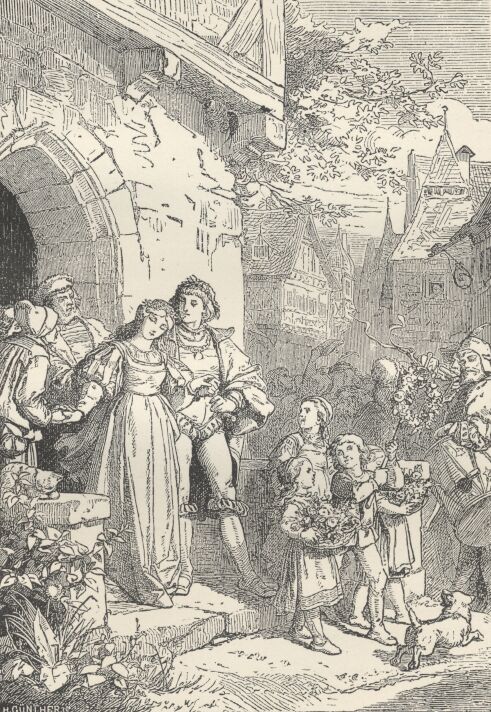
That voice, with merry music rife, The cherished child shall welcome in; What time the rosy dreams of life, In the first slumber's arms begin. As yet, in Time's dark womb unwarning, Repose the days, or foul or fair; And watchful o'er that golden morning, The mother-love's untiring care! And swift the years like arrows fly No more with girls content to play, Bounds the proud boy upon his way, Storms through loud life's tumultuous pleasures, With pilgrim staff the wide world measures; And, wearied with the wish to roam, Again seeks, stranger-like, the father-home. And, lo, as some sweet vision breaks Out from its native morning skies With rosy shame on downcast cheeks, The virgin stands before his eyes. A nameless longing seizes him! From all his wild compassions flown; Tears, strange till then, his eyes bedim; He wanders all alone. Blushing, he glides where'er she move; Her greeting can transport him; To every mead to deck his love, The happy wild flowers court him! Sweet hope—and tender longing—ye The growth of life's first age of gold; When the heart, swelling, seems to see The gates of heaven unfold! O love, the beautiful and brief! O prime, Glory, and verdure, of life's summer time! Browning o'er, the pipes are simmering, Dip this wand of clay 45 within; If like glass the wand be glimmering, Then the casting may begin. Brisk, brisk now, and see If the fusion flow free; If—(happy and welcome indeed were the sign!) If the hard and the ductile united combine. For still where the strong is betrothed to the weak, And the stern in sweet marriage is blent with the meek, Rings the concord harmonious, both tender and strong So be it with thee, if forever united, The heart to the heart flows in one, love-delighted; Illusion is brief, but repentance is long. Lovely, thither are they bringing. With the virgin wreath, the bride! To the love-feast clearly ringing, Tolls the church-bell far and wide! With that sweetest holiday, Must the May of life depart; With the cestus loosed—away Flies illusion from the heart! Yet love lingers lonely, When passion is mute, And the blossoms may only Give way to the fruit. The husband must enter The hostile life, With struggle and strife To plant or to watch. To snare or to snatch, To pray and importune, Must wager and venture And hunt down his fortune! Then flows in a current the gear and the gain, And the garners are filled with the gold of the grain, Now a yard to the court, now a wing to the centre! Within sits another, The thrifty housewife; The mild one, the mother— Her home is her life. In its circle she rules, And the daughters she schools And she cautions the boys, With a bustling command, And a diligent hand Employed she employs; Gives order to store, And the much makes the more; Locks the chest and the wardrobe, with lavender smelling, And the hum of the spindle goes quick through the dwelling; And she hoards in the presses, well polished and full, The snow of the linen, the shine of the wool; Blends the sweet with the good, and from care and endeavor Rests never! Blithe the master (where the while From his roof he sees them smile) Eyes the lands, and counts the gain; There, the beams projecting far, And the laden storehouse are, And the granaries bowed beneath The blessed golden grain; There, in undulating motion, Wave the cornfields like an ocean. Proud the boast the proud lips breathe:— "My house is built upon a rock, And sees unmoved the stormy shock Of waves that fret below!" What chain so strong, what girth so great, To bind the giant form of fate?— Swift are the steps of woe. Now the casting may begin; See the breach indented there: Ere we run the fusion in, Halt—and speed the pious prayer! Pull the bung out— See around and about What vapor, what vapor—God help us!—has risen?— Ha! the flame like a torrent leaps forth from its prison! What friend is like the might of fire When man can watch and wield the ire? Whate'er we shape or work, we owe Still to that heaven-descended glow. But dread the heaven-descended glow, When from their chain its wild wings go, When, where it listeth, wide and wild Sweeps free Nature's free-born child. When the frantic one fleets, While no force can withstand, Through the populous streets Whirling ghastly the brand; For the element hates What man's labor creates, And the work of his hand! Impartially out from the cloud, Or the curse or the blessing may fall! Benignantly out from the cloud Come the dews, the revivers of all! Avengingly out from the cloud Come the levin, the bolt, and the ball! Hark—a wail from the steeple!—aloud The bell shrills its voice to the crowd! Look—look—red as blood All on high! It is not the daylight that fills with its flood The sky! What a clamor awaking Roars up through the street, What a hell-vapor breaking. Rolls on through the street, And higher and higher Aloft moves the column of fire! Through the vistas and rows Like a whirlwind it goes, And the air like the stream from the furnace glows. Beams are crackling—posts are shrinking Walls are sinking—windows clinking— Children crying— Mothers flying— And the beast (the black ruin yet smouldering under) Yells the howl of its pain and its ghastly wonder! Hurry and skurry—away—away, The face of the night is as clear as day! As the links in a chain, Again and again Flies the bucket from hand to hand; High in arches up-rushing The engines are gushing, And the flood, as a beast on the prey that it hounds With a roar on the breast of the element bounds. To the grain and the fruits, Through the rafters and beams, Through the barns and garners it crackles and streams! As if they would rend up the earth from its roots, Rush the flames to the sky Giant-high; And at length, Wearied out and despairing, man bows to their strength! With an idle gaze sees their wrath consume, And submits to his doom! Desolate The place, and dread For storms the barren bed. In the blank voids that cheerful casements were, Comes to and fro the melancholy air, And sits despair; And through the ruin, blackening in its shroud Peers, as it flits, the melancholy cloud. One human glance of grief upon the grave Of all that fortune gave The loiterer takes—then turns him to depart, And grasps the wanderer's staff and mans his heart Whatever else the element bereaves One blessing more than all it reft—it leaves, The faces that he loves!—He counts them o'er, See—not one look is missing from that store! Now clasped the bell within the clay— The mould the mingled metals fill— Oh, may it, sparkling into day, Reward the labor and the skill! Alas! should it fail, For the mould may be frail— And still with our hope must be mingled the fear— And, ev'n now, while we speak, the mishap may be near! To the dark womb of sacred earth This labor of our hands is given, As seeds that wait the second birth, And turn to blessings watched by heaven! Ah, seeds, how dearer far than they, We bury in the dismal tomb, Where hope and sorrow bend to pray That suns beyond the realm of day May warm them into bloom! From the steeple Tolls the bell, Deep and heavy, The death-knell! Guiding with dirge-note—solemn, sad, and slow, To the last home earth's weary wanderers know. It is that worshipped wife— It is that faithful mother! 46 Whom the dark prince of shadows leads benighted, From that dear arm where oft she hung delighted Far from those blithe companions, born Of her, and blooming in their morn; On whom, when couched her heart above, So often looked the mother-love! Ah! rent the sweet home's union-band, And never, never more to come— She dwells within the shadowy land, Who was the mother of that home! How oft they miss that tender guide, The care—the watch—the face—the mother— And where she sate the babes beside, Sits with unloving looks—another! While the mass is cooling now, Let the labor yield to leisure, As the bird upon the bough, Loose the travail to the pleasure. When the soft stars awaken, Each task be forsaken! And the vesper-bell lulling the earth into peace, If the master still toil, chimes the workman's release! Homeward from the tasks of day, Through the greenwood's welcome way Wends the wanderer, blithe and cheerly, To the cottage loved so dearly! And the eye and ear are meeting, Now, the slow sheep homeward bleating— Now, the wonted shelter near, Lowing the lusty-fronted steer; Creaking now the heavy wain, Reels with the happy harvest grain. While with many-colored leaves, Glitters the garland on the sheaves; For the mower's work is done, And the young folks' dance begun! Desert street, and quiet mart;— Silence is in the city's heart; And the social taper lighteth; Each dear face that home uniteth; While the gate the town before Heavily swings with sullen roar! Though darkness is spreading O'er earth—the upright And the honest, undreading, Look safe on the night— Which the evil man watches in awe, For the eye of the night is the law! Bliss-dowered! O daughter of the skies, Hail, holy order, whose employ Blends like to like in light and joy— Builder of cities, who of old Called the wild man from waste and wold. And, in his hut thy presence stealing, Roused each familiar household feeling; And, best of all the happy ties, The centre of the social band,— The instinct of the Fatherland! United thus—each helping each, Brisk work the countless hands forever; For naught its power to strength can teach, Like emulation and endeavor! Thus linked the master with the man, Each in his rights can each revere, And while they march in freedom's van, Scorn the lewd rout that dogs the rear! To freemen labor is renown! Who works—gives blessings and commands; Kings glory in the orb and crown— Be ours the glory of our hands. Long in these walls—long may we greet Your footfalls, peace and concord sweet! Distant the day, oh! distant far, When the rude hordes of trampling war Shall scare the silent vale; And where, Now the sweet heaven, when day doth leave The air, Limns its soft rose-hues on the veil of eve; Shall the fierce war-brand tossing in the gale, From town and hamlet shake the horrent glare! Now, its destined task fulfilled, Asunder break the prison-mould; Let the goodly bell we build, Eye and heart alike behold. The hammer down heave, Till the cover it cleave:— For not till we shatter the wall of its cell Can we lift from its darkness and bondage the bell. To break the mould, the master may, If skilled the hand and ripe the hour; But woe, when on its fiery way The metal seeks itself to pour. Frantic and blind, with thunder-knell, Exploding from its shattered home, And glaring forth, as from a hell, Behold the red destruction come! When rages strength that has no reason, There breaks the mould before the season; When numbers burst what bound before, Woe to the state that thrives no more! Yea, woe, when in the city's heart, The latent spark to flame is blown; And millions from their silence start, To claim, without a guide, their own! Discordant howls the warning bell, Proclaiming discord wide and far, And, born but things of peace to tell, Becomes the ghastliest voice of war: "Freedom! Equality!"—to blood Rush the roused people at the sound! Through street, hall, palace, roars the flood, And banded murder closes round! The hyena-shapes (that women were!), Jest with the horrors they survey; They hound—they rend—they mangle there— As panthers with their prey! Naught rests to hollow—burst the ties Of life's sublime and reverent awe; Before the vice the virtue flies, And universal crime is law! Man fears the lion's kingly tread; Man fears the tiger's fangs of terror; And still the dreadliest of the dread, Is man himself in error! No torch, though lit from heaven, illumes The blind!—Why place it in his hand? It lights not him—it but consumes The city and the land! Rejoice and laud the prospering skies! The kernel bursts its husk—behold From the dull clay the metal rise, Pure-shining, as a star of gold! Neck and lip, but as one beam, It laughs like a sunbeam. And even the scutcheon, clear-graven, shall tell That the art of a master has fashioned the bell! Come in—come in My merry men—we'll form a ring The new-born labor christening; And "Concord" we will name her!— To union may her heartfelt call In brother-love attune us all! May she the destined glory win For which the master sought to frame her— Aloft—(all earth's existence under), In blue-pavillioned heaven afar To dwell—the neighbor of the thunder, The borderer of the star! Be hers above a voice to rise Like those bright hosts in yonder sphere, Who, while they move, their Maker praise, And lead around the wreathed year! To solemn and eternal things We dedicate her lips sublime!— As hourly, calmly, on she swings Fanned by the fleeting wings of time!— No pulse—no heart—no feeling hers! She lends the warning voice to fate; And still companions, while she stirs, The changes of the human state! So may she teach us, as her tone But now so mighty, melts away— That earth no life which earth has known From the last silence can delay! Slowly now the cords upheave her! From her earth-grave soars the bell; Mid the airs of heaven we leave her! In the music-realm to dwell! Up—upwards yet raise— She has risen—she sways. Fair bell to our city bode joy and increase, And oh, may thy first sound be hallowed to peace! 47
THE POWER OF SONG. The foaming stream from out the rock With thunder roar begins to rush,— The oak falls prostrate at the shock, And mountain-wrecks attend the gush. With rapturous awe, in wonder lost, The wanderer hearkens to the sound; From cliff to cliff he hears it tossed, Yet knows not whither it is bound: 'Tis thus that song's bright waters pour From sources never known before. In union with those dreaded ones That spin life's thread all-silently, Who can resist the singer's tones? Who from his magic set him free? With wand like that the gods bestow, He guides the heaving bosom's chords, He steeps it in the realms below, He bears it, wondering, heavenward, And rocks it, 'twixt the grave and gay, On feeling's scales that trembling sway. As when before the startled eyes Of some glad throng, mysteriously, With giant-step, in spirit-guise, Appears a wondrous deity, Then bows each greatness of the earth Before the stranger heaven-born, Mute are the thoughtless sounds of mirth, While from each face the mask is torn, And from the truth's triumphant might Each work of falsehood takes to flight. So from each idle burden free, When summoned by the voice of song, Man soars to spirit-dignity, Receiving force divinely strong: Among the gods is now his home, Naught earthly ventures to approach— All other powers must now be dumb, No fate can on his realms encroach; Care's gloomy wrinkles disappear, Whilst music's charms still linger here, As after long and hopeless yearning, And separation's bitter smart, A child, with tears repentant burning, Clings fondly to his mother's heart— So to his youthful happy dwelling, To rapture pure and free from stain, All strange and false conceits expelling, Song guides the wanderer back again, In faithful Nature's loving arm, From chilling precepts to grow warm.
TO PROSELYTIZERS. "Give me only a fragment of earth beyond the earth's limits,"— So the godlike man said,—"and I will move it with ease." Only give me permission to leave myself for one moment, And without any delay I will engage to be yours.
HONOR TO WOMAN. [Literally "Dignity of Women."] Honor to woman! To her it is given To garden the earth with the roses of heaven! All blessed, she linketh the loves in their choir In the veil of the graces her beauty concealing, She tends on each altar that's hallowed to feeling, And keeps ever-living the fire! From the bounds of truth careering, Man's strong spirit wildly sweeps, With each hasty impulse veering Down to passion's troubled deeps. And his heart, contented never, Greeds to grapple with the far, Chasing his own dream forever, On through many a distant star! But woman with looks that can charm and enchain, Lureth back at her beck the wild truant again, By the spell of her presence beguiled— In the home of the mother her modest abode, And modest the manners by Nature bestowed On Nature's most exquisite child! Bruised and worn, but fiercely breasting, Foe to foe, the angry strife; Man, the wild one, never resting, Roams along the troubled life; What he planneth, still pursuing; Vainly as the Hydra bleeds, Crest the severed crest renewing— Wish to withered wish succeeds. But woman at peace with all being, reposes, And seeks from the moment to gather the roses— Whose sweets to her culture belong. Ah! richer than he, though his soul reigneth o'er The mighty dominion of genius and lore, And the infinite circle of song. Strong, and proud, and self-depending, Man's cold bosom beats alone; Heart with heart divinely blending, In the love that gods have known, Soul's sweet interchange of feeling, Melting tears—he never knows, Each hard sense the hard one steeling, Arms against a world of foes. Alive, as the wind-harp, how lightly soever If wooed by the zephyr, to music will quiver, Is woman to hope and to fear; All, tender one! still at the shadow of grieving, How quiver the chords—how thy bosom is heaving— How trembles thy glance through the tear! Man's dominion, war and labor; Might to right the statue gave; Laws are in the Scythian's sabre; Where the Mede reigned—see the slave! Peace and meekness grimly routing, Prowls the war-lust, rude and wild; Eris rages, hoarsely shouting, Where the vanished graces smiled. But woman, the soft one, persuasively prayeth— Of the life 48 that she charmeth, the sceptre she swayeth; She lulls, as she looks from above, The discord whose bell for its victims is gaping, And blending awhile the forever escaping, Whispers hate to the image of love!
HOPE. We speak with the lip, and we dream in the soul, Of some better and fairer day; And our days, the meanwhile, to that golden goal Are gliding and sliding away. Now the world becomes old, now again it is young, But "The better" 's forever the word on the tongue. At the threshold of life hope leads us in— Hope plays round the mirthful boy; Though the best of its charms may with youth begin, Yet for age it reserves its toy.
THE GERMAN ART. By no kind Augustus reared, To no Medici endeared, German art arose; Fostering glory smiled not on her, Ne'er with kingly smiles to sun her, Did her blooms unclose. No,—she went by monarchs slighted Went unhonored, unrequited, From high Frederick's throne; Praise and pride be all the greater, That man's genius did create her, From man's worth alone. Therefore, all from loftier mountains, Purer wells and richer fountains, Streams our poet-art; So no rule to curb its rushing— All the fuller flows it gushing From its deep—the heart!
ODYSSEUS. Seeking to find his home, Odysseus crosses each water; Through Charybdis so dread; ay, and through Scylla's wild yells, Through the alarms of the raging sea, the alarms of the land too,— E'en to the kingdom of hell leads him his wandering course. And at length, as he sleeps, to Ithaca's coast fate conducts him; There he awakes, and, with grief, knows not his fatherland now.
CARTHAGE.
Oh thou degenerate child of the great and glorious mother, Who with the Romans' strong might couplest the Tyrians' deceit! But those ever governed with vigor the earth they had conquered,— These instructed the world that they with cunning had won. Say! what renown does history grant thee? Thou, Roman-like, gained'st That with the steel, which with gold, Tyrian-like, then thou didst rule!
THE SOWER. Sure of the spring that warms them into birth, The golden seeds thou trustest to the earth; And dost thou doubt the eternal spring sublime, For deeds—the seeds which wisdom sows in time.
THE KNIGHTS OF ST. JOHN. Oh, nobly shone the fearful cross upon your mail afar, When Rhodes and Acre hailed your might, O lions of the war! When leading many a pilgrim horde, through wastes of Syrian gloom; Or standing with the cherub's sword before the holy tomb. Yet on your forms the apron seemed a nobler armor far, When by the sick man's bed ye stood, O lions of the war! When ye, the high-born, bowed your pride to tend the lowly weakness, The duty, though it brought no fame, fulfilled by Christian meekness— Religion of the cross, thou blend'st, as in a single flower, The twofold branches of the palm—humility and power. 49
THE MERCHANT. Where sails the ship?—It leads the Tyrian forth For the rich amber of the liberal north. Be kind, ye seas—winds, lend your gentlest wing, May in each creek sweet wells restoring spring!— To you, ye gods, belong the merchant!—o'er The waves his sails the wide world's goods explore; And, all the while, wherever waft the gales The wide world's good sails with him as he sails!
GERMAN FAITH. 50 Once for the sceptre of Germany, fought with Bavarian Louis Frederick, of Hapsburg descent, both being called to the throne. But the envious fortune of war delivered the Austrian Into the hands of the foe, who overcame him in fight. With the throne he purchased his freedom, pledging his honor For the victor to draw 'gainst his own people his sword; But what he vowed when in chains, when free he could not accomplish, So, of his own free accord, put on his fetters again. Deeply moved, his foe embraced him,—and from thenceforward As a friend with a friend, pledged they the cup at the feast; Arm-in-arm, the princes on one couch slumbered together. While a still bloodier hate severed the nations apart. 'Gainst the army of Frederick Louis now went, and behind him Left the foe he had fought, over Bavaria to watch. "Ay, it is true! 'Tis really true! I have it in writing!" Thus did the Pontifex cry, when he first heard of the news.
THE SEXES. See in the babe two loveliest flowers united—yet in truth, While in the bud they seem the same—the virgin and the youth! But loosened is the gentle bond, no longer side by side— From holy shame the fiery strength will soon itself divide. Permit the youth to sport, and still the wild desire to chase, For, but when sated, weary strength returns to seek the grace. Yet in the bud, the double flowers the future strife begin, How precious all—yet naught can still the longing heart within. In ripening charms the virgin bloom to woman shape hath grown, But round the ripening charms the pride hath clasped its guardian zone; Shy, as before the hunter's horn the doe all trembling moves, She flies from man as from a foe, and hates before she loves! From lowering brows this struggling world the fearless youth observes, And hardened for the strife betimes, he strains the willing nerves; Far to the armed throng and to the race prepared to start, Inviting glory calls him forth, and grasps the troubled heart:— Protect thy work, O Nature now! one from the other flies, Till thou unitest each at last that for the other sighs. There art thou, mighty one! where'er the discord darkest frown, Thou call'st the meek harmonious peace, the god-like soother down. The noisy chase is lulled asleep, day's clamor dies afar, And through the sweet and veiled air in beauty comes the star. Soft-sighing through the crisped reeds, the brooklet glides along, And every wood the nightingale melodious fills with song. O virgin! now what instinct heaves thy bosom with the sigh? O youth! and wherefore steals the tear into thy dreaming eye? Alas! they seek in vain within the charm around bestowed, The tender fruit is ripened now, and bows to earth its load. And restless goes the youth to feed his heart upon its fire, All, where the gentle breath to cool the flame of young desire! And now they meet—the holy love that leads them lights their eyes, And still behind the winged god the winged victory flies. O heavenly love!—'tis thy sweet task the human flowers to bind, For ay apart, and yet by thee forever intertwined!
LOVE AND DESIRE.
Rightly said, Schlosser! Man loves what he has; what he has not, desireth; None but the wealthy minds love; poor minds desire alone.
THE BARDS OF OLDEN TIME. Say, where is now that glorious race, where now are the singers Who, with the accents of life, listening nations enthralled, Sung down from heaven the gods, and sung mankind up to heaven, And who the spirit bore up high on the pinions of song? Ah! the singers still live; the actions only are wanting, And to awake the glad harp, only a welcoming ear. Happy bards of a happy world! Your life-teeming accents Flew round from mouth unto mouth, gladdening every race. With the devotion with which the gods were received, each one welcomed That which the genius for him, plastic and breathing, then formed. With the glow of the song were inflamed the listener's senses, And with the listener's sense, nourished the singer the glow— Nourished and cleansed it,—fortunate one! for whom in the voices Of the people still clear echoed the soul of the song, And to whom from without appeared, in life, the great godhead, Whom the bard of these days scarcely can feel in his breast.
JOVE TO HERCULES. 'Twas not my nectar made thy strength divine, But 'twas thy strength which made my nectar thine!
THE ANTIQUES AT PARIS. That which Grecian art created, Let the Frank, with joy elated, Bear to Seine's triumphant strand, And in his museums glorious Show the trophies all-victorious To his wondering fatherland. They to him are silent ever, Into life's fresh circle never From their pedestals come down. He alone e'er holds the Muses Through whose breast their power diffuses,— To the Vandal they're but stone!
THEKLA. A SPIRIT VOICE. Whither was it that my spirit wended When from thee my fleeting shadow moved? Is not now each earthly conflict ended? Say,—have I not lived,—have I not loved? Art thou for the nightingales inquiring Who entranced thee in the early year With their melody so joy-inspiring? Only whilst they loved they lingered here. Is the lost one lost to me forever? Trust me, with him joyfully I stray There, where naught united souls can sever, And where every tear is wiped away. And thou, too, wilt find us in yon heaven, When thy love with our love can compare; There my father dwells, his sins forgiven,— Murder foul can never reach him there. And he feels that him no vision cheated When he gazed upon the stars on high; For as each one metes, to him 'tis meted; Who believes it, hath the Holy nigh. Faith is kept in those blest regions yonder With the feelings true that ne'er decay. Venture thou to dream, then, and to wander Noblest thoughts oft lie in childlike play.
THE ANTIQUE TO THE NORTHERN WANDERER.
Thou hast crossed over torrents, and swung through wide-spreading ocean,— Over the chain of the Alps dizzily bore thee the bridge, That thou might'st see me from near, and learn to value my beauty, Which the voice of renown spreads through the wandering world. And now before me thou standest,—canst touch my altar so holy,— But art thou nearer to me, or am I nearer to thee?
THE ILIAD. Tear forever the garland of Homer, and number the fathers Of the immortal work, that through all time will survive! Yet it has but one mother, and bears that mother's own feature, 'Tis thy features it bears,—Nature,—thy features eterne!
POMPEII AND HERCULANEUM. What wonder this?—we ask the lympid well, O earth! of thee—and from thy solemn womb What yieldest thou?—is there life in the abyss— Doth a new race beneath the lava dwell? Returns the past, awakening from the tomb? Rome—Greece!—Oh, come!—Behold—behold! for this! Our living world—the old Pompeii sees; And built anew the town of Dorian Hercules! House upon house—its silent halls once more Opes the broad portico!—Oh, haste and fill Again those halls with life!—Oh, pour along Through the seven-vista'd theatre the throng! Where are ye, mimes?—Come forth, the steel prepare For crowned Atrides, or Orestes haunt, Ye choral Furies, with your dismal chant! The arch of triumph!—whither leads it?—still Behold the forum!—on the curule chair Where the majestic image? Lictors, where Your solemn fasces?—Place upon his throne The Praetor—here the witness lead, and there Bid the accuser stand —O God! how lone The clear streets glitter in the quiet day— The footpath by the doors winding its lifeless way! The roofs arise in shelter, and around The desolate Atrium—every gentle room Wears still the dear familiar smile of home! Open the doors—the shops—on dreary night Let lusty day laugh down in jocund light! See the trim benches ranged in order!—See The marble-tesselated floor—and there The very walls are glittering livingly With their clear colors. But the artist, where! Sure but this instant he hath laid aside Pencil and colors!—Glittering on the eye Swell the rich fruits, and bloom the flowers!—See all Art's gentle wreaths still fresh upon the wall! Here the arch Cupid slyly seems to glide By with bloom-laden basket. There the shapes Of genii press with purpling feet the grapes, Here springs the wild Bacchante to the dance, And there she sleeps [while that voluptuous trance Eyes the sly faun with never-sated glance] Now on one knee upon the centaur-steeds Hovering—the Thyrsus plies.—Hurrah!—away she speeds! Come—come, why loiter ye?—Here, here, how fair The goodly vessels still! Girls, hither turn, Fill from the fountain the Etruscan urn! On the winged sphinxes see the tripod.— Ho! Quick—quick, ye slaves, come—fire!—the hearth prepare! Ha! wilt thou sell?—this coin shall pay thee—this, Fresh from the mint of mighty Titus!—Lo! Here lie the scales, and not a weight we miss So—bring the light! The delicate lamp!—what toil Shaped thy minutest grace!—quick pour the oil! Yonder the fairy chest!—come, maid, behold The bridegroom's gifts—the armlets—they are gold, And paste out-feigning jewels!—lead the bride Into the odorous bath—lo! unguents still— And still the crystal vase the arts for beauty fill! But where the men of old—perchance a prize More precious yet in yon papyrus lies, And see ev'n still the tokens of their toil— The waxen tablets—the recording style. The earth, with faithful watch, has hoarded all! Still stand the mute penates in the hall; Back to his haunts returns each ancient god. Why absent only from their ancient stand The priests?—waves Hermes his Caducean rod, And the winged victory struggles from the hand. Kindle the flame—behold the altar there! Long hath the god been worshipless—to prayer.
NAENIA. Even the beauteous must die! This vanquishes men and immortals; But of the Stygian god moves not the bosom of steel. Once and once only could love prevail on the ruler of shadows, And on the threshold, e'en then, sternly his gift he recalled. Venus could never heal the wounds of the beauteous stripling, That the terrible boar made in his delicate skin; Nor could his mother immortal preserve the hero so godlike, When at the west gate of Troy, falling, his fate he fulfilled. But she arose from the ocean with all the daughters of Nereus, And o'er her glorified son raised the loud accents of woe. See! where all the gods and goddesses yonder are weeping, That the beauteous must fade, and that the perfect must die. Even a woe-song to be in the mouth of the loved ones is glorious, For what is vulgar descends mutely to Orcus' dark shades.
THE MAID OF ORLEANS. Humanity's bright image to impair. Scorn laid thee prostrate in the deepest dust; Wit wages ceaseless war on all that's fair,— In angel and in God it puts no trust; The bosom's treasures it would make its prey,— Besieges fancy,—dims e'en faith's pure ray. Yet issuing like thyself from humble line, Like thee a gentle shepherdess is she— Sweet poesy affords her rights divine, And to the stars eternal soars with thee. Around thy brow a glory she hath thrown; The heart 'twas formed thee,—ever thou'lt live on! The world delights whate'er is bright to stain, And in the dust to lay the glorious low; Yet fear not! noble bosoms still remain, That for the lofty, for the radiant glow Let Momus serve to fill the booth with mirth; A nobler mind loves forms of nobler worth.
ARCHIMEDES. To Archimedes once a scholar came, "Teach me," he said, "the art that won thy fame;— The godlike art which gives such boons to toil, And showers such fruit upon thy native soil;— The godlike art that girt the town when all Rome's vengeance burst in thunder on the wall!" "Thou call'st art godlike—it is so, in truth, And was," replied the master to the youth, "Ere yet its secrets were applied to use— Ere yet it served beleaguered Syracuse:— Ask'st thou from art, but what the art is worth? The fruit?—for fruit go cultivate the earth.— He who the goddess would aspire unto, Must not the goddess as the woman woo!"
THE DANCE. See how, like lightest waves at play, the airy dancers fleet; And scarcely feels the floor the wings of those harmonious feet. Ob, are they flying shadows from their native forms set free? Or phantoms in the fairy ring that summer moonbeams see? As, by the gentle zephyr blown, some light mist flees in air, As skiffs that skim adown the tide, when silver waves are fair, So sports the docile footstep to the heave of that sweet measure, As music wafts the form aloft at its melodious pleasure, Now breaking through the woven chain of the entangled dance, From where the ranks the thickest press, a bolder pair advance, The path they leave behind them lost—wide open the path beyond, The way unfolds or closes up as by a magic wand. See now, they vanish from the gaze in wild confusion blended; All, in sweet chaos whirled again, that gentle world is ended! No!—disentangled glides the knot, the gay disorder ranges— The only system ruling here, a grace that ever changes. For ay destroyed—for ay renewed, whirls on that fair creation; And yet one peaceful law can still pervade in each mutation. And what can to the reeling maze breathe harmony and vigor, And give an order and repose to every gliding figure? That each a ruler to himself doth but himself obey, Yet through the hurrying course still keeps his own appointed way. What, would'st thou know? It is in truth the mighty power of tune, A power that every step obeys, as tides obey the moon; That threadeth with a golden clue the intricate employment, Curbs bounding strength to tranquil grace, and tames the wild enjoyment. And comes the world's wide harmony in vain upon thine ears? The stream of music borne aloft from yonder choral spheres? And feel'st thou not the measure which eternal Nature keeps? The whirling dance forever held in yonder azure deeps? The suns that wheel in varying maze?—That music thou discernest? No! Thou canst honor that in sport which thou forgettest in earnest. 52
THE FORTUNE-FAVORED. 53
Ah! happy he, upon whose birth each god Looks down in love, whose earliest sleep the bright Idalia cradles, whose young lips the rod Of eloquent Hermes kindles—to whose eyes, Scarce wakened yet, Apollo steals in light, While on imperial brows Jove sets the seal of might! Godlike the lot ordained for him to share, He wins the garland ere he runs the race; He learns life's wisdom ere he knows life's care, And, without labor vanquished, smiles the grace. Great is the man, I grant, whose strength of mind, Self-shapes its objects and subdues the fates— Virtue subdues the fates, but cannot blind The fickle happiness, whose smile awaits Those who scarce seek it; nor can courage earn What the grace showers not from her own free urn! From aught unworthy, the determined will Can guard the watchful spirit—there it ends The all that's glorious from the heaven descends; As some sweet mistress loves us, freely still Come the spontaneous gifts of heaven!—Above Favor rules Jove, as it below rules love! The immortals have their bias!—Kindly they See the bright locks of youth enamored play, And where the glad one goes, shed gladness round the way. It is not they who boast the best to see, Whose eyes the holy apparitions bless; The stately light of their divinity Hath oft but shone the brightest on the blind;— And their choice spirit found its calm recess In the pure childhood of a simple mind. Unasked they come delighted to delude The expectation of our baffled pride; No law can call their free steps to our side. Him whom he loves, the sire of men and gods (Selected from the marvelling multitude) Bears on his eagle to his bright abodes; And showers, with partial hand and lavish, down, The minstrel's laurel or the monarch's crown! Before the fortune-favored son of earth, Apollo walks—and, with his jocund mirth, The heart-enthralling smiler of the skies For him gray Neptune smooths the pliant wave— Harmless the waters for the ship that bore The Caesar and his fortunes to the shore! Charmed at his feet the crouching lion lies, To him his back the murmuring dolphin gave; His soul is born a sovereign o'er the strife— The lord of all the beautiful of life; Where'er his presence in its calm has trod, It charms—it sways as solve diviner God. Scorn not the fortune-favored, that to him The light-won victory by the gods is given, Or that, as Paris, from the strife severe, The Venus draws her darling—Whom the heaven So prospers, love so watches, I revere! And not the man upon whose eyes, with dim And baleful night, sits fate. Achaia boasts, No less the glory of the Dorian lord 54 That Vulcan wrought for him the shield and sword— That round the mortal hovered all the hosts Of all Olympus—that his wrath to grace, The best and bravest of the Grecian race Untimely slaughtered, with resentful ghosts Awed the pale people of the Stygian coasts! Scorn not the darlings of the beautiful, If without labor they life's blossoms cull; If, like the stately lilies, they have won A crown for which they neither toiled nor spun;— If without merit, theirs be beauty, still Thy sense, unenvying, with the beauty fill. Alike for thee no merit wins the right, To share, by simply seeing, their delight. Heaven breathes the soul into the minstrel's breast, But with that soul he animates the rest; The god inspires the mortal—but to God, In turn, the mortal lifts thee from the sod. Oh, not in vain to heaven the bard is dear; Holy himself—he hallows those who hear! The busy mart let justice still control, Weighing the guerdon to the toil!—What then? A God alone claims joy—all joy is his, Flushing with unsought light the cheeks of men. 55 Where is no miracle, why there no bliss! Grow, change, and ripen all that mortal be, Shapened from form to form, by toiling time; The blissful and the beautiful are born Full grown, and ripened from eternity— No gradual changes to their glorious prime, No childhood dwarfs them, and no age has worn.— Like heaven's, each earthly Venus on the sight Comes, a dark birth, from out an endless sea; Like the first Pallas, in maturest might, Armed, from the thunderer's—brow, leaps forth each thought of light.
BOOKSELLER'S ANNOUNCEMENT. Naught is for man so important as rightly to know his own purpose; For but twelve groschen hard cash 'tis to be bought at my shop!
GENIUS. "Do I believe," sayest thou, "what the masters of wisdom would teach me, And what their followers' band boldly and readily swear? Cannot I ever attain to true peace, excepting through knowledge, Or is the system upheld only by fortune and law? Must I distrust the gently-warning impulse, the precept That thou, Nature, thyself hast in my bosom impressed, Till the schools have affixed to the writ eternal their signet, Till a mere formula's chain binds down the fugitive soul? Answer me, then! for thou hast down into these deeps e'en descended,— Out of the mouldering grave thou didst uninjured return. Is't to thee known what within the tomb of obscure works is hidden, Whether, yon mummies amid, life's consolations can dwell? Must I travel the darksome road? The thought makes me tremble; Yet I will travel that road, if 'tis to truth and to right." Friend, hast thou heard of the golden age? Full many a story Poets have sung in its praise, simply and touchingly sung— Of the time when the holy still wandered over life's pathways,— When with a maidenly shame every sensation was veiled,— When the mighty law that governs the sun in his orbit, And that, concealed in the bud, teaches the point how to move, When necessity's silent law, the steadfast, the changeless, Stirred up billows more free, e'en in the bosom of man,— When the sense, unerring, and true as the hand of the dial, Pointed only to truth, only to what was eternal? Then no profane one was seen, then no initiate was met with, And what as living was felt was not then sought 'mongst the dead; Equally clear to every breast was the precept eternal, Equally hidden the source whence it to gladden us sprang; But that happy period has vanished! And self-willed presumption Nature's godlike repose now has forever destroyed. Feelings polluted the voice of the deities echo no longer, In the dishonored breast now is the oracle dumb. Save in the silenter self, the listening soul cannot find it, There does the mystical word watch o'er the meaning divine; There does the searcher conjure it, descending with bosom unsullied; There does the nature long-lost give him back wisdom again. If thou, happy one, never hast lost the angel that guards thee, Forfeited never the kind warnings that instinct holds forth; If in thy modest eye the truth is still purely depicted; If in thine innocent breast clearly still echoes its call; If in thy tranquil mind the struggles of doubt still are silent, If they will surely remain silent forever as now; If by the conflict of feelings a judge will ne'er be required; If in its malice thy heart dims not the reason so clear, Oh, then, go thy way in all thy innocence precious! Knowledge can teach thee in naught; thou canst instruct her in much! Yonder law, that with brazen staff is directing the struggling, Naught is to thee. What thou dost, what thou mayest will is thy law, And to every race a godlike authority issues. What thou with holy hand formest, what thou with holy mouth speakest, Will with omnipotent power impel the wondering senses; Thou but observest not the god ruling within thine own breast, Not the might of the signet that bows all spirits before thee; Simple and silent thou goest through the wide world thou hast won.