RETALIATION
Reading edition
Of old, when Scarròn12 his companions invited, Each guest brought his dish, and the feast was united; If our landlord supplies us with beef, and with fish, Let each guest bring himself—and he brings the best dish; Our Dean13 shall be venison, just fresh from the plains; Our Burke14 shall be tongue, with a garnish of brains; Our Will15 shall be wild-fowl, of excellent flavour; And Dick16 with his pepper shall heighten their savour; Our Cumberland’s17 sweet-bread its place shall obtain; And Douglas18 is pudding, substantial and plain; Our Garrick’s19 a salad, for in him we see Oil, vinegar, sugar, and saltness agree; To make out the dinner, full certain I am That Ridge20 is anchovy, and Reynolds21 is lamb; That Hickey’s22 a capon, and, by the same rule, Magnanimous Goldsmith a gooseberry fool. At a dinner so various, at such a repast, Who’d not be a glutton, and stick to the last? Here, waiter, more wine, let me sit while I’m able, Till all my companions sink under the table; Then, with chaos and blunders encircling my head, Let me ponder, and tell what I think of the dead. Here lies the good Dean, re-united to earth, Who mix’d reason with pleasure, and wisdom with mirth; If he had any faults, he has left us in doubt— At least, in six weeks I could not find them out; Yet some have declar’d, and it can’t be denied them, That sly-boots was cursedly cunning to hide them. Here lies our good Edmund, whose genius was such, We scarcely can praise it, or blame it too much; Who, born for the universe, narrow’d his mind, And to party gave up what was meant for mankind. Though fraught with all learning, yet straining his throat To persuade Tommy Townshend23 to lend him a vote; Who, too deep for his hearers, still went on refining, And thought of convincing, while they thought of dining: Though equal to all things, for all things unfit: Too nice for a statesman, too proud for a wit; For a patriot too cool; for a drudge disobedient; And too fond of the right, to pursue the expedient. In short, ’twas his fate, unemploy’d, or in place, sir, To eat mutton cold, and cut blocks with a razor. Here lies honest William, whose heart was a mint, While the owner ne’er knew half the good that was in ’t; The pupil of impulse, it forc’d him along, His conduct still right, with his argument wrong; Still aiming at honour, yet fearing to roam— The coachman was tipsy, the chariot drove home; Would you ask for his merits? alas! he had none; What was good was spontaneous, his faults were his own. Here lies honest Richard,24 whose fate I must sigh at; Alas! that such frolic should now be so quiet! What spirits were his! what wit and what whim! Now breaking a jest—and now breaking a limb; Now wrangling and grumbling to keep up the ball; Now teasing and vexing—yet laughing at all! In short, so provoking a devil was Dick, That we wish’d him full ten times a day at Old Nick; But, missing his mirth and agreeable vein, As often we wish’d to have Dick back again. Here Cumberland lies, having acted his parts, The Terence of England, the mender of hearts; A flattering painter, who made it his care To draw men as they ought to be, not as they are. His gallants are all faultless, his women divine, And comedy wonders at being so fine! Like a tragedy queen he has dizen’d her out, Or rather like tragedy giving a rout. His fools have their follies so lost in a crowd Of virtues and feelings, that folly grows proud; And coxcombs, alike in their failings alone, Adopting his portraits, are pleas’d with their own. Say, where has our poet this malady caught? Or wherefore his characters thus without fault? Say, was it that mainly directing his view To find out men’s virtues, and finding them few, Quite sick of pursuing each troublesome elf, He grew lazy at last, and drew from himself? Here Douglas25 retires from his toils to relax, The scourge of impostors, the terror of quacks: Come, all ye quack bards, and ye quacking divines— Come, and dance on the spot where your tyrant reclines! When satire and censure encircled his throne, I fear’d for your safety, I fear’d for my own; But now he is gone, and we want a detector, Our Dodds26 shall be pious, our Kenricks27 shall lecture— Macpherson28 write bombast, and call it a style— Our Townshend make speeches, and I shall compile; New Lauders and Bowers the Tweed shall cross over, No countryman living their tricks to discover; Detection her taper shall quench to a spark, And Scotchman meet Scotchman, and cheat in the dark. Here lies David Garrick—describe me, who can, An abridgment of all that was pleasant in man: As an actor, confess’d without rival to shine; As a wit, if not first, in the very first line; Yet, with talents like these, and an excellent heart, The man had his failings—a dupe to his art. Like an ill-judging beauty, his colours he spread, And beplaster’d with rouge his own natural red. On the stage he was natural, simple, affecting; ’Twas only that when he was off he was acting. With no reason on earth to go out of his way, He turn’d and he varied full ten times a day; Though secure of our hearts, yet confoundedly sick, If they were not his own by finessing and trick: He cast off his friends, as a huntsman his pack, For he knew when he pleas’d he could whistle them back. Of praise a mere glutton, he swallow’d what came, And the puff of a dunce he mistook it for fame; Till, his relish grown callous almost to disease, Who pepper’d the highest was surest to please. But let us be candid, and speak out our mind— If dunces applauded, he paid them in kind. Ye Kenricks, ye Kellys,29 and Woodfalls30 so grave, What a commerce was yours, while you got and you gave! How did Grub Street re-echo the shouts that you rais’d, While he was be-Roscius’d, and you were be-prais’d! But peace to his spirit, wherever it flies, To act as an angel, and mix with the skies: Those poets, who owe their best fame to his skill, Shall still be his flatterers, go where he will; Old Shakspere receive him with praise and with love, And Beaumonts and Bens be his Kellys above. Here Hickey reclines, a most blunt pleasant creature, And slander itself must allow him good-nature; He cherish’d his friend, and he relish’d a bumper; Yet one fault he had, and that one was a thumper! Perhaps you may ask, if the man was a miser? I answer, no, no—for he always was wiser; Too courteous, perhaps, or obligingly flat? His very worst foe can’t accuse him of that; Perhaps he confided in men as they go, And so was too foolishly honest? Ah, no! Then what was his failing? come, tell it, and burn ye! He was—could he help it?—a special attorney. Here Reynolds is laid; and, to tell you my mind, He has not left a wiser or better behind: His pencil was striking, resistless, and grand; His manners were gentle, complying, and bland; Still born to improve us in every part— His pencil our faces, his manners our heart: To coxcombs averse, yet most civilly steering, When they judg’d without skill, he was still hard of hearing; When they talk’d of their Raphaels, Coreggios, and stuff, He shifted his trumpet,31 and only took snuff.
POSTSCRIPT
Here Whitefoord32 reclines, and deny it who can, Though he merrily liv’d, he is now a grave man: Rare compound of oddity, frolic, and fun— Who relish’d a joke, and rejoic’d in a pun; Whose temper was generous, open, sincere— A stranger to flattery, a stranger to fear; Who scatter’d around wit and humour at will; Whose daily bon mots half a column might fill; A Scotchman, from pride and from prejudice free; A scholar, yet surely no pedant was he. What pity, alas! that so liberal a mind Should so long be to newspaper essays confin’d; Who perhaps to the summit of science could soar, Yet content “if the table he set in a roar;”— Whose talents to fill any station were fit, Yet happy if Woodfall33 confess’d him a wit. Ye newspaper witlings! ye pert scribbling folks! Who copied his squibs, and re-echoed his jokes: Ye tame imitators, ye servile herd, come, Still follow your master, and visit his tomb: To deck it, bring with you festoons of the vine, And copious libations bestow on his shrine; Then strew all around it—you can do no less— Cross-readings, Ship-news, and Mistakes of the Press.34 Merry Whitefoord, farewell! for thy sake I admit That a Scot may have humour, I had almost said wit: This debt to thy memory I cannot refuse— “Thou best-humour’d man, with the worst-humour’d muse.”
FOOTNOTES:
THE DOUBLE TRANSFORMATION A TALE
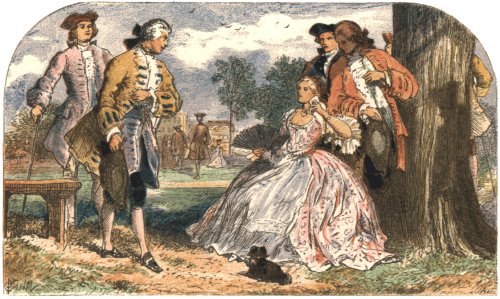
Secluded from domestic strife, Jack Book-Worm led a college life; A fellowship at twenty-five Made him the happiest man alive; He drank his glass, and crack’d his joke, And freshmen wonder’d as he spoke. Such pleasures, unalloy’d with care, Could any accident impair? Could Cupid’s shaft at length transfix Our swain, arriv’d at thirty-six? Oh! had the Archer ne’er come down To ravage in a country town; Or Flavia been content to stop At triumphs in a Fleet Street shop! Oh! had her eyes forgot to blaze! Or Jack had wanted eyes to gaze. Oh!—but let exclamation cease; Her presence banish’d all his peace! So, with decorum all things carried, Miss frown’d, and blush’d, and then was—married. The honey-moon like lightning flew; The second brought its transports, too; A third, a fourth, were not amiss; The fifth was friendship mix’d with bliss: But when a twelvemonth pass’d away, Jack found his goddess made of clay— Found half the charms that deck’d her face Arose from powder, shreds, or lace; But still the worst remain’d behind— That very face had robb’d her mind. Skill’d in no other arts was she, But dressing, patching, repartee; And, just as humour rose or fell, By turns a slattern or a belle. ’Tis true she dress’d with modern grace— Half naked at a ball or race; But when at home, at board or bed, Five greasy night-caps wrapp’d her head. Could so much beauty condescend To be a dull domestic friend? Could any curtain-lectures bring To decency so fine thing? In short—by night, ’twas fits or fretting; By day, ’twas gadding or coquetting. Fond to be seen, she kept a bevy Of powder’d coxcombs at her levee; The ’squire and captain took their stations, And twenty other near relations. Jack suck’d his pipe, and often broke A sigh in suffocating smoke; While all their hours were pass’d between Insulting repartee or spleen.
Thus, as her faults each day were known, He thinks her features coarser grown: He fancies every vice she shows Or thins her lip, or points her nose; Whenever rage or envy rise, How wide her mouth, how wild her eyes! He knows not how, but so it is, Her face is grown a knowing phiz— And, though her fops are wondrous civil, He thinks her ugly as the devil. Now, to perplex the ravell’d noose, As each a different way pursues— While sullen or loquacious strife Promis’d to hold them on for life— That dire disease, whose ruthless power Withers the beauty’s transient flower, Lo! the small-pox, whose horrid glare Levell’d its terrors at the fair; And, rifling every youthful grace, Left but the remnant of a face. The glass, grown hateful to her sight, Reflected now a—perfect fright. Each former art she vainly tries, To bring back lustre to her eyes; In vain she tries her pastes and creams, To smooth her skin, or hide its seams: Her country beaux and city cousins, Lovers no more, flew off by dozens; The ’squire himself was seen to yield, And even the captain quit the field. Poor madam, now condemn’d to hack The rest of life with anxious Jack, Perceiving others fairly flown, Attempted pleasing him alone. Jack soon was dazzled to behold Her present face surpass the old. With modesty her cheeks are dy’d; Humility displaces pride: For tawdry finery is seen, A person ever neatly clean: No more presuming on her sway, She learns good-nature every day: Serenely gay, and strict in duty, Jack finds his wife a—perfect beauty.