Volume 5 — POEMS OF FOREST AND FIELD PROEM
Reading edition
They took him into confidence—each oak Of the far forest: and all day he sat Hearing of Nature from an autocrat, An oak—so old, Dodona might have spoke Its infant oracles through it; that, part Of the oracular beauty of the gods, Yet irresponsible, down in its heart Still felt the rapture of their periods. They took him into confidence—the skies; And all night long he lay beneath one star, Hearing of God.... One that was chorister At Earth’s first morning; that beheld fierce eyes Of rebel angels, and the birth of Hell; Whom God set over Eden and o’er them, The Two, as destiny; that did foretell How Christ lay born at far-off Bethlehem.
THE HYLAS
I
I heard the hylas in the bottomlands Piping a reed-note in the praise of Spring: The South-wind brought the music on its wing, As ’t were a hundred strands Of guttural gold smitten of elfin hands; Or of sonorous silver, struck by bands, Anviled within the earth, Of laboring gnomes shaping some gem of worth. Sounds that seemed to bid The wildflowers wake; Unclose each dewy lid, And starrily shake Sleep from their airy eyes Beneath the loam, And, robed in dædal dyes, Frail as the fluttering foam, In countless myriads rise. And in my city home I, too, who heard Their reedy word, Awoke, and, with my soul, went forth to roam.
II
And under glimpses of the cloud-white sky My soul and I Beheld her seated, Spring among the woods With bright attendants, Two radiant maidens, The Wind and Sun: one robed in cadence, And one in white resplendence, Working wild wonders with the solitudes. And thus it was, So it seemed to me, Where she sat apart Fondling a bee, By some strange art, As in a glass, Down in her heart My eyes could see What would come to pass:— How in each tree, Each blade of grass,— Dead though it seemed,— Still lived and dreamed Life and perfume, Color and bloom, Housed from the North Like golden mirth, That she with jubilation would bring forth, Astonishing Earth.
III
And thus it was I knew That though the trees were barren of all buds, And all the woods Of blossoms now, still, still their hoods And heads of blue and gold, And pink and pearl lay hidden in the mould; And in a day or two, When Spring’s fair feet came twinkling through The trees, their gold and blue, And pearl and pink in countless bands would rise, Invading all these ways With loveliness; and to the skies, In radiant rapture raise The fragile sweetness of a thousand eyes. When every foot of soil would boast An ambuscade Of blossoms; each green rood parade Its flowery host; And every acre of the woods, With little bird-like beaks of leaves and buds, Brag of its beauty; making bankrupts of Our hearts of praise, and beggar us of love.
IV
Here, when the snow was flying, And barren boughs were sighing, In icy January, I stood, like some gray tree, lonely and solitary. Now every spine and splinter Of wood, washed clean of winter, By hill and canyon Makes of itself an intimate companion, A confidant, who whispers me the dreams That haunt its heart, and clothe it as with gleams. And lonely now no more I walk the mossy floor Of woodlands where each bourgeoning leaf is matched, Mated with music; triumphed o’er Of building love and nestling song just hatched.
V
Washed of the early rains, And rosed with ruddy stains, The boughs and branches now make ready for Their raiment green of leaves and musk and myrrh.— As if to greet her pomp, The heralds of her state, As ’t were with many a silvery trump, The birds are singing, singing, And all the world’s elate, As o’er the hills, as ’twere from Heaven’s gate, With garments, dewy-clinging, Comes Spring, around whose way the budded woods are ringing With redbird and with bluebird and with thrush; While, overhead, on happy wings is swinging The swallow through the heaven’s azure hush: And wren and sparrow, vireo and crow Are busy with their nests, or high or low, In every tree, it seems, and every bush. The loamy odor of the turfy heat, Breathed warm from every field and wood-retreat, Is as if spirits passed on flowery feet:— That indescribable Aroma of the woods one knows so well, Reminding one of sylvan presences, Clad on with lichen and with moss, That haunt and trail across The woods’ dim dales and dells; their airy essences Of racy nard and musk Rapping at gummy husk And honeyed sheath of every leaf and flower That open to their knock, each at the appointed hour:— And, lo! Where’er they go, Behold a miracle Too beautiful to tell!— Where late the woods were bare The red-bud shakes its hair Of flowering flame; the dogwood and the haw Voluble with bees dazzle with pearl the shaw; And the broad maple crimsons, sunset-red, Through firmaments of forest overhead: And of its boughs the wild-crab makes a lair, A rosy cloud of blossoms, for the bees, Bewildered there, To traffic in; lulling itself with these. And in the whispering woods The wild-flower multitudes Rise, star, and bell, and bugle, all amort To everything save their own loveliness And the soft wind’s caress,— The wind that tip-toes through them:—liverwort, Spring-beauty, windflower and the bleeding-heart, And bloodroot, holding low Its cups of stainless snow; Sorrel and trillium and the twin-leaf, too, Twinkling, like stars, through dew: And patches, as it were, of saffron skies, Ranunculus; and golden eyes Of adder’s-tongue; and mines, It seems, of grottoed gold, the poppy-celandines; And, sapphire-spilled, Bluets and violets, Dark pansy-violets and columbines, With rainy radiance filled; And many more whose names my mind forgets, But not my heart: The Nations of the Flowers, making gay In every place and part, With pomp and pageantry Of absolute Beauty, all the worlds of woods, In congregated multitudes, Assembled where Unearthly colors all the oaks put on, Velvet and silk and vair, Vermeil and mauve and fawn, Dim and auroral as the hues of dawn.
WIND AND CLOUD
A March Voluntary
I
Winds that cavern heaven and the clouds And canyon with cerulean blue,— Great rifts down which the stormy sunlight crowds Like some bright seraph, who, Mailed in intensity of silver mail, Flashes his splendor over hill and vale,— Now tramp, tremendous, the loud forest through: Or now, like mighty runners in a race, That swing, long pace to pace, Sweep round the hills, fresh as, at dawn’s first start, They swept, dew-dripping, from The crystal-crimson ruby of her heart, Shouting the dim world dumb. And with their passage the gray and green Of the earth’s washed clean; And the cleansing breath of their might is wings And warm aroma we know as Spring’s, And sap and strength to her bourgeonings.
II
My brow I bare To the cool, clean air, That blows from the crests of the clouds that roll, Pearl-piled and berged as floes of Northern Seas, Banked gray and thunder-low Big in the heaven’s peace; Clouds, borne from nowhere that we know, With nowhere for their goal; With here and there a silvery glow Of sunlight chasming deeps of sombre snow, Great gulfs that overflow With sky, a sapphire-blue, Or opal, sapphire-kissed, Wide-welled and deep and swiftly rifting through Stratas of streaming mist;— Each opening like a pool, Serene, cerule, Set round with crag-like clouds ’mid which its eye gleams cool.
III
What blue is bluer than the bluebird’s blue!— ’T is as if heaven itself sat on its wings; As if the sky in miniature it bore The fields and forests through, Bringing the very heaven to our door; The daybreak of its back soft-wedded to The sunset-auburn of its throat that sings.— The dithyrambics of the wind and rain Strive to, but can not, drown its strain: Again, and yet again I hear it where the maples tassel red, And blossoms of the crab round out o’erhead, And catkins make the willow-brake A gossamer blur around the lake That lately was a stream, A little stream locked in its icy dream.
IV
Invisible crystals of aërial ring, Against the wind I hear the bluebird fling Its notes; and where the oak’s mauve leaves uncurl I catch the skyey glitter of its wing; Its wing that lures me, like some magic charm, Far in the woods And shadowy solitudes: And where the purple hills stretch under purple and pearl Of clouds that sweep and swirl, Its music seems to take material form; A form that beckons with cerulean arm And bids me see and follow, Where, in the violet hollow, There at the wood’s far turn, On starry moss and fern, She shimmers, glimmering like a rainbowed shower, The Spirit of Spring, Diaphanous-limbed, who stands With honeysuckle hands Sowing the earth with many a firstling flower, Footed with fragrance of their blossoming, And clad in heaven as is the bluebird’s wing.
V
The tumult and the booming of the trees, Shaken with shoutings of the winds of March— No mightier music have I heard than these,— The rocking and the rushing of the trees, The organ-thunder of the forest’s arch. And in the wind their columned trunks become, Each one, a mighty pendulum, Swayed to and fro as if in time To some vast song, some roaring rhyme, Wind-shouted from sonorous hill to hill. The woods are never still: The dead leaves frenzy by, Innumerable and frantic as the dance That whirled its madness once beneath the sky In ancient Greece,—like withered Corybants: And I am caught and carried with their rush, Their countless panic—borne away, A brother to the wind, through the deep gray Of the old beech-wood, where the wild March-day Sits dreaming, filling all the boisterous hush With murmurous laughter and swift smiles of sun; Conspiring in its heart and plotting how To load with leaves and blossoms every bough, And whispering to itself, “Now Spring’s begun! And soon her flowers shall golden through these leaves!— Away, ye sightless things and sere! Make room for that which shall appear! The glory and the gladness of the year; The loveliness my eye alone perceives,— Still hidden there beneath the covering leaves,— My song shall waken!—flowers, that this floor Of whispering woodland soon shall carpet o’er For my sweet sisters’ feet to tread upon, Months kinder than myself, the stern and strong, Tempestuous-loving one, Whose soul is full of wild, tumultuous song, And whose rough hand now thrusts itself among The dead leaves; groping for the flowers that lie Huddled beneath, each like a sleep-closed eye: Gold adder’s-tongue and pink Oxalis; snow-pale bloodroot blooms; May-apple hoods, that parasol the brink, Screening their moons, of the slim woodland-stream: And the wild iris; trillium,—white as stars,— And bluebells, dream on dream: With harsh hand groping in the glooms, I grasp their slenderness and shake Their lovely eyes awake, Dispelling from their souls the sleep that mars; With heart-disturbing jars Clasping their forms, and with rude finger-tips, Through the dark rain that drips Lifting them shrinking to my stormy lips.
VI
“Already spicewood and the sassafras, Like fragrant flames, begin To tuft their boughs with topaz, ere they spin Their beryl canopies—a glimmering mass, Mist-blurred, above the deepening grass. Already where the old beech stands Clutching the lean soil as it were with hands Taloned and twisted,—on its trunk a knot, A huge excrescence, a great fungous clot, Like some enormous and distorting wart,— My eyes can see how, blot on beautiful blot Of blue, the violets blur through The musky and the loamy rot Of leaf-pierced leaves; and, heaven in their hue, A sunbeam at each blossom’s heart, The little bluets, crew on azure crew, Prepare their myriads for invasion too.
VII
“And in my soul I see how, soon, shall rise,— Still hidden to men’s eyes,— Dim as the wind that round them treads,— Hosts of spring-beauties, streaked with rosy reds, And pale anemones, whose airy heads, As to some fairy rhyme, All day shall nod in delicate time: And now, even now, white peal on peal Of pearly bells,—that in bare boughs conceal Themselves,—like snowy music, chime on chime, The huckleberries to my gaze reveal— Clusters, that soon shall toss Above this green-starred moss, That, like an emerald fire, gleams across This forest-side, and from its moist deeps lifts Slim, wire-like stems of seed; Or, lichen-colored, glows with many a bead Of cup-like blossoms: carpets where, I read, When through the night’s dark rifts The moonlight’s glimpsing splendor sifts, The immaterial forms With moonbeam-beckoning arms, Of Fable and Romance,— Myths that are born of whispers of the wind And foam of falling waters, music-twinned— Shall lead the legendary dance; The dance that never stops, Of Earth’s wild beauty on the green hill-tops.”
VIII
The youth, the beauty and disdain Of birth, death does not know, Compel my heart with longing like to pain When the spring breezes blow. The fragrance and the heat Of their soft breath, whose musk makes sweet Each woodland way, each wild retreat, Seem saying in my ear, “Hark, and behold! Before a week be gone This barren woodside and this leafless wold A million flowers shall invade With argent and azure, pearl and gold,— Like rainbow fragments scattered of the dawn,— Here making bright, here wan Each foot of earth, each glen and glimmering glade, Each rood of windy wood, Where late gaunt Winter stood, Shaggy with snow and howling at the sky; Where even now the Springtime seems afraid To whisper of the beauty she designs, The flowery campaign that she now outlines Within her soul; her heart’s conspiracy To take the world with loveliness; defy And then o’erwhelm the Death—that Winter throned Amid the trees,—with love that she hath owned Since God informed her from His very breath, Giving her right triumphant over Death. And, irresistible, Her heart’s deep ecstasy shall swell, Taking the form of flower, leaf, and blade, Invading every dell, And sweeping, surge on surge, Around the world, like some exultant raid, Even to the heaven’s verge. Soon shall her legions storm Death’s ramparts, planting Life’s fair standard there, The banner which her beauty hath in care, Beauty, that shall eventuate With all the pomp and pageant and the state, That are a part of power, and that wait On majesty, to which it, too, is heir.”
IX
Already bluish pink and green The bloodroot’s buds and leaves are seen Clumped in dim cirques; one from the other Hardly distinguished in the shadowy smother Of last year’s leaves blown brown between. And, piercing through the layers of dead leaves, The searching eye perceives The dog’s-tooth violet, pointed needle-keen, Lifting its beak of mottled green; While near it heaves The May-apple its umbrous spike, a ball,— Like to a round, green bean, That folds its blossom,—topping its tight-closed parasol: The clustered bluebell near Hollows its azure ear, Low-leaning to the earth as if to hear The sound of its own growing and perfume Flowing into its bloom: And softly there The twin-leaf’s stems prepare Pale tapers of transparent white, As if to light The Spirit of Beauty through the wood’s green night.
X
Why does Nature love the number five? Five-whorled leaves and five-tipped flowers?— Haply the bee i’ the voluble rose, Laboring aye to store its hive, And humming away the long noon hours, Haply it knows as it comes and goes: Or haply the butterfly, Or moth of pansy-dye, Flitting from bloom to bloom In the forest’s violet gloom, It knows why: Or the irised fly, to whom Each bud, as it glitters near, Lends eager and ardent ear.— And, also, tell Why Nature loves so well To prank her flowers in gold and blue. Haply the dew, That lies so close to them the whole night through, Hugged to each honeyed heart, Perhaps the dew the secret could impart: Or haply now the bluebird there that bears, Glad, unawares, God’s sapphire on its wings, The lapis-lazuli O’ the clean, clear sky, The heav’n of which he sings, Haply he, too, could tell me why: Or the maple there that swings, To the wind’s soft sigh, Its winglets, crystal red, A rainy ruby twinkling overhead: Or haply now the wind, that breathes of rain Amid the rosy boughs, it could explain: And even now, in words of mystery,— That haunt the heart of me,— Low-whispered, dim and bland, Tells me, but tells in vain, And strives to make me see and understand, Delaying where The feldspar fire of the violet breaks, And the starred myrtle aches With heavenly blue; and the frail windflower shakes Its trembling tresses in the opal air.
IN SOLITARY PLACES
I
The hurl and hurry of the winds of March, That tore the ash and bowed the pine and larch, And filled the night with rushings,—like the crew Of the Wild Huntsman,—and the days with hue And cry of storm, soft in the heaven’s porch Have laid them down:—loud winds, that trampled through The forests with enormous, scythe-like sweep, And from the darkened deep, The battlemented heavens, thunder-blue, Rumbled the arch, The rocking arch of all the booming oaks, With stormy chariot-spokes: Chariots, from which wild bugle-blasts they blew In warlike challenge.... Now the windflower sweet Misses the fury of their ruining feet, The trumpet-thunder of resistless flight, Crashing and vast, obliterating light; Sweeping the skeleton madness down Of last-year’s leaves; and, overhead, Hurrying the giant foliage of night, Gaunt clouds that streamed with tempest. ... Now each crown Of ancient woods, that clamored with their tread, The frenzy of their passage, stoops no more, Hearing no more their clarion-command, Their chariot-hurl and the wild whip in hand. No more, no more, The forests rock and roar And tumult with their shoutings. Hushed and still Is the green-gleaming and the sunlit hill, Along whose sides, Flushing the dewy moss and rainy grass— Beneath the topaz-tinted sassafras, Pale, aromatic as some orient wine— The violet fire of the bluet glides, The amaranthine flame Of sorrel and of bluebell runs; And through the drabs and duns Of rotting leaves, the moonéd celandine, Line upon lovely line, Deliberate, goldens into birth: And, ruby and rose, the moccasin-flower hides: Innumerable flowers, with which she writes her name, April, upon the page, The winter-withered parchment of old earth; Her fragrant autograph, that gives it worth And loveliness that take away its age.
II
Here where the woods are wet, The blossoms of the dog’s-tooth violet Seem meteors in a miniature firmament Of wild-flowers, where, with rainy sound and scent Of breeze and blossom, dim the April went: Their tongue-like leaves of umber-mottled green, So thickly seen, Seem dropping words of gold, Inaudible syllables of a magic old. Beside them, near the wahoo-bush and haw, Blooms the hepatica; Its slender flowers upon swaying stems Lifting chaste, solitary blooms, Astral, and twilight-colored,—frail as gems That star the diadems Of elves and sylvans, piercing pale the glooms;— Or like the wands, the torches of the fays, That link lone, leafy ways With slim, uncertain rays:— (The faëry people, whom no eye may see, Busy, so legend says, With budding bough and leafing tree, The blossom’s heart o’ honey and honey-sack o’ the bee, And all dim thoughts and dreams, That take the form of flowers, as it seems, And haunt the banks of greenwood streams, Showing in every line and curve, Commensurate with our love, an intimacy, A smiling confidence or sweet reserve.) There, at that leafy turn, Of trailered rocks, rise fronds of hart’s-tongue fern: Fronds that my fancy names Uncurling gleeds of emerald and gold, Whose feathering flames Were kindled in the musky mould, And now, as stealthy as the graying morn, Thorn upon woolly thorn, Build up, and silently unfold Faint, cool, green fires, that burn Uneagerly, and spread around An elfin light above the ground, Like that green, rayless glow A spirit, lamped with crystal, makes below In dripping caves of labyrinthine moss, Or grottoes of the weedy undertow.— And in the underwoods, around them, toss The white-hearts with their penciled leaves, That, ’mid the shifting gleams and glooms, The interchanging shine and shade, Seem some soft garment made By visionary hands, that none perceives; Hands busy with invisible looms Of woodland shine and shade; a shadowy light, Whose figments interbraid, Carpeting the woods with colors and perfumes.— Or, are they fragments left in flight, These flow’rs that scatter every glade With windy, rippling white, And breezy, fluttering blue, Of her wild gown that shone upon my sight, A moment, in the woods I wandered through? April’s, who fled this way? April, whom still I follow, Whom still my dreams pursue; Who leads me on by many a tangled clue Of loveliness, until in some green hollow, Born of her fragrance and her melody, But lovelier than herself and happier, too, Cradled in blossoms of the dogwood-tree, My soul shall see, White as a sunbeam in the heart of day, The infant, May.
III
Up, up, my heart! and forth where none perceives! ’Twas this which that sweet lay meant You heard in dreams. Come, let us take rich payment, For every care that grieves, From Nature’s prodigal purse. ’Twas this that May meant By sending forth the wind which round our eaves Whispered all night;—or was’t the spirit who weaves, From gold and glaucous green of early leaves, Spring’s regal raiment?— Up, up, my heart, and forth where none perceives! Come, let us forth, my heart, where none divines! Into far woodland places, Where we may meet the fair assembled races, Beneath the guardian pines, Of May’s first flowers.... Poppy-celandines, And starry trilliums, bugled columbines, With which her hair, her radiant hair she twines, And loops and laces.— Come, let us forth, my heart, where none divines! Forth, forth, my heart, and let us find our dreams, There, where they haunt each hollow! Dreams luring us with oread feet to follow, With flying feet of beams, Fleeter and lighter than the fleetest swallow: Dreams, holding us with dryad glooms and gleams, With Naiad eyes, far stiller than still streams, That have beheld and still reflect, it seems, The god Apollo.— Forth, forth, my heart, and let us find our dreams! Out, out, my heart, the world is white with spring. Long have our dreams been pleaders: Now let them be our firm but gentle leaders. Come, let us forth and sing Among the amber-emerald-tufted cedars, And balm-o’-Gileads, cotton-woods, a-swing Like giant censers, that, from leaf-cusps fling Balsams of gummy gold, bewildering The winds their feeders. Out, out, my heart, the world is white with spring. Up, up, my heart, and all thy hope put on. Array thyself in splendor. Like some bright dragon-fly, some May-fly slender, The irised lamels don Of thy new armor; and, where burns the centre, Refulgent, of the opening rose of dawn, Spread thy wild wings, and, ere the hour be gone, Bright as a blast from some bold clarion, Thy Dream-world enter.— Up, up, my heart, and all thy hope put on.
IV
And then I heard it singing, The wind that touched my hair, A song of wild expression, A song that called in session The wild-flowers sweetly swinging, The wild-flowers lightly flinging Their tresses to the air. And first, beneath a bramble arch, The bloodroot rose; each bloom a torch Of hollow snow, within which, bright, The calyx grottoed golden light. Hepatica and bluet, And gold corydalis, Arose as to an aria; Then wild-phlox and dentaria, In rapture, ere they knew it, Trooped forward, nodding to it, Faint as a first star is. And then a music,—to the ear Inaudible,—I seemed to hear; A symphony that seemed to rise And speak in colors to the eyes. I saw the Jacob’s-ladder Ring violet peal on peal Of perfume, azure-swinging; The bluebell slimly ringing Its purple chimes; and, gladder, Green note on note, the madder Bells of the Solomon’s-seal. Now very near, now faintly lost, I saw their fragrant music tossed; Mixed dimly with white interludes Of trilliums starring cool the woods. Then choral, solitary, I saw the celandine Smite bright its golden cymbals, The starwort shake its timbrels, The whiteheart’s horns of Fairy, With many a flourish airy, Strike silvery into line. And, lo, my soul they seemed to draw, By chords of loveliness and awe Into a Fairy world afar Where all man’s dreams and longings are.
V
And then a spirit looked down at me Out of the deeps of the opal morn: Its eyes were blue as a sunlit sea, And young with the joy of a star that has just been born: And I seemed to hear, with my soul, the rose of its cool mouth say:— “Long I lay, long I lay, High on the Hills of the Break-of-Day, Where ever the light is green and gray, And the gleam of the moon is a silvery spray, And the stars are glimmering bubbles. Now from the Hills of the Break-of-Day I come, I come, on a rainbow ray, To laugh and sparkle, to leap and play, And blow from the face of the world away, Like mists, its griefs and troubles.”
VI
And now that the dawn is everywhere, Let us take this path through this wild, green place, Where the rattlesnake-weed shows its yellow face, And the lichens cover the rocks with lace: Where tannin-tinct is the woodland air, Let us take this path through the oaks where, thin, The low leaves whisper, “The day is fair”; And waters murmur, “Come in, come in, Where you can hark to our waterfalls, And the wind of their foam can play with your hair, And soothe away care.— Come here, come here, where our water calls.” Berry blossoms, that seem to flow As the winds blow, Blackberry blossoms swing and sway To and fro Along the way, Like ocean spray on a breezy day, Over the green of the grass as foam on the green of a bay, When the world is white and green with the white and the green of May.
VII
The dewberries are blooming now; The days are long, the nights are short; Each haw-tree and each dogwood bough Is bleached with bloom, and seems a part,— Reflected palely on her brow,— Of dreams that haunt the Year’s young heart. But this will pass; and presently The world forget the spring that was; And underneath the wild-plum tree, ’Mid hornet hum and wild-bee’s buzz, Summer, in dreamy reverie, Will sit all warm and amorous. Summer, with drowsy eyes and hair, Who walks the orchard aisles between; Whose hot touch tans the freckled pear, And crimsons peach and nectarine; And, in the vineyard everywhere, Bubbles with blue the grape’s ripe green. Where now the briers blossoming are, Soon will the berries darkly glow; Then Summer pass: and star on star, Where now the grass is strewn below With petals, soon, both near and far, Will lie the obliterating snow.
VIII
But now the bluets blooming, The bluets brightly blue, O’er which the bees go booming, Drunk with the honey-dew, From wood-ways which they strew, Make eyes of love at you.... O slender Quaker-ladies, With eyes of heavenly hue, Who, where the mossy shade is, Hold quiet Quaker-meeting, Now tell me, is it true That these wild-bees are raiders? Bold gold-galloonéd raiders? Gold-belted ambuscaders?— Or are they serenaders, Your gold-hipped serenaders, That, to your ears repeating Old ballads, come to woo, And win the hearts of you, The golden hearts of you? And here the bells of th’ huckleberries toss, so it seems, in time, Delicate, tenderly white, thick by the wildwood way; Clusters swinging, it seems, inaudible peals of rhyme, Music visibly dropped from the virginal lips of the May, Crystally dropped, so it seems, bar upon blossoming bar, Pendent, pensively pale, star upon hollowed star.
IX
The star-flower now, that disks with gold The woodland moss, the forest grass, Already in a day is old, Already doth its beauty pass; Soon, undistinguished, with the mould ’Twill mingle and ’twill mix, alas. The bluet, too, that spreads its skies, Its little heavens, at our feet; And crowfoot-bloom, that, with soft eyes Of amber, now our eyes doth greet, Shall fade and pass, and none surmise How once they made the Maytime sweet.
X
But the crowfoot-bloom still trails its gold Along the edges of the oak-wood old; And there, where spreads the pond, still white are seen The lilies islanded between The pads’ round archipelagoes of green; The jade-dark pads that pave The water’s wrinkled wave; In which the vireo and the sparrow lave Their fluttered breasts and wings, Preening their backs, with many twitterings, With necks the moisture streaks; Then dipping deep their beaks, To which the beaded coolness clings, They bend their mellow throats And let the freshness trickle into notes. And now you hear The red-capped woodpecker rap near; And now that acrobat, The yellow-breasted chat, Calls high and clear, Chuckling his grotesque music from Some bough that he hath clomb. And now, and now, Upon another bough, Hark how the honey-throated thrush Scatters the forest’s listening hush With notes of limpid harmony, Taking the woods with witchery— Or is ’t a spirit, none can see. Hid in the top of some old tree, Who, in his house of leaves, of haunted green, Keeps trying, silver-sweet, his sunbeam flute serene?
XI
And then as I listened I seemed to see, Out of the sunset’s ruin of gold, A presence, a spirit, look down at me, With eyes that were grave with the grief of a world grown old; And I seemed to hear, with my soul, the flame of its sad mouth sigh: “Now good-by, now good-by. Down to the Caves of the Night go I; Where a shadowy couch of the purple sky, That the moon and the starlight curtain high, Is spread for my joy and sorrow: Down to the Caves of the Night go I, Where side by side with mystery And all the Yesterdays I’ll lie; And where from my body, before I die, Will be born the young To-morrow.”
XII
And here where the dusk steals on, you see, Violet-mantled, from tree to tree, The milkwort’s spike of lavender hue,— Of rosy blue,— Tipped by the weight of a passing bee,— Nods like a goblin night-cap, slim, sedate, That night shall tassel with the dew, Beneath a canopy of rose and rue. And as the purple state Of twilight crowds the sunset’s crimson gate, Now one, now two, Drifting the oaks’ dark vistas through, The screech-owl’s cry of “Who, oh, who, Who stays so late?” Drops like a challenge down to you. The silence deepens; it seems so still, That, if you laid to the tree your ear, You too might hear Its great roots growing into the hill; Or there on the twig of the oak-tree tall, The gray-green egg in the gray-green gall Split, and the little round worm and white, That grows to a gnat in a summer night, Uncurl in its nest as it dreams of flight. In the heart of the weed that grows near by,— If you laid your ear To a leaflet near,— You too might hear, if you, too, would try, The little gray worm, that becomes a fly A gray wood-fly, a rainbowed fly, As it feels a yearning for wings within, Minute of movement, steadily,— As a leaf-bud pushes from forth a tree,— Under the milk of its larval skin, The outward pressure of wings begin. Far off a vesper-sparrow lifts its song, Lost in the woods that now are beryl-wan; The path is drowned in dusk, is almost gone, Where now a fox or rabbit steals along: Dark is each vine-roofed hollow where, withdrawn, The creek-frog sounds his guttural gong, Like some squat dwarf or gnome, Seated upon his temple’s oozy dome, Summoning the faithful unto prayer, Muezzin-like, the worshipers of the moon, The insect people of the earth and air, Who join him in his twilight tune. Along the path, where the lizard hides, An instant shadow, the spider glides; The hairy spider, that haunts the way, Crouching black by its earth-bored hole, An insect ogre, that lairs with the mole, Hungry, seeking its insect prey, Fast to follow and swift to slay.— And over your hands and over your face The cobweb brushes its phantom lace: And now, from many a stealthy place, Woolly-winged and gossamer-gray, The forest moths come fluttering, Marked and mottled with lichen hues, Seal-soft umbers and downy blues, Dark as the bark to which they cling.
XIII
Now in the hollow of a hill,— Like a glow-worm held in a giant hand,— Under the sunset’s last red band, And one star hued like a daffodil, The windowed lamp of a cabin glows; The charcoal-burner’s, whose hut is poor But always open; beside whose door An oak grows gnarled and a pine stands slim. Clean of soul, though of feature grim, Here he houses where no one knows, His only neighbors the cawing crows, That make a roost of the pine’s top limb: His only friend the fiddle he bows As he sits at his door in the eve’s repose Making it chuckle and sing and speak, Lovingly pressed to his swarthy cheek. And over many a root, through flowers and weeds, Past lonely places where the raccoon breeds, By many a rock and water lying dim, Roofed with the brier and the bramble-rose, Under a star and the new-moon’s rim, Downward the wood-way leads to him, Down where his lone lamp gleams and glows, A pencil slim Of marigold light under leaf and limb.
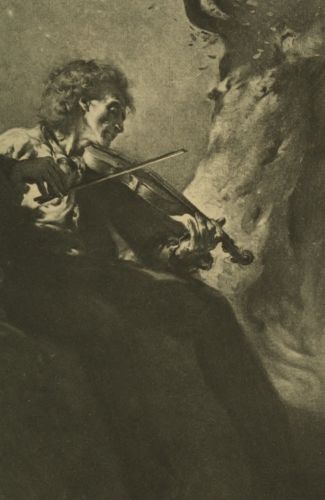
Making it chuckle and sing and speak Page 328
In Solitary Places
XIV
Ere that small sisterhood of misty stars, The Pleiadës, consents to grace the sky; While still through sunset’s golds and cinnabars The evening-star, like an Aladdin eye Of bright enchantment, at the day’s last hour, Looks downward from its twilight-builded tower, Listen, and you may hear, now low, now high, A voice, a summons, fainter than a flower. There is a fellowship so still and sweet, A brotherhood, that speaks, unwordable, In every tree, in every stream you meet, The soul is fain to dream beneath its spell.— And heart-admitted to their presence there, Those intimacies of the earth and air, It shall hear things too wonderful to tell, Too deep to interpret, and more sweet than prayer. And you may see the things that are unseen, And hear the things that never have been heard: The whisper of the woods, in gray and green, Will walk by you, its heart a wildwood bird; Or by your side, in hushed and solemn wise, The silence sit; and clothed in glimmering dyes Of pearl and purple, with a sunset word, The dusk steal to you with tenebrious eyes. Then through the ugliness that toils in night. Uncouth, obscure, that hates the glare of day, Dull things that pierce the earth, avoid the light, And hide themselves in clamminess and clay,— The dumb, ungainly things, that make a home Of mud and mire they hill and honeycomb,— Through these, perhaps, in some mysterious way Beauty may speak, fairer than wind-wild foam. Not as it speaks—an eagle message—drawn In starry vastness from night’s labyrinths: Not uttering itself from forth the dawn In egret hues: nor from the cloud-built plinths Of sunset’s splendor, speaking burningly Unto the spirit; nor from flow’rs the bee Makes mouths of musk of, cymes of hyacinths,— But from the things that type humility. From things despised.—Ev’n from the crawfish there, Hollowing its house of ooze—a wet, vague sound Of sleepy slime; or from the mole, whose lair, Blind-tunneled, corridors the earth around— Beauty may draw her truths, as draws its wings The butterfly from the dull worm that clings, Cocoon and chrysalis; and from the ground Address the soul through even senseless things. The soul, that oft hath heard the trees’ huge roots Fumble the darkness, clutching at the soil; The bird-like beaks of the imprisoned shoots Peck through the bark and into leaves uncoil; Hath heard the buried seed split through its pod, Groping its blind way up to light and God; The fungus, laboring with gnome-like toil, Heave slow its white orb through the encircling sod. The winds and waters, stars and streams and flowers, The very stones have tongues: and moss and fern And even lichens speak. This world of ours Is eloquent with things that bid us learn To pierce appearances, and so to mark, Within the rock and underneath the bark, Heard through some inward sense, the dreams that turn Outward to light and beauty from the dark.
XV
Then it came to pass as I gazed on space That I met with Mystery, face to face. Within her eyes my wondering soul beheld The eons past, the eons yet to come At cosmic labor; and the stars,—that swelled, Flaming or nebulous, from the darkness dumb, In their appointed places, world and sun, I saw were truths made visible, whose sum Proclaimed one truth, the Word of Him, the One. And it came to pass as I went my ways That I met with Beauty, face to face. Within her eyes my worshiping spirit saw The moments busy with the dreams whence spring Earth’s lovelinesses: and all things that awe Man’s soul with their perfection—everything That buds and bourgeons, blossoming above— I saw were letters of enduring law, Whose chapters make the beautiful book of Love.
THE MAN HUNT
The woods stretch deep to the mountain side, And the brush is wild where a man may hide. They have brought the bloodhounds up again To the roadside rock where they found the slain. They have brought the bloodhounds up, and they Have taken the trail to the mountain way. Three times they circled the trail and crossed, And thrice they found it and thrice they lost. Now straight through the trees and the underbrush They follow the scent through the forest’s hush. And their deep-mouthed bay is a pulse of fear In the heart of the wood that the man must hear. The man who crouches among the trees From the stern-faced men who follow these. A huddle of rocks that the ooze has mossed And the trail of the hunted again is lost. An upturned pebble, a bit of ground A heel has trampled—the trail is found. And the woods reëcho the bloodhounds’ bay As again they take to the mountain way. A rock, a ribbon of road, a ledge, With a pine tree clutching its crumbling edge. A pine, that the lightning long since clave, Whose huge roots hollow a ragged cave. A shout, a curse, and a face aghast, And the human quarry is laired at last. The human quarry with clay-clogged hair And eyes of terror who waits them there. That glares and crouches and rising then Hurls clods and curses at dogs and men. Until the blow of a gun-butt lays Him stunned and bleeding upon his face. A rope; a prayer; and an oak-tree near, And a score of hands to swing him clear. A grim, black thing for the setting sun And the moon and the stars to look upon.
THE FOREST OF SHADOWS
Deep in the hush of a mighty wood I came to a place of dread and dream, And forms of shadows, whose shapes elude The searching swords of the sun’s dim gleam, Builders of silence and solitude. And there, where a glimmering water crept From rock to rock with a slumberous sound, Tired to tears, on the mossy ground, Under a tree I lay and slept. Was it the heart of an olden oak? Was it the soul of a flower that died? Or was it the wild-rose there that spoke, The wilding lily that palely sighed?— For all on a sudden it seemed I awoke: And the leaves and the flowers were all intent On a visible something of light and bloom— A presence, felt as a wild perfume, Or beautiful music, that came and went. And all the grief I had known was gone, And all the anguish of heart and soul; And the burden of care that had made me wan Lifted and left me young and whole As once in the flush of my youth’s dead dawn. And lo! it was night. And the oval moon, A silvery spectre, paced the wood: And there in its light, like snow, she stood, As starry still as a star a-swoon. At first I thought that I looked into A shadowy water of violet, Where the faint reflection of one I knew, Long dead, gazed up from its mirror wet, Till she smiled in my face as the living do: Till I felt her touch, and heard her say, In a voice as still as a rose unfolds,— “You have come at last: now nothing holds: Give me your hand: let us wander away. “Let us wander away through the Shadow Wood, Through the Shadow Wood to the Shadow Land, Where the trees have speech and the blossoms brood, Like visible music; and, hand in hand, The winds and the waves go, rainbow-hued: Where ever the voice of beauty sighs, And ever the dance of dreams goes on; Where nothing grows old: and the dead and gone, And the loved and the lost, smile into your eyes. “Let us wander away! let us wander away!— Do you hear them calling, ‘Come here and live’? Do you hear what the trees and the flowers say, Wonderful, wild, and imperative, Hushed as the hues of the dawn of day?— They say, ‘Your life, that was rose and rue, In a world of shadows where all things die, Where beauty is dust, and love, a lie, Is ended. Come! we are waiting for you.’” And she took my hand: and the trees around Seemed whispering something I dared not hear; And the taciturn flowers, that strewed the ground, Seemed thinking something I felt with fear— A beautiful something that made no sound.— And she led me on through the forest old, Where the moon and the midnight stood on guard,— Sentinel spirits that shimmered the sward, Silver and sable and glimmering gold. And then in a moment I knew.... I knew What the trees had whispered, the winds had said; What the flowers had thought in their hearts of dew, And the stars had syllabled overhead— And she bent above me and smiled, “’Tis true! Heart of my heart, you have heard aright.— Look in my eyes and draw me near! Look in my face and have no fear!— Heart of my heart, you died to-night!”
“ROSE LEAVES, WHEN THE ROSE IS DEAD”
See how the rose leaves fall, The rose leaves fall and fade; And by the wall, in shade funereal, How leaf on leaf is laid, Withered and soiled and frayed! How red the rose leaves fall— And in the ancient trees, That stretch their ghostly arms about the Hall, Burdened with mysteries, How sadly sighs the breeze! How soft the rose leaves fall— The rose leaves fall and lie! While over them dull slugs and beetles crawl, And, palely glimmering by, The glow-worm trails its eye. How thick the rose leaves fall, And strew the garden way! For snails to slime and spotted toads to sprawl, And, plodding past each day, Coarse feet to tread in clay. How fast they fade and fall Where Beauty, carved in stone, With broken hands veils her dead eyes, and, tall, White in the moonlight lone, Stands like a marble moan. How slow they drift and fall And strew the fountained pool, That, in the nymph-carved basin by the wall, Reflects, in darkness cool, Ruin made beautiful. How red the rose leaves fall, Fall, and like blood remain Upon the dial’s disk, whose pedestal, Black-mossed, and dark with stain, Crumbles in sun and rain. How dim they seem to fall Around one where she stands, Deep in their midst, beyond the years’ recall, Reaching pale, passionate hands Into the past’s vague lands. How still the rose leaves fall Around them as they meet As oft of old! she, in her gem-pinned shawl Of white; and he, complete In black from head to feet. How faint the rose leaves fall Around them where, it seems, He holds her clasped, parting from her and all His heart’s wild hopes and dreams, There in the moon’s pale beams! Around them rose leaves fall— And in the stress and urge Of winds that strew them wanly over all, With deep, autumnal surge, There floats a funeral dirge:— “See how the rose leaves fall Upon thy dead, O soul! The rose leaves of the love that once in thrall Held thee, beyond control, Making thy heart’s world whole. “God help them still to fall Around thee, bowed above The face within thy heart, beneath the pall, The perished face thereof, The beautiful face of Love.”
MUSIC AND MOONLIGHT
White roses, like a mist Upon a terraced height; And ’mid the roses, opal, moonbeam kissed, A fountain falling white. And as the full moon flows, Orb’d fire, into a cloud, There is a fragrant sound as if a rose Sighed its sweet soul aloud. There is a whisper pale, As if a rose awoke, And, having heard in sleep the nightingale, Still dreaming of it spoke. Now, as from some vast shell A giant pearl rolls white, From the dividing cloud, that winds compel, The moon sweeps, big and bright. Moon-mists and pale perfumes, Wind-wafted through the dusk: There is a sound as if unfolding blooms Voiced their sweet thoughts in musk. A spirit is abroad Of music and of sleep; The moon and mists have made for it a road Adown the violet deep. It breathes a tale to me, A tale of ancient day; And, like a dream, again I seem to see Those towers old and gray. That castle by the foam, Where once our hearts made moan: And through the night again you seem to come Down statued stairs of stone. Again I feel your hair, Dark, fragrant, deep and cool: You lift your face up, pale with its despair, And wildly beautiful. Again your form I strain, Again, unto my heart; Again your lips, again and yet again, I press ... and then we part. As centuries ago We did in Camelot; Where once we lived that life of bliss and woe, That you remember not. When you were Guinevere, And I was Launcelot.... I have remembered many and many a year, And you—you have forgot.
THE AWAKENING
God made that night of pearl and ivory, Perfect and holy as a holy thought Born of perfection, dreams, and ecstasy, In love and silence wrought. And she, who lay where, through the casement falling, The moonlight clasped with arms of vapory gold Her Danaë beauty, seemed to hear a calling Deep in the garden old. And then it seemed, through some strange sense, she heard The roses softly speaking in the night,— Or was it but the nocturne of a bird Haunting the white moonlight? It seemed a fragrant whisper vaguely roaming From rose to rose, a language sweet that blushed, Saying, “Who comes? Who is this swiftly coming, With face so dim and hushed? “And now, and now we hear a wild heart beating— Whose heart is this that beats among our blooms? Whose every pulse in rapture keeps repeating Wild words like wild perfumes?” ... And then it ceased: and then she heard a sigh, As if a lily syllabled sweet scent,— Or was it but the wind that silverly Touched some stringed instrument? And then again a rumor she detected Among the roses, words of musk and myrrh, Saying, “He comes! the one she hath expected, Who long hath sought for her. The one whose coming made her soul awaken, Whose face is fragrance and whose feet are fire: The one by whom her being shall be shaken With dreams and deep desire.” And then she rose, and to the casement hastened, And flung it wide and, leaning outward, gazed: Above, the night hung, moon and starlight chastened; Below, with shadows mazed, The garden bloomed. Around her and o’erhead All seemed at pause—save one wild star that streamed, One rose that fell.—And then she sighed and said, “I must have dreamed, have dreamed.” And then again she seemed to hear it speak, A moth that murmured of a star attained,— Or was it but the fountain whispering weak, White where the moonbeams rained? And still it grew; and still the sound insisted, Louder and sweeter, burning into form, Until at last a presence, starlight-misted, It shone there rosy warm: Crying, “Come down! long have I watched and waited! Come down! draw near! or, like some splendid flower, Let down thy hair! so I may climb as fated Into thy heart’s high tower. Lower! bend lower, so thy heart may hear me! Thy soul may clasp me!... Beautiful above All beautiful things, behold me, yea, draw near me; Behold! for I am Love.”
THE VALE OF TEMPE
All night I lay upon the rocks: And now the dawn comes up this way, One great star trembling in her locks Of rosy ray. I can not tell the things I’ve seen, The things I’ve heard I dare not speak The dawn is breaking, gold and green, O’er vale and peak. My soul hath kept its tryst again With her as once in ages past, In that lost life, I know not when, Which was my last: When she was dryad, I was faun, And lone we loved in Tempe’s Vale, Where once we saw Endymion Pass passion-pale: Where once we saw him clasp and meet Among the pines, with kiss on kiss, Moon-breasted and most heavenly sweet, White Artemis. Where often, Bacchus-borne, we heard The Mænad shout, wild-revelling: And filled with witchcraft, past all word, The Limnad sing. Bloom-bodied ’mid the twilight trees We saw the Oread, who shone Fair as the forms Praxiteles Carved out of stone. And oft, goat-footed, in a glade We marked the Satyrs dance, and great, Man-muscled, like the oaks that shade Dodona’s gate, Fierce Centaurs hoof a torrent’s bank With wind-tossed manes, or leap a crag, While swift, the arrow in its flank, Swept by the stag. And minnow-white the Naiad there We watched, foam-shouldered, in her stream, Wringing the moisture from her hair Of emerald gleam. We saw the oak unclose and, brown, Sap-scented, from its door of bark The Hamadryad young step down: Or, crouching dark Within the oak’s old heart, we felt Her eyes, that pierced the fibrous gloom; Her breath, that was the musk we smelt, The wild perfume. There is no flower that opens glad Wide eyes of dawn and sunset hue, As fair as the Leimoniad We saw there too: That flower-divinity, rose-born, Of sunlight and white dew, whose blood Is fragrance, and whose heart of morn A crimson bud. There is no star that rises white, To tiptoe down the deeps of dusk, Sweet as the moony Nymphs of Night With breasts of musk, We met among the mystery And hush of forests, where, afar, We watched their hearts beat glimmeringly, Each heart a star. There is no beam that rays the marge Of mist that trails from cape to cape, From panther-haunted gorge to gorge, Bright as the shape Of her, the one Auloniad, That, born of wind and grassy gleams, Silvered upon our sight, dim-clad In foam of streams. All, all of these I saw again, Or dreamed I saw, as there, ah me! Upon the cliffs, above the plain, In Thessaly, I lay, while Mount Olympus helmed Its brow with moon-effulgence deep, And, far below, vague, overwhelmed With reedy sleep, Peneus flowed, and, murmuring, sighed, Meseemed, for its dead gods, whose ghosts Through its dark forests seemed to glide In whispering hosts.... ’Mid whose pale shapes again I spoke With her, my soul, as I divine, Dim ’neath some gnarled Olympian oak, Or Ossan pine, Till down the slopes of heaven came Those daughters of the Dawn, the Hours, Clothed on with raiment blue of flame, And crowned with flowers; When she, with whom my soul once more Had trysted—limbed of light and air— Whom to my breast,—(as oft of yore In Tempe there, When she was dryad, I was faun)— I clasped and held, and pressed and kissed, Within my arms, as broke the dawn, Became a mist.
THE BALLAD OF LOW-LIE-DOWN
John-a-dreams and Harum-Scarum Came a-riding into town: At the Sign o’ the Jug-and-Jorum There they met with Low-lie-down. Brave in shoes of Romany leather, Bodice blue and gipsy gown, And a cap of fur and feather, In the inn sat Low-lie-down. Harum-Scarum kissed her lightly, Smiled into her eyes of brown, Clasped her waist and held her tightly, Laughing, “Lovely Low-lie-down!” Then with many an oath and swagger, As a man of great renown, On the board he clapped his dagger, Called for sack and sat him down. So a while they laughed together; Then he rose and with a frown Sighed, “While still ’tis pleasant weather, I must leave thee, Low-lie-down.” So away rode Harum-Scarum, With a song rode out of town; At the Sign o’ the Jug-and-Jorum Weeping lingered Low-lie-down. Then this John-a-dreams, in tatters, In his pocket ne’er a crown, Touched her saying, “Wench, what matters! Dry your eyes and, come, sit down. “Here’s my hand: we’ll roam together, Far away from thorp and town. Here’s my heart,—for any weather,— And my dreams, too, Low-lie-down. “Some men call me dreamer, poet: Some men call me fool and clown— What I am but you shall know it, Only you, sweet Low-lie-down.” For a little while she pondered: Smiled: then said, “Let care go drown!” Rose and kissed him.... Forth they wandered, John-a-dreams and Low-lie-down.
VAGABONDS
I
It’s ho, it’s ho! when haw-trees blow Among the hills that Springtime thrills; When huckleberries, row on row, Hang out their blossom-bells of snow Around the rills that music fills: When haw-trees blow among the hills, It’s ho, it’s ho! oh let us go, My love and I, where fancy wills.
II
It’s hey, it’s hey! when daisies sway Among the meads where Summer speeds; When ripeness bends each fruited spray, And harvest wafts adown the day The feathered seeds of golden weeds: When daisies sway among the meads, It’s hey, it’s hey! oh, let’s away, My heart and I, where longing leads.
III
It’s ay, it’s ay! when red leaves fly, And strew the ways where Autumn strays; When round the beech and chestnut lie The sturdy burrs where creeks run dry, And frosts and haze turn golds to grays: When red leaves fly and strew the ways, It’s ay, it’s ay! oh, let us hie, My love and I, where dreaming says.
IV
Wassail! wassail! when snow and hail Make white the lands where Winter stands; When wild winds from the forests flail The last dead leaves, and, in the gale, The trees wring hands in ghostly bands: When snow and hail make white the lands, Wassail! wassail! oh, let us trail, My heart and I, where love commands.
REVEALMENT
A sense of sadness in the golden air, A pensiveness, that has no part in care, As if the Season, by some woodland pool, Braiding the early blossoms in her hair, Seeing her loveliness reflected there, Had sighed to find herself so beautiful. A breathlessness, a feeling as of fear, Holy and dim, as of a mystery near, As if the World, about us, listening went, With lifted finger and hand-hollowed ear, Harkening a music, that we can not hear, Haunting the quickening earth and firmament. A prescience of the soul that has no name, Expectancy that is both wild and tame, As if the Earth, from out its azure ring Of heavens, looked to see, as white as flame,— As Perseus once to chained Andromeda came,— The swift, divine revealment of the Spring.
A YELLOW ROSE
The old gate clicks, and down the walk, Between clove-pink and hollyhock, Still young of face though gray of lock, Among her garden’s flowers she goes, At evening’s close, Deep in her hair a yellow rose. The old house shows one gable-peak Above its trees; and sage and leek Blend with the flowers’ their scent: the creek, Leaf-hidden, past the garden flows, That on it snows Pale petals of the yellow rose. The crickets pipe in dewy damps; And everywhere the fireflies’ lamps Flame like the lights of fairy camps; While, overhead, the soft sky shows One star that glows, As, in gray locks, a yellow rose. There is one spot she seeks for where The roses make a fragrant lair, A spot where once he kissed her hair, And told his love, as each one knows, Each flower that blows, And pledged it with a yellow rose. The years have turned her dark hair gray Since that far time: and still, they say, She keeps the tryst as on that day; And through the garden softly goes, At evening’s close, Wearing for him that yellow rose.
WHIPPOORWILL TIME
I
Let down the bars; drive in the cows: The west is barred with burning rose. Unhitch the horses from the ploughs, And from the cart the ox that lows, And light the lamp within the house:— The whippoorwill is calling, “Whip-poor-will, whip-poor-will,” Where the locust blooms are falling On the hill; The sunset’s rose is dying, And the whippoorwill is crying, “Whip-poor-will, whip-poor-will;” Soft, now shrill, The whippoorwill is crying, “Whip-poor-will.”
II
Unloose the watch-dog from his chain: The first stars wink their drowsy eyes: A sheep-bell tinkles in the lane, And where the shadow deepest lies A lamp makes bright the kitchen pane:— The whippoorwill is calling, “Whip-poor-will, whip-poor-will,” Where the berry-blooms are falling On the rill; The first faint stars are springing, And the whippoorwill is singing, “Whip-poor-will, whip-poor-will;” Softly still The whippoorwill is singing, “Whip-poor-will.”
III
The cows are milked: the cattle fed: The last far streaks of evening fade: The farm-hand whistles in the shed, And in the house the table’s laid, Its lamp streams on the garden-bed:— The whippoorwill is calling, “Whip-poor-will, whip-poor-will,” Where the dogwood blooms are falling On the hill: The afterglow is waning, And the whippoorwill’s complaining, “Whip-poor-will, whip-poor-will;” Wild and shrill, The whippoorwill’s complaining, “Whip-poor-will.”
IV
The moon blooms out, a great white rose; The stars wheel onward towards the west; The barnyard-cock wakes once and crows; The farm is wrapped in peaceful rest; The cricket chirrs; the firefly glows:— The whippoorwill is calling, “Whip-poor-will, whip-poor-will,” Where the bramble-blooms are falling On the rill; The moon her watch is keeping, And the whippoorwill is weeping, “Whip-poor-will, whip-poor-will:” Lonely still, The whippoorwill is weeping, “Whip-poor-will.”
NOVEMBER
I
Morning
Deep in her broom-sedge, burrs, and ironweeds, Her frost-slain asters and dead mallow-moons, Where gray the wilding clematis balloons The brake with puff-balls: where the slow stream leads Her slower steps; decked with the scarlet beads, Of hip and haw; through dolorous maroons And desolate golds, she goes; the wailing tunes Of all the winds about her like wild reeds. The red wrought-iron hues that flush the green Of blackberry briers, and the bronze that stains The oak’s sere leaves, are in her cheeks: the gray Of forest pools, thin-clocked with ice, is keen In her cold eyes; and in her hair, the rain’s Chill silver shimmers like a moonlight ray.
II
Noon
Lost in the sleepy grays and drowsy browns Of woodlands, smoky with the autumn haze, Where dull the last, leafed maples, smouldering, blaze Like ghosts of sachem fires, the month uncrowns Her frosty hair; and where the forest drowns The road in darkness, in the rutted ways, Filled full of freezing rain, her robe she lays Of tattered gold, and seats herself and frowns. And at her frown each wood and bosky hill Shudders with prescience of approaching storm, Her soul’s familiar fiend, who, with wild broom Of wind and rain, works her resistless will, Sweeping the world, and driving with fierce arm The clouds, like leaves, through the tumultuous gloom.
III
Evening
The shivering wind sits in the oaks, whose limbs, Twisted and tortured, nevermore are still; Grief and decay sit with it; they, whose chill Autumnal touch makes hectic red the rims Of all the oak-leaves; desolating, dims The ageratum’s blue that banks the rill; And splits the milkweed’s pod upon the hill, And shakes it free of the last seed that swims. Down goes the day despondent to its close: And now the sunset’s hands of copper build A tower of brass, behind whose burning bars, The Day, in fierce, barbarian repose, Like some imprisoned Inca sits, hate-filled, Crowned with the gold corymbus of the stars.
IV
Night
There is a booming in the forest boughs; Tremendous feet seem trampling through the trees: The storm is at his wildman revelries, And earth and heaven echo his carouse. Night reels with tumult; and, from out her house Of cloud, the moon looks,—like a face one sees In nightmare,—hurrying, with pale eyes that freeze, Stooping above with white, malignant brows. The isolated oak upon the hill, That seemed, at sunset, in terrific lands A Titan head black in a sea of blood, Now seems a monster harp, whose wild strings thrill To the vast fingering of innumerable hands— Spirits of tempest and of solitude.
HALLOWMAS
All hushed of glee, The last chill bee Clings wearily To the dying aster: The leaves drop faster: And all around, red as disaster, The forest crimsons with tree on tree. A butterfly, The last to die, Droops heavily by, Weighed down with torpor: The air grows sharper: And the wind in the trees, like some sad harper, Sits and sorrows with sigh on sigh. The far crows call; The acorns fall; And over all The Autumn raises Dun mists and hazes, Through which her soul, it seemeth, gazes On ghosts and dreams in carnival. The end is near: The dying Year Leans low to hear Her own heart breaking, And Beauty taking Her flight, and all her dreams forsaking Her soul, bowed down ’mid the sad and sere.
AUBADE
Awake! the Dawn is on the hills! Behold, at her cool throat a rose, Blue-eyed and beautiful she goes, Leaving her steps in daffodils.— Awake! arise! and let me see Thine eyes, whose deeps epitomize All dawns that were or are to be, O love, all Heaven in thine eyes!— Awake! arise! come down to me! Behold! the Dawn is up: behold! How all the birds around her float, Wild rills of music, note on note, Spilling the air with mellow gold.— Arise! awake! and, drawing near, Let me but hear thee and rejoice! Thou, who bear’st captive, sweet and clear, All song, O love, within thy voice! Arise! awake! and let me hear! See, where she comes, with limbs of day, The Dawn! with wild-rose hands and feet, Within whose veins the sunbeams beat, And laughters meet of wind and ray. Arise! come down! and, heart to heart, Love, let me clasp in thee all these— The sunbeam, of which thou art part, And all the rapture of the breeze!— Arise! come down! loved that thou art!
WOMAN’S LOVE
Sweet lies! the sweetest ever heard, To her he said: Her heart remembers every word Now he is dead. I ask:—“If thus his lies can make Your young heart grieve for his false sake, Had he been true what had you done, For true love’s sake?"— “Upon his grave there in the sun, Avoided now of all—but one, I’d lay my heart with all its ache, And let it break, and let it break.” And falsehood! fairer ne’er was seen Than he put on: Her heart recalls each look and mien Now he is gone. I ask:—“If thus his treachery Can hold your heart with lie on lie, What had you done for manly love, Love without lie?"— “There in the grass that grows above His grave, where all could know thereof, I’d lay me down without a sigh, And gladly die, and gladly die.”
AT MOONRISE
Pale faces looked up at me, up from the earth, like flowers. Pale hands reached down to me, out of the dusk, like stars, As over the hills, robed on with twilight, the Hours, The Day’s last Hours departed, and the Night put up her bars. Pale fingers beckoned me on, pale fingers, like starlit mist; Dim voices called to me, dim as the wind’s dim rune, As up from the trees, like a Nymph from the amethyst Of her waters, as silver as foam, rose the round, white breast of the moon. And I followed the pearly waving and beckon of hands, The luring glitter and dancing glimmer of feet, And the sibilant whisper of silence, that summoned to lands Remoter than legend or faery, where Myth and Tradition meet. And I came to a place where the shadow of ancient Night Brooded o’er ruins, far wilder than castles of dreams, Fantastic, a mansion of phantoms, where, wandering white, I met with a shadowy presence whose voice I had followed it seems. And the ivy waved in the wind and the moonlight laid, Like a ghostly benediction, a finger wan On the face of the one from whose eyes the darkness rayed, The presence I knew for one I had known in the years long gone. And she looked in my face and kissed me on brow and on cheek, Murmured my name and wistfully smiled in my eyes; And the tears welled up in my heart that was wild and weak, And my bosom seemed bursting with yearning and my soul with sighs. And there ’mid the ruins we sat.—Oh, strange were the words that she said! Distant and dim and strange:—and hollow the looks that she gave:— And I knew her then for a joy, a joy that was dead, A hope, a beautiful hope, that my youth had laid in its grave.
THE LAMP AT THE WINDOW
Like some gaunt ghost the tempest wails Outside my door; its icy nails Beat on my pane. And night and storm Around the house, with furious flails Of wind, from which the slant sleet hails, Stalk up and down; or, arm in arm, Stand giant guard; the wild-beast lair Of their fierce bosoms black and bare.... My lamp is lit. I have no fear. Through night and storm my love draws near. Now through the forest how they go, With whirlwind hoofs, and maned with snow, The beasts of tempest! winter herds, That lift huge heads of mist and low Like oxen; beasts of air, that blow Ice from their nostrils; winged like birds, And bullock-breasted, onward hurled, That shake with tumult all the world.... My lamp is set where love can see, Who through the tempest comes to me. I press my face against the pane, And seem to see, from wood and plain, In phantom thousands, stormy pale, The ghosts of forests, tempest-slain, Vast wraiths of woodlands, rise and strain And rock wild limbs against the gale; Or, borne in fragments overhead, Sow night with horror and with dread.... He comes! My light is as an arm To guide him onward through the storm. I hear the tempest from the sky Cry, eagle-like, its battle-cry; I hear the night, upon the peaks, Send back its condor-like reply; And then again come booming by The forest’s challenge, hoarse as speaks Hate unto hate, or wrath to wrath, When each draws sword and sweeps the path.— But let them rage! through darkness far My bright light leads him like a star. The cliffs, with all their plumes of pines, Bow down high heads: the battle-lines Of all the hills, that iron seams, Shudder through all their rocky spines: And under shields of matted vines The vales crouch down: and all the streams Are hushed and frozen as with fear As from the deeps the winds draw near.... But let them come! my lamp is lit! Nor shall their fury flutter it. Now round and round, with stride on stride, In Boreal armor, tempest-dyed, I hear the thunder of their strokes— The heavens are rocked on every side With all their clouds; and far and wide The earth roars back with all its oaks.... Still at the pane burns bright my light To guide him onward through the night, To lead love through the night and storm Where my young heart will make him warm.
ACHIEVEMENT
He held himself splendidly forward Both early and late; The aim of his purpose was starward, To master his fate. So he wrought and he toiled and he waited, Till he rose o’er the hordes that he hated, And stood on the heights, as was fated, Made one of the great. Then, lo! on the top of the mountain, With walls that were wide, A city! from which, like a fountain, Rose voices that cried:— “He comes! Let us forth now to meet him! Both mummer and priest let us greet him! In the city he built let us seat him On the throne of his pride!” Then out of the city he builded, Of shadows it seems, From gates that his fancy had gilded With thought’s brightest beams, Strange mimes and chimeras came trooping, With moping and mowing and stooping— And he saw with a heart that was drooping, That these were his dreams. He entered; and, lo! as he entered, They murmured his name; And led him where, burningly centered, An altar of flame Made lurid a temple,—erected Of self,—where a form he detected— The love that his life had rejected ... And this was his fame!
MYSTERIES
Soft and silken and silvery brown, In shoes of lichen and leafy gown, Little blue butterflies fluttering around her, Deep in the forest, afar from town, There, where a stream was trickling down, I met with Silence, who wove a crown Of sleep whose mystery bound her. I gazed in her eyes, that were mossy green As the rain that pools in the hollow between The twisted roots of a tree that towers; And I saw the things that none has seen,— That mean far more than facts may mean,— The dreams, that are true, of an age that has been, That God has thought into flowers. I gazed at her lips, that were dewy gray As the mist that clings, at the close of day, To the wet hillside when the winds cease blowing: And I heard the things that none may say,— That are holier far than the prayers we pray,— The murmured music God breathes alway Through the hearts of all things growing. Soft and subtle and vapory white, In shoes of shadow and gown of light, Crimson poppies asleep around her, Far in the forest, beneath a height, I came on Slumber, who wove from night A wreath of silence, that, darkly bright, With its mystic beauty crowned her. I looked in her face, that was pale and still As the moon that rises above the hill Where the pines loom sombre as sorrow: And the things that all have known and will, I knew for a moment—the myths that fill And people the past of the soul and thrill Its hope with a far to-morrow. I heard her voice, that was strange with pain As a wind that whispers of wreck and rain To the leaves of the autumn rustling lonely: And I felt the things that are felt in vain By all—the longings that haunt the brain Of man, that come and depart again And are part of his dreamings only.
A SONG OF THE SNOW
I
Roaring winds that rocked the crow, High in his eyrie, All night long, and to and fro Swung the cedar and drove the snow Out of the North, have ceased to blow, And dawn breaks fiery. Sing, Ho, a song of the winter dawn, When the air is still and the clouds are gone, And the snow lies deep on hill and lawn, And the old clock ticks, “’Tis time! ’tis time!” And the household rises with many a yawn— Sing, Ho, a song of the winter dawn! Sing, Ho!
II
Deep in the East a rosy glow Broadens and brightens, Glints through the icicles, row on row, Flames on the panes of the farm-house low, And over the miles of drifted snow Silently whitens. Sing, Ho, a song of the winter sky, When the last star closes its icy eye, And deep in the road the snow drifts lie, And the old clock ticks, “’Tis late! ’tis late!” And the flame on the hearth leaps red, leaps high— Sing, Ho, a song of the winter sky! Sing, Ho!
III
Into the heav’n the sun comes slow, All red and frowsy: Out of the shed the muffled low Of the cattle comes; the rooster’s crow Sounds strangely distant beneath the snow And dull and drowsy. Sing, Ho, a song of the winter morn, When the snow makes ghostly the wayside thorn, And hills of pearl are the shocks of corn, And the old clock ticks, “Tick-tock, tick-tock;” And the goodman bustles about the barn— Sing, Ho, a song of the winter morn! Sing, Ho!
IV
Now to their tasks the farm-hands go, Cheerily, cheerily: With ears a-tingle and cheeks a-glow, She with her pail and he with his hoe, To milk the cows and to path the snow, Merrily, merrily. Sing, Ho, a song of the winter day, When ermine-capped are the stacks of hay, And the wood-smoke pillars the air with gray, And the old clock ticks, “To work! to work!” And the goodwife sings as she churns away— Sing, Ho, a song of the winter day! Sing, Ho!
THE WOOD WATER
An evil, stealthy water, dark as hate, Sunk from the light of day, ’Thwart which is hung a ruined water-gate, Creeps on its stagnant way. Moss and the spawny duckweed, dim as air, And green as copperas, Choke its dull current; and, like hideous hair, Tangles of twisted grass. Above it sinister trees,—as crouched and gaunt As huddled Terror,—lean; Guarding some secret in that nightmare haunt, Some horror they have seen. Something the sunset points at from afar, Spearing the sullen wood And hag-gray water with a single bar Of flame as red as blood. Something the stars, conspiring with the moon, Shall look on, and remain Frozen with fear; staring as in a swoon, Striving to flee in vain. Something the wisp that, wandering in the night, Above the ghastly stream, Haply shall find; and, filled with frantic fright, Light with its ghostly gleam. Something that lies there under weed and ooze, With wide and awful eyes And matted hair, and limbs the waters bruise, That strives yet can not rise.
THE EGRET HUNTER
Through woods the Spanish moss makes gray, With deeps the daylight never reaches, The water sluices slow its way, And chokes with weeds its beaches. ’Twas here, lost in this lone bayou, Where poison brims each blossom’s throat, Last night I followed a firefly glow, And oared a leaky boat. The way was dark; and overhead The wailing limpkin moaned and cried; The moss, like cerements of the dead, Waved wildly on each side. The way was black, albeit the trees Let here and there the moonlight through, The shadows, ’mid the cypress-knees, Seemed ominous of hue. And then, behold! a boat that oozed Slow slime and trailed rank water-weeds Loomed on me: in which, interfused, Great glow-worms glowed like beads. And in its rotting hulk, upright, His eyeless eyes fixed far before, A dead man sat, and stared at night, Grasping a rotting oar. Slowly it passed; and fearfully The moccasin slid in its wake; The owl shrunk shrieking in its tree; And in its hole the snake. But I, who met it face to face, I could not shrink nor turn aside: Within that dark and demon place There was nowhere to hide. Slowly it passed; for me too slow! The grim Death, in the moon’s faint shine, Whose story, haply, none may know Save th’ owl that haunts the pine.
THE MIRACLE OF THE DAWN
What would it mean for you and me If dawn should come no more! Think of its gold along the sea, Its rose above the shore! That rose of awful mystery, Our souls bow down before. What wonder that the Inca kneeled, The Aztec prayed and pled And sacrificed to it, and sealed,— With rites that long are dead,— The marvels that it once revealed To them it comforted. What wonder, yea! what awe, behold! What rapture and what tears Were ours, if wild its rivered gold,— That now each day appears,— Burst on the world, in darkness rolled, Once every thousand years! Think what it means to me and you To see it even as God Evolved it when the world was new! When Light rose, earthquake-shod, And slow its gradual splendor grew O’er deeps the whirlwind trod. What shoutings then and cymballings Arose from depth and height! What worship-solemn trumpetings, And thunders, burning-white, Of winds and waves, and anthemings Of Earth received the Light. Think what it means to see the dawn! The dawn, that comes each day!— What if the East should ne’er grow wan, Should nevermore grow gray! That line of rose no more be drawn Above the ocean’s spray!
PENETRALIA
I am a part of all you see In Nature; part of all you feel: I am the impact of the bee Upon the blossom; in the tree I am the sap,—that shall reveal The leaf, the bloom,—that flows and flutes Up from the darkness through its roots. I am the vermeil of the rose, The perfume breathing in its veins; The gold within the mist that glows Along the west and overflows The heaven with light; the dew that rains Its freshness down and strings with spheres Of wet the webs and oaten ears. I am the egg that folds the bird, The song that beaks and breaks its shell; The laughter and the wandering word The water says; and, dimly heard, The music of the blossom’s bell When soft winds swing it; and the sound Of grass slow-creeping o’er the ground. I am the warmth, the honey-scent That throats with spice each lily-bud That opens, white with wonderment, Beneath the moon; or, downward bent, Sleeps with a moth beneath its hood: I am the dream that haunts it too, That crystallizes into dew. I am the seed within its pod; The worm within its closed cocoon: The wings within the circling clod, The germ that gropes through soil and sod To beauty, radiant in the noon: I am all these, behold! and more— I am the love at the world-heart’s core.
THE HEAVEN-BORN
Not into these dark cities, These sordid marts and streets, That the sun in his rising pities, And the moon with sorrow greets, Does she, with her dreams and flowers, For whom our hearts are dumb, Does she of the golden hours, Earth’s heaven-born Beauty come. Afar ’mid the hills she tarries, Beyond the farthest streams, In a world where music marries With color that blooms and beams; Where shadow and light are wedded, Whose children people the Earth, The fair, the fragrant-headed, The pure, the wild of birth. Where Morn with rosy kisses Wakes ever the eyes of Day; And, winds in her radiant tresses, Haunts every wildwood way: Where Eve, with her mouth’s twin roses, Her kisses sweet with balm, The eyes of the glad Day closes, And, crowned with stars, sits calm. There, lost in contemplation Of things no mortal sees, She dwells, the incarnation Of idealities; Of dreams, that long have fired Men’s hearts with joy and pain,— The far, the dear-desired, Whom no man shall attain.
THE BALLAD OF THE ROSE
Booted and spurred he rode toward the west, A rose, from the woman who loved him best, Lay warm with her kisses there in his breast, And the battle beacons were burning. As over the draw he galloping went, She, from the gateway’s battlement, With a wafted kiss and a warning bent— “Beware of the ford at the turning!” An instant only he turned in his sell, And lightly fingered his petronel, Then settled his sword in its belt as well, And the horns to battle were sounding. She watched till he reached the beacon there, And saw its gleam on his helm and hair, Then turned and murmured, “God keep thee, Clare! From that wolf of the hills and his hounding.” And on he rode till he came to the hill, Where the road turned off by the ruined mill, Where the stream flowed shallow and broad and still, And the battle beacon was burning. Into the river with little heed, Down from the hill he galloped his steed— The water whispered on rock and reed, “Death hides by the ford at the turning!” And out of the night on the other side, Their helms and corselets dim descried, He saw ten bandit troopers ride, And the horns to battle were blaring. Then he reined his steed in the middle ford, And glanced behind him and drew his sword, And laughed as he shouted his battle-word, “Clare! Clare! and my steel needs airing!” Then down from the hills at his back there came Ten troopers more. With a face of flame Red Hugh of the Hills led on the same, In the glare of the beacon’s burning. Again the cavalier turned and gazed, Then quick to his lips the rose he raised, And kissed it, crying, “Now God be praised! And help her there when mourning!” Then he rose in his stirrups and loosened rein, And shouting his cry spurred on amain Into the troopers to slay and be slain, While the horns to battle were blowing. With ten behind him and ten before, And the battle beacon to light the shore, Small doubt of the end in his mind he bore, With her rose in his bosom glowing. One trooper he slew with his petronel, And one with his sword when his good steed fell, And they haled him, fighting, from horse and sell In the light of the beacon’s burning. Quoth Hugh of the Hills,—“To yonder tree Now hang him high where she may see; Then bear this rose and message from me— ‘The ravens feast at the turning.’”
BERTRAND DE BORN
Knight and Troubadour, to his Lady the beautiful Maenz of Martagnac.
The burden of the sometime years, That once my soul did overweigh, Falls from me, with its griefs and fears, When gazing in thine eyes of gray; Wherein, behold, like some bright ray Of dawn, thy hearts fond love appears, To cheer my life upon its way. Thine eyes! the daybreak of my heart! That give me strength to do and dare; Whose beauty is a radiant part Of all my songs; the music there; The morning, that makes dim each care, And glorifies my mind’s dull mart, And helps my soul to do and dare. God, when He made thy fresh fair face, And thy young body, took the morn And made thee like a rose, whose race Is not of Earth; without a thorn, And dewed thee with the joy that’s born Of love, wherein hope hath its place Like to the star that heralds morn. I go my way through town and thorp: In court and hall and castle bower I tune my lute and strike my harp: And often from some twilight tower A lady drops to me a flower, That bids me scale the moat’s steep scarp, And climb to love within her bower. I heed them not, but go my ways: What is their passion unto me! My songs are only in thy praise; Thy face alone it is I see, That fills my heart with melody— My sweet aubade! that makes my days All music, singing here in me! One time a foul knight in his towers Sneered thus: “God’s blood! why weary us With this one woman all our hours!— Sing of our wenches! amorous Yolande and Ysoarde here!—Not thus Shalt sing, but of our paramours!— What is thy Lady unto us!” And then I flung my lute aside; And from its baldric flew my sword; And down the hall ’twas but a stride; And in his brute face and its word My gauntlet; and around the board The battle, till all wild-beast-eyed He lay and at his throat my sword. Thou dost remember in Provence The vile thing that I slew; and how With my good jongleurs and my lance Kept back his horde!—The memory now Makes fierce my blood and hot my brow With rage.—Ah, what a madman dance We led them, and escaped somehow! Oft times, when, in the tournament, I see thee sitting yet uncrowned; And bugles blow and spears are bent, And shields and falchions clash around, And steeds go crashing to the ground; And thou dost smile on me,—though spent With war, again my soul is crowned: And I am fire to strike and slay; Before my face there comes a mist Of blood; and like a flame I play Through the loud lists; all who resist Go down like corn; until thy wrist, Kneeling, I kiss; the wreath they lay Of beauty on thy head’s gold mist. And then I seize my lute and sing Some chanson or some wild aubade Full of thy beauty and the swing Of swords and love which I have had Of thee, until, with music mad, The lists reel with thy name and ring The echoed words of my aubade. I am thy knight and troubadour, Bertrand de Born, whom naught shall part From thee: who art my life’s high lure, And wild bird of my wilder heart And all its music: yea, who art My soul’s sweet sickness and its cure, From which, God grant! it ne’er shall part.
THE TROUBADOUR, PONS DE CAPDEUIL
In Provence, to his Lady, Azalis de Mercœur in Anjou
The gray dawn finds me thinking still Of thee who hadst my thoughts all night; Of thee, who art my lute’s sweet skill, And of my soul the only light; My star of song to whom I turn My face and for whose love I yearn. Thou dost not know thy troubadour Lies sick to death; no longer sings: That this alone may work his cure— To feel thy white hand, weighed with rings, Smoothed softly through his heavy hair, Or resting with the old love there. To feel thy warm cheek laid to his; Thy bosom fluttering with love; Then on his eyes and lips thy kiss— Thy kiss alone were all enough To heal his heart, to cure his soul, And make his mind and body whole. The drought, these three months past, hath slain All green things in this weary land, As in my life thy high disdain Hath killed ambition: yea, my hand Forgets its cunning; and my heart, Sick to stagnation, all its art. Once to my castle there at Puy, In honor of thy beauty, came The Angevin nobility, To hear me sing of thee, whose fame Was high as Helen’s.—Azalis, Hast thou forgot? Forget’st thou this? And in the lists how often there I broke a spear for thee? and placed The crown of beauty on thy hair, While thou sat’st, like the fair moon faced, Amid the human firmament Of faces that toward thee bent. I take my hawk, my peregrine— No falconer or page beside— And ride from morn till eve begin; I ride forgetting that I ride, And all save this: that thou no more Dost ride beside me as of yore. A heron sweeps above me: I Remember then how oft were cast Thy hawk and mine at such: and sigh Thinking of thee and days long past, When through the Anjou fields and bowers We used to hawk and hunt for hours. And when, unhappy, I return, And take my lute and seek again The terrace where, beside some urn, The castle gathers,—while the stain Of sunset crimsons all the sea,— And sing old songs once loved of thee: The soul within me overflows With longing; and I seem to hear Thy voice through fountains and the rose Calling afar, while, wildly near, The rossignol makes mute my tongue With memories of things long sung. Here in Provence I pine for thee; And there in Anjou dost forget!— All beauty here is less to me Than is the ribbon lightly set At thy white throat; or, on thy foot, The shoe that I have loved to lute. Thy foot, that I have loved to kiss; To kiss and sing of!—Song hath died In me since then, my Azalis; Since to my soul e’en that’s denied: Thy kiss, that now alone could cure The sick heart of thy Troubadour.
THE OLD HOME
An old lane, an old gate, an old house by a tree; A wild wood, a wild brook—they will not let me be: In boyhood I knew them, and still they call to me. Down deep in my heart’s core I hear them and my eyes Through tear-mists behold them beneath the old-time skies, ’Mid bee-boom and rose-bloom and orchard-lands arise. I hear them; and heartsick with longing is my soul, To walk there, to dream there, beneath the sky’s blue bowl; Around me, within me, the weary world made whole. To talk with the wild brook of all the long-ago; To whisper the wood-wind of things we used to know When we were old companions, before my heart knew woe. To walk with the morning and watch its rose unfold; To drowse with the noontide lulled on its heart of gold; To lie with the night-time and dream the dreams of old. To tell to the old trees, and to each listening leaf, The longing, the yearning, as in my boyhood brief, The old hope, the old love, would ease me of my grief. The old lane, the old gate, the old house by the tree; The wild wood, the wild brook—they will not let me be: In boyhood I knew them, and still they call to me.
THE OLD HERB-MAN
On the barren hillside lone he sat; On his head he wore a tattered hat; In his hand he bore a crooked staff; Never heard I laughter like his laugh, On the barren hillside, thistle-hoar. Cracked his laughter sounded, harsh as woe, As the croaking, thinned, of a crow: At his back hung, pinned, a wallet old, Bulged with roots and simples caked with mould: On the barren hillside in the wind. Roots of twisted twin-leaf; sassafras; Bloodroot, tightly whipped round with grass; Adder’s-tongue; and, tipped brown and black, Yellowroot and snakeroot filled his pack, On the barren hillside, winter-stripped. There is nothing sadder than old age; Nothing saddens more than that stage When, forlornly poor, bent with toil, One must starve or wring life from the soil, From the barren hillside, wild and hoar. Down the barren hillside slow he went, Cursing at the cold, bowed and bent; With his bag of mold, herbs and roots, In his clay-stained garments, clay-caked boots, Down the barren hillside, poor and old.
THE SOLITARY
Upon the mossed rock by the spring She sits, forgetful of her pail, Lost in remote remembering Of that which may no more avail. Her thin, pale hair is dimly dressed Above a brow lined deep with care, The color of a leaf long pressed, A faded leaf that once was fair. You may not know her from the stone So still she sits who does not stir, Thinking of this one thing alone— The love that never came to her.